April 2020. 47 pages. Advisor: Chad Haefele.
This study categorizes the types of questions that patrons ask via the UNC University Libraries’ chat reference service. Virtual reference differs from
in-person reference sessions because of the lack of nonverbal data from the patron. To conduct chat reference sessions effectively, UNC University Libraries’ staff must determine if they understand the true nature of the patrons’ question. Consequently, this research study used content analysis to categorize random patron questions from 2019. This research study concluded that the majority of questions in the sample pertained to library policy or requests for assistance.
Headings:
Academic Libraries
Use Studies – Research Libraries Online Chat
HELLO, ARE YOU LISTENING TO ME?
AN ANALYSIS OF THE UNC UNIVERSITY LIBRARIES’ CHAT REFERENCE SYSTEM
By Todd Smith
A Master's paper submitted to the faculty of the School of Information and Library Science of the University of North Carolina at Chapel Hill
in partial fulfillment of the requirements for the degree of Master of Science in
Information Science.
Chapel Hill, North Carolina April 2020
Approved by:
Acknowledgements
Thanks to Chad Haefele for all of your help and support. Also, thanks to my
Table of Contents
Background ………. Page 4
Research Question ……… Page 6
Purpose ……… Page 7
Scope ……… Page 8
Literature Review ……… Page 10
History of Chat Services ……… Page 10
Examples of Chat Reference Usability Studies ………. Page 15
Content Analysis ………. Page 17
Best Practices ……….. Page 21
Methodology ………. Page 25
Strategy and Design ……… Page 25
Data Collection ………. Page 26
Sample and Sampling ………. Page 27
Data Analysis ……… Page 29
Results ……… Page 30
Application of the Categories ……….. Page 30
Explicit vs Implicit Inquiries ……….. Page 32
Analysis of the Results ………. Page 33
Implications for the Results ……….. Page 36
Background
In today’s technological world, organizations seek ways to automate their
customer service. Research predicts that computer automation will replace five
million jobs by 2020 (Picchi, 2019). Most organizations seek this solution
because it may allow them to reduce costs. Other organizations might use
automated services to expedite the user experience for customers. However, the
fastest solution is not always the best solution. The Institute of Electrical and
Electronics engineers identified a common mistake that most organizations make
while designing products: they do not include users in the design process
(Charette, 2005). Consequently, users do not use the products because the
organizations prioritize automation instead of understanding information needs
within human communication. Organizations must determine whether automation
addresses or ignores fundamental usability problems.
In addition, organizations must consider the differences between virtual
communication and interpersonal communication. Computers are not humans.
Although advances in human computer interaction allow technology to simulate
fundamental aspects of the human experience, humans will always have an
advantage. When compared to machines, humans have a natural understanding
of the human experience because they live it. When designing the user
must account for any potential gaps between humans and technology (Fagan
and Desai, 2002). For example, in chat services, humans must understand
aspects of human communication, such as nonverbal cues and sarcasm.
Automation occurs in chat services via chatbots and automated reply scripts.
Thus, programmers will experience challenges when trying to help computers
understand sarcasm. Furthermore, virtually interacting with customers differs
significantly from in-person communication.
Chat bots and chat services are increasing in popularity among
organizations globally. On most webpages, organizations include a chat box for
their customer service. For example, on the UPS Customer Service webpage,
users see the option to speak with a chat bot (Nielsen Norman Group, 2019).
The chat window allows users to engage with the chat bot and ask questions. If
the chat bot cannot answer the users’ question, then the option might move to
customer service personnel. When users contact customer service, some users
experience frustration because they must complete multiple steps before
reaching their goal. This problem raises a few challenging design questions:
What are users’ preferences for communication? Are organizations invested in
measuring if their chat sessions meet user expectations? Organizations need to
answer these questions prior to integrating automation in their user experience.
Unfortunately, many organizations already invested in chat reference
services without testing usability. Libraries across the United States already
institutions in 2015, researchers concluded that about half of the institutions
provide chat reference services (Yang and Dalal, 2015, p.70). In chat services,
the most important factor is understanding the nature of the question. In
everyday patron inquiries, library staff can misinterpret a question. The librarian
must identify the true question and further delay the information seeking process
(Straw, 2000, p. 378). This problem also occurs in chat services. Patrons may
need to repeat their question or rephrase it so that they can find the answer. Do
virtual reference sessions address user questions similarly to an in-person
environment? This question requires further exploration.
Libraries could use numerous methods to measure if user questions are
understood. Content analysis is one of the most utilized tools in study chat
services. In this method, researchers examine transcripts and code them based
on their research objectives. In addition, focus groups allow users to talk about
their experience with chat services. Also, surveys and questionnaires allow users
to share their experiences and concerns. Furthermore, when libraries analyze the
effectiveness of chat reference, they must conduct usability studies to identify
user needs that are not expressed in chat reference sessions.
Research Question
In this paper, I explore the following primary research question: what types
of questions are library patrons asking when they use the UNC Ask A Librarian
service? In addition, this study presents a secondary research question: how can
operationalize the definitions for this paper, usability is defined as “a quality
attribute that assesses how easy user interfaces are to use” (Nielsen, 2012). The
chat reference system in this case is the UNC virtual chat system. Users access
this system by clicking the Chat button on the website. To increase usability, the
libraries must identify a metric for measuring usability. Thus, the UNC library
system accomplishes this through usability studies and analysis methods (e.g.
heuristic analysis, accessibility checkers).
Purpose
Technology and human computer interaction constantly evolve. Thus,
patrons’ problems may change as they become more familiar with the software.
Currently, the UNC University Library system uses LibraryH3lp software to host
our chat services. Each library uses the same software. Librarians, student
employees, and staff manage the chat services and respond to patrons’ inquiries.
Before UNC used this system, they used other chat options such as AOL Instant
Messenger. One librarian at UNC worked with their partner to create the
LibraryH3lp program. UNC implemented the system in 2008 and has not
conducted usability tests for this system since its implementation. Eventually, the
UNC UX department wants to redesign the chat service. However, before we
start to design, we want to understand user motivations for using the UNC Ask A
Librarian service. Furthermore, the purpose of this study is to measure the types
Currently, I serve as a graduate assistant at the User Experience
department in the UNC University Libraries. We are committed to increasing
usability and improving the user experience. Usability is the measurement of the
users’ ability to interact with products without needed assistance (Usability.gov,
2019). My department is responsible for conducting user experience studies for
our products and services. We believe that the most efficient way to measure
usability for our products is to directly interact with our users. Thus, the ultimate
goal of the study is to identify a user centered design that incorporates this
study’s results. In the past, we have conducted observational analyses, surveys,
diary studies, and other types of studies.
My primary role in the department is focused on test design and test
planning. I try to identify services that need improvement and plan a test that
measures improvement effectively. When I was planning our tests for the 2019
fall semester, I considered testing our Ask A Librarian chat service. In a meeting,
I presented my test ideas to my supervisor, Chad Haefele. Chad mentioned that
there was room for expanding previous research. Thus, I decided to conduct a
transcript analysis for my master’s paper research.
Scope
This study conducts a transcript analysis for chat transcripts from the year
2019. I chose this scope because I wanted to focus on recent experiences. In
sessions. Today, patrons are still relying on chat reference to address their
information needs.
This study aims to locally apply existing literature to the UNC community.
This research does not aspire to add any new revelations to the existing chat
reference literature. However, this research presents insightful information to the
UNC Libraries system. The target audience for the results of this study is the
UNC Libraries’ staff. Afterwards, the UNC Libraries’ staff could use this study to
Literature Review
In this literature review, I created a bibliography and divided it into four
sections. Each section begins with a summary of the section. Afterwards, I
included a brief synopsis for key articles and discussed how these articles relate
to my overall argument.
History of Chat Services
Since the genesis of digital chat reference in 2000, researchers did not
conduct follow-up research to measure the success of chat reference.
Technology improvements changed the chat reference experience for users.
Consequently, future research needs to explore those changes and determine if
they increase or decrease usability. Previous research ignored the correlation
between the librarians’ view of chat reference and the chat reference user
experience. I believe the librarian perspective needs further analysis.
An Analytical Survey of Chat Reference Services
Digital Reference services continue to evolve as technology increases and
the digital age commences. Francoeur identifies how chat reference services
progressed throughout the years. Chat reference specifically refers to
synchronous messaging between the patron and the library personnel. Initially,
digital reference services started with asynchronous digital services such as
started their chat services with basic instant messengers, such as AOL Instant
Messenger. Some libraries outsource their chat services to a consortium.
Consequently, some chat services do not utilize the librarians in their library.
When Francouer conducted an analysis in 2000, Human-Click was the most
popular software. Although access to digital resources creates more autonomy in
users, Francouer argues that libraries still maintain their relevance. Since
Francouer’s argument occurred in the early 2000s, we need to re-examine this
argument for today’s digital age.
Combining IM and Vendor-based Chat: A Report from the Frontlines of an
Integrated Service
To successfully meet user needs, libraries must cater to users’
preferences for communication. Ward and Kern argue that millennial users prefer
utilizing chat services because it matches their everyday communication
methods. Ward and Kern launched a pilot project at the University of Illinois at
Urbana-Champaign. Ward and Kern hypothesized that integrating Instant
Messaging software with existing software would smoothly transition users into
using chat services (Ward and Kern, 2006, p. 418). After integrating the software,
Ward and Ken analyzed student interactions with the software. Overall, students
reported positive responses to the integration because they were familiar with the
chat medium and the previous vendor software. Libraries can adopt this
approach by adding functionality to existing systems instead of inventing an
entirely new system. Furthermore, Ward and Ken’s hypothesis differentiates from
A Systematic Review of Research on Live Chat Service
Matteson, Salamon, and Brewster provide a comprehensive analysis of
the existing literature about library chat references services. In existing literature,
Matteson, Salamon, and Brewster discovered that most patrons did not know
chat services existed. Also, Matteson, Salamon, and Brewster found that
convenience primarily motivates patrons to use chat services. Most studies
concluded that patrons were significantly satisfied with chat services. However,
librarians were only moderately satisfied with their own services. Researchers in
existing literature identified four basic question types: reference, specific search,
policy/procedure, and informational/directional (Matteson, Salamon, and
Brewster, 2011, p. 179). In addition, researchers concluded that the librarian’s
use of language set the tone for the conversation. Furthermore, Matteson,
Salamon, and Brewster identified a gap in existing research: prior studies did not
interview libraries about their attitude towards chat (Matteson, Salamon, and
Brewster, 2011, p. 184). Future research must focus on the librarian perspective.
Virtual Reference Services
Chat reference services cost money to staff, especially if the services are
open during extended hours. Bishop and Torrence conducted a cost-benefit
analysis for the libraries at University of South Florida. The sole differentiator
between prices depends on if the libraries outsource the reference service or
manage them within the university. Also, the software programs can increase the
cost. Libraries can reduce the cost if they can share software with other
costs at $2.62 per hour (Bishop and Torrence, 2007, p. 121). Also, the
researchers identified that utilizing local librarian experts is a great strategy.
Consequently, UNC should use this article as an example for estimating the chat
reference service costs.
Outsourcing Digital Reference: The User Perspective
When planning chat reference services, libraries often consider
outsourcing as a possible solution. Hill, Madarash-Hill, and Alfred acknowledge
that libraries outsource other services, such as cataloging and reference desk
shifts. In this article, Hill, Madarash-Hill, and Alfred conduct a case study on
Southeastern Louisiana University’s decision to use Tutor.com. In their contract,
Tutor.com agreed to offer twenty four hour reference services (Hill,
Madarash-Hill, and Alfred, 2007, p. 63). Based on the user population, Southeastern
Louisiana University decided this service would accommodate their users.
However, people from external organizations may not know the resources that
the library offers. Hill, Madarash-Hill, and Argue test this concern by conducting
transcript analyses and reference surveys. Overall, most patrons responded with
positive ratings for their experience with Tutor.com’s services. Hill, Madarash-Hill,
and Alfred conclude that outsourcing is a viable option for reference services.
Communication Strategies for Instant Messaging and Chat Reference
Services
Although chat reference services represent technological innovation, they
uncomfortable when using chat services. Fagan and Desai highlight the
importance of visual cues in library reference interactions. Fagan and Desai
argue that face to face reference is more comfortable for patrons and librarians
because they can read non-verbal cues. Successful chat reference must account
for this gap. Also, in addition, Fagan and Desai compare computer mediated
communication and chat reference. Chat reference ensures privacy by enabling
patrons to ask questions without embarrassment or judgement (Fagan and
Desai, 2002, p. 126). Furthermore, librarians must monitor their virtual
communication and make additional efforts to understand the patron’s language.
User Preferences in Reference Services: Virtual Reference and Academic
Libraries
Instead of hypothesizing about user preferences, the stronger approach is
to directly ask users how they want to communicate with librarians. Cummings,
Cummings, and Frederiksen administered a survey to identify patron preferences
at Washington State University. Their survey confirmed existing literature that
argues most patrons were unaware of chat reference services. In addition, this
study confirmed existing literature that patrons seek reference services primarily
in the evening. However, Cummings, Cummings, and Frederiksen diverge from
existing literature when they argue that users rank chat reference services as the
least favorable option (Cummings, Cummings, and Frederiksen, 2004, p.82).
Also, patrons responded that they would not seek chat services in situations
outside of the library. Furthermore, Cummings, Cummings, and Frederiksen’s
Libraries must survey their user base to determine if chat reference services are
preferable among users.
Examples of Chat Reference Usability Studies
The studies in this section outline the process for analyzing chat reference
services. I mimicked this process in my own data analysis for this paper. First, I
examined the data to eliminate any personally identifiable information for patrons.
Then, I identified all patron questions in the transcript and coded them by
question type. I used the five categories from Luo’s article. Furthermore, these
studies in this section provide theoretical framework for aspects of the chat
reference experience that need coding.
A Survey of the Usability of Digital Reference Services on Academic Health
Science Library Websites
Dee and Allen argue that although libraries may understand that chat
services fail, libraries are often oblivious to the reasons why chat fails. This
research article highlights a preliminary and follow-up study. In these studies,
users completed tasks and answered survey questions about using health library
websites. The researchers identify that library personnel can overlook usability
problems based on their implicit bias. The researchers tested their concerns with
graduate and undergraduate students. The researchers sought qualitative and
quantitative data. In addition to surveys and worksheets, the researchers used a
proxy server to record participant interaction with the interface. Overall,
researchers admit that some of the participants were involved in the library
science program (Dee and Allen, 2006, p. 76). Furthermore, this article
challenges researchers to consider confirmation bias in usability tests.
A Window Into Our Patron’s Needs
In this article, the researchers conducted an analysis on the chat services
for University of Minnesota Libraries – Twin Cities. The primary goal for the
study was to better understand the type of question that patrons ask. The
researchers coded chat transcripts for usage data, such as length of session,
nature of question, and referrals (Houlson, McCready, and Pfahl, 2007, p. 23).
The researchers used Microsoft Access as a database to demonstrate the
relationship between data. Overall, the researchers argue that dividing questions
into a database was a critical component to the study’s success.
Interpreting Library Chat Reference Service Transactions
This article analyzes reference chat transcripts at a university during a five
year period. The purpose of the article is to identify the type of questions that
patrons ask in the chats. The researchers argue that librarians successfully
answered most questions within the initial question. Also, the library reported that
patrons did not utilize reference services. The researchers divided the types of
questions into four main categories: General Information, Technical, Known Item
Lookup, Reference (Mavodza, 2019, p.127). The researchers assigned each
chat to a specific category. In addition, the researchers used a scale to rank
increase marketing for the chat service. This study provides a model for how to
study chat transcripts over a longer period of time.
A Survey and Empirical Study of Virtual Reference Services in Academic
Libraries
This article sought to answer the following question: how can libraries
increase the usage of virtual reference services? This article identifies the term
“synchronous reference”, which is an important distinction in library chat services.
Synchronous reference means that a human is operating the chat in a live format
(Mu, Dimitroff, Jordan, and Burclaff, 2011, p.120). Asynchronous reference refers
to reference questions that are not answered live (i.e. email reference). The
researchers tested this question in a two phase study. First, researchers
surveyed 100 academic libraries. Then, the researchers conducted a usability
study to identify the problems that prevent users from using chat services. The
survey results included recommendations for improvements, such as larger
graphics and text. Furthermore, this article shows design specifications for
improving a library chat interface.
Content Analysis
The articles in this section outline action items and guidelines for
conducting content analysis in chat reference. I plan to use Weber’s action items
to parse the data from the transcripts. I plan to follow Arnold and Kaske’s
I’m not a staff member who provides chat services, I provide a more objective,
third-person, analysis of librarian performance in chat reference service.
Approaches to Content Analysis
In addition to researchers coding question types, researchers must also
analyze the language. In Basic Content Analysis, Weber outlines techniques to
conduct a transcript analysis. Weber argues that content analysis includes
analyzing text for word frequency, consistency, word meaning, and usage
(Weber, 2011, p.4). To start this process, researchers should identify key words.
Weber provides an example of a “key word in context” list that highlights key
words within the text strings that they appear. To conduct my content analysis, I
considered the factors that Weber mentioned above (e.g. word meaning, usage).
Also, I considered the correlation between those words and the nature of the
conversation. Furthermore, Weber provides guidelines for actions in content
analysis.
A Content Analysis of Chat Transcripts in the Georgetown Law Library
Content analysis differs with the medium that contains the text. Content
analysis is defined as “a research tool used to determine the presence of certain
words or concepts within texts or sets of texts” (An Introduction to Chat
Reference, 2004). However, in library chat reference, content analysis refers to
the significance of the words and concepts in the reference session. In other
words, content analysis in this context refers to the nature of the conversation.
a product of interpretation. Morais and Sampson used four categories to label the
nature of a conversation: reference oriented, known item, policy, and technical
service questions (Morais and Sampson, 2010, p. 165). In addition, Morais and
Sampson discovered how the nature of the conversation changed with the
different types of user. For example, faculty and staff tended to ask more known
item and technical questions. Consequently, content analysis in chat reference
highlights user types to develop into personas. Furthermore, this article provides
a guideline for content analyses in library contexts.
Evaluating the Quality of a Chat Reference Service
Depending on the academic discipline, the correct answer could be
subjective. When patrons use chat reference services, they may formulate their
question in a way that does not have a correct answer. How can librarians
provide a correct answer when the parameters are undefined? In Evaluating the
Quality of a Chat Reference Service, Arnold and Kaskeused the librarian’s
expertise to measure correctness (Arnold and Kaske, 2005, p. 178). However, if
the librarians themselves measure correctness, then the results could experience
bias. To prevent this bias and ambiguity, Arnold and Kaske focus on whether or
not the question was answered or if the librarian needed to consult expertise
outside of the reference session. Arnold and Kaske thought that chat reference
analyses should focus on if the session meets the users’ expectations. When
evaluating the success of UNC chat reference sessions, I discovered instances
also discovered reference sessions that did not achieve this goal. Furthermore,
user satisfaction is measured from the perspective of the user.
Delivering Virtual Reference Services on the Web: An Investigation into the
Current Practice by Academic Libraries
Content analysis is important for advertising chat services on library
websites. Users must be able to navigate to chat services from a library
homepage. Also, librarians must market their services for users. Yang and Dalal
conducted a content analysis of the web based services for 362 institutions
(Yang and Dalal, 2015, p.70). According to Yang and Dalal, about half of the
institutions provide chat reference services. Yang and Dalal noticed that most
libraries with chat services designed the chat box to display on a subpage of the
website. Most libraries managed their own chat services. Although “Ask a
Librarian” was the most common description on websites, Yang and Dalal
identified other terms to describe the service (e.g. Research Help and Contact
Us). The overall argument for this article is there is a positive correlation between
the size of the student population and the investment in chat services. My study
tests this hypothesis in relation to the UNC library system.
Peer review of chat reference transcripts: approaches and strategies
Librarians must recognize their own biases when conducting content
analyses on their own reference sessions. To prevent this bias, libraries must
consider involving a third party to increase objectivity. This article provides a
Carolina. NCKnows was a statewide chat services in which libraries from across
the state participated. The researchers sent 456 chat transcripts to librarians
(Pomerantz, Luo, McClure, 2006, p.33). The research study goal to identify
exemplary transcripts so that librarians could establish good practice. The
researchers provided a rubric for the library to assess the transcripts. Also, public
librarians received higher service rankings than academic librarians. However,
academic librarians received higher reference rankings. After collecting data, the
researchers identified the tendency for patrons to respond in an overtly positive
manner when asked about their satisfaction. Ultimately, librarians must avoid
confirmation biases that convince them to view their performances more
favorably than the users.
Best Practices
When creating the patron’s user experience, libraries must consider
current best practices in the chat reference field. One takeaway from Chow and
Croxton’s study is that the most advanced technology does not always represent
the most useful technology. Barbier and Ward argue that librarians should survey
the patron at some point within the reference session. I found that in most UNC
chat transcripts, this best practice did not occur until the end of the chat session.
Although I did not include the different librarian approaches to chat reference in
this study’s scope, I will remain cognizant of the differences. Furthermore,
although some of these author’s recommendations are outside of this study’s
A Usability Evaluation of Academic and Virtual Reference Services
Chow and Croxton argue that libraries receive pressure to maintain the
latest technology. On the contrary, Chow and Croxton acknowledge that most
libraries do not know if the new technology increases usability. Consequently,
Chow and Croxton conducted a usability study to determine if usability impacts
the virtual reference service experience. The researchers used a mixed methods
design (Chow and Croxton, 2014, p. 314). The researchers randomly selected
from a pool of undergraduate and graduate students. Researchers emailed
participants ten questions to complete during the test. Participants then sent their
questions to one of two universities. This study analyzed five types of digital
reference: chat, telephone, email, text, and Skype. Overall, chat received the
most favorable ranking. This study impacts the chat services field by arguing that
design features can impact the patron’s digital reference experience.
Best Practices in Chat Reference Used by Florida’s Ask A Librarian Virtual
Reference Librarians
In this article, Ward and Barbier analyze Florida’s statewide Ask a
Librarian service. In 2009, Florida’s Ask A Librarian instituted a survey at the end
of session. Also, Florida implemented a quality assurance initiative that
periodically reviewed transcripts. Each month, the QA committee presented
chats to reference examples of outstanding service (Ward and Barbier, 2009, p.
54). The QA committee used a set of criteria to analyze the chats, including the
reference interview and twenty minute limits for sessions. Barbier and Ward
session. Overall, this article justifies our survey by advocating that librarians
should survey patrons at some moment during the reference session. Surveys
enable librarians to better understand if they are actually meeting user needs.
Remote Reference in US Public Library Practice and LIS Education
In this article, the researchers surveyed one hundred public libraries with
superior rankings. The results conveyed that forty nine percent of public libraries
provided chat services. In addition to assessing public library chat, the
researchers analyzed the curriculum for library science courses. The researchers
identified three primary categories in reference education: direct experiences,
simulated experiences, and indirect experiences (Mon, et. al, 2008, p. 185). Also,
the researchers identified the most popular readings among reference chat
curriculum. Chat reference received the most focus in the library science
curricula. This article is important for the chat reference field because it shows
how libraries form guidelines and best practices. Furthermore, libraries can host
their own unique chat experiences which may deviate from users’ expectations.
The User Experience field would argue that this can create consistency
problems. This article relates to this study by considering the various
backgrounds of people who respond to patron inquiries. The UNC Libraries’
system employs librarians who derive from a variety of schools. These different
schools may teach different chat reference theories in their curriculum. UNC
Consequently, differences in LIS education could influence the patron’s chat
reference experience.
Instant Message Referencing in an Academic Library
This article presents a case study of chat reference services at the
University of Buffalo. The UB library’s goal is to reduce the physical barriers that
prevent patrons from receiving reference help. In 2000, the university launched a
pilot project for its chat service. The library utilized a combination of AOL Instant
Messenger and a general instant messenger software. To assess user
satisfaction, librarians at UB conducted a survey after each IM session. The
librarians also collected demographic information, such as gender, age, and time
of usage. The results showed that most users utilize the digital reference
services between the afternoon and the evening (Foley, 2002, p.42). Also, most
reference occurred from Monday to Thursday. Ultimately, this article encourages
Methodology
Strategy and Design
This study uses content analysis as the primary research method. Content
analysis is one of the most useful methods for analyzing library reference
transactions because researchers must analyze the language that users convey
to phrase their query. Also, content analysis is a powerful tool for deciphering
meaning: “research using qualitative content analysis focuses on the
characteristics of language as communication with attention to the content or
contextual meaning of the text” (Hsieh & Shannon, p. 1278, 2005). When
researchers consider other types of methods, such as user interviews or
observational analysis, they must account that users may need to recall
information. Recall lends itself to methodology problems such as performance
bias and perceived efforts. For example, patrons may recall that they phrased
their reference question in more eloquent language. However, the actual
language used might contain grammatical and syntax errors. Content analysis
exceeds this challenge by analyzing the unaltered experience after it occurs.
Another strength of content analysis is that it allows the researcher to
conduct a third party, objective review. Reference sessions are difficult to
conduct in context analyses because that would disrupt the flow of the session.
reference session, then any questions would disrupt the natural flow of the
reference session. Any disruptions would skew the data. Thus, I decided on
content analysis to capture the natural inquiry flow in an unobtrusive manner.
Data Collection
This study primarily focuses on the transcript between the patron and the
librarian. The primary instrument for data collection is Library H3lp because UNC
saved the transcripts in the UNC Chapel Hill library’s LibraryH3lp account. UNC
already had a LibraryH3lp database of previous transactions. To start the
analysis, I downloaded the transactions into text files. Afterwards, I converted the
text files into Word files. Initially, I planned to use NVivo to code the transcripts.
Kent State University created a LibGuides to introduce new users to NVivo:
“NVivo is a software program used for qualitative and mixed-methods research.
Specifically, it is used for the analysis of unstructured text, audio, video, and
image data” (Kent State University, 2014). NVivo enables researchers to code
data into specific categories. However, NVivo did not enable me to bulk add the
text files. Consequently, the NVivo approach required a significant amount of
manual labor. To mitigate this impact, I conducted the coding in Microsoft Word. I
kept a tally of each code in Microsoft Excel.
To conduct my analysis, I identified the patron’s query and categorized
them based on the type of question. I used closed coding. Also, I collected a
combination of qualitative and quantitative data. The transcripts contain primarily
seeks, and the users’ satisfaction with the interaction. LibraryH3lp also collects
useful quantitative data, including the time of the day that the conversation
occurs and the duration of the data. However, I did not significantly focus on this
data in my database because my primary goal was to identify the type of
question the user asked. Library H3lp does not collect quantitative data, such as
affiliation with the library or academic year. Although these types of quantitative
data are important for future research, I believe this study still achieves its
objectives without obtaining them. Furthermore, I focused the majority of my
attention on the types of questions that users asked in reference sessions.
Sample and Sampling
To conduct this analysis, I analyzed a random sample of chat transcripts
from the 2019 calendar year. My total sample size was three hundred chat
transcripts from the database. I conducted this research by myself.
Consequently, I believe three hundred was an appropriate scope. In Peer Review
of Chat Reference Transcripts: Approaches and Strategies, Pomerantz, Luo, and
McClure conduct a study with a sample size of 400+ chat transcripts (Pomerantz,
Luo, McClure, 2006, p. 31). However, they divided the transcripts among thirty
eight librarians. I believe that a slightly smaller scope allowed me to ensure the
feasibility of my study.
I assigned each transcript to a number. Then, I used a random number
generator to generate a number between one and fifty. This number was equal to
transcript until I collected my total three hundred transcripts. I used this strategy
to obtain my source data.
For this study, I considered a combination of random sampling and
stratified sampling. I thought about dividing the chat transcripts into strata based
on the library. For example, I could separate all of the Park Library transcripts
into a Park category. Then, I could generate a random number and extract every
nth transcript. One could argue that this strategy is more representative of the
UNC chat services usage. However, I decided against this strategy because the
strata may identify different types of users and I wanted to stay general. For
example, Park library may attract a particular type of user. Randomized sampling
does not give preference to any particular type of users.
I chose the year 2019 because of the shift in UNC’s librarian staffing
policy. Prior to the 2018 fall semester, UNC only staffed chat services with
librarians. In the fall of 2018, the UNC library system changed the staffing policy
for chat services (Haefele, 2019). Research assistants and Circulation staff
primarily operated chat services. In addition, the UNC Libraries system reduced
the hours for chat operation. Davis Library experienced the majority of the
change effects. Consequently, the 2019 calendar year represents a full calendar
year since UNC implemented this change. Also, 2019 is the most recent year.
This study is an exploratory study that addresses information that UNC did not
problems. In future research, UNC can analyze older transcripts to identify how
library patron questions evolved over time.
Data Analysis
I did not use any automated software to code this data. Consequently, I
manually coded the words in the transcript into coding categories. In Introduction
to Reference Work, Katz identifies the most common types of patron questions in
reference sessions: known-item search questions, directional questions,
reference questions, and research questions (Katz, 2002). However, these
question types are very generic. In “Chat reference evaluation: a framework of
perspectives and measures”, Luo analyzes different chat reference research
studies. Afterwards, Luo identified five new categories that expand on Katz’
previous question types: questions about library policy, questions about using
library services, questions about local and non-local resources in collaborative
chat, questions about technical services, and questions about chat itself. I plan to
use these five categories to code the transcript data (Luo, 2008, p. 74). I chose
this coding schema because it derives from similar studies and includes more
descriptive categories. User responses in chat reference are not limited to one of
these questions. However, I coded any applicable data into a respective category
Results
Application of the Categories
In Luo’s Chat reference evaluation: a framework of perspectives and
measures, Luo outlines five categories for a classification schema. The first category is described as Questions about Library Policy or Service
Procedures. I used this category to code any patron inquiries that were about
general library policy or specific library policy in regard to an issue or concern
that the patron experienced. For example, I classified the following query in this
category:
“Hi, just wondering if the libraries provide onyen access to Ancestry.com like Duke does?”
This inquiry exemplifies a patron inquiring about the library policy for a specific
eResource. I also included inquiries in this category that inquired about the
patron’s library account, such as ILL requests and questions about fines.
The second category is described as Requests for assistance in using
library resources or services, such as e-resources. For this category, I coded
patron inquiries in which the patron explicitly or implicitly requested that the chat
service personnel actively assist the patron in accessing a resource. The
“I've learned that UNC libraries do not have access to the journal Tobacco Regulatory Science. If I'd like a copy of an article from that journal, how do I proceed?”
In this query, the patron is asking for the reference librarian to help them access
an article. Any inquiries that request assistance from the librarian belong in this
category.
The third category is described as Questions about local or non-local
resources in a collaborative chat reference service. This category mostly did
not apply to inquiries in the UNC library chat system because the UNC library
chat is not a member of a consortium. The UNC library is a member of Triangle
Research Libraries Network. However, TRLN has its own chat service. Thus,
Category 3 received minimal results.
The fourth category is described as Questions about technical
problems. This category primarily includes requests for assistance and
questions about technical issues. These issues primarily relate to any hardware
or software within library services or physical equipment in the libraries. For
example, I included the following query in this category:
“Is that the same as the "My Library Account" link from the main Health Sciences
Library page?”
In this query, the patron is asking about UI elements. This query exemplifies the
types of inquiries in this category.
The fifth category is described as Questions about chat itself. This
questions about the chat session that the patron participated in. Also, this
category addressed problems within the chat session based on delays and
technical issues. The following is an example of a query in this category: “what do
you mean "take this offline?"”. This query shows how the language used in chat sessions can confuse patrons. Furthermore, this category highlights any
miscommunications about language and policies regarding chat reference.
In Luo’s schema, Luo did not include a miscellaneous category. Thus, I
created a miscellaneous category to capture any inquiry that did not align within
any of the five previously mentioned categories. For example, the library received
a few inquiries about citation styles that were not specific to UNC library policy.
The inquiries in the Miscellaneous category are vastly diverse. One patron asked
the reference staff if they could order Chipotle for the patron. Another patron
asked the reference staff why there was a dance organization in the library.
Although those inquiries may indirectly discuss library policy, they are different in
nature from the other inquiries that belong in Category 1.
Explicit vs Implicit Inquiries
In chat reference sessions, patrons are often reluctant to state their inquiry
in clear language. Consequently, the chat service personnel must use intuition to
identify the patron’s inquiry and attempt to solve the problem. However, implicit
inquiries are more prone to misunderstanding. For example, one patron made
“I placed a hold for I Might Regret This: Essays, Drawings, Vulnerabilities, and Other Stuff and the hold is not on my account, instead there is
another book that I did not place a hold for.”
The implicit inquiry in this statement is that the patron wants the librarian to fix
the account issue. However, the patron does not specifically frame this inquiry in
the form of the question. Consequently, the librarian must determine the next
course of action. Furthermore, if the inquiry is not stated explicitly, then patrons
may not receive their desired answer.
Analysis of the Results
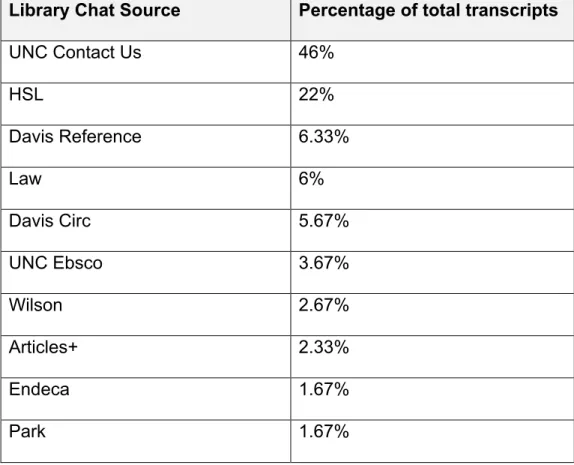
The table below shows the percentage of individual library transcripts in
the random sample of 300:
Table 1: Percentage of Total Transcripts Per Library
Library Chat Source Percentage of total transcripts
UNC Contact Us 46%
HSL 22%
Davis Reference 6.33%
Law 6%
Davis Circ 5.67%
UNC Ebsco 3.67%
Wilson 2.67%
Articles+ 2.33%
Endeca 1.67%
UNC NCC 1%
UL Service .67%
The UNC Contact Us chat service received the highest number of chat
transcripts in the sample. I’m unsure whether or not if that’s solely based on the
sample. However, since this sample was collected randomly, each library
transcript had an equal chance of being selected. UNC Contact Us was the most
frequently used chat system, followed by the HSL as the second most used.
Although these numbers do not directly represent the number of patrons that use
each library, one library might have extreme chat usage. Furthermore, these
percentages provide a small snapshot of the ways in which library patrons use
chat.
To conduct the coding, I used the following process:
• I downloaded the randomly selected transcripts. • Afterwards, I converted the text file to a Word file.
• Then, I identified the patron’s inquiry and coded it into one of six categories. • Each inquiry only received one code, even in cases of double barreling. For
example, in this inquiry, a patron asked two questions:
Hello, a PI that I work with frequently mentioned that I may be able to access SPSS through the library or ODUM remotely. Is this true? If so how do I do so?
In this inquiry, the user asks two questions. Consequently, I divided the question
often. I believed only one code for each inquiry would eliminate possible
redundancies. I’d argue most inquiries indirectly relate to library policy. However,
my goal was to attempt to identify the true nature of the inquiry. Furthermore, I
believe this was the best strategy to analyze the transcripts.
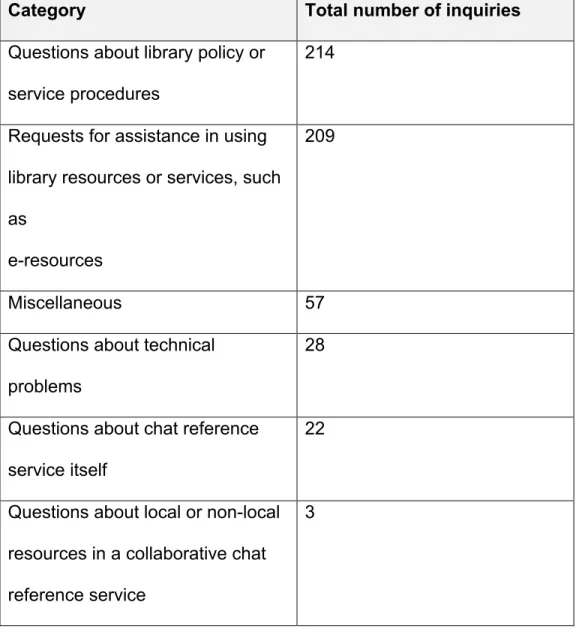
After conducting the coding for the transcripts, I received the following results:
Table 2: Transcript Results
Category Total number of inquiries
Questions about library policy or
service procedures
214
Requests for assistance in using
library resources or services, such
as
e-resources
209
Miscellaneous 57
Questions about technical
problems
28
Questions about chat reference
service itself
22
Questions about local or non-local
resources in a collaborative chat
reference service
3
The number of inquiries for Categories 1 and 2 was significantly higher than the
rest of the categories. Also, the closeness in the number of category 1 and 2
inquiries suggests that these topics are equally important to patrons. These
results provide next steps for the UNC libraries to improve their patron
experience.
Implications for Results
Based on these results, I outlined three different next steps that the UNC
university libraries can take to improve their services: clarifying policy, allocation
of resources, and website organization. The UNC university libraries must
conduct further studies to identify the next steps in the improvement process.
The majority of patron inquiries in chat reference were questions about
library policy. This presents a few questions about the patrons’ information
needs. How do patrons learn about the University libraries’ current policy?
Although a full answer to this question would require some sort of survey or other
research, my initial hypothesis is that patrons learn information about library
policy via the website or library tours. However, the information provided on tours
and on the website is likely a general overview. The UNC libraries will receive
questions if the patrons’ information need exists outside of the general scope.
The UNC University Libraries’ User Experience department should conduct a
usability study to confirm this hypothesis. In addition, what strategies do the
University Libraries employ to communicate its policy? The UNC University
Libraries maintains social media accounts to communicate with students and the
the most effective medium of communication. In addition, the UNC libraries
should consider how to clarify the wording in its policy documentation to use plain
language. Plain language increases usability by making reading more accessible
for all audiences. Furthermore, this study’s results show that the university
libraries should conduct further analysis on their strategies involving
communicating library policy.
Also, the UNC university libraries should use the results from this study to
justify allocating more resources to help and tutorial videos. The second highest
category in the chat reference transcripts was the request for assistance. When
analyzing the chat transcripts, I saw that many of the transcripts in this category
requested that librarians help patrons download a PDF from a database. This is a
common problem for patrons. This exemplifies how the university libraries could
address this problem by creating help topics. If patrons could consult help topics
for these common problems, then the amount of chat reference sessions might
decrease. Therefore, if the UNC university libraries allocate more funds and
resources to self-guided help documentation, then this could help address this
problem. I acknowledge that the UNC University Libraries have budget
restrictions. Overall, the UNC University Libraries could increase usability by
adding modules and documentation that make the UNC Libraries website more
intuitive for new and end users.
The last implication from the results of this study is the website
organization issues. In some chat reference sessions, patrons asked questions
patrons asked questions about finding library hours. The UNC Libraries
dedicated a section on their website towards library hours. The patron most likely
bypassed the Hours section to access the chat reference section. The patron
could have easily overlooked this information. However, the frequency of this
situation presents the following question: do users have trouble finding
information because of the website organization? The UNC Libraries should
conduct a task analysis on the website organization to determine if more users
experience difficulty when trying to find information. Furthermore, the UNC
Libraries should reevaluate website organization to increase usability.
The UNC Libraries’ staff acknowledges that the user interface of the chat
service is severely outdated. However, the results indicate that the interface does
not bother patrons as much as expected. In the results, questions about technical
problems was the fourth highest category. On the contrary, perhaps a survey or a
usability test is a more direct way to measure user feedback about the interface.
This is another test that the UNC University Libraries UX Department could
Conclusion
The results from this study show that chat reference sessions in the UNC
university libraries tend to follow this pattern: most of the inquiries ask for
clarification about library policy or request assistance in using the libraries
products and services. Thus, the UNC University Libraries should focus their
initiatives to find new ways to communicate this information. Also, to increase the
usability for the chat reference system, the UNC Libraries should evaluate its
web presence. Furthermore, this study served as an exploratory research study
References
1. (2004, October 11). An Introduction to Content Analysis. Retrieved November 6,
2019, from Writing@CSU: Writing Guide website:
https://www.umsl.edu/~wilmarthp/mrpc-web-resources/content-analysis.pdf
2. (2014). Statistical & Qualitative Data Analysis Software: About NVivo. Retrieved
2019, from University Libraries website:
https://libguides.library.kent.edu/statconsulting/NVivo
3. (2016, January 4). User Experience and Assessment at UNC’s University
Libraries. Retrieved September 23, 2019, from LibUX website:
http://libux.web.unc.edu/
4. (2019). Help and Support Center. Retrieved September 23, 2019, from UPS
website: https://www.ups.com/us/en/help-support-center.page?
5. (2019). User Research Methods. Retrieved September 23, 2019, from
Usability.gov website:
https://www.usability.gov/how-to-and-tools/methods/user-research/index.html
6. Bishop, B., & Torrence, M. (2007). Virtual Reference Services. College &
Undergraduate Libraries, 13(4), 117–127.
7. Budiu, R. (2018, November 25). The User Experience of Chatbots. Retrieved
September 23, 2019, from Nielsen Norman Group website:
8. Arnold, J., & Kaske, N. (2005). Evaluating the Quality of a Chat Service. Libraries
and the Academy, 5(2), 177–193.
9. Arvin, S. D., & Kaiser, A. (2012). Case Study of Synchronous Virtual Reference
in an Academic Library . Internet Reference Services Quarterly, 17, 83–93.
10. Bobrowsky, T., Beck, L., & Grant, M. (2005). The Chat Reference Interview:
Practicalities and Advice. The Reference Librarian, 43(89–90), 179–191.
11. Charette, R. (2005, September 2). Why Software Fails. Retrieved September 23,
2019, from IEEE Spectrum website:
https://spectrum.ieee.org/computing/software/why-software-fails
12. Chow, A. S., & Croxton, R. A. (2014). A Usability Evaluation of Academic Virtual
Reference Services. College & Research Libraries, 309–361.
13. Christopherson, L. (2010). Can u help me plz?? Cyberlanguage Accommodation
in Virtual Reference Conversations . School of Information and Library Science,
1–9.
14. Cummings, J., Cummings, L., & Frederiksen, L. (2007). User Preferences in
Reference Services: Virtual Reference and Academic Libraries. Libraries and the
Academy, 7(1), 81–96.
15. Dee, C. (2003). Chat Reference Services in Medical Libraries. Medical
Reference Services Quarterly, 22(2), 15–28.
16. Dee, C., & Allen, M. (2006). A Survey of the Usability of Digital Reference
Services on Academic Health Science Library Web Sites. The Journal of
17. Fagan, J. C., & Desai, C. M. (2002). Communication Strategies for Instant
Messaging and Chat Reference Services. The Reference Librarian , 38(79–80),
121–155.
18. Finnell, J., & Fontane, W. (2010). Reference Question Data Mining . Reference
and User Services Quarterly, 49(3), 278–286.
19. Foley, M. (2002). Instant Message Referencing in an Academic Library. College
& Research Libraries, 36–45.
20. Francoeur, S. (2001). An Analytical Survey of Chat Reference Services.
Reference Services Review, 29(3), 189–203.
21. Greenberg, R., & Bar-Ilan, J. (2015). “Ask a librarian”: Comparing virtual
reference services in an Israeli academic library. Library & Information Science
Research, 37, 139–146.
22. Haefele, C. (September 2019). Personal Interview.
23. Hill, J. B., Madarash-Hill, C., & Allred, A. (2007). Outsourcing Digital Reference:
The User Perspective. The Reference Librarian, 47(2), 57–74.
24. Houlson, V., McCready, K., & Steinberg Pfahl, C. (2006). A Window into Our
Patron’s Needs: Analyzing Data from Chat Transcripts. Internet Reference
Services Quarterly, 11(4), 19--39.
25. Hsieh, H.-F., & Shannon, S. (2005). Three Approaches to Qualitative Content
Analysis . Qualitative Health Research , 15(9), 1277–1288.
27. Lankes, R. D., Gross, M., & McClure, C. (2003). Cost, Statistics, Measures, and
Standards for Digital Reference Services: A Preliminary View. Library Trends,
51(3), 401–413.
28. Luo, L. (2008). Chat reference evaluation: a framework of perspectives and
measures. Reference Services Review, 36(1), 71–85.
29. Marsteller, M., & Mizzy, D. (2003). Exploring the Synchronous Digital Reference
Interaction for Query Types, Question Negotiation, and Patron Response.
Internet Reference Services Quarterly, 8(1), 149–165.
30. Matteson, M., Salamon, J., & Brewster, L. (2011). A Systematic Review of
Research on Live Chat Service. Reference & User Services Quarterly, 51(2), 82–
100.
31. Mavodza, J. (2019). Interpreting Library Chat Reference Service Transactions.
The Reference Librarian, 60(2), 122–133.
32. Mon, L., Abels, E., Agosto, D., Japzon, A., Most, L., Masnik, M., & Hamann, J.
(2008). Remote Reference in U.S. Public Library Practice and LIS Education.
Journal of Education for Library and Information Science, 49(3), 180–194.
33. Morais, Y., & Sampson, S. (2010). A Content Analysis of Chat Transcripts in the
Georgetown Law Library. Legal Reference Services Quarterly, 29(3), 165–178.
34. Mu, X., Dimitroff, A., Jordan, J., & Burclaff, N. (2011). A Survey and Empirical
Study of Virtual Reference Service in Academic Libraries. The Journal of
35. Nielsen, J. (2012, January 3). Usability 101: Introduction to Usability. Retrieved
November 6, 2019, from Nielsen Norman Group website:
https://www.nngroup.com/articles/usability-101-introduction-to-usability/
36. Picchi, A. (2016, January 18). The robot revolution will take 5 million jobs from
humans. Retrieved September 22, 2019, from CBS News website:
https://www.cbsnews.com/news/the-robot-revolution-will-take-5-million-jobs-from-humans/
37. Pomerantz, J., Luo, L., & McClure, C. (2006). Peer review of chat reference
transcripts: Approaches and strategies. Library and Information Science
Research, 28, 24–48.
38. Straw, J. (2000). A virtual understanding: The reference interview and question
negotiation in a digital age. Reference & User Services Quarterly, 39(4), 376–
379.
39. Ward, D., & Kern, M. K. (2006). Combining IM and Vendorbased Chat: A Report
from the Frontlines of an Integrated Service. Libraries and the Academy, 6(4),
417–429.
40. Ward, J., & Barbier, P. (2009). Best Practices in Chat Reference Used by
Florida’s Ask a Librarian Virtual Reference Librarians. The Reference Librarian,
51(1), 53–68.
41. Weber, R. (1990). Basic Content Analysis. Thousand Oaks, California: SAGE.
42. Xue-Ming, B. (2003). A study of Web-based interactive reference service via
academic library home pages. Reference & User Services Quarterly , 42(3),
43. Yang, S. Q., & Dalal, H. A. (2015). Delivering Virtual Reference Services on the
Web: An Investigation into the Current Practice by Academic Libraries. The