DETERMINING THE RIGHT MIX OF LIVE, VIRTUAL, AND
CONSTRUCTIVE TRAINING
Geoffrey A. Frank and Robert F. Helms II Research Triangle Institute
Research Triangle Park, North Carolina David Voor
Naval Air Warfare Center Training Systems Division Orlando, Florida
Abstract
The use of a mixture of live, virtual, and constructive training has become accepted practice for training within the Department of Defense. We call training environments that use a
combination of these techniques an Advanced Learning Environment (ALE). A key issue is getting the right mix of live, virtual, and constructive training in order to achieve cost-effective training. We present a technology-based methodology for task analysis that assists in making the tradeoffs necessary for designing a cost-effective ALE. This technology-based methodology represents an update of traditional Instructional System Design methods that have been used for training analyses. The method divides the training of each task into four steps: Familiarization, Acquiring the skills, Practicing the skills, and Validating the skills. We use the acronym FAPV to refer to these four steps. We have implemented the FAPV analysis with a tool that starts with a database of tasks and training times. The tool allows dynamic tradeoffs across a variety of variables, including student loads, choice of training devices, available facilities,
student/instructor ratios, and training device reliability. This paper describes the FAPV analysis and process, and illustrates the results with three examples developed for the US Army.
The effectiveness and cost associated with training in live, virtual, and constructive environments can vary significantly. FAPV analysis helps the training developer estimate the impact on
training effectiveness and associated costs of the choice of live, virtual, and constructive training. The dynamic variables allows the training developer to make rapid tradeoffs between multiple training environment configurations to select training devices and determine the number of training devices that are required to meet student throughput goals.
Biographical Sketches:
Geoffrey A. Frank is a Principal Scientist at the Research Triangle Institute (RTI). He has a PhD from the University of North Carolina at Chapel Hill. He was project engineer for the University of Mounted Warfare Design, the Apache Longbow Maintenance Trainer Design, and the Bradley Maintenance Trainer Study. He led efforts to design and install ALEs at Ft. Leavenworth, KS and Ft. Sill, OK.
Robert F. Helms II is Program Manager for RTI's technology assisted lifelong learning program. He received his Ph.D. from Kansas University, and has 26 years of active Army service, including an assignment as an instructor at the Command and General Staff College. Dr. Helms led an Army experiment to examine the efficiencies and effectiveness of virtual, live, and constructive training environments. He was also project leader for the University of Mounted Warfare design, and for the Apache Longbow maintenance training study.
David J. Voor is a Project Engineer at the Naval Air Warfare Center Training Systems Division (NAWC TSD). He has a BSEE from the University of Central Florida. He is the Project
Engineer for various Maintenance Training Systems to include M270A1, M1A1, M1A2 SEP and M2A3/M3A3. He is the Project Engineer for the M1A2 SEP Advanced Gunnery Training System. He was the Project Engineer for the M1A1 and M2A2/M3A2 Platoon Gunnery Trainer.
DETERMINING THE RIGHT MIX OF LIVE, VIRTUAL, AND
CONSTRUCTIVE TRAINING
Geoffrey A. Frank and Robert F. Helms II Research Triangle Institute
Research Triangle Park, North Carolina David Voor
Naval Air Warfare Center Training Systems Division Orlando, Florida
INTRODUCTION
A four step learning model (Helms 99) for skills has been derived from the US Army model (TRADOC 95) for analyzing training and determining the required training resources. This model is used to determine the right mix of live, virtual, and constructive training methods.
The Army model (TRADOC 95) defines how training time is allocated between
conference/classroom, demonstration, practical exercises, watching videos, CAI, performance exams, and written exams. Conference and written exam time is typically time spent in classrooms. Demonstration, hardware practical exercise, and hardware performance exam time is typically time spent on the training devices, simulations or role-playing, or on the job training.
The Army model has been adapted to help refine the definition of computer-based courseware, particularly for courses which feature learning by doing and apply virtual reality technology to provide effective training at low cost.
THE NEED FOR THE RIGHT MIX OF LIVE, VIRTUAL, AND CONSTRUCTIVE SIMULATION
Live training has always been the method of choice for training soldiers. As the lethality, expense, and complexity of modern weapon systems has increased and training budgets
have tightened, live training is no longer sufficient as the sole training method (ATSC 99). Cost effective training requires a mix of live, virtual, and constructive simulations to meet the student throughput. This throughput is increasing as the Army competes for the same digital and electrical/mechanical skills that are in high demand in the civilian economy.
The shrinking size and increasing variety of missions facing the Army has increased the turbulence of personnel. This means that cost-effective team training, particularly at the command and control level, is a serious problem (ATSC 99). Constructive simulations including JANUS (for company and battalion level ground combat), Brigade Battle
Simulation (BBS), and Corps Battle
Simulation (CBS) have been used as aids for tactical training. More recently, the Close Combat Tactical Trainer (CCTT) provides virtua l simulations for tactical training, but uses different entity behavior models and scenario databases. Emerging constructive simulations such as the Semi- Automated Forces (SAF) Suite provide common behavioral simulations and use the same terrain and scena rio databases as CCTT, but do not require the virtual training mockups and facilities.
For maintenance training, panel trainers and expensive, high fidelity mockups provide alternatives to training on live equipment. We
characterize these training devices as constructive simulations for maintenance training. They offer an advantage over live equipment for maintenance training in that they are designed to support fault injection so that the student can learn diagnostic and troubleshooting skills. These skills are becoming more important as the emphasis increases for organizational maintenance on fault diagnosis, fault isolation, and
remove/replace as opposed to adjustment and repair of faulty components.
A low-cost alternative to live and constructive maintenance training is to use Virtual Reality (VR) implemented on low-cost Commercial Off-The-Shelf (COTS) personal computers. As the graphics capabilities of COTS personal computers has increased, it has become possible to host high-quality virtual environments on these machines without requiring special purpose graphics hardware. This results in training devices that can be upgraded to new COTS computers through a simple port, rather than dealing with the expensive life cycle costs of obsolete training specific hardware. Furthermore, the
acquisition costs of the personal computers are often 1,000 times cheaper than the cost of hardware mockups. Thus, each student can train on his or her own VR desktop trainer at a fraction of the cost of providing each student with a mockup. Finally, effective courseware allows much higher student-to-instructor ratios than are possible with either live equipment or constructive mockups.
THE FAPV MODEL FOR ANALYSIS OF LEARNING BY DOING
Military and other educational experience has shown (Fletcher 98) that training with a personal tutor is one of the most effective ways to learn, and that the level of
interactivity is a key measure of training, both in terms of cost and effectiveness. The FAPV model describes the level of interactivity in
terms of interaction with a tutor. The tutor may be a human instructor, computer software, or a combination. One of the cost-benefit analyses supported by the FAPV model is a determination of the most
appropriate form of tutor for each of the steps for learning a task.
The FAPV method considers the training methods appropriate for four steps in the learning process for each task to be learned. The four steps are:
• Familiarize: Acquire knowledge about equipment, its capabilities, and its location by absorbing a presentation or taking a guided tour. This is a relatively passive process for the student.
• Acquire Skill: Learn techniques and procedures by being tutored. The tutor guides the student through each step of the process, prompting the student to perform the action required for each step. If a student makes a mistake, the tutor provides immediate feedback.
• Practice Skill: Internalize techniques and procedures by doing the skill with access to help from a tutor. The student perfo rms the actions of the procedure without prompting from the tutor. At any point, the student may ask the tutor for help. If the student makes a mistake, the tutor provides feedback shortly after the incorrect action. The delay before feedback varies from application to application. For example, dangerous or expensive mistakes usually produce immediate feedback, while incorrect but harmless actions may not provide an immediate response.
• Validate Skill: Test the ability to perform the skill without help from a tutor. The student is on his/her own until either the task is successfully completed, or it is determined that the student cannot complete the task successfully. For
example, if the student performs a dangerous or expensive mistake, then the test may be aborted immediately. When the performance test has ended, either with success or failure, the tutor provides an After-Action Review (AAR), interacting with the student to determine what went right, what went wrong, and how to improve the performance. If the task was not performed to standard, the AAR includes a prescription for remedial training.
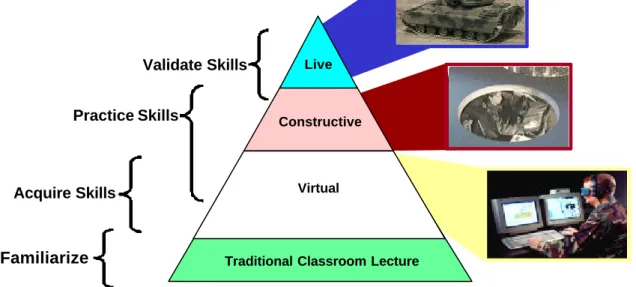
Our approach to achieving cost-effective maintenance training is to offload training in expensive live equipment and constructive mockups onto low-cost VR desktop trainers, as illustrated by the Training Triangle (Figure 1). Similarly, for tactical training, we offload expensive live and virtual training onto low-cost constructive simulations, but provide a compatible training environment so that scenarios, models, and datalogs can be shared during training. Particularly for tactical training, it is important to emphasize that virtual and constructive training cannot take the place of live training, but must be used to prepare soldiers for the essential experience of live training.
The training triangle shows the progression through the four FAPV steps in the vertical direction, and indicates the desired amount of training time as the horizontal direction. At the base of the triangle are low-cost training methods, which include lectures, computer-based training, and levels I, II, and III
Interactive Multimedia Instruction (IMI). As you move up the triangle, you apply more expensive training technologies judiciously to train soldiers who have passed through
training gates associated with the lower-cost technologies. Moving up the triangle
represents the student progressing through the four FAPV steps from familiarization to the final validation of the student’s skills.
Experience, as confirmed by experiments with experienced and inexperienced National Guard soldiers (Helms 97), has shown that specific technologies are cost effective for each of these four steps. FAPV analysis not only provides a way of making tradeoffs in training technologies, but also provides ways of aggregating the results to ensure that the proper training balance between
familiarization, skill acquisition, skill practice, and skill validation is maintained.
THE FAPV TRAINING TOOL FAPV analysis is performed with a tool that starts with a database of tasks and training times. The tool allows dynamic tradeoffs across a variety of variables, including student loads, choice of training devices, available facilities, student/instructor ratios, and training device reliability.
The FAPV training analysis process links student throughput requirements and critical task lists to specific Training Aids, Devices, Simulators, and Simulations (TADSS) loading.
The FAPV tool incorporates the FAPV concepts, and supports the training developer through the decision process. The tool loads training task databases and student throughput requirements, uses guidelines to do an initial FAPV analysis, lets the user make exceptions to the guidelines, and supports a series of tradeoffs on training methods and training environments. The tool allows the training developer to create training schedules to estimate peak loads on training devices and instructors.
The FAPV tool is implemented as a Microsoft Excel™ spreadsheet, which allows multiple input formats and output graphics.
Interactions with instructors and other Subject Matter Experts has resulted in a set of
guidelines for allocating tasks to various
environments. These guidelines are
implemented as a set of spreadsheet equations that allocate the time required for training a task to the available training environments.
FAPV Tool Inputs
The FAPV tool provides linkages and an audit trail to key inputs, such as Logistics Support Analysis (LSA) data for task definitions and times, or Army Training Requirements and Resources System data, and fielding data for projected student loads.
A key input is the task list and the associated training times. In some cases, this task list is extracted from an existing Program of
Instruction (POI) and modified to meet current needs. In other maintenance training
situations, the task list is derived from LSA data. An Integrated Product Team including TRAining and DOCtrine command
(TRADOC) school training developers, instructors, training device developers, and tactical vehicle manufacturers reviews the LSA data to determine if these tasks are covered by prerequisite courses, should be trained in the units, or should be trained in the course.
The number of training devices required is not determined by average loads, but by peak loads. In order to determine peak loads, class schedules are input. A key load balancing technique is scheduling multiple class sessions
Validate Skills
Practice Skills
Acquire Skills
Constructive Live
Familiarize Traditional Classroom Lecture Virtual
that run concurrently but start at different times. Another load balancing technique is to divide a class into groups and have the groups use different training devices in a round-robin fashion. This is particularly effective when the training environment includes multiple part-task trainers.
FAPV Tool Outputs
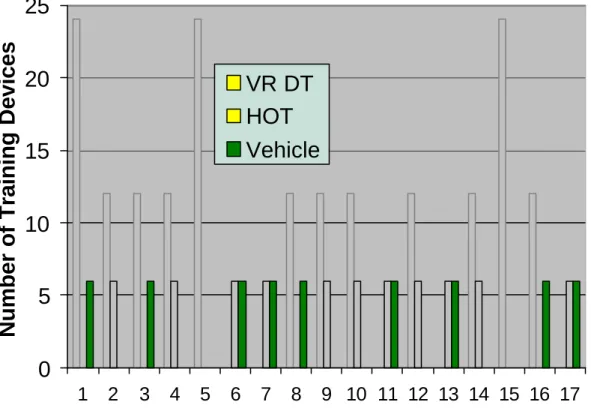
The tool computes multiple training measures, including average training device utilization, peak training device utilization (based on schedule), classroom and lab space requirements, and both peak and average instructor loads. The tool can handle multiple courses, which are sharing resources such as labs, classrooms, and training devices. Figure 2 shows an output of the FAPV tool: the utilization of VR desktop trainers (VR DTs), Hands-On Trainers (HOTs), and live vehicles over a 17 day course with two sessions of 12 students each running
concurrently. The one-week offset in start times of the sessions smoothes the load. As indicated by the figure, the peak load for the VR desktop trainers is 24 machines (one per student), since both sessions are using the VR desktop trainers at the same time. However, the average utilization of the desktop trainers is 44%. This system uses 6 HOTs and 6 vehicles, with 2 students per HOT or vehicle. It achieves 65% utilization of the HOTs, and 52% utilization of the vehicles.
The FAPV tool provides specific timing goals for familiarization with equipment and
situations that are used to perform a task, and with acquiring, practicing, and validating the skills needed for a task. In particular, an output of the FAPV tool is a task-to-TADSS mapping, which indicates how much student contact time is required for each of the FAPV steps associated with training each task.
Figure 1. Training device utilization for a 17 day class
0
5
10
15
20
25
1 2 3 4 5 6 7 8 9 10 11 12 13 14 15 16 17Number of Training Devices
VR DT
HOT
Vehicle
The FAPV tool also computes instructor contact ho urs that take into account the student/instructor ratio for specific training devices. For example, an instructor may be able to instruct a class of 12 students when they are using VR desktop trainers, but an instructor is required for each HOT and vehicle, so that the student/instructor ratio for the HOTs and vehicles is 2 instead of 12.
USING FAPV AS PART OF TRAINING DEVELOPMENT
The FAPV tool and method are designed to facilitate Integrated Product Team efforts to determine cost effective training solutions. A typical IPT for maintenance training includes representatives from several organizations:
• The vehicle program manager, who is responsible for providing the necessary training devices, and wants the most "bang for his buck";
• Combined Arms Services Command (CASCOM), who is responsible for
defining and approving the critical task list and the POI, and wants to ensure fair and consistent use of training resources;
• The TRADOC school instructors, who are responsible for training the soldiers, and who want the most effective training support possible;
• Vehicle manufacturer representatives, who are most knowledgeable about the vehicle to be trained;
• TRADOC System Manager (TSM), who is responsible for ensuring an effective training environment is developed.
• Training device manufacturers, who want to make sure that the training devices can be developed for the available budget. The process for interacting with IPTs is
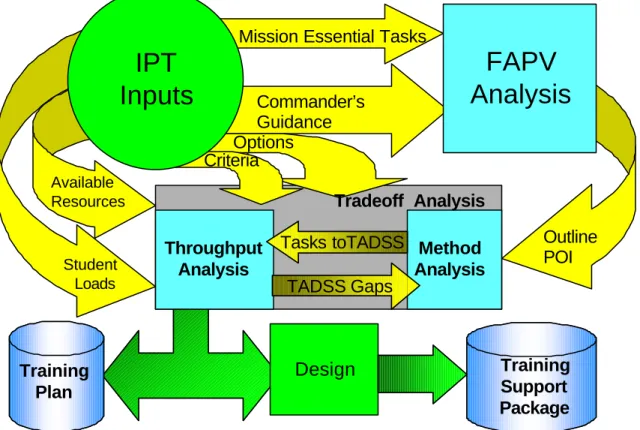
illustrated in Figure 3. This process allows the IPT to map the task lists for training into Advanced Learning Environments (ALEs) that use a combination of training devices and live, virtual, and constructive simulations. The FAPV model provides the IPT with methods and data for determining which training environments are appropriate for different types of training modes. This is typically done through a series of tradeoffs between different ALE configuration options. This process starts with the Mission Essential Task
Design
Mission Essential Tasks
Student Loads Outline POI Commander’s Guidance
FAPV
Analysis
Training Support Package Available Resources Training Plan OptionsIPT
Inputs
Throughput Analysis Method Analysis Tradeoff Analysis Criteria Tasks toTADSS TADSS GapsList and the commander's guidance. The guidance is often to define options to be considered during the tradeoffs, criteria used to evaluate the options, and guidelines for using particular training methods. For example, the guidance may be that all validation will be done in the live training environment, or that students must pass a gate using the Virtual Reality (VR) desktop
trainers before being allowed to use the HOTs or live vehicles. In the later case, the VR desktop trainers are used to ensure that safety practices are thoroughly understood by students before they move into the more potentially dangerous training situations. For example, a guideline might suggest that familiarization should be done using a combination of self-development and small group instruction. Similarly, acquiring skills should be facilitated through some
combination of group instruction,
demonstration, and practical exercise. These guidelines can be used by management to set the bounds for initial exploration of training options, based on available Training Support Infrastructure.
The role of the ins tructors in defining guidelines for the use of different training environments is critical. The training devices will be successful only if the instructors are comfortable with the devices and their roles in the training process. Once they are
comfortable with the way the devices are to be used, then the focus can shift to determining the lowest cost option, balancing development costs and life cycle costs. It is these tradeoffs where the FAPV tool outputs are most useful. The FAPV process generates a Program of Instruction (POI) outline and a mapping of the FAPV steps for each task to be trained to the lessons of the POI outline. The POI outline organizes the training into modules and the lessons within those modules, and provides a learning objective for each lesson. It also specifies the training environments used for
each lesson (more than one environment may be used for a single lesson). Finally, the POI outline allocates times to the lessons and to the training environments for each lesson. The POI outline is implemented as a
spreadsheet, and acts as a key database for the tradeoff analysis.
Tradeoffs are conducted for multiple options that are specified by the IPT. Examples of options that might be considered include:
• Option 1: Traditional training using tactical vehicles only. This option does not use any Virtual Reality (VR) or computer-based Interactive Multimedia Instruction (IMI) materials, nor does it require development of training specific devices. It does require that the school be provided with a sufficient
number of precious tactical vehicles to support training, and that the school will be funded for the life cycle support for tactical vehicles. This is often an expensive option for maintenance training, since damage to expensive
components is highly probable during training.
• Option 2: Training with Hands -On Trainers and tactical vehicles. This option does not use any VR or computer-based Interactive
Multimedia Instruction (IMI) materials. This is a typical training configuration in use at Army maintenance schools. The cost of providing and maintaining enough training devices are the critical issues for this option.
• Option 3: Training with a combination of live vehicles, HOTs, and VR andcomputer-based IMI. If training can be shifted from the live vehicles and the HOTs to low cost of COTS personal computers, this significantly reduces the recurring engineering costs and the life cycle support costs.
These analyses result in a matrix, with these options as columns and various criteria as rows, that can be used as a type of Course of Action Analysis tool by the IPT to select the most appropriate option for development and delivery.
The throughput analysis creates spreadsheets mapping each task to methods, facilities, and training devices. A separate sheet is
requirements for meeting the projected student load, with consideration for both total
throughput and peak loading. The throughput analysis uses these spreadsheets to combine information about projected student loads by year for each POI with the detailed lesson timings and the mappings of tasks to training environments.
The results of the design task are a set of documents that can be used by the IPT for the management of informed decisions for
creating a System Requirements Document (SRD) and a Work Statement (WS). This material is general enough to allow for innovative solutions to the broad training program but includes specifies for constraints in terms of tasks to be taught, student
throughput, and budget.
Examples of Tradeoffs
Tactics Training System Design
The FAPV methods arose out of IPT
discussions on collective tactics training for digital Tactical Operations Centers (TOCs). The issues focused on reducing the acquisition and life-cycle costs of Army Tactical
Command and Control Systems (ATCCS). Officers in the TOCs must serve as
information integrators and decision- makers. They are supported by operators. The entire TOC staff must operate as a team, integrating information across multiple ATCCS and making decisions based on information extracted from these systems. The school used a small group instruction model that they found effective, but required that up to 14 groups would be in session at the same time. Actual ATCCS were precious devices, and the school was not funded to provide the
maintenance personnel and system
administrators to support the ATCCS. FAPV analysis by the IPT determined that two of the ATCCS were critical for the students in the class, and that familiarization with the other ATCCS was sufficient. Use of IMI and
emulators to provide the familiarization training reduced the number of ATCCS required for each classroom from 7 to 2. Additional analysis focused on finding ways to provide low-overhead constructive
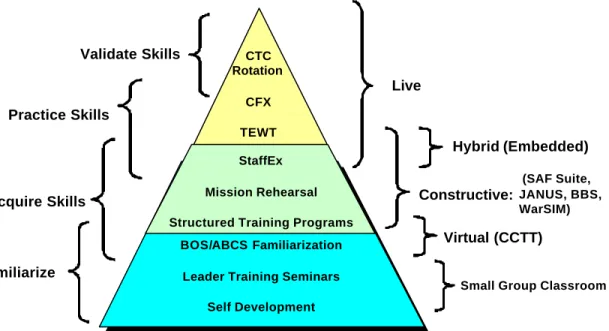
simulations available in the classroom. Figure 4 shows the options available for training. The current training strategy emphasized rotating the students through a high overhead constructive simulation before moving to a virtual simulation. IPT
discussions evolved a solution that uses a mix of constructive and virtual simulations off of a common scenario library and terrain database.
Helicopter Maintenance Trainer Design
Work on the design of a maintenance training system for helicopters shows the benefits of using VR desktop trainers to offload training on expensive hands-on trainers. The planned maintenance training system included the use of two types of hands-on training devices. The first device was a mechanical trainer that did not include any electronics, but supported the training of remove and replace tasks. The second device was a fully instrumented system that allowed an instructor to inject faults and to monitor student progress. The school was already running a two-shift operation in order to meet student throughput requirements. Investment in the planned hands-on trainers would not have provided enough student throughput even with a three-shift operation. Switching to a three-three-shift operation would have imposed significant logistical problems for the school, as well as problems finding the instructors to work the third shift. Purchasing the additional hands-on trainers needed to meet student throughput requirements was too expensive, and required additional facilities that were not available to the school.
The IPT developed a plan that used a combination of VR desktop trainers, funded hands-on trainers, and additional part-task trainers to meet student throughput
requirements with a two-shift operation. The IPT first looked at an option that combined hands-on trainers and VR desktop trainers. However, this option did not meet the student throughput requirements. Instead, the IPT came up with a collection of low-cost part-task trainers that recycled existing airframes and eliminated key bottlenecks in the training, particularly in the area of environmental controls.
Tracked Vehicle Maintenance Trainers
TRADOC schools want to replace obsolete panel trainers, which no longer represent current versions of vehicles and cannot be maintained due to obsolete parts. The goal is to provide cost-effective training for new versions of vehicles by using a combination of VR desktop trainers, hands-on trainers, and
live tactical vehicles. The option that used the combination of all three types of training
mechanisms reduced the number of hands-on trainers required by one half, making the upgrade project financially viable.
As described above, LSA data was reduced to define an initial set of tasks to be trained. However, when these tasks were compared with the New Equipment Training (NET) training learning objectives, several learning objectives did not have immediately
associated critical tasks. The FAPV analysis was used to link these learning objectives to their associated tasks. For example,
familiarization with the 1553 bus concept of operations was an essential learning objective that was not associated with any particular diagnosis or repair task, but was part of the familiarization process required for several of the diagnostic tasks.
Live, Virtual, and Constructive Training Experiment.
A study was conducted (Helms 97) of the comparative effectiveness of live, virtual, and
constructive training, and of the sequencing of training in these environments. The
Live Practice Skills
Acquire Skills
FAPV
BOS/ABCS Familiarization Leader Training Seminars
Self Development
Validate Skills
Virtual (CCTT) Familiarize
Small Group Classroom
Training Method Training Environment CTC Rotation CFX TEWT StaffEx Mission Rehearsal Structured Training Programs
Constructive:
Hybrid (Embedded)
(SAF Suite, JANUS, BBS, WarSIM)
Figure 1. Using the Familiarize, Acquire, Practice, Validate model to analyze tactical training.
participants in this study were both
experienced mechanics and inexperienced soldiers just finishing basic training. In the experimental design, soldiers either did or did not encounter a virtual environment before training in the constructive and live (i.e., operational vehicle) environments. In this study, significant reductions in the time required for performing diagnostic tasks in operational vehicles were found if the student prepared for the operational vehicle training in an VR based IMI environment. Soldiers reported spending twice as much time
performing tasks in the operational vehicle if that exercise was preceded only by classroom training, as opposed to VR training. Soldiers moved into the tank and knew how to navigate its environs, learning primarily in the live environment how confined and heavy the tank is. This preparedness led to shorter time needed for demonstrating the ability to set up the test equipment, increasing throughput in this bottleneck where there are few tanks and many soldiers to test.
CONCLUSIONS
The FAPV model provides management with
• practical assistance in determining the right mix of training methods and training environments for each task to be trained;
• recommendations for the progression of training and the "gates" for transition between learning environments; and
• a framework for making informed decisions for tradeoffs between different training methods and environments. Informed tradeoff decisions can reduce training time and costs by preparing the student to efficiently use the most expensive training methods and
environments. Tradeoffs can make the most effective use of instructors. The FAPV tool incorporates the FAPV management’s concepts for guiding the training developer through the decision
process. The tool loads training task databases and student throughput
requirements, uses guidelines to do an initial FAPV analysis, lets the user make exceptions to the guidelines, and leads the user through a series of tradeoffs on training methods and training environments. The tool allows the training developer to create training schedules to estimate peak loads on training devices and instructors. The tool computes multiple training measures, including average training device utilization, peak training device
utilization (based on schedule), classroom and lab space requirements, and both peak and average instructor loads. The tool can handle multiple courses that are sharing resources such as labs, classrooms, and training devices. The FAPV model and method is consistent with, and refines, the Instructional Systems Design approach as defined in TRADOC Regulation 350-70 (TRADOC 95) and MIL-HDBK 1379 (DoD 97). The allocation of training to hardware trainers and IMI levels in the FAPV model is consistent with the
guidelines contained in MIL-HDBK 1379-3, which maps task action verbs to knowledge, skills and attitudes (KSA) being trained and defines the level of IMI interactivity required for training these skills. By defining four steps in training a single task, FAPV provides a method for analyzing the use of multiple training methods for learning a single task.
ACKNOWLEDGEMENTS
We appreciate the support and the shared vision of COL Richard Geier and Mr. James Lowe with the US Army Armor School. We also appreciate the support of STRICOM representatives MAJ William Spengler and LTC Francis Fierko.
REFERENCES
Department of Defense, (1997). Part 3: Development of Interactive Multimedia Instruction MIL HDBK 1379: Guide for
Acquisition of Training Data Products and Services.
Fletcher, J. D. (1998). Technology-Assisted Instruction: Tantalus Revisited. DoDEA/CRESST.
Helms, R.F., Hubal R.,Triplett, S. (1997). Evaluation of the Conduct of Individual Maintenance Training in Live, Virtual, and Constructive (LVC) Training Environments and their Effectiveness in a Single Program of Instruction. (Technical Report, Research Triangle Institute).
Helms, R.F., Frank, G. A., Field, S. S. (1999). Apache Longbow Maintenance Training Study, (Technical Report, Research Triangle Institute).
The US Army Training and Doctrine Command, (1995). Part VI: Individual Training Development, Regulation 350-70, Training Development Management, Processes, and Products.
The US Army Training Support Center, (1999). Proceedings of the Second Training Effectiveness Symposium, Hampton, VA.