December 2010
4
Quarterly Report
Overtime does not pay
2
Overtime does not Pay – Quarterly Wage Indicator report – December 2010 – WageIndicator.orgOvertime does not pay
3
Overtime does not Pay – Quarterly Wage Indicator report – December 2010 – WageIndicator.orgAbout Wage Indicator
The independent non-profit Wage Indicator Foundation aims for transparency of the labour market by sharing and comparing data through its network of national websites.
By the end of 2010 Wage Indicator has operations in 55 countries world wide. See for the full list www.wageindicator.org or at any national wageindicator website, the drop down menu at the bottom of the home page.
Wage Indicator Foundation was estabished in the Netherlands in 2003. It is based in Amsterdam. It has regional offices in Ahmedabad, Bratislava, Buenos Aires, Cape Town/Maputo and Minsk. Its headquarters and postal address are below.
This quarterly Wage Indicator report is based on the international dataset of Wage Indicator. Next to scientific reports the data is made available in the shape of free salary checks for individual
occupations at its national websites. In addition, Wage Indicator websites feature sections on Minimum Wages, and labour law in relation to the Decent Work Agenda of the United Nations. Also the information needs of special groups at the labour market are catered for, like women, youth, and the elderly.
The data is volunteered by visitors of the national websites of Wage Indicator when they fill in the online salary survey. This survey is more or less identical in all countries where Wage Indicator is present. Respondents declare their gross and net income in their national currencies. These earnings are then corrected for Purchasing Power Parity (PPP). This results in income figures that make a meaningful comparison across borders possible. Next to wages, the self-reporting online
questionnaire asks about individual characteristics (e.g. male/female, age, level of education, living with a partner and children), a person’s work environment (e.g. type of job, level of responsibility, wages) and other employment-related topics.
Wage Indicator Foundation
Plantage Muidergracht 12
1018TV Amsterdam
4
Overtime does not Pay – Quarterly Wage Indicator report – December 2010 – WageIndicator.orgExecutive summary
Working overtime should be extra compensated. But this international standard is not adhered to. This is the main outcome of a comparison between 23 countries, based on 190,000 wage data, volunteered by Wage Indicator web visitors in 2009 and 2010. Our survey indicates that 4 out of 10 employees in 2010 worked more hours than previously agreed in their contracts. From this group of overtime workers, just 1.3 per cent received additional compensation. Similarly, in 2009 four out of ten employees did overwork, but only 1.1 per cent of them were rewarded for their extra efforts. This picture emerges in almost all countries reviewed, regardless of region or level of development. In cannot be concluded however, based on our latest data from 2009 and 2010, that the present recession overall has led to significantly increased working hours without proper
compensation.
About the authors
- Bruno Perinelli is a B.A. in Economics and a capital market specialist. Since 2007, he has been analysing the worldwide labour market for the Wageindicator Foundation. Several articles about minimum wage and labour conditions were published in prestigious newspapers. He has also studied the income distribution and the determinants of wages in Argentina.
- Victor A. Beker is Project Leader for Latin America of the WageIndicator Foundation. He is a Professor in Economics, Director of the Center for Research on the New Economy at the University of Belgrano, Argentina, and former Director of Economic Statistics at Argentina´s Statistics Bureau. He has been invited to teach as visiting professor at the University of Salamanca, Spain, and has been visiting researcher at the New York University and the London School of Economics. He has been hired by UNIDO as expert in Information Systems. He is the author of several books and numerous research papers. He has been awarded several prizes for his scientific production in Economics.
5
Overtime does not Pay – Quarterly Wage Indicator report – December 2010 – WageIndicator.orgOvertime does not pay
Wage Indicator report
December 2010
Table of content
• Introduction
• Minimum wage
• Satisfaction with pay and income stability
• Regular pay
• Not agreed working hours and overtime compensation
6
Overtime does not Pay – Quarterly Wage Indicator report – December 2010 – WageIndicator.org1. Introduction
This report focuses on compliance with payment standards established by the
International Labour Organization (ILO). More in particular the report looks at payment behavior in terms of minimum wages, overtime compensation as well as regularity of pay. It concludes with sections on satisfaction with pay, income stability and the gender pay gap.
Nearly 190,000 questionnaires completed through the worldwide Wage Indicator
network in 2009 and 2010 were incorporated in this study. Next to this data set also the minimum wage figures, collected and published by the Wage Indicator web teams, were drawn on.
The online method of data collection results overall in a younger and more highly-educated workforce represented in the response figures, because this group is more likely to have access to and use the Internet. This leads to a slight sample bias in the type of survey respondents, which has to be borne in mind when interpreting the results.
7
Overtime does not Pay – Quarterly Wage Indicator report – December 2010 – WageIndicator.org2. Minimum wage
The international Decent Work standards state that the minimum wage must cover the living expenses of the employee and his/her family. It must relate reasonably to the general level of wages earned and the living standard of higher-income groups.
Earnings below the statutory minimum wage are considered a serious violation of both the Decent Work standards and the employee’s human rights.
This section sets the hourly minimum wages per country against the actual earnings as filled in by participants in the surveys. In this way the proportion of the working
population earning above the statutory minimum wage can be inferred.
As expected, most of the workers earn above the minimum wage in all the countries included in the sample. The proportion of employees earning more than the basic salary ranges from 77.5 to 99 per cent. Two South American countries included in the study - Argentina and Colombia - show the lowest percentages. The relatively low Colombian figure is accounted for in particular by the clerical support workers. This phenomenon also explains the Argentine low percentage, together with the earnings of the domestic cleaning and other household personnel. By contrast, only 0.5 per cent of workers in Belarus earn less than the official minimum wage.
Although two South American countries are at the bottom of the table, the relative lack of compliance with the minimum wage standard is not typical for the whole region: 92 per cent of the Brazilian and the Chilean workers earn above the minimum wages set by law. Surprisingly, of the employees in developed countries, like the Netherlands and France, over 10 per cent declare wages below the statutory minimum.
8
Overtime does not Pay – Quarterly Wage Indicator report – December 2010 – WageIndicator.orgCountry Monthly Minimum wage in local currency Hourly Minimum wage in local currency % of workers that earn above the minimum
Argentina 1,740.00 10.04 77.7% Belgium 1,387.50 8.01 91.2% Brazil 510.00 2.94 92.5% Belarus 220,080.00 1,270.67 99.5% Chile 172,000.00 992.38 92.6% Colombia 576,500.00 3,326.22 77.5% Czech Republic 8,000.00 46.16 95.6% France 1,343.77 8.86 87.6% Hungary 73,500.00 424.07 94.7% Indonesia 1,100,000.00 6,346.64 94.9% Netherlands 1,398.60 8.07 85.8% Russian Federation 4,330.00 24.98 98% Spain 633.30 3.65 97.5% Ukraine 669.00 3.86 97.9% United States (*) 1,255.70 7.25 85.8%
(*)The monthly minimum wage was calculated on the base of the Federal hourly minimum wage.
3. Working hours and overtime compensation
The International Labor Organization rules that overtime work should be avoided. If it can’t be avoided however, those who work more hours than agreed must receive extra compensation. This compensation has to be at least the basic hourly wage plus all
additional benefits they are entitled to. Yet this international standard is not adhered to. Our survey indicates that 41.2 per cent of the employees in 2010 worked more hours than previously agreed in their contracts. From this group of overtime workers, only 1.3 per cent received additional compensation. Similarly, in 2009 four out of ten employees did overwork, but only 1.1 per cent of them were rewarded for their extra efforts.
Region by region, the analysis shows that in four out of the five Latin American countries in our sample the percentage of overtime workers increased in 2010. In Argentina, Brazil, Chile and Mexico this proportion increased between 0.4 and 3.1 percentage points. Instead, it fell with 2.4 percentage points in Colombia. The proportion of those who got extra compensation for their overtime work however slightly fell, with the
exception of Brazil and Colombia which show a slight increase in extra rewards.
From the eight European countries that reduced the percentage of overtime workers, Belgium is exceptional with a 5.7 percentage point contraction. On the other hand, six European countries show overwork increases. Particularly, this proportion rose 5.3
9
Overtime does not Pay – Quarterly Wage Indicator report – December 2010 – WageIndicator.org percentage points in both France and the United Kingdom in 2010, as compared to 2009. Regarding the extra compensation, nine out of the fourteen European countries in our study saw a rise in the percentage of rewarded overtime workers. However, there remains a massive portion of overtime work that is not correctly compensated for in those countries. Not compensating properly for overwork continues to be the rule in Europe.Finally, overwork shows a dramatic 7.3 percentage points increase in Kazakhstan and a moderate 0.3 percentage points growth in India between 2009 and 2010. By contrast, it fell 1.8 percentage points in Indonesia. Like everywhere else, the proportion of
compensation for overtime work is strikingly low in these countries, even though it grew in Indonesia and Kazakhstan in 2010, as compared to 2009.
Table 3 – Labourers who work more hours than agreed, by country % of employees that work more hours than agreed Countries 2010 2009 Azerbaijan 30.60% 33.5% Argentina 30.60% 30.20% Belgium 40.60% 46.30% Brazil 35.60% 32.50% Belarus 45.40% 44.40% Chile 35.30% 34.50% Colombia 34.80% 37.20% Czech Republic 44.80% 45,00% Finland 25.50% 23.70% France 53.80% 48.50% Germany 49.70% 52.50% Hungary 46.70% 39.50% India 35.70% 35.40% Indonesia 34.60% 36.40% Kazahstan 49.50% 42.20% Mexico 41.50% 39.10% Netherlands 38.70% 35.80% Russian Federation 47.30% 52.40% Spain 37.20% 40.10% Sweden 36.80% 39.40% Ukraine 39.80% 43.80% United Kingdom 48.50% 43.20% United States 32.40% 29.60% Overall 41.20% 39.90%
Table 4 – Labourers who earn an extra compensation for working overtime Countries % of employees that receive an extra compensation for working
10
Overtime does not Pay – Quarterly Wage Indicator report – December 2010 – WageIndicator.orgovertime 2010 2009 Azerbaijan 4.40% 3.80% Argentina 1.70% 3.70% Belgium 1.80% 2.10% Brazil 7.50% 4.40% Belarus 3.10% 3.30% Chile 3.40% 5.20% Colombia 2.60% 1.70% Czech Republic 4.30% 6.3% Finland 5.20% 4.2% France 2.60% 3.60% Germany 3.70% 3.20% Hungary 5.10% 2.90% India 1.50% 1.60% Indonesia 6.60% 4.80% Kazahstan 2.60% 1.40% Mexico 1.40% 2.0% Netherlands 4.60% 3.7%
Russian Federation 2.60% n.a.
Spain 2.10% 1.90% Sweden 5.30% 4.70% Ukraine 1.60% 0.80% United Kingdom 4.30% 3.60% United States 2.20% 4.10% Overall 1.30% 1.10%
11
Overtime does not Pay – Quarterly Wage Indicator report – December 2010 – WageIndicator.org4. Regular pay
Another Decent Work international standard demands that every worker must get paid on a regular basis. But are they? And how insecure are they as a result thereof? This can be found out by relating the answers to two questions from our survey. The first
question is: did you receive your last wage on time? The second question is: do you expect to get paid in the near future?
Overall, 88.4 per cent of the workers received their last wages when it was expected and 90.4 per cent of them believe they will get their wages on time, which indicates a high degree of pay regularity. Detailed per country, the picture shows a wider range. The percentage of workers that got their salaries on time ranges from 82 to 99 per cent, except for the Brazilian case, where only 73 per cent were paid on time. However, not paying on time in Brazil seems to be a temporary phenomenon as nine out of ten
workers expect to get paid in the near future. Workers from all the other countries in our survey show high expectations regarding payment on time. The proportion that is
confident to get paid punctually varies between 81 to 95 per cent. As in the case of minimum wages, paying regularity is not related in any significant way to region or level of economic development of the country.
0% 20% 40% 60% 80% 100%
1
Received lastest wage on time (% of total) OverallUnited States
United Kingdom Ukraine Spain Russian Federation Netherlands Kazahstan Indonesia India Hungary France Finland Czech Republic Colombia Chile Belarus Brazil Belgium Argentina
12
Overtime does not Pay – Quarterly Wage Indicator report – December 2010 – WageIndicator.org0% 20% 40% 60% 80% 100%
1
Workers that expect to get paid on time (% of total) OverallUnited Kingdom
Ukraine Spain Russian Federation Netherlands Kazahstan Indonesia India Hungary France Finland Czech Republic Colombia Chile Belarus Brazil Belgium Argentina
5. Satisfaction with pay and income stability
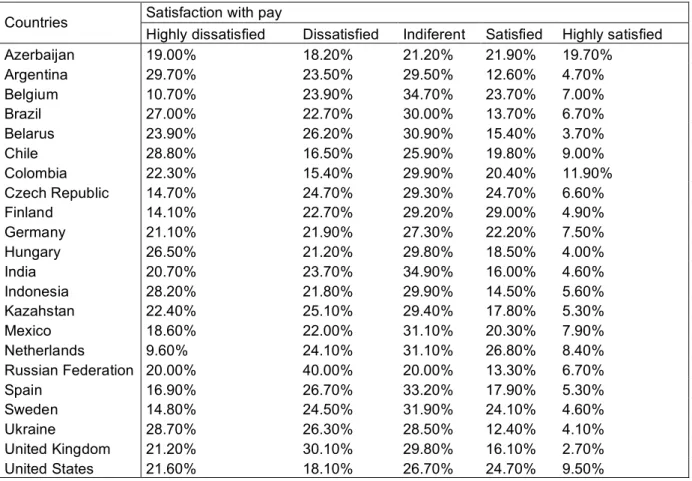
Decent Work Wage regulations are to make sure that every worker earns an income which allows him/her to lead a worthy life. One of the main findings from the cross-country comparison of satisfaction with pay is that, in almost every cross-country, people tend to be dissatisfied with their pay. In every country studied a minority of workers doesn’t even earn the minimum wage. These workers understandably are dissatisfied with their pay. However, according to our research, the percentage of workers dissatisfied with their wages is higher than the proportion that gets less than the minimum. In 20
countries, almost our full sample, the unsatisfied workers outnumber those who say they are satisfied with their wages. Only in Azerbaijan and the Netherlands, a majority of respondents express pay satisfaction.
There seems to be no significant correlation between the countries’ economic level of development and pay satisfaction. Developed countries like Spain and the United
Kingdom show ‘unsatisfied’ pay gaps that reach 20.4 and 32.5 percentage points. At the same time, emerging Latin American economies Argentina and Brazil also present high levels of dissatisfaction. The nations that show the largest wage dissatisfaction are the
13
Overtime does not Pay – Quarterly Wage Indicator report – December 2010 – WageIndicator.org Ukraine and the Russian Federation. Surprisingly the United States, considering its consumerist economy, presents a narrow gap of 5.5 percentage points only.Table 2 – Levels of satisfaction with pay Satisfaction with pay
Countries
Highly dissatisfied Dissatisfied Indiferent Satisfied Highly satisfied
Azerbaijan 19.00% 18.20% 21.20% 21.90% 19.70% Argentina 29.70% 23.50% 29.50% 12.60% 4.70% Belgium 10.70% 23.90% 34.70% 23.70% 7.00% Brazil 27.00% 22.70% 30.00% 13.70% 6.70% Belarus 23.90% 26.20% 30.90% 15.40% 3.70% Chile 28.80% 16.50% 25.90% 19.80% 9.00% Colombia 22.30% 15.40% 29.90% 20.40% 11.90% Czech Republic 14.70% 24.70% 29.30% 24.70% 6.60% Finland 14.10% 22.70% 29.20% 29.00% 4.90% Germany 21.10% 21.90% 27.30% 22.20% 7.50% Hungary 26.50% 21.20% 29.80% 18.50% 4.00% India 20.70% 23.70% 34.90% 16.00% 4.60% Indonesia 28.20% 21.80% 29.90% 14.50% 5.60% Kazahstan 22.40% 25.10% 29.40% 17.80% 5.30% Mexico 18.60% 22.00% 31.10% 20.30% 7.90% Netherlands 9.60% 24.10% 31.10% 26.80% 8.40% Russian Federation 20.00% 40.00% 20.00% 13.30% 6.70% Spain 16.90% 26.70% 33.20% 17.90% 5.30% Sweden 14.80% 24.50% 31.90% 24.10% 4.60% Ukraine 28.70% 26.30% 28.50% 12.40% 4.10% United Kingdom 21.20% 30.10% 29.80% 16.10% 2.70% United States 21.60% 18.10% 26.70% 24.70% 9.50%
Wage stability will also be highly appreciated by the working population. It sheds light on the income situation in the near future, which should be clear in order to make saving and consumption plans. In this sense, income stability contributes to workers’ level of satisfaction with life as-a-whole.
Thus, one of the questions from our survey is whether respondents believe that their earnings will become unstable or uncertain. As might be expected, the lowest
percentages of income instability expectations come from Finland, Belgium, the Netherlands and Sweden, developed countries with strong labor laws and generous unemployment allowances. Despite their comparably high levels of economic
development, Spain, the United Kingdom and the United States however show greater income uncertainty, which may have been prompted by the sub-prime economic crisis. More in line with what might be expected are the high percentages in the Russian
14
Overtime does not Pay – Quarterly Wage Indicator report – December 2010 – WageIndicator.org Federation, Hungary and the Latin American countries, where state support of the unemployed is modest and the periods between jobs are longer.0,00% 10,00% 20,00% 30,00% 40,00% 50,00% 60,00% Workers that think income will become unstable (% of total) 1
Income unstability AzerbaijanArgentina Belgium Brazil Belarus Chile Colombia Finland Hungary India Indonesia Kazahstan Mexico Netherlands Russian Federation Spain Sweden Ukraine United Kingdom United States
6. Equal pay for equal work
Fair treatment at work is yet another Decent Work standard laid own in
ILO-Conventions. It forbids sexual intimidation, entitles all employees to equal training and schooling opportunities, and enables them to complain if they perceive cases of
discrimination. Also, it prescribes pay equality between people who do the same work, whatever their gender, ethnic background or religion. Here we report on gender pay equality only. First, the worldwide gender wage gap is analyzed in a cross-occupation comparison. Secondly, the perception of respondents as regards equal opportunities between men and women is considered.
The most striking result from the cross-occupation comparison is the prevalence of the gender gap in all fields. Although for some specific occupations – particularly personal care - female wages are higher than male wages, overall women earn between 54 and 86 per cent of men’s wages, for the same tasks. The gender pay gap reaches its highest level in the armed forces, notably amongst commissioned officers, where men earn more than twice the women’s salaries. By contrast, pay inequality is only small in the clerical occupations. In fact, some female clerical workers even earn 7.6 per cent more
15
Overtime does not Pay – Quarterly Wage Indicator report – December 2010 – WageIndicator.org than men. Regarding the high-qualified occupations, the gender pay gap hovers at middle levels. Female managers, professionals and technicians gain from 75 to 78 per cent of what their male peers earn. There seems to be no relationship between low-qualified occupations and gender pay inequality: the gap is 17 percentage points in the elementary occupations. By contrast however, it widens to 35 percentage points in the craft and related trade activities.Three out of four respondents consider that women and men have the same labour opportunities. Actually, the survey registered a 4.5 percentage point increase in workers’ perception of equality in 2010 as compared to 2009. Only in the Ukraine and the Russian Federation dramatic declines in people’s feeling about gender labour equality were
found. In these two countries the percentage of respondents believing women and men to have the same opportunities fell 14 and 20 points, respectively.
Split by gender, both in 2009 and 2010 more men than women have a positive view: 77 against 65 percent points, a relatively narrow gap of 12 percent points. The percentages of positive male response as regards equal labor market opportunities for women remain consistently higher than female response in (almost) all of the nations surveyed.
Yet again, also when split by gender, the perception of the gender opportunities gap in the Russian Federation seems to be the most dramatic of all. Here slightly more than 50 per cent of the women workers say that men and women don’t have the same labour opportunities. Russian men by and large share this view, 39 per cent believing women don’t have the same opportunities as men.
In conclusion, even though the majority of respondents believe that women and men have the same labour opportunities, there are still considerable gender pay and opportunities gaps.
16
Overtime does not Pay – Quarterly Wage Indicator report – December 2010 – WageIndicator.orgGroups of occupations Occupations Male's hourly wage in $ PPP Female's hourly wage in $ PPP Female´s wage as % of male wage Armed forces
occupations Commissioned armed forces officers 16.76 7.38 44.04%
Armed forces occupations, other ranks 14.49 11.37 78.47%
Chief executives, senior officials and legislators 20.98 21.09 100.51%
total Armed forces occupations 10.54 5.76 54.70%
Managers Administrative and commercial managers 20.99 15.69 74.75%
Production and specialised services managers 22.26 16.52 74.20%
Hospitality, retail and other services managers 15.56 12.93 83.15%
total Managers 20.76 15.69 75.55%
Professionals Science and engeneering professionals 19.16 12.77 66.62%
Health professionals 19.16 12.53 65.37%
Teaching professionals 14.42 10.58 73.34%
Business and administration professionals 18.90 13.72 72.58%
Information and communications technology professionals 18.30 15.98 87.30%
Legal, social and cultural professionals 17.14 14.37 83.85%
total Professionals 18.21 13.69 75.17%
Technical and associate
professionals Science and engeneering associate professionals 17.26 13.78 79.85%
Health associate professionals 14.25 11.48 80.55%
Business and administration associate professionals 16.66 10.81 64.87%
Legal, social and cultural associate professionals 15.80 11.36 71.91%
Information and communications technicians 9.65 8.72 90.42%
Technical and associate professionals
14.53 11.40 78.46%
Clerical support
workers General and keyboard clerks 11.41 10.61 92.97%
Customer services clerks 9.11 6.23 68.39%
Numerical and material recording clerks 12.49 10.81 86.48%
17
Overtime does not Pay – Quarterly Wage Indicator report – December 2010 – WageIndicator.orgtotal Clerical support workers 11.43 9.82 85.90%
Service and sales
workers Personal service workers 10.95 9.17 83.73%
Sales workers 12.16 8.64 71.10%
Personal care workers 6.99 11.36 162.44%
Protective services workers 7.68 5.09 66.24%
total Service and sale workers 10.96 9.14 83.37%
Skilled agricultural, forestry and fishery workers
Market-oriented skilled agricultural workers 13.75 9.58 69.67%
Market-oriented skilled forestry, fishery and hunting workers 12.87 14.37 111.64%
Subsistance farmers, fishers, hunters and gatherers 4.47 3.94 87.98%
total Skilled agricultural, forestry and fishery workers 13.42 9.58 71.37%
Craft and related
trade workers Building and related trade workers, excluding electricians 15.74 13.69 86.96%
Metal, machinery and related trade workers 14.37 10.98 76.37%
Handicraft and printing workers 15.06 9.67 64.23%
Electrical and electronics trades workers 13.75 11.94 86.80%
Food procesing, wood working, garment and other craft and related trade workers 10.68 7.08 66.28%
total Craft and related trade workers 14.26 9.22 64.63%
Plant and machine opperators and assemblers
Stationary plant and machine operators 13.03 8.90 68.26%
Assemblers 10.63 7.62 71.70%
Drivers and mobile plant operators 12.32 13.75 111.64%
Total Plant and machine opperators and assemblers 12.32 9.51 77.22%
Elementary
occupations Cleaners and helpers 9.62 6.74 70.12%
Agricultural, forestry and fishery labourers 9.58 7.26 75.75%
Food preparation assistants 7.53 8.64 114.71%
Refuse workers and other elementary workers 10.20 4.67 45.79%
total Elementary occupations 9.54 7.95 83.33%
Table 6 – Workers that consider that women and men have the same opportunities Countries Women and men have the same opportunities
18
Overtime does not Pay – Quarterly Wage Indicator report – December 2010 – WageIndicator.org2010 2009 Azerbaijan 87.10% 86.00% Argentina 66.70% 68.30% Belgium 75.60% 76.40% Brazil 67.00% 68.10% Belarus 72.20% 70.80% Chile 70.20% 70.60% Colombia 77.50% 81.70% Czech Republic 78.70% 78.80% Finland 65.10% 73.20% Hungary 68.30% 57.00% India 84.90% 86.60% Indonesia 81.60% 85.50% Kazahstan 73.90% 71.40% Mexico 73.30% 81.80% Netherlands 86.50% 84.50% Russian Federation 53.40% 74.00% Spain 75.90% 69.30% Sweden 83.50% 76.90% Ukraine 65.10% 79.50% United Kingdom 82.70% 82.50% Overall 76.40% 71.90%
Table 7 – Women that think there are equal gender opportunities Women that think there are equal gender opportunities Countries 2010 2009 Azerbaijan 92,90% 81,80% Argentina 63,10% 63,10% Belgium 68,10% 69,20% Brazil 66,80% 65,70% Belarus 66,20% 66,20% Chile 50,00% 61,80% Colombia 75,70% 79,20% Czech Republic 71,40% 71,50% Finland 51,30% 64,00% Hungary 62,50% 56,30% India 77,80% 76,70% Indonesia 78,60% 82,70% Kazahstan 76,00% 70,20% Mexico 74,10% 69,70% Netherlands 82,40% 83,80% Russian Federation 46,90% 66,70% Spain 65,10% 60,20% Sweden 75,30% 65,30% Ukraine 58,10% 76,70% United Kingdom 75,60% 77,40% Overall 65,00% 65,20%
Table 8 – Men that think there are equal gender opportunities Men that think there are equal gender opportunities Countries
19
Overtime does not Pay – Quarterly Wage Indicator report – December 2010 – WageIndicator.orgAzerbaijan 82,40% 88,60% Argentina 69,60% 72,00% Belgium 82,50% 84,00% Brazil 67,20% 70,10% Belarus 74,90% 74,10% Chile 81,10% 75,70% Colombia 78,90% 83,20% Czech Republic 87,60% 84,60% Finland 79,70% 87,10% Hungary 76,50% 58,10% India 86,00% 88,60% Indonesia 83,10% 86,50% Kazahstan 72,50% 72,40% Mexico 72,70% 84,40% Netherlands 88,90% 85,20% Russian Federation 61,50% 86,20% Spain 84,60% 77,90% Sweden 92,40% 91,00% Ukraine 71,90% 81,30% United Kingdom 88,40% 89,20% Overall 76,40% 77,20%