Original Research Article
Evaluation of severity of chronic obstructive pulmonary disease using
bronchial obstruction, dyspnea, exercise index and global initiative for
chronic obstructive lung disease classification and it’s correlation with
physical quality of life measured by St. George’s respiratory disease
questionnaire score
Snehal Daga
1, Vrushali Khadke
1, Deepak Phalgune
2*, Abbas Chopadawala
1INTRODUCTION
Chronic obstructive pulmonary disease (COPD) is a slow, progressive, and largely irreversible airways disease
resulting in breathlessness, cough and sputum production. Smoking, other air pollutants, biomass fuel, and pesticides are well established risk factors for COPD. The Global initiative for chronic Obstructive Lung Disease
1Department of Medicine, 2Department of Research, Poona Hospital and Research Centre, Pune, Maharashtra, India
Received: 11 February 2020
Revised: 12 February 2020
Accepted: 02 March 2020
*Correspondence:
Dr. Deepak Phalgune,
E-mail: [email protected]
Copyright: © the author(s), publisher and licensee Medip Academy. This is an open-access article distributed under the terms of the Creative Commons Attribution Non-Commercial License, which permits unrestricted non-commercial use, distribution, and reproduction in any medium, provided the original work is properly cited.
DOI: http://dx.doi.org/10.18203/2349-3933.ijam20201109
ABSTRACT
Background: The Global initiative for chronic Obstructive Lung Disease (GOLD) criteria classified chronic obstructive pulmonary disease (COPD) by severity into four stages. Recently, Body mass index (BMI), Bronchial Obstruction, Dyspnea, Exercise (BODE) index, was proposed to provide useful prognostic information of COPD patients. Health-related quality of life (HRQOL) is measured by St. George’s Respiratory disease Questionnaire (SGRQ). Study was undertaken to assess correlations between BODE index and GOLD classification with SGRQ score.
Methods: Fifty five COPD patients were included. Spirometry was performed in all patients. Modified Medical Research Council (mMRC) scale was used to label severity of dyspnea. Six-minute walking distance (6 MWD) was performed. BODE index was calculated by giving points to BMI, forced expiratory volume in one minute (FEV1), 6 MWD, and mMRC. SGRQ was used to determine HRQOL. Correlation analysis was done using Pearson’s method.
Results: Mean symptoms, mean activity, mean impacts and mean total SGRQ score were significantly higher in patients having mMRC scale 0-1, patients who could walk ≤149 meters, and in patients who had GOLD III and IV class. Lesser the FEV1, higher the mMRC grade, and lesser the 6 MWD, worse was the quality of life. BODE index (r = 0.72) and GOLD classification (r =0.59) were significantly and positively correlated with symptoms score, activity score, impacts score and total SGRQ score.
Conclusions: BODE index correlated better than the Gold classification with SGRQ score implying that apart from
the airflow limitation, functional impairment measured by the 6MWT and mMRC also affect HRQOL.
(GOLD) criteria classified COPD by severity into four stages; this constitutes the basis of treatment recommendations. The GOLD classification has already demonstrated its usefulness in longitudinal studies in which higher GOLD stages were found to be associated with increased mortality risk.1,2 Nevertheless, doubts
exist about the appropriateness of the GOLD classification to categorise the impact of the disease on health status adequately.3 Consequently, the clinical
utility of the GOLD classification for pulmonary rehabilitation may be questioned.4
Recently, a new multidimensional grading system, the Body mass index (BMI), Bronchial Obstruction, Dyspnea, Exercise (BODE) index, was proposed to provide useful prognostic information of COPD patients.5
This multidimensional grading system incorporates four parameters: assessment of symptoms, nutritional state, exercise capacity, and spirometric measures such as forced expiratory volume in one second (FEV1), all aimed to include both respiratory and systemic manifestations of COPD.5
The concept of health-related quality of life (HRQOL) combines some of the main aspects of health, disease, and adaptation that make an integral part of the patient and his or her treatment. The measurement of HRQOL in these patients mainly covers the following dimensions related to their subjective experience: difficulties in physical mobility, psychological and social status, and general perception of health and well-being in relation to the disease.5 HRQOL has become an important outcome
in respiratory patients as proved by the development of several respiratory disease-specific questionnaires like the St. George’s Respiratory disease Questionnaire (SGRQ).
Although the BODE index has been shown to be a predictor of the risk of death, its utility has been seen in the evaluation of pulmonary rehabilitation programs and prediction of hospitalizations in COPD patients.6,7 But
there are not enough studies to show whether this index is a useful indicator of patients’ health status. Using the BODE index in COPD patients will help in detecting the disease early and to start treatment early. Therefore, a study was undertaken to assess the correlations between the BODE index and GOLD classification with SGRQ score and to find which was better index for predicting the impact of COPD on physical quality of life.
METHODS
This observational study was conducted between May 2016 and September 2017. After approval from the scientific advisory committee and institutional ethics committee, written informed consent was obtained from all patients. Fifty-five patients who attended outpatient department of chest diseases or admitted in Poona Hospital and Research Centre, Pune were included. The criteria for diagnosis of COPD was based on the
symptoms of the patient and spirometry tests the patient had undergone, which has FEV1/Forced expiratory capacity (FVC) <0.7) and post bronchodilator no reversibility/partial reversibility.
Inclusion criteria
• Patients aged ≥18 years of either sex.
• Stable COPD patients.
Exclusion criteria
• Patients with respiratory tract infection, interstitial lung disease, bronchial asthma, walking disability.
• Patients with history of cardiac event like acute coronary syndrome/ heart failure in last two months.
Demographic features and medical history of the patients including the disease duration, smoking history was recorded. Weight, height was measured and BMI was calculated. Spirometry was performed as per American Thoracic Society (ATS)/ European Respiratory Society
(ERS) recommendations using Spirometer RMS
MEDSPIROR (Recorders and Medicare Systems Pvt. Ltd., Chandigarh, India) and software “HELIOS”.8 The
procedure was repeated at least three times until three acceptable readings were obtained. After that a short acting beta-2 agonist salbutamol 400 µgm was administered and repeat reading was obtained after 10 minutes. At end of the test post bronchodilator FEV1, FVC and the FEV1 /FVC was obtained. Using the post bronchodilator FEV1, COPD staging was done according to GOLD 2017.
The Modified Medical Research Council (mMRC) scale was used to label severity of dyspnea. Six-minute walking distance (6 MWD) was performed in a 30 m long, flat and straight corridor. Patients were motivated to walk at the fastest speed they can for 6 minutes. Pulse and oxygen saturation was measured before and after the test and the distance walked was recorded by counting the number of laps. During the test if the participant experienced chest pain, intolerable dyspnea, leg cramps or SpO2 fell below 80%, patient was asked to stop and
discontinue and was excluded from the study.
BODE index was calculated by giving points to BMI, FEV1 (Post bronchodilator), 6 MWD, and mMRC. SGRQ was used to determine the quality of life.
classification and correlate with total SGRQ score and its components.
On the basis of a previously published study, a sample size of 55 patients was calculated by a formula with 80% power and 5% probability of Type I error to reject null hypothesis.9,10
Data collected were entered in Excel 2007 and analysis of data was done using Statistical package for social sciences (SPSS) version 21, IBM Corporation, USA for MS Windows. The data on categorical variables is shown as n (% of cases) and data on continuous variables is shown as mean±standard deviation (SD). The inter-group statistical significance of difference of categorical variables and continuous variables between two groups was tested using Chi-Square test/Fisher’s exact test and unpaired ‘t’ test. Inter-group statistical significance of difference of means of continuous variables more than two groups was tested using one-way analysis of variance (ANOVA) or F test. The correlation analysis was done using Pearson’s method. The confidence limit for significance was fixed at 95% level with p-value <0.05.
RESULTS
Of 55 patients studied, 6 (10.9%), 20 (36.4%), 14 (25.5%), 12 (21.8%) and 3 (5.5%) were between 45- 54 years, 55-64 years, 65-74 years, 75-84 years and >84 years respectively. The mean±standard deviation of age of the patients was 66.5±10.6 years. Twenty eight (50.9%) patients were males and 27 (49.1%) were females. Of 55 patients, 21 (38.2%) were smokers and 34 (61.8%) were non-smokers. One (1.8%), 18 (32.7%), 22 (40.0%), and 14 (25.5%) patients had duration of disease less than 12 months, 12 <60 months, 60 - 120 months and >120 months respectively. Of 55 patients, 12 (21.8%), 29 (52.7%), 12 (21.8%), 1(1.8%) and 1 (1.8%) had no annual exacerbation, 1, 2, 3 and 4 annual exacerbations
respectively. Nine (16.4%), 32 (58.2%) and 14 (25.4%) patients had BMI <21.0 kg/m2, 21.0 - 25.0 kg/m2 and
>25.0 kg/m2 respectively. The mean±SD of BMI in the
study group was 23.7±4.5 kg/m2. Of 55 patients, 11
(20.0%), 19 (34.5%), 13 (23.6%) and 12 (21.8%) had FEV1 ≥65%, 50 - 64%, 36 - 49% and ≤35% respectively. The mean±SD of FEV1 in the study group was 50.4±15.8%.
Ten (18.2%), 18 (32.7%), 14 (15.5%) and 13 (23.6%) patients had BODE index 0 - 2, 3 - 4, 5 - 6 and 7 - 10 respectively. Of 55 patients, 1 (1.8%), 30 (54.5%), 18 (32.7%) and 6 (10.9%) had GOLD index stage I, stage II, stage III and stage IV respectively. Thirteen (23.6%), 24 (43.6%), 17 (30.9%) and 1 (1.8%) patients had Grade 1, Grade 2, Grade 3 and Grade 4 mMRC respectively. Of 55 patients, none, 23 (41.8%), 28 (50.9%), and 4 (7.3%) had 6 MWD ≥350, 250 - 349, 150 - 249 and ≤150 metres respectively. The mean±SD of 6 MWD in the study group was 235.8±46.8 metres.
There was no statistically significant difference in distribution of mean BODE Index and total SGRQ score between male and female patients. There was no statistically significant difference in distribution of mean BODE Index and total SGRQ score between smokers and non-smokers. The distribution of mean BODE Index and total SGRQ score did not differ significantly between groups of patients who had <2 co-morbidities and group of patients who ≥2 co-morbidities. The distribution of mean BODE index and mean total SGRQ score did not differ significantly in patients whose BMI were <21.0 kg/m2, 21.0 - 25.0 kg/m2 and > 25.0 kg/m2.
Distribution of mean symptoms score and mean impacts score did not differ significantly between the patients who were <60 years and ≥60 years. Mean activity and mean total score was significantly higher in patients who were ≥60 years (Table 1).
Table 1:Distribution of mean SGRQ scores by age.
Symptom Activity Impacts Total
Age in years Mean±SD Mean±SD Mean±SD Mean±SD
<60 51.97±14.15
59.03±12.62
59.13±13.65 67.75±12.74
28.23±13.92 41.52±12.24
49.02±11.92
≥60 35.57±13.73
p-value 0.080 0.033 0.084 0.044
Unpaired t test was used.
SGRQ - St. George’s Respiratory disease Questionnaire
As depicted in Table 2, distribution of mean total SGRQ score was significantly higher among the patients with duration of disease ≥60 months compared to patients with <60 months duration of disease. The distribution of mean total SGRQ score was significantly higher among patients with annual exacerbations compared to patients
Table 2:Distribution of mean total SGRQ according to disease duration and annual exacerbations.
Variables N Mean total SGRQ score±SD p value
Disease duration <60 Months 19 40.7±10.8 0.005
≥60 Months 36 50.3±12.0
Annual exacerbations No exacerbation 12 39.6±9.9 0.018
exacerbation 43 49.0±12.3
Unpaired ‘t’ test was used.
SGRQ- St. George’s Respiratory disease Questionnaire
Table 3:Distribution of mean SGRQ scores by components of BODE index.
BODE index
components FEV1
p
value mMRC scale
p value
≤35% 36 - 49% 50 - 64% ≥65% 0-1 2 3 4
Mean
Symptoms±SD
68.9±
12.9 64.6±8.7
51.8± 9.6
45.8±
8.1 0.001
44.7± 6.3
56.0±
10.9 66.6±11.4
83.7±
12.8 0.001
Mean Activity±SD
72.0±
12.9 75.0±9.7
58.2± (11.6)
59.4±
11.2 0.001
53.6± 13.8
63.5±
8.6 75.8±9.9
86.6±
10.9 0.001
Mean Impact±SD
45.6±
13.1 40.5±10.0
27.2± 10.9
23.3±
10.5 0.001
21.3± 10.2
34.6±
12.9 40.0±11.6
60.0±
11.9 0.001
Mean Total±SD 57.4±
11.3 54.8±7.7
40.4± 9.5
37.6±
7.9 0.001
34.7± 8.6
46.7±
10.0 55.3±9.2
72.0±
10.5 0.001
ANOVA test was used
SGRQ-St. George’s Respiratory disease Questionnaire
BODE-Body mass index (BMI), Bronchial Obstruction, Dyspnea, Exercise FEV1 -forced expiratory volume in one second
mMRC- Modified Medical Research Council
Table 4:Distribution of mean SGRQ scores by components of BODE index.
BODE Components 6 MWD in meters p value BMI in kg/m2 p value
≤149 150-249 250 - 349 ≤21 >21
Mean Symptoms±SD 83.4±1.1 60.2±9.5 48.7±10.6 0.001 57.5±13.4 55.0±10.9 0.609
Mean Activity±SD 84.9±3.4 69.3±10.5 57.3±12.2 0.001 65.7±13.0 64.1±16.5 0.761
Mean Impact±SD 49.0±15.8 39.2±11.1 24.0±10.9 0.001 33.9±14.0 31.9±15.1 0.705
Mean Total±SD 65.6±8.7 51.7±9.2 38.1±9.3 0.001 47.3±12.3 45.3±13.4 0.668
ANOVA test was used.
SGRQ -St. George’s Respiratory disease Questionnaire
BODE- Body mass index (BMI), Bronchial Obstruction, Dyspnea, Exercise 6 MWD-Six-minute walking distance
Table 5:Distribution of mean SGRQ scores by GOLD classification.
SGRQ score GOLD Classification p value
GOLD I GOLD II GOLD III GOLD IV
Mean Symptoms±SD 39.1±5.7 50.1±9.8 66.7±9.5 66.4±16.2 0.001
Mean Activity±SD 55.2±8.9 59.0±11.3 75.7±8.7 68.1±16.9 0.001
Mean Impacts±SD 19.0±3.6 26.4±10.9 43.0±11.2 43.9±14.9 0.001
Mean Total±SD 33.3±6.2 40.0±9.1 56.7±7.5 55.0±15.3 0.001
ANOVA test was used
SGRQ -St. George’s Respiratory disease Questionnaire GOLD-Global initiative for chronic Obstructive Lung Disease
Mean symptoms, mean activity score, mean impacts score and mean total SGRQ score were significantly higher in patients who could walk ≤149 meters. The distribution of mean symptoms score, mean activity
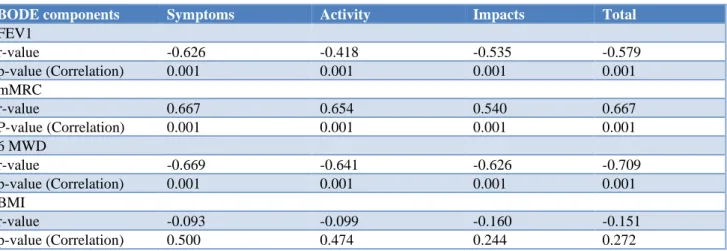
GOLD III and IV class (Table 5). As shown in Table 6, lesser the FEV1, higher the mMRC grade, and lesser the 6 MWD worse was the quality of life. BMI did not show
significant correlation with symptoms score, activity score, impacts score and total SGRQ score.
Table 6:Correlation between SGRQ scores and BODE index.
BODE components Symptoms Activity Impacts Total
FEV1
r-value -0.626 -0.418 -0.535 -0.579
p-value (Correlation) 0.001 0.001 0.001 0.001
mMRC
r-value 0.667 0.654 0.540 0.667
P-value (Correlation) 0.001 0.001 0.001 0.001
6 MWD
r-value -0.669 -0.641 -0.626 -0.709
p-value (Correlation) 0.001 0.001 0.001 0.001
BMI
r-value -0.093 -0.099 -0.160 -0.151
p-value (Correlation) 0.500 0.474 0.244 0.272
Pearson’s correlation test was used.
SGRQ -St. George’s Respiratory disease Questionnaire
BODE- Body mass index (BMI), Bronchial Obstruction, Dyspnea, Exercise FEV1 - forced expiratory volume in one second
MMRC- Modified Medical Research Council 6 MWD- Six-minute walking distance
Table 7:Correlation between 2 COPD staging systems and SGRQ scores.
Symptoms Activity Impacts Total
COPD Staging r value p value r value p value r value p value r value p value
BODE Index 0.727 0.001 0.581 0.001 0.650 0.001 0.720 0.001
GOLD class 0.585 0.001 0.438 0.001 0.567 0.001 0.594 0.001
Spearman rank correlation test was used. COPD- Chronic obstructive pulmonary disease
BODE- Body mass index (BMI), Bronchial Obstruction, Dyspnea, Exercise SGRQ -St. George’s Respiratory disease Questionnaire
GOLD- Global initiative for chronic Obstructive Lung Disease
As depicted in Table 7, BODE index was significantly and positively correlated with symptoms score, activity score, impacts score and total SGRQ score. GOLD classification was significantly and positively correlated with symptoms score, activity score, impacts score and total SGRQ score. Bode index correlated better (r values more) than Gold classification to health related quality of life as it is a multidimensional index to determine severity of COPD and its systemic consequences.
DISCUSSION
This study was conducted in 55 patients attending Poona hospital and research centre. In the present study we have calculated BODE index, GOLD classification and SGRQ score and found correlation with each other. Total SGRQ score was 49.02 and 41.52 in patients aged ≥60 years and <60 years respectively (p-value<0.05). Corlateanu et al, also reported that the total SGRQ score was higher in the
elderly patients than in the younger patients (69.7 vs. 57.4, p <0.0001).11 But Martinez et al, stated that older
subjects with COPD report better HRQOL than do younger COPD patients and that this age-related difference involved a lower impact of dyspnea with increasing age.12 They suggested that the younger
population had more negative perception or the elderly population adjusted by restricting their activities or having minimal expectations.
The prevalence, hospitalization and mortality for COPD in women is increasing. The biggest risk factor for disease development in the developed world is tobacco smoke. For women in the developing world, where fuels such as coal and biomass are used for indoor cooking and heating, several studies have reported an association between exposure to biomass smoke and COPD.13 In the
SGRQ score between male and female patients. Katsura et al, and Skumlein et al, reported that women had greater deterioration in health related quality of life.14,15
In this study 21/55 (38.2%) were smokers and 34 (61.8%) were non-smokers implying that other noxious particles like dust, biomass fuel, pesticides were responsible for the airway obstruction in 61.8% cases. However, history of smoking did not affect the HRQOL and BODE index. The distribution of mean BODE index and total SGRQ score did not differ significantly between smokers and non-smokers in the study group. In India approximately two-thirds of the population uses biomass fuel for cooking purposes. On the contrary, just one-third of the Indian subset comprises the smoking population.16 Thus,
exposure to biomass fuel is a greater hazard for COPD in India.
COPD is a systemic disease and co morbidities that occur frequently in COPD patients include cardiovascular disease, skeletal muscle dysfunction, metabolic syndrome, osteoporosis, depression and lung cancer. In the present study mean BODE Index and total SGRQ score did not differ significantly between group of patients with <2 co-morbidities and group of patients with ≥2 co-morbidities. A study conducted in Europe by Jones et al, reported that co morbidities >3 resulted in worse SGRQ score unlike our study.17
In the present study, the distribution of mean total SGRQ score was significantly higher among the patients with higher duration of disease (>60 months) compared to group of cases with lesser duration of disease (<60 months). Longer the duration of the disease, worse was the quality of life. Similar finding were reported by Ahmed et al, and by Miravitlles et al.18,19
Total SGRQ score was significantly higher among patients with annual exacerbations compared to group of patients with no annual exacerbations. David et al, and Jones et al, reported positive correlation between frequent exacerbations and total SGRQ scores.20,17 Mean
symptoms, mean impacts score and mean total SGRQ score were significantly higher in patients having FEV1 ≤35%. These findings are consistent with the studies conducted by Jones et al, Antonelli-Incalzi et al, and Sarkar et al.17,21,9
mMRC dyspnea grade was significantly and positively correlated with symptoms score, activity score, impact score and total SGRQ score. Hsu et al, concluded that the mMRC dyspnoea scale is a concise and practical tool to assess the HRQOL of patients with COPD in daily clinical practice.22 Similar positive correlation were
reported in studies conducted by Marin et al, and Sarkar et al.23,9 In the present study, 6MWD was significantly
and negatively correlated with symptoms score, activity score, impact score and total SGRQ score. Various previous studies have reported statistical significant correlation between SGRQ and 6MWD.24-26
The distribution of mean BODE Index and total SGRQ score did not differ significantly across three BMI groups. De et al, reported that mean BMI reduced significantly with progression of COPD severity.27
Meta-analysis by Cao et al, and Guo et al, concluded that there was a significant non-linear relationship between BMI and mortality of COPD patients.28,29 Lower BMI had
higher risk of death and therefore BMI forms an important component of BODE index.
In the present study SGRQ total correlated better with BODE index than with GOLD class (r = 0.72, vs r =0.594). Overall, we found that the SGRQ scores worsened exponentially as disease severity increased by BODE quartiles. Previous studies by Sarkar et al, Marin et al, Huijsmans et al, Medinas et al, Nonato et al, and Ong et al, concluded that BODE index positively correlated with SGRQ score.9,23,4,5,30,31
Total SGRQ score and all of its 3 domains showed a significant worsening in GOLD stages III and IV. In previous studies, it has been suggested that the boundary between GOLD stages II and III (FEV1 <50%) marks a threshold for dramatic worsening of health status and an increased mortality risk.1,21 Huijsmans et al, reported that
the largest reduction in exercise capacity and quality of life was found in the transition from GOLD III to GOLD IV.4 Health related quality of life should be evaluated
when planning interventions as it better expresses the composite effect of the intervention on patient’s well-being. The BODE index reflects stages of COPD better and should emerge as a tool to assess disease modification and future disease outcome. GOLD and BODE indices can be used express the complex nature of COPD better.
There are few limitations to the present study. Authors have not included data regarding occupational exposure history, socioeconomic status, medication use, or previous hospitalization. This study only evaluated the SGRQ and the results may not extend to other instruments of HRQOL. Authors have not assessed anxiety and depression which are known to affect the quality of life in COPD patients. Multi-centric studies with large sample size is needed to validate our findings.
CONCLUSION
Smoking was not the only cause of COPD in this study. Majority were due to other noxious particles. Duration of disease and annual exacerbations positively correlated with quality of life.
Funding: No funding sources Conflict of interest: None declared
Ethical approval: The study was approved by the Institutional Ethics Committee
REFERENCES
1. Mannino DM, Doherty DE, Sonia Buist A. Global Initiative on Obstructive Lung Disease (GOLD) classification of lung disease and mortality: findings from the Atherosclerosis Risk in Communities (ARIC) study. Respir Med. 2006;100:115-22. 2. Ekberg-Aronsson M, Pehrsson K, Nilsson JA,
Nilsson PM, Lofdahl CG. Mortality in GOLD stages of COPD and its dependence on symptoms of chronic bronchitis. Respir Res. 2005;6:98.
3. Calverley PM. The GOLD classification has
advanced understanding of COPD. Am J Respirat Crit Care Med. 2004;170:211-2.
4. Huijsmans RJ, de Haan A, ten Hacken Nick NN, Straver RV, van’t Hul AJ. The clinical utility of the GOLD classification of COPD disease severity in
pulmonary rehabilitation. Respir Med.
2008;102:162-71.
5. Medinas Amorós M, Mas-Tous C, Renom-Sotorra F, Rubi-Ponseti M, Centeno-Flores MJ, Gorriz-Dolz MT. Health-related quality of life is associated with COPD severity: a comparison between the GOLD staging and the BODE index. Chron Respir Dis. 2009;6:75-80.
6. Cote CG, Celli BR. Pulmonary rehabilitation and the BODE index in COPD. Eur Respir J. 2005;26:630-6.
7. Ong KC, Earnest, A, Lu, SJ. A multidimensional grading system (BODE Index) as predictor of hospitalization for COPD. Chest. 2005;128:3810-6. 8. Miller Martin R, Hankinson JATS, Brusasco V,
Burgos F, Casaburi R, Coates A, et al. Standardisation of spirometry. Eur Respir J. 2005;26(2):319-38.
9. Sarkar SK, Basuthakur S, Das SK, Das A, Das S, Choudhury S, et al. Evaluation of correlation of BODE index with health-related quality of life among patients with stable COPD attending a tertiary care hospital. Lung India. 2015;32:24. 10. Charan J, Biswas T. How to calculate sample size
for different study designs in medical research?. Ind J Psycholo Med. 2013 Apr;35(2):121-6.
11. Corlateanu A, Botnaru V, Covantev S, Dumitru S, Siafakas N. Predicting Health-Related Quality of Life in Patients with Chronic Obstructive Pulmonary Disease: The Impact of Age. Respira. 2016;92:229-34.
12. Martinez CH, Diaz AA, Parulekar AD, Rennard SI, Kanner RE, Hansel NN, et al. Age-related
differences in health-related quality of life in COPD: an analysis of the COPDGene and SPIROMICS Cohorts. Chest. 2016;149:927-35. 13. Varkey AB. Chronic obstructive pulmonary disease
in women: exploring gender differences. Curr Opini Pulmonary Med. 2004 Mar 1;10(2):98-103.
14. Katsura H, Yamada K, Wakabayashi R, Kida K. Gender‐associated differences in dyspnoea and health‐related quality of life in patients with chronic
obstructive pulmonary disease. Respirol.
2007;12:427-32.
15. Skumlien S, Haave E, Morland L, Bjørtuft Ø, Ryg MS. Gender differences in the performance of activities of daily living among patients with chronic obstructive pulmonary disease. Chron Respir Dis. 2006;3:141-8.
16. Ladhani S. COPD–An Indian Perspective. J Lung Pulm Respir Res. 2016;3:00070.
17. Jones PW, Brusselle G, Dal Negro RW, Ferrer M, Kardos P, Levy M, et al. Health-related quality of life in patients by COPD severity within primary care in Europe. Respir Med. 2011;105:57-66. 18. Ahmed MS, Neyaz A, Aslami AN. Health-related
quality of life of chronic obstructive pulmonary disease patients: Results from a community based cross-sectional study in Aligarh, Uttar Pradesh, India. Lung India. 2016;33:148.
19. Miravitlles M, Molina J, Naberan K, Cots JM, Ros F, Llor C. Factors determining the quality of life of patients with COPD in primary care. Ther Adv Respir Dis. 2007;1:85-92.
20. David A, Corlateanu A. Influence of COPD exacerbations on health related quality of life. Eur Respir J. 2012;40:4821.
21. Antonelli-Incalzi R, Imperiale C, Bellia V, Catalano F, Scichilone N, Pistelli R, et al. Do GOLD stages of COPD severity really correspond to differences in health status? Eur Respir J. 2003;22:444-9. 22. Hsu KY, Lin JR, Lin MS, Chen W, Chen YJ, Yan YH.
The modified Medical Research Council dyspnoea scale is a good indicator of health-related quality of life in patients with chronic obstructive pulmonary disease. Singapore Med J. 2013;54:321-7.
23. Marin JM, Cote CG, Diaz O, Lisboa C, Casanova C, Lopez MV, et al. Prognostic assessment in COPD: health related quality of life and the BODE index. Respir Med. 2011;105:916-21.
24. Agrawal SR, Joshi R, Jain A. Correlation of severity of chronic obstructive pulmonary disease with health-related quality of life and six-minute walk test in a rural hospital of central India. Lung India. 2015;32:233.
25. Dourado VZ, de Oliveira Antunes LC, Tanni SE, de Paiva SA, Padovani CR, Godoy I. Relationship of upper-limb and thoracic muscle strength to 6-min
walk distance in COPD patients. Chest.
2006;129:551-7.
27. De S. Body mass index among patient with chronic obstructive pulmonary diseases. Indian J Physiol Pharmacol. 2012;56:353-8.
28. Cao C, Wang R, Wang J, Bunjhoo H, Xu Y, Xiong
W. Body mass index and mortality in chronic obstructive pulmonary disease: a meta-analysis. PLoS One. 2012;7:e43892.
29. Guo Y, Zhang T, Wang Z, Yu F, Xu Q, Guo W, et
al. Body mass index and mortality in chronic obstructive pulmonary disease: A dose–response meta-analysis. Med. 2016;95(28):e4225.
30. Nonato NL, Díaz O, Nascimento OA, Dreyse J, Jardim JR, Lisboa Carmen. Behavior of quality of life (SGRQ) in COPD patients according to BODE
scores. Archivos Bronconeumología (English
Edition) 2015;51:315-21.
31. Ong KC, Lu SJ, Soh CS. Does the multidimensional grading system (BODE) correspond to differences in health status of patients with COPD? Int J Chron Obstruct Pulmon Dis 2006;1:91.
Cite this article as: Daga S, Khadke V, Phalgune D, Chopadawala A. Evaluation of severity of chronic obstructive pulmonary disease using bronchial obstruction, dyspnea, exercise index and global initiative for chronic obstructive lung disease classification and it’s correlation with physical quality of life measured by St. George’s respiratory disease questionnaire score. Int J Adv Med