Using a Typed Mind Map as a Data Model
in a TDD DICE System
Li-Ren Chien and Daniel J. Buehrer
Department of Computer Science and Information Engineering, Chung Cheng University, Min-Hsing, Chia-Yi, Taiwan
This paper introduces a new Typed Mind Map extension for a data model in a parse-tree-based online referee sys-tem with a TDD(Test-Driven Development)model and DALM (DICE adaptive learning model)model named DICE. Typed Mind Maps and a semantic node are defined by OWL-DL. Typed Mind Maps are now widely used in the DICE system as a uniform data model for the system, instructors, learners and materials. The Mind Maps are used for system configuration, system deployment, learner’s information, organization of training materials, answer parsing and some widgets. An implementation based on this data model has been working for years in a real teaching and learning environment.
Keywords: typed mind map, data model, XML, know-ledge representation, DICE, TDD
1. Introduction
This paper introduces Typed Mind Maps[1]for knowledge representation. We also use a parse-tree-based Mind Map to compare student pro-grams within a TDD(test driven development) model named DICE[5].
We have been using our DICE system for several years now. The DICE system was implemented in an OS-independent, distributed, client-server environment, with a parse-tree-based automatic assessment system for test-based assignment tu-toring and problem solving. All training work including assigned practice, turn-in and assess-ment can be run on the DICE system. DICE has been working in Hsing Kuo High School in Tai-wan for over 2 years, exceeding 2,500 learners involved since autumn 2005. We have planned to develop a sophisticated testing mechanism TDD(test-driven development)model in DICE for the underachievers[10]; moreover, an adap-tive learning environment named DALM(DICE
adaptive learning model) [11]was proposed to adapt different kinds of learners to DICE TDD teaching units.
We aim to develop an explicit formal specifi-cation of the terms in the domain and relations among them[13], but within a widely-used and undemanding formalism [6]. The use of Mind Maps in the ontology development process is very attractive[14] because it is a very simple formalism with a simple user-interface that is usable for students, teachers, and administra-tors. A typed Mind Map is a traditional Mind Map with a semantic description that can also be expressed as a Mind Map.
From the viewpoint of teaching programming in computer science, a system like DICE should involve the knowledge representations of the learners, the instructors, the DICE system ad-ministrators and the DICE system itself. For example, DICE should represent how the sys-tem administrator should organize the syssys-tem information, how an instructor should represent his teaching units, and how a learner should figure out his answer for a question. We need to integrate all of this knowledge into a unified representation.
2. Mind Map
A Mind Map is based on organizing information via hierarchies and categories [7]. It has been widely used for centuries in different fields. One of the uses is “keeping a small database of something with structure that is either very dynamic or not known in advance”[3]. As Dim-itry Polivaev’s argument that “The main disad-vantage of such approach when compared to traditional database applications is poor query possibilities”. We feel that this defect of Mind Maps can be overcome by the addition of data types, so that Mind Maps can reflect their own syntactic/semantic definitions as well as user-defined types and objects.
In our view, a Mind Map is a node with recursive node collections. There is no information in a Mind Map other than the node name and its as-sociation to its child nodes. An ontology defines a common vocabulary for researchers who need to share information in a domain. It includes machine-interpretable definitions of basic con-cepts in the domain and relations among them. [13]
2.1. Formal Definition of the Mind Map
We describe a Mind Map by a recursive defini-tion.
Definition 1: (Mind Map Node)
A mind map node is a pair n = (s, < N|l >) where s is a String, N is a set of Mind Map nodes and l is a link to a Mind Map.
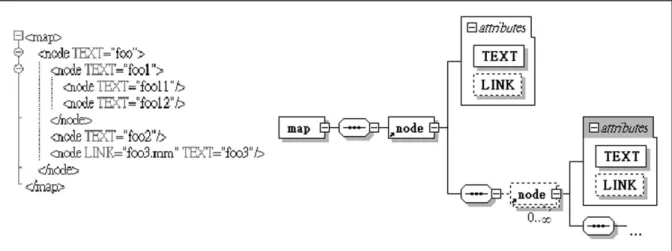
Figure 1.The foo Mind Maps.
Definition 2: (Link)
A link is a reference of a Mind Map.
Definition 3: (Child/Parent Node)
3-1 For a Mind Map noden= (s,N), ifm∈N thenmis a mind map child node ofnand
nis the Mind Map parent node ofm.
3-2 For a Mind Map node n = (s,l), if l =
MM(m) then m is a reference child mind map node ofnandnis the reference parent Mind Map node ofm.
Definition 4: (Root/Leaf/Linked Leaf Node/null leaf node/component node)
4-1 A Mind Map root node is a Mind Map node with no parent.
4-2 A Mind Map node n of the form(s,N)where N =∅is a Mind Map leaf node
4-3 A Mind Map node n of the form(s,l)is a Mind Map linked leaf node.
4-4 A Mind Map node n of the form(null,∅)is a Mind Map null leaf node.
4-5 A Mind Map node that does not belong to the above node classifications is a compo-nent node.
Definition 5: (Mind Map)
A Mind Map root node n = {s,{M|l}} is de-noted by MM(n).
Definition 6: (Category Mind Map)
∀y∈MM(n)∧(y is a Mind Map null leaf node
∨y is a Mind Map linked node) then MM(n)is a category Mind Map.
Example 1: The Mind Map in Figure 1 can be represented as
n={“foo(n)”,{n1, n2, n3}},
n1={“foo1”, {n11, n12}}, n2={“foo2”}and
n3={“foo3”, l}
n11={“foo11”}, n12={“foo12”}, l=MM(m)
and m={“foo(m)”} Example 2:
In Example 1:
The n1 is a child node of n and n is the parent
node of m for n1∈ {n1, n2, n3}.
The n and the m are root nodes, for neither of them has a parent.
The n2, n11 and n12 are Mind Map leaf Nodes,
for they all have the form{s,∅}(simplified{s}) The n3is a Mind Map linked leaf node that refers
to m.
Consequently, a Mind Map is a vertex-labeled directed rooted graph. The string s denotes the root node of a Mind Map representing a concept or a term that we are interested in for a specified domain. A self-reference linked leaf node can extend Mind Maps from tree structures to gen-eral labeled graphs. Such a definition attempts to provide a simple graph data structure for a data model.
A rooted Mind Map node represents a concept by a terms. The linked node(l)or the Mind Map nodes in set of Mind Map (N) of a root node maintain the association of other terms with the root node. A leaf Mind Map node holds the changeable information of a concept. A cate-gory Mind Map represents the schema of the Mind Map when using Mind Map as a “small database”.
2.2. Informal Definition of the Typed Mind Map
A typed Mind Map consists of a traditional Mind Map and a typed Mind Map describing the types which are used in that traditional Mind Map. A typed Mind Map may also be dis-played as a traditional Mind Map, and it can be edited and displayed by any FreeMind-like software, with kernel types being extended to include those used in the typed Mind Map. We classify a traditional Mind Map as either an un-restricted Mind Map (UMM)or a typed Mind Map(TMM). The ontology information can be
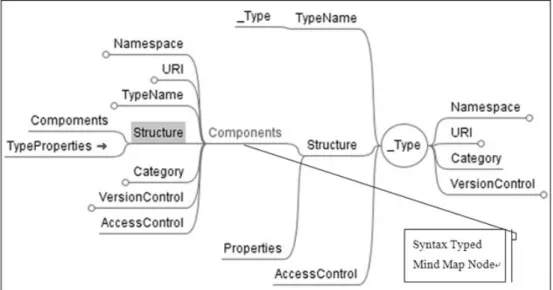
used to translate to/from a typed node of a TMM into a sequence of un-typed nodes in a UMM. As Figure 2 shows, a typed Mind Map is an ex-tended Mind Map with a “special” Type Mind Map to describe the typing mechanism. The special Type Mind Map consists of a typed Mind Map to describe the schema of a Typed Mind Map, a semantic typed Mind Map to express the ontology of a Mind Map and some misc. nodes to illustrate some additional information of a Mind Map(e.g. version control, access control, category. . .etc. ).
Figure 2 represents a specific Mind Map that describes the type of a type (i.e. what a typed Mind Map looks like).
Definition 7: (Syntax Type Mind Map Node)
A syntax typed Mind Map node s is the root node of a category Mind Map that associates to a specific Mind Map n. We define s as the syntax Mind Map node of the Mind Map n.
As Figure 2 shows, a node named “Compo-nents” shows the schema of MM((“ Type”, N)). It describes the structure or the schema of a Mind Map. The typetype.mm describes itself via the “Components” node. In our implemen-tation, we define a special Mind Map named type as a primitive type to mark a Mind Map as atypedMind Map.
Definition 8: (Misc. Type Mind Map Nodes)
As Figure 2 shows, some misc. nodes are re-served for comprehensive use of a Mind Map.
For example, a version control node can be de-signed for tracing the changed history of a typed Mind Map, an access control node can be added to figure out the user rights for a Mind Map, and a category node list can be used to catalog a Mind Map for multiple classification systems.
Definition 9: (Semantic Type Mind Map Node)
A semantic typed Mind Map node is designed to describe the ontology of a Mind Map.
Figure 3 shows a representative semantic typed Mind Map node. The representation of a com-plex object should support self-description,strong typing and information hiding. The traditional Mind Map is weak on strong typing.
We separate a concept from a single represen-tation(e.g. OWL, SUMO. . .etc.) into a tradi-tional Mind Map and a Typed Mind Map that consists of syntax and semantic nodes.
In our proposal, the semantic typed Mind Map node plays the role of OWL-DL, as it sup-ports the maximum expressiveness without los-ing computational completeness and decidabil-ity of reasoning about data types[4]. A semantic typed Mind Map node uses OWL-DL to de-fine the primitive types and constructor types. Meanwhile, a typed Mind Map can export to an OWL-DL document via its semantic typed Mind Map node, and so can an OWL-DL doc-ument be displayed as a TMM. OWL-DL can import a typed Mind Map.
Definition 10: (Type-Type Mind Map)
A type-type Mind Map is a Mind Map that in-volves a syntax typed Mind Map node and a semantic typed Mind Map node in its root. For-malizing, MM(n)is a Mind Map with the root node formed(s,N), if{∃{x,y}|x ∈syntax type Mind Map node ∧y ∈ semantic typed Mind Map} ∈ N then MM(n) is a type-type Mind Map.
Definition 11: (Kernel Type Mind Map)
A kernel Mind Map having the type of a type-type Mind Map is a type-typed Mind Map.
For example, Figure 2 is a typed Mind Map that uses itself as a type.
Any typed Mind Map can be built from this well-defined kernel typed Mind Map. At the same time, an unrestricted Mind Map can be assigned to an exclusive typed Mind Map auto-matically.
Definition 12: (Typed Mind Map Node)
A typed Mind Map node is a Mind Map node with a type. We formalize the typed Mind Map as a pair (n,MM(t)) where n is a Mind Map node and MM(t)is a kernel type Mind Map.
Definition 13: (Typed Mind Map)
A typed Mind Map is a Mind Map with a type. We formalize the typed Mind Map as TMM(n,MM(t))where n is a Mind Map root node and MM(t)is a kernel type Mind Map.
2.3. An Implementation of the Typed Mind Map
We rely on a widely-used freeware named Free-Mind, written in Java, for the creation of Mind Maps [3]. The electronic Mind Maps with ex-tension .mm that are created by FreeMind obey the XML specification. A tree-based node col-lection named ‘node’ with a ‘TEXT’ attribute denoting the text in a node is enclosed by a root node named ‘map’. As a knowledge representa-tion, FreeMind-like XML schema simplify the Mind Map directly from visual image into an XML node named ‘node’ with a ‘Text’ attribute. The interesting terms in a domain are denoted by the ‘TEXT’ attribute in the ‘NODE’ node. As right side of Figure 4 shows, the recursive definition of node provides a tree-based collec-tion to organize nodes. The ‘LINK’ attribute in a node extends the tree into a directed rooted graph. The links can be restricted to only form a directed acyclic graph(i.e. DAG).
The implementation of our typed Mind Map API is based on FreeMind-like XML schema. A FreeMind-like Mind Map file can be read into the API as a typed Mind Map node. A typed Mind Map algebra supports rich opera-tions to operate on Mind Maps. A tree-based query function retrieves suitable nodes from Mind Maps.
The API was widely used on system configura-tion, training material organizaconfigura-tion, learner in-formation/answers and some widgets as a com-mon knowledge and information representation in the DICE system. The system compares the
output of a student’s program with standard out-put file to decide a score that he will get. The result is immediately sent to the student.
3. The DICE
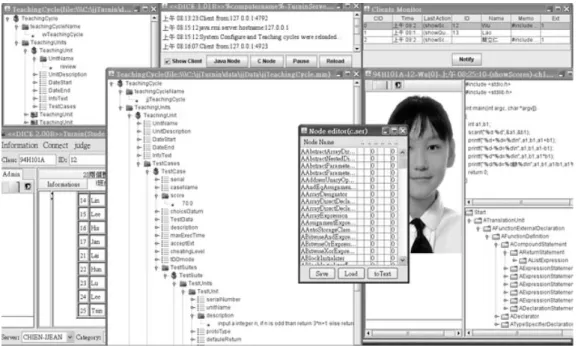
Since 2005, we have commenced to establish DICE system for a test-based assignment tu-toring and problem solving environment. [5] All training work, including assigned practice, turn-in and assessment can be run on the DICE system. DICE has been working at Hsing Kuo High School in Taiwan R.O.C. over 2 years. Figure 5 shows a running DICE System. After running DICE for years, we found some well-known problems of a test-based grader. These caused the underachievers to be elimi-nated from the DICE system. One problem is that only clearly defined questions with a com-pletely specified interface can be used. It leads students to focus on output correctness first and foremost, and it does not encourage or reward for good performance while testing [12]. An-other of the perceived shortcomings is that its inflexibility prevents assessment of more com-plex questions [2]. When a complex question occurs, we found that some underachievers just sat before his/her computer and waited for the bell to ring. So we need a more sophisticated mechanism to help underachievers.
At the second stage, we refer to training method criteria and TDD concepts to establish a new training model for learning programming, which
Figure 5.A running DICE.
is named the DICE TDD Model[10]. It provides sixteen kinds of training methods for learners. At the third stage, we conduct Kolb’s [8][9] learning style instrument as the test item of indi-vidual differences. We find the best fit between learning styles and training methods which will result in a satisfactory learning outcome. We will prove that different learners need different training methods in the DICE system. [11]
4. Using Typed Mind Map in DICE
Typed Mind Maps now are widely used in the DICE system to provide a uniform data model between system, instructors, learners and mate-rials. The applications include:
– System configuration – System deployment – Learner’s information
– Training Materials organization – Answer Parsing
– Widgets
In the next two subsections, we will describe clearly the use of the training material organi-zation and an electric Kolb LSI widget.
4.1. Training Material Organization for DICE TDD Model
DICE TDD is a comprehensive model in an au-tomatic grading system for DICE. As Figure 6 shows, a program assignment was given after
Figure 7. The schema of a test in TDD DICE.
each teaching unit. The instructor makes a test plan consisting of problems (or so called test cases). A test case was composed by the test-based grader, like data sets and TDD-like data sets.
As Figure 7 shows, a training material in TDD DICE is structured bottom up from test items, test units, test suites, test cases, and test units to a test cycle.
4.1.1. Storage Policies
Generally, there are four main policies to store the training material to a computer system: – Storing materials to a file/directory system – Storing materials in a relational database
system
– Storing materials in an object-oriented data-base system
– Storing materials to serial XML files.
As Figure 8, the original design of TDD in DICE organized training materials to a file/directory system for keeping DICE independent(e.g. need not rely on heavy database system). As Table 2 indicates, a file-based storage policy is faulty on many points except economic. For example, a file-based policy is hard to distribute the training
File
Directory RelationalDatabase OODB XMLfiles Typed
Mind Map
Distributed − + + + + + +
Deployed − + + + + + +
Economic + + − − − + + + +
Efficient − + + + − − − −
Intuitive − − − + + + + +
Knowledge
Represented − − − + + + +
Table 2.Comparison between different training material storage policies.
material to instructors’ space and the format of a file is non-intuitive for human understanding.
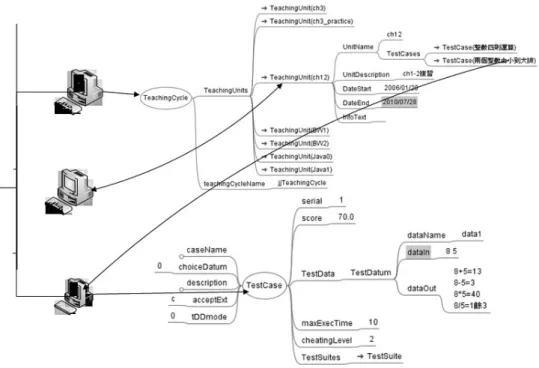
In the DICE TDD model, we take each compo-nent in Figure 6 as a “concept” of a typed Mind Map. An associated node of a concept can be a component node or a reference (i.e. linked node). In our typed Mind Map API implemen-tation, a linked node can be point to different typed Mind Map placed on any TCP/IP device via standard URI retrieve technique or our typed Mind Map delivering layer API. The main ad-vantage of this policy makes the deployment of training materials more flexible for different teaching and training environments than ever.
As Figure 9 shows, same material expressed in Figure 8 was transferred to several typed Mind Maps and deployed to different hosts via IP network. The instructor in host 1 planned a teaching cycle named ‘jjTeachingCycle’ to or-ganize sequence of teaching units to be placed on different hosts. The teaching unit ch12 was cached to host 1 while the others were kept for reference. The host maintained an independent teaching unit type Mind Map that was cited by host 1. Meanwhile, it referred to an independent test case that was replaced on host 3.
4.2. A Widget for Evaluating Learner’s Kolb Learning Style
As an adaptive learning environment, DALM (DICE adaptive learning model)based on DICE test-driven development(TDD)model was im-plemented in a parse-tree based automatic on-line grader. There are three variables in DALM. The individual differences variable(I)classifies the learners into several groups. The training method (T) tells which TDD model is chosen in DICE. The learning outcome (O) presents the learning performance of learners with an in-dividual difference level and the chosen TDD model. The learning outcome is related to the individual difference and the training method, denoted as O=f(I, T).
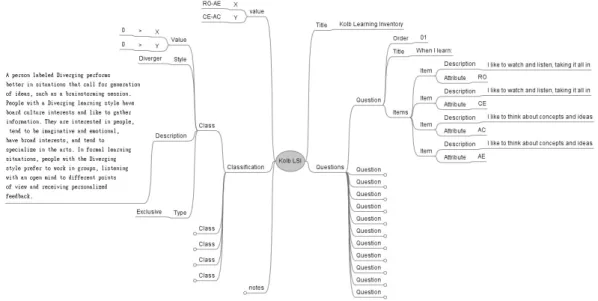
In DALM, we need a tool to measure learner’s Kolb learning style(KLS)as individual differ-ence. A TMM-based widget was built up for evaluating the learner’s KLS before a teaching cycle. Figure 10 show TMM of the Kolb’s learn-ing style inventory-version 3.1. [8]As Figure 11 shows, our TMM-based KLS widget loads and transfers the Typed Mind Map to an electronic questionnaire. The result of this questionnaire is packed to a TMM and is delivered to DICE server as part of the learner’s information.
Figure 10.Typed Mind Map of Klob’s learning style inventory.
Figure 11. A widget for evaluating learner’s Kolb learning style.
5. Conclusions and Future Work
This paper describes an innovative Mind Map usage via extending a kernel type Mind Map associated with the original Mind Map. The kernel type Mind Map represents the schema by a syntax node and the ontology by a semantic node. Such a policy makes the best flexibil-ity of using a Mind Map. A traditional Mind Map is a non-typed Mind Map that can be used during system designing stage for keeping the most variant possibility of structure. When the
system gets into a stable stage, it is easily ex-tended to syntax typed Mind Map by associating the traditional Mind Map with syntax node type Mind Map. A syntax typed Mind Map can be used to do the schema checking by tree compar-ing. This study shows it works well in a DICE TDD system as a uniform data model.
learner’s information to training materials orga-nization. This study shows it works well in a DICE TDD system as a uniform data model. In Section II we have defined a systematic and symbolic model for typed Mind Map. For tak-ing the typed Mind Map as a data model, the typed Mind Map algebra is proposed. Some basic definition of elements, axioms and opera-tions were made and implemented in our TDD API. We take the TMM algebra proposal as an important future work. Moreover, after the sys-tem has run for years in a stable stage, we can start to develop the semantic type node of the system. For we have defined a semantic type Mind Map by an OWL-DL, it’s more suitable to develop the machine learning and reasoning mechanisms with artificial intelligence meth-ods.
References
[1] BUZAN, The Mind Map Book: Mind Mapping
Guidelines, Penguin, New York, 1991.
[2] D. CHRISTOPHER, L. DAVID ANDO. JAMS,(2005).
“Automatic Test-based Assessment of Program-ming: A Review”, ACM Journal of Educational Resources in Computing, Vol. 5, No. 3, September 2005. Article 4.
[3] DIMITRYPOLIVAEV. FreeMind – free mind mapping
software, FreeMind Official Homepage & Wiki, Available at http://freemind.sourceforge .net/wiki/index.php/Main Page, 2008.
[4] D. L. MCGUINNESS AND F.VAN HARMELEN, eds.
OWL Web Ontology Language Overview, World Wide Web Consortium (W3C) recommenda-tion, Available at http://www.w3.org/TR/owl-features.
[5] LI-RENCHIEN, D. BUEHRER AND CHINYIYANG. Dice: A Parse-tree Based Online Assessment Sys-tem for a Programming Language Course, Interna-tional Conference on Teaching and Learning(iCTL 2007), Putrajaya, Malaysia, 2007.
[6] T. R. GRUBER, A Translation Approach to Portable
Ontology Specification, Knowledge Acquisition 5: pp. 199–220, 1993.
[7] JOHNW. BUDD., Mind Maps as Classroom Exercise, Journal of Economic Education, 2004.
[8] A. Y. KOLB, D. A. KOLB, The Kolb’s learning style inventory-version 3.1 2005 technical specifications, Boston, MA: Hay Resource Direct. 2005.
[9] D. A. KOLB ANDR. FRY, “Toward an applied theory of experiential learning”. In Thories of Group Pro-cess, G.L. Cooper(ed.), John Wiley and Sons, Inc., New York, NY, pp. 33–54, 1975.
[10] LI-RENCHIEN, D. BUEHRER ANDCHIN YIYANG.
Using Test-driven Development in a Parse-tree Based Online Assessment System, IADIS Inter-national Conference e-Learning, Lisbon, Portugal. 2007.
[11] LI-RENCHIEN, D. J. BUEHRER, CHIN-YIYANG. An
Adaptive Learning Environment in the DICE Sys-tem with a TDD Model,Interactive Computer Aided Learning, Villach(ICL 2007), Austria, 2007.
[12] STEPHEN H. EDWARDS AND MANUEL A. P´EREZ
-QUINONES˜ . Experiences using test-driven develop-ment with an automated grader,Journal of Comput-ing Sciences in Colleges. Vol. 22, Issue 3, January 2007.
[13] T. BUZAN. Use your head. BBC Books, N. F. Noy
and D. L. McGuinness.(2001)“Ontology”, 1974.
[14] Y. SURE, M. ERDMANN, J. ANGELE, S. STAAB, R.
STUDER ANDD. WENKE. OntoEdit: Collaborative
ontology development for the Semantic Web, 1st International Semantic Web Conference (ISWC 2002), Vol. 2342 of LNCS, pp. 221–235, 2002.
Received:June, 2008
Accepted:September, 2008
Contact addresses:
Li-Ren Chien Department of Computer Science and Information Engineering Chung Cheng University #168, University Rd, Min-Hsing Chia-Yi, Taiwan, R.O.C. e-mail:[email protected] Daniel J. Buehrer Department of Computer Science and Information Engineering Chung Cheng University #168, University Rd, Min-Hsing Chia-Yi, Taiwan, R.O.C. e-mail:[email protected]
LI-RENCHIENis a Ph.D. candidate in the Department of Computer Science and Information Engineering at Chung Cheng University, Tai-wan, R.O.C. He obtained the BS in physics from Chung Yuan Christian University and the MS in computer science and information engineer-ing from Chung Cheng University. He has been a teacher of computer science and physics in Hsin Kuo high school, Taiwan, R.O.C. since 1989. His research interests are e-learning, automatic grading system and artificial intelligence.
DANIELJ. BUEHRERwas born in Green Bay, Wisconsin, USA. He re-ceived his B.S. in physics and in mathematics from Carroll College, Waukesha, Wisconsin, in May, 1971. His M.S. and Ph.D. in computer science were received from the University of Iowa in Dec. 1973 and May, 1976, respectively. He was an assistant professor at the University of South Carolina from 1976–1979, at National Tsing Hua University from 1979–1986, DePaul University from 1986–1987. He worked at Rich, Inc. of Chicago from 1987–1988. He has been with the Dept. of Computer Science and Information Engineering at National Chung Cheng University since the beginning of the University, in 1989, and is now a full professor there.