Lucrări ştiinţifice Zootehnie şi Biotehnologii, vol. 40(2), (2007), Timişoara
CONTRIBUTION TO THE KNOWLEDGE OF THE RESTING
BEHAVIOR OF DAMS AND NEWBORN CALVES
CONTRIBU
Ţ
II LA CUNOA
Ş
TEREA COMPORTAMENTULUI
DE ODIHN
Ă
AL VACILOR-MAM
Ă
Ş
I VI
Ţ
EILOR
NOU-N
Ă
SCU
Ţ
I
TRIPON I., STANCIU G., GAVOJDIAN D., CZISZTER L. T., ACATINCĂI S., BAUL SIMONA
Faculty of Animal Sciences and Biotechnologies, Timişoara, România
The aim of this paper was to measure the main aspects that characterized the resting behavior of the dam-calf couple in the first week after calving. The experiments were carried out in winter on 5 dam-calf couples. During the experiments, the following resting behavior aspects were determined: number of periods standing up, number of periods lying down, the length of the periods. Data was computed by ANOVA/MANOVA. Results showed that the mother cows spent on average 761 minutes standing up, respectively 54% from a day length, and 633 minutes lying down, respectively 46% from a day time. The calves spent on average 224 minutes standing up during 12.7 periods, respectively 16% from a day length and 1216 minutes lying down.
Key words: resting behavior, mother cows, newly born calf, Romanian Black and White Cows.
Introduction
Lately researches about animal behavior became important. The results from these researches are used to evaluate the welfare of farm animals and to improve the technologies used to raise them.
In the last years, major progresses in video recording devices, the reduced costs for video cameras and video recorders made possible very precise studies of cattle behavior. Very precise data obtained from those studies were used to develop new and better technologies for cattle.
In the modern era, new technologies of cattle breeding have been developed. These technologies are based on a high degree animal concentration. Cattle are maintained within large groups in small spaces, in very artificial conditions. The time spent for each individual is more and more reduced. In those conditions, the modification of behavior caused by some stress factors affects the production.
This paper presents a study of resting behavior of dam-calf couple during the first week after calving.
Materials and Methods
Researches were carried out during the winter season between 09.02.2006 and 29.02.2006 at the university research farm, on a number of 5 couple dam-calf from Romanian Black and White breed.
The mother cows and their calves were housed in the maternity barn on 4.1 x 2.5 m pens. The behavior of calves and their mothers was video recorded nonstop during the first, second and seventh day after calving.
To record the behavior of dam-calf couple a Panasonic video camera was used connected to a Panasonic video recorder type NV-FJ622EE-K. For recording 180 minutes video cassettes were used set in the Ep mode so that it was possible to record 9 hours on each cassette. Also, the video camera permitted to record the date and hours in a mode that included minutes and seconds, which helped the timing process.
For a better interpretation the recorded material was divided in three periods for every 24 hours of surveillance: 07:00 to 15:00, 15:00 to 23:00 and 23:00 to 07:00.
In the processing of recorded data the feeding and elimination behaviors were observed for dam-calf couple by counting and timing the periods.
Data obtained from these observations was processed with ANOVA/MANOVA.
Results and Discussions
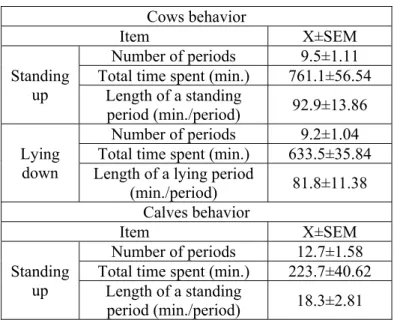
Daily average values for resting behavior of dam-calf couple during the first week after calving are presented in Table 1.
Cows spent, on average, 761 minutes standing up representing 54% of a day and 633.5 minutes representing 46% of a day time on the first week after calving.
Calves spent standing up only 224 minutes, respectively 16% of their total time.
Cows spent standing up 9.5 periods a day with a length of 93 minutes. The calves spent standing up 12.7 periods, but with a length of only 18 minutes.
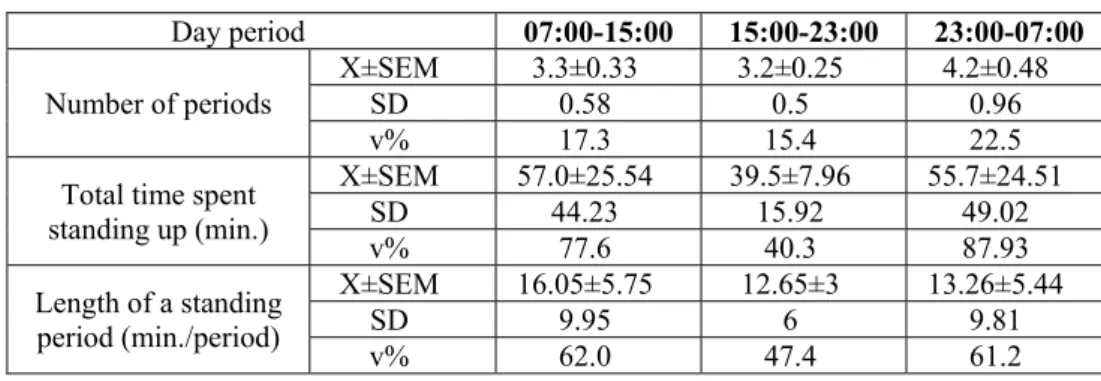
Table 2, Table 3 and Table4 presents calves resting behavior during the first week after calving.
From Table 2, Table 3 and Table 4 data results that during the experiments calves spent a large amount of their time lying down with short periods when they were standing up. Calves spent from 12.4 minutes to 20.3 minutes in the standing up position. The variability for these behavioral aspects was very high from 57.3% to 93.4%.
and 5.2 periods during the afternoon and between 3.5 and 4.2 periods during the night.
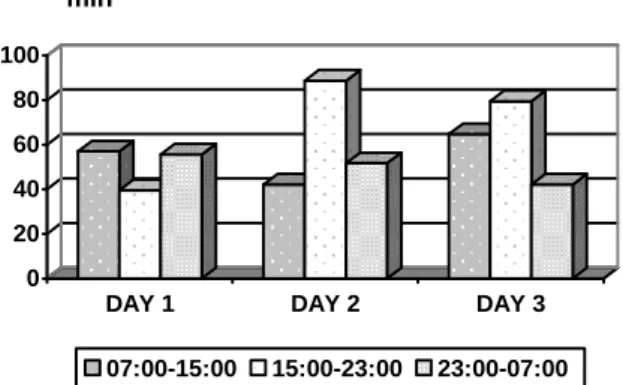
Calves were standing up 57 minutes during the morning of the first day of study, 39.5 minutes during the afternoon and 55.7 minutes during the night. In the second day of the experiments calves stayed up 42.1 minutes in the morning, 88.8 minutes in the afternoon and 51.7 minutes during the night.
Table 1
Resting behavior of the dam-calf couple (daily averages) in the first week after calving
Cows behavior
Item X±SEM
Standing up
Number of periods 9.5±1.11 Total time spent (min.) 761.1±56.54
Length of a standing
period (min./period) 92.9±13.86
Lying down
Number of periods 9.2±1.04 Total time spent (min.) 633.5±35.84 Length of a lying period
(min./period) 81.8±11.38 Calves behavior
Item X±SEM
Standing up
Number of periods 12.7±1.58 Total time spent (min.) 223.7±40.62
Length of a standing
period (min./period) 18.3±2.81
Calves stayed up more during the morning (64.8 minutes) and during the afternoon (79.6 minutes) of the seventh day and less during the night (42.1 minutes).
Figure 1 presents the average value for the time spent standing up by calves. From the chart results that calves spent more time standing up in the afternoon of the second and seventh day of the study (88.8 and 79.6 minutes, respectively).
Table 2
Calf resting behavior during the first day after calving
Day period 07:00-15:00 15:00-23:00 23:00-07:00 Number of periods
X±SEM 3.3±0.33 3.2±0.25 4.2±0.48 SD 0.58 0.5 0.96 v% 17.3 15.4 22.5 Total time spent
standing up (min.)
X±SEM 57.0±25.54 39.5±7.96 55.7±24.51 SD 44.23 15.92 49.02 v% 77.6 40.3 87.93 Length of a standing
period (min./period)
X±SEM 16.05±5.75 12.65±3 13.26±5.44
SD 9.95 6 9.81
v% 62.0 47.4 61.2 Table 3
Calf resting behavior during the second day after calving
Day period 07:00-15:00 15:00-23:00 23:00-07:00 Number of periods
X±SEM 3.7±0.85 5.2±1.38 3.5±0.5 SD 1.7 2.75 1 v% 45.5 52.5 28.6 Total time spent
standing up (min.)
X±SEM 42.1±3.2 88.8±17.5 51.7±14.09
SD 6.35 35 28.19 v% 15.1 39.4 54.5 Length of a standing
period (min./period)
X±SEM 12.5±2.1 21.7±6.68 16.58±5.21
SD 4.14 13.37 10.44
v% 33.0 61.4 62.9 Table 4
Calf resting behavior during the seventh day after calving
Day period 07:00-15:00 15:00-23:00 23:00-07:00 Number of periods
X±SEM 3.4±0.75 4±0.32 3.6±0.24 SD 1.67 0.7 0.54 v% 49.2 17.7 15.2 Total time spent
standing up(min.)
X±SEM 64.8±17.6 79.6±34.0 42.1±9 SD 39.34 76.05 20.12 v% 60.7 95.6 47.8 Length of a standing
period (min./period)
0 20 40 60 80 100
min
DAY 1 DAY 2 DAY 3
07:00-15:00 15:00-23:00 23:00-07:00
Figure 1: Average values for the time spent standing up by calves
Conclusions
Calves spent standing up on average 223.7 minutes per day during the study divided in 12.7 periods.
Calves spent standing up between 55 and 72 minutes during 8-hour span (morning, afternoon or night) representing between 11.5 and 16% of the total time.
Calves spent standing up only 224 minutes, respectively 16% of their total time. Cows spent, on average, 761 minutes standing up representing 54% of a day time.
Calves spent standing up between 3.3 and 3.7 periods in the morning, between 3.2 and 5.2 periods during the afternoon, and between 3.5 and 4.2 periods during the night.
Bibliography:
1. Hänninen, L., De Passille, A. M., Rushen. J (2005)-The effect of flooring type and social grouping on the rest and growth of dairy calves. Applied Animal Behaviour Science, 91: 193-204.
2. Podar, C., Kelemen, A., Reman, D.G., Oroian, I., Suba, C. (2005) – Din viaţa şi comportamentul taurinelor. Implicaţii tehnologice, Bucureşti.
3. Sato, S., Wood-Gush, D. G. M., Wetherill G (2002). – Observations on crèche behaviour in suckler calves, Behavioural Processes, Volume 15, Issues 2-3, Pages 333-343.
CONTRIBU
Ţ
II LA CUNOA
Ş
TEREA COMPORTAMENTULUI
DE ODIHN
Ă
AL VACILOR-MAM
Ă
Ş
I VI
Ţ
EILOR
NOU-N
Ă
SCU
Ţ
I
TRIPON I., STANCIU G., GAVOJDIAN D., CZISZTER L. T., ACATINCĂI S., BAUL SIMONA
Faculty of Animal Sciences and Biotechnologies, Timişoara, România
Scopul acestui studiu a fost determinarea principalelor aspecte care caracterizează comportamentele de odihnă al cuplului format din vaca mamăşi viţelul nou-născut în prima săptămână după fătare. Experimentele s-au desfăşurat în sezonul de iarnă pe 5 cupluri vacă mamă cu viţelul. Au fost urmărite următoarele aspecte ale comportamentului de odihnă al viţeilor şi al vacilor mamă: numărul perioadelor petrecute în poziţie ortostatică, numărul periosdelor petrecute în decubit, durata perioadelor. Datele au fost prelucrate folosind analiza varianţei şi comparate între ele cu ajutorul testului ANOVA/MANOVA. Rezultatele obţinute au arătat că vacile mamă au stat în medie în poziţie ortostatică 761 de minute, reprezentând 54% din timpul unei zile şi 633 minute în decubit, reprezentând 46% din timpul total al unei zile. Viţeii au petrecut, în medie, 224 de minute pe zi în poziţie ortostatică repretentând 16% din durata unei zile şi 1216 minute în decubit.