how to address controversy. It continues by characterizing opportunity, identifying common catalysts that create demand for effective planning, and discussing how to recognize moments of leverage to advance community goals. The concluding section presents a series of case studies illustrating these principles in practice.
Understanding Controversy
In a community planning context, the catalysts for controversy are often: (1) A persistent problem that stakeholders want addressed; or (2) A pending decision that significantly impacts stakeholders. In both cases, there are often competing interests that pit one set of community constituents against another.
A problem or decision can rise to the level of a controversy when there are deeply held opposing views and when the normal decision-making process is
Expanding Our Influence: Embracing
Controversy and Seizing Opportunity
Ben Hitchings
Roger Waldon
Two factors often shape the outcome of community planning efforts – how planners handle controversy and
how they seize opportunity. This article characterizes these factors, identifies strategies to address them, and
presents several case studies to illustrate these techniques in practice. In so doing, it offers insights on how
to turn a community’s passions to productive use and expand our influence as planning professionals.
Ben Hitchings, AICP, CZO, is the Planning Director for the Town of Morrisville, North Carolina, and the President-Elect for the North Carolina Chapter of the American Planning Association. Roger Waldon, FAICP, is a Principal with Clarion Associates, former Planning Director for the Town of Chapel Hill, and author of a book published by Planners Press entitled Planners A day in the life of a community planner is not
always exciting. Yet, amid the regular fare of site plan reviews, planning board meetings, and presentations to public officials, there are defining moments when planners either expand or diminish their relevance as planning professionals. At these times, the cumulative benefits of day-to-day community planning efforts can be washed away in a flood of criticism. Or, when thoughtfully managed, such moments can highlight the extraordinary value of good planning and lift the planner and the profession on a wave of appreciation. The difference often depends on two things: 1) how planners handle controversy, and 2) their ability to seize opportunity.
Controversy is a powerful force in community planning. If poorly managed, it can divide citizens and discredit planners. However, if appropriately channeled, controversy can be a productive force that engages stakeholders and builds commitment to developing lasting solutions to ongoing community problems. In turn, windows of opportunity open and close for advancing important community goals. The profession’s ability to recognize and seize these opportunities can have a dramatic effect on its ability to catalyze positive community change.
Carolina Planning Volume 37
deadlocks”, and “relationship deadlocks” that impede efforts to develop a successful resolution to the problem. Such impasses sometimes escalate a disagreement or dispute into a full-blown controversy.
The Cost of Controversy
Controversy is often a sign that real decisions are being made and that there is genuine disagreement about what course of action to take. Significant resources may be at stake and serious impacts may threaten different stakeholders. Controversy can be a force that is hard to control; bringing with it a number of pitfalls. It creates a bully pulpit for grandstanding and personal attacks and can create a stage for widespread misinformation. It creates significant costs in time and resources that have to be directed away from other activities planning bodies are involved in. As a result, anticipating potential sources of controversy and taking active steps to manage or avoid them can help protect organizational resources for other activities. Sometimes, however, this leads to premature compromise. Other times, lasting resolution is only possible through a full community airing and discussion of an issue, however heated. Planners often have to play the role of a referee to clarify the rules of the process, and make sure that the various participants adhere to them. They can also serve as a valuable source of information, help to identify the range of options available, and enumerate the trade-offs. Finally, they can manage the process and help guide it to successful resolution.
challenged in resolving the issue in a broadly acceptable manner. Negotiation experts William Ury and Richard Smoke (1985) note that certain factors often trigger a crisis including:
•
Little time;•
High uncertainty;•
Narrowed options; and•
High stakes.The exact point when a dispute becomes a controversy is sometimes hard to define, but the resulting condition is often marked by the following elements:
•
Strongly held views that appear to be in conflict;•
Vigorous and often rancorous public debate;•
A sense of existing or pending injustice; and•
Active media coverage.Participants and Roles
Controversies ignite strong emotions in participants. While passions may at times impair the ability of some stakeholders to discuss the issues in a way that others consider rational, passion is also a sign that participants care. As a result, they may be willing to invest significant time and energy in resolving the issue.
As controversy begins to develop over a specific issue or upcoming decision, it is helpful to recognize and consider the roles of various participants in the process. Godschalk et al. (1994) describe circles of participation in disputes, with decision makers and primary stakeholders in the center circle, and active community leaders and the general public representing additional rings of involvement extending outward. The various participants in a dispute start with different levels of power, and some of them may feed the controversy in an effort to expand their power and influence in the process. In turn, members of the media often describe the dispute and amplify it through their coverage. In response, organizational actors may try to manage the controversy to support their position on an issue. Planners often have the opportunity and responsibility of trying to manage this debate and promote the development of a lasting solution.
Interests may stratify along geographic lines, social or economic ties, or shared experiences. A key tension often forms between the interests of an individual or a neighborhood, and the community at large. In such circumstances, people directly affected by the issue tend to participate most actively (for example on the issue of whether or not to connect a road through a neighborhood). These divisions can leave a void that planners fill in representing the larger community interest.
Another scenario that can emerge is a struggle for influence in the decision-making process. Godschalk et al. (1994) identify controversy as a means by uninvolved participants to try to get power in a process. They also identify a variety of “procedural deadlocks”, “substantive
The Madison Avenue Approach
This approach seeks to manage controversy through careful message development and marketing in an effort to shape public perceptions. Often, this approach amounts to sharing information and working to frame an issue based on a particular perspective. More extreme forms, however, can involve misinformation and outright propaganda. In an age of 24-hour news cycles, this technique sometimes entails establishing a system of rapid response to commentary and criticism on an issue in an effort to manage the media and shape the public debate.
Planners and others who subscribe to high ethical standards work to acknowledge divergent perspectives and share accurate information with interested participants. Transparency and access to information in turn can help promote understanding that leads to resolution. This approach is based on the premise that if everyone is working in the context of full, complete, and accurate information, there is a better chance for a successful community outcome. Whatever form it takes, this approach often involves considerable time and resources to conduct and sustain. Even when resources are limited, there is often value in sharing one’s perspective in a clear and concise way.
The Dispute Resolution Approach
In this approach, facilitation and dispute resolution techniques are utilized to identify stakeholders, establish a process, share information, build common understanding, and work collaboratively to develop a mutually acceptable solution. This technique can be very effective in resolving issues, and can build strong long-term relationships among participants. However, it can also take considerable time and resources. As a result, this may not be a good strategy Approaches for Addressing Controversy
When a controversy begins to emerge in a community, it often represents an opportunity for planners to help a community make progress on important issues (and in so doing, demonstrate and showcase some of the benefits of good planning). What options are available to planners and decisionmakers when a problem or pending decision has been elevated to the level of a controversy? Here are four to consider:
The Neville Chamberlain Approach
Named for the British Prime Minister who gave in to Germany shortly before World War II, this strategy of appeasement and partial or complete capitulation can quickly end a controversy, but can inhibit a long-term resolution of the actual problem. This can be a good strategy to use when the stakes are low or there are upcoming opportunities to address an issue more fully. Full surrender on an important issue, however, can cause lasting resentment among participants whose interests were not advanced through the solution, negatively impacting consensus building on future issues.
The Damn the Torpedoes Approach
This full speed ahead approach articulated by Admiral David Farragut during the Civil War tries to proceed quickly through the controversy to seek resolution — however unsatisfactory — in an effort to create a sense of finality, in the hopes that participants will move on and the controversy will blow over quickly. It can generate a quick decision and can be good to use when there are a few isolated hold-outs on an issue. However, when the stakes are high and powerful parties are on the losing end, the resolution may be short-lived and unilateral resolution can generate hard feelings that may impair future decision
Carolina Planning Volume 37
C. Emerging threats (e.g. a controversial cell tower case with more on the way, concerns about the negative impacts of hydrofracking): As technologies evolve and societal needs change, communities will confront new land use issues. Tracking these trends can help planners anticipate emerging topics of community concern. One example of this in North Carolina is the phenomenon of hydrofracking. Hydraulic fracturing (hydrofracking) is a relatively new practice being used to mine natural gas out of the ground. This process has come under scrutiny due to concerns about environmental and health safety. One of the concerns is that the materials used can contaminate aquifers and spoil water supplies. This is an example of an emerging issue that would benefit from planner attention on the front end, to position a community to deal with the controversy when it unfolds.
D. Leader interests (e.g. particular issues that are of interest to people in power): Planners should always have an ear to the ground and be aware of the leading issues that are on the front burners of elected officials and other community leaders. Paying attention to issues that are high priorities for a community, and working to be sure that those issues get adequate work and attention, not only helps the community but also enhances the credibility and visibility of planning’s role in addressing community issues.
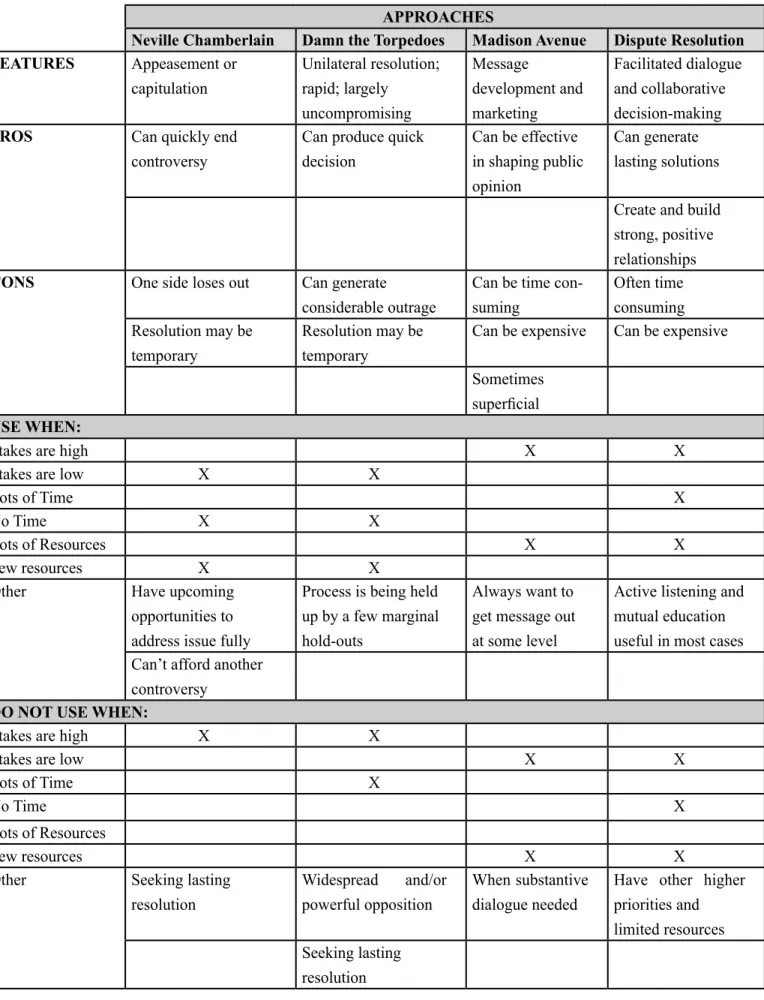
There are times when each of these strategies may be a desirable one to pursue. Elements of each may also work well in combination or separately at different stages in a controversy. All are legitimate strategies that help move beyond controversy. The key is to consider the circumstance of each controversy and thoughtfully decide which approach is best. If the answer is that the Dispute Resolution Approach is best, the situation is likely ripe for a planner to step to the front in highly a visible way to both help the community, and demonstrate the value of good planning. A summary of the options and when they good to use is included in Table 1.
Seizing Opportunity
While planners are often forced to confront controversy, an equally important challenge is recognizing opportunity and determining how to seize it to effect positive change in the community. To do so requires an understanding of how local
governments and other organizations make decisions and what drives them to take action. There are several ways in which planners can both identify and take advantage of opportunities:
Call to Action
Planners should keep their eyes out for situations such as the following that sometimes motivate action.
A. Persistent complaints (e.g. cars always speed through our neighborhood: development review process is too slow: our street always floods in a heavy rain): Recurring feedback of this kind is a clear indication of the need for attention to an issue, and for possible remedial action. A planner should be ever mindful of this kind of situation, for use in setting priorities among the many community issues to be addressed. And in exercising this kind of responsiveness, a planner can both address a community need and enhance professional credibility
B. Unusual events (e.g. a pedestrian death; a major flood; an unanticipated surplus in the annual budget): The heightened community awareness that often comes in the wake of unusual events can spur the development of lasting solutions to long-standing community problems. When an event like this occurs, planners should routinely ask themselves what planning action or initiative would help address the problem. The very act of asking that question raises the profile of the planning function as a community response mechanism.
Citizens leaning in for discussion: When controversies get heated, citizens
APPROACHES
Neville Chamberlain Damn the Torpedoes Madison Avenue Dispute Resolution
FEATURES Appeasement or
capitulation
Unilateral resolution; rapid; largely
uncompromising
Message
development and marketing
Facilitated dialogue and collaborative decision-making
PROS Can quickly end
controversy
Can produce quick decision
Can be effective in shaping public opinion
Can generate lasting solutions
Create and build strong, positive relationships
CONS One side loses out Can generate
considerable outrage
Can be time con-suming
Often time consuming Resolution may be
temporary
Resolution may be temporary
Can be expensive Can be expensive
Sometimes superficial USE WHEN:
Stakes are high X X
Stakes are low X X
Lots of Time X
No Time X X
Lots of Resources X X
Few resources X X
Other Have upcoming
opportunities to address issue fully
Process is being held up by a few marginal hold-outs
Always want to get message out at some level
Active listening and mutual education useful in most cases Can’t afford another
controversy DO NOT USE WHEN:
Stakes are high X X
Stakes are low X X
Lots of Time X
No Time X
Lots of Resources
Few resources X X
Other Seeking lasting
resolution
Widespread and/or powerful opposition
When substantive dialogue needed
Have other higher priorities and limited resources Seeking lasting
Carolina Planning Volume 37
Infrastructure improvements? Parties involved with a stake in the Village Center were cordial to each other, but objectives and agendas differed, and each developed its own plans for activities and facilities in the Village.
A Planning Director with foresight saw opportunity in dealing with this conflict. This was a case of Preparing for Opportunity. Change was occurring in Pinehurst, and interest in the Village Center was picking up. A temporary slowing of market conditions was accompanied by increased interest, following national trends, for living, working, and recreating in a village-type environment. There was opportunity to create a framework to encourage separate, independent organizations to make decisions that would reinforce each other, and in so doing enhance the outcomes. The Director assembled participants, and pursued implementation of what would become known as the Village Roundtable. At the first meeting, the participants identified several potential models of working together: Independent Action (continuation of the status quo, with each party doing its own thing); Cooperation (involving information-sharing); and Collaboration (involving joint planning and sponsorship, simultaneous joint actions by multiple parties). The Roundtable members decided to meet regularly and launch a special website that allowed parties to post and share information and ideas. Quarterly meetings allowed for discussion and resolution of issues that had previously been divisive.
The Roundtable generated a new collaborative energy centered on a consensus vision of what is most important and valued about the Village Center. In this
Preparing for Opportunity
Planners can prepare for opportunity by tracking regional and national trends, and keeping an eye out for issues that may be making their way to their community. For example, the need to stimulate the national economy may create a new source of federal funding to help their community complete a much-needed local infrastructure project. We can also use a temporary lull in development activity within a jurisdiction to prepare for an expected upcoming surge in growth. The better we understand political, social, and economic forces and how they interact in our community, the better our chances of recognizing an emerging opportunity.
Moments of Leverage
Planners can help create opportunity through successes on other projects. A good time to start work on a controversial initiative is often on the heels of a planning success. Did your community just win a grant to make a much needed transportation improvement? Maybe now is a good time to push for updating the pedestrian-bicycle plan. Did the Council just bask in the glow of a county historic preservation award? Maybe now is the time to try to start the façade renovation grant program.
Case Studies of Addressing Controversy and Seizing Opportunity
The following are examples of controversies from North Carolina communities. There are three examples that help illustrate some of the challenges and opportunities planners face: Example 1, from the Village of Pinehurst, illustrates “Preparing for Opportunity”; Example 2, from the Town of Hillsborough, illustrates a “Call to Action”; and Example 3, from Iredell County, describes an initiative that grew out of a “Moment of Leverage.”
Example 1: Pinehurst - Different Visions for the Village Center
The Village Center in Pinehurst, originally designed by Frederick Law Olmstead, stands as one of the classic pieces of urban America. There are many residents and organizations in Pinehurst who consider it their privilege and obligation to be stewards of this unique and historical treasure. Not surprisingly, not all individuals and organizations see the task of preserving the Village Center in the same way. Close to a dozen organizations/ institutions exist in Pinehurst, each with its own interest and stake in the Village Center. Some approach the situation from a perspective of historic preservation— with strict adherence to the original Olmstead drawings and plans. Others see the Village Center as an opportunity for context-sensitive commerce, economic growth and tourism. These organizations should have worked together, but controversies based on differing priorities and interests divided them. How to approach parking? Landscaping? Traffic issues? Event planning?
Collaboration Triangle: There are varying levels of
cooperation that can occur among organizations. Independent
action by parties with differing interests in a controversy can become obstructive. Sharing information about issues and
actions between organizations is useful. What we should
aspire to achieve is collaborative, joint action where
market forces for development were compelling. Key to the agreement was that the swap of jurisdiction be acre-for-acre. The planning directors saw in the controversy the opportunity for intergovernmental cooperation and success.
Example 3: Iredell County - Rural and Urban Interests
Iredell County provides another example of North Carolina’s growing pains and an accompanying set of community tensions and opportunities. This traditionally rural county on the edge of the Charlotte metropolitan region increasingly saw itself torn by controversies, pitting 7th-generation farmers against NASCAR-fueled growth advocates in a classic urban-rural edge story. Farmers saw subdivisions come up to the boundaries of their cultivated fields, complete with wells along property lines that made application of fertilizers and pesticides illegal. New suburban residents were annoyed by farming operations, odors, and agricultural equipment. Farmers were angry about having to pay via taxes for services for affluent developments—services they would never use. The farming community was upset with the loss of agricultural land but unwilling to consider land use example, the planner saw an opportunity in the controversy
and divergence of opinion among the stakeholders, and seized the opportunity to help construct a framework that could positively impact the community. No action was certainly a possibility here, but instead the planner proactively constructed a framework for collaborative action, and in so doing elevated the visibility and regard for the planning function.
Example 2: Hillsborough - Intergovernmental Issues
Located in Orange County, Hillsborough is an example of a community with a historic core surrounded by post-war suburban growth. Orange County is a diverse center of activity with an active culture of participatory governance, an agricultural heritage, and an array of growth management policies. The Town of Hillsborough exercises zoning jurisdiction within its town limits and extraterritorial jurisdiction (ETJ); Orange County rules apply outside those areas.
Growth philosophies differ between the Town and County. As development pushed outward from the historic core, Hillsborough managed the growth through its zoning and subdivision ordinances—but problems occurred at the edges. With this expanding development at the periphery, problems emerged with the set of differing Town and County regulations. Hillsborough’s ETJ was established decades ago without the benefit of the information and management practices currently available. Developments outside of Hillsborough’s jurisdiction were developed under County standards, with not enough attention (in the eyes of the Town) to issues of street standards, water and sewer infrastructure and capacity, and connection to adjoining land uses. Hillsborough asked for consideration of extension of its ETJ, but the County was unwilling to grant one and thereby give up parts of its own jurisdiction. This conflict increased rapidly over time, particularly with respect to allocation of limited infrastructure capacity, and differing points of view fueled the controversy.
The sounds of a “Call to Action” were increasing in volume. This was a case of persistent and repeated dissatisfaction expressed by both landowners and developers about the awkward alignment of regulations and jurisdictions. Town and County planning directors saw the negative impacts of this tension and uncertainty, and were encouraged by the interest of elected leaders who repeatedly found themselves dealing with the misalignment. The planners pro-actively worked to convene a group that would devise an interlocal agreement over a series of meetings. Building on the dissatisfaction and interest in finding a solution, the planners were successful in forging a consensus solution that addressed the concerns. A key provision of the resulting agreement was an exchange of ETJ — the Town gave up zoning jurisdiction in environmentally sensitive areas where
Carolina Planning Volume 37
thoughtful intervention in controversies, planners have an opportunity to promote constructive community dialogue, build mutual understanding, and help participants reach agreement on difficult issues. When a community succeeds in developing a lasting solution to a challenging problem, it can create a sense of accomplishment among the participants, and build stronger relationships that improve the chances of success in resolving future disputes. In this way, planners can help manage controversies and harness community passions for productive uses.
In turn, planners’ understanding of how issues of the hour fit into larger community dynamics and societal trends can help them anticipate moments of opportunity to advance important community needs. As forward thinkers, planners are perennially ahead of their time, encouraging a community to take steps to ensure a successful future when challenges are often just emerging and resistance to change is high. They can address these obstacles by building our understanding of how organizations make decisions and by learning to recognize when different factors might align to create community understanding and support for action on an issue.
Thus, as planners proceed with their daily work, it is worth spending time thinking about how to handle controversy and how to seize opportunity. The insights they glean will make them more effective planners and help them to demonstrate the tremendous value that good planning can bring to their communities.
References
Godschalk, David R. et al. Pulling Together: A Planning and Development Consensus-Building Manual (Washington, D.C.: Urban Land Institute, 1994). Ury, William L. and Richard Smoke. “Anatomy of a
Crisis,” in Negotiation Journal, Vol. 1, No. 1 (January 1985), pp.93-100.
were high.
Planners recognized that a “Moment of Leverage” had emerged. Voluntary Agricultural Districts had been tried and found to be popular and successful in helping to preserve farmland. Officials in leadership positions with the county, the municipalities, the development community, and the Agricultural Extension Service all had started talking about the need for a workable solution. County and municipal planners came together to study the geographies and began to suggest a series of service boundaries to coordinate and limit infrastructure expansions. With preliminary ideas ready to present, they established a working group representing diverse interests. After some adjusting, the new growth boundaries won consensus approval. The working group helped provide information to the farming community owning land outside of the service boundaries about how to place land in the agricultural preservation districts (removing most development opportunity) for a specified period of time (preserving long-term options for subsequent generations). Special service districts were proposed to allow those within the service boundaries, who were demanding county services, to receive those services in conjunction with additional tax responsibilities. The result is highly acclaimed—it allows and plans for urban-type growth in areas suited for it, and preserves agricultural heritage in the key rural areas of the county. Again, active planning turned controversy into opportunity for community enhancement.
Conclusion
For planners working on challenging community issues, controversy is an unavoidable occurrence and moments of opportunity are often fleeting. Through
Suburban encroachment: A classic conflict of interests occurs when urban and