Abstract
I have hypothesized a series of educational booklets that can be used to help pediatric patients with intellectual and developmental disabilities (I/DD) navigate an inpatient stay. For this project I have focused on pediatric cancer and created the first booklet, “I Have: Cancer.” I envision the “I Have” series to expand and encompass more diseases and conditions as I continue my career and education. From my own experience and after consulting with people with multidisciplinary experience with pediatric I/DD, what seemed most helpful to the pediatric patient would be an individualized and interactive approach to patient education. This care booklet could be an inclusive and appropriate method of explanation of cancer for
interdisciplinary use.
My intention is to promote appropriate language and terminology, advocate for pediatric patients with I/DD and their families, and above all, to educate these patients about the process of having cancer and being hospitalized. The hospital can be an alarming place for any child, and for those with I/DD it can be, confusing, and frightening, and disruptive to the routines that can be a source of comfort to them. I hope to alleviate some of the stress that these pediatric patients may experience, and provide a tool for communication between pediatric patients with I/DD and their caregivers.
“I&HAVE:&CANCER”& 3&
Introduction
Life expectancy has increased significantly worldwide in people with intellectual and developmental disabilities (I/DD), resulting in an increased incidence of age related illnesses including cancer (O'Regan, & Drummound, 2008). The incidence of cancer is poorly
documented for this population. Reports vary broadly, citing the incidence of childhood cancer in children with I/DD anywhere from five to eighteen percent (O'Regan, & Drummound, 2008). While little research exists for pediatric patients with I/DD and specific oncological diagnoses, it is generally accepted that individuals with I/DD have a significant risk of suffering from a
serious illness at some point during their childhood. For instance, children with Down Syndrome
have a 20 times higher risk for childhood Acute Lymphoblastic Leukemia than that of the
general population (“Dana-Farber researchers,” 2014) and there is evidence that relates autism to an increased cancer risk (Crepsi, 2011). Despite this increased risk; however, healthcare
professionals may not be forthcoming with cancer information for people with I/DD. The reasons for this lack of and inconsistent patient education may be multifactorial, but are at least in part because of challenges associated with communication or a lack of understanding of the needs of this population (Jones, Tuffrey-Wijne, Bernal, Butler, Hollins, 2007).
Pediatric patients with I/DD deserve quality education about their disease and treatment options. A lack of information negatively affects the patient’s care, as well as the patient’s physical, psychological and social well-being (Tuffrey-Wijne, et al, 2006). Families of pediatric patients with I/DD are similarly impacted. There is no reason to believe that children with I/DD
have less need for information than the rest of the population. In fact, having a better
understanding of their disease and treatment may enhance not only compliance with treatment,
In an effort to provide meaningful patient education to this population in need, I have created a tool to promote health literacy and understanding of cancer for pediatric patients with
I/DD. I have hypothesized a series of educational booklets, to help these patients navigate an
inpatient stay. For this project, I have focused on pediatric cancer and created the first booklet, “I Have: Cancer.” I envision the “I Have” series to expand and encompass more diseases and conditions as I continue my career and education.
The intention for this project was to create informational care packets for children with I/DD who have a neoplastic/hematological/oncological diagnosis. I hoped it would be an
educational and interactive tool for preparation of an inpatient hospital stay, medical procedures, and overall experience of receiving cancer treatment.
From my own experience and after consulting with people with experience with pediatric I/DD, what seemed most helpful to the pediatric patient would be an individualized explanation. This care booklet could be an individualized and appropriate tool for patient teaching. No formal participant research was conducted for this project, but instead I created this resource based on my review of the literature, patient observations, and prior experience working with these children and their families.
Purpose
“I&HAVE:&CANCER”& 5&
Children with I/DD do not have less need for information about cancer than the rest of the population (Skorpen, Larsen, & Holthe, 2012). The lack of information and teaching
materials related to cancer may prevent children with intellectual and developmental disabilities from understanding their inpatient stay and treatments, and may increase the stress that they experience while in the hospital.
In regards to developing this tool with a nursing lens, I felt that it was crucial for nurses and student nurses to have access to resources specifically for this population. Interaction with patients with I/DD is very likely, as over a billion people, about 15% of the world's population, have some form of disability (“Disability and health”, 2014). Yet little education is provided in
nursing school for interacting with patients with I/DD, and inappropriate language is still taught and used in the hospital. Specifically, pediatric oncology nurses should be aware of the learning needs of children with I/DD related to cancer diagnosis and treatment. Withholding information, either consciously or not, can cause unnecessary distress for the patient (Tuffrey-Wijne, et al, 2006).
Implementation
Research
Creating the booklet involved a review of the literature, observation, and a review of existing tools to incorporate a holistic nursing approach while developing a user-friendly and interactive tool. After reviewing the available literature, I found that research specifically about pediatric patients with I/DD and an oncological diagnosis is severely lacking. Much of the following research I tailored from several sources discussing oncology, I/DD education, pediatric cancer education, general health literacy, and availability of health education tools.
In my search for information about educating individuals with I/DD, I found the following literature in support of developing new educational tools. Development of ways to provide adequate information in a flexible and sensitive manner is necessary in healthcare. Effective communication of information is essential for empowering patients to make informed decisions about their care. However, patient autonomy is dependent on the clarity, consistency and completeness of the information they are provided and therefore use to base their decisions (O'Regan & Drummound, 2008). Many people with I/DD experience difficulties comprehending new or complex information, as well as learning new skills. Following a new cancer diagnosis, they have many learning challenges including understanding treatments and the associated side effects (O'Regan & Drummound, 2008).
After researching the needs of children and childhood cancer information needs I found that an effective system should allow the young user to navigate it with the help of intuitively meaningful metaphors and pictures, as they cannot read and write fluently (Ruland, Starren, & Vatne, 2008). Additionally, as children with cancer can be very ill, the application should be
“I&HAVE:&CANCER”& 7&
While no tool existed specifically for children with I/DD and cancer, I did find some resources for related populations. For example, social stories are used with individuals with I/DD as an intervention for promoting behaviors or explaining situations (“Social Stories,” n.d.). Social stories are short descriptions of a particular situation or activity, which include
information about what to expect in that situation (“Social Stories,” n.d.). They typically consist of an explanation of a behavior or topic and positive language (e.g, the individual should rather than should not). Social stories present information in a literal context, which may improve an individual’s comprehension of a previously complex or ambiguous situation or activity (“Social
Stories,” n.d.).
A series of books exists, “Books Beyond Words” that features stories of adults with I/DD, written for adults with I/DD and their caregivers (Getting on with cancer, n.d.). The books discuss a variety of topics including depression, going to court, falling in love, going to the hospital, and cancer. “Getting on with Cancer” features an adult woman, Veronica, who has Down Syndrome and cancer. She has surgery and also chemotherapy and radiation (Donaghey, Bernal, Tuffrey-Wijne, & Hollins, 2002). “Getting on with Cancer” employs more of the concept of social stories, which I wanted to implore, but I wanted more interaction between the book and
reader. However, the book does include a color-coded divider system that I think is effective and
achieves a similar goal to my booklet’s loose three-hole-page system. Based on where the patient
is in the disease or recovery process, the caregiver can flip to the divider in “Getting on with
Cancer” that best matches the patient’s situation; “falling ill”, “seeing a specialist and having a
chest X-ray”, “chemotherapy”, and more, including additional resources for the caregiver
An intervention for traditionally developing pediatric patients that has been developed is the SISOM system (Ruland, Starren, Vatne, 2008). This system is designed for children aged 7-12 with cancer to help report symptoms and problems. The creators enlisted children to assist in
designing the application so the interactive characters would be child-friendly and age-adjusted.
An excellent point made by the authors was that a tool needs to have a “serious” nature, and
should not tempt children to choose symptoms to report because the pictures or interactions are
fun to watch. At the same time, the tool should be engaging so the child wants and continues to
use it (Ruland, Starren, Vatne, 2008). I kept this idea of balance in mind as I developed the
pictorial representations in the booklet.
Additionally (through clinical experiences and previous work as a camp counselor) I was able to observe adult and pediatric patients with oncological diagnoses, some with I/DD, and their caregivers. From my clinical interactions with them, and their interactions with their primary nurse, I further gathered understanding and information about this population and their families that aided me in creating my product.
Detailed in the Booklet
Running&head:&“I&HAVE:&CANCER”& 9&
Table 1: Content of “I Have: Cancer”
• Cover Page/Logo
• Letter to the Caregiver/Nurse • Explanation of Cancer • Central Line Use and Care
• Peripheral IV Start • IV Chemotherapy • Oral Chemotherapy • Nausea
• Alopecia • Mucositis • Neutropenia • Hand hygiene
Graphics and Layout
Along with researching and developing content, I additionally reviewed information about visual presentation that was used in creating the final product.
The cover graphic can influence the patient’s attitude toward the information (Carolyn, 2006). Cover graphics should be friendly, attract attention, and clearly portray the
purpose of the material to the intended audience (Carolyn, 2006). To grab the
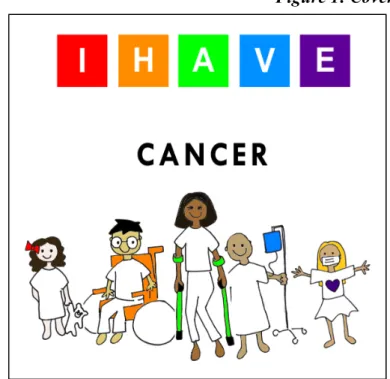
attention of the viewer and show the purpose, I chose to include a simple and colorful logo and a variety of children on the cover to portray the diversity of children with I/DD who can use the “I Have:” series (See Figure 1). I designed the cover page with hopes of using it on each booklet of the series,
changing only the topic, to provide a unified and consistent look throughout the potential series.&& In regard to relevance of illustrations, the literature suggests key points should be
highlighted in the graphics included in the educational material (Carolyn, 2006). Illustrations
should present key messages visually so the viewer can understand the main ideas from the illustrations alone (Carolyn, 2006). Illustrations should be on the same page and adjacent to the corresponding text (Carolyn, 2006). Pictures related to written or spoken text, when compared to text alone, significantly increases attention to and recall of health education information (Houts, et al., 2006). Using simple drawing helps viewers with low literacy skills to understand the intended message without being distracted by irrelevant details (Houts, Doak, Doak, & Loscalzo, 2006). Furthermore, extra details can be distracting to the viewer, thus the simple line drawings featured in the booklet (See Figures 2 and 3). Additionally, I chose to primarily use black and white line drawings throughout the booklet so patients are able to color in the figures, thus increasing their interaction with the tool.
The text must be visually accessible for most readers. Many children with I/DD have visual impairment and therefore it is necessary to type the text in a large font and use double
spacing (Skorpen, Larsen, & Holthe, 2012). Consulting a list of strategies for improving patient education using written materials, I employed the following techniques: use simple words with
one or two syllables, use simple sentences with 8-10 words per sentence, use simple large print
“I&HAVE:&CANCER”& 11&
instructions (letter to the caregiver/nurse), and use simple illustrations appropriate for the
intended audience (Andrus & Roth, 2002). An example of the text is shown in Figure 4.&&
Layout and sequence of information should be consistent, making it easier for the viewer to predict the flow of information (Carolyn, 2006). Each page uses the same fonts, style of illustration, and layout to provide consistency and flow for the reader.&
According to Carolyn (2006) the viewer should interact with the text, as research has shown that memory improves when the viewer interacts with the information rather than passively reading it. I have included the following statement in the letter to the caregiver/nurse on the first page of the booklet: “Feel free to have the patient draw on the booklet; color the figures their skin and hair colors, draw a line from the bag of chemo through the tubing and into their blood stream, etc.” I would like to encourage caregivers to encourage the patient to interact with the pages as much as possible to increase understanding and attention to the material.
SIDE EFFECTS OF CHEMOTHERAPY: HAIR LOSS
Sometimes cancer medicine can make your hair fall out.
This means the medicine is working really hard to fight the cancer.
Your hair might fall out in the shower.
Your hair might fall out while you are sleeping. You might see hair on
your pillow.
This is normal.
Your hair will grow back, but it can take a long time. It can take months
or years.
Future work
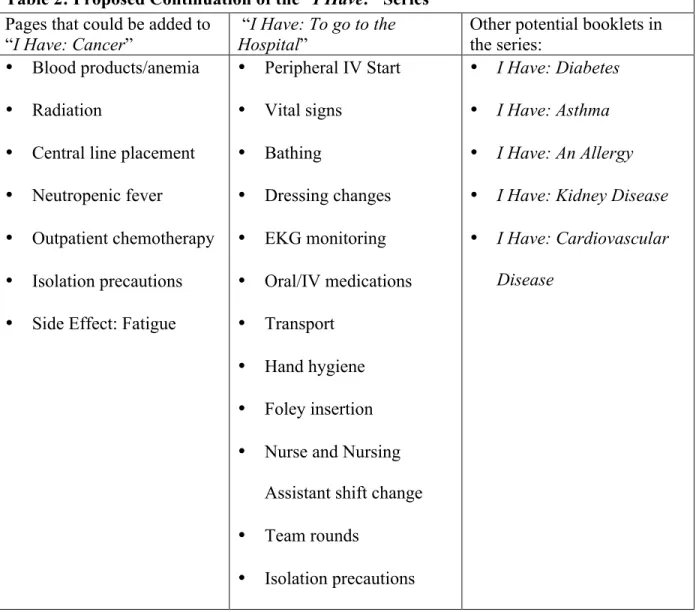
With expansion and more research, I would like to continue this project by adding new pages to the booklet, with cancer related and general inpatient information. Eventually, my intent is to expand this tool beyond pediatric oncology, and do a set of booklets. Detailed in Table 2 is a proposed continuation of “I Have: Cancer” and ideas for more “I Have”: tools.
Table 2: Proposed Continuation of the “I Have:” Series Pages that could be added to
“I Have: Cancer” “HospitalI Have: To go to the ” Other potential booklets in the series: • Blood products/anemia
• Radiation
• Central line placement • Neutropenic fever
• Outpatient chemotherapy
• Isolation precautions
• Side Effect: Fatigue
• Peripheral IV Start • Vital signs
• Bathing
• Dressing changes
• EKG monitoring
• Oral/IV medications
• Transport • Hand hygiene
• Foley insertion
• Nurse and Nursing Assistant shift change
• Team rounds
• Isolation precautions
• I Have: Diabetes
• I Have: Asthma
• I Have: An Allergy
• I Have: Kidney Disease
• I Have: Cardiovascular
Disease
“I&HAVE:&CANCER”& 13&
for reporting side effects such as SISOM have been created, but this software is targeted at the traditionally developing child (Ruland, Starren, Vatne, 2008). I would like to continue to focus on providing appropriate health literacy and educational tools for children with I/DD. With the transition in healthcare from paper information to electronic records and information sharing, I
believe that creating an application or system that could be used on a phone or tablet would
allow the “I Have” series to potentially be more accessible and easy to interact with. I would like
my application to include interactive touch-screen features and audio, showing videos of
procedures and step-by-step explanations. Additionally, I would like for the patient to be able to
“choose a character” so they can see an illustration of a patient of a similar age with the gender,
hair color, clothing of their choice. My hope to include a patient-like character is based on a
study participant quote from the Skorpen, et al., 2012 article, “It is easier to identify with
someone looking like yourself.”
Conclusion
With wide ranges of estimated individuals with I/DD affected by cancer, and very little research for pediatric patients with I/DD and cancer, I plea that more research be completed to provide education and interventions for these patients and their families. While this project is far from complete, I hope to have sparked an interest in an area of nursing that deserves more attention. Hoping to pursue pediatric nursing upon graduation, I wish to continue this research and implementation of appropriate education for all ages and stages of development.
Acknowledgments
Appendix
“I&HAVE:&CANCER”& 15&
Letter to the Nurse/Caregiver:
Thank you for using
I Have: Cancer
, a tool that with your help can better
explain cancer and the treatment process to pediatric patients with intellectual
and developmental disabilities.
Please use the included pages that most relate to your patient’s situation, and
work through them with your patient prior to a procedure and/or treatment or
when the patient receives a new diagnosis of cancer.
This particular booklet has been written for pediatric patients with intellectual
and developmental disabilities who understand literal audio, written, and
visual direction.
Please feel free to use supplemental materials and resources as well as write
in information as you see fit, if that child learns best that way.
Additionally, please take into consideration the timing of when to do this
teaching. I recommend same-day teaching, as close to the procedure as
possible, while still allowing time for working through and understanding. It is
best for patient continuity if the nurse/caregiver who goes through this booklet
with the patient can also be present during the procedure.
I also recommend making positive statements, praising the child for being an
excellent helper and for holding still during certain procedures, like the IV
start, at the end of the procedure.
Feel free to have the patient draw on the booklet; color the figures their skin
and hair colors, draw a line from the bag of chemo through the tubing and into
their blood stream, etc.
I hope you find this educational tool interactive and helpful with patients.
I HAVE: CANCER
Your body is made up of lots of little things called cells.
Most cells are good and help you stay healthy.
Some cells are bad and make you sick. Cancer cells are bad cells.
Nothing you did gave you cancer.
You cannot give cancer to other
people.
No one knows why you got cancer.
We are here to help you.
The nurses and doctors are going to
help you fight the bad cancer cells.
We will give you medicine.
Cancer medicine tries to fight the
bad cells.
Cancer medicine can make you feel sick or hurt.
“I&HAVE:&CANCER”& 17&
CENTRAL LINE USE AND CARE
Some medicine can’t be swallowed. Doctors
can use a tiny
tube in your
chest to put
medicine in
your blood.
This medicine will go to the rest of your
body and help you when you are sick.
The tube in your chest is called a “central
line.”
There are caps on the tube so nothing can get in or out. The nurse can
put medicine in the tube. The nurse can take a little bit of blood out of
the tube.
The caps will be changed every week, so germs don’t get in the tube.
If the skin where the tube is hurts, tell your
PERIPHERAL IV START
Some medicine cannot be swallowed. Nurses can use a tiny tube in
your arm to put medicine in your blood. This medicine will go to the rest
of your body and help you when you are sick.
Look at your arm. Do you see blue
lines?
The nurse will put the tube inside one of
the blue lines to give the medicine.
The nurse’s job is to put in the tube.
Your job is to hold still.
Your nurse may put Freezy Spray or Cream on your hands first. This is
so it won’t hurt.
First the nurse will look at your arms and hands and find the blue lines.
The nurse will touch the blue lines.
“I&HAVE:&CANCER”& 19&
Next the nurse will slip a tube into the blue line. It will pinch. Your job is
to hold still.
The nurse will put some special liquid in the tube.
The nurse will then put tape on the tube to make sure it does not come
out.
The nurse will close the cap on the tube so nothing comes in or out of
the tube
Then it is all done. Your nurse will call this your “I-V”
The nurse will put medicine in the tube
sometimes.
If it hurts or is scratchy, tell the
nurse. Point to the hurt.
IV CHEMOTHERAPY
Chemotherapy is a cancer medicine.
Some cancer medicine cannot be swallowed. This medicine cannot be
taken at home. This medicine is put into your “I-V” or “central line.”
Two nurses will come in your room. The nurses will check your name.
The nurses will wear gloves and gowns.
One nurse will clean your tube with special soap and open the cap.
The nurse will put a bag of cancer medicine on a pole and connect it to
the tube in your arm or chest.
Chemotherapy can take a few hours. Your tube will be connected to the
pole the whole time.
The nurse will program a box on the pole to tell the
cancer medicine when to start dripping into your tube.
The box might make a “BEEP” sound.
Call the nurse if the box makes a
“BEEP” sound.
The medicine will drip from the bag
on the pole, to the tubes, to the tube
in your body, and will get to your
blood.
“I&HAVE:&CANCER”& 21&
ORAL CHEMOTHERAPY
Chemotherapy is a cancer medicine.
Some cancer medicine can be swallowed.
Your nurse will give you pills or liquid to put in your mouth and swallow.
When you swallow this medicine, it goes to your tummy.
Your tummy tells your blood to come get the medicine, and the
medicine then goes into your blood.
SIDE EFFECTS OF CHEMOTHERAPY: NAUSEA
Sometimes cancer medicine makes
you feel sick.
It can hurt your belly and make you
throw up.
This means the medicine is working
really hard to fight the cancer.
If you hurt, tell your nurse.
Use your finger to show where the hurt is.
“I&HAVE:&CANCER”& 23&
SIDE EFFECTS OF CHEMOTHERAPY: HAIR LOSS
Sometimes cancer medicine can make your hair fall out.
This means the medicine is working really hard to fight the cancer.
Your hair might fall out in the shower.
Your hair might fall out while you are sleeping. You might see hair on
your pillow.
This is normal.
Your hair will grow back, but it can take a long time. It can take months
or years.
SIDE EFFECTS OF CHEMOTHERAPY: MOUTH SORES
Sometimes cancer medicine makes you hurt.
It can hurt your mouth and give you
spots in your mouth.
It can hurt to eat.
It can hurt to brush your teeth.
This means the medicine is working
really hard to fight the cancer.
If you hurt, tell your nurse.
Use your finger to show where the hurt is.
“I&HAVE:&CANCER”& 25&
SIDE EFFECTS OF CHEMOTHERAPY: NEUTROPENIA
Cancer medicine helps fight the bad cells.
To make sure all the bad cells are gone, sometimes cancer medicine
will fight good cells too. But that’s okay.
When this happens your nurse or doctor may say “your counts are low”
or you are “neutropenic.”Being “neutropenic” means you have to be
careful not to get bad germs in your body.
Being “neutropenic” means you can get sick easier.
To help keep the bad germs away…
You should wash your hands before you eat.
You should wash your hands after you use the bathroom.
You should wash your hands if they are dirty.
You will have to wear a special mask on
your mouth and a special shirt if you
leave your room.
Your nurse will wear a special mask
and a special shirt too.
Nurses will wear gloves when they help
you.
HAND HYGIENE
Washing your hands can help keep bad germs away.
You should wash your hands before you eat.
You should wash your hands after you use the bathroom.
You should wash your hands if they are dirty.
To wash your hands…
First turn on the water at the sink.
Feel the water with your hands. Is it
too hot? Turn the COLD knob on the
sink.
Feel the water with your hands. Is it
too cold? Turn the HOT knob on the
sink.
Feel the water with your hands. Does
it feel good? Cover your two hands with the water.
Take your hands out of the water. Leave the water running.
Next, find the soap next to the sink.
Pump the soap in your hand. Pump the
soap in your hand again.
“I&HAVE:&CANCER”& 27&
Next, put your two hands back in the water.
Rinse off your two hands.
Next, find the towels. Take one towel and dry your hands. Dry your
fingers. Dry your wrists. Dry the front of your hands. Dry the back of
your hands.
Throw away the towel.
Take another towel. Turn off the water
at the sink.
References
Andrus, M. & Roth, M. T. (2002). Health Literacy. Pharmacotherapy, 22(3), 282-302.
Carolyn, C. C. (2006). Do your patients understand? How to write effective healthcare
information. Orthopaedic Nursing, 25(1), 39-48; quiz 49-50. Retrieved from
http://search.proquest.com/docview/195964223?accountid=14244
Crespi, B. (2011). Autism research: Autism and cancer risk John Wiley & Sons, Inc.
doi:10.1002/aur.208
Dana-Farber researchers uncover link between Down syndrome and leukemia. (2014). Retrieved
January 4, 2015, from
http://www.dana-farber.org/Newsroom/News-Releases/dana-farber-researchers-uncover-link-between-Down-syndrome-and-leukemia.aspx
Disability and health. (2014). Retrieved January 4, 2015, from
http://www.who.int/mediacentre/factsheets/fs352/en/
Disability awareness information. (n.d.). Retrieved January 1, 2015, from
http://www.cpdusu.org/about/committee/awareness/
Donaghey, V., Bernal, J., Tuffrey-Wijne, I., & Hollins, S. (2002). Getting on with cancer. Great Britain: Gaskell and St. George’s Hospital Medical School.
Getting on with cancer: Books beyond words. (n.d.). Retrieved January 1, 2015, from
https://www.booksbeyondwords.co.uk/bookshop/paperbacks/getting-cancer Houts, P. S., Doak, C. C., Doak, L. G., & Loscalzo, M. J. (2006). The role of pictures in
improving health communication: A review of research on attention, comprehension, recall, and adherence. Patient education and counseling, 61(2), 173-190. doi:
“I&HAVE:&CANCER”& 29&
Jones, A., Tuffrey-Wijne, I., Bernal, J., Butler, G. & Hollins, S. (2007). Meeting the cancer information needs of people with learning disabilities: experiences of paid carers. British Journal of Learning Disabilities, 35: 12–18. doi: 10.1111/j.1468-3156.2006.00400.x
McEnhill, L. S. (2008). Breaking bad news of cancer to people with learning disabilities. British
Journal Of Learning Disabilities, 36(3), 157-164. doi:10.1111/j.1468-3156.2008.00517.x
O'Regan, P., & Drummound E. (2008). Cancer information needs of people with intellectual
disability: a review of the literature. European journal of oncology nursing: The official
journal of European Oncology Nursing Society, 12(2), 142-147.
doi:10.1016/j.ejon.2007.12.001
Ruland, C. M., Starren J., & Vatne T. M. (2008). Participatory design with children in the
development of a support system for patient-centered care in pediatric oncology. Journal of
biomedical informatics, 41(4), 624-635. doi:10.1016/j.jbi.2007.10.004
Skorpen, S., Larsen, F. K., & Holthe, T. (2012). Cancer and people with intellectual disabilities:
User participation is important when creating adapted cancer information material. Child
health and human development yearbook, 231-238
Social stories: Their use and benefits. (n.d.). Retrieved March 10, 2015 from
http://www.autism.org.uk/living-with-autism/strategies-and-approaches/social-stories-and-comic-strip-conversations/social-stories-their-uses-and-benefits.aspx
Tuffrey-Wijne, I., Bernal, J., Jones, A., Butler, G., & Hollins, S. (2006). People with intellectual
disabilities and their need for cancer information. European journal of oncology nursing :
the official journal of European Oncology Nursing Society, 10(2), 106-116.