© 1987
GLENDA R. LEWIS. A Survey of the Organization
and Management of State Shellfish Programs.
(Under the direction of DR. MORRIS A. SHIFFMAN)
The operational and intergovernmental practices of
state shellfish programs were examined to view the current
status of these state programs. A questionnaire was used
to perform the study. States are currently in compliance
with directives and requirements of the Interstate
Shellfish Sanitation Conference. Obstacles discovered to
efficient and effective state implementation of these
duties include insufficient resources, state doubt in the
validity of established bacteriological standards, and a
general lack of legislative and public awareness. An
effective approach to aid in the coordination of state
efforts under the Conference is the full exchange of
information among neighboring states. A strong need
exists for a realistic and continuing evaluation of the
TABLE OF CONTENTS
Page
CHAPTER I: INTRODUCTION... 1
Purpose of the Study 4
Hypothesis 5
Statement of the Problem 5 Thesis Statement 5 CHAPTER II: STUDY SPECIFICATIONS ... 6Objectives 6
Limitations and Constraints of the Study 6
CHAPTER III: REVIEW OF RELEVANT LITERATURE ... 8Introduction 8
History and Background 8
Regulation of Food in the United States 8
Regulation of Shellfish in the United States 12
Current Situations 20 The Interstate Shellfish Sanitation Conference 20Summary 25
CHAPTER IV: RESEARCH METHOD AND DATA COLLECTION ... 26Method of Research 26
Instrument of the Study 26
Description of Research Population 27
Research Procedure 27Questionnaire Development 27
Pilot Test 30Distribution/Follow-up 31
Data Processing 32
Summary 3 2
CHAPTER V: RESULTS OF SURVEY AND DISCUSSION ... 33
Discussion of the Results 60
Summary of the Results 66
CHAPTER VI: CONCLUSIONS ... 70
CHAPTER VII: FINDINGS AND RECOMMENDATIONS ... 72
CHAPTER VIII: BIBLIOGRAPHY ... 74
Figure
1 2
3
4
5 6 7
8
9
Page
Model State organization Chart ... 35 Frequency of State Contact with the Food
and Drug Administration ... 37
Frequency of State Contact with the
National Marine Fisheries Service ... 38 Frequency of State Contact with the
National Oceanic and Atmospheric
Administration ... 39
State Usage of Strategies ... 43
Use of Strategies Per State ... 44
State Usage of Water Classification
Measures ... 49
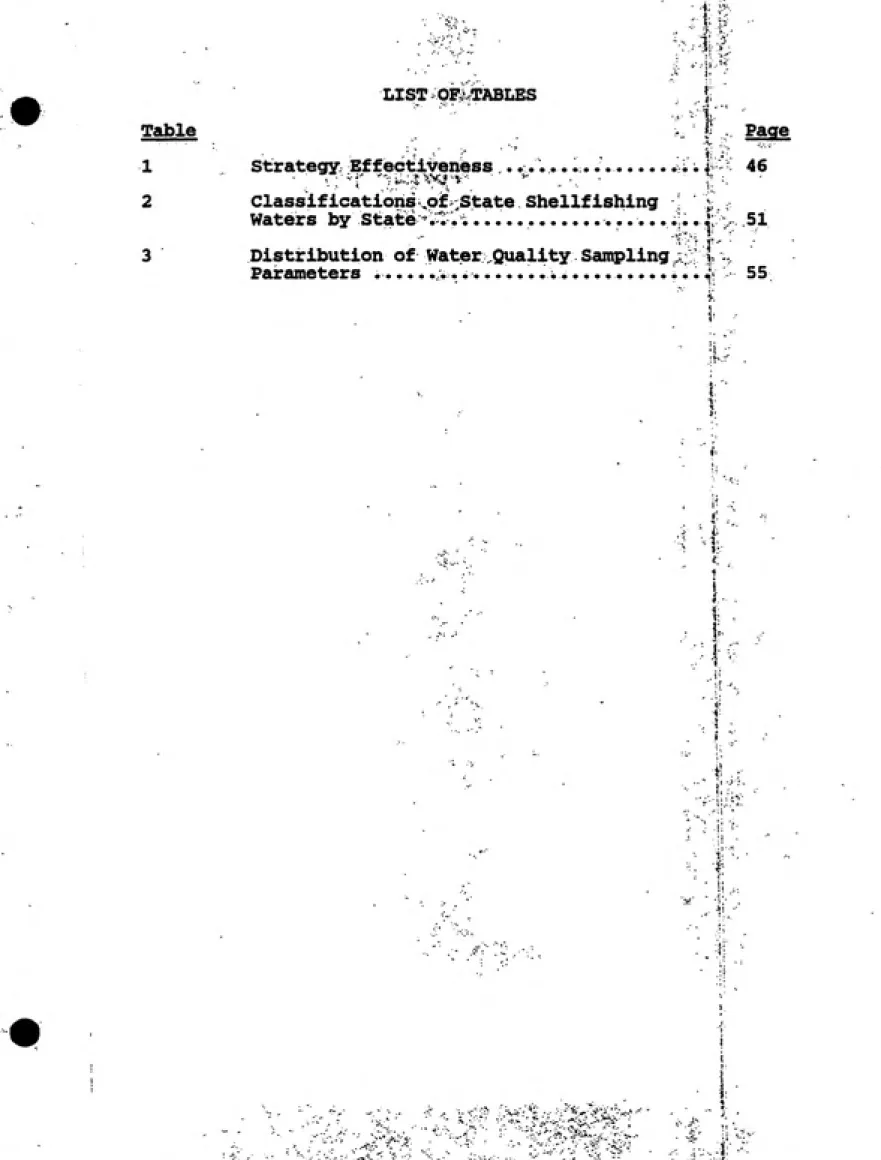
LIST OF TABLES
Table Page
1 Strategy Effectiveness ... 46
2 Classifications of State Shellfishing
Waters by State ... 51
3 Distribution of Water Quality Sampling
To my mother, Mrs. Olive Lewis and my father,
Mr. Lucien Lewis, whose love and encouragement helped make
ACKNOWLEDGEMENTS
The writer wishes to express sincere gratitude and
appreciation to all persons who contributed to the
successful completion of the study. Special thanks goes
to Dr. Morris A. Shiffman for his guidance and patience
throughout the study. An expression of gratitude is due
Dr. Mark D. Sobsey and Dr. Michael J. Symons for their
assistance and support.
Further, the writer wishes to express appreciation to
the state shellfish regulatory officials who willingly
participated in the study. Special thanks and
appreciation are due Mr. Bob Wetherell and Mr. Dave
Dressel, the Food and Drug Administration, and Ms. Dorothy
Leonard, the National Oceanic and Atmospheric
INTRODUCTION
Molluscan shellfish have provided an important source
of food for the United States since colonial times while
simultaneously serving as an important economic base for
many coastal communities. In the early 1900's oyster
production along the Gulf and Eastern coasts of the United States was a major resource, often exceeding 100 million pounds per year. This compares to 53 million pounds produced on all coasts in 1975 (Clem, 1978).
Shellfish are found predominantly in estuaries where freshwater mixes with saline coastal waters. Estuaries
provide critical habitats for shellfish, while also serving
as nursery areas for an estimated 60 percent of the nation's
living marine resources. These valuable resources require
protection and monitoring to ensure the health of the
Nation's shellfish population.
Shellfish exposed to polluted water may become agents of gastroenteric diseases. The quality of the water in
which shellfish are grown presents the primary hazard to the
consumer. Shellfish, if contaminated, present a potential
ability to filter and concentrate pathogenic microorganisms
and toxic substances from the environment; 2) the natural
habitat of shellfish is almost universally subject to some
degree of industrial, residential, or animal pollution; 3)
shellfish are frequently consumed either raw or partially
cooked; 4) harmful substances can be introduced into shucked
meats due to the nature of the shucking process; and 5)
inadequate refrigeration of packed raw shellfish provides an
excellent growth medium for bacteria (Federal Register,
1975).
In order to provide adequate consumer protection and
minimize potential health hazards, sanitary controls in the
management of shellfish must encompass all phases of
shellfish growth, production, and distribution — from the
growing area through all aspects of harvesting, processing,
packaging, storage, and distribution.Currently, our shellfish resources are managed through
23 State shellfish programs throughout the United States.
These State programs are, in turn, managed under the
National Shellfish Sanitation Program and the Interstate
Shellfish Sanitation Conference.^
The National Shellfish Sanitation Program is a
voluntary cooperative program between the federal
government, shellfish-producing states, and the shellfish
industry. The program has as its mission the protection of
the consumer from shellfish-borne illness, which is
accomplished through the setting forth of guidelines for the
management of state shellfish programs.
Upon its creation in 1982, the Interstate Shellfish
Sanitation Conference replaced the National Shellfish
Sanitation Program. Like the National Shellfish Sanitation
Program, the Interstate Shellfish Sanitation Conference is a
tripartite organization with federal, state, and industry
representation. The Interstate Shellfish Sanitation
Conference, however, is more formally organized, with a
constitution, by-laws, executive board, and task forces.
States manage their programs with the aid of uniform
sanitation standards established for each phase of bringing
safe shellfish to the consumer — encompassing the growth,
harvest, processing, packaging, storage, and interstate
shipping of shellfish. Criteria and standards for the
sanitary control of shellfish are contained in the National
Shellfish Sanitation Program Manual of Operations, Part I,
Sanitation of Shellfish Growing Areas and Part II,
Sanitation of the Harvesting and Processing of Shellfish.
These standards have been formally adopted by the Interstate
Shellfish Sanitation Conference and by State agencies, which
incorporate them into state laws or regulations.
4
implement these standards. Such variations exist for several reasons. Some are an inevitable result of
differences in geography or resources (specific species
abundance and distribution). Others result from differences
in organizational structure, the availability of funds, the priority level of the shellfish issue in state legislatures, or the amount of available staff to perform the varied tasks required. The variations themselves are not necessarily detrimental, however the nature and extent of the variations may increase the risk of safe shellfish not reaching the
consumer.
Purpose of the Study
The purpose of the study is to determine:
1) What variations exist among the 23 shellfish
producing states in the operational and
intergovernmental practices used by them to
accomplish uniform shellfish control measures, as
set forth by the National Shellfish Sanitation
Program;
2) What variations in these practices seem to be
undesirable in terms of inefficiency in
management; and
Hypothesis
The greater the degree of variability, as well as the
frequency of variability among states in their operational
and intergovernmental practices when implementing uniform
sanitation standards, the greater the potential risk to the
consumer of obtaining unsafe shellfish.Statement of the Problem
State organizational and management practices, with
regard to ensuring the safety and quality of shellfish, are
inconsistent throughout the 23 shellfish-producing states.
Thesis Statement
Inconsistencies in State operational and
intergovernmental practices in implementing uniform
shellfish control measures, as set forth by the National
Shellfish Sanitation Program, have the potential to
CHAPTER II
STUDY SPECIFICATIONS
Objectives
1) To determine whether states are functioning within
the general framework of the National Shellfish Sanitation
Program and the Interstate Shellfish Sanitation Conference;
2) To determine what differing techniques and
strategies State shellfish programs utilize in carrying out
their National Shellfish Sanitation Program and Interstate
Shellfish Sanitation Conference duties;
3) To determine whether a stronger or different State
role is needed to regulate shellfish; and
4) To identify major obstacles to State action for
regulating shellfish sanitation.
Limitations and Constraints of the Study
Limitations; The major limitation of the study is the
willingness and ability of the key State shellfish
Constraint: The major constraint is the size of the
study. Consideration is given to the Interstate Shellfish
Sanitation Conference participant states which are
CHAPTER III
REVIEW OF RELEVANT LITERATURE
Introduction
The purpose of this chapter is:
1) to inform the reader of developments in food safety and protection by reviewing the first
federal food laws;
2) to inform the reader of developments in shellfish
regulation, in particular; and
3) to inform the reader of the current status of the control of shellfish resources in the United
States.
Presented is a brief legislative history of food
control in the United States, in general, with emphasis on
the history of shellfish control and its application to
current shellfish control practices.
History and Background
Regulation of Food in the United States
Today the United States food supply is generally
the most complex. Numerous federal programs^ exist through
which the government is involved in food regulation. To
fully appreciate the complex structure of food and drug control today requires some knowledge of the history of
federal food protection.^ Two major federal food laws are
covered: the Food and Drugs Act of 1906 and the Federal Food, Drugs, and Cosmetic Act of 1938.
The original incentive for the beginning of food
processing regulations was the recognition and realization
that the consumption of impure foods contributed to many
cases of illness and even death. An 1879 bill introduced in
Congress "for preventing the adulteration of articles of food and drink" (Congressional Record, 1879) marked the first attempt at Federal control of food for protecting the consumer. It also initiated a 27-year battle, resulting in the enactment of the Pure Food and Drugs Act of 1906. This
act defined "adulterated foods" and instituted the first
food inspection program to apply to all foods in interstate
commerce.
In the years following its enactment, several
limitations of the 1906 act were noted. The Chief of the
Bureau of Chemistry (later to become the Food and Drug
^Major food safety related programs can be seen in
Appendix 3.^A chronology of federal food safety and related
10
Administration) included the following limitations in his 1917 annual report (1917 Report of the Bureau of Chemistry,
1951):
1) lack of legal standards for foods;
2) lack of authority to inspect warehouses;
3) need for greater flexibility to prescribe the
disposition of imports; and
4) no ban on the addition of poisonous substances to
food.
As a result, between 1906 and 1938 the Food and Drugs Act was amended several times in attempts to strengthen the
law.^ A 1933 bill to supplant the "outworn mechanism" of
the 1906 law outlined several new provisions which would
permit increased regulation over foods (1933 Annual Report).
Stated provisions included:
1) Informative labeling would be required;
2) The promulgation of definition and standards for food, which will have the force of law, would be authorized;
3) The prohibition of added poisons in foods or the
establishment of safe tolerances would be provided for;
4) The operation of factors under federal permit would be prescribed where protection of public health would not be
otherwise affected; and
5) More severe penalties, as well as injunctions, in
the case of repeated offenders would be prescribed.
Opposition to this bill occurred and a succession of Congressional bills followed in the next four years. These events culminated on June 25, 1938 when the President signed Public Law 717, the Federal Food, Drug, and Cosmetic Act of 1938, into law. This was the first major statutory revision
of the 1906 act and has subsequently been amended several
times.^
The Food, Drug, and Cosmetic Act (21 USC 301-392) is the basic food and drug law of the United States. With its numerous amendments it is the most extensive law of its kind
in the world. Many State food laws are patterned after the
federal law, and some have provisions to add automatically
any new federal requirements.
The Food and Drug Administration under the Federal
Food, Drug, and Cosmetic Act as amended (21 USC 301) has responsibility to ensure that foods, including fish and shellfish, shipped or received in interstate commerce are safe, are processed under sanitary conditions, and are not adulterated. If the Food and Drug Administration finds
unsanitary plant conditions, adulterated products, or a
contaminated product, it can take any of the following legal
actions: "(1) prosecute anyone who violates the provisions
12
of the act; (2) enjoin a plant or individual to correct the
unsanitary plant conditions; and (3) seize a food that is
adulterated or contaminated when introduced to or while in
interstate traffic." (1979 Report) In practice, these powers are seldom used by the Food and Drug Administration to insure that fresh or frozen shellfish are safe. Instead, the Food and Drug Administration relies on its participation
in the National Shellfish Sanitation Program and the
Interstate Shellfish Sanitation Conference to achieve its
purpose.
Regulation of Shellfish in the United States
Prior to 1925, United States shellfish resources were
not a federal priority. The value of these resources, however, was reflected in State control measures, such as bacteriological sampling of shellfish, inspection of
processing plants, and some inspection of shellfish growing areas. New York state passed legislation as early as 1715. Other states to pass early legislation were New Jersey
(1730) and Rhode Island (1734). Such legislation was directed to the regulation of harvesting, with a goal to protect the renewable shellfish resources in order to assure
a continuing supply.
Public health controls of shellfish became a national
of a large number of outbreaks of illnesses associated with
consuming raw oysters, clams, and mussels. In the winter of 1924, there occurred in New York City, Chicago, and
Washington, D.C. a widespread typhoid fever outbreak traced
to the consumption of oysters contaminated by sewage
pollution. In response to the seriousness of the outbreak and the loss of confidence in the shellfish industry, local and State public health officials and the shellfish industry requested that the Surgeon General of the United States
Public Health Service develop necessary control measures to
ensure a safe shellfish supply to the consumer.
In accordance with this request, the Surgeon General
called a conference of representatives from State and
municipal health authorities. State conservation
commissions, the Bureau of Chemistry, the Bureau of
Fisheries (now the National Marine Fisheries Service) and
the shellfish industry. This historic conference was held in Washington, D.C. on February 19, 1925 (US Public Health
Service, 1925).
It is important to note that many federal and State
agencies were represented, as well as key members of the shellfish industry. This cooperative approach was the first
of its kind ever attempted toward federal food protection
and would set a precedent for future shellfish control.
14 promote the development of basic control practices, which the states would adopt. The members of the conference
recommended eight resolutions for the sanitary control of the oyster industry (Federal Register, 1975). The
principles of shellfish sanitation resulting from this
conference included:
1) "The beds on which shellfish are grown must be determined, inspected, and controlled by some official State agency and the US Public Health Service."
2) "The plants in which shellfish are shucked or
otherwise prepared or packed by the shipper must
be controlled by some official State agency and
the US Public Health Service."
3) "There must be such governmental supervision and such trade organization as will make plain the source of shellfish and will prevent shellfish
from one source being substituted for those from another source. This will be chiefly a problem of
the individual State."
4) "The methods of shipping must be supervised,
inspected, controlled, and approved by the proper
official federal and State agency."
5) "The product must conform to an established
bacterial standard and must meet federal. State,
salinity, water content, food proportion and
conform to the Pure Food Laws standards."
The public health controls and principles formulated at
the 1925 conference became the basis of the National
Shellfish Sanitation Program.
To implement the program, members of the 1925 conference agreed to publicize those states which had
adopted the principles, in what is known as the Interstate
Certified Shellfish Shippers List. The producing states would issue "Certificates", i.e., a permit to operate, to those shellfish shippers meeting agreed upon sanitary
standards.
None of these matters were formalized in federal
regulations, but relied upon a voluntary approach to convince state officials of the importance of adopting control practices. The voluntary approach relies on the
enactment of State laws along with federal technical support and industry participation. The National Shellfish
Sanitation Program has been entirely dependent upon this approach for over 75 years.
To further implement this cooperative, voluntary
16 *Each shellfish shipping state agreed to adopt adequate laws and regulations for sanitary control of the shellfish
industry, make sanitary surveys of growing areas, delineate and patrol restricted areas, inspect shellfish plants, and conduct such additional inspections, laboratory
investigations, and control measures as necessary to insure that the shellfish reaching the consumer had been grown,
harvested, and processed in a sanitary manner. Along with this, states issued numbered certificates and forwarded copies of the interstate certificates to the Food and Drug
Administration.
*The Food and Drug Administration agreed to serve in an advisory capacity reviewing State programs and suggesting
improvements. Included in this was the inspection of a
representative number of shellfish processing plants.^ On
the basis of information obtained, the Food and Drug
Administration would endorse, or withhold endorsement, of
each State program. A list of valid interstate shipper certificates issued by State control authorities with Food
^Guidelines for federal appraisal of State Shellfish
Sanitation programs were adopted in 1965 and can be found in
US Department of Health, Education, and Welfare, Public Health Service, Division of Environmental Engineering and
Food Protection, Shellfish Sanitation Branch. National
Shellfish Sanitation Program Manual of Operations, Part III,
Public Health Service Appraisal of State Shellfish
Sanitation Programs, 1965. This manual is no longer used in
federal evaluation of state programs. Parts I and II of the
and Drug Administration endorsed programs was published
monthly.
*The shellfish industry agreed to harvest and process shellfish under sanitary conditions. This included
obtaining shellfish from safe sources, providing plants
which met the agreed upon sanitary standards, placing the
proper certificate number on each package of shellfish, and
keeping and making available to the control authorities
records which would show the origin and disposition of all
shellfish.
The basic public health principles formulated in 1925 for the National Shellfish Sanitation Program have remained
unchanged. Program procedures, however, have been
periodically updated and improved.^
In 1954, the first of ten National Shellfish Sanitation workshops was held in Washington, D.C.^ The purpose of the
workshop was to provide a forum for the three Program participants to: 1) recommend changes in the program's
administrative procedures and technical standards; 2) review
^A list of previous editions of Manual of Operations for the National Shellfish Sanitation Program can be seen in Appendix 5.
^National Shellfish Sanitation Program Workshops were held in 1954, 1956, 1958, 1961, 1964, and 1968 under Public Health Service sponsorship. In 1971, 1974, 1975, and 1977 the Food and Drug Administration sponsored workshops as part
of its administrative role in the National Shellfish
18
research needs and ongoing projects; 3) discuss state
program activities and emerging problems; and 4) describe new federal legislation, regulations, and programs (National
Shellfish Sanitation Program, 1977).
In 1968, responsibility for the shellfish sanitation program was moved from the Public Health Service to the Food and Drug Administration. The change in administration
brought with it drastic changes for the National Shellfish Sanitation Program. The Food and Drug Administration's
enforcement orientation led to problems with state programs. Various state programs began to diverge from the established
standards. The Food and Drug Administration threatened not to endorse the states' programs. However, since
participation in the program is voluntary, the federal arm
of the program has no legal authority to enforce state compliance with the established standards. Removal of federal endorsement of a state program was the only action available to ensure the safety of shellfish as a food
source.
Removal of federal endorsement of a state program
results in the decertification of that state. With
decertification, any shellfish originating in state waters
are no longer allowed to be transported in interstate
from the Interstate Certified Shellfish Shippers List. Once removal from this list has occurred, other states agree to
no longer accept shellfish from the decertified state. Such actions facilitate state compliance with National Shellfish
Sanitation Program guidelines and facilitates the prevention of shellfish from the decertified state ever reaching the
market.
Accordingly, the Food and Drug Administration proposed
formal Federal regulations for a "National Shellfish Safety
Program" in the Federal Register (1975). The proposed regulations were to legalize the National Shellfish
Sanitation Program and give the Food and Drug Administration authority to administer the program under federal mandates.
Evaluation of comments received in response to the
proposed regulations led the Food and Drug Administration to
determine that National Shellfish Sanitation Program goals would not likely be reached through the promulgation of
federal regulations. Subsequently, revision of the 1965 Manuals of Operation was chosen as a better approach to
strengthening the program (Federal Register, 1985).
During this period many shellfish producing states were
concerned that some state shellfish control agencies were not adopting the revisions in a uniform and timely manner. For this reason, other methods for strengthening the program were also sought. The primary method chosen was the
20
National Conference of Interstate Milkshippers program.
This program has been successful since 1950 in assuring a nationwide safe and wholesome milk supply and was used as a model for developing the Interstate Shellfish Sanitation
Conference.
Current Situation
The Interstate Shellfish Sanitation Conference
In 1982 the Interstate Shellfish Sanitation Conference
was formed in Annapolis, Maryland. Constitution, By-laws, and Procedures were adopted establishing "a variable
organization with the stated purpose of fostering and
improving the sanitation of shellfish through interstate cooperation and through uniformity of State shellfish programs." (Interstate Shellfish Sanitation Conference,
1982) The organization allows for input from State
regulatory officials and industry under the health umbrella of the Food and Drug Administration.
To achieve its goal, the Interstate Shellfish
Sanitation Conference agreed to adopt a set of guidelines for the sanitary control of shellfish. At the first annual"
meeting held in 1983, the Interstate Shellfish Sanitation Conference adopted the National Shellfish Sanitation Program Manual of Operations, Parts I and II, 1965, and formal
procedures that enabled it to adopt changes in the
In addition, the business of the Conference is met through the existence of an executive board, task forces, committees, and annual meetings, as provided for in the constitution and by-laws.
Committees are developed pertaining to the specific issue referred to them by the Task Forces. Routinely,
committees are set up thirty to sixty days after the annual meeting. Experts in the area under consideration by the committee are sought as committee members. Initially, members are obtained on a voluntary basis. If, however,
after this first approach a committee lacks the number
necessary to accomplish its goals, members are solicited by
the Interstate Shellfish Sanitation Conference chairman.
Committee members meet throughout the year, usually by phone. Old, unresolved issues carried over from the
previous annual meeting are deliberated throughout the year. On the Sunday and Monday prior to voting at the next annual
meeting, the committee members meet to finalize their
position on the issues prior to submitting them to the
appropriate Task Force. On Tuesday and Wednesday prior to voting, the Task Forces meet and consider the old issues
submitted to them by committee. At this point, the issues
are either adopted and a report submitted to the general
assembly or referred back to committee for further
deliberation. On Thursday, voting by State delegates takes
22
At the annual meetings, voting State delegates have the authority for adopting policies, procedures, and guidelines. New items to be voted upon are submitted to the appropriate
Task Force which deliberates and takes one of two courses of
action: 1) if the Task Force can not resolve the points in question, it refers the issues to committees for further
deliberation (these are now old issues to be deliberated
upon for the next annual meeting); or 2) if the Task Force
can resolve the points in question it issues a recommended
action to the voting delegates. Consideration of the
recommendations and subsequent voting takes place in the
open general assembly. To assure that adequate
consideration by the Task Force is given to each suggestion or proposal, new items must be submitted three to four
months prior to the next Conference meeting.
Once a Task Force's findings are accepted, the proposal
is forwarded to the Food and Drug Administration for review
to insure its consistence with existing federal laws,
regulations, and Conference policies and procedures.
Following Food and Drug Administration approval, states
begin incorporating the recommended policies, procedures, or guidelines into each State's regulations or laws through
their own Administrative Procedures. Although State
Conference activities are directed by an executive
board. Members of the board include elected representatives of State and industry on a specified regional basis, and a Food and Drug Administration representative. Only State
representatives, however, have voting rights on the board, as well as on the task forces.
The Food and Drug Administration serves, within
guidelines agreed upon in a Memorandum of Understanding with
the Interstate Shellfish Sanitation Conference "as an
evaluator of the State's program compliance with the
Interstate Shellfish Sanitation Conference national program,
a training and standardization agency, and as a channel for
dissemination of information" (Interstate Shellfish
Sanitation Conference, 1982).
Another aspect of United States shellfish regulation
concerns shellfish of foreign origin. Such shellfish are
not under the direct scope of this study, but require
mentioning.
The importation of fresh or frozen shellfish are
subject to the provisions of the Federal Food, Drug, and
Cosmetic Act (and if in consumer size packaging, to the Fair
Packaging and Labeling Act) and to additional controls under the National Shellfish Sanitation Program.
As the basis of the National Shellfish Sanitation
Program is to assure safe shellfish through stringent
24 of shellfish under this program poses some problems. For example, in the absence of known growing water quality, an objective analysis is not adequate to assure the safety of
imported shellfish. In addition, there are no practicable, analytical procedures for detecting the broad spectriom of potentially harmful contaminants and naturally occurring marine biotoxins common to shellfish worldwide. Further, it
is recognized that shellfish analyses alone are neither
reliable nor indicative of the unsampled portion's quality.
Thus, to assure the quality of imported shellfish and avoid outbreaks of illness, additional national Shellfish
Sanitation Program controls are used and those foreign countries that satisfactorily apply these controls are entitled to certify shellfish products.
For a foreign country to become a National Shellfish Sanitation Program participant, an official agency of that
country agrees to the general terms of the Program through the means of a memorandum of understanding with the Food and Drug Administration. The countries currently having
effective memoranda of understanding are Australia, Canada, England, Iceland, Japan, Korea, Mexico, and New Zealand.
A country wishing to negotiate a shellfish memorandum
of understanding must supply to the Food and Drug Administration evidence that demonstrates that the
government should have the resources necessary (trained
personnel, laboratory facilities, etc.) to provide controls over the country's export shellfish industry.
Once a country has an effective memorandum of
understanding, its shellfish control authority may submit certificates of their certified shellfish shippers to the
Food and Drug Administration. The Food and Drug
Administration in turn, publishes all the certified shippers in the Interstate Certified Shellfish Shippers List.
Summary
The history and background of United States food regulation and shellfish regulation, in particular, are
outlined. The method of operation of the Interstate
Shellfish Sanitation Conference is also given. Imported shellfish and problems related to their control are also
CHAPTER IV
RESEARCH METHOD AND DATA COLLECTION
Method of Research
A survey is the method of research used. The study is
based on an investigation into the use of differing operational and intergovernmental practices by State shellfish sanitation programs in maintaining safe,
marketable shellfish, as well as environmentally healthy
growing areas and harvest grounds.
Instrument of the Study
The primary method of inquiry is a questionnaire
presented to key State shellfish regulatory officials (see
Appendix 6). The questionnaire is divided into four major
categories:I. Organization and Policy
II. Intergovernmental Program Activities
III. Operations
IV. Program Activities & Functions
aspects of water quality surveys, 2) growing area classification and patrol, and 3) intergovernmental
activities. Effective management of these areas is crucial
in achieving shellfish of safe quality and maintaining that
the consumer is protected from harmful shellfish.
Insights into the operation and management of the State
shellfish programs is important for an understanding of the
present status of shellfish control and a necessity for
future program planning.
Description of Research Population
The population under study is the State Shellfish
Sanitation Programs of the 23 shellfish-producing states in
the United States. These states are participants in the
Interstate Shellfish Sanitation Conference.
Research Procedure
Questionnaire Development
Research indicated that states are responsible for five
major functional duties in the management of their state
programs:1) survey of growing areas
2) plant inspections
3) patrol activities
4) laboratory analysis
28
The focus is on the intergovernmental and operational
practices utilized in performing the above functions, as other studies have been conducted concerning the technical
aspects and problems facing the shellfish industry (National Shellfish Sanitation Workshop Proceedings, 1971, 1974;
National Marine Fisheries Service, 1977; Hunt, 1979; Dressel
et al., 1983; Tuttle, 1985).
To gather this information, questions were needed which addressed agency responsibility, resource allocation, and
management techniques. Questions of resource allocation and
funding, however, were omitted on the advice of federal shellfish officials. Such information, though known by
state shellfish regulatory officials, is not always readily accessible to them. A lengthened response time by state
officials to the questionnaire was assumed to result.
States have also been reluctant to supply such information on past federal surveys. For these reasons it was suggested
that resource allocation and funding questions be omitted,
as they would perhaps contribute to a diminished number of responses or delays in response time.
The questionnaire was designed to accomplish the
objectives based on the above specified five functional
areas. Categories I and III, Organization and Policy, and Operations, respectively, were designed to answer questions of agency responsibility. Categories II and IV,
Activities and Functions, respectively, were designed to answer questions concerning management techniques.
Questions were designed to be clear, concise, and
readily answerable. To further facilitate receiving as many responses as possible, a summary of responses was offered to those respondents who wished to receive the results of the survey. Questionnaires were sent to key state shellfish regulatory officials in charge of growing areas. These
officials were selected based on their access to information
of their state's overall shellfish operations.
During the development of the questionnaire, great interest in the study was expressed by the Food and Drug
Administration and the National Oceanic and Atmospheric
Administration. The Food and Drug Administration's interest stemmed from their concern about the role of the states in
the Interstate Shellfish Sanitation Conference. The study also parallels the Food and Drug Administration's role in
the Interstate Shellfish Sanitation Conference of evaluation
of state programs.
The interest expressed by the National Oceanic and Atmospheric Administration focused on the intergovernmental
aspect. Prior studies conducted by them were similar, but
30
Sanitation Conference in respect to state intergovernmental
activities. Pilot Test
A pilot test of the questionnaire was conducted prior to the mailing of the survey itself. Input was solicited
from state as well as federal shellfish regulatory
officials. Feedback for the pilot test was directed
primarily to the expected willingness of state officials to respond at all, to respond in a timely fashion, or to
respond accurately to the inquiry about the management of their state programs. Further comments on content,
structure, and length were also invited.
Federal shellfish regulatory officials were from the Food and Drug Administration and the National Oceanic and Atmospheric Administration. Two state shellfish regulatory
officials were chosen from North Carolina and South
Carolina.
A copy of the questionnaire was mailed to both sets of officials. State officials responded by mail, while federal officials responded by phone. Responses to the pilot test indicated the need for minor structural and content changes. Also mentioned was the likelihood of state response. It should be noted that the Interstate Shellfish Sanitation
Conference and the National Oceanic and Atmospheric
frame of this study. Response from federal officials
suggested that such a coincidence could lead to a diminished
number of responses.
A copy of the cover letter, title page to the
questionnaire, the questionnaire, and a list of the key
state regulatory officials to whom questionnaires were sent
can be seen in Appendix 6.Distribution and Follow-up
Ten of the twenty-three states contacted responded to
the initial mailing of the questionnaire. Of these ten,
three returned additional information on their state's
current policies and regulations for managing shellfish
resources. The additional information included copies of
state statutes and program guidelines.
One month after the initial mailing, reminder notes,
along with an additional copy of the questionnaire, were
sent to delinquent responders. From this follow-up effort,
eight additional responses were obtained, for a total of 18
responses from the pool of 23 questionnaires distributed.
Of these eight, three returned additional information on
their state's current policies and regulations for managing
shellfish resources. The additional information included
memoranda from agency to industry, management plan criteria
for growing water reopenings, growing area surveys, and a
summary of bacteriology laboratory sampling. Additionally,
32
agency responsibility and the organizational structure of
their state's shellfish programs. A copy of the follow-up
note can be seen in Appendix 6. Data Processing
Results of the survey are tabulated and presented in the following chapter. Approximately 78% of those surveyed
responded. Results of each question are given, followed by a discussion of each response individually, where needed. This is followed by a general discussion of all responses
and a summary.
Summary
The method of research and data collection for the
study are outlined. The instrument of the study, the
research population, and the research procedure is given in
RESULTS OF THE SURVEY
Do you wish to receive a summary of information submitted by
all of the states responding to this questionnaire?
Yss 18 Send to:____________________
No 0
I. ORGANIZATION AND POLICY
1. Do you have a division or agency which specifically
regulates shellfish? (Check appropriate response)
Yes 18 No 0
All states responding had existing shellfish programs.
What specific activities or functions is each division/ agency responsible for?
Function Division/Agency
Survey of Growing Areas ___________________ Plant Inspections ___________________ Patrol Activities ___________________ Laboratory Analysis ___________________ Resource Management ___________________
(relaying)
Responses indicate that current agency
responsibility for state shellfish programs lies within specific divisions of State Departments of Health or of Environmental Control/Natural Resources. Within these
divisions, the hierarchy of responsibility is further divided to extend responsibility to the level of
Bureau/Branch or Section.
Eleven states who responded share responsibility for the above functions between either of the two departments stated above. Six states who responded have general responsibility for their shellfish
programs only within one department (either their
departments of Health, as with 3 of these 6 states; or with their departments of Environmental Control/Natural
34
remaining state, responsibility for the management of
health and environmental concerns lies within one
department.
It should also be noted that eight of the
responding states share responsibility for patrol
activities with law enforcement departments or
divisions in their state. In one case, this responsibility has legally been given to local
communities. Likewise, one state shares laboratory
duties with local and county labs.
Actual responsibility, in terms of implementing
duties on a daily basis, for the specific functions
listed above, lie at the Bureau/Branch or Section organizational level of hierarchy, particularly in regional offices. A model state organizational chart to illustrate the different levels of hierarchy
discovered can be seen in Figure 1.
3. What is the total number of full-time staff employed within the division/agency who are responsible for the
management of shellfish?
Responses to this question range from 3/4 of a position to 279. It was noted in some instances that
full-time staff have other duties besides shellfish
and, as such, only devote part of their time to
shellfish.
3a. Of this number, how many full-time staff carry out the following regulatory duties and responsibilities in
managing shellfish in your state?
Growing Area Surveys _____ Plant Inspections _____ Patrol Activities _____ Laboratory Analysis _____
Resource Management _____
For tabulation purposes, states have been divided into three categories based solely on the number of shellfish staff indicated in response to the above question. This categorization should in no way be
related to the amount of a state's production of
shellfish or the subsequent market values of this shellfish. The three categories and their criteria are:
1) Minor Shellfish States - Zero to ten state
personnel responsible for shellfish management.
2) Median Shellfish States - Eleven to fifty
FIGURE 1.
MODEL STATE ORGANIZATION CHART
State Department Of
Division
Of
Division
Of
Bureau
Bureau Bureau
Division
Of DivisionOf
Branch
Brancri Brand!
Section
Region
Section
36
3) Major Shellfish States - Greater than fifty state
personnel responsible for shellfish management.
Seven states who responded can be classified as minor shellfish states. Responses range from 3/4 of a position to ten. In this category it should be noted that number of full-time staff is no way reflective of shellfish agency size. Likewise, the capability of shellfish management in these states should not be diminished. Three states have one person responsible on a full-time basis. Obviously duties in any of the
five categories must be shared. A more accurate
account, in the case of such small numbers, includes
looking at the number of agency staff in terms of person-years.
Nine states who responded can be classified as
median shellfish states. Their range of responses was
from 11-43 full-time staff.
Two states who responded can be classified as
major shellfish states. Responses of 182 and 279
full-time staff for shellfish regulatory duties was given.
II. INTERGOVERNMENTAL PROGRAM ACTIVITIES
1. Indicate frequency of contact your state has with the
following federal agencies regarding shellfish management. (Please indicate with corresponding
number.)
very frequent frequent infrequent rare none 1 2 3 4 5
Food & Drug Administration (FDA) _____ National Marine Fisheries Service (NMFS) _____
National Oceanic & Atmospheric
Administration (NOAA) _____
Responses indicate that all states responding have some degree of contact with the Food and Drug
Administration. Agency contact with the National
Oceanic and Atmospheric Administration, in general, and
its National Marine Fisheries Service, in particular,
however, are infrequent or rare. The responses
obtained can be expressed in the following percentages, based on responses of frequent and very frequent
contact: contact with the Food and Drug Administration
- 94%; contact with the National Marine Fisheries
Service - 22%; and contact with the National Oceanic and Atmospheric Administration - 17%. A synopsis of
FIGURE 2.
FREQUENCY OF STATE CONTACT WITH THE
FOOD AND DRUG ADMINISTRATION
NUMBER
10-Very Frequent
Frequent
infrequent Rare None
38
FIGURE 3.
FREQUENCY OF STATE CONTACT WITH THE
NATIONAL MARINE FISHERIES SERVICE
18- 17- 16-
15-
14-
13-NUMBER
1211 -OF
STATES
10
9 8
7
6 5 -4 3
2 1
-Very Frequent Infrequent Rare
Frequent
None
FIGURE 4.
FREOUENCY OF STATE CONTACT WITH THE
NATIONAL OCEANIC AND ATMOSPHERIC ADMINISTRATION
18-
17- 16-
15-
14-
13-NUMBER
12-11
OF
STATES
10-9
8
7 6
5
4
3
-2
1 H
^
Very Frequent Infrequent Rare None
Frequent
40
Discussion: Frequency of contact is important because
the sharing of information can facilitate a more
coordinated federal, state, and industry program. Frequency of contact with the federal agency
specified is loosely defined, here referring to contact
on a basis of approximately less than or equal to once
a month and up to quarterly contact.
Based on the responsibilities of each agency
toward shellfish resources, the responses were both expected and surprising. It was expected that Food and Drug Administration contact would be high, as this
agency has the responsibility for the evaluation of State shellfish programs. On the other hand, since the National Oceanic and Atmospheric Administration, in respect to shellfish, is responsible for assisting the
States in managing, using, and conserving resources in the coastal zone, a frequency of contact greater than
17% was expected. Authority for these actions is given
to the National Oceanic and Atmospheric Administration
in the Coastal Zone Management Act of 1972.
Response to contact with the National Marine
Fisheries Service was not as surprising. This agency
has the responsibility toward shellfish resources of managing, conserving, developing, and protecting living marine resources which depend upon healthy and
productive marine habitats. Response was not as
surprising with this agency because its authority under
the Magnuson Fishery and Conservation Act of 1976 is
for federal waters three to two hundred miles out to
sea. State waters, where shellfish resources are
primarily found, are still under the authorization of
the States.
Is your state currently involved, or has it been
involved within the past 2 to 5 years, in interstate
activities that would have an impact on shellfish
growing waters (i.e., the Chesapeake Bay Agreement of
1983)?
Yes 5
Currently involved 5
Past 2-5 years 2
No 5 Not Applicable 8
(for states who do not
share an estuary containing shellfish resources)
2a. Which states are involved?
The states currently involved in interstate
agreements have these agreements with at least one, and
up to four other states involved. On the average,
agreements currently undertaken involve four states sharing responsibilities.
2b. Are the interstate activities undertaken by your state guided by written Memoranda of Understanding (MOUs),
nonformalized agreement, legal agreement, or other?
MOUs 1
Nonformalized Agreement 4 Legal Agreement 2
Other 2
(please indicate)
1) National Shellfish Sanitation Program and
Interstate Shellfish Sanitation Program
cooperative agreement and
2) Joint ventures based on geography, concerning
value and clean-up.
If No, please refer to the following?
2c. Is your state planning to become involved in interstate
efforts within the next 1-2 years?
Yes 0 No 4 Don't Know 1
2d. Which of the following have you encountered as obstacles to forming interstate agreements?
Unwilling Neighboring States _ Home State Unwilling _ Geographical Location of Home State _
Lack of Communication Channels
with Neighboring States _ Other (please indicate) _
1) State agency has not pursued
interstate agreements; 2) Lack of need;
3) Shared estuaries are unclassified (unsurveyed; unapproved); and
42
3. Check the following strategies which your state alone
(nonregional efforts) has undertaken in the last 2 to 5
years to improve or safeguard shellfish.
Citizen Advisory Board (CAB) 5
Enforcement Conferences (EC) 6
Environmental Quality Standards (EQS) 13
Tax Incentives (TI) __1_
Civil Court Action (CiCA) __6
Criminal Court Action (CrCA) 8 Shellfish Task Force (STF) 7 None (N) 1
Other (please list) (O) 6 1) Establishment of a lot sampling
program for approved growing areas.
2) Modernization of the state's
shellfish program through increased technical capabilities;
3) Creation of a water quality authority to enhance and protect growing areas; 4) Review of NPDES applications and
regulatory permit review; and
5) Creation of a joint action group -A cooperative venture between legis¬ lature, citizens, seafood dealers, and harvesters to propose legislation. 6A) Legislative action to ban overboard
discharges;
6B) Training program for municipal shellfish
conservation officers.
The total nximber of states which used each
strategy can be seen in Figure 5. It should be noted
that not all states used all categories. The range of
strategies used per state is from 0-5 strategies. The
following distribution was observed:
Number of Strategies Number of States Used per State
0 1
1 5
2 5
3 1 4 3 5 3
FIGURE 5.
STATE USAGE OF STRATEGIES
TOTAL
NUMBER
^
CAB EC ECS Tl CCA CrCA STF N 0
STRATEGY USED BY STATES
LEGEND:
CAB - Citizen Advisory Board
EC - Environmental Conferences
EQS - Environmental Quality Standards
Tl - Tax Incentives CiCA - Civil Court Action
CrCA - Criminal Court Action STF - Shellfish Task Force
N - None
FIGURE 6.
USE OF STRATEGIES PER STATE
44
5
-4H NUMBER
OF
3-STRATEGIES
USED PER STATE
2-
1-#2
#6 #7
#1 #4
#3 #5
#11
#18
#14 #15
#8 #10
#9
#13
#12 #16
#17 T---1—
~l---1---1---1---1---\---1---1---1---1---1---1---1---2 3 4 5 6 7 8 9 10 11 1~l---1---1---1---1---\---1---1---1---1---1---1---1---2 13 14 15 16 17 18
Discussion; The number of strategies used per state has no relevancy unless the strategies are effective in producing the desired result of cleaner shellfishing waters and safer shellfish for market purposes.
Effectiveness of the state strategies was questioned to determine if current state practices are useful in
achieving the desired result.
4. If your state has implemented the above strategies, how effective have they been in promoting and ensuring
quality shellfish? (Please indicate below with corresponding number.)
very very don' t
effective effective neutral ineffective ineffective know
Citizen Advisory Board
Enforcement Conferences
Environmental Quality Standards
Tax Incentives Civil Court Action Criminal Court Action Shellfish Task Force
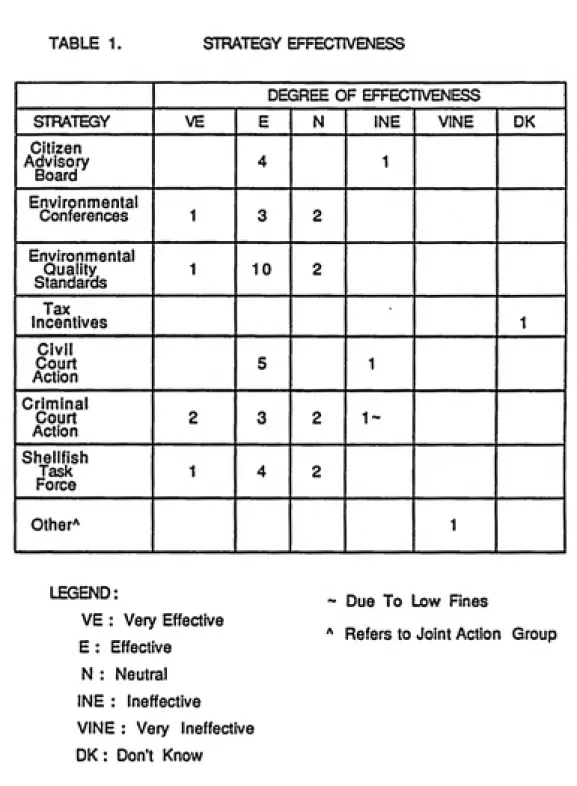
Effectiveness of the strategies is summarized and presented in Table 1.
4a. If your state has not used these strategies, in your
opinion, do you think they would be effective?
Yes 4 No 1 No Answer 13
One YES response indicated effectiveness of the strategies would be based on the circumstances.
5. List the 3 major obstacles in managing shellfish in your
state.
A variety of responses were given and grouped into 4 major categories:
1) Administrative/Operating Constraints
2) Legal Constraints
46
TABLE 1. STRATEGY EFFECTIVENESS
DEGREE OF EFFECTIVENESS
STRATEGY VE E N INE VINE DK
Citizen
Advisory
Board
4 1
Environmental
Conferences 1 3 2
Environmental
Quality
Standards
1 10 2
Tax
Incentives 1
Civil Court Action
5 1
Criminal Court Action
2 3 2 1~
Shellfish
Task Force
1 4 2
Other'^ 1
LEGEND:
VE : Very Effective
E : Effective N : Neutral INE : Ineffective
VINE : Very Ineffective
DK : Don't Know
~ Due To Low Fines
" Refers to Joint Action Group
Administrative/Operating Constraints
1) Insufficient resources (funding, staff, & labs)
2) Long geographical distances to growing areas 3) Harvest on public ground
4) Nonpoint source pollution
5) Lack of good shellfish growing areas
6) Importation of questionable quality shellfish from certified/non-certified interstate shippers
7) State shellfish industry financially inconsequential 8) Lack of industry cooperation/support
9) Reclaiming closed areas due to pollution
Legal Constraints
1) Lack of clear regulations
2) Low fines for prohibited violations
3) Lack of adequate control of animal and boat
pollution
4) Low priority of shellfish as related to other issues
5) Limited natural resources on private and military
land
Technical/Analytical Constraints
1) Lack of a truly representative bacteriological
indicator
2) Major deficiencies in NSSP Manual (1986) (criteria outdated and generally not scientifically supported)
Public Constraints
1) Lack of knowledge about shellfish concerns on part
of industry and general public
2) Coastal development and competing user groups
3) Too many harvesters for amount of resource
4) Too many landing areas
5) Industry and public doubt about growing water
examination methods
6. What are the major factors contributing to your state
developing shellfish programs? (Check all that apply.)
Environmental Deterioration Concern for the Public's Health
Federal/Industrial Financial
Incentives
State Requirements and Mandates
Other (please indicate)
1) Need to comply with the cooperative efforts of the Food and Drug Administration
in the National Shellfish
Sanitation Program and the
Yes 6 No No No 8 Yes Yes 0 1 9 7 48
2) Commitment by the shellfish industry; and
3) Interest in resource enhancement
7. Do you think a stronger or different state role is needed in managing shellfish? Or both?
Stronger role:
Different role:
Both:
7a. If you answered yes to any of the above, in what way
should the role be altered?
Eight responses to this question were given. Four
of these indicated that a stronger state role could best be facilitated through an increase in funding and/or staff. Other responses for a stronger state
role were as follows:
One indicated that fines for illegal harvesting should be strengthened. One stressed that the state agency must be responsive to the needs of the shellfish industry. Another stated that shellfish harvesting area closures should serve as red flags to state environmental monitoring and permitting agencies.
Lastly, one state indicated that current state efforts are thought to be sufficient.
III. OPERATIONS
1. Of the following, what are the measures on which your
state bases its classification of waters? (Check all that apply.)
MEASURE
A Water Quality Studies 18
B Pollution Source Survey 18 C Hydrographic & Meterological
Characteristics 17
D Harvesting Practices 9 E Resources (specific species
abundance & distribution) 6
F Interrelationships of the
foregoing factors 13 G Other (please indicate) 0
FIGURE 7.
STATE USAGE OF WATER CLASSIFICATION MEASURES
NUMBER
OF
STATES USING
MEASURES
i
i
I
i
I
i
MEASURE LEGEND:
MEASURE A - Water Quality Studies MEASURE B - Pollution Source Survey
MEASURE C - Hydrographic & Meterological Characteristics MEASURE D - Harvesting Practices (Commercial, Sport,
Wet storage facilities, Landings, Active leases)
50
2. What is the total area (in acres) of classified shellfishing waters within your state?
The range of classified shellfishing waters was
from 1-2,263,000 acres.
2a. How much of this area (in acres) is within your
division or agency's jurisdiction?
All states responding were responsible for 100% of the area stipulated.
3. How many acres are prohibited? _____ Approved? _____
Conditionally approved? _____ Restricted? _____
Non-productive? _____ Other classifications? _____
(Please indicate classification)
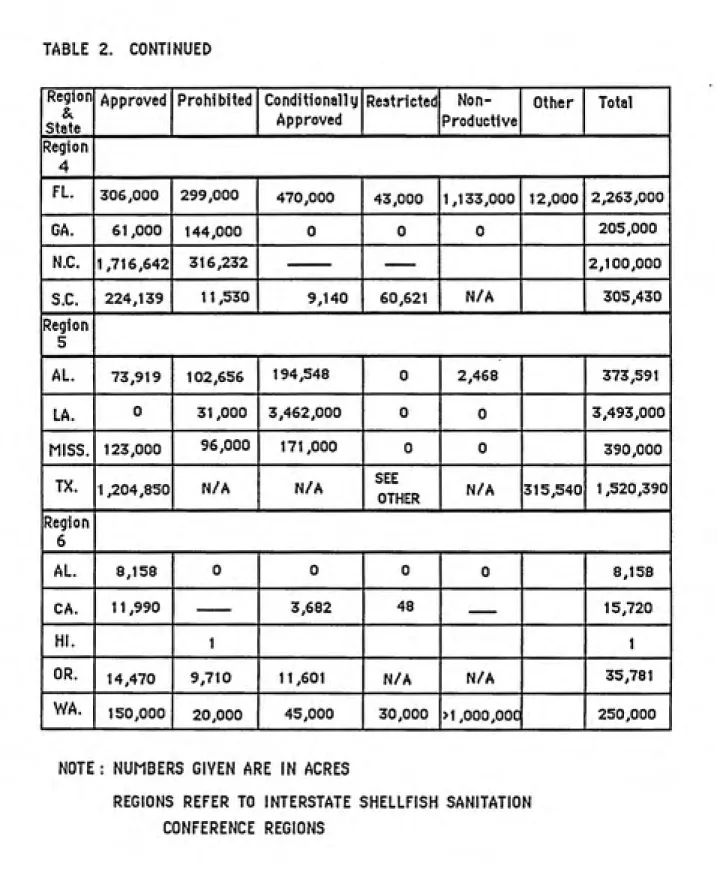
Classifications of state shellfishing waters by
state can be seen in Table 2. The classifications are
given for all twenty-three of the shellfish-producing states. Several other classifications are used by
states. These include: Unclassified (unapproved) instead of Nonproductive, seasonally condemned,
seasonally condemned around marinas, polluted instead
of Restricted, and conditionally restricted.
Discussion: This question answers the broad question of, "What do we know?" Updates on this information
lend themselves to studies of trends in classification
and of information relating improving or declining
State water quality. With such information, a focus
and direction for future planning can be established,
improvements begun, and problems diffused. Thus, to obtain an overall picture of the current status of US
shellfishing waters, information for all 23 states is included. States are listed according to the
Interstate Shellfish Sanitation Conference regions.
This information is accessible to the public and is
found in the 1985 National Estuarine Register.
IV. PROGRAM ACTIVITIES AND FUNCTIONS
The National Shellfish Sanitation Program Manual of Operations states five functions for states to perform in
the management of shellfish:
1. Shoreline Surveys/ Water Quality Sampling 2. Inspection of packing/processing plants
3. Laboratory Analysis
4. Enforcement Activities
TABLE 2.
CLASSIFICATIONS OF STATE SHELLFISHING WATERS BY STATE
Region
& State
Approved Prohibited Conditionally
Approved
Restricted Non¬ productive
Other Total
Region
1
MA. 255,000 41,000 1,000 5,000 500,000 802,000
ME. 36,500 8,800 16,100 2,500 7
60,000+
NH. 4,000 6,000 0 0 0
10,000
Rl. 62,025 18,602 11,447
92,074 Region
2
CT. 309,000 77,714 5,654 0
392,419
NJ. 483,903 114,077 19,375
43,205 -600,000
NY.
900,000 200,000 Varies Varies ?
1,100,000 Region
3
DE.
209,000 19,000 3,000 0 44,000 275,000
MD.
'1,053,000 0 0 -50,000
- 90,000 -1,200,000
VA. ?
2,354 91,186 91,439 4,473 500,000
NOTE: NUMBERS GIVEN ARE IN ACRES
REGIONS REFER TO INTERSTATE SHELLFISH SANITATION
CONFERENCE REGIONS
ilA
TABLE 2. CONTINUED
Region
& State
Approved Prohibited Conditionally Restricted
Approved
Non¬ productive
Other Total
Region
4 FL.
306,000 299,000 470,000 43,000 1,133,000
12,000 2,263,000
GA. 61 ,000 144,000 0 0 0 205,000
N.C. 1,716,642 316,232
2,100,000
S.C. 224,139 11,530 9,140 60,621 N/A 305,430
Region
5
AL. 73,919 102,656 194,548 0 2,468 373,591
LA. 0 31,000 3,462,000 0 0 3,493,000
MISS. 123,000 96,000 171,000 0 0 390,000
TX. 1,204,850 N/A N/A
SEE
OTHER N/A 315,540 1,520,390
Region
6
AL. 8,158 0 0 0 0 8,158
CA. 11,990 3,682 48 15,720
HI. 1 1
OR.
14,470 9,710 11,601 N/A N/A 35,781
WA.
150,000 20,000 45,000 30,000 > 1,000,000 250,000
NOTE: NUMBERS GIVEN ARE IN ACRES
The following questions pertain to activities involved in each function.
Shoreline Surveys/Water Quality Sampling
1. What method is used in conducting shoreline surveys
within your state?
Desktop 4 Field 18
2. Approximately what percentage of your state's classified
shellfishing waters are surveyed annually?
The percent of classified shellfishing waters
surveyed annually by states ranges from 0% to 100%. A summary of the percent of waters surveyed annually can be seen in Figure 8.
3. Check each of the following parameters which are included in the water quality monitoring program conducted by your division/agency.
Fecal Coliform 17 Total Coliform 11
Viruses 2 Paralytic Shellfish Poisoning
Heavy Metals 12 Petroleum Hydrocarbons 10
Chlorinated Hydrocarbons __9_ Other (please indicate)
1) Radiological; Organophosphates
2) Salinity
3) Special microbiological studies
when required (fecal strep, IMViC)
4) Fecal Strep, Enterococcus, Clostridium The number of parameters monitored per state
ranges from one to seven or more:
Number of Parameters
Monitored per State Number of States
1 3
2 4
3 5 4 0
5 1 6 2 >7 1
53
FIGURE 8.
PERCENT OF WATERS SURVEYED. BY STATE
PERCENT
OF
90100
8090
-70-80
6070
5060
WATERS 4050
SURVEYED 3040
2030
1020
010
-r2 year goal r- Atter 1-1-87
1 2 3
< •<
ͣ
< •<
ͣ
< < A
< < <
ͣ
< •<
< <
\
IM
7 8 9 10 11 12 13 14 15 16 17 18
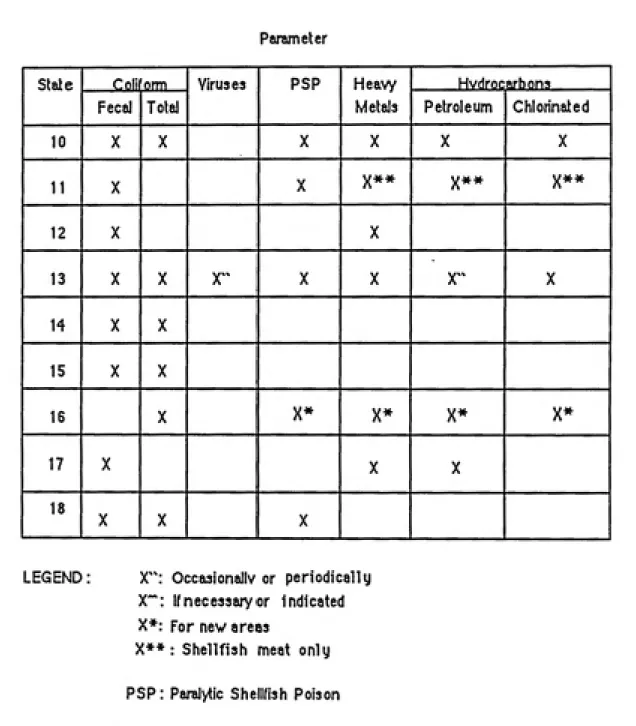
hydrocarbons) only occasionally, and some on a periodic basis. Heavy metals and the hydrocarbons are also
monitored only in the meat samples of one state and if
necessary or if indicated, in others. Results are
summarized in Table 3.
Inspection of Packing/Processing Plants
1. What is the inspection frequency in your state? Weekly 0 Semi-annually 3
Monthly 11 Annually 12 Quarterly 4 Other 0
(indicate frequency)
One state indicated that the frequency of its
inspections depends on the plant's operation. State plant inspection frequency is summarized in Figure 9.
Laboratory Analysis
1. Is growing water sampling and market sampling of
shellfish meat conducted on a schedule?
Growing Water Sampling:
Yes 16 If yes, on what schedule? No 2
Schedule:
Weekly 1 Quarterly Bi-monthly 1 Semi-annually Monthly 6 Annually
Other responses indicate that growing water
sampling is also conducted after pollution events or after periods of relaying and in one state, sampling varies from area to area.
Market Sampling:
Yes 13 If yes, on what schedule?
Monthly
Quarterly No 2
Schedule:
Weekly 2
Bi-monthly 1 Occasionally 1
55
TABLE 3.
DISTRIBUTION OF WATER QUALITY S^^PLING P/iR/iMETERS
Parameler
State Coliform Viruses PSP Heavy Metals
Hydrocarbons
FecaJ Total Petroleum Chlorinated
1 X X
2 X X X
3 X
4 X X X" X" X" X" X"
5 X
6 X X X" X"
X"
7 X X X X X
8 X X X X X X
9 X X
X X-* X~ X~
TABLE 3. CONTINUED
Parameter
State Coil orm Viruses PSP Heavy Metals
Hydrocarbons Fecal Total Petroleum Chlorinated
10 X X X X X X
11 X X X** X*» X**
12 X X
13 X X X" X X X" X
14 X X
15 X X
16 X X* X* X* X*
17 X X
X 18
X X X
LEGEND: X": Occasionaliv or periodically
X~: If necessary or Indicated
X*: For new areas
X** : Shellfish meat only