Lei Wang. A Content Analysis of the Use of Facebook by Academic Libraries. A Master’s Paper for the M.S. in I.S. degree. April, 2014. 55 pages. Advisor: Reagan Moore
This study focuses on the usage of Facebook as a user service by academic libraries. The purpose of this research is to gain a greater understanding of the use of Facebook among academic libraries. A content analysis was conducted on a sample of 75 Facebook pages managed by academic libraries selected from Association of Research Libraries (ARL)’s 2012 list of the top 100 libraries in the United States. This study examines academic library Facebook pages in order to explore to what extent Facebook pages have been implemented by academic libraries, what type of information are shared on libraries' Facebook pages, and how successful these pages are in reaching out to users. Results of this study provide not only data to illustrate to what extent Facebook has been adopted and how it is being used, but also provide useful implications and suggestions of future use of Facebook pages.
Headings:
A CONTENT ANALYSIS OF THE USE OF FACEBOOK BY ACADEMIC LIBRARIES
by Lei Wang
A Master’s paper submitted to the faculty of the School of Information and Library Science of the University of North Carolina at Chapel Hill
in partial fulfillment of the requirements for the degree of Master of Science in
Information Science.
Chapel Hill, North Carolina April 2014
Approved by:
Table of Contents
Introduction ... 2
Literature Review ... 5
Methodology: ... 7
Results ... 10
Use of Social Media by Academic Libraries ... 10
Activeness of Academic Library Facebook Page ... 11
Facebook Posts Content ... 13
Discussion ... 26
Facebook vs. Other Social Media Tools ... 26
Types of Posts ... 27
Comments vs. “Likes” ... 29
Result Consistency ... 30
Suggestions ... 30
Limitations ... 31
Conclusion ... 31
REFERENCES ... 33
Appendix A: Social Media Checklist ... 36
Appendix B: Sample Population ... 42
Appendix C: Facebook Page Data Collection Template ... 50
Introduction
With the recent boom of information technologies in the new millennium, college students are immersed in an electronic and Internet world that offers different ways of learning and different channels to access information compared to previous generations. The ability to navigate and contribute to the digital world has become a crucial property of the information skills required by today’s students. Over the past few years, librarians have struggled to offer new service models, methods, and technologies that can be adapted to improve library services. Due to the high use of social networking tools among students, many media specialists advocate using these new social web platforms to reach out to student populations (Farkas, 2007a, b; Mathews, 2006, 2007a; Milstein, 2009). Online Social Networks (OSNs), as one of the most prominent Web 2.0
technologies, reduce the need for users to come to the library and repackage materials into an environment that is more familiar to them. Therefore, most academic libraries have embraced them as a method of promoting themselves within their communities.
Among the Online Social Networks, such as MySpace, Facebook, and Delicious, Facebook has seen broad acceptance among students as a means of online
communication (Stutzman, 2007, p. 3). In Facebook, users can create and update their own profile information, interact with one another, viewing others’ profiles and
objectives, discuss issues, post photos, and share related content. Furthermore, Facebook pages enable public figures, businesses, organizations and other entities to create an authentic and public presence on Facebook. Pages are visible to everyone on the internet by default. Each person on Facebook can connect with pages by liking or subscribing to receive their updates in News Feed and interact with them. According to statistics by Facebook.com, over one billion people like and comment on an average of 3.2 billion times on pages every day. A well-managed Facebook page can be a powerful stage of word-of-mouth marketing. Facebook is increasingly used by individuals of all ages, especially among college students. According to a study by Ellison (2007),
approximately 79% to 95% of undergraduate students have Facebook accounts. If academic libraries truly want to be where students are, Facebook is a terrific venue to reach them.
Academic librarians, recognizing this trend, have increasingly turned to utilizing Facebook to interact directly with students through a site sponsored by the library. Libraries can release news such as new books and resources information, notifications of lectures, training, and conferences etc. This outreach strengthens the exchanges and feedback: students can participate in literature discussions, recommendation; library can receive feedback from users on library services. Moreover, libraries can embed the library catalog that allows students to access them without actually visiting their web site. In addition, library reference services can be embedded into the Facebook as a function called “Ask a librarian” or “Research help.”
of Facebook by academic libraries is not without controversial voices. Some librarians argue that social networking by academic librarians is an ineffective use of librarian time and effort (Sekyere, 2009). Some students perceive this outreach method as invading student space and a waste of valuable student time due to the frequent, irrelevant
messages. Therefore, librarians should not too actively advocate befriending students but rather allow them to control their level of participation. In addition, libraries should keep posting interesting and useful information so that they won't be perceived by college students as email spam or a waste of time. However, there is little data showing whether Facebook has been effectively used to share information and what the level of user involvement is. Most of the existing research involving Facebook focuses on whether students accept libraries using Facebook to contact them and their feelings about it. Very few quantitative studies have been designed to analyze academic libraries’ presence on Facebook comprehensively. This study is an effort to fill this gap by examining the extent to which Facebook has been adopted and how it is being used.
This study will examine the use of Facebook among academic libraries through the following research questions:
1) Which social media is most commonly used by academic libraries?
2) To what extent are Facebook pages implemented by academic libraries? In other words, how frequently do academic libraries use Facebook pages?
3) What types of contents are typically posted by the Facebook pages of academic libraries?
5) What type of posts gets the largest number of "likes" or comments? What type of posts gets the fewest feedbacks?
6) Why do these posts receive high/low level of feedbacks?
7) Are the results consistent within pages of all academic libraries?
8) What can be concluded as the best practice for using Facebook among academic libraries?
Literature Review
The impact of Facebook on academic libraries has been discussed fairly extensively in the library literature. Early research primarily focused on introducing Facebook to academic librarians and explaining its importance. Matthews (2006)
reviewed the features offered by Facebook and explored the use of a Facebook group for the Georgia Tech library as a platform for librarians to interact with students (Matthews, p.306). Matthews suggested that academic libraries could adopt online social networks to increase campus visibility and to help students understand the value of the library (p.307).
Facebook page can serve as a reminder to use the resources available at an academic library (Farkas, 2007a). Libraries also create event invitations for programs as an
additional forum to promote library activities (Chu and Meulemans, 2008). Additionally, academic libraries are embedding library services within the Facebook page by using Facebook applications. Some academic libraries embed the library catalog to allow students to access the contents of the library catalog without actually visiting the library’s web site (Farkas, 2007b). Some academic libraries are also embedding the
“ask-a-librarian” feature within the Facebook page to provide reference services. In 2007, Mack et al found that the majority of reference questions during a semester at Penn State were submitted to a librarian through Facebook, rather than through e-mail, instant messenger, or in-person reference (Mack et al, 2007, p. 5). Research has also investigated the possibility of using Facebook to increase awareness of upcoming library events. Kwong (2007) reported on the use of Facebook and MySpace, both social media sites, to
advertise upcoming library events at Indiana University South Bends Schurz Library. Kwong partially attributed the much greater success of the 2007 Schurz Library Speaker Series, in comparison with the previous year’s speaker, to the awareness generated by the use of the social sites (p. 57). By 2011, the majority of libraries (90.4% of 115 ARL member libraries) have at least one Facebook page (Wan, 2011).
Gerolimos (2011) examined user interaction of 3513 posts, among which 63.42% had neither comments nor “likes”. Another concern is that college students may be resistant to befriending the library if their personal information is visible to university officials (Sekyere, 2009). Chu and Meulemans (2008) conducted a survey of 89 students and a focus group of four students in order to understand their usage of social networks, like MySpace and Facebook. They found that student’s use of social networks for entertainment was very high, but most students expressed concern about adults, parents, and professors presence on the social networks. This reveals potential limitations for libraries using social networking tools. Even those students receptive to social
networking by libraries indicated that they did not want their time wasted with frequent, irrelevant messages (Connell, 2009). Irrelevant information may detract from the academic libraries outreach attempts and be considered as intrusive as email spam.
Methodology:
unobtrusiveness. Unlike interviews, questionnaires and experiments, researchers can examine content without involving a human subject. It is therefore unlikely that the act of measuring a phenomenon will instill some change that may impact the data (Riffe, 2005, Berg, 2009). Furthermore, the content to be analyzed is determined by the researcher and therefore the result will be more consistent than other methods.
Sample Selection:
For this study, the population for research was defined as Facebook pages from academic libraries that were fully accredited by the Association of Research Libraries (ARL). ARL is an organization of leading research libraries in North America. To become a member, a library must meet rigorous criteria in terms of collections and services. Its member list is a roster of top academic libraries in the United States and Canada. ARL maintains a list of the 100 largest libraries in the United States by volumes held.
library’s name and the word “Facebook”. If both of the previous two methods failed to find a library Facebook page, searches on Facebook can be performed. Keywords of Facebook searching included the library’s name and the geographical location of the school.
Data Collection
When performing research for this study, data collection for this study was conducted from Jan 6th, 2014 to Jan 26th, 2014. Although potentially the information on Facebook pages is dynamically changing, information from a prior time period barely changes and hence data covering that time period can be considered as constant.
Therefore, the data to be collected would then be information of Facebook posts during the time period January 1st, 2013 to December 31st, 2013. Data collection consisted of filling useful information into templates, taking notes, and recording associated screenshots of the academic library’s Facebook page.
The first step is to conduct a checklist as shown in Appendix A. Each academic library is investigated for its use of different social media, including Facebook, Twitter, Blogs, YouTube, and Flickr. The checklist is binary-coded: if the library is using the social media, it would be marked as 1; if not, marked as 0. The second step is to find the corresponding Facebook page URL and names of the academic libraries using Facebook as shown in Appendix B. The last step is then to collect Facebook posts information of each of these libraries as shown in Appendix C.
and therefore used as the standard for post categorization. The data to be collected include total number of all wall posts, number of posts of each category, and
corresponding “Likes” /Comments. The term "feedback" is used to describe a post that contains either a "like" or a comment. Also, if a post includes both a comment and a "like" from the same user, only the comment is counted, while library comments or "likes" are not counted at all. A "like" placed on a comment is similar to leaving a comment, but it is mostly an indication that someone agrees with the original post.
Results
Use of Social Media by Academic Libraries
Social Media Name Number of Academic Libraries
Percentage out of 75 Academic Libraries
Facebook 71 94.67%
Twitter 68 90.67%
Blogs 52 69.33%
Flickr 29 38.67%
YouTube 38 60.67%
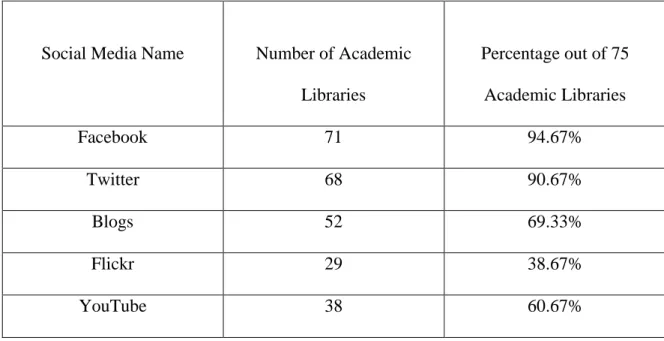
Table 1 provides data of how many academic libraries are using which social media tools. Each of the 75 academic libraries being studied uses at least one of the social media tools listed in the table. According to this table, Facebook is the most commonly used social media, with 71 out of 75 (94.67%) academic library users. Only Harvard University Library, Brigham Young University Harold B. Lee Library, University of South Carolina, and University of Alabama Libraries do not have Facebook Page. The second commonly used social media tool is Twitter, and Flickr has the fewest academic library users.
Activeness of Academic Library Facebook Page
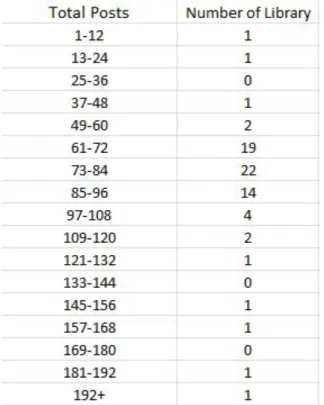
Figure 1: Number of Posts of Each Academic Library Pages in 2013 and the Average Number
Facebook Posts Content
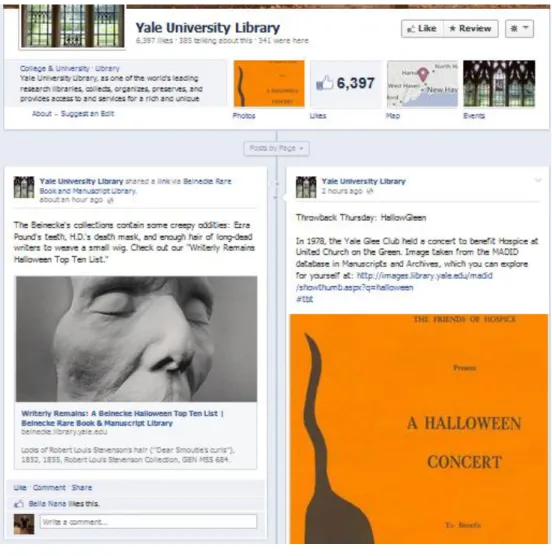
Although many different variations of types and numbers of posts exist among the academic libraries, several common characteristics of Facebook timeline posts were found to be present on many of the sites. An example of common timeline posts by academic library can be found in the screenshot from the Facebook page of Yale
University Library as shown in Figure 2. In this screenshot, there is one post of a shared link and one post about an event.
To identify patterns and common themes of posts of the Facebook pages, the post content is compared and classified. Typical Facebook posts that are found on multiple academic library Facebook pages can be categorized into the following types: Info, Events, Collection/Resources, Photos/Videos, Chronicles/Historical Moments (awards), People (Librarians/Faculty/Volunteer), Links, Reference, Direct Interaction
Figure 2: Screenshot of Yale Library Facebook Page
1) Info
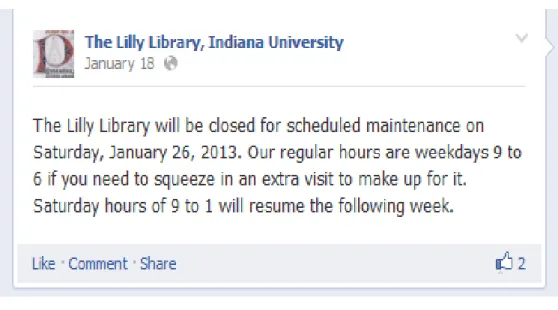
Firgure 3: An Information Post by the Lilly Library
2) Events
The category "Events" includes posts about library events, such as workshops, exhibitions, lectures, competitions, etc. Figure 4 provides an example of such post, which is a screenshot from the University of Chicago Library Facebook page about the event "Library Book Sale."
.
3) Collections/Resources
The "Collections/Resources" category refers to the posts related to library
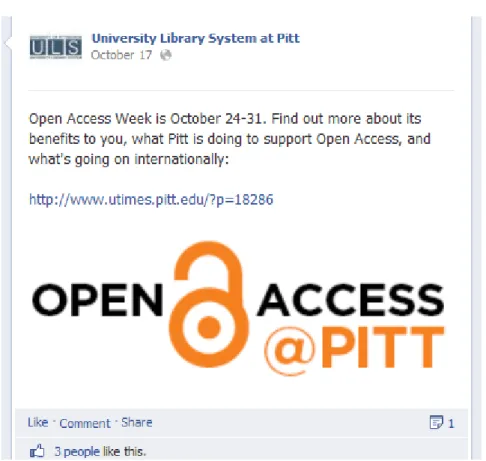
collections, including updates or promotions of electronic and print collections, database trials, other research resources, etc. An example of this type of post can be illustrated by the following screenshot of the Facebook page of the University Library System at Pitt of the University of Pittsburgh (Figure 5). This post is about the Open Access Week that allows people to get access to resources with little restriction.
4) Photos/Videos
This category includes posts of images and videos clip, and changes to the cover photos on the page, as exampled by Figure 6, which is a screenshot of picture posts from the Ohio State University Library Facebook page.
Figure 6: A Photo Posted by the Ohio State University Library
5) Chronicle/ Historical Moments
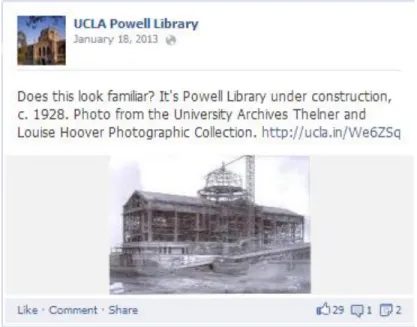
Figure 7: A Historical Post by the UCLA Powell Library
6) People (Librarians/Staff/Faculty/Volunteer)
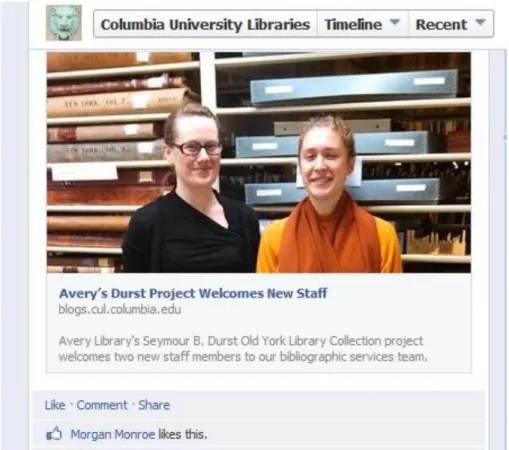
Posts about people such as librarians, faculties, and volunteers can also be found on the academic library Facebook pages. This type of posts includes the introductions of these people, news about librarians, job advertisements for librarians, and their
accomplishments etc. An example of such a post can be found in the following
Figure 8: A Post about People by the Columbia University Libraries
7) Links
Figure 9: A Link Shared by the Princeton University Library Page
8) Reference
Posts that are categorized in this type are about the reference services, document delivery, research supports, etc. A post about citation by the UNC Davis Library
Facebook page gives an example of this category as shown in Figure 10.
9)Interactions
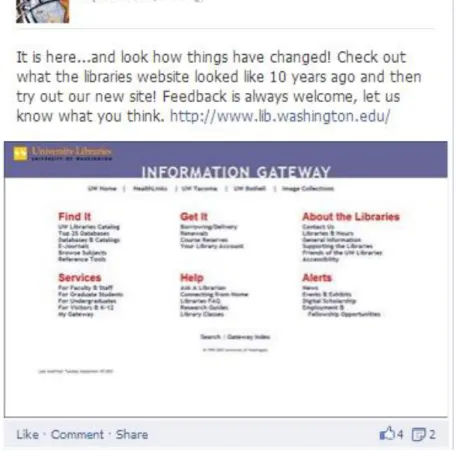
Sometimes there are academic library pages' posts that intend to inquire about people's opinions, advice, or suggestions towards the library. These posts are included in the "Direct Interaction" category. An example is given below in Figure 11, which is a post by University of Washington Libraries that asks for feedbacks about their new web site.
10) Others
Posts that cannot be categorized into any of the previous types described above are included in the "Others" category. These are often special or non-typical posts released by a small number of libraries.
Data Result for Categories:
Comparison and analysis of the number of posts of each type listed above can provide information about which types of content are the most frequently posted by academic library. Table 3 illustrates the frequency of each type of post by giving the number and percentage. During the data collection period, there were a total of 6133 posts on the Facebook Pages of the 75 academic libraries being studied. According to Table 3, the most frequent type of post on the libraries' walls was Links, with a percentage of 29.20%, followed by Events (27.83%).
The percentage of posts of each category is calculated by the following formula. Percentage of Posts of Each Category =
Figure 12: Pie Chart of Percentage of Different Types of Posts of All the 75 Academic Libraries in the Year of 2013
Another aspect that this study examined is the amount of user-generated content and user participation. Content created by users are considered via comments made on the posts while the degree of user participation is determined by the number of "likes." Number of comments and “likes” towards posts of each category provides deeper
understanding of which types of posts are most likely to receive feedbacks. Table 4 gives detailed data of number of posts, likes, comments of the Facebook pages of the 75
academic libraries being studied within the year of 2013 and their relative ratios. It determines how many of the libraries' posts include "likes" or comments and how many have none. Several findings are demonstrated by Table 4 as illustrated below.
Table 4: Number of Posts and Feedbacks (Likes and Comments), and Relative Ratios/Percentage
782.00
1707.00
511.00 491.00 233.00
159.00 1791.00
237.00 115.00 107.00 Info
Events
Collection/Resources
Photos/Video
Chronicle/ Historical Moments
Table 4 also includes the ratio of comments to "likes," which is as low as 0.07. Out of the total 28734 feedbacks examined, 26782 are "likes" and only 1952 are
comments. This evidence demonstrates a low level of user-generated content compared to user participation.
Table 5 illustrates the question of what type of posts receives the most/fewest feedbacks from another approach. Each of the 75 academic library Facebook pages was examined separately. The category that has the largest percentage of number of posts, in other words, what is the most common type of posts, was determined for each page. In addition, the category that receives the most "likes," the most comments, and the fewest feedbacks were also identified for each page. And last, for each category, the number of pages with this category being the most common type, receiving the most "likes", the most comments, or the fewest feedbacks, were counted and recorded in Table 5
Table 5: Categories and Number of Library Facebook Pages that Has Each Category as its: a) Most frequently "liked" Category, b) Most frequently commented Category, c)
Least frequently responded Category, and d) Most frequently posted Category.
Table 5-a Table 5-b
Table 5-c Table 5-d
Discussion
The results of the study show that Facebook is the most commonly used social media tool by academic libraries. Among the 75 libraries examined, 71 of them use Facebook pages as a stage of information-sharing and user interaction. With advantages such as giant user group and additional features and customization options that allows librarians to modify their pages according to their needs, Facebook stands out to be the predominant social media tool used by libraries. Almost all of the pages examined in this study post more than once a month, which reflects the high frequency of Facebook use.
Types of Posts
Typical posts examined can be classified into 10 categories based on their contents: Info, Events, Collection/Resources, Photos/Videos, Chronicles/Historical Moments, People (Librarians/Faculty/Volunteer), Links, Reference, Interaction and Others. "Links" occupies the largest proportion of the total number of posts, with a percentage of 30.43%, followed by Events (23.65%). Since a lot of information related to the library is accessible only from sites outside of Facebook, librarians who are in charge of managing the Facebook page need to share the links to these sites in order to provide users with useful information. Also, posting links requires little time or creativity compared to other contents, which makes it is much easier for librarians to post links. Therefore, Links is the major type of posts for most libraries as indicated by Table 4 and Table 5-c. Another common type of posts is events, which shows that the Facebook page has been highly used as a tool of informing users about the occurrence of various events.
In order to examine whether Facebook has been successfully used to get user feedbacks, the level of user response and participation was studied, since using the number of "likes" and comments towards the posts can serve as an indicator. Among the categories listed above, "Interaction" posts receive the most comments and "Photos and Videos" posts receive the most "likes." In "Interaction" posts, some page administrators would solicit users' feedbacks with direct questions, such as "what do you think" and "how do you like." It is more likely for a user to provide a response to questions like these than posts in the form of plain statements like notices and announcements.
Photos and videos tend to gain a lot of attention from users since it is the most intuitive and visual way for people to get information. Most people that browse the web prefer viewing pictures and watching videos to reading. People can get information not only visually but also promptly from photos, since the time of to view a text post takes much longer than viewing photos. Videos are even more engaging, appealing to the senses of sight and sound. In addition, since on Facebook pages, photos and videos have a large preview image, rather than lines of tiny texts, they are more able to catch people's eyes. Therefore, photos receive the most "likes" among all the categories. At the same time, photos receive a relatively greater number of comments than other categories. However, these comments are mostly simple compliments like "looks nice" and "beautiful," which provide little valuable or constructive information to the librarians.
Although "Links" is a major part of all the posts, this type of posts rarely receives any response. Since viewing the content from another site requires opening a new
be directed to a new page and hence the possibility that they will return to the original Facebook page to give feedback will be low. Also, some links shared by the page administrators are actually irrelevant to the library itself, which may attract less interest from users who seek information related to the library.
Comments vs. “Likes”
previously mentioned, most comments examined in this study tend to be simple compliments with few words, especially under posts of photos.
Result Consistency
The results of what types of post are the most frequently posted or that generate responses on the libraries' Facebook pages are consistent among the libraries examined, evidenced by the two approaches shown by Tables 3 and 4 and Table 5. Tables 3 and 4 address this question from a general perspective by examining the total number of different posts of all the pages, while Table 5 demonstrates the result by examining the pages separately and by finding the majority of the pages that correspond to the highest level of post frequency or amount of feedback with respect to each category. For example, Table 5-c shows that the majority of these Facebook pages post "Links" most often, which is consistent with the result in Table 3, where 29.20% of all the posts are Links. The consistency and resemblance between these two approaches show that the academic libraries use Facebook pages for sharing similar types of information. Also, the use of Facebook pages receives about the same level of user response.
Suggestions
would be more vivid and possibly attract more attention. Also, when seeking users' opinions, a picture of the question in bold and bright font would also increase people's attention compared to plain text post. When posting links from other sites, a brief and intriguing comment on the link can be added to trigger the users' interest and involvement.
Limitations
Although this study effectively constructed a method for measuring the use of Facebook pages by academic libraries from multiple aspects, limitations still exist. This method of research cannot document other types of interaction with library Facebook pages by library users, since it is not able to access the full record of how the Facebook site had been used (or not used), such us the web traffic. The only data that can be used is known as the "wall", which is probably the most popular Facebook feature.
Conclusion
REFERENCES
Babbie, Earl R. (2009). The Practice of Social Research. Stamford, Connecticut: Wadsworth Publishing.
Berg, B. (2009). Qualitative research methods for the social sciences. Boston: Allyn & Bacon.
Buckingham, A., Saunders, P. (2004). The Survey Methods Workbook. Malden: Polity Press.
Chu, M. and Meulemans, Y. (2008), The problems and potential of MySpace and Facebook usage in academic libraries, Internet Reference Services Quarterly, 13(1), 69-85.
Connell, R. (2009), Academic libraries, Facebook and MySpace, and student outreach: a survey of student opinion, Portal, 9(1), 25-36.
Creswell, John W. (2003). Research Design: Qualitative, Quantitative, and Mixed Methods Approaches. Thousand Oaks: Sage Publications, Inc.
Ellison, N. (2007). Facebook use on campus: A social capital perspective on social network sites. Presentation at the Sixth Annual ECAR Symposium, Boca Raton, FL. Retrieved from http://net.educause.edu/ir/library/pdf/ecr0713.pdf
Undergraduate Libraries, 18(4), 307-318
Hendrix, D., Chiarella, D., Hasman, L., Murphy, S., & Zafron, M. L. (2009). Use of facebook in academic health sciences libraries. Journal of the Medical Library Association, 97(1), 44-47. Retrieved from
http://vnweb.hwwilsonweb.com.libproxy.lib.unc.edu/hww/jumpstart.jhtml?recid=
0bc05f7a67b1790e06bc114cd79d59965b80b050e973ff1d320e6b6d91f5d42d03b7
4f8ff89a6c62&fmt=C
Kwong, V. (2007). Reach Out to Your Students Using MySpace and Facebook. Indiana Libraries, 26(3), 53-57.
Mack, D., Behler, A., Roberts, B., Rimland, E. (2007). Reaching Students with Facebook: Data and Best Practices. Electronic Journal of Academic and Special
Librarianship, 8(2). Retrieved from
http://southernlibrarianship.icaap.org/content/v08n02/mack_d01.html
Matthews, B. (2006). Do you Facebook? College and Research Libraries News 67(5), 306-7.
Gerolimos, M. (2011). Academic Libraries on Facebook: An Analysis of Users' Comments. D-Lib Magazine,17(1), 11-12
Milstein, S. (2009). Twitter for libraries (and librarians) , Computers in Libraries, 29 (5), 17-18
Powell, R. R., & Connaway, L. S. (2004). Basic Research Methods for Librarians (4th ed.). Westport, CT.: Libraries Unlimited.
Sekyere, K. (2009). Too much hullabaloo about Facebook in Libraries! Is it really helping libraries?, Nebraska Library Association Quarterly, 40(2), 25-7.
Stemler, Steve (2001). An overview of content analysis. Practical Assessment, Research & Evaluation, 7(17). Retrieved from http://PAREonline.net/getvn.asp?v=7&n=17 Stutzman, F. (2006). An Evaluation of Identity-Sharing Behavior in Social Networking
Communities. iDMAa Journal 3 (1). Retrieved from
Appendix
Appendix A: Social Media Checklist
Name of Academic Library Facebook Twitter Blogs Flickr YouTube
Harvard University Library 0 1 0 0 1
University of Illinois at
Urbana–Champaign Library
1 1 1 1 1
Yale University Library 1 1 1 1 0
University of California,
Berkeley Libraries
1 1 1 1 0
Columbia University
Libraries
1 1 1 0 0
University of Michigan
Library
1 1 0 1 1
University of Texas Libraries 1 1 1 1 1
University of Chicago Library 1 0 1 1 1
University of California, Los
Angeles Library
1 1 1 0 0
Indiana University Libraries 1 1 1 1 1
Stanford University Libraries
and Academic Information
Resources
University of Wisconsin–
Madison Libraries
1 1 1 1 1
Cornell University Library 1 1 1 0 0
Princeton University Library 1 1 0 0 0
University of Washington
Libraries
1 1 0 0 1
University of Minnesota
Libraries
1 1 0 0 1
University of North Carolina
at Chapel Hill Library
1 1 1 1 1
University of Pennsylvania
Libraries
1 1 1 1 1
Duke University Libraries 1 1 1 1 1
Ohio State University
Libraries
1 1 1 0 0
University of Pittsburgh
Library System
1 0 0 0 0
University of Arizona
Libraries
1 0 1 0 0
University of Oklahoma
Libraries
1 1 1 0 0
Michigan State University
Libraries
University of Virginia Library 1 1 1 1 0
University of Iowa Libraries 1 1 1 1 1
Pennsylvania State University
Libraries
1 1 0 1 0
New York University
Libraries
1 1 0 0 0
Northwestern University
Library
1 1 1 0 0
University of Georgia
Libraries
1 1 1 1 1
Rutgers University Libraries 1 1 0 0 0
University of Colorado at
Boulder Libraries
1 1 0 0 1
Texas A&M University
Libraries
1 1 0 0 1
Arizona State University
Libraries
1 1 1 1 1
University of Florida George
A. Smathers Libraries
1 0 0 0 0
University of Cincinnati
Libraries
1 1 1 0 0
North Carolina State
University Libraries
Washington University
Libraries
1 1 1 1 0
University of Kansas
Libraries
1 1 0 1 1
Brigham Young
University Harold B. Lee
Library
0 1 0 0 0
Brown University Library 1 1 1 0 0
University of Southern
California Libraries
1 1 0 0 1
University of California,
Davis Library
1 0 1 0 1
Howard-Tilton Memorial
Library at Tulane University
1 1 0 0 0
Louisiana State University
Libraries
1 1 1 0 1
University of Connecticut
Libraries
1 1 1 1 1
State University of New York
at Buffalo Libraries
1 1 1 0 1
Temple University Libraries 1 1 1 0 0
University of South Carolina
Libraries
University of Maryland
Libraries
1 1 1 1 1
University of Kentucky
Libraries
1 1 1 0 0
University of California, San
Diego Libraries
1 1 1 1 0
University of Rochester
Libraries
1 1 1 1 0
Johns Hopkins University
Libraries
1 1 0 0 1
University of Massachusetts
Amherst Libraries
1 1 0 0 0
University of Notre
Dame Hesburgh Libraries
1 1 0 0 0
Wayne State University
Libraries
1 1 0 0 1
Emory University Libraries 1 1 1 0 1
University of Hawaii at
Manoa Library
1 1 0 1 1
University of Missouri
Libraries
1 1 1 0 0
University of Alabama
Libraries
Vanderbilt University Jean
and Alexander Heard Library
1 1 1 0 0
University of Nebraska–
Lincoln Libraries
1 1 1 0 0
Auburn University Libraries 1 1 1 1 0
Oklahoma State University
Libraries
1 1 1 0 1
Georgetown University
Library
1 1 0 0 1
University of Utah J. Willard
Marriott Library
1 1 1 1 1
University of New Mexico
Libraries
1 1 1 0 0
University of Miami Libraries 1 0 1 1 0
University of Tennessee
Libraries
1 1 1 0 1
Syracuse University Library 1 1 1 0 0
University of California,
Irvine Libraries
1 1 1 0 1
Southern Illinois University
Carbondale Morris Library
1 0 1 0 0
Massachusetts Institute of
Technology Libraries
University of California,
Riverside Libraries
1 1 1 0 1
Sum 72 68 52 29 38
Appendix B: Sample Population
Name of Academic Library
URL Name of Facebook Page
Harvard University Library
N/A N/A
University of Illinois at Urbana–Champaign Library
https://www.facebook.com
/universitylibrary
University of Illinois at Urb
ana-Champaign Main Library
Yale University Library
https://www.facebook.com
/yalelibrary
Yale University Library
University of California, Berkeley Libraries
https://www.facebook.com
/ucberkeleylibrary
UC Berkeley Library
Columbia University Libraries https://www.facebook.com /culibraries Columbia University Libraries
University of Michigan Library
https://www.facebook.com
/pages/University-of-
Michigan-Library/110483979013559
University of Texas Libraries
https://www.facebook.com
/tamulibraries?ref=br_tf
Texas A&M University Libraries
University of Chicago Library
https://www.facebook.com
/uchicagolibrary
The University of Chicago Library
University of California, Los Angeles Library
https://www.facebook.co
m/UCLA.Powell.Library
UCLA Powell Library
Indiana University Libraries https://www.facebook.co m/pages/IU-Libraries/23769999627463 3 IU Libraries Stanford University Libraries and Academic Information Resources
https://www.facebook.co
m/greenlibrary
Green Library, Stanford Uni versity
University of Wisconsin– Madison Libraries https://www.facebook.co m/UWMadLibraries UW-Madison Libraries Cornell University Library https://www.facebook.co m/cornelluniversitylibrary
Cornell University Library
Princeton University Library
https://www.facebook.co
m/PULibrary
Princeton University Librar y
University of
Washington Libraries
https://www.facebook.co
m/uwlibraries
University of Washington Li braries
University of Minnesota Libraries
https://www.facebook.co
m/umnlib
University of North Carolina at Chapel Hill Library
https://www.facebook.co
m/UNCDavisLibrary
UNC Davis Library
University of Pennsylvania Libraries https://www.facebook.co m/PennLibraries Penn Libraries Duke University Libraries https://www.facebook.co m/dukelibraries
Duke University Libraries
Ohio State University Libraries
https://www.facebook.co
m/pages/Ohio-State-
University-Libraries/10912938850
Ohio State University Librar ies
University of Pittsburgh Library System
https://www.facebook.co
m/pittuls
University Library System a t Pitt
University of Arizona Libraries
https://www.facebook.co
m/uazlibraries
University of Arizona Libr aries
University of Oklahoma Libraries
https://www.facebook.co
m/UniversityLibraries
The University of Oklahoma Libraries Michigan State University Libraries https://www.facebook.co m/msu.libraries MSU Libraries
University of Virginia Library
https://www.facebook.co
m/pages/University-of-
Virginia-Library/136530559704906
University of Iowa Libraries
https://www.facebook.co
m/UofIowaLibraries
University of Iowa Libraries
Pennsylvania State University Libraries
https://www.facebook.co
m/psulibs
Penn State University Libra ries @ University Park
New York University Libraries https://www.facebook.co m/NYULibraries NYU Libraries Northwestern University Library https://www.facebook.co m/NorthwesternLibrary Northwestern University Library
University of Georgia Libraries https://www.facebook.co m/ugalibraries UGA Libraries Rutgers University Libraries https://www.facebook.co m/pages/Rutgers- University-Libraries/175081641956 Rutgers University Libraries
University of Colorado at Boulder Libraries
https://www.facebook.co
m/cublibraries
CU Boulder Libraries
Texas A&M University Libraries
https://www.facebook.co
m/tamulibraries
Texas A&M University Libraries
Arizona State University Libraries
https://www.facebook.co
m/ASULibraries
ASU Libraries
University of Florida George A. Smathers Libraries
https://www.facebook.co
m/UFSmathersLibraries
University of Cincinnati Libraries
https://www.facebook.co
m/uclibraries
UC Libraries
North Carolina State University Libraries https://www.facebook.co m/ncsulibraries NCSU Libraries Washington University Libraries https://www.facebook.co m/WUSTLlibraries Washington University Libraries - Olin Library University of Kansas
Libraries
https://www.facebook.co
m/KULibraries
University of Kansas Libraries
Brigham Young
University Harold B. Lee Library
N/A N/A
Brown University Library
https://www.facebook.co
m/brownuniversitylibrary
Brown University Library
University of Southern California Libraries
https://www.facebook.co
m/USCLibraries
USC Libraries
University of California, Davis Library
https://www.facebook.co
m/pages/UC-Davis-Library/173702685997465
UC Davis Library
University of
Connecticut Libraries
https://www.facebook.com
/UConnLibraries
UConn Libraries
State University of New York at Buffalo
Libraries
https://www.facebook.com
/ublibraries
University at Buffalo Libraries Temple University Libraries https://www.facebook.com /templelibraries Temple University Libraries
University of South Carolina Libraries
N/A N/A
University of Maryland Libraries
https://www.facebook.com
/UMDArchives?ref=br_tf
University of Maryland University Archives University of Kentucky
Libraries
https://www.facebook.com
/uklibraries
University of Kentucky Libraries
University of California, San Diego Libraries
https://www.facebook.com
/ucsdlib
The UC San Diego Library
University of Rochester Libraries
https://www.facebook.com
/pages/Rush-Rhees-Library/118708092066
Rush Rhees Library
Johns Hopkins University Libraries
https://www.facebook.com
/mselibrary
Milton S. Eisenhower Libr ary, Johns Hopkins Univer sity
University of
Massachusetts Amherst
https://www.facebook.com
/umassamherstlibraries
Libraries
University of Notre Dame Hesburgh Libraries
https://www.facebook.com
/hesburghlibraries
Hesburgh Libraries @ University of Notre Dame
Wayne State University Libraries
https://www.facebook.com
/waynestatelibraries
Wayne State University Library System Emory University Libraries https://www.facebook.com /EmoryLibraries Emory Libraries
University of Hawaii at Manoa Library
https://www.facebook.com
/UHMLib?sk=wall
University of Hawaii at Manoa Library
University of Missouri Libraries
https://www.facebook.com
/MizzouLibraries
MU Libraries, University of Missouri
University of Alabama Libraries
N/A N/A
Vanderbilt
University Jean and Alexander Heard Library https://www.facebook.com /vulibrary Vanderbilt University Library
University of Nebraska– Lincoln Libraries
https://www.facebook.com
/pages/UNL-Libraries-
University-of-Nebraska-
Lincoln-UNL Libraries --
Libraries/87086676278 Auburn University Libraries https://www.facebook.com /auburnlibraries Auburn University Libraries Oklahoma State University Libraries https://www.facebook.com /okstatelibrary?ref=search
Edmon Low Library
Georgetown University Library https://www.facebook.com /gulibrary Lauinger Library, Georgetown University
University of Utah J. Willard Marriott Library https://www.facebook.com /pages/J-Willard-Marriott- Library-University-of-Utah/42623589421
J. Willard Marriott
Library, University of Utah
University of New Mexico Libraries
https://www.facebook.com
/UNMlibraries
UNM University Libraries
University of Miami Libraries
https://www.facebook.com
/UMLibraries
University of Miami Libraries
University of Tennessee Libraries https://www.facebook.com /utklibraries UT Libraries Syracuse University Library https://www.facebook.com /SyracuseULib Syracuse University Libraries
University of California, Irvine Libraries
https://www.facebook.com
/UCIrvineLibraries
Southern Illinois University
Carbondale Morris Library
https://www.facebook.com
/pages/Morris-Library/236841381171
Morris Library
Massachusetts Institute of Technology Libraries
https://www.facebook.com
/mitlib?ref=ts
MIT Libraries
University of California, Riverside Libraries
https://www.facebook.com
/ucrlibraries
UC Riverside Libraries
Appendix C: Facebook Page Data Collection Template
Start date: January 1st, 2013 End date: Dec 31st, 2013 (Same Time period for all libraries)
Facebook Page Name:
Instruction:
Definitions of the Table's Columns:
2) Info: the type of Facebook posts that contain information about hours of operation, facilities updates, contact details, etc.
3) Events: the type of Facebook posts that contain information about workshops, exhibits, lectures, competitions, etc.
4) Collections/Resources: the type of Facebook posts that are related to library collections, such as updates or promotions of electronic and print collections, database trials, other research resources, etc.
5) Photos/Videos: the images and videos clips that are posted on the Wall
6) Chronicle/Historical Moments: posts about remarkable moments or history of the libraries can be included in this category, such as how and when the library was built, the story of the name of the library, the awards that the library has won, etc.
7) People (Librarians/Staff/Faculty/Volunteer): the type of Facebook posts about people such as librarians, faculties, and volunteers, including the introductions of these people, news about librarians, job advertisements for librarians, and their accomplishments etc. 8) Links: links shared by the libraries' page administrators
9) Reference: the type of Facebook posts about reference services, document delivery, research supports, etc.
10) Interaction: the type of Facebook post that intends to inquire about people's opinions, advice, or suggestions towards the library
11) Others: the other types of special or non-typical posts released by small number of libraries
Definitions of the Table's rows: 1) Categories: name of types of posts
2) Number of Posts: total number of Facebook posts
3) Number of "likes:" total number of "likes" received from users
4) Number of Comments: total number of comments received from users
5) Number of Posts with No Feedbacks: total number of posts that received no comments or "likes"
6) Ratio of "Likes" to Posts: number of "likes" divided by number of posts, i.e. row 3 divided by row 1, representing the average number of "likes" each post received 7) Ratio of Comments to Posts: number of comments divided by number of posts, i.e. row 4 divided by row 1, representing the average number of comments each post received
8) Percentage of Posts with No Feedbacks: number of posts with no feedbacks divided by number of posts and times 100%, representing the proportion of posts with no feedbacks among all posts
This template is used for recording data of each of the academic libraries' Facebook Pages. Table 4 is the integration of the data of all the 75 pages based on this template. There are two extra rows in Table 4:
1) Number of Total Feedbacks: the sum of number of "likes" and comments
Appendix D: Description of Search Strategy and Sources Used