by Ashley K. Swanson, BS; Liza Makowski, PhD
Contact information Phone:
Email: [email protected]
Physiologic and Metabolic Responses during Vigorous Exercise, Making Recovery Nutrition Indispensible
Sports dietitians frequently educate athletes on the significance of recovery nutrition. Aside from providing education, it is also imperative that dietitians are prepared to answer questions that reinforce recovery nutrition recommendations. Responding with scientific accuracy will strengthen one’s credibility as a dietitian. Familiarity with the pathophysiology and biochemistry that occurs during strenuous exercise, which makes recovery nutrition indispensible, is important for the knowledge and benefit of the athlete. This article reports upon several basic physiological and metabolic responses that occur during vigorous exercise and are central to recovery nutrition.
Physiologic and Metabolic Changes during Strenuous Exercise
recovery nutrition. Prior to making recommendations, a full understanding of the causes of nutritional depletion and how it affects an athlete’s body should be obtained through science and from literature. This will set the foundation for recovery nutrition recommendations.
Hormone Response
Catabolic hormones are released in response to vigorous workout periods and during the recovery process to provide glucose, protein, and fat as fuel. Although several catabolic hormones are released, such as cortisol, epinephrine, norepinephrine, and glucagon, cortisol will be highlighted most, due to its popularity and influential catabolic implications to athletes. In response to intense exercise and lowering levels of blood glucose, adrenal glands secrete cortisol, which stimulates glucose production by the liver. It also functions to metabolize fat, protein, and carbohydrates to provide fuel to the working muscles. Fat and protein breakdown and glycogen depletion continues to occur as catabolic hormones, such as cortisol, remain elevated for thirty to sixty minutes following a vigorous workout1.
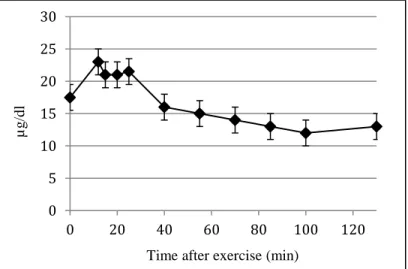
Volpe et al. exercised 12 men to exhaustion on stationary bikes. They found that “serum cortisol levels increased 44% at 12 minutes after exercise” and remained raised until 25 minutes following exercise, after which they began declining2, as seen in Figure 1. Additionally, Hill and colleagues exercised men at intensities
0 5 10 15 20 25 30
0 20 40 60 80 100 120
µg
/d
l
Time after exercise (min)
of 40, 60, and 80% maximal oxygen uptake (VO2max). They found that moderate to intense physical activity, defined as 60 and 80% of VO2max respectively, stimulated significant increases in cortisol levels from pre- to post-exercise measurements3. Rahimi et al. also found that resistance exercise promotes an increase in cortisol during and for at least 30 minutes following exercise4. During exercise, it is a natural and essential response that cortisol generate fuel by aiding in the metabolism of protein, glucose, and fat. Although this catabolic state is perfectly acceptable during exercise, it promotes a catabolic state after exercise, which is less desirable. The body now has the capability to receive exogenous sources of fuel post-exercise, which will decrease the reliance on catabolic hormones as a method for fuel.
Muscle Degradation
A catabolic environment generated by strenuous exercise promotes muscle damage that results in net protein loss and decreased protein synthesis by increasing branched chain amino acid (BCAA) (i.e. leucine, isoluecine, and valine) oxidation. Most amino acids are metabolized in the liver, where BCAAs are metabolized in the muscle. BCAAs comprise about 35% of the essential amino acids in muscle protein and are required for protein synthesis5. They can promote anabolism by increasing the rate of protein synthesis and opposing the rate of protein
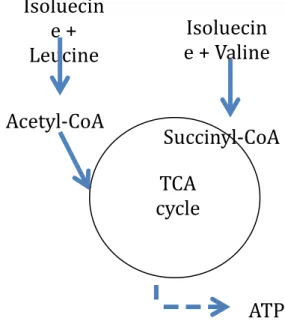
Figure 2 BCAAs are broken down to supplement the TCA cycle as it increases in rate to generate more ATP for the exercising body.
Acetyl-CoA
Isoluecin
e +
Leucine
TCA
cycle
Isoluecin
e + Valine
Succinyl-CoA
catabolism. It is hypothesized that the anabolic effects of BCAAs are mediated through insulin. They have also been shown to participate in the activation of mTOR6. However, BCAAs are oxidized during exercise and supplement the tricarboxylic acid (TCA) cycle, as seen in Figure 2. BCAA-derived acetyl-CoA increases TCA cycle activity to produce adenosine triphosphate (ATP), which provides energy to the exercising body. In order to spare further BCAA breakdown and an overall net protein loss post-exercise, exogenous nutrition is needed to supply the TCA cycle and reverse BCAA catabolism.
Furthermore, muscle contraction promotes 5' adenosine monophosphate-activated protein
kinase (AMPK) activation,which increases fatty acid oxidation and
muscle glucose uptake. AMPK activation disrupts the mammalian
target of rapamycin (mTOR) signaling pathway, which is
responsible for regulating and initiating key signaling cascades in
protein synthesis, as seen in Figure 3. mTOR also plays a
fundamental role in cell proliferation and muscle hypertrophy,
acting as a regulator of protein synthesis by sensing and
incorporating signals from nutrients, such as carbohydrates and
amino acids7.Disruption of this pathway increases the likelihood of autophagy, a catabolic process that involves the degradation of
cellular components7. Although disruption of this pathway is a natural and transient response to exercise, recovery nutrition can be
used to promote mTOR signaling and activity following exercise, leading to protein synthesis and cellular growth.
Stress/Exerci
se
AMPK
mTOR
Protein
synthesis Cell
growth
Immune Function
In addition to muscle damage, intense physical activity temporarily suppresses immune cell function, increasing an athlete’s susceptibility to minor infections. Moderate to vigorous physical activity increases plasma concentrations of inflammatory cytokines (e.g. TNF-α), anti-inflammatory cytokines (e.g. interleukin (IL)-1), and acute phase proteins (e.g. C-reactive protein) all of which can manipulate leukocyte functions8. Hormonal changes that occur during exercise, such as increases in cortisol and epinephrine are known to negatively alter immune response by suppressing type 1 T-cell cytokine production, which is critical in promoting cell-mediated immune responses8. Leukocytes are critical in helping the body defend itself against infectious disease and foreign matter. Additionally, the circulation of natural killer (NK) cells has been found to decrease below one half of pre-exercise levels for up to 24 hours following vigorous exercise, after which they return to normal levels8. NK cells oppose viruses and infection, thus a decrease in circulating NK cells can further compromise the athlete’s immune system. Depressed immune function is most prominent when moderate to vigorous exercise lasts longer than 1.5 hours and is performed without nutritional intake8. Encouraging recovery nutrition can resist an athlete’s susceptibility of becoming sick.
Preventing Catabolism and Promoting Anabolism
Ivy and colleagues termed “metabolic window” as an approximate period of time following a workout where recovery nutrition becomes indispensible1. Following strenuous exercise, muscle sensitivity to nutritional stimuli is enhanced for approximately 30–60 minutes10. During this “window,” the fatigued body can blunt its catabolic hormone response and prevent further muscle protein degradation by utilizing nutrition to replenish depleted muscle stores and expedite muscle repair and growth.
Following exercise, nutritional supplementation in the right combination is effective in helping an athlete recover. Carbohydrate intake, following exercise, has been shown to increase insulin levels1. This is vital for the athlete because insulin is an anabolic hormone. When carbohydrates are consumed, this causes a rise in insulin levels, which
promotes the uptake of nutrients, such as glucose, into the muscles. However, insulin itself cannot fully stimulate muscle protein synthesis in the absence of amino acids. Carbohydrate intake alone does not provide a net gain in muscle protein and likewise, protein ingestion without carbohydrates does not stimulate an anabolic state to sufficiently promote muscle protein synthesis and amino acid uptake by the muscles. Thus, the combination of protein and carbohydrate has been shown to be more valuable than either macronutrient independently10.
A balanced post-exercise meal of carbohydrates and protein, consumed during this “metabolic window,” enhances muscle glycogen storage and protein synthesis1. It decreases the body’s reliance on
endogenous nutrients and, thus, the need for catabolic hormones to remain elevated. The
nutritional promotion of the mTOR signaling pathway can also be mediated via carbohydrate and
protein intake as seen in Figure 4. Providing the body with exogenous nutrients decreases the
body’s dependence further breakdown of nutrients within the body. This promotes a faster recovery for the athlete and preserves muscle breakdown following exercise. It also helps to maintain integrity of the immune system by lowering blood cortisol levels, which are known to manipulate the body’s ability to fight infection and foreign material.
Recovery Nutrition Recommendations
It is recommended that a ratio of grams of carbohydrates to grams of protein be ingested
after rigorous exercise within the “metabolic window” and preferably again two hours later10.This
ratio can be 2:1 for resistance exercises and 4:1 for glycogen depleting exercise such as long
distance running. Consuming a balanced snack or meal after the “metabolic window” closes can
result in 85 percent less protein synthesis when compared with eating during the window’s
approximate 45 minute opening1. Consumption of high glycemic index carbohydrates has been
shown to result in higher muscle glycogen levels 24 hours after vigorous exercise when compared
with the same amount of low glycemic index carbohydrates11.Examples of post-exercise meals
can include homemade items such as a peanut butter and jelly sandwich, Greek yogurt and granola,
and a piece of fruit with a cheese stick. Sports dietitians have a tremendous opportunity to
positively influence an athlete’s recovery process. As science-based recommendations are made,
an athlete can trust that he or she is making the best effort towards a faster recovery in preparation
for the next workout.
RD, LD, CDE, CSSD, who challenged her to research the pathophysiology and biochemistry associated with nutrition recommendations.
Liza Makowski, PhD received her doctorate from the Harvard School of Public Health, department of nutrition. She conducts research in the Michael Hooker Research Center and is an assistant professor at Gillings School of Global Public Health, department of nutrition.
1. Ivy J, Portman R. Nutrient Timing. North Bergen, NJ: Basic Health Publications, Inc; 2004
2. Volpe SL, Lowe NM, Woodhouse LR, et al. Effects of Maximal Exercise on the
Short-Term Kinetics of Zinc Metabolism in Sedentary Men. Br J Sports Med. 2007;41:156-161.
3. Hill EE, Zack E, Battaglini C, et al. Exercise and Circulating Cortisol Levels: The
Intensity Threshold Effect. J Endocrinol Invest. 2008;7:587-91.
4. Rahimi R, Rohani H, and Ebrahimi M. Effects of very short rest periods on testosterone
to cortisol ratio during heavy resistance exercise in men. Apunts Med Esport.
2011;46:145-149.
5. Shimomura Y, Murakami T, Nakai N, et al. Exercise Promotes BCAA Catabolism:
Effects of BCAA Supplementation on Skeletal Muscle during Exercise. JN.
2004;134:1583-1587.
6. Blomstrand E, Eliasson J, Karlsson HKR, et al. Branched-Chain Amino Acids Activate
Key Enzymes in Protein Synthesis after Physical Activity. JN. 2006;136:269-273.
7. Yang X, Yang C, Farberman A, et al. The mammalian target of rapamycin-signaling
pathway in regulating metabolism and growth. J Anim Sci. 2008;86:E36-E50.
8. Gleeson M. Immune Function in Sport and Exercise. J Appl Physiol. 2007;103:693-699.
9. Koopman R, Saris WH, Wagenmakers AJ. Nutritional Interventions to Promote
Post-Exercise Muscle Protein Synthesis. Sports Med. 2007;37:895-906.
10.Ivy J, Ferguson L. Optimizing Resistance Exercise Adaptations Through the Timing of
Post-Exercise Carbohydrate-Protein Supplementation. Strength and Conditioning J.
11.Position of the American Dietetic Association, Dietitians of Canada, and the American