31
Optimization of parallel machine scheduling problem with human
resiliency engineering: A new hybrid meta-heuristics approach
Masoud Rabbani
1*, Soroush Aghamohammadi Bosjin, Reza Yazdanparast
1School of Industrial Engineering, College of Engineering, University of Tehran, Iran[email protected], [email protected], [email protected]
Abstract
This paper proposes a unique mixed integer programming model to solve non-identical parallel machines (NIPM) with sequence-dependent set-up times and human resiliency engineering. The presented mathematical model is formulated to consider human factors including Learning, Teamwork and Awareness. Moreover, processing time of jobs are assumed to be non-deterministic and dependent to their start time which leads to more precision and reality. The applicability of the proposed approach is demonstrated in a real world car accessories industrial unit. A hybrid metaheuristic method based on Genetic algorithm and simulated annealing is proposed to solve the problem. Parameter tuning is applied for adjustment of metaheuristic algorithm parameters. The superiority of the proposed hybrid metaheuristic method is evaluated by comparing the obtained results to GAMS, and two other hybrid metaheuristics. Moreover, it is shown that the hybrid approach provides better solutions than other hybrid approaches under uncertainty. This is the first study that presents a new hybrid approach for optimization of the stated problem by considering human resiliency.
Keywords:
Parallel machine scheduling problem; human resiliency; non-monotonic time-dependent processing time; simulated annealing; genetic algorithm (GA)1- Introduction
Parallel machine scheduling is a common used machine configuration in various industrial units. Parallel machine scheduling is divided into identical and non-identical processors. Each type has an especial effect on processing times and setup times of jobs. In parallel machine scheduling every job can be processed on every machine while, processing time and set-up time of jobs may differ depending on selected machine. This problem deals with a set of jobs and non-identical machines (n, m) to solve a mixed non-linear integer programming, set-up time of each job is dependent to the previous job, due dates are incorporated as a completion time of jobs suggested by costumers. Various factors can affect the performance of a production system. Human factors play an important role in production systems. Human factors play a considerable role in sharing data and experiences especially when the desired job is critical and needs enough knowledge and cautions. Another important factor in production and industrial systems is about the integration of different separate sections of the system which can preclude from useless efforts and decrease the wastes during the production. In order to increase the coordination of separate units in a production system human resource can be fruitful. Resilience engineering (RE) is relatively new approach toward improving the performance and resiliency of industrial units. Resilience engineering is an organizational culture which considers a coherent plan for every accident that may occur during the work and is a new method minimizing incidents (Azadeh et al., 2017b). The main goal of resilience is to minimize different kinds of risk that may cause problems during the operation.
*Corresponding author
ISSN: 1735-8272, Copyright c 2019 JISE. All rights reserved
Journal of Industrial and Systems Engineering
Vol. 12, No. 2, pp. 31- 45 Spring (April) 2019
32
Although all RE principles don’t match with the goal of this study which performance optimization of parallel machine scheduling, some principles can contribute significantly including Learning, Teamwork and Awareness.
Learning is one of the most important principles of RE focusing on operator knowledge about working with higher performance, less breakdowns and coherent plans after breakdowns (Wreathall, 2006). Learning effect is also incorporated in the model to consider human effects on the processes. In other words, jobs take less time when operators become experienced and match themselves with complication of the job. Time-dependent learning effect is based on the processing time of machines, while position based learning effect depends on position of jobs and also there are some combined time and position based learning effects (Zhou and Zhang, 2015; Azadeh et al., 2017a). Here, learning effect has been taken into account based on position (position dependent).
One of the other RE principles which affects the production systems significantly is teamwork. Teamwork and good human resource planning provide a situation with less probability of human errors and improves the stability of the system. There are two important factors in a production system which is dependent to team work in perspective of human resiliency. First factor is about the job pressure and the related possible accidents; second factor is about the possible financial damages that may occur during the production because of irregularities between units. These unforeseen events are likely to happen however; the main purpose of team work resiliency is to minimize the possibility of this accidents. In first factor a good human resource planning is able to decrease the job pressure by dividing the critical activities between operators which lead to better concentration and also performing the activities by less required time. Implementation of an information system which records and analyzes the Middle and upper level managers experiences is another important solution for the team work resilience policies that integrates separate management islands to decrease the possible damages.
Moreover, awareness is other aspect of human knowledge and such a culture makes the system less vulnerable against unpredicted accidents. The main purpose of awareness in RE is to improve information of personnel about their performance while teamwork focuses on mutual cooperation (Yang et al., 2012).This study proposes a mathematical model is formulated to consider the human aspects along with traditional objective functions of parallel machine scheduling in a real car accessory manufacturing process. Moreover, the proposed mathematical model has considered non-monotonic processing times in order to consider the problem as close as possible to real world situation.
Processing times are variable in real world industrial units (Nasiri et al., 2017). Non-monotonic is a behavior that happens on processing time of job, the changes in start time of each job is determinative on a period of each job and make processing time to show a non-deterministic behavior due to instability of variables. For example, in a restaurant making a food may take more time than usual because of overcrowding, we call such moment’s breaking point. Considering this feature makes the processing time non-deterministic and makes the model more similar to the real world situation (Azadeh et al., 2016).
This paper proposes a new mixed non-linear integer programming for optimization of parallel machine scheduling problem which minimizes maximum completion time. The presented mathematical model is formulated to consider human factors including Learning, Teamwork and Awareness. Moreover, processing time of jobs are assumed to be non-deterministic and dependent to their start time which leads to more precision and reality. The applicability of the proposed approach is demonstrated in a real world car accessories industrial unit. Since the proposed problem is non-deterministic polynomial-time hard (NP-hard), a hybrid Genetic-Simulated annealing (HGASA) method is proposed to solve the problem. Since the performance of metaheuristic algorithms is dependent to their initial inputs, a parameter tuning method is applied to increase the productivity of the proposed algorithm. The performance of the proposed metaheuristic algorithm is compared to GAMS, hybrid Particle Swarm Optimization (PSO)-Simulated annealing, and hybrid Genetic-Tabu search results for small test problems. The performance of the proposed hybrid metaheuristics is also compared together for big size test problems. The results indicate the superiority of the presented Genetic-Simulated annealing method. To best of our knowledge this is the first study dealing with human factors in optimization of parallel scheduling considering variable processing times.
33
2- Literature review
Different machine scheduling problems with various layouts and dependent or independent set-up times are investigated in literature. Set-up times can be considered as dependent variables to job sequences (Tanaka and Araki, 2013). Set-up times may be depended to a set of jobs (families) in scheduling (Tavakkoli-Moghaddam and Mehdizadeh, 2007; Mehdizadeh et al., 2015). Different methods are proposed for solving scheduling problems in recent years. Guo and Tang (2015) introduced a scatter search algorithm for optimizing objective functions using a specific improved method for machine scheduling with single machine layout. For including more practical situation in problems learning effect was introduced by (Biskup, 1999). Failure is another important factor which may occur with a probability dependent to previous job (Mirabi et al., 2013). Different types of position based and time based learning effect and deterioration effect are proposed by (Low and Lin, 2013; Wu et al., 2013; Zhang et al., 2013; Yin et al., 2015). Hosseini and Tavakkoli-Moghaddam (2013) presented two metaheuristic methods namely MOGA and MOSA for solving flow shop scheduling by considering learning parameters and dynamic entrances. Maintenance restriction is an important feature which can take less time by considering learning effect (Ghodratnama et al., 2010).
Farahani and Hosseini (2013) showed optimal objective functions in minimizing period time in single machine scheduling with processing times dependent to start time, is V shape while process time is different between previous job's finish time and start time of current job. Flow shop scheduling with no pause during the process is a common issue which deals with running time of a job that must continue from first position to the end position without any delay or interruption (Akhshabi et al., 2014; Ramezani et al., 2015). An effective scheduling lead to a significant improvement on productivity, less idle time, shorter cycle time (Nasiri et al., 2017). Parallel machine scheduling can be formulated based on m-traveling salesman problem (TSP) (Baez et al., 2016). while two time-dependent formulations for the problem have been proposed by (Baez et al., 2016) which present better results. Scheduling with potential machine disruptions could entail some resource to be out of reach for a period of time due to deteriorating effect (Yin et al., 2016). Rostami et al. (2015) presented a parallel machine modeling under uncertainty condition formulated by fuzzy logic. Sequence dependent jobs can also have deteriorating effects caused by various reasons such as operator tardiness (Ruiz-Torres et al., 2013).
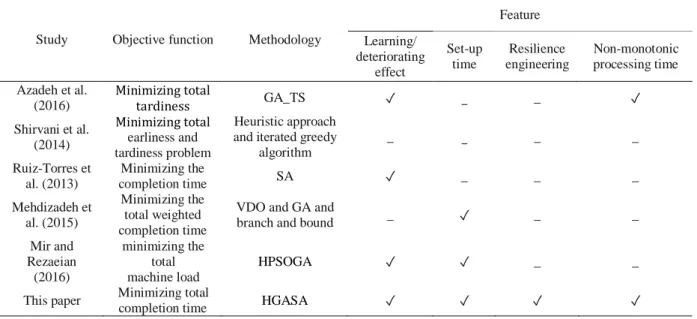
Minimizing total completion time can decrease job tardiness and lateness and total work in process inventories in parallel machine scheduling with constraints on priority of jobs and variable setup times based on their prerequisites (Tavakkoli-Moghaddam et al., 2009). Scheduling also can be developed with queue models, queuing theory is a common tool for analyzing features such as average waiting time (Sharmaa et al.; Kim and Ward, 2013; Xu et al., 2014). Mir and Rezaeian (2016) formulated and solved scheduling for an active control problem which is monitored during the process for a G1/G1/1 line as an example of the approximating Brownian control problem that considered a robust hybrid approach to minimize machine load on parallel machines. Alimoradi et al. (2016) presented an important approach to formulating uncertainly in scheduling by considering robustness, in some terms products are perishable thus earliness and tardiness should be minimized (Shirvani et al., 2014). There are some researches discussed about the relation between the human factors and industrial systems. (Forsythe, 1997) discussed about the impacts of human factors in a production system in three factors comprised of agile economic development, deploy technology and introducing new technologies. (Emodi, Zhang, Lang, & Bi, 2007) presented a model to analyze the human factors in the repetitive activities for a production/assembly line in order to decrease the injuries and damages. In this paper human factors are formulated based on human resiliency to analyze wider aspects of human factors in a production scheduling system. Table 1 is summary of researches about parallel machine scheduling in recent years.
34
Table 1. Overview of literature on parallel machine scheduling problem
Study Objective function Methodology
Feature Learning/ deteriorating effect Set-up time Resilience engineering Non-monotonic processing time Azadeh et al.
(2016)
Minimizing total
tardiness GA_TS ✓ _ _ ✓
Shirvani et al. (2014)
Minimizing total earliness and tardiness problem
Heuristic approach and iterated greedy
algorithm
_ _ _ _
Ruiz-Torres et al. (2013)
Minimizing the
completion time SA ✓ _ _ _
Mehdizadeh et al. (2015)
Minimizing the total weighted completion time
VDO and GA and
branch and bound _ ✓ _ _
Mir and Rezaeian (2016) minimizing the total machine load
HPSOGA ✓ ✓ _ _
This paper Minimizing total
completion time HGASA ✓ ✓ ✓ ✓
3- Problem description
This study considers non-identical machines and independent job (n, m). Machines are able to process each job in a specific period. All of the jobs are available at starting time, and when a job starts on a machine there is no interruption (non-preemptive). Parallel machine scheduling with resilience is denoted by 𝑃𝑚 / 𝑅 / 𝐶𝑚𝑎𝑥.
3-1- Mathematical model
In this model 𝑃t𝑖𝑡𝑘 denotes the processing time influenced by breaking point (𝑎) and
job-independent growing rate of processing time (0 ≤ 𝐵 ≤ 1) (Mehdizadeh et al., 2015; Azadeh et al., 2016).
Indices
𝒊, 𝒋 Job type (𝑖 , 𝑗 = 1,2, . . . , 𝑛 ) 𝒕 Job position (𝑡 = 1,2, . . . , 𝑛) 𝒌 Machine type (𝑘 = 1,2, . . . , 𝑚)
Parameters
𝑷𝒊𝒕𝒌 Processing time of job i located in position k on machine m
𝒅𝒋 Due date of job j 𝜶 Resilience index
𝒂 A big value
𝑴 Breaking point
𝑩 Job independent increasing rate of the processing times 𝑺𝒊𝒋𝒌 Set-up time of job j after job i on machine k
𝜶1 Learning effect index 𝜶𝟐 Teamwork index 𝜶3 Awareness index W1 Weight of learning effect W2 Weight of team work effect W3 Weight of awareness effect Decision variables
𝑷𝒕𝒊𝒕𝒌 Processing time of job i located at position t considering breaking point 𝑷𝑨𝒊𝒕𝒌 Actual processing time of job i located at position t for machine k
𝒙𝒊𝒋𝒌 1 if job j instantly traces job i on machine k; and 0, otherwise 𝒚𝒊𝒌 1, if job i is assigned to machine k; and 0, otherwise
𝑪𝒊 Completion time of job i
𝒙𝟎𝟏𝒌 1 if job i on machine k is the first in the queue; and 0, otherwise
35
Min z = max (𝐶𝑖) (1)
st.
∑𝑀𝑘=1𝑦𝑖𝑘 =1 ∀ i (2)
∑𝑁𝑖=1∑𝑀𝑘=1𝑥𝑖𝑗𝑘 𝑖≠𝑗
=1 ∀j (3)
𝐶𝑖 ≥ 𝑆𝑖𝑗𝑘𝑦𝑖𝑘+ 𝑃𝐴𝑖𝑡𝑘𝑦𝑖𝑘 ∀i. k ∀i. k (4)
𝐶𝑗 ≥ 𝐶𝑖 + 𝑃𝐴𝑗𝑡𝑘+ 𝑆𝑖𝑗𝑘𝑦𝑖𝑗− 𝑀(1 − 𝑥𝑖𝑗𝑘) ∀ i. j, i ≠ j ∀ i. j, i≠ j (5) ∑𝑁𝑖=1𝑥𝑖𝑗𝑘
𝑗≠𝑖
=𝑦𝑗𝑘 ∀j. k (6)
∑ 𝑥𝑖𝑗𝑘 ≤ 𝑦𝑖𝑘 𝑁
𝑗=1 𝑗≠𝑖
∀i. k (7)
𝑃𝑡𝑖𝑡𝑘= 𝑃𝑖𝑡𝑘+ (𝑉𝑖𝐵(𝑎 − 𝐶𝑖−1)) + ((1 − 𝑉𝑖)𝐵(𝐶𝑖−1− 𝑎)))) ∀ i, t, k (8)
𝑎 − 𝐶𝑖−1≤ 𝑀𝑉𝑖 ∀ t (9)
𝐶𝑖−1− 𝑎 ≤ 𝑀(1 − 𝑉𝑖) ∀ t (10)
α= ((α1W1) + (α2W2) + (α3W3))/W1+W2+W3 (11)
𝑃𝐴𝑖𝑡𝑘= 𝑦𝑖𝑘𝑃𝑇𝑖𝑡𝑘𝑡𝛼 ∀𝑖. 𝑡. 𝑘 (12)
∑𝑁𝑖=1𝑥01𝑘 ≤ 1 ∀k (13) 𝑉𝑖 . 𝑦𝑖𝑘. 𝑥𝑖𝑗𝑘 . 𝑥01𝑘 𝑖𝑛 {0.1}; 𝐶𝑖 ≥ 0 ; ∀i. j. k ∀i. j. k (14)
Equation (1) minimize the maximum completion time of jobs. Equation (2) obliges the model to allocate every job to one machine. Equation (3) indicates the arrangement of jobsby considering the nominated locations and machines. Equation (4) forces the finishing time of each job to be more than the run time and setup time. Equation (5) shows that the completion time of each job greater than completion time of its earlier job, process time and set up time (if setup is needed). Equation (6)
shows job j must instantly follow other job on a specific machine. Equation (7) illustrates that if job i, i≠0 is processed on a specific machine, utmost one job will carry out after that job. Equation (8) - (10) relates the processing time and breaking point which makes the processing time to demonstrate an unpredictable behavior. Equation (11) shows (𝛼) to be the weighted average of resilience factors. Since there is a correlation between awareness, learning and teamwork, these three factors are able to decrease the average processing time of jobs by decreasing average failures and performance improvement of operators. Equation (12) represents the actual processing time and shows the capability of human factors to challenge with different types of disasters and problems such as non-predictable processing time based on (Hosseini and Tavakkoli-Moghaddam, 2013). Equation (13)
indicates just one job is authorized to follows the dummy job 0 on each machine. Equation (14)
represents the features of the decision variables.
4- Solution procedure
The proposed hybrid metaheuristic approach for solving the proposed mathematical model is presented in following subsections.
4-1- Genetic algorithm
Fundamental of genetic algorithm is based on transportation of inheritable features by genes. Each chromosome is comprised of genes which is a number in the solution area, in first step GA generates an initial solution and makes different solutions by changing the genes in a chromosome crossover, mutation and selection are the main operators of genetic algorithm each of which generates new chromosomes by an specific function, in this paper a chromosome shows allocation and sequence of jobs for each machine simultaneously. Chromosome's length is equal to (m + n - 1) which illustrates allocation and sequence of jobs for each machine by considering numbers behind of machine's number in each chromosome as a job numbers (numbers of machines are pre-determined).
4-1-1- Crossover
Cross over is a local search in solution area and has different types like one point cross over, two-point cross over and uniform cross over. The efficiency of genetic algorithms bears on the type of the
36
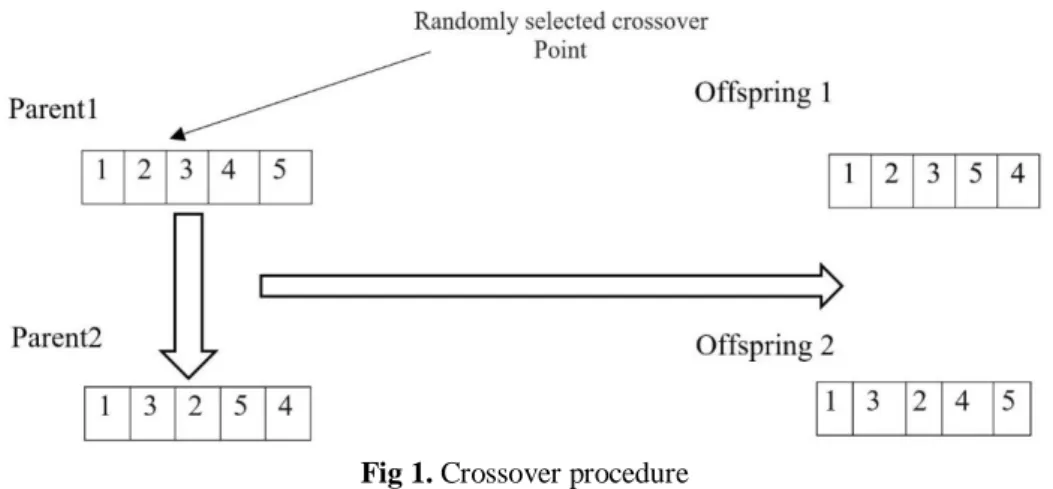
crossover used. In one point crossover two different chromosomes are selected randomly as parents and genes are located in new position order of chromosomes based on a randomly selected point in the parent length called child chromosome. Here one point crossover is used; figure 1 shows the cross over procedure.
Fig 1. Crossover procedure
4-1-2- Mutation
This operator is used to make diversity in solution area by changing genes position randomly in a chromosome. In this method two points are chosen randomly and genes in these positions are swapped. Figure 2 shows an example of mutation.
Fig 2. Mutation procedure
4-1-3- Selection
Selection makes new chromosomes based on elitism this operator uses different ways to make change, roulette wheel is one of the most common methods for selection, roulette wheel is a qualification-commensurate selection to choose the best chromosomes with more chance to duplicate off springs for the next generations.
4-2- Simulated annealing
Physical annealing process of solids is an operation of increasing temperature of solid to melting point and gradual decreasing of temperature (T) to reach considered properties, as temperature decreases movement of molecules decreases. In this procedure changes are accepted with high probably at the beginning and decreases in continue as same as physical annealing process of solids.
exp (−𝛥𝑧
𝑇 ) (15)
This algorithm transmits from one configuration to its contiguous configuration with a probability; this feature makes the algorithm as a Markov chain. This procedure also prevents from trapping in
37
local minimum solution. In this study a HGASA algorithm is used to takes advantage of both procedures, comparing SA with other algorithms SA generates a good feasible solution with acceptable diversity; SA algorithm is dependent to size of problem and performs well in small size test problems. Genetic algorithm searches and compares a large number of solutions with high diversity and depicts acceptable result in large size problems thus a hybrid SA_GA algorithm is comprised of two phases, first phase is the SA algorithm which produces the inner loop of random search and reaches a good local search, since GA algorithm is dependent to the initial solution, in second phase the solution achieved by SA is used as an initial solution for GA algorithm. GA will investigate the other possible solutions as an outer loop and preclude from trapping in local minimum solutions using mutation operator which is designed to produce cells with less dependency to their parents. There is a benefit in using SA as inner and GA as outer loop. Hybridization will decrease the volume of generated response by using to search engine core that benefit from advantages of each other and emulate the necessity of searching extra solutions.
4-3- Taguchi method
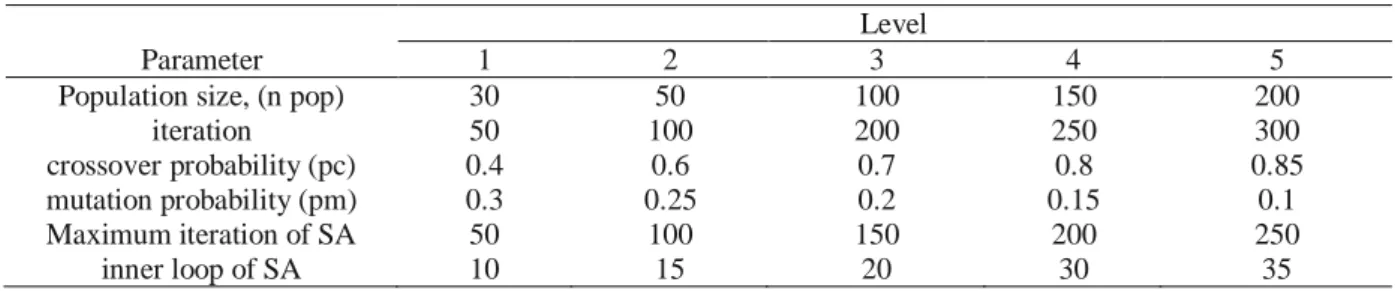
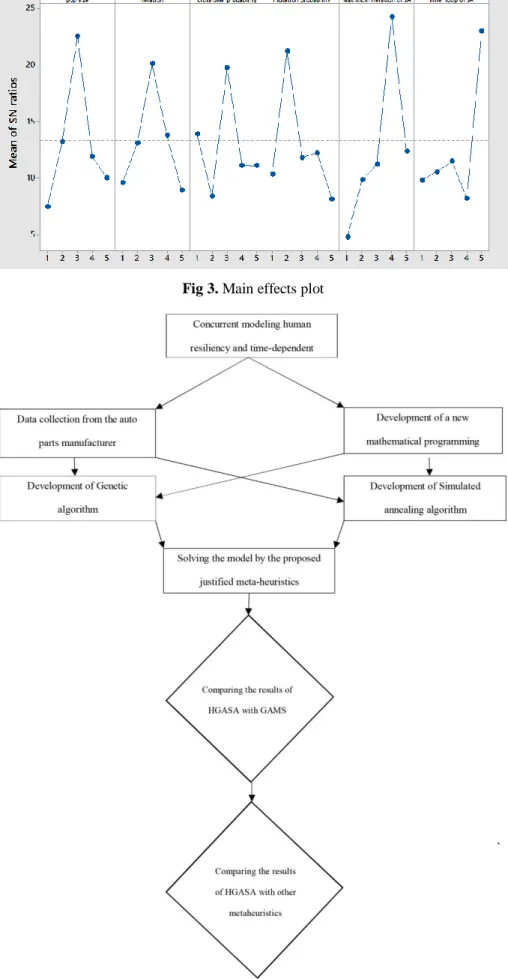
Metaheuristic algorithms depends on factors and initial data's divided to controllable and uncontrollable factors in Taguchi method, uncontrollable factors are assumed to be fix due to high expenditures and other reasons,frequent experiments are held to evaluate the corresponding effect of uncontrollable factors to reach optimum combination of parameters. In an experiment with large number of factors implementing a full factorial design is not an optimal procedure while fractional factorial experiment takes less time , Taguchi method illustrates a method to minimize the number of experiments to achieve considerable information's about the system. This method uses signal-to-noise (S/N) ratio for Sensitivity analyses of considered characteristic that are divided into controllable and uncontrollable external factors in a process, in this algorithm six factors with five levels are studied and figure 3 shows the results of TM.
Table 2. Design factors and their levels Level
Parameter 1 2 3 4 5
Population size, (n pop) 30 50 100 150 200
iteration 50 100 200 250 300
crossover probability (pc) 0.4 0.6 0.7 0.8 0.85 mutation probability (pm) 0.3 0.25 0.2 0.15 0.1 Maximum iteration of SA 50 100 150 200 250
inner loop of SA 10 15 20 30 35
Based on S/N method and figure 3 best parameters are set.
Table 3.Best values for different HGASA parameters
Parameters Best level
Population size, (n pop) 100
Iteration 250
Crossover probability (pc) 0.7 Mutation probability (pm) 0.25 Maximum iteration of SA 200
38
Fig 3. Main effects plot
39
The main steps of the proposed method are presented as follows:
Step 1: Investigation about modeling of human resiliency and time-dependent processing time.
Step 2: Proposing a new model and data collection from the company.
Step 3: Solving the model by the proposed approach and Gams.
Step 4: validation of model and comparing the results.
5- Experiments
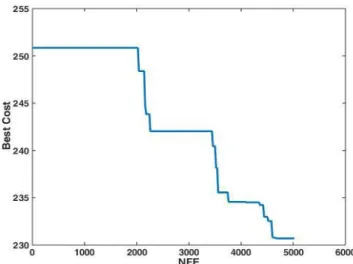
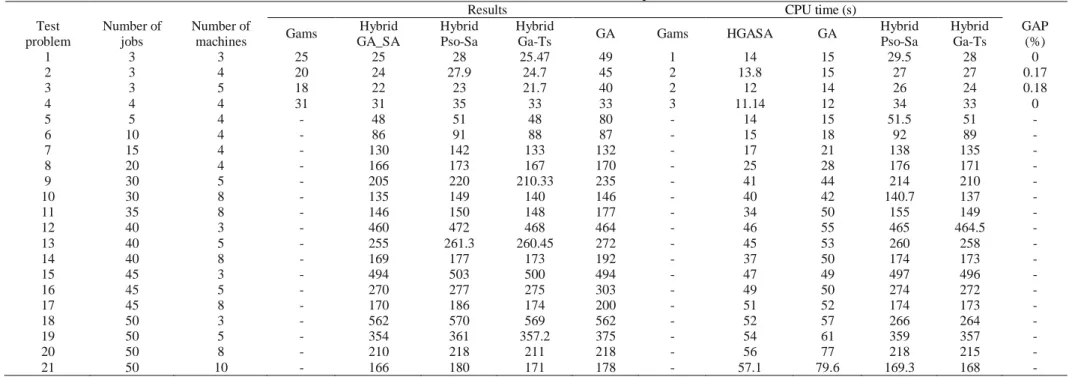
This algorithm is applied in MATLAB R2014 and run on a PC core i5, 2.5 GHz speed with 6 GB of ram to compare HGASA algorithm with GA algorithm , 22 test problems are generated without considering resilience as below: the set of test problems is comprised with groupings of jobs and machines (n , m) being n = {3,4,5,10,15,20,30,35,40,45,50} , m = {3,4,5,8,10} with the setup times , processing times and due dates unvaryingly distributed on (2 , 8) , (20 , 60) and (10 , 100 ) respectively and each of which should repeat at least for 10 time ,range of learning rate and other factors are considered between [0.7 , 0.9] (Biskup, 1999; Hosseini and Tavakkoli-Moghaddam, 2013). In this research resilience rate is assumed to be 0.8 which is weighted average of position based learning effect, team work and awareness rates with (0.65, 0.15, 0.2) factor's weight respectively, (α ) also is logarithm to base 2 of learning rate (α = −0 ∙ 32 ). (a) and (b) are specified based on a case study, results are also compared with a nonlinear solver in Gams, the results are shown in table 4. In this research, an auto part manufacturer company located at the Tehran-Karaj highway, is studied as a case study of parallel machine scheduling. This company produces car gear accessories for different types of car with [200000 600000] total production in the month. This company is comprised of four press machines with different tonnage and parallel layout and twenty Personnel, resilience culture is a prominent feature of this company, variable personnel scheduling , night and day work shifts and different strategies for promoting Personnel knowledge are effective on awareness and learning which is considered on resilience index, since this company registers the production data's during the month and registers operators performance, thus scheduling data's are contributed based on production planning of company. Setup times, processing times and due dates is uniformly distributed on (0.5, 2), (8, 42) and (15, 30) day respectively by considering resilience, the results of case study are shown in Figure 5 and figure 6.
40
Fig 6. Gant chart of the case study
Table 4. Obtained results of the various test problems
Results CPU time (s)
Test problem
Number of jobs
Number of
machines Gams
Hybrid GA_SA
Hybrid Pso-Sa
Hybrid
Ga-Ts GA Gams HGASA GA
Hybrid Pso-Sa
Hybrid Ga-Ts
GAP (%)
1 3 3 25 25 28 25.47 49 1 14 15 29.5 28 0
2 3 4 20 24 27.9 24.7 45 2 13.8 15 27 27 0.17
3 3 5 18 22 23 21.7 40 2 12 14 26 24 0.18
4 4 4 31 31 35 33 33 3 11.14 12 34 33 0
5 5 4 - 48 51 48 80 - 14 15 51.5 51 -
6 10 4 - 86 91 88 87 - 15 18 92 89 -
7 15 4 - 130 142 133 132 - 17 21 138 135 -
8 20 4 - 166 173 167 170 - 25 28 176 171 -
9 30 5 - 205 220 210.33 235 - 41 44 214 210 -
10 30 8 - 135 149 140 146 - 40 42 140.7 137 -
11 35 8 - 146 150 148 177 - 34 50 155 149 -
12 40 3 - 460 472 468 464 - 46 55 465 464.5 -
13 40 5 - 255 261.3 260.45 272 - 45 53 260 258 -
14 40 8 - 169 177 173 192 - 37 50 174 173 -
15 45 3 - 494 503 500 494 - 47 49 497 496 -
16 45 5 - 270 277 275 303 - 49 50 274 272 -
17 45 8 - 170 186 174 200 - 51 52 174 173 -
18 50 3 - 562 570 569 562 - 52 57 266 264 -
19 50 5 - 354 361 357.2 375 - 54 61 359 357 -
20 50 8 - 210 218 211 218 - 56 77 218 215 -
41
6-
Results and discussion
To validate the proposed algorithm, results of HSAGA are compared with GAMS computed by following formula in table 5.
GAP =HGASA𝑆𝑜𝑙𝑢𝑡𝑖𝑜𝑛− GAMS𝑆𝑜𝑙𝑢𝑡𝑖𝑜𝑛 HGASA𝑆𝑜𝑙𝑢𝑡𝑖𝑜𝑛
(16)
To compare HGASA results with GA and other hybrid results, Paired-Samples t-test is used which is utilized to discuss about validation of difference between HGASA and other approach's results as dependent variables, in this test normal variables are compared, obviously common properties between approaches justifies dependency between them, as an example GA is a common approach between hybrid GASA and hybrid GATS (Genetic-Tabu search). Since completion time is a variable first step is to determine distribution of this variable to understand whether it has normal distribution or not. To answer this question Kolmogorov-Smirnov test is applied by SPSSS software. The obtain results regarding the normality of employed methods are presented in table 5.
Table 5. Normality test results for considered metaheuristics methods
Kolmogorov-Smirnov result (Sig.) Metaheuristic method
0.476 Hybrid SA-GA
0.69 GA
0.472 Hybrid GA-TS
0.538 Hybrid PSO-SA
The results prove that all of the variables have normal distributions as Sig. is greater than 5%. Therefore, paired t-test is used for pairwise comparisons among metaheuristic methods. The obtained results are presented in table 6.
Table 6. Pairwise comparison results between applied metaheuristic methods
Paired t-test result (Sig.) Paired Differences
Compared methods
Std. Error Mean Std. Deviation
Mean
0.000 0.63015
2.88773 -4.04524
Hybrid SA-GA vs Hybrid GA-TS
0.000 0.95203
4.36274 -7.96190
Hybrid SA-GA vs Hybrid PSO-SA
0.000 2.60272
11.92716 -15.42857
Hybrid SA-GA vs GA
Results indicate that in sig less than 5% variance between HSAGA with GA, HPSOSA and HGATS is considerable so the proposed algorithm has better performance rather than other metaheuristics.
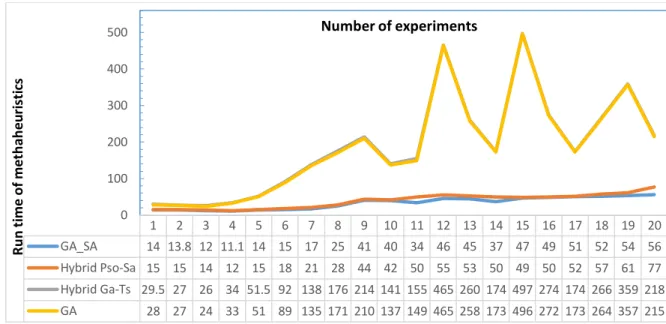
Figure 7 illustrates the difference between runtime of HSAGA with GA, HPSOSA and HGATS,
figure 8 depicts the results of HGASA considering resilience factors and compares it with the initial state.
42
Fig 7. Run time comparison of HSAGA and other algorithms
Fig 8. HGASA and HSAGA with resilience
7- Conclusion
In this paper, a hybrid Genetic-Simulated annealing (HGASA) method proposed to deal with the NP-Hard non-identical machines with sequence-dependent setup time. The objective of this model is to minimize completion time. In order to consider the problem as close as possible to real situation, human resilience effect has been taken into account in the model. Start time of each job also could make an impressive effect on the future activities and make the results more variable. Moreover, parameter tuning for each metaheuristic is applied to improve the performance of the algorithm. The obtained results of HGASA were compared with other metaheuristic approaches based on GAP criteria. The results indicate the superiority of the proposed hybrid GA-SA method. This was the first study that considers human factors and resiliency in parallel machine scheduling optimization problem.
1 2 3 4 5 6 7 8 9 10 11 12 13 14 15 16 17 18 19 20
GA_SA 14 13.8 12 11.1 14 15 17 25 41 40 34 46 45 37 47 49 51 52 54 56
Hybrid Pso-Sa 15 15 14 12 15 18 21 28 44 42 50 55 53 50 49 50 52 57 61 77 Hybrid Ga-Ts 29.5 27 26 34 51.5 92 138 176 214 141 155 465 260 174 497 274 174 266 359 218
GA 28 27 24 33 51 89 135 171 210 137 149 465 258 173 496 272 173 264 357 215
0 100 200 300 400 500 R u n t im e o f m et h ah eu ri st ic s
Number of experiments
1 2 3 4 5 6 7 8 9 10 11 12 13 14 15 16 17 18 19 20 21
HGASA with resilience learning
effect 21.120.218.526.140.472.4109.139.172.113.122.387.214.142.416227.144473.298.176.137.
HGASA 25 24 22 31 48 86 130 166 205 135 146 460 255 169 494 270 171 562 354 210 163
HGASA with resilience factors HGASA 0.0 100.0 200.0 300.0 400.0 500.0 600.0 O b je ct iv e fu n ct io n v al u e
43
Acknowledgments
The authors are grateful for the valuable comments and suggestions from the respected reviewers. They have enhanced the strength and significance of our paper. The authors are grateful for the support provided by the College of Engineering, University of Tehran, Iran. The authors also claim no conflict of interest.
References
Akhshabi, M, Tavakkoli-Moghaddam, R, & Rahnamay-Roodposhti, F. (2014). A hybrid particle swarm optimization algorithm for a no-wait flow shop scheduling problem with the total flow time.
The International Journal of Advanced Manufacturing Technology, 70(5 .1181-1188 ,)8
-Alimoradi, S, Hematian, M, & Moslehi, G. (2016). Robust scheduling of parallel machines considering total flow time. Computers & Industrial Engineering, 93, 152-161 .
Azadeh, A, Habibnejad-Ledari, H, Abdolhossein Zadeh, S, & Hosseinabadi Farahani, M. (2016). A single-machine scheduling problem with learning effect, deterioration and non-monotonic time-dependent processing times. International Journal of Computer Integrated Manufacturing, 1-13 . Azadeh, A, Salmanzadeh-Meydani, N, & Motevali-Haghighi, S. (2017a). Performance optimization of an aluminum factory in economic crisis by integrated resilience engineering and mathematical programming. Safety science, 91, 335-350 .
Azadeh, Ali, Yazdanparast, Reza, Zadeh, Saeed Abdolhossein, & Zadeh ,Afshin Esmail. (2017b). Performance optimization of integrated resilience engineering and lean production principles. Expert Systems with Applications, 84, 155-170 .
Baez, Sarahi, Angel-Bello, Francisco, & Alvarez, Ada. (2016). Time-dependent formulations for minimizing total completion time in a parallel machine scheduling problem with dependent setup times. IFAC-PapersOnLine, 49(12), 857-862 .
Biskup, Dirk. (1999). Single-machine scheduling with learning considerations. European Journal of OperationalResearch, 115(1), 173-178 .
Farahani, Mehdi Hosseinabadi, & Hosseini, Leila. (2013). Minimizing cycle time in single machine scheduling with start time-dependent processing times. The International Journal of Advanced Manufacturing Technology, 64 .1479-1486 ,)9-12(
Ghodratnama, A, Rabbani, Masoud, Tavakkoli-Moghaddam, R, & Baboli, A. (2010). Solving a single-machine scheduling problem with maintenance, job deterioration and learning effect by simulated annealing. Journal of Manufacturing Systems, 29 .1-9 ,)1(
Guo, Qingxin, & Tang, Lixin. (2015). An improved scatter search algorithm for the single machine total weighted tardiness scheduling problem with sequence-dependent setup times. Applied Soft Computing, 29, 184-195 .
Hosseini, N, & Tavakkoli-Moghaddam, R. (2013). Two meta-heuristics for solving a new two-machine flowshop scheduling problem with the learning effect and dynamic arrivals. The International Journal of Advanced Manufacturing Technology, 65(5-8), 771-786 .
Kim, Jeunghyun, & Ward, Amy R. (2 013 .) Dynamic scheduling of a GI/GI/1+ GI queue with multiple customer classes. Queueing Systems, 75(2-4), 339-384 .
Low, Chinyao, & Lin, Wen-Yi. (2013). Some scheduling problems with time-dependent learning effect and deteriorating jobs. Applied Mathematical Modelling, 37(20), 8865-8875 .
44
Mehdizadeh, Esmaeil, Tavakkoli-Moghaddam, Reza, & Yazdani, Mehdi. (2015). A vibration damping optimization algorithm for a parallel machines scheduling problem with sequence-independent family setup times. Applied Mathematical Modelling, 39(22), 6845-6859 .
Mir, Mir Saber Salehi, & Rezaeian, Javad. (2016). A robust hybrid approach based on particle swarm optimization and genetic algorithm to minimize the total machine load on unrelated parallel machines.
Applied Soft Computing, 41, 488-504 .
Mirabi, Mohammad, Ghomi, SMT Fatemi, & Jolai, Fariborz. (2013). A two-stage hybrid flowshop scheduling problem in machine breakdown condition. Journal of Intelligent Manufacturing, 24(1), 193-199 .
Nasiri, Mohammad Mahdi, Yazdanparast, Reza, & Jolai, Fariborz. (2017). A simulation optimisation approach for real-time scheduling in an open shop environment using a composite dispatching rule.
International Journal of Computer Integrated Manufacturing, 30(12), 1239-1252 .
Ramezani, Pezhman, Rabiee, Meysam, & Jolai, Fariborz. (2015). No-wait flexible flowshop with uniform parallel machines and sequence-dependent setup time: a hybrid meta-heuristic approach.
Journal of Intelligent Manufacturing, 26(4), 731-744 .
Rostami, Mohammad, Pilerood, Amir Ebrahimzadeh, & Mazdeh, Mohammad Mahdavi. (2015). Multi-objective parallel machine scheduling problem with job deterioration and learning effect under fuzzy environment. Computers & Industrial Engineering, 85, 206-215 .
Ruiz-Torres, Alex J, Paletta, Giuseppe, & PéRez, Eduardo. (2013). Parallel machine scheduling to minimize the makespan with sequence dependent deteriorating effects. Computers & Operations Research, 40(8), 2051-2061 .
Sharmaa, Sameer, Gupta, Deepak, & Sharma, Seema. Linkage network of biserial queues with a multistage flowshop scheduling in fuzzy environment .
Shirali, Gh A, Motamedzade, M, Mohammadfam, I, Ebrahimipour, V, & Moghimbeigi, A. (2015). Assessment of resilience engineering factors based on system properties in a process industry.
Cognition, Technology & Work, 1-13 .
Shirvani, Nargess, Ruiz, Rubén, & Shadrokh, Shahram. (2014). Cyclic scheduling of perishable products in parallel machine with release dates, due dates and deadlines. International Journal of Production Economics, 156, 1-12 .
Tanaka, Shunji, & Araki, Mituhiko. (2013). An exact algorithm for the single-machine total weighted tardiness problem with sequence-dependent setup times. Computers & Operations Research, 40(1), 344-352 .
Tavakkoli-Moghaddam, R, & Mehdizadeh, E. (2007). A new ILP model for identical parallel-machine scheduling with family setup times minimizing the total weighted flow time by a genetic algorithm. International Journal of Engineering Transactions A Basics, 20(2), 183 .
Tavakkoli-Moghaddam, Reza, Taheri, Farid, Bazzazi, Mohammad, Izadi, M, & Sassani, Farrokh. (2009). Design of a genetic algorithm for bi-objective unrelated parallel machines scheduling with sequence-dependent setup times and precedence constraints. Computers & Operations Research, 36(12), 3224-3230 .
Wreathall, John. (2006). Properties of resilient organizations: an initial view Resilience engineering: Concepts and precepts (pp. 275-286): Ashgate, Aldershot, UK.
45
Wu, Wen-Hsiang, Xu, Jianyou, Wu, Wen-Hung, Yin, Yunqiang, Cheng, I-Fan, & Wu, Chin-Chia. (2013). A tabu method for a two-agent single-machine scheduling with deterioration jobs. Computers & Operations Research, 40(8), 2116-2127 .
Xu, Yuming, Li, Kenli, Hu, Jingtong, & Li, Keqin. (2014). A genetic algorithm for task scheduling on heterogeneous computing systems using multiple priority queues. Information Sciences, 270, 255-287 .
Yang, Hong-an, Sun, Qi-feng, Saygin, Can, & Sun, Shu-dong. (2012). Job shop scheduling based on earliness and tardiness penalties with due dates and deadlines: an enhanced genetic algorithm. The International Journal of Advanced Manufacturing Technology, 61(5-8), 657-666 .
Yin, Yunqiang, Wang, Yan, Cheng, TCE, Liu, Wenqi, & Li, Jinhai. (2016). Parallel-machine scheduling of deteriorating jobs with potential machine disruptions. Omega .
Yin, Yunqiang, Wu, Wen-Hung, Cheng, TCE, & Wu, Chi-Chia. (2015). Single-machine scheduling with time-dependent and position-dependent deteriorating jobs. International Journal of Computer Integrated Manufacturing, 28(7), 781-790 .
Zhang, Yebin, Wu, Xianyi, & Zhou, Xian. (2013). Stochastic scheduling problems with general position-based learning effects and stochastic breakdowns. Journal of Scheduling, 16(3), 331-336 .
Zhou, Yiyuan, & Zhang, Qiang. (2015). Multiple-Machine Scheduling with Learning Effects and Cooperative Games. Mathematical Problems in Engineering, 2015 .