Constant-Size Commitments to Polynomials and
Their Applications
?Aniket Kate1, Gregory M. Zaverucha2, and Ian Goldberg3
1
Max Planck Institute for Software Systems (MPI-SWS) 2
Certicom Research 3 University of Waterloo
Abstract. We introduce and formally define polynomial commitment schemes, and provide two efficient constructions. A polynomial com-mitment scheme allows a committer to commit to a polynomial with a short string that can be used by a verifier to confirm claimed evaluations of the committed polynomial. Although the homomorphic commitment schemes in the literature can be used to achieve this goal, the sizes of their commitments are linear in the degree of the committed polyno-mial. On the other hand, polynomial commitments in our schemes are of constant size (single elements). The overhead of opening a commit-ment is also constant; even opening multiple evaluations requires only a constant amount of communication overhead. Therefore, our schemes are useful tools to reduce the communication cost in cryptographic pro-tocols. On that front, we apply our polynomial commitment schemes to four problems in cryptography: verifiable secret sharing, zero-knowledge sets, credentials and content extraction signatures.
Keywords:Polynomial Commitments, Verifiable Secret Sharing, Zero-Knowledge Sets, Credentials
1
Introduction
Commitment schemes are fundamental components of many cryptographic pro-tocols. A commitment scheme allows a committer to publish a value, called the commitment, which binds her to a message (binding) without revealing it (hid-ing). Later, she mayopenthe commitment and reveal the committed message to a verifier, who can check that the message is consistent with the commitment.
We review three well-known ways a committer can commit to a message. Let
gandhbe two random generators of a groupGof prime orderp. The committer can commit to a message m ∈R Zp simply as Chgi(m) = gm. This scheme is unconditionally binding, and computationally hiding under the assumption that the discrete logarithm (DL) problem is hard inG. The second scheme, known as a Pedersen commitment [31], is of the formChg,hi(m, r) =gmhr, wherer∈RZp. Pedersen commitments are unconditionally hiding, and computationally binding
?
An extended version of this paper is available [24]. This research was completed at the University of Waterloo.
under the DL assumption. Third, the committer may publishH(m) orH(m||r) for any one-way function H. In practice a collision-resistant hash function is often used. A survey by Damg˚ard [16] covers the commitment schemes in detail. Now consider committing to a polynomial φ(x) ∈R Zp[x], a problem mo-tivated by verifiable secret sharing. Suppose φ(x) has degreet and coefficients
φ0, . . . , φt. We could commit to the string (φ0|φ1|. . .|φt), or to some other unam-biguous string representation ofφ(x). Based on the commitment function used, this option may have a constant size commitment which uniquely determines
φ(x). However, it limits the options for opening the commitment; opening must reveal the entire polynomial. This is not always suitable for cryptographic appli-cations, most notably secret sharing, that require evaluations of the polynomial (i.e.,φ(i) fori∈Zp) be revealed to different parties or at different points in the protocolwithout revealing the entire polynomial. One solution is to commit to the coefficients,e.g.,C= (gφ0, . . . , gφt), which allows one to easily confirm that
an openingφ(i) for indexiis consistent withC. However, this has the drawback that the size of the commitment is nowt+ 1 elements ofG.
Our Contributions. The main contribution of this paper is an efficient scheme to commit to polynomials φ(x) ∈ Zp[x] over a bilinear pairing group, called PolyCommitDL, with the following features. The size of the commitment is con-stant, a single group element. The committer can efficiently open the commit-ment to any correct evaluation φ(i) along with an element called the witness, which allows a verifier to confirm that φ(i) is indeed the evaluation ati of the polynomialφ(x). The construction is based on an algebraic property of polyno-mialsφ(x)∈Zp[x] that (x−i)perfectlydivides the polynomialφ(x)−φ(i) for any
i∈Zp. The hiding property of the scheme is based on the DL assumption. The binding property of the main scheme is proven under the SDH assumption [6]. Using a technique similar to Pedersen commitments, we also define a stronger commitment scheme PolyCommitPed, which achieves unconditional hiding and computational binding under the SDH assumption.
When a set of evaluations {φ(i) :i∈S} is opened at the same time, what we term batch opening, the overhead still remains asinglewitness element. Se-curity of batch opening assumes that the bilinear version of the SDH (BSDH) problem [21] is hard. Further, our schemes are homomorphic and easily random-izable. As in other work on reducing communication costs (e.g., [8]) the global system parameters are somewhat large (O(t) in our case). Reducing communi-cation complexity (i.e., the number of bits transferred) is our goal, and to this end we apply thePolyCommitschemes to the following four applications.
First we apply thePolyCommitschemes to the Feldman verifiable secret shar-ing (VSS) protocol [18]. The new VSS protocol requires a broadcast with size
O(1) as compared toO(n) required in the best known protocols in the literature (wherenis the number of participants) [18, 31].
Second, we define and use the PolyCommit schemes to construct a relaxed type of zero-knowledge set (ZKS) [27]. A ZKS is a commitment to a setS, such that the committer may prove thati∈S, ori6∈S without revealing additional information aboutS, not even|S|. We definenearly zero-knowledge setsas ZKS
that do not attempt to hide the size of the committed set. This is sufficient for most applications of zero-knowledge sets, and our construction has constant size proofs of (non)membership as compared to the best known constructions of ZKS that require non-constant communication [12, 25]. We apply the same relax-ation to elementary zero-knowledge databases (ZK-EDB), and achieve constant communication there as well.
In the next application we leverage the efficiency of batch opening, by using the PolyCommit schemes in an efficient general construction of a content ex-traction signature (CES) scheme [35]. A CES scheme allows a signature holder to extract signatures for subsections of the signed message. The general con-struction, when instantiated with our commitment scheme and a general secure signature scheme, is as efficient as the best known CES scheme, which relies on specific properties of the RSA signature scheme.
In the special case when the CES scheme is used to authenticate a list of attributes, the result is a digital credential with an efficient selective show op-eration. A selective show allows the credential holder to reveal only a subset of the attributes, with proof that the revealed attributes are signed. More precisely, the communication cost of revealingkattributes in a credential withtattributes is O(k), while known credential systems must communicateO(t) bits. We also show how to efficiently prove knowledge of committed values, allowing predicates on attributes to be proven in zero-knowledge (also with complexityO(k)).
Outline. In the rest of this section, we compare our contributions with related work (work related to each application is included in the respective subsection). In §2, we cover some preliminary material and describe our cryptographic as-sumptions.§3 defines polynomial commitments and presents our constructions.
§4 is devoted to applications while§5 presents some open problems. Due to space constraints, all security proofs are included in the extended version [24].
Related Work. Similar to our scheme, a Merkle hash tree [26] allows many values to be committed to with a single element. Here, the leaves of a binary tree are the messages. Each non-leaf node has the valueH(L||R) whereLandR
are its children, and H is a collision-resistant hash function. One can open the commitment to an individual message by revealing the message, and a path up the tree to the root. The opening has sizeO(logn) as compared to O(1) in our scheme, wherenis the total number of (leaf) elements.
Chaseet al.[13] introduce mercurial commitments to construct ZKS, which eventually led to the commitment schemes for committing to a vector of mes-sages [12, 25]. Catalano et al. [12], and Libert and Yung [25] construct vector commitment schemes under the name trapdoor t-mercurial commitments. The security of both of these commitment schemes is based on SDH-like assumptions and their system parameters have size O(t), as in our scheme. In [12], all mes-sages must be revealed when opening, while in [25], the committer may open a commitment to a single message. However, in [25], it is not possible to have arbitrary indices for committed messages since each of thetcommitted messages
is associated with a value in the system parametersgαj
forj∈[1, t]. Our scheme have no such restriction on the domain for the indices, offering greater flexibility. Another related primitive is anaccumulator[3], which aggregates a large set of input elements into a single element and can provide a witness as evidence that an element is included in the accumulator. Further, it is possible to use a witness to prove (in zero-knowledge) that the element is included in the accumulator. Camenisch and Lysyanskaya [10] extend the concept todynamic accumulators, which support efficient updates. Auet al.[1] observe that a paring-based accu-mulator by Nguyen [29] is a boundedaccumulator, i.e., only a fixed number of elements can be accumulated. They then go on to use bounded accumulators to construct a compact e-cash scheme [2]. However, the accumulated elements in this scheme are not ordered, which makes it inappropriate for accumulating polynomials. While ourPolyCommitschemes provide the same features as non-dynamic accumulators, they have additional features (hiding and batch opening) and are more general since we can commit to a polynomial instead of a set.
2
Preliminaries
In what follows, all adversaries are probabilistic polynomial time (PPT) algo-rithms with respect to a security parameterκexpect if stated otherwise. Further, they are static and they have to choose their nodes before protocol instances start. A function (·) :N→R+ is callednegligibleif for all c >0 there exists a
k0such that(k)<1/kc for allk > k0. In the rest of the paper,(·) will always denote a negligible function. We use the notatione:G×G→GT to denote a symmetric (type 1) bilinear pairing in groups of prime orderp≥22κ. The choice of type 1 pairings was made to simplify presentation, however, our constructions can easily be modified to work with pairings of types 2 and 3 as well. For details of bilinear pairings, see the extended version of the paper.
We use thediscrete logarithm(DL) assumption [26, Chap. 3], and thet-strong Diffie-Hellman(t-SDH) assumption [6] to prove the security of thePolyCommitDL andPolyCommitPedschemes. Security of two additional properties of the schemes require a generalization of thet-Diffie-Hellman inversion(t-DHI) assumption [28, 5], and the bilinear version oft-SDH, thet-BSDH assumption [21].
Definition 1. Discrete logarithm (DL) Assumption. Given a generator
g of G∗, where G∗ = G or GT, and a ∈R Z∗p, for every adversary ADL,
Pr[ADL(g, ga) =a] =(κ).
Mitsunari, Sakai and Kasahara [28] introduced theweak Diffie-Hellman as-sumption, which was renamed thet-DHI assumption by Boneh and Boyen [5] as this assumption is stronger than the Diffie-Hellman assumption, especially for large values oft. See Cheon [14] for a security analysis.
Thet-DHI problem is, on input hg, gα, . . . , gαti ∈
Gt+1 to output g1/α, or equivalently (see [7]),gαt+1. In this paper, we use a generalization of thet-DHI assumption, where A has to output a pairhφ(x), gφ(α)i ∈
2κ > deg(φ) > t. We call this assumption the t-polynomial Diffie-Hellman (t -polyDH) assumption. This assumption was implicitly made by [1, 2] to support their claim that the accumulator of [29] is bounded.4
Definition 2. t-polynomial Diffie-Hellman (t-polyDH) Assumption.Let
α∈RZ∗p. Given as input a(t+ 1)-tuplehg, g
α, . . . , gαt
i ∈Gt+1, for every adver-sary At-polyDH, the probability Pr[At-polyDH(g, gα, . . . , gαt) =hφ(x), gφ(α)i] =
(κ)for any freely chosenφ(x)∈Zp[x]such that 2κ>deg(φ)> t.
Boneh and Boyen [6] defined thet-SDH assumption that is related to but stronger than the t-DHI assumption and has exponentially many non-trivially different solutions, all of which are acceptable.
Definition 3. t-Strong Diffie-Hellman (t-SDH) Assumption. Let α ∈R Z∗p. Given as input a (t+ 1)-tuple hg, gα, . . . , gα
t
i ∈ Gt+1, for every adversary
At-SDH, the probability Pr[At-SDH(g, gα, . . . , gαt) =hc, gα1+ci] = (κ) for any value ofc∈Zp\{−α}.
Security of the batch opening extension of our commitment schemes requires the bilinear version of thet-SDH assumption, thet-BSDH assumption [21].
Definition 4. t-Bilinear Strong Diffie-Hellman (t-BSDH) Assumption. Letα∈RZ∗p. Given as input a(t+ 1)-tuplehg, gα, . . . , gα
t
i ∈Gt+1, for every ad-versaryAt-BSDH, the probabilityPr[At-BSDH(g, gα, . . . , gαt) =hc, e(g, g)α1+ci] =
(κ)for any value ofc∈Zp\{−α}.
A similar assumption was also made in [22], but with a different solution:
hc, e(g, h)1/(α+c)i, whereh∈
RGis an additional system parameter.
3
Polynomial Commitments
In this section we provide a formal definition of a polynomial commitment scheme, followed by two constructions. In the first construction the commit-ments are computationally hiding, while in the second they are unconditionally hiding. We also discuss some useful features of our constructions.
3.1 Definition
A polynomial commitment scheme consists of six algorithms: Setup, Commit, Open,VerifyPoly,CreateWitness, andVerifyEval.
4 Note that we bound deg(φ) by 2κas evaluations can be found for polynomials with higher degrees in PPT using number theoretic techniques (e.g., for φ(x) = xp−1,
gφ(α)=gfor anyα∈Z∗p). In practice, deg(φ)2 κ
Setup(1κ, t) generates an appropriate algebraic structureGand a commitment public-private key pair hPK,SKito commit to a polynomial of degree ≤t. For simplicity, we addG to the public key PK.Setupis run by a trusted or distributed authority. Note thatSKis not required in the rest of the scheme.
Commit(PK, φ(x)) outputs a commitmentCto a polynomialφ(x) for the public key PK, and some associated decommitment informationd. (In some con-structions,dis null.)
Open(PK,C, φ(x), d) outputs the polynomialφ(x) used while creating the com-mitment, with decommitment informationd.
VerifyPoly(PK,C, φ(x), d) verifies thatCis a commitment toφ(x), created with decommitment informationd. If so it outputs 1, otherwise it outputs 0.
CreateWitness(PK, φ(x), i, d) outputshi, φ(i), wii, wherewiis a witness for the evaluationφ(i) ofφ(x) at the indexianddis the decommitment information.
VerifyEval(PK,C, i, φ(i), wi) verifies that φ(i) is indeed the evaluation at the index i of the polynomial committed in C. If so it outputs 1, otherwise it outputs 0.
Note that it is possible to commit to a list of messages (m1, . . . , mt+1) by associating each to a unique key (index)k1, . . . , kt+1 inZp, and interpolating to findφ(x)∈Zp[x], such that deg(φ)≤t andφ(kj) =mj.
In terms of security, a malicious committer should not be able to convinc-ingly present two different values asφ(i) with respect toC. Further, until more than deg(φ) points are revealed, the polynomial should remain hidden. Next, we formally define the security and correctness of a polynomial commitment.
Definition 5. (Setup,Commit,Open,VerifyPoly,CreateWitness, andVerifyEval) is asecure polynomial commitment schemeif it satisfies the following properties.
Correctness. LetPK←Setup(1κ)andC ←Commit(PK, φ(x)). For a commit-mentC output by Commit(PK, φ(x)), and all φ(x)∈Zp[x],
– the output ofOpen(PK,C, φ(x))is successfully verified byVerifyPoly(PK,C, φ(x)), and,
– any hi, φ(i), wiioutput by CreateWitness(PK, φ(x), i) is successfully ver-ified by VerifyEval(PK, C, i, φ(i), wi).
Polynomial Binding. For all adversaries A:
Pr
PK←Setup(1κ), (C,hφ(x), φ0(x)i)← A(PK) :
VerifyPoly(PK,C, φ(x)) = 1 ∧ VerifyPoly(PK,C, φ0(x)) = 1 ∧φ(x)6=φ0(x)
=(κ).
Evaluation Binding. For all adversaries A:
Pr
PK←Setup(1κ), (C,hi, φ(i), w
ii,hi, φ(i)0, w0ii)← A(PK) :
VerifyEval(PK,C, i, φ(i), wi) = 1∧
VerifyEval(PK,C, i, φ(i)0, wi0) = 1 ∧φ(i)6=φ(i) 0
=(κ).
Hiding. Given hPK,Ciand {hij, φ(ij), wφi
ji:j ∈[1,deg(φ)]} for a polynomial
– no adversary A can determine φ(ˆi) with non-negligible probability for any unqueried indexˆi(computational hiding) or
– no computationally unbounded adversary Aˆ has any information about
φ(ˆi)for any unqueried indexˆi (unconditional hiding).
3.2 Construction: PolyCommitDL
We now provide an efficient construction of a polynomial commitment scheme. PolyCommitDL is based on an algebraic property of polynomials φ(x)∈ Zp[x]: (x−i) perfectly divides the polynomialφ(x)−φ(i) fori∈Zp. In the literature, Herzberget al.[23] have used this technique in their share recovery scheme.
Setup(1κ, t) computes two groupsG, andGT of prime orderp(providingκ-bit security) such that there exists a symmetric bilinear pairinge : G×G → GT and for which the t-SDH assumption holds. We denote the generated bilinear pairing group as G = he,G,Gti. Choose a generator g ∈R G. Let
α ∈R Z∗p be SK, generated by a (possibly distributed) trusted authority. Setup also generates a (t+ 1)-tuple hg, gα, . . . , gαti ∈
Gt+1 and outputs PK=hG, g, gα, . . . , gαti.SKis not required in the rest of the construction.
Commit(PK, φ(x)) computes the commitment C = gφ(α) ∈ G for polynomial
φ(x)∈ Zp[X] of degree t or less. Forφ(x) = Pdeg(j=0φ)φjxj, it outputs C = Qdeg(φ)
j=0 (g αj
)φj as the commitment toφ(x).
Open(PK,C, φ(x)) outputs the committed polynomialφ(x).
VerifyPoly(PK,C, φ(x)) verifies thatC=? gφ(α). IfC=Qdeg(φ) j=0 (g
αj
)φj forφ(x) = Pdeg(φ)
j=0 φjxj the algorithm outputs 1, else it outputs 0. Note that this only works when deg(φ)≤t.
CreateWitness(PK, φ(x), i) computesψi(x) =φ(x(x)−−iφ)(i)and outputshi, φ(i), wii, where the witnesswi=gψi(α)is computed in a manner similar toC, above.
VerifyEval(PK,C, i, φ(i), wi) verifies thatφ(i) is the evaluation at the indexiof the polynomial committed to by C. If e(C, g) =? e(wi, gα/gi)e(g, g)φ(i), the algorithm outputs 1, else it outputs 0.
VerifyEvalis correct because
e(wi, gα/gi)e(g, g)φ(i)=e(gψi(α), g(α−i))e(g, g)φ(i)=e(g, g)ψi(α)(α−i)+φ(i) =e(g, g)φ(α)=e(C, g) asφ(x) =ψi(x)(x−i) +φ(i) Theorem 1. PolyCommitDLis a secure polynomial commitment scheme (as de-fined in Definition 5) provided the DL and t-SDH assumptions hold in G. A proof is provided in the extended version. The proof of the binding property uses the t-SDH assumption, while the proof of the hiding property uses the DL assumption.
3.3 Construction: PolyCommitPed
PolyCommitPed is also based on the same algebraic property of φ(x) ∈ Zp[x]: (x−i) perfectly divides the polynomialφ(x)−φ(i) fori∈Zp; however, it uses an additional random polynomial ˆφ(x) to achieve unconditional hiding.
ThePolyCommitDL scheme is homomorphic in nature. GivenPolyCommitDL commitments Cφ1 and Cφ2 associated with polynomials φ1(x) and φ2(x)
re-spectively, one can compute the commitment Cφ for φ(x) = φ1(x) +φ2(x) as
Cφ=Cφ1Cφ2. Further, given two witness-tupleshi, φ1(i), wφ1iiandhi, φ2(i), wφ2ii at indexi associated with polynomialsφ1(x) and φ2(x) respectively, the corre-sponding tuple for polynomial φ(x) can be given ashi, φ1(i) +φ2(i), wφ1iwφ2ii. The PolyCommitPed construction uses the homomorphic property to combine two commitments (one toφ(x), one to ˆφ(x)), although each commitment uses a different generator. Next, we define ourPolyCommitPed construction.
Setup(1κ, t) computes two groupsGandGT of prime order p(providing κ-bit security) such that there exists a symmetric bilinear pairinge:G×G→GT and for which thet-SDH assumption holds. We denote the generated bilinear pairing group asG=he,G,Gti. Choose two generatorsg, h∈RG. Letα∈R Z∗pbeSK, generated by a (possibly distributed) trusted authority.Setupalso generates a (2t+2)-tuplehg, gα, . . . , gαt, h, hα, . . . , hαti ∈
G2t+2and outputs PK=hG, g, gα, . . . , gαt, h, hα, . . . , hαti. Similar toPolyCommit
DL, SKis not required by the other algorithms of the commitment scheme.
Commit(PK, φ(x)) chooses ˆφ(x) ∈R Zp[x] of degree t and computes the com-mitment C = gφ(α)hφˆ(α) ∈
G for the polynomial φ(x) ∈ Zp[X] of degree
t or less. For φ(x) = Pdeg(φ)
j=0 φjxj and ˆφ(x) = P deg( ˆφ)
j=0 φˆjxj, it outputs
C=Qdeg(φ) j=0 (g
αj)φjQdeg( ˆφ) j=0 (h
αj)φjˆ as the commitment toφ(x).
Open(PK,C, φ(x),φˆ(x)) outputs the committed polynomialsφ(x) and ˆφ(x).
VerifyPoly(PK,C, φ(x),φˆ(x)) verifies thatC=? gφ(α)hφˆ(α). IfC=Qdeg(φ) j=0 (g
αj )φj Qdeg( ˆφ)
j=0 (h
αj)φjˆ forφ(x) =Pdeg(φ)
j=0 φjxj and ˆφ(x) =P deg( ˆφ)
j=0 φˆjxj, it outputs 1, else it outputs 0. This only works when both deg(φ) and deg( ˆφ)≤t.
CreateWitness(PK, φ(x),φˆ(x), i) calculates ψi(x) =φ((xx)−−φi)(i) and ˆψi(x) = ˆ
φ(x)−φˆ(i)
(x−i) , and outputshi, φ(i),φˆ(i), wii. Here, the witnesswi=g
ψi(α)hψˆi(α).
VerifyEval(PK,C, i, φ(i),φˆ(i), wi) verifies thatφ(i) is the evaluation at the index
iof the polynomial committed to byC. Ife(C, g)=? e(wi, gα/gi)e(gφ(i)h ˆ φ(i), g), the algorithm outputs 1, else it outputs 0.
In the extended version we show PolyCommitPed is correct and prove the following security theorem.
Theorem 2. PolyCommitPedis a secure polynomial commitment scheme (as de-fined in Definition 5) provided the t-SDH assumption holds in G.
The proof of the binding property is based on thet-SDH assumption, while the hiding property is unconditional.
3.4 Features
We next discuss some important features ofPolyCommitDL andPolyCommitPed.
Homomorphism. In§3.3, we describe that thePolyCommitDL scheme is (ad-ditive) homomorphic in nature. In the full version we show thatPolyCommitPed is also homomorphic.
Unconditional Hiding for PolyCommitDL. When t0 < deg(φ) evaluations have been revealed,PolyCommitDL unconditionally hides any unrevealed evalu-ation, since thet0+ 1 evaluationshα, φ(α)i,hi1, φ(i1)i, . . . ,hit0, φ(it0)iare
insuf-ficient to interpolate a polynomial of degree> t0. Note that the evaluation pair
hα, φ(α)iis available in an exponentiated formhgα, gφ(α)i.
Indistinguishability of Commitments. When a polynomial commitment scheme is randomized, an unbounded adversary cannot distinguish commitments to chosen sets of key-value pairs. When committing to a set of key-value pairs (hk1, m1i, . . . ,hkt+1, mt+1i), if indistinguishablePolyCommitDLcommitments are required, it is sufficient to set onemito a random value. On the other hand, the PolyCommitPed scheme is inherently randomized and can be used directly.
Trapdoor Commitment. The constructions are also trapdoor commitment schemes, whereSK=αis the trapdoor. Refer to the extended version for details.
Batch Opening. In the case when multiple evaluations in a PolyCommitDL commitment must be opened, the opening may be batched to reduce the com-putation and the communication of both the committer and the verifier; i.e., opening multiple evaluations at the same time is cheaper than opening each of those evaluations individually usingCreateWitness and VerifyEval. Let B ⊂Zp,
|B| < t be a set of indices to be opened, for a commitment C = gφ(α) cre-ated using PolyCommitDL. The witness for the values φ(i), for all i ∈ B, is computed as wB = gψB(α) for the polynomial ψB(x) = Qφ(x)−r(x)
i∈B(x−i)
where r(x) is the remainder of the polynomial division φ(x)/(Q
i∈B(x−i)); i.e., φ(x) =
ψB(x) Qi∈B(x−i)
+r(x) and for i ∈ B, φ(i) = r(i). We define two algo-rithms for batch opening. The algorithmCreateWitnessBatch(PK, φ(x), B) out-puts hB, r(x), wBi and the algorithm VerifyEvalBatch(PK, C, B, r(x), wB) out-puts 1 ife(C, g)=? e(gQi∈B(α−i), wB)e(g, gr(α)) holds, degr(x) =|B|, andr(i) =
φ(i) for alli∈B.
In terms of security, since commitments are formed in the same way as the Commit algorithm of PolyCommitDL and CreateWitnessBatch reveals no more information than running theCreateWitness algorithm ofPolyCommitDL for all batch elements individually, the hiding property (Theorem 1) still holds. For binding, an adversary should not be able to open a batchBcontaining an index
i, in a manner that conflicts with the valueφ(i) output in an individual opening of indexi. Formally, we say that batch opening is binding if the following holds:
Pr
PK←Setup(1κ, t),(C,hB, wB, r(x)i,hi∈B, wi, φ(i)i)← A(PK) :
VerifyEvalBatch(PK,C, B, wB, r(x)) = 1∧
VerifyEval(PK,C, i, wi, φ(i)) = 1 ∧φ(i)6=r(i)
=(κ).
Theorem 3. The construction of CreateWitnessBatch, VerifyEvalBatch in §3.4 is binding provided the t-BSDH assumption holds inG.
This theorem is proven in the full version. The batch construction can be mod-ified for PolyCommitPed due to homomorphic nature of PolyCommitDL. In the full version we also compare the overhead of various commitment schemes, when Alice commits to t values, and then must reveal k of them.Overheadexcludes the communication cost of sending the committed values. Notably, the commu-nication overhead ofPolyCommitDL is constant when batch opening is used.
Strong Correctness. VSS schemes will require an additional property of the PolyCommit scheme: it should not be possible to commit to a polynomial of degree greater thant. This is called thestrong correctnessproperty.
To define strong correctness for the PolyCommit schemes is not easy, e.g., there are many polynomialsφ0of degree greater thantsuch thatφ(α) =z∈RZp and sogzis trivially aPolyCommitDL commitment to some polynomial of degree
t0 such that 2κ > t0 > t. To avoid this triviality, we require that an adversary
A must convince a challenger B that he knows φ with the following game. A
creates a commitment to a claimed polynomial φ0 of degree t0. B challenges A
with t0+ 1 indices I ⊂ Zp. A wins if he is able to produce {hi, φ(i), wi)i}i∈I accepted by VerifyEval and that the interpolation (in exponents) of any t0+ 1 witnesses generates a degreet−1 polynomial. Similarly forPolyCommitPed. Refer to the extended version of the paper for proof of the following theorem.
Theorem 4. PolyCommitDLandPolyCommitPedhave the strong correctness prop-erty if thet-polyDH assumption holds inG.
Practicality and Efficiency Improvements. In absence of a single trusted party, computing Setup can be distributed. Here, SK = α is computed in a distributed form (i.e., shared by multiple parties forming a distributed authority) using the concept of distributed key generation [31]. PK is computed using a distributed multiplication protocol [20]. As we do not require SK during our protocols and as anybody can verify the correctness of PKusing pairings, it is possible to considerPKas a global reusable set, shared in many systems.
Further, the exponentiations required when committing and creating wit-nesses can be trivially parallelized. Also, sinceC=gφ(α)is computed as a prod-uct of powers (sometimes called a multi-exponentiation), we suggest using fast exponentiation techniques [32] instead of a na¨ıve implementation. It is also pos-sible to precomputee(C, g) ande(g, g) for use during verification.
4
Applications
In this section, we describe applications of our commitment schemes to verifiable secret sharing (§4.1), zero-knowledge sets and elementary databases (§4.2), and selective disclosure of signed data and credentials (§4.3).
4.1 Verifiable Secret Sharing (VSS)
For integersnandtsuch thatn > t≥0, an (n, t)-secret sharingscheme [34, 4] is a method used by adealerPdto share a secretsamong a set ofnparticipants (the sharingShphase) in such a way that in thereconstructionRecphase any subset oft+ 1 or more honest participants can compute the secrets, but subsets of size
tor fewer cannot. Furthermore, in secret sharing, nodes may need a procedure to verify the correctness of the dealt values in order to prevent malicious behaviour by the dealer. To solve this problem, Chor et al.[15] introduced verifiability in secret sharing, which led to the concept ofverifiable secret sharing(VSS).
VSS schemes have two security requirements:secrecyandcorrectness.
Secrecy (VSS-S). At-limitedadversary who compromisestnodes cannot com-putesduring theShphase.
Correctness (VSS-C). The reconstructed value should be equal to the shared secretsor every honest node concludes that the dealer is malicious by out-putting⊥.
In the computational complexity setting, any malicious behaviour byPdis caught by the honest nodes in theShphase itself and the VSS-C property simplifies to the following: the reconstructed value should be equal to the shared secrets.
Many VSS applications requires that broadcasts from anyt+ 1 honest nodes or any 2t+1 nodes is sufficient to reconstructs. Therefore, along with VSS-S and VSS-C, we mandate the correctness property that we refer as thestrong correct-nessproperty. Further, some VSS schemes achieve a stronger secrecy guarantee.
Strong Correctness (VSS-SC). The same unique value s is reconstructed regardless of the subset of nodes (of size greater than 2t) chosen by the adversary in theRecalgorithm.
Strong Secrecy (VSS-SS). The adversary who compromisestnodes have no more information aboutsexcept what is implied by the public parameters.
Feldman [18] developed the first efficient VSS protocol, which forms the basis of all VSS schemes defined in the literature. In the literature, the dis-crete logarithm commitment or Pedersen commitment is used in the Feldman VSS achieve the binding (correctness) and the hiding (secrecy) properties. Both of these commitment schemes trivially satisfy the strong correctness (VSS-SC) property of VSS by the fact that the size of a commitment to a polynomial
φ(x)∈Zp[x] is equal to deg(φ) + 1, which isO(n) (since for optimal resiliency, deg(φ) = t = bn−1
2 c). However, the commitment to a polynomial has to be broadcast to all nodes, which results in a linear-size broadcast for Feldman VSS and their variants and a linear complexity gap between the message and the bit complexities. Our goal is to close this gap using any of thePolyCommitschemes. Next, we apply PolyCommitDL to existing polynomial-based VSS schemes and reduce the broadcast message size of VSS by a linear factor, making it equal to the message complexity. AlthoughPolyCommitDL can be used in any univariate polynomial-based scheme, we choose the Feldman VSS for ease of exposition.
ShPhase
1. To share a secrets∈Z∗p, the dealerPdchooses a random degreetpolynomial
φ(x) = Pt j=0φjx
j ∈
Zp[x] such that φ(0) = φ0 = s. It then broadcasts
C=Commit(PK, φ(x)).
2. For ` ∈ [1, n], Pd computes a share s` = φ(`), a witness w` =
CreateWitness(PK, φ(x), `) and sendsh`, φ(`), w`ito nodeP`over a secure and authenticated channel.
3. After receivinghi, φ(i), wiifromPd, nodePirunsVerifyEval(PK,C, i, φ(i), wi). If the verification fails,Pibroadcasts an accusation message againstPd. 4. If more thantnodes accusePd, then it is clearly faulty and is disqualified. If
not, for each accusing party P`,Pd broadcasts the corresponding share and witnessh`, φ(`), w`isuch thatVerifyEvalholds.
5. If any of the revealed shares failsVerifyEval,Pdis disqualified and the protocol stops. If there is no disqualification, each nodeP`acceptss`=φ(`).
RecPhase
Anyt+ 1 or more nodesPipublish their accepted shares and witnesseshi, si, wii. All t+ 1 (or more) nodes verify each of the broadcast shares hi, φ(i), wii using
VerifyEval and then interpolate the pairshi, φ(i)ito determine the secrets=φ(0). Fig. 1.eVSS: An efficient Feldman VSS usingPolyCommitDL
Ourefficient Feldman VSS(eVSS) scheme runsSetup(1κ, t) ofPolyCommitDL once, which outputs PK=hG, g, gα, . . . , gαt
i. Further, as we are working in the synchronous communication model, a resiliency boundofn≥2t+ 1 is required for VSS to provide correctness against a t-limited Byzantine adversary as the
n−t honest nodes available during the Sh and Rec phases should at least be equal tot+1 (the required threshold). In Figure 1, we present eVSS that uses the PolyCommitDL scheme in the Feldman VSS. In theShand theRecphases of the eVSS scheme, the VSS methodology remains exactly the same as that of Feldman VSS except here t+ 1 commitments of the formgφj forφ(x) =Pt
j=0φjx j are replaced by a single polynomial commitmentC=gφ(α). In addition, along with a share si, Pd now sends a witness wi to node Pi. Overall, the eVSS protocol needsO(1) broadcast instead ofO(n) required by the Feldman VSS. In case of multiple accusations, dealer Pd can use the batch opening feature described in
§3.4 to provide a single witness for the complete batch. Furthermore, due to the homomorphic nature of PolyCommit, the eVSS scheme can easily converted to a distributed key generation protocol [31].
Theorem 5. The eVSS protocol implements a synchronous VSS scheme with the VSS-S and VSS-SC properties for n≥2t+ 1provided the DL, t-SDH and
t-polyDH assumptions hold inG.
We need to prove the secrecy, correctness and strong correctness properties of a synchronous VSS scheme. Secrecy and correctness result directly from Theo-rem 1, while TheoTheo-rem 4 provides the strong correctness property. The secrecy
provided by eVSS is computational against at-bounded adversary, and uncon-ditional against at−1 bounded adversary. Share correctness is computational. PolyCommitDL can easily be replaced by PolyCommitPed in the above eVSS scheme. In that case, we achieve the strong secrecy (VSS-SS) property due to the unconditional hiding property (Theorem 2) ofPolyCommitPed.
4.2 Nearly ZKSs and Nearly ZK-EDBs
Micali et al. [27] define zero-knowledge sets (ZKSs). Basically a ZKS allows a committer to create a short commitment to a set of values S, such that he may later efficiently prove statements of the form kj ∈ S or kj 6∈ S in zero-knowledge. No additional information about S is revealed. Perhaps the most challenging aspect in ZKS construction is that not even an upper bound on
|S| may be revealed. The closely related notion of zero-knowledge elementary databases(ZK-EDB) is also defined in [27]. Loosely speaking, an EDB is a list of key-value pairs, and a ZK-EDB allows a committer to prove that a given value is associated with a given key with respect to a short commitment.
We argue that relaxing the requirements of a ZKS is sufficient for known applications, and show this leads to a significantly more efficient primitive. In particular, by not hiding|S|, the size of the proof that an element is (or is not) in a committed set is reduced by a factor of sixteen or more, when compared to the best known ZKS construction.
Motivation. Much of the literature on ZKSs does not consider applications [12, 13, 19, 25, 33]. In the applications of ZKSs (and ZK-EDBs) suggested in [27] the size of the set (or DB) is not crucial to the intended security or privacy of the application. The applications given are to improve privacy and access control when the records of an EDB contain sensitive information about people, e.g., medical records. In such cases, revealing a bound on the number of records in the database clearly does not affect the privacy of an individual whose information is kept in the database.
Another use of ZKSs and ZK-EDBs is for committed databases [30]. In this application, a database owner commits to the database and then proves for every query that the response is consistent with the commitment. For many applications thecontentsof the committed database must be hidden, but the size may be revealed. An example is given in Buldaset al.[9]. Here ZK-EDBs are used to increase the accountability of a certification authority by preventing it from providing inconsistent responses to queries about the validity of a certificate. Clearly, keeping the number of certificates hidden is not required. Therefore, a weaker type of ZKS primitive that does not hide the size of the set will suffice for most practical applications of ZKSs. We call a ZKS that may leak information about the size of the set anearly ZKS. Similarly, anearly ZK-EDBis a ZK-EDB that may leak information about the number of records it contains.
Note that an accumulator also represents a set of values with proofs of mem-bership, and some even allow proofs of non-membership (e.g., see [17]). They do
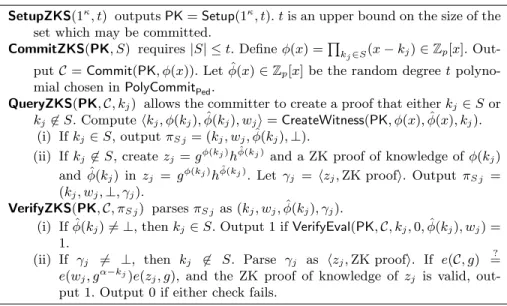
SetupZKS(1κ, t) outputsPK=Setup(1κ, t).tis an upper bound on the size of the set which may be committed.
CommitZKS(PK, S) requires|S| ≤t. Defineφ(x) =Q
kj∈S(x−kj)∈Zp[x]. Out-putC=Commit(PK, φ(x)). Let ˆφ(x)∈Zp[x] be the random degreet polyno-mial chosen inPolyCommitPed.
QueryZKS(PK,C, kj) allows the committer to create a proof that eitherkj∈Sor
kj6∈S. Computehkj, φ(kj),φˆ(kj), wji=CreateWitness(PK, φ(x),φˆ(x), kj). (i) Ifkj∈S, outputπS j= (kj, wj,φˆ(kj),⊥).
(ii) Ifkj6∈S, createzj=gφ(kj)h ˆ
φ(kj) and a ZK proof of knowledge ofφ(k j) and ˆφ(kj) in zj = gφ(kj)h
ˆ
φ(kj). Letγ
j = hzj,ZK proofi. Output πS j = (kj, wj,⊥, γj).
VerifyZKS(PK,C, πS j) parsesπS jas (kj, wj,φˆ(kj), γj).
(i) If ˆφ(kj)6=⊥, thenkj∈S. Output 1 ifVerifyEval(PK,C, kj,0,φˆ(kj), wj) = 1.
(ii) If γj 6= ⊥, then kj 6∈ S. Parse γj as hzj,ZK proofi. If e(C, g) ? =
e(wj, gα−kj)e(zj, g), and the ZK proof of knowledge of zj is valid, out-put 1. Outout-put 0 if either check fails.
Fig. 2.A nearly ZKS scheme based onPolyCommitPed.
not however, guarantee hiding (the ZK property), in [17] after seeing responses tot non-membership queries we may recover the entire accumulated set.
Construction of a Nearly ZKS. This construction (Figure 2) will use PolyCommitPed, and allows us to commit to S ⊂ Zp such that |S| ≤ t. The basic idea is to commit to a polynomialφ, such thatφ(kj) = 0 forkj ∈S, and
φ(kj)6= 0 forkj 6∈S. Our construction relies on a ZK proof that provesφ(kj)6= 0 without revealingφ(kj) to maintain privacy for queries whenkj6∈S. Although a construction based on PolyCommitDL is also possible, we choosePolyCommitPed as the required ZK proof is simpler in the latter case. For convenience we describe our protocols assuming the ZK proof is non-interactive, however, an interactive ZK proof may be used as well.
A security definition and proof are provided in the full version. The ZK proof of knowledge may be implemented using any secure ZK proof system allowing proof of knowledge of a discrete logarithm (see [11] for examples).
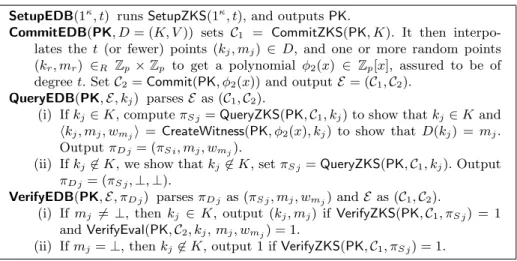
Construction of a Nearly ZK-EDB. This construction (Figure 3) makes use of the above nearly ZKS construction andPolyCommitDL. LetD= (K, V)⊂
Ztp×Ztp be a list of key-value pairs that will define the database (K andV are ordered lists of equal length such that the value mj ∈ V corresponds to the key kj ∈ K). The values may repeat, but the keys must be distinct. We write
D(kj) to denote the value associated to keykj (ifkj 6∈K, thenD(kj) =⊥). The underlying idea of our construction is to commit to the keys using our nearly ZKS, and also commit toφ, such thatφ(kj) =mj, usingPolyCommitDL, since it
SetupEDB(1κ, t) runsSetupZKS(1κ, t), and outputsPK.
CommitEDB(PK, D= (K, V)) sets C1 = CommitZKS(PK, K). It then interpo-lates the t (or fewer) points (kj, mj) ∈ D, and one or more random points (kr, mr) ∈R Zp×Zp to get a polynomial φ2(x) ∈ Zp[x], assured to be of degreet. SetC2=Commit(PK, φ2(x)) and outputE= (C1,C2).
QueryEDB(PK,E, kj) parsesE as (C1,C2).
(i) Ifkj∈K, computeπS j=QueryZKS(PK,C1, kj) to show thatkj∈Kand
hkj, mj, wmji = CreateWitness(PK, φ2(x), kj) to show thatD(kj) = mj. OutputπD j= (πS i, mj, wmj).
(ii) Ifkj6∈K, we show thatkj6∈K, setπS j=QueryZKS(PK,C1, kj). Output
πD j= (πS j,⊥,⊥).
VerifyEDB(PK,E, πD j) parsesπD jas (πS j, mj, wmj) andE as (C1,C2).
(i) Ifmj 6=⊥, then kj ∈ K, output (kj, mj) if VerifyZKS(PK,C1, πS j) = 1 andVerifyEval(PK,C2, kj, mj, wmj) = 1.
(ii) Ifmj=⊥, thenkj6∈K, output 1 ifVerifyZKS(PK,C1, πS j) = 1.
Fig. 3.A nearly ZK-EDB scheme constructed using our nearly ZKS construction (Fig-ure 2) andPolyCommitDL.
is sufficient for security and more efficient. The reason for using the nearly ZKS is to respond to queries whenk6∈Dwithout revealing any additional information.
Efficiency of our nearly ZKS and ZK-EDBs. The size of the commitment is a single group element for a nearly ZKS, or two elements for a nearly ZK-EDB. Proof thatkj∈S, consists of two group elements, while proof thatkj 6∈S consists of about five group elements (when ZK proofs are implemented using a standard three-move ZK protocol, made non-interactive with the Fiat-Shamir heuristic). The proof sizes for our nearly ZK-EDB construction are three and about five group elements (respectively).
The ZK-EDB in the literature with the shortest proofs is that of Libert and Yung [25] (based on their ZKS construction). Asymptotically, (non)membership proofs areO(κ/log(t)) bits, whereκis a security parameter, andt is the size of the system parameters. For the parameter choices given [25], proof sizes range from 80–220 group elements. The computation of their scheme and ours is nearly equal. Therefore, using nearly ZK-EDBs in the place of ZK-EDBs reduces com-munication costs by at least a factor of sixteen.
4.3 Credentials and Selective Disclosure of Signed Data
In this section we briefly describe two applications of the PolyCommitschemes, and we will show how polynomial commitments can reduce communication costs. Both applications are based on the following idea. Suppose Alice has a list of values (m1, . . . , mt), which will be signed by Trent. If Trent signs the concatena-tion, then Alice must reveal allmito allow Bob to verify the signature. However, if Trent signsC=Commit(PK, φ(x)) whereφ(i) =mi, then Alice may allow Bob to verify that Trent has signedmi without revealing the othermj. Bob verifies
the signature onC, and Alice produces a witness to prove thatCopens tomi at positioni, allowing Alice to convince Bob that Trent signedmi.
Content Extraction Signatures. If (m1, . . . , mt) are parts of a document, then signing a polynomial commitment is a content extraction signature(CES) scheme. Steinfeldet al.[35] introduce CES and give a generic construction of CES signatures. The scheme requires a standard commitment scheme, which is then used to commit to each of thetsub-messages (m1, . . . , mt) individually, forming a vector of commitments, which is signed. The scheme is secure, provided the signature scheme is secure, and the commitment scheme is hiding and binding.
Since both PolyCommit schemes are hiding and binding, and allow a list of messages to be committed, they can be used in the general construction of Steinfeldet al. Along with the commitment, Trent should also signtso that Bob knows that only indices {1, . . . , t} correspond to valid sub-messages. The new scheme is nearly as communication efficient as a specific scheme in [35] which has the lowest communication cost. The latter, however, depends on specific properties of the RSA signature scheme and is secure in the random oracle model. Using a polynomial commitment scheme gives an efficient generic construction. Therefore, efficient standard model CES schemes are possible by combining any of thePolyCommitschemes with a signature scheme secure in the standard model.
Pseudonymous Credentials. If (m1, . . . , mt) are attributes about Alice, and Trent is an identity provider, then the signature Alice holds on C is a digital credential that allows Alice to reveal only as much information as is necessary to complete an online transaction. Here, we create C using PolyCommitDL, as batched openings are efficient forPolyCommitDL. Disclosing a singlemi requires Alice to transmit (C,SignTrent(C),hi, mi, wii), the size of which is independent of
t. If Alice reveals a subset of the attributes, a single witness may be used to reduce communication even further using batch opening (described in§3.4). Further, if Trent signs multiple commitments to the same attributes (but includes an extra randomized attribute), Alice may present a different commitment to the same verifier unlinkably.
For many interesting applications of credentials, selective show is insufficient because Alice would like to prove something aboutmi(e.g.,mi <1990) without revealing mi. Alice may prove knowledge of a nonzero committed value φ(i) without revealing it, and compose this proof with other proofs aboutmi using standard ZK proof techniques for proving knowledge of, relations between or the length of discrete logarithms [11]. Since the communication costs per attribute of proving knowledge of a committed value are constant, ifkattributes are involved in showing a credential, the complexity of the show will be O(k). In existing schemes the communication isO(t) wheret is the total number of attributes in the credential. Further details of this application are given in the full version of this paper.
5
Open Problems
Finally, we list a few open problems related to polynomial commitment schemes. 1. Is it possible to construct efficient polynomial commitment schemes under weaker assumptions? 2. What other protocols does PolyCommitimprove? (For example, canPolyCommitreduce the communication of asynchronous VSS pro-tocols or verifiable shuffles?) 3. We have mainly focused on the communication costs, but our construction asks for nontrivial computation. Is it possible to reduce computation cost as well?
Acknowledgements. We thank the anonymous reviewers for providing many helpful comments, and thank Benoit Libert for sending us a preprint of [25]. We gratefully acknowledge the financial support of NSERC, MITACS, and the David R. Cheriton Graduate Scholarship program.
References
1. M. H. Au, Q. Wu, W. Susilo, and Y. Mu. Compact E-Cash from Bounded Accu-mulator. InProceedings of CT-RSA’07, pages 178–195, 2007.
2. M.H. Au, W. Susilo, and Y. Mu. Practical anonymous divisible e-cash from bounded accumulators. InProceedings of FC’08, pages 287–301, 2008.
3. J.C. Benaloh and M. de Mare. One-way accumulators: A decentralized alternative to digital signatures (extended abstract). In Proceedings of EUROCRYPT’93, pages 274–285. Springer, 1993.
4. G.R. Blakley. Safeguarding cryptographic keys. In Proceedings of the National Computer Conference, pages 313–317, 1979.
5. D. Boneh and X. Boyen. Efficient Selective-ID Secure Identity-Based Encryption Without Random Oracles. In Proceedings of EUROCRYPT’04, pages 223–238, 2004.
6. D. Boneh and X. Boyen. Short Signatures Without Random Oracles. InProceedings of EUROCRYPT’04, pages 56–73. Springer, 2004.
7. D. Boneh, X. Boyen, and E.J. Goh. Hierarchical identity based encryption with constant size ciphertext. InEurocrypt, volume 3494, pages 440–456. Springer, 2005. 8. D. Boneh, C. Gentry, and B. Waters. Collusion resistant broadcast encryption with short ciphertexts and private keys. InProceedings of CRYPTO’05, pages 258–275. Springer, 2005.
9. A. Buldas, P. Laud, and H. Lipmaa. Eliminating Counterevidence with Appli-cations to Accountable Certificate Management. Journal of Computer Security, 10(3):273–296, 2002.
10. J. Camenisch and A. Lysyanskaya. Dynamic accumulators and application to efficient revocation of anonymous credentials. InProceedings of CRYPTO’02, pages 61–76. Springer, 2002.
11. J. Camenisch and M. Stadler. Proof systems for general statements about discrete logarithms. Technical report, 1997. 260, Dept. of Computer Science, ETH Zurich. 12. D. Catalano, D. Fiore, and M. Messina. Zero-knowledge sets with short proofs. In
Proceedings of EUROCRYPT’08, pages 433–450. Springer, 2008.
13. M. Chase, A. Healy, A. Lysyanskaya, T. Malkin, and L. Reyzin. Mercurial com-mitments with applications to zero-knowledge sets. In Proceedings of EURO-CRYPT’05, pages 422–439. Springer, 2005.
14. J.H. Cheon. Security analysis of the strong Diffie-Hellman problem. InProceedings of EUROCRYPT’06, pages 1–13. Springer, 2006.
15. B. Chor, S. Goldwasser, S. Micali, and B. Awerbuch. Verifiable Secret Sharing and Achieving Simultaneity in the Presence of Faults (Extended Abstract). In
Proceedings of FOCS’85, pages 383–395, 1985.
16. I. Damg˚ard. Commitment schemes and zero-knowledge protocols. InLectures on Data Security, pages 63–86. Springer, 1999.
17. I. Damg˚ard and N. Triandopoulos. Supporting non-membership proofs with bilinear-map accumulators. 2008. Cryptology ePrint Archive: Report 2008/538. 18. P. Feldman. A Practical Scheme for Non-interactive Verifiable Secret Sharing. In
Proceedings of FOCS’87, pages 427–437, 1987.
19. R. Gennaro and S. Micali. Independent zero-knowledge sets. In Proceedings of ICALP’06, pages 34–45. Springer, 2006.
20. R. Gennaro, M.O. Rabin, and T. Rabin. Simplified VSS and Fast-Track Multiparty Computations with Applications to Threshold Cryptography. In Proceedings of PODC’98, pages 101–111. ACM Press, 1998.
21. V. Goyal. Reducing Trust in the PKG in Identity Based Cryptosystems. In Ad-vances in Cryptology—CRYPTO’07, pages 430–447, 2007.
22. F. Guo, Y. Mu, and Z. Chen. Identity-Based Encryption: How to Decrypt Multiple Ciphertexts Using a Single Decryption Key. In Proceedings of Pairing’07, pages 392–406. Springer, 2007.
23. A. Herzberg, S. Jarecki, H. Krawczyk, and M. Yung. Proactive Secret Sharing Or: How to Cope With Perpetual Leakage. InProceedings of CRYPTO’95, pages 339–352, 1995.
24. A. Kate, G. Zaverucha, and I. Goldberg. Polynomial commitments. Technical re-port, 2010. CACR 2010-10, Centre for Applied Cryptographic Research, University of Waterloo.
25. B. Libert and M. Yung. Concise Mercurial Vector Commitments and Independent Zero-Knowledge Sets with Short Proofs. InTCC’10, pages 499–517, 2010. 26. A. Menezes, P. Van Oorschot, and S. Vanstone.Handbook of Applied Cryptography.
CRC Press, 1st edition, 1997.
27. S. Micali, M. Rabin, and J. Kilian. Zero-knowledge sets. In Proceedings of FOCS’03, pages 80–91. IEEE, 2003.
28. S. Mitsunari, R. Sakai, and M. Kasahara. A New Traitor Tracing. IEICE Trans-actions on Fundamentals of Electronics, Communications and Computer Sciences, E85-A(2):481–484, 2002.
29. L. Nguyen. Accumulators from bilinear pairings and applications. InProceedings of CT-RSA, pages 275–292, 2005.
30. R. Ostrovsky, C. Rackoff, and A. Smith. Efficient Consistency Proofs for Gen-eralized Queries on a Committed Database. InProceedings of ICALP’04, pages 1041–1053, 2004.
31. T. P. Pedersen. Non-Interactive and Information-Theoretic Secure Verifiable Secret Sharing. InProceedings of CRYPTO’91, pages 129–140. Springer, 1991.
32. N. Pippenger. On the evaluation of powers and related problems. In IEEE SFCS(FOCS)’76, pages 258–263, 1976.
33. M. Prabhakaran and R. Xue. Statistically Hiding Sets. InProceedings of CT-RSA, pages 100–116. Springer, 2009.
34. A. Shamir. How to Share a Secret. Commun. ACM, 22(11):612–613, 1979. 35. R. Steinfeld, L. Bull, and Y. Zheng. Content extraction signatures. InProceedings