COMPUTING
PRACTICES
Computer Programs for
Detecting and Correcting
Spelling Errors
James L. Peterson
The University of Texas at Austin
1. Introduction
Computers are being used exten- sively for document preparation. The typical system is a time-shared one with file systems, text editors, and text formatting programs. The au- thor can enter a document directly on-line with the text editor, storing it in the computer's file system. The document has formatting commands indicating appropriate margins, spacing, paging, indenting, and so on. The text formatter interprets this to produce a file suitable for printing. The text file can be modified using a text editor which is generally an interactive program, while the for- matter is more often a batch pro- gram.
Permission to copy without fee all or part of this material is granted provided that the cop- ies are not made or distributed for direct commercial advantage, the ACM copyright notice and the title of the publication and its date appear, and notice is given that copying is by permission of the Association for Com- puting Machinery. To copy otherwise, or to republish, requires a fee a n d / o r specific per- mission.
Key words and phrases: spelling, spelling pro- grams, spelling correction, spelling dictionary CR Categories: 3.42, 4.0, 4.40, 4.49
Author's address: J.L. Peterson, Department o f Computer Sciences, The University of Texas at Austin, Austin, TX 78712.
© 1980 ACM 0001-0782/80/1200-0676 75¢. 676
SUMMARY: With the increase in word and text processing
computer systems, programs which check and correct spell-
ing will become more and more common. Peterson investi-
gates the basic structure of several such existing programs
and their approaches to solving the problems which arise
when this type of program
is
created. The basic framework
and background necessary to write a spelling checker or
corrector are provided.
This method of document prep- aration has created a market for word processing systems. This market will grow as more people use computers to improve their document prepara- tion.
Once this mode o f document preparation is adopted, several new operations on text files become pos- sible. Our interest here is in the pos- sibility of analyzing documents for spelling errors. Several systems can analyze a text file for potential spell- ing errors, pointing out probable cor- rect spellings. We expect spelling programs to be a standard part o f all future text processing systems. Sev- eral companies, including IBM, have
Communications o f
the ACM
recently begun to promote systems including spelling programs.
There are two types o f spelling programs: spelling checkers and spell- ing correctors. The problem for a spelling checker is quite simple: Given an input file o f text, identify those words which are incorrect. A spelling corrector both detects mis- spelled words and tries to find the most likely correct word. This prob- lem contains elements of pattern rec- ognition and coding theory. A solu- tion is possible only because of re- dundancy in the English language.
Each word can be considered a point in a multidimensional space of letter sequences. Not all letter se-
December 1980 Volume 23 Number 12
quences are words, and the spelling checker must classify each candidate word (called a token) as a correctly spelled word or not. We want to minimize errors, both type 1 (indi- cating a correctly spelled word is in- correct) and type 2 (indicating an incorrectly spelled word is correct). Correcting a misspelling involves a search of the word space to select the nearest neighbor(s) of the incorrectly spelled word. (This view of words in a multidimensional space can lead to peculiar representations of words such as in [13] in which each word is represented as a vector in a two-di- mensional space.)
Spelling errors can be introduced in m a n y ways. The following three are probably most important.
Author ignorance. Such errors can lead to consistent misspellings and are probably related to the difference between how a word sounds and is actually spelled.
Typographical errors on typing.
These are less consistent but perhaps more predictable, since they are re- lated to the position o f keys on the keyboard and probably result from errors in finger movements. Studies have shown that large databases m a y have significant keyboarding errors
[4].
Transmission and storage errors.
These are related to the specific en- coding and transmission mecha- nisms. Early work in spelling correc- tion was often focused on the prob- lem of optical character recognition (OCR) input [2, 5, 16, 34, 42] and the recognition of Morse code [23]. Different sources o f error suggest that some algorithms will be better for some errors.
The original motivation for re- search on spellers was to correct er- rors in data entry; much early work was directed at finding and correct- ing errors resulting from specific in- put devices in specific contexts. Dav- idson [8] was concerned with finding the (potentially misspelled) names of passengers for a specific airline flight. Either the stored or inquiry n a m e (or both) might be misspelled. Carlson [5] was concerned with
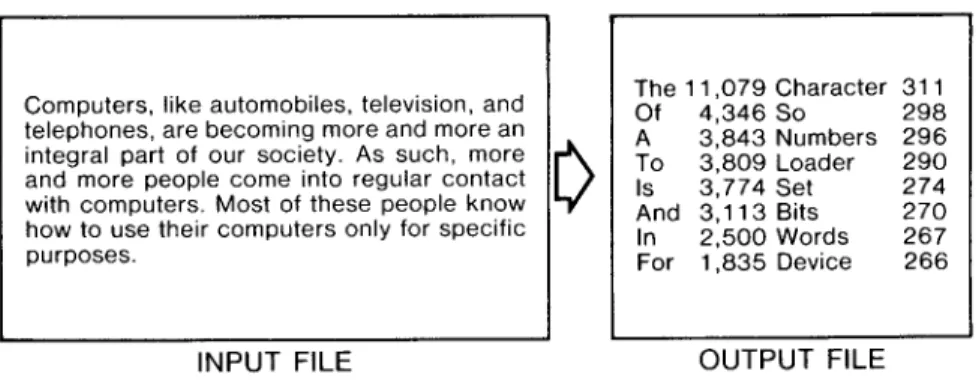
Computers, like automobiles, television, and telephones, are becoming more and more an integral part of our society. As such, more and more people come into regular contact with computers. Most of these people know how to use their computers only for specific purposes.
The 11,079 Character 311 Of 4,346 So 298 A 3,843 Numbers 296 To 3,809 Loader 290 Is 3,774 Set 274 And 3,113 Bits 270 In 2,500 Words 267 For 1,835 Device 266
INPUT FILE OUTPUT FILE
Fig. 1. Constructing a Word List. The words have been ordered by number of occurrences.
names and places in a genealogical database. F r e e m a n [10] was working only with variable names and key words in the C O R C p r o g r a m m i n g language, while McElwain and Ev- ans [23] were concerned with im- proving the output o f a system so that it would recognize Morse code. Each o f these projects considered the spelling problem as only one aspect o f a larger problem, and not as a separate software tool.
M a n y academic studies on the general problem of string matching and correction algorithms have been conducted [1, 7, 22, 32, 33, 43, 44], but not with the aim of producing a working spelling p r o g r a m for general text.
R e c e n t l y , s e v e r a l s p e l l i n g checkers have been written for the sole purpose of checking text. Re- search extends back to 1957, but the first spelling checker written as an applications p r o g r a m (rather than research) appears to have been S P E L L for the DEC-10, written by R a l p h G o r i n at Stanford in 1971. This p r o g r a m and its revisions are widely distributed today.
The U N I X operating system pro- vides two spelling checkers: T Y P O and SPELL. These both represent different approaches. Another spell- ing checker has been written for I B M / 3 6 0 and I B M / 3 7 0 systems and is in use at the IBM T h o m a s J. Wat- son Research Center in Yorktown Heights.
This paper reports on an investi-
gation o f these programs: how they work and their advantages and dis- advantages. As a result, we deter- mined how a spelling checker can be written using existing software tech- nology. On the basis of this study. we then proceeded to write ,3ur own spelling checker/corrector, using a top-down p r o g r a m m i n g methodol- ogy [31].
2. Token Lists
The simplest assistance in check- ing spelling is an algorithm which lists all distinct tokens in the input (see Figure 1). This requires a per- son to identify any misspellings; a p r o g r a m of this sort is a simple ex- ercise.
Even at this stage significant de- cisions must be made: e.g., What is a potential word (token)? It is a se- quence of letters, separated by
delimiters. D e l i m i t e r s include blanks and special characters, such as commas, periods, colons, and so on. In most cases, the classification o f a character as a letter or a delim- iter is clear, but careful thought should be given to the interpretation of numbers, hyphens, and apos- trophes.
Tokens which include numbers are often ignored by spelling check- ers. This includes both tokens which are totally numbers (1978, 10, and so on) and tokens which are part num- ber and part letter (3M, IBM360, R2D2, and so on). Whether or not these sorts of tokens should be con-
677 C o m m u n i c a t i o n s
of the A C M
December 1980 Volume 23 N u m b e r 12
COMPUTING
PRACTICES
sidered by a speller is best left as an option to be selected by the user.
Hyphens are generally consid- ered delimiters; each part o f the hy- phenated token is considered a sep- arate token. This follows from the normal use o f a hyphen to construct compound words (such as
German-
American, great-grandmother, four-
footed,
and so on). It is best not to allow hyphenation at the end o f a line in the input to a spelling checker, since it is not possible, in general, to correctly undo such hyphenation.Apostrophes are generally con- sidered to be letters for the purpose o f spelling correction. This is due to their use as an indicator o f omitted letters (as in
don't
andI'd)
and o f possessi,,es(King's
andJohn's).
An apostrophe at the beginning or end o f a token might be considered a delimiter, since they are sometimes used as quote markers (as in,"the
token "ten'... "),
but plural posses- sives also have apostrophes at the ends o f words(kids').
Another concern is the
case
of letters in a token. Most frequently, all letters will be lowercase, although the first letter at the start o f a sen- tence is capitalized. Sincethe
is nor- mally considered the same word asThe,
most spellers map all letters into one case (upper or lower) for analy- sis. A flag may be associated with the token to allow proper capitalization for spelling correctors, since we want the capitalization o f corrected tokens to match the capitalization o f the input token. Thus,amung
should be corrected toamong,
whileAmung
is corrected toAmong.
The case problem is actually more complex because o f the exis- tence o f words, particularly in com- puter literature, which are strictly uppercase (such as
FORTRAN
andIBM)
and the widespread use of ac- ronyms(GCD
andCPU)
which are also uppercase.Should fortran
oribm
be considered misspellings or sepa- rate words? What should be the cases o f the letters used to correct an input
678
token such as
aMunG?
These prob- lems are minor but require thought in designing spelling correctors. Spelling checkers need only report thataMunG
is not correctly spelled in any case; this allows all tokens to be mapped into a uniform case for checking.A separate problem is a possible decision that tokens which consist solely o f uppercase characters should (optionally) not even be considered by a spelling corrector since they will most likely be proper names, vari- able names, or acronyms, none o f which would typically be understood by a spelling program anyway.
Once these decisions are made, creating a list of all distinct tokens is relatively straightforward. The basic algorithm is
Initialize. Get the name of the input file and the output file, open them, and set all vari- ables to their initial state,
Loop. While there are still tokens in the input file, get the next token and enter it into an internal table of tokens.
To enter the token, first search to see if it is already in the table. I f not, add it to the table.
Print. When all tokens have been read, print the table and stop,
The key to this program is ob- viously its internal table of tokens. We need to be able to search the table quickly and find a token (if it exists), or determine that it is not in the table. We also need to be able to add new tokens to the table, although we need not delete them. The speed of the program is especially depen- dent on the search time. A hash table approach would seem the most rea- sonable for the table.
The table would be most useful if it were
sorted.
Sorting can be done either alphabetically or by fre- quency. Attaching a frequency count to each table entry provides the num- ber o f uses o f each token. This can speed the process by searching higher frequency items first (a self- modifying table structure); it may also help in determining misspell- ings. Typographical errors are gen- erally not repeated, and so tokens typed incorrectly will tend to have a very low frequency. Any token with low frequency is thus suspect. Con- sistent misspellings (due to the au-Communications of
the ACM
thor not knowing the correct spell- ing) are not as easily found using this technique.
This type o f spelling program was used to check spelling for the text of
Computer Organization and Assem-
bly Language Programming
(Aca- demic Press, 1978). Although it was quite tedious to check the resulting list o f words (5,649 unique words out o f 156,134 tokens), the result was a book with no (known) spelling er- rors.3. TYPO
An extension of this token list concept is the basis of the T Y P O program on U N I X [24, 26]. This pro- gram resulted from research on the frequency o f two-letter pairs
(di-
grams)
and three-letter triples(tri-
grams)
in English text. If there are 28 letters (alphabetic, blank, and apos- trophe), then there are 28 letters, 282 (= 784) digrams and 28 z (= 21,952) trigrams. However, the frequency o f these digrams and trigrams varies greatly, with many being extremely rare. In a large sample o f text, only 550 digrams (70 percent) and 5,000 trigrams (25 percent) actually oc- curred. If a token contains several very rare digrams or trigrams, it is potentially misspelled. The use of di- grams and trigrams to both detect probable spelling errors and indicate probable corrections has been one o f the most popular techniques in the literature [5, 6, 16, 23, 24, 26, 32, 33, 42].T Y P O computes the actual fre- quency o f digrams and trigrams in the input text and a list of the distinct tokens in the text. Then for each distinct token, an
index of peculiarity
is computed. The index for a token is the root-mean-square o f the indi- ces for each trigram of the token. The index for a trigram
xyz
given digram and trigram frequenciesf(xy), f(yz), and f(xyz)
is[log(f(xy)
- 1) + log
(f(yz) -
1 ) ] / 2 -log(f(xyz)
- 1). (The log o f zero is defined as - 1 0 for this computation.) This in- dex is a statistical measure o f the probability that the trigram
xyz
was produced by the same source which yielded the rest o f the text.December 1980 Volume 23 N u m b e r 12
The index of peculiarity mea- sures how unlikely the token is in the context of the rest of the text. The output o f T Y P O is a list of tekens, sorted by index of peculiarity. Ex- perience indicates that misspelled to- kens tend to have high indices o f peculiarity, and hence appear toward the front of the list. Errors tend to be discovered since (a) misspelled words are found quickly at the beginning o f the list (motivating the author to continue looking), and (b) the list is relatively short. In a document o f 10,000 tokens, only approximately 1,500 distinct tokens occur. This n u m b e r is further reduced in TYPO by comparing each token with a list o f over 2,500 c o m m o n words. If the token occurs in this list, it is known to be correct and is not output, thereby eliminating about half the distinct input tokens and producing a much shorter list.
4. Dictionary Look-Up
The use of an external list (a dictionary) o f correctly spelled words is the next level o f sophistication in spelling checkers. The spelling checker algorithm using a dictionary is
Initialize.
Build List. Construct a list o f all distinct to- kens in the input file.
Search. Look up each token o f the list in the dictionary.
If the token is in the dictionary, it is correctly spelled.
If the token is not in the dictionary, it is
not known to be correctly spelled and is put on the output list.
Print. Print the list o f tokens which were not found in the dictionary.
If the list o f input tokens and the dictionary are sorted, then only one pass through the list and dictionary is needed to check all input tokens, thereby providing a fast checker.
The major component of this al- gorithm is the dictionary. Several dictionaries exist in machine reada- ble form. It may be most practical to use the o u t p u t o f the spelling checker to create the dictionary: i.e., a list o f tokens which are not in the diction- ary. Starting with a small dictionary, many correctly spelled words will be output by the checker. By deleting spelling errors and proper names 679
from this list, we have a list of new words which can be added to the dictionary. A new dictionary can eas- ily be created by merging the two.
The size o f a reasonable diction- ary can be estimated by glancing at books which list words mainly for use by secretaries; e.g., [21]. These usually have 20,000-40,000 words.
One must be careful not to pro- duce too large a dictionary. A large dictionary may include rare, archaic, or obsolete words. In technical writ- ing, these words are most likely to be the result o f a misspelling. Another problem with most large dictionaries is the tendency to include incorrectly spelled words. It is neither interesting nor pleasant to verify the correct spelling o f 100,000 words.
A dictionary of 10,000 words would be quite reasonable for a small community of users. Since the aver- age English word is about eight char- acters long, this requires about 100K bytes of storage. Controls on who may modify the dictionary will be needed.
The need for controls creates the post o f system dictionary administra- tor. This person would be responsible for maintaining the shared system dictionary: the addition of new words and the selective deletion of those infrequently used.
One approach to limiting the size o f the system dictionary is to create multiple dictionaries, one for each major topic area. This leads natu- rally to the concept of a c o m m o n base dictionary with multiple local dictionaries o f special words specific to a given topic. When a particular file is to be checked, a temporary master dictionary is created by aug- menting the c o m m o n base with se- lected local dictionaries. These local dictionaries can be created and maintained by the dictionary admin- istrator or by individual users reflect- ing their own vocabularies.
The above algorithm for diction- ary look-up is a batch algorithm. It is essentially the algorithm used for the U N I X and IBM spelling pro- grams. There are some problems with this approach. First, a substan- tial real-time wait may be required while the program is running; this C o m m u n i c a t i o n s
o f the A C M
can be quite annoying to a user at an interactive console. Second, the out- put list o f misspelled and unknown tokens lacks context. It may be dif- ficult using some text editors to find these tokens in the text due to differ- ences in the case (for editors which pay attention to upper/lower case) and search difficulties (the file may be quite large, a n d / o r the misspelled token may be a commonly occurring substring in correctly spelled words).
5. Interactive Spelling Checkers
Problems such as those just dis- cussed can be easily corrected with an interactive spelling checker. An interactive checker uses the follow- ing basic algorithm:
Initialize. Possibly asking the user for mode settings and the n a m e s of local dictionaries. Check. For each input token, search the dic-
tionary.
If the token is not in the dictionary, ask the user what to do.
This is the approach of the DEC-10 SPELL program and the approach which we used with our own spelling corrector.
5.1 Modes of Operation
Several modes of operation may be available in an interactive checker. The interaction with the user may be verbose (novice users) or terse (experts familiar with the pro- gram). Local dictionaries of special- ized terms may be temporarily added to the large shared system dictionary. A training mode (in which all tokens are defined to be correctly spelled) may be useful for constructing local dictionaries.
The options available to the user are determined by user needs. The following list indicates some options: Replace. The unknown token is taken to be misspelled and will be replaced. The token is deleted and a correctly spelled word is requested from the user.
Replace and remember. The un- known token is replaced by a user specified word, and all future uses of this token are also replaced by the new word.
Accept. The token is to be consid- ered correct (in this context) and left alone.
D e c e m b e r 1980 Volume 23 N u m b e r 12
COMPUTING
PRACTICES
Accept and remember. The un- known token is correct and will be left alone. In addition, all future uses of this token are correct in this doc- ument; the user should not be asked about them again.
Edit. Enter an editing submode, allowing the file to be modified in its local context.
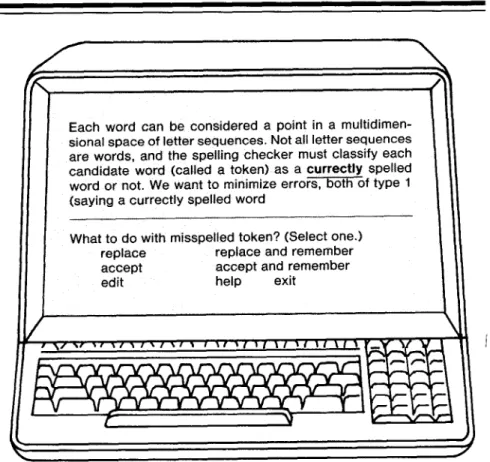
The use of a C R T as the terminal allows the spelling checker to display the context of an unknown token: At least the line containing the token should be displayed. On terminals with sufficient bandwidth and fea- tures, a larger context o f several lines or an entire page can be displayed with the token emphasized by bright- ness, blinking, size, or font. (See Fig- ure 2.)
5.2 The Dictionary
The performance o f an interac- tive spelling checker is important. The user is waiting for the checker and the checker must therefore be sufficiently fast to avoid frustration. Also, unlike batch checkers which need to look up each distinct token once (sorting them to optimize the search), an interactive checker must look up each occurrence in the order in which they are used. Thus, the interactive checker must do more work.
(It would be possible to batch small portions, as much as a page, o f the input file. A list of all distinct tokens on a page would be created and the dictionary searched for each token. Each token which was not found would be presented to the user. This is repeated for each page in the input file. The main problems are response time and keeping track o f the context o f each usage of a token for display.)
The structure o f the dictionary is thus o f great importance. It must allow very fast searches. The "cor- rect" structure must be determined for the configuration o f the computer system. Such factors as m e m o r y size,
68o
file access methods, and the existence of virtual m e m o r y can be significant in determining appropriate struc- tures. I f the m e m o r y is large enough, the entire dictionary can be kept in memory, making operations easier and faster. I f the m e m o r y is virtual as opposed to physical, however, the dictionary structure should minimize page faults while searching. I f the m e m o r y is too small, a two-layer structure is needed, keeping the most frequently referenced words in m e m - ory, while accessing the remainder with disk reads as necessary.
Algorithms and data structures for text processing m a y be tailored to the properties of the English lan- guage. Several studies have created large c o m p u t e r files of text which can be analyzed to determine the statistical properties o f the language. The most c o m m o n l y cited collection is the Brown Corpus [20] created at Brown University. The Brown Cor- pus contains 1,014,232 total tokens
with 50,406 distinct words. The long- est word is 44 characters, while 99 percent are 17 characters or less in length; the average word length is 8.1 characters. It is well-known, how- ever, that short words are used more frequently than long words. The ten most c o m m o n words are the, of, and, to, a, in, that, is, was, and he. Because of this usage of shorter words, the average token length,when weighted by frequency o f use, is only 4.7 char- acters, with 99 percent having 12 characters or less.
K n u t h [19] is a good source for different data structures and search algorithms. However, there is no "best" algorithm; each machine and each system m a k e different d e m a n d s on the dictionary data structure. We will now outline a few approaches.
The DEC-10 SPELL p r o g r a m uses a hash chain table of 6,760 en- tries. T h e hash function for a token is the first two letters (L1 and L2) and the length (WL) of the token (2,
E a c h w o r d can b e c o n s i d e r e d a p o i n t in a m u l t i d i m e n - sional s p a c e o f l e t t e r s e q u e n c e s . Not all letter s e q u e n c e s a r e w o r d s , a n d the spelling c h e c k e r must classify e a c h c a n d i d a t e w o r d (called a t o k e n ) as a c u r r e c t l y s p e l l e d w o r d o r not. We w a n t to m i n i m i z e e r r o r s , ~ f t y p e 1 ( s a y i n g a c u r r e c t l y s p e l l e d w o r d
W h a t to d o w i t h misspelled t o k e n ? ( S e l e c t o n e , ) r e p l a c e r e p l a c e and r e m e m b e r a c c e p t a c c e p t and r e m e m b e r e d i t h e l p e x i t
Fig. 2. An Interactive Spelling Program as It Might Appear on a CRT Terminal. Here, a page of text with a highlighted misspelled word, along with a list of corrective actions, are displayed.
Communications December 1980
of Volume 23
3 . . . 10, 11 and over) as (LI * 26 + L2) * 10 + m i n ( W L - 2, 9). Each hash table entry is a pointer to a chain o f words, all of which have the same first two letters and the same length. (This p r o g r a m assumes all tokens of length 1 are correctly spelled.)
Another suggested structure for the dictionary is based on tries [19, 27, 30]. A large tree structure repre- sents the dictionary. The root of the tree branches to 26 different nodes, one for each of the possible first let- ters of words in the dictionary. Each o f these nodes would branch accord- ing to the possible second letters, given the known first letter associ- ated with the node. These new nodes branch on possible third letters, and so on. A special bit would indicate the possible ends of words. This structure is particularly appropriate for small computer systems in which a token must be compared, with a dictionary entry, one character at a time. Searching for a token of W L characters requires following the tree W L levels down and checking the end-of-word bit.
Alternative structures are gener- ally based on the frequency of use of words. It is known that usage is ex- tremely variable, and a small n u m b e r of words are most often used. Hence, we want to structure our search strat- egy so that the most c o m m o n words are searched first. One suggestion [35] is a two-level search strategy.
In the two-level search strategy, the token would first be c o m p a r e d with entries in the small in-core table o f most frequently used words. I f the token is not in this table, a search of the remaining words would be made. This larger table might be stored on secondary disk or drum storage, or in a separate part o f virtual memory, requiring longer access and search times. I f this table is on secondary storage, access to a block can be accomplished by an in-core index.
F r o m the Brown Corpus, we can determine the following statistics for the percentage of most c o m m o n English words. The size of the table determines the percentage of tokens found. As the table size is doubled, a larger percentage is found.
Size
C o m p l e t e Dictionary (probably stored on disk)
2,000
50%
Document specific words
F C°mm°n
no'is °r s
5%
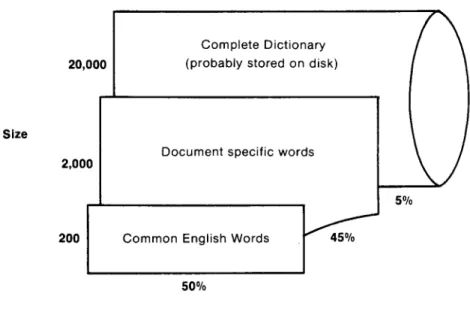
frequency of use of tokens Fig. 3. The Possible Size and Use of Three Separate Dictionaries.
20'00 1
Table Size % of Tokens Found Gain
16 28.8
32 36.0 7.2
64 43.2 7.2
128 49.6 6.4
256 55.6 6.0
Thus, over half o f the tokens in nor- mal English occur in a vocabulary of only 134 words. A table of this size can easily be stored in memory. A good search strategy can be designed for such a small table; for example, K n u t h [19] gives a hashing algorithm which results in only one comparison to identify any of the 31 most fre- quently used words in English (35.7 percent o f all tokens).
Another i m p r o v e m e n t in search time can be made by noticing that the total n u m b e r of distinct tokens in a document tends to be small to mod- erate (1,500 for a 10,000-word docu- ment) and often uses words of par- ticular interest to the subject area. This means that for each specific document, there exists a (small) table of words which occur frequently in that document (but not in normal English). (See Figure 3.) Thus, it is wise to build another table of words which have been used in this specific document. This three-table structure would be searched by
First, the small table of most com- m o n English words.
N e x t , the table of words which have already been used in this doc- ument.
Finally, the large list of the remain- ing words in the main dictionary. I f a word is found at this level, add it to the table of words for this document.
Distinct data structures m a y be appropriate for these three tables since they exhibit the following dif- ferent properties:
Most c o m m o n English w o r d s - - static, small (100-200);
D o c u m e n t specific w o r d s - - dynamic, small to moderate (1,000-2,000);
Secondary storage d i c t i o n a r y - - static, very large (10,000-100,000). (You m a y recognize that the lat- ter two data structures are similar to a paging or segmentation scheme. Notice that even if the underlying computer system provides a virtual m e m o r y by such a m e m o r y manage- ment scheme, this data structure will provide improved locality and hence a lower fault rate.)
6. Spelling Correction
An interactive spelling checker can also be helpful in correction. In the simplest case, the checker re-
681 C o m m u n i c a t i o n s
of the A C M
December 1980 Volume 23 N u m b e r 12
COMPUTING
PRACTICES
members all tokens which the user has indicated should be replaced and the words with which the tokens are to be replaced. After the first such replacement, future occurrences o f the misspelled token can be auto- matically corrected, although this feature might be undesirable in some instances.
A similar approach is including c o m m o n misspellings in the diction- ary with the correct spelling. Thus, greatfully would be tagged as a mis- spelling o f gratefully and prehaps as a misspelling of perhaps. This ap- proach has not been included in any current spellers, probably because of the lack o f an obvious source of known misspellings and the low fre- quency o f even common misspell- ings.
Most misspellings can be gener- ated from correct spellings by a few simple rules. Damerau [7] indicates that 80 percent of all spelling errors are the result of:
(1) transposition o f two letters; (2) one letter extra;
(3) one letter missing; (4) one letter wrong.
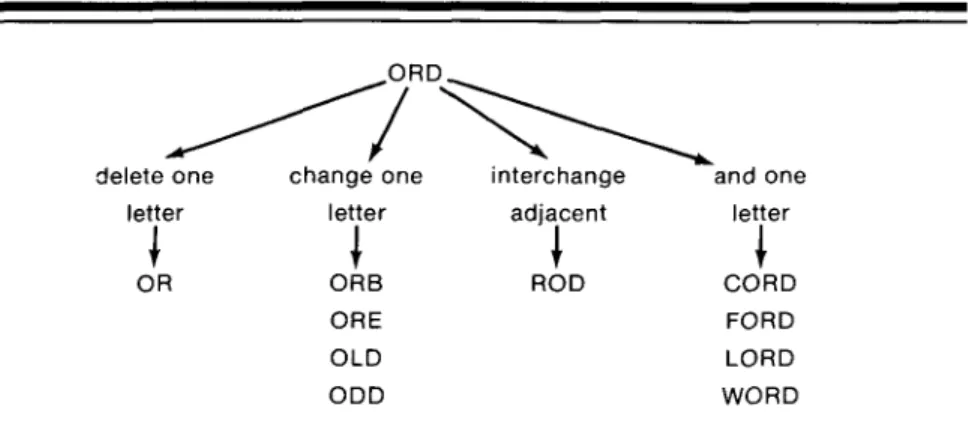
These four rules are the basis for the correction portion o f the DEC- 10 spelling corrector. (See Figure 4.) The basic algorithm for correction is For each token which is not found in the dictionary, construct a list of all words which could produce this token by one of the above rules. These are candidate spell- ings.
If the list has exactly one candidate, guess that word and ask the user if that word is the correct spelling.
If the list contains several words, state this. The user may then request the list and select one as the correct word, or indicate one of the normal options of replace, replace and remember, accept, accept and remember, or edit.
The candidate list is formed by multiple searches o f the dictionary. Transpositions can be detected by transposing each pair o f adjacent characters in the token, one at a time, and searching for the resulting token. If the resulting token is found, it is a
candidate and is added to the list. For a token of WL characters, this requires WL-1 searches of the dic- tionary. Checking for one extra letter requires deleting each character one at a time, and searching for the re- sulting tokens. This requires an ad- ditional WL searches; most tokens are short (five characters on the av- erage) so this need not be expensive. However, no statistics are available on the average length of misspelled words.
The remaining two types o f er- rors (one missing letter and one wrong letter) are difficult to detect. Two strategies are possible. The comparison operation can be defined to include a special match-any char- acter. This means that a search for a missing letter could be achieved by inserting or appending the special match-any character and searching. The characteristics o f this type of search are more complex than a sim- ple bit-wise compare and will take more time. Considering the critical nature o f performance, two separate searches may be needed, with and without the match-any character fea- ture. A search with a match-any char- acter feature cannot stop when the first word match is found, but must continue, since many words may match the token. This approach re- quires WL + 1 searches for a missing letter error and WL searches for a wrong letter error.
A second approach is to substi- tute each potential character in each character position and search nor- mally. If there are N potential char-
acters (N approximately 27 depend- ing on the classification of the apos- trophe and similar characters), then a missing letter error requires N * ( W L + 1) searches and a wrong letter requires N* WL searches.
A specific dictionary structure may allow improvements. The DEC-10 SPELL program separates the dictionary into 6,760 chains by the first two letters and length. For a token o f length WL, candidate spellings for one-letter-wrong and transposition errors are of the same length, candidates for one-letter- extra errors are o f length WL - 1, and one-letter-missing candidates are o f length WL + 1. This consid- erably shortens the number o f chains which must be searched. The search strategy is best described by quoting from the comments o f the SPELL program itself.
There are four kinds of errors that the pro- gram attempts to correct:
one wrong letter; one missing letter; one extra letter; two transposed letters.
For a wrong letter in the third or subsequent character, all words which are candidates must exist on the same chain that the sus- pect token hashes to. Hence, each entry on that chain is inspected to determine if the suspect differs from the entry by exactly one character. This is accomplished by an exclusive-or (XOR) between the suspect and the dictionary.
Then a J F F O instruction selects the first nonzero byte in the XOR. This byte is zeroed and if the result is all zero, then the dictionary word differs from the suspect in only one letter. All such words are listed at CANDBF, where they can be inspected later.
delete one change one interchange and one
letter letter adjacent letter
OR ORB ROD CORD
ORE FORD
OLD LORD
ODD WORD
Fig. 4. An Illustration of an Incorrectly Spelled Token and the Correctly Spelled Tokens Which Result When Certain Simple Rules Are Applied.
682 Communications Decembhr 1980
of Volume 23
For a wrong letter in the first or second character, the program tries varying the sec- ond letter through all 26 possible values, searching for an exact match. Then all 26 possible values of the first letter are tried, after setting the second letter to its original value. This means that 52 more chains are searched for possible matches.
To correct transposed letters, all combina- tions of transposed letters are tried. There are only WL - 1 such combinations, so it is fairly cheap to do this.
To correct one extra letter, WL copies of the token are made, each with some letter removed. Each of these is looked up in the dictionary. This takes WL searches. To correct one missing letter, WL + 1 copies of the token are made, each time inserting a null character in a new position in the suspect. The null character is never part of any word, so the suspect token augmented by an embedded null can be thought of as a word with one wrong letter (the null). Then the algorithm for matching one wrong letter is used. lfthe first character is omitted, all 26 possible first characters are tried. Also, 26 more tokens are formed by varying the second character in case that had been omitted.
C o u n t i n g , we f i n d t h a t a t o t a l o f 3 * W L + 103 c h a i n s m u s t be s e a r c h e d , w i t h W L such c h a i n searches r e q u i r i n g a special a l g o - r i t h m to l o o k for (exactly) one w r o n g c h a r a c t e r . T h e d i c t i o n a r y (of say
100,000 w o r d s ) is split into 6,760 chains, so a c h a i n s e a r c h o r d i n a r i l y l o o k s at o n l y 5 to 50 words. F o r a t o k e n o f 8 c h a r a c t e r s this m i g h t m e a n 3,000 c o m p a r i s o n s .
S p e l l i n g c o r r e c t i o n is c e r t a i n l y n o t c h e a p . It is, h o w e v e r , n e i t h e r p r o - h i b i t i v e l y e x p e n s i v e n o r n o r m a l l y n e e d e d ; it is n e e d e d o n l y for those t o k e n s not f o u n d in the d i c t i o n a r y .
O t h e r c o r r e c t i o n a l g o r i t h m s h a v e b e e n suggested. O n e t h e o r e t i c a l l y p l e a s i n g s u g g e s t i o n [1] is to d e t e r - m i n e the l e n g t h s o f c o m m o n sub- strings in a t o k e n a n d a d i c t i o n a r y word. T h i s c a n b e u s e d to d e t e r m i n e a n index o f matching. T h e i n d e x o f m a t c h i n g c a n be c o n s i d e r e d the p r o b a b i l i t y the t o k e n r e s u l t e d f r o m a m i s s p e l l i n g o f the d i c t i o n a r y word. T h e w o r d w i t h the h i g h e s t p r o b a b i l - ity c a n be selected as the m o s t l i k e l y correct spelling. T h i s seems to be a v e r y e x p e n s i v e a l g o r i t h m .
S i m i l a r a l g o r i t h m s h a v e b e e n in- v e s t i g a t e d b y W a g n e r a n d F i s c h e r [43] a n d L o w r a n c e a n d W a g n e r [22]. A d d i t i o n a l i n f o r m a t i o n c a n often be u s e d to i n c r e a s e c o r r e c t i o n a c c u -
r a c y o r speed. O n e i m p o r t a n t source o f a d d i t i o n a l i n f o r m a t i o n is the source o f p o s s i b l e errors. F o r e x a m - ple, errors i n t r o d u c e d b y O C R i n p u t devices are o n l y the s u b s t i t u t i o n o f o n e l e t t e r for a n o t h e r ; c h a r a c t e r s are n e v e r i n s e r t e d o r d e l e t e d b y the O C R r e a d e r . I n a d d i t i o n , it is p o s s i b l e to c r e a t e a confusion matrix g i v i n g the p r o b a b i l i t y p i , i o f r e a d i n g a c h a r a c t e r i w h e n the correct c h a r a c t e r i s j . T h i s c o n f u s i o n m a t r i x c a n be u s e d to in- d i c a t e w h i c h c h a r a c t e r s s h o u l d be c o n s i d e r e d w h e n a n i n p u t l e t t e r is to be corrected. I n a m o r e g e n e r a l sys- tem, d i g r a m a n d t r i g r a m f r e q u e n c i e s c o u l d be u s e d to l i m i t the n u m b e r o f a l t e r n a t i v e spellings w h i c h m u s t be c o n s i d e r e d .
T h e l a y o u t o f the s t a n d a r d t y p e - w r i t e r k e y b o a r d m a y also be o f use in c o r r e c t i n g errors i n t r o d u c e d in k e y b o a r d i n g text.
A n o t h e r t e c h n i q u e a t t a c k s the p r o b l e m o f w o r d s w h i c h the o r i g i n a l a u t h o r spelled incorrectly. T h e mis- spellings in this case are o f t e n b a s e d o n w o r d sound. It has b e e n s u g g e s t e d t h a t t o k e n s s h o u l d be c o n v e r t e d to s t a n d a r d p h o n e t i c spelling, w h i c h w o u l d be u s e d to f i n d s i m i l a r l y s o u n d i n g w o r d s in the d i c t i o n a r y . T h i s w o u l d h e l p correct such a p p a r - ent d o u b l e errors as u s i n g f f o r p h o r k for qu.
O n the o t h e r h a n d , c o r r e c t i o n b a s e d u p o n the f o u r rules used b y the D E C - 1 0 S P E L L p r o g r a m is q u i t e successful a n d r e l a t i v e l y c h e a p , leav- ing the m o r e difficult c o r r e c t i o n s to the user.
7. Affix A n a l y s i s
F o r p e r f o r m a n c e reasons, it is de- s i r a b l e to k e e p the d i c t i o n a r y in m e m o r y . Thus, serious t h o u g h t h a s b e e n given to w a y s o f r e d u c i n g the size o f the d i c t i o n a r y . I n the B r o w n C o r p u s o f 50,406 words, h a l f were u s e d o n l y once o r twice. A d i c t i o n a r y o f 8,000 w o r d s w o u l d r e p r e s e n t 90 p e r c e n t o f the words; 16,000 w o r d s w o u l d y i e l d 95 percent.
A m a j o r r e d u c t i o n m a y be p o s - sible, h o w e v e r , b y c o n s i d e r i n g c o m - m o n affixes. ( A n affix is e i t h e r a
suffix or a prefix.) M o s t p l u r a l n o u n s a n d v e r b s result f r o m a d d i n g a n -s to
the e n d o f the s i n g u l a r forms. O t h e r c o m m o n suffixes i n c l u d e -ly, -ing, -est, -er, -ed, -ion, a n d so on. By r e m o v i n g these suffixes a n d s t o r i n g o n l y the r o o t word, the d i c t i o n a r y c a n be r e d u c e d significantly. S i m i l a r a p p r o a c h e s a r e p o s s i b l e for prefixes. T w o a p p r o a c h e s are possible. In the s i m p l e s t case, e a c h t o k e n is ex- a m i n e d for a list o f c o m m o n affixes. T h e s e are r e m o v e d i f f o u n d . H e n c e , a n y t o k e n e n d i n g in -s has the -s r e m o v e d . ( T h e o r d e r o f s e a r c h c a n assure t h a t l a r g e r suffixes like -ness
are r e m o v e d first.) T h e n the d i c t i o n - a r y is s e a r c h e d . I f f o u n d , the t o k e n is j u d g e d correct. A m a j o r p r o b l e m w i t h this a p p r o a c h is t h a t it d o e s not c a t c h m i s s p e l l e d t o k e n s w h i c h are the result o f correct affixes incor- r e c t l y a p p l i e d to correct words, such as implyed o r f i x s . T h i s c a n a l l o w m i s s p e l l e d t o k e n s to e s c a p e d e t e c - tion.
A s o l u t i o n to this p r o b l e m is to flag e a c h w o r d in the d i c t i o n a r y w i t h its legal affixes. T h e n the d i c t i o n a r y is first s e a r c h e d for the t o k e n . I f the t o k e n is n o t f o u n d , it is e x a m i n e d for p o s s i b l e affixes. T h e s e are r e m o v e d a n d the d i c t i o n a r y s e a r c h e d for the root. I f the r o o t is f o u n d , its flags are e x a m i n e d to see t h a t the p a r t i c u l a r affix is legal for this root.
T h e rules a s s o c i a t e d w i t h affix r e m o v a l c a n be c o m p l e x . As a n ex- a m p l e , the f o l l o w i n g flags a n d their i n t e r p r e t a t i o n are u s e d in the D E C - 10 S P E L L p r o g r a m . T h e s e rules s h o w h o w to a d d a suffix to a r o o t word. Let a a n d b be " v a r i a b l e s " t h a t c a n s t a n d for a n y letter. U p p e r c a s e letters a r e constants. " . . . " s t a n d s for a n y string o f zero or m o r e letters.
"G" flag:
...E --~ ...ING
...a ~ ...alNG, ifa is not E. "J" flag:
. . . E ~ ...INGS
...a --~ ...alNGS, ifa is not E. "O" flag:
...E--* ...ED
...bY-~ ...blED, if b is not A, E, I, O, or U
...ba --> ... baED, otherwise. "S" flag:
...bY --o .. hIES, if b is not A, E, 1, O, orU
...a-* ...aES, ifa is S, X, Z, or H ...a ~ ...aS, otherwise.
683 Communications of
the ACM
December 1980 Volume 23 Number 12
COMPUTING
PRACTICES
Suffix removal requires the correct reversal o f the above rules, showing how to produce a root and suffix from an input token. Similar rules are defined for prefix removal.
T h e interaction o f affix removal and spelling correction is not well understood, nor is iterated affix re- moval (removing several affixes). See Figure 5 for an example.
O f the three spelling checkers, each uses a different approach to affix analysis. The IBM speller uses no affix analysis, preferring a larger but simpler dictionary. The U N I X speller removes a few c o m m o n suf- fixes and prefixes with no check for the legality o f these affixes on the resulting root. Some o f the DEC-10 SPELL programs maintain the flags listed above.
8. Design and Implementation
Based upon the research on spell- ing programs recounted above, we implemented a p r o g r a m to check and correct spelling errors [31]. Our in- tent was twofold: (1) to produce a machine-independent spelling pro- gram design, and (2) to test m o d e r n p r o g r a m m i n g principles in the construction of a nontrivial pro- gram.
A spelling p r o g r a m is an excel- lent example of a p r o g r a m m i n g proj- ect, especially for students. The con- cept o f a p r o g r a m which detects (and
possibly corrects) spelling errors in a text file excites students with its ap- parent sophistication. In its simplest implementation, however, it is little more than a table look-up program. At the same time, advanced students can extend the project to almost ar- bitrary complexity.
O u r spelling p r o g r a m is an inter- active spelling corrector. A three- level dictionary o f c o m m o n English words (256 o f them), a hash table o f d o c u m e n t words, and a disk- based dictionary are used. Local dictionaries are supported. The p r o g r a m was developed completely t o p - d o w n in a Pascal-like pseudo- language.
T h e design consists o f two parts. Starting with the main program, a
text portion discusses the possible alternative designs and the decisions which lead us to our choice. This choice is then written in a code por- tion. The code portion uses proce- dure calls to represent those parts of the design yet to be completed. This approach is then repeated with the undefined procedures, alternating between a text discussion of the de- sign and an eventual code represen- tation of our design choice.
The result o f this a p p r o a c h to design is a document which details not only what the p r o g r a m is, but also why the p r o g r a m has developed as it has. The design document serves to both describe and explain.
To implement the speller, a text editor was used to delete the text portion of the design document, leav- ing only the code portion. The text editor was then used to effect a mas- sive inversion o f the code. Note that a top-down design first produces the main p r o g r a m and then its subpro-
cedures. This is the inverse order required by, for example, Pascal. Thus, it is necessary to completely reorder the procedures as produced by the top-down design.
In addition, the use of abstract data types resulted in associating data type and variable declarations with the few procedures and func- tions which actually use the data items. The declarations in a Pascal p r o g r a m must be at the beginning o f the program, preceding all procedure declarations. This required addi- tional m o v e m e n t o f code. Finally, some limitations o f the Pascal lan- guage (e.g., inability to use a set value in a case statement) were over- come by local recoding.
T h e result o f this relatively me- chanical editing o f the design docu- ment was an executable Pascal pro- gram. There were no major errors; the errors were either syntactic (e.g., missing semicolons or index variable declarations) or due to a failure to properly initialize some local vari- ables.
There are still some problems with our spelling program, particu- larly in terms o f performance. The p r o g r a m is somewhat sluggish. We are investigating the cause o f this difficulty, but feel it is p r o b a b l y the result of one or more o f the following three factors:
(1) T h e dictionary is disk- based. With the dictionary stored on disk, a search for a new word re- quires considerable time, both for the search and for the disk I / O . This is particularly a problem when the pro- gram is attempting to generate cor- rect spellings o f a misspelled word. As m a n y as 200 potential spellings,
root
suffix
prefix
root
suffix
w a n t
-e d
re-
apply
-ied
" ' / / ~ " ~
L ~ ~
~ i°n suffix suffix
0v °v °i e''x
m , s - r e - p r e - s ! n t - a ! o n
!s
Fig. 5. Prefix and Suffix Analysis in a Spelling Corrector Showing Three Different Levels of Difficulty.
684 C o m m u n i c a t i o n s
of the A C M
December 1980 Volume 23 N u m b e r 12
almost all of them incorrect, must be searched for, each generally requir- ing a disk access.
(2) The use of separate proce- dures for subgoals in the top-down design has resulted in, as it now stands, 105 procedures. No single procedure is more than a page in length; many are only a couple o f lines long. All but a handful of these procedures are called from exactly one place in the program. This means that substantial procedure call overhead could be eliminated by tex- tually substituting the body o f the procedure for the procedure call, renaming local variables if necessary. This might (substantially) improve execution time, but would destroy program readability. Hence, we are investigating the possibility of me- chanically performing these substi- tutions as a prepass before compila- tion.
(3) Finally, the use of a high- level language, such as Pascal, for this program may result in a substan- tial increase in execution time over a lower level language. We expect to translate the program design into lower level languages, such as C and various assembly languages, in order to improve both memory storage re- quirements (for both code and data) and execution time. This problem may be aggravated in the case of Pascal since it lacks a built-in string data type.
9. Future Checkers
The existing spelling checkers clearly demonstrate the feasibility of spelling checkers and correctors for English, and by implication, for sim- ilar languages. Suffix and prefix analysis for Romance languages might be easier and more necessary. The applicability of this work to Ger- man, Russian, or Oriental languages is unknown.
The existence o f a spelling checker and corrector suggests that the next step is to build into the checking programs more knowledge. The following checkers and correc- tors are possible areas for further research and refinement.
Consistency. In some cases, sev- eral correct spellings exist for a given word, such as grey and gray. In ad- dition to assuring that all tokens in a file are correctly spelled, we should assure that a consistent spelling is used. Also, we should check that the appropriate case is used for proper names such as IBM, Algol, Jim, and SO o n .
Syntax. Given that we can iden- tify words in a sentence, the next step is to classify each word according to its word class (noun, verb, adjective, article, and so on). Given this iden- tification, the structure of each sen- tence can be checked to assure that each sentence is properly constructed and syntactically correct.
Grammar. Once syntax can be checked, we must check grammar. This includes not only spelling and syntax, but also proper usage of the words and punctuation as well.
Semantics. Finally, a program which examines a document for cor- rect meaning would be useful. This program would check that the ideas in the document are properly devel- oped and presented, that conclusions are correctly based on the facts pre- sented (or known), that the docu- ment is complete and consistent, and that the document contributes new information or insights into signifi- cant problems.
Each checker would have an associ- ated corrector which would attempt to correct any problems. These pro- grams would greatly aid the prepa- ration o f documents, although they would be more difficult to con- struct.
We have begun efforts to con- struct a syntax checker. The on-line dictionary is being expanded to in- clude parts of speech for each word, and various table-driven parsing methods are being researched. A question o f considerable importance is how much syntax checking can be done without semantic information, particularly for such problems as number agreement and missing arti- cles.
Acknowledgments
Discussions with W.B. Acker- man, R. Amsler, M.H. Conner, and L.R. Power have aided the author in writing this paper.
References
i. Alberga, C.N. String similarity and mis- spellings. Comm. A C M 10, 5 (May 1967), 302- 313. This master's thesis reviews previous work, referring to the work of two researchers at IBM Watson who suggest finding the long- est c o m m o n substrings and assigning proba- bilities based on the portion of the correct string matched. The paper presents rather ex- tensive but unreadable analysis of different algorithms, with no real results. (Reviewed in Comptng. Reviews 8, 5 (Sept.-Oct. 1967), 440- 441.)
2. Bledsoe W.W., and Browning, 1. Pattern recognition and reading by machine. Proc. Eastern Joint Comptr. Conf., Boston, Mass., Dec. 1959, pp. 225-232. Here, the authors have used a small dictionary with the proba- bility o f each word for OCR.
3. Blair, C.R. A program for correcting spell- ing errors. Inform. and Control 3, I (March 1960), 60-67. Blair weights the letters to create a four- or five-letter abbreviation for each word. If abbreviations match, the words are assumed to be the same. The possibility (im- possibility) of building in rules like "i before e except after c and when like a as in neighbor and weigh" is mentioned.
4. Bourne, C.P. Frequency and impact of spelling errors in bibliographic data bases. Inform. Processing and Mgmt. 13, 1 (1977), 1- 12. Bourne examines the frequency of spelling errors in a sample drawn from 11 machine- readable bibliographic databases. He finds that spelling errors are severe enough to influ- ence the search strategy to find information in the database. Errors are not only in the input queries, but also in the database itself.
5. Carlson, G. Techniques for replacing characters that are garbled on input. Proc. 1966 Spring Joint Comptr. Conf., AFIPS Press, Arlington, Va., 1966, pp. 189-192. The author uses trigrams to correct the O C R input of genealogical records.
6. Cornew, R.W. A statistical method o f spelling correction. Inform. and Control 12, 2 (Feb. 1968), 79-93. Cornew employs digrams first, then a dictionary search to correct one character substitutions. The dictionary al- ready exists for a speech output problem.
7. Damerau, F.J. A technique for computer detection and correction o f spelling errors. Comm. ACM 7, 3 (March 1964), 171-176. The four errors (wrong, missing, extra, and trans- posed) are mentioned here as accounting for 80 percent of errors. D a m e r a u uses a bit vector for preliminary compare (bit [i] is on if letter i is in word). (Reviewed in Comptng. Reviews 5, 4 (July-Aug. 1964), 219.)
8. Davidson, L. Retrieval o f misspelled n a m e s in an airlines passenger record system. Comm. ACM 5, 3 (March 1962), 169-171. The author abbreviates a n a m e to match a stored one. Either n a m e (token or dictionary) may be wrong.
685 C o m m u n i c a t i o n s
o f the A C M
D e c e m b e r 1980 Volume 23 N u m b e r 12
9. Fisher, E.G. The use o f context in char- acter recognition. Tech. Rep. 76-12, Dept. o f Comptr. and Inform. Sci., Univ. o f Massachu- setts, Amherst, July 1976. Fisher considers the problems of automatically reading addresses from envelopes in the Post Office and also Morse code recognition.
10. Freeman, D.N. Error correction in CORC: The Cornell computing language. Ph.D. Th., Dept. o f Comptr. Sci., Cornell Univ., Ithaca, N.Y., Sept. 1963.
11. Galli, E.J. and Yamada, H.M. An auto- matic dictionary and verification o f machine- readable text. I B M Syst. J. 6, 3 (1967), 192- 207. This article is a good discussion o f the general problem o f token identification and verification.
12. Galli, E.J., and Yamada, H.M. Experi- mental studies in computer-assisted correction o f unorthographic text. IEEE Trans. Engi- neering Writing and Speech EWS-11, 2 (Aug. 1968), 75-84. Galli and Yamada provide a good review and explanation o f techniques and problems.
13. Giangardella, J.J., Hudson, J., and Roper, R.S. Spelling correction by vector representa- tion using a digital computer. 1EEE Trans. Engineering Writing and Speech EWS-IO, 2 (Dec. 1967), 57-62. The authors define hash functions to give a vector representation o f a word as norm, angle, and distance. This speeds search time (over linear search) and aids in localizing the search for correct spellings since interchanged characters have the same norm and the extra or deleted letter is within fixed range.
14. Glantz, H.T. On the recognition of infor- mation with a digital computer. J. A CM 4, 2 (April 1957), 178-188. Glantz seems to want either exact match or greatest number o f equal characters in equal positions; his approach is good for OCR.
15. Hanson, A.R., Riseman, E.M., and Fisher, E.G. Context in word recognition. Pattern Recognition 8, 1 (Jan. 1976), 35~,5. The au- thors suggest positional binary trigrams to correct words with wrong letters. See also [33]. 16. Harmon, L.D. Automatic reading of cur- sive script. Proc. Symp. on Optical Character Recognition, Spartan Books, Washington, D.C., Jan. 1962, pp. 151-152. Harmon uses digrams and a "confusion matrix" to give the probability o f letter substitutions.
17. Harmon, L.D. Automatic recognition o f print and script. Proc. 1EEE 60, 10 (Oct. 1972) 1165-1176. Here, Harmon surveys the tech- niques for computer input o f print, including a section on error detection and correction. He indicates that digrams can catch 70 percent o f incorrect letter errors.
18. James, E.B., and Partridge, D.P. Toler- ance to inaccuracy in computer programs. Comptr. J. 19, 3 (Aug. 1976), 207-212. The authors describe an approach to correcting spelling errors in Fortran key words. 19. Knuth, D.E. The Art o f Computer Pro- gramming, Volume 3: Sorting and Searching. Addison-Wesley, Reading, Mass., 1973. This is a classic reference on sorting and searching methods.
20. Kucera H., and Francis, W.N. Computa- tional Analysis of Present-Day American Eng- lish. Brown Univ. Press, Providence, R.I., 1967. The authors give frequency and statis- tical information for the Brown Corpus o f over a million tokens.
21. Leslie, L.A. 20,000 Words. McGraw-Hill, N.Y., 1977. This work is representative o f several books which list words.
22. Lowrance, R., and Wagner, R.A. An ex- tension of the string-to-string correction prob- lem. J. A C M 22, 2 (April 1975), 175-183. This article extends the work of Wagner and Fischer [431 to include adjacent transpositions as an edit operation.
23. McElwain, C.K., and Evans, M.E. The degarbler a program for correcting machine- read Morse code. Inform. and Control 5, 4 (Dec. 1962), 368-384. The authors' program uses digrams, trigrams, and a dictionary to correct up to 70 percent o f errors in machine recognized Morse code. It also uses 5 special rules for the types o f errors which can occur (dot interpreted as dash, etc.)
24. McMahon, L.E., Cherry, L.L., and Mor- ris, R. Statistical text processing. Bell Syst. Tech. J. 57, 6, part 2 (July-August 1978), 2137-2154. McMahon et al. provide a good description of how computer systems can be used to process text, including spelling correc- tion and an attempt at a syntax checker.
25. Morgan, H.L. Spelling correction in sys- tems programs. Comm. A C M 13, 2 (Feb. 1970), 90-94. Morgan discusses the use o f spelling correction for compilers and operat- ing system JCL. He uses a dictionary with the four classes of errors and also notes that it is possible to use syntax and semantics to narrow search space. He reports on the CORC com- piler [10] which associated a probability with each possible misspelling.
26. Morris, R., and Cherry, L.L. Computer detection o f typograhical errors. IEEE Trans. Professional Comm. PC-18, 1 (March 1975), 54-64. Morris and Cherry describe the TYPO program for the U N I X system.
27. Muth, F., and Tharp, A.L. Correcting hu- man error in alphanumeric terminal input. Inform. Processing and Mgmt. 13, 6 (1977), 329-337. This paper suggests using a tree structure (like a trie) with special search pro- cedures to find corrections. Damerau's review points out that their search strategies need improvement and that their tree is much too big to be practical. Each node o f the tree has one character (data) and three pointers (fa- ther, brother, son). (Reviewed in Comptng. Reviews 19, 6 (June 1978), 231.)
28. O'Brien, J.A. Computer program for au- tomatic spelling correction. Tech. Rep. RADC-TR-66-696, Rome Air Development Ctr., New York, March 1967. This report describes an early prototype o f a spelling cor- rection program designed to correct input from an O C R reader. It was implemented on a C D C 160A with special hardware. 29. Okuda, T., Tanaka, E., and Kasai, T. A method for the correction o f garbled words based on the Levenshtein metric. 1EEE Trans. Comptrs. C-25, 2 (Feb. 1976), 172-177. The authors suggest a method for correcting an incorrectly spelled token.
30. Partridge, D.P., and James, E.B. Natural information processing. Internat. J. Man-Ma- chine Studies 6, 2 (March 1974), 205-235. Here, the authors use a tree structure repre- sentation of words to allow checks for incor- rect input words. This is done in the context o f correcting key words in a Fortran program, but more is there. Frequencies are kept with tree branches to allow the tree to modify itself to optimize search.
31. Peterson, J.L. Design o f a spelling pro- gram: An experiment in program design. Lec- ture Notes in Comptr. ScL 96, Springer-Verlag, New York, Oct. 1980. In this work the com- plete top-down design o f a program to detect and correct spelling errors is given. The design is machine-independent, but directly results in a Pascal program which implements the de- sign.
32. Riseman, E.M., and Ehrich, R.W. Con- textual word recognition using binary di- grams. IEEE Trans. Comptrs. C-20, 4 (April 1971), 397403. The authors indicate that the important property o f digrams is only their zero or nonzero nature.
33. Riseman, E.M., and Hanson, A.R. A con- textual postprocessing system for error correc- tion using binary n-grams. I E E E Trans. Comptrs. C-23, 5 (May 1974), 480--493. Rise- man and Hanson suggest using digrams (2- grams), trigrams (3-grams), or in general n- grams, but only storing whether the probabil- ity is zero or nonzero (1 bit). They also favor using positional n-grams which means a sep- arate n-gram table for each pair o f positions is kept (for each i and j we have the digram table for characters in position i and position j in a word).
34. Rosenbaum, W.S., and Hilliard, J.J. Mul- tifont O C R postprocessing system. I B M J. Res. and Develop. 19, 4 (July 1975), 398-421. This paper focuses very specifically on OCR problems. Searching with a match-any char- acter is discussed.
35. Sheil, B.A. Median split trees: A fast look- up technique for frequently occurring keys. Comm. A C M 21, 11 (Nov. 1978), 947-958. Sheil defines a tree data structure for search- ing and applies this, as an example, to a dictionary o f common English words. 36. Szanser, A.J. Error-correcting methods in natural language processing. Inform. Process- ing 68, North-Holland, Amsterdam, Aug. 1968, pp. 1412-1416. This is a confused paper dealing with correction for machine transla- tion and automatic interpretation o f short- hand transcript tapes; it suggests using "elas- tic" matching.
37. Szanser, A.J. Automatic error-correction in natural languages. Inform. Storage and Re- trieval 5, 4 (Feb. 1970), 169-174.
38. Tanaka, E., and Kasai, T. Correcting method o f garbled languages using ordered key letters. Electronics and Comm. in Japan 55, 6 (1972), 127-133.
39. Tenczar, P.J., and Golden, W.W. Spell- ing, word and concept recognition. Rep. CERL-X-35, Univ. o f Illinois, Urbana, II1., Oct. 1962.
686 Communications
o f the A C M
December 1980 Volume 23 N u m b e r 12