SYMBOLIC VERIFICATION OF REMOTE CLIENT BEHAVIOR IN DISTRIBUTED SYSTEMS
Robert Anderson Cochran III
A dissertation submitted to the faculty of the University of North Carolina at Chapel Hill in partial fulfillment of the requirements for the degree of Doctor of Philosophy in the
Department of Computer Science.
Chapel Hill 2016
c 2016
ABSTRACT
Robert Anderson Cochran III: SYMBOLIC VERIFICATION OF CLIENT BEHAVIOR IN DISTRIBUTED SYSTEMS
(Under the direction of Michael K. Reiter)
ACKNOWLEDGEMENTS
I would like to thank my advisor, Prof. Michael Reiter, for his support and guidance throughout my Ph.D. study. I am sincerely grateful for his enthusiasm, patience, and mentorship. I would also like to thank Prof. Cristian Cadar, Prof. Somesh Jha Prof. Dinesh Manocha, and Prof. Fabian Monrose for graciously serving on my dissertation committee. I am grateful for the time they devoted to reading both my proposal and this dissertation; and for their many questions, insightful comments, and helpful suggestions. I also thank my research collaborators and co-authors, Darrell Bethea, Andrew Chi, Marie Nesfield, and Prof. Cynthia Sturton as well as all other members of the UNC security group.
I thank Dr. Ben Livshits for his mentorship at Microsoft Research and for the opportunity to work on projects built upon symbolic reasoning. I also thank Prof. Brian Dean, Prof. Robert Geist, and Prof. Jim Martin at Clemson University for introducing me to computer science research and for encouraging me to pursue graduate school.
I thank all my friends in the UNC Computer Science Department, particularly my fellow bandidos: Darrell Bethea, David Millman, Brittany Fasy, and Catie Welsh. I thank Jim Kuras and Lile Stephens for their friendship and artistic inspiration. I also sincerely thank everyone in the improv comedy community of Chapel Hill.
TABLE OF CONTENTS
LIST OF FIGURES . . . xi
1 Introduction . . . 1
1.1 Problem . . . 2
1.2 Thesis Statement . . . 3
1.3 Motivation . . . 3
1.4 Contributions . . . 4
2 Background and Related Work . . . 6
2.1 Detecting and Preventing Misbehavior in Online Games . . . 6
Monitoring . . . 7
Bot Detection . . . 7
Network Manipulation . . . 8
Peer-to-Peer Auditing . . . 8
2.2 Detecting Remote Client Misbehavior in the General Case . . . 8
Model-based Verification . . . 8
Authoritative State . . . 9
Auditing . . . 10
2.3 Verifying Distributed Systems . . . 10
Model Checking . . . 11
Software Verification . . . 12
2.4 Verifiable Computation . . . 12
2.5 Symbolic Execution . . . 13
Applications for Software Testing . . . 14
Applications for Debugging . . . 15
Parallel Symbolic Execution . . . 15
3 Symbolic Client Verification . . . 17
3.1 Goals, Assumptions and Limitations . . . 18
3.2 Client Verification Approach . . . 19
3.2.1 Generating Round Constraints . . . 20
Toy Example . . . 20
3.2.2 Accumulating Constraints . . . 23
3.2.3 Constraint Pruning . . . 25
3.2.4 Server Messages . . . 25
3.3 Case Study: XPilot. . . 27
3.3.1 The Game . . . 27
3.3.2 Client Modifications . . . 29
Message acknowledgments . . . 29
Floating-point operations . . . 29
Bounding loops . . . 29
Client trimming . . . 30
3.3.3 Verification with Lazy Round Constraints . . . 31
3.3.4 Verification with Eager Round Constraints . . . 33
Manual Tuning . . . 33
Frame processing . . . 33
Packet processing . . . 35
User input . . . 36
Eager Verification Performance . . . 37
3.4 Case Study: Cap-Man. . . 38
3.4.2 Evaluation . . . 40
3.5 Case Study: TetriNET. . . 41
3.5.1 The Game . . . 41
3.5.2 Evaluation . . . 42
3.6 Verification with message loss . . . 43
3.7 Acknowledgement Scheme forXPilot. . . 47
3.8 Summary . . . 48
4 Guided Client Verification . . . 49
4.1 Goals, Assumptions and Limitations . . . 50
4.2 Training . . . 52
4.2.1 Requirements . . . 52
4.2.2 Algorithm . . . 52
4.3 Verification . . . 54
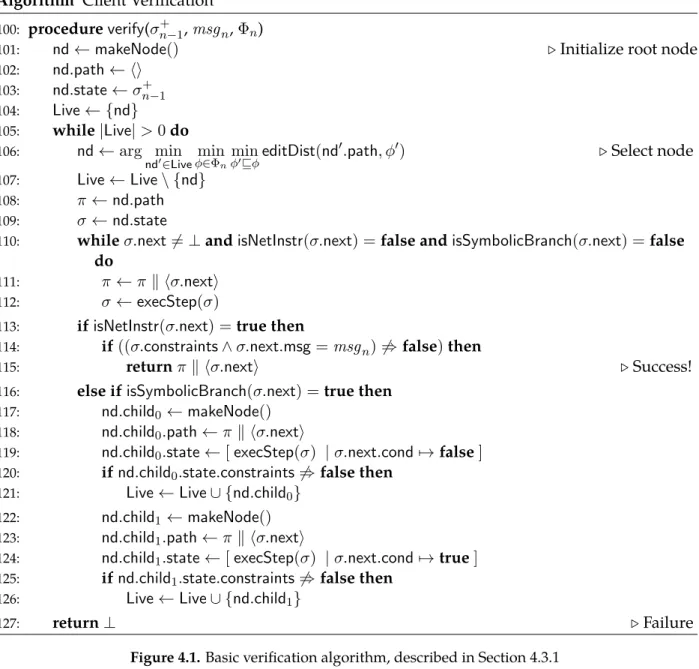
4.3.1 Guided Verification Algorithm . . . 55
Preprocessing for a server-to-client message . . . 55
Overview of basic verification algorithm . . . 55
Details of basic verification algorithm . . . 58
4.4 Edit-distance calculations . . . 59
4.4.1 Judicious use of edit distance . . . 60
4.4.2 Selectingnd. . . 61
4.4.3 Memory management . . . 61
4.5 Backtracking and Equivalent State Detection . . . 62
4.6 Configurations . . . 64
4.6.1 Default configuration . . . 64
4.6.2 Hint configuration . . . 65
4.7 Evaluation . . . 66
TetriNET . . . 69
4.7.1 Case Study:TetriNET. . . 70
4.7.2 Case Study:XPilot . . . 75
4.8 Summary . . . 79
5 Parallel Client Verification . . . 80
5.1 Goals and Background . . . 81
5.1.1 Client Verification Overview . . . 82
Assumptions . . . 82
Architecture and Assumptions . . . 83
Client Verification Definition . . . 83
Client Verification Backtracking . . . 84
5.2 Parallel Client Verification . . . 84
5.2.1 Algorithm Definitions . . . 85
5.2.2 Key Insights . . . 86
5.2.3 Multi-threading primitives . . . 87
5.2.4 Details of parallel verification algorithm . . . 88
5.2.5 Details of parallel verification algorithm sub-procedures . . . 91
Management of nodes inNodeScheduler. . . 91
Building execution fragments inVerifyWorker . . . 92
5.2.6 Algorithm summary . . . 93
5.3 Multi-threaded KLEE . . . 93
5.4 Evaluation . . . 94
5.4.1 Case Study:TetriNET. . . 95
5.4.2 Case Study:XPilot . . . 100
5.4.3 Evaluation ofNodeSchedulerandTrainingSelectorThreads . . . 103
5.5 Evaluation of Optimization Techniques . . . 104
5.5.2 Impact of Optimizations on Solver Queries . . . 106
Query Cache Hit Rate . . . 106
Query Cache Hit Rate Per Message . . . 107
Cumulative Query Cache Hits and Solver Queries . . . 109
Complexity of Solver Queries . . . 110
5.5.3 Impact of Optimizations on Instructions Executed and Memory Usage . . . 112
5.6 Summary . . . 114
6 Conclusion . . . 116
LIST OF FIGURES
1.1 Abstracted client verification problem . . . 2
3.1 Example game client . . . 21
3.2 Construction of
C
ifromC
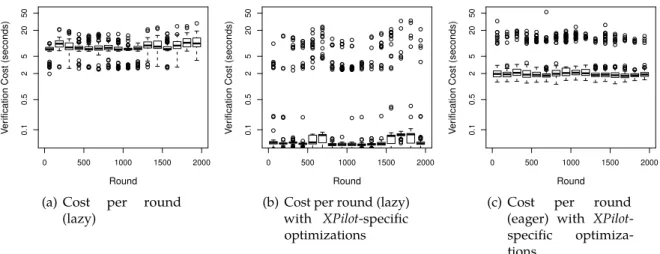
i−1andmsgi . . . 243.3 Verification cost per round while checking a 2,000-roundXPilotgame log . . . 32
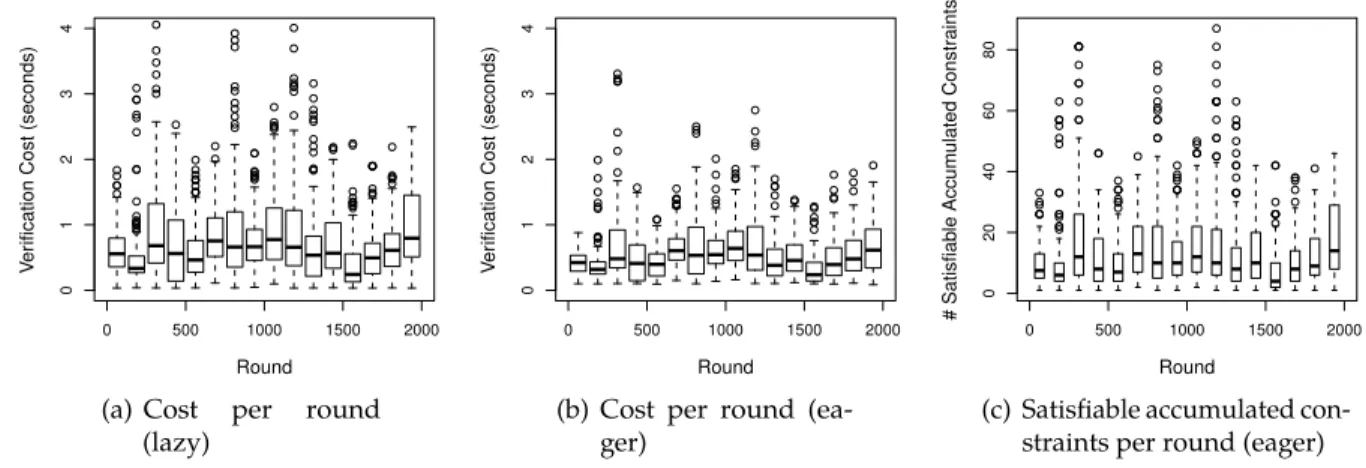
3.4 XPilotframe layout . . . 34
3.5 Verifying a 2,000-roundCap-Mangame log . . . 40
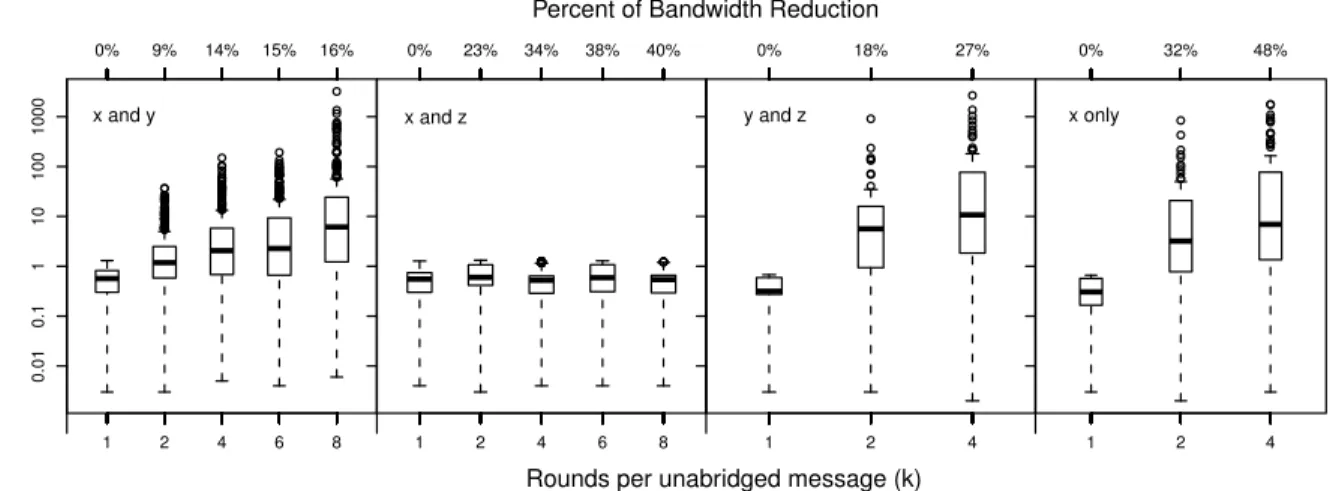
3.6 Verification of 100-roundTetriNETlogs under different configurations of client-to-server message content. . . 43
3.7 Verification (lazy) of 2000-round XPilot log with loss of client-to-server messages at the rate indicated on horizontal axis. . . 45
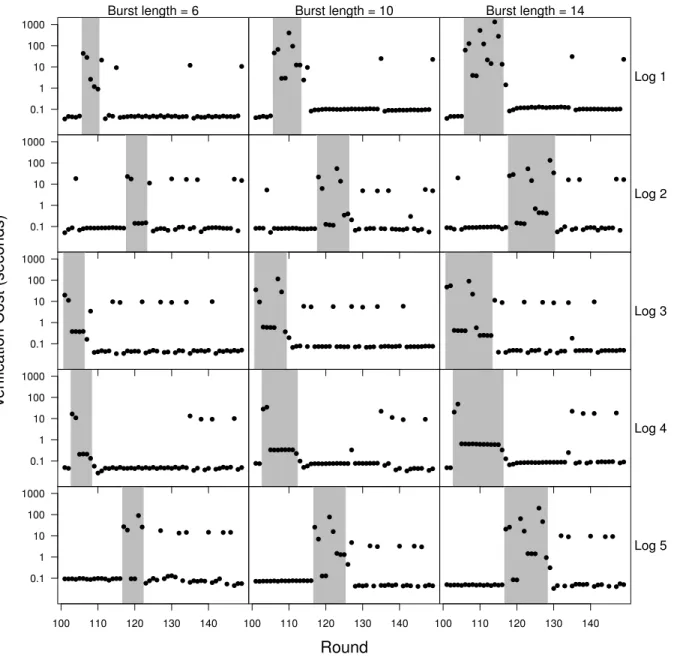
3.8 Verification (lazy) ofXPilotlogs with randomly induced bursts of client-to-server message losses. Shaded areas designate rounds in which losses occurred. . . 46
4.1 Basic verification algorithm, described in Section 4.3.1 . . . 57
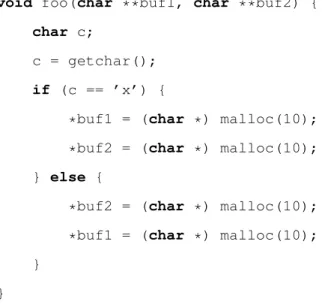
4.2 Example code that may induce different pointer values for variables in otherwise equivalent states. . . 63
4.3 TetriNETverification costs. . . 72
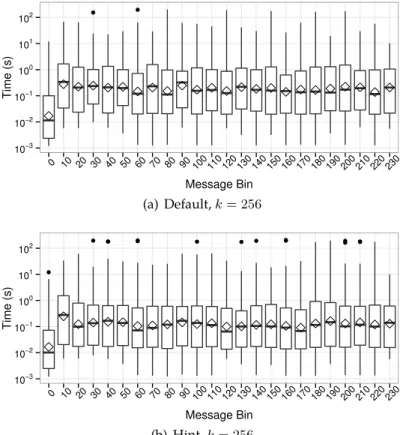
4.4 TetriNETverification delays . . . 73
4.5 Percentage of time spent in each component of the verifier. . . 75
4.6 XPilotverification costs . . . 77
4.7 XPilotverification delays . . . 78
5.1 Off-line and in-line client verification. . . 81
5.2 Verifier Architecture . . . 82
5.3 Node data structure and node tree. . . 85
5.4 Main procedure for parallel client verification. . . 88
5.6 Summary statistics forTetriNETresults . . . 95
5.7 TetriNETparallel verification costs. . . 98
5.8 TetriNETparallel verification delays. . . 99
5.9 Summary statistics forXPilotresults . . . 100
5.10 XPilotparallel verification costs . . . 101
5.11 XPilotparallel verification delays . . . 102
5.12 Verification cost with and withoutTrainingSelectorthread . . . 103
5.13 Verification costs and delays forTetriNETandXPilotfor a single representa-tive log. . . 106
5.14 Overall query cache hit rates for a single log selected from each of the TetriNETandXPilotcase studies. . . 107
5.15 Query Cache Hit Rates. . . 108
5.16 Cumulative number of cache hits. . . 109
5.17 Cumulative number of solver queries. . . 110
5.18 Complexity of Solver Queries. . . 111
5.19 Client instructions executed. . . 113
CHAPTER 1: INTRODUCTION
A malicious client in a distributed system can undermine the integrity of the larger distributed application in a number of different ways. Misbehavior may be the result of a malicious user attempting to either disrupt services or to gain advantage in a system. For example, a server application with a vulnerability may be compromised directly by a modified client. Alternatively, if a client is authoritative for state data in a larger distributed application, a malicious client may transmit an illegal version of this state throughout the distributed application. Real world attacks might consist of a player in a networked game cheating by modifying the client executable or the user of a network service might craft a sequence of messages that exploit a vulnerability in a server application.
There are many techniques for identifying malicious behavior in a distributed system. Some of these methods include, for example, probabilistic models of expected traffic patterns, attack signatures for known vulnerabilities and process level monitoring to identify control-flow attacks. In this dissertation, however, we address the problem of identifying malicious clients through the verification of legitimate client behaviour.
!"#$%&
!&'()"$%*'+,-.,/0
"&'1$*2-,3'4$55/.$
1-*'!"#$%& #&'()"$%*'6%78*5
98$5*"-%&
(-8):'!;/#$' 7,-:8<$:'"$=
+$,0"*'<)"$%*'*-' <-%*"%8$
>)-<3'<)"$%*'-,' ,$?7,-#"5"-% @AB
1C
q
!
Figure 1.1.Abstracted client verification problem
validate the client’s requests, but this incurs the bandwidth overhead of transmitting all client-side inputs (user inputs, timer values, etc.) to the server to permit replay and the computational overhead of replaying the client on the server side.
This dissertation presents a technique that resolves the tension between precision, bandwidth consumption and computational expense with a verification technique that validates legitimate client behavior as being consistent with the sanctioned client software. We accomplish behavior verification without encumbering the application with substantially more bandwidth use and without sacrificing accuracy. That is, any conclusion reached as to whether the sequence of client behaviors could, in fact, have been produced from the sanctioned client software is correct.
1.1 Problem
The client verification problem can be abstracted as follows. A server wishes to verify that a client is running the sanctioned software, but does so without modifying the client (e.g., by having the client send its inputs to the server). It therefore has no direct access to client state: the server knows only its own state and the network messages,M, that have been sent. The problem can then be phrased as: Given a client program P, is it possible for P to yield outputM? This is illustrated in Figure 1.1.
our methods to be viable. In this dissertation we demonstrate that symbolic execution can be used as a foundation for verification remote client behavior.
1.2 Thesis Statement
Network messages from a remote client in a distributed system can be verified using a technique based on symbolic execution, in some cases at a rate that keeps pace with the application, to determine if the messages were generated by sanctioned software.
1.3 Motivation
We evaluate our framework in the context of online games. Online games provide a useful proving ground for our techniques due to the frequent manipulation of game clients for the purposes of cheating [93, 61, 90] and due to the pressure that game developers face to minimize the bandwidth consumed by their games [67]. As such, our techniques are directly useful for cheat detection in this domain. Multi-player online games are very popular and profitable and are growing more so. Since 1996 the computer game industry has quadrupled — in 2008 alone, worldwide video-game software sales grew 20 percent to $32 billion [63]. Estimates place revenue from online games at $11 billion, with games such asWorld of Warcraft, which has more than 10 million subscribers worldwide, bringing in around $1 billion in revenue for parent company Blizzard Entertainment [1, 33].
Since its inception, the online game industry has been plagued by cheating of numerous types, in some cases with financial repercussions to the game operator. Age of EmpiresandAmerica’s Army are examples of online games that suffered substantial player loss due to cheating [75], and for subscription games, player loss translates directly to a reduction in revenue. Game developers and operators are not the only ones for whom the stakes are high. Hoglund and McGraw [46] argue that “games are a harbinger of software security issues to come,” suggesting that defenses against game cheats and game-related security problems will be important techniques for securing future massive distributed systems of other types.
Usually implemented by modifying the game client, the invalid command cheat results in the cheater sending commands that are not possible with an unmodified game client. Examples include giving the cheater’s avatar great strength or speed. This may also be implemented by modifying the game executable or data files. Many games suffer this form of cheating, including console games such as Gears of War.[90, Section 4.2.3]
Our technique will detect commands that are invalid in light of the history of the client’s previous behaviors witnessed by the server, even if those commands could have been valid in some other execution. Simply put, our approach will detect any client message sequence that is impossible to observe from the sanctioned client software.
1.4 Contributions
The key contributions of this dissertation are:
• A novel technique,symbolic client verification, that can verify the behavior of a remote client by determining whether a sequence of messages from a remote client could have been generated by sanctioned software.
• An extension of symbolic client verification to optimize identification of legitimate clients that
uses training data to improve performance.
• A parallel algorithm for symbolic client verification that significantly improves performance.
• Evaluations of symbolic client verification in the framework of online games on a game of our
own design, calledCap-Man, and two real-world games,XPilotandTetriNET.
CHAPTER 2: BACKGROUND AND RELATED WORK
In this dissertation we use the analysis of source code to develop a model of client behavior, against which messages from the client are checked by a verifier. In this chapter we place our proposed methods in the wider context of security and verification methods by describing related work and background information. We start with an overview of cheating in online games and specific methods for detecting malicious behavior in such environments. We then give an overview of existing techniques for the detection of remote client misbehavior in the general case. While this dissertation places an emphasis on online games, it is useful to understand our contributions in the context of other verification methods; so we give an overview of verification methods in distributed systems and the emerging field of verifiable computing. Finally, we give background information on symbolic execution, which serves as the foundation for the proposals in the following chapters.
2.1 Detecting and Preventing Misbehavior in Online Games
As long as humans have played games, there have been players that have wished to cheat; and as long as there have been cheaters, players have devised methods to prevent or detect this cheating. One of the earliest examples of a cheat prevention method existed over 2000 years ago. In Ancient Rome, many games were based on dice and those who wished to keep players honest used a device to prevent the dice thrower from influencing the result [59]. Thepyxis corneawas a table-top sized “tower” for rolling dice fairly; the dice were placed into an open funnel at the top and rolled down a internal staircase until exiting onto the table. Games of the modern era are much more complicated than those of Ancient Rome but the tension between honest players and cheating players still exists.
Players love to cheat — especially in online games ... be ready to add server-side support to prevent user cheating with methods that you were not able to predict.[45]
We now give an overview of the techniques developers and researchers have investigated for the detection and prevention of malicious behavior in online games and how they relate to the proposals of this dissertation. For more information on this area, a number of authors have conducted surveys on the problem of of cheating in online games: Yan and Randell [93], Lyhyaoui et al. [61], and Webb and Soh [90].
Monitoring
One common approach to defeat a variety of cheats involves augmenting the client-side com-puter with monitoring functionality to perform cheat detection (e.g.,PunkBuster,World of Warcraft’s Warden,Valve’sVAC[81] and [30, 31, 53, 66, 71]). Such approaches require consideration of how to defend this functionality from tampering, and some commercial examples have met with re-sistance from the user community. Accusations of client-side monitoring that violates standard expectations for player privacy have been levied against bothWarden[89] andVAC[13]. These systems aggressively ban users that trigger cheat detection monitoring;Valve’sVAChas banned over 2 million player accounts [76]. However, the systems do have false positives; in 2010,Valve erroneously banned 12,000 players [64]. In contrast, our approach does not rely on monitoring functionality being added to clients and does not have false positives.
Bot Detection
Network Manipulation
Another cheat that has received significant attention occurs when clients delay or suppress reporting (and choosing) their own actions for a game step until after learning what others have chosen in that step (e.g., [4, 29]). Such attacks can also go unnoticed by our techniques, if such delay or suppression could be explained by factors (e.g., network congestion) other than client modification. Our techniques are compatible with all proposed defenses of which we are aware for network delay suppression and so can be used together with them.
Peer-to-Peer Auditing
Finally, various works have examined security specifically for peer-to-peer games, e.g., using peer-based auditing [41, 49, 52]. Our technique may be applicable in some peer-to-peer auditing schemes, but we focus on the client-server setting in this dissertation.
2.2 Detecting Remote Client Misbehavior in the General Case
Detecting the misbehavior of remote clients in a client-server application is an area that has received considerable attention outside the domain of online games. We now expand our scope to examine methods for detecting remote client misbehavior in all types of networked software.
Model-based Verification
the sequences of URLs that the client-side program can invoke. Any request that does not conform to this graph is then flagged as potentially malicious. Other works [10, 74] address parameter tampering attacks in web forms by using server-side proxies to infer a parameter constraint model when a web form is served to a client. Each client request using the web form is checked against the parameter model.
The techniques we propose in this dissertation follow a similar paradigm to the above ap-proaches. We use analysis (in our case, of source code) to develop a model of client behavior, against which inputs (messages from the client) are compared. Unfortunately, compromised clients that make calls consistent with control-flow models may still manipulate application state [21] and can escape detection, in a manner analogous to mimicry attacks on intrusion-detection systems [86, 77]. The primary differentiator of our approach from these previous works is soundness: only sequences of client messages that could have actually been produced through valid client execution, on the inputs sent by the server, will be accepted. This precision is accomplished though our use of sym-bolic execution (described below in Section 2.5) to derive the complete implications of each message value to the client-side state. While this would hardly be tractable for any arbitrary client-server application, the control-loop structure of many clients that have frequent communication with the server can bound the amount of uncertainty that the verifier faces in checking the client’s messages.
Authoritative State
authoritative state to the server is that it is known to increase the bandwidth consumed by interactive applications owing to the need for every access to authoritative state to reach the server (e.g., [67, p. 112]).
Auditing
If the preceding approach can be viewed as a “pessimistic” way of eliminating trust in the client to manage authoritative state, one might say an “optimistic” version was proposed by Jha et al. [50]. Instead of moving authoritative state to a trusted server, a trustedaudit serverprobabilistically audits the management of authoritative state at the client. In this approach, each client periodically commits to its complete state by sending a cryptographic hash of it to the audit server. If later challenged by the audit server, the client turns over the requested committed state and all information (client-to-server and (client-to-server-to-client updates, user inputs) needed to re-trace and validate the client’s behavior between this state and the next committed state. This approach, however, introduces additional costs to the client in the form of increased computation to cryptographically hash client state, storage to retain the information needed to respond to an audit, and bandwidth to transmit that information in the event of an audit. Our approach introduces no additional client-side computation, client-side storage or client-server bandwidth. Moreover, verification of clients in this scheme must be done duringan active session, since clients cannot retain the needed information forever. In contrast, our approach supports auditing at any time in the future by the server operator, provided that it records the needed messages (to which it already has access).
2.3 Verifying Distributed Systems
methods for testing and verifying distributed system implementations and behaviours. A key distinction to note is that in this dissertation we are not checking a model of the overall client-server implementation or formally verifying the implementation. Our proposals are concerned with verifying observed network behavior received from the client against a model derived from the client source code.
Model Checking
Software Verification
Recently, mechanically verified implementations of distributed systems have proven to be more robust and safe than ad-hoc implementations with accompanying hand-written proofs of correctness (e.g., for Byzantine fault tolerance algorithms [58] or for the Chord distributed hash table [99]). Systems for implementing formally verified software been built using domain-specific languages that enable formal verification, such as the Coq [7] interactive proof assistant and the TLA+ [57] proof specification system. These implementations include OS kernels [42], components of web browsers [70] and distributed protocols (e.g., Verdi [91] and IronFleet [44]). In this dissertation we do not formally verify the overall client-server implementation itself for fault tolerance and liveness, but rather use the implementation of the remote software to verify observed network behavior. Our techniques are, in theory, compatible with existing methods for verifying distributed systems, and may provide additional security properties. The guarantees above are only as good as the assumptions made about the types of faults that may occur; some work formally verifies software under general network or system errors, but leaves out consideration of targeted attacks.
2.4 Verifiable Computation
scheme for verifiable computation using abstractions from the theory of computation was first in-troduced by Generro et. al [35]. They defined a scheme that is a combination of fully homomorphic encryption [36] and Yao’s garbled circuits [96]. While impractical, this work showed that verifiable computation is achievable. Other work has improved this scheme, allowing for the outsourced task to be represented in a high level language that is transformed into an arithmetic circuit [68, 85, 5]. Others use advances in interactive proofs [40] or probabilistically checkable proofs [48] to permit a verifier to probabilistically confirm that an outsourced computation was performed correctly. Verifiable computing has been studied in under several different assumptions and client-server configurations; including, multi-client outsourcing [24], computations on encrypted data [32] and biometric computations [11]. Walfish et al. [87] provide a useful survey of several approaches to verifiable computation with performance and implementation comparisons.
There are several key differences between the solutions found in the area of verifiable com-putation and the proposals of this dissertation. While some improvements have been made (e.g., Pinocchio [68]), current systems for verifiable computation induce significant overhead on the client and must be implemented in specialized languages to allow transformation into an arithmetic circuit representation. Such transformations can induce an increase in the representation size that is exponential in the size of the input if the task contains a large number of loops or memory accesses. Our proposals do not induce any additional overhead on the client and can be implemented in any language that can be complied into a byte-code representation supported by the verifier (in our case, C). Secondly, while the techniques of verifiable computing could be generalized into supporting a wide variety of client-server applications, current verifiable computation systems would require existing implementations to be rewritten. Our technique supports several classes of applications without any changes to preexisting message format and frequency.
2.5 Symbolic Execution
allowed to be “anything” — the memory regions of the input are marked as symbolic and are not given any initial value. The program is executed step-by-step, building constraints on the symbolic variables based on the program’s operations on those variables. For example, if the program sets a← b+c, wherea,b, andcare all marked as symbolic, then after the operation, there will be a
new logical constraint on the value ofathat states that it must equal the sum ofbandc. When the program conditionally branches on a symbolic value, execution forks and both program branches are followed, with the true branch forming a constraint that the symbolic value evaluates to true and the false branch forming the opposite constraint. Using this strategy, symbolic execution can follow every possible code path in the target program, building a constraint for each one that must hold on execution of that path. Symbolic execution can help locate software bugs, for example, by providing constraints that enable a constraint solver to generate concrete inputs that cause errors to occur. Specifically, if execution reaches an error condition (or a state thought to be “impossible”), then a constraint solver can use the constraints associated with that path to solve for a concrete input value that triggers the error condition. Having a concrete input that reliably reproduces an error is a great help when trying to correct the bug in the source code.
Applications for Security
Symbolic execution has seen significant interest in the security community for generating vul-nerability signatures [14, 28], generating inputs that will induce error conditions [18, 95], automating mimicry attacks [56], and optimizing privacy-preserving computations [88], to name a few. The approach that we take to the behavior verification problem in this dissertation is an application of symbolic execution. In our case, we symbolically execute the client software with client-side inputs unknown to the server marked symbolic and then determine whether the messages received from the client violate the postconditions derived from the software.
Applications for Software Testing
path constraint implied by its choice at each branch point. The path constraint is then modified by negating a clause and a satisfying assignment to the constraint is found to derive a new input that will cover a different path in the program. More recent examples of this approach, which is also calledconcolicexecution, includeCUTE[72],JPF[84] andPex[78, 2]. In contrast, our approach expands the verifier’s search for paths to explain client messages as needed, starting from an initial collection of paths, but it does so without solving for inputs to exercise a path concretely and without the goal of achieving high path coverage.
Applications for Debugging
The applications of symbolic execution that are most related to our own are in debugging and diagnostics. Zamfir et al. [98] developed a debugging tool that uses symbolic execution to reconstruct the likely path a program took before it crashed, from the core dump file recorded by the operating system when the crash occurred. Their technique finds a feasible path or set of paths through a program that allow the program to reach the memory and process state that the core dump file indicates. SherLog[97] is another error diagnosis tool that uses a log file instead of a core dump file to indicate how a program executed. SherLogperforms path analysis (not symbolic execution per se, but a similar technique) to determine the likely execution paths and variable values implied by a given set of log files. Similarly, symbolic execution has been used to discover the constraints for the paths through a program that reaches a vulnerability or error condition [14, 16, 18, 95]. Viewed through the lens of our work, the core dump file, log file, or error condition in these previous works is analogous to a “client message”, and these tools similarly seek to find an execution that could explain it. However, the structure of our verification task — namely successively building an execution path to explain an entire sequence of messages — and the performance demands that we seek to meet give rise to a technique which we believe to be novel.
Parallel Symbolic Execution
CHAPTER 3: SYMBOLIC CLIENT VERIFICATION
In this chapter we demonstrate a technique to detect any type of client modification that causes the client to exhibit behavior, as seen by the server, that is inconsistent with the sanctioned client software and the game state known at the server. That is, our approach discerns whether there wasany possible sequenceof user inputs to the sanctioned client software that could have given rise to each message received at the server, given what the server knew about the game client based on previous messages from the client and the messages the server sent to the client. In doing so, our approach remedies the previously heuristic and manual construction of server-side checks. Moreover, our approach potentially enables new client designs that reduce bandwidth use by placing more authoritative state at the client, since our approach verifies that the client’s behavior is consistent with legal management of that state. While reducing interaction with the client will generally increase the computational cost of our verification, verification need not be done on the critical path and can be performed selectively (e.g., only for randomly selected or suspicious users).
Our strategy exploits the fact that clients are often structured as an event loop that processes user inputs, server messages, or other events in the context of current client state and then sends an update to the server on the basis of its processing. We symbolically execute the loop to derive a predicate that characterizes the effects of the loop, and specifically the update sent to the server, as a function of its inputs and game state. By partially instantiating these predicates on the basis of the actual messages the server receives from a client and what the server previously sent to the client, a verifiercan then use a constraint solver to determine whether the resulting predicate is satisfiable. If so, then the messages are consistent with proper client execution — i.e., there weresomeuser inputs that could have yielded these messages.
the strengths of our approach. However, it does demonstrate the (few) ways in which we found it necessary to adaptXPilotto use our technique efficiently. For the second case study, we use a game of our own design that is similar toPac-Manbut that has features to better exercise our technique. Third, we utilizeTetriNET, a multiplayer version ofTetris, to demonstrate the potential bandwidth savings that symbolic client verification can enable. Together, these case studies illustrate the limits and benefits of our approach and serve as a foundation for future work.
Following our initial investigation of these case studies, we investigate the impact of message loss on our verification technique. We extend our technique to improve verification performance in the face of message loss on the network. We then evaluate this extension usingXPilot, since it is an example of a game built to use an unreliable transport protocol for performance reasons and consequently to continue operation despite message loss.
3.1 Goals, Assumptions and Limitations
Importantly, our technique will even detect commands that are invalid in light of the history of the client’s previous behaviors witnessed by the server, even if those commands could have been valid in some other execution. Simply put, our approach will detect any client message sequence that is impossible to observe from the sanctioned client software.
As we present and evaluate our approach, it requires access to source code for the client, though potentially a similar approach could be developed with access to only the executable. The approach should be attractive to developers because it can save them significant effort in implementing customized server-side verification of client behaviors. Our approach is comprehensive and largely automatic; in our case study described in Section 3.3, we needed only modest adaptations to an existing open-source game.
iterations that execute without sending updates increases, the uncertainty in the verifier’s “model” of the client state also generally increases. This increase will induce greater server-side computation in verifying that future updates from the client are consistent with past ones. As we will see in Section 3.3, it is useful for these updates from the client to indicate which server-to-client messages the client has received, but importantly, the information sent by the client need not include the user inputs or a full account of its relevant state. Indeed, it is this information that a client would typically send today and that we permit the client to omit in our approach.
Due to the scope of what it tries to detect, however, our technique has some limitations that are immediately evident. First, our technique will not detect cheats that are permitted by the sanctioned client software due to bugs. Second, modifications to the client that do not change its behavior as seen at the server will go unnoticed by our technique. For example, any action that is possible to perform will be accepted, and so cheating by modifying the client program to make difficult (but possible) actions easy will go undetected. Put in a more positive light, however, this means that our technique has no false alarms, assuming that symbolic execution successfully explores all paths through the client. As another example, a client modification that discloses information to the player that should be hidden, e.g., such as a common cheat that uncovers parts of the game map that should be obscured, will go unnoticed by our technique. In the limit, a user could write their own version of the client from scratch and still go undetected, provided that the behaviors it emits, as witnessed by the server, are a subset of those that the sanctioned client software could emit.
3.2 Client Verification Approach
Our detection mechanism analyzes client output (as seen by the server) and determines whether that output could in fact have been produced by a valid client. Toward that end, a key step of our approach is to profile the client’s source code using symbolic execution and then use the results in our analysis of observed client outputs. We begin with an application of symbolic execution; shown in our context in Section 3.2.1–Section 3.2.4. The symbolic execution engine that we use in our work is klee [17], with some modifications to make it more suitable for our task.
with its behavior). Values or messages are then valid if they could have been emitted by a valid client.
At a high level, the symbolic client verification technique works by generating postconditions for all of the paths through key event loops in the client application, and then during verification, constructing chains of postconditions in combination with the message trace we are verifying. If the complete postcondition chain is satisfiable, then the message trace could have been produced by a legitimate client. The computational expense required for this method of verification lends it to be useful primarily in an offline fashion and only after modifying test applications to constrain the search spaces they present.
3.2.1 Generating Round Constraints
The first step of our technique is identifying the main event loop of the game client and all of its associated client state, which should include any global memory, memory that is a function of the client input, and memory that holds data received from the network. These state variables are then provided to the symbolic execution tool, which is used to generate a constraint for each path through the loop in a single round. These constraints are thus referred to asround constraints. Round constraints consist of three classes of symbolic variables: statevariables,inputvariables and networkvariables.
Toy Example
For example, consider the toy game client in Figure 3.1(a). This client reads a keystroke from the user and either increments or decrements the value of the location variablelocbased on this key. The new location value is then sent to the server, and the client loops to read a new key from the user. Although this example is a toy, one can imagine it forming the basis for aPongclient.
1: loc←0; 2:
3: whiletruedo 4: key←readkey(); 5: ifkey= ESCthen 6: endgame(); 7: else ifkey=‘↑’then 8: loc←loc+ 1; 9: else ifkey=‘↓’then 10: loc←loc−1;
11: sendlocation(loc);
(a) Toy game client
1: prev loc←symbolic; 2: loc←prev loc; 3: whiletruedo 4: key←symbolic; 5: ifkey= ESCthen 6: endgame(); 7: else ifkey=‘↑’then 8: loc←loc+ 1; 9: else ifkey=‘↓’then 10: loc←loc−1;
11: msg←loc 12: breakpoint;
(b) Symbolically instrumented toy game client
Figure 3.1.Example game client
Symbolically executing one loop iteration of this modified program, we see that there are four possible paths that the client could take in any given round. In the first possible path,keyisESC, and the game ends. Note that this branch never reaches thebreakpoint. The second and third possible paths are taken whenkeyis equal to ‘↑’ and ‘↓’, respectively. The final path is taken when keyis none of the aforementioned keys. These last three paths all terminate at thebreakpoint.
Via symbolic execution, the verifier can obtain the constraints for all symbolic variables at the time each path reached the breakpoint. Because we artificially createdprev loc during the instrumentation phase, it remains an unconstrained symbolic variable in all three cases. The state variableloc, however, is constrained differently on each of the three paths. In the case whenkey is equal to ‘↑’, symbolic execution reportsloc=prev loc+ 1as the only constraint onloc. When keyis equal to ‘↓’, the constraint is thatloc=prev loc−1. And whenkeyis not ‘↑’, ‘↓’, orESC, the
constraint is thatloc=prev loc.
according to the rules of a valid game client. The disjunction of round constraints in this case is:
(loc=prev loc+ 1)∨(loc=prev loc−1)∨(loc=prev loc) (3.1)
For example, suppose the verifier knows that the client reported on its previous turn that itsloc was 8. If the client were to then report its new location asloc= 9, the verifier could simply check to see if the following is satisfiable:
(prev loc= 8)∧(loc= 9)∧
[(loc=prev loc+ 1)∨(loc=prev loc−1)∨(loc=prev loc)]
Of course, it is satisfiable, meaning that the new valueloc= 9could in fact have been generated by a valid game client. Suppose, though, that in the next turn, the client reports his new position at loc= 12. Following the same algorithm, the verifier would check the satisfiability of
(prev loc= 9)∧(loc= 12)∧
[(loc=prev loc+ 1)∨(loc=prev loc−1)∨(loc=prev loc)]
Because these round constraints arenotsatisfiable, no valid game client could have produced the messageloc= 12(in this context). Therefore, the verifier can safely conclude that the sender of that message is running an incompatible game client — is cheating.
3.2.2 Accumulating Constraints
While the branches taken by a client in each round may not be visible to the verifier, the verifier can keep a set of constraints that represent possible client executions so far. Specifically, the verifier forms a conjunction of round constraints that represents a sequence of possible paths through the client’s loop taken over multiple rounds; we call this conjunction anaccumulated constraintand denote the set of satisfiable accumulated constraints at the end of roundiby
C
i. This set corresponds to the possible paths taken by a client through roundi.The verifier updates a given set
C
i−1of accumulated constraints upon receiving a new client messagemsgi in roundi. To do so, the verifier first combines the values given inmsgiwith each round constraint for roundi, where each symbolic variable in the round constraint represents client state for roundi, and the round constraint characterizes those variables as a function of the variables for roundi−1. The verifier then combines each result with each accumulated constraint inC
i−1 and checks for satisfiability.For example, let us parameterize the round constraints for the toy example in Section 3.2.1 with the round numberj:
G
(j) ={locj =locj−1+ 1, locj =locj−1−1, locj =locj−1}Note that each member of
G
(j)corresponds to a disjunct in (3.1). If in roundi = 2the server receives the messagemsg2 = 9 from the client, then it generates the constraintM = “loc2= 9”, because the value “9” in the message represents information corresponding to the variablelocin the client code. Then, combiningMwith eachG∈G
(2)gives the three constraints:loc2 = 9∧loc2=loc1+ 1 loc2 = 9∧loc2=loc1−1 loc2 = 9∧loc2=loc1
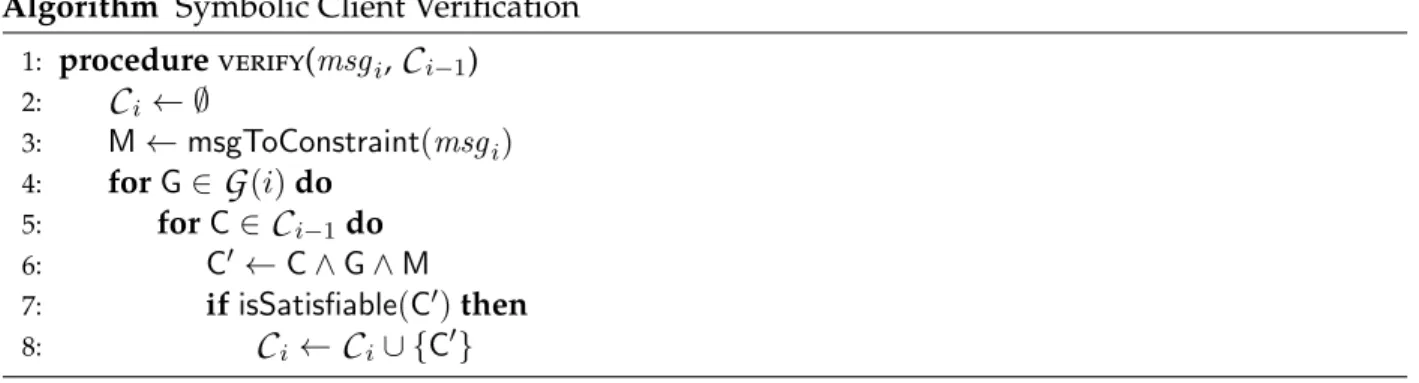
Algorithm Symbolic Client Verification 1: procedureverify(msgi,
C
i−1)2:
C
i← ∅3: M←msgToConstraint(msgi) 4: forG∈
G
(i)do5: forC∈
C
i−1do6: C0 ←C∧G∧M
7: ifisSatisfiable(C0)then 8:
C
i ←C
i∪ {C0}Figure 3.2.Construction ofCifromCi−1andmsgi
These three round constraints each represent a possible path the client might have taken in the second round. The verifier must therefore consider each of them in turn as if it were the correct path. For example, if
C
1 ={loc1 = 8}, then the verifier can use each round constraint to generate the following possible accumulated constraints:loc1 = 8∧[loc2 = 9∧loc2 =loc1+ 1] loc1 = 8∧[loc2 = 9∧loc2 =loc1−1] loc1 = 8∧[loc2 = 9∧loc2 =loc1]
Since the second and third constraints are not satisfiable, however, this reduces to
C
2 = {loc1 = 8∧[loc2 = 9∧loc2 =loc1+ 1]}= {loc1 = 8∧loc2 = 9}
3.2.3 Constraint Pruning
Every accumulated constraint in
C
iis a conjunctionC=c1∧. . .∧cn(or can be written as one, in conjunctive normal form). In practice, constraints can grow very quickly. Even in the toy example of the previous section, the accumulated constraint inC
2has one more conjunct than the accumulated constraint inC
1. As such, the verifier must take measures to avoid duplicate constraint checking and to reduce the size of accumulated constraints.First, the verifier partitions the conjuncts of each new accumulated constraintC0(line 6) based on variables (e.g.,loc2) referenced by its conjuncts. Specifically, consider the undirected graph in which each conjunctckinC0is represented as a node and the edge(ck, ck0)exists if and only if there
is a variable that appears in bothckandck0. Then, each connected component of this graph defines
a block in the partition ofC0. Because no two blocks forC0share variable references, the verifier can check each block for satisfiability independently (line 7), and each block is smaller, making each such check more efficient. And, since some accumulated constraintsC0will share conjuncts, caching proofs of satisfiability for previously-checked blocks will allow shared blocks to be confirmed as satisfiable more efficiently.
Second, because round constraints refer only to variables in two consecutive rounds — i.e., any
G∈
G
(j)refers only to variables for roundjandj−1— the formulasGandMin line 6 will referonly to variables in roundsiandi−1. Therefore, if there are blocks of conjuncts forC0in line 6 that contain no references to variables for roundi, then these conjuncts cannot be rendered unsatisfiable in future rounds. Once the verifier determines that this block of conjuncts is satisfiable (line 7), it can safely remove the conjuncts in that block fromC0.
3.2.4 Server Messages
Round constraints are not a function of only user inputs (and potentially random coin flips and time readings) but also of messages from the server that the client processes in that round. We have explored two implementation strategies for accounting for server messages when generating round constraints:
by conjoining an eager round constraint with one or more conjuncts of the form “svrmsg=m”, wheresvrmsgis the symbolic variable for a server message in the client software, andmis the concrete server message that this variable took on in roundi. We refer to this approach as “eager” since it enables precomputation of round constraints prior to verification but, in doing
so, also computes them for paths that may never be traversed in actual game play.
• Lazy: In this approach,lazy round constraintsare generated from the client software after it has been instantiated with the concrete server-to-client messages that the client processed in that round; these round constraints for roundithen constitute
G
(i)directly. Since the server messages are themselves a function of game play, the lazy round constraints cannot be precomputed (as opposed to eager round constraints) but rather must be computed as part of verification. As such, the expense of symbolic execution is incurred during verification, but only those paths consistent with server messages observed during game play need be explored.In either case, it is necessary that the server log the messages it sent and that the verifier know which of these messages the client actually processed (versus, say, were lost). In our case study in Section 3.3, we will discuss how we convey this information to the server, which it records for the verifier.
As discussed above, the eager approach permits symbolic execution to be decoupled from verification, in that eager round constraints can be computed in advance of game play and then augmented with additional conjuncts that represent server messages processed by the client in that round. As such, the generation of round constraints in the eager approach is a conceptually direct application of a tool like klee (albeit one fraught with game-specific challenges, such as those we discuss in Section 3.3.4). The lazy approach, however, tightly couples the generation of round constraints and verification; below we briefly elaborate on its implementation.
To handle server-to-client messages from the log, we intercept therecv()system call and instead call our own replacement function. This function first checks to see that the next message in the network log is indeed a server-to-client message. If it is, we return the message and advance this active path’s pointer in the log by one message. Otherwise, this active path has attempted more network reads in roundithan actually occurred in the network log prior to reaching the breakpoint corresponding to a client-message send. In this case, we return zero bytes to therecv() call, indicating that no message is available to be read. Upon an active path reaching the breakpoint (which corresponds to a client send), if the next message in the log is a server-to-client message, then this active path has attempted fewer network reads than the log indicates, and it is terminated as invalid. Otherwise, the round constraint built so far is added to
G
(i), and the logged client message is used to instantiate the new conjunctMin line 3 of Figure 3.2.3.3 Case Study: XPilot
In our first case study, we apply our technique toXPilot, an open-source multiplayer game written in about 150,000 lines of C code. XPilotuses a client-server architecture that has influenced other popular open source games. For example, the authors ofFreecivusedXPilot’s client-server architecture as a basis for the networking in that game. XPilotwas first released over 15 years ago, but it continues to enjoy an active user base. In fact, in July 2009, 7b5 Labs released anXPilotclient for the Apple iPhone and Apple iPod Touch (seehttp://7b5labs.com/xpilotiphone), which is one
of several forks and ports of theXPilotcode base over the years. We focus on one in particular called XPilot NG(XPilot Next Generation).
3.3.1 The Game
clients can set key mappings, and servers can configure nearly every aspect of the game (e.g., ship mass, initial player inventory, probability of each type of power-up appearing on the map, etc.).
As we have discussed, developers of today’s networked games design clients with little authori-tative state in order to help address cheating. In keeping with that paradigm,XPilotwas written with very little such state in the client itself. Despite this provision, there are still ways a malicious user can send invalid messages in an attempt to cheat. InXPilot, there are some sets of keys that the client shouldneverreport pressing simultaneously. For example, a player cannot press the key to fire (KEY FIRE SHOT) while at the same time pressing the key to activate his shield (KEY SHIELD). A valid game client will filter out any attempts to do so, deactivating the shield whenever a player is firing and bringing it back online afterward. However, an invalid game client might attempt to gain an advantage by sending a keyboard update that includes both keys. As it happens, the server does its own (manually configured) checking and so the cheat fails in this case, but the fact that the client behavior is verifiably invalid remains. There are numerous examples of similar cheats in online games that servers fail to catch, either because of programming errors or because those particular misuses of the protocol were unforeseen by the game developers. In our evaluations, we confirmed that our technique detects this attempt to cheat inXPilot, as expected. This detection was a direct result of the logic inherent in the game client, in contrast to the manually programmed rule in theXPilotserver. While this example is illustrative, we emphasize that our goal is not to identify new cheating vulnerabilities on theXPilotserver, but rather to illustrate how a pre-existing game client can be adapted for verification in our framework and how the verifier performs under different configurations.
3.3.2 Client Modifications
Message acknowledgments
Client-server communication inXPilotuses UDP traffic for its timeliness and decreased overhead — the majority of in-game packets are relevant only within a short time after they are sent (e.g., information about the current game round). For any traffic that must be delivered reliably (e.g., chat messages between players),XPilotuses a custom layer built atop UDP. Due toXPilot’s use of UDP and the fact that it can process arbitrary numbers of messages in a single client loop, we added toXPilotan acknowledgement scheme to inform the server of which inbound messages the client processed in each loop iteration and between sending its own messages to the server. The server logs this information for use by the verifier. There are many possible efficient acknowledgement schemes to convey this information; the one we describe in Section 3.7 assumes that out-of-order arrival of server messages is rare.
These acknowledgments enable the server to record a log of relevant client events in the order they happened (as reported by the client). For each client-to-server message that the server never received, the verifier simply replaces the constraintMimplied by the missing message (see line 3 of Figure 3.2) withM=true.
Floating-point operations
XPilot, like most games of even moderate size, includes an abundance of floating-point variables and math. However, it is not currently possible to generate constraints on floating-point numbers with klee or to check them using stp. Therefore, we implementXPilot’s floating-point operations using a simple fixed-point library of our own creation. As a result, symbolic execution on the XPilotclient produces constraints from this library for every mathematical operation in the client code involving a symbolic floating-point number. These constraints, in turn, inflate the verification speeds reported in Section 3.3.4, in particular.
Bounding loops
Ω(n2)round constraints. During symbolic execution ofXPilot, most loops have a concrete number of iterations, but there are some loops that iterate over a symbolic variable. If this symbolic variable is unbounded, then the number of round constraints can become impractical to manage. While some loops are not explicitly bounded in the code, they are implicitly bounded by the environment during normal execution. For example, the user input loop inXPilotis a while loop that continues until there are no longer any queued user input events to process. During normal execution, the number of iterations of this loop is limited by how fast a player can press a key. As such, during symbolic execution, we limited the input processing loop to a maximum of three iterations because we observed that during gameplay, this queue never contained more than three events. The user input loop and the packet processing loop inXPilotrequired this type of modification, but all other loops were exhaustively searched.
Client trimming
The XPilotclient, like presumably any game client, contains much code that is focused on enhancing the user gaming experience but that has no effect on the messages that the client could send to the server. To avoid analyzing this code, we trimmed much of it from the game client that we subjected to analysis. Below we summarize the three classes of such code that we trimmed. Aside from these three types of code, we also trimmed mouse input-handling code, since all game activities can be performed equivalently using the keyboard.
First, several types of user inputs impact only the graphical display of the game but have no effect on the game’s permissible behaviors as seen by the server. For example, one type of key press adjusts the display of game-play statistics on the user’s console. As such, we excised these inputs from the client software for the purposes of our analysis.
Third, klee is built upon llvm and requires the input executable to be compiled into the llvm intermediate representation (IR). Like all software,XPilotdoes not execute in isolation and makes use of external libraries; not all of these were compiled into llvm IR. Specifically, the graphics library was not symbolically executed by klee, and instead any return values from graphics calls thatXPilot later needed were simply declared symbolic.
3.3.3 Verification with Lazy Round Constraints
In this section we measure the performance of verification using lazy round constraints. As discussed in Section 3.2, lazy round constraints are generated once the client-to-server and server-to-client messages are known. Thus, the only unknown inputs to the game client when generating lazy round constraints are the user inputs and time readings (and random coin flips, but these do not affect server-visible behavior inXPilot).
In generating lazy round constraints, we departed slightly from the description of our approach in Section 3.2, in that we inserted multiple breakpoints in the client event loop, rather than only a single breakpoint. Each breakpoint provides an opportunity to prune accumulated constraints and, in particular, to delete multiple copies of the same accumulated constraint. This is accomplished using a variant of the algorithm in Figure 3.2, using constraints derived from prefixes of the loop leading to the breakpoint, in place of full round constraints. Some of these extra breakpoints correspond to the (multiple) send locations inXPilot’s loop. Aside from this modification, we implemented our approach as described in Section 3.2.
Round
V
er
ification Cost (seconds)
0 500 1000 1500 2000
0.1 0.5 2 5 20 50
(a) Cost per round (lazy)
Round
V
er
ification Cost (seconds)
0 500 1000 1500 2000
0.1 0.5 2 5 20 50
(b) Cost per round (lazy)
with XPilot-specific
optimizations
Round
V
er
ification Cost (seconds)
0 500 1000 1500 2000
0.1 0.5 2 5 20 50
(c) Cost per round (eager) with XPilot -specific optimiza-tions
Figure 3.3.Verification cost per round while checking a 2,000-roundXPilotgame log
3.3.4 Verification with Eager Round Constraints
In this section we discuss verification ofXPilotusing eager constraint generation. Recall that eager round constraints are precomputed from the sanctioned client software without knowledge of the messages the client will process in any given loop iteration. However, we found this approach to require moderate manual tuning to be practical, as we describe below.
Manual Tuning
A direct application of our method for generating eager round constraints for theXPilotclient loop would replace the user key press with symbolic input and any incoming server message with a symbolic buffer and then use klee to symbolically execute the resulting client program. Such a direct application, however, encountered several difficulties. In this section we describe the main difficulties we encountered in this direct approach and the primary adaptations that we made in order to apply it to theXPilotclient. These adaptations highlight an important lesson: the eager technique, while largely automatic, can require some manual tuning to be practical. Because our technique is targeted toward game developers, we believe that allowing for such manual tuning is appropriate.
Frame processing
InXPilot, messages from the server to the client describing the current game state are called frames. Each frame is formed of a chain of gamepackets(not to be confused with network packets). The first and last packets in a frame are always special start-of-frame and end-of-frame packets, called PKT STARTandPKT END. Figure 3.4 shows anXPilotframe, containing a packet of typePKT FUEL and potentially others (indicated by “. . .”). Packets are encoded as a single header byte followed by a packet data section that can carry anything from a single byte to an arbitrary-length string, depending on the packet type. Frames may contain multiple packet types and multiple instances of the same packet type.
PKT STARTheader
PKT STARTdata ..
.
PKT FUELheader
PKT FUELdata .. .
. . .
PKT ENDheader
PKT ENDdata .. .
Figure 3.4.XPilotframe layout
This continues until the packet handler for PKT END is called, the return of which signifies the end of the frame handling. Therefore, given a completely symbolic buffer representing the frame, our symbolic execution would need to walk the client code foreach possible sequenceof packets in a frame, up to the maximum frame size. ButXPilot has dozens of packet types, some of which include a very small amount data. As evidence of the infeasibility of such an approach, consider the following (very conservative) lower bound on the number of packet sequences: There are at least 10 types of packets that we considered whose total size is at most 5 bytes. The maximum size for a server-to-client frame inXPilotis 4,096 bytes, which means there is room for over 800 of these packets. That givesat least10800possible packet sequences that symbolic execution would traverse to generate constraints, which is obviously infeasible.
packet-processing constraints that characterize how the client should process each packet in the particular frame. For example, if the only packet types werePKT START,PKT FUEL,PKT TIME LEFT, andPKT END, the packet-processing constraints representing the processing of a single packet would be
(p=PKT START)∧(constraints for(PKT START))
(p=PKT FUEL)∧(constraints for(PKT FUEL))
(p=PKT TIME LEFT)∧(constraints for(PKT TIME LEFT))
(p=PKT END)∧(constraints for(PKT END))
wherepis a variable for the packet type andconstraints for(PKT START)represents the additional constraints that would result from symbolic execution of the packet handler forPKT START. With this new model of packet processing, the verifier can build a frame-processing constraint to represent any given frame from the logs. In this way, when the verifier checks the behavior of a given client, it does so armed with the frames the server sent to the client, the messages the server received from the client, and the frame-processing constraints that characterize the client’s processing of each frame, which the verifier constructs from the packet-processing constraints.
Packet processing
value of the destination array directly, as the packet handler would have. Then, when symbolically executing the packet handlers, we can simply skip this packet.
To avoid similar modifications to the extent possible, we pruned the packets the verifier considers during verification to only those that are necessary. That is, there are several packet types that will not alter the permissible behaviors of the client as could be witnessed by the server, and so we ignored them when applying our technique. Most of these packet types represent purely graphical information. For example, a packet of typePKT ITEMsimply reports to the client that a game item of a given type (e.g., a power-up or a new weapon) is floating nearby at the given coordinates. This information allows the client to draw the item on the screen, but it does not affect the valid client behaviors as observable by the verifier.1
User input
The first part of the client input loop checks for and handles input from the player. Gathering user-input constraints is fairly straightforward, with the exception thatXPilotallows players to do an extensive amount of keyboard mapping, including configurations in which multiple keys are bound to the same function, for example. We simplified the generation of constraints by focusing on the user actions themselves rather than the physical key presses that caused them. That is, while generating constraints within the user-input portion ofXPilot, we begin symbolic executionafter the client code looks up the in-game action bound to the specific physical key pressed, butbefore the client code processes that action. For example, if a user has bound the actionKEY FIRE SHOT to the key ‘a’, our analysis would focus on the effects of the actionKEY FIRE SHOT, ignoring the actual key to which it is bound. However, as with other client configuration options, the keyboard mapping could easily be sent to the server as a requirement of joining the game, invoking a small, one-time bandwidth cost that would allow the verifier to check the physical key configuration.
1
Eager Verification Performance
We ran our eager client verifier on the same 2,000-roundXPilotgame log and on the same com-puter used in Section 3.3.3. Figure 3.3(c) describes the per-round validation cost (in seconds) using a box-and-whiskers plot. As in Figure 3.3(b), we employed here anXPilot-specific optimization by observing that the number of client messages in a round bounds the number of user inputs in that round. As such, in piecing together round constraints, the verifier includes a number of copies of user-input constraints (see Section 3.3.4) equal to the client sends in that round. Similar to Figure 3.3(b), Figure 3.3(c) exhibits three bands (the third comprising a few large values), corre-sponding to different numbers of copies. The large percentage of rounds contained no user inputs and were the quickest to process, with a mean cost of 1.64s and a standard deviation of 0.232s. The second band of rounds — those with a single user input — took longer to process, with a mean of 11.3s and a standard deviation of 1.68s. Remaining rounds contained multiple user inputs and took the longest to process (34.2s, on average), but recall that they were by far the least frequent. The verifier’s memory usage remained below 100MB throughout these verification runs.
Comparing Figures 3.3(b) and 3.3(c), the times for the eager approach are much slower than those for the lazy approach, when applied toXPilot. This performance loss is due to the fact that a large portion of theXPilotclient code is dedicated to handling server messages. And while the verifier in the eager case has preprocessed this portion of the code, the resulting round constraints are much more complex than in the lazy approach, where the verifier knows the exact values of the server messages when generating round constraints. This complexity results in constraint solving in the eager case (line 7 of Figure 3.2) being more expensive.
3.4 Case Study: Cap-Man
Our client verification technique challenges the current game-design philosophy by allowing servers to relinquish authoritative state to clients while retaining the ability to validate client behavior and thus detect cheating. As a way of demonstrating this notion, we have written a game calledCap-Manthat is based on the gamePac-Man. In some waysCap-Manis easier to validate than XPilotwas — it represents a considerably smaller code base (roughly 1,000 lines of C code) and state size.
That said,Cap-Manis interesting as a case study for three reasons. First, whereasXPilotwas written with virtually no authoritative client state, we will see thatCap-Manis intentionally rife with it, providing a more interesting challenge for our technique because it is so much more vulnerable to invalid messages. Second, the size of its code base allows us to conduct a more direct comparison between lazy and eager verification. Third,Cap-Mandiffers fromXPilotin that the set of possible user inputs per round is substantially larger than the set of paths through the client’s event loop. That is, in XPilot, there is nearly a one-to-one correspondence between user inputs and paths through the client event loop, which dampens the improvement that our technique offers over, e.g., the verifier simply running the client on all possible inputs in each round.Cap-Mandemonstrates the scalability of our technique to many possible user inputs when this is not the case, thereby separating our technique from other such possible approaches.
3.4.1 The Game