Multicenter Evaluation of the Xpert Norovirus Assay for Detection of
Norovirus Genogroups I and II in Fecal Specimens
Mark D. Gonzalez,aL. Claire Langley,b Blake W. Buchan,cMatthew L. Faron,cMelanie Maier,dKate Templeton,eKimberly Walker,f Elena B. Popowitch,gMelissa B. Miller,g,hArundhati Rao,fUwe G. Liebert,dNathan A. Ledeboer,cJan Vinjé,b
Carey-Ann D. Burnhama
Department of Pathology & Immunology, Division of Laboratory and Genomic Medicine, Washington University School of Medicine, St. Louis, Missouri, USAa
; Division of Viral Diseases, Centers for Disease Control and Prevention, Atlanta, Georgia, USAb
; Department of Pathology, Medical College of Wisconsin, Milwaukee, Wisconsin, USAc ; Institute of Virology, Leipzig University, Leipzig, Germanyd
; Specialist Virology Centre, Royal Infirmary of Edinburgh, Edinburgh, United Kingdome
; Department of Pathology, Scott and White Memorial Hospital, Temple, Texas, USAf
; Clinical Molecular Microbiology Laboratory, UNC Health Care, Chapel Hill, North Carolina, USAg ; Department of Pathology and Laboratory Medicine, University of North Carolina School of Medicine, Chapel Hill, North Carolina, USAh
Norovirus is the most common cause of sporadic gastroenteritis and outbreaks worldwide. The rapid identification of norovirus has important implications for infection prevention measures and may reduce the need for additional diagnostic testing. The Xpert Norovirus assay recently received FDA clearance for the detection and differentiation of norovirus genogroups I and II (GI and GII), which account for the vast majority of infections. In this study, we evaluated the performance of the Xpert Norovirus assay with both fresh, prospectively collected (nⴝ914) and frozen, archived (nⴝ489) fecal specimens. A Centers for Disease Control and Prevention (CDC) composite reference method was used as the gold standard for comparison. For both prospective and frozen specimens, the Xpert Norovirus assay showed positive percent agreement (PPA) and negative percent agreement (NPA) values of 98.3% and 98.1% for GI and of 99.4% and 98.2% for GII, respectively. Norovirus prevalence in the prospective specimens (collected from March to May of 2014) was 9.9% (nⴝ90), with the majority of positives caused by genogroup II (82%, nⴝ74). The positive predictive value (PPV) of the Xpert Norovirus assay was 75% for GI-positive specimens, whereas it was 86.5% for GII-positive specimens. The negative predictive values (NPV) for GI and GII were 100% and 99.9%, respectively.
G
lobally, norovirus is the most common cause of endemic and epidemic gastroenteritis in all age groups (1). Within the United States, it is estimated that norovirus infections account for 400,000 emergency room visits, 56,000 to 71,000 hospitalizations, and 570 to 800 deaths annually (2). In countries that have imple-mented rotavirus vaccination programs, norovirus has become the leading cause of gastroenteritis in young children, in both outpatient and hospitalized individuals (3–6).Norovirus, originally called Norwalk virus, was identified from a gastroenteritis outbreak in Norwalk, OH, when the viral parti-cles were visualized using electron microscopy (7). Genomic se-quence data place norovirus in the genusNorovirusin the family Caliciviridae, which also includesSapovirus,Lagovirus,Nebovirus, andVesivirus, which are all small, nonenveloped, positive-sense RNA viruses. Currently, there are 7 known genogroups of noro-virus, designated genogroup I (GI) to GVII, and over 40 genotypes (8). The majority of norovirus infections in humans are caused by GI and GII viruses (9). Norovirus can be transmitted via the fecal-oral route, through aerosolization of viral particles in vomitus (10, 11), and through contaminated food, water, and environmental sources (12).
Norovirus infections are characterized by a variety of symp-toms, including vomiting, nonbloody diarrhea, abdominal pain, nausea, and a low-grade fever. In otherwise healthy individuals, norovirus infections are typically self-limiting and resolve within a few days of symptom onset. However, norovirus symptoms can be more severe and prolonged in the elderly, young children, and immunocompromised individuals. Currently, there are no U.S. Food and Drug Administration (FDA)-approved treatments or vaccines for norovirus infections, so treatment is chiefly support-ive care, such as rehydration.
Laboratory methods for norovirus detection have evolved over time. Although both feces and vomitus may be analyzed, feces is usually regarded as the specimen of choice because of the higher viral load in this specimen type. Electron microscopy was histor-ically used to diagnose norovirus infection, but it is costly, time-consuming, and not readily available in many hospitals and is thus not used routinely in most clinical laboratories today. Norovirus cannot be isolated in routine cell cultures in the laboratory.
Enzyme immunoassays have been developed for detecting no-rovirus GI and GII antigens in fecal specimens, but these assays have differing sensitivities (31% to 92%) and specificities (65.3% to 100%) (summarized in reference13). Variability in the noro-virus burden in fecal specimens and variability in the viral geno-type are factors that influence the performance characteristics of the antigen assays. One antigen assay, the Ridascreen norovirus test (R-Biopharm, Darmstadt, Germany), has been cleared by the FDA, but only for investigation of norovirus outbreaks (rather than for diagnosing disease in individual patients).
Received30 August 2015 Returned for modification15 September 2015
Accepted30 October 2015
Accepted manuscript posted online11 November 2015
CitationGonzalez MD, Langley LC, Buchan BW, Faron ML, Maier M, Templeton K, Walker K, Popowitch EB, Miller MB, Rao A, Liebert UG, Ledeboer NA, Vinjé J, Burnham C-AD. 2016. Multicenter evaluation of the Xpert Norovirus assay for detection of norovirus genogroups I and II in fecal specimens. J Clin Microbiol 54:142–147.doi:10.1128/JCM.02361-15.
Editor:A. J. McAdam
Address correspondence to Carey-Ann D. Burnham, [email protected].
Although no specific antimicrobial therapy is used to treat no-rovirus infection, a rapid and accurate diagnosis can expedite ap-propriate infection prevention measures and reduce the necessity of additional diagnostic procedures and can also facilitate public health measures if the infection is part of an outbreak. Nucleic acid amplification tests (NAATs) for norovirus detection have gone through several iterations and have now become the mainstay for identification of norovirus in clinical specimens. Several commer-cial multiplex NAAT gastrointestinal pathogen panels which in-clude norovirus as a target have received FDA clearance. These assays include the xTAG Gastrointestinal Pathogen Panel (GPP) (Luminex, Austin, TX), the FilmArray Gastrointestinal (GI) Panel (Biofire, Salt Lake City, UT), and the Verigene Enteric Pathogens Nucleic Acid test (Nanosphere, Northbrook, IL) (14–18). The Xpert Norovirus assay, which is easy to perform, can be run on demand, and has a short (⬃90-min) turnaround time, recently received FDA clearance and is the first standalone molecular assay for detection of norovirus. The objective of this multicenter study was to evaluate the laboratory and clinical performance character-istics of the Xpert Norovirus assay.
MATERIALS AND METHODS
Specimens.This study evaluated both prospectively collected, fresh spec-imens (collected from March to May 2014) and banked, frozen specspec-imens (collected from January 2008 to May 2014). At each study site, specimens were deidentified by a third-party individual who documented basic in-formation, including patient age, gender, and health care setting. Fresh and frozen unpreserved and unformed fecal specimens were included in the study if they were collected from patients presenting with acute gas-troenteritis, if a sufficient amount was available both for Xpert Norovirus assay testing and for the composite reference method, and if the Xpert Norovirus assay could be performed within 24 h of collection for fresh specimens or within 24 h of thawing for frozen specimens. Frozen speci-mens also had to be stored atⱕ⫺70°C prior to testing. A total of 914 fresh fecal specimens were collected and tested at 6 clinical trial sites, while 489 frozen fecal specimens were tested at 7 clinical trial sites (Table 1). Insti-tutional review board (IRB)/ethics committee approval was obtained at each study site.
Xpert Norovirus assay.The Xpert Norovirus assay was performed according to the manufacturer’s instructions. Briefly, a swab was placed into the fecal specimen to gather a small amount of material, and then the swab was inserted, broken off, and left in a sample reagent vial. The sample reagent vial with the swab tip was then subjected to vortex mixing for 10 s. This entire mixture was transferred, using a disposable pipette, into the sample chamber of an Xpert Norovirus assay cartridge and loaded on a GeneXpert instrument system platform for testing. If an indeterminate result (an invalid result, an error, or no result) was obtained, then the specimen was tested one additional time. Each day of testing, one negative
and two positive controls, including separate GI and GII positive controls, were tested and had to be acceptable prior to testing patient specimens. Xpert Norovirus assay cartridges contain a sample processing control (SPC) and a probe check control (PCC). The SPC controls for adequate specimen processing and the presence of PCR inhibitors, while the PCC controls for reagent rehydration, PCR tube filling within the cartridge, probe integrity, and dye stability. All controls had to perform as expected in all cases for the assay result to be considered valid. After Xpert Norovi-rus assay testing, all specimens were stored atⱕ⫺70°C prior to shipment on dry ice to the CDC for composite reference method testing.
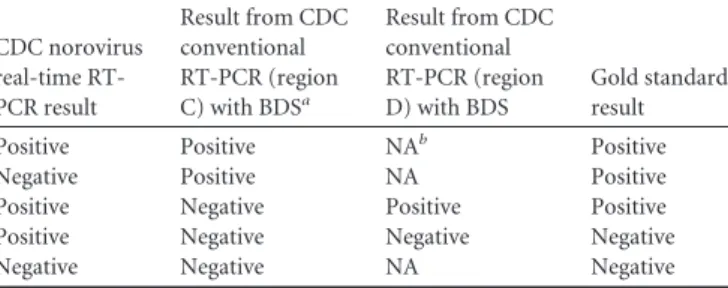
Composite reference method.As a gold standard for comparison, a composite reference method was used at the CDC. The composite refer-ence method consisted of a real-time reverse transcription (RT)-PCR as-say (19) with modifications and a conventional RT-PCR that amplified two distinct regions of the capsid gene (termed regions C and D) followed by bidirectional sequencing (19). The primers used in the composite method were different from the ones used in the Xpert Norovirus assay. The algorithm for the composite method result interpretation is shown in
Table 2. Norovirus-positive samples were genotyped by comparisons with reference sequences (9). Testing at the CDC was performed on specimens in batches.
Statistical analysis.A power calculation was performed to determine the requirements for the study to demonstrate that the lower 2-sided 95% confidence interval for positive percent agreement (PPA) was greater than 85% and that the lower 2-sided 95% confidence interval for negative percent agreement (NPA) was greater than 82%. In order to ensure a reasonable probability of meeting the significance criteria, the PPA and NPA targets were 95% and 92%, respectively. Thus, the sample size re-quirements included a minimum of 124 samples positive for each of GI and GII norovirus and 155 negative specimens. The positive percent agreement (PPA), negative percent agreement (NPA), positive predictive value (PPV), and negative predictive value (NPV) were calculated using standard methods. The 95% confidence interval was calculated using a two-tailed Fisher’s exact method.
RESULTS
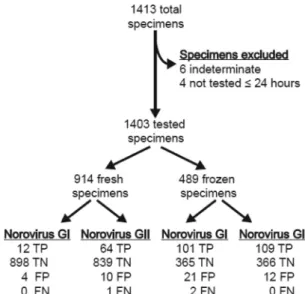
Specimens.A total of 1,413 eligible fecal specimens were col-lected for Xpert Norovirus assay testing. Ten specimens (5 with indeterminate results from the composite reference method, 4 that were not tested within 24 h of collection, and 1 with an indeterminate result by the Xpert Norovirus assay) were ex-cluded from the final analysis, resulting in a total of 1,403 spec-imens for analysis (Fig. 1). Of the 1,403 specimens analyzed, 914 were fresh specimens (collected from March to May 2014) and 489 were frozen specimens. The frozen specimens were preselected to increase the number of GI-positive specimens. Two frozen specimens were excluded from the GII analysis due to indeterminate Xpert Norovirus assay results, resulting in 1,401 specimens analyzed for GII results (Fig. 1).
TABLE 1Number of fresh and frozen specimens tested at each clinical site
Study site
No. of specimens tested
Fresh Frozen Total
A 119 29 148
B 307 28 335
C 383 38 421
D 38 219 257
E 57 32 89
F 0 32 32
G 10 111 121
Total 914 489 1,403
TABLE 2Composite reference test algorithm for result interpretation
CDC norovirus real-time RT-PCR result
Result from CDC conventional RT-PCR (region C) with BDSa
Result from CDC conventional RT-PCR (region D) with BDS
Gold standard result
Positive Positive NAb Positive
Negative Positive NA Positive
Positive Negative Positive Positive
Positive Negative Negative Negative
Negative Negative NA Negative
aBDS, bidirectional sequencing. b
Study subjects.The numbers of subjects were approximately equal with regard to gender distribution (females, n ⫽ 738, 52.6%) (Table 3). Nearly half (n⫽675, 48.1%) of all subjects were between 21 to 65 years of age, and over one-third (n⫽531, 37.8%) of the subjects were⬎65 years of age (Table 3). The majority of specimens came from subjects who were hospitalized (n⫽907, 64.6%), with outpatients being the next-most-common patient population (n⫽272, 19.4%) (Table 3).
Xpert Norovirus assay performance.The Xpert Norovirus as-say provided a valid result for 98.6% (1,383/1,403) of the speci-mens in the first attempt at analysis, with the analyses of 20 (1.4%) specimens showing indeterminate results. Repeat testing resulted in a valid assay result for all 20 repeat specimens. Of the 1,403 specimens tested, 23.7% (n⫽333) were positive for GI or GII by the Xpert Norovirus assay (Table 4). Of the norovirus-positive specimens, 41.4% (n⫽138) were GI and 58.6% (n⫽195) were GII. No dually GI-positive and GII-positive specimens were de-tected by the Xpert Norovirus assay.
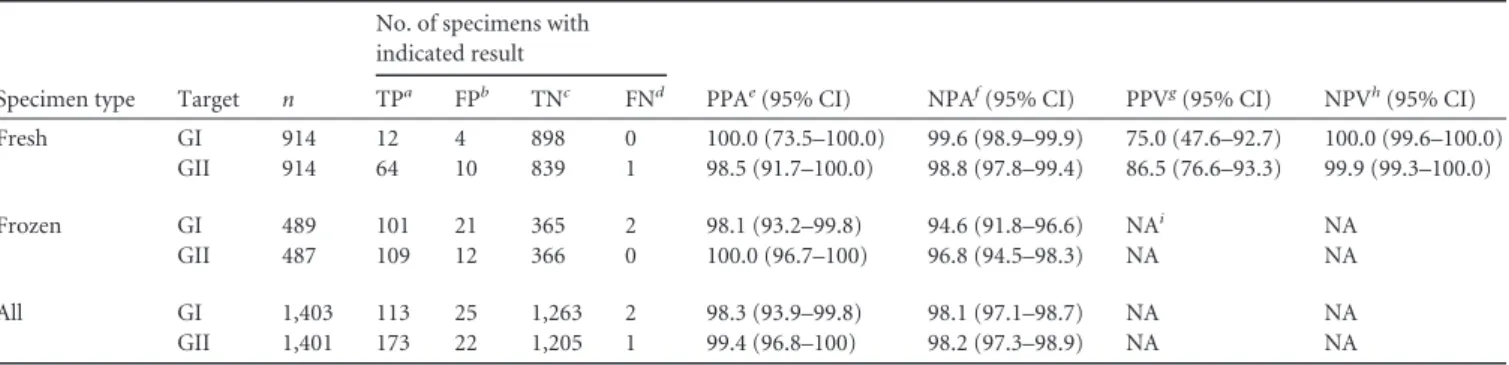
As there is no established gold standard for norovirus testing, the results from the Xpert Norovirus assay were compared to the results from the composite reference testing that was conducted at the CDC. On the basis of the composite method, the Xpert Noro-virus assay positive percent agreement (PPA) and negative percent agreement (NPA) for all specimens were 98.3% and 98.1% for GI-positive specimens and 99.4% and 98.2% for GII-positive specimens, respectively (Table 5). The positive predictive value (PPV) and negative predictive value (NPV) for fresh specimens were 75.0% and 100% for GI-positive specimens and 86.5% and 99.9% for GII-positive specimens, respectively (Table 5).
Analysis of prospective specimens.The fresh prospectively collected specimens were obtained from the clinical trial sites from March to May of 2014, and over this time period 9.9% (n⫽ 90) of specimens tested positive for norovirus by the Xpert Noro-virus assay (Table 6). Of these positive specimens, 17.8% (n⫽16) were GI and 82.2% (n⫽74) GII. Most of the positive specimens were submitted from hospitalized subjects (38.9%), followed by outpatients (27.8%) and patients in long-term-care facilities (25.6%). Finally, while 27.7% (n⫽253) of specimens were col-lected in March, that month accounted for 53.3% (n⫽48) of all norovirus-positive specimens (Table 6).
Norovirus genotypes.A sequence that could be genotyped was obtained from each the 286 Xpert Norovirus assay-positive sam-ples. The genotypes that were detected by the Xpert Norovirus assay included GI.1 (n⫽1), GI.3 (n⫽3), GI.3B (n⫽23), GI.3C (n⫽16), GI.4 (n⫽14), GI.5 (n⫽1), GI.5A (n⫽3), GI.6 (n⫽1), GI.6A (n⫽28), GI.7 (n⫽22), GI.9 (n⫽1), GII.1 (n⫽3), GII.2 (n⫽4), GII.3 (n⫽5), GII.4 New Orleans (n⫽74), GII.4 Osaka (n⫽1), GII.4 Sydney (n⫽75), GII.6 (n⫽2), GII.6B (n⫽1), GII.13 (n⫽7), and GII.14 (n⫽1).
DISCUSSION
Norovirus can cause both sporadic gastroenteritis and outbreaks; norovirus outbreaks are associated with health care institutions, cruise ships, schools, and other environments in which people are in close quarters. A meta-analysis of acute gastroenteritis cases worldwide revealed that norovirus accounts for 18% of all
diar-FIG 1Overview of specimens collected and tested by the Xpert Norovirus assay. Of the 6 specimens that were excluded for indeterminate results, 5 were indeterminate by the composite reference method and 1 was indeterminate by the Xpert Norovirus assay. The true-positive (TP), true-negative (TN), false-positive (FP), and false-negative (FN) results of the Xpert Norovirus assay were determined by the composite reference method.
TABLE 3Demographics of study subjects
Subject parameter
No. (%) of specimens
Fresha Frozenb All
Gender
Male 420 (46.0) 225 (46.0) 645 (46.0)
Female 494 (54.0) 244 (49.9) 738 (52.6)
Not specified 0 (0.0) 20 (4.1) 20 (1.4)
Age range (yrs)
0–1 8 (0.8) 12 (2.4) 20 (1.4)
⬎1–5 6 (0.7) 46 (9.4) 52 (3.7)
⬎5–12 10 (1.1) 35 (7.2) 45 (3.2)
⬎12–21 29 (3.2) 32 (6.5) 61 (4.4)
⬎21–65 520 (56.9) 155 (31.7) 675 (48.1)
⬎65 341 (37.3) 190 (38.9) 531 (37.8)
Not specified 0 (0.0) 19 (3.9) 19 (1.4)
Health care setting
Emergency department 48 (5.2) 13 (2.6) 61 (4.3) Hospitalized 561 (61.4) 346 (70.8) 907 (64.6)
LTCFc 81 (8.9) 0 14 (2.9) 95 (6.8)
Outpatient 223 (24.4) 49 (10) 272 (19.4)
Other 1 (1.1) 67 (13.7) 68 (4.9)
aData represent percentages of all fresh specimens (n⫽914). b
Data represent percentages of all frozen specimens (n⫽489).
cLTCF, long-term-care facility.
TABLE 4Xpert Norovirus assay-positive specimens by norovirus genogroup
Norovirus genogroup
No. (%) of specimens
Fresha Frozenb All
GI 16 (1.8) 122 (25) 138 (9.8)
GII 74 (8.1) 121 (24.7) 195 (13.9)
Negative 824 (90.1) 246 (50.3) 1,070 (76.3)
aData represent percentages of all fresh specimens (n⫽914). b
rheal infections (1). On the basis of the Xpert Norovirus assay, we observed that 9.9% (n⫽90) of freshly collected specimens tested positive for norovirus. Given that 78.9% of norovirus cases in the Northern Hemisphere occur between October and March (1), our lower prevalence could reflect the limited time frame (i.e., March to May of 2014) within which fresh specimens were collected. In fact, over half (n⫽48, 53.3%) of the positive norovirus specimens reported here were from March, with 70.8% (n⫽34) of these specimens from a single clinical site. We also observed a
predom-inance (84%,n⫽64) of positive GII specimens in our study, a result which has been noted in a previous study where GII viruses accounted for⬃62% of norovirus outbreaks (20).
Control of norovirus outbreaks is complicated by the relatively low infectious dose (21) and by the high level of norovirus shed-ding in vomitus (21) and feces (22). Routine norovirus prevention and control measures utilize a combination of staff- and patient-level strategies, including hand hygiene, assigning of patient co-horts, use of appropriate protective equipment, and effective en-vironmental disinfection (23, 24). The implementation of such measures requires the prompt identification of norovirus-infected patients. Among the strengths of the Xpert Norovirus assay are the relative ease of performing the test, the ability to run samples on demand without batch processing, and the short turnaround time, which includes less than 5 min of hands-on time and ap-proximately 90 min for a result.
In a study in Hong Kong, the investigators enhanced their stan-dard infection control measures by performing norovirus PCR testing on all specimens submitted for fecal studies, even if noro-virus testing was not requested (25). By the use of a laboratory-developed PCR assay for norovirus detection (26), 242 (25%) pa-tients tested positive for norovirus; among them, 114 (47% of positives) were detected only by testing samples for which noro-virus testing had not been ordered. The resulting increased detec-tion led to addidetec-tional patients being identified and given proper precautions. Overall, the authors found that these enhanced mea-sures reduced the number of hospital-acquired norovirus infec-tions from 131 to 16 cases per 1,000 potentially infectious patient-days, relative to the previous 12 months (25).
Asymptomatic carriage of norovirus is an area of unknown significance for infection prevention measures and poses a diag-nostic problem for laboratory testing. Real-time RT-PCR testing of fecal specimens of asymptomatic individuals in England re-vealed a 12% age-adjusted prevalence of norovirus, with the high-est prevalence noted for children⬍5 years of age (27). One source of asymptomatic shedding can be a recently resolved infection. A median of 29 days of norovirus shedding has been documented via real-time RT-PCR in norovirus-infected volunteers (21). The
du-TABLE 5Performance of the Xpert Norovirus assay compared to the composite reference method
Specimen type Target n
No. of specimens with indicated result
PPAe(95% CI) NPAf(95% CI) PPVg(95% CI) NPVh(95% CI)
TPa FPb TNc FNd
Fresh GI 914 12 4 898 0 100.0 (73.5–100.0) 99.6 (98.9–99.9) 75.0 (47.6–92.7) 100.0 (99.6–100.0) GII 914 64 10 839 1 98.5 (91.7–100.0) 98.8 (97.8–99.4) 86.5 (76.6–93.3) 99.9 (99.3–100.0)
Frozen GI 489 101 21 365 2 98.1 (93.2–99.8) 94.6 (91.8–96.6) NAi NA
GII 487 109 12 366 0 100.0 (96.7–100) 96.8 (94.5–98.3) NA NA
All GI 1,403 113 25 1,263 2 98.3 (93.9–99.8) 98.1 (97.1–98.7) NA NA
GII 1,401 173 22 1,205 1 99.4 (96.8–100) 98.2 (97.3–98.9) NA NA
aTP, true positive. b
FP, false positive.
cTN, true negative. d
FN, false negative.
ePPA, positive percent agreement; CI, confidence interval. f
NPA, negative percent agreement.
gPPV, positive predictive value. h
NPV, negative predictive value.
iNA, not applicable.
TABLE 6Evaluation of fresh specimen results
Demographic Information
No. (%) of specimensa
Total tested
(n⫽914) GI positive GII positive All positive Gender
Male 420 (46) 4 (1) 28 (6.7) 32 (7.6)
Female 494 (54) 12 (2.4) 46 (9.3) 58 (11.7)
Age range (yrs)
0–1 8 (0.88) 0 (0) 0 (0) 0 (0)
⬎1–5 6 (0.66) 1 (16.7) 0 (0) 1 (16.7)
⬎5–12 10 (1.1) 0 (0) 1 (10) 1 (10)
⬎12–21 29 (3.2) 0 (0) 3 (10.3) 3 (10.3) ⬎21–65 520 (56.9) 9 (1.7) 35 (6.7) 44 (8.4) ⬎65 341 (37.3) 6 (1.8) 35 (10.3) 41 (12)
Health care setting
Emergency department 48 (5.2) 1 (2.1) 6 (12.5) 7 (14.6) Hospitalized 561 (61.4) 5 (0.9) 30 (5.3) 35 (6.2) LTCF 81 (8.9) 1 (1.2) 22 (27.2)b 23 (28.4)
Outpatient 223 (24.4) 9 (4) 16 (7.2) 25 (11.2)
Other 1 (0.1) 0 (0) 0 (0) 0 (0)
Mo
March 253 (27.7) 6 (2.4) 42 (16.6) 48 (19) April 329 (36) 6 (1.8) 21 (6.4) 27 (8.2) May 332 (36.3) 4 (1.2) 11 (3.3) 15 (4.5)
a
Data are presented as percentages of specimens for that given row.
ration of symptoms and norovirus shedding can be much longer in immunocompromised patients than in healthy patients (28, 29). It remains unknown whether asymptomatic norovirus carri-ers can serve as a reservoir for sporadic cases or outbreaks and whether such individuals require infection prevention measures. Additionally, given the potential for a high prevalence of asymp-tomatic carriage, the only fecal specimens that should be tested for norovirus are those from individuals with symptoms of gastroen-teritis, similarly to parameters commonly established by clinical laboratories forClostridium difficiletesting (30).
While there are several FDA-approved assays that include no-rovirus as a target, the Xpert Nono-rovirus assay is the first FDA-cleared stand-alone NAAT specifically for norovirus detection. There are currently 3 FDA-cleared multiplex assays for syndromic testing for gastrointestinal pathogens that include norovirus as a target—the xTAG GPP, the FilmArray GI panel, and the Verigene enteric-pathogen nucleic acid test. The xTAG GPP method detects 15 gastrointestinal pathogens, including GI and GII norovirus. This assay requires a separate nucleic acid extraction prior to am-plification and target detection. In contrast, the FilmArray GI as-say is a self-contained test that performs nucleic acid extraction, detection, and interpretation of results for 22 gastrointestinal pathogens, including GI and GII norovirus. While these assays detect both GI and GII, they do not differentiate between these genotypes. Two recent studies (14,15) evaluated the FilmArray GI panel, using a CDC-based assay as the reference method for no-rovirus detection (31), and reported sensitivities of 91.7% and 94.5% and specificities of 99.5% and 98.8%, respectively. In the paper by Khare et al., in addition to evaluating the FilmArray GI panel, the authors reported that the sensitivity and specificity of the xTAG GPP panel for norovirus were 100% and 90.8%, respec-tively. Two other recent studies (16,17) used a different reference method (32) to evaluate the xTAG GPP panel and reported sensi-tivities of 93.4% to 94.4% and specificities of 98.9% to 100%. The results for the Xpert Norovirus assay presented here indicate sim-ilar performance characteristics with the FilmArray GI and xTAG GPP panels, but additional studies are needed to directly compare these methods for norovirus detection. These studies and others have evaluated coinfections detected by multiplex panels, which have been reported at rates of 8% to 17.2% (14–18). In most of these studies, norovirus is commonly a component of these coin-fections. Given the high prevalence of asymptomatic norovirus shedding, the clinical significance of norovirus detection in cofections remains unclear and is an important area for future in-vestigation.
This study had a number of strengths, including the large num-ber (n⫽914) of prospectively collected specimens from patients with acute gastroenteritis from multiple medical centers and di-verse health care settings. Norovirus genotyping data revealed that specimens in this study represented a variety of distinct GI (n⫽ 11) and GII (n⫽10) genotypes, indicating that the Xpert Noro-virus assay has the capacity to detect a variety of noroNoro-virus geno-types. The inclusion of frozen specimens improved the power for evaluating the analytical performance characteristics for geno-group GI. The limitations of this study included a relative paucity of specimens from subjects less than 21 years of age (n⫽178, 12.7% of total), the limited time frame and time of year (i.e., nonpeak) during which the samples were collected, and the low number of GI-positive prospective specimens. Additionally, while fecal specimens were submitted for routine studies, limited
clini-cal data are available to correlate the testing results with symptoms and the presence of other pathogens in these samples.
In summary, the Xpert Norovirus assay is a rapid and accurate method to detect and differentiate the prominent norovirus geno-groups. Consistent with previous reports, we found that norovirus is a frequent cause of acute gastrointestinal infections, and effi-cient and accurate testing has the potential to rapidly identify in-fected individuals, minimizing the need for additional diagnostic testing and prompting infection prevention measures.
ACKNOWLEDGMENTS
This study was funded by Cepheid. L.C.L. was supported by a grant from the CDC Foundation.
The findings and conclusions in this report are ours and do not nec-essarily represent the official position of the Centers for Disease Control and Prevention.
Names of specific vendors, manufacturers, or products are included for public health and informational purposes; inclusion does not imply endorsement of the vendors, manufacturers, or products by the Centers for Disease Control and Prevention or the U.S. Department of Health and Human Services.
FUNDING INFORMATION
This work was funded by Cepheid. CDC Foundation provided funding to L. Claire Langley.
REFERENCES
1.Ahmed SM, Hall AJ, Robinson AE, Verhoef L, Premkumar P, Parashar UD, Koopmans M, Lopman BA.2014. Global prevalence of norovirus in cases of gastroenteritis: a systematic review and meta-analysis. Lancet In-fect Dis14:725–730.http://dx.doi.org/10.1016/S1473-3099(14)70767-4. 2.Hall AJ, Lopman BA, Payne DC, Patel MM, Gastañaduy PA, Vinjé J,
Parashar UD.2013. Norovirus disease in the United States. Emerg Infect Dis19:1198 –1205.http://dx.doi.org/10.3201/eid1908.130465.
3.Payne DC, Vinjé J, Szilagyi PG, Edwards KM, Staat MA, Weinberg GA, Hall CB, Chappell J, Bernstein DI, Curns AT, Wikswo M, Shirley SH, Hall AJ, Lopman B, Parashar UD.2013. Norovirus and medically at-tended gastroenteritis in U.S. children. N Engl J Med368:1121–1130.http: //dx.doi.org/10.1056/NEJMsa1206589.
4.Bucardo F, Reyes Y, Svensson L, Nordgren J.2014. Predominance of norovirus and sapovirus in Nicaragua after implementation of universal rotavirus vaccination. PLoS One 9:e98201. http://dx.doi.org/10.1371 /journal.pone.0098201.
5.Hemming M, Räsänen S, Huhti L, Paloniemi M, Salminen M, Vesikari T.2013. Major reduction of rotavirus, but not norovirus, gastroenteritis in children seen in hospital after the introduction of RotaTeq vaccine into the National Immunization Programme in Finland. Eur J Pediatr172:
739 –746.http://dx.doi.org/10.1007/s00431-013-1945-3.
6.Koo HL, Neill FH, Estes MK, Munoz FM, Cameron A, Dupont HL, Atmar RL.2013. Noroviruses: the most common pediatric viral enteric pathogen at a large university hospital after introduction of rotavirus vac-cination. J Pediatric Infect Dis Soc2:57– 60.http://dx.doi.org/10.1093 /jpids/pis070.
7.Kapikian AZ, Wyatt RG, Dolin R, Thornhill TS, Kalica AR, Chanock RM.1972. Visualization by immune electron microscopy of a 27-nm particle associated with acute infectious nonbacterial gastroenteritis. J Vi-rol10:1075–1081.
8.Vinjé J.2015. Advances in laboratory methods for detection and typing of norovirus. J Clin Microbiol53:373–381.http://dx.doi.org/10.1128/JCM .01535-14.
9.Vega E, Barclay L, Gregoricus N, Shirley SH, Lee D, Vinjé J. 2014. Genotypic and epidemiologic trends of norovirus outbreaks in the United States, 2009 to 2013. J Clin Microbiol52:147–155.http://dx.doi.org/10 .1128/JCM.02680-13.
11. Wikswo ME, Cortes J, Hall AJ, Vaughan G, Howard C, Gregoricus N, Cramer EH.2011. Disease transmission and passenger behaviors during a high morbidity Norovirus outbreak on a cruise ship, January 2009. Clin Infect Dis52:1116 –1122.http://dx.doi.org/10.1093/cid/cir144. 12. Matthews JE, Dickey BW, Miller RD, Felzer JR, Dawson BP, Lee AS,
Rocks JJ, Kiel J, Montes JS, Moe CL, Eisenberg JN, Leon JS.2012. The epidemiology of published norovirus outbreaks: a review of risk factors associated with attack rate and genogroup. Epidemiol Infect140:1161– 1172.http://dx.doi.org/10.1017/S0950268812000234.
13. Robilotti E, Deresinski S, Pinsky BA.2015. Norovirus. Clin Microbiol Rev28:134 –164.http://dx.doi.org/10.1128/CMR.00075-14.
14. Khare R, Espy MJ, Cebelinski E, Boxrud D, Sloan LM, Cunningham SA, Pritt BS, Patel R, Binnicker MJ.2014. Comparative evaluation of two commercial multiplex panels for detection of gastrointestinal pathogens by use of clinical stool specimens. J Clin Microbiol52:3667–3673.http: //dx.doi.org/10.1128/JCM.01637-14.
15. Buss SN, Leber A, Chapin K, Fey PD, Bankowski MJ, Jones MK, Rogatcheva M, Kanack KJ, Bourzac KM.2015. Multicenter evaluation of the BioFire FilmArray gastrointestinal panel for etiologic diagnosis of in-fectious gastroenteritis. J Clin Microbiol53:915–925.http://dx.doi.org/10 .1128/JCM.02674-14.
16. Claas EC, Burnham CA, Mazzulli T, Templeton K, Topin F. 2013. Performance of the xTAG® gastrointestinal pathogen panel, a multiplex molecular assay for simultaneous detection of bacterial, viral, and para-sitic causes of infectious gastroenteritis. J Microbiol Biotechnol23:1041– 1045.http://dx.doi.org/10.4014/jmb.1212.12042.
17. Wessels E, Rusman LG, van Bussel MJ, Claas EC.2014. Added value of multiplex Luminex Gastrointestinal Pathogen Panel (xTAG® GPP) test-ing in the diagnosis of infectious gastroenteritis. Clin Microbiol Infect
20:O182–O187.http://dx.doi.org/10.1111/1469-0691.12364.
18. Spina A, Kerr KG, Cormican M, Barbut F, Eigentler A, Zerva L, Tassios P, Popescu GA, Rafila A, Eerola E, Batista J, Maass M, Aschbacher R, Olsen KE, Allerberger F.2015. Spectrum of enteropathogens detected by the FilmArray GI Panel in a multicentre study of community-acquired gastroenteritis. Clin Microbiol Infect http://dx.doi.org/10.1016/j.cmi .2015.04.007.
19. Vega E, Barclay L, Gregoricus N, Williams K, Lee D, Vinjé J.2011. Novel surveillance network for norovirus gastroenteritis outbreaks, United States. Emerg Infect Dis17:1389 –1395.
20. Siebenga JJ, Vennema H, Zheng DP, Vinjé J, Lee BE, Pang XL, Ho EC, Lim W, Choudekar A, Broor S, Halperin T, Rasool NB, Hewitt J, Greening GE, Jin M, Duan ZJ, Lucero Y, O’Ryan M, Hoehne M, Schreier E, Ratcliff RM, White PA, Iritani N, Reuter G, Koopmans M.
2009. Norovirus illness is a global problem: emergence and spread of no-rovirus GII.4 variants, 2001–2007. J Infect Dis200:802– 812.http://dx.doi .org/10.1086/605127.
21. Atmar RL, Opekun AR, Gilger MA, Estes MK, Crawford SE, Neill FH, Ramani S, Hill H, Ferreira J, Graham DY.2014. Determination of the 50% human infectious dose for Norwalk virus. J Infect Dis209:1016 – 1022.http://dx.doi.org/10.1093/infdis/jit620.
22. Chan MC, Sung JJ, Lam RK, Chan PK, Lee NL, Lai RW, Leung WK.
2006. Fecal viral load and norovirus-associated gastroenteritis. Emerg In-fect Dis12:1278 –1280.http://dx.doi.org/10.3201/eid1208.060081. 23. MacCannell T, Umscheid CA, Agarwal RK, Lee I, Kuntz G, Stevenson
KB; Healthcare Infection Control Practices Advisory Committee-HICPAC.2011. Guideline for the prevention and control of norovirus gastroenteritis outbreaks in healthcare settings. Infect Control Hosp Epi-demiol32:939 –969.http://dx.doi.org/10.1086/662025.
24. Division of Viral Diseases, National Center for Immunization and Respiratory Diseases, Centers for Disease Control and Prevention.
2011. Updated norovirus outbreak management and disease prevention guidelines. MMWR Recomm Rep60(RR-3):1–18.
25. Cheng VC, Wong LM, Tai JW, Chan JF, To KK, Li IW, Hung IF, Chan KH, Ho PL, Yuen KY.2011. Prevention of nosocomial transmission of norovirus by strategic infection control measures. Infect Control Hosp Epidemiol32:229 –237.http://dx.doi.org/10.1086/658330.
26. Kageyama T, Kojima S, Shinohara M, Uchida K, Fukushi S, Hoshino FB, Takeda N, Katayama K.2003. Broadly reactive and highly sensitive assay for Norwalk-like viruses based on real-time quantitative reverse transcription-PCR. J Clin Microbiol41:1548 –1557.http://dx.doi.org/10 .1128/JCM.41.4.1548-1557.2003.
27. Phillips G, Tam CC, Rodrigues LC, Lopman B.2010. Prevalence and characteristics of asymptomatic norovirus infection in the community in England. Epidemiol Infect 138:1454 –1458. http://dx.doi.org/10.1017 /S0950268810000439.
28. Schorn R, Höhne M, Meerbach A, Bossart W, Wüthrich RP, Schreier E, Müller NJ, Fehr T.2010. Chronic norovirus infection after kidney trans-plantation: molecular evidence for immune-driven viral evolution. Clin Infect Dis51:307–314.http://dx.doi.org/10.1086/653939.
29. Saif MA, Bonney DK, Bigger B, Forsythe L, Williams N, Page J, Babiker ZO, Guiver M, Turner AJ, Hughes S, Wynn RF.2011. Chronic norovi-rus infection in pediatric hematopoietic stem cell transplant recipients: a cause of prolonged intestinal failure requiring intensive nutritional sup-port. Pediatr Transplant 15:505–509. http://dx.doi.org/10.1111/j.1399 -3046.2011.01500.x.
30. Brecher SM, Novak-Weekley SM, Nagy E.2013. Laboratory diagnosis of
Clostridium difficileinfections: there is light at the end of the colon. Clin Infect Dis57:1175–1181.http://dx.doi.org/10.1093/cid/cit424.
31. Trujillo AA, McCaustland KA, Zheng DP, Hadley LA, Vaughn G, Adams SM, Ando T, Glass RI, Monroe SS.2006. Use of TaqMan real-time reverse transcription-PCR for rapid detection, quantification, and typing of norovirus. J Clin Microbiol44:1405–1412.http://dx.doi.org/10 .1128/JCM.44.4.1405-1412.2006.
32. van Maarseveen NM, Wessels E, de Brouwer CS, Vossen AC, Claas EC.