Modelling changes in clinical
attachment loss to classify
periodontal disease progression
Teles R, Benecha HK, Preisser JS, Moss K, Starr JR, Corby P, Genco R, Garcia N, Giannobile WV, Jared H, Torresyap G, Salazar E, Moya J, Howard C, Schifferle R, Falkner KL, Gillespie J, Dixon D, Cugini M. Modelling changes in clinical attachment loss to classify periodontal disease progression. J Clin Periodontol 2016; 43: 426–434. doi: 10.1111/jcpe.12539.
Abstract
Aim: The goal of this study was to identify progressing periodontal sites by applying linear mixed models (LMM) to longitudinal measurements of clinical attachment loss (CAL).
Methods: Ninety-three periodontally healthy and 236 periodontitis subjects had their CAL measured bi-monthly for 12 months. The proportions of sites demon-strating increases in CAL from baseline above specified thresholds were calculated for each visit. The proportions of sites reversing from the progressing state were also computed. LMM were fitted for each tooth site and the predicted CAL levels used to categorize sites regarding progression or regression. The threshold for progression was established based on the model-estimated error in predictions. Results: Over 12 months, 21.2%, 2.8% and 0.3% of sites progressed, according to thresholds of 1, 2 and 3 mm of CAL increase. However, on average, 42.0%, 64.4% and 77.7% of progressing sites for the different thresholds reversed in sub-sequent visits. Conversely, 97.1%, 76.9% and 23.1% of sites classified as pro-gressing using LMM had observed CAL increases above 1, 2 and 3 mm after 12 months, whereas mean rates of reversal were 10.6%, 30.2% and 53.0% respectively.
Conclusion: LMM accounted for several sources of error in longitudinal CAL measurement, providing an improved method for classifying progressing sites.
Ricardo Teles1,2, Habtamu K. Benecha3, John S. Preisser3, Kevin Moss4, Jacqueline R. Starr2,5, Patricia Corby6, Robert Genco7, Nathalia Garcia8, William V. Giannobile9, Heather Jared10, Gay Torresyap2, Elida Salazar2, Julie Moya6, Cynthia Howard6, Robert Schifferle7, Karen L. Falkner7, Jane Gillespie8, Debra Dixon8and MaryAnn Cugini2 1
Department of Periodontology, School of Dentistry, University of North Carolina at Chapel Hill, Chapel Hill, NC, USA; 2Department of Applied Oral Sciences,
Forsyth Institute, Cambridge, MA, USA; 3
Department of Biostatistics, Gillings School of Global Public Health, University of North Carolina at Chapel Hill, Chapel Hill, NC, USA;4Department of Dental Ecology, School of Dentistry, University of North Carolina at Chapel Hill, Chapel Hill, NC, USA; 5Department of Oral Health Policy and Epidemiology, Harvard School of Dental Medicine, Harvard University, Boston, MA, USA;6New York University College of Dentistry, Bluestone Center for Clinical Research, New York, NY, USA;7Department of Oral Biology, School of Dental Medicine, State University of New York at Buffalo, Buffalo, NY, USA;8Section of Periodontics, Department of Applied Dental Medicine, Southern Illinois University School of Dental Medicine, Alton, IL, USA;9Department of Periodontics and Oral Medicine & Michigan Center for Oral Health Research, University of Michigan School of Dentistry, Ann Arbor, MI, USA;10Rho Inc., Contract Research Organization, Chapel Hill, NC, USA
Key words: clinical attachment loss; disease progression; linear mixed models; periodontal disease
Accepted for publication 27 February 2016
For many years it was generally believed that periodontal diseases progressed linearly, i.e. with a con-stant, relatively slow rate of increase in clinical attachment loss (CAL). This assumption was chal-lenged when data from longitudinal studies on untreated subjects
sug-gested the possibility of abrupt changes in CAL, leading to the competing “burst hypothesis” of progression (Goodson et al. 1982, Haffajee et al. 1983, Socransky et al. 1984). Since then, researchers and clinicians have pursued differ-ent approaches to iddiffer-entify sites that
Conflict of interest and source of funding statement
The authors declare that they have no conflict of interest.
This study was supported by research grant DE021127-01 from the National Institute of Dental and Craniofacial Research.
©2016 The Authors.Journal of Clinical PeriodontologyPublished by John Wiley & Sons Ltd.
426
are undergoing or will undergo periodontal disease progression, motivated in part by the belief that sudden changes in observed CAL data could be artefacts resulting from measurement error (Haffajee et al. 1983, Aeppli & Pihlstrom 1989, Machtei et al. 1993, Breen et al. 1999b).
Several methods have been pro-posed that account for CAL mea-surement error. Among such approaches, the tolerance method described by Haffajee et al. (1983) accounted for cross-sectional vari-ance in CAL measurement at the site, subject and population levels and required data from only two time points. However, a recent examination of the reproducibility of CAL measurements (Corraini et al. 2013) indicated that measurement error frequencies were too high to permit the reliable detection of CAL changes using data from only two visits, thus questioning the validity of the tolerance method. Another limitation of the tolerance method was that it did not take into account the reversibility of changes in CAL (Goodson et al. 1982, Harley et al. 1987, Jeffcoat & Reddy 1991, Breen et al. 1999a).
Studies on the reliability of longi-tudinal CAL measurements indicated that the cross-sectional characteriza-tion of reproducibility of CAL may not fully account for all sources of variation in measurements of CAL over time (Espeland et al. 1991). Although methods such as linear regression analysis; running median (Haffajee et al. 1983); the cumulative sum method (Aeppli & Pihlstrom 1989); and an individualized multi-threshold approach (Machtei et al. 1993) use data from multiple visits, they use measurements only from the subject’s site to classify progres-sion ignoring information from other sites or subjects. Thereby, they fail to take into consideration the full impact of multiple sources of varia-tion in CAL measurements in the diagnosis of periodontal disease progression.
The goal of this study was to classify sites regarding progression of periodontal diseases by applying linear mixed models (LMM) (Laird & Ware 1982, Cnaan et al. 1997) to longitudinal CAL measurements in a population of adults with
dif-ferent stages of disease. LMMs are a type of linear regression model for repeated measures (i.e. CAL) that include both fixed effects (e.g. time, gender) and random effects, the latter specific to subjects and sites.
The rationale was that LMMs account for multiple sources of variation in CAL measurements and should therefore provide more accurate classification than methods that do not leverage this informa-tion.
Material and Methods
Study design
The data presented here were obtained from an ongoing prospective multicentre clinical study to search for biomarkers of periodontal disease progression. A consecutive sample of 329 participants was recruited between January 2012 and April 2015 at four centres in the United States: The Forsyth Institute (Cambridge, MA), New York University College of Dentistry (New York, NY), South-ern Illinois University School of Den-tal Medicine (Alton, IL), and the University at Buffalo, State Univer-sity of New York (Amherst, NY). Participants were examined clinically by calibrated examiners every 2 months for 12 months to monitor for periodontal disease progression based on CAL measurements. The study was approved by the Institu-tional Review Board at each centre prior to initiation.
Study population
The inclusion and exclusion criteria can be found in the online supporting information, further details can be obtained at Clini-calTrials.gov (https://clinicaltrials.-gov/ct2/home) under the identifier NCT01489839.
Standard deviations of duplicate measures of CAL and intra-examiner reproducibility
From 29,189 replicate site-specific CAL measurements from the 329 participants’ baseline data, we com-puted the average standard deviation (SD) of CAL within each subject and across subjects. Data obtained
from 16 clinical examiners based on 318,237 replicate measures across all visits were used to calculate intra-examiner agreement.
Clinical examination
Periodontal assessments performed on each subject included up to 168 sites per subject (6 sites per tooth – mesiobuccal, buccal, distobuccal, mesiolingual, lingual and distolingual
– for up to 28 teeth excluding third molars) and included: presence or absence of gingival redness and pla-que; probing depth (PD); measure-ment of distance from the cementoenamel junction to the free gingival margin (B measure) (in case of recession, a negative value was assigned); CAL (calculated by sub-tracting the B measure from the PD); presence or absence of plaque, gingi-val redness, BOP and suppuration. PD and the B measure were measured using a North Carolina manual peri-odontal probe (PCPUNC 15 Hu-Friedy Co, Chicago, IL), rounding down to the nearest millimetre and at pre-molars and the first and second molars these variables were measured twice. CAL was calculated for each pass by the electronic data capturing (EDC) system. If the difference between the 2 measurements was ≥2 mm, the examiner was prompted by the EDC to obtain PD and the B measure a third time. The median CAL among the 2 or 3 passes was used for analysis.
Rescue therapy
Subjects with≥6 sites with cumulative loss of attachment≥2 mm from base-line during monitoring phase had their monitoring interrupted, and proceeded to treatment. Participants displaying≥4 mm of CAL increase at a given site received periodontal res-cue therapy at such sites and contin-ued with monitoring. After the monitoring phase, periodontally healthy subjects received professional dental prophylaxis and exited the study, whereas participants with peri-odontal disease received non-surgical mechanical periodontal therapy.
Subjects and sites included in analyses
enrolled in the study up until April 12, 2015. Participants that had their monitoring interrupted due to rescue therapy were excluded. If a subject received rescue therapy in some but not all sites, data for such sites were removed from the analysis and the subject was otherwise retained in the analysis for any remaining sites. In addition, sites with extreme varia-tions in CAL (i.e. a difference between the minimum CAL and maximum CAL >5 mm) were also excluded.
Data analyses
The analyses proceeded in three stages: we (i) calculated the observed proportion of sites with progression and regression according to different thresholds; (ii) performed an alter-nating logistic regressions (ALR) implementation of the generalized estimating equations (GEE) proce-dure to assess whether the propor-tion of progressing sites changes over time and (iii) applied LMMs to predict subject-specific trends in CAL for each site and from which classifications of progression and regression were made. Statistical sig-nificance was defined as p<0.05 throughout. All statistical analyses were conducted using SASÒ soft-ware.
Stage 1 – The observed propor-tion of sites with changes in CAL from the baseline values greater or equal to 1, 2 and 3 mm, respectively, were summarized for every visit in each clinical group separately. In addition, we also summarized the proportion of progressed sites with reversals at the subsequent visit (i.e. being progressed a visit j, and then not-progressed at visit j +1). For these calculations, missing data points in the observed CAL mea-surements were imputed by LOCF (last-observation-carried-forward) from the previous visit. In contrast, all LMMs and the GEE analysis described below were conducted without imputation of missing data points.
Stage 2 – The ALR (Carey et al. 1993) implementation of GEE for population-averaged modelling was performed using all the sites simul-taneously to assess whether the population-averaged proportions of observed CAL increases ≥1 mm
from baseline to 2, 4, 6, 8, 10 and 12 months changed over time, while adjusting for disease cohort (healthy, mild, severe). For additional details on this model refer to the online supplementary appendix.
Stage 3 – For each of the 168 tooth sites, a separate linear mixed effects model (Laird & Ware 1982, Holditch-Davis et al. 1998) with a cubic polynomial for time (months) was fitted to quantify the course of progression within individuals. Specifically, the model for CALit,
the value of attachment loss from the ith subject at time=t (for t=0, 2, 4, 6, 8, 10 or 12 months) is
CALit¼b0þb0iþb1Agei
þb2Femaleiþb3bCALi
þ ðb4þb1iÞtimeþ ðb5 þb2iÞtime2þb6time
3þb 7 bCAL2i þb8Ageitime
þb9Femaleitime
þb10bCALitimeþeit
The model includes fixed effects for age, gender (with males as the reference group), time, time-squared and time-cubed, the two-way inter-actions age by time and gender by time, mean baseline CAL for the subject (bCALi) and its square, as
well as the interaction of bCALi
and (linear) time. The fixed effects and their parameters b0,. . .,b10, define the population-averaged regression. This is a fairly rich model for fixed effects with respect to inclusion of polynomial and interaction terms. The rationale was to account for between-subject vari-ability and thereby reduce error in the prediction of subject-specific trends, which in turn should improve accuracy of classification of within-subject change. To this end, the model additionally includes ran-dom effects b0i, b1i and b2i for
sub-jects, time and time-squared respectively; these and the random error term eij, are independent and
normally distributed with unknown variances. The random effects com-ponent for each subject is the differ-ence between the subject’s regression and the population-averaged regres-sion (the latter determined from fixed effects). This random effects component is a measure of how progression of periodontal disease at
the site for each subject systemati-cally differs from the typical course of progression in the whole popula-tion after accounting for age, gender and baseline CAL. Furthermore, each tooth site of each subject has his or her own regression curve for CAL given by the sum of the fixed effects and random effects compo-nents. From the subject-specific curves generated from the regression models (one model per site), pre-dicted values of CAL were com-puted at baseline and at 2, 4, 6, 8, 10 and 12 months for each site and person. Model assessment was based on the Predicted Residual Error Sum of Squares (PRESS) residual e(i)t, which is the difference between
observed and predicted CAL from the i-th subject at the t-th visit based on the fit of the model that leaves out that subject. The predic-tion accuracy of the LMM for each site was calculated using two sum-maries of PRESS residuals, the PRESS statistic (Liu et al. 1999) and the Sum of Absolute Predicted Residual Errors, each divided by the total number of observations across all subjects and visits for the site. These statistics enable identification of sites where prediction of CAL is best and where it is poorest (for additional details, see online supple-mentary material).
We developed a threshold for progression empirically based on the prediction standard errors from a second series of LMMs (again, one per site) fitted to DCALit, which is
the change in CAL value from base-line to time=t(fort=2, 4, 6, 8, 10 or 12 months) for subject i. These models are identical to the models described above, except that the out-come is DCALij. The threshold for
(2Q75 <DpCAL <4Q75mm) and (iv) progressing sites (DpCAL ≥4Q75) (for additional details on this model, see online supplementary material). The high threshold of 4Q75for pro-gression was motivated by the desire for high specificity in the classifica-tion of progression of periodontitis potentially at the expense of lower sensitivity.
To show the effect of classifica-tion of sites based upon LMM pre-diction, the mean observed and predicted CAL values were calcu-lated at each visit across all sites and subjects within each category of disease progression. In addition, the observed proportion of sites with changes in observed CAL from the baseline values greater or equal to 1, 2 and 3 mm, respectively, were summarized for every visit in each site category of progression. We also summarized the proportion of pro-gressed sites with reversals at the subsequent visit. To illustrate further the fluctuation of CAL over time for individual sites and the smooth-ing effect of the LMM on the pro-file of longitudinal changes in CAL measurements, we selected a partici-pant (subject X) with a large num-ber of sites (n=30) with increase in CAL ≥2 mm from baseline to 12 months. The observed and esti-mated values for CAL over time and the longitudinal changes in CAL were then plotted for every progressing site.
Results
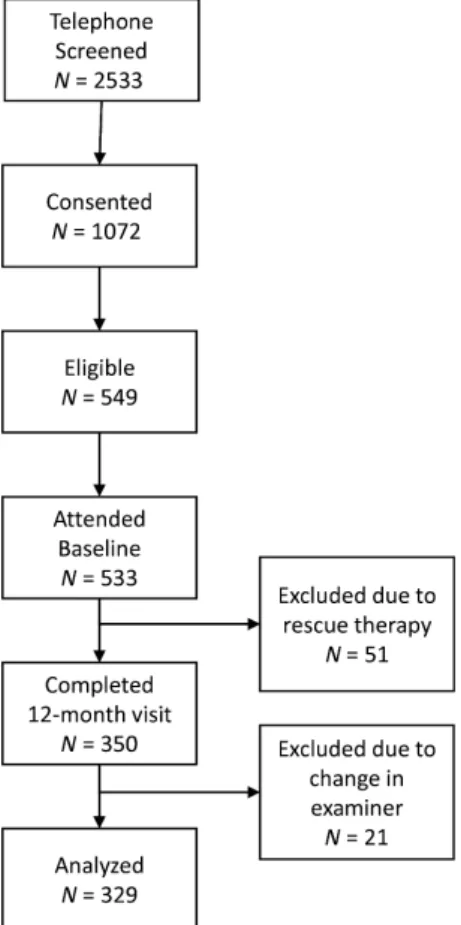
Out of the 533 participants who attended a baseline visit, 51 subjects had their monitoring interrupted due to rescue therapy, whereas 350 had already completed the 12-month monitoring (Fig. 1). Out of these, 21 were excluded because of a change in examiner, resulting in 329 participants in the final analy-sis. Periodontally healthy subjects tended to be younger, more likely to be female, and to have fewer missing teeth than subjects with mild or severe periodontal loss (Table 1). One can also observe that subjects in the Healthy category presented less plaque, gingival red-ness, BOP and suppuration than the periodontitis groups. However, sub-jects classified as “periodontally healthy” were not necessarily
peri-odontally intact and had an average CAL of 1.2 mm. This was the result of our inclusion criteria, which allowed for the presence of reces-sions, with the intent of allowing for the recruitment of older subjects in this category. Among these par-ticipants, 48 sites were excluded due to a fluctuation in CAL greater than 5 mm and 107 sites were excluded due to rescue therapy for a final number of 52,441 sites included in analyses.
Standard deviations of duplicate measures of CAL and intra-examiner reproducibility
The subject-level mean SD of dupli-cate measures was 0.26 mm (range 0 to 0.79 mm). The intra-examiner agreement for the 16 clinical examin-ers was: exact agreement (SD) –
66.2% (6.6%) of the time; and agreement within 1 mm – 95.9% (2.3%).
Proportion of sites with progression and reversals
A total of 2,192 sites (4.2%) that had missing CAL data points had data carried forward from the previ-ous visit in the first (descriptive) stage of the analysis. Within 12 months, overall, 21.2, 2.8 and 0.3% of sites progressed according to the thresholds of 1, 2 and 3 mm respectively. The proportion of sites that progressed according to simple thresholds increased over time, with a high proportion of reversals, irre-spective of the diagnostic threshold and the clinical group (Table 2). The data indicate a higher proportion of progressing sites in the periodontal
Fig. 1.Flow chart of subject recruitment for the study: 2,533 subjects were telephone
disease groups compared to healthy subjects for all three thresholds. The proportion of sites reversing was
rel-atively independent of the duration of follow-up, though the proportion of sites classified as reversing within
a given time period increased greatly as the progression threshold increased.
Table 1. Demographic and clinical parameters of study subjects in the three clinical categories: periodontally healthy subjects, subjects with mild periodontal loss and subjects with severe periodontal loss.
Clinical Groups Total Healthy Mild Severe
N of subjects (sites) 93 (15,260) 113 (17,822) 123 (19,359) 329 (52,441) No Male/Female 24/69 46/67 61/62 131/198 Age (years; meanSD) 3813 5212 4912 4713 No AA/C/Other/ND 17/51/23/2 20/72/12/9 50/64/4/5 87/187/39/16 No of Missing Teeth (meanSD) 0.61.2 1.51.5 1.51.6 1.31.5 Pocket depth (mm; meanSD) 1.70.3 2.30.3 2.80.5 2.30.6 Clinical attachment level (mm; meanSD) 1.20.4 2.20.5 2.60.7 2.10.8 Percentage of sites per subject with:
Plaque (meanSD) 5023 6422 7121 6325 Gingival redness (meanSD) 2722 5226 6524 5028 Bleeding on probing (meanSD) 1920 3420 5424 3726 Suppuration (meanSD) 0.030.15 0.010.07 0.120.34 0.050.23 No of sites/subject
<4 mm (meanSD) 1648 14112 12021 14023 4–6 mm (meanSD) 0.51.2 169 3415 1817
>6 mm (meanSD) 0 0.71.8 2.74.4 1.33.1 AA, African American; C, Caucasian; ND, Not disclosed.
Table 2. Observed percentage of sites with progression and percentage of progressed sites with reversals at the subsequent visit (i.e. no longer being in the state of progression) based on changes in CAL from baseline greater than or equal to 1, 2 and 3 mm at each visit; data for all subjects and stratified for the three clinical groups.
Cohort Visit Threshold of change in CAL
1 mm 2 mm 3 mm
Progression Reversal Progression Reversal Progression Reversal Overall 2 months 14.4% – 1.5% – 0.1% –
4 months 17.6% 45.6% 1.9% 67.0% 0.2% 72.0% 6 months 17.7% 44.4% 2.2% 64.9% 0.2% 83.9% 8 months 18.6% 42.5% 2.1% 68.6% 0.2% 80.9% 10 months 19.9% 39.3% 2.6% 59.8% 0.3% 69.3% 12 months 21.2% 38.3% 2.8% 61.7% 0.3% 82.2% Mean: 18.2% 42.0% 2.2% 64.4% 0.2% 77.7% Healthy 2 months 10.6% – 0.4% – 0.01% –
4 months 13.2% 49.0% 0.5% 67.0% 0.02% 100.0% 6 months 15.5% 37.0% 0.8% 66.0% 0.04% 100.0% 8 months 15.6% 42.0% 0.7% 69.0% 0.02% 100.0% 10 months 16.3% 38.0% 0.9% 62.0% 0.01% 67.0% 12 months 17.9% 36.0% 1.1% 63.0% 0.01% 100.0% Mean: 14.9% 40.4% 0.7% 65.4% 0.02% 93.4% Mild 2 months 15.0% – 1.8% – 0.2% –
4 months 18.7% 43.0% 2.2% 67.0% 0.3% 59.0% 6 months 18.2% 46.0% 2.6% 63.0% 0.3% 84.0% 8 months 19.4% 42.0% 2.6% 67.0% 0.3% 86.0% 10 months 20.6% 38.0% 3.1% 55.0% 0.3% 69.0% 12 months 22.7% 37.0% 3.4% 56.0% 0.4% 80.0% Mean: 19.1% 41.2% 2.6% 61.6% 0.3% 75.6% Severe 2 months 16.8% – 2.1% – 0.2% –
Alternating logistic regressions
All three groups– healthy, mild and severe periodontal disease – experi-enced a statistically significant increase in progression of periodon-titis over time (Fig. 2). Additional results and interpretations are pre-sented in the online supporting information.
Linear mixed models for CAL measurements
The distribution of mean values (i.e. minimum, 25thquartile, median, 75th quartile and maximum) for the PRESS statistics and absolute value of PRESS residuals for each of the 168 sites measured were: 0.51; 0.79; 0.95; 1.22; 2.12 and 0.53; 0.64; 0.71; 0.79; 1.06 respectively. The latter set of results indicate that for the site with the best prediction, site 445, the average absolute PRESS residual was 0.53 mm. For the site with the worst prediction, site 273, the mean
lack of fit was 1.06 mm (see online supplementary material for addi-tional details).
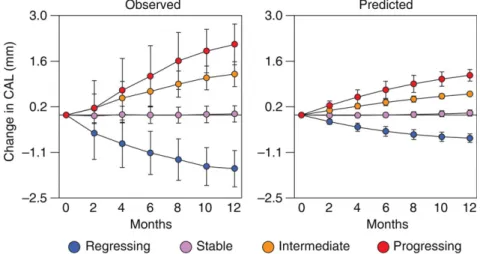
From the LMM for changes in CAL, the 75th percentile for the standard errors of prediction was 0.238 and the width of the 95% pre-diction interval for predicted ΔCAL 0.47 mm (see online supplementary material). Using this threshold to classify sites according to their pro-gressing state, progression occurred in 0.2%, 0.9% and 0.7% of the sites for healthy, mild and severe subjects (Table 3). Line plots of mean observed and predicted ΔCAL (SD) for sites in the four categories of progression illustrate how the classification scheme resulted in dis-tinguishable patterns of changes in CAL for both observed and pre-dicted values of CAL (Fig. 3). The proportion of progressing and reversing sites based on observed CAL measurements, stratified for the 4 categories of progression,
revealed that progressing sites had the highest proportions of sites crossing the thresholds for CAL change and the lowest percentages of reversal from the progressing state (Table 4). One can also observe that for the 1 and 2 mm thresholds, the rates of reversals decreased over time in progressing sites.
Using all sites from a single par-ticipant (subject X) with changes ≥2 mm at 12 months to illustrate, plotting the observed CAL measure-ments or their changes from baseline does not distinguish profiles for the different sites (Figs S1a and b respectively). In contrast, the LMM smoothed the longitudinal profiles of CAL measurements, helping to dif-ferentiate profiles from different sites (Fig. S1c). Plotting changes in pCAL (DpCAL) values revealed distinct patterns of change. For instance, the three curves that had the greatest change in pCAL, including the one highlighted in red, were the only three classified as being progressed based on the LMM approach (Fig. S1d).
Discussion
The use of LMMs to predict peri-odontal disease progression showed several advantages over traditional methods described in the literature. First, the LMMs could be applied to all visits from all subjects simultane-ously while accounting for variation in CAL measurements within sub-jects over time and between subsub-jects. Specifically, by introducing subject-specific intercepts, slopes and quad-ratic trends (i.e. random effects), the models accounted for the random fluctuations in CAL measurements over time, while providing smoothed predicted profiles of site-specific change in predicted CAL for each site. The predictions were
addition-Fig. 2.Plots of probabilities that clinical attachment loss (ΔCAL)≥1 mm against time
for the three disease categories: periodontally healthy, mild periodontal loss and severe periodontal loss, calculated using alternating logistic regression.
Table 3. Number of subjects and number and percentage of sites (in parenthesis) for each of the four categories of progression from base-line to month 12 with classifications based on base-linear mixed model predictions of CAL for subjects in the three distinct clinical groups. Categories of Progression
ally based on “fixed effects,” which are similar to the more familiar coef-ficients from standard linear
regres-sion models. In particular, the model adjusted for potential influences on CAL changes from age, gender and
baseline mean CAL (subject level) differences.
Using a cut-off based on the standard errors of predicted change in CAL, we classified a small per-centage of sites as progressing. Although we cannot verify the bio-logical or clinical accuracy of this classification, this proportion agrees with literature suggesting that peri-odontal disease progression affects a very small percentage of examined sites (Lindhe et al. 1983, 1989, Papa-panou et al. 1989, Heitz-Mayfield et al. 2003, Schatzle et al. 2003). Also in accord with the literature, we classified as progressing a higher percentage of sites in subjects with versus without periodontitis (L€oe et al. 1986).
Different approaches in the litera-ture have been used to overcome the influence of error in measurement of CAL in classifying periodontal dis-ease progression (Haffajee et al. 1983, Aeppli & Pihlstrom 1989,
Fig. 3.Line plots of mean changes in clinical attachment loss (DCAL) for observed
and predicted values over time for sites grouped in the four categories of progression based in the linear mixed models: Regressing –1,918 sites from 238 subjects; Stable– 46,661 sites from 329 subjects; Intermediate– 3,535 sites from 319 subjects; and Pro-gressing–327 sites from 147 subjects. Whiskers indicate standard deviation.
Table 4. Observed percentage of sites with progression and percentage of progressed sites with reversals at the subsequent visit (i.e. no longer being in the state of progression) based on changes in CAL from baseline greater than or equal to 1, 2 and 3 mm at each visit and stratified for the four site categories of progression.
Progression Category Visit Threshold of change in CAL
1 mm 2 mm 3 mm
Progression Reversal Progression Reversal Progression Reversal Regressing 2 months 9.5% – 1.9% – 0.2% –
4 months 6.0% 69.0% 0.8% 72.0% 0.2% 75.0% 6 months 3.1% 76.0% 0.6% 71.0% 0.1% 100.0% 8 months 1.0% 90.0% 0.1% 100.0% 0.1% 100.0% 10 months 0.3% 100.0% 0.0% 100.0% 0.0% 100.0% 12 months 0.0% 100.0% 0.0% * 0.0% * Mean: 3.3% 87.0% 0.6% 85.8% 0.1% 93.8% Stable 2 months 13.7% – 1.2% – 0.1% –
4 months 15.7% 48.0% 1.4% 73.0% 0.1% 85.0% 6 months 15.0% 50.0% 1.3% 75.0% 0.1% 92.0% 8 months 15.0% 51.0% 1.0% 84.0% 0.1% 100.0% 10 months 15.7% 50.0% 1.1% 84.0% 0.1% 96.0% 12 months 16.8% 50.0% 0.9% 89.0% 0.0% 95.0% Mean: 15.3% 49.8% 1.2% 81.0% 0.1% 93.6% Intermediate 2 months 25.4% – 4.7% – 0.5% –
4 months 47.0% 24.0% 8.2% 51.0% 1.2% 44.0% 6 months 58.1% 22.0% 11.5% 51.0% 0.9% 88.0% 8 months 71.4% 16.0% 14.6% 54.0% 1.3% 86.0% 10 months 81.4% 12.0% 20.2% 48.0% 1.7% 70.0% 12 months 86.7% 12.0% 22.8% 55.0% 2.3% 90.0% Mean: 61.7% 17.2% 13.7% 51.8% 1.3% 75.6% Progressing 2 months 29.8% – 7.0% – 1.6% –
Machtei et al. 1993). Most strategies focus on identifying thresholds of change in CAL that would compen-sate for variance in CAL assess-ments, as determined by pairs of cross-sectional measurements. How-ever, given the high level of errors in CAL measurements in periodontitis subjects, detection of changes in CAL are subjected to high rates of false-positives (Corraini et al. 2013). Another weakness of this approach is its lack of accounting for longitu-dinal sources of variation in CAL measurements (Espeland et al. 1991). An additional challenge is that apparent longitudinal fluctuation in CAL that is partly due to measure-ment error may be indistinguishable from actual reversal in CAL. As illustrated by the high proportion of sites demonstrating reversal after crossing the threshold of ≥3 mm of CAL increase in our dataset, raising the threshold for progression does not avoid issues associated with reversal of changes in CAL and in fact was associated with a high over-all proportion (70–80%) classified as reversing within any time interval.
Indeed, one of the first questions raised after we detected relatively high rates of reversal was if disease progression had occurred at all in this population. To globally address this issue we tested if the proportion of sites crossing certain thresholds of increases in CAL would accumulate over time. The use of ALR provided strong evidence that the percentage of sites with increases in CAL accu-mulated over time in all clinical groups. That the apparent high rate of reversal did not nullify increases in CAL supports the notion that dis-ease progression truly occurred. Noteworthy, when the proportions of sites crossing the preset thresholds of CAL increase and the rates of reversal were computed for sites stratified in the four categories of progression, progressing sites had the highest proportions of sites crossing the three thresholds of increases in CAL and the lowest rates of reversal. These results indi-cate that our classification of pro-gression was able to identify sites with a high likelihood of having undergone “irreversible” progression. Because the diagnosis of peri-odontal disease progression relies on changes in CAL, which are known
to have many sources of error (Cor-raini et al. 2013), we made every effort to minimize the error in the CAL measurements. Values for the average SD of duplicate site-specific CAL measurements reported in the literature have varied from 0.63 mm (Zappa et al. 1991) to 0.84 mm (Goodson et al. 1982). Our results compared favourably with these fig-ures with an overall mean SD of replicate CAL measurements of only 0.28 mm. This could be partly explained by the inclusion of peri-odontally healthy subjects in this study population (most studies examined only subjects with peri-odontitis) and a lower level of dis-ease in the subjects with periodontitis. Some investigators have reported intra-examiner CAL or relative attachment level agree-ment ≤1.0 mm for replicate measure-ments of CAL varying from 93% (Baelum et al. 1993) to 97% (Cham-bers et al. 1991). We obtained 96% intra-examiner agreement within 1 mm. Further longitudinal follow-up of examiner reproducibility demonstrated no drift in intra-exam-iner agreement over time.
The approach described here is not without shortcomings. Perhaps the main limitation of the analysis was that it was impossible to deter-mine the diagnostic reliability of the proposed method, as the true diag-nosis of disease progression remains unknown. In fact, because we cannot separate biologically or clinically meaningful fluctuation from mea-surement error, it is possible that we smoothed relevant changes in CAL along with noise. This problem is not unique to the proposed approach, and we anticipate that as the field accrues more well-collected longitudinal data, we can begin to develop gold standard measures of progression. Further, computational difficulties associated with model complexity, specifically with respect to the number of variance compo-nents requiring estimation, prohib-ited the simultaneous fitting of all sites. Fully Bayesian model estima-tion may circumvent these difficul-ties. Nonetheless, the LMM applied to individual sites leveraged repeated measurements data from all partici-pants and should better account for errors in CAL measurements than previously proposed approaches.
In summary, the LMM accounted for several sources of error in longitu-dinal CAL measurement with the goal of enabling a more accurate identification of progressing sites. The results corroborate previous investigations suggesting that the diagnosis of disease progression based on a pair of visits is prone to a high rate of false positives.
References
Aeppli, D. M. & Pihlstrom, B. L. (1989) Detec-tion of longitudinal change in periodontitis.
Journal of Periodontal Research24, 329–334. Baelum, V., Wen-Min, L., Dahlen, G., Fejerskov,
O. & Xia, C. (1993) Six-year progression of destructive periodontal disease in 2 subgroups of elderly Chinese. Journal of Periodontology
64, 891–899. doi:10.1902/jop.1993.64.9.891. Breen, H. J., Johnson, N. W. & Rogers, P. A.
(1999a) Site-specific attachment level change detected by physical probing in untreated chronic adult periodontitis: review of studies 1982-1997. Journal of Periodontology70, 312– 328. doi:10.1902/jop.1999.70.3.312.
Breen, H. J., Rogers, P. A., Slaney, R. E., Gillett, I. R. & Johnson, N. W. (1999b) Option-4 algo-rithm for third generation disc probe: agree-ment of selected site-specific relative attachment level measurements and detection of longitudinal site-specific attachment level change.Journal of Periodontology70, 159–170. doi:10.1902/jop.1999.70.2.159.
Carey, V., Zeger, S. L. & Diggle, P. (1993) Modeling multivariate binary data with alter-nating logistic regressions.Biometrika80, 517–
526. doi:DOI 10.1093/biomet/80.3.517. Chambers, D. A., Imrey, P. B., Cohen, R. L.,
Crawford, J. M., Alves, M. E. & McSwiggin, T. A. (1991) A longitudinal study of aspartate aminotransferase in human gingival crevicular fluid.Journal of Periodontal Research26, 65–74. Cnaan, A., Laird, N. M. & Slasor, P. (1997)
Using the general linear mixed model to anal-yse unbalanced repeated measures and longitu-dinal data. Statistics in Medicine 16, 2349–
2380. doi:Doi 10.1002/(Sici)1097-0258 (19971030)16:20<
2349:Aid-Sim667>3.0.Co;2-E.
Corraini, P., Baelum, V. & Lopez, R. (2013) Reli-ability of direct and indirect clinical attachment level measurements. Journal of Clinical Peri-odontology40, 896–905. doi:10.1111/jcpe.12137. Espeland, M. A., Zappa, U. E., Hogan, P. E., Simona, C. & Graf, H. (1991) Cross-sectional and longitudinal reliability for clinical measure-ment of attachmeasure-ment loss. Journal of Clinical Periodontology18, 126–133.
Goodson, J. M., Tanner, A. C., Haffajee, A. D., Sornberger, G. C. & Socransky, S. S. (1982) Patterns of progression and regression of advanced destructive periodontal disease. Jour-nal of Clinical Periodontology9, 472–481. Haffajee, A. D., Socransky, S. S. & Goodson, J.
M. (1983) Comparison of different data analy-ses for detecting changes in attachment level.
Journal of Clinical Periodontology10, 298–310. Harley, A., Floyd, P. & Watts, T. (1987)
Moni-toring untreated periodontal disease.Journal of Clinical Periodontology14, 221–225.
N. P. (2003) Clinical course of chronic peri-odontitis. II. Incidence, characteristics and time of occurrence of the initial periodontal lesion. Journal of Clinical Periodontology 30, 902–908.
Holditch-Davis, D., Edwards, L. J. & Helms, R. W. (1998) Modeling development of sleep-wake behaviors: I. Using the mixed general linear model.Physiology & Behavior63, 311–318. Jeffcoat, M. K. & Reddy, M. S. (1991) Progression
of probing attachment loss in adult periodonti-tis.Journal of Periodontology62, 185–189. Laird, N. M. & Ware, J. H. (1982)
Random-effects models for longitudinal data.Biometrics
38, 963–974.
Lindhe, J., Haffajee, A. D. & Socransky, S. S. (1983) Progression of periodontal disease in adult subjects in the absence of periodontal therapy.Journal of Clinical Periodontology10, 433–442.
Lindhe, J., Okamoto, H., Yoneyama, T., Haffa-jee, A. & Socransky, S. S. (1989) Longitudinal changes in periodontal disease in untreated subjects.Journal of Clinical Periodontology16, 662–670.
Liu, H., Weiss, R. E., Jennrich, R. I. & Wenger, N. S. (1999) PRESS model selection in repeated measures data. Computational Statis-tics & Data Analysis30, 169–184.
Loe, H., Anerud, A., Boysen, H. & Morrison, E.€ (1986) Natural history of periodontal disease in man. Rapid, moderate and no loss of attach-ment in Sri Lankan laborers 14 to 46 years of age.Journal of Clinical Periodontology13, 431– 445.
Machtei, E. E., Dunford, R., Hausmann, E., Grossi, S., Norderyd, J. & Genco, R. J. (1993) A stepwise approach to determine periodontal attachment loss in longitudinal studies.Journal of Periodontal Research28, 536–539.
Papapanou, P. N., Wennstrom, J. L. & Grondahl, K. (1989) A 10-year retrospective study of
peri-odontal disease progression.Journal of Clinical Periodontology16, 403–411.
Schatzle, M., Loe, H., Lang, N. P., Heitz-May-field, L. J., Burgin, W., Anerud, A. & Boysen, H. (2003) Clinical course of chronic periodonti-tis. III. Patterns, variations and risks of attach-ment loss. Journal of Clinical Periodontology
30, 909–918.
Socransky, S. S., Haffajee, A. D., Goodson, J. M. & Lindhe, J. (1984) New concepts of destruc-tive periodontal disease. Journal of Clinical Periodontology11, 21–32.
Zappa, U., Reinking-Zappa, M., Graf, H. & Espeland, M. (1991) Cell populations and epi-sodic periodontal attachment loss in humans.
Journal of Clinical Periodontology18, 508–515.
Supporting Information
Additional Supporting Information may be found in the online version of this article:
Figure S1. (a) Line plot of clinical attachment loss (CAL) measure-ments for 30 sites with changes ≥2 mm in observed CAL measure-ments from baseline to 12 months from a single participant (subject X). (b) changes in CAL (DCAL) for the same 30 sites. (c) predicted CAL val-ues from the linear mixed models for the same 30 sites over time. (d) changes in the predicted CAL over time. The blue profile highlights an
example of a site classified as stable, whereas the red profile illustrates a progressing site based in the LMMs. Table S1. Log odds ratio estimates (standard errors) from the ALR analysis with dichotomous outcome ΔCAL ≥1 mm versus ΔCAL <1 mm with change relative to baseline CAL.
Table S2. Sites with the highest and the lowest mean PRESS statistics. Table S3. Sites with the highest and the lowest mean absolute PRESS residuals.
Table S4. Quantiles mean PRESS statistics.
Table S5. Quantiles mean absolute PRESS residuals.
Table S6.Summary statistics for the standard errors of changes in pre-dicted values.
Table S7. Quantiles of the standard errors of predicted change in CAL.
Address:
Ricardo Teles
Department of Periodontology UNC School of Dentistry Koury Health Sciences Building 385 S. Columbia Street, Room 3506 Chapel Hill, NC 27599-7455
E-mail: [email protected]
Clinical Relevance
Scientific rationale for the study: Periodontal disease progression is diagnosed based on changes in CAL measurements which are known to be prone to error. We used linear mixed models to account for errors in classifying periodontal sites regarding disease progression.
Principal findings: Fluctuations in
longitudinal CAL measurements over time resulted in implausibly high proportions of sites reversing from a progressing state. The linear mixed model for each site provided subject-specific predicted trends hav-ing patterns consistent with peri-odontal disease progression.