Enantioselective [2+2+2] Cycloadditions of Ene-Allenes and Allenes
Andrew T. Brusoe
A dissertation submitted to the faculty of the University of North Carolina at Chapel Hill in partial fulfillment of the requirements for the degree Doctor of Philosophy in the Department of Chemistry.
Chapel Hill 2013
ABSTRACT
ANDREW T. BRUSOE: Enantioselective [2+2+2] Cycloadditions of Ene-Allenes and Allenes (Under the direction of Erik J. Alexanian)
Acknowledgements
I would like to thank those that helped make that aided me in the pursuit of my PhD. Foremost, I thank my advisor Erik Alexanian for providing guidance, support, and hands-on training. I also thank the other faculty members of the Department of Chemistry who I have had the pleasure of interacting with. Among these, I especially thank Professors Maurice Brookhart and Jeff Johnson for sparking my interest in physical organic chemistry. I thank Professors Mike Crimmins and Dave Nicewicz and their research groups for access to their instrumentation and chemicals and for the technical assistance necessary to complete my work. I thank Professors Maurice Brookhart, Jeff Johnson, Simon Meek, and Joseph Templeton for serving on my thesis committee. I thank my colleagues in the Alexanian group for ensuring a light-hearted work environment and Dr. Rahul Edwankar for his efforts towards the work described in Chapter III.
I would like to thank former co-workers and mentors who helped me prepare for my graduate career. I particularly thank Professors Vanessa McCaffrey, Andrew French, and John Huffman and Dr. Seon Hepburn for proving assistance and advice during earlier years of my chemical education.
Table of Contents
List of Tables ... vii
List of Abbreviations and Symbols ... x
Chapter I: Background ... 1
Chapter II: Development of an Ene-Allene and Allene [2+2+2] Cycloaddition ... 15
A. Initial Result ... 15
B. Catalyst Optimization ... 17
C. Added Allene Scope ... 20
D. Substrate Scope ... 22
E. Postreaction Modification of [2+2+2] Cycloadducts ... 26
F. Summary... 27
Chapter III: Development of Enantioselective Allene-Ene-Allene [2+2+2] Cycloaddition ... 28
A. Effect of the Ligand on Yield and Enantioselectivity ... 28
B. Effect of the Precatalyst, Counterion, and Solvent on Yield and Enantioselectivity ... 32
C. Effect of Miscellaneous Reaction Parameters on Yield and Enantioslectivity ... 35
D. Effect of Added Allene on Yield and Enantioselectivity ... 36
E. Effect of ene-allene Structure on Yield and Enantioselectivity ... 37
Chapter IV: Discussion of the Reaction Mechanism ... 40
A. Determination of the Reaction Mechanism ... 40
B. Origin of Stereoselectivity ... 44
Appendix I – Structural Isomers of Cycloadducts ... 50
Appendix II – Ligand Structures ... 51
Appendix III – Experimental Procedures and Data ... 52
A. General Methods ... 52
B. Preparation of Added Allenes ... 52
D. Preparation of [2+2+2] Cycloadducts ... 73
E. Modified adducts ... 89
F. Ligands ... 92
Appendix IV – Select NMR Spectra for Cycloadducts ... 96
List of Tables
Table 1. Representative Optimization Experiments. ... 18
Table 2. The Ligand Effect on Yield and Enantioselectivity ... 29
Table 3. Screen of (R)-H8-BINAP derivatives ... 31
Table 4. Counterion Effect on Yield and Enantioselectivity ... 33
Table 5. Solvent Effect on Yield and Enantioselectivity. ... 34
List of Figures
Figure 1. Early examples of metal-catalyzed cycloadditions. ... 1
Figure 2. Catalytic cycles of metal-catalyzed [2+2+2] cycloadditions. ... 2
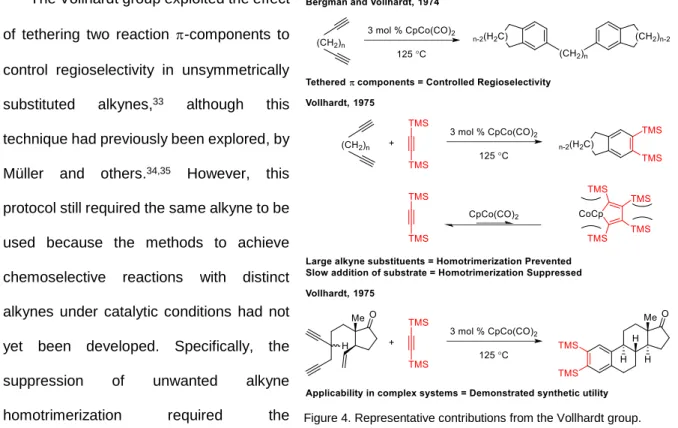
Figure 3. Early examples of [2+2+2] cycloadditions of tethered -components... 3
Figure 4. Representative contributions from the Vollhardt group. ... 4
Figure 5. Mori’s work on catalytic asymmetric [2+2+2] cycloadditions. ... 5
Figure 6. Typical products of intramolecular [2+2+2] cycloadditions of alkynes. ... 6
Figure 7. The first enantioselective [2+2+2] cycloadditions generating sp3 stereocenters. ... 6
Figure 8. Representative catalytic asymmetric [2+2+2] cycloadditions of diynes. ... 7
Figure 9. Intramolecular enantioselective [2+2+2] cycloadditions that generate two stereocenters. ... 8
Figure 10. Montgomery’s [2+2+2] cycloaddition of ene-ynes and an added alkene. ... 8
Figure 11. Representative catalytic asymmetric [2+2+2] cycloadditions... 9
Figure 12. Frontier orbital interactions in olefin-metal complexes. ... 10
Figure 13. Equilibrium constants for ligand exchange of an olefin with a phosphine. ... 11
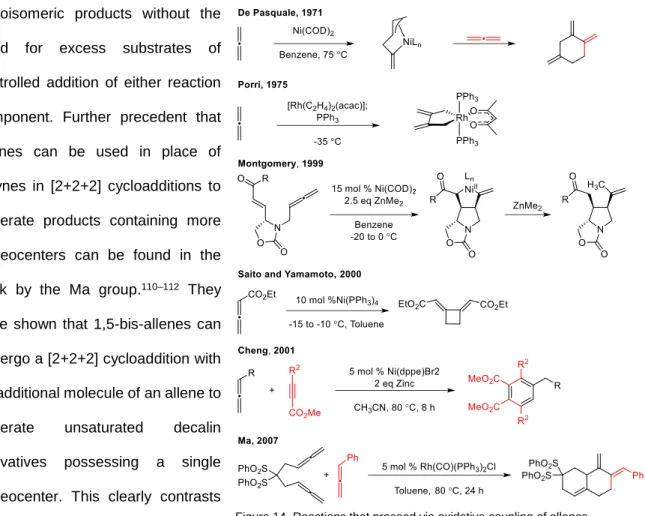
Figure 14. Reactions that proceed via oxidative coupling of allenes. ... 13
Figure 15. Preparation of ene-allenes. ... 15
Figure 17. X-Ray crystal structure of compound 6. ... 16
Figure 16. Initial results of ene-allene [2+2+2] cycloaddition. ... 16
Figure 18. Allenes screened that did not afford the desired [2+2+2] cycloadduct in good yield. ... 20
Figure 19. Allenes that undergo the [2+2+2] cycloadduction ... 22
Figure 20. Ene-allene tethers evaluated. ... 22
Figure 21. Substrates containing substituted allenes. ... 23
Figure 22. Substrates possessing modified alkenes. ... 25
Figure 23. Post-reaction modifications of [2+2+2] cycloadducts. ... 26
Figure 24. Structures of (R)-BINAP and (R)-H8-BINAP. ... 28
Figure 25. Preparation of (R)-H8-BINAP derivatives. ... 31
Figure 26. Effect of the added allene on the yield enantioselectivity of the [2+2+2] cycloaddition. ... 36
Figure 28. Plausible reaction mechanisms. ... 40
Figure 30. Reaction that established precedent for allene-allene oxidative coupling. ... 43
Figure 31. Experiments to determine if an added allene acts as a dative ligand. ... 43
Figure 29. The change in steric environment from a change in dihedral angle. ... 45
Figure 32. Quadrant diagrams. ... 47
Figure 33. Model used to explain poor performance of 1,1-disubstituted allenes. ... 47
Figure 34. Rationale for formation of the observed diastereomers. ... 48
Figure 36. Lowest energy conformation after oxidative coupling of 1,2-butadiene. ... 48
Figure 36. All possible products from the [2+2+2] cycloaddition of 1 and ethyl allenoate. ... 50
List of Abbreviations and Symbols
(solv) solvate
3,4,5-tri-MeO-MeO-BIPHEP 2,2'-Bis[di(3,4,5-trimethoxyphenyl)phosphino]-6,6'- dimethoxy-1,1'-biphenyl
3,5-iPr-4-Me2N-MeO-BIPHEP 2,2'-Bis[di(3,5-di-i-propyl-4-dimethylaminophenyl)phosphino]-6, 6'-dimethoxy-1,1'-biphenyl
4,4’-TMS-BINAP 4,4'-bis(trimethylsilyl)-2,2'-bis(diphenylphosphino)-1,1'-binaphthy
Acac acetylacetonate
Ar aryl
BINAM 2,2'-Bis(N-diphenylphosphinoamino)-5,5',6,6',7,7',8,8'-octahydro
BINAP 1,1'-Binaphthyl-2,2'-diyl hydrogenphosphate
BINOL 1,1'-Bi-2-naphthol
Bn benzyl
BTFM-Garphos 2,2'-Bis[bis(3,5-trifluoromethylphenyl)phosphino]-4,4',6,6'- tetramethoxybiphenyl
BTMSA bis(trimethylsilyl)acetlylene
C3-TunePhos 1,13-Bis(diphenylphosphino)-7,8-dihydro-6H-dibenzo[1,5]dioxonin catASiumMNXyl (-)-2,3-Bis[(2R,5R
)-2,5-dimethylphospholanyl]-1-(3,5-dimethylphenyl)-1H-pyrrole-2,5-dione
Chenphos 1-[(S)-Ferrocenyl-2-(R)-ethyl-1-dimethylamino)-phenyl]-(S )-phosphino-1'-dicyclohexylphosphino-ferrocene
CHIRAPHOS Bis(diphenylphosphino)butane
Cl Chloro or Chloride
Cl-MeO-BIPHEP 5,5'-dichloro-6,6'-dimethoxy[1,1'-biphenyl]-2,2'-diyl]-bis-diphenylphosphine
COD 1,5-cyclooctadiene
coe cyclooctene
Cp Cyclopentadienyl or Cyclopentadiene
Cy cyclohexyl
Cy2PF-Pcy2 (R)-1-[(S )-2-Dicyclohexylphosphino-ferrocenyl]-ethyl-di-cyclohexylphosphine
Cy2PPhCHNMe2-T-PCy2 (S)-(-)-[(S
)-2-Dicyclohexylphosphinoferrocenyl](N,N-dimethylamino)(2-dicyclohexylphosphinophenyl)methane
DCE 1,2-dichloroethane
DCM dichloromethane
DIFLUOROPHOS 5,5'-bis(diphenylphosphino)-2,2,2',2'-tetrafluoro-4,4'-bi-1,3-benzodioxole
DIOP 4,5-Bis(diphenylphosphinomethyl)-2,2-dimethyl-1,3-dioxolane
DMAD Dimethyl acetylenedicarboxylate
DMF N,N-dimethylformamide
DM-SEGPHOS 5,5'-Bis[di(3,5-xylyl)phosphino]-4,4'-bi-1,3-benzodioxole
DMSO dimethylsulfoxide
DTBM-MeO-BIPHEP 2,2'-Bis[di(3,5-di-t-butyl-4-methoxyphenyl)phosphino]-6, 6'-dimethoxy-1,1'-biphenyl
DTBM-SEGPHOS 5,5'-Bis[di(3,5-di-t-butyl-4-methoxyphenyl)phosphino]-4,4'-bi-1,3-benzodioxole
DT-MeO-BIPHEP 2,2'-Bis[di(3,5-di-t-butylphenyl)phosphino]-6,6'-dimethoxy-1, 1'-biphenyl
ee enantiomeric excess
eq Equivalent
ESI electrospray ionization
Et ethyl
furyl-MeO-BIPHEP 2,2'-Bis(di-2-furanylphosphino)-6,6'-dimethoxy-1,1'-biphenyl
h hour
H8BINAP 2,2'-Bis(diphenylphosphino)-5,5',6,6',7,7',8,8'-octahydro-1, 1'-binaphthyl
HOMO Highest Occupied Molecular Orbital
iPr-MeO-BIPHEP 2,2'-Bis(di-i-propylphosphino)-6,6'-dimethoxy-1,1'-biphenyl
IR infrared
LAH Lithium aluminum hydride, LiAlH4
Ln Generalized ligand set
LRMS low resolution mass spectrometry
LUMO Lowest Unoccupied Molecular Orbital
M Metal
Me Methyl
Me-DuPhos 1,2-Bis((2S,5S)-2,5-dimethylphospholano)benzene MeO-BIPHEP 2,2'-Bis(diphenylphosphino)-6,6'-dimethoxy-1,1'-biphenyl MeO-MOP 2-Diphenylphosphino-2'-methoxy-1,1'-binaphthyl
min minutes
MVK methyl vinyl ketone
NA not applicable
nbd norbornadiene
ND not determined
NMe2-P(3,5-Me-4-MeOPh)2 (S,S)-(-)-2,2'-Bis[(R )-(N,N-dimethylamino)(phenyl)methyl]-1,1'-bis[di(3,5-dimethyl-4-methoxyphenyl)phosphino]ferrocene NMe2-PPh2 2,2'-Bis[(R
)-(N,N-dimethylamino)(phenyl)methyl]-1,1'-bis(diphenylphosphino)ferrocene
NMR nuclear magnetic resonance
NR no reaction
OiPr iso-propoxide
OMs methanesulfonate
OTf trifluoromethanesulfonate
p-CF3-MeO-BIPHEP 2,2'-Bis(4-(trifluoromethyl)phenyl)-6,6'-dimethoxy-1,1'-biphenyl
Ph Phenyl
Ph2PPhCHNMe2-T-PPh2 (S)-(-)-[(S )-2-Diphenylphosphinoferrocenyl](N,N-dimethylamino)(2-diphenylphosphinophenyl)methane
Ph2PPhF-P(3,5-CF3Ph)2 (R)-(-)-1-[(R )-2-(2'-Diphenylphosphinophenyl)ferrocenyl]ethylbis(di-3,5-trifluoromethylphenyl)phosphine
Ph2PPhF-PPh2 (R)-(+)-1-[(R )-2-(2'-Diphenylphosphinophenyl)ferrocenyl]-ethyl-di-cyclohexylphosphine
PhanePhos 4,12-Bis(diphenylphosphino)-[2.2]-paracyclophane
p-MeO-BINAP 2,2'-bis[di-(p-methoxyphenyl) phosphino]-1.1'-binaphthyl PPF-PCy2 (R)-1-[(S)-2-(Diphenylphosphino)ferrocenyl]
ethyldicyclohexylphosphine ethanol adduct
PPF-PtBu2 (R)-1-[(S)-2-Diphenylphosphino)ferrocenyl]ethyl-di-t-butylphosphine PPF-PXyl2 (R)-1-[(S
)-2-Diphenylphosphino)-ferrocenyl]ethyl-bis-(3,5dimethylphenyl)phosphine
PPh3 Triphenylphosphine
p-Tol-BINAP 2,2'-Bis(di-p-tolylphosphino)-1,1'-binaphthyl
p-Tol-MeO-BIPHEP 2,2'-Bis(di-p-tolylphosphino)-6,6'-dimethoxy-1,1'-biphenyl
pyr Pyridine
Rf retention factor
rac racemic
SYNPhos 6,6'-Bis(diphenylphosphino)-2,2',3,3'-tetrahydro-5,5'-bi-1,4-benzodioxin
tBu tert-Butyl
THF Tetrahydrofuran
TMS Trimethylsilane
Tr Trityl, triphenylmethane
Ts toluenesulfonate
Xyl-MeO-BIPHEP Bis[di(3,5-xylyl)phosphino]-6,6'-dimethoxy-1,1'-biphenyl
Xylyl 3,5-dimethylphenyl
Xylyl-BINAP 2,2'-Bis[di(3,5-xylyl)phosphino]-1,1'-binaphthyl
Xylyl-P-Phos 2,2',6,6'-Tetramethoxy-4,4'-bis(di(3,5-xylyl)phosphino)-3, 3'-bipyridine
beta
Pi
Chapter I: Background
The efficient preparation of cyclohexane derivatives from commodity chemicals has been a long-standing objective in organic synthesis.1 Various ionic and pericyclic reactions have been developed to achieve this goal. The majority of these methods utilize stepwise bond constructions. Several methods, however, are capable of generating two -bonds in a single reaction. Among these, the Diels-Alder cycloaddition is unmatched in its ability to reliably and predictably generate cyclohexenes in high yield and enantioselectivity.2 Its application in natural product and target directed synthesis is unparalleled by any other single reaction.3 However, the thermal [4+2] cycloaddition generally requires activating substituents to ensure reasonable reaction rates.
An alternative approach toward the synthesis of cyclohexane derivatives would involve the construction of three -bonds during the cyclization and not require the presence of activating groups. One iteration of this hypothetical reaction would be the [2+2+2] cycloaddition of three alkenes. This process would generate a cyclohexane possessing up to six stereocenters using readily accessed compounds in a single step. This rapid generation of target-relevant molecular complexity from simple starting materials would represent a significant advance over current stepwise methodologies.4 Given this potential, it is not surprising that the [2+2+2] cycloaddition has been a widely studied approach for the preparation of six-membered carbocycles and heterocycles.5,6 The original work in this field, however, focused on the use of alkynes for the preparation of aromatic systems.
The first examples were reported by Walter Reppe in 1948,7 who described the use of simple nickel catalysts and the necessary conditions to affect the cyclotrimerization of acetylene or terminal alkynes to the corresponding arenes; the use of terminal
to cyclooctatetraene is observed. In the presence of the reported nickel catalysts, the reaction can be conducted at reasonable temperatures and pressures, whereas the analogous uncatalyzed cyclotrimerization proceeds only under extreme conditions (400°C).
The requirement for a catalyst is somewhat surprising because the reaction is remarkably exothermic (ca. 142 kcal/mol).8 Nonetheless, the activation parameters associated with an uncatalyzed pathway are prohibitively high (Gǂ 60 – 80 kcal/mol). The termolecular transition state required for a concerted reaction intermolecular has a large entropic barrier, whereas the ionic and radical stepwise pathways (which would require the formation of vinyl anions and cations or radicals, respectively) are inaccessible due to significant enthalpic barriers. In general, transition-metal-catalyzed cycloadditions lower both the entropic and enthalpic barriers relative to an uncatalyzed reaction. Thus, the thermal trimerization of acetylenes requires extremely harsh conditions whereas the catalyzed reaction is spontaneous at room temperature.
Because of the tremendous thermodynamic driving force, it is not surprising that numerous metals capable of catalyzing this transformation have been discovered or developed. Subsequent work since the original report has shown the cyclotrimerization of acetylenes to arenes can be catalyzed by Zr,9 V,10 Ta, Cr, Mo, W,11 Fe,12 Co, Rh, Ir,13 Pd,14,15 and Cu16. Although this background chapter will focus on the construction of carbocycles, this methodology has also been extended for the synthesis of heterocycles.17
Although mechanistic subtleties exist, the most commonly evoked mechanisms for transition-metal-catalyzed cycloadditions consist of the following steps (Figure 2): 1) Coordination of two -components to the active transition-metal catalyst; 2) Oxidative coupling[1] of the metal to generate a metallocycle;18,19 3a) A Diels-Alder-like incorporation of the third -component to generate a metallo-norbornadiene or; 3b) 1,2-Insertion of the third -component to generate a
metallo-cycloheptatriene; 4a ) A retro [4+1] or; 4b) Reductive elimination to form the product.20 Displacement
[1]The term oxidative coupling is used with respect to the metal. During this transformation, the metal undergoes a formal increase
of the product from the catalyst with an additional equivalent of substrate initiates another cycle. Although the catalytic reaction is an efficient method to prepare aromatic compounds, it is not necessarily the best way to prepare a particular compound of interest. That is, the reaction is only high yielding for the cyclotrimerization of the same alkyne. When mixtures of alkynes are used, a statistical product distribution is usually obtained. Furthermore, the products are usually obtained as an unselective mixture of regioisomeric products, which limits the utility both in complex settings and for bulk chemical preparation. These problems were largely unresolved for thirty years, and the fully intermolecular cycloaddition of three distinct -components remains a daunting synthetic challenge.6,21
One method to control regioselectivity of [2+2+2] cycloaddition is via the tethering of two of the reaction components. This technique was demonstrated in stoichiometric examples of partially intramolecular [2+2+2] cycloadditions by Müller during the 1970’s (Figure 3).22–32 He showed that upon treatment of a diyne with Wilkinson’s catalyst a metallo cyclopentadiene could be obtained. Importantly, this
organometallic compound would undergo a rapid reaction with an added alkyne to generate a new aromatic product. This two-step process constitutes a formal, intramolecular [2+2+2] cycloaddition. Notably, treatment of these compounds with alkenes, including potent dienophiles, does not result in the formation of the corresponding cyclohexadiene. These results suggest that alkynes, relative to alkenes, are significantly more reactive under these conditions. Furthermore, the results establish metallocyclopentadienes as plausible intermediates in the subsequent alkyne cyclotrimmerizations catalyzed by rhodium. Despite the studies of the novel reactivity of diynes in the presenece of Wilkinson’s catalyst, the need for a stoichiometric amount of rhodium prevented the wide-spread application of this method.
The applicability of economically feasible multi-component cycloadditions was not well demonstrated until the Vollhardt group undertook a systematic investigations of [2+2+2] catalyzed by
Figure 3. Early examples of [2+2+2] cycloadditions of tethered
widely available and highly active CpCo(CO)2. The Vollhardt group studied [2+2+2] cycloadditions of three alkynes or two alkynes and an alkene in inter- and intra-molecular settings and addressed the previously identified limitations (vide supra). Figure 4 highlights some of the most important results of the Vollhardt group’s investigations of [2+2+2] cycloadditions. Reactions involving any alkenes (not shown) typically require high loadings of CpCo(CO)2 because the resulting products poison the catalytic activity of the complex.
The Vollhardt group exploited the effect of tethering two reaction -components to control regioselectivity in unsymmetrically substituted alkynes,33 although this technique had previously been explored, by Müller and others.34,35 However, this protocol still required the same alkyne to be used because the methods to achieve chemoselective reactions with distinct alkynes under catalytic conditions had not yet been developed. Specifically, the suppression of unwanted alkyne homotrimerization required the
development of two additional strategies. The first strategy involved the use of alkynes possessing very large substituents. The presence of the large substituents retards homotrimerization because the intermediate metallocycles and corresponding cycloadducts are highly strained.36 Thus, bis(trimethylsilyl)acetylene (BTMSA) was used because it does not undergo homotrimerization and the result aryl silanes readily undergo ipso substitution under mild conditions. The stability of BTMSA under the reaction conditions allows it to be present in excess without undergoing side reactions or without poisoning the catalyst, which enabled the development of the second critical strategy: the slow addition of the more-reactive -component to the less reactive component. The slow addition of the most reactive -components to the catalyst and BTMSA ensures a low concentration of the diyne, thereby
rendering cyclotrimerization of the diyne kinetically irrelevant. The combined use of these strategies greatly increased yields of the desired isomer and allowed alkyne cyclotrimerization to be used in the synthesis of complex molecules.
A classic example of the use of [2+2+2] cycloadditions in total synthesis is the Vollhardt’s preparation of estrone. During this synthesis, a [2+2+2] cycloaddition is used to generate a benzocyclobutane, which undergoes subsequent 4- electrocyclic ring opening to generate a diene, and terminates with a Diels-Alder cycloaddition with the tethered alkene. Remarkably, this transformation occurs in a single synthetic manipulation.37–41 The achievements of the Vollhardt group were responsible for a marked increase in the interest in [2+2+2] cycloadditions, and much work has been done subsequently by numerous groups. Today, the most commonly used metals in [2+2+2] cycloadditions are rhodium and nickel. Early examples demonstrating catalysis with these metals were obtained using Wilkinson’s catalyst (Grigg et. al. and Stevenson et. al.)42 and nickel tetrakis(triphenylphosphine) (Smith et. al.).43
Catalytic asymmetric reactions were a major challenge to be addressed in the area of [2+2+2] cycloadditions. A significant task associated with developing these reactions is the suppression all cycloadditions catalyzed by achiral metal complexes. Thus, complexes with chelating ligands are usually used to prevent ligand dissociation and thereby ensure that all catalytically active species are chiral. Moreover, cationic rhodium-based catalysts are generally used for these reactions because of the increased number of coordination sites allows simultaneous coordination of ligands, substrates, and solvent.
The majority of [2+2+2] cycloadditions published prior until 1995 generated benzenoid products. Because sp3 stereocenters were not commonly
produced in [2+2+2] cycloadditions, ways to affect enantioselective catalysis are non-obvious. The Mori group, using a nickel catalyst generated in situ from Ni(COD)2 and a chiral monodentate phosphines[2], reported the first example of enantioselective [2+2+2] cycloaddition. The reaction produces a
stereocenter via the desymmetrization of a triyne with acetylene (Figure 5).44 Although the isoquinoline cycloadducts are formed with moderate enantioselectivity, this reaction served as proof-of-principle for enantioselective [2+2+2] cycloadditions. Subsequent examples of asymmetric [2+2+2] cycloadditions have been provided by Evans, Shibata, and Tanaka,all of which have occurred since 2004.
Numerous groups, most notably the Shibata45–54 and Tanaka55–70 groups, have developed a multitude of catalytic asymmetric [2+2+2] cycloadditions of alkynes for the generation of atropisomeric products with high enantioselectivity (Figure 6) and can be used to access a variety of compounds.21,71–73 These
reactions are the most common examples of catalytic asymmetric [2+2+2] cycloadditions. A thorough discussion of these reactions is outside the scope of this brief background section, but in general, these reactions use rhodium or iridium-based catalysts in combination with DuPHOS, SEGPHOS, or BINAP ligands. Typically, the yields and enantioselectivities are excellent (>80%, >90% ee). Much of this chemistry was developed contemporaneously to the early asymmetric [2+2+2] cycloadditions that generate sp3 stereocenters.
The development of catalytic asymmetric [2+2+2] cycloadditions that generate sp3 stereocenters was based upon the prior precedent for the non-enantioselective reactions. The [2+2+2] cycloaddition of two alkynes and one alkene to form racemic products had
been well-documented using various metals (Co,74,75 Rh,76–78 Ir,79 and Pd77,80,81) for over twenty years before the first asymmetric example was demonstrated. The Evans82–84 and Shibata85,86 groups were the first to report enantioselective [2+2+2] cycloadditions using 1,6-eneynes as substrates. Each group reported the use of cationic rhodium-based catalysts to affect the [2+2+2] cycloadditions of 1,6-eneynes and disubstituted alkynes in excellent yields and enantioselectivities (Figure 7). Whereas the Evans
Figure 7. The first enantioselective [2+2+2] cycloadditions generating sp3
stereocenters.
system was generally limited to terminal, monosubstituted alkenes and aryl propiolates as the added -component, the Shibata group reported exclusively on the use of 1,1-disubstituted alkenyl substrates
in conjunction with terminal or disubstituted alkynes for both the tethered alkyne and the added alkyne. Exemplary yields are generally obtained via the Evans system, whereas the Shibata system produces variable yields dependent on the combination of substrate and alkyne. Excellent enantiocontrol is observed in both systems (the lowest enantioselectivity reported in either system is 88% ee). Both authors propose mechanisms that are consistent with the general scheme in Figure 2: Intramolecular coupling of the ene-yne; coordination and insertion of the second alkyne; reductive elimination. These reactions are the first reported examples of a [2+2+2] cycloadditions that generate sp3 stereocenters via rehybridization (as opposed to desymmetrization).
The catalytic asymmetric [2+2+2] cycloadditions of diynes and added alkenes have also been reported by Shibata87,88 and Tanaka (Figure 8).89,90 These reactions provide access
to products distinct to those generated in the cycloadditions of ene-ynes. The slow addition of the diyne to the added 1,1-disubstituted alkene (exo-methylene lactones, acrylates, and acrylamides) and catalyst is required to retard competitive alkyne homotrimerization. While the reactions furnish products in good yields with high enantioselectivities, only single stereocenters can be generated directly from these reactions. These stereocenters are always derived from 1,1-disubstituted alkenes, which must be used because the cyclohexadiene products lacking fully substituted centers are prone to yield and enantioselectivity lowering isomerization. A notable extension of this methodology was reported by Shibata88 in which the desymmetrization of norbornene affords a product containing four stereocenters. Highly strained bicyclic alkenes are used as the reaction partner because they have a high affinity for transition metals and the resultant cyclohexadienes are stable towards isomerization. In addition to norbornenes, styrenes and dienes can be used in this system, but the use of these alkenes results in products possessing a single stereocenter. Excluding reactions with norbornene derivatives, as of 2008
there were no reports of partially intermolecular catalytic asymmetric cycloadditions that generated greater than two stereocenters in a single reaction.
Figure 9 displays the first examples of catalytic asymmetric [2+2+2] cycloadditions that generate multiple stereocenters via rehybridization; these are fully intramolecular reactions. These reactions were also initially explored by Shibata91–94 and by Tanaka.95,96 The fully intramolecular nature of these reactions dicatates the chemo- and regioselectivity of the reaction, which allows multiple alkenes to be used in the presence of significantly more reactive alkynes. This strategy
works because the effective concentration of the tethered alkene is always substantially higher than that of another molecule of substrate and geometric constrains prohibit the formation of regioisomeric products. Various general classes of substrates can be used in these reactions, including diene-ynes, yne-ene-ynes, and ene-yne-enes and give rise to various fused and bridged tricyclic systems. While the fully intramolecular reactions are able to afford products possessing two stereocenters in high diastereoselectivity, including quaternary centers, the linear preparation of the substrates can be problematic and limits the potential utility of the reactions.
Intermolecular [2+2+2] cycloadditions of multiple alkenes are significantly less well established than the preceding intramolecular reactions. This is true for both enantioselective and non-enantioselective reactions. At
the onset of the work contained within this thesis, there had been only a single report in which multiple alkenes could be used in a partially intermolecular [2+2+2] cycloaddition (Figure 10). Montgomery has
Figure 10. Montgomery’s [2+2+2] cycloaddition of ene-ynes and an added alkene.
reported the use of an in situ generated nickel catalyst for the cycloaddition of ene-ynes and enones.97 The catalytic efficiency of these reactions is low (typically 3-4 turnovers), but the products contain three stereocenters (a single example of a product containing four stereocenters is reported). Remarkably, the reaction is a result of novel chemoselectivity in which an alkene undergoes preferential insertion into a nickelacycle. This realization was made based on the observation of a substrate dimer arising from a [2+2+2] of two molecules of substrate in which two alkenes and one alkyne undergo a reaction. Related reductive couplings of ene-ynes establish oxidative coupling between the alkyne and tethered alkene as a viable process.98,99
The first catalytic asymmetric intermolecular [2+2+2] cycloaddition of multiple alkenes was reported by Tanaka in 2012 after the completion
of the work described in this thesis (Figure 11).100 A system that affords high yields of enantiopure cycloadducts derived from 1,6-ene-ynes and acrylamides is described. Compared to most [2+2+2] cycloadditions, the substrate generality is quite high, as the substituents on the alkene, alkyne, and amide can be varied with minimal loss in yield or enantioselectivity. However, the use of acrylamides is critical to the successful of the reaction – all other activated alkenes result in the formation of substrate dimers. The authors proposed the enhanced Lewis basicity of the acrylamide allows chelation, thereby rendering it a more kinetically competent reaction partner.
A survey of the [2+2+2] cycloadditions presented in Figures 6 – 11 reveals that the catalysts and substrates used in the reactions possess many similarities. Virtually all of the catalytic asymmetric [2+2+2] cycloadditions are conducted with rhodium complexes of BINAP derivatives. The preference for rhodium-based catalysts is in part based on the low loadings of catalyst that can be used. Although thorough studies on the mechanisms of these [2+2+2] cycloadditions have not been conducted, the cationic complexes are likely more highly active complexes because an additional coordination site is generated upon abstraction of the chloride ligand. Furthermore, the use of cobalt-based catalysts is rare because the decomplexation of the products from the catalyst can be problematic. Analysis of the conditions surveyed in these publications does not reveal whether the choice of ligand significantly
influences the reaction yield or enantioselectivity. Therefore, it cannot be determined if the pervasive use of BINAP derivatives is due to their availability and cost or if reactions performed with other ligands give significantly lower yields and enantioselectivities. Thus, preliminary investigations of new catalytic asymmetric [2+2+2] cycloadditions should be conducted with cationic rhodium complexes ligated to BINAP derivatives.
To date, every enantioselective [2+2+2] cycloaddition to prepare carbocycles requires the presence of at least a single alkyne. This is problematic because the use of alkynes also intrinsically limits the number of stereocenters that can be generated during a [2+2+2] cycloaddition. After the reaction occurs, the product retains an unreacted -bond from each alkyne. Thus, each alkyne decreases the maximum number of stereocenters by two. A simple alternative would be the substitution of alkenes for alkynes, but implementation of this idea is challenging. First, highly substituted alkenes must be used to maximize the number of stereocenters that can be generated during a reaction. Most of the catalytic asymmetric [2+2+2] cycloaddition reported prior to this work only tolerate monosubstituted or 1,1-disubtituted alkenes. The methylene of terminal alkenes does not afford a stereocenter in the product. Thus, each terminal alkene used inherently limits the number of stereocenters by one. Furthermore, alkenes, relative to alkynes, typically have attenuated reactivity towards late transition metals. Thus, [2+2+2] cycloadditions of multiple alkenes typically encounter higher thermodynamic and kinetic barriers than those using alkynes. Also problematic is the high substrate specificity in most [2+2+2] cycloadditions. A particular catalytic system is generally intolerant towards structural changes (ie, a system that works well with 1,1-disubstituted alkenes cannot use 1,2-disubstituted alkenes).Therefore, attaining a catalytic asymmetric [2+2+2] cycloaddition that generates multiple stereocenters likely will require the presence of at least a single highly reactive -component (e.g., an alkyne) to offset any barrier encountered by a change in alkene substitution.
It is instructive to consider why alkynes are inherently more reactive than alkenes toward late transition metals,
particularly in [2+2+2] cycloadditions. This is best accomplished by evaluating the fundamentals of bonding between C-C -components and late transition metals (Figure 12). There are two bonding interactions between an alkene and a metal: -bonding, which results in the donation of electron density
from the HOMO of the alkene to the LUMO of the metal; -backbonding, which is the donation of electron density from the metal HOMO into the LUMO of the -component. Both of these bonding interactions occur simultaneously. The importance of these two bonding interactions is determined by the relative energy levels of the HOMO and LUMO for both the metal catalyst and the -component. Therefore, the electronegativity, oxidation state, and ligand sphere of the metal in addition to the identity of the -component (all of which change during the course of a reaction) all affect how strongly a given -component will bind to a given metal complex. Typically, for C-C double bonds and electron-rich late
transition metals, the dominant bonding interaction is -backbonding, whereas the dominant interaction in electron-poor early transition metals is -donation.
The second factor that controls the relative ability of two -components to coordinate to a metal is the relative steric properties of each potential ligand. Steric interactions between the metal and the -component weaken the bonding interaction; this is commonly encountered when substituted alkenes are used. Because of their respective geometries, alkynes are typically less hindered than the corresponding alkene. Thus, the relative binding affinity of -components to coordinate a late transition metal complex can be approximated as terminal alkyne > internal alkyne and ethylene >> terminal alkene > internal (Z)-alkene > internal (E)-alkene. Electron-withdrawing alkene substituents increase
-backbonding, whereas electron-donating substituents increase -bonding. The former increases the binding affinity for electron rich metals, whereas the latter promotes binding to electron-deficient metals.101,102
The binding affinity for numerous olefins with an electron rich Ni0 system has been
studied. Figure 13 shows the general trends discussed above operate to produce a dramatic impact on binding affinities. The alkenes with electron-withdrawing groups bind most strongly, whereas binding of sterically hindered alkenes is disfavored. It should be noted that these data were obtained using a complex that would maximize sensitivity to the LUMO energy of the olefins studied, and the magnitude
of preferences is expected to be lower for less -basic metal complexes (the HOMO energies of nickel(0)complexes are among the highest of common transition metal complexes).103 These data suggest in a quantitative sense that highly substituted alkenes should be viable reaction components in [2+2+2] cycloadditions provided the substituents contain electron-withdrawing groups.
Based on this information, it was hypothesized that reaction components which can strongly coordinate to transition metal catalysts and produce sp3 centers in the corresponding product could strike a balance between attaining a reasonable reaction rate and obtaining a product with multiple stereocenters (>2). Allenes were identified as possible -components for [2+2+2] cycloadditions. Allenes typically possess similar thermodynamic stabilities to that of the corresponding alkyne isomers while maintaining the same linear geometry.104 Thus, for the reasons detailed above, allenes should coordinate to metals strongly. However, unlike alkynes, allenes possess only a single sp hybridized atom. Regardless of which terminus reacts, a substituted allene should react to produce a new sp3 center. Furthermore, the allene isomer of a given alkyne is generally 3 – 5 kcal/mol less stable due to strain energy.104 This strain energy provides an additional thermodynamic driving force for the reaction. Therefore, replacing alkynes with allenes should allow the development of cycloadditions that produce products containing greater numbers of sp3-hybridized stereocenters relative to the isomeric alkyne substrates and potentially allow the use of multiple alkene partners.
regioisomeric products without the need for excess substrates of controlled addition of either reaction component. Further precedent that allenes can be used in place of alkynes in [2+2+2] cycloadditions to generate products containing more stereocenters can be found in the work by the Ma group.110–112 They have shown that 1,5-bis-allenes can undergo a [2+2+2] cycloaddition with an additional molecule of an allene to generate unsaturated decalin derivatives possessing a single stereocenter. This clearly contrasts typical [2+2+2] cycloadditions of
three alkynes; these reactions can only produce achiral benzenoid products. This last example validates the hypothesis that the use of allenes in [2+2+2] cycloadditions can be used as a general strategy to increase the number of stereocenters formed in the product.
Although allenes could be used to generate more stereochemically complex cycloadducts, the use of allenes in [2+2+2] cycloadditions does present some challenges not associated with the use of alkynes. Unlike an alkyne, the -bonds present in an allene are not necessarily degenerate. Therefore, the first challenge associated with using allenes in cycloadditions is the need to control which -bond of the allene reacts. This can be accomplished by biasing the substitution on the allene such that the -bonds are no longer degenerate (e.g. using electron-withdrawing groups to favor coordination at a
particular site) or by tethering two of the reacting -components, such that reacting at one terminus of the allene requires the adoption of energetically unfavorable conformations. The second challenge associated with using allenes as -components in [2+2+2] cycloadditions is the inherent reactivity of
the resultant allyl metal species. Therefore, the ensuing steps after the formation of allyl metal fragments must be sufficiently fast to decrease the likelihood of unproductive side reactions. The third consideration one must make when working with allenes is that allenes possessing just two different substituents on the opposite termini possess axial chirality. Thus, when designing an enantioselective cycloaddition of allenes, chiral allenes must be avoided. This limits one to the use of any monosubstituted allene or 1,1-disubstituted, 1,1,3-trisubstituted, or tetrasubstituted allenes containing identical substitution on at least one terminus.
The second prong of the strategy to generate cycloadducts possessing multiple stereocenters is the use of internal alkenes in conjunction with allenes. For reasons detailed above, the use of substituted alkenes is a significant challenge in [2+2+2] cycloadditions. To circumvent the lower affinity of late metals for substituted alkenes, initial efforts would focus on the use of alkenes with relatively low LUMO’s (e.g. acrylates).113 In addition to increasing the backbonding from the metal to the C-C *, the heteroatoms contained within the electron withdrawing groups may also be able to coordinate to the metal. Electron-withdrawing groups also increase the rate of insertion into carbon-metal bonds by stabilizing the resulting organometallic intermediate.102 Precedent for using electron-withdrawing groups to increase the stability of metalated intermediates has also been established previously. Montgomery’s previously discussed cycloaddition makes use of electron-withdrawing groups to allow various internal alkenes to be used in their [2+2+2] cycloaddition.97
Chapter II: Development of an Ene-Allene and Allene [2+2+2] Cycloaddition A. Initial Result
Based on the information presented in the background section, we hypothesized that ene-allenes would be an ideal class of substrates to develop a new [2+2+2] cycloaddition.
These substrates can be readily prepared via the dialkylation of malonates. The alkene portion of the substrate is readily appended via Wittig olefination of the corresponding aldehyde or by alkylation of the corresponding allenyl malonate with the appropriate allylic electrophile (Figure 15). The preparation of the requisite allenyl diethyl malonate requires four steps, starting from 1,4-butyn-diol. A monochlorination of the symmetric diol is followed by a LAH reduction to afford allenyl alcohol.114 Bromination of this alcohol is followed by alkylation with diethyl malonate. Although the yields for these steps are typically low (35 – 50%), the first two reactions can be conducted on > 1 mol scale. A one-step preparation of allenyl alcohol from propargyl alcohol via the Crabbe reaction has recently been reported.115,116 Using these methods, ene-allene 1 was prepared.
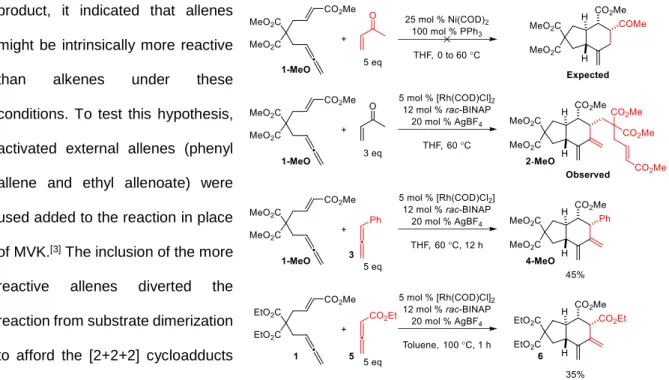
Preliminary reactions were conducted to generate a new cycloadduct from 1-MeO and methyl vinyl ketone (MVK). Based on conditions similar to those used in other [2+2+2] cycloadditions, 1-MeO and MVK were subjected to nickel and rhodium catalysts (Figure 9). No reaction was observed with nickel-based catalysts, but an unexpected substrate dimer was observed in an experiment conducted with an
in situ generated Rh/bisphosphine complex. Instead of undergoing an intermolecular cycloaddition with one molecule of substrate and the added MVK, a trans-hydrindane arose from reacting with two molecules of substrate. Remarkably, the substrate dimer was the only product present in the crude NMR of the reaction mixture – no other diastero- or constitutional isomers were present in the reaction. Additional experiments were performed to determine if this substrate dimerization could be developed into a general reaction. Because MVK, an unhindered, activated alkene, was not incorporated into the
product, it indicated that allenes might be intrinsically more reactive than alkenes under these conditions. To test this hypothesis, activated external allenes (phenyl allene and ethyl allenoate) were used added to the reaction in place of MVK.[3] The inclusion of the more reactive allenes diverted the reaction from substrate dimerization to afford the [2+2+2] cycloadducts arising from reaction with both the
added allene and 1-MeO. Remarkably, of the forty isomers that reasonably could be obtained from this reaction, only a single isomer was observed in all cases (see Appendix 1 for the other potential isomeric products).
Structural assignments were made for compound 6 based on 1D and 2D 1H and 13C NMR experiments and havw subsequently been confirmed by X-Ray crystallography (Figure 17). The structure of 6 was used to confirm the structures of compounds 2-MeO and 4-MeO based on analogy of the chemical shifts and coupling
constants. The X-Ray structure clearly indicates the trans stereochemistry of the ring junction as well the trans-trans-cis relationships of the stereocenters. The trans-configuration of the alkene was translated to the product. A number of unique structural features are present in compound 6. First, the presence of four new stereocenters is virtually unprecedented because most [2+2+2] cycloadditions generate only a single stereocenter. Furthermore, it is extremely rare for a carbocyclic cycloadduct to
[3]The malonate tether was switched from dimethyl to diethyl malonate because the resulting ene-allenes are less polar and give
Figure 16. Initial results of ene-allene [2+2+2] cycloaddition.
contain a stereochemically defined ring junction. Cycloisomerization reactions or higher order cycloadditions that do produce stereochemically defined ring junctions usually favor the formation of a
cis relationship.20 The observed trans-hydrindane carbocyclic framework is present in virtually all natural and synthetic steroids. Furthermore, stereoselective methods for the preparation of trans -hydrindanes are rare.117,118
B. Catalyst Optimization
All aspects of the catalyst system were analyzed to optimize the reaction. Initial experiments evaluated numerous solvents, reaction temperatures, silver salt additives, ligands, and reaction stoichiometries. These optimization efforts are summarized in Table 1. Reactions with phenyl allene are very difficult to monitor accurately, but, cycloadducts derived from ethyl allenoate produce large differences in Rf. Therefore, optimization reactions were performed with ethyl allenoate.
The initially used conditions of 5 eq of allenoate with respect to substrate were used because ethyl allenoate undergoes competitive side reactions to form a mix of uncharacterized side products.107 Thus, using an excess was necessary to ensure complete consumption of the substrate. Slow addition of the either component leads to lower conversions and significant amounts of substrate dimer (Entries 2 and 3). Dimerization occurs when the concentration of substrate is significantly higher than that of the added allene. By design, the concentration of allenoate is always low when it is added slowly. A low concentration of allenoate also occurs when the ene-allene is added slowly because the decomposition of allenoate is rapid in the absence of ene-allene. Thus, slow addition of either reaction component results in a decrease in yield. The concentration of the reaction is also important (not shown in the table). Reactions are run with an initial ene-allene concentration of 0.04 M. At lower concentration the reactions require much more time and at higher concentrations substrate dimerization becomes problematic. All subsequent reactions were performed at 0.04M by adding a solution of substrate and allenoate to the catalyst immediately prior to heating.
Table 1. Representative Optimization Experiments.
Entry [Rh], mol % [Ag], mol % Ligand, mol % eq Allene Solvent Temp
(°C) Time (h)
Isolated Yield (%)
1 [Rh(COD)Cl]2, 5 AgBF4, 20 BINAP, 12 5 THF 60 2 35
2 [Rh(COD)Cl]2, 5 AgBF4, 20 BINAP, 12 5a Toluene 80 6 25
3 [Rh(COD)Cl]2, 5 AgBF4, 20 BINAP, 12 5b Toluene 80 24 Trace
4 [Rh(COD)Cl]2, 5 AgBF4, 20 BINAP, 12 5 Toluene 100 2 50
5 [Rh(COD)Cl]2, 5 AgBF4, 20 BINAP, 12 1.25 Toluene 100 1.5 31
6 [Rh(COD)Cl]2, 5 AgOTf, 20 BINAP, 12 1.25 Toluene 100 1.5 43
7 [Rh(COD)Cl]2, 5 None BINAP, 12 1.25 Toluene 100 3 37c
8 [Rh(COD)Cl]2, 5 AgOTf, 20 BINAP, 12 5 Toluene 60 1.5 30c
9 [Rh(COD)Cl]2, 5 AgOTf, 20 BINAP, 12 1.25 DCE 80 3.5 27c
10 [Rh(COD)Cl]2, 2.5 AgOTf, 10 BINAP, 6 1.25 Toluene 100 1.5 48
11 [Rh(COD)Cl]2, 1 AgOTf, 4 BINAP, 2.4 1.25 Toluene 100 12 36 c
12 [Ir(COD)Cl]2, 2.5 AgOTf, 10 BINAP, 6 1.25 Toluene 100 1.5 0
13 [Rh(COD)Cl]2, 2.5 AgSbF6, 10 BINAP, 6 1.25 Toluene 100 1.5 40
14 [Rh(COD)Cl]2, 2.5 AgPF6, 10 BINAP, 6 1.25 Toluene 100 1.5 46
15 [Rh(COD)Cl]2, 2.5 AgOTf, 5 BINAP, 6 1.25 Toluene 100 1.5 57
16 [Rh(COD)Cl]2, 2.5 NaBArF,5 BINAP, 6 1.25 Toluene 100 1.5 34
17 [Rh(COD)Cl]2, 2.5 AgNTf2, 5 BINAP, 6 1.25 Toluene 100 1.5 40
18 [Rh(COD)Cl]2, 2.5 AgOTs, 5 BINAP, 6 1.25 Toluene 100 1.5 38
19 [Rh(COD)Cl]2, 2.5 AgTFA, 5 BINAP, 6 1.25 Toluene 100 1.5 NDd
20 [Rh(COD)Cl]2, 2.5 AgClO4, 5 BINAP, 6 1.25 Toluene 100 1.5 NDd
21 [Rh(COD)Cl]2, 2.5 AgAsF6, 5 BINAP, 6 1.25 Toluene 100 1.5 NDd
22 [Rh(COD)Cl]2, 2.5 AgOTf, 5 BINAP, 10 1.25 Toluene 100 1.5 52
23 [Rh(COD)Cl]2, 2.5 AgOTf, 5 BINAP, 6 1.25 Trifluorotoluene 100 12 43
24 [Rh(COD)Cl]2, 2.5 AgOTf, 5 BINAP, 6 1.25 DCE 100 3 41
25 [Rh(COD)Cl]2, 2.5 AgOTf, 5 BINAP, 6 1.25 9:1 Toluene/DCE 100 3 51
26 [Rh(COD)Cl]2, 2.5 AgOTf, 5 BINAP, 6 1.25 Mesitylene 100 3 59
27 Rh(PPh3)3Cl, 5 None None 1.25 Toluene 100 12 0
28 [Rh(CO)2Cl]2, 2.5 None PPh3, 11 1.25 Toluene 100 12 0
29 [Rh(COD)Cl]2, 2.5 AgOTf, 5 Segphos, 6 1.25 Toluene 100 12 23
30 [Rh(COD)Cl]2, 2.5 AgOTf, 10 o-tolyl-BINAP, 6 1.25 Toluene 100 12 39
31 [Rh(COD)Cl]2, 2.5 AgOTf, 10 MONOPHOS, 12 1.25 Toluene 100 12 0
32 [Rh(COD)Cl]2, 2.5 AgOTf, 5 P-Phos, 6 1.25 Toluene 100 12 41
33 [Rh(COD)Cl]2, 2.5 AgOTf, 5 MeDUPHOS, 6 1.25 Toluene 100 12 NR
34 [Rh(COD)Cl]2, 2.5 AgOTf, 5 Xylyl-BINAP, 6 1.25 Toluene 100 2 51
35 [Rh(COD)Cl]2, 2.5 AgOTf, 5 BINAP, 6 2 Toluene 100 2 63
36 [Rh(COD)Cl]2, 2.5 AgOTf, 5 H8-BINAP, 6 2 Toluene 100 2 64
37 [Rh(nbd)Cl]2, 2.5 AgOTf, 5 H8-BINAP, 6 2 Toluene 100 7 61
38 [Rh(coe)2Cl]2, 2.5 AgOTf, 5 H8-BINAP, 6 2 Toluene 100 2 76
39 [Rh(C2H4)2Cl]2, 2.5 AgOTf, 5 H8-BINAP, 6 2 Toluene 100 1.5 79
“Standard Conditions”
40 [Rh(COD)2][BF4], 10 AgBF4, 20 BINAP, 12 1.25 Toluene 100 1.5 32
41 None AgOTf4, 20 BINAP, 12 1.25 Toluene 100 12 0
42 [Rh(COD)Cl]2, 5 AgOTf4, 20 None 1.25 Toluene 100 12 0
aAllene added over the course of 3 h via syringe pump. bSubstrate added to over the course of 24 h via syringe pump. cIncomplete conversion.
gives an increase in yield, whereas reactions without silver salts give poorer conversions, require longer times, and elicit a decrease in yield (Entries 6 and 7). Reactions performed at a lower temperature (60 °C) or in an additional solvent (DCE) provided lower yields of the desired cycloadduct (Entries 8 and 9) so experiments were continued in toluene at 100 °C. Decreasing the catalyst loading from 10 mol % total [Rh] to 5 mol % gave a surprisingly large increase in yield, but reactions with lower loadings gave lower conversions and yields (Entries 10 and 11). The origin of the increase in yield is not well understood because control experiments indicate that the product is stable under the reaction conditions.
Because reactions in which AgOTf is used in place of AgBF4 gave higher yields, a more extensive counterion screen was conducted (Entries 16 – 21), but none provided higher yields than what is attained using AgOTf. Increasing the amount of the bidentate ligand slowed the reaction but did not increase the yield. A short solvent screen was also conducted because prior experiments showed a change in solvent typically influenced the yield. However, reactions in trifluorotoluene, DCE, and 9:1 toluene/DCE did not improve the yield (Entries 23 – 25). A marginal improvement in yield occurred by performing the reaction in mesitylene, but the difficulty in removing this solvent prompted the optimization to be continued in toluene.
It was unclear if the identity of the olefin contained in the rhodium precatalyst would have a significant impact on the yield of the reaction. Therefore, the reaction was performed using various olefin-bound rhodium precatalysts (Entries 37 – 39). Using [Rh(nbd)Cl]2, which contains the strongly coordinating bidentate diene norbornadiene, required much longer to consume the starting material. Reactions with cyclooctene and ethylene bound precatalysts gave the product in significantly higher yield and greatly shortened the reaction. This trend suggests that the olefins present on the precatalyst can compete with the substrate for open coordination site on the metal and that precatalysts with bidentate dummy ligands should be avoided. Thus, the following conditions were determined to be optimal for this reaction: 2.5 mol % [Rh(C2H4)2Cl]2, 6 mol % H8BINAP, 5 mol % AgOTf, with 2 equivalents of allenoate in toluene (0.04M), which afford a 79% yield of the desired cycloadduct 6 in the reaction of compound 1 with ethyl allenoate 5.
C. Added Allene Scope The first part of the substrate scope to be evaluated was the added allene scope. Because substrate dimerization occurs in the absence of added allene, it was expected that other alkyl-substituted allenes would be viable reaction partners. However, reactions with allenes possessing simple n-alkyl substitution led to the formation of complex mixtures. The number of new alkene peaks in the crude 1H
NMR implicated -hydride elimination as an offending process. Additionally, but-3,4-dienylmalonate 8, the allene containing portion of substrate 1, was subjected to the standard reaction conditions but also resulted in the formation of an uncharacterized complex mixture. Because of the acidity of the malonic proton may have been problematic (either inherently, or due to the accessibility of malonate
nucleophiles via deprotonation), the methylated adduct was also evaluated. This reaction with truncated substrate 9 produced the desired cycloadduct 10 in 29% yield along with a considerable amount of the substrate dimer and uncharacterized by-products. Due to similarities in the structures of the allene on the substrate and the added allene it is not surprising that poor chemoselectivity between dimerization, the formation of the desired product, and competing side reactions is observed. A structurally different allene, protected allenylic amine, was also evaluated, but it too gave rise to a complex mixture. Gas evolution and disappearance of the Boc peaks in the crude NMR indicated that the Boc carbamate was not stable under the reaction conditions. Finally, an allenyl ether was also screened as a possible reaction partner, but this reaction also produced a significant amount of substrate dimer. The inability of these substrates to undergo the desired cycloaddition indicated that alkyl allenes are generally unstable under these conditions or less reactive than the substrate. Those that were stable had structures too similar to ene-allene substrates to expect high chemoselectivity. Solutions to this chemoselectivity problem almost certainly would require using a large excess of the added alkyl allene, and therefore, other allene substitution patterns were pursued.
The next class of allenes to be investigated were those possessing 1,1-disubstitution. Allenes possessing combinations of alkyl, aryl, and carbonyl substitution were prepared and evaluated. In general, these derivatives underwent rapid isomerization to 1,3-dienes or promoted substrate dimerization. This reactivity pattern was also observed for a 1,1,3-trisubstituted allene. In general, the presence of an activating group promoted the dimerization pathway, whereas the absence of activating groups led to the decomposition of the added allene. A proposal for why these allenes are ineffective in this reaction is included in Chapter IV.
Based on the above results, the only allene substitution tolerated under these conditions is simple aryl and ester substitution and alkyl substitution that possess bulky substituents at the homoallenylic position. (Figure 19). Using the standard conditions (defined in Table 2), Substrate 1 underwent cycloadditions with ethyl and benzyl allenoate in 79% and 67%
yield, respectively. Using phenyl allene under the standard conditions gives a 59% yield, whereas using an electron poor phenyl allene dramatically decreased the yield of product (24%). Finally, a substrate mimic possessing an alkyl allene delivered the desired cycloadduct, although the product was only isolated in 29% yield and required the use of 5 equivalents of the added allene. Although the scope of added allenes that undergo the [2+2+2] cycloaddition is not excellent, similar limitations are common for other [2+2+2] cycloadditions.
D. Substrate Scope
The next aspect of the reaction’s scope to be explored was the nature of the tether of the ene-allene (Figure 20). Typically, most [2+2+2] cycloadditions tolerate various substrate tethers. The most common tethers are malonates, bissulfonylmethylenes, ethers, sulfonamides, and
occasionally, simple methylene units. These are typically used because each (with the exception of simple methylenes) biases the conformation of the substrate via the Thorpe-Ingold effect.119 Additionally, the presence of these groups usually facilitates the preparation of the substrate. Derivatives possessing each of these tethers were prepared and subjected to the standard reaction conditions. The diethylmalonate tether is present in the standard substrate and affords the corresponding cycloadduct in 79%. A substrate containing a bissulfonylmethane tether gives nearly the
Figure 19. Allenes that undergo the [2+2+2] cycloaddition
same yield as a substrate with a malonate tether. Moreover, this tether can be removed in a single step via a dissolving metal reduction to arrive at the formal methylene-tethered product (vide infra). Increasing the length of the tether by an additional methylene would allow access to decalin products. However, there are relatively few prior reports of -components separated by four atoms undergoing a [2+2+2] cycloaddition to generate a decalin product. Under the standard conditions, a substrate with and increased tether length gave the trans-decalin in 48% yield. The requirement of the geminal disubstitution limits the utility of reaction, so a substrate possessing an unsubstituted methylene tether was prepared. Yet, instead of undergoing the desired cycloaddition, the methylene-tethered substrate underwent a rapid isomerization to a complex mixture. This result is not very surprising, as ene-allenes have been shown to be highly reactive substrates in cycloisomerization reactions.120,121 Interestingly, most rhodium catalyzed [2+2+2] cycloadditions require the presence of the Thorpe-Ingold effect whereas nickel-catalyzed cycloadditions are subject to this limitation. This may be due to the increased number of coordination sites to rhodium(III) intermediates relative to nickel(II).
Heteroatom-based tethers were also explored. An allylic-allenylic ether substrate failed to give the expected cycloadduct under the normal reaction conditions, but rather underwent non-specific decomposition. The formation of rhodium allyl species derived from allylic ethers is known and constitutes one possible side reaction this substrate could undergo.122 Despite these results, a substrate containing a nitrogen-based tether was evaluated. This sulfonamide-linked ene-allene afforded the expected cycloadduct in 45% yield. Based on these results, it is not clear whether the tether needs to promote the cyclization (via the Thorpe-Ingold effect), retard the rate of substrate decomposition, or both.
The relationship between the reaction yield and the structure of the allene contained within ene-allene was also investigated. Because the use of chiral allenes was avoided, the only
modifications available to the standard substrate include 1,1-disubstitution or 1,3,3-trisubsitution in which the 3-substituents were identical. Based on ease of preparation, substrates possessing 1,3,3-triubsituted allenes were the first to be studied. As with the added allenes possessing alkyl substitution,
subjecting either of the 1,3,3-trisubstituted allenes to the reaction conditions led to an uncharacterized mix of products. The composition of the mixture did not change based on the inclusion of exclusion of the allenoate, indicating that the substrates were intrinsically unstable under the reaction conditions. Because of these observations, only 1,1-disubstituted allenes possessing substituents lacking allenylic C-H bonds were investigated. Numerous attempts were made to prepare these compounds, but these substrates are generally unstable or require precursors that cannot be accessed. For example, a phenyl-substituted allene substrate derivative underwent cyclization in the absence of external reagents or catalysts. Thus, only simple mono-substituted allenes can be incorporated in the substrate.
The final aspect of the racemic [2+2+2] cycloaddition to be explored was the alkene portion of the ene-allene (Figure 22). This portion of the substrate tolerates a relatively large variety of substitution patterns as long as an electron-withdrawing group is present. The standard substrate undergoes the cycloaddition with ethyl allenoate in 79% yield whereas a phenyl enone containing substrate undergoes the cycloaddition in 62% yield. Additionally, both of these substrates can also undergo a [2+2+2] cycloaddition with phenyl allene to deliver the cycloadducts in 59% and 42% yield, respectively. Ene-allenes possessing electron poor cinnamyl moieties can also undergo the [2+2+2] cycloaddition. Specifically, p-methylbenzoate substrate 35 afforded the normal cycloadduct in 63% yield; a substrate possessing a p-CF3 (37) group gives product 38 in similar yield (58%). Because (Z)-alkenes typically bind to transition metals more strongly than do (E)–alkenes, the (Z)-methyl acrylate substrate was prepared. In contrast to the [2+2+2] cycloaddition reported by the Montgomery group in which alkene isomers undergo a stereoconvergent reaction, these isomeric substrates react via stereodivergent reaction. While the (Z) isomer affords a 1.2:1 mix of diastereomers, both diastereomers retain the cis
relationships between the hydrogen atoms contained in the alkene of the substrate, indicating the alkene is incorporated into the product via a stereospecific elementary step.
Two methylidene containing substrates were prepared: the methacrylate substrate 44 undergoes the expected cycloaddition in considerably higher yield than that not containing an activating group (46) (62% and 27%, respectively). Both of these adducts possess quaternary centers at the ring junction and position substituents with a 1,3-diaxial configuration.
Despite the wide variety of alkenes that can be incorporated into the substrate, not all substitution patterns are tolerated. Substrates containing a simple terminal alkene are unreactive in the cycloaddition, whereas a cyclohexenone substrate containing substrate provided a complex mixture. Non-carbonyl based electron withdrawing groups were also targeted for use in the cycloaddition. However, these ene-allene derivatives could not be prepared. For example, a vinyl nitrile substrate could not be prepared as a single olefin isomer, whereas the necessary dehydration of
a Henry adduct to provide the desired nitro alkene was problematic.
Other than the reaction of 39 to produce 40 and 41, each cycloadduct was obtained as a single diastereomer. It is important to note that the crude 1H NMR spectrum of a reaction generally reveals that other minor products are formed during the cycloaddition. However, these products are not formed in sufficient quantity to permit isolation or characterization. It is presumed that the remaining mass balance is consumed either by the formation of small amounts of the vast number of isomers possible
or by the formation of undetectable oligomers/polymers.
Analysis of the alkene scope indicates that this substrate parameter is quite general, especially in comparison to most other [2+2+2] cycloadditions. Although activating groups are generally required to obtain acceptable yields of products, the positioning and nature of these groups can be varied without significant changes in yield.
E. Postreaction Modification of [2+2+2] Cycloadducts Although not the focus of prolonged
efforts, some straightforward manipulations of the cycloadducts were undertaken (Figure 23). The requirement of a tether to bias the reaction outcome inherently limited the potential utility of the products, so the use of a removable was tether investigated. Bissulfonyl groups are
known to undergo reductive desulfonylation via dissolving metal reduction to afford unsubstituted methylenes. After some optimization, it was found that the tether is easily removed by treating the substrate with freshly activated magnesium turnings in methanol, providing the reduced product in a 51% yield. The epimerizable stereocenters and exchangeable esters are stable under these conditions.
Addition reactions of the cycloadduct focused on manipulations of the diene present in the product. The first reaction investigated was the sequential [2+2+2] cycloaddition followed by a rhodium-catalyzed hydrogenation of the diene without the need for an additional catalyst. Simply switching the argon atmosphere for a hydrogen balloon and stirring at room temperature overnight affords the tetrasubstituted olefin in high yield without requiring isolation of the initially formed cycloadduct. More forcing conditions or alternative catalysts for the complete reduction of the diene were not investigated. Because the exocyclic 1,3-diene is relatively locked in an s-cis conformation it was expected to be a capable diene. Removing the reaction solvent and re-dissolution in the presence of di-methylacetylene dicarboxylate affords the 1,4-cycloexadiene after heating to 100 °C overnight. The resultant
cyclohexadiene undergoes dehydrogenation in the presence of DDQ to afford the corresponding aromatic tricycle 52 in excellent yield. More meaningful synthetic applications were complicated by the inability to differentiate the termini of the diene, thus precluding regioselective manipulations.
F. Summary
Chapter III: Development of Enantioselective Allene-Ene-Allene [2+2+2] Cycloaddition The investigations of an enantioselective [2+2+2] cycloaddition were conducted concurrently with end of studies toward the racemic version of the reaction. Much of the work was performed with Rahul Edwankar, a postdoctoral researcher in the group. Nearly all reactions in this section are distinct from those presented in the preceding section, although a handful of the optimization experiments for the enantioselectivity also led to an increase in yield (e.g. the use of H8BINAP).
A. Effect of the Ligand on Yield and Enantioselectivity
The extensive use of BINAP in related catalytic asymmetric [2+2+2] cycloadditions indicated it would be a good ligand to begin the study of the enantioselectivity of the reaction. However, complexes generated from enantiopure (R)-BINAP provide the product with very low
enantioselectivity (19% ee). Because of this result, studies were performed to determine whether the ligand could substantially alter the enantioselectivity of the reaction. This was accomplished by an initial ligand screen of the bidentate phosphines used recently in catalytic asymmetric [2+2+2] cycloadditions: (R)-SEGPHOS, (R)-P-Phos, and (R)-H8BINAP (Table 2). Initially, this preliminary ligand screen showed that the ligand structure played only a small role in determining the enantioselectivity of the reaction, because reactions with (R)-BINAP, (R)-SEGPHOS, and (R)-P-Phos provide the product with nearly identical enantioselectivity (ca. 20% ee, Entries 1 – 3). However, continued screening showed that the use of (R)-H8-BINAP resulted in significantly higher enantioselectivities than the use of (R)-BINAP. The large change in enantioselectivity in reactions with (R)-BINAP and (R)-H8-BINAP is remarkable given their small structural differences (Figure 24). Besides the increased solubility H8BINAP relative to BINAP, the tetralin moieties impart a wider ligand preferred bite angle and make the phosphorus atoms slightly more electron-rich.123 Given the subtle nature of these structural changes relative to the change in enantioselectivity, additional families of ligands were screened in order to determine if other catalyst structures could improve the enantioselectivity. See Appendix 2 for the structures of all ligands.
![Figure 5. Mori’s work on catalytic asymmetric [2+2+2] cycloadditions.](https://thumb-us.123doks.com/thumbv2/123dok_us/8322088.2206000/18.918.132.813.819.915/figure-mori-s-work-catalytic-asymmetric-cycloadditions.webp)
![Figure 6. Typical products of intramolecular [2+2+2]](https://thumb-us.123doks.com/thumbv2/123dok_us/8322088.2206000/19.918.499.810.255.389/figure-typical-products-intramolecular.webp)
![Figure 8. Representative catalytic asymmetric [2+2+2] cycloadditions of diynes.](https://thumb-us.123doks.com/thumbv2/123dok_us/8322088.2206000/20.918.146.811.458.639/figure-representative-catalytic-asymmetric-cycloadditions-diynes.webp)
![Figure 9. Intramolecular enantioselective [2+2+2]](https://thumb-us.123doks.com/thumbv2/123dok_us/8322088.2206000/21.918.146.812.767.972/figure-intramolecular-enantioselective.webp)
![Figure 11. Representative catalytic asymmetric [2+2+2] cycloadditions.](https://thumb-us.123doks.com/thumbv2/123dok_us/8322088.2206000/22.918.275.797.397.476/figure-representative-catalytic-asymmetric-cycloadditions.webp)