CHARACTERIZATION AND CLASSIFICATION OF MINUSCULE KAC–MOODY REPRESENTATIONS BUILT FROM COLORED POSETS
Michael C. Strayer
A dissertation submitted to the faculty at the University of North Carolina at Chapel Hill in partial fulfillment of the requirements for the degree of Doctor of Philosophy in the Department of Mathematics in the College
of Arts and Sciences.
Chapel Hill 2019
ABSTRACT
Michael C. Strayer: Characterization and classification of minuscule Kac–Moody representations built from colored posets
(Under the direction of Robert A. Proctor)
To Rachelle and Hannah.
ACKNOWLEDGEMENTS
I have had many exceptional math teachers, professors, mentors, and advisors dating back to high school. These include Dennis Harshbarger, David Hahn, John Williams, Kyle Calderhead, JeffRiedl, JP Cossey, Stefan Forcey, and my dissertation advisor, Bob Proctor. I would like to thank each of them for the many collective years they invested in helping me develop my mathematical talent. Additionally, they all taught me many important lessons about the mathematics profession and many even more important lessons about life. I consider each of them to be a good friend and great supporter. I would like to give a very special thanks to Bob Proctor for the work and dedication he put into both the paper [Str] and to this dissertation, which included helpful suggestions on terminology and notation and many hours of editing work. He gave numerous comments and remarks on exposition that helped greatly improve both of these documents, for which I am deeply grateful.
I would like to thank Prakash Belkale, Jiuzu Hong, Shrawan Kumar, and Richárd Rimányi for being on my dissertation committee. I would like to thank Justin Sawon for his dedication and service as Director of Graduate Studies in the Mathematics Department. I would like to thank Laurie Straube and Sara Kross for their frequent and invaluable help and, more importantly, their friendship. I would like to thank the Mathematics Department for supporting me financially during my first four years at UNC Chapel Hill and the Graduate School for supporting me during my final year with a Dissertation Completion Fellowship.
I am truly blessed to have the love and support of dozens of friends and family members. They helped me stay sane throughout graduate school and have always been quick to give me encouragement. I want to especially thank my parents and my brother Matthew, who were always eager to share their belief in me. Aside from my wife, they were the family members with whom I most shared my celebrations and my struggles. They were there for me every step of the way and deserve my sincerest thanks.
TABLE OF CONTENTS
LIST OF FIGURES . . . viii
LIST OF TABLES . . . ix
CHAPTER 1: INTRODUCTION AND BACKGROUND . . . 1
1.1 Introduction . . . 1
1.2 Pre-existing minuscule andd-complete posets, dominant minuscule and full heaps . . . 3
1.3 Our development ofΓ-coloredd-complete andΓ-colored minuscule posets . . . 5
1.4 Overview and organization . . . 7
CHAPTER 2: DEFINITIONS . . . 9
2.1 Combinatorial definitions . . . 9
2.2 Algebraic definitions . . . 11
2.3 Representations of Lie algebras built from colored posets . . . 13
2.4 The general case: Multiply laced definitions . . . 15
2.5 Extensions of characterizations from the simply laced to the general case . . . 17
CHAPTER 3: REPRESENTATIONS OF BOREL DERIVED SUBALGEBRAS . . . 18
3.1 Square nilpotent representations ofn+andn− . . . 18
3.2 Square nilpotent representations ofb0+andb0− . . . 21
3.3 Square nilpotent representations ofn+andn−in the general case . . . 25
3.4 Square nilpotent representations ofb0+andb0−in the general case . . . 28
CHAPTER 4: COMBINATORIALLY CHARACTERIZED WEIGHTS . . . 31
4.1 A combinatorially motivated component weight function . . . 31
4.2 Existence and uniqueness forsl2weights along color strings . . . 35
4.4 A combinatorially motivated component weight function in the general case . . . 39
4.5 Existence and uniqueness forsl2weights along color strings in the general case . . . 42
4.6 Frontier census properties and eigenvalue bounds in the general case . . . 43
CHAPTER 5: MINUSCULE REPRESENTATIONS BUILT FROM POSETS . . . 46
5.1 UpperP-minuscule representations ofb0+. . . 46
5.2 P-minuscule representations ofg0 . . . 49
5.3 UpperP-minuscule representations ofb0+in the general case . . . 51
5.4 P-minuscule representations ofg0in the general case . . . 54
CHAPTER 6: THE CHARACTERIZATION . . . 56
6.1 Γ-Coloredd-complete andΓ-colored minuscule posets . . . 56
CHAPTER 7: PREPARING FOR THE CLASSIFICATION . . . 58
7.1 The (colored) minuscule and (colored)d-complete posets of Proctor . . . 58
7.2 The dominant minuscule heaps of Stembridge . . . 60
7.3 The full heaps of Green . . . 62
7.4 Equivalences between sets of our properties and sets from Stembridge and Green . . . 63
7.5 Decomposition of finiteΓ-coloredd-complete posets . . . 66
CHAPTER 8: THE CLASSIFICATION . . . 70
8.1 Reducing the classifications to the connected cases . . . 70
8.2 A sufficient condition for Mn2SB . . . 72
8.3 Classification of connectedΓ-coloredd-complete posets . . . 75
8.4 Classification of connectedΓ-colored minuscule posets . . . 81
8.5 Classification of upperP-minuscule andP-minuscule representations . . . 84
CHAPTER 9: FURTHER REMARKS . . . 86
9.1 Comparison of Theorem 6.1.1(b) to Green’s Theorem 4.1.6(i) . . . 86
9.2 Extension ofP-minuscule representations to the full Kac–Moody algebra . . . 86
9.3 Abstract minuscule representations . . . 87
LIST OF FIGURES
2.1 Clockwise from bottom left: Simple graphΓof affine type ˜E6, full heap posetPcolored byΓ, and edge-colored lattice of filter-ideal splitsF I(P). Subscripts inPindicate element colors. Splits (F,I) are described by the maximal elements of the idealI. Opposite diamond edges in F I(P) have the same color. . . 10 2.2 Clockwise from bottom left: Simple graphΓof finite typeD5, posetPcolored byΓ, and
its edge-colored latticeF I(P) of filter-ideal splits. Subscripts inPindicate element colors. Splits (F,I) with boxes are described by the maximal elements of the idealI. Parallel edges inF I(P) have the same color. . . 14 2.3 From left-to-right: A Dynkin diagram Γ, a generalized Cartan matrix for Γ (using the
LIST OF TABLES
1.1 Our four settings for minuscule representations built by colored posets . . . 2 1.2 The characterizations ofP-minuscule and upperP-minuscule representations . . . 2 1.3 The classifications of connectedΓ-colored minuscule andΓ-coloredd-complete posets . . . 2
2.1 Coloring property abbreviations and locations of definitions; also see Table 2.4. . . 11 2.4 Extended coloring property abbreviations and locations of definitions . . . 17
CHAPTER 1
Introduction and background
1.1 Introduction
The minuscule representations of the semisimple Lie algebras are the irreducible highest weight repre-sentations whose weights are all in the Weyl group orbit of the highest weight. Under the standard ordering on the set of weights, the weight diagrams of these representations are distributive lattices. The posets of join irreducible elements of these distributive lattices of weights are known as the “minuscule” posets. Their elements can be “colored” with the nodes of the associated Dynkin diagram. These colorings can be used to represent the actions of the Chevalley generators of the algebras on the spaces generated by the “order ideals” of these colored minuscule posets.
This dissertation is concerned with extending this picture in two ways. First, we extend from semisimple Lie algebras to arbitrary Kac–Moody algebras. Second, we consider representations of their Borel subalgebras as well as representations of the Kac–Moody algebras. After presenting definitions in Chapter 2, this dissertation has two parts. Part I consists of Chapters 3–6, wherein we produce an axiomatic characterization of when certain analogous “minuscule” representations of the above algebras can be built from colored posets. Part II consists of Chapters 7–8, wherein we classify the colored posets satisfying the axiomatic characterization from Part I. This in turn classifies the associated representations built from colored posets.
To extend the notion of building minuscule representations from colored posets to the more general Kac–Moody settings, we respectively define “P-minuscule” and “upperP-minuscule” representations in Section 2.3. Those definitions are each made with respect to a given posetPthat is colored by the nodes of the Dynkin diagramΓthat specifies the Kac–Moody algebra at hand.A prioriit is not assumed whether the dimensions of these representations are finite or infinite. Distinguishing between these two cases, we can picture our four settings in the 2×2 table below, Table 1.1.
Representation Finite dimensional Infinite dimensional P-minuscule FiniteΓ-colored minuscule posets InfiniteΓ-colored minuscule posets UpperP-minuscule FiniteΓ-coloredd-complete posets InfiniteΓ-coloredd-complete posets
Table 1.1: Our four settings for minuscule representations built by colored posets
independent definitions of two types of colored posets that axiomatically characterize theP-minuscule and upperP-minuscule representations. The main results of Part I state these axiomatic characterizations. See Theorems 5.1.1 and 5.2.2 for the simply laced case and Theorems 5.3.1 and 5.4.2 for the general case. We define the “Γ-colored minuscule” and “Γ-coloredd-complete” posets to be the colored posets that respectively satisfy these two collections of axioms. Using this shorthand terminology, these characterizations are summarized in Theorem 6.1.1. Specializing these posets to the finite and infinite cases fills in the table:
Representation Finite dimensional Infinite dimensional
P-minuscule FiniteΓ-colored minuscule posets InfiniteΓ-colored minuscule posets UpperP-minuscule FiniteΓ-coloredd-complete posets InfiniteΓ-coloredd-complete posets
Table 1.2: The characterizations ofP-minuscule and upperP-minuscule representations
In Part II, working only with these collections of axioms, we classify the Γ-colored minuscule and Γ-coloredd-complete posets. To do this, we refer to earlier classification results obtained by R.A. Proctor, J.R. Stembridge, R.M. Green, and Z.S. McGregor-Dorsey. Here the main results are stated in Theorems 8.3.8 and 8.4.5. Table 1.3 previews how the 2×2 table will be filled in with lists of connected posets.
Connected posets Finite Infinite
Γ-colored minuscule Colored minuscule posets Full heaps First introduced by: R.A. Proctor (1984) R.M. Green (2007) Γ-coloredd-complete Dominant minuscule heaps Filters of full heaps First introduced by: J.R. Stembridge (2001) This dissertation (2019)
Table 1.3: The classifications of connectedΓ-colored minuscule andΓ-coloredd-complete posets
Section 1.2 is a background section. There we briefly describe the work of Proctor, Stembridge, Green, and McGregor-Dorsey; more detail for this is added in Chapter 7. We will describe our new developments and contributions to this area in Section 1.3. Section 1.4 expands upon the table of contents, describing the progression of results in this dissertation.
1.2 Pre-existing minuscule andd-complete posets, dominant minuscule and full heaps
Here we describe how this subject developed from 1980 to 2013. The principal antecedents to this dissertation are [Gr1], [Gr3], and [McG], and important antecedents to those works were [Pr1], [Pr4], [Ste] and [Ha2]. Those references were concerned with colored minuscule posets, coloredd-complete posets and the closely related dominant minuscule heaps, and full heaps. In this section we indicate where these kinds of posets first appeared. These are the posets that appear in Table 1.3.
It has been known that the minuscule representations of the semisimple Lie algebras can be constructed combinatorially. Consider one of the irreducible minuscule posetsPintroduced by Proctor that were colored by him in Theorem 11 of [Pr1] with the nodes of an associated Dynkin diagramΓ. These are the “colored minuscule posets” of Table 1.3. Form the setF I(P) of all of the “splits”F/IofP: HereFis an upwardly closed subset (filter) ofPandIis its complementary downwardly closed subset (ideal) ofP. These splits are the elements of a Bruhat distributive lattice, called an irreducible minuscule lattice in [Pr1], whose covering edges are colored by the Dynkin nodes. These edges can be used to define colored raising and lowering actions of the Chevalley generators of the Lie algebragassociated toΓ. It can be seen that these actions specify a representation ofg“carried by”F I(P). Wildberger used [Wil] this picture to specify the actions in a minuscule representation of a Chevalley basis for the Lie algebra; see Section 7.2 of [Gr3]. R.G. Donnelly constructed many representations of semisimple Lie algebras using lattices of splits; see [Don] and subsequent papers. Proctor showed [Pr1] that minuscule posets have the combinatorial Sperner property and (with R. Stanley’s help) the combinatorial Gaussian property; see Section 11.3 of [Gr3]. Minuscule posets are the structures on which the Littlewood–Richardson and cohomology calculations for minuscule varieties performed in [BuSa] and its references are based. The minuscule posets are classified by the minuscule highest weights of the associated representations.
[e,w] are distributive lattices. Whenλis dominant, he then characterized the finiteΓ-colored posetPof join irreducibles of the lattice with some structural “d-complete” conditions. The reduced decompositions of wcorresponded to the linear extensions ofP. Working in the context of Viennot’s heap forw, Stembridge extended [Ste] Proctor’s work to include non-simply lacedΓ. He reformulated Proctor’s notion of colored d-complete with some elegant coloring axioms, and referred to these posets as “dominant minuscule heaps.” More generally, Stembridge characterized the heaps for allλ-minuscule elements. M. Hagiwara described [Ha1, Ha2] the minuscule heaps for elements of the Kac–Moody Weyl groups specified by star shaped Dynkin diagrams and for the affine Weyl group of type ˜An. Stembridge’s coloring axioms for thed-complete posets
are not all self-dual. Proctor showed thatd-complete posets have unique jeu de taquin rectifications [Pr5] and (with D. Peterson’s help) the hook length property [Pr6]. These posets have been receiving increasing attention, as in [KlRa]. There is a bibliography for them in [PrSc]. When that study of the axioms for finite uncoloredd-complete posets was written, it became apparent that the definition of “d-complete” could likely be extended to infinite locally finite posets. But it was unclear precisely what the most appropriate definition should be for such posets. For further historical details, see Section 13 of [Pr6].
Proctor classified [Pr3] the uncoloredd-complete posets as “slant sums” of “slant irreducible” uncolored d-complete posets. He organized the possible slant irreducibled-complete posets into fifteen explicitly drawn families. An uncoloredd-complete poset may be colored essentially uniquely [Pr4, Prop. 8.6] to form a coloredd-complete poset, so this classification can be applied to coloredd-complete posets as well. When Stembridge extended Proctor’s work to include the non-simply laced case, he organized [Ste] the additional possibilities into two additional families.
Adopting some of Stembridge’s axioms, Green axiomatically defined [Gr1] “full heaps” colored by Dynkin diagramsΓ. These are infinite locally finite colored posetsPin which the appearances of each color fromΓare unbounded above and below; we refer to such structures as “doubly infinite.” He regarded these posets as being close companions to the finite minuscule posets of [Pr1]. All of his coloring axioms for full heaps were self-dual. The “extended slant lattices” used by Hagiwara to describe the minuscule heaps for type ˜Anwere early appearances of full heaps.
noted that these representations (with no highest weights) are analogous in many ways to the minuscule representations of semisimple Lie algebras (which are finite dimensional with highest weights). For infinite dimensional Kac–Moody algebras, there are no highest weight representations that are analogous to the minuscule representations of semisimple Lie algebras. This dissertation launches a program in which an abstract notion of “minuscule” representation for arbitrary Kac–Moody algebras will be defined. These representations will also be classified. See Section 9.3.
After introducing full heaps, Green defined [Gr3] the notion of “principal subheap” for full heaps colored by affineΓ. These are finite colored posets. He showed that the principal subheaps of such a full heap are isomorphic to each other. Then he proved that the possible principal subheaps were exactly the pre-existing finite colored minuscule posets. Our classification in Section 8.4 shows that Green’s full heaps are exactly our infiniteΓ-colored minuscule posets and that Green’s principal subheaps (the pre-existing finite colored minuscule posets) are exactly our finiteΓ-colored minuscule posets. The relationship between the finite Γ-colored minuscule posets and the infiniteΓ-colored minuscule posets is entirely different here than in [Gr3]. Green classified [Gr3, Thm. 6.6.2] the full heaps colored by Dynkin diagrams of affine type. His student Z.S. McGregor-Dorsey then showed [McG, Thm. 4.7.1] that any Dynkin diagram with finitely many nodes that colors a full heap must consist of affine connected components. Together these results showed that the list in Theorem 6.6.2 of Green was already the complete list of full heaps colored by connected Dynkin diagrams. 1.3 Our development ofΓ-coloredd-complete andΓ-colored minuscule posets
The unified definitions that we develop for finite and infinite “Γ-colored minuscule” and “Γ-colored d-complete” posets may be of more interest than any one of our stated results by itself. These new overarching definitions do not depend on knowing the cardinality of the poseta priori; in addition they provide the first definition of an infinite coloredd-complete poset. These definitions are presented in Section 6.1, wherein our main results of Part I are also summarized. That section has been written for immediate accessibility.
It is the introduction of “frontier census” coloring properties for a posetPthat enables us to provide definitions of “Γ-colored minuscule” and “Γ-coloredd-complete” that uniformly fill Table 1.2. Given an elementy∈Pthat is an extreme element ofPof colorb∈Γ, these properties limit the number of elements that lie beyondyinPthat have colors that are adjacent tobinΓ. The frontier census properties are presented in Section 4.3 in the simply laced case and are extended to the general case in Section 4.6.
[Gr3] that the lattice of splits of a full heap forΓ“carried” a representation ofg0; this first appeared as Theorem 3.1 of [Gr1]. The “necessary” direction of our Theorem 5.4.2 provides a converse to Theorem 4.1.6(i) that includes finite dimensional representations as well as infinite dimensional representations. To state this converse, we formulate a notion of “P-minuscule” representation (Section 2.3): This is a representation ofg0 carried byF I(P) that “looks like” a minuscule representation of a semisimple Lie algebra. At the same time we obtain a version of the “sufficient” Theorem 4.1.6(i) of [Gr3] that now includes posets of unknown (finite or “mixed”) cardinality. While doing this we produce several intermediate results: As more and more coloring properties are assumed for the posetP, the representations constructed have stronger and stronger algebraic properties. Most often these algebraic properties are the satisfaction of some of the defining relations forg0. Each of these collections of coloring properties is necessary as well as being sufficient for the collection of algebraic properties at hand. This development clarifies which collections of the coloring properties assumed in Theorem 4.1.6(i) correspond to which algebraic aspects of the representations. It also facilitates comparison with the collections of coloring properties considered by Stembridge in his parallel study of the reduced decompositions of aλ-minuscule Kac–Moody Weyl group elementw.
By omitting the “down only” coloring property required in Theorem 5.4.2, earlier in Theorem 5.3.1 we obtain a similar characterization of colored poset constructions of representations of just the “Borel derived” (Section 2.2) subalgebrab0+. WhenPis finite, these representations arise [Str, §14] as the restrictions tob0+of the Demazureb+-modules for the dominantλ-minusculew. (Even whenPis finite, the Kac–Moody algebra
gat hand can be infinite dimensional.) For this “up only” analog to Theorem 5.4.2, we introduce two new definitions. We formulate the notion of “upperP-minuscule” representation ofb0+(Section 2.3). For the lower right corner of Table 1.1, we formulate a notion of coloredd-complete that works for infinite locally finite colored posets. So this desire to obtain a theorem forb0+analogous to Theorem 5.4.2 led to the first definition for infinite coloredd-complete posets.
Kac–Moody program: In an anticipated paper a definition of “abstract minuscule” representation for a Kac–Moody algebra will be presented. This definition will not refer to a poset that has been supplieda priori. Given such a representation, it should be possible to construct a posetPso that the given representation can be viewed as aP-minuscule representation. We preview this proposed new definition in Section 9.3. 1.4 Overview and organization
After definitions are given in Chapter 2, this dissertation has two parts. Part I consists of Chapters 3–6, and Part II consists of Chapters 7–8. We obtain the axiomatic characterization of upperP-minuscule and P-minuscule representations in Part I, and we classify the posets that satisfy this axiomatic description in Part II. Chapter 9 contains some further remarks.
Each of Chapters 3, 4, and 5 begin with two or three sections which develop the simply laced case; then later parallel sections extend those developments to the general case. This extending process is described in more detail in Section 2.5.
Chapter 3 concerns representations of the Borel derived subalgebrab0+that are carried by the lattice of splitsF I(P). Theorem 3.1.4 states that the possession of three of our earliest coloring properties by the posetPis equivalent to the existence of a representation of the smaller subalgebran+⊂b0+that is carried by F I(P). Section 3.2 studies the extension of this representation ofn+to the Borel derived subalgebrab0+by specifying the actions of the simple coroots (which form a basis of the Cartan derived subalgebrah0). There is some freedom available for such an extension; the weight functions we introduce are accounting tools to keep track of the coroot actions.
In Chapter 4, we introduce a particular nice weight function. The prototypical minuscule representations of semisimple Lie algebras have weights along their “sl2strings” that are composed of eigenvalues from {−1,0,+1} for the simple coroot actions. Our preferred weight function is defined in Section 4.1. In Proposition 4.2.1 we begin to obtain simple coroot actions with {−1,0,+1} values when three coloring properties forPare present. We introduce the frontier census coloring properties in Section 4.3.
We obtain our main results of Part I in Chapter 5 when we axiomatically characterize the upper P-minuscule andP-minuscule representations. We summarize these results in Chapter 6 by presenting our new definitions ofΓ-coloredd-complete andΓ-colored minuscule posets.
CHAPTER 2 Definitions
In this chapter we give the most routine definitions we will need; more specialized definitions that have been developed for this dissertation will be introduced when needed. Definitions in the first three sections are made within the context of the simply laced case. In Section 2.4 we extend definitions to the general case. Then in Section 2.5 we explain how the extensions of the simply laced results to the general case are organized in Chapters 3–5.
2.1 Combinatorial definitions
Fix a partially ordered setPthroughout. Letters such asz,y,x, . . . are used to denote elements of P. Consult [Sta] for the following terminology: comparable elements, covering relations and the Hasse diagram, chains and saturated chains, antichains, closed and open intervals, connected posets, direct sums of posets, join irreducible elements, convex subsets, linear extensions, order dual posetP∗, and rank. We assume each Pislocally finite; this means that all of its closed intervals are finite. We write x → yto indicate that x is covered byy. We say xandyareneighborsinPif x → yory → x. A subset F ⊆ Pis afilterofPif whenever x∈Fandy≥x, we also havey∈F. Dually, a subsetI ⊆Pis anidealofPif whenever x∈I and y≤ x, we also havey∈I. For each filterFofPthere is a corresponding idealI:=P−F. LetF I(P) be the set of all ordered pairs (F,I) such thatFis a filter ofPandIis its corresponding ideal: These are thesplitsof P. The setF I(P) becomes a distributive lattice when it is ordered by inclusion of the ideals within the splits. Figures 2.1 and 2.2 display posetsPand their latticesF I(P) of splits. We write (F+x+. . . ,I−x−. . .) instead of (F∪ {x, . . .},I− {x, . . .}) and (F−x−. . . ,I+x+. . .) instead of (F− {x, . . .},I∪ {x, . . .}). Each edge in the Hasse diagram ofF I(P) can be viewed as transferring a minimal element of some split’s filter to its ideal, where it becomes a maximal element: InF I(P) one has (F,I)→(F−x,I+x) whenxis a minimal element ofF. Dually, one has (F+y,I−y)→(F,I) whenyis a maximal element ofI.
f e g a
b c d
yd zg
wc xe
ug vf
sa te
qb rg
oa pc
mg nd
ke lc
if jg
n j d f e g c g e g c e g a b f e g a c g e f d c e c g a b d c g a
y,z y,x y,v y
w u
s,t s
z w,x
w,v x
u,v s,v
q,v
q,t v
t q,r
r q,p
o,p q,n
q o,n p
o m,n
m k,n
k,l i,n
k i,l
i, j l
Γ-setis a set of entities indexed by the colors inΓ. Leta,b∈Γ. If{a,b}is an edge ofΓ, we writea∼band sayaandbareadjacent. Ifa,band{a,b}is not an edge ofΓ, we writea;band sayaandbaredistant. Letδabbe the Kronecker delta: Hereδab := 1 ifa =bandδab :=0 otherwise. Letγabbe the adjacency indicator: Hereγab:=1 ifa∼bandγab:=0 otherwise. Note thatγab =P
c∼bδac. Defineθab:=2δab−γab.
We haveθab =2 ifa=bandθab=−1 ifa∼bandθab=0 ifa;b.
We equipPwith a surjectivecoloring functionκ: P→Γ. We say thatPis aΓ-coloredposet. See Figures 2.1 and 2.2. For eacha∈Γ, letPa:=κ−1(a) be the subset of all elements inPof colora. The coloring ofP
induces an edge coloring of the Hasse diagram ofF I(P): The color of an edge is given by the color of the element transferred along that edge.
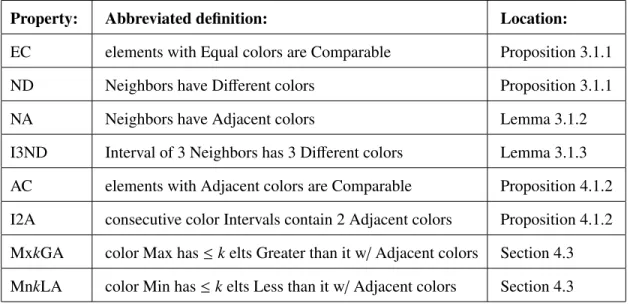
Various poset coloring properties will be precisely defined as needed; Table 2.1 indexes these forthcoming definitions. The poset displayed in Figure 2.1 satisfies all of these properties; the poset displayed in Figure 2.2 satisfies all of them except Mn1LA. See also Table 2.4 in Section 2.4, which indexes the extensions of the properties I3ND, I2A, MxkGA, and MnkLA to the general case.
Property: Abbreviated definition: Location:
EC elements with Equal colors are Comparable Proposition 3.1.1
ND Neighbors have Different colors Proposition 3.1.1
NA Neighbors have Adjacent colors Lemma 3.1.2
I3ND Interval of 3 Neighbors has 3 Different colors Lemma 3.1.3 AC elements with Adjacent colors are Comparable Proposition 4.1.2 I2A consecutive color Intervals contain 2 Adjacent colors Proposition 4.1.2 MxkGA color Max has≤kelts Greater than it w/Adjacent colors Section 4.3 MnkLA color Min has≤kelts Less than it w/Adjacent colors Section 4.3
Table 2.1: Coloring property abbreviations and locations of definitions; also see Table 2.4.
2.2 Algebraic definitions
We regard the graphΓas being asimply laced Dynkin diagram: OnceΓhas been given a total ordering, the associated generalized Cartan matrix is [θab]a,b∈Γ. TheKac–Moody algebragwithCartan subalgebrah
subalgebras of thederived subalgebrag0:=[g,g] formed by intersections ofhandb±withg0as theCartan
derived subalgebrah0and theBorel derived subalgebrasb0±. The algebrasn±and the derived algebras are
generated [Kac, §9.11] by subsets of the symbols{xa,ya,ha}a∈Γsubject to somedefining relations. WhenΓis
simply laced, the relations are certain unions (specified below) of the following sets: (XX): (i) [xb,xa]=0 ifa,b∈Γwitha;b,
(ii) [xa,[xa,xb]]=0 for alla,b∈Γ,
(YY): (i) [yb,ya]=0 ifa,b∈Γwitha;b,
(ii) [ya,[ya,yb]]=0 for alla,b∈Γ,
(HH): (i) [hb,ha]=0 for alla,b∈Γ,
(HX): (i) [ha,xa]=2xafor alla∈Γ,
(ii) [hb,xa]=−xaifa,b∈Γwitha∼b,
(iii) [hb,xa]=0 ifa,b∈Γwitha;b,
(HY): (i) [ha,ya]=−2yafor alla∈Γ,
(ii) [hb,ya]=yaifa,b∈Γwitha∼b,
(iii) [hb,ya]=0 ifa,b∈Γwitha;b,
(XY): (i) [xa,ya]=hafor alla∈Γ,
(ii) [xb,ya]=0 ifa,b∈Γwitha,b.
The relations HX and HY can be condensed to [hb,xa] = θabxa and [hb,ya] = −θabya fora,b ∈ Γ. The
algebrah0is the Lie algebra generated by{ha}a∈Γsubject to the relation HH, and so it is abelian. The algebra n+(respectivelyn−) is the Lie algebra generated by{xa}a∈Γ(respectively{ya}a∈Γ) subject to the relations XX
(respectively YY). The algebrab0+(respectivelyb0−) is the Lie algebra generated by{xa,ha}a∈Γ(respectively
{ya,ha}a∈Γ) subject to the relations XX, HH, and HX (respectively YY, HH, and HY). We note thatb0+=h0+n+
andb0−=h0+n−. The algebrag0is the Lie algebra generated by{xa,ya,ha}a∈Γsubject to all of the relations
above. When gis finite dimensional (and consequently semisimple), the algebrash,b±, andgare equal
to their derived counterparts. In this dissertation, we are almost always concerned only with the derived subalgebras andn±.
LetVbe any vector space. We say an operatorT : V → Vissquare nilpotentifT2 = 0. Consider actions onVof the generators xa,ya, andha that are respectively given by operators Xa, Ya, andHa in
End(V) for alla ∈ Γ. If theXa (respectivelyYa) are square nilpotent for alla ∈ Γ, we say their actions
simultaneously diagonalizes the operators{Ha}a∈Γ. Aweight functiononBis aΓ-set ofC-valued functions onB. Here theh0-weightof{Ha}a∈Γis the weight function{ξa}a∈ΓsatisfyingHa.v=ξa(v).vfor everya∈Γ
and everyv∈ B. Theeigenvalue setforBisEh0 :={ξa(v)|a∈Γ,v∈ B}.
We recall a basic algebraic fact: Letk,l≥1 and letLbe the Lie algebra defined by generatorsg1, . . . ,gk
subject to relationsr1, . . . ,rlin the Lie bracket [·,·] inL. LetG1, . . . ,Gkbe elements of End(V). Letgi 7→Gi
for 1≤i≤kbe a bijection. Suppose under this bijection the operatorsG1, . . . ,Gkalso satisfy the relations
r1, . . . ,rl, now in the commutator [·,·] in End(V). Then the bijection induces a Lie algebra homomorphism
fromLto the subalgebra ofgl(V) generated byG1, . . . ,Gk. HenceVis a representation ofL. Our usage of
the terminology above and this algebraic fact will leave the actions ofxa,ya, andhaimplicit, and so we will
refer only to the operatorsXa,Ya, andHain End(V).
2.3 Representations of Lie algebras built from colored posets
We return to our standard context that is established by the fixed locally finite poset Pcolored with the fixed finite simple graphΓbyκ, and having lattice of splitsF I(P). LetV be the free complex vector space onF I(P). For each split (F,I), denote the corresponding vector inV byhF,Ii. Every mention of diagonal operators is made with respect to the basis{hF,Ii}(F,I)∈F I(P) forV. Leta ∈ Γand let (F,I) be a
split inF I(P). To guarantee the sums in the following two definitions are finite, temporarily assume all antichains inPare finite. Define thecolor raising operator XabyXa.hF,Ii:=PhF−x,I+xi; here the sum
is taken over all elementsxof colorathat are minimal inF. Dually, define thecolor lowering operator Yaby
Ya.hF,Ii:=P
hF+y,I−yi; here the sum is taken over all elementsyof coloramaximal inI. Whenever we create such operators, it will be clear that these sums are finite. Linearly extendXaandYato all ofV. For
a∈Γ, the action ofXa(respectivelyYa) on a basis vectorhF,Iican be viewed as summing over all ways to
move up (respectively down) inF I(P) from (F,I) by an edge coloreda. We extend our standard context to includeV (usually implicitly) and the{Xa,Ya}a∈Γ.
We sayF I(P)carries a representation ofn+(respectivelyn−) if the{Xa}a∈Γ(respectively{Ya}a∈Γ) satisfy
XX (respectively YY) with respect to the commutator [·,·] in End(V). We sayF I(P)carries a representation of b0+ (respectively b0−) if there exists aΓ-set of diagonal operators {Ha}a∈Γ on V such that {Xa,Ha}a∈Γ
(respectively{Ya,Ha}a∈Γ) satisfy XX and HX (respectively YY and HY). The lattice of splits in Figure 2.2
b c
a d g
xb ua va yc zd qg
(P,∅) u
x y
x,y v
q u,q
x,q y,q
x,y,q v,q (∅,P)
a b c a g d a b c a g
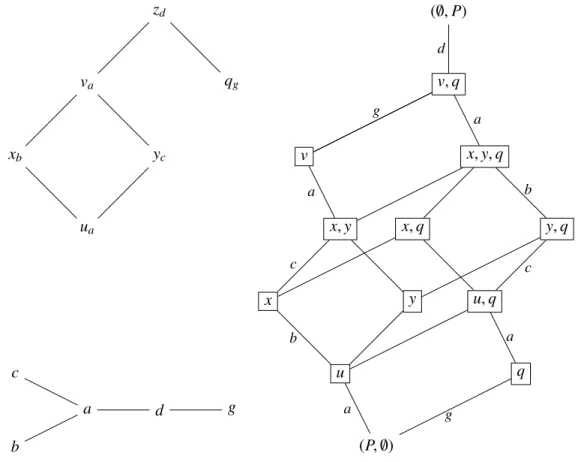
Figure 2.2: Clockwise from bottom left: Simple graphΓof finite typeD5, poset Pcolored byΓ, and its
edge-colored latticeF I(P) of filter-ideal splits. Subscripts inPindicate element colors. Splits (F,I) with boxes are described by the maximal elements of the idealI. Parallel edges inF I(P) have the same color.
XX, YY, HX, HY, and XY. The lattice of splits in Figure 2.1 carries a representation ofg0, wheregis the algebra of affine type ˜E6. Note that any diagonal operators{Ha}a∈Γautomatically satisfy the relation HH.
IfF I(P) carries a representation ofb0+,b0−, org0, then{hF,Ii}(F,I)∈F I(P)is always taken to be theh0-weight
basis forV. The minuscule representations built from colored minuscule posets and the representations built from full heaps mentioned in Chapter 1 are examples of representations ofg0carried byF I(P). These representations areX- andY-square nilpotent.
We say a representation ofb0+(respectivelyb0−) carried byF I(P) isupper(lower)P-minusculeif it is X-square (Y-square) nilpotent and the actions of the diagonal operators{Ha}a∈Γsatisfy:
(i) The setEh0 of eigenvalues of the{Ha}a∈Γis contained in{−1,0,1,2, . . .}(respectively contained in {. . . ,−2,−1,0,1}),
The representation carried byF I(P) in Figure 2.2 is upperP-minuscule. Here we haveHa.hP,∅i=−hP,∅i, Hg.hP,∅i = −hP,∅i, Hb.hP,∅i = 0, Hc.hP,∅i = 0, and Hd.hP,∅i = +2hP,∅i. The actions of the{He}e∈Γ
at other splits can be computed by working up through F I(P) using the relation HX. So one can see Eh0 ={−1,0,1,2}.
We say a representation ofg0carried byF I(P) isP-minusculeif the setEh0 of eigenvalues of the{Ha}a∈Γ is contained in{−1,0,1}. It can be seen thatP-minuscule representations ofg0areX- andY-square nilpotent. One can confirm that the latticeF I(P) of splits displayed in Figure 2.1 carries aP-minuscule representation ofg0.
2.4 The general case: Multiply laced definitions
So far the structureΓabove has been a simple graph. Here we introduce more general structuresΓthat can be used to specify general Kac–Moody algebras. These structures are combinatorial reformulations of arbitrary generalized Cartan matrices. The simple graphs from the simply laced case will be subsumed into this new framework.
LetΓbe a finite graph with no loops. We say thatΓis aDynkin diagramif for any two distinct nodes a,b∈Γone of the following three possibilities occurs:
(i) There is no edge betweenaandb.
(ii) There is a single undirected and unlabeled edge betweenaandb.
(iii) There is a pair of oppositely directed edges betweenaandb, each labeled with a positive integer, such that the product of these two integers is at least 2.
See Figure 2.3 for an example of a Dynkin diagramΓ.
We extend the Section 2.1 definition of the integersθabfora,b ∈Γ. We still setθaa:=2 for alla ∈Γ. Now supposea,b∈Γare distinct and consider the cases listed above. For Case (i), we still setθab =θba :=0 and sayaandbaredistant. For Case (ii), we still setθab=θba:=−1. For Case (iii), supposekandlare the positive integers respectively labeling the directed edges fromatoband frombtoa. Then we setθab :=−k andθba:=−l. If Case (iii) does not occur for any distincta,b∈Γ, then we will still sayΓissimply laced. If Case (iii) does occur for some distincta,b∈Γ, then we will sayΓismultiply laced. In thegeneral casewe will consider a poset that has been colored by any Dynkin diagram.
• •
• • • •
a b c a b c
2
1
a b c
!
a 2 −1 0
b −1 2 −2
c 0 −1 2
Figure 2.3: From left-to-right: A Dynkin diagramΓ, a generalized Cartan matrix forΓ(using the transpose convention of [Ste]), and the Dynkin diagram of finite typeB3traditionally used forΓ.
thataisk-adjacent to bandbisl-adjacent to a. So in Figure 2.3 the colorbis 2-adjacent to the colorcandc is 1-adjacent tob.
These definitions describe the combinatorial information in a generalized Cartan matrix while avoiding the specification of a total ordering on the nodes ofΓ. Once a total ordering ofΓis fixed, the corresponding generalized Cartan matrix is [θab]a,b∈Γ. Conversely, given a generalized Cartan matrix, one may use its entries
to build the corresponding Dynkin diagram satisfying the rules specified above.A prioriwe do not assume that the generalized Cartan matrices associated to our Dynkin diagrams have any special properties, such as being symmetrizable. However,a posterioriit can be seen that only certain values of the integers{θab}a,b∈Γ
can arise in the generalized Cartan matrices associated to the Dynkin diagrams that can be used to color the posets that interest us the most. See Corollary 7.5.4.
For a Dynkin diagramΓ, the Lie algebrasn±andb0±andg0are now generated by subsets of the symbols
{xa,ya,ha}a∈Γsubject to unions of sets ofgeneral defining relations:
(XX): [xa,[. . . ,[xa
| {z }
1−θbatimes
,xb]. . .]]=0 for alla,b∈Γsuch thata,b,
(YY): [ya,[. . . ,[ya
| {z }
1−θbatimes
,yb]. . .]]=0 for alla,b∈Γsuch thata,b,
(HH): [hb,ha]=0 for alla,b∈Γ,
(HX): [hb,xa]=θabxafor alla,b∈Γ,
(HY): [hb,ya]=−θabyafor alla,b∈Γ,
(XY): [xa,yb]=δabhafor alla,b∈Γ,
The algebrasn±,b0±, andg0are defined as in Section 2.2, now using the general defining relations. We still
say thatF I(P)carries a representationof one of the subalgebrasn±,b0±, org0with the same definitions as in
Section 2.3, now using the general defining relations.
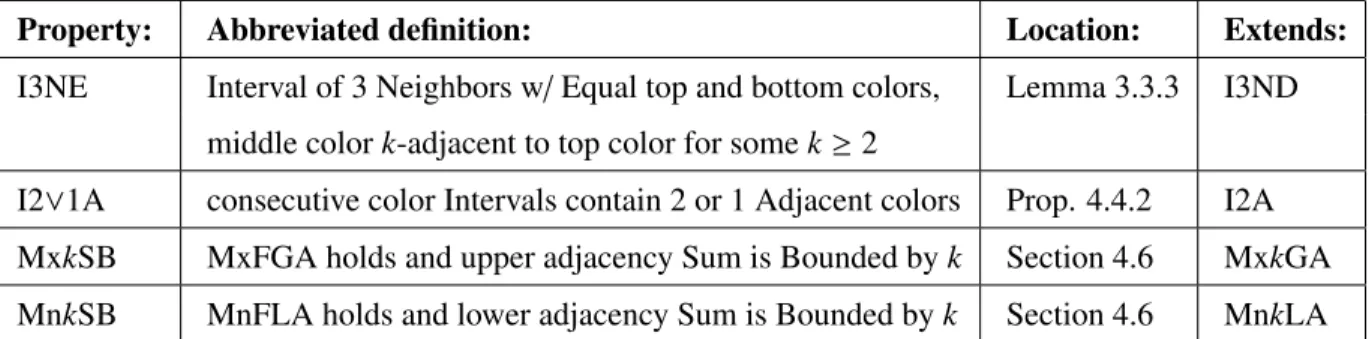
Property: Abbreviated definition: Location: Extends: I3NE Interval of 3 Neighbors w/Equal top and bottom colors, Lemma 3.3.3 I3ND
middle colork-adjacent to top color for somek≥2
I2∨1A consecutive color Intervals contain 2 or 1 Adjacent colors Prop. 4.4.2 I2A MxkSB MxFGA holds and upper adjacency Sum is Bounded byk Section 4.6 MxkGA MnkSB MnFLA holds and lower adjacency Sum is Bounded byk Section 4.6 MnkLA
Table 2.4: Extended coloring property abbreviations and locations of definitions
2.5 Extensions of characterizations from the simply laced to the general case
Chapters 3, 4, and 5 are structured as follows: For each section handling the simply laced case in the first half of the chapter, there is a section extending this material to the general case in the second half of the chapter. Result numbers can be compared directly: To extend a result in the simply laced case to the corresponding result in the general case, replace the section number for the simply laced case with the corresponding section number for the general case in the middle of its three-tier number. For example, Proposition 3.1.1 is extended by Proposition 3.3.1.
These extensions are mostly routine. Many proofs can still be applied to the general case verbatim or without much change when using the extended coloring properties and defining relations. When we do rewrite a proof (or a section of a proof), it is usually because the calculations have changed when the extension is made. The most significant change in development happens when extending the simply laced Section 3.1 to the general Section 3.3. There are only two relations XX specifyingn±in the simply laced case, while there
CHAPTER 3
Representations of Borel derived subalgebras
This chapter establishes the earliest results for representations ofn±andb0±built from colored posets.
Proposition 3.1.1 contains conditions that are often assumed or derived throughout the rest of the dissertation; these form the foundation for the “minuscule” settings for b0+ and g0 in Chapter 5. After obtaining a characterization of square nilpotent representations ofn±built from colored posets in Theorem 3.1.4, we
extend this result to representations ofb0±in Theorem 3.2.8.
3.1 Square nilpotent representations ofn+andn−
We establish our earliest equivalences between sets of coloring properties and sets of algebraic conditions. Theorem 3.1.4 summarizes this section by listing three coloring properties for P that are necessary and sufficient for the specified{Xa}a∈Γactions to generate anX-square nilpotent representation ofn+that is carried
byF I(P).
Proposition 3.1.1. The following are equivalent:
(i) The color raising operators{Xa}a∈Γare X-square nilpotent.
(ii) The following two properties are satisfied by P:
(EC): Elements with equal colors are comparable, and (ND): Neighbors have different colors.
(iii) The color lowering operators{Ya}a∈Γare Y-square nilpotent.
For alla∈Γand every split (F,I), the property EC implies that the sums definingXa.hF,IiandYa.hF,Ii are either single terms or are zero. From now on when we are creating these operators we will be assuming property EC holds. The properties EC and ND together ensure that no two edges of the same color are incident in the Hasse diagram ofF I(P).
expansion ofXa2.hF,Ii, we haveXa2.hF,Ii , 0. Now suppose ND fails. Then there is a colora ∈ Γ and
neighborsx→y, withx,y∈Pa. LetFbe the filter generated byx. SincehF−x−y,I+x+yiis a term in
the expansion ofXa2.hF,Ii, we haveXa2.hF,Ii,0.
Now suppose (ii) holds and fixa∈Γ. Let (F,I)∈ F I(P). SupposeXa.hF,Ii=hF−x,I+xifor some elementx∈Pa. Lety∈Pa; hereyis comparable toxby EC. However, noteycannot coverxby ND. Hence
yis not minimal inF−x. Sincey∈Pawas arbitrary, we haveXa.hF−x,I+xi=0. So for every colora∈Γ
and (F,I)∈ F I(P) we haveX2a.hF,Ii=0. Dualize to obtain the equivalence of (ii) and (iii). We get our first defining relation by strengthening ND:
Lemma 3.1.2. Suppose P satisfies EC and ND. Then the following are equivalent: (i) The relation[Xb,Xa]=0holds if a,b∈Γare distant.
(ii) The following additional property is satisfied by P: (NA): Neighbors have adjacent colors.
(iii) The relation[Yb,Ya]=0holds if a,b∈Γare distant.
Proof. To prove (i) implies (ii), first suppose (ii) fails. Then there exist neighborsx → ysuch that either
κ(x)= κ(y) orκ(x); κ(y). By ND we haveκ(x), κ(y), soκ(x); κ(y). Leta :=κ(x) and b := κ(y). Let
F be the filter generated by x. SincehF− x−y,I +x+yiis a term in the expansion ofXbXa.hF,Ii, we
haveXbXa.hF,Ii, 0. However,XaXb.hF,Ii=0 since the only minimal element inF has colora. Hence
[Xb,Xa].hF,Ii,0, and so (i) fails.
Now suppose (ii) holds. Let a and b be distant colors. Let (F,I) be any split and without loss of generality assumeXbXa.hF,Ii , 0. Then there are elements xandysuch thatκ(x) =aandκ(y)= band
XbXa.hF,Ii=hF−x−y,I+x+yi. By NA we knowxandyare not neighbors. Thus they are incomparable
minimal elements ofF. HenceXaXb.hF,Ii = hF −y−x,I+y+xi = XbXa.hF,Ii, so [Xb,Xa].hF,Ii =0.
Dualize to obtain the equivalence of (ii) and (iii).
We get our second defining relation by introducing a special case of the future key property I2A: Lemma 3.1.3. Suppose P satisfies EC and ND. Then the following are equivalent:
(i) The relation[Xa,[Xa,Xb]]=0holds for all a,b∈Γ.
(I3ND): If three successive neighbors x → y → z form an interval in P, then x and z have different colors.
(iii) The relation[Ya,[Ya,Yb]]=0holds for all a,b∈Γ.
Proof. For alla,b∈Γ, note [Xa,[Xa,Xb]]=Xa2Xb−2XaXbXa+XbX2a. By Proposition 3.1.1 the first and last
terms vanish when acting on any split. Thus the relation [Xa,[Xa,Xb]]=0 holds if and only ifXaXbXa =0
holds.
Suppose (i) holds, so that for all a,b ∈ Γwe have XaXbXa = 0. Suppose three successive neighbors
x→y→zform an interval inP. Definea:=κ(x) andb:=κ(y) andc:=κ(z). LetFbe the filter generated byx. Note thatXcXbXa.hF,Ii=hF−x−y−z,I+x+y+zi,0. Hence we havec,a, so I3ND holds.
Now suppose (ii) holds. Leta,b ∈Γand (F,I)∈ F I(P) be such thatXbXa.hF,Ii ,0. Then there are
elementsxandywithκ(x)=aandκ(y)=bsuch thatXbXa.hF,Ii=hF−x−y,I+x+yi. Eitherxandyare
incomparable orx→y. Supposexandyare incomparable. Every element of colorainF−x−ymust be greater thanxby EC, but none may coverxby ND. HenceXaXbXa.hF,Ii=0. Now supposex→y. Suppose
z∈F−x−yhas colora. By I3ND the set of elements{x,y,z}is not an interval. Thuszis not minimal in F−x−y, and so againXaXbXa.hF,Ii=0. Dualize to obtain the equivalence of (ii) and (iii).
Since NA implies ND, we can combine the three results above to produce: Theorem 3.1.4. The following are equivalent:
(i) The latticeF I(P)carries an X-square nilpotent representation ofn+. (ii) The properties EC, NA, and I3ND are satisfied by P.
(iii) The latticeF I(P)carries a Y-square nilpotent representation ofn−.
We conclude this section with a combinatorial property to characterize when the commutator bracket of color raising or lowering operators with adjacent colors is nonzero. We will see at the end of Section 8.3 that “Γ-coloredd-complete” and “Γ-colored minuscule” posets (see Section 6.1) satisfy this property.
Proposition 3.1.5. Suppose P satisfies EC. Then the following are equivalent:
(i) If a,b∈Γare adjacent, then there is some split(F,I)for which[Xb,Xa].hF,Ii,0.
(ii) The following additional property is satisfied by P:
Proof. First suppose that AN fails. Then there exist colorsa,b ∈ Γwitha ∼ band such that there are no neighbors in P with colors a and b. Let (F,I) ∈ F I(P). If XbXa.hF,Ii = 0 and XaXb.hF,Ii = 0,
then we are done. Otherwise, without loss of generality suppose thatXbXa.hF,Ii , 0. By EC, the result
of this action is a single term. Thus there are elements x,y ∈ P withκ(x) = aand κ(y) = b such that XbXa.hF,Ii =hF−x−y,I+x+yi. By assumption we know thatxandyare not neighbors inP, so they
must be incomparable. ThusXaXb.hF,Ii=hF−x−y,I+x+yias well, and so [Xb,Xa].hF,Ii=0.
Now suppose that AN holds. Supposea,b∈Γare adjacent. By AN we know there exist some neighbors x→ywithκ(x)=aandκ(y)=b. LetFbe the principal filter generated byx. By EC the actionXbXa.hF,Ii
is a single term, so we haveXbXa.hF,Ii=hF−x−y,I+x+yi. We also haveXaXb.hF,Ii=0 sincexis the
only minimal element ofFandκ(x)=a. Hence [Xb,Xa].hF,Ii,0. Dualize to obtain the equivalence of (ii)
and (iii).
3.2 Square nilpotent representations ofb0+andb0−
We extend our representations ofn+(respectivelyn−) tob0+(respectivelyb0−) by constructing diagonal
operators{Ha}a∈ΓonVthat satisfy HX and HY. Locally, if two basis vectors are connected by an edge in
F I(P), the relations HX (or HY) indicate how to relate theh0-weights of the two vectors:
Lemma 3.2.1. Suppose P satisfies EC. Let{Ha}a∈Γbe aΓ-set of diagonal operators withh0-weight{ξa}a∈Γ.
(a) The operators{Xa,Ha}a∈Γsatisfy the relations HX if and only if for every b∈Γ, split(F,I)∈ F I(P),
and minimal element x∈F, we haveξb(F−x,I+x)−ξb(F,I)=θκ(x),b.
(b) The relations HX are satisfied if and only if the relations HY are satisfied.
(c) The operators{Ya,Ha}a∈Γsatisfy the relations HY if and only if for every b∈Γ, split(F,I)∈ F I(P),
and maximal element y∈I, we haveξb(F+y,I−y)−ξb(F,I)=−θκ(y),b.
Proof. Leta,b∈Γand (F,I)∈ F I(P). For (a), note that both sides of the requirement (HbXa−XaHb).hF,Ii= θabXa.hF,Iivanish ifFdoes not have a minimal element of colora. Letxbe minimal inFof colora. By EC we haveXa.hF,Ii=hF−x,I+xi. Then (HbXa−XaHb).hF,Ii=(ξb(F−x,I+x)−ξb(F,I))Xa.hF,Ii, and so
the equivalence in (a) follows. Dualize to obtain (c). Part (b) holds since any edge inF I(P) can be dually viewed both as transferring a minimal element of a filter to an ideal and as transferring a maximal element of
follows: Two splits (F,I) and (F0,I0) are in the same component if there is a path from (F,I) to (F0,I0) in the Hasse diagram ofF I(P) containing finitely many edges. In this section, we work on one component at a time. An example of a posetPfor whichF I(P) has more than one component isP:=Z. Here there will be three components: The component{(∅,Z)}, the component{(Z,∅)}, and the component containing every other split. Using the finiteness of the set of colors, we get the following:
Proposition 3.2.2. Suppose P satisfies EC. Then the number of components ofF I(P)is finite. When P is finite, there is only one component.
Proof. Let (F,I)∈ F I(P). For eacha∈Γwe could havePa∩I =∅orPa∩I = Paor∅, Pa∩I , Pa.
Record this outcome for each color and call the resultingΓ-set of outcomes thecolor levelof (F,I). So the split (F,I) can have one of 3|Γ|possible color levels.
Let (F,I) and (F0,I0) be splits that have the same color level. We show they are in the same component ofF I(P). Note that
I−I0 =[
a∈Γ
Pa∩(I−I0) and I0−I=
[
a∈Γ
Pa∩(I0−I).
Since (F,I) and (F0,I0) have the same color level andPsatisfies EC, we see for alla∈ΓthatPa∩(I−I0)
andPa∩(I0−I) are finite sets. The unions on each right hand side are disjoint andΓis finite, so we have
|I−I0|=X
a∈Γ
|Pa∩(I−I0)| and |I0−I|=
X
a∈Γ
|Pa∩(I0−I)|.
ThusI−I0andI0−I are finite sets. Since a path from (F,I) to (F0,I0) can be formed by transferring all of the elements ofI−I0to a filter and then transferring all of the elements ofI0−Ito an ideal, we see (F,I) and (F0,I0) are in the same component ofF I(P). Since there are finitely many color levels and the splits that have the same color level are in the same component ofF I(P), there must be finitely many components. If Pis finite, then so areI−I0andI0−I for any (F,I),(F0,I0)∈ F I(P). Thus there is only one component in
this case.
Here we will only use the second statement of Proposition 3.2.2.
Suppose (F,I) and (F0,I0) are in the same component ofF I(P). The edges in any path from (F,I) to (F0,I0) have the net effect of adding every element ofI0−I and removing every element ofI−I0. Fixb∈Γ and note that bothPb∩(I0−I) andPb∩(I−I0) are finite. So in any path from (F,I) to (F0,I0), the cardinality
number of edges of colorbtraversed “going down.” Set∆b[(F0,I0),(F,I)] :=|Pb∩(I0−I)| − |Pb∩(I−I0)|.
This is the signed net number of edges of colorbtraversed in any finite path from (F,I) to (F0,I0). Note that ∆b[(F0,I0),(F,I)]=−∆b[(F,I),(F0,I0)]. We are defining the functions{∆a}a∈Γonly on pairs of splits that are
in the same component ofF I(P).
We now present a components-wide version of the equations in Lemma 3.2.1. Let{ηa}a∈Γbe a weight
function onF I(P). We call it acomponent weight functionif for allb∈Γ, whenever (F,I) and (F0,I0) are in the same component ofF I(P) we have
ηb(F0,I0)−ηb(F,I)=2∆b[(F0,I0),(F,I)]−
X
c∼b
∆c[(F0,I0),(F,I)]. (3.1)
We say that aΓ-set of diagonal operators{Ha}a∈ΓonVarecomponent diagonal operatorsif theirh0-weight
{ηa}a∈Γis a component weight function.
Lemma 3.2.3. Let b∈Γand let(F,I),(F0,I0), and(F00,I00)be splits in the same component ofF I(P). (a) We have∆b[(F00,I00),(F,I)]= ∆b[(F00,I00),(F0,I0)]+ ∆b[(F0,I0),(F,I)].
(b) Let{ηa}a∈Γbe a weight function onF I(P). If Equation (3.1) holds for the pairs of splits(F,I),(F0,I0)
and(F0,I0),(F00,I00), then it also holds for the pair(F,I),(F00,I00).
Proof. LetP1 be a finite path inF I(P) from (F,I) to (F0,I0), and letP2be a finite path in F I(P) from
(F0,I0) to (F00,I00). LetPbe the concatenation ofP1 followed byP2. The quantities ∆b[(F0,I0),(F,I)]
and∆b[(F00,I00),(F0,I0)] are the respective signed net number of edges of colorbtraversed alongP1and
P2. Thus their sum is the signed net number of edges of color btraversed alongP. But this quantity is also∆b[(F00,I00),(F,I)], so we get (a). Then (b) follows from (a) by noting thatηb(F00,I00)−ηb(F,I) =
ηb(F00,I00)−ηb(F0,I0)+ηb(F0,I0)−ηb(F,I).
Applying Equation (3.1) to an edge inF I(P) recovers the equations in Parts (a) and (c) of Lemma 3.2.1: Any edge inF I(P) has the form (F,I)→(F−x,I+x) for some split (F,I) and some minimal elementxof F. Seta:=κ(x). Note that for anyd∈Γwe have∆d[(F−x,I+x),(F,I)]=δad. Applying this observation
to (3.1) for someb∈Γresults in
3.2.1(c) can be obtained by using the alternate realization (F0+x,I0 −x) → (F0,I0) of this edge, where (F0,I0) :=(F−x,I+x). This specialization gives the “necessary” direction and the transitivity from Lemma 3.2.3(b) gives the “sufficient” direction of
Corollary 3.2.4. A weight function is a component weight function if and only if it satisfies Equation (3.2) along every edge ofF I(P).
With this result in mind, applying Lemma 3.2.1 shows the operators needed to satisfy HX (or HY) are exactly the component diagonal operators:
Proposition 3.2.5. Suppose P satisfies EC. Let{Ha}a∈Γbe diagonal operators withh0-weight{ηa}a∈Γ. Then
the following are equivalent:
(i) The operators{Xa,Ha}a∈Γsatisfy HX.
(ii) The operators{Ha}a∈Γare component diagonal operators.
(iii) The operators{Ya,Ha}a∈Γsatisfy HY.
Apply this result to representations: Corollary 3.2.6. Suppose P satisfies EC.
(a) IfF I(P)carries a representation ofb0+or ofb0−, then the diagonal operators{Ha}a∈Γgiving the actions
of{ha}a∈Γare component diagonal operators.
(b) Suppose P additionally satisfies NA and I3ND. If{ηa}a∈Γis a component weight function, then the
corresponding component diagonal operators{Ha}a∈Γcan be used to extend the representations of
Theorem 3.1.4 fromn+andn−to X- and Y-square nilpotent representations ofb0+andb0−.
Now we show a component weight function{ηa}a∈Γalways exists. Fixb∈Γ, a componentC, and any
split (F0,I0)∈ C. Letηb(F0,I0) be any complex number. Then for (F,I)∈ C, define
ηb(F,I) :=ηb(F0,I0)+2∆b[(F,I),(F0,I0)]−
X
c∼b
∆c[(F,I),(F0,I0)]. (3.3)
For eachb∈Γ, make such choices for all components and then perform this construction. Lemma 3.2.7. (a) The{ηa}a∈Γdefined by (3.3) is a component weight function.
(b) Eachηain some component weight function{ηa}a∈Γis uniquely determined by its value on one split for
Proof. Fixb∈Γ, a componentC, and the split (F0,I0) chosen forC. Let (F,I),(F0,I0)∈ C. Using (3.3) we
know Equation (3.1) holds for the pairs (F,I),(F0,I0) and (F0,I0),(F0,I0). Since Equation (3.1) holds also
for the pair (F0,I0),(F0,I0), Lemma 3.2.3(b) shows it holds for (F,I),(F0,I0). Thus we get (a). We get (b) by
noting that eachηain a given{ηa}a∈Γmust satisfy (3.3) once its values are specified on one split from each
component.
Using the existence obtained in Lemma 3.2.7(a), we can extend Theorem 3.1.4: Theorem 3.2.8. The following are equivalent:
(i) The latticeF I(P)carries an X-square nilpotent representation ofn+. (ii) The latticeF I(P)carries an X-square nilpotent representation ofb0+. (iii) The properties EC, NA, and I3ND are satisfied by P.
(iv) The latticeF I(P)carries a Y-square nilpotent representation ofb0−. (v) The latticeF I(P)carries a Y-square nilpotent representation ofn−.
Any operators{Ha}a∈Γused to satisfy Part (ii) or Part (iv) are component diagonal operators.
Proof. Using Lemma 3.2.7(a), let {ηa}a∈Γ be any component weight function. Then (iii) implies (ii) by
Corollary 3.2.6(b) using{ηa}a∈Γ. Also (ii) implies (i) by restricting to the operators{Xa}a∈Γ. And (i) implies
(iii) by Theorem 3.1.4. Dualize to obtain the equivalence of (iii), (iv), and (v). The last statement follows
from Corollary 3.2.6(a).
3.3 Square nilpotent representations ofn+andn−in the general case
We now extend the results of Chapter 3 to the general case. See Section 2.5 for a description of numbering conventions and a summary of changes between the simply laced and general cases. Here we refer to the definitions for the general case made in Section 2.4. As we generalize it, the statement of our first result does not need to be modified:
Proposition 3.3.1. The following are equivalent:
(i) The color raising operators{Xa}a∈Γare X-square nilpotent.
(ii) The poset P satisfies EC and ND.
(iii) The color lowering operators{Ya}a∈Γare Y-square nilpotent.
By Proposition 3.3.1, we see that when EC and ND hold we have
[Xa,[Xa,[Xa,Xb]]]=0 for alla,b∈Γ, (3.4)
sinceXa2will be in every term of the commutator expansion of the left-hand side. So for the operators{Xa}a∈Γ
to satisfy XX for any value ofθba, we only need to be concerned with the brackets [Xa,Xb] and [Xa,[Xa,Xb]]
for everya,b∈Γ; ifθba≤ −2, the remaining requirements for XX will hold by applying (3.4).
We reverse the roles ofaandbin Lemma 3.1.2 to handle the extended relations XX; the original proof can still be used.
Lemma 3.3.2. Suppose P satisfies EC and ND. Then the following are equivalent: (i) The relation[Xa,Xb]=0holds if a,b∈Γare distant.
(ii) The poset P satisfies NA.
(iii) The relation[Ya,Yb]=0holds if a,b∈Γare distant.
Lemma 3.1.3 must be modified. This modification introduces the property I3NE, which updates the property I3ND. We note that I3NE is a preliminary version of I2∨1A, which will extend I2A in Section 4.4. Here we need to rewrite most of the proof.
Lemma 3.3.3. Suppose P satisfies EC and ND. Then the following are equivalent: (i) If[Xa,[Xa,Xb]],0for a,b∈Γ, thenθba≤ −2.
(ii) The following additional property is satisfied by P:
(I3NE): If three successive neighbors x→y→z form an interval in P and x and z have equal colors, thenκ(y)is k-adjacent toκ(x)=κ(z)for some k≥2.
(iii) If[Ya,[Ya,Yb]],0for a,b∈Γ, thenθba≤ −2.
Proof. Fora,b ∈ Γ: As before, by Proposition 3.3.1 the relation [Xa,[Xa,Xb]] = 0 holds if and only if
XaXbXa=0 holds.
Suppose that (i) holds. Suppose three successive neighbors x → y → z form an interval in P and a:=κ(x)=κ(z). Letb:=κ(y). LetFbe the filter generated byxand letI :=P−F. ThenXaXbXa.hF,Ii=
hF−x−y−z,I+x+y+zi,0. By (i) we knowθba ≤ −2, sobisk-adjacent toafor somek≥2.
Now suppose that (ii) holds. Let a,b ∈Γand suppose that [Xa,[Xa,Xb]] , 0. By the first paragraph
XaXbXa.hF,Ii=hF−x−y−z,I+x+y+zi. Here we haveκ(x)=κ(z)=aandκ(y)=b. By EC we have
x<z. By ND we know thatzdoes not coverx. Letube any element in the open interval (x,z). We knowzis minimal inF−x−y; from this we see thatu=y. Hencex→y→zis an interval. From I3NE we see thatb isk-adjacent toafor somek≥2, soθba≤ −2. Dualize to obtain the equivalence of (ii) and (iii). To extend the statement of Theorem 3.1.4, we only need to replace the property I3ND by the updated property I3NE. We include a new proof, which is needed due to the more complicated extended relations XX. Theorem 3.3.4. The following are equivalent:
(i) The latticeF I(P)carries an X-square nilpotent representation ofn+. (ii) The properties EC, NA, and I3NE are satisfied by P.
(iii) The latticeF I(P)carries a Y-square nilpotent representation ofn−.
Proof. Suppose (i) holds. Proposition 3.3.1 shows that EC and ND hold. Note fora,b ∈Γthat we have
θba=0 if and only ifaandbare distant. Thus the relations XX and Lemma 3.3.2 show thatPsatisfies NA. If for somea,b∈Γwe have [Xa,[Xa,Xb]],0, then the relation XX impliesθba≤ −2. So Lemma 3.3.3 shows
thatPsatisfies I3NE.
Now suppose (ii) holds. Since NA implies ND, we seePsatisfies EC and ND. By Proposition 3.3.1 we know the actions of the{Xa}a∈ΓareX-square nilpotent. Leta,b∈Γ. Supposeθba=0. Since this is equivalent
to the condition thataandbare distant, Lemma 3.3.2 shows that [Xa,Xb] = 0. Now supposeθba = −1.
Then Lemma 3.3.3 shows that [Xa,[Xa,Xb]]=0. Also, by (3.4) we know that [Xa,[Xa,[Xa,Xb]]]=0 for all
a,b∈Γ. Hence the relations XX hold ifθba≤ −2 as well, so (i) holds. Dualize to obtain the equivalence of
(ii) and (iii).
So even though the relations XX now possibly contain many more requirements than they did previously, we only needed a simple alteration of I3ND in order to extend the characterization of theX-square nilpotent representations ofn±in Theorem 3.1.4 to the general case.
The extension of Proposition 3.1.5 has the same statement and proof as before: Proposition 3.3.5. Suppose P satisfies EC. Then the following are equivalent:
(i) If a,b∈Γare adjacent, then there is some split(F,I)for which[Xb,Xa].hF,Ii,0.
(ii) The property AN is satisfied by P.
3.4 Square nilpotent representations ofb0+andb0−in the general case
Section 3.2 introduced several accounting tools for tracking the actions of the simple coroots in repre-sentations ofb0±built from colored posets. These tools are not affected by the updated definition ofθabfor a,b∈Γ. Our computations in Section 3.2 depended only upon the colored edge structure of the distributive latticeF I(P) and would hold foranycomplex valued matrix [θab]a,b∈Γ. Lemma 3.2.1 has the same statement
and proof as before:
Lemma 3.4.1. Suppose P satisfies EC. Let{Ha}a∈Γbe aΓ-set of diagonal operators withh0-weight{ξa}a∈Γ.
(a) The operators{Xa,Ha}a∈Γsatisfy the relations HX if and only if for every b∈Γ, split(F,I)∈ F I(P),
and minimal element x∈F, we haveξb(F−x,I+x)−ξb(F,I)=θκ(x),b.
(b) The relations HX are satisfied if and only if the relations HY are satisfied.
(c) The operators{Ya,Ha}a∈Γsatisfy the relations HY if and only if for every b∈Γ, split(F,I)∈ F I(P),
and maximal element y∈I, we haveξb(F+y,I−y)−ξb(F,I)=−θκ(y),b.
Components ofF I(P) and theΓ-set of functions{∆a}a∈Γhave the same definitions as in Section 3.2.
However, Equation (3.1) took advantage of havingθbc =−1 whenbandcare adjacent colors. Let{ηa}a∈Γ
be a weight function onF I(P). Generalizing Equation (3.1), we define{ηa}a∈Γto be acomponent weight
functionif for allb∈Γ, whenever (F,I) and (F0,I0) are in the same component ofF I(P) we have
ηb(F0,I0)−ηb(F,I)=2∆b[(F0,I0),(F,I)]+
X
c∼b
θcb∆c[(F0,I0),(F,I)]. (3.5)
In practice, we will use the following equivalent form of Equation (3.5):
ηb(F0,I0)−ηb(F,I)=X
c∈Γ
θcb∆c[(F0,I0),(F,I)]. (3.6)
This version is obtained by combining the terms on the right-hand side of (3.5) usingθbb=2 andθcb =0 whenc;b.
In the extension of Lemma 3.2.3 we only need to update the equation number:
Lemma 3.4.3. Let b∈Γand let(F,I),(F0,I0), and(F00,I00)be splits in the same component ofF I(P). (a) We have∆b[(F00,I00),(F,I)]= ∆b[(F00,I00),(F0,I0)]+ ∆b[(F0,I0),(F,I)].
(b) Let{ηa}a∈Γbe a weight function onF I(P). If Equation (3.6) holds for the pairs of splits(F,I),(F0,I0)
The original proof of Lemma 3.2.3 can be applied verbatim.
The argument given following Lemma 3.2.3 that produced Equation 3.2 still works, once the following modifications are made: Now refer to Equation (3.6), and remove the phrase “sinceθab=2δab−P
c∼bδac.”
This phrase is not needed since the right-hand side of Equation (3.6) becomesθabdirectly. For the reader’s convenience, we restate the unchanged Equation (3.2):
ηb(F−x,I+x)−ηb(F,I)=θab. (3.2)
Herebis an arbitrary color, the element xis minimal inF, anda := κ(x). So Corollary 3.2.4 still holds verbatim:
Corollary 3.4.4. A weight function is a component weight function if and only if it satisfies Equation (3.2) along every edge ofF I(P).
This corollary and Lemma 3.4.1 will reproduce Proposition 3.2.5 verbatim:
Proposition 3.4.5. Suppose P satisfies EC. Let{Ha}a∈Γbe diagonal operators withh0-weight{ηa}a∈Γ. Then
the following are equivalent:
(i) The operators{Xa,Ha}a∈Γsatisfy HX.
(ii) The operators{Ha}a∈Γare component diagonal operators.
(iii) The operators{Ya,Ha}a∈Γsatisfy HY.
Now apply this Proposition 3.4.5 to representations and use Theorem 3.3.4 to extend Corollary 3.2.6; the only change is the updating of property I3ND to property I3NE:
Corollary 3.4.6. Suppose P satisfies EC.
(a) IfF I(P)carries a representation ofb0+or ofb0−, then the diagonal operators{Ha}a∈Γgiving the actions
of{ha}a∈Γare component diagonal operators.
(b) Suppose P additionally satisfies NA and I3NE. If{ηa}a∈Γis a component weight function, then the
corresponding component diagonal operators{Ha}a∈Γcan be used to extend the representations of
Theorem 3.3.4 fromn+andn−to X- and Y-square nilpotent representations ofb0+andb0−.
(3.3) to the general
ηb(F,I) :=ηb(F0,I0)+
X
c∈Γ
θcb∆c[(F,I),(F0,I0)]. (3.7)
In Lemma 3.2.7 we only need to update the equation number:
Lemma 3.4.7. (a) The{ηa}a∈Γdefined by (3.7) is a component weight function.
(b) Eachηain some component weight function{ηa}a∈Γis uniquely determined by its value on one split for
each component.
The proof of Lemma 3.2.7 in Section 3.2 still applies once Equations (3.6) and (3.7) are referenced. We can now extend Theorem 3.2.8 to the general case; again the only change in the statement is to replace property I3ND with I3NE.
Theorem 3.4.8. The following are equivalent:
(i) The latticeF I(P)carries an X-square nilpotent representation ofn+. (ii) The latticeF I(P)carries an X-square nilpotent representation ofb0+. (iii) The properties EC, NA, and I3NE are satisfied by P.
(iv) The latticeF I(P)carries a Y-square nilpotent representation ofb0−. (v) The latticeF I(P)carries a Y-square nilpotent representation ofn−.
Any operators{Ha}a∈Γused to satisfy Part (ii) or Part (iv) are component diagonal operators.
CHAPTER 4
Combinatorially characterized weights
Here we begin to examineh0-weights more closely by examining the eigenvalues of component diagonal operators on our basis of splits{hF,Ii}(F,I)∈F I(P). The minuscule representations of the semisimple Lie
algebras act in such a way that for every colora∈Γand any weight basis vectorv, the action ofhaonvgives
ha.v=−vorha.v=0 orha.v= +v. The operators and properties we introduce in this chapter will be used in Chapter 5 to obtain this condition in our setting of representations constructed from colored posets. Our main result in this chapter is Proposition 4.2.1; it obtains a combinatorial characterization of the “if” direction in Part (ii) of the definition of an upperP-minuscule representation ofb0+.
4.1 A combinatorially motivated component weight function
We continue to assumePsatisfies EC. If one does not care about the relationship between combinatorial properties and eigenvalues, Theorem 3.2.8 said that a representation ofn+carried byF I(P) can be extended tob0+without requiring coloring properties for Pbeyond EC, NA, and I3ND: Create a component weight function by choosing for each component ofF I(P) a Γ-set of complex numbers and a split. Then use the corresponding component diagonal operators{Ha}a∈Γto extend the action ofn+. Here we construct a
particular weight function{µa}a∈ΓonF I(P) whose values are determined by the local structure ofP. WhenP
has two new additional properties beyond EC, in Proposition 4.1.2 we use Corollary 3.2.4 to show that it is a component weight function. As we work toward obtaining the attractive (upper)P-minuscule representations ofg0(andb0+), in the next two sections we will obtain relationships between further coloring properties and thish0-weight.
We prepare to define our new Z-valued weight function {µa}a∈Γ. Fix a color b ∈ Γ. To construct µb:F I(P)→Z, we introduce auxiliary functionsυb:F I(P)→Nandψb:F I(P)→N:
We first defineυb :F I(P)→Nin stages. Let (F,I) be a split. IfPb∩Idoes not have a maximal element,
then setυb(F,I) :=1. Now suppose thatPb∩Ihas a maximal elementy. By EC the elementyis unique. We
three requirements:
(i) The elementzis greater thany, (ii) Its colorc:=κ(z) is adjacent tob, and
(iii) The number of elements greater thanythat are inPc∩Iis finite.
If there is some colora ∼bsuch that there are infinitely many elements greater thanyinPa∩I, then set υb(F,I) :=|Υb(F,I)|+1. Otherwise setυb(F,I) :=|Υb(F,I)|.
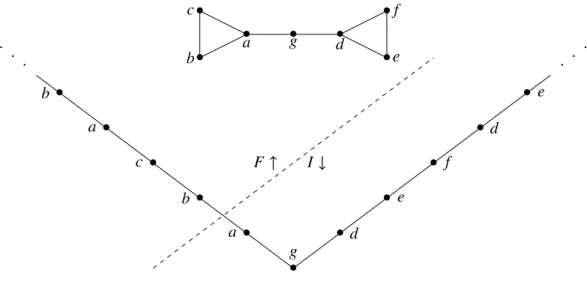
Figure 4.1 illustrates the three possible scenarios for computing{υi}i∈Γon aΓ-colored posetPat a split
(F,I). Since there is no maximal element of colord inI, one hasυd(F,I) = 1. Becauseg ∼ d, we get
υg(F,I)=|Υg(F,I)|+1=2. Lastly, we haveυa(F,I)=|Υa(F,I)|=0.
We also defineψb:F I(P)→Nin dually analogous stages. Let (F,I) be a split. IfPb∩Fdoes not have
a minimal element, then setψb(F,I) :=1. Now suppose thatPb∩Fhas a minimal elementy. By EC the
elementyis unique. We build up another setΨb(F,I)⊆ Ffrom the empty set∅. Letz∈F. We placezinto
Ψb(F,I) if it meets the following three requirements:
(i) The elementzis less thany,
(ii) Its colorc:=κ(z) is adjacent tob, and
(iii) The number of elements less thanythat are inPc∩Fis finite.
If there is some colora ∼ b such that there are infinitely many elements less thany inPa ∩F, then set ψb(F,I) :=|Ψb(F,I)|+1. Otherwise setψb(F,I) :=|Ψb(F,I)|.
We can now define the weight function{µa}a∈Γ. Let (F,I) be a split and letb∈Γ. IfPb∩I ,∅, then
• • • • • • • • • • • · · · · · · • • • • • • • g a b c d e f g a b c a b d e f d e
F ↑ I ↓


![Figure 2.3: From left-to-right: A Dynkin diagram Γ, a generalized Cartan matrix for Γ (using the transpose convention of [Ste]), and the Dynkin diagram of finite type B 3 traditionally used for Γ.](https://thumb-us.123doks.com/thumbv2/123dok_us/8328156.2208642/25.918.129.815.111.192/figure-generalized-cartan-transpose-convention-dynkin-diagram-traditionally.webp)