INVESTIGATION
Trans
-ancestry Fine Mapping and Molecular Assays
Identify Regulatory Variants at the
ANGPTL8
HDL-C GWAS Locus
Maren E. Cannon,* Qing Duan,* Ying Wu,* Monica Zeynalzadeh,* Zheng Xu,* Antti J. Kangas,† Pasi Soininen,‡Mika Ala-Korpela,§Mete Civelek,** Aldons J. Lusis,††Johanna Kuusisto,‡‡
Francis S. Collins,§§Michael Boehnke,*** Hua Tang,†††Markku Laakso,‡‡Yun Li,*,‡‡‡and Karen L. Mohlke*,1 *Department of Genetics and‡‡‡Department of Biostatistics, University of North Carolina, Chapel Hill, North Carolina 27599,†Computational Medicine, Institute of Health Sciences, University of Oulu and Biocenter Oulu, 90014 Finland,
‡NMR Metabolomics Laboratory, School of Pharmacy, University of Eastern Finland, Kuopio, 70600 Finland,§School of
Social and Community Medicine, University of Bristol and Medical Research Council Integrative Epidemiology Unit at the University of Bristol, BS8 1TH United Kingdom,**Center for Public Health Genomics and Department of Biomedical Engineering, University of Virginia, Charlottesville, Virginia 22904,††Department of Medicine, Department of Human Genetics, Molecular Biology Institute, Department of Microbiology, Immunology and Molecular Genetics, University of California, Los Angeles, California 90095,‡‡Institute of Clinical Medicine, Internal Medicine, University of Eastern Finland and Kuopio University Hospital, 70600 Finland,§§National Human Genome Research Institute, National Institutes of Health, Bethesda, Maryland 20892,***Department of Biostatistics and Center for Statistical Genetics, University of Michigan, Ann Arbor, Michigan 48109, and†††Department of Genetics, Stanford University, California 94305 ORCID ID: 0000-0001-6721-153X (K.L.M.)
ABSTRACT Recent genome-wide association studies (GWAS) have identified variants associated with high-density lipoprotein cholesterol (HDL-C) located in or near theANGPTL8gene. Given the extensive sharing of GWAS loci across populations, we hypothesized that at least one shared variant at this locus affects HDL-C. The HDL-C–associated variants are coincident with expression quantitative trait loci forANGPTL8andDOCK6in subcutaneous adipose tissue; however, onlyANGPTL8expression levels are associated with HDL-C levels. We identified a 400-bp promoter region ofANGPTL8and enhancer regions within 5 kb that contribute to regulating expression in liver and adipose. To identify variants functionally responsible for the HDL-C association, we performedfine-mapping analyses and selected 13 candidate variants that overlap putative regulatory regions to test for allelic differences in regulatory function. Of these variants, rs12463177-G increased transcriptional activity (1.5-fold, P= 0.004) and showed differential protein binding. Six additional variants (rs17699089, rs200788077, rs56322906, rs3760782, rs737337, and rs3745683) showed evidence of allelic differences in transcriptional activity and/or protein binding. Taken together, these data suggest a regulatory mechanism at theANGPTL8HDL-C GWAS locus involving tissue-selective expression and at least one functional variant.
KEYWORDS Genetics Gene Expression Cholesterol Transcription Complex genetic
traits
To date, at least 157 loci have been associated with high-density lipoprotein cholesterol (HDL-C) in genome-wide association studies (GWAS) (Willeret al.2013). Analyses of European, African American, Mexican, Pima Indian, and East Asian participants have identified four different lead variants associated with HDL-C located in or near angiopoietin-like protein 8 (ANGPTL8) (Coram et al. 2013; Weissglas-Volkovet al.2013; Willeret al.2013; Nairet al.2016; Spracklenet al.2017).ANGPTL8is a small protein of 198 amino acids; the gene is located on chromosome 19 within intron 14 of dedicator of cytokinesis 6 (DOCK6), and is transcribed in the opposite direction of DOCK6. European GWAS meta-analyses identified
variant rs2278426 was associated with HDL-C (P= 3.4· 1029,N= 4361) and total cholesterol (P =5.0·1026) (Weissglas-Volkovet al. 2013; Hansonet al.2016), which is a nonsynonymous variant in exon 2 ofANGPTL8(Arg59Trp) that exhibits relatively high linkage disequi-librium (LD) with the European lead rs737337 [r2= 0.74, 1000G Ad-mixed American (AMR)] and moderate LD with the African American lead rs12979813 (r2= 0.52 AMR). Finally, in recent lipid associations in East Asian samples, lead variant rs3760782 was the strongest HDL-C–associated variant (P = 8.8·10211) and another variant in strong LD (rs1865063,r2=0.95) is the lead variant for total cholesterol (P =1.5·10215) and LDL-C (P =1.8·1028) (Spracklenet al.2017). rs3760782 is located 3.5 kb upstream ofANGPTL8and in intron 20 of DOCK6. Given the extensive sharing of GWAS loci across populations (Visscheret al.2012), we hypothesized that at least one shared variant at theANGPTL8locus affects HDL-C in all of these populations.
ANGPTL8is a recently defined gene also calledC19orf80,LOC55908, refeeding-induced fat and liver (RIFL),TD26, hepatocellular carcinoma-associated gene, lipasin, and betatrophin (Quagliariniet al.2012; Ren et al. 2012; Zhang 2012). Serum ANGPTL8 protein levels have been associated with many metabolic phenotypes including type 1 and type 2 diabetes (Espeset al.2014a,b; Fuet al.2014b; Huet al.2014; Yamada et al.2015), obesity (Fuet al.2014b; Leeet al.2016), and nonalcoholic fatty liver disease (Leeet al.2016). The gene is mainly expressed in liver and adipose tissues, despite being entirely contained within one intron of the ubiquitously expressedDOCK6(Quagliariniet al.2012; GTEx Con-sortium 2013). The precise mechanisms of action of ANGPTL8 remain unclear. ANGPTL8 is secreted into the plasma and is involved in tri-glyceride storage in adipose tissue; knockout mice gained less fat than wild-type (Wanget al.2013) mice andAngptl8knockdown in 3T3L1 mouse adipocytes led to decreased triglyceride content (Renet al.2012). ANGPTL8expression is increased in response to stress, it upregulates early growth response transcription factor and downregulates adipose triglyceride lipase, suggesting a role in lipid homeostasis (Zhanget al. 2015). ANGPTL8 contains a lipoprotein lipase inhibitory motif and inhibits LPL function when coexpressed with ANGPTL3 (Halleret al. 2017). Additionally, serum ANGPTL8 protein is inversely associated with HDL-C levels (Yiet al.2015) supporting a role ofANGPTL8in HDL-C metabolism.
DOCK6is a member of the dedicator of cytokinesis family of atypical guanine nucleotide exchange factors.DOCK6is expressed in many tis-sues, with highest levels of expression in the lungs, thyroid, and adipose (GTEx Consortium 2013). DOCK6 functions as a guanine nucleotide exchange factor for RAC1 and CDC42 and has roles in cytoskeletal remodeling and neurite outgrowth (Miyamotoet al.2007). Mutations inDOCK6can cause Adams-Oliver syndrome, an actin cytoskeletopathy characterized by limb and skin defects (Shaheenet al.2011).DOCK6does not have functions that obviously relate to HDL-C metabolism.
Two coding variants in ANGPTL8 have been proposed to affect HDL-C levels. A rare ANGPTL8 nonsense variant, rs145464906
(MAF = 0.001 in.42,000 individuals of European ancestry) encoding Gln121Ter, is associated with increased HDL-C (P= 5.1·10213) and increased triglycerides (P =0.003) in an exome array-based association analysis (Pelosoet al.2014). Based on conditional analysis (Pelosoet al. 2014) and LD (r2,0.01), rs145464906 is independent of the reported ANGPTL8GWAS variants. The common Mexican and Pima Indian lead variant, rs2278426 encoding Arg59Trp, has been proposed to in-crease cleavage of ANGPTL3, leading to dein-creased LPL activity and lower HDL-C (Hansonet al.2016). Although coding variants have been identified, the variants responsible for the common HDL-C as-sociation signal at this locus remain unclear, and may include regula-tory variants. While a simple mechanism involving a single variant that alters transcription of a single gene is straightforward, multiple variants and/or multiple genes may contribute to the functional consequences of a GWAS signal (Corradin et al. 2014; Heet al. 2015; Romanet al.2015).
In this study, we describe an association between the HDL-C locus variants and subcutaneous adipose level ofANGPTL8RNA. We show that a subset of HDL-C–associated variants overlap regions with strong evidence of regulatory activity (Bernsteinet al.2010; Encode Project Consortium 2012), and we usetrans-ancestryfine-mapping and func-tional assays to identify variants exhibiting allelic differences in regu-latory activity at theANGPTL8HDL-C GWAS locus.
MATERIALS AND METHODS
Study population and phenotypes
The METabolic Syndrome In Men (METSIM) study includes 10,197 men, aged from 45 to 73 yr, randomly selected from Kuopio, Eastern Finland, and examined in 2005–2010 (Stancakovaet al.2009; Laakso et al.2017). The Ethics Committee of the University of Eastern Finland in Kuopio and the Kuopio University Hospital approved the METSIM study, and it was carried out in accordance with the Helsinki Declara-tion. Triglyceride and lipoprotein characteristics were measured via proton nuclear magnetic-resonance (NMR) or enzymatic assays in 10,079 METSIM participants (Inouyeet al.2010). DNA samples were genotyped on the Illumina OmniExpress and HumanCoreExome ar-rays, and additional genotypes were imputed using the GoT2D inte-grated haplotypes reference panel as previously described (Fuchsberger et al.2016).
We also analyzed a set of 8421 self-identified African American participants from the Women’s Health Initiative SNP Health Associa-tion Resource (WHI-SHARe) study. Details of the study design, cohort characteristics, written informed consent, and study approval by local Human Subjects Committees have been described previously (Hays et al.2003). Participants who had consented to genetic research were genotyped on the Affymetrix 6.0 array and additional genotypes were imputed using the 1000 Genomes Project data as a reference panel, as previously described (Reineret al.2012).
Association, conditional, and haplotype analysis
For METSIM, we performed a preliminary test for association between 19 million genetic variants and 72 lipid and lipoprotein subclasses (Davis J.P., Huyghe J.R., Jackson A.U., Stringham H.M., Teslovich, T.M., Welch R.P., Fuchsberger C., Locke A.E., Narisu N., Chines P.S., Kangas A.J., Soininen P., Ala-Korpela M., Kuusisto J., Collins F.S., Laakso M., Mohlke K.L., Boehnke M., unpublished data). To better observe the relative differences between variants, we use the association of variants with the concentration of phospholipids in medium HDL because the association with this trait is stronger (P= 1.9·1027) than with HDL-C (P = 7.7 · 1024). We assumed an additive mode of
Copyright © 2017 Cannonet al. doi:https://doi.org/10.1534/g3.117.300088
Manuscript received May 9, 2017; accepted for publication July 26, 2017; published Early Online July 28, 2017.
This is an open-access article distributed under the terms of the Creative Commons Attribution 4.0 International License (http://creativecommons.org/ licenses/by/4.0/), which permits unrestricted use, distribution, and reproduction in any medium, provided the original work is properly cited.
Supplemental material is available online atwww.g3journal.org/lookup/suppl/ doi:10.1534/g3.117.300088/-/DC1.
1Corresponding author: University of North Carolina, 5096 Genetic Medicine Bldg., CB
inheritance and accounted for cryptic relatedness between individuals using the EMMAX mixed model (q.emmax test) implemented in EPACTS (Kanget al.2010). After accounting for age, BMI, smoking status, and lipid-lowering medication status as covariates, trait value residuals were inverse normal transformed. We carried out reciprocal conditional analyses with candidate variants within the associated sig-nal to evaluate the potential presence of a second association sigsig-nal by adjusting for specific genetic variants, including METSIM lead variant rs737337 and Women’s Health Initiative (WHI) lead variant rs4804154. LD in locus plots was calculated from the METSIM imputed genotypes, and all chromosome coordinates correspond to hg19.
For WHI, association analysis was performed under an additive genetic model using linear regression adjusted for covariates. The imputed allelic dosage at each variant was tested via MACH2QTL (Li et al.2010). Genome-wide African ancestry proportion, age, BMI, and smoking history were included as covariates. Genome-wide African ancestry proportion was derived from locus-specific ancestry, which has a correlation of 0.99 with thefirst principal component of pop-ulation structure. Ancestry estimation has been described previously (Coram et al.2013). To assess the potential presence of multiple, independent variants at the same locus influencing HDL-C trait, we repeated regression analyses, conditioning on rs4804154. LD in locus plots was calculated from WHI-imputed genotypes, and all chromo-some coordinates correspond to hg19.
We constructed haplotypes based onfive variants atANGPTL8 that were previously reported as the GWAS index variants (rs4804154, rs737337, and rs2278426) in studies of different ancestry groups (Teslovichet al.2010; Coramet al.2013; Weissglas-Volkovet al.2013; Willeret al.2013; Hansonet al.2016) or are proxies (rs3745683 and rs3760782) in high LD with both the European and African American lead variants. We performed haplotype analyses using the“haplo.stat”R package (Schaidet al.2002), estimated haplotypes and haplotype fre-quencies using the haplo.em function, and tested for association between haplotypes and the concentration of phospholipids in medium HDL (METSIM) or HDL-C (WHI) level using the haplo.glm function. We assumed an additive model in which the regression coefficient repre-sented the expected change in inverse normalized HDL-C level with each additional copy of the specific haplotype compared with the refer-ence haplotype. The same covariates used for single variant analysis were also used in the haplotype analysis model.
Expression quantitative trait association
RNA from subcutaneous adipose tissue was extracted and the expression levels of probesets were measured using Affymetrix Human Genome U219 Array in 770 METSIM participants (Civeleket al.2016). The expression quantitative trait locus (eQTL) forANGPTL8was not pre-viously reported because of a gene name difference with RefSeq and Ensembl. Expression data were normalized using Robust Multi-Array Average (RMA) analysis (Irizarryet al.2003). eQTL associations were performed as previously described (Civelek et al. 2016). Briefly, we applied PEER analysis (Stegleet al.2010) to account for complex non-genetic factors in the RMA-normalized gene expression levels. We adjusted for 35 inferred confounding factors and inverse normal trans-formed the PEER-processed residuals. In eQTL analysis, we used ge-notype dosages imputed using Haplotype Reference Consortium data (McCarthyet al.2016) to test for the variant association with expres-sion levels of all genes within 1 Mb of rs737337. We assumed an additive mode of inheritance and accounted for cryptic relatedness between individuals using the EMMAX mixed model implemented in EPACTS (Kanget al.2010). Additionally, we performed conditional analysis on the expression level ofANGPTL8 by adjusting for
rs4804155 and on the expression level ofDOCK6by adjusting for rs17699089 to assess the presence of multiple, independent associa-tions. We also performed conditional analysis using candidate func-tional variant rs12463177 to assess the coincidence of GWAS and eQTL signals. To examine the relationship between RMA-normalized expression levels and HDL-C, we adjusted both traits for age and BMI, inverse normal transformed the residuals, and then tested for association in regression analyses.
MANTRA
Tofine-map theANGPTL8locus, we performedtrans-ancestry meta-analysis using MANTRA (Morris 2011). MANTRA accounts for the shared similarity in closely related populations using Bayesian partition model assuming the same underlying allelic effect. It models the effect heterogeneity among distant populations by clustering according to the shared ancestry and allelic effects. We conducted the analysis based on the association summary statistics from GWAS in METSIM and WHI and included variants present in both METSIM and WHI. We con-structed a 99% credible set of variants by ranking all variants according to their Bayes factors.
CAVIAR and PAINTOR
To prioritize functional variants, we analyzed variants at theANGPTL8 locus using both CAVIAR (Hormozdiariet al.2014) and PAINTOR (Kichaevet al.2014). CAVIAR estimates the posterior probability of a variant being functional by jointly modeling theP-values andb asso-ciation statistics, and PAINTOR leverages functional genomic annota-tion data, in addiannota-tion to associaannota-tion strength, to prioritize funcannota-tional variants. Both methods allow for multiple functional variants at the risk locus. Using consistent alleles for METSIM and WHI African Ameri-cans, we calculatedZscores based onP-values and the sign ofbfrom GWAS in these studies. For METSIM, the LD matrix was calculated based on European data from the 1000 Genomes Project Phase 1. For WHI African Americans, LD was calculated based on imputed data as previously described (Reineret al.2012). In CAVIAR, we returned the credible set that contains all of the true functional variants with 95% confidence level. The annotation matrix used in PAINTOR contained data from the ENCODE project accessed from the UCSC Genome Browser using the Table Browser tool. The matrix included HepG2 H3K4me1, H3K4me2, H3K4me3, and H3K27ac histone marks, DNase hypersensitivity clusters (ENCODE v3) and transcription factor binding (ENCODE v2) from the Broad Institute. Presence or absence of overlap was determined by the UCSC Table Browser intersection with the signal tracks. In PAINTOR, analysis was performed for METSIM alone (Finns), WHI alone (African Americans), and the two data sets together. We set the number of functional variants as 2, 3, 4, or 5 based on feasible running time. PAINTOR predicted var-iants to be functional based on a posterior probability .0.1, a threshold suggested previously (Kichaevet al.2014).
Functional annotation
on 1000 Genomes Phase 1 data. The AFR dataset was used for African American LD and EUR for European LD.
Cell culture
HepG2, SW872, SGBS, 293T, 3T3L1, Huh-7, and MIN6 cell lines were maintained at 37with 5% CO2.HepG2 cells (ATCC, HB-8065) were cultured in MEM-a (Gibco) supplemented with 10% FBS and 1 mM sodium pyruvate. SW872 cells (ATCC, HTB92) were cultured in DMEM:F12 (Sigma) supplemented with 10% FBS. SGBS cells (Wabitschet al.2001) were generously provided by Dr. Martin Wabitsch (University of Ulm) and cultured in DMEM:F12 (Sigma) supplemented with 10% FBS and 5% 3.3 mM biotin/1.7 mM panthotenate solution. SW872 and SGBS cells were transfected in the undifferentiated, preadi-pocyte state. 293T cells (ATCC, CRL-3216) were cultured in DMEM (Sigma) supplemented with 10% FBS and 200 mM L-glutamine. 3T3-L1 cells (ATCC, CL-173) were cultured and differentiated as described in the ATCC protocol. Huh-7 cells (JCRB0403, Japanese Collection of Re-search Bioresources Cell Bank, National Institute of Biomedical Innova-tion), were cultured in DMEM with high glucose (Gibco) with 10% FBS, 1 mM sodium pyruvate, 1 mM nonessential amino acids (Sigma), and 1 mM L-glutamine. MIN6 cells (Miyazakiet al.1990) were cultured in DMEM (Sigma), supplemented with 10% FBS, 1 mM sodium pyruvate, and 0.1 mMb-mercaptoethanol.
Dual luciferase transcriptional reporter assays
We PCR-amplified fragments surrounding each regulatory region or variant withfive PRIME Mastermix (five PRIME) or Phusion High-Fidelity Polymerase (New England Biosystems) with the primers listed in Supplemental Material, Table S1 inFile S1from DNA of individuals homozygous for alleles associated with increased or decreased HDL-C. Gateway attB sites were included in primers and Gateway cloning was used to insert fragments into a Gateway-compatible pGL4.23 (minimal promoter) or pGL4.10 (promoterless)firefly luciferase reporter vector (Promega). Fragments containing HDL-C–associated variants are des-ignated as forward or reverse based on their orientation with respect to the genome and theANGPTL8gene. The 5-kb and promoter regions were only cloned in the forward orientation (pGL4.10) because they include theANGPTL8promoter. Regions were isolated based on epi-genetic marks of promoter and/or enhancer regions surrounding the HDL-C–associated variants. We isolated three to five independent clones (biological replicates) for each allele for each orientation and verified by sequencing. Each clone was cotransfected withRenilla lu-ciferase vector in duplicate (HepG2, 293T, Huh-7, SW872) or triplicate (SGBS, 3T3L1) wells (technical replicates) using FUGENE 6 (HepG2, 293T, Huh-7, SW872, 3T3L1; Promega), Lipofectamine 2000 (Min6; Life Technologies), or Lipofectamine 3000 (SGBS; Life Technologies). Twenty-four (SGBS) or 48 h (all other cell types) after transfection, we collected cell lysates and assayed for luciferase activity using the Dual-Luciferase Reporter Assay System (Promega). Firefly luciferase activity of the clones containing the PCR fragments was normalized toRenilla luciferase readings to control for differences in transfection efficiency. We repeated all luciferase transcriptional reporter experiments on in-dependent days and obtained consistent results. Data are reported as fold change in activity relative to an empty pGL4.23 or pGL4.10 vector. We used two-sided Student’st-tests to compare luciferase activity be-tween alleles or haplotypes.
Electrophoretic mobility shift assays
For electrophoretic mobility shift assays (EMSAs), we prepared nuclear cell extracts from HepG2, HuH-7, SGBS, 3T3L1, SW872, and MIN6 cells
using the NE-PER nuclear and cytoplasmic extraction kit (Thermo Scientific). Protein concentration was measured with a BCA assay (Thermo Scientific), and lysates were stored at280until use. We designed 17–19 bp biotin–or IR-Dye 700–labeled oligos around the HDL-C–associated variants (Table S1 inFile S1) for both alleles. We annealed double-stranded oligos and performed binding reactions as previously described (Kulzeret al.2014). We used 4–6mg of antibody in supershift assays and 100–200 ng CEBPB-purified protein for select EMSAs. Binding reactions were run on nondenaturing PAGE DNA retardation gels in 0.5· TBE (Lonza). For biotin-labeled oligos, we transferred the reactions to Biodyne nylon membranes (Thermo Scientific), cross-linked them on a UV cross-linker (Stratagene), and detected DNA–protein complexes by chemiluminescence. For IR-DYE 700–labeled oligos, we imaged gels on a LiCor Odyssey CLx Imaging System. We repeated all EMSA experiments on another day with consistent results.
Data availability
Plasmids are available upon request. Supplementalfigures and tables contain all relevant data.
RESULTS
Regulation of tissue-selective expression of ANGPTL8 ANGPTL8expression is largely restricted to liver and adipose tissues (Quagliariniet al.2012; GTEx Consortium 2013). To determine drivers ofANGPTL8tissue specificity, we tested candidate regulatory regions in human hepatocyte (HepG2, Huh-7), human preadipocyte (SGBS), human adipocyte (SW872), mouse adipocyte (3T3-L1), human em-bryonic kidney (293T), and mouse islet b (MIN6) cell lines. We tested a region extending 400 bp upstream of the transcription start site that spans epigenetic marks characteristic of promoters, and a regulatory region that extends 5 kb upstream of the transcription start site (regions shown in Figure 1). The 400 bp promoter contains no HDL-C–associated variants; the 5-kb region contains seven HDL-C–associated variants (rs200788077, rs56322906, rs6511729, rs3760782, rs737337, rs737338, and rs3745683). We tested these candidate regions in transcriptional reporter luciferase assays. In comparison to empty vector, the promoter increased transcriptional activityfivefold in HepG2 (P,0.0001) and 1.6-fold in Huh-7 (P= 0.04), but not in any other cell type (P.0.5, Figure 2A). The 5-kb region increased transcriptional activity in HepG2 by eightfold in HepG2 (P =0.0007) and sixfold in Huh-7 (P =0.002) compared with empty vector and increased transcrip-tional activity twofold in preadipocyte (SW872,P =0.0007) and adipo-cyte (3T3-L1,P= 0.023) cells compared with empty vector (Figure 2B). Neither region showed transcriptional activity in MIN6 or 293T cells. These data suggest that the 400-bp region contains promoter regulatory elements contributing to tissue specificity in liver, but may be mediated by additional enhancer elements, especially in adipocytes.
T.M., Welch R.P., Fuchsberger C., Locke A.E., Narisu N., Chines P.S., Kangas A.J., Soininen P., Ala-Korpela M., Kuusisto J., Collins F.S., Laakso M., Mohlke K.L., Boehnke M., unpublished data). Association analyses conditioned on rs737337 showed no evidence for any addi-tional signals (allP.8.0·1024, Figure S1B and Table S2 inFile S1). In WHI, the lead variant associated with HDL-C is rs4804154 (P= 8.4· 10217), located 13 kb from rs737337, and we did not observe evidence of any additional signals (P.4.8·1024, Figure 3B, Figure S1D, and Table S3 inFile S1). rs4804154 is in low LD with the reported African American lead variant rs12979813 (r2= 0.18 AFR). rs12979813 is the most strongly associated genotyped variant in the previously reported African American sample (Coramet al.2013), which includes the WHI study, but rs4804154 is the strongest variant after imputation in WHI. These two lead variants, rs737337 and rs4804154, are in moderate pairwise LD in Europeans (r2= 0.67 EUR) and in low pairwise LD in Africans (r2 = 0.26 AFR). rs737337 was among the most strongly associated variants in WHI (P= 9.1·10210) and the same was true of rs4804154 in METSIM (P= 5.7·1025). The rare coding variant rs145464906 in ANGPTL8 (Peloso et al. 2014) is not present in METSIM and was not significantly associated with HDL-C in WHI (P= 0.30). Conditioning on the common coding variant rs2278426 atten-uates, but does not abolish, the signal in both populations (METSIM rs737337,P= 0.03; WHI rs4804154,P =1.82·1024). Conditioning on
the lead variant abolished the association with rs2278426 (WHI,P = 0.78; METSIM,P =0.86), suggesting that the regulatory variants cap-ture more of the association signal than rs2278426 alone. Because many GWAS loci are shared across populations, the presence of an associa-tion signal in both WHI and METSIM supports the hypothesis of at least one shared functional variant across populations.
small effect sizes of haplotype 2 (^b=20.01 in WHI), 3 (^b=20.044 in WHI,^b=20.146 in METSIM), and 5 (^b=20.009 in WHI,^b=20.049 in METSIM) suggest that rs737337, rs2278426, and rs4804154 may con-tribute to, but are not alone responsible for, the association signal. These data are consistent with a signal shared across populations driven by one or more functional variants represented by rs3745683 and rs3760782, with potential additional contributions from rs737337, rs2278426, and/or other proxies.
eQTL associations with HDL-C–associated variants and nearby genes
To determine which gene(s) the HDL-C–associated variants may affect, we investigated eQTL associations. We observed an eQTL association in subcutaneous adipose tissue from 770 METSIM study participants for bothANGPTL8(rs4804154,P= 1.0·1029; Figure 3C, Figure S2 inFile S1, and Table 2) andDOCK6(rs17699089,P= 7.2·1027; Figure S2 in File S1, Table 2, and Table S4 inFile S1), but not any other gene within 1 Mb of rs737337 (Table S4 inFile S1). The METSIM and WHI HDL-C– associated variants were among the variants most strongly associated with bothANGPTL8andDOCK6mRNA levels (Figure 3 and Table S4 inFile S1), suggesting that the same variants associated with HDL-C may act by affecting expression level ofANGPTL8and/orDOCK6. Conditional anal-yses were performed to confirm the coincidence of the GWAS and eQTL signals. For both genes, alleles associated with lower HDL-C levels were associated with lower mRNA levels. In addition,ANGPTL8mRNA level
was associated with HDL-C level in METSIM samples (P= 0.017, Figure S3 inFile S1), whereasDOCK6was not (P= 0.42, Figure S3 inFile S1). Evidence that the variants most strongly associated with HDL-C are also most strongly associated withANGPTL8mRNA levels suggests that a regulatory mechanism acts at this GWAS locus.
Selection of variants to test for allelic differences in regulatory activity
Prioritizing variants at GWAS loci for functional study can be chal-lenging, especially at loci with regulatory mechanisms. To narrow Figure 2 Cell-type specificity of ANGPTL8 is influenced by nearby
regulatory regions. Candidate regulatory regions were tested in a pGL4.10 vector in six cell types to determine drivers of tissue
speci-ficity. Reporter activity was normalized to empty vector (EV) in each cell type. Data are represented as the mean6SD of 10 biological repli-cates. (A) A 400-bp promoter. (B) A 5-kb regulatory region including the promoter. Comparison of the 400-bp promotervs.5-kb regulatory region;P,0.05 for cell types. Cell lines: HepG2, human hepatocel-lular carcinoma (liver); Huh-7, human hepatocelhepatocel-lular carcinoma; SGBS, human preadipocyte; SW872, human adipocyte; 3T3L1, mouse adipo-cyte; MIN6, mouse pancreaticbcell; 293T, human embryonic kidney.
variants that may have regulatory function, we considered three meth-ods: LD with the lead GWAS variants, threefine-mapping algorithms in each of METSIM and WHI, and overlap with predicted regulatory regions (Figure S4 inFile S1). First, we considered variants in LD with the lead GWAS variants in European and/or African American ances-try individuals (1000 Genomes EUR and AFR). Because the variants in Europeans are of moderate allele frequency (MAF0.07), we consid-ered variants that meet an LD thresholdr2.0.5. In total, 42 variants exhibitedr2.0.5 with a lead HDL-C–associated variant in at least one study and could be considered as candidates for regulatory function (Figure S5 and Table S5 inFile S1). As a second approach to prioritize candidate variants at this locus, we used the MANTRA, CAVIAR, and PAINTOR algorithms to interpret the HDL-C–associated variants in the METSIM Finnish and WHI African American ancestry groups (Table S6, Table S7, and Table S8 in File S1). Finally, we identified candidate variants based on simple positional overlap with evidence of predicted regulatory regions, as variants overlapping these regions are more likely to be functional (Figure S5 and Table S5 inFile S1) (Bernstein et al.2010; Encode Project Consortium 2012; Parkeret al. 2013; Sheffieldet al.2013). Nine variants identified in at least onefi ne-mapping analysis overlapped regulatory regions (rs12463177, rs17766692, rs17699089, rs200788077, rs56322906, rs3760782, rs737337, rs737338, and rs3745683). We considered these nine variants to represent the most plausible candidate variants based both onfine-mapping and regulatory overlap and examined them for allelic differences on regulatory function. To compare the set of nine most plausible candidate variants to those that only show regulatory overlap, we also examined four additional variants in regulatory regions that were not identified by anyfine-mapping anal-ysis (rs34692794, rs10421795, rs10421382, and rs6511729). Thus, we examined a total of 13 variants in assays examining allelic effects on regulatory function. All 13 variants are located within 9 kb of the ANGPTL8transcription start site (Figure 1 and Table S5 inFile S1).
Functional characterization of candidate variants
We examined the candidate variants for allelic differences in assays of regulatory function in human liver-derived (HepG2, Huh-7), preadi-pocyte (SGBS), and adipreadi-pocyte (SW872) cells. We chose these cell types becauseANGPTL8is expressed in liver and adipose, they had the high-est transcriptional activity in our cell type-specificity assays, and they have roles in HDL-C metabolism. We tested variants individually or as a haplotype in luciferase transcriptional reporter assays and/or in EMSA (Figure S6 and Figure S7 inFile S1). Among the variants ana-lyzed, rs12463177, which was identified in all threefine-mapping anal-yses and is a candidate atr2.0.5 in both populations (r2=0.74 with rs737337 EUR,r2=0.93 with rs4804154 AFR), and is 8 kb upstream from the ANGPLT8transcription start site showed significant (P, 0.05) allelic differences in two assays of regulatory function (Figure 4). In luciferase transcriptional reporter assays in HepG2, a 697-bp region containing rs12463177-G showed 1.2 to 1.4-fold increased enhancer activity (P= 0.02 forward orientation;P= 0.004 reverse) compared with rs12463177-C. While modest, this allelic difference was replicated in three independent experiments. The significant effect on transcrip-tional activity was not replicated in Huh-7, SGBS, and SW872 cells, in which this region showed repressor activity; however, the trend be-tween the alleles is consistent with HepG2, at least in the reverse ori-entation (Figure S6 in File S1). In EMSAs using HepG2 and SGBS nuclear extract, the rs12463177-G allele showed increased binding (Fig-ure 4, and Fig(Fig-ure S7 and Fig(Fig-ure S8 inFile S1). The direction of effect of rs12463177 transcriptional activity is consistent with the eQTL direc-tion. A functional role for rs12463177 is consistent with additional evidence that rs12463177 overlaps a DNase hypersensitivity site that
was previously correlated toANGPTL8expression (Sheffieldet al.2013; green rectangle in Figure 1) and that the eQTL association signal is attenuated when conditioned on rs12463177 (Figure S2 inFile S1and Table 2).
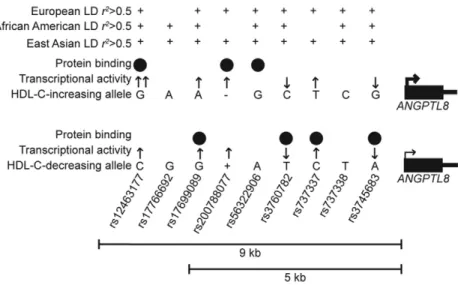
Six additional variants (rs17699089, rs200788077, rs56322906, rs3760782, rs737337, and rs3745683) showed evidence of allelic differ-ences in an assay for regulatory function and two (rs17766692 and rs737338) did not (Figure S6, Figure S7, Figure S8, and Figure S9 inFile S1). rs56322906 was only tested in transcriptional reporter assays as part of the 5-kb haplotype described below (Figure S11 in File S1). rs737337 showed by far the strongest enhancer activity in transcrip-tional reporter assays, an up to 60-fold increase compared with empty vector in HepG2 (Figure S6 in File S1), and rs737337-C shows strong allele-specific binding in liver cell types (Figure S7 inFile S1). Supershift experiments using HepG2 nuclear extract identified RXRaas binding to this probe, although not as part of the allele-specific complex (Figure S10 inFile S1). Interestingly, the four var-iants that overlap regulatory regions but were not predicted by any fine-mapping analysis (rs34692794, rs10421795, rs10421382, and rs6511729) did not show allelic differences in protein binding (Figure S9 inFile S1). In total, we observed evidence of functional activity for seven of the nine candidate regulatory variants in these assays (Figure 5).
To examine the effect on transcriptional activity of multiple variants together with theANGPTL8promoter, we tested 5-kb haplotypes located immediately upstream of theANGPTL8transcription start site. This re-gion includesfive of the seven variants showing allelic differences in pro-tein binding and/or transcriptional activity when examined separately (rs200788077, rs56322906, rs3760782, rs737337, and rs3745683; Figure S6 in File S1) and two variants that did not show evidence of allelic differences (rs6511729 and rs737338; Figure S9 inFile S1). Transcriptional reporter assays of the smaller segments containing individual variants had shown both activator (e.g., rs737337) and repressor (e.g., rs3760782 and rs3745683) activity. The 5-kb haplotype acted as an enhancer in HepG2, Huh-7, SGBS, and SW872, with intermediate activity observed between the individual segments, but did not show significant differences in tran-scriptional activity between the two haplotypes (Figure S11 inFile S1). These results suggest a complex regulatory mechanism involving en-hancer and repressor regions that work in concert to regulate expression.
DISCUSSION
In this study, we examined the tissue specificity ofANGPTL8, reported thefirst eQTL for variants at theANGPTL8HDL-C GWAS locus in adipose tissue, and identified variants at the GWAS locus that exhibit
allelic differences in assays of regulatory function. We found that a 400-bp promoter is the main driver of tissue specificity in liver, and that expression may be mediated by additional enhancer elements within 5 kb upstream of ANGPTL8, especially in adipocytes. Of seven candidate regulatory variants that showed allelic differences in transcriptional activity and/or protein binding, rs12463177 showed the clearest allelic differences consistent with the direction of theANGPTL8eQTL. These data suggest that multiple regions and potentially multiple variants regulateANGPTL8expression in liver and adipose tissue.
ANGPTL8is a strong candidate gene at this GWAS locus. Al-though we observed coincidental association between the GWAS variants and transcript level for both ANGPTL8 and DOCK6 in subcutaneous adipose tissue samples, ANGPTL8mRNA level was associated with HDL-C in METSIM, whereasDOCK6mRNA level was not (Figure S3 in File S1). DNase hypersensitivity sites that overlap regulatory variants are correlated toANGPTL8expression (Figure 1), providing further support for ANGPTL8as the target gene. ANGPTL8 protein levels have been shown to be inversely
n Table 2 Associations withANGPTL8andDOCK6expression in subcutaneous adipose tissue
Variant Allelesa Gene Effectb SE P-Value P
cond-eSNP Pcond-rs12463177
r2with
eSNP (EUR)c r 2with eSNP (AFR)c
rs4804155 G/C ANGPTL8 20.499 0.081 1.04·1029 — 0.516 — —
rs737337 C/T ANGPTL8 20.526 0.098 9.74·1028 0.244 0.402 0.67 0.40
rs4804154 T/C ANGPTL8 20.500 0.081 1.38·1029 0.762 0.270 1.00 0.48
rs12463177 C/G ANGPTL8 20.479 0.080 3.84·1029 0.570 — 0.94 0.47
rs17699089 G/A DOCK6 20.406 0.081 7.21·1027 — 0.005 — —
rs737337 C/T DOCK6 20.298 0.099 2.68·1023 0.324 0.413 0.74 0.29
rs4804154 T/C DOCK6 20.398 0.082 1.65·1026 0.253 0.267 0.94 0.91
rs12463177 C/G DOCK6 20.382 0.081 3.06·1026 0.029 — 1.00 0.98
Lead eQTL variants forANGPTL8(rs4804155) andDOCK6(rs17699089), lead GWAS variants (rs4804154 and rs737337), and functional candidate variant rs12463177 association withANGPTL8andDOCK6expression in 770 primary subcutaneous adipose samples. Conditional analysis on each lead eSNP and the candidate functional variant rs12463177 attenuated both theANGPTL8andDOCK6association signals.Pcond, conditionalP-value; eSNP, strongest associated eQTL variant. aThe HDL-C–decreasing and eQTL effect alleles are presentedfirst.
bEffect size is shown as the inverse normal transformed expression levels [log
2(fluorescence intensity)] with each additional copy of the allele. c
r2is calculated from 1000 Genomes Phase 1 data.
Figure 4 Allelic differences in regulatory assays of rs12463177 (A) A 698-bp region containing either allele of rs12463177 was cloned into the pGL4.23 vector and transfected in HepG2 cells. Data are represented as the mean6SD of 3–5 biological replicates. Luciferase activity was normalized to empty vector (EV) andP-values were de-termined by t-tests.P,0.05,P,0.01. (B) Differential protein
associated with HDL-C (Yiet al.2015). This direction is opposite of the association we observed withANGPTL8expression and HDL-C; however, others have suggested that ELISA methods may not con-sistently quantify serum ANGPTL8 levels (Fuet al.2014a). Further-more, ANGPTL8 inhibits lipoprotein lipase when coexpressed with ANGPTL3, giving a direct connection to lipid metabolism (Haller et al.2017). While we cannot rule out a role forDOCK6, these lines of evidence and a rare coding variant inANGPTL8associated with HDL-C (Pelosoet al.2014) suggestANGPTL8as the most likely target gene at this HDL-C GWAS locus.
TheANGPTL8HDL-C GWAS locus exhibited unusual character-istics infine-mapping because the associated variants defined by LDr2 with the lead GWAS variants span a larger chromosomal region in African Americans than in Europeans, opposite of most loci in the genome (International HapMap Consortium 2003). Our haplotype association analyses showed that the LD differences are due to a hap-lotype with 20% frequency in African Americans from WHI that is essentially not observed in Finns from METSIM (0.02% frequency). At this locus, low-frequency haplotypes (frequency,0.03; Table 1) dis-tinguishr2thresholds of 0.8 and 0.5 in Finns, and ther2dependence on allele frequency suggests that a LD threshold ofr2.0.8 for selecting candidate variants may be too restrictive and miss potentially func-tional variants. Here, we considered an initial set of candidate variants based on a more liberal threshold of r2. 0.5, resulting in 42 total variants. We then tested nine variants predicted by MANTRA, CAV-IAR, and PAINTOR and that overlapped regulatory datasets in functional assays. Seven of nine variants showed evidence of allelic differences (Figure 5), but only rs12463177 and rs17699089 showed differences consistent with the direction of the eQTL association. Of four additional variants that overlapped regulatory regions but were not predicted to be functional infine-mapping assays, none showed evi-dence of regulatory activity. Taken together, these data suggest that the joint use offine-mapping and regulatory overlap can successfully iden-tify variants exhibiting allelic differences in functional assays.
The mechanisms by which the variants that showed allelic differences in functional assays may work in concert remains unclear. The effect on transcriptional activity of rs12463177 was modest and only significant in one cell type (Figure 4 and Figure S6 inFile S1). This marginal effect observed in cell lines may not represent the physiological effectin vivo. The magnitude of effect of rs737337 was much greater (50-fold in-creased transcriptional activity), but did not show significant allelic
differences, in contrast to a previous report (Schmidt et al.2015). rs737337 exhibited strong liver-specific, allele-specific protein binding, but the specific transcription factor(s) remain unknown. One possible mechanism is that the regulatory region containing rs737337 is a strong enhancer that drives expression ofANGPTL8, but that the region con-taining rs12463177 is important for regulating allele-specific expres-sion. Transcriptional regulators bound at the multiple variants may act together via chromosomal looping with theANGPTL8promoter. Fur-ther experiments, especiallyin vivo, are needed to elucidate the precise roles and interactions of the seven variants that showed allelic differ-ences in transcriptional activity and/or protein binding.
In this study, we identifiedANGPTL8as the target gene at this HDL-C GWAS locus, determined regulatory drivers of tissue spec-ificity, and combinedfine-mapping approaches and regulatory over-lap with experimental assays to identify variants that may contribute to the HDL-C GWAS signal at ANGPTL8. Identifying variants underlying GWAS loci contributes to a growing understanding of target genes, their direction of effect, and metabolic phenotypes. Our results are consistent with previously described results at other GWAS loci where multiple common regulatory variants act together (Corradinet al.2014; Heet al.2015; Romanet al.2015), and con-tinued work on theANGPTL8locus will further clarify the complex mechanism of these variants.
ACKNOWLEDGMENTS
We thank the participants in the Metabolic Syndrome in Men and Women’s Health Initiative studies. We acknowledge the Encyclopedia of DNA Elements National Institutes of Health (NIH) Roadmap Epi-genomics, and Genotype-tissue expression project Consortia. We thank Martin Wabitsch (University of Ulm, Ulm, Germany) for his generous donation of SGBS cells. We acknowledge the University of North Carolina Michael Hooker Proteomics Core Facility for their as-sistance in identifying proteins bound in the DNA-affinity assay. This study was supported by NIH grants F31HL127984 (to M.E.C.), R01DK093757 (to K.L.M.), R01DK072193 (to K.L.M.), U01DK105561 (to K.L.M.), U01DK062370 (to M.B.), R00HL121172 (to M.C.), R01HG006292 (to Y.L.), R01HG006703 (to Y.L.), R01HL129132 (to Y.L.), and 1-ZIA-HG000024 (to F.S.C.); Academy of Finland grants 77299 and 124243 (to M.L.); the Finnish Heart Foundation (to M.L.); the Finnish Diabetes Foundation (to M.L.); Kuopio University Hospital State Research Funding (Valtion tutkimusrahoitus, VTR) grant (to M.L.); Figure 5 Summary of functional results for seven candidate variants. Summary of shared LD with lead HDL-C–associated variants reported in European (rs737337), African American (rs4804154), and East Asian (rs3760782) populations are shown; variants meeting ther2.0.5 threshold are marked with +. Results from transcriptional reporter luciferase assays and electrophoretic mobility shift assays (EMSA) for nine candidate variants are shown. Arrows show the direction of transcriptional activity in reporter assays. Two arrows at rs12463177-G indicate allelic differ-ences in transcriptional activity. Black circles show allele-specific protein binding observed in EMSA ex-periments. The larger and smaller arrows at the
and the Commission of the European Community grant HEALTH-F2-582 2007-201681 (to M.L.). The serum nuclear magnetic resonance spectroscopy (NMR) metabolomics was supported by the Sigrid Juselius Foundation and the Strategic Research Funding from the University of Oulu. The content is solely the responsibility of the authors and does not necessarily reflect the official views of the National Institutes of Health. A.J.K. and P.S. are shareholders of Brainshake Ltd., a company offering NMR-based metabolite profiling. A.J.K. and P.S. report employment relations for Brainshake Ltd.
LITERATURE CITED
Bernstein, B. E., J. A. Stamatoyannopoulos, J. F. Costello, B. Ren, A. Milosavljevic et al., 2010 The NIH roadmap epigenomics mapping consortium. Nat. Biotechnol. 28: 1045–1048.
Civelek, M., Y. Wu, C. Pan, C. K. Raulerson, A. Koet al., 2017 Genetic regulation of adipose gene expression and cardio-metabolic traits. Am. J. Hum. Genet. 100: p428–p443.
Coram, M. A., Q. Duan, T. J. Hoffmann, T. Thornton, J. W. Knowleset al., 2013 Genome-wide characterization of shared and distinct genetic components that influence blood lipid levels in ethnically diverse human populations. Am. J. Hum. Genet. 92: 904–916.
Corradin, O., A. Saiakhova, B. Akhtar-Zaidi, L. Myeroff, J. Williset al., 2014 Combinatorial effects of multiple enhancer variants in linkage disequilibrium dictate levels of gene expression to confer susceptibility to common traits. Genome Res. 24: 1–13.
Encode Project Consortium, 2012 An integrated encyclopedia of DNA elements in the human genome. Nature 489: 57–74.
Espes, D., J. Lau, and P. O. Carlsson, 2014a Increased circulating levels of betatrophin in individuals with long-standing type 1 diabetes. Diabeto-logia 57: 50–53.
Espes, D., M. Martinell, and P. O. Carlsson, 2014b Increased circulating betatrophin concentrations in patients with type 2 diabetes. Int. J. Endocrinol. 2014: 323407.
Fu, Z., A. B. Abou-Samra, and R. Zhang, 2014a An explanation for recent discrepancies in levels of human circulating betatrophin. Diabetologia 57: 2232–2234.
Fu, Z., F. Berhane, A. Fite, B. Seyoum, A. B. Abou-Samraet al., 2014b Elevated circulating lipasin/betatrophin in human type 2 diabetes and obesity. Sci. Rep. 4: 5013.
Fuchsberger, C., J. Flannick, T. M. Teslovich, A. Mahajan, V. Agarwalaet al., 2016 The genetic architecture of type 2 diabetes. Nature 536: 41–47. GTEx Consortium, 2013 The genotype-tissue expression (GTEx) project.
Nat. Genet. 45: 580–585.
Haller, J. F., I. J. Mintah, L. M. Shihanian, P. Stevis, D. Buckleret al., 2017 ANGPTL8 requires ANGPTL3 to inhibit lipoprotein lipase and plasma triglyceride clearance. J. Lipid Res. 58: 1166–1173.
Hanson, R. L., F. Leti, D. Tsinajinnie, S. Kobes, S. Puppalaet al., 2016 The Arg59Trp variant in ANGPTL8 (betatrophin) is associated with total and HDL-cholesterol in American Indians and Mexican Americans and differentially affects cleavage of ANGPTL3. Mol. Genet. Metab. 118: 128–137.
Hays, J., J. R. Hunt, F. A. Hubbell, G. L. Anderson, M. Limacheret al., 2003 The women’s health initiative recruitment methods and results. Ann. Epidemiol. 13: S18–S77.
He, H., W. Li, S. Liyanarachchi, M. Srinivas, Y. Wanget al., 2015 Multiple functional variants in long-range enhancer elements contribute to the risk of SNP rs965513 in thyroid cancer. Proc. Natl. Acad. Sci. USA 112: 6128–6133. Hormozdiari, F., E. Kostem, E. Y. Kang, B. Pasaniuc, and E. Eskin,
2014 Identifying causal variants at loci with multiple signals of associ-ation. Genetics 198: 497–508.
Hu, H., W. Sun, S. Yu, X. Hong, W. Qianet al., 2014 Increased circulating levels of betatrophin in newly diagnosed type 2 diabetic patients. Diabetes Care 37: 2718–2722.
Inouye, M., J. Kettunen, P. Soininen, K. Silander, S. Ripattiet al., 2010 Meta-bonomic, transcriptomic, and genomic variation of a population cohort. Mol. Syst. Biol. 6: 441.
International HapMap Consortium, 2003 The international HapMap project. Nature 426: 789–796.
Irizarry, R. A., B. Hobbs, F. Collin, Y. D. Beazer-Barclay, K. J. Antonelliset al., 2003 Exploration, normalization, and summaries of high density oli-gonucleotide array probe level data. Biostatistics 4: 249–264. Kang, H. M., J. H. Sul, S. K. Service, N. A. Zaitlen, S. Y. Konget al.,
2010 Variance component model to account for sample structure in genome-wide association studies. Nat. Genet. 42: 348–354.
Kichaev, G., W. Y. Yang, S. Lindstrom, F. Hormozdiari, E. Eskinet al., 2014 Integrating functional data to prioritize causal variants in statis-ticalfine-mapping studies. PLoS Genet. 10: e1004722.
Kulzer, J. R., M. L. Stitzel, M. A. Morken, J. R. Huyghe, C. Fuchsbergeret al., 2014 A common functional regulatory variant at a type 2 diabetes locus upregulates ARAP1 expression in the pancreatic beta cell. Am. J. Hum. Genet. 94: 186–197.
Laakso, M., J. Kuusisto, A. Stancakova, T. Kuulasmaa, P. Pajukantaet al., 2017 The metabolic syndrome in men study: a resource for studies of metabolic and cardiovascular diseases. J. Lipid Res. 58: 481–493. Lee, Y. H., S. G. Lee, C. J. Lee, S. H. Kim, Y. M. Songet al., 2016 Association
between betatrophin/ANGPTL8 and non-alcoholic fatty liver disease: animal and human studies. Sci. Rep. 6: 24013.
Li, Y., C. J. Willer, J. Ding, P. Scheet, and G. R. Abecasis, 2010 MaCH: using sequence and genotype data to estimate haplotypes and unobserved ge-notypes. Genet. Epidemiol. 34: 816–834.
McCarthy, S., S. Das, W. Kretzschmar, O. Delaneau, A. R. Woodet al., 2016 A reference panel of 64,976 haplotypes for genotype imputation. Nat. Genet. 48: 1279–1283.
Miyamoto, Y., J. Yamauchi, A. Sanbe, and A. Tanoue, 2007 Dock6, a Dock-C subfamily guanine nucleotide exchanger, has the dual specificity for Rac1 and Cdc42 and regulates neurite outgrowth. Exp. Cell Res. 313: 791–804.
Miyazaki, J., K. Araki, E. Yamato, H. Ikegami, T. Asanoet al., 1990 Establishment of a pancreatic beta cell line that retains glucose-inducible insulin secretion: special reference to expression of glucose transporter isoforms. Endocrinology 127: 126–132.
Morris, A. P., 2011 Transethnic meta-analysis of genomewide association studies. Genet. Epidemiol. 35: 809–822.
Nair, A. K., P. Piaggi, N. A. McLean, M. Kaur, S. Kobeset al., 2016 Assessment of established HDL-C loci for association with HDL-C levels and type 2 di-abetes in Pima Indians. Diabetologia 59: 481–491.
Parker, S. C., M. L. Stitzel, D. L. Taylor, J. M. Orozco, M. R. Erdoset al., 2013 Chromatin stretch enhancer states drive cell-specific gene regu-lation and harbor human disease risk variants. Proc. Natl. Acad. Sci. USA 110: 17921–17926.
Peloso, G. M., P. L. Auer, J. C. Bis, A. Voorman, A. C. Morrisonet al., 2014 Association of low-frequency and rare coding-sequence variants with blood lipids and coronary heart disease in 56,000 whites and blacks. Am. J. Hum. Genet. 94: 223–232.
Quagliarini, F., Y. Wang, J. Kozlitina, N. V. Grishin, R. Hydeet al., 2012 Atypical angiopoietin-like protein that regulates ANGPTL3. Proc. Natl. Acad. Sci. USA 109: 19751–19756.
Reiner, A. P., S. Beleza, N. Franceschini, P. L. Auer, J. G. Robinsonet al., 2012 Genome-wide association and population genetic analysis of C-reactive protein in African American and Hispanic American women. Am. J. Hum. Genet. 91: 502–512.
Ren, G., J. Y. Kim, and C. M. Smas, 2012 Identification of RIFL, a novel adipocyte-enriched insulin target gene with a role in lipid metabolism. Am. J. Physiol. Endocrinol. Metab. 303: E334–E351.
Roman, T. S., A. F. Marvelle, M. P. Fogarty, S. Vadlamudi, A. J. Gonzalez et al., 2015 Multiple hepatic regulatory variants at the GALNT2 GWAS locus associated with high-density lipoprotein cholesterol. Am. J. Hum. Genet. 97: 801–815.
Schaid, D. J., C. M. Rowland, D. E. Tines, R. M. Jacobson, and G. A. Poland, 2002 Score tests for association between traits and haplotypes when linkage phase is ambiguous. Am. J. Hum. Genet. 70: 425–434. Schmidt, E. M., J. Zhang, W. Zhou, J. Chen, K. L. Mohlkeet al.,
variants in epigenomic features using a systematic, data-driven approach. Bioinformatics 31: 2601–2606.
Shaheen, R., E. Faqeih, A. Sunker, H. Morsy, T. Al-Sheddiet al.,
2011 Recessive mutations in DOCK6, encoding the guanidine nucleo-tide exchange factor DOCK6, lead to abnormal actin cytoskeleton orga-nization and Adams-Oliver syndrome. Am. J. Hum. Genet. 89: 328–333. Sheffield, N. C., R. E. Thurman, L. Song, A. Safi, J. A. Stamatoyannopoulos
et al., 2013 Patterns of regulatory activity across diverse human cell types predict tissue identity, transcription factor binding, and long-range interactions. Genome Res. 23: 777–788.
Spracklen, C. N., P. Chen, Y. J. Kim, X. Wang, H. Caiet al., 2017 Association analyses of East Asian individuals and trans-ancestry analyses with European individuals reveal new loci associated with cholesterol and triglyceride levels. Hum. Mol. Genet. 26: 1770–1784.
Stancakova, A., M. Javorsky, T. Kuulasmaa, S. M. Haffner, J. Kuusistoet al., 2009 Changes in insulin sensitivity and insulin release in relation to glycemia and glucose tolerance in 6,414 Finnish men. Diabetes 58: 1212–
1221.
Stegle, O., L. Parts, R. Durbin, and J. Winn, 2010 A Bayesian framework to account for complex non-genetic factors in gene expression levels greatly increases power in eQTL studies. PLoS Comput. Biol. 6: e1000770. Teslovich, T. M., K. Musunuru, A. V. Smith, A. C. Edmondson, I. M.
Stylianouet al., 2010 Biological, clinical and population relevance of 95 loci for blood lipids. Nature 466: 707–713.
Visscher, P. M., M. A. Brown, M. I. McCarthy, and J. Yang, 2012 Five years of GWAS discovery. Am. J. Hum. Genet. 90: 7–24.
Wabitsch, M., R. E. Brenner, I. Melzner, M. Braun, P. Molleret al., 2001 Characterization of a human preadipocyte cell strain with high
capacity for adipose differentiation. Int. J. Obes. Relat. Metab. Disord. 25: 8–15.
Wang, Y., F. Quagliarini, V. Gusarova, J. Gromada, D. M. Valenzuelaet al., 2013 Mice lacking ANGPTL8 (Betatrophin) manifest disrupted tri-glyceride metabolism without impaired glucose homeostasis. Proc. Natl. Acad. Sci. USA 110: 16109–16114.
Weissglas-Volkov, D., C. A. Aguilar-Salinas, E. Nikkola, K. A. Deere, I. Cruz-Bautistaet al., 2013 Genomic study in Mexicans identifies a new locus for triglycerides and refines European lipid loci. J. Med. Genet. 50: 298–308.
Willer, C. J., E. M. Schmidt, S. Sengupta, G. M. Peloso, S. Gustafssonet al., 2013 Discovery and refinement of loci associated with lipid levels. Nat. Genet. 45: 1274–1283.
Yamada, H., T. Saito, A. Aoki, T. Asano, M. Yoshidaet al., 2015 Circulating betatrophin is elevated in patients with type 1 and type 2 diabetes. En-docr. J. 62: 417–421.
Yi, M., R. P. Chen, R. Yang, X. F. Guo, J. C. Zhanget al., 2015 Betatrophin acts as a diagnostic biomarker in type 2 diabetes mellitus and is negatively associated with HDL-cholesterol. Int. J. Endocrinol. 2015: 479157. Zhang, R., 2012 Lipasin, a novel nutritionally-regulated liver-enriched
factor that regulates serum triglyceride levels. Biochem. Biophys. Res. Commun. 424: 786–792.
Zhang, Y., S. Li, W. Donelan, C. Xie, H. Wanget al., 2015 Angiopoietin-like protein 8 (betatrophin) is a stress-response protein that down-regulates expression of adipocyte triglyceride lipase. Biochim. Biophys. Acta 1861: 130–137.