WHAT WE DO: AN EXAMINATION OF BLACK CULTURAL EXPRESSIONS AND WHITE CONSUMPTION
Sinclair Palmer
A thesis submitted to the faculty at the University of North Carolina at Chapel Hill in partial fulfillment of the requirements for the degree of Master of Arts in the
Department of Music in the School of Arts and Sciences.
Chapel Hill 2019
Approved by: Mark Katz
ii
iii
ABSTRACT
Sinclair Palmer: What We do: An Examination of Black Cultural Expression and White Appropriation
(Under the direction of Mark Katz)
Using the “Got to Give It Up”/“Blurred Lines” copyright cases of the 2010s as a point of departure, this thesis examines white appropriations of black music and associated images, as well as the ways that this appropriation both shapes white
imaginaries of blackness and popularizes specific tropes of black culture. It will push for the consideration of power relationships within music copyright cases which concern potential acts of cultural appropriation by exploring aspects of the cases in several ways: 1) discussing blackface and (neo-)minstrelsy in their historical and contemporary
contexts, 2) placing “Blurred Lines” into broader contexts of white appropriation in the United States and U.S. copyright law, and 3) using this framework to assess the
iv
ACKNOWLEDGEMENTS
v
TABLE OF CONTENTS
LIST OF FIGURES ... vi
INTRODUCTION ... 1
CHAPTER 1: POWER AND INFLUENCE IN THE CONSUMPTION OF (NEO)-MINSTRELSY ... 5
CHAPTER 2: ON CULTURAL APPROPRIATION AND HISTORICAL ERASURE ... 11
CHAPTER 3: “BLURRED LINES” VERSUS THE WORLD ... 16
CHAPTER 4: APPLYING A FRAMEWORK ... 29
CONCLUSION ... 32
vi
LIST OF FIGURES
Figure 1 - “Blurred Lines” Form and Chord Progression
(My Transcription) ... 17 Figure 2 - Comparison of bass and keyboard excerpts in "Blurred Lines"
and "Got to Give It Up" ... 19 Figure 3 - “Got to Give It Up” Form and Chord Progression
1
INTRODUCTION
“The first thing I thought about was one of my dad’s songs…I thought it was a remix, but it wasn’t,” Marvin Gaye III claimed in a 2015 interview. He had been asked to discuss recent lawsuits concerning the similarities between his father’s 1977 hit “Got to Give It Up” and Robin Thicke’s “Blurred Lines,” released in 2013.1 Thicke and co-writer
Pharrell Williams, already under scrutiny for the misogynistic depictions of women in the composition, had preemptively sued the Gaye family as a defensive measure against accusations of copyright infringement, following similar accusations concerning the introduction to his song “Million Dollar Baby” and its uncanny similarity to that of Gaye’s “Trouble Man.”2 Their suit for declaratory judgement sought to legally
disassociate “Blurred Lines” from “Got to Give It Up” before a copyright infringement suit could be filed. “There is a way to do business and a way not to do business,” Gaye’s son told reporters in 2013. “I’m sure anyone would see the similarities…clearly, between what my father does and what Robin Thicke is trying to do.3
1Entertainment Tonight, “Marvin Gaye’s Son Talks Blurred Lines Lawsuit,” YouTube, Nov. 18, 2013. https://www.youtube.com/watch?v=SGEjD-XtLpA.
2Robin Thicke and Pharrell Williams also filed a complaint against Bridgeport Music, publisher of Funkadelic’s song “Sexy Ways” (1974), as the Gaye family’s initial complaint also cited similarities between this song and “Blurred Lines.” George Clinton, co-writer of “Sexy Ways,” later denounced these accusations in a Twitter post, claiming that there was “no sample” of his song in “Blurred Lines.” Thicke and Williams dropped their action against Bridgeport Music in 2014: “Marvin Gaye Estate vs Robin Thicke and Pharrell Williams,” Lost in Music, last updated 2019, accessed Mar. 20, 2019.
2
In 2014, District Court Judge John A. Kronstadt denied Robin Thicke and Pharrell Williams’s appeal for declaratory judgement, establishing that “elements of ‘Blurred Lines’ may be substantially similar to protected, original elements of ‘Got to Give It Up.’”4 Allowed to proceed, the Gaye family sued Thicke and Williams for
copyright infringement, winning what became nearly $5 million and half of all future royalties and publishing revenue. The decision was later affirmed in the Ninth Circuit Court of Appeals in a 2016 trial prompted by the appellants.5 The case, while
successfully providing the Gayes with one form of justice, did not illuminate the some of the broader issues in which this issue is contextualized, namely a U.S. American history of appropriation of black cultural artifacts and identifiers. Marvin Gaye III’s comments on his initial feelings upon hearing “Blurred Lines”—that it was a remix of his father’s song—provides evidence that appropriation and misrepresentation has become
increasingly covert and normalized. Perhaps what Marvin Gaye does, what Robin Thicke is trying to do, and what white entertainers have tried to do for centuries, is lay claim to black expressions.
It is essential to consider the racial and musical identities of these artists in order to analyze their cultural-historical power relationships. Marvin Gaye was a black soul artist born in Washington D.C. in 1939, who began his music career as a session
drummer for Motown records. He began his solo persona in the 1960s, helping to build
4Randy Lewis, “Robin Thicke, Pharrell Williams Lose First Round in ‘Blurred Lines’ Case,” Los Angeles
Times, Oct. 30, 2015, accessed Mar. 6, 2019. https://www.latimes.com/entertainment/music/posts/la-et-ms-robin-thicke-pharrell-williams-blurred-lines-marvin-gaye-lawsuit-20141030-story.html.
5Jordan Darville, “Pharrell and Robin Thicke Ordered to Pay Nearly $5 Million in “Blurred Lines” Lawsuit,” The Fader, Dec. 13, 2018, accessed Mar. 6, 2019.
3
the foundation for an era of black popular music.6 Pharrell Williams, producer of
“Blurred Lines,” is a black music producer born in Virginia Beach. His contributions to the U.S. American music industry have been generative and prolific, collaborating with some of the nation’s most successful musical artists as a guest contributor, crafting award-winning film soundtracks, and producing some of the most celebrated popular music compositions since 2000.7 Robin Thicke, one of Williams’s collaborators, is a
white singer-songwriter born to a musical family in Los Angeles. He began his career as a producer for Interscope Records in the early 2000s, shifting his focus to songwriting and performing by 2006. While Thicke has not received the broad acclaim that Williams or Gaye have, he has crafted a number of contemporary chart-toppers in his career, including “Blurred Lines.”8 With this, we can at least assume that Thicke and Williams
would have reveled in the extensive musical legacy of Marvin Gaye. In fact, Williams confirms this: in a 2013 interview, he admitted that Gaye was one of his greatest musical inspirations, and that he tried to emulate “the feeling that ‘Got to Give It Up’ gave [him]” in “Blurred Lines.”9 But curiously, a large portion of the academic and opinion writing
surrounding this series of lawsuits has focused on potential aspects of cultural appropriation related to Thicke’s “copying” of a black artist’s song, regardless of
6“Marvin Gaye,” Biography, accessed Mar. 9, 2019. https://www.biography.com/people/marvin-gaye-9307988.
7“Pharrell Williams,” Biography, accessed Mar. 9, 2019. https://www.biography.com/people/pharrell-williams.
8“Robin Thicke.” Biography, accessed Mar. 9, 2019. https://www.biography.com/people/robin-thicke-21209847.
9HipHollywood, “Pharrell Williams Admits He Was Inspired by Marvin Gaye’s ‘Got to Give It Up’ – HipHollywood.com,” YouTube video, Oct. 31, 2013, accessed Mar. 9, 2019.
4
Williams’s songwriting credit.10 This raises the question: does consideration of identity
differences influence our placement of the line between copyright infringement and cultural appropriation?
Using the “Blurred Lines” cases as a point of departure, this thesis examines white appropriations of black music and associated images, as well as the ways that this appropriation both shapes white imaginaries of blackness and popularizes specific tropes of black culture. This expands upon existing scholarship surrounding neo-minstrelsy, (white) cultural appropriation, and color-blind ideology by academics such as Lewis R. Gordon, Matthew D. Morrison, Jason Rodgriguez, and Nick Heffernan, all of whom having contributed work which shaped many of the ideas in this project. It will push for the consideration of power relationships within music copyright cases which concern potential acts of cultural appropriation by exploring aspects of the cases in several ways: 1) discussing blackface and (neo-)minstrelsy in their historical and contemporary contexts, 2) placing “Blurred Lines” into broader contexts of white appropriation in the United States and U.S. copyright law, and 3) using this framework to assess the appropriative qualities of “Blurred Lines.”
10See: Toni Lester, “Blurred Lines–Where Copyright Ends and Cultural Appropriation Begins–The Case of Robin Thicke versus Bridgeport Music and the Estate of Marvin Gaye,” Hastings Communication and Entertainment Law Journal 36 (2013): 217-41; Melanie Thibeault, “Blurring the Lines of Cultural Appropriation in American Pop Culture,” The College Voice, Nov. 6, 2013, accessed Apr. 9, 2019.
https://thecollegevoice.org/2013/11/06/blurring-the-lines-of-cultural-appropriation-in-american-pop-culture/; Bob Stanley, “Blurred Lines: The Danger of Confusing Musical Inspiration with Appropriation,”
The Guardian, Mar. 11, 2015, accessed Apr. 9, 2019.
5
CHAPTER 1: POWER AND INFLUENCE IN THE CONSUMPTION OF (NEO-)MINSTRELSY
Blackface makeup, popularized in vaudeville and minstrel shows in the mid-19th
century, enabled white entertainers to embody black characters steeped in racist stereotypes in their theatrical impersonations of black plantation workers in the
southern United States. Often portrayed as lazy and buffoonish, the characters spoke in “plantation” dialects, sang and danced in the style of black “authenticity,” and the burnt cork or shoe shine which blackened their faces was often accompanied by large, painted lips and pompous formal wear.11 While it has become uncommon, blackface practices
have persisted as a way of overtly and covertly (mis)representing black bodies. In early 2019, two Virginia politicians admitted to having worn blackface makeup in the 1980s to impersonate famous African Americans.12 The Netflix series Dear White People (2017)
features white college students hosting a blackface-themed Halloween party as the central conflict of its first season, and Today Show host Megyn Kelly claimed in 2018 that using blackface makeup in costumes was acceptable, “as long as you were dressing up as, like, a character.”13 What Kelly failed to realize is the impact that representations
11Karla Lant, “Blackface,” in Multicultural America: A Multimedia Encyclopedia, Carlos E. Cortés, ed. (Thousand Oaks, CA: SAGE Publications, Inc., 2013), 367.
12Rhae Lynn Barnes, “Yes, Politicians Wore Blackface. It Used to be All-American ‘Fun,’” Feb. 8, 2019, accessed Mar. 6, 2019. https://www.washingtonpost.com/outlook/yes-politicians-wore-blackface-it-
used-to-be-all-american-fun/2019/02/08/821b268c-2b0d-11e9-b011-d8500644dc98_story.html?utm_term=.956c8d64b6d1.
6
of identity have on our perceptions of those identities; that is, that we project these perceptions onto real people, regardless of the black “character” being portrayed.14
The context of blackface is as important as the practice itself. White performers who wore blackface, typically minstrels performing in minstrel shows, were adored by black and white audiences alike. Black performers were objectified by their white
audiences, particularly those who were expected to wear blackface for all-black minstrel shows. These audiences were attracted to the authenticity which they believed only the black performers could provide, though ironically, the performances only reflected a white-imagined caricature of plantation life which relied on the literal masking of their black complexions.15 “Authentically black” cultural practices portrayed in minstrel
shows were, in reality, only partly-black cultural practices warped by white
imaginations, which both obstructed the visibility of black performers while normalizing the objectification of black people.16 The reasons for the broad approval of this overtly
racist form of entertainment in the black community are unclear, but some influential black thinkers and writers contested the practice nevertheless. Frederick Douglass, for instance, famously described white blackface minstrels who claimed to perform in “the authentic Negro style” as “the filthy scum of white society, who have stolen from us a complexion denied to them by nature, in which to make money, and pander to the
14See: Rebecca Pardo, “Reality Television and the Metapragmatics of Racism,” Journal of Linguistic
Anthropology 23, no. 1 (2013): 65-81; Devah Pager and Hana Shepherd, “The Sociology of
Discrimination: Racial Discrimination in Employment, Housing, Credit, and Consumer Markets,” Annual Review of Sociology 34 (2008): 181-209; Sudeep Bhatia, “The Semantic Representation of Prejudice and Stereotypes,” Cognition 164 (2017): 46-60.
15Karla Lant, “Blackface,” 368.
7
corrupt taste of their white fellow-citizens”;17 this salient remark has since been
reiterated in conversations surrounding cultural appropriation, “blackophilia,” and color-blind ideology.18
The gradual shift from the blackface mask to what musicologist Matthew D. Morrison calls “Blacksound” was indicated by a transformation of U.S. American
imaginaries of African-isms and perspectives surrounding artistic expression during the late 19th century. Blacksound, or “racially coded sonic scripts” which are inspired by
blackface practices, describes normalized performance actions based on real and imagined histories of African American bodies.19 “I would assert,” Morrison claimed in
his 2014 dissertation, “that the combination of ‘freedom of subject matter’ and the presence of ‘African borrowings’ (whether real or imagined) centrally marked the transition from blackface to Blacksound in mobilizing an American popular sound.”20
By freedom of subject matter, Morrison references the decontextualization of Blacksound from blackface by white minstrels, allowing for intentional yet covert
appropriations of black sonic expressions. It is my position that the decontextualization of white-performed Blacksound from the blackface mask gave way to a black-focused
17Frederick Douglass, “The Hutchinson Family. – Hunkerism,” The North Star (Rochester: Oct. 27, 1848). In Uncle Tom’s Cabin & American Culture Stephen Railton, dir., accessed Mar. 22, 2019.
http://utc.iath.virginia.edu/minstrel/miar03bt.html.
18See: Bill Yousman, “Blackophilia and Blackophobia,” Communication Theory 13, no. 4 (2003): 366-91, and Jason Rodriguez, “Color-Blind Ideology and the Cultural Appropriation of Hip-Hop,” Journal of Contemporary Ethnography 35, no. 6 (2006): 645-68.
19Matthew Morrison, “Sound in the Construction of Race: From Blackface to Blacksound in Nineteenth-Century America,” PhD diss. (Columbia University, 2014): 2.
8
color-blind ideology, in which white actors have recontextualized Blacksound as “American,” rather than as fundamentally black.21
Neo-minstrelsy, or popular contemporary artistic practices which recall minstrel tropes, has in turn taken a hold of pop culture since the beginning of the 20th century.
Recently, white Australian hip hop artist Iggy Azalea’s work was compared to
minstrelsy, and her appropriation of African American Vernacular English labeled by some as “verbal blackface.”22 One commenter broadly compared the “phenomenon of
the white rapper” to the popularity of the minstrel show, accusing these rappers of appropriating the African American “struggle” in order to turn a profit.23 Positions have
also shifted in conversations surrounding black minstrelsy since its fall in the mid-20th
century: Jimi Hendrix, whose music was rendered “inauthentically rock” by white audiences because of his being black, was simultaneously labeled as “inauthentically black” by his black audiences.25 This recalls and contrasts Douglass’s statement of
displeasure concerning white minstrels, could emulate the “authentic negro style” with the help of blackface makeup; the commodification of Blacksound by white musicians had made white audiences the gatekeepers of the popular music styles which stemmed from it.26 Meanwhile, black audiences became and have remained concerned with the
images and practices of black musical artists, fighting to reclaim black authenticity from
21Jason Rodgriguez, “Color-Blind Ideology and the Cultural Appropriation of Hip-Hop,” 647-48.
22Jeff Guo, “How Iggy Azalea Mastered Her Blaccent,” The Washington Post, Jan. 4, 2016, accessed Mar. 7, 2019. https://www.washingtonpost.com/news/wonk/wp/2016/01/04/how-a-white-australian-rapper-mastered-her-blaccent/?noredirect=on&utm_term=.f64d572df709.
23Andrew Oliver, “White Rappers: America’s New Minstrels,” New Fury Media, Jul. 14, 2015, accessed Mar. 7, 2019. http://thenewfury.com/wordpress/white-rappers-americas-new-minstrels/.
25Jack Hamilton, Just Around Midnight (Cambridge, MA: Harvard University Press, 2016), 16. 26Matthew D. Morrison, “Sound in the Construction of Race,” 139, 152-53.
9
its connection to minstrelsy. In 2006, jazz trumpeter Wynton Marsalis compared commercialized vulgarity in rap songs to minstrel show antics, pointing out that the world would not hold black rappers accountable for “making a fool out of
[themselves].”27 The same commercialized vulgarity has been described as not only a
part of hip hop, but a popularized central theme, reminiscent of racist black stereotypes highlighted in minstrel acts nationwide.28
Both black and white intellectuals have pushed against accusations of neo-minstrelsy as well. Two common broad justifications manifest this position: The first, exclusively regarding white practitioners of black musics, pardons artists who have publicly voiced appreciation for their black influences, and/or those who have become respected and admired by their black public.29 The second shifts accountability for the
exploitation of black music from artists to the powerful and influential tastes of white audiences.30 The concept of white appropriation, or the appropriation of black spaces
and intellectual property for the creation and maintenance of “whiteness,” continues to influence our understanding of minstrelsy and cultural production. In a 2002 article,
27Sholto Byrnes, “Wynton Marsalis: Blowing Up a Storm,” The Independent, Aug. 13, 2006, accessed Mar. 7, 2019. https://www.independent.co.uk/arts-entertainment/music/features/wynton-marsalis-blowing-up-a-storm-411715.html and Marc Aronson, “The Complicated Mix of Racism and Envy Behind
Blackface,” The Washington Post, Feb. 8, 2019, accessed Mar. 7, 2019.
https://www.washingtonpost.com/news/made-by-history/wp/2018/07/22/the-complicated-mix-of-racism-and-envy-behind-blackface/?utm_term=.61fff545c98b.
28Matthew Jones, “Blackface Minstrelsy: Then and Now,” The Odyssey, Mar. 28, 2016, accessed Mar. 7, 2019. https://www.theodysseyonline.com/blackface-minstrelsy.
29See: Aaron Williams, “It’s Time to Finally Start Accepting White Rappers as a Legitimate Part of Hip-Hop,” Uproxx, Sep. 26, 2017, accessed Mar. 7, 2019. https://uproxx.com/hiphop/white-rappers-hip-hop-appropriation-appreciation-outsiders/. See also: Nick Heffernan, “‘As Usual, I’ll Have to Take an IOU’: W.E.B. Du Bois, the Gift of Black Music and the Cultural Politics of Obligation,” Journal of American Studies 52, no. 4 (2018): 1095-1121.
10
social scientists Jeanita W. Richardson and Kim A. Scott provide evidence that white youths’ consumption of rap-related products correlates to the amount of negative press that rappers receive at a given time, or to recall Marsalis’s statement, rappers “making a fool of [themselves].”31 After giving evidence that the majority of rap consumers are
white, media studies scholar Bill Yousman connects this reality to a broader relationship between overt tendencies of white supremacy (“identifiable in both the individualized bigotry of hate groups and the institutional racism of mainstream American social structure”) and covert exertions of power by whites in the form of purchasing,
consuming, and appropriating black culture.32 Cornel West elegantly summed up this
power difference in 1997: “One irony of our present moment is that just as young black men are murdered, maimed, and imprisoned in record numbers, their styles have become disproportionately influential in shaping popular culture.”33 The twisted
juxtaposition of celebrating and mutilating blackness (which applies to the physical and cultural implications of West’s statement) is indeed part of a reality which African Americans are forced to face; but while we have no choice but to experience this reality consciously, white U.S. Americans are both complicit and implicit in perpetuating black disenfranchisement.
31Jeanita W. Richardson and Kim A. Scott, “Rap Music and Its Violent Progeny,” Journal of Negro
Education 71, no. 3 (2002): 184.
11
CHAPTER 2: ON CULTURAL APPROPRIATION AND HISTORICAL ERASURE
“[T]he final measure of the greatness of all peoples is the amount and standard of the literature and art they have produced...Through his artistic efforts the Negro is smashing the race barriers faster than he has ever done through any other method.”34
—James Weldon Johnson, from the preface to TheBook of American Negro Poetry (1931)
While on tour with trumpeter Dizzy Gillespie in the late 1950s, jazz saxophonist Phil Woods began to openly question his position as a white musician in a decidedly black music genre, drawing from the music of Charlie Parker. He decided to ask Gillespie, as well as bandmates Max Roach and Miles Davis, if he could “make it” as a white man playing jazz. Gillespie consoled him: “No one can steal a gift. Bird (Charlie Parker) gave the world his music, and if you can hear it you can have it.”35 W.E.B. Du
Bois wrote a similar sentiment in The Souls of Black Folk nearly sixty years earlier, describing black music as “the singular spiritual heritage of the nation and the greatest gift of the Negro people.”36 This generous view of black music’s legacy carries a few
unspoken implications: 1) that African American music is not only a part of a broader
34James Weldon Johnson, “1922 Preface to The Book of American Negro Poetry,” Modern American
Poetry, Cary Nelson and Bartholomew Brinkman, ed., accessed Mar. 8, 2019. http://www.english.illinois.edu/maps/poets/g_l/johnson/preface1.htm.
35Gene Lees, You Can’t Steal a Gift: Dizzy, Clark, Milt, and Nat (Lincoln, NE: University of Nebraska Press, 2001), 96.
12
U.S. American history, it defines it; and 2) that black music has been a “gift” to the United States by African Americans. The limits of this gift are unclear; is it a gift which is experienced passively on behalf of African Americans, a permission slip to adopt a black expression, or something in between? American studies scholar Nick Heffernan wrote:
It would be wrong to understand Du Bois’s notion of the gift as an entirely
conciliatory gesture that, in the service of an integrationist vision, offers up black culture for white appropriation without condition of demur.37
On the contrary. In a later publication, Du Bois addresses the violence which has been committed against black bodies by white U.S. Americans’ construct of racism, the irony of white “imprison[ment] and enthrall[ment]…for such a cause [as racial superiority], for such a phantasy!” and whites’ subsequent cognitive dissonance which enables a “divine” theft, or appropriation, of black identity.39 This transformation suggests Du
Bois’s difficulty reconciling his feeling of pride in black cultural products with the self-bestowed and (simultaneously) systemic entitlement held by white U.S. Americans. As almost a concession to his concept of “double-consciousness” articulated in The Souls of Black Folk twenty years earlier, Du Bois calls out: “Whiteness is the ownership of the earth forever and ever, Amen!” as if American identification had at last forcibly overcome that of the African American.40
37Nick Heffernan, “As Usual, I’ll Have to Take an IOU,” 1098.
13
The term cultural appropriation typically carries a negative connotation; it is an act of violence, a conscious or subconscious expression of “the fact of dominance.”41
“Appropriator” has become a condemnatory epithet in contemporary “call-out” culture, and as our collective understanding of cultural appropriation shifts as we move further into a globalized world, culprits and their actions are changing. Anthropologist David Howes described the massive cultural appropriation of Hopi traditions in the U.S.
American Southwest as “the commercial exploitation of Indianness.”42 There are, in fact,
many parallels between the appropriation of African American and American Indian cultures; notably, both have been misrepresented in the form of white agents coloring their skin, and both have historically inspired predominantly white-occupied U.S. American countercultures.43 These similarities suggest that those labeled by U.S.
Americans as “others” (or, historically, non-white) commonly experience the decontextualization of their cultural identifiers in acts of cultural appropriation committed against them. Isolating cultural appropriation from cultural participation can be difficult and often impossible, as both bring forth vague concepts of intellectual property and intent in action. At face value, the term “participation” implies
innocuousness, but often acts that are conceived as participatory are appropriative in effect. Williams v. Gaye is clarified with the understanding that Robin Thicke and
Pharrell Williams did appropriate aspects of “feel” from “Got to Give It Up,” and that for Thicke, this was an attempt at black cultural participation.
41Eduardo Bonilla-Silva, Racism Without Racists: Color-Blind Racism and the Persistence of Racial
Inequality in the United States (Lanham, MD: Rowman and Littlefield, 2010), 54.
42David Howes, “Cultural Appropriation and Resistance in the American Southwest,” in Cross-Cultural
14
Cultural participation often occurs not in the form of artistic expression, but in that of appreciation, or passive participation. In a 2017 article, philosopher Lewis
Gordon illustrated his surprise when he realized that the driver responsible for bumping some “seriously great hip-hop” at a gas station was white, and more, that the driver was “enjoying the music,” or by Gordon’s standards, appreciating rather than
appropriating.44“That white guy wasn’t trying to be black” Gordon insisted; he was
enjoying a black cultural product.45 Gordon uses this vignette to introduce his
displeasure with the “cultural appropriation thesis,” which simplifies what he insists is a distinct separation between acts of participation and appropriation:
The fallacy of the cultural appropriation thesis is the notion that whites
appropriate simply by participation… Cultural participation is not identical with historical erasure. What has happened to a long list of black cultural productions is the erasure of their historical genesis emerging from what could be called white historical capital.46
Here, Gordon reminds the reader of the lasting effects of white appropriation via color-blind ideology, identifying the cultural products absorbed into a vaguely “American” identity as “white historical capital.” Focusing on the processes and effects of this ideologycould help shape a clearer concept of cultural appropriation, given Gordon’s concerns. A reaction to the civil rights movement, color-blind ideology is “the assertion of essential sameness between racial and ethnic groups” despite unique histories and relationships to power.47 It enables acts of cultural appropriation under the belief that
44Lewis Gordon, “Rockin’ It in Blue,” 218-19, author’s emphasis. 45Ibid. 218-19.
46Ibid. 218.
15
much of the world exists as somewhat of a mono-culture, rather than as a vast system of cultural interchange. What color-blind ideology ignores is the ways in which acts of power have guided this interchange, as well as the lasting effect that these power relationships have on future exchange. K.J. Greene, a renowned U.S. music copyright scholar, made the claim in 2008 that the consistent pattern of appropriating African American art indicates primarily systemic, rather than individual, acts of racism in the United States.48 Indeed, with systemic institutions in place to further commodify
Blacksound by the late 19th century, we have since witnessed the normalization of
appropriating blackness.49 Modern white appropriations of black music are always
already historically contextualized to many, unearthing memories of blackface
minstrelsy and other forms of disenfranchisement, pushing color-blind ideology forth as an ultimate form of African American historical erasure.
48K.J. Greene, “‘Copynorms,’ Black Cultural Production, and the Debate over African-American Reparations,” Cardozo Arts and Entertainment 25, no. 3(2008): 1181
16
CHAPTER 3: “BLURRED LINES” VERSUS THE WORLD
17
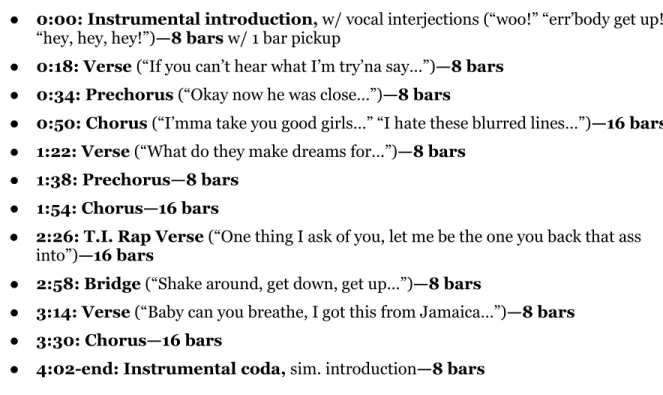
Fig. 1: “Blurred Lines” Form and Chord Progression (My Transcription)
● 0:00: Instrumental introduction, w/ vocal interjections (“woo!” “err’body get up!” “hey, hey, hey!”)—8 bars w/ 1 bar pickup
● 0:18: Verse (“If you can’t hear what I’m try’na say…”)—8 bars
● 0:34: Prechorus (“Okay now he was close…”)—8 bars
● 0:50: Chorus (“I’mma take you good girls…” “I hate these blurred lines…”)—16 bars
● 1:22: Verse (“What do they make dreams for…”)—8 bars
● 1:38: Prechorus—8 bars
● 1:54: Chorus—16 bars
● 2:26: T.I. Rap Verse (“One thing I ask of you, let me be the one you back that ass into”)—16 bars
● 2:58: Bridge (“Shake around, get down, get up…”)—8 bars
● 3:14: Verse (“Baby can you breathe, I got this from Jamaica…”)—8 bars
● 3:30: Chorus—16 bars
18
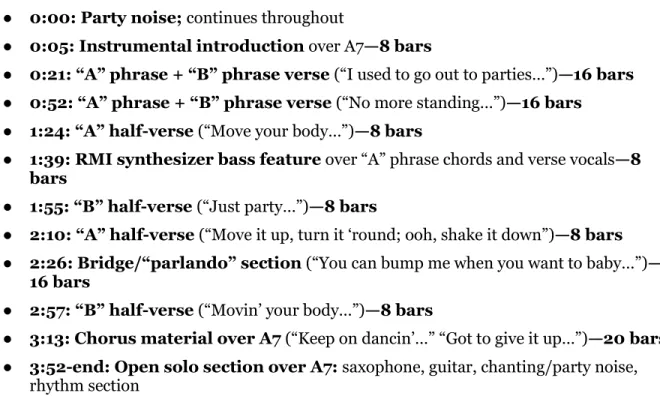
After about five seconds of a group of partygoers’ sonic space and a short instrumental introduction, the bulk of “Got to Give It Up” alternates between two opposing eight-measure phrases (labeled “A” and “B” in figure 3), though the pattern has its occasional aberrations. The most present of these is the bridge section, to which many referred as the “parlando” section in the Williams and Gaye trials, where the piece moves into the parallel minor key area and back in 16 measures. It finishes with a
chorus over the “A” phrase and an extended, modal instrumental solo section in the key of A, blessed with the occasional background vocal interlude, accentuated party noises, and a chant: “Let’s dance, let’s shout! Gettin’ funky’s what it’s all about!” Like “Blurred Lines,” “Got to Give It Up” uses synthesizer bass, Rhodes organ, drum set, and one cowbell, with the addition of tambourine, guitar, alto saxophone, and other
miscellaneous percussion instruments. Uniquely, the piece utilized both the talents of producer Art Stewart and a collective of instrumental musicians, giving the piece consistent and fresh improvised material in the recording progress.
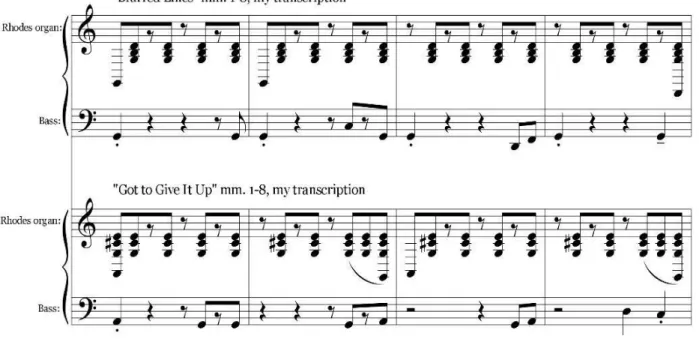
The relationships between the bass lines and keyboard parts in both songs serve similar functions, accentuating beat one and following with beat syncopation in every measure (see fig. 2). Both pieces begin some of their signature vocal phrases with long, melodic, eighth-note pickups, rising in contour to a sustained note or notes after their downbeats, and ending in unique melismas. While the songs’ lyrics depict unrelated scenarios, both utilize text painting and at times similar vocabulary, though it is
19
heard in both, as Judge Jacqueline Nguyen brought up during the Ninth Circuit appeal, are likely to be found in others’ (pop) compositions as well.
20
Fig. 3: “Got to Give It Up” Form and Chord Progression (My Transcription)
● 0:00: Party noise; continues throughout
● 0:05: Instrumental introduction over A7—8 bars
● 0:21: “A” phrase + “B” phrase verse (“I used to go out to parties…”)—16 bars
● 0:52: “A” phrase + “B” phrase verse (“No more standing…”)—16 bars
● 1:24: “A” half-verse (“Move your body…”)—8 bars
● 1:39: RMI synthesizer bass feature over “A” phrase chords and verse vocals—8 bars
● 1:55: “B” half-verse (“Just party…”)—8 bars
● 2:10: “A” half-verse (“Move it up, turn it ‘round; ooh, shake it down”)—8 bars
● 2:26: Bridge/“parlando” section (“You can bump me when you want to baby…”)— 16 bars
● 2:57: “B” half-verse (“Movin’ your body…”)—8 bars
● 3:13: Chorus material over A7 (“Keep on dancin’…” “Got to give it up…”)—20 bars
● 3:52-end: Open solo section over A7: saxophone, guitar, chanting/party noise, rhythm section
❖ “A” Phrase is 8 bars of A7
21
22
To review: In Fall 2014, a California judge denied Pharrell Williams and Robin Thicke’s request for summary judgment, or a court ruling which would have disqualified a Gaye family lawsuit against the Thicke parties, allowing the Gaye family to sue the Thicke parties in early 2015. Musical works published after 1978 such as “Blurred Lines” are protected under the 1976 Copyright Act, which provides federal protection for lyrics and written music (i.e. the “musical composition”) and of sound recordings.
Compositions published before 1978 such as “Got to Give It Up” are protected under the 1909 Copyright Act, which extended vague protection to “musical compositions.”50 Gaye
v. Williams is not alone in its attempt at assessing and comparing works protected by different Acts; one of the greatest accomplishments of the 1976 Act was its protection of music which involved enough improvisation or spontaneous in-studio composition to drastically detach its sound from its written music, as well as its clarification of the types of musical elements eligible for copyright protections, complicating the task set of
comparing these works.
The Thicke parties described protectable musical elements as limited to “melody, lyrics, harmony, chords, [and] instrumentation”; the Gaye party and their expert
musicologists Judith Finell and Ingrid Monson applied a broad interpretation of these elements to their analysis of the two songs.51 A general overview of their concerns
follows:
50Justin Maya, “Music’s ‘Blurred Lines’ Verdict Broadens Copyright Protection,” FIU Law, Apr. 15, 2019, accessed Mar. 8, 2019. https://law.fiu.edu/blurred-lines-verdict/.
51United States Court of Appeals for the Ninth Circuit. “15-56880 Pharrell Williams v. Frankie Gaye.”
YouTube video, Oct. 6, 2017, accessed Mar. 23, 2019.
23
1) Similarities between the “parlando” section of “Got to Give It Up” and the rap section of “Blurred Lines,” occurring from bar 73 to bar 88 in both songs: “This structural copying is identical to the millisecond in both songs’ recordings. Not only that, but the thought expressed in Marvin Gaye’s parlando (‘Oh, you can bump me when you want to Babe’) and Clifford Harris [T.I.]’s rap (‘One thing I ask of you. Let me be the one you back that ass into’) are substantially similar as well.”52
2) Similar “word painting” in the two compositions: “In the [chorus] following the rap section in ‘Blurred Lines,’ that same device is used with substantially similar
words. Ms. Finell testified that the word painting in the ‘Got to Give It Up’ lead sheet was found in the lyrics ‘move it up, … turn it ’round; ooh, shake it down,’ and the corresponding music (which appears in the lead sheet), and the word painting in ‘Blurred Lines’ is in the lyrics ‘shake around, get down, get up’ and the corresponding music. She described how the lyrics ‘up,’ ‘round,’ ‘shake,’ and ‘down’ were depicted musically in a very similar fashion in both songs, such as the lyric ‘down’ ending on the downbeat on scale degree 1 in both, and a melodic ascent by a step on the lyric ‘up’ in both.”53
3) Similar “interweaving of the bass line and the keyboard” in both compositions, which Finell described as “the ‘heartbeat’ of both songs.”54
52Brief of Amicus Curiae Musicologists in Support of the Gaye Family and Arguing for Affirmance: 10-11, Pharrell Williams, et. al., v. Frankie Christian Gaye et. al. (2017) (No. 2:13-CV-06004-JAK-AGR). https://cpb-us-w2.wpmucdn.com/blogs.law.gwu.edu/dist/a/4/files/2018/12/Blurred-Lines-Amicus-Ethnomusicologists-ux4f0v.pdf.
24
4) Similar melodies and harmonies, illustrated by audio examples of “Thicke singing ‘Blurred Lines’ over instrumental portions of ‘Got to Give It Up’ taken from the lead sheet and Marvin Gaye singing ‘Got to Give It Up’ over instrumental portions of ‘Blurred Lines.’”55
Finell and Monson also identified eight additional “significant and substantial
similarities” which could be found between the two sound recordings as protected under the 1976 Act, which according to the Thicke parties, were ultimately irrelevant as they did not pull directly from the Gaye deposit.56 The District Court ultimately agreed: one
of the outcomes of the 2015 lawsuit was the ruling that the lead sheet for “Got to Give It Up,” not the sound recording, “defined and limited” the composition’s protectable musical features and elements.57 However, a decision was still made in favor of the Gaye
family as these elements were proven to be present in “Blurred Lines.”
The Thicke parties appealed this verdict, but in March 2018, the Ninth Circuit affirmed the District Court’s decision in a split 2-1 vote. Panel Judge Jacqueline Nguyen dissented, “eviscerating” the Gayes’ expert testimony: “The Gayes, no doubt, are pleased by this outcome. They shouldn’t be. They own copyrights in many musical works, each of which (including ‘Got to Give It Up’) now potentially infringes the copyright of any famous song that preceded it.”58 Nguyen here references the inevitability of musical and
55Eid. 14.
56Eid. 15, footnote 4. 57Eid. 14-15.
25
artistic interchange, suggesting that compositions written by Gaye may now, by the precedents set in this case, infringe upon the copyright protections of other songs. While the task of the Court of Appeals is to assess the legality of the District Court’s procedure rather than reassess evidence and make a new decision, Nguyen’s point about neutral creative exchange was one that had been discussed throughout and after this legal process. One commenter expressed in response to the verdict: “[I]t’s a sad day indeed when being influenced by an artist is considered copyright infringement”; another: “When you go into a recording studio, you borrow from the past to move the art
forward. I think that's all that happened.”59 Others disagreed with the assertion that the
verdict would have what was called a “chilling effect” on the music community, such as attorney Robert Jacobs: “[W]ill [the verdict] really affect how songwriters and producers practice their craft or how labels and publishers decide what they will release? If history is any lesson, the answer is probably not.”60 Indeed, other popularized music copyright
infringement cases have been tried by similar precedents, such as that in 1976 between George Harrison and Ronnie Mack concerning “My Sweet Lord” and “He’s So Fine,” with little effect on future cases.61
Several Amicus briefs were filed on behalf of various groups of music
practitioners and educators in response to the District Court decision, prior to the Ninth Circuit appeal. Two examine the soundness of the Gaye musicologists’ methodology and
59Harley Brown, “‘Blurred Lines’ Verdict: Music Lawyers Weigh In,” quoting Dina Lapolt and Lawrence Iser, Billboard, Mar. 11, 2015, accessed Mar. 20, 2019.
https://www.billboard.com/articles/news/6495167/blurred-lines-verdict-music-lawyers-react. 60Ibid. quoting Jonathan Altschul and Robert Jacobs.
26
evidence to support overarching claims, which were both submitted by various scholars of music: one submitted by a group including Paul Berliner, Vijay Iyer, Kay Shelemay, Michael Veal, and Christopher Waterman in support of the Gaye family, and another submitted by individuals such as Nicole Biamonte, John Kovach, Charles Cronin, Robert Fink, and Brad Osborn. Both groups, in their examination, address the difficulty in comparing the songs’ written copyright deposits in order to find similarities; in the words of those supporting the Gaye family, “all notation—even ‘in its narrowest sense’— necessarily requires interpretation. And that interpretation is necessary for anyone confronted with musical notation, whether a performer, a [m]usicologist, or a lawyer.”62
This assertion is interpreted differently between the two documents, however. The brief in support of the Gaye family claims that the expert musicologists possessed the
qualifications necessary in assessing any interpretation of these two pieces, and that they did this clearly and effectively.63 The opposing brief does not deny these
qualifications, but took issue with both the presentation of the score excerpts to a potentially musically-untrained jury and panel, as well as “cherry-picking of musical information” by the Gaye musicologists; in other words, the score’s “interpretation” by Monson and Finell was potentially manipulative of non-musicians.64 An overview of
their concerns follows:
62Brief of Amicus Curiae Musicologists in Support of the Gaye Family and Arguing for Affirmance: 17. 63See: Brief of Amicus Curiae Musicologists in Support of the Gaye Family and Arguing for Affirmance. 64Brief of Amicus Curiae Musicologists in Support of Plaintiff-Appellants-Cross-Appellees: 9, Pharrell Williams, et. al., v. Frankie Christian Gaye, et. al. 15-56880 (2017) (No. 2:13-CV-06004-JAK-AGR).
27
1) That the Gaye musicologists’ comparisons of the two basslines and melodies were flawed and arbitrary, and that this misrepresentation would ultimately help to jeopardize creative freedom: “The determination of substantial similarity of melody must involve direct comparison of the melodic
information recorded in the registered visual sheet music or score. If it is a short melody of only three or four notes, then the melodies (pitch plus
rhythm) must be nearly identical to be deemed similar. To allow one person to monopolize short, simple, and non-identical melodic snippets would cause uncertainty and impinge on creative freedom.”65
2) That the Gaye musicologists’ melodic comparisons were dishonest in their representation of musical content: “Ms. Finell and Professor Monson’s melodic comparisons presented non-corresponding portions of the melodies of the two works and distorted the duration and placement of notes in their presentation. But when the melodies in question are aligned as they are actually notated, their melodies and harmonies are demonstrably unrelated.”66
3) That the Gaye musicologists’ harmonic comparisons were dishonest in their representation of musical content: “…Professor Monson claimed a single instance of harmonic similarity, even though the chords and tones making up
28
the harmonic progression in question were different in the selected portions of the two songs that she compared.”67
Both briefs state concern about musical integrity, but only within the bounds of what was considered copyrightable material. The songs were completely dissected, with individual parts being contextualized and recontextualized in order to draw evidence that “Blurred Lines” was “Got to Give It Up” in disguise. In this way, the case embodied Morrison’s Blacksound thesis in a legal arena. By disqualifying issues of race in practice while paving a way for academic discussions such as this, Gaye v Williams efficiently drew strictly musical similarities between the two pieces, many of which stemming from facets of Blacksound (such as the Rhodes organ, use of cowbell in a U.S. pop music setting, musical syncopation, etc.), and all of which providing sufficient evidence to indicate copyright infringement.
29
CHAPTER 4: APPLYING A FRAMEWORK
Three Amicus briefs that support the Thicke parties indicate “not only broad concern about the deleterious potential of the jury verdict on innovation in the area of popular music, but also the widely shared view that the jury’s verdict was based on personal antipathy towards the appellants…”68 This statement echoes that of Ninth
Circuit Judge Nguyen, but also brings up an important point: What factors, unrelated to copyrightable musical material, could have influenced the jury verdict? Marvin Gaye III’s early statements surrounding this legal battle mention not specific musical copying, but broad imitation of “what [his] father does.”69 It was perhaps surprising to him that
what his father did would be simplified to copyrightable elements, and that these elements would be worth $5 million. Revisiting the essential and salient critique of the “cultural appropriation thesis” by Lewis Gordon in 2017 (that it “reduces culture to mere folkways”) could just as easily be applied to the methods in the “Blurred Lines” case.70 In
order to draw conclusions which could be supported by U.S. copyright law, “Got to Give It Up” as well as “Blurred Lines” were necessarily reduced to snippets of melodic figures and basslines, an unnatural dissection of the songs’ identifying features. I insist that similarities between the two songs, as Gordon would likely agree, should be addressed
68Charles Cronin, “Pharrell Williams, et al. v. Bridgeport Music, et al.”
30
in terms of historical erasure and white appropriation, rather than on the premise of limited musical similarities which caused innumerable issues in the District Court proceedings.
While “Got to Give It Up” was essentially improvised in-studio by Gaye and the Motown session band, the music of “Blurred Lines” was primarily composed by Pharrell Williams, and the lyrics written and performed by Robin Thicke. This complicates accusations of cultural appropriation, as Toni Lester addressed in 2013:
The song, given who ended up singing it and getting the greater public recognition for it—the white singer, Thicke—is definitely a form of cultural appropriation, albeit a "lite" version. I say "lite" because the song's co-writer, Williams, who is black, also benefits financially (I am assuming 50-50) from its sales. Nevertheless, I am not completely ready to let go of the term "cultural appropriation" because the dramatic economic success of the song is definitely tied to the fact that the primary singer is white…71
Her point reconfigures our understanding of the power flows in this case. The crediting of “Blurred Lines” suggests that Thicke hired Williams as the song’s producer (and T.I. as an artistic contributor). This was not strictly a “gift” on behalf of the two black artists as they are continuously compensated for their work, but Thicke’s entitlement to the labor and image of black musicians, as well as his being credited as the author of a hip hop song, a manipulator of Blacksound, does not escape the realm of white
appropriation. Perhaps Williams’s and T.I.’s involvement in “Blurred Lines” labels it as a “lite” version of cultural appropriation, in Lester’s words, but one could also make the argument that it is an exemplar of contemporary historical erasure; as she points out, the “dramatic economic success of the song is definitely tied to the fact that the primary
31
singer is white.”72 Thicke’s success here relies not on his appropriation of black
expressions, but his position as a white artist associated with these expressions, sympathetic to color-blind ideology and adhering to white imaginaries of a “cultural milieu of blackness.”73 Thicke’s presentation as a “white guy in black music” also
positions him as an enabler of young, white listeners’ own color-blind ideology.
72Ibid.
32
CONCLUSION
This project has assessed the implications of cultural appropriation and historical erasure via the appropriations of black cultural expressions by white musicians. In the process, it has addressed intentionality and conscious decision-making,
cultural/historical capital, power flows, ideologies surrounding racism, and perspectives on black intellectual property. I end with this: there is nothing that can be done to stop cultural appropriation. We are simply too embedded in a system of cultural interchange, modern capitalism, and institutionalized racism to broadly address either the harm imposed or our place as instigators in violent appropriative acts. We rely on “lite” versions of cultural appropriation for continued sociocultural growth, without
recognizing these actions’ connection to historical context. We can, however, begin to address the ways in which power enables cultural appropriation on large and small scales. Robin Thicke, found to have not “intentionally” infringed upon the copyright of “Got to Give It Up,” appropriated elements of a piece written by a black musical artist and profited from it; dismissing the similarities between this and minstrelsy, namely the reality of a white artist’s acquired acclaim from commodifying adopted identifiers, would be irresponsible and unfair.74
33
34
REFERENCES
Aronson, Marc. “The Complicated Mix of Racism and Envy Behind Blackface.” The Washington Post. Jul. 22, 2018. Accessed Mar. 7, 2019.
https://www.washingtonpost.com/news/made-by-history/wp/2018/07/22/the-
complicated-mix-of-racism-and-envy-behind-blackface/?utm_term=.61fff545c98b.
Barnes, Rhae Lynn. “Yes, Politicians Wore Blackface. It Used to be All-American ‘Fun.’” The Washington Post. Feb. 8, 2019. Accessed Mar. 6, 2019.
https://www.washingtonpost.com/outlook/yes-politicians-wore-blackface-it-
used-to-be-all-american-fun/2019/02/08/821b268c-2b0d-11e9-b011-d8500644dc98_story.html?utm_term=.956c8d64b6d1
Bhatia, Sudeep. “The Semantic Representation of Prejudice and Stereotypes.” Cognition 164 (2017): 46-60.
Bonilla-Silva, Eduardo. Racism Without Racists: Color-Blind Racism and the
Persistence of Racial Inequality in the United States. Lanham, MD: Rowman and Littlefield, 2010.
Brief of Amicus Curiae Musicologists in Support of
Plaintiff-Appellants-Cross-Appellees. Pharrell Williams, et. al., v. Frankie Christian Gaye, et. al. 15-56880 (2017) (No. 2:13-CV-06004-JAK-AGR).
https://cpb-us- w2.wpmucdn.com/blogs.law.gwu.edu/dist/a/4/files/2018/12/musicologists-brief-2a9f966.pdf.
Brief of Amicus Curiae Musicologists in Support of the Gaye Family and Arguing for Affirmance. Pharrell Williams, et. al., v. Frankie Christian Gaye et. al. (2017) (No. 2:13-CV-06004-JAK-AGR).
https://cpb-us- w2.wpmucdn.com/blogs.law.gwu.edu/dist/a/4/files/2018/12/Blurred-Lines-Amicus-Ethnomusicologists-ux4f0v.pdf.
“Bright Tunes Music v. Harrisongs Music.” Music Copyright Infringement Resource. Accessed Mar. 20, 2019.
https://blogs.law.gwu.edu/mcir/case/bright-tunes-music-v-harrisongs-music/.
Brown, Harley. “‘Blurred Lines’ Verdict: Music Lawyers Weigh In,” quoting Dina Lapolt and Lawrence Iser. Billboard. Mar. 11, 2015. Accessed Mar. 20, 2019.
https://www.billboard.com/articles/news/6495167/blurred-lines-verdict-music-lawyers-react.
Byrnes, Sholto. “Wynton Marsalis: Blowing Up a Storm.” The Independent. Aug. 13, 2006. Accessed Mar. 7, 2019.
35
Cronin, Charles. “Pharrell Williams, et al. v. Bridgeport Music, et al. No. 15-56880 (9th Cir. July 11, 2018), Comments by Charles Cronin,” quoting Judge Jacqueline Nguyen. Accessed Mar. 8, 2019. https://blogs.law.gwu.edu/mcir/case/pharrell-williams-et-al-v-frankie-gaye-et-al/.
Darville, Jordan. “Pharrell and Robin Thicke Ordered to Pay Nearly $5 Million in “Blurred Lines” Lawsuit.” The Fader. Dec. 13, 2018. Accessed Mar. 6, 2019. https://www.thefader.com/2018/12/13/pharrell-robin-thicke-pay-5-million-blurred-lines-lawsuit.
Douglass, Frederick. “The Hutchinson Family. – Hunkerism.” The North Star
(Rochester: Oct. 27, 1848). In Uncle Tom’s Cabin & American Culture Stephen Railton dir. Accessed Mar. 22, 2019.
http://utc.iath.virginia.edu/minstrel/miar03bt.html.
Du Bois, W.E.B. The Souls of Black Folk ed. Candace Ward. Originally published in Chicago: A.C. McClurg, 1903. Mineola, NY: Dover Publications, 1994.
Du Bois, W.E.B. “The Souls of White Folk.” In Darkwater: Voices from Within the Veil. New York: Harcourt, Brace and Company, 1920. Reprinted in Monthly Review 55, no. 6 (2003): 44-58.
Entertainment Tonight. “Marvin Gaye’s Son Talks Blurred Lines Lawsuit.” YouTube. Video file. Nov. 18, 2013. Accessed Mar. 6, 2019.
https://www.youtube.com/watch?v=SGEjD-XtLpA.
Gaye, Marvin. Got to Give It Up. Tamla-Motown. 1977, 7” single.
Gordon, Lewis. “Black Aesthetics, Black Value.” Public Culture 30, no. 1 (2018): 19-34. Gordon, Lewis. “Rockin’ It in Blue: A Black Existential Essay on Jimi Hendrix.”
Discourse 39, no. 2 (2017): 216-29.
Greene, K.J. “‘Copynorms,’ Black Cultural Production, and the Debate over African-American Reparations.” Cardozo Arts and Entertainment 25, no. 3 (2008): 1179-1227.
Guo, Jeff. “How Iggy Azalea Mastered Her Blaccent.” The Washington Post. Jan. 4, 2016. Accessed Mar. 7, 2019.
https://www.washingtonpost.com/news/wonk/wp/2016/01/04/how-a-white-
australian-rapper-mastered-her-blaccent/?noredirect=on&utm_term=.f64d572df709.
36
Heffernan, Nick. “‘As Usual, I’ll Have to Take an IOU’: W.E.B. Du Bois, the Gift of Black Music and the Cultural Politics of Obligation.” Journal of American Studies 52, no. 4 (2018): 1095-1121.
HipHollywood. “Pharrell Williams Admits He Was Inspired by Marvin Gaye’s ‘Got to Give It Up’ – HipHollywood.com,” YouTube. Video file. Oct. 31, 2013. Accessed Mar. 9, 2019. https://www.youtube.com/watch?v=yfJkRXcXZQQ.
Howes, David. “Cultural Appropriation and Resistance in the American Southwest.” In Cross-Cultural Consumption: Global Markets, Local Realities, 138-160. London: Routledge, 1996.
Johnson, James Weldon. “1922 Preface to The Book of American Negro Poetry.” Modern American Poetry, Cary Nelson and Bartholomew Brinkman, ed. Accessed Mar. 8, 2019.
http://www.english.illinois.edu/maps/poets/g_l/johnson/preface1.htm.
Jones, Matthew. “Blackface Minstrelsy: Then and Now.” The Odyssey. Mar. 28, 2016. Accessed Mar. 7, 2019. https://www.theodysseyonline.com/blackface-minstrelsy. Lant, Karla. “Blackface.” In Multicultural America: A Multimedia Encyclopedia, Carlos
E. Cortés, ed. Thousand Oaks, CA: SAGE Publications, Inc., 2013. http://dx.doi.org.libproxy.lib.unc.edu/10.4135/9781452276274.n129.
Lees, Gene. You Can’t Steal a Gift: Dizzy, Clark, Milt, and Nat. Lincoln, NE: University of Nebraska Press, 2001.
Lester, Toni. “Blurred Lines – Where Copyright Ends and Cultural Appropriation Begins –The Case of Robin Thicke versus Bridgeport Music and the Estate of Marvin Gaye.” Hastings Communication and Entertainment Law Journal 36 (2013): 217-41.
Lewis, Randy. “Robin Thicke, Pharrell Williams Lose First Round in ‘Blurred Lines’ Case.” Los Angeles Times. Oct. 30, 2014. Accessed Mar. 6, 2019.
https://www.latimes.com/entertainment/music/posts/la-et-ms-robin-thicke-pharrell-williams-blurred-lines-marvin-gaye-lawsuit-20141030-story.html
Lott, Eric. Love and Theft: Blackface Minstrelsy and the American Working Class. Oxford, UK: Oxford University Press, 1993.
Maya, Justin. “Music’s ‘Blurred Lines’ Verdict Broadens Copyright Protection.” FIU Law. Apr. 15, 2019. Accessed Mar. 8, 2019. https://law.fiu.edu/blurred-lines-verdict/.
37
“Marvin Gaye Estate vs Robin Thicke and Pharrell Williams.” Lost in Music. Last updated 2019. Accessed Mar. 20, 2019.
https://www.lostinmusic.org/Cases/Detail/15-marvin-gaye-estate-vs-robin-thicke-and-pharre.
Morrison, Matthew D. “Gaye vs. Thicke: How Blurred are the Lines of Copyright Infringement?” OUP Blog. Mar. 26, 2015. Accessed Apr. 9, 2019.
http://blog.oup.com/2015/03/blurred-lines-copyright-infringement/.
Morrison, Matthew D. “Sound in the Construction of Race: From Blackface to
Blacksound in Nineteenth-Century America.” PhD diss. Columbia University, 2014.
Oliver, Andrew. “White Rappers: America’s New Minstrels.” New Fury Media. Jul. 14, 2015. Accessed Mar. 7, 2019. http://thenewfury.com/wordpress/white-rappers-americas-new-minstrels/.
Pager, Devah and Hana Shepherd. “The Sociology of Discrimination: Racial Discrimination in Employment, Housing, Credit, and Consumer Markets.” Annual Review of Sociology 34 (2008): 181-209
Pardo, Rebecca. “Reality Television and the Metapragmatics of Racism” Journal of Linguistic Anthropology 23, no. 1 (2013): 65-81.
“Pharrell Williams.” Biography. Last updated Jun. 5, 2017. Accessed Mar. 9, 2019. https://www.biography.com/people/pharrell-williams.
Richardson, Jeanita W. and Kim A. Scott. “Rap Music and Its Violent Progeny.” Journal of Negro Education 71, no. 3 (2002): 175-92.
“Robin Thicke.” Biography. Last updated May 30, 2017. Accessed Mar. 9, 2019. https://www.biography.com/people/robin-thicke-21209847.
Rodriguez, Jason. “Color-Blind Ideology and the Cultural Appropriation of Hip-Hop.” Journal of Contemporary Ethnography 35, no. 6 (2006): 645-68.
Sisario, Ben and Noah Smith. “‘Blurred Lines’ Infringed on Marvin Gaye Copyright, Jury Rules.” Mar. 10, 2015. Accessed Mar. 9, 2019.
https://www.nytimes.com/2015/03/11/business/media/blurred-lines-infringed-on-marvin-gaye-copyright-jury-rules.html.
Stanley, Bob. “Blurred Lines: The Danger of Confusing Musical Inspiration with Appropriation.” The Guardian. Mar. 11, 2015. Accessed Apr. 9, 2019.
https://www.theguardian.com/commentisfree/2015/mar/11/blurred-lines-musical-inspiration-pharrell-williams-marvin-gaye.
38
https://thecollegevoice.org/2013/11/06/blurring-the-lines-of-cultural-appropriation-in-american-pop-culture/
Thicke, Robin, Pharrell Williams, and T.I. Blurred Lines. Star Trak-Interscope. 2013, digital download.
TMZ. “Marvin Gaye's Son -- You Can Bet We're Gonna Sue Robin Thicke | TMZ.” YouTube. Video file. Aug. 22, 2013. Accessed Mar. 6, 2019.
https://www.youtube.com/watch?v=Eugx6aZLwuo.
The Today Show. “Megyn Kelly Apologizes in Email for Blackface Comments.” YouTube. Video file. Oct. 28, 2018. Accessed Mar. 6, 2019.
https://www.today.com/video/megyn-kelly-apologizes-in-email-for-blackface-comments-1351749699604.
United States Court of Appeals for the Ninth Circuit. “15-56880 Pharrell Williams v. Frankie Gaye.” YouTube. Video File. Oct. 6, 2017. Accessed Mar. 8, 2019. https://www.youtube.com/watch?time_continue=3381&v=fv35-zzPOKI.
West, Cornel. Race Matters, revised ed. Boston: Beacon Press, 2001.
Williams, Aaron. “It’s Time to Finally Start Accepting White Rappers as a Legitimate Part of Hip-Hop.” Uproxx. Sep. 26, 2017. Accessed Mar. 7, 2019.
https://uproxx.com/hiphop/white-rappers-hip-hop-appropriation-appreciation-outsiders/.