SCHEDULING AND LOCKING IN
MULTIPROCESSOR REAL-TIME OPERATING SYSTEMS
Bj¨orn B. Brandenburg
A dissertation submitted to the faculty of the University of North Carolina at Chapel Hill in partial fulfillment of the requirements for the degree of Doctor of Philosophy in the Department of Computer Science.
Chapel Hill 2011
Approved by:
James H. Anderson
Sanjoy K. Baruah Hermann H¨artig
Jan F. Prins
F. Donelson Smith
ABSTRACT
BJ ¨ORN B. BRANDENBURG: Scheduling and Locking in Multiprocessor Real-Time Operating Systems
(Under the direction of James H. Anderson)
With the widespread adoption of multicore architectures, multiprocessors are now a standard
deployment platform for (soft) real-time applications. This dissertation addresses two questions
fundamental to the design of multicore-ready real-time operating systems: (1) Which scheduling
policies offer the greatest flexibility in satisfying temporal constraints; and (2) which locking
algorithms should be used to avoid unpredictable delays?
With regard to Question 1, LITMUSRT, a real-time extension of the Linux kernel, is presented and its design is discussed in detail. Notably, LITMUSRT implements link-based scheduling, a novel approach to controlling blocking due to non-preemptive sections. Each implemented scheduler
(22 configurations in total) is evaluated under consideration of overheads on a 24-core Intel Xeon
platform. The experiments show that partitioned earliest-deadline first (EDF) scheduling is generally
preferable in a hard real-time setting, whereas global and clustered EDF scheduling are effective in a
soft real-time setting.
With regard to Question 2, real-time locking protocols are required to ensure that the maximum
delay due to priority inversion can be boundeda priori. Several spinlock- and semaphore-based
multiprocessor real-time locking protocols for mutual exclusion (mutex), reader-writer (RW)
exclu-sion, andk-exclusion are proposed and analyzed. A new category of RW locks suited to worst-case
analysis, termed phase-fair locks, is proposed and three efficient phase-fair spinlock implementations
are provided (one with few atomic operations, one with low space requirements, and one with
constant RMR complexity).
Maximum priority-inversion blocking is proposed as a natural complexity measure for semaphore
protocols. It is shown that there are two classes of schedulability analysis, namely
asymptotically optimal locking protocols are designed and analyzed: a family of mutex, RW, and
k-exclusion protocols for global, partitioned, and clustered scheduling that are asymptotically
optimal in the suspension-oblivious case, and a mutex protocol for partitioned scheduling that is
ACKNOWLEDGEMENTS
I am indebted to many people who first helped me to get into graduate school, and then helped
me to get out again. First of all, I would like to thank my advisor, Jim Anderson, for his unwavering
support, and my committee, Sanjoy Baruah, Hermann H¨artig, Jan Prins, Don Smith, and Paul
McKenney, for their guidance and advice. I would also like to express my thanks and appreciation to
all my co-authors, Aaron Block, Hennadiy Leontyev, John Calandrino, Uma Devi, Mac Mollison,
Chris Kenna, Andrea Bastoni, Jonathan Hermann, and Alex Mills, and the students in the real-time
systems group that I sadly did not have a chance to write a paper with, Cong Liu, Glenn Elliott,
Guruprasad Aphale, Jeremy Erickson, Haohan Li, Bipasa Chattopadhyay, and Chih-Hao Sun, for
their help and feedback. Many thanks also to the friendly CS department staff, and in particular Jodie
Turnbull, John Sopko, Murray Anderegg, and Mike Stone, who helped me in many large and small
ways over the years.
I am grateful to the German-American Fulbright Program and the Graduate School’s
Disserta-tion CompleDisserta-tion Fellowship for financial support during my first and last year in graduate school,
respectively. Without Fulbright’s support, I probably would not have attended an American graduate
school. Special thanks are also due to Jan Prins, for quickly un-rejecting my application to UNC
after it ended up on the wrong pile due to a “processing mishap.”
Life in Sitterson Hall and Brooks Building would not have been much fun without my friends in
the CS department: Aaron Block, Sasa Junuzovic, Jay Aikat, Sean Curtis, Stephen Olivier, Keith
Lee, Jamie Snape, Srinivas Krishnan, Anish Chandak, Jeff Terrell, Stephen Guy—thank y’all for a
great time in North Carolina!
Outside school, I am greatly indebted to Jasper McChesney. I was very lucky to meet you by
chance in the roommate lottery and have greatly enjoyed your company—thank you very much for
the many interesting discussions, hiking trips, and wonderful times of advanced nerdery. In a similar
vein, I would also like to thank Dot Hall for her compassion, energy, and the occasional crazy idea.
Very special thanks to Aaron and Nicki Block for their unrelenting support and mentorship.
Whenever I needed help or guidance, I knew I could count on you. You taught me a lot about
American culture; without you my stay in the U.S. would have been only half as interesting and
fun. Thank you very much for your generosity and friendship. One day we will finish that bike ride
around Berlin!
Another colleague and friend that deserves special mention is Andrea Bastoni, who was a visiting
scholar with UNC’s real-time group from October 2009 until October 2010. Thanks a lot for all the
fun we had inside and outside of the department, for the papers we wrote, and for your contributions
to LITMUSRT. You came at exactly the right time; unfortunately you had to leave again after only a year. Thanks for staying involved with LITMUSRTanyway.
Foremost, I thank my parents Harald and Petra for their unwavering support, understanding,
and encouragement, both during graduate school and the years before. A defining event in my life
was the high school exchange that brought me to Mayfield High School in Las Cruces, NM during
junior year. In Las Cruces, I developed ambition and tenacity, without which this dissertation would
not have been possible. For this I would like to thank my former host parents Barbara and George
Stafford, who out of the kindness of their hearts opened their door to an unknown teenager.
Finally, I am deeply thankful to Nora, for all the love and support, for her patience, for following
me halfway around the world to North Carolina, and for her trust that this was indeed the right way. I
TABLE OF CONTENTS
LIST OF TABLES . . . xvi
LIST OF FIGURES . . . xvii
LIST OF ABBREVIATIONS . . . xxiii
1 INTRODUCTION . . . 1
1.1 The Cost of Over-Provisioning . . . 2
1.2 The Divergence of Theory and Practice . . . 3
1.2.1 Background . . . 3
1.2.2 Multiprocessor Real-Time Scheduling . . . 6
1.2.3 Real-Time Locking . . . 9
1.3 Thesis Statement . . . 10
1.4 Contributions . . . 11
1.4.1 LITMUSRT . . . 11
1.4.2 Comprehensive Overhead Accounting . . . 12
1.4.3 Overhead-Aware Evaluation Methodology . . . 13
1.4.4 Case Study: Multiprocessor Real-time Scheduling on 24 Cores . . . 14
1.4.5 Spin-Based Locking Protocols . . . 14
1.4.6 Efficient Phase-Fair Spinlock Implementations . . . 16
1.4.7 A Notion of Optimality for Suspension-Based Locking Protocols . . . 17
1.4.8 Optimal Suspension-Based Multiprocessor Locking Protocols . . . 18
1.4.9 Case Study: The Impact of Overheads on Locking Protocols . . . 19
2 BACKGROUND AND PRIOR WORK . . . 21
2.1 Hardware Foundations. . . 21
2.1.1 Multiprocessors and Multicore Platforms . . . 21
2.1.2 Processor Caches . . . 25
2.1.3 Interrupts . . . 34
2.1.4 Timers and Clocks . . . 37
2.2 Real-Time Task Model and Constraints . . . 41
2.2.1 Temporal Correctness . . . 45
2.2.2 Alternate Soft Real-Time Definitions . . . 47
2.2.3 Schedulability Analysis Concepts . . . 52
2.3 Real-Time Scheduling . . . 56
2.3.1 Uniprocessor Real-Time Scheduling . . . 58
2.3.1.1 Fixed-Priority Scheduling . . . 58
2.3.1.2 Job-Level Fixed-Priority Scheduling . . . 62
2.3.2 Partitioned Multiprocessor Real-Time Scheduling . . . 64
2.3.3 Global Multiprocessor Real-Time Scheduling . . . 70
2.3.3.1 Global Fixed-Priority Scheduling . . . 71
2.3.3.2 Global Job-Level Fixed-Priority Scheduling . . . 73
2.3.3.3 Global Job-Level Dynamic-Priority Scheduling . . . 86
2.3.4 Clustered Multiprocessor Real-Time Scheduling . . . 99
2.4 Real-Time Locking Protocols . . . 101
2.4.1 Resource Model . . . 103
2.4.2 Priority Inversion Blocking . . . 107
2.4.3 Uniprocessor Real-Time Locking Protocols . . . 109
2.4.4 Multiprocessor Real-Time Locking Protocols . . . 119
2.4.4.1 Spinlock Protocols . . . 120
2.4.4.2 Semaphore Protocols . . . 124
2.5 Real-Time Operating Systems . . . 135
2.5.1 Purpose-Built Real-Time Operating Systems . . . 138
2.5.1.1 Category I: Deeply-Embedded Real-Time Operating Systems . . . 139
2.5.1.2 Category II: UNIX-like Real-Time Operating Systems . . . 142
2.5.1.3 Category III: Separation Kernels . . . 145
2.5.1.4 Category IV: Research Kernels . . . 146
2.5.2 Real-Time Extensions of General-Purpose Operating Systems . . . 148
2.5.2.1 Para-Virtualized Real-Time Linux . . . 150
2.5.2.2 Native Real-Time Linux . . . 152
3 THEORY, PRACTICE, AND OVERHEADS . . . 160
3.1 A Practical Interpretation of the Sporadic Task Model . . . 160
3.2 The Linux Scheduling Framework . . . 167
3.2.1 Invocation of the Scheduler . . . 167
3.2.2 Hierarchical Scheduling Classes and Per-Processor Runqueues . . . 168
3.2.3 The Timesharing Scheduling Class . . . 170
3.2.4 The Real-Time Scheduling Class . . . 171
3.3 The Design and Implementation of LITMUSRT. . . 180
3.3.1 The Architecture of LITMUSRT. . . 182
3.3.1.1 The LITMUSRTCore Infrastructure . . . 182
3.3.1.2 Scheduler Plugins . . . 185
3.3.1.3 User-Space Interface . . . 189
3.3.1.4 User-Space Library and Tools . . . 194
3.3.2 Low-Overhead Non-Preemptive Sections . . . 194
3.3.3 Non-Preemptive Sections with Predictable Pi-Blocking . . . 198
3.3.4 Safe Process Migrations . . . 205
3.3.6 Scheduler Plugin Implementation . . . 211
3.3.6.1 TheP-FPPlugin . . . 212
3.3.6.2 TheP-EDFPlugin . . . 213
3.3.6.3 TheG-EDFPlugin . . . 213
3.3.6.4 TheC-EDFPlugin . . . 215
3.3.6.5 ThePD2Plugin . . . 216
3.4 Overhead Accounting under Event-Driven Schedulers . . . 219
3.4.1 Approach . . . 220
3.4.2 Release Delay . . . 221
3.4.3 Preemption and Migration Delays . . . 230
3.4.4 Interrupt Delays . . . 235
3.4.4.1 Release Interrupts . . . 237
3.4.4.2 Timer Ticks . . . 242
3.4.5 Preemption-Centric Interrupt Accounting . . . 250
3.4.6 Schedulability Analysis . . . 259
3.5 Overhead Accounting under Quantum-Driven Schedulers . . . 263
3.5.1 Release Delay . . . 264
3.5.2 Effective Quantum Size . . . 266
3.5.3 Periodic Task Sets . . . 269
3.6 Summary . . . 270
4 OVERHEAD-AWARE EVALUATION OF REAL-TIME SCHEDULERS . . . 272
4.1 Methodology . . . 273
4.1.1 Sources of Capacity Loss . . . 274
4.1.2 Evaluation Approach . . . 276
4.1.3 Overhead Model . . . 279
4.1.4 Task Set Generation . . . 282
4.1.6 Integrating Overhead Accounting. . . 286
4.1.7 Weighted Schedulability Score . . . 289
4.1.8 Tardiness . . . 293
4.2 Case Study. . . 294
4.2.1 Platform . . . 294
4.2.2 Tested Schedulers . . . 295
4.2.3 Parameter Distributions . . . 297
4.3 Scheduling Overheads . . . 299
4.3.1 Tracing, Post-Processing, and Statistics . . . 299
4.3.2 Experiments . . . 305
4.3.3 Results . . . 306
4.4 Cache-Related Overheads . . . 318
4.4.1 Measurement Approach . . . 319
4.4.1.1 Schedule-Sensitive Method . . . 321
4.4.1.2 Synthetic Method . . . 322
4.4.2 Experiments . . . 323
4.5 Schedulability Experiments . . . 330
4.5.1 Interrupt Handling and Quantum Alignment . . . 333
4.5.2 Cluster Size . . . 346
4.5.3 Scheduler Selection . . . 356
4.5.4 Prior Studies in Context . . . 364
4.6 Summary . . . 371
5 REAL-TIME SPINLOCK PROTOCOLS . . . 372
5.1 Group Locking . . . 374
5.2 Reader-Writer Spinlocks . . . 376
5.2.1 Request Order . . . 376
5.2.1.2 Task-Fair RW Locks . . . 378
5.2.1.3 Preference RW Locks . . . 380
5.2.1.4 Phase-Fair RW Locks . . . 380
5.2.2 Blocking Overview . . . 383
5.3 Efficient Phase-Fair Reader-Writer Spinlocks . . . 386
5.3.1 A Simple Phase-Fair Reader-Writer Spinlock . . . 387
5.3.2 A Compact Phase-Fair Reader-Writer Spinlock . . . 391
5.3.3 A Phase-Fair Reader-Writer Spinlock with Constant RMR Complexity . . . 395
5.4 Detailed Blocking Analysis . . . 401
5.4.1 Holistic Blocking Analysis . . . 402
5.4.2 Interference Sets. . . 404
5.4.3 Task-Fair Mutex Spinlocks . . . 409
5.4.4 Minimum Reader Parallelism . . . 412
5.4.5 Task-Fair RW Spinlocks . . . 415
5.4.6 Phase-Fair RW Spinlocks . . . 417
5.5 Summary . . . 420
6 REAL-TIME SEMAPHORE PROTOCOLS . . . 421
6.1 Blocking Optimality . . . 423
6.1.1 Priority Inversions in Multiprocessor Systems . . . 423
6.1.2 A Blocking Complexity Measure . . . 425
6.1.3 Lower Bound on Maximum S-Oblivious Pi-Blocking . . . 426
6.1.4 Lower Bound on Maximum S-Aware Pi-Blocking . . . 428
6.2 Locking under S-Oblivious Schedulability Analysis . . . 429
6.2.1 Resource-Holder Progress . . . 430
6.2.2 Mutual Exclusion under Clustered Scheduling . . . 437
6.2.3 Reader-Writer Exclusion under Clustered Scheduling . . . 439
6.2.5 Mutual Exclusion under Global Scheduling . . . 447
6.2.6 Optimality, Combinations, and Limitations . . . 451
6.3 Locking under S-Aware Schedulability Analysis . . . 457
6.3.1 Mutual Exclusion under Partitioned Scheduling . . . 458
6.3.2 Priority Inheritance and Boosting under Global Scheduling . . . 463
6.3.3 Maximum Pi-Blocking in Priority Queues . . . 469
6.3.4 Open Questions . . . 470
6.4 Detailed Blocking Analysis . . . 472
6.4.1 GlobalOMLP. . . 473
6.4.2 ClusteredOMLP . . . 476
6.4.2.1 Mutual Exclusion . . . 476
6.4.2.2 Reader-Writer Exclusion . . . 478
6.4.2.3 k-Exclusion . . . 481
6.4.3 PartitionedFMLP+. . . 483
6.4.3.1 Preemptive Request Execution . . . 483
6.4.3.2 Non-Preemptive Request Execution . . . 486
6.5 Summary . . . 487
7 OVERHEAD-AWARE EVALUATION OF REAL-TIME LOCKING PROTOCOLS . . . 488
7.1 Accounting for Locking Overheads . . . 489
7.1.1 Transitive Interrupt Delays . . . 490
7.1.2 Spinlock Protocols . . . 492
7.1.3 Non-Preemptive Semaphore Protocols . . . 495
7.1.4 Preemptive Semaphore Protocols . . . 502
7.1.5 Remote Procedure Calls . . . 504
7.1.6 Limitations . . . 509
7.2 Spinlock Implementation Efficiency . . . 510
7.3.1 Hard Real-Time Spinlock Comparison . . . 517
7.3.2 Soft Real-Time Spinlock Comparison . . . 521
7.3.3 Scheduler Comparison . . . 523
7.4 Semaphore Protocols for S-Oblivious Analysis . . . 524
7.4.1 The GlobalFMLPvs. the GlobalOMLPvs. the ClusteredOMLP . . . 528
7.4.2 The ClusteredOMLPvs. theMPCP-VS . . . 532
7.5 Semaphore Protocols for S-Aware Analysis . . . 533
7.5.1 TheFMLP+with Preemptive and Non-Preemptive Execution . . . 534
7.5.2 TheFMLP+vs. theMPCPvs. theDPCP. . . 535
7.6 Spinning vs. S-Oblivious Analysis vs. S-Aware Analysis . . . 538
7.7 Summary . . . 543
8 CONCLUSION . . . 545
8.1 Summary of Results . . . 545
8.1.1 Theory, Practice, and Overheads. . . 545
8.1.2 Overhead-Aware Evaluation of Real-Time Schedulers . . . 546
8.1.3 Real-Time Spinlock Protocols . . . 548
8.1.4 Real-Time Semaphore Protocols . . . 549
8.1.5 Overhead-Aware Evaluation of Real-Time Locking Protocols . . . 550
8.2 Assumptions, Open Questions, and Future Work . . . 553
8.2.1 Hardware Platform . . . 553
8.2.2 Evaluation Methodology . . . 557
8.2.3 Scheduler Design and Implementation . . . 560
8.2.4 Future Directions in Real-Time Locking . . . 564
8.3 Closing Remarks . . . 567
LIST OF TABLES
2.1 Working set and cache footprint of the task depicted in Figure 2.4 . . . 28
2.2 Available hardware timers and clocks . . . 41
2.3 Summary of notation: sporadic task model . . . 44
2.4 Uniprocessor example task set . . . 59
2.5 Multiprocessor example task set . . . 74
2.6 Modified multiprocessor example task set . . . 86
2.7 Pfair subtask parameters . . . 91
2.8 Summary of notation: resource model . . . 104
3.1 Methods in the LITMUSRT plugin interface . . . 187
3.2 Summary of notation: overheads in event-driven schedulers . . . 260
4.1 Evaluated schedulers . . . 296
5.1 Simplified bounds on worst-case s-blocking . . . 384
6.1 S-oblivious blocking bounds of theOMLP . . . 451
6.2 Parameters of the task setτφ. . . 464
7.1 Summary of notation: overheads in locking protocols . . . 494
7.2 Implemented and evaluated spinlock algorithms . . . 514
7.3 Evaluated spinlock and scheduler combinations . . . 518
LIST OF FIGURES
1.1 Global, partitioned, and clustered scheduling . . . 6
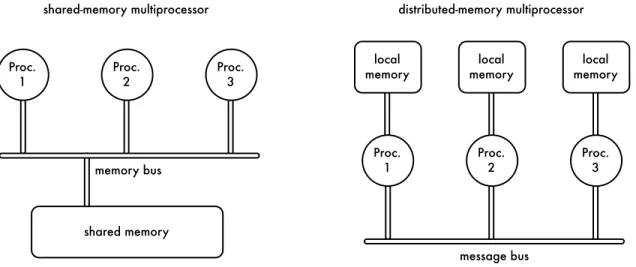
2.1 Shared- and distributed-memory multiprocessors . . . 22
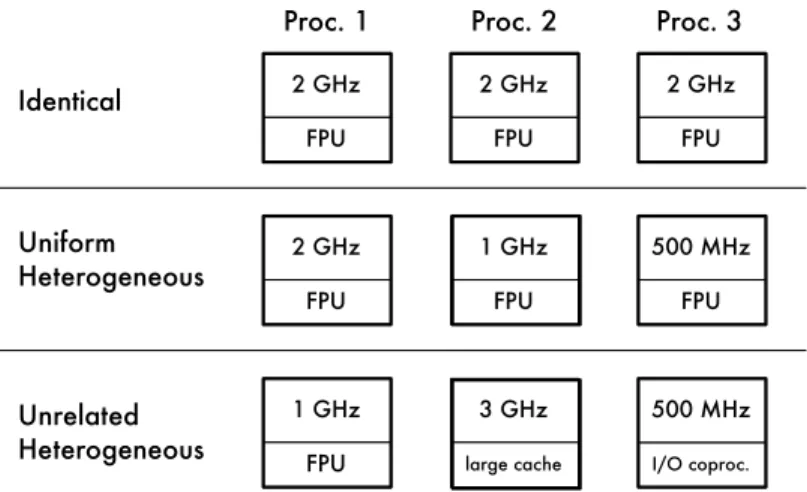
2.2 Identical, uniform, and unrelated multiprocessors . . . 24
2.3 Two-level cache hierarchy with shared L2 caches . . . 26
2.4 Memory reference trace . . . 27
2.5 Page coloring . . . 32
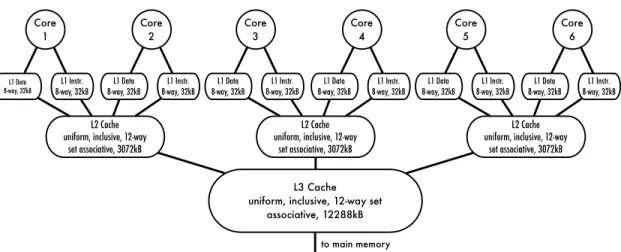
2.6 Cache hierarchy of the experimental platform . . . 34
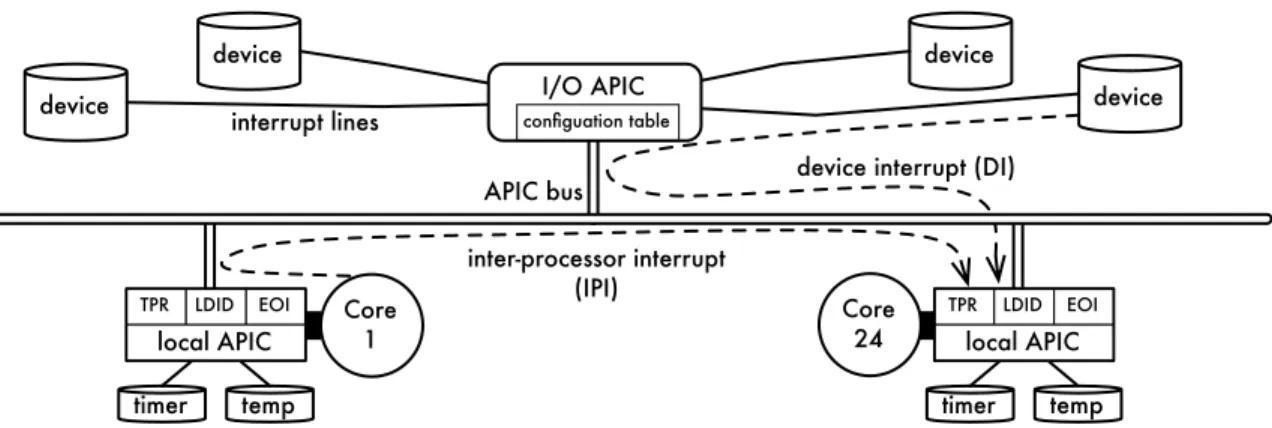
2.7 I/O APIC and local APICs . . . 36
2.8 Available timers and clocks . . . 40
2.9 Sporadic task model . . . 43
2.10 Hard and soft utility value functions . . . 51
2.11 UniprocessorFPschedule . . . 59
2.12 UniprocessorEDFschedule . . . 62
2.13 First-fit, best-fit, and worst-fit bin-packing heuristics . . . 67
2.14 The Dhall effect . . . 72
2.15 GlobalRMschedule exhibiting unbounded tardiness . . . 73
2.16 MultiprocessorG-EDFschedule . . . 75
2.17 Baker’s problem-window approach . . . 77
2.18 Baruah’s extended problem window . . . 81
2.19 MultiprocessorG-EDFschedule exhibiting a deadline miss . . . 87
2.20 Scheduling delays due to quantum-driven scheduling . . . 88
2.21 Pfair subtask parameters . . . 92
2.22 Constrained pfair windows . . . 93
2.23 Pfair windows motivating group deadlines . . . 94
2.25 Unbounded priority inversion . . . 102
2.26 Resource request phases . . . 105
2.27 Job state diagram . . . 106
2.28 UniprocessorNCPschedule . . . 110
2.29 Deadline miss due to non-preemptive section . . . 111
2.30 UniprocessorPIPschedule demonstrating benefits of preemptive execution . . . 112
2.31 UniprocessorPIPschedule . . . 113
2.32 UniprocessorPIPschedule exhibiting deadlock . . . 114
2.33 UniprocessorPCPschedule . . . 115
2.34 UniprocessorSRPschedule . . . 117
2.35 Pi-blocking vs. s-blocking . . . 121
2.36 MSRPschedule . . . 122
2.37 PIPfailure under partitioned scheduling . . . 125
2.38 DPCPschedule . . . 128
2.39 MPCPschedule . . . 129
2.40 MPCP-VSschedule . . . 132
2.41 Native and para-virtualized real-time Linux designs . . . 150
3.1 Unneeded migrations caused by Linux’s pull operation . . . 176
3.2 Required migration missed by Linux’s push operation . . . 178
3.3 The structure of LITMUSRT. . . 183
3.4 Eager and lazy preemptions . . . 199
3.5 Repeated, eagerly enacted preemptions . . . 200
3.6 O(1)pi-blocking under link-based scheduling . . . 205
3.7 Stack corruption due to migration races . . . 208
3.8 Aligned and staggered quanta . . . 218
3.9 Release delay under global event-driven scheduling . . . 223
3.11 Release delay under event-driven scheduling with non-preemptive sections . . . 228
3.12 UniprocessorEDFschedules with preemption overheads . . . 231
3.13 G-EDFschedules with preemption and migration overheads . . . 234
3.14 Interrupt delay accounting techniques . . . 238
3.15 Timer tick delay accounting techniques . . . 243
3.16 Timer tick overhead in jobs that are not preempted . . . 245
3.17 Response-time bound for preemption-centric interrupt accounting . . . 252
3.18 Preemption-centric timer tick delay accounting . . . 256
3.19 Preemption-centric interrupt accounting in the presence of migrations . . . 258
3.20 Release delay under quantum-driven scheduling . . . 265
3.21 Effective quantum length . . . 267
4.1 Overhead-aware evaluation method . . . 277
4.2 Piece-wise linear overhead model . . . 279
4.3 Non-decreasing overhead interpolation . . . 281
4.4 Schedulability plot illustration . . . 285
4.5 Weighted schedulability plot illustration . . . 292
4.6 Statistical outlier in overhead measurement . . . 304
4.7 Scheduling overhead underP-FPandP-EDF . . . 308
4.8 Distribution of scheduling overhead underP-EDFforn= 20andn= 480. . . 309
4.9 Timer tick overhead underPD2with staggered and aligned quanta . . . 311
4.10 Timer tick overhead underPD2and three cluster sizes . . . 313
4.11 Scheduling overhead underP-EDF,C-EDF, andG-EDF . . . 314
4.12 Release interrupt overhead underP-EDF,C-EDF, andG-EDF. . . 316
4.13 Tick and release interrupt overhead underC-PD2andC-EDF. . . 317
4.14 CPMD measurement approach . . . 319
4.15 Maximum and average observed CPMD in an idle system . . . 325
4.17 Maximum and average observed CPMD in the presence of cache-polluting
background tasks . . . 328
4.18 P-FPHRT schedulability under global and dedicated interrupt handling . . . 335
4.19 G-EDFSRT schedulability under global and dedicated interrupt handling . . . 337
4.20 P-EDFSRT schedulability under global and dedicated interrupt handling . . . 339
4.21 P-EDFHRT schedulability under global and dedicated interrupt handling . . . 340
4.22 PD2 HRT schedulability under global and dedicated interrupt handling and staggered and aligned quanta forc= 24. . . 342
4.23 PD2 HRT schedulability under global and dedicated interrupt handling and staggered and aligned quanta forc= 2. . . 343
4.24 C-PD2SRT schedulability under global and dedicated interrupt handling and staggered and aligned quanta . . . 345
4.25 Comparison ofC-EDFcluster sizes in terms of HRT schedulability . . . 347
4.26 Comparison ofC-EDFcluster sizes in terms of SRT schedulability . . . 349
4.27 Relative tardiness underEDF-based schedulers for uniform heavy utiliza-tions and short periods . . . 351
4.28 Comparison ofPD2cluster sizes in terms of HRT schedulability . . . 354
4.29 Comparison ofPD2cluster sizes in terms of SRT schedulability . . . 355
4.30 HRT schedulability underP-FP-Rm,P-EDF-Rm, andC6-aPD2-R1 . . . 358
4.31 SRT schedulability underP-EDF-Rm, C2-EDF-R1,G-EDF-R1, and C2-sPD2-Rm . . . 360
4.32 SRT schedulability underP-EDF-Rm, C2-EDF-R1,G-EDF-R1, and C2-sPD2-Rm . . . 362
4.33 Relative tardiness underEDF-based schedulers for heavy bimodal utiliza-tions and short periods . . . 363
5.1 Unnecessary sequencing of readers in task-fair mutex spinlocks . . . 378
5.2 Reader parallelism (and lack thereof) under task-fair RW locks . . . 379
5.3 Reader delay under writer preference locks . . . 381
5.4 Reduced delay under phase-fair RW locks . . . 382
5.5 Reader and writer control flow in thePF-Talgorithm . . . 389
5.7 Allocation of bits inPF-Clocks . . . 392
5.8 Maximum number of jobs pending during an interval of fixed length . . . 407
5.9 Minimum reader parallelism . . . 413
6.1 S-oblivious and s-aware pi-blocking . . . 425
6.2 Lower bound on s-oblivious pi-blocking . . . 427
6.3 Lower bound on s-aware pi-blocking . . . 428
6.4 Lower bound on s-oblivious pi-blocking due to priority boosting ifc >1 . . . 431
6.5 Request phases under priority donation . . . 433
6.6 Clustered mutexOMLPschedule . . . 435
6.7 Clustered RWOMLPschedule . . . 441
6.8 Clusteredk-exclusionOMLPschedule . . . 444
6.9 Pi-blocking of independent jobs ifc < m. . . 447
6.10 Lower bound on s-oblivious pi-blocking in FIFO- and priority-ordered queues . . . 448
6.11 GlobalOMLPschedule . . . 450
6.12 PartitionedFMLP+schedule . . . 459
6.13 Ω(φ)s-aware pi-blocking underG-EDFscheduling with priority inheritance . . . 465
6.14 Ω(φ)s-aware pi-blocking underG-EDFscheduling with priority boosting . . . 468
6.15 Lower bound on s-aware pi-blocking if requests are satisfied in priority order . . . 470
7.1 Transitive interrupt delays . . . 490
7.2 Pi-blocking due to remote ISR execution . . . 491
7.3 Locking overheads in non-preemptive spinlock protocols . . . 493
7.4 Locking overheads in non-preemptive semaphore protocols . . . 496
7.5 Additional CPMD incurred by lower-priority jobs . . . 499
7.6 Additional preemption overheads in preemptive semaphore protocols . . . 503
7.7 DPCPlocking overheads . . . 505
7.8 Three scheduler invocations due to agent activation . . . 506
7.10 Average critical section length grouped by implementation technique . . . 513
7.11 HRT schedulability under P-EDF-R1 with MX-Q, TF-Q, and PF-Q
spinlocks forwratio = 0.1 . . . 519 7.12 HRT schedulability under P-EDF-R1 with MX-Q, TF-Q, and PF-Q
spinlocks forwratio = 0.5 . . . 520 7.13 SRT schedulability underG-EDF-R1withMX-Q,TF-Q, andPF-Q
spin-locks forwratio = 0.1 . . . 522 7.14 SRT schedulability underG-EDF-R1withMX-Q,TF-Q, andPF-Q
spin-locks forwratio = 0.75 . . . 523 7.15 HRT schedulability underP-EDF-R1,C2-EDF-R1,C6-EDF-R1, and
G-EDF-R1withMX-Q,TF-Q, andPF-Qspinlocks . . . 525
7.16 SRT schedulability underP-EDF-R1,C2-EDF-R1,C6-EDF-R1, and
G-EDF-R1withMX-Q,TF-Q, andPF-Qspinlocks . . . 526
7.17 SRT schedulability under the globalOMLP, globalFMLP, and the
clus-teredOMLP . . . 529
7.18 SRT schedulability under the globalOMLP, globalFMLP, and the
clus-teredOMLPin the case of high contention . . . 530
7.19 Lower SRT schedulability under the globalOMLPthan under the globalFMLP. . . 531
7.20 HRT schedulability underP-EDFwith the clusteredOMLPand under
P-FPwith theMPCP-VS. . . 532
7.21 HRT schedulability underP-FP-R1scheduling with two variants of theFMLP+. . . . 535 7.22 HRT schedulability under P-FP-R1scheduling with the FMLP+, the
MPCP, and theDPCP . . . 537
7.23 Lower SRT schedulability under theFMLP+than under theDPCP . . . 538 7.24 HRT Schedulability under suspension- and spin-based locking protocols . . . 540
7.25 SRT Schedulability under suspension- and spin-based locking protocols . . . 542
7.26 Lower SRT schedulability under non-preemptive task-fair mutex spinlocks
LIST OF ABBREVIATIONS
ACPI Advanced Configuration and Power Interface
ACPI PM ACPI Power Management
APIC Advanced Programmable Interrupt Controller
API Application Programming Interface
ASN Address Space Number
C-EDF Clustered Earliest-Deadline First
C-PD2 ClusteredPD2
CFS Completely Fair Scheduler
COTS Components Of The Shelf
CPMD Cache-related Preemption and Migration Delay
CSI Cycle-Stealing Interrupt
DI Device Interrupt
DM Deadline-Monotonic
DPCP Distributed Priority-Ceiling Protocol
DSP Digital Signal Processor
ECU Engine Control Unit
EDF Earliest-Deadline First
EOI End Of Interrupt
ERfair Early-Release fair
ESP Electronic Stability Program
FDSO File-Descriptor-attached Shared Object
FIFO First-In First-Out
FMLP+ Flexible Multiprocessor Locking Protocol (improved)
FMLP Flexible Multiprocessor Locking Protocol
FPU Floating Point Unit
FP Fixed-Priority
G-EDF Global Earliest-Deadline First
GPOS General-Purpose Operating System
GPS Global Positioning System
GPU Graphics Processing Unit
GUI Graphical User Interface
HPET High-Precision Event Timer
HRT Hard Real-Time
HW Hardware
I/O Input/Output
IPC Inter-Process Communication
IPI Inter-Processor Interrupt
IQR Inter-Quartile Range
ISA Instruction Set Architecture
ISR Interrupt Service Routine
JLDP Job-Level Dynamic-Priority
JLFP Job-Level Fixed-Priority
LDID Logical Destination ID
LKM Loadable Kernel Module
MMU Memory Management Unit
MPCP-VS Multiprocessor Priority-Ceiling Protocol with Virtual Spinning
MPCP Multiprocessor Priority-Ceiling Protocol
MSRP Multiprocessor Stack Resource Policy
NCP Non-preemptive Critical section Protocol
NMI Non-Maskable Interrupt
NP-FMLP+ Non-preemptive Flexible Multiprocessor Locking Protocol (improved)
NUMA Non-Uniform Memory Access
OMLP O(m)Locking Protocol
OS Operating System
P-EDF Partitioned Earliest-Deadline First
PCB Process Control Block
PCP Priority-Ceiling Protocol
pi-blocking Priority Inversion blocking
PIC Programmable Interrupt Controller
PIP Priority Inheritance Protocol
PIT Programmable Interval Timer
PS Fluid Processor Sharing
RMR Remote Memory Reference
RM Rate-Monotonic
RPC Remote Procedure Call
RTOS Real-Time Operating System
RW Reader-Writer
s-aware Suspension-aware
s-blocking Spin blocking
s-oblivious Suspension-oblivious
SMI System Management Interrupt
SMM System Management Mode
SMP Symmetric Multiprocessor
SRP Stack Resource Policy
SRT Soft Real-Time
TI Timer Interrupt
TLB Translation Look-aside Buffer
TPR Task Priority Register
TSC Timestamp Counter
UMA Uniform Memory Access
WCET Worst-Case Execution Time
CHAPTER 1
INTRODUCTION
With the recent advent of multicore chips, multiprocessors are now commonly encountered in
servers, personal computers, and embedded systems (Sodanet al., 2010). As a result, real-time
applications—that is, applications that must satisfy temporal constraints in order to be deemed
correct—are increasingly being deployed on multiprocessors (Baker, 2010). One reason for the
proliferation of multicore platforms in real-time systems is that such platforms have come to constitute
a significant share of the cost-efficient components-of-the-shelf (COTS) market (Child, 2010).
Another important factor is their considerable processing capacity, which makes them an attractive
choice for hosting compute-intensive tasks such as high-definition video stream processing, object
recognition and tracking, and computer vision applications in general.
For example, Villalpando et al. (2010) evaluated Tilera’s 64-core TILE64 processor (Bell
et al., 2008) for use in the real-time hazard detection and avoidance system of the Altair Lunar
Lander (NASA, 2008). They found “that for [computer vision and image analysis] the TILE64
architecture provides excellent performance,” and further recommended the platform for other
on-board tasks, including spacecraft and instrument control (Villalpando et al., 2010). Notably, a
radiation-hardened 49-core version of the TILE64 processor, named Maestro, has been developed
with the explicit purpose of enabling space-born, embedded multicore real-time systems (Malone,
2009; Crago, 2009).
Many real-time applications can be decomposed into a collection of recurrenttasks. The goal of
this dissertation is to determine how such tasks should be supported at the operating-system level. In
particular, the research presented herein is focused on two questions fundamental to the design of
multiprocessor real-time operating systems (RTOSs):
Q2 Which synchronization techniques should be used to enable tasks to access shared resources (such as message buffers and I/O devices) without incurring unpredictable delays?
To motivate our research, we begin by illustrating the need for predictable and efficient multicore
RTOSs with two examples.
1.1
The Cost of Over-Provisioning
Temporal constraints naturally arise whenever computers interact with the “real world.” In particular,
this is the case when computers control or observe physical processes, or when human users perceive
a device’s reaction as slow or delayed. Real-time constraints are commonly classified as eitherhard
orsoft, with the interpretation that hard real-time (HRT) constraints must always be met, whereas
violations are tolerable to a limited extent in the soft real-time (SRT) case.
An example of the former is the electronic stability control(or program, ESP) deployed in
modern cars (Liebemannet al., 2004). The purpose of ESP is to prevent roll-over accidents by
correcting driver errors such as exaggerated steering during panic reactions. This is achieved by
applying corrective forces to individual wheels when a dangerous level of lateral acceleration is
detected (Liebemannet al., 2004). HRT constraints are fundamental to ESP because a delay in the
sensing of the current acceleration or enactment of appropriate corrections can have catastrophic
consequences. Anti-lock brakes and traction control are subject to similar constraints.
In contrast, an unresponsivegraphical user interface(GUI) usually does not have catastrophic
consequences, but results in unsatisfied customers nonetheless. A recent consumer review of HP’s
TouchSmart interface criticized that “the [TouchSmart interface] is simply too sluggish for everyday
use” (Stern, 2010). Barnes & Noble’s Nook e-book reader was disparaged similarly (Topolsky, 2010).
The underlying failure in both cases is that the user interface did not respond in time—while not
safety-critical, noticeable graphics or audio glitches can spell financial disaster for manufacturers
of consumer electronics. Similar arguments apply to popular multimedia features such as video
playback and interactive games.
To impose minimum levels of predictability in safety-critical applications, governments have
instituted certification authorities such as the U.S. Federal Aviation Authority (FAA) and the National
subsystem should not affect the correct operation of other components. The easiest and historically
most-commonly used way to ensure isolation is to employ a dedicated processor for each functionality.
However, this approach has led to an increasingly unmanageable proliferation of such systems, to
the effect that some modern cars contain in excess of one hundred processors (Hergenhan and
Heiser, 2008). Unsurprisingly, there are strong market forces and design imperatives that require
engineers to curb this spread of embedded processors: not only does the overall system complexity
(and thus cost) grow with each added component, but every embedded system requires wiring and
cooling, adds weight, requires space, drains power, and must be purchased, transported, stored, tested,
documented, serviced, eventually replaced, and finally recycled. Thus, instead of embedding one
hundred networked, slow uniprocessors throughout a car, it would be desirable to use only ten (or
fewer) shared, but ten-times as powerful, multicore processors that are highly utilized.
Over-provisioning GUIs and other soft real-time applications with faster-than-necessary
proces-sors is similarly costly, and especially so in the highly competitive mobile sector (e.g., smart phones
and tablets), which is subject to stringent energy, cooling, and cost constraints. There are thus strong
incentives to “do more with less”: an increasing number of real-time tasks need to share limited
physical resources on multiprocessors without compromising predictability or efficiency.
1.2
The Divergence of Theory and Practice
A solid RTOS foundation is thus required to fully exploit the promise of multicore technology for
real-time applications. Unfortunately, the existing foundation appears increasingly insufficient, as
most RTOSs in common use today still rely on approaches rooted in decades-old uniprocessor design
concepts.1 Motivated by these developments, research on multiprocessor real-time systems has
surged in recent years and many algorithmic advances have been made. Unfortunately, these results
have found only little adoption in practice.
We briefly digress to introduce needed background before discussing the current state of affairs.
1.2.1 Background
Each of the concepts mentioned in the remainder of this chapter is discussed in detail in Chapter 2.
One particularly well-studied abstraction of recurrent real-time activity is the sporadic task
model. When such a task is triggered by an (external) event such as an interrupt, it releases a
sequentialjobto process the triggering event. Each job has adeadlineby which it should complete.
In this section, we restrict our discussion toimplicit deadlines, where a job’s deadline also marks the
earliest-possible release time of the next job (of the same task). A task’sutilizationis the fraction of
one processor’s capacity that must be reserved for it. Similarly, thetotal utilizationof a task set is
simply the sum of all utilizations of tasks in the set.
From an RTOS point of view, the sporadic task model is a good compromise between practicality
and expressiveness. It is easy to implement, well-analyzed, and can represent both cyclic tasks such as
ESP and video decoding as well as event-driven tasks such as GUI applications. To avoid confusion,
we use the term “task” to refer to a sporadic task on the model level and let “process” denote the
OS-level concept of a sequential thread of control. A sporadic task is typically implemented as a
process that executes an infinite loop, where each loop iteration corresponds to one job.
Temporal correctness. A task set isschedulableif it can be shown that each task meets its timing constraints. A procedure that establishes whether a task set is schedulable under a given scheduler
is aschedulability test. In an HRT context, a sporadic task set is schedulable if each job meets its
deadline (Liu and Layland, 1973). In contrast, some deadline misses are tolerable in SRT applications:
a task set is SRT schedulable iftardinessis bounded,i.e., if the magnitude of deadline misses does
not exceed a (reasonably small) constant (Devi, 2006).2 A task set isfeasibleif there existssome
scheduling policy under which it is schedulable. For a task set to be feasible (either HRT or SRT) on
mprocessors, its total utilization must not exceedm—unbounded deadline misses cannot be avoided
if processors are overloaded. In the context of our discussion here, a scheduler can be considered
optimalif any task set with total utilization at mostmis schedulable (with regard to either HRT or
SRT constraints, respectively; see Section 2.2.3 for a precise definition of scheduler optimality).
Capacity loss. To meet the design goal of maximum flexibility (recall Question Q1), an ideal RTOS should supportanyfeasible task set. Given the above limit on total utilization (and our focus on
implicit deadlines), this means that any task set with total utilization not exceeding the total processor
capacitymshould be schedulable. In practice, it is not possible to allocate all processor capacity to
real-time tasks,i.e., task systems with total utilization less thanmmay not be schedulable. Such
capacity losshas two primary causes: the choice of scheduling policy and runtime overheads. With
regard to the former, if the RTOS employs a non-optimal scheduling policy, then a feasible task
set may not be schedulable due toalgorithmiccapacity loss. The latter,overhead-relatedcapacity
loss, is due to processor time that is consumed by hardware inefficiencies (e.g., cache misses) and
system management activities (e.g., computing a scheduling decision). Such runtime overheads are
unavoidable to some degree, but can differ significantly among schedulers and implementations.
Time lost to system overheads must be accounted for when testing whether a task set is schedulable
on a given platform, which reduces the amount of processor capacity effictively available to real-time
tasks.
To minimize overall capacity loss, an RTOS should ideally use a scheduler that is both optimal
and that incurs minimal overheads.
Uniprocessor real-time scheduling. The scheduling of sporadic tasks on uniprocessors is well understood. The two most-relevant scheduling policies arefixed-priority(FP) andearliest-deadline
first(EDF) scheduling. UnderFPscheduling, each task is statically assigned a unique priority prior
to execution. At runtime, competing jobs are then scheduled in order of decreasing task priority. In
contrast, underEDFscheduling, jobs are scheduled in order of increasing deadlines (i.e., in order of
urgency) and no manual priority assignment is required. In a classic result, Liu and Layland (1973)
showed that, for HRT constraints,EDFis optimal, whereasFPis subject to algorithmic capacity
loss (Liu and Layland, 1973). Since a task set that is HRT schedulable also has bounded tardiness,
EDFis optimal in the SRT case as well.
Nonetheless,FPscheduling is much more common in practice. One likely reason is the relative
ease of implementing FP efficiently (using a bitmask where each set bit indicates the presence
of pending jobs at a corresponding priority level). While it is also possible to implementEDF
efficiently (Short, 2010), the required techniques are conceptually more difficult and are not part of OS
developer folklore (in contrast toFPimplementation techniques, which are widely known). Buttazzo
(2005) argued that the preference forFPis further reinforced by widespread misconceptions and
myths concerning supposed advantages in practice (such as failure modes under transient overloads),
Main Memory L2
Cache CacheL2
Core 1 Core 2 Core 3 Core 4
Q1
J1
J2 J3 J4
global: one job queue shared by all processors
(a) Global scheduling.
Main Memory L2
Cache CacheL2
Core 1 Core 2 Core 3 Core 4
Q1 J1 Q3 J3 Q2 J2 Q4 J4
partitioned: one job queue per processor
(b) Partitioned scheduling.
Main Memory L2
Cache CacheL2 Core 1 Core 2 Core 3 Core 4
Q1 J1 J2 Q2 J3 J4 clustered: one job queue per cluster
(c) Clustered scheduling.
Figure 1.1: Illustration of multiprocessor scheduling approaches for four cores that share L2 caches in pairs of two. Note that L2 cache affinity is not lost when migrations occur under clustered scheduling. (See Section 2.1.2 for details.)
use ofFPas the uniprocessor real-time scheduler of choice is thus not justified. Rather, it could
be considered a historical accident—alas, one that has since been codified in the POSIX real-time
standard (IEEE, 1993, 2003, 2008b), which mandatesFPscheduling. (The POSIX standard does not
prohibit additional schedulers, but few RTOSs supplementFPwith other real-time schedulers such
asEDF.)
1.2.2 Multiprocessor Real-Time Scheduling
There are two fundamental classes of multiprocessor schedulers: globalandpartitioned. Under
global scheduling (illustrated in inset (a) of Figure 1.1), all processors serve a single ready queue and
jobs may migrate among processors. In contrast, underpartitionedscheduling (illustrated in inset (b)
of Figure 1.1), tasks are statically assigned to processors during an offline phase and each processor
is scheduled individually using a uniprocessor policy such asEDForFP.
There is a clear analytical answer to Question Q1: some global schedulers areprovably superior
to any partitioned approach. This is because partitioned scheduling requires tasks to be statically
assigned to processors such that no processor is overloaded, which is equivalent to solving a
bin-packing problem. As even an optimal bin-packing may leave some bins incompletely filled (i.e., some
partitioned ontomprocessors (Oh and Baker, 1998; Anderssonet al., 2001; Andersson and Jonsson,
2003), whereis an arbitrary small positive number. In other words, nearly up to half of the available
processor capacity may be lost to the algorithmic limitations of partitioned scheduling.
In contrast, optimal global schedulers exist. For example, considerglobalEDF (G-EDF), where
the uniprocessorEDFpolicy is globally applied to a shared ready queue. While it has long been
known thatG-EDFcan be subject to severe algorithmic capacity loss in an HRT context (Dhall and
Liu, 1978), Devi and Anderson (2005) recently showed thatG-EDFdoes in fact ensure bounded
tardiness for any sporadic task set with utilization at mostm,i.e., G-EDFis optimal in an SRT
context (Devi, 2006; Devi and Anderson, 2008).
For HRT constraints, the global algorithmPD2 is optimal (Srinivasan and Anderson, 2006). PD2is aproportionate fair(Baruahet al., 1996), orpfair, scheduler, which is a class of schedulers that ensure that a task’s processor allocation is always proportional to its utilization (within stringent
bounds, see Chapter 2).PD2derives its properties from dividing jobs into (many) subtasks of fixed
size, each of which is assigned an individual deadline. Subtasks are scheduled on anEDFbasis with
additional rules to break deadline ties.3With an appropriate subtask granularity,PD2 ensures that all
deadlines will be met for any task set with utilization at mostm(assuming implicit deadlines).
Therefore,in theory, global scheduling is clearly preferable to partitioned scheduling.
However,in practice, global schedulers are commonly eschewed. Many OS developers consider
global scheduling to be impractical due to the associated runtime overheads and implementation
complexity. For example,PD2’s subtask-based scheduling causes jobs to incur frequent preemptions and migrations. While the scheduling literature generally considers such costs to be negligible, the
associated loss of cache affinity4can significantly increase a job’s processor demand in practice by
introducing additional cache misses. Preemptions occur less frequently underG-EDF. However,
processors must still access a shared ready queue, which OS developers traditionally avoid because
frequent accesses to global data structures often entail high lock contention and cache-coherency
overheads. Consequently, virtually all multiprocessor-capable RTOSs employ partitioned scheduling,
where most data structures and scheduling decisions are processor-local and thus cache-friendly.
3The namePD2
is due to its use of two tie-breaking rules and since it supersedes an earlier algorithm namedPDby Baruahet al. (1995). AlgorithmPDderives its name from the use of “pseudo-deadlines” (Baruahet al., 1995).
4
Of course, it would be unrealistic to expect global algorithms to scale to tens or hundreds of
processors. However, this does not imply that the other extreme, partitioned scheduling, is the best
choice. Instead,clustered scheduling(Calandrinoet al., 2007; Baker and Baruah, 2007) could be a
practical, better-performing compromise. Illustrated in inset (c) of Figure 1.1, clustered scheduling is
a hybrid of both global and partitioned scheduling that groups processors sharing low-level caches
into disjointclusters. As under partitioning, tasks are statically assigned to clusters during an offline
phase. Within each cluster, jobs are then scheduled “globally” from a shared per-cluster ready queue.
The intuition behind clustered scheduling is to reconcile the advantages of both partitioned and global
scheduling: the impact of bin-packing issues is reduced as there are fewer and larger bins (compared
to partitioned scheduling), some level of cache affinity is maintained during job migrations, and lock
contention is reduced as queues are shared among fewer processors (compared to global scheduling).
Nonetheless, most multiprocessor-capable RTOSs currently rely onpartitioned fixed-priority
(P-FP) scheduling as the primary supported real-time scheduling policy. This choice reflects great
conservatism: even among partitioned schedulers,P-FPis inferior topartitioned earliest-deadline
first(P-EDF) scheduling sinceEDFis optimal on a uniprocessor andFPis not (Liu and Layland,
1973). YetP-FPhas remained thetraditionalRTOS scheduler due to its uniprocessor legacy and the
previously mentioned POSIX-compliance reasons.
Compliance with the POSIX real-time standard (IEEE, 1993, 2003, 2008b), however, should
not prevent needed innovation and adaptation. The standard is in fact silent on multiprocessor
issues,5and understandably so, as multiprocessor real-time systems were still an “academic curiosity”
when it was first ratified. It further does not preclude RTOSs from supporting other, possibly
better-performing scheduling policies in addition to the mandatedFP. With the advent of the multicore
age, and given that RTOSs are now being redesigned and restructured to adapt, it is presently an
opportune time to revisit the choice of a “default” RTOS scheduler.
5
1.2.3 Real-Time Locking
Most published schedulability tests make the simplifying assumption that tasks (and hence jobs) are
independent, that is, it is assumed that a job is never delayed by actions of other jobs. In practice,
this assumption does not hold when jobs share resources that are protected by locks. For example, if
a job must transmit a message, but the required network device has already been locked and is in use,
then the job isblocked—it cannot progress until the shared resource becomes available.
Such blocking can endanger temporal correctness because it can give rise topriority inversions,
which, intuitively, occur when a high-priority job is forced to wait for a lower-priority job.
Uncon-trolled priority inversions jeopardize the temporal correctness of real-time tasks because they can
result in unpredictable delays. However, if the maximum delay due to resource sharing is known
a priori, then it can be accounted for when testing whether a given task set is schedulable. An
RTOS must thus incorporate areal-time locking protocolthat allows the maximum length of priority
inversion to be analytically bounded. Naturally, it is desirable to employ locking protocols that
minimize the occurrence of priority inversions since frequent or long priority inversions severely
limit an RTOS’s suitability for ensuring stringent real-time constraints. A practical locking protocol
should further be easily and efficiently implementable, just as with schedulers.
Unfortunately, few RTOSs implement any algorithm beyond basic uniprocessor priority
inheri-tance and ceiling protocols, which are insufficient under partitioned scheduling (see Section 2.4.4.2).
In effect, current RTOSs fundamentally fail to provide the means necessary topredictably use
locks on multiprocessors (special cases aside). Given that extensions of uniprocessor protocols that
are (at least theoretically) appropriate forP-FPscheduling have been available for more than 20
years (Rajkumaret al., 1988; Rajkumar, 1990, 1991), this is a dire state of affairs.
Given the relative immaturity of multiprocessor real-time locking research (compared to advances
in real-time scheduling), the lack of proper locking protocol support is hardly surprising. In fact,
prior to the work presented herein, locking optimality questions had received little, if any, attention.
As a result, goals such as “minimizingthe occurrence of priority inversion” were only intuitively
understood and lacked analytical precision. Instead, provably optimal multiprocessor locking
1.3
Thesis Statement
Tofullyexploit the potential of modern multicore platforms, RTOSs will have to advance beyond
the traditional, but increasingly strained uniprocessor approach of FP scheduling with priority
inheritance. With regard to Question Q1, several promising multiprocessor scheduling approaches
exist. With regard to Question Q2, while the multiprocessor locking protocol design space is still
relatively unexplored, and questions of optimality have not received much attention in prior work,
proper locking protocols for P-FP scheduling exist. Yet neither such protocols nor promising
schedulers have been evaluated, much less adopted, in mainstream RTOSs to date.
A primary cause for this growing disconnect is the open question of practicality. Runtime
overheads are typically considered to be negligible in algorithm-centric research, but such overheads
are rarely negligible in practice. In fact, many overhead sources can exhibit counterintuitive trends
that are difficult to anticipate. As a result, there is a strong focus on overhead measurements in the
RTOS community, with a particular focus oninterrupt latency, which is a metric that reflects the
RTOS’s responsiveness in enacting scheduling decisions. Unfortunately, this causes a disregard for
algorithmic properties, as latency by itself fails to capture schedulability analysis tradeoffs that arise
when multiple tasks subject to varying timing constraints compete for processor time.
Either extreme—completely disregarding overheads or making them the sole focus—yields only
incomplete and misleading answers. Are algorithmically optimal, high-overhead global schedulers
still superior to non-optimal, low-overhead partitioned schedulers if overheads and algorithmic
properties are both fully accounted for? If not, is clustered scheduling a viable compromise?
Motivated by these considerations, the main thesis supported by this dissertation is the following.
A “multicore-ready” RTOS should employ scheduling and synchronization algorithms that minimize the loss of processor capacity allocable to real-time tasks. When both overhead-related and algorithmic capacity loss are considered on a current multicore platform,(i)partitioned scheduling is preferable to global and clustered approaches in the HRT case,(ii)P-EDFis superior toP-FP, and(iii)clustered scheduling can be effective in reducing the impact of bin-packing limitations in the SRT case. Further,
1.4
Contributions
In the following, we briefly summarize the contributions presented in the subsequent chapters.
1.4.1 LITMUSRT
Central to our work is the proposition that a meaningful comparison of multiprocessor scheduling
and locking algorithms must be implementation-based. An actual RTOS is thus required. To this
extent, we co-developed theLinuxTestbed forMultiprocessorScheduling inReal-Time Systems (LITMUSRT).6
As the name implies, LITMUSRT is an extension of Linux (Torvalds, 1997; Torvalds and contributors, 2010), which is a widely used open-source UNIX-like kernel. Conceptually, LITMUSRT consists of three parts:(i)it extends Linux’s scheduling infrastructure with an implementation of the sporadic task model,(ii)it provides a plugin interface that allows the active scheduling policy and locking protocols to be changed at runtime, and(iii)it provides additional system calls for real-time tasks.
The Linux scheduling framework is structured as a hierarchy of scheduling classes. Each
scheduling class encapsulates the policy used for a particular process type. For example, regular
user-space processes are scheduled usingCFS, a timesharing policy inspired by proportional-share
fair scheduling (Tijdeman, 1980; Stoicaet al., 1996). Similarly, scheduling classes for low-priority
background work and high-priority “real-time” processes exist. (In compliance with the POSIX
standard, Linux’s real-time scheduling class usesFPscheduling with support for 100 distinct priority
levels.) Whenever Linux makes a scheduling decision, it polls each scheduling class in the hierarchy
in top-to-bottom order until a pending task is found. LITMUSRTintroduces a new scheduling class at the top of the hierarchy such that non-LITMUSRT tasks are only scheduled when no real-time workload is present.
In contrast to the regular Linux scheduling classes, the LITMUSRTscheduling class does not implement any particular policy. Instead, it defers all scheduling decisions to the active real-time
6
scheduler plugin. This simplifies experimental scheduler development and maintenance: instead of
interfacing with the full Linux kernel (and its considerable complexities that tend to change from
version to version), LITMUSRTplugins interface only with the LITMUSRTscheduling class via the plugin interface, which remains (mostly) stable between releases. Notably, LITMUSRTsupports global scheduling policies, which are not well supported by standard Linux.
LITMUSRTfurther augments the Linux system call interface with additional real-time-specific system calls. In particular, LITMUSRTadds calls for real-time task and job control (e.g., to configure task parameters, to wait for the next job release, to obtain the job sequence number,etc.) and for
invoking real-time locking protocols (e.g., to acquire resource handles, to lock resources,etc.).
An early prototype of LITMUSRT existed prior to the commencement of the work described in this dissertation (Calandrinoet al., 2006); however, this early version lacked several critical
features. In particular, it did not allow processes to suspend for any reason (such as loading shared
libraries, acquiring a semaphore, or using any kind of I/O device), to the effect that the system
failed with a “kernel panic” if a real-time task attempted to suspend. Consequently, only artificial,
completely processor-bound workloads could be supported. In the current version of LITMUSRT (which this dissertation is based on), these limitations have been removed and virtually no code from
the beginnings of LITMUSRT remains. The design and implementation of LITMUSRT is discussed in detail in Chapter 3.
1.4.2 Comprehensive Overhead Accounting
As argued above, it is critical to account for runtime overheads when establishing whether a task set
is schedulable. This requires procedures for incorporating delays due to overheads into published
schedulability tests that assume ideal, overhead-free execution. In particular, such procedures must
besafe,i.e., they may not underestimate delays due to overheads at runtime.
Such procedures have long been known for uniprocessor systems and are discussed in detail
in (Liu, 2000). Some of these also apply to multiprocessor scheduling and have been used in this
context before (Devi, 2006; Calandrinoet al., 2006). However, to the best of our knowledge, there is
no comprehensive summary of multiprocessor overhead accounting techniques available today.
In Chapter 3, we present a complete description of the techniques that we use to account for
We further describe a newpreemption-centricapproach to account for asynchronous interrupts in
Section 3.4.5. Under preemption-centric interrupt accounting, each task’s execution budget is inflated
by a bound on the worst-case delay due to interrupts.
Overheads affect not only scheduling, but also locking protocols. In Chapter 7, we describe
locking-related overhead sources (such as system calls, suspensions, and context switches) in detail
and derive appropriate accounting methods.
1.4.3 Overhead-Aware Evaluation Methodology
The central contribution with regard to Question Q1 is a methodology for evaluating scheduling
choicesunder full consideration of overheadson a given platform. Conceptually, this methodology
consists of five steps split across an OS-level phase and a subsequent analytical phase. First, each
scheduling algorithm that is to be evaluated is implemented in LITMUSRT. Next, hundreds of benchmark task sets are run to exercise each scheduler over the course of several hours. During
these experiments, millions of raw overhead measurements are collected using low-overhead cycle
counters; measuring cache-related overheads is particularly challenging (see Section 4.4). In a
post-processing step, we extract models of worst- and average-case overheads from the collected traces.
Each source of delay (interrupts, scheduling decisions, context switches,etc.) is upper-bounded as a
function of task-set size using piece-wise linear interpolation. This concludes the OS-level phase of
the process.
In the analytical phase, we incorporate the overhead models into existing schedulability tests
for each scheduler. This enables testing whether a given task set is schedulablein the presence of
overheads, thereby rectifying the theoreticians’ assumption that overheads are negligible. Finally, we
apply each overhead-aware schedulability test to millions of randomly generated sporadic task sets,
which is computationally intensive and requires the use of UNC’s research cluster. For each scheduler,
the resulting fraction of schedulable task sets is an empirical performance measure that reflects both
implementation efficiency and algorithmic properties. This allows to answer Question Q1 for a given
platform. A predecessor of this approach was described in (Calandrinoet al., 2006). However, our
Since the methodology sketched so far yields a very large number of graphs (several thousand
in the case study discussed below), we further describe a method for aggregating these individual
graphs into composite graphs that express interesting trends more succinctly (Section 4.1.7).
1.4.4 Case Study: Multiprocessor Real-time Scheduling on 24 Cores
Since schedulers must be compared under consideration of overheads, a proper evaluation is
neces-sarily platform-specific (although it may be possible to extrapolate general trends in some cases).
To demonstrate the applicability of our overhead-aware evaluation methodology, and to support our
claim that both overheads and algorithmic properties significantly affect scheduler performance, we
present a case study that compares 22 scheduler variants (including partitioned, clustered, and global
schedulers) on a large (for today’s standard) Intel x86-64 multicore platform with a total of 24 cores.
Our results, discussed at length in Sections 4.3– 4.5, show that scheduling policy implementations
differ significantly in overheads (up to an order of magnitude in some cases), and that such differences
have a major impact: overheads are decidedly not negligible. At the same time, our results also show
that low runtime overheads do not imply that a particular scheduler is always preferable: increased
overheads are an acceptable price to pay for some, but not all, algorithmic improvements.
Our results further show that there is no single “best” scheduler in practice. Rather, scheduler
performance is highly workload-dependent (task parameters, number of tasks, etc.). In general,
P-EDFis preferable in the HRT case due to its combination of low overheads and uniprocessor
optimality. In particular,P-EDFperforms as well or better thanP-FPfor most tested workloads.
G-EDFandC-EDFperform well for many SRT workloads and outperform partitioned schedulers in
the case of workloads that are difficult to partition (i.e., if there is a large proportion of high-utilization
tasks).P-EDFandC-EDFare thus good candidates for RTOS inclusion.
1.4.5 Spin-Based Locking Protocols
Having developed and demonstrated a methodology for choosing a scheduler, we next consider
lock-based synchronization protocols for multiprocessor systems in Chapters 5–7. As previously
mentioned, research on multiprocessor real-time locking protocols is less mature than
scheduling-oriented research. Our contributions thus not only pertain to the selection of such a protocol, but also
When a job requires a shared resource that is currently locked by another job, it must wait before
it can proceed in its execution. On a multiprocessor, there are two fundamental ways to implement
waiting. In suspension-based protocols, a waiting job relinquishes its assigned processor until the
resource becomes available, which gives other jobs the chance to execute. In contrast, in spin-based
protocols, a waiting job executes a simple delay loop (i.e., it busy-waits or “spins”) until it gains
access to the desired resource.
While busy-waiting results in a waste of processor cycles when a resource is contended, it has
the advantage that spin-based protocols are easier to analyze than suspension-based protocols and
that they can be efficiently implemented. The contribution of Chapter 5 is the design and analysis of
three spin-based locking protocols, one realizingmutual exclusion(mutex), where at most one job
may hold a resource at any time, and the other two realizingreader-writer exclusion(RW), where
only writers require exclusive access.
Mutex protocol. Our mutex protocol relies on non-preemptive execution (jobs spinning or holding a resource may not be preempted) and FIFO queue locks (Anderson, 1990; Mellor-Crummey and
Scott, 1991a) to ensure progress. On a platform withmprocessors, this combination yields an upper
bound ofO(m)blocking critical sections, since at most one job per processor can precede a job in
the wait queue. Spin-based mutex protocols using FIFO queue locks have been previously studied in
the context of pfair schedulers (Holman, 2004; Holman and Anderson, 2002a, 2006),P-EDF(Gai
et al., 2003), andG-EDF(Deviet al., 2006). Our contribution is twofold. We present an improved
holisticanalysis framework that reduces pessimism in the derivation of bounds on the worst-case
delay by considering all critical sections of a job simultaneously; secondly, we present a mechanism
to enact preemptions “lazily” that limits the negative impact of non-preemptive execution under
event-driven global schedulers such asG-EDF. The latter is required to prevent some jobs from
being repeatedly preempted and thus delayed (see Section 3.3.3 for details). Prior work did not
consider the possibility of such repeated preemptions.
RW protocols. Spin-based RW locks have not been considered in prior work on multiprocessor real-time systems. In throughput-oriented computing, RW locks are attractive because they increase
average concurrency (compared to mutex locks) if reads occur more frequently than writes. In a
for readers,i.e., the higher degree of concurrency must be reflected ina prioriworst-case analysis
and not just in observed average-case delays.
Three types of RW locks with predictable ordering of readers and writers have been studied
in prior (non-real-time) work: writerandreader preference locks(Courtoiset al., 1971;
Mellor-Crummey and Scott, 1991b), andtask-fair RW locks(Mellor-Crummey and Scott, 1991b). Under
a reader (respectively, writer) preference lock, write (respectively, read) requests are only satisfied
if there are no unsatisfied read (respectively, write) requests. Under a task-fair RW lock, requests
(either read or write) are satisfied strictly in FIFO order.
Unfortunately, neither preference nor task-fair RW locks are well-suited to real-time systems:
preference locks allow starvation, which entails unpredictable and excessive delays, and task-fair RW
locks can cause mutex-like delays when readers and writers issue requests in an interleaved manner,
and thus offer little analytical advantage over regular mutex locks. In Chapter 5, we introduce and
analyzephase-fairRW locks as an alternative, under whichreader phasesandwriter phasesalternate
(unless there are only requests of one kind). At the beginning of a reader phase, all incomplete read
requests are satisfied, whereas one write request is satisfied at the beginning of a writer phase. This
results inO(1)acquisition delay for read requests without starving write requests. Additionally, an
analysis of task-fair RW locks is presented as well.
1.4.6 Efficient Phase-Fair Spinlock Implementations
An efficient implementation is essential to making spin-based locking protocols competitive. That is,
a low-overhead implementation is required to compensate for the spin-related waste of processor
cycles. If there would be no efficient implementation of phase-fair locks, then their practical
value would be severely limited. In Section 5.3, we present three phase-fair RW locks that can be
implemented on common multiprocessor instruction set architectures (ISAs) such as Intel’s x86
platform.
The first lock requires 16 bytes per lock and is optimized to require a minimum number of
atomic instructions, which carry a high execution cost on common multiprocessor platforms. The
second lock is more compact and requires only four bytes per lock, which makes it more appropriate
for memory-constrained embedded systems. However, this is achieved at the expense of additional