DEMOGRAPHIC RESEARCH
VOLUME 33, ARTICLE 43, PAGES 1211−1240
PUBLISHED 4 DECEMBER 2015
http://www.demographic-research.org/Volumes/Vol33/43/ DOI:10.4054/DemRes.2015.33.43
Research Article
A multistate life table approach to
understanding return and reentry migration
between Mexico and the United States during
later life
Alma Vega
Noli Brazil
© 2015 Alma Vega & Noli Brazil.
This open-access work is published under the terms of the Creative Commons Attribution NonCommercial License 2.0 Germany, which permits use, reproduction & distribution in any medium for non-commercial purposes, provided the original author(s) and source are given credit.
1 Introduction 1212
2 Background 1213
3 Data and methods 1215
3.1 Data 1215
3.2 The multistate life table framework 1217
4 Results 1221
4.1 Age profile of later-life migration 1221
4.2 Duration of migration 1224
4.3 Validation of the ENADID 1226
5 Discussion 1228
6 Acknowledgements 1232
A multistate life table approach to understanding return and reentry
migration between Mexico and the United States during later life
Alma Vega1
Noli Brazil2
Abstract
BACKGROUND
Empirical research describes retirement migration to Mexico as a viable option for some older Americans. However, far less research examines this phenomenon among Mexican immigrants in the United States. The literature that does address this topic treats international migration as a singular occurrence and does not examine the possibility of return and subsequent reentry between countries. This omission creates an important gap in our knowledge of international retirement migration, considering the strong transnational ties that Mexican immigrants maintain to their home and destination countries.
OBJECTIVE
Using a multistate life table approach, this study examines the rate of return to Mexico and reentry back into the United States among Mexican males aged 50 and older with U.S. migration experience, as well as the number of years spent in both countries. RESULTS
Results show that the rate of reentry from Mexico into the United States declined from 3.33% at ages 50−54 to less than 1% at age 70 and older (p<0.05). By contrast, the rate of return to Mexico from the United States increased from 3.19% at ages 50 to 54 to 4.44% at ages 65 to 69 and dropped to less than 2% at age 70 and older (p<0.05). CONCLUSIONS
Although rates of return and reentry among this population are relatively low, they provide insight into the potential life course factors driving the migration patterns of a population of increasing size and relevance in the United States.
1 NewCourtland Center for Transitions and Health, University of Pennsylvania, Philadelphia, U.S.A. E-Mail: [email protected].
1. Introduction
Popular media suggest that international migration is an increasingly viable option for older Americans (e.g., Christie 2006; Hawley 2007; Sassen 1988). Reasons why this group, as well as older Europeans, move abroad include a lower cost of living, favorable climate, and greater amenities available overseas (Casado-Díaz, Kaiser, and Warnes 2004; Sunil, Rojas, and Bradley 2007). However, far less attention has been paid to the international migration behavior of older Mexicans in the United States. This represents a significant omission, considering the rapid growth and aging of Mexicans in the country. Mexicans are the largest immigrant group in the United States, representing 30% of the total foreign-born population (Grieco and Trevelyan 2010), and their migration stream constitutes the largest migrant flow in the world (The World Bank 2011). Hispanics in general also represent the fastest growing group at older ages (Administration on Aging 2010), given their lower mortality rates and longer life expectancies relative to other ethnic and racial groups in the United States (Palloni and Arias 2004). Aguilera (2004) is among the few to examine retirement migration among Mexicans in the United States and finds that 38% of newly legalized Mexican immigrants intend to retire in Mexico. It remains unclear, however, how many actually do so and whether they reenter the United States at a later point.
The lack of research on this topic would suggest that older Mexicans are a geographically immobile group. Yet older Mexicans have social and financial incentives for return migration (defined here as the act of returning to the country of origin) such as social support and land ownership (Massey 1987b), and reentry migration (defined as the act of reentering the United States from Mexico) including proximity to children and grandchildren, and retirement benefits (Banks 2009). Despite these push and pull factors, research often treats international retirement migration as a singular occurrence and ignores the possibility of return to the home country and subsequent reentry to the United States (e.g., Aguila and Zissimopoulos 2008; Casado-Díaz, Kaiser, and Warnes 2004; Sunil, Rojas, and Bradley 2007; Vega 2015). By doing so, the current literature leaves unexamined the important implications that the timing and duration of migration spells have on micro- and macro-level outcomes. For example, individuals who plan on returning to the home country during retirement may tailor their wealth accumulation during their working years so as to retire comfortably in the home country without considering the possibility of reentering the United States. At the macroeconomic level, every year a migrant spends abroad generates savings to old-age support programs tied to residence within the United States.
Researchers have asserted that the salmon bias explains Hispanic health and mortality advantages in the United States (Palloni and Arias 2004), although several studies have challenged this claim (Abraído-Lanza et al. 1999; Turra and Elo 2008). Most of these studies, however, ignore the possibility of immigrants reentering the United States at a later point. Turra and Elo (2008) are among the few to consider this possibility. The authors find that reentry is just as important in understanding the salmon bias as return to the country of origin. They find that mortality rates are nearly as high for migrants reentering the United States as they are for migrants who return to the country of origin. Thus, any tendency for unhealthy migrants to leave the United States is potentially offset by the higher mortality rates of immigrants who reenter the United States. While a valuable contribution, their study is limited to primary social security beneficiaries.
Despite its many implications, studying international migration among older Mexicans is difficult, given the absence of adequate data. The ideal data source contains all Mexican immigrants in Mexico who recently returned from the United States as well as all Mexican immigrants in the United States who recently arrived from Mexico. In the absence of this ideal, empirical research on this phenomenon has been mostly limited to documenting just one of these migration streams (e.g., Aguila and Zissimopoulos 2008; Van Hook and Zhang 2011; Vega 2015). The present study addresses this gap by combining nationally representative data sources from both Mexico and the United States to examine rates of return to Mexico and reentry to the United States in a multistate life table context. By doing so, we consider the confluence of return and reentry migration events as they play out in the course of later life. In this way, the present study zooms in on a population that has received considerable attention while in their working years, but has been largely absent from discussions on international retirement migration.
2. Background
rural Mexican town frequently visiting the home country in order to maintain social ties in hopes of an eventual permanent return. The literature also finds an association between income and wealth and return migration during later life. Massey (1987b) finds that Mexican immigrants, after generating enough income during their working years, tend to return to Mexico as they approach retirement age, and observes older migrants receiving their U.S. pensions in Mexico. Land ownership in the home country has also been shown to have a powerful effect on the propensity to return (Aguilera 2004; Durand et al. 1996; Massey 1987b).
However, there are also strong incentives pulling older immigrants back to the United States. Among the most powerful are children and grandchildren. Bolzman (2013) found that older Spanish and Italian immigrants in Switzerland were much more likely to return to their country of origin if their children were there. Banks (2009) finds similar results, showing that the presence of grandchildren often compelled American retirees in Mexico to reenter the United States. Jasso et al. (2004) also note the importance of health care services in residential decisions during later life. The authors hypothesize that the often-superior U.S. health care system may draw older adults to immigrate to the United States much more than employment considerations.
However, the literature suggests that rates of return and reentry may differ based on age. Life-course theory posits that the motivation for migration varies across the life course (Lee 1966), with peaks and valleys existing in the propensity to migrate even within later life (Litwak and Longino 1987). For example, Litwak and Longino (1987) assert that post-retirement migration generally transpires over three stages. The first takes place immediately after retirement to search for better amenities, followed by a move to a caretaker after mild disability sets in, and, finally, a move to an institution to receive more intensive caretaking. The authors explicitly apply this reasoning to domestic migration but it can, conceivably, apply in an international context as well. It is possible that Mexican immigrants behave similarly to older Americans (Sunil, Rojas, and Bradley 2007) and migrate to Mexico when they are relatively young and healthy older adults, but reenter the United States at older ages when their health begins to decline (Jasso et al. 2004)
in this case, the country – that can provide greater resources with which to manage their health during later life. These migrants may spend relatively long periods of time in one country and migrate only under severe circumstances.
Despite evidence indicating that older Mexicans have incentives for returning to Mexico and subsequently reentering the United States, to the authors' knowledge no studies have estimated rates of return and reentry for older Mexicans and the duration of these migration spells. Using a multistate life table framework, the current study fills this gap in the literature by estimating these migration characteristics using nationally representative data from Mexico and the United States. Given age heterogeneity in the motivation and capacity for migration, we estimate return and reentry rates and duration spells by five-year age groups. Given the vast literature on Mexican immigrants of working age, we instead focus our analysis on the elderly population. By doing so we draw specific attention to a population that is currently under-researched, despite its increasing relevance. We also do not limit our analysis of older migrants to those aged 60 and older, as has previously been done (Litwak and Longino 1987; Rogers 1992; Rogers and Raymer 2001), but include migrants between the ages of 50 and 60 in order to capture pre- and post-retirement trends.
3. Data and methods
3.1 Data
In order to calculate return and reentry rates, we generate counts of four separate populations of Mexican-born (hereafter called Mexican) males3 aged 50 years and older with a history of migration to the United States: (1) those who reentered the United States from Mexico within the previous five years; (2) those who remained in Mexico within this time frame; (3) those who returned to Mexico from the United States within the previous five years; and (4) those who remained in the United States within this time frame. Because a single data source capturing these populations does not currently exist, we combine samples from three data sources. First, the 2000 Integrated Public-Use Micro-data Series (IPUMS) for the United States (IPUMS U.S.A.; Ruggles et al. 2010) is used to estimate populations (1) and (4). IPUMS U.S.A. consists of the 5% sample of the 2000 census harmonized by the Minnesota Population Center to facilitate cross-country comparisons. Although the U.S. census has been found to undercount immigrants (Costanzo et al. 2002), undercount is lower for older adults (Robinson, Adlakha, and West 2002).
We rely on the 2000 IPUMS Mexico (Minnesota Population Center 2014) to estimate population (3) − Mexicans in Mexico who recently returned from the United States. IPUMS Mexico is based on the 10.6% sample of the 2000 Mexican census that captures individuals who reported living in the United States five years prior. We use the 1997 National Survey of Demographic Dynamics (ENADID; National Institute of Statistics and Geography n.d.) to estimate population (2) − Mexicans with prior migration to the United States that remained in Mexico during the previous five-year period. The ENADID is a nationally representative demographic survey in Mexico that has been previously used to examine U.S.-Mexico migration (e.g., Bean et al. 1998; Hill and Wong 2005; Massey 1987a; Rendall, Brownell, and Kups 2011). Unlike IPUMS Mexico, the ENADID indicates whether respondents had ever returned from the United States, not just those who returned within the previous five years.
The final pooled sample consists of Mexican males aged 50 years and older in IPUMS U.S.A. (N=28,741) and all Mexican males in Mexico aged 50 years and older who at some point returned from the United States (N=5,028), which includes those who recently returned (within the past five years) as captured in IPUMS Mexico (N=2,077) and those who had returned at some point in their lives as captured in the ENADID (N=2,951). Table 1 shows sample sizes by age.
Table 1: Unweighted sample sizes of Mexican-born males who migrated from the United States to Mexico and from Mexico to the United States, as well as those who stayed in each country in a five-year period
Source: Authors’ calculations using the 1997 National Survey of Demographic Dynamics (ENADID), the 2000 Integrated Public-Use Microdata Series for the United States (IPUMS U.S.A) and the 2000 Integrated Public-Use Microdata Series (IPUMS Mexico).
While more recent versions of all data sources are available, they do not contain the variables required for this analysis. Specifically, later ENADID surveys do not indicate whether migrants had ever been to the United States (only if they had done so
Destination country United States Mexico
Country 5 years later
United States (𝟓𝑰𝒙𝑼.𝑺.,𝑼.𝑺.)
Mexico (𝟓𝑰𝒙𝑼.𝑺.,𝑴𝒆𝒙)
United States
(𝟓𝑰𝒙𝑴𝒆𝒙,𝑼.𝑺.)
Mexico (𝟓𝑰𝒙𝑴𝒆𝒙,𝑴𝒆𝒙) Age
50−54 9,454 681 234 593
55−59 6,447 457 125 564
60−64 4,309 397 99 547
65−69 2,935 306 62 444
70+ 5,001 236 75 803
Unweighted Total 28,146 2,077 595 2,951
within the previous five years) and IPUMS U.S.A. 2010 does not indicate where migrants lived five years ago.
3.2 The multistate life table framework
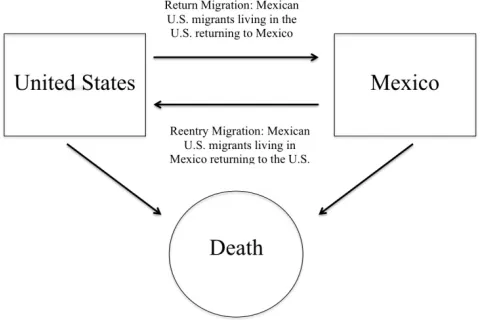
Borrowing from Rogers (1995), a multistate life table approach is used to model return and reentry migration between Mexico and the United States. As depicted in Figure 1, we are interested in the transitions of Mexican males with U.S. migration experience between three states: (1) Living in Mexico; (2) Living in the United States; and (3) Death. In this analysis we estimate five-year return and reentry rates and the expected duration in each state. Migration of older Mexican males from Mexico or the United States into other countries represents a small percentage of the total population (Hill and Wong 2005) and thus they are not considered in the model. Therefore, our analysis conforms more closely to Roger’s (1995) conceptualization of a closed rather than an open multiregional system, even though we observe international migration.
Figure 1: Multistate model of return and reentry migration of Mexican U.S. migrants
First, we define 5𝐼𝑥𝑈.𝑆.,𝑀𝑒𝑥 as the population of return migrants aged x to x+5. Using IPUMS Mexico, we estimate 5𝐼𝑥𝑈.𝑆.,𝑀𝑒𝑥 using the number of Mexican males aged x to x+5 who lived in the United States five years ago but returned to Mexico by the end of those five years. This definition conforms to that of Rogers and Belanger (1990), who distinguish patterns of return migration from that of primary and repeat migration in the United States. The authors define return migrants as those returning to their region of birth, primary migrants as those emigrating from their region of birth, and repeat migrants as those moving neither to nor from their region of birth. As the present study is only concerned with return to Mexico and reentry back into the United States, we do not examine repeat migrants.
Next, we define 5𝐼𝑥𝑀𝑒𝑥,𝑀𝑒𝑥 as the population of Mexican males aged x to x+5 in Mexico with prior U.S. migration experience who did not migrate back to the United States. Using the ENADID, we estimate this value using the number of Mexican males aged x to x+5 who at some point returned from the United States, lived in Mexico exactly five years ago, and lived in Mexico five years later. As previously noted, we use the ENADID to estimate this population because IPUMS Mexico does not indicate whether Mexicans in Mexico had ever returned from the United States, only whether they had returned within the previous five years.
Next, we define 5𝐼𝑥𝑀𝑒𝑥,𝑈.𝑆. as the population of reentry migrants aged x to x+5. Using IPUMS U.S.A., we estimate 5𝐼𝑥𝑀𝑒𝑥,𝑈.𝑆.using the number of Mexican males aged x to x+5 with a history of migration to the United States who lived in Mexico exactly five years ago and lived in the United States by the end of those five years. Since we are interested in reentry into the United States, 5𝐼𝑥𝑀𝑒𝑥,𝑈.𝑆. does not contain first-time migrants, as does Rogers and Belanger’s (1990) definition of a primary migrant. If the migrant arrived in the United States more than five years ago, it is assumed that his most recent entry into the United States was not his first.
It should be noted that the ENADID contains an emigration component wherein respondents in Mexico were asked about household members living in the United States. We do not use this information to estimate 5𝐼𝑥𝑀𝑒𝑥,𝑈.𝑆. but instead rely on corresponding immigrant counts in IPUMS U.S.A., since emigration is often underreported (Nowok, Kupiszewska, and Poulain 2006), particularly from Mexico to the United States (Ibarraran and Lubotsky 2007). In their calculations of migration flows, De Beer et al. (2010) apply a correction factor that integrates emigration counts reported by sending countries and immigration counts reported by receiving countries. We do not apply this correction as our study is limited to migration between the United States and Mexico, whereas De Beer et al. (2010) use this method to harmonize estimates across 19 European countries.
United States five years ago and lived in the United States at the end of those five years. These counts are obtained from IPUMS U.S.A.4 Given these values, the rate of return from the United States to Mexico between age x and x +5 is
𝑚𝑥𝑈.𝑆.,𝑀𝑒𝑥
5 = 𝐼𝑥 𝑈.𝑆.,𝑀𝑒𝑥 5
𝐼𝑥𝑚𝑖𝑑 𝑈.𝑆.
5 (1)
where 5𝐼𝑥𝑚𝑖𝑑 𝑈.𝑆. is the mid-period population of Mexican males age x to x+5 living in the United States. Analogously, the rate of reentry from Mexico to the United States between age x to x+5 is
5𝑚𝑥 𝑀𝑒𝑥,𝑈.𝑆. = 𝐼𝑥 𝑀𝑒𝑥,𝑈.𝑆. 5
𝐼𝑥𝑚𝑖𝑑 𝑀𝑒𝑥
5 (2)
where 5𝐼𝑥𝑚𝑖𝑑 𝑀𝑒𝑥 is the mid-period population of Mexican males aged x to x+5 with U.S. migration experience living in Mexico. We calculate standard errors for these rates using Canty and Davison’s (1999) weighted bootstrapping method, which yields estimates that adjust for sampling weights. Bootstrapping the standard errors allows us to avoid making distributional assumptions about the data when deriving statistical inferences from the estimates, which is important given the small, albeit nationally representative, sizes for some of our groups.
Similarly to Rogers and Raymer (2001), we define the population at risk of return migration, 5𝐼𝑥𝑚𝑖𝑑 𝑈.𝑆., as Mexican males who lived in the United States five years ago but returned to Mexico, 5𝐼𝑥𝑈.𝑆.,𝑀𝑒𝑥, and those who stayed in the United States within this period, 5𝐼𝑥𝑈.𝑆.,𝑈.𝑆.. We assume that half of the return-migrating individuals migrated within the first 2.5 years of the five-year period. Therefore, 5𝐼𝑥𝑚𝑖𝑑 𝑈.𝑆. = 5𝐼𝑥𝑈.𝑆.,𝑈.𝑆. +
𝐼𝑥𝑈.𝑆.,𝑀𝑒𝑥 5
2 . The variable 5𝐼𝑥𝑚𝑖𝑑 𝑀𝑒𝑥 is similarly defined as 𝐼𝑥 𝑀𝑒𝑥,𝑀𝑒𝑥
5 + 𝐼𝑥
𝑀𝑒𝑥,𝑈.𝑆. 5
2 .
It should be noted that these five-year rates depart from the United Nation’s definition of migration as a one-year occurrence (United Nations 2013). As such, they are more likely to capture long-term moves, which may be a more appropriate metric for later-life migrants. The literature documents seasonal international migration among older, relatively affluent Northern Europeans (Casado-Díaz, Kaiser, and Warnes 2004) but it is still unknown whether this pattern applies to older Mexican immigrants. Because Hispanics have substantially fewer economic resources than non-Hispanic Whites when entering into retirement age (Wolff 2006), they may be less likely to travel abroad repeatedly within short time frames. Such was the case for Italian and
4
Spanish older migrants in Switzerland whose ability to travel to and from the home country was hindered by low income levels (Bolzman 2013).
The final set of transition rates needed for the multistate life table is the five-year age-specific death rates of migrants. The death rates 5𝑚𝑥 𝑈.𝑆.,𝐷𝑒𝑎𝑡ℎ and 5𝑚𝑥 𝑀𝑒𝑥,𝐷𝑒𝑎𝑡ℎ are drawn from the literature. For the former, we use the age-specific death rates for Mexican-origin males in the United States in 2001 presented in Arias et al. (2003). Ten-year death rates are transformed into five-year deaths rates by fitting an exponential curve over the ten-year rates and using the resulting equation to predict corresponding five-year rates. In doing this, we rely on the assumption that adult mortality has an exponential relationship to age (Wachter 2014).
Information from Turra and Elo (2008) is used to calculate age-specific death rates for Mexican males in Mexico who had previously migrated to the United States. The authors find that Hispanic elderly male immigrants who are primary Social Security beneficiaries and returned to their home countries had 15% more mortality compared to those who remained in the United States. Thus, the mortality rates 5𝑚𝑥 obtained in Arias et al. (2003) are inflated by this quantity to represent the mortality rates of Mexican immigrant males who return-migrated.
We construct the following age-specific transition matrix 5𝕄𝑥 from the migration and death rates:
5𝕄𝑥 =� 𝑚𝑥 𝑈.𝑆.,𝐷𝑒𝑎𝑡ℎ
5 +5𝑚𝑥 𝑈.𝑆.,𝑀𝑒𝑥 − 𝑚5 𝑥 𝑀𝑒𝑥,𝑈.𝑆.
− 𝑚5 𝑥𝑈.𝑆.,𝑀𝑒𝑥 5𝑚𝑥 𝑀𝑒𝑥,𝐷𝑒𝑎𝑡ℎ+5𝑚𝑥𝑀𝑒𝑥,𝑈.𝑆.� (3),
where death is an absorbing state. We then calculate life table transition probabilities using the following equation:
5ℚ𝑥 = (𝕀 + 2.5 5𝕄𝑥)−1(𝕀 −2.5 5𝕄𝑥) (4),
constructing the multistate life table in this study are the same as those for the standard multistate life table models which can be found in articles and standard text books (e.g., Palloni 2001; Schoen 1988; Willekens et al. 1982) and thus will not be repeated here.
A concern with the calculation of the reentry rates is the use of data sources from two different years − 1997 and 2000 − to estimate the numerator and denominator, which introduces bias if migrants significantly differ between the two years. In other words, the reentry rates are biased if the numerator does not relate to the population in the denominator because they were measured in two different years. In order to gauge the magnitude of the difference, we compare the characteristics of a group that is captured in both the 1997 ENADID and the 2000 IPUMS Mexico, 5𝐼𝑥𝑈𝑆,𝑀𝑒𝑥, which represents individuals who reported living in the United States five years prior. These migrants will hereafter be referred to as five-year return migrants. They are to be differentiated from return migrants who returned from the United States at any point. Another potential source of misalignment between the numerator and denominator is the use of three different data sets to estimate their values. We cannot gauge the degree of this bias because there is no relevant population that is common across all three data sources.
4. Results
4.1 Age profile of later-life migration
Table 2 displays five-year age-specific rates at which older Mexican males in Mexico with previous U.S. migration experience reentered the United States and at which older Mexican males in the United States returned to Mexico. Before discussing the differences across ages, it should be noted that the 95% confidence intervals indicate that all rates of return and reentry are statistically different from zero. Thus, while net migration from Mexico to the United States (measured as the number of entrants to the United States minus the number of return migrants) has virtually stopped (Passel, Cohn, and Gonzalez-Barrera 2012), we find evidence of small yet nontrivial gross rates of return and reentry among older Mexican males.
which is notable given that international moves can be more difficult to orchestrate than domestic moves. This finding is especially notable in light of the physical limitations associated with late life (Centers for Disease Control and Prevention 2014a, 2014b), which can complicate travel.
Table 2: Rates of return to Mexico among Mexican immigrant males in the United States and of reentry back into the United States among Mexican males in Mexico with U.S. migration experience
United States to Mexico Mexico to United States Age Rate 95% Confidence Interval Rate 95% Confidence Interval 50−54 0.0319 0.0283 0.0355 0.0333 0.0273 0.0393 55−59 0.0302 0.0263 0.0341 0.0180 0.0136 0.0224 60−64 0.0384 0.0334 0.0434 0.0163 0.0123 0.0203 65−69 0.0444 0.0375 0.0513 0.0111 0.0078 0.0144
70+ 0.0199 0.0166 0.0232 0.0066 0.0049 0.0084
Source: Authors’ calculations using the 1997 National Survey of Demographic Dynamics (ENADID) (N=2,951), the 2000 Integrated Public-Use Microdata Series for the United States (IPUMS U.S.A) (N=28,741) and the 2000 IPUMS Mexico (N=2,077).
Notes: Migration rates are calculated as the ratio of two random variables. Bootstrapped standard errors with 1,000 replications are presented. To test whether rates of return and reentry between two age groups are statistically significant, we estimated standard errors by taking 1,000 bootstrap samples of the differences in the rates between these age groups. This method yielded a standard error of 0.0041 for the difference in the rate of return migration to Mexico between the 65-to-69 and to-54-year-old age groups, and 0.0032 for the difference in the rate of reentry to the United States between the 70-and-older and 50-to-54-year-old age groups.
The results from Table 2 also show that ‘younger’ old-age migrants, herein defined as those aged 50 to 54, reenter the United States at higher rates than ‘older’ old-age migrants aged 70 and over. The rate of reentry to the United States ranges from 3.33% at ages 50−54 to less than 1% at age 70 and over, a difference that is statistically significant at the 5% level.5
While it is not possible to know the exact reasons for this finding, the literature provides several possible explanations. This age pattern may reflect the physical toll of international travel. Migrants aged 50 to 54 may be more physically able to make the long journey from Mexico to the United States. One study of older Spanish and Italian immigrants in Switzerland found that younger migrants preferred to alternate between the home and destination countries, whereas older migrants chose to remain in Switzerland (Bolzman 2013). Respondents cited the difficulties of traveling under poor health conditions as a primary reason. Another reason why 50−54-year-olds have a
5 To test whether the age-specific rates are statistically significant from one another, we estimated standard
higher rate of reentry to the United States may be related to life-course events often associated with age. For example, retirement migrants in diverse areas such as Switzerland (Bolzman 2013), Australia (Percival 2013), and Mexico (Banks 2009) all describe the powerful effect their grandchildren had on their migration decisions. Individuals are more likely to be grandparents to young children in their early fifties than at age 70 and older (AARP 2002), and thus are more likely to travel at the former rather than latter ages to reunite with grandchildren in the United States. Yet another possible reason for this age pattern may be the social difficulties of uprooting and reestablishing oneself late in life. Migrant males aged 70 and older are less likely to be employed than those in their early fifties (Borjas 2011) and are therefore more dependent on government assistance than younger old-age migrants (Smith and Edmonston 1997). However, the welfare reform of the 1990s added restrictions to the ability of recent migrants to receive several federal programs, making older migrants particularly vulnerable in the United States.
Irrespective of its reason, the difference in reentry rates across groups has important implications. Borjas (2011) finds that immigrant males in their early fifties often work into later life specifically to accrue the 10 years worth of work credits necessary to qualify for U.S. social security benefits. This pattern may apply to newly arrived immigrant elderly as well. Thus, older reentrants to the United States potentially represent those most likely to be employed in the United States.
In contrast to reentry, which peaked at age 50 to 54 and progressively decreased thereafter, the rate of return to Mexico increased noticeably during the ages at which most individuals exit the labor force, namely ages 60 to 69. The right-hand panel in Table 2 shows that the rate of return to Mexico increased from 3.19% at ages 50 to 54 to 4.44% at ages 65 to 69, a difference that is statistically significant at the 5% level.6 This age pattern hints at the importance of retirement in the decision to return-migrate. Moreover, a possible explanation for this pattern is the importance of amenities in later life. Litwak and Longino (1987) attribute the higher rates of migration during the ages immediately after retirement to a greater desire for more amenities during those ages. Following this argument, it is reasonable to assume that given Mexico’s lower cost of living, Mexican migrants in the United States would return to Mexico in their sixties, the ages at which most individuals retire (Munnell 2011), if they were in search of greater amenities. Table 2 shows that the rate of return increased noticeably from 3.02% at ages 55 to 59 to 3.84% at ages 60 to 64, increased further to 4.44% at ages 65 to 69, but decreased significantly thereafter. This pattern suggests that migrants who were more likely to have recently exited the labor force were also more likely to return to
6 The standard error for the difference in the rate of return to Mexico between ages 65 to 69 and 50 to 54 was
Mexico than younger migrants who were still likely in the labor force and older migrants who were well past the normal retirement age.
4.2 Duration of migration
The findings in Table 2 provide a sense of the magnitude of return and reentry migration across ages. However, they do not indicate the duration of these migration spells. The literature on this topic suggests that Mexican immigrants in the United States maintain strong transnational ties (Roberts, Frank, and Lozano-Ascencio 1999) and thus may divide their time between the United States and Mexico.
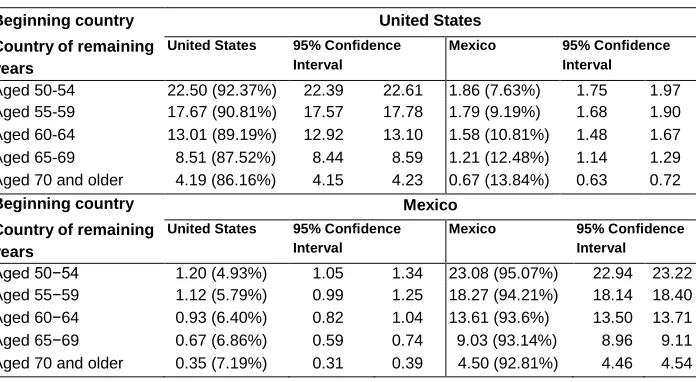
Table 3 displays the expected number of years (and proportion of remaining life) one can expect a migrant male to spend in the United States and Mexico conditional on his age and starting country. The table shows that Mexican immigrants in the United States and ex-U.S. migrant males in Mexico aged 70 and older can expect to live a greater portion of their lives in the other country than those aged 50 to 54. A Mexican male in Mexico between ages 50 to 54 with a history of U.S. migration can expect to live 23.08 more years in Mexico and spend only 1.20 years of the rest of his life in the United States. Put another way, this migrant can expect to spend 95.07% of the rest of his life in Mexico and only 4.93% in the United States. By contrast, those aged 70 and older can expect to spend a higher proportion of the rest of their lives in the United States (7.19%). The difference in the proportion of remaining years spent in the United States between 50−54 year-olds and 70+ year-olds (2.26%) is statistically significant at the 5% level.7 These patterns also apply to rates of return from the United States to Mexico. A Mexican immigrant male in the United States aged 50 to 54 can expect to live 7.63% of the rest of his life in Mexico, whereas this number is 13.84% among the 70 and older population. The difference in these proportions (6.21%) is statistically significant at the 5% level.8
7 To test whether the difference in the proportion of remaining years spent abroad at age 70 and older and
50-to-54 is statistically significant, we estimated standard errors by taking 1,000 bootstrap samples of the differences in the proportions between the age groups. This method yielded a standard error of 0.0015.
8 The standard error for the difference in the expected proportion of remaining years spent in Mexico between
Table 3: Number of years (and proportion of remaining life) a migrant male with U.S. migration experience can expect to spend in the United States and Mexico conditional on his age and starting country
Source: Authors’ calculations using 1997 National Survey of Demographic Dynamics (ENADID) (N=2,951), the 2000 Integrated Public-Use Microdata Series for the United States (IPUMS U.S.A) (N=28,741), and the 2000 IPUMS Mexico (N=2,077). Notes: Underlying mortality rates for Mexican immigrant males in the United States are drawn from Arias et al. (2003). Mortality rates for return migrant males in Mexico under are obtained by inflating the mortality rates found in Arias et al. (2003) by 0.15. These were the amounts of excess mortality found among return migrants in Turra and Elo (2008) compared to those who remained in the United States. To test whether the age-specific proportions are statistically significant from one another, we estimated standard errors by taking 1,000 bootstrap samples of the differences in the proportions between the age groups. This method yielded a standard error of 0.0026 for the difference in the proportion of time immigrants in the United States aged 70 and older and 50-to-54 are expected to spend in Mexico, and 0.0015 for the difference in the proportion of time ex-U.S. migrants in Mexico aged 70 and older and 50-to-54 are expected to spend in United States.
On one level, this pattern reflects the shorter life span of ‘older’ old-age migrants. A half-year abroad for a 70-year-old with 10 years of remaining life represents a larger proportion of his remaining time than for a 50-year-old with more years to live. On another level, the proportion of time that older old-age migrants spend abroad is surprising. Research shows that younger retirement migrants intend to spend more time abroad than older retirement migrants (Bolzman 2013). Older migrants are also more likely to suffer from numerous diseases (Centers for Disease Control and Prevention 2014a, 2014b) and presumably have more physical difficulty traveling. However, older migrants are also much less likely to be tied to the labor force. These migrants may be free to spend extended amounts of time abroad and meet transnational commitments, such as caretaking for young grandchildren (Treas 2008), returning to Mexico to oversee property (Roberts, Frank, and Lozano-Ascencio 1999), reentering the United
Beginning country United States
Country of remaining years
United States 95% Confidence
Interval
Mexico 95% Confidence
Interval
Aged 50-54 22.50 (92.37%) 22.39 22.61 1.86 (7.63%) 1.75 1.97 Aged 55-59 17.67 (90.81%) 17.57 17.78 1.79 (9.19%) 1.68 1.90 Aged 60-64 13.01 (89.19%) 12.92 13.10 1.58 (10.81%) 1.48 1.67 Aged 65-69 8.51 (87.52%) 8.44 8.59 1.21 (12.48%) 1.14 1.29 Aged 70 and older 4.19 (86.16%) 4.15 4.23 0.67 (13.84%) 0.63 0.72
Beginning country Mexico
Country of remaining years
United States 95% Confidence
Interval
Mexico 95% Confidence
Interval
States to utilize U.S. health care services (Jasso et al. 2004), and returning to Mexico to reconnect with family and friends (Roberts, Frank, and Lozano-Ascencio 1999). Because the life expectancies reported in Table 3 are synthetic measures they may be a product of several different flows; thus numerous factors may help explain the differential age patterns. Therefore, the multistate life table results only hint at possible conclusions and far more research is needed to understand the nature of these trends. What is clear from the present study is that differential age patterns exist, and older Mexican immigrants are far from geographically sedentary.
4.3 Validation of the ENADID
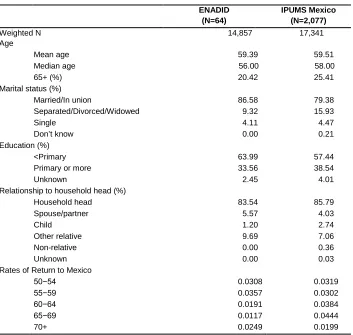
As noted earlier, the rates of return shown in Table 2 were calculated using data only from 2000. However, the rates of reentry were constructed using data from 2000 and 1997. Specifically, while the numerator 5𝐼𝑥𝑀𝑒𝑥,𝑈.𝑆. in equation 2 is measured in 2000 using IPUMS Mexico, in the denominator, 5𝐼𝑥𝑀𝑒𝑥,𝑀𝑒𝑥 is measured in 1997 using the ENADID. We rely on the 1997 ENADID to measure 5𝐼𝑥𝑀𝑒𝑥,𝑀𝑒𝑥 because the 2000 IPUMS Mexico does not indicate whether individuals had ever been to the United States, only if they had returned within the previous five years. Using data sources from different years yields misleading reentry rates if 5𝐼𝑥𝑀𝑒𝑥,𝑀𝑒𝑥significantly differs between the two years. While we cannot directly estimate this difference, we can compare the demographic characteristics and rates of return of a population captured in both data sources, five-year return migrants, in order to gauge the potential bias introduced by using two different years of data.
Table 4: Descriptive statistics of Mexican males in Mexico aged 50 years and older who reported having returned from the United States within the previous five years in the 1997 ENADID and the 2000 IPUMS Mexico
ENADID IPUMS Mexico
(N=64) (N=2,077)
Weighted N 14,857 17,341
Age
Mean age 59.39 59.51
Median age 56.00 58.00
65+ (%) 20.42 25.41
Marital status (%)
Married/In union 86.58 79.38
Separated/Divorced/Widowed 9.32 15.93
Single 4.11 4.47
Don’t know 0.00 0.21
Education (%)
<Primary 63.99 57.44
Primary or more 33.56 38.54
Unknown 2.45 4.01
Relationship to household head (%)
Household head 83.54 85.79
Spouse/partner 5.57 4.03
Child 1.20 2.74
Other relative 9.69 7.06
Non-relative 0.00 0.36
Unknown 0.00 0.03
Rates of Return to Mexico
50−54 0.0308 0.0319
55−59 0.0357 0.0302
60−64 0.0191 0.0384
65−69 0.0117 0.0444
70+ 0.0249 0.0199
Source: Authors’ calculations using the 1997 Mexican National Survey of Demographic Dynamics (ENADID), the 2000 Integrated Public-Use Micro-data Series for Mexico (IPUMS Mexico), and the 2000 IPUMS United States.
the 1997 ENADID values. We find that the rates of return are very similar in the 50−54, 55−59, and 70+ age groups. However, we find that the rates of return using IPUMS Mexico are nearly twice as large for 60−64-year-olds and more than double for 65−69-year-olds. Assuming that differences in the return migration rates reflect similar differences in the reentry rates, the comparison of ENADID and IPUMS Mexico return migration rates suggest that the estimates of reentry migration for 60−64 and 65−69-year-olds using the 1997 ENADID may be biased downwards. Nonetheless, rates of reentry among those least and most costly to the economy, namely those aged 50 to 54 and 70 and older (Smith and Edmonston 1997), respectively, are roughly similar.
5. Discussion
While once limited to industrialized countries, rapid population aging is now a global phenomenon (United Nations n.d.). Countries will absorb the costs of housing an older population as residents ‘age in’. However, older individuals are increasingly entering the population as migrants. The ease of travel, portability of Social Security benefits, and emergence of retirement communities abroad have lowered the costs of international migration during later life, making it a more attractive option than before. At the same time, migrants likely maintain ties to the destination country that will draw them to return. The amount of time they spend in each country may hold important implications for consumption of U.S. old-age support programs, social support structures within immigrant households, and our understanding of immigrant aging and health in the United States.
Before discussing the social implications of these findings, several limitations should be noted. First, we are not able to examine the migration behavior of women due to small sample sizes. Women may have differing rates of return and reentry relative to men due to differences in push and pull factors, such as stronger family ties, weaker links to the labor force, and longer life expectancies. Second, this study does not account for migration to and from the United States and Mexico within this five-year period. Rather, it only examines the rates at which individuals who start out in one country end up in another country at the end of five years, without considering intervening transitions. Thus, “snowbirds” (Sullivan and Stevens 1982) who migrate seasonally are not examined. Examining one-year migration rates instead of five-year migration rates would provide us with important information regarding more short-term migration decisions. As previously discussed, we did not examine one-year time windows due to data constraints.
Another potential concern with the analysis is the use of different data sources to capture the population of migrants and those at risk of migrating. If the populations represented in the numerator and denominator do not relate, the estimated rates are systematically distorted. This concern also plagues the estimation of other rates of demographic phenomena, including mortality, which often relies on separate data sources to estimate the number of deaths and the population at risk of dying (Patel et al. 2004). While evidence suggests that the ENADID, IPUMS U.S.A., and IPUMS Mexico are quite reliable (e.g., Massey and Zenteno 2000; Rendall, Brownell, and Kups 2011), particularly for the elderly migrant population (Robinson, Adlakha, and West 2002), the possibility of differential rates of undercount across data sources cannot be discounted. Despite this limitation, the study makes use of available information to provide insight into an under-researched subject with increasing relevance − the migration patterns of elderly Mexican migrants − and thus represents an important first step in advancing this field of research.
Lastly, while the study provides estimates of return and reentry rates at older ages when none previously existed, it does not examine the reasons underpinning these migration streams. The goal of the study is not to determine the reasons for return and reentry but rather to present point estimates of their magnitude and open up a discussion as to why these patterns may exist. Future research examining the mechanisms driving return and reentry migration amongst older Mexicans and the differential rates across age groups is required.
reasons. Although we find a similar peak among Mexican immigrants, it is still far from clear whether amenities can explain this peak. Amenity migrants are often positively selected on socio-economic status (Casado-Díaz, Kaiser, and Warnes 2004), whereas most U.S. immigrants have few economic resources when entering retirement age (Sevak and Schmidt 2014). There is also no evidence to suggest that Mexican immigrants who return to Mexico from the United States are amenity-enjoying retirees in their later years. In their analysis of the 50 and older population, Aguila and Zissimopoulos (2013) find that labor force participation rates for ex-U.S. migrants and non-migrants were similar. In other words, those who had never been to the United States were just as likely to be working in late life as those who at some point returned from the United States.
Instead of amenities as the primary factor driving the locational decisions of older immigrants, the literature points to the importance of reconnecting with family. Several studies have suggested that social and familial ties may have an even greater influence than income in determining return migration (Massey 1987b; Vega 2015). For example, older Spanish and Italian immigrants in Switzerland listed the location of children as the most important factor in their retirement location decisions (Bolzman 2013). Instead of seeking to receive assistance, these migrants expressed a desire to relocate in order to provide assistance to their children. Migrants are also motivated toward retirement migration by non-child family members. For example, Percival (2013) finds that British immigrants in Australia, particularly those who were widowed, expressed a desire to return to Britain to reconvene with siblings. These findings elucidate an important distinction between native-born and foreign-born older adults: whereas the former group often make their retirement location decisions in the country in which their family lives, older immigrants are more likely to have family in multiple countries and must navigate this dispersion. The transnational context in which immigrants make retirement location decisions may fundamentally alter their perspective toward privileging familial ties instead of amenities.
they are not U.S. citizens or legal permanent residents. A promising future endeavor would be to examine the characteristics of migrants in each migration stream.
The present study sheds light on the complex role of transnational ties in the country-level residential decisions of older Mexican males. The results show considerable movement among the older U.S. migrant population both in Mexico and the United States (as high as 2% among migrants 70 and older in the United States), despite their presumably weak labor force ties. As Aguilera (2004) observes, Mexican immigrants can have concomitant commitments in both Mexico and the United States that pull them toward both countries in later life. As such, they should not be taken for granted as geographically immutable, as the heavy focus on the role of employment considerations in discussing Mexican immigration to the United States would imply. Although older Mexicans have exited the labor force, they still have many reasons for international travel to and from Mexico.
The results also illuminate the need for more theories on retirement migration that consider the role of transnationalism. As Aguilera (2004) notes, a transnational perspective is requisite to understanding international migration choices among the elderly. However, existing theories on later-life migration are largely limited to domestic migration (Litwak and Longino 1987; Walters 2000) and do not consider the international ties individuals often maintain in multiple countries. These ties include closeness to children and grandchildren abroad (Baldock 2000; Banks 2009; Treas 2008; Zhou 2013), dual citizenship (Conway, Potter, and St Bernard 2013), and bi-national identities whereby migrants identify strongly with both the destination and source countries (Conway, Potter, and St Bernard 2013). Moreover, transnational ties may become increasingly important at the older ages when migrants gain more economic and physical mobility and seek stronger healthcare support. Developing theories that integrate transnational push and pull factors can help shed light on the mechanisms underlying retirement migration decisions.
6. Acknowledgements
References
AARP (2002). The grandparent study 2002 report [electronic resource]. Washington, D.C.: AARP. http://assets.aarp.org/rgcenter/general/gp_2002.pdf.
Abraído-Lanza, A.F., Dohrenwend, B.P., Ng-Mak, D.S., and Turner, J.B. (1999). The Latino mortality paradox: A test of the “salmon bias” and the healthy migrant hypotheses. American Journal of Public Health 89(10): 1543−1548.
doi:10.2105/AJPH.89.10.1543.
Administration on Aging (2010). A statistical profile of Hispanic older Americans aged 65+ [electronic resource]. Washington, D.C.: U.S. Department of Health and Human Services. http://www.aoa.gov/Aging_Statistics/minority_aging/Facts-on-Hispanic-Elderly.aspx.
Aguila, E. and Zissimopoulos, J. (2008). Labor market and immigration behavior of middle-aged and elderly Mexicans. Ann Arbor, MI: University of Michigan Retirement Research Center, Working Paper; 2008-192.
Aguila, E. and Zissimopoulos, J. (2013). Retirement and health benefits for Mexican migrant workers returning from the United States. International social security review 66(2): 101−125. doi:10.1111/issr.12014.
Aguilera, M.B. (2004). Deciding where to retire: Intended retirement location choices of formerly undocumented Mexican migrants. Social Science Quarterly 85(2): 340−360. doi:10.1111/j.0038-4941.2004.08502008.x.
Arias, E., Anderson, R.N., Kung, H.-C., Murphy, S.L., and Kochanek, K.D. (2003). Deaths: Final deaths for 2001. Hyattsville, MD: National Center for Health Statistics, DHS Publication; 2003-1120.
Baldock, C.V. (2000). Migrants and their parents: Caregiving from a distance. Journal of Family Issues 21(2): 205−224. doi:10.1177/019251300021002004.
Banks, S.B. (2009). Intergenerational ties across borders: Grandparenting narratives by expatriate retirees in Mexico. Journal of Aging Studies 23: 178−187.
doi:10.1016/j.jaging.2007.11.004.
Bolzman, C. (2013). Ageing immigrants and the question of return: New answers to an old dilemma? In: Percival, J. (ed.). Return migration in later life: International perspectives. Bristol, Great Britain: Policy Press: 67−88. doi:10.1332/
policypress/9781447301226.003.0004.
Borjas, G.J. (2011). Social security eligiblity and the labor supply of older immigrants. Industrial and Labor Relations Review 64(3): 485−501. doi:10.1177/
001979391106400304.
Canty, A.J. and Davison, A.C. (1999). Resampling‐based variance estimation for labour force surveys. Journal of the Royal Statistical Society: Series D (The Statistician) 48(3): 379−391. doi:10.1111/1467-9884.00196.
Casado-Díaz, M.A., Kaiser, C., and Warnes, A.M. (2004). Northern European retired residents in nine southern European areas: Characteristics, motivations and adjustment. Ageing and Society 24: 353−381. doi:10.1017/S0144686
X04001898.
Centers for Disease Control and Prevention (2014a). Table 44 (page 1 of 3). Respondent-reported prevalence of heart disease, cancer, and stroke among adults aged 18 and over, by selected characteristics: United States, average annual, selected years 1997–1998 through 2011–2012 [electronic resource]. Atlanta, GA: Centers for Disease Control and Prevention. http://www.cdc.gov/nchs/data/hus/2013/044.pdf.
Centers for Disease Control and Prevention (2014b). Table 54 (page 1 of 5). Selected measures of disability and health status among adults aged 65 and over, by urbanization level and selected characteristics: United States, average annual, 2002–2004 through 2010–2012 [electronic resource]. Atlanta, GA: Centers for Disease Control and Prevention. http://www.cdc.gov/nchs/data/hus/ 2013/054.pdf.
Christie, L. (2006). Retire in style south of the border [electronic resource]. New York, NY: CNN Money. http://money.cnn.com/2006/02/13/real_estate/acapulco_ alternatives/index.htm.
Conway, D., Potter, R.B., and St Bernard, G. (2013). Caribbean return migration in later life: Family issues and transnational experiences as influential pre-retirement factors. In: Percival, J. (ed.). Return migration in later life. Bristol, United Kingdom: Policy Press: 89−112. doi:10.1332/policypress/9781
Costanzo, J.M., Davis, C., Irazi, C., Goodkind, D., and Ramirez, R. (2002). Evaluating components of international migration: The residual foreign-born. Washington, D.C.: U.S. Census Bureau, Population Division Working Paper; 61.
De Beer, J., Raymer, J., Van der Erf, R., and Van Wissen, L. (2010). Overcoming the problems of inconsistent international migration data: A new method applied to flows in Europe. European Journal of Population 26(4): 459−481.
doi:10.1007/s10680-010-9220-z.
Durand, J., Kandel, W., Parrado, E.A., and Massey, D.S. (1996). International migration and development in Mexican communities. Demography 33(2): 249−264. doi:10.2307/2061875.
Durand, J. and Massey, D.S. (1992). Mexican migration to the United States: A critical review. Latin American Research Review 27(2): 3−42.
Grieco, E.M. and Trevelyan, E.N. (2010). Place of birth of the foreign-born population: 2009. Washington, D.C.: U.S. Census Bureau, American Community Survey Briefs; ACSBR/09-15.
Haverstick, K. and Zhivan, N.A. (2009). Older Americans on the go: How often, where, and why? Chestnut Hill, MA: Center for Retirement Research at Boston College, Research brief; 9-18.
Hawley, C. (2007). Seniors head south to Mexican nursing homes [electronic resource]. http://usatoday30.usatoday.com/educate/college/academics/casestudies/ElderlyC are_CaseStudy_20080416.pdf.
Hill, K. and Wong, R. (2005). Mexico-us migration: Views from both sides of the border. Population and Development Review 31(1): 1−18.
doi:10.1111/j.1728-4457.2005.00050.x.
Ibarraran, P. and Lubotsky, D. (2007). Mexican immigration and self-selection. In: Borjas, G.J. (ed.). Mexican immigration to the United States. Chicago, IL: The University of Chicago Press: 159−192. doi:10.7208/chicago/9780226066684.
003.0006.
Kandel, W. and Cromartie, J. (2004). New patterns of Hispanic settlement in rural America. Washington, D.C.: United States Department of Agriculture Economic Research Service, Rural Development Research Report; RDRR-99.
Lee, E.S. (1966). A theory of migration. Demography 3(1): 47−57. doi:10.2307/
2060063.
Lichter, D.T. and Johnson, K.M. (2009). Immigrant gateways and Hispanic migration to new destinations. International Migration Review 43(3): 496−518.
doi:10.1111/j.1747-7379.2009.00775.x.
Lindstrom, D.P. (1996). Economic opportunity in Mexico and return migration from the United States. Demography 33(3): 357−374. doi:10.2307/2061767.
Litwak, E. and Longino, C.F. (1987). Migration patterns among the elderly: A developmental perspective. The Gerontologist 27: 266−272. doi:10.1093/geront/
27.3.266.
Massey, D.S. (1987a). The ethnosurvey in theory and practice. International Migration Review 21(4): 1498−1522. doi:10.2307/2546522.
Massey, D.S. (1987b). Understanding Mexican migration to the United States. The American Journal of Sociology 92(6): 1372−1403. doi:10.1086/228669.
Massey, D.S. (ed.). (2010). New faces in new places: The changing geography of American immigration. New York, NY: Russell Sage Foundation.
Massey, D.S. and Zenteno, R.M. (2000). A validation of the ethnosurvey: The case of Mexico-U.S. Migration. International Migration Review 34(3): 766−793.
doi:10.2307/2675944.
Minnesota Population Center (2014). Integrated public use microdata series, international: Version 6.3 [machine-readable database] [electronic resource]. Minneapolis, MN: University of Minnesota. https://international.ipums.org/
international/index.shtml.
Morawska, E. (1990). The sociology and historiography of immigration. In: Yans-McLaughlin, V. (ed.). Immigration reconsidered: History, sociology, and politics. New York, NY: Oxford University Press: 187−240.
National Institute of Statistics and Geography (n.d.). Encuesta Nacional de la Dinámica Demográfica 1997 [National Survey of Demographic Dynamics, 1997] [electronic resource]. http://www.inegi.org.mx/est/contenidos/Proyectos/ Encuestas/Hogares/especiales/enadid/enadid1997/default.aspx.
Nowok, B., Kupiszewska, D., and Poulain, M. (2006). Statistics on international migration flow. In: Poulain, M., Perrin, N., and Singleton, A. (eds.) THESIM Towards Harmonised European Statistics on International Migration. Louvain-la-Neuve: Presses Universitaires de Louvain: 203−232.
Pablos-Méndez, A. (1994). Mortality among Hispanics: Letter to the editor. Journal of the American Medical Association 271(16): 1237−1238. doi:10.1001/jama.271.
16.1237a.
Palloni, A. (2001). Increment-decrement life tables. In: Preston, S.H., Heuveline, P., and Guillot, M. (eds.) Demography: Measuring and modeling population processes. Malden, MA: Blackwell Publishers: 256−272.
Palloni, A. and Arias, E. (2004). Paradox lost: Explaining the Hispanic adult mortality advantage. Demography 41(3): 385−415. doi:10.1353/dem.2004.0024.
Passel, J., Cohn, D.V., and Gonzalez-Barrera, A. (2012). Net migration from Mexico falls to zero - and perhaps less [electronic resource]. Washington D.C.: Pew Hispanic Center. http://www.pewhispanic.org/2012/04/23/net-migration-from-mexico-falls-to-zero-and-perhaps-less/.
Patel, K.V., Eschbach, K., Ray, L.A., and Markides, K.S. (2004). Evaluation of mortality data for older Mexican Americans: Implications for the Hispanic paradox. American Journal of Epidemiology 159(7): 707−715. doi:10.1093/aje/
kwh089.
Percival, J. (2013). “We belong to the land”: British immigrants in Australia contemplating or realising their return “home” in later life. In: Percival, J. (ed.). Return migration in later life. Bristol, UK: Policy Press: 113−139.
doi:10.1332/policypress/9781447301226.003.0006.
Piore, M.J. (1979). Birds of passage: Migrant labor and industrial societies. Cambridge, UK: Cambridge University Press. doi:10.1017/CBO978051157
2210.
Roberts, B.R., Frank, R., and Lozano-Ascencio, F. (1999). Transnational migrant communities and Mexican migration to the U.S. Ethnic and Racial Studies 22(2): 238−266.
Robinson, J.G., Adlakha, A., and West, K.K. (2002). Coverage of the population in census 2000: Results from demographic analysis. Washington, D.C.: U.S. Census Bureau, Working Paper; 91.
Rogers, A. (1988). Age patterns of elderly migration: An international comparison. Demography 25(3): 355−370. doi:10.2307/2061537.
Rogers, A. (1995). Origin-dependent life tables and projections. Multiregional demography: Principles, methods and extensions. New York, NY: John Wiley & Sons: 140−176.
Rogers, A. (ed.). (1992). Elderly migration and population redistribution. London: Belhaven Press.
Rogers, A. and Belanger, A. (1990). The importance of place of birth in migration and population redistribution analysis. Environment and Planning A 22(2): 193−210.
doi:10.1068/a220193.
Rogers, A. and Raymer, J. (2001). Immigration and the regional demographics of the elderly population in the United States. The Journals of Gerontology Series B: Psychological Sciences and Social Sciences 56(1): S44−S55. doi:10.1093/
geronb/56.1.S44.
Ruggles, S., Alexander, J.T., Genadek, K., Goeken, R., Schroeder, M.B., and Sobek, M. (2010). Integrated public use microdata series, international: Version 5.0 [machine-readable database] [electronic resource]. Minneapolis, MN: Minnesota Population Center [producer and distributer]. https://ipums.org.
Sassen, S. (1988). The mobility of labor and capital: A study in international investment and labor flow. Cambridge: Cambridge University Press. doi:10.1017/CBO97
80511598296.
Sassen, S. (1991). The global city: New york, London, Tokyo. Princeton, N.J.: Princeton University Press.
Schoen, R. (1988). Modeling multigroup populations. New York, NY: Plenum Press.
doi:10.1007/978-1-4899-2055-3.
Sjaastad, L.A. (1962). The costs and returns of human migration. Journal of Political Economy 70(5, Part 2: Investment in Human Beings): 80−93.
Smith, J.P. and Edmonston, B. (1997). The new Americans: Economic, demographic, and fiscal effects of immigration. Washington, D.C.: National Academies Press.
Stark, O. and Bloom, D.E. (1985). The new economics of labor migration. The American Economic Review: Papers and Proceedings of the Ninety-Seventh Annual Meeting of the American Economic Association 75(2): 173−178.
Sullivan, D.A. and Stevens, S.A. (1982). Snowbirds seasonal migrants to the sunbelt. Research on Aging 4(2): 159−177. doi:10.1177/0164027582004002002.
Sunil, T.S., Rojas, V., and Bradley, D.E. (2007). United States’ international retirement migration: The reasons for retiring to the environs of Lake Chapala, Mexico. Ageing and Society 27: 489−510. doi:10.1017/S0144686X07005934.
The World Bank (2011). Migration and remittances: Factbook 2011. Washington, D.C. Treas, J. (2008). Transnational older adults and their families. Family relations 57:
468−478. doi:10.1111/j.1741-3729.2008.00515.x.
Turra, C.M. and Elo, I.T. (2008). The impact of the salmon bias on the Hispanic mortality advantage: New evidence from social security data. Population Research and Policy Review 27: 515−530. doi:10.1007/s11113-008-9087-4. United Nations (n.d.). World population ageing: 1950−2050 [electronic resource]. New
York, NY: United Nations. http://www.un.org/esa/population/publications/ worldageing19502050/.
United Nations, Department of Economic and Social Affairs (2013). International migration report, 2013 [electronic resource]. New York, NY. http://esa.un.org/unmigration/documents/worldmigration/2013/Full_Document_f inal.pdf.
Van Hook, J. and Zhang, W. (2011). Why stays? Who goes? Selective emigration among the foreign-born. Population Research and Policy Review 30: 1−24.
doi:10.1007/s11113-010-9183-0.
Vega, A. (2015). The impact of social security on return migration among Latin American elderly in the U.S. Population Research and Policy Review 34(3): 307−330. doi:10.1007/s11113-014-9339-4.
Walters, W.H. (2000). Types and patterns of later-life migration. Geografiska Annaler 82(3): 129−147. doi:10.1111/1468-0467.00079.
Willekens, F.J., Shah, I., Shah, J., and Ramachandran, P. (1982). Multi-state analysis of marital status life tables: Theory and application. Population Studies 36(1): 129−144. doi:10.2307/2174163.
Wolff, E.N. (2006). The adequacy of retirement resources among the soon-to-retire, 1983−2001. Levy Economics Institute Working Paper; 472.