Adolescents' Responses to Pictorial Warnings on Their Parents'
Cigarette Packs
Kathryn Peebles, M.P.H.a,1, Marissa G. Hall, M.S.P.H.a,b, Jessica K. Pepper, Ph.D.a,c, M. Justin Byron, Ph.D.a,b, Seth M. Noar, Ph.D.b,d, and Noel T. Brewer, Ph.D.a,b,*
aDepartment of Health Behavior, Gillings School of Global Public Health, University of North
Carolina, Chapel Hill, North Carolina
bLineberger Comprehensive Cancer Center, University of North Carolina, Chapel Hill, North
Carolina
cRTI International, Research Triangle Park, North Carolina
dSchool of Media and Journalism, University of North Carolina, Chapel Hill, North Carolina
Abstract
Purpose—Pictorial cigarette pack warnings are a promising policy solution to increase smoking cessation among adults. However, little is known regarding adolescents' responses to pictorial warnings, particularly in real-world settings.
Methods—Participants were 112 adolescent children, ages 13–17, whose parents received either text-only warnings on the side of their cigarette packs or pictorial warnings on the top half of the front and back of their cigarette packs for 4 weeks as part of a trial. We measured adolescents' recall and recognition of these warnings, negative emotional reactions to the warnings, perceived effectiveness of the warnings, social interactions about the warnings, and smoking risk beliefs.
Results—Adolescents accurately recalled pictorial warnings more often than text-only warnings (82% vs. 19%, p < .001). Recognition of warnings was also higher for pictorial than text-only warnings (82% vs. 34%, p < .001). Pictorial warnings drew greater attention (p < .001), elicited greater negative emotional reactions (p < .05), and sparked more social interactions (p < .01) than text-only warnings.
Conclusions—Pictorial warnings on cigarette packs may have important effects on adolescent children of smokers. Future research should further investigate the impact of such messages on adolescents' susceptibility to smoking initiation and interest in quitting smoking, particularly as the United States and other countries work to implement pictorial warning regulations.
*Address correspondence to: Noel T. Brewer, Ph.D., Department of Health Behavior, Gillings School of Global Public Health,
University of North Carolina, 325 Rosenau Hall CB7440, Chapel Hill, NC 27599. [email protected] (N.T. Brewer). 1Present address: Department of Epidemiology, School of Public Health, University of Washington, Seattle, WA 98195. Conflicts of Interest: The authors have no conflicts of interest or financial disclosures to report.
Disclaimer: The content is solely the responsibility of the authors and does not necessarily represent the official views of the NIH or
HHS Public Access
Author manuscript
J Adolesc Health
. Author manuscript; available in PMC 2017 December 01.Published in final edited form as:
J Adolesc Health. 2016 December ; 59(6): 635–641. doi:10.1016/j.jadohealth.2016.07.003.
A
uthor Man
uscr
ipt
A
uthor Man
uscr
ipt
A
uthor Man
uscr
ipt
A
uthor Man
uscr
Keywords
Cigarette regulatory policy; Cigarette pack warnings; Adolescence
Tobacco use results in the death of almost six million people globally each year [1]. In the United States, cigarette smoking is the primary cause of preventable death, killing 480,000 people annually [1]. Almost 90% of smokers begin smoking by the age of 18 [2], and adolescence is a critical period for development of enduring smoking-related attitudes and behaviors [3,4]. Therefore, adolescents are a particularly important population to target with tobacco prevention messages and regulatory interventions, including pictorial cigarette pack warnings. The 2009 Family Smoking Prevention and Tobacco Control Act required that the U.S. Food and Drug Administration (FDA) develop nine new pictorial warnings for cigarette packs [5]. While a tobacco industry lawsuit has delayed the implementation of pictorial warnings, the FDA intends to propose a revised set of warnings that will address the concerns raised in the lawsuit [6]. Understanding how pictorial warnings affect adolescents' emotional and cognitive responses, smoking attitudes and intentions may provide important information as the FDA designs new warnings and prepares for subsequent legal challenges.
A large body of research indicates that pictorial warnings are more effective than text-only warnings among adults [7,8], drawing more attention, eliciting stronger cognitive and negative affective reactions, increasing intentions to quit smoking [7], and reducing smoking behaviors [8,9]. However, few studies have examined adolescents' responses to pictorial warnings. Experimental studies have yielded mixed findings among adolescents. For example, several studies have found pictorial warnings engendered higher perceived effectiveness and quit intentions than text warnings [10–12], whereas others showed no difference in discouragement from smoking [13] or demonstrated higher intentions to smoke in response to pictorial warnings [12]. However, each of these studies relied on brief exposures to warnings in artificial settings. Observational data collected from countries that have implemented pictorial warning policies provide strong evidence of consistent positive effects among adolescents [14–16]. Smoking prevalence among Canadian adolescents declined by 5% following implementation of pictorial warnings in 2001 [16]. In Australia, cognitive processing (i.e., the extent to which individuals think about and elaborate on the pictorial warnings), social interactions, negative cigarette pack attitudes, and consideration of quitting or cutting back on smoking increased among adolescent smokers following implementation of pictorial warnings in 2006 [14]. Similarly, adolescents in the United Kingdom reported greater cognitive processing and higher perceived effectiveness of the cigarette pack warnings to reduce smoking following implementation of pictorial warning labels in 2008 [15]. While these latter studies describe the real-world response of
adolescents to pictorial warnings, they cannot easily disentangle the impact of the warnings from secular trends and concurrent antitobacco interventions, such as national antitobacco media campaigns or tax increases implemented in concert with the pictorial warnings.
Evaluation of the effect of pictorial warnings on adolescents in naturalistic settings in the United States has been hindered by ethical and regulatory considerations that preclude the application of pictorial warning labels to adolescents' own cigarette packs, as well as
A
uthor Man
uscr
ipt
A
uthor Man
uscr
ipt
A
uthor Man
uscr
ipt
A
uthor Man
uscr
practical considerations that limit labeling other cigarette packs to which adolescents may be exposed. Our randomized controlled trial of pictorial cigarette pack warnings [9] among adult smokers presented a unique opportunity to interview the adolescent children of study participants about the warnings. Our study investigated adolescents' real-world reactions to cigarette pack warnings, social interactions about the warnings, and changes in smoking attitudes and risk beliefs in response to the warnings.
Methods
Study participants
From December 2014 to September 2015, we recruited 116 adolescents ages 13–17 residing in North Carolina or California with a parent, guardian, or other household member who participated in a randomized controlled trial in which a single pictorial or text-only warning label (Figure 1) was affixed to their cigarette packs for 4 weeks (i.e., the “parent study”; see Brewer, et al. [9] for a full description of the parent study and Brewer, et al. [17] for a detailed description of the parent study protocol). The parent study recruited participants through Facebook, Craigslist, email lists, in-person recruitment, referrals from local retailers, flyers, yard signs, and bus and newspaper advertisements. The parent study participant was usually the adolescent's mother or father, who, for simplicity, we refer to as the “parent” hereafter. We excluded data from four adolescents whose responses were likely influenced by an adult in the room during the phone interview, as indicated by the
adolescent's report or interviewer's observations; thus, our analytic sample was 112 adolescents. Five adolescents whose parents received text-only warnings accurately described a pictorial warning in response to an open-ended item assessing recall of the warning, likely because they also saw other parent study participants' packs. For these participants, we coded warning recall as incorrect and included them in the pictorial arm for the remaining analyses. Sensitivity analyses produced similar results after excluding data from these five adolescents. We, therefore, include their data in analyses, resulting in a more conservative analysis because these five adolescents likely had less exposure to a pictorial warning than those adolescents whose parents were assigned a pictorial warning.
Procedures
We identified parent study participants who lived in the same household as adolescents ages 13–17 and informed the parents about a study opportunity for their adolescent children. We obtained verbal consent from a legal guardian for the adolescent's participation. In
households with more than one eligible adolescent, we asked to interview the adolescent with the most recent birthday. We then invited the adolescent to participate in the study, obtained verbal assent prior to conducting the survey over the phone, and provided a $40 incentive for completion of the survey. The University of North Carolina institutional review board approved the study.
Measures
We used the message impact framework, a taxonomy of variables that pictorial warnings may affect [7], to select outcome measures (Figure 2). Survey items assessed unaided recall and list-aided recognition of the warning to which the adolescent's parent was assigned,
A
uthor Man
uscr
ipt
A
uthor Man
uscr
ipt
A
uthor Man
uscr
ipt
A
uthor Man
uscr
reactions to the warning [18–20], reactance to the warning [21], perceived effectiveness of the warning, social interactions about the warning, attitudes toward smoking [14,22], smoking risk appraisals [22–24], smoking susceptibility [25], smoking behavior [22,25], and demographics. We cognitively tested [26] new and modified items with 10 adolescents ages 13–17. The survey instrument and decision rules to assess accuracy of warning recall are available in an Online Supplement.
Analysis
We compared the two study arms (pictorial vs. text only) using t tests for continuously measured variables and chi-square, Fisher's exact, or McNemar's test for categorical variables as appropriate. Analyses used SAS version 9.4 (SAS Institute Inc., Cary, NC). We set critical alpha to .05 and used two-tailed statistical tests.
Results
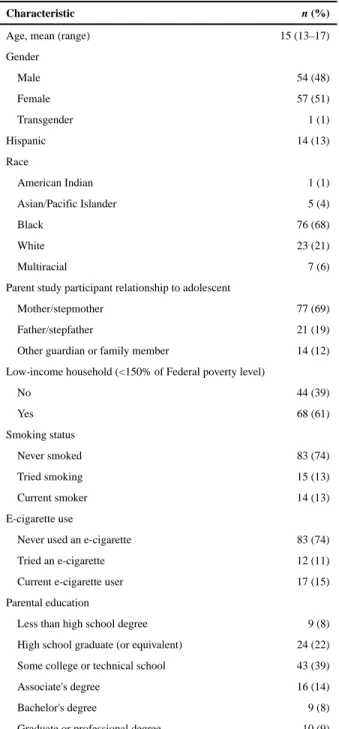
Of the 112 participants, 48% were male and their mean age was 15 (Table 1). Most (68%) were African-American, and more than half (61%) lived in households with income of less than 150% of the federal poverty level. For the majority of participants (69%), the
adolescent's mother or stepmother participated in the parent study. Thirteen percent of adolescents were current smokers, defined as smoking some days or every day, and an additional 13% had previously tried smoking. Demographic characteristics did not differ between pictorial and text-only warning arms.
Recall and recognition of warnings
Most (93%, 104/112) adolescents reported seeing their parents' cigarette packs during the study, and the majority (63%, 70/112) reported seeing the warning we applied to their parents' cigarette packs at least once. Seeing the warning was not associated with any of the nine demographic characteristics in Table 1 (all p > .05). However, seeing the warning differed by study arm: 75% (38/51) of those whose parents were assigned pictorial warnings reported seeing them, compared to 52% (32/61) of those whose parents were assigned text-only warnings (p < .05).
We next looked at recall and recognition among the 70 adolescents who reported seeing a warning on their parents' cigarette packs. Most (82%, 31/38) adolescents whose parents were assigned pictorial warnings accurately described the image on their parents' warnings in measures of unaided recall. In contrast, only 19% (6/32) of adolescents whose parents were assigned text-only warnings accurately described the text on their parents' warnings (p < .001, Figure 3). More adolescents recalled the warning's image (82%) than text (34%, 13/38), among adolescents whose parents were assigned pictorial warnings (p < .001). Accurate recall of the text accompanying the pictorial warning did not differ from recall of the text-only warning (p = .15).
The pattern of findings for list-aided recognition was similar. More participants recognized the pictorial warning image than the pictorial warning text (97%, 37/38 vs. 76%, 29/38, p < . 01). Recognition of both pictorial warning image (97%) and text (76%) was higher than
A
uthor Man
uscr
ipt
A
uthor Man
uscr
ipt
A
uthor Man
uscr
ipt
A
uthor Man
uscr
recognition of the text-only warning (41%, 11/27 [data missing for five participants], both p < .01).
Responses to warnings
Among the 70 adolescents who reported seeing any warning, pictorial warnings captured more attention than text-only warnings (p < .01, Table 2). Pictorial warnings also elicited more strongly negative emotional reactions (p < .05) than text-only warnings. In particular, adolescents reported feeling sadder (p < .05) and more “grossed out” (p < .01) by pictorial warnings relative to text-only warnings, though we observed no differences in feeling anxious or scared. Reactance to the warning, discouragement from wanting to smoke because of the warning, worry about their parent's health due to smoking, perceived harm of smoking, and smoking susceptibility did not differ by warning type (Table 2).
Social interactions about the warning
Forty-five of the 70 adolescents (64%) who recalled seeing a warning on their parents' cigarette packs talked to someone about the warning. Conversation partners included the adolescent's parents, other family members, friends, boyfriend or girlfriend, and classmates. Participants most frequently reported discussing the negative consequences of smoking (n = 18), quitting smoking (n = 15), the specific health consequence depicted on the warning (n = 8), and the impact of secondhand smoke on others (n = 6). Four participants (three who saw a pictorial warning and one who saw a text-only warning) reported sharing the warning on social media via Facebook, Instagram, or Twitter.
Adolescents who recalled seeing a pictorial warning were more likely to talk to someone about the warning than adolescents who recalled seeing a text-only warning (77% vs. 44%, p < .01, Table 2). Adolescents who saw pictorial warnings were also more likely to discuss them with their parents than were adolescents who saw text-only warnings (70% vs. 41%, p < .05). Conversations about quitting smoking were somewhat more common among adolescents in the pictorial warning arm relative to those in the text-only warning arm, although the finding was not statistically significant (60% vs. 37%, p = .06).
Discussion
Adolescents who reported seeing a pictorial warning on their parents' cigarette packs during a 4-week trial had greater unaided recall of the warning image, greater recognition of both the warning image and accompanying text, reported stronger negative emotional reactions in response to the warning, and were more likely to talk to someone about the warning than those adolescents who saw a text-only warning. These findings are consistent with previous observational research on the impact of pictorial warnings on adolescents [8], in which unaided recall of the warning [15] and social interactions [14] increased following national implementation of pictorial warnings on cigarette packs in the United Kingdom and Australia, respectively. Some experimental research with adolescents has also demonstrated stronger negative emotional reactions to pictorial warnings [27,28], a construct hypothesized to explain the effect of pictorial warnings on attitudes and behavior [29].
A
uthor Man
uscr
ipt
A
uthor Man
uscr
ipt
A
uthor Man
uscr
ipt
A
uthor Man
uscr
Adolescents whose parents were assigned a pictorial warning were more likely to report seeing the warning, indicating the potential broader reach of pictorial warnings in disseminating smoking-related health warning messages as compared with text-only warnings. This finding is particularly important for adolescents living with smokers. Compared to adolescents living with nonsmokers, adolescents living with smokers are both at greater risk of smoking initiation [4,30] and are likely to have greater exposure to pictorial warnings on cigarette packs. The greater attention drawn by pictorial warnings among our sample of adolescents suggests that pictorial warnings may be especially well suited to reach this group of adolescents at higher risk of smoking initiation.
Pictorial warnings sparked more conversations between adolescents and their parents than did text-only warnings. Adolescents also spoke with other family members, friends, significant others, and classmates about the pictorial warning, and these conversations extended beyond discussion of the pictorial warning content to include other smoking-related risks, such as harms caused by second-hand smoke. Previous research has suggested that these kinds of social interactions may play an important role in how adults process pictorial warnings [31], and they may play an even larger role among adolescents [32]. Social influences, in the form of social networks and perceived social norms, are particularly important to the formation of smoking-related attitudes and behaviors during adolescence, playing a role in both promotion and deterrence of smoking behaviors [32]. Social interactions are a key part in a bidirectional process in which smoking attitudes and subsequent behaviors influence and are influenced by social norms [33]. Thus, discussions about cigarette pack warnings may serve to increase adolescents' cognitive processing of the warnings, increase the reach of warning messages, and reinforce knowledge of smoking health harms. Given the high occurrence of social interactions in our study, and the importance of social influences in this age group [32] future research should further investigate how social interactions sparked by the warnings may operate within an adolescent's peer group.
Our findings match the early steps in the process through which tobacco control mass media campaigns have affected change among adolescents [34,35]. We found differences in the constructs forming the early phases of the message impact framework [7], including greater attention and recall, stronger negative emotional reactions, and more frequent social interactions among those who saw a pictorial warning relative to text-only warnings. We did not observe differences between study arms in the more distal outcomes of perceived harm of smoking, discouragement from wanting to smoke, worry about parent's health due to smoking, and willingness to smoke. However, with the exception of willingness to smoke, each of the observed differences was in the expected direction. Contrary to previous research demonstrating that pictorial warnings elicit reactance among adults [21,36,37], we did not find that reactance among adolescents differed between study arms. As reactance derives from a perceived threat to one's freedom [38], adolescents could have experienced greater reactance due to a newfound need for independence and autonomy [39]. Thus, it is reassuring that pictorial warning exposure was not associated with greater reactance in our study. However, future studies should examine reactance among adolescents in larger samples. The small sample size and the relatively limited period of exposure in our study may have limited our ability to detect differences. Adolescents in our study were exposed to
A
uthor Man
uscr
ipt
A
uthor Man
uscr
ipt
A
uthor Man
uscr
ipt
A
uthor Man
uscr
pictorial warnings within a 4-week period. In contrast, reductions in adolescent smoking were observed only after 2 years of nationwide implementation of pictorial warnings in Canada [16]. A meta-analysis of antitobacco mass media campaigns similarly found that key elements in the efficacy of such campaigns were the duration and intensity of exposure [35]. This suggests that higher levels of exposure to pictorial warnings over a longer period of time have the potential to yield impacts on smoking beliefs and perhaps even behaviors, and our findings suggest some potential pathways of influence.
The use of a naturalistic pack-labeling protocol [9,17] allowed us to describe adolescents' responses to pictorial warnings in a manner similar to a real-world implementation of pictorial warnings in the United States. Additionally, the majority of adolescents in our study were from low-income households. Given the greater impact of smoking on low-income populations [40], it is particularly important to understand how pictorial warnings affect these populations and how the warnings may contribute to alleviation of smoking-related health disparities. We were limited by the small sample size available for recruitment from the parent study, reducing our ability to detect statistically significant differences between text-only and pictorial warning arms for some outcome variables. The parent study examined the potential impact of adding pictorial warnings to cigarette packs and implementing other label formatting changes required by the 2009 Tobacco Control Act compared to the status quo text-only warnings in the United States. Examining these changes together leaves open the possibility that the differences we observed may be due to adding pictures as well as to other changes to warning format. Additionally, adolescents saw pictorial warnings only on their parent's cigarette packs and perhaps on the packs of
neighbors or their parent's friends who also participated in the parent study and so almost certainly continued to see normally labeled cigarette packs during the same period. Greater saturation of the warning could yield larger results in the real world. Furthermore, the relatively short duration of exposure also limited our ability to detect outcomes that may be affected through interventions of greater length.
In conclusion, compared to text-only warnings, pictorial cigarette pack warnings were accurately recalled and recognized with greater frequency, captured more attention, elicited stronger negative emotional reactions, and inspired more social interactions among
adolescents. Pictorial warnings hold promise as a policy tool to broadly disseminate smoking-related health information to both smoking and nonsmoking adolescents. Future research should explore the effect of specific messages targeted to this population, as well as theoretical pathways through which changes in smoking behaviors may by induced by pictorial warnings.
Supplementary Material
Refer to Web version on PubMed Central for supplementary material.
Acknowledgments
Funding Sources: Research reported in this publication was supported by grant number P50CA180907 from the National Cancer Institute and FDA Center for Tobacco Products (CTP).
A
uthor Man
uscr
ipt
A
uthor Man
uscr
ipt
A
uthor Man
uscr
ipt
A
uthor Man
uscr
References
1. Centers for Disease Control and Prevention. [Accessed December 31, 2015] Smoking and Tobacco Use. Available at: http://www.cdc.gov/tobacco/data_statistics/fact_sheets/fast_facts/
2. U.S. Department of Health and Human Services. Preventing tobacco use among youth and young adults: A report of the surgeon general. Atlanta: Centers for Disease Control and Prevention; 2012. 3. Macy JT, Chassin L, Presson CC. Smoking behaviors and attitudes during adolescence prospectively
predict support for tobacco control policies in adulthood. Nicotine Tob Res. 2012; 14:871–9. [PubMed: 22193576]
4. Gilman SE, Rende R, Boergers J, et al. Parental smoking and adolescent smoking initiation: An intergenerational perspective on tobacco control. Pediatrics. 2009; 123:e274–81. [PubMed: 19171580]
5. [Accessed March 26, 2016] Family Smoking Prevention and Tobacco Control and Federal Retirement Act; Public Law. p. 111-31.Available at: https://www.gpo.gov/fdsys/pkg/ PLAW-111publ31/pdf/PLAW-111publ31.pdf
6. Holder, EH. [Accessed March 26, 2016] Re: R.J Reynolds v. Food & Drug Administration, No. 11– 5332 (D.C. Cir. 2013). https://www.justice.gov/sites/default/files/oip/legacy/
2014/07/23/03-15-2013.pdf
7. Noar SM, Hall MG, Francis DB, et al. Pictorial cigarette pack warnings: A meta-analysis of experimental studies. Tob Control. 2016:341–54. [PubMed: 25948713]
8. Noar SM, Francis DB, Bridges C, et al. The impact of strengthening cigarette pack warnings: Systematic review of longitudinal observational studies. Soc Sci Med. 2016; 164:118–29. [PubMed: 27423739]
9. Brewer NT, Hall MG, Noar SM, et al. Randomized trial of pictorial cigarette pack warnings' impact on smoking behaviors. JAMA Intern Med. 2016; 176:905–12. [PubMed: 27273839]
10. Vardavas CI, Connolly G, Karamanolis K, et al. Adolescents perceived effectiveness of the proposed European graphic tobacco warning labels. Eur J Public Health. 2009; 19:212–7. [PubMed: 19218335]
11. Hammond D, Thrasher J, Reid JL, et al. Perceived effectiveness of pictorial health warnings among Mexican youth and adults: A population-level intervention with potential to reduce tobacco-related inequities. Cancer Causes Control. 2012; 23(1):57–67. [PubMed: 22362058]
12. Sabbane LI, Lowrey TM, Chebat JC. The effectiveness of cigarette warning label threats on nonsmoking adolescents. J Consum Aff. 2009; 43:332–45.
13. Pepper JK, Cameron LD, Reiter PL, et al. Non-smoking male adolescents' reactions to cigarette warnings. PLoS One. 2013; 8:e65533. [PubMed: 23950861]
14. White V, Webster B, Wakefield M. Do graphic health warning labels have an impact on adolescents' smoking-related beliefs and behaviours? Addiction. 2008; 103:1562–71. [PubMed: 18783508]
15. Moodie C, Mackintosh AM, Hastings G. Adolescents' response to pictorial warnings on the reverse panel of cigarette packs: A repeat cross-sectional study. Tob Control. 2015; 24:e93–7. [PubMed: 24005566]
16. Environics Research Group Limited. [Accessed February 1, 2016] Wave 6 surveys: The health effects of tobacco and health warning messages on cigarette packages: Survey of youth. 2003. Available at: http://www.tobaccolabels.ca/wp/wp-content/uploads/2013/12/Canada-2003-The- Health-Effects-of-Tobacco-and-Health-Warning-Messages-on-Cigarette-Packages-Survey-of-Youth-Wave-6-Government-Report1.pdf
17. Brewer NT, Hall MG, Lee JG, et al. Testing warning messages on smokers' cigarette packages: A standardised protocol. Tob Control. 2016; 25:153–9. [PubMed: 25564282]
18. Nonnemaker, J., Farrelly, M., Kamyab, K., et al. Experimental study of graphic cigarette warning labels: Final results report. Research Triangle Park, NC: RTI International; 2010.
19. Watson D, Clark LA, Tellegen A. Development and validation of brief measures of positive and negative affect: The PANAS scales. J Pers Soc Psychol. 1988; 54:1063–70. [PubMed: 3397865] 20. Leshner G, Vultee F, Bolls PD, et al. When a fear appeal isn't just a fear appeal: The effects of
graphic anti-tobacco messages. J Broadcasting Electron Media. 2010; 54:485–507.
A
uthor Man
uscr
ipt
A
uthor Man
uscr
ipt
A
uthor Man
uscr
ipt
A
uthor Man
uscr
21. Hall, MG., Sheeran, P., Noar, SM., et al. Reactance to health warnings scale: Development and validation. Ann Behav Med. 2016. http://dx.doi.org/10.1007/s12160-016-9799-3
22. [Accessed August 19, 2014] Population Assessment of Tobacco and Health Study. Path study data collection instruments: Youth extended interview. 2013. Available at: www.reginfo.gov/public/do/ DownloadDocument?objectID=40723501
23. Dijkstra A, Brosschot J. Worry about health in smoking behaviour change. Behav Res Ther. 2003; 41:1081–92. [PubMed: 12914809]
24. Ranby KW, Lewis MA, Toll BA, et al. Perceptions of smoking-related risk and worry among dual-smoker couples. Nicotine Tob Res. 2013; 15:734–8. [PubMed: 22990222]
25. Centers for Disease Control and Prevention. [Accessed August 14, 2014] Youth tobacco survey. 2011. Available at: http://www.cdc.gov/tobacco/data_statistics/surveys/yts/pdfs/2011-yts-questionnaire.pdf
26. Willis, GB. Cognitive interviewing: A tool for improving questionnaire design. Thousand Oaks, CA: Sage Publications, Incorporated; 2004.
27. Andrews JC, Netemeyer RG, Kees J, et al. How graphic visual health warnings affect young smokers' thoughts of quitting. J Marketing Res. 2014; 51:165–83.
28. Do KT, Galvan A. FDA cigarette warning labels lower craving and elicit frontoinsular activation in adolescent smokers. Soc Cogn Affect Neurosci. 2015; 10:1484–96. [PubMed: 25887154] 29. Wang AL, Lowen SB, Romer D, et al. Emotional reaction facilitates the brain and behavioral
impact of graphic cigarette warning labels in smokers. Tob Control. 2015; 24:225–32. [PubMed: 25564288]
30. Leonardi-Bee J, Jere ML, Britton J. Exposure to parental and sibling smoking and the risk of smoking uptake in childhood and adolescence: A systematic review and meta-analysis. Thorax. 2011; 66:847–55. [PubMed: 21325144]
31. Hall MG, Peebles K, Bach LE, et al. Social interactions sparked by pictorial warnings on cigarette packs. Int J Environ Res Public Health. 2015; 12:13195–208. [PubMed: 26506363]
32. Kobus K. Peers and adolescent smoking. Addiction. 2003; 98:37–55. [PubMed: 12752361] 33. Simons-Morton BG, Farhat T. Recent findings on peer group influences on adolescent smoking. J
Prim Prev. 2010; 31:191–208. [PubMed: 20614184]
34. Hafstad A, Aaro LE, Engeland A, et al. Provocative appeals in anti-smoking mass media
campaigns targeting adolescents: The accumulated effect of multiple exposures. Health Educ Res. 1997; 12:227–36. [PubMed: 10168574]
35. Brinn MP, Carson KV, Esterman AJ, et al. Mass media interventions for preventing smoking in young people. Cochrane Database Syst Rev. 2010:CD001006. [PubMed: 21069667]
36. LaVoie, NR., Quick, BL., Riles, JM., et al. Are graphic cigarette warning labels an effective message strategy? A test of psychological reactance theory and source appraisal. Commun Res.
http://dx.doi.org/10.1177/0093650215609669
37. Erceg-Hurn DM, Steed LG. Does exposure to cigarette health warnings elicit psychological reactance in smokers? J Appl Soc Psychol. 2011; 41:219–37.
38. Brehm, JW. A theory of psychological reactance. New York, NY: Academic Press; 1966. 39. Grandpre J, Alvaro EM, Burgoon M, et al. Adolescent reactance and anti-smoking campaigns: A
theoretical approach. Health Commun. 2003:349–66. [PubMed: 12788679]
40. Centers for Disease Control and Prevention. [Accessed June 16, 2016] Cigarette Smoking and Tobacco Use Among People of Low Socioeconomic Status. Available at: http://www.cdc.gov/ tobacco/disparities/low-ses/index.htm
A
uthor Man
uscr
ipt
A
uthor Man
uscr
ipt
A
uthor Man
uscr
ipt
A
uthor Man
uscr
Implications and Contribution
This study describes adolescents' responses to pictorial warnings on cigarette packs in a naturalistic setting in the United States. Study findings demonstrate that pictorial warnings communicate smoking-related health risk messages to both smoking and nonsmoking adolescents and are superior to text-only warnings on multiple metrics.
A
uthor Man
uscr
ipt
A
uthor Man
uscr
ipt
A
uthor Man
uscr
ipt
A
uthor Man
uscr
Figure 1.
Four pictorial and four text-only warnings used in the parent study.
A
uthor Man
uscr
ipt
A
uthor Man
uscr
ipt
A
uthor Man
uscr
ipt
A
uthor Man
uscr
Figure 2.
Message impact framework for cigarette pack warnings.
A
uthor Man
uscr
ipt
A
uthor Man
uscr
ipt
A
uthor Man
uscr
ipt
A
uthor Man
uscr
Figure 3.
Recall and recognition of the warning among adolescents who saw their parents' warning. Error bars show 95% confidence intervals.
A
uthor Man
uscr
ipt
A
uthor Man
uscr
ipt
A
uthor Man
uscr
ipt
A
uthor Man
uscr
A
uthor Man
uscr
ipt
A
uthor Man
uscr
ipt
A
uthor Man
uscr
ipt
A
uthor Man
uscr
ipt
Table 1
Participant characteristics, n = 11 2
Characteristic n (%)
Age, mean (range) 15 (13–17)
Gender
Male 54 (48)
Female 57 (51)
Transgender 1 (1)
Hispanic 14 (13)
Race
American Indian 1 (1)
Asian/Pacific Islander 5 (4)
Black 76 (68)
White 23 (21)
Multiracial 7 (6)
Parent study participant relationship to adolescent
Mother/stepmother 77 (69)
Father/stepfather 21 (19)
Other guardian or family member 14 (12)
Low-income household (<150% of Federal poverty level)
No 44 (39)
Yes 68 (61)
Smoking status
Never smoked 83 (74)
Tried smoking 15 (13)
Current smoker 14 (13)
E-cigarette use
Never used an e-cigarette 83 (74)
Tried an e-cigarette 12 (11)
Current e-cigarette user 17 (15)
Parental education
Less than high school degree 9 (8)
High school graduate (or equivalent) 24 (22)
Some college or technical school 43 (39)
Associate's degree 16 (14)
Bachelor's degree 9 (8)
Graduate or professional degree 10 (9)
A
uthor Man
uscr
ipt
A
uthor Man
uscr
ipt
A
uthor Man
uscr
ipt
A
uthor Man
uscr
ipt
Table 2
Responses to warning, smoking risk appraisals, and social interactions about the warning, n = 70
Text-only warning n = 27 mean (SD)
Pictorial warning n = 43 mean (SD)
Attention/noticing of warning 2.85 (1.03) 3.65 (.65)*
Negative emotional reactions to warning 2.23 (1.05) 2.73 (.86)*
Discouragement from wanting to smoke because of warning 3.48 (.94) 3.65 (.81)
Reactance to the warning 2.35 (.99) 1.95 (.93)
Worry about parent's health due to smoking 3.41 (.84) 3.56 (.88)
Perceived likelihood of harm 3.56 (.70) 3.72 (.63)
Smoking susceptibility 1.08 (.19) 1.17 (.34)
Talked to anyone about the warning, n (%) 12 (44) 33 (77)*
Talked to parent about the warning, n (%) 11 (41) 30 (70)*
Talked about whether warning would encourage parent to quit smoking, n (%) 10 (37) 26 (60)†
Text-only warning and pictorial warning here refer to the adolescent's recalled condition, among adolescents who reported seeing a warning on their parent's cigarette packs. Response scales range from 1 (not at all, strongly disagree, definitely not) to 4 (a lot, very, strongly agree, definitely yes) for first seven variables in the table.
SD = standard deviation.
* p < .05.