BURNING WITH EDUCATIONAL AMBITION: STATUS ATTAINMENT IN THE 21st CENTURY US
Samuel H. Fishman
A dissertation submitted to the faculty at the University of North Carolina at Chapel Hill in partial fulfillment of the requirements of the degree of Doctorate of Philosophy in the Sociology
Department in the UNC College of Liberal Arts and Sciences.
Chapel Hill 2019
Approved by: S. Philip Morgan Robert A. Hummer
iii ABSTRACT
SAMUEL H. FISHMAN: Burning with Educational Ambition: Status Attainment in the 21st Century US
(Under the Direction of S. Philip Morgan)
Status attainment theory is a foundation of sociological thought on intergenerational stratification in the US. This dissertation extends sociological knowledge by assessing two of status attainment theory’s core assumptions about educational attainment. The first assumption is that educational expectations mediate the relationship between parental sociological status and educational attainment. This assumption requires a robust relationship between expectations and educational attainment. This first assumption is evaluated in the first three chapters. The second assumption is a strong relationship between parental socioeconomic status and educational attainment. The fourth chapter assesses this second assumption. By exploring these assumptions, this dissertation addresses my research agenda’s primary questions: (A) What are key
mechanisms through which inequality is transmitted across generations? (B) What social characteristics buffer the negative effects of socioeconomic disadvantage? For analysis, this dissertation uses data from the National Longitudinal Study of Adolescent to Adult Health, which has followed adolescents (1994-1995) through the young adulthood (2007-2008).
iv
expectations are a stronger predictor of educational attainment for adolescents with high GPAs than for adolescents with lower GPAs. Lastly, reducing measurement error in educational expectations may improve the accuracy of educational attainment models.
The fourth chapter demonstrates that the relationship between parental socioeconomic status and educational attainment is not consistent across all populations in the US. Unlike other race/ethnic-nativity groups, parental education does not predict educational attainment among the children of Korean, Chinese, and Vietnamese immigrants. This chapter suggests that cultural schemas on social mobility related to ethnicity and nativity drive this pattern. In all, this
dissertation extends knowledge on intergenerational stratification processes. First, the
v
ACKNOWLEDGEMENTS
This research uses data from Add Health, a program project directed by Kathleen Mullan Harris and designed by J. Richard Udry, Peter S. Bearman, and Kathleen Mullan Harris at the
University of North Carolina at Chapel Hill, and funded by grant P01-HD31921 from the Eunice Kennedy Shriver National Institute of Child Health and Human Development, with cooperative funding from 23 other federal agencies and foundations. Special acknowledgment is due to Ronald R. Rindfuss and Barbara Entwisle for assistance in the original design. Information on how to obtain the Add Health data files is available on the Add Health website
vi
TABLE OF CONTENTS
LIST OF TABLES………...xi
LIST OF FIGURES………..xiii
DISSERTATION INTRODUCTION………...1
Data………...9
REFERENCES………..11
CHAPTER 1: DO PLANS REALLY MATTER?: RE-ASSESSING THE ROLE OF ADOLESCENT EXPECTATIONS IN EDUCATIONAL ATTAINMENT...………...13
Introduction………....13
Literature Review………...15
Educational Expectations as a Determinant of Educational Attainment………...15
An Alternative Perspective: Contextual and Family-Level Selection…………...17
Other Factors in the Relationship between Educational Expectations and Educational Attainment………...……20
Conceptual Model………..21
Data and Methods………..23
Data and Measures.………23
Methods………..27
Results………....29
Descriptive Results………29
vii
Hausman Tests of Cluster-level Confounding………...32
Other Robustness Tests………..32
Limitations……….34
Discussion and Conclusion………36
Discussion………..36
Conclusion……….37
Tables and Figures……….40
REFERENCES………..46
CHAPTER 2: COLLEGE-FOR-SOME OR COLLEGE-FOR-ALL?: THE JOINT ROLES OF EXPECTATIONS AND ACHIEVEMENT IN EDUCATIONAL ATTAINMENT.………...51
Introduction………51
Literature Review………...54
Educational Expectations: An Independent Predictor of Educational Attainment?...54
Advances in Modeling the Relationship between Educational Expectations and Attainment……….57
Other Factors in the Relationship between Expectations and Academic Achievement with Educational Attainment………...58
Theory………....59
Data………....60
Measures………....62
Methods………...63
Results………....65
Descriptive Statistics………..65
viii
Replication in ELS……….67
Sibling Models………...67
Summary of Results………...68
Robustness Tests………....69
Discussion and Conclusion………....70
Discussion………..70
Conclusion……….74
Tables and Figures……….75
REFERENCES………..84
CHAPTER 3: BURNING WITH EDUCATIONAL AMBITION: THE ROLES OF EDUCATIONAL AMBITION AND COURSEWORK IN EDUCATIONAL ATTAINMENT………..87
Introduction………....87
Literature Review………...90
Status Attainment and Educational Ambition………....90
Ambitions and Coursework………...92
Social Structural Perspectives on Educational Ambitions……….92
Summary………....93
Theorical Framework……….94
The Theory of Conjunctural Action………...94
Forming Ambitions………....95
Ambitions within the Status Attainment Model………....97
Other Factors in Educational Attainment………..97
ix
Measures………....99
Methods………101
Results………..104
Descriptive Results………..104
Regression Analyses………105
Robustness Tests………..110
Discussion and Conclusion………..…....111
Discussion………111
Conclusion………...115
Tables and Figures………...117
REFERENCES………130
CHAPTER 4: EDUCATIONAL MOBILITY AMONG THE CHILDREN OF ASIAN AMERICAN IMMIGRANTS.………...134
Introduction………..134
Literature Review………...137
Duality of Structure………..137
Lee and Zhou………...138
Demographic Research on the Contextual Selection of Immigrants…………...140
Xie and Colleagues………..141
Contextualization within the Weberian Tradition………142
Summary of Literature Review………142
Further Comparisons by Race/Ethnicity and Nativity……….143
x
and Educational Attainment………...……..145
Unobserved Geographic and School Heterogeneity………....145
Other Control Variables………...146
Conceptual Model………147
Data………..149
Measures………..150
Methods………152
Results………...154
Extensions and Robustness Tests……….157
Discussion and Conclusion………...160
Discussion………160
Limitations………...166
Conclusion………...166
Tables and Figures………...168
REFERENCES………....179
DISSERTATION CONCLUSION………..184
Research Limitations and Future Research………..188
Conclusion………...189
REFERENCES………191
APPENDIX A………..192
APPENDIX B………..214
APPENDIX C………..224
xi
LIST OF TABLES
Table 1.1: Descriptive Statistics from Add Health’s Linked Full Siblings (N=2,125)………….41
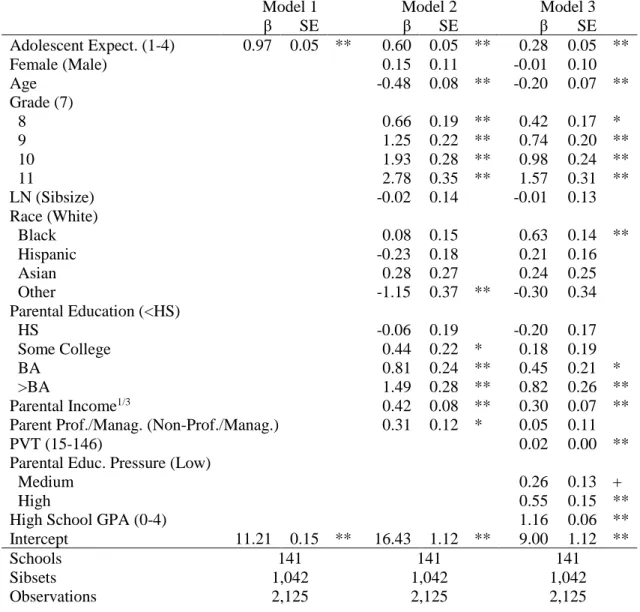
Table 1.2: OLS Regression of Education Years Completed on Adolescent Expectations and Select Covariates.………..42
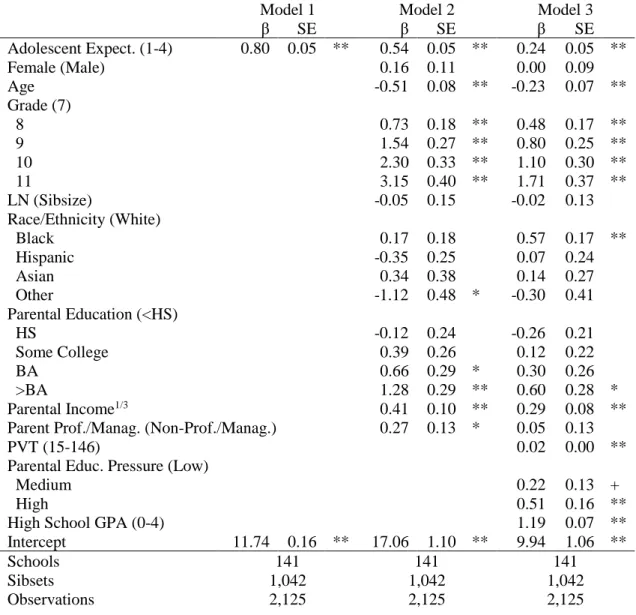
Table 1.3: School Fixed Effects Models of Educational Years Completed on Adolescent Expectations and Select Covariates.………..43
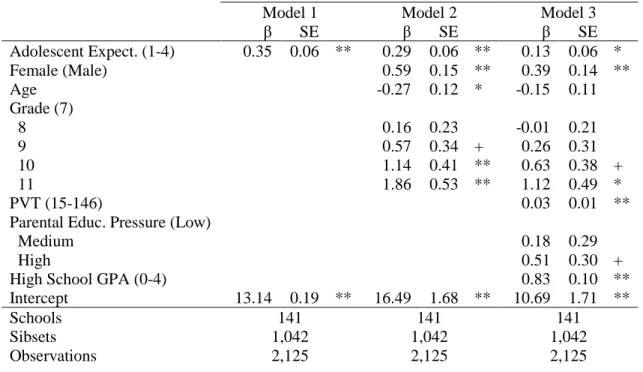
Table 1.4:Sibling Fixed Effects Models of Educational Years Completed on Adolescent Expectations and Select Covariates.………..44
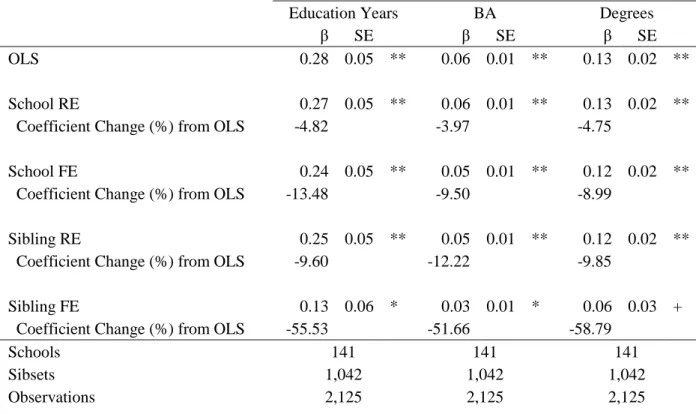
Table 1.5: Summary of Adolescent Expectation-Educational Attainment Point Estimates for OLS, School Random and Fixed Effects, and Sibling Random and Fixed Effects Models for Different Educational Attainment Outcomes.………45
Table 2.1: Descriptive Statistics from Add Health………75
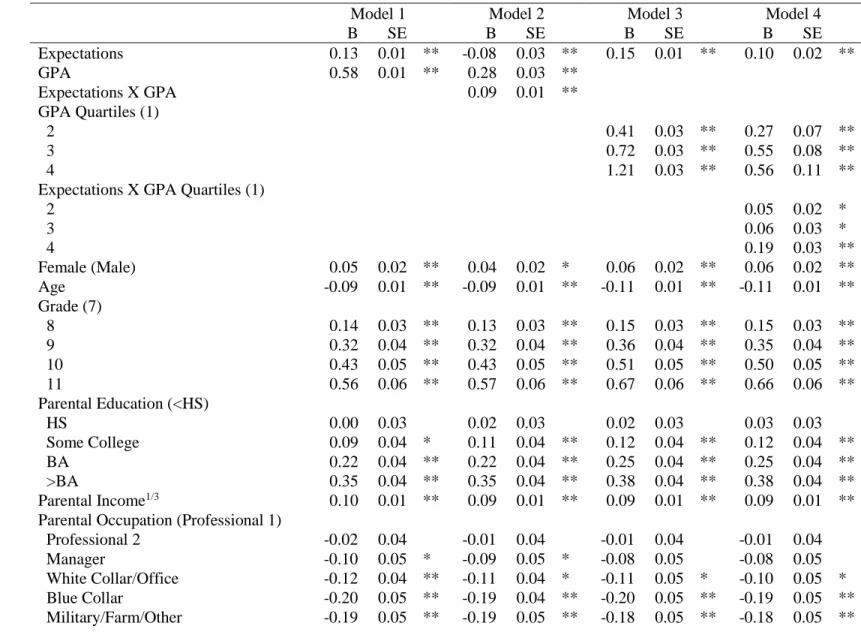
Table 2.2: OLS Regression of Educational Degrees Completed on Educational Expectations, High School GPA, and Selected Covariates from Add Health Primary Sample………...77
Table 2.3: OLS and Sibling Fixed Effects Regression of Educational Degrees Completed on Educational Expectations, High School GPA, and Selected Covariates from Add Health Sibling File……….80
Table 3.1: Descriptive Statistics from Add Health Sample……….119
Table 3.2: Fit Statistics from Measurement Models………120
Table 3.3: Confirmatory Tetrad Analysis………121
Table 3.4: Coefficients from Preferred Measurement Model of Educational Ambition (MIMIC 1)………...122
Table 3.5: Fit Statistics from Structural Models………..123
Table 3.6: Structural Model of Educational Attainment Processes with GPA, Parental Educational Pressure, Educational Ambition, and Education Years Equations………..125
xii
Table 3.8: Effects of Socioeconomic Status on Education: Decomposition into Ambition-Mediated Indirect Effects,
Other Indirect Effects, and Direct Effects………128 Table 4.1: Linear Regression of Educational Attainment on Race/Ethnicity-Nativity………...169 Table 4.2: Linear Regression of Educational Attainment with Interaction
of Race/Ethnicity-Nativity with Parental Education………171 Table 4.3: Linear Regression of Educational Attainment with Interaction
of Race/Ethnicity-Nativity with Parental Income………174 Table 4.4: Linear Regression of Educational Attainment with Interaction
of Race/Ethnicity-Nativity with Parental Occupation……….175 Table 4.5: Interaction Models of Parental Education by Race/Ethnicity-Nativity:
Does the Population have a Weaker Parental-Offspring Education Gradient
xiii
LIST OF FIGURES
Figure 1: A Diagram of the Status Attainment Model from Sewell, Hauser and Wolf (1980)…...4
Figure 2: Gap between Educational Expectations and Educational Attainment……….5
Figure 1.1: Educational Expectations’ Relationship with Educational Attainment: Neighborhood/School or Family-Level Selection……….40
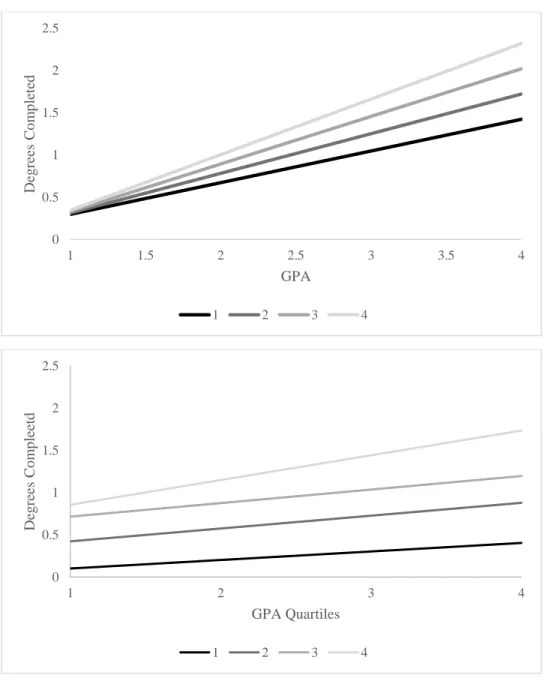
Figure 2.1: Estimates from OLS Regression of Education Degrees Completed with Expectations-GPA Interaction from Add Health Main Sample (Lines Denote 1-4 Expectation to Attend College)……….78
Figure 2.2: Estimates from OLS Regression of Education Degrees Completed with Expectations-GPA Interaction from ELS………79
Figure 2.3: Estimates from Pooled Sibling OLS and Sibling Fixed Effects Regression of Education Degrees Completed with Expectations-GPA Interaction from Add Health Sibling File (Lines Denote 1-4 Expectation to Attend College)………..82
Figure 2.4: Difference of Education Degrees Completed for the Highest and Lowest Expectation Levels by GPA for Each Analytical File………83
Figure 3.1: Factor Models of Educational Ambition………...117
Figure 3.2: The Traditional Status Attainment Model……….118
Figure 3.3: Updated Status Attainment Model………129
Figure 4.1: Conceptual Model of Asian American Educational Mobility………...168
Figure 4.2: Linear Regression of Educational Attainment with Interaction of Race/Ethnicity-Nativity with Parental Education for 2.5+ Generation Whites and 1.5-2.0 Generation Koreans, Chinese, and Vietnamese Americans………172
Figure 4.3: Linear Regression of Educational Attainment with Interaction of Race/Ethnicity-Nativity with Parental Education for 2.5+ Generation Whites and Blacks ………...177
1
Dissertation Introduction
The status attainment model is the foundation for much sociological research on
intergenerational social stratification within the United States (US). Status attainment theory argues that parents’ socioeconomic status determines much of their offspring’s adult
socioeconomic status. Much of status attainment research has focused on educational attainment processes. In short, the theory argues that social status is recreated across generation, as the offspring of high-socioeconomic status parents are likely to complete higher levels of education than the offspring of lower-socioeconomic status parents. Status attainment theory also contends that the influence of parental socioeconomic status on educational attainment occurs through psycho-social mechanisms which stratify adolescents. These psycho-social mechanisms include cognitive ability, the influence of “significant others” (e.g., parents, teachers, and peers),
academic achievement, and educational expectations. This dissertation focuses on two aspects of status attainment theory, the role of educational expectations in educational attainment and the relationship between parental socioeconomic status and educational attainment.
2
Model,” Sewell and colleagues improved sociologists’ knowledge of intergenerational transmission pathways. A large body of current sociological research stems from status attainment theory, both in the stratification literature—on education, income, occupation inequality, and wealth inequality—and in research on social determinants of familial outcomes, immigrants’ social mobility, and health disparities. Consequently, sociologists from several subdisciplines draw on assumptions from status attainment theory.1
My dissertation re-assesses two of these assumptions, which have been inadequately addressed in prior research. (1) Educational expectations mediate the relationship between parental socioeconomic status and educational attainment. Status attainment theory argues that resources (e.g., financial, human capital) conferred from parental socioeconomic status influence adolescents’ reflections on their own educational opportunities and realistic goals. These self-reflections are embodied in educational expectations. In turn, educational expectations influence long-term educational behaviors (e.g., academic motivation, standardized test preparation, submission of college applications). Embedded within this broader assumption is a narrower assumption that educational expectations have a powerful influence on educational attainment. (2) Parental socioeconomic status influences offspring’s educational attainment. This
stratification process—often called status transmission—is the foundation of status attainment theory. Status attainment theory contends that resources from socioeconomic status influence educational expectations and academic achievement, which in turn, impact educational
attainment. Most status attainment research also assumes that parental socioeconomic status has a direct relationship with educational attainment. In other words, the children of higher status
1Explicit discussion of status attainment theory varies considerably by subdiscipline within sociology. Education
3
parents also tend to have higher educational attainment by adulthood. By evaluating these two assumptions, I address two of my research agenda’s broader research questions. (A) What are key mechanisms through which inequality is transmitted across generations? (B) What social characteristics buffer the negative effects of socioeconomic disadvantage?
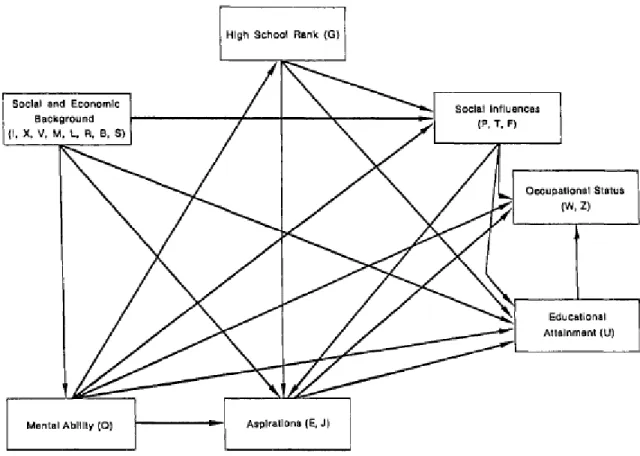
My first three papers assess the relationship between educational expectations and educational attainment. Status attainment research contends that educational expectations (referred to as aspirations in Figure 1) are the final stop in the causal chain between family socioeconomic status and educational attainment (see Figure 1). Educational expectations have been measured in several ways in the status attainment literature. Classic literature using the Wisconsin Longitudinal Study (e.g., Sewell and colleagues) focused on expected college attendance, whereas research using data sets collected by the National Center for Education Statistics focus on expected degree completion. Some research has argued that educational expectations reflect underlying achievement motivation or educational ambition. Other literature focuses on expectations as reflections of plans; this research suggests that the plans impact educational attainment. Regardless of the specific interpretation, educational expectations are proposed to be a powerful predictor of educational attainment, reflecting adolescents’ psycho-social educational orientations.
4
Figure 1: A Diagram of the Status Attainment Model from Sewell, Hauser and Wolf (1980)2
Although much research assumes that educational expectations are important—to the extent that many studies treat expectations as an outcome variable (Bozick et al. 2010; Feliciano and Lanuza 2016; Karlson 2015; Roth 2017)—little research has formally assessed if
expectations actually influence long-term educational outcomes. Even less work has examined the conditions in which expectations impact long-term educational outcomes.
Despite these limitations, educational expectations have continually increased across the second half of the 20th century because of the prevailing college-for-all ethos in the US education
2 Note that Sewell et al.’s (1980) expectations measure is described as aspirations. At this point in stratification
5
system (Reynolds et al. 2006). This ethos argues that all adolescents should attend college, regardless of socioeconomic background or even academic preparation. This ethos is
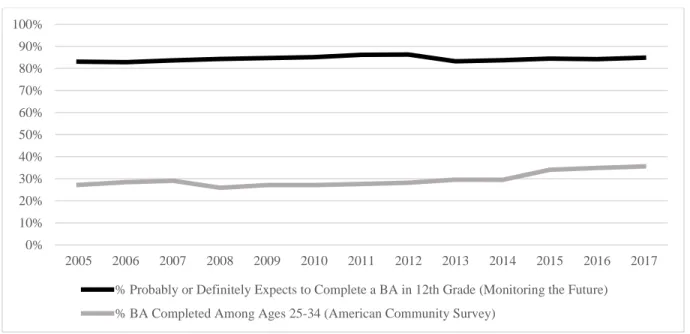
implemented by high school counselors and the ease of access to higher education, especially via community colleges (Rosenbaum 2001). Even federally funded education programs, such as GEAR UP, treat increasing adolescents’ expectations as a core programmatic goal (Department of Education 2018). Despite adolescents’ high levels of college expectations, many are not completing college (see Figure 2 for description) (Reynolds et al. 2006).
Figure 2: Gap between Educational Expectations and Educational Attainment
This issue of unachieved expectations suggests that expectations may not be as influential on educational attainment as social scientists have thought. Although much literature has
assessed the cross-sectional relationship between educational expectations and attainment and its change over time, much less work has focused on improving the specification of the
expectations-attainment relationship, with the exception of Steven Morgan’s work (Morgan 2004, 2005). My first dissertation chapter, entitled “Do Plans Really Matter?: Re-Assessing the
0% 10% 20% 30% 40% 50% 60% 70% 80% 90% 100%
2005 2006 2007 2008 2009 2010 2011 2012 2013 2014 2015 2016 2017
% Probably or Definitely Expects to Complete a BA in 12th Grade (Monitoring the Future)
6
Role of Adolescent Expectations in Educational Attainment,” focuses on improving the model specification of the relationship between educational expectations and educational attainment. This paper is important for sociology because prior research and current education policy has assumed a strong relationship between expectations and attainment. Evidence of a spurious or relatively weak relationship would change how sociologists and policy-makers approach educational stratification.
Another key social problem is the limited conditions in which educational expectations influence educational attainment. Status attainment research assumes that expectations influence educational attainment, net of other factors, including academic achievement. Rosenbaum’s (2001) work, however, suggests that adolescents may be harmed by their high expectations. He argues that nearly universal high expectations without proper academic preparation and
information on navigating the post-secondary education system, will only lead to success for a select few. In turn, many students will have their dreams dashed and accrue excess college debt. Domina et al. (2011b) argued against Rosenbaum, contending that expectations increase
adolescents’ academic efforts. These authors argue that dreaming big is beneficial for most adolescents. Rosenbaum (2011) and Domina et al. (2011a) debated on the efficacy of
expectations in Sociology of Education. My second paper addresses the assumption of a robust relationship between expectations and attainment by answering the following question: how does academic preparation influence the relationship between educational expectations and
educational attainment? This paper is entitled “College-for-Some or College-for-All?: The Joint Roles of Expectations and Achievement in Educational Attainment.”
7
has documented secular increases in educational expectations, and argued that this is driven by college-for-all (Reynolds et al. 2006). Similarly, research has observed the de-coupling of socioeconomic status from expectations (Goyette 2008). This paper addresses these issues using a different framework for understanding educational expectations. I assume that educational expectations are one reflection of latent educational ambition. This perspective is based off of early status attainment research’s argument that expectations reflect achievement motivation (Haller and Portes 1973) and more recent research’s direct connection of expectations with latent ambition (Baird, Burge, and Reynolds 2008). I take this opportunity to re-think how expectations are formed and their relationship with academic trajectory—via coursework. I draw on the Theory of Conjunctural Action (TCA) (Johnson-Hanks et al. 2011) to explain the interplay between materials—real-world interactable resources and symbolic resources—and schemas— stable ways of thinking about materials—in stratification processes. The TCA perspective
underlies much of this dissertation and is utilized to varying degrees in different papers. In sum, I address three issues in this paper: (1) The measurement of educational ambition. (2) The
relationship between ambition and coursework, which is integral to the measurement of ambitions. (3) Ambition’s mediating role in the status attainment model. This paper is entitled “Burning with Ambition: The Roles of Educational Ambition and Coursework in Educational Attainment.” My future research agenda may extend this research by using data from NCES studies (ELS or NELS). These studies include a wider variety of educational psycho-social characteristics than Add Health and different measures of educational expectations.
8
these restricted data will aid in my long-term research goal to continue examining psycho-social mechanisms for educational inequality.
Last, my dissertation turns to a different question: exploring how the relationship between parental socioeconomic status and offspring’s education varies by race/ethnicity and nativity. This paper addresses my second research question, focusing on factors which buffer the negative effects of socioeconomic disadvantage on stratification outcomes. Fundamental to status attainment research—from Blau and Duncan to current iterations—is the relationship between parental socioeconomic status and offspring’s education. Recent research, however, suggests that Asian Americans’ academic outcomes are less influenced by parental
socioeconomic status than other race/ethnic groups. Lee and Zhou (2015) and Xie and colleagues (Hsin and Xie 2014; Liu and Xie 2016; Xie and Goyette 2003) have outlined similar, yet, distinct theories to explain these patterns. Lee and Zhou’s (2015) qualitative work focuses on the
mechanisms through which the children of Asian American immigrants have academic success. They rely on a social structural-cultural explanation, arguing that the unique circumstances (especially immigrant selection) of Asian Americans, influenced the development of Asian American cultural schemas on education and mobility and aided the accumulation of resources for ethnic communities’ sustained academic success. They put only some emphasis on distinct cultural schemas from Asian Americans’ countries of origin. Xie and colleagues, instead, argue that Asian Americans’ buffering of socioeconomic disadvantage is related to Confucian cultural schemas on the efficacy of effort and people’s malleability. These schemas lead Asian
9
Asian Americans—in general. Their research has had limited success, however, in differentiating Asian Americans by ethnicity.
I use TCA to explain the role of culture in stratification in this paper, discussing the interaction between cultural schemas, immigrant status, and socioeconomic status. I
contextualize Lee and Zhou and Xie and colleagues work within the TCA framework, focusing on the underlying reasons for Asian Americans’ distinct education patterns. My theory tests if ethnicity-immigrant status—proxying cultural schemas—buffers the influence of socioeconomic (both material and schematic resources) on educational attainment.
My paper extends this research in two ways. (1) I evaluate the relationship between parental socioeconomic status and race/ethnic-nativity differences using longitudinal education outcomes from nationally representative data. (2) I adjudicate Lee and Zhou (2015) and Xie and colleagues’ theories. Because of the controversial nature of the culture-stratification connection within sociology, I aim to keep my arguments about culture nuanced. One attempt to nuance my arguments relates this research to Weber’s Protestant Ethic (1905), and its discussion of the relationship between religion/culture with socioeconomic outcomes and mobility.
Data
10
(purposeful) Chinese and (incidental) Filipino Americans. (3) Add Health is designed around schools. Schools, like families, are a key node of social clustering. More detailed descriptions of the analytic files are enclosed in the dissertation papers.
11
REFERENCES
Baird, Chardie L., Stephanie W. Burge, and John R. Reynolds. 2008. “Absurdly Ambitious? Teenagers’ Expectations for the Future and the Realities of Social Structure.” Sociology
Compass 2(3):944–62.
Blau, Peter M. and Otis Dudley Duncan. 1967. The American Occupational Structure. New York City: John Wiley and Sons.
Bozick, Robert, Karl Alexander, Doris Entwisle, Susan Dauber, and Kerri Kerr. 2010. “Framing the Future: Revisiting the Place of Educational Expectations in Status Attainment.”
Social Forces 88(5):2027–52.
Department of Education. 2018. Gaining Early Awareness and Readiness for Undergraduate
Programs (GEAR UP) Annual Performance Report for Partnership and State Projects.
Washington, DC.
Domina, Thurston, AnneMarie Conley, and George Farkas. 2011a. “The Case for Dreaming Big.” Sociology of Education 84(2):118–21.
Domina, Thurston, AnneMarie Conley, and George Farkas. 2011b. “The Link between
Educational Expectations and Effort in the College-for-All Era.” Sociology of Education
84(2):93–112.
Feliciano, Cynthia and Yader R. Lanuza. 2016. “The Immigrant Advantage in Adolescent Educational Expectations.” International Migration Review 50(3):758–92.
Goyette, Kimberly A. 2008. “College for Some to College for All: Social Background, Occupational Expectations, and Educational Expectations over Time.” Social Science
Research 37(2):461–84.
Haller, Archibald O. and Alejandro Portes. 1973. “Status Attainment Processes.” Sociology of
Education 46(1):51–91.
Hout, Michael. 1988. “More Universalism, Less Structural Mobility: The American
Occupational Structure in the 1980s.” American Journal of Sociology 93(6):1358–1400. Hsin, Amy and Yu Xie. 2014. “Explaining Asian Americans’ Academic Advantage over
Whites.” Proceedings of the National Academy of Sciences 111(23):8416–21.
Johnson-Hanks, Jennifer A., Christine A. Bachrach, S. Philip Morgan, and Hans-Peter Kohler. 2011. Understanding Family Change and Variation: Toward a Theory of Conjunctural
Action. Vol. 5. New York: Springer.
12
Lee, Jennifer and Min Zhou. 2015. The Asian American Achievement Paradox. New York: Russell Sage Foundation.
Liu, Airan and Yu Xie. 2016. “Why Do Asian Americans Academically Outperform Whites?– The Cultural Explanation Revisited.” Social Science Research 58:210–26.
Morgan, Stephen L. 2004. “Methodologist as Arbitrator: Five Models for Black-White
Differences in the Causal Effect of Expectations on Attainment.” Sociological Methods &
Research 33(1):3–53.
Morgan, Stephen L. 2005. On the Edge of Commitment: Educational Attainment and Race in the
United States. Palo Alto, CA: Stanford University Press.
Reynolds, John, Michael Stewart, Ryan MacDonald, and Lacey Sischo. 2006. “Have Adolescents Become Too Ambitious? High School Seniors’ Educational and Occupational Plans, 1976 to 2000.” Social Problems 53(2):186–206.
Rosenbaum, James E. 2001. Beyond College for All: Career Paths for the Forgotten Half. New York, NY: Russell Sage Foundation.
Rosenbaum, James E. 2011. “The Complexities of College for All: Beyond Fairy-Tale Dreams.”
Sociology of Education 84(2):113–17.
Roth, Tobias. 2017. “Interpersonal Influences on Educational Expectations: New Evidence for Germany.” Research in Social Stratification and Mobility 48:68–84.
Sewell, William H., Archibald O. Haller, and Alejandro Portes. 1969. “The Educational and Early Occupational Attainment Process.” American Sociological Review 34(1):82–92. Sewell, William H., Robert M. Hauser, Kristen W. Springer, and Taissa S. Hauser. 2003. “As
We Age: A Review of the Wisconsin Longitudinal Study, 1957–2001.” Research in
Social Stratification and Mobility 20:3–111.
Sewell, William H., Robert M. Hauser, and Wendy C. Wolf. 1980. “Sex, Schooling, and Occupational Status.” American Journal of Sociology 86(3):551–83.
Weber, Max. 1905. “The Protestant Ethic and the Spirit of Capitalism.” Pp. 1–202 in The
Protestant Ethic and the Spirit of Capitalism: and Other Writings. London, UK: Penguin
Books.
13
CHAPTER 1: DO PLANS REALLY MATTER?: RE-ASSESSING THE ROLE OF ADOLESCENT EXPECTATIONS IN EDUCATIONAL ATTAINMENT
Introduction
A large body of stratification literature in the US has found that adolescent educational expectations are a consistent and influential predictor of educational attainment (Andrew & Hauser, 2011; Sewell, Hauser, Springer, & Hauser, 2003). Some research even utilized
educational expectations as an outcome, assuming that adolescent expectations had a strong link with long-term academic outcomes (Andrew & Flashman, 2017; Bozick, Alexander, Entwisle, Dauber, & Kerr, 2010; Feliciano & Lanuza, 2016; Karlson, 2015; Roth, 2017). Although some classical studies contended that educational expectations have no independent effect on
educational attainment (Alexander & Cook, 1979; Bourdieu, 1973), little research has formally evaluated the robustness of the expectations-attainment association (Morgan, 2004, 2005).
14
performance is “increasing educational expectations of participating students and their parents, guardians, or family members” (Department of Education, 2018, p. 3). Consequently, if
adolescent educational expectations’ relationship with educational attainment is overstated, this policy goal of increasing expectations may be misplaced.
Assessing the accuracy of educational expectations-attainment models requires techniques which account for omitted variable bias. Morgan’s (2004) study of black-white differences in the association between adolescent expectations and educational attainment addressed the problem of omitted variables using several causal estimation techniques. Although some methods found a robust relationship, this study could not dismiss the possibility of a non-causal relationship between adolescent expectations and educational attainment. Morgan’s work, however, did not assess potential sources of omitted variable bias. In addition, Morgan’s bounds models—which suggested the possibility of a non-causal relationship—relied on a series of untestable assumptions.
Extending Morgan’s study, this paper uses iterative fixed effects models to assess the relationship between educational expectations and educational attainment. These models control for potential omitted variables at two social levels, the family and school/neighborhood. In turn, these models may provide more consistent estimates of the relationship between educational expectations and educational attainment than cross-sectional models from prior status attainment research without heavily relying on untestable assumptions.
15
data from the National Longitudinal of Adolescent to Adult Health to estimate hierarchical models which control for sources of unobserved background characteristics: OLS, school fixed effects, and sibling fixed effects models. Last, the discussion section addresses the findings’ relevance for future research.
Literature Review
Educational Expectations as a Determinant of Educational Attainment
Most stratification research on educational expectations can trace its roots to status attainment theory, and specifically to the Wisconsin Model (Morgan, 2005; Sewell, Haller, & Portes, 1969; Sewell et al., 2003). Foundational status attainment research argued that
educational expectations are the “strategic center” of the educational attainment process, as they reflect latent educational ambition (Andrew & Hauser, 2011; Baird et al., 2008; Haller & Portes, 1973, p. 68). Thus, educational expectations were proposed to be a mediator between family background and educational attainment and an individual-level predictor of educational attainment (Baird et al., 2008; Morgan, 2005).
Educational expectations are influenced by resources related to family socioeconomic status (parental education, income, and occupation) (Sewell et al., 2003), and individual-level factors, such as cognitive ability, parental influence, and academic achievement (Andrew & Hauser, 2011; Bozick et al., 2010; Sewell et al., 2003), characteristics which also influence educational attainment (Sewell et al., 2003). Although changes in academic achievement result in small fluctuations in expectations, educational expectations are largely stable during
16
addition, previous research has not found evidence of reverse causality—that educational expectations predict academic achievement (Andrew and Hauser 2011).
Utilizing longitudinal fixed effects and OLS models, recent literature found that increases in educational expectations were associated with increases in middle and high school students’ perceptions of the utility of high school mathematics and academic efforts (Domina et al., 2011). This finding supports the status attainment model, demonstrating that adolescent educational expectations influence educational behavior, which in turn, influences educational attainment (Haller & Portes, 1973; Sewell et al., 2003).
Although prior status attainment literature argued that educational expectations mediated the relationship between family background and educational attainment (Sewell et al., 1969, 2003), recent research demonstrated that the association between parental education and income with educational expectations had become weaker (Goyette, 2008). This change has been
attributed to secular increases in adolescents’ expectation of college degree completion (Baird et al., 2008; Goyette, 2008) associated with the “college-for-all” ethos (Domina et al., 2011; Rosenbaum, 2001). Thus, educational expectations may no longer serve as one of the primary mediators between family socioeconomic background and educational attainment. More recent research has focused on expectations’ role as an independent predictor of educational attainment (Andrew & Hauser, 2011; Baird et al., 2008; Domina et al., 2011; Goyette, 2008; Morgan, 2004; Reynolds et al., 2006).
17
data (Andrew & Hauser, 2011), and many recent studies continued to assume that expectations are important for educational attainment, treating the variable as an outcome (Andrew & Flashman, 2017; Bozick et al., 2010; Feliciano & Lanuza, 2016; Karlson, 2015; Roth, 2017). Thus, a large body of literature assumes that that adolescent expectations play an integral role in educational attainment.
An Alternative Perspective: Contextual and Family-Level Selection
This paper proposes an alternative perspective, that adolescent expectations’ relationship with educational attainment was mis-specified in prior status attainment research because of the omission of important social resources (Morgan, 2004). Classical studies, such as Bourdieu (1973), Alexander and Cook (1979), Bowles and Gintes (2011), and MacLeod’s (1987) work, argued that social structural characteristics—such as schools, neighborhoods, or family
background—, rather than individual-level factors, drive educational stratification. Educational expectations—alongside cognitive ability and academic performance—is an individual-level factor which social structuralists have treated with skepticism. Morgan (2004) operationalized this perspective using quantitative terminology, stating that educational expectations may only capture the propensity for educational attainment, with no independent influence on educational attainment. Therefore, thoroughly controlling for omitted variables responsible for the
association between educational expectations and educational attainment would yield a weakened relationship.
18
expectations and attainment. Prior research outlines the important role of families and schools/neighborhoods in adolescents’ development and well-being (Parcel & Dufur, 2001). Thus, key resources at the family and school/neighborhood-levels may be sources of omitted variable bias in the relationship between adolescent educational expectations and educational attainment.
19
educational attainment, and their omission in status attainment research may lead to inconsistent estimates of the association between adolescent expectations and educational attainment.
Alternatively, omitted resources connected with schools and neighborhoods may
influence educational expectations and attainment, giving the impression of a robust relationship (Bourdieu, 1973, 1984; Bowles & Gintis, 2011). This perspective is labeled school/neighborhood selection. Much current literature has observed schools and neighborhoods’ impact on adolescent academic achievement (Crosnoe, 2004; Jargowsky & El Komi, 2011; Owens, 2010; Parcel, Dufur, & Cornell Zito, 2010; Rosenbaum, 2011). Contextual resources related to
schools/neighborhoods, such as aggregate school/neighborhood socioeconomic deprivation, average school-level academic achievement, or knowledge about navigating postsecondary education may influence long-term educational attainment. Like socioeconomic resources in status attainment research, these contextual resources may also affect educational expectations, driving the expectations-attainment association. For example, attending advantaged schools may confer students with high expectations and is associated with high levels of educational
attainment. However, the knowledge conferred from peers, teachers, and school counselors on navigating the postsecondary education system (Rosenbaum, 2001, 2011)—rather than high expectations—may be driving long-term educational attainment. Thus, exclusion of these
20
Fixed effects models offer a solution for family and school/neighborhood-level confounding. Using information on social clusters—e.g., schools or families—fixed effects account for omitted variables (Allison, 2009).3 School fixed effects models control for common characteristics of respondents who attend the same school, such as the student body, teachers, facilities, and neighborhood (e.g., Jargowsky & El Komi, 2011; Roth, 2017). Similarly, sibling fixed effects models control for characteristics shared among siblings, such as socioeconomic status, extended family, and parents’ knowledge and human capital (Campbell & Horowitz, 2016; Fishman & Min, 2018; Kohler, Behrman, & Schnittker, 2011). Because families are nested within school districts and neighborhoods, the sibling fixed effects estimation strategy also accounts for school/neighborhood confounding. Unlike the instrumental variable and bounds models used in Morgan’s (2004) research, fixed effects models make relatively modest assumptions (Allison, 2009). In sum, school and sibling models offer a potential solution for omitted variable bias at the school and family-levels in the relationship between educational expectations and educational attainment.
Other Factors in the Relationship between Educational Expectations and Educational Attainment
Consistent with prior status attainment research (Andrew & Hauser, 2011; Bozick et al., 2010; Domina et al., 2011; Sewell et al., 2003), this study accounts for other sociodemographic variables. Race is a determinant of differences in educational expectations and educational attainment in the US. For example, prior research found that blacks and Hispanics had less stable educational expectations than whites and Asian Americans (Cheng & Starks, 2002). In turn, Asian Americans had substantially higher levels of educational attainment than whites, and
3 Few studies contain enough covariates to exhaustively control for school/neighborhood or family-level omitted
21
Hispanics and blacks had lower levels of education than whites. The majority of these
differences in educational attainment were due to socioeconomic background, but also could be attributed to other factors (Kao & Thompson, 2003).
Other factors related to educational expectations and educational attainment include age, family size, and gender. Age/grade is a key determinant of educational attainment not only because older individuals have more temporal opportunities to attain more school, but also because older adolescents have already passed key academic transitions. Thus, it may be more reasonable for older adolescents to assume that attaining higher levels of education is possible (assuming they have passed these hurdles). In addition, birth into later birth cohorts was
associated with increased educational attainment (Barclay & Myrskylä, 2016). Similarly, family size was considered to be a predictor of educational expectations and attainment in status
attainment research (Andrew & Hauser, 2011; Sewell et al., 2003). Gender also influences both educational expectations and educational attainment. Women’s educational expectations vastly increased in recent years (Jacob & Wilder, 2010) to a point where they were higher than those among men (Mello, 2008), and women tended to complete more years of educational attainment than men (DiPrete & Buchmann, 2013).
Conceptual Model
22
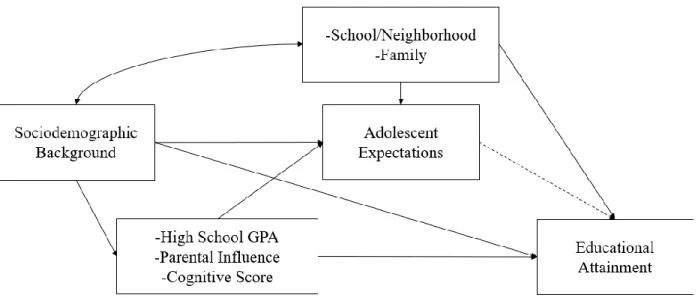
This paper proposes an alternative theory, family and school/neighborhood-level selection. The selection theory suggests that the relationship between adolescent expectations and educational attainment is mis-specified in cross-sectional models used in status attainment research (see Figure 1.1). The school/neighborhood selection hypothesis would be supported if the relationship between adolescent expectations and educational attainment is reduced in school fixed effects models relative to OLS models, demonstrating model misspecification due to school/neighborhood-level confounding. The family-level selection hypothesis would be supported if the relationship between educational expectations and educational attainment is reduced in sibling fixed effects models relative to OLS models, revealing model misspecification due to family-level confounding. In sum, the selection theory argues that cross-sectional
expectations-attainment models are mis-specified by omitting key social structural characteristics, leading to upward biased and inconsistent estimates.
The analysis also acknowledges the roles of cognitive ability, high school GPA, and parents’ educational pressure in predicting educational attainment, independent of adolescent educational expectations. Firstly, it is important to establish that other individual-level factors predict educational attainment to validate that empirical models possess enough power to detect a potential relationship between adolescent expectations and educational attainment. Second, the inclusion of these variables allows for evaluation of the importance of adolescent educational expectations, relative to other individual-level factors.
Selection into Educational Expectations
The conceptual model treats expectations as a proximate predictor of educational attainment. The model controls for the selection into educational expectations via
23
attainment models: cognitive ability, high school GPA, and parental influence (Sewell et al. 2003).
Data and Methods
Data and Measures
This study utilized sibling-pair data from the National Longitudinal Study of Adolescent to Adult Health (Add Health) (Harris & Udry, 2013). Drawing on a school-design, Add Health collected data from US adolescents through young adulthood in Waves I (mean age 16) through IV (mean age 29). This study employed Add Health’s rich information on sociodemographic background, families, and schools. In addition, Wave I of Add Health collected information on linked sibsets. These sibsets were classified by their familial relationship (e.g., identical twins, full siblings, half-siblings).
This paper utilized Add Health’s full siblings and twins for the analysis. These sibling pairs were broadly representative of respondents from Add Health and share sociodemographic characteristics—such as parents’ socioeconomic background, family environment through adolescence, and extended family. These siblings received the same questionnaires, shared the same household, and the majority attended the same schools (Harris, Halpern, Smolen, & Haberstick, 2006). There is modest variance in model assumptions by the type of sibling pair (Kohler et al., 2011). Twin models control for a broader range of environmental and genetic confounders than full-sibling models. The problem of systematic environmental differences experienced by full-siblings was addressed by controlling for age and grade. Similarly,
24
genetic propensity for educational attainment (Braudt, 2018)—revealed no meaningful influence of controlling for genetic differences on estimates (see Table A.19). Thus, aggregating full-siblings and twins is unproblematic.
Age/grade variation in the relationship between adolescent expectations and educational attainment was explored, revealing a significant interaction between 12th grade status and an increased association between educational expectations and educational attainment. This
interaction is unsurprising; many 12th grade respondents may have submitted college applications or received acceptance into college by the time of the interview. This pattern is also consistent with Rosenbaum’s (2011) work, which argued that 12th grade expectations may have a different impact on educational outcomes than expectations among younger high school and middle school students. For this reason, all 12th grade respondents and their sibling-pairs were dropped from the analysis.4 Multiple imputation (10 rounds) was used to recover missing cases.5 The final file included 2,125 complete cases, nested within 1,042 sibsets, which were further nested within 141 schools.6
This study’s primary outcome variable was years of educational attainment in Wave IV. Individuals in Wave IV had an average of 28 years of age, and thus most had completed their education. A coding scheme from (Kane, Morgan, Harris, & Guilkey, 2013), which converted
4 Additional analyses revealed that the sibling-pairs of 12th grade respondents were representative of the rest of the
sample, featuring an identical expectations-attainment relationship.
5 Imputed cases had similar means and distributions to the observed data for all cases. Truncated regression models
were used to model continuous outcomes with cut-points (e.g., GPA). To model covariates with high rates of missingness (parental income, parental educational pressure, and high school GPA), variables similar to the covariates (block-level median income, adolescents’ perceived parental educational pressure, and coursework achievement in Wave I) with low missingness rates were included in the chained imputation.
6 The file began with 3,689 linked siblings. After dropping siblings in 12th grade (N=3,175), missing educational
25
the ordinal variable for educational attainment into a linear variable for years of educational attainment, was used.7 A detailed measure of educational attainment—as opposed to a dichotomous measure—was used because educational attainment has a (generally) linear association with earnings (Carnevale, Rose, & Cheah, 2013). Alternative measures of educational attainment—bachelor’s degree completion or degree completion (less than high school, high school, some college, bachelor’s, and more than a bachelor’s)—were used in sensitivity analyses, revealing similar patterns to the education years models (see Table A.5). These outcomes were treated as linear for the ease of between-model comparisons. The normal distribution of degree completion and relatively normal distribution of bachelor’s degree completion made the linear estimation strategy relatively unproblematic.
The primary predictor variable of interest was educational expectations from Wave I. This variable was obtained from the question: “On a scale of 1 to 5, where 1 is low and 5 is high, how likely is it that you will go to college?” The bottom two categories (1 and 2) were merged because of non-monotonicity in their relationship with educational attainment. The final scale had four values and was treated as linear. A wide variety of measures of educational expectations has been used in prior literature (Morgan, 2007), including expected degree completion (Andrew & Hauser, 2011) and plans to attend college (Andrew & Flashman, 2017). This measure of college attendance expectations reflects this paper’s focus on the college-for-all setting. College-for-all heavily focuses on the bachelor’s degree and does not necessarily make differentiations about different levels of college (4-year institution, masters, Ph.D., or professional degree) (Goyette, 2008). Second, supplemental analyses indicated that this measure of educational
7 The education ordinal variable is converted to a linear indicator of years of education using the following
26
expectations reflects latent educational ambition. Preliminary analysis of models correcting for measurement error revealed similar patterns to those in the primary analysis (see Table A.16). Third, this measure of educational expectations has an advantage over degree-focused measures of educational expectations because it is less education-knowledge dependent. For example, Rosenbaum (2011) argued that expectation to complete a master’s degree may reflect knowledge of postsecondary education, rather than solely educational plans. Lastly, this measure reflects the sequential nature of educational attainment. For high school students, college reflects the next potential stage in their academic careers. Similarly, the vast majority of 7th and 8th grade students will attend at least some high school and additional analyses suggest that adolescent expectations are not more predictive of educational attainment in 11th grade than in 7th grade.
Parental educational pressure—an indicator of parental influence (Sewell et al., 2003) closely related to educational aspirations—was obtained from Add Health’s Wave I parent survey question: “How disappointed would you be if {NAME} did not graduate from college?” The answer was divided into three categories: very disappointed, somewhat disappointed, and not disappointed (referent). These categories were renamed: high pressure, medium pressure, and low pressure (referent).
Cumulative high school GPA was the other key independent variable. GPA was obtained from Add Health’s high school transcripts from Wave III. Alternative measures of high school GPA were tested in equivalent regression models (see Table A.18). These models revealed little noticeable difference from the primary analyses.
27
The measure of cognitive score was obtained from the Peabody Verbal Test (PVT) from Wave I. This score was standardized, with an average of 100.
Family socioeconomic background was captured using measures of parental education, family income, and parents’ occupation. Parental education measured the highest level of parental educational attainment at the time of Wave I. This variable was divided into 5
categories: less than high school, high school, some college, bachelors, or more than bachelors. Income is obtained from Wave I’s parent survey. Unfortunately, this variable had a large proportion of missing cases (around one fourth) because not all parents of Add Health’s respondents replied to the parent survey. A cubed root transformation was used to account for income’s skewness while maintaining cases with no income. Parents’ occupation was divided into two categories: professional/manager and non-professional/manager. Last, a measure of respondents’ race/ethnicity was included. This variable was divided into five categories: white, black, Hispanic, Asian, and other.
Methods
Pooled sibling models of education years were estimated using linear regression among i, individuals, within j, families, which are further nested within k, schools, such that
(1) edyrs = α + β0ijk + β1aexpijk + Ɛijk
(2) edyrs = α + β0ijk + β1aexpijk + β2Xijk + β3Xjk + Ɛijk
(3) edyrs = α + β0ijk + β1aexpijk + β2Xijk + β3Xjk + β4pvtijk + β5pressijk + β6gpaijk + Ɛijk
28
mediators: PVT score, parental educational pressure, and high school GPA. These OLS models assume no family and school/neighborhood-level confounding. The OLS models used sibset-cluster robust standard errors to account for family-sibset-clustering. Comparable sibling random effects models were also estimated (see Table A.2 for complete models). Like the pooled robust OLS models, the random effects models accounted for clustering, but assumed no family and school/neighborhood-level confounding. The sibling random effects models yielded slightly lower estimates than the pooled OLS models.
Next, pooled sibling models with school fixed effects, αk, were estimated, such that (4) edyrs = αk + β0ijk + β1aexpijk + β2Xijk + β3Xjk + β4pvtijk + β5pressijk + β6gpaijk + Ɛijk
where all school-level variance was held constant. This model used the following counterfactual: if respondents attending the same school had different educational expectations, would they obtain different levels of educational attainment? If the inclusion of school fixed effects
attenuates the association between educational expectations and educational attainment, then the school/neighborhood selection hypothesis would be supported. School random effects models were also estimated (see Table A.1 for complete models). The school models used school-cluster robust standard errors.
Lastly, models with sibling fixed effects, αj, were estimated, such that (5) edyrs = αj + β0ijk + β1aexpijk + β2Xijk + β3pvtijk + β4pressijk + β5gpaijk + Ɛijk
where all family-level variance was held constant, dropping family-level variables from the model. School fixed effects were also dropped because sibling fixed effects restricted school-level variation.8 This model addressed the following counterfactual: if siblings had different adolescent educational expectations, would they complete different levels of educational
8 The model assumes that siblings attended the same school during adolescence (Harris et al. 2006). Models which
29
attainment? This approach accounts for shared characteristics—observed and unobserved— between these siblings. If the inclusion of sibling fixed effects reduces the relationship between adolescent expectations and educational attainment relative to OLS models, then the family-selection hypothesis would be supported. The sibling fixed effects models used sibset-cluster robust standard errors. After the primary analyses, Hausman tests (1978) formally evaluated model specification.
Results
Descriptive Results
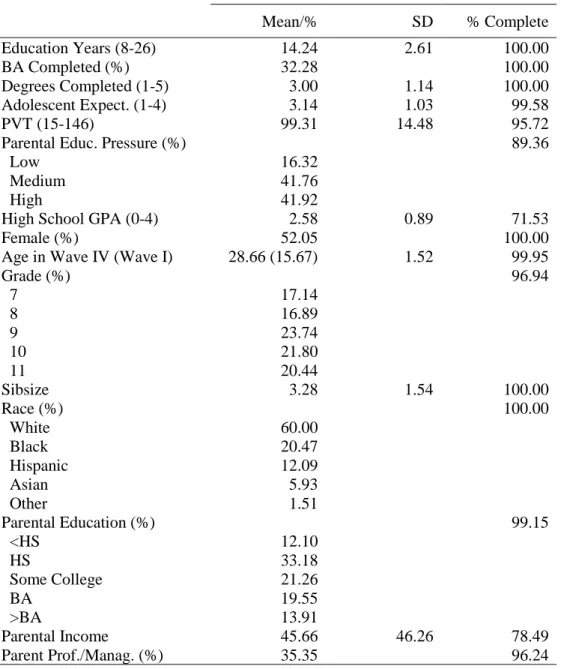
Table 1.1 displays descriptive results. The average years of education in Wave IV was 14.24, with 32 percent completing bachelor’s degrees and an average of 3.00 degrees completed. The average educational expectations were 3.14 (1-4), demonstrating that most respondents expected to attend college. The average PVT score was 99.31, and respondents’ average GPA was 2.58. Students had an average age of 15.67 years in Wave I and 28.66 years in Wave IV. The students were relatively evenly dispersed among grades, ranging from 17 percent in 8th grade and 24 percent in 9th grade. The plurality of parents had medium (42%) or high (42%) educational pressure for their children. Although the plurality of respondents’ parents had a high school degree (33%), large percentages completed bachelor’s degrees (20%) or more (14%). The mean parental income was 46 thousand dollars per year, and less than half (36%) of the
respondents’ parents had professional or managerial jobs.
Regression Results
30
education completed. Model 2 included sociodemographic control variables (gender, age, grade, sibsize, race, parental education, parental income, and parental occupation) in the model. These additions led to an attenuation of the association between adolescent expectations and
educational attainment. For every increase in one point of expectations, there was a .60 average increase in years of education completed, when holding other covariates constant. Lastly, PVT scores, parental educational pressure, and high school GPA were introduced in Model 3, further attenuating the association between educational expectations and educational attainment. In Model 3, for every increase in one point of adolescent educational expectations, there was a .28 average increase in years of education completed, net of other variables. In other words,
individuals with the highest levels of adolescent educational expectations (4) were predicted to complete .84 more years of education than those with the lowest level of educational
expectations (1). Thus, results from OLS models suggest a strong relationship between adolescent expectations and educational attainment, consistent with status attainment theory.
31
relative to the equivalent OLS estimate (see Table 1.5). In sum, the inclusion of school fixed effects only modestly reduced point estimates relative to OLS models.
32
This finding suggests that cross-sectional estimates of the expectations-attainment association in status attainment research may provide inconsistent and upward biased estimates.
Hausman Tests of Cluster-level Confounding
Hausman tests (1978) were used to formally evaluate model specification by comparing expectation-attainment estimates from random and fixed effects models (see Table A.5).
Random effects models—like the robust OLS techniques used above—account for clustering (see Table 1.5 for comparison). Unlike fixed effects models, OLS and random effects assume no cluster-level confounding. Comparison of school random and fixed effects models found no significant evidence of model misspecification from school/neighborhood-level confounding. In contrast, Hausman tests of sibling random and fixed effects models yielded significant test statistics, demonstrating model misspecification from omitting family-level characteristics. Thus, sibling fixed effects models provided the most consistent and least biased estimates of the
expectations-attainment relationship of the models estimated.
Other Robustness Tests
33
parental education (see Tables A.10 through A.13). However, these interactions were
non-monotonic and suggested that expectations may benefit the children of parents with some college and college degrees more than those with less than a high school degree or those with more than a bachelor’s degree. This finding suggests that increases in expectations offer the greatest benefits for relatively advantaged adolescents, conflicting with GEAR UP’s aim to increase adolescent expectations among disadvantaged populations.
Next, different model specifications were explored. Models were estimated which treated expectations as categorical (see Table A.14), replaced expectations with aspirations (see Table A.15), and utilized a latent variable (see Table A.16) for underlying educational ambitions. These model comparisons suggested misspecification in OLS models. One potential pitfall of sibling fixed effects models is the decrease in the signal-to-noise ratio (Kohler et al., 2011). Models which adjusted the reliability (signal-to-noise ratio) of the expectations measure revealed nearly identical point estimates with small reductions in reliability (see Table A.17). It is
34
selection (see Table A.19). Next, bachelor’s completion models were estimated using logit and logit sibling fixed effects estimators. Similar patterns to those from the earlier analyses were revealed in these models (see Table A.20). Models were re-estimated to examine if the exclusion of block-level socioeconomic and family (mother’s marital status, maternal age, and birth order) characteristics influenced estimates. Tests revealed that excluding that covariates did not impact expectations-attainment estimates. In sum, the analyses above revealed the robustness of the primary analyses, demonstrating that cross-sectional estimates of the relationship between adolescent expectations and educational attainment are inconsistent and upward biased.
Limitations
Although the analysis controlled for sources of unobserved heterogeneity, the models herein are still susceptible to some sources of bias. If omitted individual-level variables persist, the sibling fixed effects models may have provided upward biased estimates of the relationship between adolescent expectations and educational attainment. For example, this analysis did not address within-school peer-group selection or personality; controlling for these potential sources of bias may (further) reduce the association between adolescent expectations and educational attainment. Controlling for GPA, however, reduces the threat of omitted variable bias. Only omitted variables which directly impact expectations and educational attainment could bias estimates. In contrast, GPA-mediated effects would not bias estimates.
35
which dichotomized NELS’s detailed expectation measure (expected bachelor’s degree vs. no expected bachelor’s degree) (Goyette, 2008). In addition, these detailed degree expectations measures may also reflect knowledge in addition to educational plans (Rosenbaum, 2011). Lastly, changes to educational expectations measures in past research, however, yielded only modest improvements in empirical fit (Jencks, Crouse, & Mueser, 1983). Add Health’s measure captured two dimensions of expectations—certainty and plans—, which should further reduce measurement error (Jencks et al., 1983).
Below several potential limitations of the sibling models are addressed. First, sibling models only include individuals who lived with a sibling during adolescence, excluding those with a sibsize of one. Robustness tests, however, revealed that the cross-sectional association between educational expectations and educational attainment did not meaningfully vary by respondent sibsize (see Table A.9). Second, sibling fixed effects models are limited by the degree of within-family variation in educational expectations and educational attainment. Yet, similar research has used sibling and twin fixed effects models with similar or smaller sample sizes and predictor variables with limited within-sibset variation (e.g., Amin, Behrman, & Kohler, 2015; Campbell & Horowitz, 2016; Fishman & Min, 2018) to assess model
36
sizes and variables with limited variation. Thus, prior research and the sensitivity analyses from this paper offer further support for the primary finding from this paper: model misspecification in cross-sectional estimates of the expectations-attainment association.
Discussion and Conclusion
Discussion
Status attainment research (Andrew & Hauser, 2011; Sewell et al., 2003) and current education policy (GEAR UP) contend that adolescent educational expectations is a core predictor of educational attainment. Findings from this paper, however, demonstrated that this relationship may be overstated in prior research. Relative to results from OLS models,
expectations-attainment point estimates were 52 to 59 percent reduced in sibling fixed effects models. Supplementary analyses demonstrated that sibling fixed effects was the preferred model specification, supporting the family-level selection hypothesis. The analysis, however, did not find clear evidence of school/neighborhood-level selection.
These results suggest that prior educational expectations-attainment models omitted important family-level characteristics. For example, socioeconomic status may have been under-specified by excluding familial wealth or information on extended family members.
expectations-37
attainment point estimates are inconsistent and upward biased. Sibling fixed effects models, in contrast, provide lower and more consistent estimates.
This study partially supports Morgan’s (2004) operationalization of classical social structuralist theory (Alexander & Cook, 1979; Bourdieu, 1973), which argued that educational expectations reflect propensities for educational attainment, rather than serving as independent predictors of educational attainment. Analyses demonstrate that expectations are—in part— reflections of social structural inequality. The remaining expectations-attainment association, however, suggests that expectations exert a modest influence on educational attainment.
Findings from this study offer insights for stratification research. First, results from fixed effects models demonstrate that adolescent educational expectations are a weaker predictor of
educational attainment than prior status attainment research would suggest (Sewell et al., 2003). These findings demonstrate that educational expectations are not likely the core of educational attainment processes (Haller & Portes, 1973). Although educational expectations may positively influence adolescents’ efforts (Domina et al., 2011), these efforts may translate into only minor increases in educational attainment. In sum, the finding of an attenuated relationship between educational expectations and educational attainment suggests that classical status attainment theory mis-specified models. At the same time, this paper confirms other aspects of status attainment theory, demonstrating that high school GPA and cognitive ability have relatively robust associations with educational attainment.
In addition, this study provides important knowledge for education policymakers. The efforts of educational policy programs—such as GEAR UP—to increase educational
38
robustness tests suggested that the educational returns to increased expectations may be greatest for relatively advantaged adolescents (see Table A.13). These problems are consistent with Rosenbaum’s (2001, 2011) work, which warned of the potential for unfulfilled plans among adolescents with high expectations, but limited knowledge of navigating postsecondary
education. One promising alternative is increased focus on psycho-social characteristics which influence adolescents’ academic achievement and intellectual development. For example, Dweck and colleagues (e.g., Yeager & Dweck, 2012) contended that growth mindsets towards learning and intelligence exert a powerful influence on academic outcomes and may even buffer the negative effects of poverty on academic achievement (Claro, Paunesku, & Dweck, 2016).
Conclusion
Findings from this paper reveal that educational expectations play a smaller role in stratification than previously suggested. These results contrast with status attainment theory, which contends that educational expectations are a central predictor of educational attainment. To further test if the relationship between educational expectations and educational attainment is spurious, future research should examine which omitted family-level variables are responsible for much of the association between expectations and educational attainment. Alternatively, this literature may benefit from replication using data from different studies with matched siblings.
39
40
Figure 1.1: Educational Expectations’ Relationship with Educational Attainment: Neighborhood/School or Family-Level Selection