The objective of infrastructure management is to provide a coherent and balanced set of computer-based services to customers, employees, and suppliers. To attain this objective, firms must deal with a series of issues:
• Cost of IT infrastructure
• Integration of information, applications, and platforms • Flexibility to respond to business environments • Resilience
• Service levels
Let’s look more closely at infrastructure opportunities and challenges.
Opportunities
There is a continuous increase in the power of information technology. This means that new business models and processes can be invented around new technologies as they appear. Firms that have the capability and knowledge to manage their IT infrastructures to take advantage of these opportunities will reap important benefits.
Management Challenges
Creating and managing a coherent IT infrastructure raises multiple challenges: making wise infrastructure investments, coordinating infrastructure components, dealing with scalability and technology change, and management and governance.
M A K I N G W I S E I N F R A S T R U C T U R E I N V E S T M E N T S
IT Infrastructure is a major capital investment for the firm. If too much is spent on infra-structure, it lies idle and constitutes a drag on firm financial performance. If too little is spent, important business services cannot be delivered and the firm’s competitors (who spent just the right amount) will outperform the underinvesting firm. How much should the firm spend on infrastructure? This question is not easy to answer.
A related question is whether a firm should purchase its own IT infrastructure com-ponents or rent them from external suppliers. As we discussed earlier, a major trend in computing platforms—both hardware and software—is to outsource to external providers. The decision either to purchase your own IT assets or rent them from external providers is typically called the rent versus buy decision.
C H O O S I N G A N D C O O R D I N AT I N G I N F R A S T R U C T U R E C O M P O N E N T S
Firms today create IT infrastructures by choosing combinations of vendors, people, and technology services and fitting them together so they function as a coherent whole. When each element of infrastructure is driven by somewhat different forces, accomplishing this
C h a p t e r 4
I T I n f r a s t r u c t u r e : H a r d w a r e a n d S o f t w a r e
LEARNING TRACK 7: IT INFRASTRUCTURE: MANAGEMENT OPPORTUNITIES, CHALLENGES, AND SOLUTIONS
is a major management job. For instance, changes in law may mandate vast increases in data storage and retrieval, but the existing hardware platform may be incapable of sup-porting the addition computing demand.
D E A L I N G W I T H I N F R A S T R U C T U R E C H A N G E
As firms grow, they can quickly outgrow their infrastructure. As firms shrink, they can get stuck with excessive infrastructure purchased in better times. How can a firm remain flexible when most of the investments in IT infrastructure are fixed cost purchases and licenses? How well does the infrastructure scale? Scalability refers to the ability of a computer, product, or system to expand to serve a larger number of users without break-ing down.
How can the infrastructure be changed, and over what time frame? Because the firm’s digital infrastructure permeates every nook and cranny of the firm, and therefore direct-ly affects how employees perform on a daidirect-ly basis, any change in this infrastructure would seem to have to occur slowly, guided by some vision (business or technology based) or understanding of the future requirements for infrastructure. Left to constituent business units, or a single chief information officer and his or her staff, chaos could reign or, alternatively, bold technologically advanced plans may come and go without any real change. Who will supply this vision or understanding needed for long-term, stable evo-lution?
M A N A G E M E N T A N D G O V E R N A N C E
A long-standing issue among information system managers and CEOs has been the question of who will control and manage the firm’s IT infrastructure. Should depart-ments and divisions have the responsibility of making their own information technology decisions or should IT infrastructure be centrally controlled and managed? What is the relationship between central information systems management and business unit infor-mation systems management? How will infrastructure costs be allocated among business units? Each organization will need to arrive at answers based on its own needs.
Solution Guidelines
There are no formulas or easy answers to these questions, and each firm arrives at a dif-ferent set of decisions based on the firm’s history, current financial condition, and its strategy. The following guidelines will be helpful.
Perhaps the single most frequent question that CIOs ask (often prodded by their boards of directors) is, “Are we spending too much on IT infrastructure?” In some com-panies the opposite question is more common: “Are we spending enough on IT to keep up with our competitors?” As it turns out, there is no single, simple answer, no formula for getting it right. But there are several ways to approach the issue and several rules of thumb.
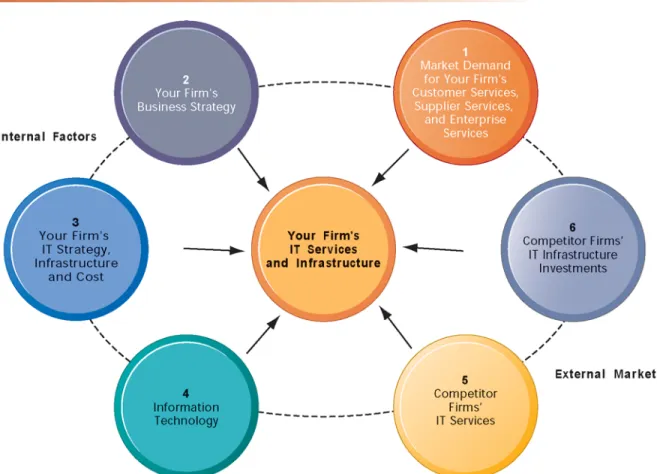
C O M P E T I T I V E F O R C E S M O D E L F O R I T I N F R A S T R U C T U R E Figure 4-9 illustrates a competitive forces model you can use to address the question of how much your firm should spend on IT infrastructure.
Market demand for your firm’s services.Make an inventory of the services you cur-rently provide to customers, suppliers, and employees. Most firms do not have such an inventory. Survey each group, or hold focus groups to find out if the services you cur-rently offer are meeting the needs of each group. For example, are customers complain-ing of slow responses to their queries about price and availability? Are employees com-plaining about the difficulty of finding the right information for their jobs? Are suppliers complaining about the difficulties of discovering your production requirements?
Your firm’s business strategy.Analyze your firm’s five-year business strategy and try to assess what new services and capabilities will be required to achieve strategic goals.
Your firm’s information technology (IT) strategy, infrastructure, and cost.Examine your firm’s information technology plans for the next five years and assess its alignment with the firm’s business plans. Make an inventory of existing IT infrastructure cost. Many firms do not know the total cost of their existing IT infrastructure. You will want to per-form a total cost of ownership analysis (see the discussion later). If your firm has no IT strategy, you will need to devise one that takes into account the firm’s five-year strategic plan.
Information technology assessment.Is your firm behind the technology curve or at the bleeding edge of information technology? Both situations are to be avoided. Clearly, you do not want to spend resources on advanced technologies that are still experimental, often expensive, and sometimes unreliable. You want to spend on technologies for which standards have been established and suppliers of IT are competing on cost, not design, and where there are multiple suppliers. On the other hand, you do not want to put off investment in new technologies, allowing your competitors time to develop new business models and capabilities and experience using the new technologies.
Competitor firm services.Benchmark your service levels to customers, suppliers, and employees against those of your competitors. Establish quantitative and qualitative meas-ures of service for your firm and your competitors, and try to assess what services they offer customers, suppliers, and employees. If your firm has significant shortfalls in serv-ice levels to either group, your firm is at a competitive disadvantage. Look for ways your firm can excel at service levels.
FIGURE 4-9 Competitive forces model for IT infrastructure.
There are six factors you can use to answer the question, “How much should our firm spend on IT infrastructure?”
Competitor firm IT infrastructure investments.Benchmark your expenditures for IT infrastructure against your competitors. Although some firms regard their IT expendi-tures as a competitive secret, you can find out information on public companies’ IT investments in their SEC Form 10-K annual reports to the federal government when those expenditures impact a firm’s financial results. Many companies are quite public about their innovative expenditures on IT, and you can impute the level of expenditures based on your research in the trade and professional literature.
It is not necessarily the case that you should spend as much as, or more than, your competitors. Perhaps your firm has discovered much less expensive ways of providing services, and this can lead to a cost advantage. Alternatively, your firm may be spending far less than competitors and experiencing commensurate poor performance and losing market share.
After completing this analysis, you will have a good idea of how much you and your competitor firms are spending on IT infrastructure, what you are receiving in return, and how your competitive position might be improved.
S TA R T I N G O U T S M A L L
Before embarking on a large-scale infrastructure project, it may be useful to experiment with new technologies on a smaller scale. Such projects should concentrate on infra-structure improvements that can be easily implemented and where the return on invest-ment (ROI) is very clear.
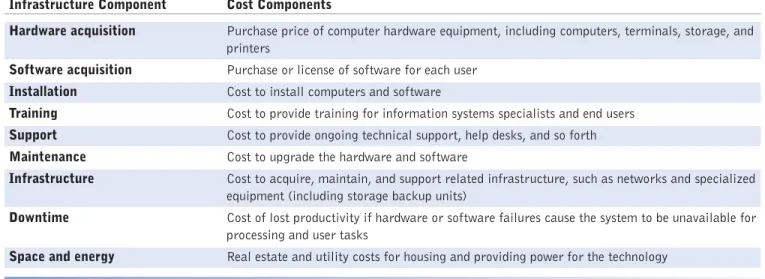
T O TA L C O S T O F O W N E R S H I P O F T E C H N O L O G Y A S S E T S In benchmarking your firm’s expenditures on IT infrastructure with that of your com-petitors, you will need to consider a wide range of costs. The actual cost of owning tech-nology resources includes the original cost of acquiring and installing hardware and soft-ware, as well as ongoing administration costs for hardware and software upgrades, main-tenance, technical support, training, and even utility and real estate costs for running and housing the technology. The total cost of ownership (TCO) model can be used to ana-lyze these direct and indirect costs to help firms determine the actual cost of specific technology implementations.
Table 4-3 describes the most important TCO components to consider in a TCO analy-sis. When all these cost components are considered, the TCO for a PC might run up to three times the original purchase price of the equipment. Hidden costs for support staff, downtime, and additional network management can make distributed client/server archi-tectures— especially those incorporating handheld computers and wireless devices— more expensive than centralized mainframe architectures.
Hardware and software acquisition costs account for only about 20 percent of TCO, so managers must pay close attention to administration costs to understand the full cost of the firm’s hardware and software. It is possible to reduce some of these administration costs through better management. Many large firms are saddled with redundant, incom-patible hardware and software because their departments and divisions have been allowed to make their own technology purchases. Such information technology infra-structures are excessively unwieldy and expensive to administer.
These firms could reduce their TCO through greater centralization and standardiza-tion of their hardware and software resources. Companies could reduce the size of the information systems staff required to support their infrastructure if the firm minimizes the number of different computer models and pieces of software that employees are allowed to use. In a centralized infrastructure, systems can be administered from a cen-tral location and troubleshooting can be performed from that location (David, Schuff, and St. Louis, 2002).
TABLE 4-3 Total Cost of Ownership (TCO) Cost Components
Infrastructure Component Cost Components
Hardware acquisition Purchase price of computer hardware equipment, including computers, terminals, storage, and printers
Software acquisition Purchase or license of software for each user Installation Cost to install computers and software
Training Cost to provide training for information systems specialists and end users Support Cost to provide ongoing technical support, help desks, and so forth Maintenance Cost to upgrade the hardware and software
Infrastructure Cost to acquire, maintain, and support related infrastructure, such as networks and specialized equipment (including storage backup units)
Downtime Cost of lost productivity if hardware or software failures cause the system to be unavailable for processing and user tasks