Master’s Thesis
Title
Design, Implementation and Evaluation of
Scalable Resource Management System for Internet Servers
Supervisor Prof. Masayuki Murata
Author Takuya Okamoto
February, 2003
Department of Informatics and Mathematical Science, Graduate School of Engineering Science,
Master’s Thesis
Design, Implementation and Evaluation of Scalable Resource Management System for Internet Servers
Takuya Okamoto
Abstract
A great deal of research has been devoted to solving the problem of network congestion posed against the context of increasing Internet traffic. However, there has been little concern regarding improvements of the performance of Internet servers such as Web/Web proxy servers in spite of the projections that the performance bottleneck will shift from networks to endhosts. For example, Web servers or Web proxy servers must accommodate many TCP connections simultaneously and their server throughputs degrade when resource management schemes are not considered.
In the previous work, we have proposed a scalable resource management scheme for Web servers in order to overcome above-mentioned problems, which has two major mechanisms: one is a dynamic allocation of send socket buffer, which assigns a proper size of send socket buffer to each TCP connection based on an ‘expected’ throughput estimated at a TCP sender host. The other is a memory-copy reduction scheme, which decreases the number of memory access operations in a data transmission at a TCP sender host. We have validated the effectiveness of our proposed scheme through some simulation and implementation experiments, and confirmed that our scheme can improve a server performance and fair and effective usage of the send socket buffer can be achieved.
In the current Internet, however, many Web document transfer requests are transferred via Web proxy servers, which are usually prepared by ISPs (Internet Service Providers) for their customers. They must accommodate many TCP connections both upward TCP connections (from the proxy
server to Web servers) and downward TCP connections (from client hosts to the proxy server). Hence, a proxy server becomes a likely spot for bottlenecks to occur during Web document trans-fers, even when the bandwidth of the network and Web server performance are adequate. In this thesis, therefore, we propose a novel scalable resource management scheme for Web proxy servers. Our proposed scheme has two following mechanisms: one is a dynamic allocation of receive socket buffer for each TCP connection at a TCP receiver host, which assigns it based on its utilization monitored at the receiver host. Another is a connection management scheme that intentionally tries to close ‘idle’ persistent TCP connections, which transfer no data, in order to prevent newly arriving TCP connections from being rejected when the server resources becomes shorthanded.
We validate the effectiveness of our proposed scheme through some simulation and imple-mentation experiments. From these results, we conclusively confirm that our proposed scheme can improve the server performance by up to 50% at maximum, and document transfer delay perceived by client hosts can be decreased by up to about 30%.
Keywords
TCP (Transmission Control Protocol), HTTP (Hypertext Transfer Protocol), Web/Web Proxy Server, Socket Buffer, Persistent TCP Connection, Resource Management
Contents
1 Introduction 5
2 Background 8
2.1 Web/Web proxy servers . . . 8 2.2 Server Resources at Internet Servers . . . 11 2.3 Persistent TCP Connection by HTTP/1.1 . . . 13
3 Algorithm 19
3.1 Socket Buffer Management Scheme . . . 19 3.1.1 Control of Send Socket Buffer . . . 19 3.1.2 Control of Receive Socket Buffer . . . 21 3.1.3 Handling the Relation between Upward and Downward TCP Connections 24 3.2 Connection Management Scheme . . . 25
4 Simulation Experiments 28
4.1 Performance of the Scalable Socket Buffer Tuning . . . 28 4.2 Overall Performance of Resource Management Scheme . . . 31
5 Implementation and Experiments 39
5.1 Implementation Overview . . . 39 5.2 Implementation Experiments . . . 40
6 Concluding Remarks 45
Acknowledgements 46
List of Figures
1 Mechanisms of Web/Web Proxy Servers . . . 10
2 Analysis Model . . . 15
3 Probability that a TCP Connection is Active . . . 18
4 Persistent Connection List in Connection Management Scheme . . . 26
5 Network Model (1) . . . 28
6 Simulation Results: Change of Assigned Size of Send Socket Buffer . . . 29
7 Simulation Results: Change of Assigned Size of Receive Socket Buffer . . . 30
8 Network Model (2) . . . 31
9 Simulation Results: Effect of Socket Buffer Size . . . 36
10 Simulation Results: Effect of Dividing Ratio of Socket Buffer . . . 37
11 Simulation Results: Performance of Connection Management Scheme . . . 38
12 Network Environment for Implementation Experiment . . . 40
13 Experimental Results: Server Throughput and Document Transfer Time . . . 43
1
Introduction
The rapid increase of the Internet users has been the impetus for much research into solving net-work congestion posed against the context of increasing netnet-work traffic [1-4]. However, little net-work has been done in the area of improving the performance of Internet servers despite the projected shift in the performance bottleneck from networks to endhosts [5-7]. There are already hints of this scenario emerging as evidenced by the proliferation of busy Web servers on the present-day Internet that receive hundreds of document transfer requests every second during peak volume periods.
Needless to say, busy Web servers must have many concurrent HTTP sessions. Then the server throughput degrades when an effective resource management is not considered, even with a large network capacity. In order to improve Web server performance under the peak periods, in our previous work, we have proposed a scalable resource management scheme [8, 9]. Our proposed scheme has two major mechanisms: one is a dynamic allocation of send socket buffer, which assigns send socket buffer based on an ‘expected’ throughput estimated at the sender host in order to avoid the waste of send socket buffer. By assigning a proper size of send socket buffer, we can expect the performance improvement as a following reason. Suppose that a Web server sends a TCP data to two client hosts of 64 Kbps dial-up (say, client A) and 100 Mbps LAN (say client B). When the server assigns a same size of send socket buffer to both client hosts, it is likely that the assigned size of send socket buffer is too large for client A and it is too insufficient for client B. This is because the network capacity (more strictly, bandwidth-delay products) between client A and the Web server is different form that between client B and the Web server. The other mechanism of our proposed scheme is a memory-copy reduction scheme, which decreases the number of memory access operations in a data transmission at a TCP sender host. When a TCP sender host transfers data located at a file system, the sender copies it from the file system to an application buffer, then it copies from the application buffer to the socket buffer. Our algorithm omits one
of the memory copy operations, and improves the server performance. We have validated the effectiveness of our proposed scheme through some simulation and implementation experiments, and confirmed that our scheme can improve a server performance and fair and effective usage of the send socket buffer can be achieved.
In the current Internet, there are many Web document requests via Web proxy servers [10]. Then the proxy servers must also accommodate a large number of TCP connections, since they are usually provided by ISPs (Internet Service Providers) for their customers. Furthermore, proxy servers must handle both upward TCP connections (from the proxy server to Web servers) and downward TCP connections (from client hosts to the proxy server). Hence, the proxy server becomes a likely spot for bottlenecks to occur during Web document transfers, even when the bandwidth of the network and Web server performance are adequate. It is the contention that any effort expended to study ways to reduce document transfer time of Web documents must consider improvements in the performance of Internet servers. Although our proposed scheme explained above can be applied to a Web proxy server, it is not the best solution since we have not taken into consideration about characterization of proxy servers in our previous work.
Therefore, in this thesis, we propose a novel scalable resource management scheme for Web proxy servers. We first discuss several problems that arise from the handling a large number of TCP connections at Web proxy servers. One of these problems involves a receive socket buffer allocation for TCP connections. When a TCP connection is not assigned a proper size of re-ceive socket buffer based on its bandwidth-delay product, the assigned socket buffer may be left unused or insufficient, which results in the waste of the assigned resources and the server per-formance degradation. Another problem considered in this thesis is a management of persistent TCP connections provided by HTTP/1.1, which waste resources at busy Web proxy servers. When Web proxy servers accommodate many persistent TCP connections without effective management schemes, their resources continue to be assigned to those connections until they are closed by timer expiration although most of the persistent connections transfer no data. This means that new
TCP connections cannot be established since there is a shortage of server resources.
We then propose a novel resource management scheme for Web proxy servers. Our proposed scheme has two major mechanisms: one is a control scheme of receive socket buffer of each TCP connection. We integrate two schemes for the send and receive socket buffer into a complete mech-anism with considering their relationship. The other is a connection management scheme [11] that prevents newly arriving Web document transfer requests from being rejected at the proxy server due to the lack of its resources. The scheme involves the management of persistent TCP con-nections, which intentionally tries to dynamically close them when the server resources become shorthanded. We verify the effectiveness of our proposed scheme through simulation and imple-mentation experiments. In the simulations, we evaluate its basic performance and characteristics by comparing with those of the original proxy server. Further, we discuss the results of implemen-tation experiments, and confirm that Web proxy server throughput can be improved by up to 50%, and document transfer time perceived by client hosts can be decreased significantly.
We last note that the application of our proposed scheme is not limited to the above-mentioned Web/Web proxy servers, but to the Internet hosts handling many TCP connections simultaneously; a popular peer in P2P networks would be one example that can enjoy our proposed scheme.
The rest of this thesis is organized as follows. In Section 2, we provide an outline of Inter-net servers, such as Web servers and Web proxy servers, and their resources for handling TCP connections, and discuss the advantages and disadvantages of persistent TCP connections through HTTP/1.1. In Section 3, we propose a new resource management scheme for Web/Web proxy servers, and confirm its effectiveness by detailing the results we obtained in our simulation exper-iments and implementation experexper-iments in Sections 4 and 5. Finally, we present our concluding remarks in Section 6.
2
Background
In this section, we first explain a mechanism of Internet servers and their resources, in Subsec-tions 2.1 and 2.2, respectively. We then discuss the potential that a persistent TCP connection can improve Web document transfer times. However, as will be clarified in Subsection 2.3, it requires a careful treatment at Internet servers.
2.1 Web/Web proxy servers
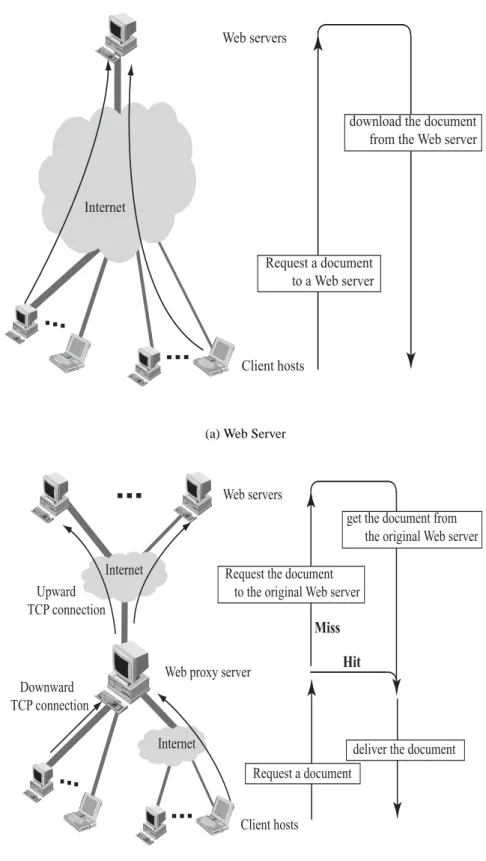
A Web server delivers Web documents using HTTP (Hypertext Transfer Protocol) in response to document transfer requests from Web client hosts as shown in Fig. 1(a). A Web client host transfers Web document requests and browses the requested documents using a Web browser. In recent years, the Internet services including WWW have been developed rapidly and the number of Internet users has increased, which result in a serious network congestion.
On the current Internet, a Web server must accommodate hundreds of TCP connections for document transfer requests from Web client hosts at peak periods. These connections have differ-ent characteristics, such as RTT, packet loss rate, and the available bandwidth. Then the required resources for each TCP connection are different. Almost all current OSs, however, do not consider such differences when they assign their resources to TCP connections, which causes unfair and in-effective usage of their resources. It is important for realizing fair services to assign the resources fairly and effectively to each TCP connection at the Web server.
A Web proxy server works as an agent for Web client hosts that request Web documents [12]. When it receives a Web document transfer request from a Web client host, it obtains the requested document from the original Web servers on behalf of the client host and delivers it to the client. It also caches the obtained Web document. When other client hosts request the same documents, it transfers the cached documents, which results in that the document transfer time is much reduced, as described in Fig. 1(b). For example, it is reported in [13] that using Web proxy servers reduces
document transfer time by up to 30%. Also, when the cache is hit, the document transfer is performed without any connection establishment to the Web servers. Thus, the congestion within the network and at Web servers can also be reduced.
Web proxy servers accommodate a large number of connections, which are connected from Web client hosts and to Web servers. It is a different point from Web servers. The proxy server behaves as a sender host for the downward TCP connection (between the client host and the proxy server) and as a receiver host for the upward TCP connection (between the proxy server and the Web server). Therefore, if the resource management is not appropriately taken into consideration at the proxy server, the document transfer time increases even when the network is not congested or the load of the Web server is not high. Thus, even when the bandwidth of the network is efficiently large, data transfer throughput is degraded when Web/Web proxy servers have non-optimal performance.
In the past literature, a number of studies has characterized Web server performance [14-16]. Also, some researchers have compared and evaluated the performance of Web/Web proxy servers for HTTP/1.0 and HTTP/1.1 in [13, 17]. Various studies have focused on cache replacement algo-rithms [18-20]. However, little work has been done on the management of server resources. Server resources are finite and cannot be increased when the server is running. If the remaining resources become shorthanded, the server cannot function fully and this results in server performance degra-dation. Moreover, a Web proxy server behaves as a sender host for downward TCP connections and as a receiver host for upward TCP connections. It means that more careful treatment of the resources should be done at the proxy server. On the current Internet, however, most Web proxy servers including those of [21, 22] do not take into consideration such a case.
In following subsections, we explain the resources of Internet servers for establishing a TCP connection and show problems at busy Internet servers.
Internet
Web servers
Client hosts
Request a document to a Web server
download the document from the Web server
(a) Web Server
Internet Upward TCP connection Downward TCP connection Web servers
Web proxy server
Client hosts
Request a document
deliver the document Request the document
to the original Web server
get the document from the original Web server
Hit Miss
Internet
(b) Web Proxy Server
2.2 Server Resources at Internet Servers
The resources at the Web/Web proxy servers that we focus on in this thesis are mbuf, file
de-scriptor, control blocks, and socket buffer. These are closely related to the performance of TCP
connections when transferring Web documents. Mbuf, file descriptor, and control blocks are re-sources for TCP connections. The socket buffer is used for storing transferred documents through TCP connections. When there are few resources, the Web/Web proxy servers are unable to es-tablish a new TCP connection. Thus, the client host has to wait for existing TCP connections to be closed and for their assigned resources to be released. If this cannot be accomplished, these servers reject the request.
In what follows, we describe the resources of Web proxy servers and how they deal with TCP connections. Although we have considered FreeBSD 4.6 [23] in our discussion, we believe that the results, in essence, can be extended to other OSs, such as Linux.
Mbuf
Each TCP connection is assigned an mbuf, which is located in the kernel memory space and used to move the transmission data between the socket buffer and the network interface. When the data size exceeds the size of mbuf, the data is stored in another memory space, called the mbuf cluster, which is listed to the mbuf. Several mbuf clusters are used for storing data based on its size. The number of mbufs prepared by the OS is configured in building the kernel; the number of defaults is 4096 in FreeBSD [24]. Since each TCP connection is assigned at least one mbuf when established, the default number of connections the server can simultaneously establish is 4096. This would be too small for busy servers.
File descriptor
A file descriptor is assigned to each file in a file system so that the kernel and user applications can identify it. This is also associated with a TCP connection when it is established, and is called a
socket file descriptor. The number of connections that can be established simultaneously is limited
to the number of file descriptors prepared by the OS. The number of default file descriptors is 1064 in FreeBSD [24]. In contrast to mbuf, the number of file descriptors can be changed after the kernel is booted. However, since user applications, such as Squid [21], occupy memory space based on the number of available file descriptors when they are booted, it is very difficult to inform the applications of the change in the number at run time. That is, we cannot dynamically change the number of file descriptors used by the applications dynamically.
Control blocks
When establishing a new TCP connection, it is necessary to use more memory space for data structures that are used in storing connection information, such asinpcb,tcpcb, andsocket. Theinpcbstructure is used to store source and destination IP addresses, port numbers, and other details. The tcpcbstructure is for storing network information, such as the RTT (Round Trip Time), RTO (Retransmission Time Out), and congestion window size, which are used by TCP’s congestion control mechanism [25]. Thesocketstructure is used for storing information about the socket. The number of maximum structures that can be built in the memory space is initially 1064. Since the memory space for these data structures has been set in building the kernel and remains unchangeable while the OS is running, a new TCP connection cannot be established as the amount of memory spaces is shorthanded.
Socket buffer
The socket buffer is used for data transfer operations between user applications and the sender/receiver TCP. When the user application transmits data using TCP, the data is copied to the send socket buffer and is subsequently copied in the mbufs (or mbuf clusters). The assigned size of the socket buffer is a key issue in the effective transfer of data by using TCP. Suppose that a server host is sending TCP data to two client hosts; one a 64 Kbps dial-up (say, client A) and the other a 100 Mbps LAN (client B). If the server host assigns equal size send socket buffers to both client hosts, it is likely that the amount of assigned buffer will be too large for client A and too small for client B, because of the differences in the capacity (more strictly, bandwidth-delay products) of their connections. A compromise in buffer usage should be considered so that buffers can be effectively allocated to both client hosts.
2.3 Persistent TCP Connection by HTTP/1.1
In recent years, many Web/Web proxy servers and client hosts have supported a persistent
con-nection option, which is one of the most important functions of HTTP/1.1 [26]. In the older
version of HTTP (HTTP/1.0), the TCP connection between the server and client hosts is immedi-ately closed when a document transfer is completed. However, since Web documents have many in-line images, it is necessary to establish TCP connections many times to download them by us-ing HTTP/1.0. This results in a significant increase in document transfer time since the average Web documents at a typical Web server is about 10 KBytes [14, 27]. The use of the three-way handshake at each TCP connection establishment makes the situation worse.
In HTTP/1.1 the server preserves the status of the TCP connection, including the congestion window size, RTT, RTO, and ssthresh, when it finishes document transfer. It then re-uses the connection and its status when other documents are transferred using the same HTTP session (and corresponding TCP connection). The three-way handshake can thus be avoided and the latency
is reduced. However, the server maintains established TCP connections, irrespective of whether the connection is active (being used for packet transfer) or not. That is, the resources at the server are wasted when the TCP connection is inactive. This results in a significant portion of resources being wasted to maintain these numerous persistent TCP connections.
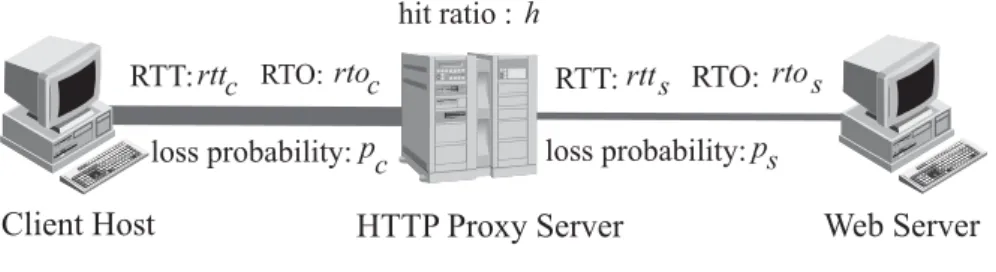
In what follows, we introduce a rough analytical estimate that can be used to determine how many TCP connections are active or idle, and explain why excessive resources are wasted in the server when native persistent TCP connections are utilized. To achieve this, we use the network topology in Figure 2, where a Web client host and a Web server are connected via a proxy server, and derive the probability that a persistent TCP connection will be active, i.e., in sending TCP packets. The notations in the figure,pc, rttc, andrtoc are the respective packet loss ratio, RTT, and RTO between the client host and the proxy server. Similarly, ps, rtts, and rtos are those between the proxy and Web server. The mean throughput of the TCP connection between the proxy server and the client host, and that between the Web server and the proxy server, denoted asρc andρsrespectively, can be obtained by using the analysis results presented in our previous
work [28]. Note that we obtained a more accurate estimate of TCP throughput estimation than in [29] and [30] , especially for small file transfers. Using the results obtained in [28], we can derive the time for Web document transfer via a proxy server. We also introduce the parameters
handf, which respectively represent the cache hit ratio of the document at the Web proxy server and the size of the document being transferred. Note that the proxy server is likely to cache the ‘Web page’, which includes the main document and some in-line images. That is, when the main document is found in the proxy server’s cache, the in-line images that follow it are likely to be cached, and vice versa. Thus, his not an adequate metric when we examine the effects of persistent connections, but the following observation is also applicable to the above-mentioned case.
When the requested document is cached by the proxy server, a request to the original Web server is not required, and the document is directly delivered from the proxy server to the client
RTT: loss probability: RTO: HTTP Proxy Server loss probability: hit ratio : RTT: RTO: Web Server Client Host rtt s c rto p rto p rtt c c s s h
Figure 2: Analysis Model
host. However, when the proxy server does not have the requested document, it must be transferred from the appropriate Web server to the client host via the proxy server. Thus, document transfer time,T(f), can be determined as follows;
T(f) = h Sc+ρf c + (1−h) Sc+Ss+ρf c + f ρs
whereScandSsrepresent the connection setup times of a TCP connection between the client host
and proxy server and that between the proxy server and Web server, respectively. To deriveScand
Ss, we must consider the effect of the persistent connections provided by HTTP/1.1, which deletes the three-way handshake. Here, we defineXcas the probability that the TCP connection between the client host and the proxy server can be maintained by the persistent connection, andXsas the corresponding probability that the TCP connection between the proxy server and the Web server can be maintained. Then,ScandSscan be described as follows;
Sc = Xc·12rttc+ (1−Xc)·32rttc (1)
Ss = Xs·12rtts+ (1−Xs)·32rtts (2)
XcandXsare dependent on the length of the persistent timer,Tp. That is, if the idle time between
two successive document transfers is smaller thanTp, the TCP connection can be used for second document transfer. However, if the idle time is larger thanTp, the TCP connection has been closed and a new TCP connection must be established.
and found that the idle time between Web document transfers follows a Pareto distribution whose probability density function is given by;
p(x) = αkαxα+1 (3)
whereα= 1.5 andk= 1. We can then calculateXcandXsas follows;
Xc = d(Tp) (4)
Xs = (1−h)·d(Tp) (5)
whered(x) is the cumulative distribution function ofp(x). The average document transfer time,
T(f), can be determined from Eqs. (1)–(5). We can finally deriveU, which is the utilization of the persistent TCP connection as follows;
U = Tp 0 p(x)· T(f) T(f) +xdx+ (1−d(Tp))· T(f) T(f) +Tp
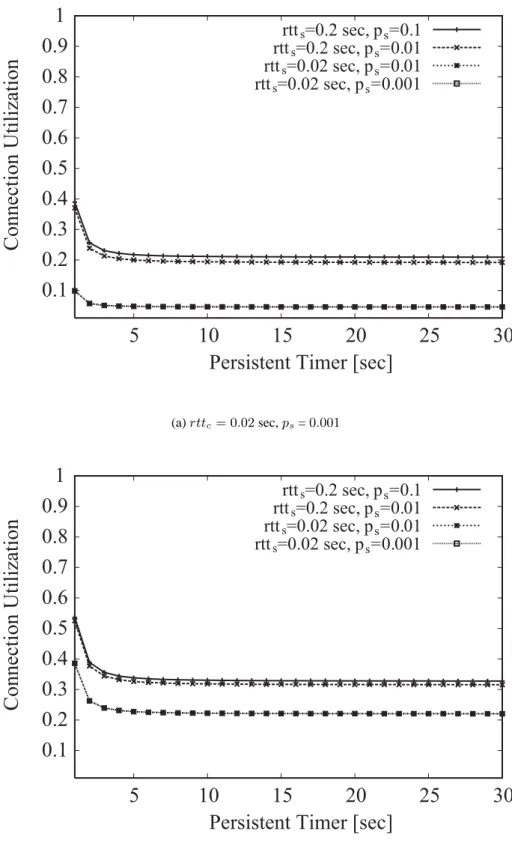
Figure 3 plots the probability that a TCP connection is active, as a function of the length of persistent timerTp, in cases where there are various parameter sets ofrttc,pc,rtts, andps. Here
we set rtoc = 4∗rttc,rtos = 4∗rtts, andh = 0.5, the packet size to 1460 KBytes, andf to 12 KBytes based on the average size of Web documents reported in [14]. These figures reveal that the utilization of the TCP connections is very low, regardless of the network conditions (RTTs and packet loss ratios on links between the proxy server and the client host/the Web server). Thus, if idle TCP connections are maintained at the proxy server, a large part of the resources at the proxy server are wasted.
Furthermore, we can see that utilization increases when the persistent timer is short (<5 sec). This is because the smallerTpvalue can prevent situations from emerging where the proxy server’s resources will be wasted. That is, one solution to this problem is to simply discard HTTP/1.1 and to use HTTP/1.0, as the latter closes the TCP connection immediately after document transfer is complete. However, as HTTP/1.1 has other elegant mechanisms, such as pipelining and content
negotiation [26], we should develop an effective resource management scheme for it. Our solu-tion is that when resources become shorthanded, the server intensolu-tionally closes persistent TCP connections that are unnecessarily wasting them at the server.
In [17], the authors also pointed out other shortcomings of HTTP/1.1. They evaluated the performance of a Web server with HTTP/1.0 [31] and HTTP/1.1 through three kinds of imple-mentation experiments where the network created the bottleneck, where CPU processing speed created the bottleneck, and where the disk system created the bottleneck in the system. Through experimental results, they presented that HTTP/1.1 may degrade Web server performance. This is because when memory is fully utilized by being assigned to mostly idle connections and a new HTTP session requires memory, the Web documents cached in memory are paged out, which means that subsequent requests for these documents will require disk I/O. They also proposed a new connection management method, called early close, which establishes one TCP connection at every Web objects, including embedded files. However, this does not provide quintessential solution to resource management by Web servers, since it does not consider the remaining server resources. Also, the bulk of the past reported researches on improving the performance of Web proxy servers has focused on cache replacement algorithms [18-20, 32, 33]. In [13], for exam-ple, the authors have evaluated the performance of Web proxy servers, focusing on the difference between HTTP/1.0 and HTTP/1.1 through simulation experiments, including the effect of using cookies and aborting document transfers by client hosts. However, little work has been done on resource management at the proxy server, and no effective mechanism has been proposed. Then we will describe our scheme in detail in the next section.
0.1
0.2
0.3
0.4
0.5
0.6
0.7
0.8
0.9
1
5
10
15
20
25
30
Connection Utilization
Persistent Timer [sec]
rtt
s=0.2 sec, p
s=0.1
rtt
s=0.2 sec, p
s=0.01
rtt
s=0.02 sec, p
s=0.01
rtt
s=0.02 sec, p
s=0.001
(a)rttc= 0.02sec,ps=0.0010.1
0.2
0.3
0.4
0.5
0.6
0.7
0.8
0.9
1
5
10
15
20
25
30
Connection Utilization
Persistent Timer [sec]
rtt
s=0.2 sec, p
s=0.1
rtt
s=0.2 sec, p
s=0.01
rtt
s=0.02 sec, p
s=0.01
rtt
s=0.02 sec, p
s=0.001
(b)rttc= 0.2sec,ps=0.01
3
Algorithm
In this section, we propose a new resource management scheme that is suitable for Web/Web proxy servers, which solves the problems identified in the previous section.
3.1 Socket Buffer Management Scheme
As explained previously, Web/Web proxy servers have to accommodate a numerous TCP con-nections. Consequently, the server performance degrades when the proper size of send/receive socket buffers is not assigned. Furthermore, when we consider Web proxy servers, resources of both of the sender and receiver sides should be taken into account. We proposed a scalable socket buffer management scheme, called Scalable Socket Buffer Tuning (SSBT) in this thesis, which dynamically assigns send/receive socket buffers to each TCP connection.
3.1.1 Control of Send Socket Buffer
Previous research has assumed that the bottleneck in data transfer is not in the endhost but in the network. Consequently, the allocation size of send socket buffer is fixed, for example in the previous version of FreeBSD [23], this was 16 KBytes and it is 32 KBytes in the current version. The assigned size is not large enough for the high-speed Internet or it is too large for narrow links. Therefore, it is necessary to assign a send socket buffer to each TCP connection with considering its bandwidth-delay product. In [9], we have proposed a control scheme of the send socket buffer assigned to TCP connections and confirmed its effectiveness by simulation and implementation experiments. In what follows, we summarize the scheme briefly.
The equation-based automatic TCP buffer tuning (E-ATBT) we have proposed in [9] solves the above problem. In E-ATBT, the sender host estimates the ‘expected’ throughput for each TCP connection by monitoring three parameters (packet loss probability, RTT, and RTO values). It then determines the required buffer size of the connection from the estimated throughput, not from the
current window size of the TCP as the ATBT scheme proposed in [5] does. The estimation method used to estimate TCP throughput is based on the analysis results obtained in [28]. The authors derived the average throughput of a TCP connection for a model where multiple connections with different input link bandwidths share a bottleneck router, employing the RED algorithm [34]. The following parameters are necessary to derive the throughput:
• p: packet dropping probability of the RED algorithm
• rtt: the RTT value of the TCP connection
• rto: the RTO value of the TCP connection
In their analysis, the average window size of the TCP connection is first calculated using the above three parameters. The average throughput is then obtained by considering the degradation in performance caused by TCP retransmission timeout. The analysis developed in [35] can be easily applied to our scheme, by regarding the packet dropping probability of the RED algorithm as observed packet loss rate. The parameter set (p, rtt and rto) is obtained at the sender host as follows. Rtt and rto can be directly obtained from the sender TCP. Also, the packet loss rate p can be estimated from the number of successfully transmitted packets and the number of lost packets detected at the sender host via acknowledgement packets.
Note that the appropriateness of the estimation method used in the E-ATBT algorithm has been validated [35]. However, we can apply another estimation result of TCP throughput given in [29] using an additional parameter forWmax, the buffer size of the receiver.
λ=min Wmax RT T , 1 RT T 2bp 3 +T0min(1,3 3bp 8 )p(1 + 32p2)
wherebis set to 2 if the receiver uses the TCP’s Delayed ACK option, and 1 if not. We denote the estimated throughput of connectionibyρi. Fromρi, we simply determineBi, the required buffer
size of connectioni, as;
whererttiis the RTT value of connectioni. By this mechanism, a stable assignment of the send socket buffers to TCP connections is expected to be provided if the parameter set (p, rtt, and rto) used in the estimate is stable. However, in ATBT, the assignment is inherently unstable even when the three parameters are stable, since the window size oscillates more significantly regardless of the stability of the parameters.
As in ATBT, our E-ATBT also adopts a max-min fairness policy for re-assigning excess buffers. Different to the ATBT algorithm, however, E-ATBT employs a proportional re-assignment policy. That is, when an excess buffer is re-assigned to connections needing more buffer, the buffer is re-assigned proportionally to the required buffer size calculated from the analysis. Whereas ATBT re-assigns excess buffers equally, since it has no means of knowing the expected through-put for the connections.
3.1.2 Control of Receive Socket Buffer
As in the case of the send socket buffer, most past researches have assumed that the receive socket buffer at a TCP receiver host is sufficiently large. Many current OSs assign a small, fixed-sized receive socket buffer to each TCP connection. For example, the default size of the receive socket buffer is fixed at 16 or 56 KBytes in FreeBSD systems. As reported in [36], however, this size is now regarded as small because network capacity has dramatically increased on the current Inter-net, and the performance of servers has also increased. Furthermore, similar to the send socket buffer for the sender TCP, the appropriate size for a receive socket buffer should be changed based on network conditions involving available bandwidth and the number of competing connections. Therefore, the receive socket buffer assigned to the TCP connection may be insufficient or remain unused when it is not appropriately assigned.
Ideally, the receive socket buffer should be set to the same size as the congestion window size of the corresponding sender TCP, to avoid performance limitations. The problem is that the receiver cannot be informed of the congestion window size of the sender host. Furthermore, the
receiver TCP does not maintain RTT and RTO values as in the sender TCP, and the packet loss probability is very difficult. However, the sender TCP’s congestion window size can be estimated by monitoring the utilization rate of the receive socket buffer and the occurrence of packet losses in the network as follows.
Suppose that the data processing speed of the upper-layer application at the receiver is suf-ficiently high. In such a case, when the TCP packets stored in the receive socket buffer become ready to be passed to the application, the packets are immediately removed from the receive socket buffer. Let us now consider changes of the usage of the receive socket buffer, with or without packet loss in the network.
Case 1: Packet loss occurs
Here, the utilization of the receive socket buffer increases since the data packets successively ar-riving at the receiver host remain stored in the receive socket buffer and wait for the lost packet to be retransmitted from the sender. Assuming that the lost packets are retransmitted by the Fast Re-transmit algorithm [37], it takes about one RTT for the lost packet to be reRe-transmitted. Therefore, the number of packets stored in the receive socket buffer almost equals to the current congestion window size at the sender host, since the TCP sends data packets within the congestion window size in one RTT. Consequently, the appropriate size for the receive socket buffer should be a little larger than the maximum number of stored packets at that time. As a result, we control the receive socket buffer as follows:
• If the utilization of the receive socket buffer becomes close to 100%, the assigned buffer size is increased since the congestion window size of the sender host is considered to be limited by the receive socket buffer, not by network congestion.
• When the maximum utilization of the receive socket buffer is substantially lower than 100%, the buffer size is decreased since excess buffer remains unused.
Case 2: No packet loss occurs
Different to the Case 1, the utilization of the receive socket buffer remains small. Two situations can be considered: (a) the assigned size of the receive socket buffer is sufficiently large so that the congestion window size of the sender host is not limited, and (b) the assigned size of the receive socket buffer is so small that it limits the sender’s congestion window size. This depends on whether the bandwidth delay product of TCP connection is larger than the assigned receive socket buffer size or not. Since the receiver host cannot know the bandwidth-delay product of the TCP connection, we distinguish between the two cases by increasing the assigned receive socket buffer and monitoring the change in throughput for receiving data packets from the sender as follows:
• When throughput does not increase, it corresponds to case (a). Therefore, we do not increase the assigned size of the receive socket buffer since it is already assigned enough.
• When the throughput does not increase, corresponding to case (b), the proxy server con-tinues increasing the receive socket buffer, since it is considered that increasing the socket buffer size would allow the congestion window size at the sender to be increased.
To precisely control the receive socket buffer, we should also consider the situation where the data processing speed of the receiver application is slower than the network speed. Here, the utilization of the receive socket buffer remains high even when no packet loss occurs in the network, because the data transmission rate of the sender is limited by the data processing speed of the receiver application regardless of the receive socket buffer size. That is, increasing the receive socket buffer size has little effect on the throughput of TCP connection. Therefore, the assigned size of the receive socket buffer should remain unchanged.
Based on the above considerations, we can determine the appropriate size of the receive socket buffer using the following algorithms. The receive socket buffer is resized at regular intervals. During theith interval, the receiver monitors the maximum utilization for the receive socket buffer (Ui) and the rate at which packets are received from the sender (ρi). When packet loss occurs
during the ith interval, the assigned receive socket buffer (Bi) is updated through the following equations:
• Bi=α·Ui·Bi−1whenUi< Tu
• Bi=β·Bi−1 whenUi < Tl
where α = 2.0, β = 0.9,Tl = 0.4 andTu = 0.8. These values are used in the simulation and
implementation studies in the following sections. However, when no packet loss occurs during the
ith interval, we use the following equations are used to updateBi:
• Bi=α·Bi−1whenUi< Tlandρi ≥ρi−1
• Bi=β·Bi−1 whenUi < Tlandρi< ρi−1
• Bi=Bi−1 whenUi > Tl
3.1.3 Handling the Relation between Upward and Downward TCP Connections
A Web proxy server relays a document transfer request to a Web server for a Web client host. Thus, there is a close relation between an upward TCP connection (from the proxy server to the Web server) and a downward TCP connection (from the client host to the proxy server). That is, the difference in expected throughput for both connections should be taken into account when socket buffers are assigned to both connections. For example, when the throughput of a certain downward TCP connection is larger than that of other concurrent downward TCP connections, the larger socket buffer size should be assigned to the TCP connection using E-ATBT. However, if the throughput for the upward TCP connection corresponding to the downward TCP connection is low, the send socket buffer assigned to the downward TCP connection is not likely to be utilized fully . When this happens, the unused send socket buffer should be assigned to the other concurrent TCP connections with smaller socket buffers, improving their throughputs.
There is one problem that must be overcome in implementing the above method. Although TCP connections can be identified with the control block, calledtcpcb, by the kernel, the relation between the upward and downward connections cannot be determined explicitly. Therefore, we need to estimate the relation by using the following algorithm. The proxy server monitors the utilization of the send socket buffer for downward TCP connections, which is assigned by the E-ATBT algorithm. When the send socket buffer is not fully utilized, it decreases the assigned buffer size, since the low utilization of the send socket buffer is considered to be caused by the low throughput of the corresponding upward TCP connection.
3.2 Connection Management Scheme
As explained in Subsection 2.3, a careful treatment of persistent TCP connections on the Web/Web proxy server is necessary to efficiently use resources at the server that considers the extent of re-maining resources. The key idea is as follows. When the Web/Web proxy server is not heavily loaded and remaining resources are sufficient, it tries to keep as many TCP connections open as possible. When resources at the server are going to be shorthanded, the server tries to close per-sistent TCP connections to free their resources, so that they can be used for new TCP connections. To achieve this control the remaining resources at the Web/Web proxy server should be mon-itored. The resources for establishing TCP connections in our case are mbuf, file descriptor, and
control blocks. When they are limited, no additional TCP connection can be established. The
amount of resources cannot be changed dynamically once the kernel is booted. However, the to-tal and remaining amounts of resources can be monitored in the kernel system. Therefore, we introduced threshold values to utilize resources, and if one of the utilization levels for these re-sources reaches its threshold, the server starts closing persistent TCP connections and releases the resources assigned to those connections.
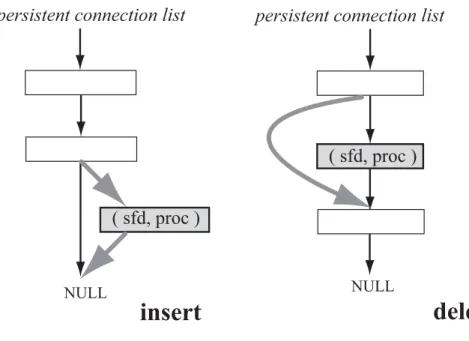
We also have to maintain persistent TCP connections at the server to maintain or close them according to how resources are being utilized. Figure 4 has our mechanism for managing persistent
persistent connection list
( sfd, proc )
persistent connection list
NULL NULL
insert
delete
( sfd, proc )
Figure 4: Persistent Connection List in Connection Management Scheme
TCP connections at the server. When a TCP connection finishes transmitting a requested document and becomes idle, the server records the socket file descriptor and the process number as a new entry in the persistent connection list, which is used by the kernel to handle the persistent TCP connections. Note that new entries are added to the end of the list. When the server decides to close some persistent TCP connections, it selects connections from the top of the list. In this way, the server can close the oldest persistent connections first. When a certain persistent TCP connection in the list becomes active before being closed, or when it is closed by the expiration of the persistent timer, the server removes the corresponding entry from the list. All operations on the persistent connection list can be done with simple pointer manipulations.
To manage resources even more effectively, we add a mechanism where the amount of re-sources assigned to the persistent TCP connections gradually decreases after the connection be-comes inactive. No socket buffer is needed when the TCP connection is idle. Therefore, we can gradually decrease the send/receive socket buffer for persistent TCP connections by taking account of the fact that as the connection idle time continues, the possibility that the TCP connection will
Sender Host
Receiver Host
bandwidth: 100 [Mbps]
propagation delay: 0.1 [sec]
loss probability: 0.0001 - 0.01
Figure 5: Network Model (1)
4
Simulation Experiments
In this section, we evaluate the performance of our proposed mechanism through simulation ex-periments using ns-2 [38]. The implementation overview of our proposed scheme and the results of implementation experiments will be provided in Section 5.
4.1 Performance of the Scalable Socket Buffer Tuning
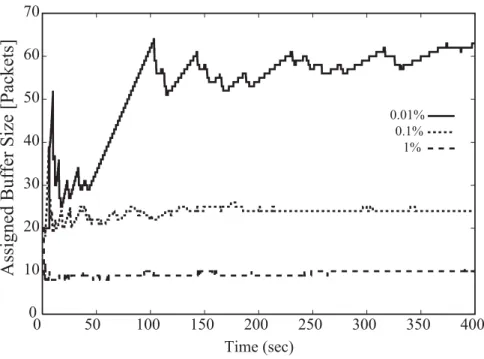
We first discuss the results of simulation experiments to confirm the behavior of the control mech-anisms of socket buffers. We use the network model in Fig. 5 to validate the effectiveness of the control mechanism of send socket buffer. In this model, we set the bandwidth of the link to 100 Mbps, the propagation delay to 0.1 sec, and the packet loss probability to 1%, 0.1%, and 0.01%. We implement our proposed scheme of control send socket buffer to the sender host, and the sender host transfers an infinite size to the receiver host through a TCP connection. The simulation time is 400 sec.
Figure 6 shows the change in the assigned size of the send socket buffer during the simulation time. It is obvious that as the packet loss probability increases, the assigned buffer size decreases. In this case, the throughput of the TCP connection between the sender and receiver host becomes low when the packet loss probability is high. Thus our algorithm tries to assign a smaller size of send socket buffer to the connection based on the estimated results of the throughput.
0 10 20 30 40 50 60 70 0 50 100 150 200 250 300 350 400
Assigned Buffer Size [Packets]
Time (sec)
0.01% 0.1% 1%
Figure 6: Simulation Results: Change of Assigned Size of Send Socket Buffer
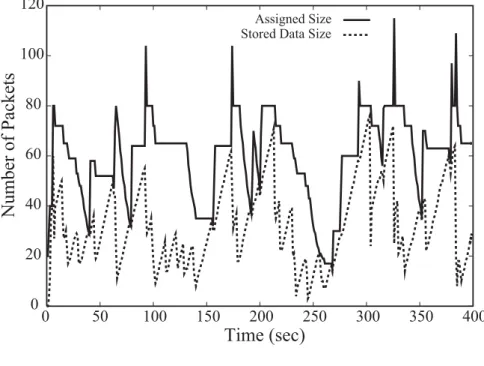
We next evaluate the control mechanism of receive socket buffer. In this simulation, we use the same network model as for the send socket buffer, and set the bandwidth of the link to 100 Mbps, the propagation delay to 0.1 sec, and the packet loss probability to 1% and 0.1%. We implement our proposed algorithm on the receiver host, and the sender host transfers an infinite size to the receiver host. The simulation time is 400 sec.
Figures 7(a) and 7(b) show the changes in the assigned size of the receive socket buffer and the size of the stored data in the receive socket buffer as a function of simulation time when the packet loss probability is set to 0.1% and 1%, respectively. From these figures, it is obvious that the scheme we propose can assigned the appropriate size of the receive socket buffer. This means that it can precisely monitor the usage of the receive socket buffer and assign the receive socket buffer the appropriate size according to the monitored utilization.
0 20 40 60 80 100 120 0 50 100 150 200 250 300 350 400
Number of Packets
Time (sec)
Assigned Size Stored Data Size(a) Packet Loss Probability: 0.1%
0 20 40 60 80 100 120 0 50 100 150 200 250 300 350 400
Number of Packets
Time (sec)
Assigned Size Stored Data Size(b) Packet Loss Probability: 1%
Client Hosts
Web proxy server
Web servers h = 0.5
propagation delay : 0.01 1 sec loss probability : 0.0001 0.01
# of client hosts : 432 # of Web servers : 432
propagation delay : 0.01 1 sec loss probability : 0.001 0.1
Figure 8: Network Model (2)
4.2 Overall Performance of Resource Management Scheme
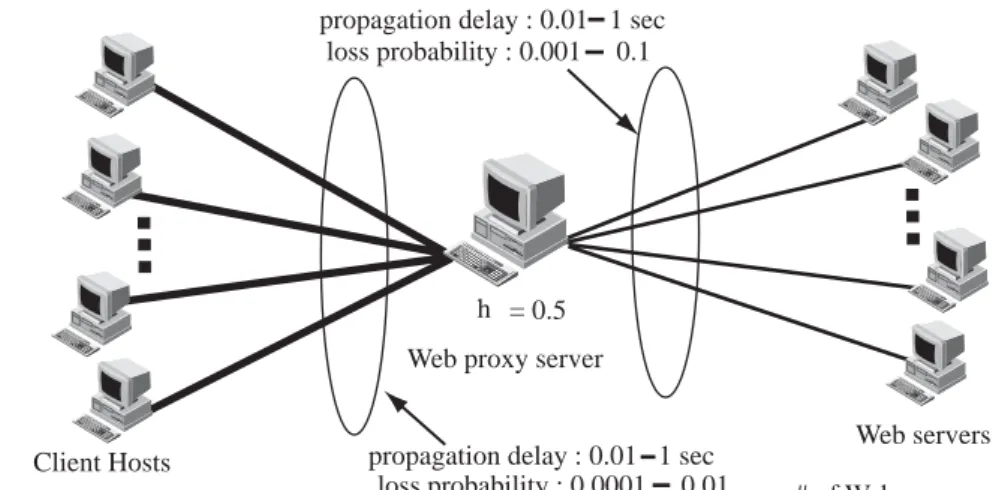
We then comprehensively evaluate the effectiveness of our proposed scheme, including the con-nection management scheme. Figure 8 shows the simulation model. It is used to simulate a situation where many Web client hosts and Web servers in a heterogeneous environment commu-nicate with a Web proxy server to send and receive Web documents. To do that, we intentionally set the bandwidths, propagation delay, and packet loss probability of the links between the proxy server and the Web clients/servers. The bandwidths of the links between the client hosts and the proxy server are changed to 100 Mbps, 1.5 Mbps, and 128 Kbps, and those between the proxy server and the Web servers are changed to 100 Mbps, 10 Mbps, and 1.5 Mbps. The packet loss probability on each link between the Web proxy servers and client hosts is selected from 0.0001, 0.001, and 0.01, and that between the proxy server and Web servers is selected from 0.001, 0.01, and 0.1. The propagation delay for each link is set to 1 sec, 0.1 sec, and 0.01 sec. Both of the numbers of Web servers and client hosts are fixed at 432.
In the simulation experiments, each client host randomly selects one of the Web servers and generates a document transfer request to the proxy server. The distribution for the requested
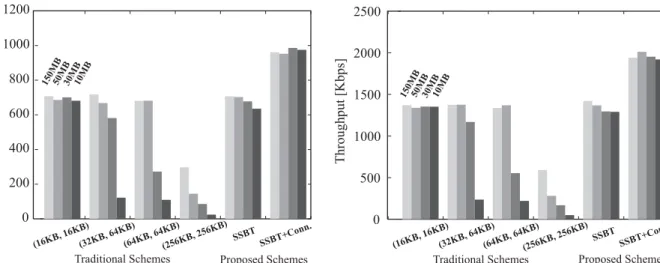
document size follows that reported in [14]. That is, it is given by a combination of log-normal distribution for small documents and a Pareto distribution for large ones. The access model for the client hosts also follows that in [14], where the client host first requests the main document, and then requests some in-line images, which are included in the document after a short interval (following [14], we call it active off time), and then requests the next document after a somewhat longer interval (inactive off time). Web client hosts transfer Web document requests to the Web proxy server only when the resources at the proxy server are sufficient to accommodate those connections. When the remaining amount of server resources is shorthanded, the client hosts have to wait for other TCP connections to be terminated and for the assigned resources to be released. After the Web proxy server accepts the request, the proxy server decides whether to transfer the requested document to the client host directly, or to download it from the original Web server and then deliver it to the client host based on the cache hit ratio h, which is fixed at 0.5 in our simulation experiments. As well as Web client hosts, the proxy server can download the requested document only when the proxy server has sufficient resources to establish a new TCP connection. The socket buffer that the proxy server can use is divided equally between the send socket buffer and receive socket buffer. That is, when the system has 50 MBytes socket buffer, 25 MBytes are assigned equally to each buffer. We did not simulate the other limitations of the proxy server resources precisely explained in Subsection 2.1. Instead, we introduced Nmax, the maximum number of TCP connections which can be established simultaneously at the proxy server.
In addition to the proposed mechanism, we conducted some simulation experiments with the traditional mechanisms, where a fixed-size send/receive socket buffer is assigned to each TCP connection for comparison. The simulation time is 1000 sec. We compare the performance of the proposed mechanism and the traditional mechanism, focusing on the following aspects;
• Server-side proxy throughput: which is defined by the total transfer data size from Web
• Client-side proxy throughput: which is defined by the total transfer data size from the
proxy server to client hosts divided by simulation time.
• Average document transfer time: which is defined by the average time from when client
host sends a Web document request to when the client host finishes receiving it.
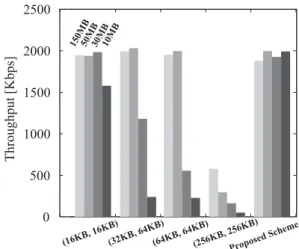
First, we evaluate the performance of the Web proxy server when the total amount of the socket buffer is changed. In this simulation, we change the total socket buffer size to 150 MBytes, 50 MBytes, 30 MBytes, and 10 MBytes, each of which is equally divided for send and receive socket buffers. Nmax is set to 846, meaning that, all the TCP connections both from Web client hosts and to Web servers are not rejected being established due to the lack of other resources. Figure 9 shows the server-side proxy throughput, client-side proxy throughput, and document transfer time. Each graph in this figure shows the results for the traditional mechanisms with various size of the send socket buffers and the receive socket buffers at the left 16 bar charts. For example, (32 KB, 64 KB) means the traditional scheme assigns a fixed 32 KBytes for the send socket buffer and a fixed 64 KBytes for the receive socket buffer. The results for the proposed mechanism at the right 4 bar charts. Here, we did not use the connection management scheme explained in Subsection 3.2 since it shows no effect on the performance of the proposed scheme. Note that we have confirmed that the connection management scheme does not have any adverse effects in this case.
Figure 9 reveals that when the total amount of the socket buffer is small in the traditional schemes, the average proxy server throughput decreases especially when the assigned buffer size for each TCP connection is large. This is because some TCP connections do not use the assigned socket buffer when the assigned size is large. This also causes newly arriving TCP connections to wait to become established until other TCP connections have closed and released the assigned socket buffer. However, the throughput of the scheme we proposed is high even when the total amount of the socket buffer is quite small. This is because we can assign an appropriate size for the
socket buffer for each TCP connection based on its estimated demand. Consequently, the excess buffers of narrow-link users are re-assigned to wide-link users who request a large socket buffer.
One possible way to improve the throughput of the proxy server in the traditional schemes is to configure the ratio of the send and receive socket buffers, instead of equally dividing for send and receive socket buffer as we did in the above simulation experiments. That is, if the ratio could be changed according to the size required, the utilization of the socket buffer would increase, resulting in improved proxy server throughput. To investigate this further, let us look at the results when we change the ratio for the send and receive socket buffers. In this simulation, we setNmax to 846 and total amount of the socket buffer is fixed to 50 MBytes. We then divided the socket buffer for send and receive socket buffers in the ratios of 1:1, 2:1, 4:1, and 1:2. Figure 10 shows that in the traditional schemes, the most appropriate value of the division ratio changes when the assigned size of the socket buffer changes. It is also affected by the various factors such as the cache hit ratio, the total number of TCP connections at the proxy server, and so on. That is, it is very difficult to find the best setting of the division ratio of the send/receive socket buffer. However, the proxy server throughput in our scheme still remains high even if we set the ratio incorrectly or the total socket buffer is very small. That is, we can say that our proposed scheme has good robustness against the setting of the division ratio of the socket buffer.
Let us now discuss the results we obtain from the evaluating the connection management scheme. Here, we set Nmax to 600, which is sufficiently small to accept all TCP connections
arriving at the proxy server. The other parameters are the same as in Fig. 9. Figure 11 shows the simulation results for our scheme with and without the connection management scheme (SSBT and SSBT+Conn, respectively). From this figure, it is obvious that in the traditional schemes, both proxy server throughput and document transfer time are worse than those in Fig. 9. This small value for Nmax means some TCP connections must wait to become established because of the lack of proxy server resources, even if most TCP connections at the proxy server are not used for data transmission and only waste proxy server resources. This phenomenon can be seen even in
our scheme without the connection management scheme. On the other hand, when the connection management scheme is used, the proxy server throughput increases and document transfer time decreases. The connection management scheme proposed in this thesis intentionally terminates persistent TCP connections which do not transfer any data, and the released resources are used for newly arriving TCP connections, which can start transmitting Web documents immediately. This improves the resource utilization of the proxy server, which also reduces the document transfer time perceived by Web clients.
0 200 400 600 800 1000 1200 (16KB, 16KB)(32KB, 6 4KB) (64KB, 64KB)(256KB, 256KB) Throughput [Kbps] 150MB50MB30MB10MB Proposed Scheme Traditional Schemes
(a) Server-side proxy throughput
0 500 1000 1500 2000 2500 (16KB, 16KB)(32KB, 6 4KB) (256KB, 256KB)Proposed Scheme Throughput [Kbps] (64KB, 64KB) 150MB50MB30MB10MB Traditional Schemes
(b) Client-side proxy throughput
1 10 100
Document Transfer Time [sec]
(16KB, 16KB)(32KB, 64KB)(64KB, 64KB)(256KB, 256KB) 150MB50MB30MB10MB 1000 Proposed Scheme Traditional Schemes
(c) Document Transfer Time
0 200 400 600 800 1000 1200 (16KB, 16KB)(32KB, 6 4KB) (64KB, 64KB)(256KB, 256KB) Throughput [Kbps] ( 1 : 1 ) ( 1 : 2 ) ( 4 : 1 ) ( 2 : 1 ) Proposed Scheme Traditional Schemes
(a) Server-side proxy throughput
0 500 1000 1500 2000 2500 (16KB, 16KB) (32KB, 6 4KB) (256KB, 256KB) Throughput [Kbps] (64KB, 6 4KB) ( 1 : 1 ) ( 1 : 2 ) ( 4 : 1 ) ( 2 : 1 ) Proposed Scheme Traditional Schemes
(b) Client-side proxy throughput
1 10 100 1000
Document Transfer Time [sec]
(16KB, 16KB)(32KB, 64KB) (256KB, 256KB) (64KB, 6 4KB) ( 1 : 1 ) ( 1 : 2 ) ( 4 : 1 ) ( 2 : 1 ) Proposed Scheme Traditional Schemes
(c) Document Transfer Time
0 200 400 600 800 1000 1200 (16KB, 16KB)(32KB, 64KB)(64KB, 6 4KB) (256KB, 256KB) SSBTSSBT+Conn. Throughput [Kbps] 150MB 10M B 30MB 50MB
Traditional Schemes Proposed Schemes
(a) Server-side proxy throughput
0 500 1000 1500 2000 2500 (16KB, 16KB)(32KB, 64KB) (256KB, 256KB)SSBTSSBT+Conn. Throughput [Kbps] (64KB, 64KB) 150MB50MB30MB10MB
Traditional Schemes Proposed Schemes
(b) Client-side proxy throughput
1 10 100
Document Transfer Time [sec]
(16KB, 16KB)(32KB, 64KB)(64KB, 64KB)(256KB, 256KB) SSBTSSBT+Conn.
150MB50MB30MB10MB
1000
Traditional Schemes Proposed Schemes
(c) Document Transfer Time
5
Implementation and Experiments
In this section, we discuss the results we obtain in implementation experiments and confirm the effectiveness of our proposed scheme within an actual system.
5.1 Implementation Overview
Our scheme consists of two algorithms; the socket buffer management scheme discussed in Sub-section 3.1, and the connection management scheme described in SubSub-section 3.2. We implement it on a PC running FreeBSD 4.6, by modifying the source code of the kernel system and the Squid proxy server [21]. The total number of lines of added source code is about 1000.
The socket buffer management scheme is composed of two mechanisms: control of the send socket buffer and the receive socket buffer. To control the send socket buffer, we have to obtain the ‘estimated’ throughput of each TCP connection established at the proxy server from the three parameters in Subsection 3.1.1. These parameters can easily be monitored at a TCP sender host, such as a Web server or a Web proxy server. We monitor these parameters in the kernel system at regular intervals. In the following experiments, we set the interval at 1 sec. We then calculate the estimated throughput of a TCP connection and assign a send socket buffer using the algorithm in Subsection 3.1.1. To control the receive socket buffer, we modify the kernel system to monitor the utilization of the receive socket buffer at regular intervals as described in Subsection 3.1.2, which is set to 1 sec in our implementation. Note that it should be careful to treat the receive socket buffer when the assigned buffer size is decreased in our scheme. This is because if we decrease the receive socket buffer size without sending ACK packets with a new value for the advertised window size to the TCP sender host, transferred packets may be lost due to the lack of receive socket buffer [39]. Therefore, we decrease the receive socket buffer size 0.5 sec after informing the sender host of the new advertised window size by sending an ACK packet.
Client host
Web proxy server
Web server
# of users
200, 600
upper limit : 400 connections
threshhold : 300 connections
persistent timer : 15 seconds
cache hit Ratio : 0.5
Figure 12: Network Environment for Implementation Experiment
resources and maintain an adequate number of persistent TCP connections which are concurrently established at the proxy server, as described in Subsection 3.2. We therefore have to monitor the remaining server resources in the kernel system every second and compare them with their threshold values for the resources. Furthermore, to manage persistent TCP connections at the proxy server, we have to establish the persistent connection list explained in Subsection 3.2 in the kernel system.
5.2 Implementation Experiments
Figure 12 outlines our experimental system. The Web proxy server host has dual Intel Xeon Processor 2 GHz CPUs and 2 GBytes of RAM, the Web server host has 2 GHz CPU and 2 GBytes of RAM, and the client host has 2 GHz CPU and 1 GByte of RAM. All of three machines run a FreeBSD 4.6 system. The amount of proxy server resources is set such that the proxy server can accommodate up to 400 TCP connections simultaneously. The threshold value, at which the proxy server begins to close persistent TCP connections, is set to 300 connections. We intentionally set the size of the proxy server cache to be 1024 KBytes, so that the cache hit ratio becomes about 0.5. The length of the persistent timer used by the proxy server is set to 15 seconds. The client host uses httperf [40] to generate document transfer requests to the Web proxy server, which can
emulate numerous users making Web accesses to the proxy server. The number of emulated users in the experiments is set to 200 and 600. In the traditional system, therefore, all TCP connections at the Web proxy server can be established when there are 200 TCP connections, but all TCP connections cannot be accepted when this number is 600 due to the lack of server resources. As in the simulation experiments, the access model for each user at the client host (the distribution for the requested document size and think time between successive requests) follows that reported in [14]. When the request is rejected by the proxy server due to the lack of resources, the client host resends the request immediately. We compare the proposed scheme and the original scheme in which no mechanism proposed in this thesis is used.
Figure 13 shows the average throughput of the proxy server, and the average document transfer time perceived by the client host. Here, we define the average throughput of the proxy server as the total size of the transferred documents from the proxy server to client hosts divided by the experimentation time (500 sec). From this figure, when the number of users is 200, the average throughput of traditional scheme (16 KB, 16 KB) is lower than that of another traditional scheme (256 KB, 256 KB). This is because the assigned size of send/receive socket buffer is too small in spite of that the network capacity and the Web server performance is sufficiently. When the number of users increases to 600, however, the performance of the traditional schemes decreases in both terms of the proxy server throughput and the document transfer time, Especially, the traditional scheme (256 KB, 256 KB) degrades its performance significantly. This is because the proxy server resources are much shorthanded in this case, since too large size of socket buffer is assigned to TCP connections.
When we look at the results of our proposed scheme, we can observe that when the number of users is 200, the proxy server throughput is almost the same as that of the traditional scheme (256 KB, 256 KB). In 600 users case, however, our proposed scheme does not degrade its through-put in spite of that the number of users is much larger than the capacity of the proxy server. It also provides the smallest document transfer time for the Web client host. This results mean that our
scheme can effectively control the persistent connections at the proxy server.
Furthermore, we exhibit the pretty good performance of the proposed scheme in terms of the resource utilization at the proxy server. Figure 14 shows the average size of the assigned socket buffer to all TCP connections. It clearly shows that our scheme can save the socket buffer amazingly at the proxy server. Note that the traditional scheme (256 KB, 256 KB) uses about 10 times larger socket buffer but it can provide only 75% throughput and larger document transfer time, compared with the proposed scheme. From the above results, we can conclude that our proposed scheme works effectively on the actual system, providing quite better performance than the traditional scheme.
0 2 4 6 8 10 12 14
Average Throughput of Proxy Server [Mbps]
(16KB, 16KB) (256KB, 256KB) Proposed Scheme
200 users 600 users
Traditional Schemes
(a) Average Throughput of Proxy Server
0 1 2 3 4 5 6 7 8 9
Average Document Transfer TIme [sec]
(16KB, 16KB) (256KB, 256KB) Proposed Scheme
200 users 600 users
Traditional Schemes
(b) Average Document Transfer Time
0 50 100 150 200 250 300 350
Assigned Buffer Size [MBytes]
(16KB, 16KB) (256KB, 256KB) Proposed Scheme 200 users 600 users
Traditional Schemes
6
Concluding Remarks
In this thesis, we have proposed a new resource management mechanism for TCP connections at Internet servers. Our proposed scheme has two algorithms. The first is a socket buffer management scheme which effectively assigns the send/receive socket buffers to heterogeneous TCP connec-tions based on their expected demands. It takes into account for the dependency between the upward and downward TCP connections at proxy servers. The second is a scheme for managing persistent TCP connections. It monitors server resources, and intentionally closes idle TCP con-nections when the remaining server resources are shorthanded. We have evaluated the our scheme through various simulation and implementation experiments, and confirmed that it can improve the proxy server performance, and reduce the document transfer time for Web client hosts.
As future studies, we will evaluate the server performance by implementation experiments where more Web server/client hosts exists in the network. Furthermore, in order to improve the server performance, we will have to consider the management of other server resources, such as a CPU utilization.