Journal of Global Pharma Technology
Available Online at:
www.jgpt.co.in
RESEARCH ARTICLE
Evaluate Toxic Effect of Bisphenol A on Kidney of Male Mice and
Mitigation
Its Effect by Green Tea Extract
Ahmed Ghdhban Al-Ziaydi
1,Hayder H. Abed
2,Aamer M. Ali
3*,Eman Mobder
Nayif
4,Anwar Hassan Fadhel
51. College of Medicine, University of Al-Qadisiyah, Iraq.
2. Physiology and Chemistry Department, Veterinary Medicine College, Muthanna University, Iraq.
3. Department of Pathological Analysis Techniques, Al-Mustaqbal University College, Iraq.
4. Department of Pathological Analysis Techniques, Al-Mustaqbal University College, Iraq.
5. Bachelor in Veterinary Medicine College, Muthanna University, Iraq.
*Corresponding Author: Aamer. M. Ali
Abstract
Bisphenol A is a substance for the synthesis variety of plastics, primarily epoxy resins and polycarbonates. Bisphenol can have severe effects on the type and might contribute to gradual cumulative renal injury over a lifetime. This study object to estimate toxic effect of bisphenol A on type of male mice also mitigation toxic effect of bisphenol A by using extract green tea. Healthy adult male albino laboratory mice (Mus musculus) treated for two doses of bisphenol a (20 mg/kg and 40 mg/kg body weight per day) for thirty days and green tea extract was co-administration orally as antioxidant. Bio-chemical parameter of serum creatinine and blood urea was calculated as indicator of kidney function. groups treated with bisphenol A showed increased in serum creatinine and blood urea also histopathological of kidney showed significant damage in groups that treated with bisphenol A whereas groups that treated with bisphenol A and co-administration green tea extract showed mitigation toxic effect of bisphenol A due to role of green tea as anti-oxidant compound.
Keywords: Evaluate, Bisphenol A, Green Tea, Antioxidant compound.
Introduction
Bisphenol A is a substance for the synthesis variety of plastics, firstly epoxy resins and polycarbonates, addendum some polysulfones and certain common consumer goods, like plastic bottles counting water-bottles, DVDs CDs, and sports equipment [1].Bisphenol A can accumulated in the body and show severe damage in certain organs such as in heart, liver, testis and brain[2-5] by the formation of (ROS), increasing lipid peroxidation and decreasing the activities of anti-oxidant enzymes thereby causing oxidative stress in vital organ of animal and human.
Bisphenol A through every-day life can have severe effects kidney and might contribute to progressive cumulative renal injury through a life-time. nephrotoxicity is a significant public health concern as it can progress to chronic kidney disease in the long run, it is
essential to explore whether BPA
contamination could indeed have an unfavorable impact on the kidney [6].Green tea is known as a powerful anti-oxidant and reactive oxygen species scavenger. Poly-phenols in green tea are thought to be responsible for the cancer preventive effects observed in laboratory and epidemiological studies [7]. The study aim to evaluate toxic effect of bisphenol A on kidney and amelioration its toxic effect by using extract green tea as anti-oxidant compound.
Material and Methods
Animals
Center for Cancer and Medical genetic research. All mice were acclimatized in the standard appropriate conditions 12 h/light and 12h/dark in 25 ±4 C° for 1 week before study was beginning.
Chemicals Materials
Bisphenol A as a powder Pure 99% was purchased From Sigma (U.S.A) by Iraqi Biotechnology laboratory (Baghdad - Iraq), in addition all histological processes of samples was carried out in Iraqi- Center for Cancer and Medical genetic research (Baghdad-Iraq).
Biochemical Assay Kit
Blood urea nitrogen and serum Creatinine was determined using Cobas C111 depending on Roche diagnostic assay kit -Japan.
Green Tea Leaves
Freshly green tea leaves was supplied from marketplace in Samwah province-Iraq, washing for three times with tube water to removing any odd matter finely washing with distilled water, ground green tea a fine powder put in kept in dark plastic container for next steps.
Preparation of Extract of Green Tea Leaves
10 gram fine powder of green tea leaves was added to 1000 ml of water and boiled in 80 ᴼC for 8 hr with stirring, the mixture was cooled at (room temperature) and filtrated by using filter paper (Whatman No. 1), supernatant was kept in dark plastic container for next steps [8,9].
Experimental Design and Treatment Schedule
A sixty mice animal was divided randomly into six groups (10 mice per group) as following:
First group: Animals were not treated and were served as a negative control (NC).
Second group: Animal was treated with
(DMSO) dimethyl sulfoxide in concentration 40% with sterile water and act as positive - control (PC)
Third group: Animal were treated with low
dose of bisphenol A (20 mg /kg of body weight) (LD)
Forth group: Animal was treated with high
amount of bisphenol A (40 mg / kg of body weight) (HD)
Fifth group: Animal were treated with little dose of bisphenol A (20 mg/kg of body weight)
in addition extract green tea was
administrated orally (LD+ plant extract).
Sixth group: Animal was treated with high
dose of bisphenol A (40 mg/Kg of body weight) and green tea extract was co-administration orally (HD+ Plant extract).
All treatment with bisphenol A was transmitting out using intraperitoneal administration by dissolve bisphenol A in 40 % DMSO and in range 100 µl per day for one month. Aqueous extraction of Green tea was co-administrated orally to fifth and sixth groups instead of water.
Preparation of Blood and Histological Samples
After 30 days of treatment animal were anesthetized and sacrificed by using Ether then chest was opened and one milliliter (1ml) of blood was collected by cardiac puncture and preserve in tube with using 130 mM anticoagulant sodium citrate in ratio 9:1 (blood :sodium citrate). The blood samples will be Centrifuged Immediately in 1800 rpm for 15 min and plasma will be transferred to new tube and keep in -20 C° until assay [10]. Kidneys of animal was isolated and kept in formalin (10%), histological prepared sample was carried out by using sections stained with hematoxylin and eosin (H & E)[11].
Statistical Analysis
All obtained results from all parts of this study were analyzed using graph Pad prism version 6.01 depending on one way ANOVA
test to compare between different
concentrations of samples.
Results
urea nitrogen in mice treated with little dose of bisphenol A and co-administration for green tea (mean =21.39 mg/dl) compaered to group treated with little dose of bisphenol A. Whereas group treated with high amount of
bisphenol and green tea shown significant decreased in blood urea of male mice (mean = 27.96 mg/dl) compared to group mice treated with high amount of bisphenol A.
Figure 1: Blood urea nitrogen level in male mice treated for 30 days with bisphenol A and amelioration its effect by green tea extract .P value ≤ 0.0001 (****) and n=10
Table 1: Analysis results data of blood urea nitrogen using graph Pad prism version 6.01 depending on one way A NOVA. P value < 0.0001 (****)
Tukey's multiple comparisons test Mean Diff. 95% CI of diff. Significant Summary
NC vs. PC -1.832 -3.024 to -0.6403 Yes ***
PC vs. LD -7.770 -8.961 to -6.578 Yes ****
PC vs. HD -17.46 -18.66 to -16.27 Yes ****
LD vs. LD+ green tea extract 5.637 4.446 to 6.829 Yes ****
HD vs. HD+ green tea extract 8.756 7.564 to 9.947 Yes ****
Result of serum creatinine in male mice shown in Figure (2), there is signinficant
difference between negative control
(mean=0.121 mg/dl) and positive control (mean= 0.217 mg/dl). Result shown in singificant increase in serum creatinine in group treated with little amount of bisphenol A (mean=0.285 mg/dl) and group treated
with high amount of bisphenol A (mean = 0.388 mg/dl) compared to positive control. Mice group treated with low dose of bisphenol A and green tea extract (mean=0..229 mg/dl) and high amount of bisphenol A and extract green tea (mean = 0.317 mg/dl) shown in significant decreased compaered to positive control.
Figure 2: Serum creatinine level in male mice treated for 30 days with bisphenol A and amelioration its effect by green tea extract .P value < 0.0001 (****) and n=10
Table 2: Analysis results data of serum creatinine using graph Pad prism version 6.01 depending on one way A NOVA. P value < 0.0001 (****)
Tukey's multiple comparisons test Mean Diff. 95% CI of diff. Significant Summary
NC vs. PC -0.0956 -0.1211 to -0.07008 Yes ****
PC vs. LD -0.0680 -0.09352 to -0.04248 Yes ****
PC vs. HD -0.1716 -0.1971 to -0.1461 Yes ****
LD vs. LD+ green tea extract 0.0552 0.02968 to 0.08072 Yes ****
Histopathological Examination
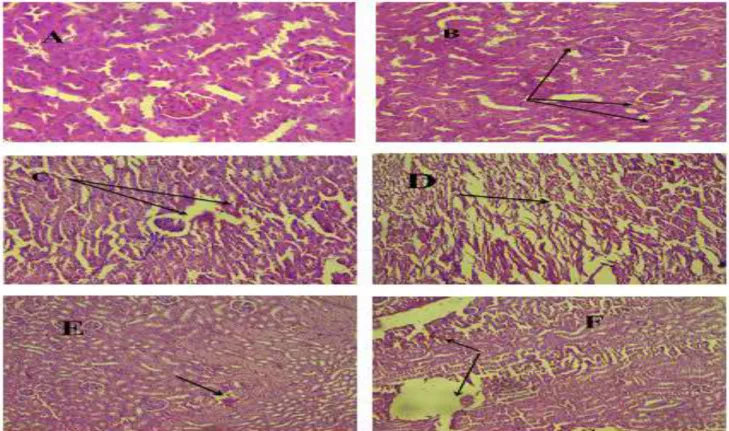
Figure 3: Show histopathol-ogical section of H&E for kidney of male mice treated with bisphenol A and green tea extract for 30 days. A-Histopathol-ogical section (20 X) of group (1) which act as negative control. B-Histopathol-ogical section (10 X)of positive control which treated with 40% DMSO only . Main patholB-Histopathol-ogical lesions characterized by dilation of bowman space and slightly cellular degeneration of renal tubules. C-Histopathol-ogical section (10X) of group (3) which treated with low dose of bisphenol A (20mg/kg body weight) for 30 days. Main histopathol-ogical lesions show cellular degeneration characterized by enlargement of renal epithelial cells and vascular degeneration , also there is sloughing of epithelial cells which lining the renal tubules. D-Histopathol-ogical section (10X) of group (4) which treated with high dose of bisphenol A (40mg/kg body weight) for 30 days. Main histopathol-ogical lesions showed markedly damage tubules and sever edematous aggregation also showed cellular degeneration characterized by epithelial enlargement of renal tubules. E-Histopathological section (10X) of group (5) which treated with low dose of bisphenol A plus green tea extract for 30 days. Showed congested blood vessels, RBCs in the lumen of the renal tubules. F-Histopathol-ogical section (10X)of group (6) which treated with high dose of bisphenol A plus green tea extract for 30 days. Main histopathological lesions show cellular degeneration characterized by enlargement of renal epithelial cells and vascular degeneration
Discussion
In general know that utmost ingest, environmental phenols are rapid conjugated with glucuronic acid in the gut wall and liver and almost fully excreted in urine as highly soluble in water metabolites with short terminal half-lives [12]. The kidney is the main member for the excretion of these environmental phenols. Renal excretion of xenobiotics is reliant on on renal tubular secretion, glomerular filtration rate, and reabsorption.
About organic compounds, for example phenols, are glucuronidated in the liver and eliminated by active tubular secretion [13]. As shown in Figures (2and 3) there is significant increase in blood urea and serum creatinine in positive group compared to negative group and this due to role of DMSO which causes a significant efferent arteriolar (postglomerular) and a less pronounced
afferent arteriolar (preglomerular)
vasoconstriction [14]. In 3rd group (LD
Group) and 4th group (HD Group) as show in
Figure (2 and 3) significant increasing in blood urea and serum creatinine compared to positive group. This increasing due to Bisphenol A contains phenolic rings, the metabolism and side effects of BPA may have common characteristics with phenols of intestinal origin. BPA is eliminated by the kidney, and increased blood levels have been observed in nephron which my lead to destruction of nephrons of mice.
In 5th group (LD+ Green tea) and 6 th group (HD + Green tea) Show significant decreasing in value of serum creatinine and blood urea compared to 3rd and 4 th groups respectively which refer to important role of green tea as protective an antioxidant against bisphenol A. extract Green tea contains catechins, well-known for their
anti-oxidative property, stabilized plasma
hemolysis. Catechins can also chelate metal ions such as iron (III) to form not active complexes and prevent the generation of potentially damaging free radicals [15, 16]. Green tea extract is considered as potent scavengers of reactive oxygen species, for
example hydrogen peroxide, hydroxyl
radicals, nitric oxide and superoxide produced by several chemicals [17]. In new study [18] supplementation of extract green
tea attenuates cyclosporine A-induced
oxidative stress in rats. Other study [19] detect that green tea might protect liver and brain cells against oxidative stress by ethanol intoxication.
The renal tubules are particularly precise to toxic influences, because they have high oxygen consuming and vulnerable enzyme systems, and they have complicated carry mechanism that may be use for transfer of toxins and can be damaged by such toxins. Also the tubules come in contact with toxic chemicals through their excretion and elimination by the kidneys [20]. Several chemicals had a direct nephrotoxic act and excreted their effects principally on the renal tubules. The found of degeneration may be relateding to the depletion of ATP, which finally including to the death of the cells [21].
Many studied [22, 23] showed that NP (Nonylphenol) and its related compounds caused a modification of the structure and function of the kidney and other organs such as the liver and gills. The histopathological examination of kidney that is BPA-treated groups showed dilation of bowman space and acute cellular degeneration of renal tubules at 2nd group showed in fig. (3B) compared with 1st group (negative group) in Figure (3A), it may be due to the toxic action of
DMSO [24] which administrated to 2nd
group. Cellular degeneration characterized by enlargement of renal epithelial cells and
vascular degeneration in 3 rd group which are treated with low dose of bisphenol A, also there is sloughing of the epithelial cells which lining the renal tubules which showed in figure (3C) It may due to cytotoxic effect and increases estrogen metabolism in the kidney due to BPA. The histopathological section of 4th group (HD Group) showed damage tubules and sever edematous
aggregation, also showed cellular
degeneration characterized by epithelial enlargement of renal tubules as shown in Fig.(3D) due to high dose of BPA which cause nephrotoxic effect and destruction of the mice nephrons.
These results in agreed with other study [25] showed histopathological section of kidney for rat which treated with BPA ,these sections showed severe dilatation and congestion in the cortical renal blood vessels, thickening of the glomerular and the renal tubular basement membranes. Also agreed with other study [26, 27] which showed large inter-tubular hemorrhagic area, congestion,
necrotic area, and mononuclear cell
infiltration and histopathological changes in renal tissues were observed in cortex of rats treated with BPA.
On the other hand, 5th and 6th groups showed slightly damage & congested of blood vessels as in Figure (3E and 3F) compared with 3rd and 4th groups respectively and this due to effect of green tea which can ameliorates the effect of BPA because green tea contains catechins, which have strong anti-oxidative action, and agreed with other study [28] detect that green tea may do protect brain and liver cells against oxidative stress induced by ethanol intoxication. Other studies [29] reveal that BPA-induced oxidative stress could be significantly mitigated by exactly green tea.
References
1. Pivnenko K, Pedersen GA, Eriksson E,
Astrup TF (2015) Bisphenol A and its structural analogues in household waste paper. Waste management, 1 (44): 39-47.
2. Xia W, Jiang Y, Li Y, Wan Y, Liu J, Ma Y,
Mao Z, Chang H, Li G, Xu B, Chen X (2011) Early-life exposure to bisphenol a induces liver injury in rats involvement of
mitochondria-mediated apoptosis. PloS one,
28: 9(2):e90443.
3. Posnack NG (2014) The adverse cardiac
effects of di (2-ethylhexyl) phthalate and bisphenol A. Cardiovascular toxicology, 1: 14(4):339-57.
4. Richter CA, Birnbaum LS, Farabollini F,
Saal FS (2007) In vivo effects of bisphenol
A in laboratory rodent studies.
Reproductive toxicology, 1: 24(2):199-224.
5. Takahashi O, Oishi S (2003) Testicular
toxicity of dietarily or parenterally administered bisphenol A in rats and mice.
Food and chemical toxicology, 1:
41(7):1035-44.
6. Trasande L, Attina TM, Trachtman H
(2013) Bisphenol A exposure is associated with low-grade urinary albumin excretion in children of the United States. Kidney international, 1: 83(4):741-8.
7. Fukushima Y, Ohie T, Yonekawa Y,
Yonemoto K, Aizawa H, Mori Y, Watanabe M, Takeuchi M, Hasegawa M, Taguchi C, Kondo K (2009) Coffee and green tea as a large source of antioxidant polyphenols in the Japanese population. Journal of agricultural and food chemistry, 2: 57(4):1253-9.
8. Wei H, Zhang X, Zhao JF, Wang ZY,
Bickers D, Lebwohl M (1999) Scavenging of hydrogen peroxide and inhibition of ultraviolet light-induced oxidative DNA damage by aqueous extracts from green and black teas. Free Radical Biology and Medicine, 1: 26(11-12):1427-35.
9. Chandra AK, De N (2010)
Goitrogenic/antithyroidal potential of green tea extract in relation to catechin in rats. Food and Chemical Toxicology, 1: 48(8-9):2304-11.
10.Welshons WV, Nagel SC, vom Saal FS
(2006) Large effects from small exposures. III. Endocrine mechanisms mediating effects of bisphenol A at levels of human exposure. Endocrinology, 1: 147(6):s56-69.
11.Adebayo AO, Oke BO, Akinloye AK (2009)
The gross morphometry and histology of the male accessory sex glands in the
greater cane rat (Thryonomys
swinderianus, Temminck). Journal
Veteriner Anatomy, 2(2):41-51.
12.Dekant W, Völkel W (2008) Human
exposure to bisphenol A by biomonitoring: methods, results and assessment of environmental exposures. Toxicology and applied pharmacology, 1: 228(1):114-34.
13.Boeniger MF, Lowry LK, Rosenberg J
(1993) Interpretation of urine results used to assess chemical exposure with emphasis on creatinine adjustments: a review.
American Industrial Hygiene Association Journal, 1: 54(10):615-27.
14.Rijtema M, Mosig D, Drukker A, Guignard
JP (1999) The effects of dimethyl sulfoxide on renal function of the newborn rabbit. Neonatology, 76(6):355-61.
15. Guo Q, Zhao B, Li M, Shen S, Xin W(1996)
Studies on protective mechanisms of four components of green tea polyphenols against lipid peroxidation in synaptosomes. Biochimica et Biophysica Acta
(BBA)-Lipids and Lipid Metabolism, 13:
1304(3):210-22.
16.Yang CS, Maliakal P, Meng X (2002)
Inhibition of carcinogenesis by tea. Annual review of pharmacology and toxicology, 42(1):25-54.
17.Schroeder P, Klotz LO, Sies H (2003)
Amphiphilic properties of (−)-epicatechin and their significance for protection of cells against peroxynitrite. Biochemical and biophysical research communications, 18: 307(1):69-73.
18.Mohamadin AM, Beshbishy HA,
El-Mahdy MA (2005) Green tea extract
attenuates cyclosporine A-induced
oxidative stress in rats. Pharmacological research, 1: 51(1):51-7.
19.Ostrowska J, Łuczaj W, Kasacka I,
Różański A, Skrzydlewska E (2004) Green tea protects against ethanol-induced lipid peroxidation in rat organs. Alcohol, 1: 32(1):25-32.
20.Tisher CC (1989) Renal pathology with
clinical and functional correlations. JB LIPINCOTT Company, 1.
21.Shimizu S, Eguchi Y, Kamiike W, Waguri
S, Uchiyama Y, Matsuda H, Tsujimoto Y (1996) Retardation of chemical hypoxia-induced necrotic cell death by Bcl-2 and ICE inhibitors: possible involvement of common mediators in apoptotic and necrotic signal transductions. Oncogene, 12(10):2045-50.
22.Zha J, Sun L, Spear PA, Wang Z (2008)
Comparison of ethinylestradiol and
nonylphenol effects on reproduction of Chinese rare minnows (Gobiocypris rarus). Ecotoxicology and environmental safety, 1: 71(2):390-9.
23.Bhattacharya H, Xiao Q, Lun L (2008)
and histopathological evaluation. Tissue and Cell, 1: 40(4):243-9.
24.Rijtema M, Mosig D, Drukker A, Guignard
JP (1999) The effects of dimethyl sulfoxide on renal function of the newborn rabbit. Neonatology, 76(6):355-61.
25.Ahmed WM, Moselhy WA, Nabil TM (2015)
Bisphenol A toxicity in adult male rats:
hematological, biochemical and
histopathological approach. Global
veterinaria., 14(2):228-38.
26.Korkmaz A, Aydoğan M, Kolankaya D,
Barlas N (2011) Vitamin C
co-administration augments bisphenol A, nonylphenol, and octylphenol induced oxidative damage on kidney of rats. Environmental toxicology, 26(4):325-37.
27.Edres HA, Taha NM, Mandour AE, Lebda
MA (2018) Impact of L-Carnitine on Bisphenol A-Induced Kidney Damage in Rats. Alexandria Journal for Veterinary Sciences, 1: 56(1).
28.Ostrowska J, Łuczaj W, Kasacka I,
Różański A, Skrzydlewska E (2004) Green tea protects against ethanol-induced lipid peroxidation in rat organs. Alcohol., 1: 32(1):25-32.
29.Suthar H, Verma RJ, Patel S, Jasrai YT