Android-Based Vehicle Monitoring and Tracking System Using ARM7
and CAN Technology.
T.Narendra Kumar, S.Sivaji Asst.Professor, Asst.Professor,
Dept of ECE,Sri Sun Flower College of Engineering and Technology, Vignan University, E-mail id:[email protected],
[email protected]
Abstract: This system aims to provide a low-cost means of monitoring a vehicle’s performance and tracking by communicating the obtained data to a mobile device via Bluetooth. Then the results can be viewed by the user to monitor Temperature, Humidity and Fuel consumption .Data can also be sent to the vehicle’s maintenancedepartment which may be used to detect and predict faults in the vehicle. This is done by collecting live readings from the engine control unit (ECU) utilizing the vehicle’s built in liquid crystal display (LCD). An electronic hardware unit is built to carry-out the interface between the vehicle’s LCD board and a Bluetooth module, which in part communicates with an Android-based mobile device. The mobile device is capable of transmitting data to a server using GPS (global positioning system) and cellular internet connection.
I. Introduction
As the increasing of the amount of electronic controller and instruments in the modern automotive, the vehicle reliability is largely influenced by the complexity of circuit deployed in the control system. The high quality vehicles use CAN (Controller Area network) bus system to link all the controllers in a system to achieve unified management. This leads to easy data sharing and interoperability between different control systems. However, due to the complexity of vehicles, for example, sensors are deployed throughout the entire vehicle with diversified standards, the data within an automotive system are varied such as complex data format, heterogeneous data so to fulfill the gap among different systems one gateway is used which is a bridge to connect various CAN bus with different speed ratio. Furthermore, the vehicle system requires the information for the maintainer and driver. It is necessary to design an efficient, reliable gateway as well as its data processing system.
ARM is high-performance, low-cost, low power consumption RISC processor. For a variety of areas, such as
embedded control, multimedia, DSP and mobile
applications, ARM architecture is the first RISC microprocessor designed for low-budget market. The embedded operating system will be subject to certain restrictions. But because of its low price, reliability and other factors, it is widely used in various industrial controllers. The most important is the physical connectivity
reduction. Only two wires are required to manage a different system, which necessitates an exchange of data between them. This is only done by networking using CAN (Controller Area Network) bus. CAN (Controller Area Network) is a serial bus system, which was originally developed for automotive applications in the early 1980's.Controller Area Network (CAN) is a serial communication protocol that may be used to transfer up to 8 data bytes within a single message. CAN offers high-speed communication rate up to 1M bits/sec thus allows in real-time control applications. In addition, the error confinement and the error detection feature make it more reliable in noise critical environment. Common sensor data such as Engine control unit, Anti Lock System and etc., are available on the network, so the data can be shared, thus eliminating the need for redundant sensors.
CAN is a two-wire, Half duplex, high-speed network system and is well suited for high-speed applications using short messages With the help of the ARM Controller. We can control range of functions. The CAN transceiver is used to transmit and receive data. These Transceivers are specially designed for high-speed differential data transmission between the CAN controllers and the physical differential bus lines.
will be implemented by using AVR microcontroller. Apart from this all sensors information is passed to the smart phone using Bluetooth technology. For this purpose one Bluetooth module is interfaced to the ARM controller in node1. Remaining part android mobile will take care. For that we have to develop one specific application for the android mobile based on our requirement.
The smart phone application is developed in java Programming Language by using the Eclipse Integrated Development Environment (IDE).We use the Android Software development kit (SDK) which includes a verity of custom tools that help us develop mobile application on the android Platform. The most important of these are the android Emulator and the Android Development Tool (ADT) plug-in for Eclipse. In project android application is used to access the sensors information based on the Bluetooth technology. Within the application program one set point is fixed for each sensor. If the received sensor value is greater than the set point value then android application is accessing the inbuilt GPS and finds the vehicle position. Then one message is transferred to the one specific number which includes the vehicle position and sensors information.
II. System Overview
The purpose of our Android-based user-interface vehicle diagnostic and tracking system implemented in this work is the execution of diagnoses on a remote vehicle using internationally agreed data trouble codes.
Figure:1 System Overall Architecture
Figure: 2 SYSTEM OVERALL BLOCK DIAGRAM
A. Liquid crystal display (LCD)
A liquid crystal display (LCD) is a thin, flat panel used for electronically displaying information such as text, images, and moving pictures. Its uses include monitors for computers, televisions, instrument panels, and other devices ranging from aircraft cockpit displays, to every-day
consumer devices such as video players, gaming devices, clocks, watches, calculators, and telephones. Among its major features are its lightweight construction, its portability, and its ability to be produced in much larger screen sizes than are practical for the construction of cathode ray tube (CRT) display technology. Its low electrical power consumption enables it to be used in battery-powered electronic equipment. It is an electronically-modulated optical device made up of any number of pixels filled with liquid crystals and arrayed in front of a light source (backlight) or reflector to produce images in color or monochrome. The earliest discovery leading to the development of LCD technology, the discovery of liquid crystals, dates from 1888. By 2008, worldwide sales of televisions with LCD screens had surpassed the sale of CRT units.
B.ARM7 (LPC2148)
The LPC2141/42/44/46/48 microcontrollers are based on a 16-bit/32-bit ARM7TDMI-S CPU with real-time emulation and embedded trace support, that combine microcontroller with embedded high speed flash memory ranging from 32kB to 512kB. A 128-bit wide memory interface and unique accelerator architecture enable 32-bit code execution at the maximum clock rate. For critical code size applications, the alternative 16-bit Thumb mode reduces code by more than 30 % with minimal performance penalty. Due to their tiny size and low power consumption, LPC2141/42/44/46/48 are ideal for applications where miniaturization is a key requirement, such as access control and point-of-sale. Serial communications interfaces ranging from a USB 2.0 Full-speed device, multiple UART’s, SPI,
SSP to I2C-bus and on-chip SRAM of 8kB up to 40kB, make these devices very well suited for communication gateways and protocol converters, soft modems, voice recognition and low end imaging, providing both large buffer size and high processing power. Various 32-bit timers, single or dual 10-bit ADC(s), 10-bit DAC, PWM channels and 45 fast GPIO lines with up to nine edge or level sensitive external interrupt pins make these microcontrollers suitable for industrial control and medical systems.
Figure: 4 pin connections
C.Hc-05 Bluetooth Module
serial connection setup. Serial port Bluetooth module is fully qualified Bluetooth V2.0+EDR (Enhanced Data Rate) 3Mbps Modulation with complete 2.4GHz radio transceiver and Baseband. It uses CSR Blue core 04-External single chip Bluetooth system with CMOS technology and with AFH (Adaptive Frequency Hopping Feature). It has the footprint as small as 12.7mmx27mm. Hope it will simplify your overall design/development cycle.
Figure 3: Pin connections
D.Configuring LPC2148 and BLUETOOTH MODULE
In this application Node1 will make use of ARM processor and all other nodes will be implemented by using AVR microcontroller. Apart from this all sensors information is passed to the smart phone using Bluetooth technology. For this purpose one Bluetooth module is interfaced to the ARM controller in node1. While the
personal computer’s serial communications port uses RS232
voltage levels, an interface is needed to convert between the different voltage levels. For this purpose, a properly a MAX232 IC was used. As an example, the following configuration commands were issued:
Figure: 4 PCB of the complete hardware interface unit.
DEFAULT:
Slave, 9600 baud rate, N, 8, 1. Pin code 1234
AT COMMAND:
Communications Test:
Sent: AT
Receive: OK
Change baud rate:
Sent: AT+BAUD1
Receive: OK1200
Sent: AT+BAUD2
Receive: OK2400
1---1200
2---2400
3---4800
4---9600
5---19200
6---38400
7---57600
8---115200
Baud rate setting can be save even power down.
Change Bluetooth Device Name:
Sent: AT+NAMEdevicename
Receive: OKname
(Device name is the name you want the device to be, and it will be searched with this name) Name setting can be save even power down.
CHANGE PINCODE:
Sent: AT+PINxxxx
Receive: OK set pin
(Xxxx is the pin code you set)
Pin code can be save even power down.
Figure: 5 Circuit Schematic of the hardware interface unit.
III. THE MOBILE APPLICATION SOFTWARE
systems in the market for smart phones such as Symbian,
Windows Mobile, RIM, iPhone OS (iOS), … etc. Android
has four distinguishing advantages when compared with the other mobile phone operating systems: 1) It is an open mobile platform; Users can customize and expand applications according to their needs. 2) All applications are equal, where all applications are run in virtual machine resources. 3) The application programs have no boundaries. The developers can combine the data of the World Wide Web and the locally available (stored) in the Android platform because Android can access the core mobile devices and Internet through the standard API. 4) The application development is quick and easy since the Android platform extends a great deal of useful libraries and tools to the developers. Our Android mobile application software was designed to perform the following tasks: a) Connect to the Bluetooth module b) Send request messages to the Bluetooth. c) Receive responses from Bluetooth. d) Display the responses to the user in a user friendly form e) is able to upload the values to a remote server when desired.
A. Development of the Android Application Software:
We have developed our Android mobile application software on a Windows ®7 platform for an Android 4.3 driven Samsung Galaxy S phone. We installed development environment preparation software which included the java development kit (JDK), Eclipse, Android software development kit (SDK), Android virtual devices (AVD). Meanwhile, Android development tools (ADT) is the plug-in through which Eclipse is customized for Android applications development.
It provides a powerful integrated environment and extends the functions of Eclipse that allows users to create applications quickly and add components on the API. AVD is a collection of virtual devices where each AVD simulates a virtual device to run the Android platform and test the application software before they are run (tested) on the actual physical mobile phone (device). The smart phone application is developed in java Programming Language by using the Eclipse Integrated Development Environment (IDE).We use the Android Software development kit (SDK) which includes a verity of custom tools that help us develop mobile application on the android Platform. The most important of these are the android Emulator and the Android Development Tool (ADT) plug-in for Eclipse.
A. Mobile Application Software Testing and Menus
In project android application is used to access the sensors information based on the Bluetooth technology. Within the application program one set point is fixed for each sensor. If the received sensor value is greater than the set point value then android application is accessing .the inbuilt GPS and finds the vehicle position.
Then one message is transferred to the one specific number which includes the vehicle position and sensors information. The mobile applications configuration software menu allows for personal settings of features such as turning GPS ON or OFF, duration between consecutive reading from LCD, custom (specific) parameters for certain vehicles, etc, as shown in Fig 6
Figure 6: Configuration menu on the mobile application software
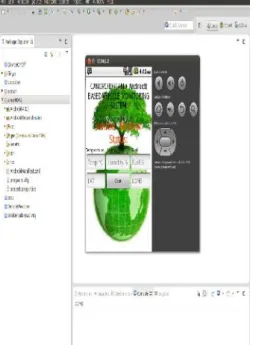
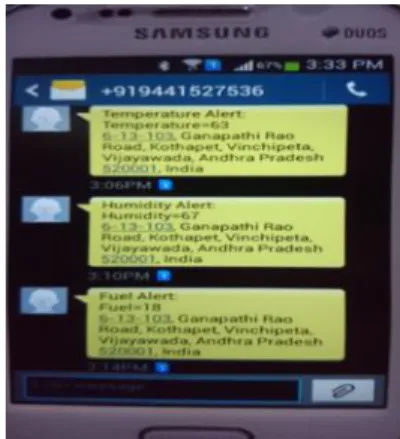
For that we have to develop one specific application for the android mobile based on our requirement in figure7.In project android application is used to access the sensors information based on the Bluetooth technology.For this purpose one Bluetooth module is interfaced to the ARM controller in node1. Within the application program one set point is fixed for each sensor. If the received sensor value is greater than the set point value then android application is accessing the inbuilt GPS and finds the vehicle position. Then one message is transferred to the one specific number which includes the vehicle position and sensors information. This is the display of monitored sensor parameters in the android App in figure8 and Monitored acquire parameters send messages in figure9 to the maintenance department.
Figure 8: output display of ANDROID app
Figure 9: output display of SMS in mobile phone
IV.Conclusion
We implemented a CANDROID based vehicle
monitoring system which is composed of a combination of a low-cost hardware unit and user friendly. The mobile application software will interact with the hardware interface unit wirelessly via Bluetooth to acquire desired vehicle parameters displayed on the LCD board. These readings will be displayed locally to the user then can be sent to a vehicle maintenance department. I used android application to access the sensors information based on the Bluetooth technology. With the help of sensors I could manage the inbuilt GPS to locate the position of any object by refracting the sensor signals how the position of the vehicle is and immediately a message will be sent to the concerned number.
V.Acknowledgement
I would like to take this opportunity to express our profound sense of gratitude to my guide Mr. S.Sivaji, Assistant Professor, Vignan’s University, for his constant guidance, supervision, motivation and encouragement all the way during the project, his annotations and criticisms are the key behind successful completion of this project work. We also think Philips electronics for providing free
samples of their ARM7 board and Mr.G.S.R.satyanarayana of their technical team.
REFERENCES
[1] T. Menard, and J. Miller, “Comparing the GPS capabilities of the
iPhone4 and iPhone 3G for vehicle tracking using
FreeSim_Mobile,” 2011 IEEEIntelligent Vehicles Symposium (IV), pp. 278–283, June 2011.
[2] M. Johanson, and L. Karlsson, “Improving vehicle diagnostics through wireless data collection and statistical analysis,” IEEE
Vehiclular Technology Conference (VTC-Fall 2007), pp. 2184-2188, September2007.
[3] A. Tahat, A. Sacca, Y. Kheetan, ”Design of an integrated mobile system to measure blood-pressure," in Proc. IEEE 18th Symposium
on Communications and Vehicular Technology (SCVT), pp. 1-6, November2011.
[4] www.atmel.com
[5] www.beyondlogic.org
[6] www.dallassemiconductors.com
[7] www.maxim-ic.com
[8] www.alldatasheets.com
[9] www.howstuffworks.com
[10] www.digi.com
[11] LPC2148 Data sheet.
[12] AVR CONTROLLER Data sheets.
Authors:
Tanneru Narendra Kumar received his B.Tech in USHA RAMA college of Engineering & Technology, pottipadu (Near Gannavaram), Andhra pradesh in 2012. And he completed his M.Tech in Vignan University, vadlamudi, Andhra Pradesh, in 2014. Presently he is working as an Assistant Professor in
Sri Sun Flower College of Engineering And
Technology.,(ECE Department) Lankapalli, Andhra
Pradesh, India. His present area of interest is in embedded systems, Modelling and Simulation.
S.Sivaji received his B.Tech in
Electronics and Communication
Engineering in Loyola Institute of Engg. & Tech., Dullipalla, sattenapalli mandal, Guntur in 2007
and M.Tech in Automotive