DOI: 10.1534/genetics.104.026658
The DrosDel Collection: A Set of
P
-Element Insertions for Generating Custom
Chromosomal Aberrations in
Drosophila melanogaster
Edward Ryder,* Fiona Blows,* Michael Ashburner,* Rosa Bautista-Llacer,* Darin Coulson,*
Jenny Drummond,* Jane Webster,* David Gubb,* Nicola Gunton,* Glynnis Johnson,*
Cahir J. O’Kane,* David Huen,* Punita Sharma,* Zoltan Asztalos,* Heiko Baisch,
†Janet Schulze,
†Maria Kube,
†Kathrin Kittlaus,
†Gunter Reuter,
†Peter Maroy,
‡Janos Szidonya,
‡A
˚ sa Rasmuson-Lestander,
§Karin Ekstro
¨m,
§Barry Dickson,**
Christoph Hugentobler,
††Hugo Stocker,
††Ernst Hafen,
††Jean Antoine Lepesant,
‡‡Gert Pflugfelder,
§§Martin Heisenberg,*** Bernard Mechler,
†††Florenci Serras,
‡‡‡Montserrat Corominas,
‡‡‡Stephan Schneuwly,
§§§Thomas Preat,****
John Roote* and Steven Russell*
,1*Department of Genetics, University of Cambridge, Cambridge CB2 3EH, United Kingdom,†Institute of Genetics, Martin Luther University,
D-06120 Halle, Germany,§Department of Molecular Biology, Umea˚ University, S-901 87 Umea˚, Sweden,‡Department of Genetics and
Molecular Biology, University of Szeged, 6726 Szeged, Hungary,**Institute of Molecular Biotechnology, Austrian Academy of Sciences, A-1030 Vienna, Austria,††Zoologisches Institut der Universitat Zurich, 8057 Zurich, Switzerland,‡‡Biologie du Developpement, CNRS,
Institute Jacques Monod, FR-75251 Paris, France,§§Institut fu¨r Genetik, Universita¨t Mainz, 55128 Mainz, Germany,***Lehrstuhl
fu¨r Genetik, Universita¨t Wu¨rzburg, Am Hubland, 97074 Wu¨rzburg, Germany,†††Department of Developmental
Genetics, A040, Deutsches Krebsforschungszentrum, D-69120 Heidelberg, Germany,‡‡‡Departament de
Genetica, Facultat de Biologia, Universitat de Barcelona, 08028 Barcelona, Spain,§§§Institute of
Zoology, University of Regensburg, D-93040 Regensburg, Germany and****De´veloppement, Evolution, Plasticite´ du Syste`me Nerveux, CNRS, 91190 Gif-sur-Yvette, France
Manuscript received January 22, 2004 Accepted for publication March 2, 2004
ABSTRACT
We describe a collection ofP-element insertions that have considerable utility for generating custom chromosomal aberrations inDrosophila melanogaster.We have mobilized a pair of engineeredPelements,
p{RS3}and p{RS5}, to collect 3243 lines unambiguously mapped to the Drosophila genome sequence. The collection contains, on average, an element every 35 kb. We demonstrate the utility of the collection for generating custom chromosomal deletions that have their end points mapped, with base-pair resolution, to the genome sequence. The collection was generated in an isogenic strain, thus affording a uniform background for screens where sensitivity to genetic background is high. The entire collection, along with a computational and genetic toolbox for designing and generating custom deletions, is publicly available. Using the collection it is theoretically possible to generate⬎12,000 deletions between 1 bp and 1 Mb in size by simple eye color selection. In addition, a further 37,000 deletions, selectable by molecular screening, may be generated. We are now using the collection to generate a second-generation deficiency kit that is precisely mapped to the genome sequence.
G
ENETICALLY tractable model organisms are valu- for components that function in particular pathwaysand characterize how individual genes participate in able research tools for uncovering basic biological
such pathways. principles that are conserved through evolution. Many
The fruit fly,Drosophila melanogaster, is one such
tracta-molecular pathways, such as signaling cascades, gene
ble model that has been used extensively to elucidate regulatory pathways, and cell cycle control circuits, were
many conserved genetic hierarchies. One particularly first characterized genetically in model systems. The
powerful approach with Drosophila is the ability to rap-subsequent molecular cloning of the genes involved in
idly carry out focused genome-wide screens for path-such pathways has shown how evolution has utilized
way components by identifying loci that modify specific basic molecular building blocks to control a wide variety
phenotypes (seeSt. Johnston2002 for review). In this
of biological processes. Key to the success of such
ap-approach, a sensitized genetic background, most com-proaches has been the ability to carry out genetic screens
monly exhibiting an easily scored adult phenotype such as rough eyes or a wing defect, is used to search for mutations in genes that make the phenotype more
se-1Corresponding author:Department of Genetics, University of
Cam-vere (enhancer) or more like wild type (suppressor).
bridge, Downing St., Cambridge CB2 3EH, United Kingdom.
E-mail: [email protected] Mutation-bearing chromosomes are introduced into the
sensitized background and the phenotype is assessed. specific recombinase (FRT site) placed within intron
one. In the case of RS3, a second FRT site is placed
Importantly, the mutagenized chromosome is
heterozy-gous, allowing genetic interactions between the sensi- upstream of the first of themini-whiteexons; in the case
of RS5 the second FRT site is located downstream of
tized background and mutations that are homozygous
lethal to be detected. Particularly useful tools for such themini-whiteexons. Golic and Golic demonstrated how
a pair ofRS3andRS5elements can be used to generate
approaches are characterized sets of chromosomal
dele-tions that can be used to screen rapidly most of the chromosome rearrangements by design. These
chromo-some rearrangements include both deficiencies and du-genome at low resolution. As well as utility in modifier
screens, chromosomal deletion sets have also been used plications (Figure 6). Since the insertion site of any
P element can be precisely mapped to the genomic
to find, de novo, genes that are involved in particular
biological processes, an approach exemplified by the sequence, the end points of any chromosome aberration
derived from a pair of theseRSelements can be
deter-detailed analysis of embryonic segmentation carried out
by Wieschaus and colleagues (ZusmanandWieschaus mined with single-base-pair resolution.
The problem of genetic background heterogeneity is
1985; Merrill et al.1988). Therefore, the availability
of defined and characterized sets of chromosomal dele- less easily overcome. Powerful genetic methods are
avail-able with D. melanogaster to construct “isogenic” lines
tions is of considerable importance for future genetic
studies. and we have used these methods in our current screen
(Ashburner1989). However, in the absence of practi-Since the first chromosomal deletion in Drosophila,
for the genesforkedandBar, was isolated in 1914 (see cal methods to preserve these lines cryogenically, there
is no way to prevent the slow, but inevitable, divergence
Bridges1916) the Drosophila community has isolated
⬎5000 deletions (data fromFlyBase2003). A very use- of these lines in subsequent years. While this may be a
drawback in the long term, there can be no doubt that, ful collection of these has been organized as a core
“deficiency kit,” a set of 220 fly stocks that include dele- in the medium term, a deficiency kit in a homogeneous
genetic background will be of considerable utility in
tions coveringⵑ85% of the euchromatic genome (
Bloom-ingtonDrosophilaStock Center2003). The kit has genome-scale analysis of Drosophila.
We describe here the construction of a set of isogenic been widely used by the Drosophila community for both
classical genetic mapping and the modifier screens de- lines that form the basis for a mobilization screen with
RSelements. We describe the isolation and mapping of
scribed above. Although this kit continues to be updated
and its coverage improved, it suffers from two unavoid- ⬎3000 newP-element-insertion lines on this background
and demonstrate their utility for generating deletions able drawbacks. The first is that the kit is genetically
heterogeneous, including deletions uncovered between precisely mapped onto the genome sequence. This work
is a prelude to an ongoing effort to generate a precisely 1918 and 2003 on a wide range of genetic backgrounds.
This makes the kit unusable for screens that require a mapped deletion kit that will cover as much of the
ge-nome of D. melanogasteras is possible. In addition, we
homogeneous genetic background, for example, those
involving complex neural phenotypes such as behavior have constructed a genetic and computational toolkit
that allows individual researchers to design and synthe-or learning and memsynthe-ory. Since a variety of genomic
approaches indicate that genetic background can have size deletions in regions of particular interest. The
mate-rials we have generated are all publicly available.
profound affects on gene expression (Jin et al. 2001;
Mieklejohnet al.2003) the heterogeneous background of the current deficiency kit severely limits its utility
MATERIALS AND METHODS
for genomics studies. The second limitation is that the
current deletion kit is not firmly anchored to the ge- Genetic nomenclature is according toFlyBase(2003). The
FM7 balancer stocks were obtained from the Bloomington
nome sequence, since the limits of each deletion are
DrosophilaStock Center. TheFLPstocky w P{70FLP, ry⫹}3Fand
known only from genetic or cytological mapping. The
RS3andRS5plasmids were kindly provided by Kent Golic. The
resolution of cytological mapping is, at very best, within w-(G)strain was chosen for its lack ofPelements and its use as
50–100 kb. To overcome these limitations we formed a a reference strain in some behavioral studies (Duraet al.1993).
W-(G)originated from aw1118stock outcrossed to a wild-type strain,
consortium of European laboratories with the goal of
Cantos-S(G), for six generations. All other stocks were from
producing a second-generation deficiency kit, DrosDel.
the Cambridge stock collection.
The new kit is being generated in a uniform genetic
Construction of the isogenic lines:Using the crossing scheme
background and uses a method that allows the end (Figure 1) described below, 40 isogenic lines of the stockw1118
points of deletions to be determined with single-base- were constructed. These lines were isogenic for theX, second,
and third chromosomes. The fourth chromosome was not
pair resolution.
isogenized. The six healthiest lines (1, 3, 5, 8, 15, and 31),
The approach we have taken involves the use of a
based on homozygous viability and fertility, were then
ex-pair of engineered P elements, RS3 and RS5, built by
amined using two behavioral assays, along with two controls
GolicandGolic(1996). The RSelements each carry [w(G)and Canton-S(G)]. Lines were tested for regularity of
a functional whitegene (mini-white) with a recognition circadian rhythm and learning and memory. Circadian
ryth-micity was tested (Hamblenet al.1986) and four lines (4, 5, 15,
site-Figure1.—Cross 1.
and 31) showed wild-type behavior. For memory, all lines y w P{70FLP, ry⫹}3Fiso;Sco/In(2LR)SM6a, Cy;3iso
scoredⵑ95%, using the method ofPacualandPreat(2001). y w P{70FLP, ry⫹}3Fiso; 2iso; In(3LR)TM2, Ubx/In(3LR)TM6C,
In the case of learning, all lines were initially assayed with a Sb
1-hr memory test using the method described byTullyand w1118
iso;Sco/In(2LR)SM6b, Cy amosRoi-1P{70FLP, ry⫹};3iso
Quinn(1985). The two lines that scored highest (1 and 31)
FM7h, SM6a, and TM6Cwere used to balance inserts on were retested for 24-hr memory following 120 cycles of spaced
theX, second, and third chromosomes, respectively, because training; line 31 performed best, scoring 41.5⫾ 7.8. Taken
of their efficiency in suppressing recombination over most of together, line 31 was found to consistently score the best in
the chromosome and the fact that each is marked with an all assays and was therefore used as the basis for further stock
easily recognizable “user friendly” dominant mutation.FM7h
construction; it is henceforth described asw1118
iso;2iso;3iso.
was kept heterozygous overP{RS3}l(1)CB-6411-31, a lethalRS3
Stock construction:Using the crossing schemes described
insert. Note thatFM7hcarries a recessive female sterile muta-below, the following stocks were constructed usingw1118
iso;2iso;
tion,ocelliless1. It was also useful to have a homozygous viable
3isoas the isogenic background.
and fertileXchromosome balancer, marked withw⫺andB. Balancers:
For this reasonIn(1)FM7j, y w Bwas made by selecting ay w In(1)FM7j, y w B;2iso;3iso oc⫹Brecombinant fromIn(1)FM7j/In(1)FM7ifemales. There
In(1)FM7h, w oc ptg B/P{RS3}l(1)CB-6411-31;2
iso;3iso is no balancer for the fourth chromosome, but the lack of
w1118
iso;Sco/In(2LR)SM6a, Cy;3iso recombination on this chromosome meant that the two
reces-w1118
iso;2iso;In(3LR)TM2, Ubx/In(3LR)TM6C, Sb sive lethal, but dominant visible markers,eyDand ciD, could
w1118
iso;2iso;3iso;eyD/l(4)P{RS3r}l(4)CB-6471-31 be used.eyDandciDwere kept heterozygous over the reduced
w1118
iso;2iso;3iso;ciD/l(4)P{RS3r}l(4)CB-6471-31 (w⫺) version ofP{RS3}CB-6471-3, a lethal chromosome4
in-sert, because theeyD/ciD combination was too sickly in this
P-element transposase source:
genetic background.
w1118
iso;2iso;In(3LR)TM6C, Sb/⌬2-3, Dr TheFLPstocky w P{70FLP, ry⫹}3Fwas provided by Kent
Golic. ThisXchromosome insertion was introduced into the RS3 and RS5 donors:
line 31 autosomal isogenic background and further stocks
w1118
iso;Sco/In(2LR)SM6a,Cy, P{RS};3iso were constructed with the appropriate balancers. To enable
induction ofFLPevents on theXchromosome, however, it was FLP source:
necessary to transpose the70FLP Pelement onto an autosomal balancer (see Figures 2 and 3). The chromosome2balancer
Figure
2.
—
Cross
2
A.
Construction
o
f
b
alancer
Figure
3.
—
Cross
2B.
Construction
o
f
b
alancer
In(2LR)SM6b, al2Cy dplvIamosRoi-1cn2Psp2was chosen, the domi- serial number, and an indicator ofRS-element type (3 or 5).
All data were managed using a mySQL database (see below). nant rough eye phenotype ofRoi-1making it easy to distinguish
fromSM6a. Four independent lines ofSM6b, P{70FLP, ry⫹} Molecular biology:DNA preparation and inverse PCR pro-tocols were modified from the methods described on the were tested for their ability to induce somatic flip in lines
carryingRSelements, after heat shock. BerkeleyDrosophilaGenome Project (BDGP) web site (http://
www.fruitfly.org/about/methods/inverse.pcr.html); full and All stocks, including the w1118
iso; 2iso; 3isostock, were tested
for the presence of extraneousPelements. Southern blots of detailed protocols are available from the DrosDel web site (see below). At all times the coordinates of the original fly genomic DNA were probed with DIG-labeled PCR products
amplified from a Carnegie 2 template (RubinandSpradling lines were preserved in a 96-well plate to facilitate data track-ing. Inverse PCR sequences were determined on an ABI 3100 1983) and covering either the 5⬘end of thePelement (primers
P5⬘L and P5⬘R, which amplified nucleotides 24–586) or the capillary sequencer using standard conditions and analyzed using ABI sequencing analysis 3.7 software. The following 3⬘end (primers P3⬘L and P3⬘R, which amplified nucleotides
2750–2879); coordinates refer to the wild-type P sequence primers were used for inverse PCR and other PCR amplifica-tions; a diagram of the location of the primers with respect (O’HareandRubin1983). The P5⬘probe hybridized to only
those lines expected to carry aPelement, but not to the iso- to theP-element structure is available at http://www.drosdel. org.uk/ddelements.html:
genic stock or to stocks carryingSM6a/ScoorTM6C/TM2in the isogenic background. The P3⬘probe hybridized strongly
RS3-1A: TTATGAGTTAATTCAAACCCCAC to only those lines expected to carry a Pelement, but also
RS3-2: TACGTACTCGCGATGAGCAC weakly to a DNA fragment from all lines tested; however, the
RS5F: CGTACTTTGGAGTACGAAATGC same fragment was present in the transposase-producing stock
RS5R: CGAATCATTAAAGTGGGTATCAC and so could not come from a mobilePelement.
PRY1: CCTTAGCATGTCCGTGGGGTTTGAAT
RS donor stocks:The SM6a chromosome was chosen as the
PRY4: CAATCATATCGCTGTCTCACTCA base RS donor because it can be easily identified in crosses.
PLAC1: CACCCAAGGCTCTGCTCCCACAAT Using an autosomal donor meant that jumps could be
recov-PLAC4: ACTGTGCGTTAGGTCCTGTTCATTGTT ered in both sexes and using a balancer chromosome helped
P5⬘L: TCCCGTCGATAGCCGAAG
maintain isogenicity. The w1118
iso; Sco/In(2LR)SM6a, Cy; 3iso
P5⬘R: CTGCTGCTCTAAACGACGC
stock was used as a host for germline transformation with the
P3⬘L: CCCCACGGACATGCTAAGGG
pP{RS3} and pP{RS5} plasmids (Karess1985;GolicandGolic
P3⬘R: CGGCAAGAGACATCCACTTAACG
1996). Using inverse-PCR, 31 RS3 and 28 RS5 lines were
W7500D: GTCCGCCTTCAGTTGCACTT mapped to theSM6achromosome. Four and six lines,
respec-W11678U: TCATCGCAGATCAGAAGCGG tively, were selected as potential donor candidates since they
SP1: ACACAACCTTTCCTCTCAACAA carried a single insertion, and the transposition rates for each
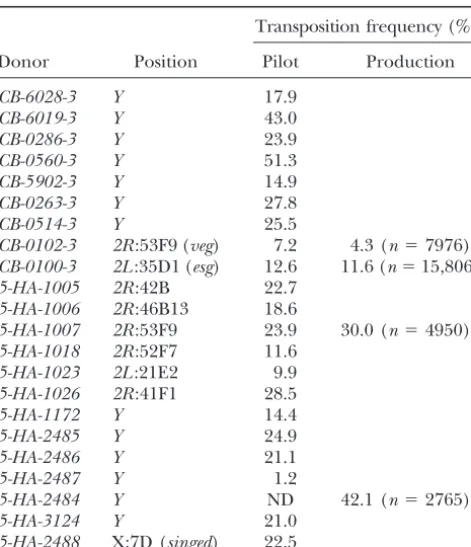
SPEP1: GACACTCAGAATACTATTC stock were compared (Table 1).
Mobilization:For the mobilization screens all crosses were Data processing:Sequences were stripped ofP-element se-performed in bottles or 4-in. glass vials on cornmeal agar quence using custom software (http://www.flyseq.org.uk/rs_ medium at 25⬚. Males of the donor stockw1118
iso;Sco/In(2LR)SM6a, progs.htm) and aligned to Release 3.1 (Celnikeret al.2002)
P{RS}, Cy;3isowere crossed tow1118iso;2iso;⌬2-3,Dr/In(3LR)TM6C, of theD. melanogastergenome sequence using BLASTN (
Alt-Sbin bottles, 10–15 pairs per bottle. schulet al.1990). We define matches to heterochromatin as
F1 dysgenic males, w1118iso; 2iso/SM6a, P{RS}; ⌬2-3,Dr/3iso, belonging to the WGS3 heterochromatin sequence available
were then crossed tow1118
iso;2iso;3isovirgin females. This second from the BDGP (http://www.fruitfly.org/sequence/sequence_
cross was performed under “standardized” conditions,i.e., one db/WGS3_het_genomic_dmel_RELEASE3-0.FASTA). We de-or two males were crossed to four to six females in each fine matches to natural transposable elements as being to the vial. These conditions were repeated for a number of donor canonical TE sequences from the file maintained at the BDGP chromosomes, so that the transposition frequency (the per- (http://www.fruitfly.org/p_disrupt/datasets/NATURAL_ centage of fertile vials that show at least one transposition) of TRANSPOSABLE_ELEMENTS.embl). Alignments and addi-each could be compared and suitable donors selected for the tional information about the mappedPelements were format-large-scale screens. A single F2progeny fly with the phenotype ted using custom Perl scripts and imported into the DrosDel
w⫹Cy⫹Dr⫹from each vial was crossed to thew1118
iso;2iso; 3iso mySQL database for further manipulation. The task of
select-stock and an unbalanced line was established and given a ing a pair of elements in a suitable location and orientation unique bar code. Following successful sequencing of the inser- to construct a deletion was achieved with custom Perl scripts. tion, these stocks were then balanced. The scripts predict all possiblew⫹deletions between 1 bp and
In an attempt to recover different insertion distributions, 1 Mb in size that can theoretically be generated from the set
RS3andRS5elements were mobilized from several different of insertions that we have mapped (http://www.flyseq.org.uk/
Ychromosome insertions isolated during the course of the rs_progs.htm). production screen (see Table 1).w1118
iso/Y, P{RS};2iso;3isomales Data release and availability: Data for this project will be
were crossed to w1118
iso; 2iso; ⌬2-3,Dr/In(3LR)TM6C, Sb virgin periodically frozen for public release. This greatly simplifies
females. The resulting dysgenic w1118
iso/Y, P{RS}; 2iso; ⌬2- both data analysis and stock ordering. Version 1.0 of theRS
3,Dr/3iso males were crossed under standard conditions to collection was released in March 2003 and contained data for
w1118
iso;2iso;3isovirgin females. The first F2w⫹Dr⫹female prog- 2527RSelements. Version 2.0 is presented here and contains eny from each vial was used to establish a new insert line. It 3243 elements. These can be combined to produce 12,258 was found that the spectrum of insertions recovered from w⫹deletions ranging in size from 1 bp to 1 Mb. In the future we
Ychromosome donors did not significantly differ from the will extend the prediction software to allow the selection of
autosomal donors used (seeresults). elements that can be combined to synthesize other
chromo-Data tracking:To facilitate data tracking all stocks were bar some aberrations, such asw⫺deletions, inversions, and translo-coded at every stage so that individual lines could be easily cations. All data and software are available from the DrosDel followed from isolation through to sequencing. The unique web site (http://www.drosdel.org.uk). In addition, the sequence ID for each element consists of a laboratory code (CB, Cam- data have all been submitted to GenBank and to FlyBase.
Figure4.—Cross 3.
with stocks containingP-element insertions that can be used forP-element mapping are unsuitable. We therefore used an internalP-element primer (PRY4) together with two custom to create custom deletions outside of the core DrosDel
defi-ciency kit we produced a web-based ordering system to inter- primers designed for genomic sequences expected to beⵑ300 bp from each side of the deletion. Unique products from each face with the web pages of the Szeged Drosophila Stock
Cen-tre. The software uses PHP and HTML to access the DrosDel end of the deletion were then amplified and sequenced. We also verified that the genetic manipulations had indeed cor-mySQL database and allows users to search for, and order,
insertion stocks, deletion stocks, and the stocks used for mobi- rectly reconstituted the predictedmini-whitesequence by using lization and deletion construction. The ordering system is the w7500D and w1167U PCR primers described byGolic available at http://www.drosdel.org.uk. It directly accesses the and Golic (1996). These amplify a 1.64-kb region of whs
Szeged Drosophila Stock Centre (http://gen.bio.u-szeged.hu/ around the FRT site. In addition to verifying by sequence, gen/) where the stock orders are processed and dispatched. each deletion described in this article has also been mapped
Construction of deletions:Constructing chromosomal dele- genetically, using mutant alleles of genes that we predict tions usingRSelements is a two-step process (seeresultsfor should be in its vicinity.
details;GolicandGolic1996) and was carried out according to the crossing schemes in Figures 4 and 5.
Confirmation of deletions:Deletions constructed using this
RESULTS method carry aPelement with amini-whitegene containing
a single FRT site within intron 1. ThisPelement should be
RS-element mobilization: Small-scale pilot
experi-stable, even in the presence ofPtransposase, since it carries
ments were performed to assess the transposition
fre-two 3⬘P-element ends (Grayet al.1996). The identity of the
pre-Figure5.—Cross 4.
sented in Table 1 the range was broad, from ⵑ7% to processed through our sequencing system (see Table 2).
Of these, 4708 lines produced a PCR product, as judged
⬎50%. The proportion of new insertions that were
ho-mozygous lethal was 12.0% for the RS3 element (n ⫽ by gel electrophoresis. Not all amplified products
pro-duced an acceptable sequence—a low percentage of
se-973) and 4.7% for theRS5element (n⫽2203). These
are broadly in line with the frequencies found in other quencing reactions failed completely (6.3%). In addition,
233 amplifications (4.9%) indicated multiple P-element
large-scale screens (Spradlinget al.1999). From these
data we selected twoRS3(CB-0102-3andCB-0100-3) and insertions, frequently visible as two or more bands by
gel electrophoresis of the PCR products. To be useful twoRS5(5-HA-1007and5-HA-2484) donor lines to
gen-erate the majority of the newRSinsertions. Large-scale for deletion construction, individualRSinsertions must
map to a single location on the Drosophila genome
mobilizations withRS3andRS5were carried out as
de-scribed inmaterials and methods. sequence. Of those elements successfully sequenced,
513 (12%) have a restriction site too close to the end
TABLE 2 TABLE 1
RS-element mobilization Recovery and characterization ofRSelements
Total %
Transposition frequency (%)
RSelements processed 5699 —
Donor Position Pilot Production
Successful PCR 4708 82.6
CB-6028-3 Y 17.9 Successful sequencing 4191 73.5
CB-6019-3 Y 43.0 BLASTN to unambiguous site 3380 59.3
CB-0286-3 Y 23.9 Multiple blast matches 307 5.4
CB-0560-3 Y 51.3 Short sequence 513 9
CB-5902-3 Y 14.9 Multiple insertions 233 4.1
CB-0263-3 Y 27.8
CB-0514-3 Y 25.5
CB-0102-3 2R:53F9 (veg) 7.2 4.3 (n⫽7976)
CB-0100-3 2L:35D1 (esg) 12.6 11.6 (n⫽15,806)
ble 3). In part, at least, this is due to the large number
5-HA-1005 2R:42B 22.7
(196,ⵑ11%) ofRS3 elements mapping to the escargot
5-HA-1006 2R:46B13 18.6
region, the site of theRS3donor element. Most of these
5-HA-1007 2R:53F9 23.9 30.0 (n⫽4950)
5-HA-1018 2R:52F7 11.6 elements have been discarded. As a consequence of local
5-HA-1023 2L:21E2 9.9 hopping events and also ofP-element-insertion hotspots
5-HA-1026 2R:41F1 28.5 (see below) there is some redundancy in the collection
5-HA-1172 Y 14.4
of mapped elements; this was therefore reduced by
dis-5-HA-2485 Y 24.9
carding many of theesginsertions, reducing the
collec-5-HA-2486 Y 21.1
tion to 3243. These 3243 insertion lines constitute
ver-5-HA-2487 Y 1.2
sion 2.0 of the DrosDel collection and can be accessed
5-HA-2484 Y ND 42.1 (n⫽2765)
5-HA-3124 Y 21.0 in our publicly accessible database. Using this collection
5-HA-2488 X:7D (singed) 22.5 we can, in theory, produce⬎12,000 customw⫹deletions ranging in size between 1 bp and 1 Mb (see below).
Results from pilot and production mobilizations using
dif-To test the quality of our primary collection we assessed
ferent donor sources. Transposition frequency is the fraction,
as a percentage of fertile vials with at least one transposition. a set of homozygous lethalRS3 insertions. We crossed
For the pilot experiments the number of fertile vials for each 47 different lethal insertions with deficiencies believed experiment wasⵑ150; for the production runs the number
to cover them. Thirty-eight (81%) of these were lethal
of fertile vials is noted in parentheses. ND, not done.
over the appropriate deletion. Ten of these 38 were selected for reversion. All 10 were reverted to nonlethal
chromosomes byP-element transposase.
Donor site effects and element distribution:Four main
of theP element (usually below 20 bp) and were
dis-donors were used during the course of ourRS
mobiliza-carded. An additional 307 (7.3%) lines mapped to either
tion screen (Table 1): three from chromosome2(
CB-heterochromatic sequences or natural transposons. In
0100-3at scaffold location 15311845 on2L,CB-0102-3at
total, 3380RSelements were successfully mapped to the
scaffold location 12161296 on2R, and5-HA-1007at
scaf-genome sequence and can therefore be used in the
de-fold location 12161298 on2R) and one from theY
chro-letion construction project. These results are
summa-mosome (5-HA-2484). We analyzed whether the site of
rized in Tables 2 and 3.
the donor element affects the distribution of recipient
There is a large difference in the percentage ofRS3
andRS5elements mapping to chromosome arm2L(Ta- elements in the genome since this information may be
TABLE 3
Chromosomal distribution ofRSelements
Average
Chromosome RS3 % RS5 % Total % spacing (kb)
2L 515 28.5 257 16.4 22.8 28
2R 344 19 356 22.6 20.7 29
3L 289 16 242 15.4 15.7 43
3R 354 19.5 337 21.4 20.5 40
4 14 0.8 9 0.6 0.7 42
X 292 16.2 371 23.6 19.6 32
TABLE 4 Predicted deletions Chromosome Deletions 2L 2,305 2R 3,658 3L 1,495 3R 2,122 4 31 X 2,647 Total 12,258
useful in designing directed strategies for increasing the
coverage ofP-element insertions in future screens. The
distribution of new element insertions on individual chromosome arms generated from different donors was tested using the two-sample Kolmogorov-Smirnov test (Robert and Casella 1999; data not shown). As we
note above, in the case of2Lthere is a significant
differ-ence in the distribution of insertions derived from the
2Ldonor and those derived from other donors. While
this bias can, in part, be attributed to the fact that the site
of the2Ldonor, in theescargotregion, is a recognized
hotspot forP-element insertions (e.g.,Ashburneret al.
1999), only 1% of insertions from the Ychromosome
donor and 0.4% of the insertions from the2Rdonor map
to this site, compared with⬎10% of insertions from the
2Ldonor. We presume that this disparity results from
synergy between local P-element hopping and a very
permissive P-element acceptor site. In addition to the
escargotlocus, there are a few other hotspots for inser-tion. A cluster of 46 elements at 53F9, in the vicinity of theCB-0102-3donor, is again presumably due to local hopping. Three other sites, at 19A2, 21B, and 92B3,
each have⬎20 independent insertions.
In general, the distribution of elements along each of the chromosome arms is uniform. On average, we have collected insertions spaced every 30–40 kb (Ta-ble 3). A relatively even distribution is important for our primary objective, to generate a set of chromosomal deletions covering the entire genome. To allow an as-sessment of the deletion coverage our collection can generate, we devised a custom Perl script to process the element-insertion data held in an SQL database. The
script takes into account the requirement to pairRS3r
andRS5relements in the correct orientation to
gener-ate aw⫹deletion chromosome. In theory, our collection
can generate 12,258 chromosomal deletions ranging in size from 1 bp to 1 Mb (Table 4). In terms of coverage
(Table 4), we find that chromosome arms2L,3R, andX
are equally represented with a little over 2000 potential
deletions possible on each. Chromosome arm2Ris
over-represented with ⬎3600 deletions predicted, whereas
3Lis underrepresented withⵑ1500 deletions possible.
These figures highlight the importance of element
dis-TABLE 5 Gene coverage of predicted deletions 2L 2R 3L 3R 4 X Size range Genes Deletions Average Genes Deletions Average Genes Deletions Average Genes Deletions Average Genes Deletions Average Genes Deletion s Average Total 1 b p to 1 0 k b 1 1 287 0.04 39 199 0.20 8 9 8 0.08 37 125 0.30 0 7 0.00 6 157 0.04 873 10 – 100 kb 1,775 225 7.89 3,208 344 9.33 1,435 183 7.84 1,639 219 7.48 12 3 4.00 1,370 226 6.06 1,200 100 – 500 kb 32,078 855 37.52 58,323 1449 40.25 17,305 487 35.53 29,596 759 38.99 449 21 21.38 34,589 999 34.62 4,570 500 kb to 1 M b 85,763 938 91.43 176,962 1666 106.22 62,440 727 85.89 95,682 1019 93.90 0 0 0.00 103,779 1265 82.04 5,615 Total — 2305 —— 3658 —— 1495 —— 2122 —— 31 —— 2647 — 12,258 A summary of the number o f g enes uncovered b y p redicted deletions in a given size range is shown. Genes, the number of genes o n a given chromosome arm that would be included in d eletions of a p articular size range. Deletions, the number o f d eletions that could b e constructed with the current collection. Averag e, the average number of genes included in d eletions of a given size range.
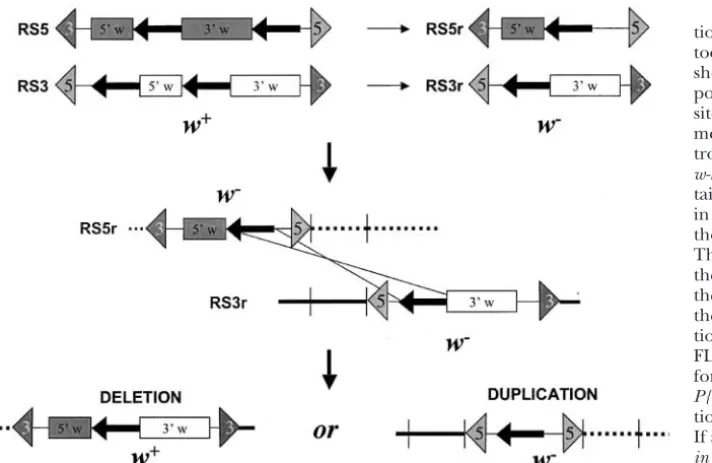
under-Figure 6.—Creating genomic dele-tions with RS elements. A stylized car-toon of theP{RS3}andP{RS5}elements shows a functional mini-white gene com-posed of two exons (boxes) and twoFRT
sites (shown as thick arrows in theP ele-ment), one of which is contained in in-tron 1 of thewhite gene. In reality the
w-hsgene used in theRSconstructs con-tains 6 exons, with the FRT site located in the first intron. The 5⬘and 3⬘ends of thePelement are marked with triangles. The elements differ in the position of the secondFRTsite in the element and the orientation of the construct within theP-element ends. Internal recombina-tion between theFRTsites mediated by FLP recombinase produces the remnant form of the elements, P{RS3r} and
P{RS5r}, each of which has a nonfunc-tionalwhite gene and a singleFRTsite. If aP{RS3r}and aP{RS5r}are arranged
in trans on homologous chromosomes and they are in the orientation and rela-tive positions shown, an FLP-mediated recombination between them produces a reconstitutedPelement with a functionalwhite
gene. The intervening genomic DNA in this example is deleted. The reciprocal event in this case creates a tandem duplication of the deleted segment, separated by anFRTsite, but nowhitegene.
represented due to a lower frequency of element inser- that will permit efficient whole-genome screens with a
manageable number of stocks.
tion on this arm (16% compared toⵑ20% for the other
major arms). Insertions in or near genes:Although not our primary
objective, some of the insertions we have generated are The fact that our collection is precisely mapped with
respect to the genome sequence allows us to accurately of utility for the gene disruption project since they are
located in genes or regions of the genome previously not determine the number of genes that deletions in
partic-ular size ranges will uncover. For example, in the 500- hit byPelements. Approximately 66% of ourRS-element
insertions map within 1 kb of a previously mappedP
ele-to 700-kb range an average ofⵑ70 genes per deletion
are uncovered on each arm (Table 5). In terms of our ment. Thus, ⵑ1000 elements may be used to increase
the coverage ofP-element insertions in the Drosophila
goal to generate a new deletion kit, we have selected
an average deletion size of 600 kb with, where possible, genome since they are ⬎1 kb away from a previously
describedPinsert. From our collection, a total of 1970
an overlap of 200 kb. This will generate a collection of
ⵑ600 deletions covering the genome. Since, on average, elements are inserted within 959 annotated genes: of
these, 36 are genes previously unmarked by aP-element
each 600-kb deletion will removeⵑ70 genes,
construct-ing deletions overlappconstruct-ing by 200 kb will allow screenconstruct-ing insertion and 33 have no previously reported alleles
in FlyBase. These data are currently being curated by
at a resolution ofⵑ25 genes per unique deleted region.
Overall, our predictions indicate that we can cover⬎95% FlyBase and are available from the DrosDel web site.
Pilot deletion screen: As a prelude to the planned
of the euchromatic genome with deletions at this
resolu-tion. Therefore, our insert collection provides good cov- deletion kit, a pilot study was performed to validate the
method for constructing deletions and ensure our lines erage and will generate deletions at a level of resolution
TABLE 6
Deficiencies constructed in the pilot screen
Df Name Band Location Name Band Location Chromosome Size (bp)
Df(2R)ED1 CB-0140-3 53E10 12090452 5-HA-1118 53F9 12161047 2R 70,595
Df(3R)ED2 CB-0160-3 91A5 14224969 5-HA-1087 91F1 14922510 3R 697,541
Df(2L)ED3 5-HA-1150 35B2 14472727 CB-0183-3 35D1 15311845 2L 839,118
Df(4)ED6364 CB-0038-3 102A4 79870 5-HA-1572 102B1 213735 4 133,865
TABLE 7
Deficiency results
Df F1variegation No. ofw⫹F2 %
Df(2R)ED1 Strong 81/1155 7
Df(3R)ED2 Red spots 2/1109 0.2
Df(2L)ED3 Slight 1/832 0.1
Df(4)ED6364 White 4/716 0.6
Df(4)ED6366 White 20/625 3.2
behave as expected. Constructing deletions with theRS
elements is a three-step process (Figure 6). A pair of
RS3andRS5elements in the same relative orientation
is selected using the software described above. Appro-priate pairs of element-bearing stocks are then individu-ally subjected to FLP-induced recombination to make
w⫺derivatives known as remnants (RS3randRS5r). In
the case of anRS5element, FLP-induced recombination
will generate a remnant that carries only the first exon
of themini-white gene; in the case of an RS3 element,
the last five exons ofmini-whitewill remain after
recom-bination. In each case the remnant element will be flanked on one side by an FRT site. The remnant
ele-ments are then combinedin transin the presence of a
source of FLP. Recombination induced between their Figure7.—Genetic analysis of deletions generated with the
FRT sites will reconstitute a functional whitegene and RSsystem. The diagrams show the genetic extent of known
generate a deletion of the sequence between the RSr deletions relative to a set of known gene mutations and
P-element insertions (triangles above the line). The end points
elements. This event will happen in both the germline
of theEDdeficiencies with respect to the scaffold sequence
and the soma; consequently the heat-shocked flies will
location are indicated below the line. See text for details. (A)
often display red sectors in the eye. The reciprocal
prod-Df(2R)ED1(53F1;53F11, 70,776 bp). (B)Df(3R)ED2(91A5;91F1,
uct will be a tandem duplication of exactly the same 697,541 bp). (C)Df(2L)ED3(35A;35D, 839,118 bp).
extent, but will remainw⫺(Figure 6). Since all of the
stocks used carry a nonfunctional endogenouswhite
al-lele, each step can be followed simply by eye color. Flies genetic tests, the reconstitutedRSelement in each
defi-ciency line was analyzed molecularly to confirm that it that carry the deletion can be identified as the only
red-eyed progeny from heat-shocked parents. The size contained the predicted deletion end points. To this end,
specific PCR primers were designed for genomic DNA of the deletions and the elements used are shown in
Table 6. Deletions between 70 and 839 kb were chosen flanking the end points of each deletion and
PCR-ampli-fied products generated from heterozygous deletion-to test the robustness of the system.
Flip-out and flip-in frequencies:The internal recom- bearing lines were sequenced. In all cases the genetic
and molecular data were in agreement with the
pre-bination of theRSelements to produce thew⫺remnants
(flip-out) was extremely efficient, with rates of conver- dicted results.
Df(2R)ED1 is the smallest deficiency we constructed
sion well over 98% in all lines tested (n⫽378). Rates of
FLP-mediated recombination to produce reconstituted at 70 kb (Figure 7A). As expected, it is lethal in
combi-nation withRhoGEF204291(53E4-F2) and
Df(2R)P803-⌬15 whitegenes and, hence, deficiencies, varied with the size
of the deletion produced, the smaller 70-kb deletion (53E;53F11). Sequencing confirms the presence of the
CB-0140-3and5-HA-1118insertion end points and the [Df(2R)ED1] occurring much more readily than the
larger ones (Table 7). The appearance of mosaic-eyed PCR product from the reconstituted wgene is also as
expected.Df(3R)ED2 isⵑ10-fold larger at 697 kb
(Fig-flies in the heat-shocked generation is indicative of the
success of the flip-in. The frequency and size of red sec- ure 7B). The deletion chromosome is lethal in
combina-tion withP{lacW}l(3)S007302(91B1-6) andDf(3R)Cha9
tors is often reflected in the frequency of red-eyed
prog-eny in the next generation and there is some correlation (91C7-D1; 92A2); again the molecular mapping
con-firms the predicted end points and the correctwgene
between the degree of F1variegation and the size of the
deletion. structure.Df(2L)ED3is the largest deletion we attempted
at 839 kb, just under 0.7% of the euchromatic genome
Verification of elements:The pilot deficiencies were
examined genetically by complementation testing with (Figure 7C). It is genetically deleted for noc(no-ocelli)
Figure7.—Continued.
predicted from theRS-element-insertion sites. Molecu- periments could be that the reconstitutedRSelement
would mobilize in the presence of a source of transpo-lar mapping confirmed the predicted end points.
Fi-nally, to demonstrate the resolution and utility of the sase. However, deletions constructed with this method
generate a recombinant P element that is flanked by
system, we attempted to construct two fourth
chromo-some deletions differing by a single, predicted, haplo- two 3⬘-P-element ends. This element should be stable
in the presence ofP-element transposase since
trans-insufficient gene (Figure 8). We began with a common
position requires intact 5⬘and 3⬘ends (Mullinset al.
RS5element (5-HA-1572) inserted inCG2316and
gen-1989). To confirm the stability of the double 3⬘ P
ele-erated a 123-kb deletion [Df(4)ED6366] ending in the
ments we screened for the loss of the w⫹ marker in
5⬘end ofpangolinby recombination withCB-5204-3. A
three different deletion lines in the presence of the
second deletion [Df(4)ED6364] extended a further 10 kb
⌬2-3 transposase. No w⫺progeny were observed from
proximal (CB-0038-3, 2 kb distal toci) and removes the
Df(2R)ED1 (18,305 progeny), Df(3R)ED2 (7368
prog-predicted ribosomal protein-encoding gene, RpS3A
eny), orDf(2L)ED3(16,743 progeny).
(CG2168). Molecular mapping confirmed the predicted breakpoints and a genetic analysis confirmed that both
deletions fail to complement pan mutations. Since
DISCUSSION
Df(4)ED6364removesRpS3Awe would expect it to show
a dominant Minute phenotype and this is indeed what We describe here the results of P
-element-mobiliza-we observe. tion screens using a pair of transposons that facilitate
Element stability:A potential problem with using de- the generation of custom chromosomal aberrations
us-ing the methods developed byGolicandGolic(1996).
ex-Figure8.—Generating deletions with single-gene resolution:Df(4)ED6364andDf(4)ED6366both start at the distal insertion,
5-HA-1572.Df(4)ED6366extends toCB-5204-3, which is distal to the ribosomal protein geneRpS3A. As a heterozygoteDf(4)ED6366
is phenotypically normal (Minute⫹). Df(4)ED6364extends a further 10 kb proximal toCB-0038-3and deletes theRpS3Agene. Individuals heterozygous for this deletion show a strongMinutephenotype. The molecular map is a representation of the genome annotation from Apollo.
In total, we have mapped 3243 insertions by DNA se- notypes. Along with complex genetic traits, it is
becom-ing clear from data generated in microarray experi-quencing onto the current Drosophila genomic
se-quence scaffold. Our analysis indicates that we can use ments in both Saccharomyces cerevisiae and Drosophila
that genetic background can have profound effects on these insertions to produce, in theory, 12,258 different
deletions between 1 bp and 1 Mb. With the current gene expression. A genome-wide genetic resource
gen-erated on a single genetic background will be of consid-element distribution the collection can potentially
gen-erate deletion coverage for ⵑ95% of the euchromatic erable utility in pursuing genomics approaches to
Dro-sophila biology. It might be argued that the genetic genome. The materials to synthesize all of these
dele-tions are available from public stock centers. The pilot background for this resource should be that sequenced
by the Drosophila genome project (Adamset al.2000).
experiments presented here indicate that molecularly
defined deletions of⬎800 kb can be efficiently gener- However, this background carries four visible mutations
(y1,cn1,bw1, andsp1), each of which could interfere with
ated. Whether or not any particular deletion can be
re-covered will, of course, depend upon the phenotypic a phenotypic assay. For this reason we chose to use a
genetic background that was as free of known mutations consequences of haploidy for its chromosome region.
In very general terms deletions that are ⬎1 Mb in as possible and was also consistent with the genetic
meth-ods needed to attain our end. Of course the isogenic
D. melanogasterare inviable as heterozygotes (Ashburner
1989). We are, therefore, aiming to generate a set of background of the stocks will not be maintained forever
since the natural accumulation of mutations in the stocks 600-kb deletions overlapping by an average of 200 kb.
This will cover the majority of the euchromatic genome will, over time, generate second-site lethals, in
particu-lar, deletion or element stocks. While this is a difficulty
with deletions at a resolution ofⵑ25 genes per deletion.
In practice, this means that the whole genome can be that affects all Drosophila stocks, our collection is unique
in that it starts from a uniform genetic background. In
screened at high resolution withⵑ600 stocks.
Our collection is of particular utility because all of addition, since our collection can be used to generate
cus-tom deletions, any suspect genetic interaction detected the insertion lines and the deletions that are derived
from them are in a uniform genetic background. The with a DrosDel deletion can, in many cases, be rapidly
checked by simply selecting an alternative pair of ele-importance of this fact cannot be overstated since many
biological processes, particularly complex multigenic ments and generating a new deletion. Individual RS
stocks are unlikely to accumulate the same mutations. traits, are very sensitive to genetic background. In
con-structing our collection we were careful to assay several We demonstrate the utility of our P-element
collec-tion for generating molecularly defined deficiencies by isogenic lines to select a genetic background that scored
as close to wild type as possible in different behavioral constructing five deletions, ranging in size from 70 to
839 kb, which delete 14 (ED1), 52 (ED2), 51 (ED3), 8
assays. This selection alone will make our collection of
ge-netic and molecular mapping of each deletion indicates correct name for each potential deletion they could gener-ate. The names of the deletions follow the current nomen-that they are all of the expected structure. In addition to
this we show how the collection can be used to generate clatural guidelines (http://flybase.bio.indiana.edu/docs/
nomenclature/lk/nomenclature.html) with the generic deletions with single-gene resolution. This aspect of the
collection may be useful for studies with previously in- symbol Df(n), wheren is the chromosome or
chromo-some arm containing the deletion, followed by the suffix tractable regions of the genome and suggests that
inter-ested researchers may be able to rapidly construct a set EDN, whereNis a preassigned integer,e.g.,Df(3R)ED2.
Data on allw⫹DrosDel deletions that can theoretically
of defined deletions that can provide a fine-structure
genetic map in regions of particular interest. be generated have been submitted to FlyBase. Those
that have not been made are listed under a new class We note that other researchers have recognized the
need for generating custom chromosomal deficiencies of aberration: potential deficiency.
In addition to the w⫹ deletions we describe here,
on a genome-wide scale. A recently described method,
using a hybrid P-element – hobo transposon, demon- the RS elements can generate other aberrations. For
example, if we remove the limitation that deletions pro-strates that it is possible to generate deletions of at least
0.5 Mb and that by using a molecular screen one can duced by recombiningRSrelements need to generate
w⫹ progeny, the coverage of the collection is
substan-recover many nested deletions in a particular region
(Huet et al 2002; Mohr and Gelbart 2002). While tially increased. With these criteria we estimate that an additional 37,000 chromosomal deletions could be con-this system is clearly very flexible, the advantage of our
collection is that deletions may be generated from stocks structed with our collection. Such deletions may be
gen-erated from any two elements that are a suitable distance already mapped to the genome sequence and further
molecular characterization is limited to confirming the apart and in the correct orientation; there is no longer
a requirement to use oneRS3 and oneRS5. Although
deletion end points.
The process of generating deletions once appropriate these deletions cannot be selected on the basis of eye
color they may be isolated using selection strategies pairs of elements have been identified is
straightfor-ward. We have produced a “genetic toolbox” of 14 fly combined with molecular methods such as PCR (i.e.,
Kaiser andGoodwin1990) or by the classical genetic strains, all based on our isogenic background, that
re-searchers can use to construct custom deletions. These method of uncovering a recessive visible marker.
Alter-natively, w⫺ deletions or duplications can be selected
are available from public stock centers and detailed
instructions for crossing schemes are on the DrosDel by scoring for male recombination; however, in this case
the isogenicity of the genetic background would be lost. web site. In addition, we provide a range of informatics
tools on the web site that allow researchers to easily As with the current, widely used deficiency kit, a
bar-rier to any attempt to cover the entire Drosophila ge-select pairs of elements to generate deletions in regions
of interest. The initial flip-out to generateRSrremnant nome with deletions or mutations is the presence of
insufficient regions. Approximately 76 haplo-elements is extremely efficient and the easily identified
w⫺ individuals are recovered after a single heat-shock insufficient loci are known inD. melanogaster(Lindsley
et al. 1972;Ashburner1989; K.Cook, personal commu-pulse during embryogenesis. In the case of the flip-in
to generate the deletion, efficiency varies with the size nication). These may have a visible, lethal, or sterile
phenotype. Of these, at least 55 are known or are
pre-of the deleted genomic segment. For small (⬍100 kb)
deletions, almost 10% of the progeny arew⫹and have dicted to be due to the haplo-insufficiency of genes
encoding ribosomal proteins (Lambertsson 1998;
therefore undergone the appropriate recombination.
With larger deletions the efficiency drops off to 0.1% K.Cook, personal communication). Deletions for most
of these will have a Minutephenotype (Lambertsson
or less; however,w⫹ individuals are easily spotted in a
population, even at a level of 1/10,000. We therefore 1998) and should be recoverable if suitable precautions
are taken (i.e., by allowing slowly developing genotypes
believe that, within the limitations of the deletion size
that flies will tolerate, we can efficiently construct a tile to hatch). In some regions more than one ribosomal
protein maps close together; however, in general,
Min-of genomic deletions spanning much Min-of the
euchro-matic portion of the genome. utes are not additive in their phenotypic effects
(Schultz1929). When we take into account the
loca-Any researcher can order a particular pair ofRS
ele-ments and, from them, construct a deletion. If more tions of known haplo-insufficient loci, we calculate that
our insertions will enable the construction of deficien-than one laboratory did so for a particular pair of
ele-ments and named the resulting deletion differently, cies that will cover 86% of the euchromatic genome.
This is virtually identical to the 85% coverage attained then recording and annotating information from the
literature could become difficult. For this reason we with the current, genetically heterogeneous deficiency
kit.
have prenamed all theoretically possiblew⫹ deletions
up to 1 Mb in size and appeal to the community to use Several stratagems are available to obviate the
prob-lems of haplo-insufficient loci. If these loci have been these names. When researchers order stocks from the
36:283–287;A. L. Parks, K. R. Cook, M. Belvin, N. A. Dompe, R. be to balance the deletion with a suitable duplication.
Fawcettet al., 2004, Systematic generation of high-resolution
dele-Such duplications can be constructed as the reciprocal
tion coverage of theDrosophila melanogastergenome. Nat. Genet.36:
products of the deletions described here (Figure 6); 288–297).
however, in this case it is not clear how stable such tandem duplications will be in isolation when they do
not balance a haplo-insufficient region. An alternative LITERATURE CITED
approach is to generate duplications as recombinants
Adams, M. D., S. E. Celniker, R. A. Holt, C. A. Evans, J. D. Gocayne
between similar pericentric inversions, either directly et al., 2000 The genome sequence ofDrosophila melanogaster.
Science287:2185–2195.
or via autosynaptic intermediates (Gubb1988; D.Gubb
Altschul, S. F., W. Gish, W. Miller, E. W. MyersandD. J. Lipman,
and J.Roote, unpublished observations). In their
arti-1990 Basic local alignment search tool. J. Mol. Biol.215:403–410.
cle describing the system,GolicandGolic(1996) show Ashburner, M., 1989 Drosophila: A Laboratory Handbook. Cold Spring
Harbor Laboratory Press, Cold Spring Harbor, NY.
how the RS elements can be used to generate other
Ashburner, M., S.Misra, J.Roote, S. E.Lewis, R.Blazejet al.,
chromosomal aberrations by design. For example,
inver-1999 An exploration of the sequence of a 2.9-Mb region of the
sions and duplications can be produced with similar genome ofDrosophila melanogaster: theAdhregion. Genetics153:
179–219.
ease from RS insertions, considerably increasing the
BloomingtonDrosophilaStock Center, 2003 http://flystocks.
utility of the collection we have produced. We confirm
bio.indiana.edu/
their observations by generating both inversions and Bridges, C. B., 1916 Non-disjunction as proof of the chromosome
theory of heredity. Genetics1:1–52.
autosynaptics from our RS collection in pilot
experi-Celniker, S. E., D. A. Wheeler, B. Kronmiller, J. W. Carlson, A.
ments (D.Coulson, unpublished observations). We are
Halpernet al., 2002 Finishing a whole-genome shotgun: release
currently exploring the possibility of generating a ge- 3 of theDrosophila melanogastereuchromatic genome sequence.
Genome Biol.3:RESEARCH0079.
nome-wide duplication kit to complement the
defi-Dura, J. M., T. PreatandT. Tully, 1993 Identification oflinotte,
ciency kit. A final approach to increasing deletion
cover-a new gene cover-affecting lecover-arning cover-and memory inDrosophila
melanogas-age is to attempt to construct individual deletions that ter.J. Neurogenet.9:1–14.
FlyBase, 2003 The FlyBase database of theDrosophilagenome
proj-flank the haplo-insufficient locus. We demonstrate here
ects and community literature. Nucleic Acids Res.31:172–175
the possibility of this approach by generating two fourth
(http://flybase.org/).
chromosome deletions that differ by a single gene, Golic, K. G., andM. M. Golic, 1996 Engineering the Drosophila
genome: chromosomal rearrangements by design. Genetics144:
RpS3A. Animals haploid for RpS3A can be recovered;
1693–1711.
they do, however, display a strongMinutephenotype.
Gray, Y. H., M. M. TanakaandJ. A. Sved, 1996 P-element induced
In summary, we have generated a collection ofP-ele- recombination inDrosophila melanogaster: hybrid element
inser-tion. Genetics144:1601–1610.
ment insertions on an isogenic genetic background that
Gubb, D., 1988 Chromosome mechanics; the genetic manipulation
permit the construction of molecularly defined
chromo-of aneuploid stocks, pp. 109–130 inDrosophila: A Practical
Ap-somal aberrations in Drosophila. Using our collection, proach, Ed. 2, edited by D. B.Roberts. IRL Press, Oxford.
Hamblen, M., W. A. Zehring, C. P. Kyriacou, P. Reddy, Q. Yuet
⬎12,000 precisely mapped deletions can theoretically
al., 1986 Germ-line transformation involving DNA from the
be generated. We demonstrate the feasibility of using
periodlocus inDrosophila melanogaster: overlapping genomic
frag-the collection to generate genetically and molecularly ments that restore circadian and ultradian rhythmicity toperO
andper⫺mutants. J. Neurogenet.3:249–291.
verified deletions and further show how the collection
Huet, F., J. T. Lu, K. V. Myrick, L. R. Baugh, M. A. Crosbyet al.,
can be employed to delete genomic regions with
single-2002 A deletion-generator compound element allows deletion
gene resolution. The collection, along with computa- saturation analysis for genomewide phenotypic annotation. Proc.
Natl. Acad. Sci. USA99:9948–9953.
tional tools for mapping, is available to the wider
re-Jin, W., R. M. Riley, R. D. Wolfinger, K. P. White, G. Passador
-search community, giving re-searchers the capability of
Gurgelet al., 2001 The contributions of sex, genotype and age
generating defined chromosomal deletions in regions to transcriptional variance inDrosophila melanogaster.Nat. Genet.
29:389–395.
of interest. We are now proceeding with the
construc-Kaiser, K., andS. F. Goodwin, 1990 “Site-selected” transposon
mu-tion of a core deficiency kit. tagenesis in Drosophila. Proc. Natl. Acad. Sci. USA87:1686–1690.
Karess, R. E., 1985 P-element mediated germ line transformation
We are deeply indebted to Kent Golic for reagents, advice, and
ofDrosophila, pp. 121–142 inDNA Cloning, Vol. 2, edited by D. M. encouragement throughout this project. We acknowledge the
excel-Glover. IRL Press, Oxford.
lent technical assistance of Christian Apelt, Thomas Rudolph,
Anne-Lambertsson, A., 1998 TheMinutegenes inDrosophila melanogaster
Cathleen Aurich, and Monika Dosztig during this project. The work and their molecular functions. Adv. Genet.38:69–134. described in this article was funded by a grant from the European Lindsley, D. L., L. Sandler, B. S. Baker, A. T. C. Carpenter, R. E. Community (QLRT-2000-915) and a Biotechnology and Biological Denellet al., 1972 Segmental aneuploidy and the genetic gross Sciences Research Council Investigating Gene Function award (8/ structure of the Drosophila genome. Genetics71:157–184.
Merrill, P. T., D. SweetonandE. Wieschaus, 1988 Requirements
IGF12434) to S. Russell, M. Ashburner, D. Glover, and C. O’Kane.
for autosomal gene activity during precellular stages ofDrosophila melanogaster.Development104:495–509.
Note added in proof: Subsequent to the acceptance of this manuscript,
Mieklejohn, C. D., J. Parsch, J. M. RanzandD. L. Hartl, 2003
two articles describing a collection ofpiggyBac-based insertions and a
Rapid evolution of male-biased gene expression in Drosophila.
set of deletions created by an FRT-based approach similar to the one
Proc. Natl. Acad. Sci. USA100:9894–9899.
described here have been published, supporting the utility of the Mohr, S. E., andW. M. Gelbart, 2002 Using theP{wHy}hybrid method we propose (S. T. Thibault, M. A. Singer, W. Y. Miyazaki, transposable element to disrupt genes in region 54D–55B in
B. Milash, N. A. Dompeet al., 2004, A complementary transposon Drosophila melanogaster.Genetics162:165–176.
Mullins, M. C., D. C. RioandG. M. Rubin, 1989 Cis-acting DNA
sequence requirements forPelement transposition. Genes Dev. Spradling, A. C., D. Stern, A. Beaton, E. J. Rhem, T. Lavertyet al., 1999 The BerkeleyDrosophilaGenome Project gene disruption
3:729–738.
O’Hare, K., andG. M. Rubin, 1983 Structures of P transposable project: singleP-element insertions mutating 25% of vital
Dro-elements and their sites of insertion and excision in theDrosophila sophila genes. Genetics153:137–177.
melanogastergenome. Cell34:25–35. St. Johnston, D., 2002 The art and design of genetic screens.
Dro-Pacual, A., andT. Preat, 2001 Localization of long-term memory sophila melanogaster. Nat. Rev. Genet.3:176–188.
within theDrosophilamushroom body. Science294:1115–1117. Tully, T.,andW. G. Quinn,1985 Classical conditioning and
reten-Robert, C., andG. Casella, 1999 Monte Carlo Statistical Methods. tion in normal and mutant Drosophila melanogaster. J. Comp.
Springer-Verlag, New York. Physiol.157:263–277.
Rubin, G. M., andA. C. Spradling, 1983 Vectors forP-element- Zusman, S. B., andE. F. Wieschaus, 1985 Requirements for zygotic
mediated gene transfer in Drosophila. Nucleic Acids Res. 11: gene activity during gastrulation inDrosophila melanogaster.Dev.
6341–6351. Biol.111:359–371.
Schultz, J., 1929 The Minute reaction in the development of