97
All Rights Reserved © 2012 IJARCSEE
Receiver Location Privacy in MANET By Using cyclic
technique for node ID generation
Satish Shrivastava
Nitin Agrawal Sitendra Tamrakar
M.Tech Scholar
Asst.Prof. CSE Asst.Prof. CSE
NRI INSTITUTE OF INFORMATION SCIENCE & TECHNOLOGY
,
BHOPAL
Abstract— In this paper pprivacy attacks to ad hoc
routing protocols become an important issue as mobile
ad hoc networks enter security critical domains.
We
modified Rids scheme for node location privacy in
ANDOR protocol in mobile adhoc network. RIDS
scheme also provide facility for the detection of
wormhole attack and node misbehaviors in adhoc
network. Different author proposed a different
scheme for RIDS for providing security in mobile
adhoc network. But all technique suffered common
problem that problem is generation of node ID and
protection of node ID in location based routing
protocol. In this dissertation we modified the RIDS
model for node id generation technique for
identification of location of secured node. For these
process we used cyclic shift technique for node ID
generation. Here we discuss RIDS ANDOR and
describe our proposed scheme.
Keywords— Location Disclosure Protection;
Anonymity; Security; Ad Hoc Networks.
I.
I
NTRODUCTIONRecent wireless research indicates that wireless Mobile Ad Hoc Networks (MANET) present a larger security problem than conventional wired and wireless networks [1,2]. In the traditional Internet, routers within the central parts of the network are owned by a few well-known operators and are therefore assumed to be somewhat trustworthy. This assumption no longer holds in an Ad Hoc network, since all nodes entering the network are expected to take part in routing. Also, because the links are usually wireless, any security that was gained because of the difficulty of tapping into the network is lost. Furthermore, because the topology in such a network can be highly dynamic, traditional routing protocols can no longer be used. Thus, Ad Hoc
network has much harder security requirements than the traditional network and the routing in Ad Hoc networks is an especially hard task to accomplish securely, robustly, and efficiently. In general, the wireless MANET is particularly vulnerable due to its fundamental characteristics of open medium, dynamic topology, absence of central authorities, distributed cooperation, and constrained capability. The existing security solutions for wired networks cannot be applied directly in wireless MANETs. Applications that make use of ad hoc routing have heterogeneous security
requirements. Authentication, message integrity, and
non-repudiation to an ad hoc environment are part of a minimal security policy. Apart from these, there are several other security issues [1, 3] such as black hole attacks, denial of service, and information disclosure. A location disclosure attack can reveal something about the locations of nodes or the structure of the network. The information gained might reveal as to which other nodes are adjacent to the target, or the physical location of a node. In the end, the attacker knows which nodes are situated on the route to the target node. If the locations of some of the intermediary
nodes are known, one can gain information about the location of the target as well. In many cases, the location information might be very crucial. In MANETs installed for tactical/military missions in a hostile and/or unknown territory, these types of attacks have to be prevented. In many cases, the communicating nodes need to be anonymous—no other node in the network should know who is communicating with whom. Initially, we present a solution that achieves complete anonymity and discuss trade-offs between complete anonymity and difficulty in identifying misbehaving nodes. We then present enhancements to our protocol to prevent these attacks albeit at the cost of complete anonymity
98
All Rights Reserved © 2012 IJARCSEE
scenario the eavesdropping adversary tries to track the route discovery messages to infer some information about the destination’s venue or the route established between source and destination. To realize the importance of location privacy imagine a MANET in a battlefield where the nodes are living soldiers. If the adversary breaks the location privacy of the nodes in such a scenario the existence of the soldiers would be revealed and also their lives
Might be in danger
The rest of this paper is organized as follows. In section II some related works are reviewed. Section III gives an overview of the ANODR protocol. Section IV describes the adversary model. Section V concludes this paper
II.
RELATED
WORK
Chaum’s mixnet [8] and DC-net [9] were the origin of many future ideas to address private communication. Mixnet removes the correlation between sources and destinations. A mix node is a network member that performs encryption and padding on its received messages and sends them out in a random order so that it is impossible for outsiders to distinguish which output message belongs to which input message. DC-net [9] is based on binary superposed sending. In DC-net the anonymity set is composed of all potential senders. Each sender shares a secret key at least with one other user. If sender A is wishing to send a message, it should superpose the message with its exchanged secrets. Other users superpose in the same manner (if no message to send they superpose zero with shared keys). All messages are transmitted to the receiver. The sum of these messages is the message of A, because every secret is added twice and canceled. Therefore, the message is delivered without revealing the originator. Another solution proposed for wired networks is Crowds [10]. Crowds consists of a number of network users. Before a data request is sent to the server it is chained randomly through a number of crowds members, so that the server knows that it came from one of the members, but he has no idea about the original sender. The protocols proposed to provide anonymity
in wired networks assume having a fixed topology and usually having trusted third parties. Such solutions are not suitable for MANETs as well as any other mobile scenario in which the network topology might change all the time. Most of the routing-based anonymous protocols for MANETs try to address the identity anonymity issue, e.g.
are static and data is always sent to a powerful sink. One of the first simple ideas to address the destination location privacy in ad hoc routing protocols was not to stop the route request packet flow at the destination node and continue with that for several extra hops to hide the
receiver’s venue. Also for route location privacy the authors of ARM [7] proposed not to forward the RREP message only on the discovered route which is the case in every other MANET routing protocols, but to form a cloud of routes around the real one. This is done by adding a TTL field to the packets which is used to forward them for a number of hops around the discovered path. The neighbors of the nodes en route who receive the RREP message should broadcast it after replacing some fields by random numbers and their neighbors would do so till the TTL reaches zero. Therefore the discovered route is covered by some fake flows. Also the data packets will be broadcasted in a limited number of hops around the discovered route for
the same purpose. This solution provides route location
privacy to some level, i.e. makes the adversary uncertain about the real route’s location inside the cloud, but can not hide the destination’s location which might be of higher importance. We refer to this idea of ARM as
route cloud idea. Some location privacy solutions for MANETS are proposed for geo-routing scenarios, e.g. [14] addresses destination location privacy for the category of MANETs in which geographic information of the nodes is available. This protocol uses the location information of the destination node to generate an area including the destination to deliver the data packets to all of the nodes in that. The number of nodes inside the anonymity zone determines the privacy level provided by the protocol. On the other hand, measuring the network anonymity in general is another issue in private communication research area. [15] and [16] have proposed information theory based metrics to quantify privacy. The basic idea is that the privacy degree is maximized when all anonymity set members have the same probability to be the real object of interest.
III OVERVIEW OF THE UNDERLYING ROUTING PROTOCOL
99
All Rights Reserved © 2012 IJARCSEE
it will try to open the trapdoor with its private key. If it succeeds and sees the well known tag it will consider itself as the destination and initiates the RREP message. Otherwise, it adds a self aware layer to the one is a highly motivated passive avesdropper who has the ability to monitor the traffic all over the network, for example by employing several overhearing nodes in different points of the network to cover the whole area. Our goal against this adversary is to prevent it from finding the destination’s venue and also the path between communicating pairs. The second attacker considered is an internal adversary, which is a compromised node in the network. The adversary can take control of the compromised node. The private routing protocol should make it impossible for him to break the location privacy of the destination even if it is located on the route. Internal Adversaries should be prevented from finding out if their neighbor nodes are source or destination even if they are on the same route. We suppose that the compromising capability of the adversary is not unlimited onion and encrypts the new onion with its secret key and also attaches a one time public key to the message and rebroadcasts it. The next nodes would do the same and would record the one time public key sent by the previous node which will be used in RREP phase. Eventually if the destination receives the RREQ message it will initiate the RREP message. The nodes on the route from the destination to the sender will directly forward this message to the sender. The RREP message includes the proof of trapdoor opening,
Proofdes, generated by the destination, which the sender will use to verify if the RREP is initiated by the intended destination. Every node on the route generates a random
route pseudonym, Kseed, encrypts it by the one time
public key of the previous node and replaces that in the appropriate field of the received RREP message. The route seudonym will be used as the shared secret key between every two consecutive nodes en route in data forwarding phase. The onion and the proof of trapdoor opening are encrypted by the route pseudonym to hide them from outsiders. Every intermediate node opens the random route pseudonym with its one time public key and then uses it to extract the onion. Then it strips its own layer from the onion expecting to see what it has encrypted a while ago and modifies that with its route pseudonym and stored one time public key and forwards that to the previous node on the route. Eventually when the sender receives the RREP packet it will open the onion and check for the appropriate proof of successful trapdoor decryption. If the onion data matches the previously generated onion core and the proof of trapdoor decryption is shown, the route discovery is done. The RREQ
and RREP packet formats are as follows:
RREQ : < RREQ, seq#, global trap, onion, PK − 1time >
RREP : < RREP, {Kseed}PK−1time, fKseed (Proofdes, onion) >
Each intermediate node records the correspondence between its own route pseudonym and its upstream node’s route pseudonym in its routing table. When a data packet is received, the intermediate node looks up its routing table for the received route seudonym. If it is found, the node would replace the route pseudonym with the next hop’s corresponding one and forward the packet. Otherwise, the packet will be discarded. A symmetric key would be piggybacked in the first global trapdoor from the destination to the sender as the end to end encryption key for next contacts. To avoid public cryptosystem’s expenses, this symmetric key will be used for the next RREQ messages from the same sender to the same destination e.g. in case that the route is broken due to node mobility and a new route shall be reestablished [17].
IV
PROPOSEDWORKA. RIDS-ANDOR
Main ideas of RDIS, consisting of hiding the route reply message flow as well as the ring route idea. We will apply this idea to ANODR as an underlying routing protocol, but it could be applied to some other identification-anonymous routing protocols in an appropriately designed similar way[25]. As mentioned earlier, in RDIS the RREP messages are unified with RREQ messages in appearance since being initiated till a random number of hops from the destination. We call the RREP packets modified to RDIS type as RDIS-RREP packets which can only be distinguished by the nodes on the discovered route. RDIS also can achieve route privacy when it is combined with the cloud technique. One random node en route will decide to change the appearance of the RREP packet from RDIS-RREP to a RDIS-RREP. From that node on, we use the cloud idea of ARM to route the RREP message toward the source node. So the adversary will not be able to distinguish the discovered route
Message Type Unification
100
All Rights Reserved © 2012 IJARCSEE
work is to hide the destinations location by making it impossible for the adversary to determine the origin of route reply packets. We use the similar message type, RDIS, for RREQ and RREP packets. The nodes on the route use the keys to check if this is a RREP message intended to them. So when a RDIS-RREP message is forwarded, the nodes out of the route would behave exactly as they do about a RDISRREQ message till the TTL field reaches zero. As we will describe, after a random number of hops the RDIS-RREP packet is changed to a RREP packet as Figure 1 shows. This is because forwarding the reply packet in RDIS-RREP format toward the source causes a high overhead due to two reasons. First, the RDIS-RREP packet will be broadcasted by every node receiving that till TTL = 0, and second the size of a RDIS-RREP packet is larger than a normal RREP packet
B. Applying RDIS to ANODR
To apply RDIS to ANODR we need to change the appearance of the route request and the route reply messages to the unified one so that the RDIS-RREP flow seems to be part of the RDIS-REQ flow to any outsider without losing the routing functionalities. For this purpose many properties should be considered. One is the size of RDIS-RREP and RDIS-RREQ packets which Should be the same to prevent the outsider to distinguish them. Another one is that the appearance difference from the RDISRREQ packet the destination node receives and the RDISRREP packet it initiates should be similar to the difference between a received RDIS-REQ packet received at any other node and the RDIS-RREQ packet broadcasted consequently by it. Therefore the initiation of the RDIS-RREP message would look like a part of the RDIS-RREQ flow. Also every field of one of these two message types should change with the same pattern as the other one. For example, the sequence number that is a fixed field in RDIS-RREQ should be preserved the same in the corresponding RDIS-RREP flow. As a matter of course we change the content of the message type field in both of them to the same packet type, RDIS. When a node receives a RDIS packet with new seq #, it will generate a random number between 0 and 1. If the number is less than a fixed parameter Pf the node will proceed with the packet, otherwise it will do nothing and therefore discard the packet. If the node decides to proceed with the received packet it will record the seq# in its routing table and will proceed with the message to follow the ordinary ANODR behavior (described in section III). When the destination node receives the RDISRREQ message it generates the corresponding RDIS-RREP packet. It decreases the received TTL by one. The
RDIS-RREP packet includes a sequence number field filled with the same seq# of the corresponding RDIS-RREQ (in regular ANODR there is no sequence number or TTL in reply packets). The global trapdoor is
preserved in RDIS-RREP. We change
{Kseed}PK−1time to {REPLY,Kseed}PK−1time in the RDIS-RREP packet. In order to match the size of the RDIS-RREP packets we need to add an additional field in the RDIS-RREQ packets filled with random data. So all in all a RDIS-RREQ packet will look like
< RDIS, TTL, seq#, global trap, onion, PK − 1time, random field >
And a RDIS-RREP packet will look like
< RDIS,TTL, seq#, global
Trap {REPLY,Kseed}PK−1time,
fKseed (Proofdes, onion) >
The adversary may distinguish between the RDIS-RREQ and RDIS-RREP messages because he knows that the onion length in RREQ messages increases as the message nears the destination and the onion length in RREP messages decreases as the message gets further from the destination. Therefore the onion length should be fixed. In an improved version of ANODR the length of the onion is fixed at 128 bit Every node applies its symmetric key encryption on the 128 bit long onion. In RDIS, we use this mechanism to prevent the adversary from using the varying length of the onion to analyze the message type or the distance from the destination.When a node receives a RDIS message while it has forwarded another RDIS message with the same seq# before, it will try to open {REPLY,Kseed}PK−1time using its one time public key generated during the RREQ phase. If after such a decryption the node can see the REPLY tag it realizes that this packet is a RDIS-RREP intended to it. Then it will generate a random number between 0 and 1. If this number is greater than a fixed parameter Pr it will decrease TTL by one and replace the Kseed and the onion with its own .Otherwise, it will change the RDIS-RREP message to a normal RDIS-RREP message as shown below, but the TTL field will be preserved to be used for the route cloud idea. So one of the nodes en route randomly will change the RDIS-RREP packet to a normal RREP as follows, which except having the TTL field is the ordinary reply packet format in ANODR: < RREP, TTL, {Kseed}PK−1time, fKseed (Proofdes, onion) >
101
All Rights Reserved © 2012 IJARCSEE
ANODR). If so, the node will modify the reply packet as described in III and will also decrease TTL by a random number among 1,2,3 and 4. Therefore this packet will be forwarded on the discovered route normally till it reaches the destination. When a node that is not located on the discovered route receives such a packet and it realizes that the packet is not intended to it, it will generate a random number among 1,2,3 and 4 and will decrease the TTL by that. It will also replace the next two fields with random bits without changing the packet size and broadcasts the packet. Therefore a cloud of routes will be formed around the route and the discovered route will be hidden among them. This will provide the protocol with route location privacy
Ring route RDIS
RDIS instead of a route between the source and destination we form a ring route such that the two communication end nodes are located on that. For this purpose the destination node should respond not only to the first received RREQ message but to the first two of them. Therefore two routes will be formed between the source and the destination. As mentioned above, in RDIS every
C. Cyclic Shift and Bit wise Exclusive OR (XOR)
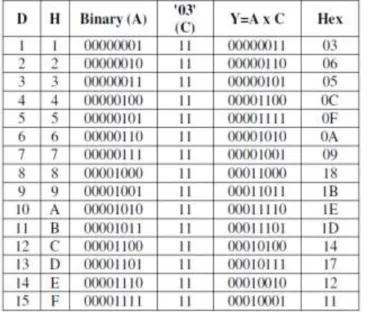
Let x be a block of n bits. A cyclic shift to the left by m bits is performed by taking the first m bits from the left side of the block and attaching them to the right side Accordingly, a cyclic shift to the right by m bits is performed by taking the first m bits from the right side and attaching them to the left side. Table 1 shows the multiplication of '03' and it is followed by Table 1 which shows that by using cyclic shift operation, then XOR by the number itself, it Will produce the same result as Table.
TABLE 1: Finite Field multiplication of '03' in binary and hexadecimal
So that for '0E','0D','0B' and '09' finite field multiplication:
'0E' = (((A<<1) XOR A) <<1) XOR A) << 1 '0D' = ((A<<1) XOR A) <<2) XOR A '0B' = (A<<1) XOR A) XOR (A<<3) '09' = ((A << 3) XOR A)
It was found that in new approach technique, GF (2^8) multiplications, which is the best method that can be implemented by table look-up has been replaced by cyclic shift and XOR operation.
A session key is a single-use symmetric key used for encrypting all messages in one communication session. A closely related term is content encryption key (CEK), traffic encryption key (TEK), or multicast key which refers to any key used to encrypt messages, as against different uses, like encrypting other keys (key encryption key (KEK) or key wrapping key). Session keys will introduce complication into a system, normally to an undesirable end also help with some real issues. There are two primary reasons to use session keys:
First, several cryptanalytic attacks become easier as more material encrypted with a specific key is available. By limiting the amount of information processed using a particular key, those attacks are created harder.
Second, asymmetric encryption is too slow for many purposes, and every one secret key algorithms need that the key is securely distributed. By using an asymmetric algorithm to encrypt the secret key for an aditional, faster, symmetric algorithm, it's possible to improve overall performance considerably. This can be the method used by PGP and GPG.
A. Simulation Process
The whole methodology simulate in network discrete simulator NS-2.34 in NS-2 has two type of file one is TCL (Tool Command Language) and another one is OTCL (Object Tool Command Language) in OTCL file create a methodology concept in our algorithm.
VI Results
Case1 : Existing graph
102
All Rights Reserved © 2012 IJARCSEE
Graph 1: Xgraph result of Packet Information for
Simple RIDS
Case 2 : Proposed Graph
In M-RIDS number of drop packets is about 18 to 32%.and receiving of packet is about 68 to 82%.this is because of malicious node can not interfere in the selected path of sending packets.
Graph 2: Xgraph result of Packet Information for
Modified RIDS
Case 3 : Compare Proposed graph and Existing graph .
PDR of M-RIDS is comparatively better than S-RIDS. Because of using cyclic chain in M-RIDS .Hence the performance increase up to 10 to 20%.
Graph 3 : Xgraph result of Packet Delivery Ratio modified rids and simple rids.
Case 4 : Compare Proposed graph and Existing graph with routing load .
The routing load in S-RIDS is more because in this technique each node maintain its own routing table for those node that are not in a selected path.
Graph 4: Xgraph result of routing load rids modified
and simple rids
103
All Rights Reserved © 2012 IJARCSEE
Throughput is the rate at which the n/w sent or receives data. it indicate the fraction of channel capacity successful data transmission. As shown in the graph the throughput of m-rids is more as compare to s-rids
Graph 5 :Xgraph result of rids and modified rids packet delivered
throughput in both case.
VI
I
C
ONCLUSIONSIn this paper we have Implement of various method
of Reciver node privacy in adoch network.now on
the behalf of all the method we have design simple
and efficient technique for privacy of node using
quantum cryptography.
REFERENCES