257 | P a g e
Relationship between religious coping and Post-traumatic
Stress Disorder (PTSD) in flood-affected people
Misbah Rafiq¹,Omer Habib²
¹Research Scholar, Department of Psychology,
University of Kashmir (India)
²Assistant Professor, Department of Psychology,
Govt. Degree College Girls, Baramulla.(J&K, India)
ABSTRACT
This study was conducted to examine the relationship between religious coping and Posttraumatic Stress Disorder (PTSD) among flood-affected population of Srinagar city, Jammu and Kashmir, India. The study was conducted in aftermath of the September 2014 devastating flood that hit the Kashmir Valley. Purposive sampling was used; students from two hostels and adults from a locality marooned in flood-water for at least three days in Srinagar city were selected (n = 152 ). Participants completed two scales, ‘ Impact of an Event Scale’ and ‘Brief RCOPE’. Data was analyzed by running stepwise regression. The results showed significant positive correlations between Positive Religious Coping ( PRC ) and Post Traumatic Stress Disorder (PTSD); and a positive correlation also existed between Negative Religious Coping ( NRC ) and PTSD. Negative religious coping could fairly predict PTSD, whereas positive religious coping was not found to be a good predictor of PTSD. The findings from the present study suggest that religious coping patterns affect ways in which trauma is interpreted and reactions toward it.
Keywords: Brief RCOPE, Impact of an event scale; Negative Religious Coping ( NRC );
Positive Religious Coping ( PRC )and Posttraumatic Stress Disorder ( PTSD ).
I.INTRODUCTION
1.1 Understanding Post traumatic Stress Disorder (PTSD):
There is a huge evidence that exposure to a traumatic event causes significant psychological stress.
Recognizing this fact, DSM-III (1980) introduced a diagnosis, namely--- Posttraumatic Stress Disorder,
PTSD—which entails an extreme response to a severe stressor, including increased anxiety, avoidance of
stimuli associated with the trauma, and a numbing of emotional responses. (Alloy, Riskind & Manos,
2005) [1]
Posttraumatic Stress Disorder (PTSD) is thus, a severe psychological reaction lasting at least one month
258 | P a g e
involving actual or threatened death or serious injury to oneself or others. Such events include assault,rape, natural disaster, such as earthquakes and floods, and accidents such as airplane crashes and fires, and terrorist attacks.
It is interesting, however that all people exposed to trauma do not develop PTSD. Alloy, Riskind & Manos
(2005) enumerate features that may affect the likelihood of a person developing PTSD. These features include
characteristics of trauma, person and post-trauma environment. [1]
Table shows the factors that increase the likelihood of developing PTSD
Features of trauma Features of person Features of the post-traumatic environment
Intensity of exposure to trauma Pre-trauma psychological adjustment Availability and quality of
social support
Duration of exposure to trauma Family history of psychopathology Additional major stressors
Extent of threat posed by trauma Cognitive and coping styles
Nature of trauma: caused by
humans or natural disasters
Feelings of guilt
1.2 Relationship between PTSD and religious coping
Out of these characteristics the present study attempts to investigate the extent to which religious coping can
prevent the development of PTSD. As over past 15 years, there has been a sharp increase in the number
of studies that focus on the role of religion in coping with major life stressors. Empirical studies have demonstrated that many people turn to religion as a resource in their efforts to understand and deal
with the most difficult times of their lives (Koenig, 1998; and Anno & Vasconcelles, 2005). [2]
Pargament (2011) developed a theory of religious coping. He defined religious coping as efforts to
understand and deal with life stressors in ways related to the sacred. His theory stresses several points:
a) religious coping is multi-functional: it includes search for meaning, control, intimacy with others,
transformation etc; b) religious coping is multi-modal: it involves behaviours, emotions, relationships, and
cognitions; c) religious coping is a dynamic process that changes over time, context, and circumstances;
d) religious coping is multi-valent: it is a process leading to helpful or harmful outcomes, and thus,
research on religious coping acknowledges both the ―bitter and the sweet‖ of religious life. [3]
Pargament, Smith, Koeing, Perez (1998) attempted to identify positive and negative patterns of religious
coping methods, develop a brief measure of these religious coping patterns, and examine their
implications for health and adjustment. Through exploratory and confirmatory factor analyses, positive
259 | P a g e
City bombing, college students coping with major life stressors, elderly hospitalised patients copingwith serious medical illnesses. A 14-item measure of positive and negative patterns of religious coping
methods ( Brief RCOPE) was constructed. The positive pattern consisted of religious forgiveness,
seeking spiritual support, collaborative religious coping, spiritual connection, religious purification, and
benevolent religious reappraisal. The negative pattern was defined by spiritual discontent, punishing God
reappraisals, interpersonal religious discontent, demonic reappraisal, and reappraisal of God‘s powers. As
predicted, people made more use of positive than the negative religious coping methods. Furthermore,
the two patterns had different implications for health and adjustment. [4]
In order to quantitatively examine the relationship between religious coping and psychological adjustment to
stress, Ano and Vasconcelles (2005) conduted meta-analysis of 49 relevant studies with a total of 105 effect
sizes. Four types of relationships were investigated: positive religious coping with positive psychological
adjustment, positive religious coping with negative psychological adjustment, negative religious coping with
positive psychological adjustment, and negative religious coping with negative psychological adjustment. The
results of the study generally supported the hypotheses that positive and negative forms of religious coping are
related to positive and negative psychological adjustment to stress, respectively. [2]
Chen and Koenig (2006) also conducted a review of empirical studies that examined the relationship
between religion/ spirituality and PTSD; it showed mixed findings (n = 11). Overall, these results appeared to
be encouraging toward confirming the conceptual link between religion and trauma. [5]
Furthermore, Fallot and Heckman (2005) examined types of religious/spiritual coping used by women trauma
survivors with co-occurring mental health and substance use disorders. Findings supported importance of
spiritual coping for women trauma survivors with co-occurring disorders and suggested the value of increased
attention to spirituality in behavioral health services, especially in assessment and therapeutic relationships. [6]
Moreover, a study conducted three years after the 2005 Pakistan earthquake, aimed to identify potentially
protective psychosocial factors associated with lower PTSD and depressive symptom levels (Feder, Ahmad,
Morgan, Sing & Charner, 2013). They found 65% of participants met criteria for probable PTSD. Purpose in life
was associated with lower symptom levels and higher positive emotions. A form of negative religious coping
(feeling punished by God for one‘s sins or lack of spirituality) was associated with higher symptom levels and
negative emotions. [7]
In addition Koenig, McCullough & Lason (2004), quote Cardoza (2004)`s study which shows that reading
Quran, praying, or engaging in traditional ceremonies was associated with significantly lower anxiety
symptoms in non-disabled subjects; however no relationship could be shown in those who were
disabled. Given the cross-sectional nature of this analysis, turning to religion in response to disability
260 | P a g e
1.3 Rationale of the studyIn the present study, the effects of religious coping on the development of PTSD in wake of
September 2014 floods that hit the Kashmir valley (Jammu and Kashmir, India) are examined. The
September 2014 flood in the valley was reported to be the worst natural catastrophe witnessed in the
last 60 years.
Heavy rainfall had caused 1) flash flooding with localized damage across the state, 2) landslides, which
impacted on communities and road connectivity and 3) widespread flooding in the Kashmir Valley.
Flood waters breached embankments in many low-lying areas in Kashmir, including the capital Srinagar,
forcing people to move to safer places. The Jhelum River, Chenab and many other streams had been
flowing above danger mark. The worst affected districts were Srinagar, Anantnag, Baramulla, Pulwama,
Ganderbal, Kulgam, Budgam, Rajouri, Poonch and Reasi. 280 human lives were reported lost. It was
reported that 450 villages, with an estimated rural population of 823,281, were flooded, with farmlands
being submerged. The Jhelum river had been flowing four feet above danger mark in Srinagar. 70
percent of the Srinagar city was flooded, several areas remained submerged for about 2 weeks. The
worst hit areas of the Srinagar city were Rajbagh, Bemina, Jawaharnagar, Lal Chowk, Hyderpora and
the down-town areas of the city. (National Coalition of Humanitarian Agencies in India, 2014) [9]
1.3.1: Reasons for qualifying September, 2014 flood (in Kashmir) as a traumatic event
Intensity of damage caused by floods:
Deaths ---280
Persons injured/ sick--- 21,500+ People in relief camps ---20,000+ Evacuated ---110,000+
Displaced by flooding and shelter damage ---543,379+
The State Government estimated the overall loss of Rs. 46,000 crores, which includes Impact on roads,
access, local economy, markets, contamination of water sources, public infrastructure, and other state assets.
Houses completely damaged/ flooded---67,934+
Houses partially damaged ---66,220+ (National Coalition of Humanitarian Agencies in India,
2014) [9]
1.4 Objectives of the study:
To assess the relationship between Positive Religious Coping and Post-traumatic stress disorder (PTSD). To assess the relationship between Negative Religious Coping and PTSD.
To determine the extent to which Positive Religious Coping and Negative religious Coping determine
261 | P a g e
1.5 Research Hypothesis ( H₁ ):a) There is exists a correlation between Positive Religious coping ( PRC ) and PTSD.
b) There is exists a correlation between Negative Religious Coping ( NRC) and PTSD.
c) PTSD is affected by Positive Religious coping ( PRC ); and Negative Religious Coping ( NRC).
II.METHODS AND MATERIALS
The study was conducted in three localities of Srinagar city after devastating floods of September 2014
that hit the Valley. The object of this study were the localities namely, Karan Nagar, Bemina, and
Rainawari, the first two located near the river basin, Jhelum and the third one near Dal Lake;
moreover all the three places lie in the Srinagar district of the state of Jammu and Kashmir, India. These
localities were among the places flooded all of the sudden giving no time to the residents to escape
thereby causing them to get marooned for 3-6 days in water levels going as high as ground and first
floors. This study was carried 3 three months after the flood, that is, in December 2014.
Participants:
The sample comprised of the 152 adults (aged 17-62 years). There were 110 males (i.e., 72%) and 42
females (i.e., 28%), out of these 86 (i.e., 57%) were medical students residing in two hostels at
different localities, one in Karan Nagar and the other in Bemina (areas in Srinagar city). Out of these
students, 45 (i.e., 52%) were male medical students and 41 (i.e., 48%) were female medical students.
The remaining were 66 males (i.e, 43% of the total sample) residing in Rainawari, Srinagar. 57% were
the educated youth belonging to the middle socio-economic status and 43% had low education and
belonged to low socio-economic status.
Criteria of inclusion:
Ages 17-65
People marooned for more than three days.
Criteria of exclusion:
1. Children > 16 years of age.
2. Adults < 65 years of age.
2.1 Scales used:
The subjects in the present study were assessed on two variables: PTSD and Religious Coping.
a) For assessing PTSD, Impact of an Event Scale-R (IES-R) developed by Wiess and Marmar (1997)
262 | P a g e
b) for assessing Religious Coping, Brief RCOPE ( 1998 ) developed by Pargament was brought into theuse.
The impact of an Event Scale-R (IES-R) measures the symptoms of the Posttraumatic Stress Disorder
(PTSD) according to the DSM-IV, it has three sub-scales, these are: Avoidance, Intrusion and Arousal.
It is a 22-item 5-point rating-scale, ranging from ‗0‘ indicating ‗Not-At-All‘ to ‗4‘ indicating
‗Extremely‘.
The reliability and the validity of R are found to be quite decent; the test-retest reliability of
IES-R was found to be 0.57 for ‗Intrusion‘ and 0.51 for ‗Avoidance‘ when the time-interval between the
two administrations was six months and more. But when the time-interval was six weeks or less,
reliabilities were 0.94 and 0.89. [Horowitz et al 1979; and Wiess & Marmer, 1997, cited in Beck et al,
2008). Moreover, the mean estimate of the Internal Consistency for the Intrusion is 0.86 and for
Avoidance, it is 0.82. Using, the 0.80 criterion set by Carmines & Zeller (1979), both IES sub -scales
are consistent, which indicates that each of them measures a homogenous construct (Beck et al, 2008).
[10]
Furthermore, the Validity of IES is also decent, the estimate of the content validity of the instrument
is 0.63 which is the correlation coefficient between IES Intrusion and Avoidance, which suggest that
the sub scales are relatively independent of one another, each of them representing a different type of
reaction in the face of stressful events. With respect to the construct validity the moderate correlation
between Intrusion and Avoidance obtained in a number of studies that used IES is consistent with
Horowitz‘s prediction that people tend to present an oscillating pattern wherein Intrusive symptoms are followed by Avoidance (Beck et al, 2008). [10]
The other scale used in this study is the Brief RCOPE (Kenneth Pargament, 1998), it is a 1item
4-point rating scale ranging from ‗1‘ indicating ‗Not-At-All‘ to ‗4‘ indicating ‗A great deal‘. The first 7
items measure Positive Religious Coping (PRC) and the remaining 7 measure Negative Religious Coping
(NRC). The positive pattern consists of religious forgiveness, seeking spiritual support, collaborative
religious coping, spiritual connection, religious purification, and benevolent religious reappraisal. The
negative pattern is defined by spiritual discontent, punishing God reappraisals, interpersonal religious
discontent, demonic reappraisal, and reappraisal of God‘s powers. Therefore, this scale yields two scores, one is the Positive Religious Coping Score and the other is the Negative Religious Coping
Score. The scoring is quite simple again, the sum of the scores of first 7 items will yield a Positive
Religious Coping Score and the sum of the scores on the last 7 items will yield a Negative Religious
Coping score. The lowest score for both Positive and Negative Religious Coping categories is ‗7‘ and
the highest score is ‗28‘ (Pargament, Feuille, & Burdzy, 2011). [3]
The Brief RCOPE has demonstrated good internal consistency and a decent validity. An article by
263 | P a g e
as 0.94 and the alphas for NRC generally lower than the PRC scale, ranging from 0.60 amongPakistani undergraduates to 0.90 in a sample of cancer patients. With respect to the concurrent validity,
the article writes, PRC is most strongly and consistently related to measures of positive psychological
constructs and spiritual well-being. On the contrary, NRC is consistently tied to indicators of poor
functioning, such as anxiety, depression, PTSD symptoms, negative affect and pain (Pargament, Feuille,
& Burdzy, 2011). [3]
III.RESULTS
The results of the initial correlation analysis show significant positive correlation between PRC and
PTSD, and also a significant positive correlation is found between NRC and PTSD. ( r = .213, p = .009 & r =
.293, p = .000 respectively ) (see Table 1.2). Although a significant positive correlation between NRC and
PTSD is expected and is consistent with the previous research, which indicates that with every unit
increase in NRC there is a corresponding increase in PTSD as well, but PRC and PTSD is supposed
to be negatively correlated, that is, with every unit increase in PRC, PTSD is expected to decrease.
Therefore a positive correlation between PRC and PTSD is not consistent with the previous research.
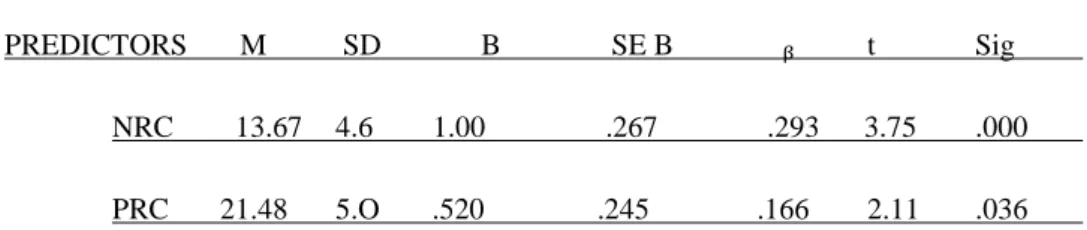
Furthermore, to examine the extent to which PRC and NRC can predict PTSD, Stepwise regression
was run on the data (see Table 1.3). It shows NRC in step 1 ( ᵦ = .293, p = .000 ) which could explain
8 % of variance in PTSD ( R² = .086; F ( 1, 150 ) = 14.062, p = .000 ). Although PRC also contributes to
the overall variance, which is 11 % ( R² = .112 ), but it is not a significant predictor.
Furthermore there was no multicollinearity in the predictor variables ( as an IVF value was less than 5
in both variables ), which indicates that PRC and NRC can be used to predict PTSD.
IV.DISCUSSION
The present study was conducted to examine the relationship between Religious Coping and PTSD in a
sample of flood-affected people of the Srinagar city. The findings from the study reveal a statistically
significant positive correlation between Positive Religious Coping (PRC) and PTSD which is consistent
with the previous research, however it also reveals a positive significant correlation between PRC and
PTSD which is not in tune with the previous research.
Furthermore the findings suggest that PTSD can be predicted by Positive Religious Coping ( PRC )
and Negative Religious Coping ( NRC), albeit to a moderate degree. Nonetheless, there was a
pronounced trend of Negative Religious Coping ( NRC) fairly predicting PTSD. It is worth mentioning
that only 11 % of variance in PTSD could be explained by PRC and NRC, indicating that there are
264 | P a g e
Amongst the four types of relationships that might exist between religious coping patterns andpsychological adjustment (Ano & Vasconcelles, 2005), the present study revealed the relationship of
negative religious coping with negative psychological adjustment.
Somewhat surprisingly, besides an expected significant positive correlation between Negative Religious
Coping ( NRC ) and PTSD, there was also an unexpected significant positive correlation between
Positive Religious Coping ( PRC ) and PTSD. It is unexpected because positive religious coping is expected
to reduce the chances of developing PTSD. Therefore, instead of a positive correlation, a negative correlation
between positive religious coping and PTSD makes more sense. However it might be because sometimes
religious coping is a preferred method of coping but does not have the expected positive effect. One
of the studies showing this unexpected pattern is that of Witvliet et al `s ( 2004 ) study which found
that religious coping, both positive and negative are associated with severity of PTSD symptoms.
Because several previous studies had found that positive religious coping had a beneficial impact on
mental health, this group`s finding showed that positive religious coping was associated with the
severity of PTSD symptoms, which was unexpected. [11]
In the similar vein the present study brings forth this unexpected pattern. However it might have been
because of many reasons. One reason for explaining this unexpected finding might be that this study
was carried just three months after the traumatic event ( flood ) which is less, as reactions to trauma
run a somewhat normal course for a certain period of time and usually ward off with the passage of
time. Research suggests that different kinds of religious coping may be related to mental health in
different ways at different time points before and after the stressor. (Pargament, et al, 1994 ). [12]
Moreover being a cross-sectional study, there are no baselines established; there are no longitudinal
research data confirming the pre-trauma religious functioning of the sample. So was it that the trauma
led to the religious coping or that there was already an amount of religious coping present which
determined the reaction toward the trauma remains to be established.
Alternately, research also points out the cultural perspective (which includes religion and spirituality )
as a determinant in the interpretation of the traumatic event. When a traumatic experience is viewed in
the context of a larger religious or spiritual narrative, its meaning may vary for the patient. Since the
present study was conducted on Kashmiri Muslims, why it links positive religious coping to severity of
the PTSD symptoms cannot be precisely established in context of the cultural influences, because there
is no relevant reference to previous research which demonstrates the general trend of religious coping
among Kashmiris. However, this can still be considered in context of the history of long-standing
political conflict, and a vulnerability to get affected by the natural disasters that engulfs Kashmir.
Therefore, indicating that besides the traumatic event (i.e., flood ) in context to which the present
study has been conducted, there are other traumatic events that the Kashmiris have suffered as well.
265 | P a g e
help them make sense out of the sufferings that they undergo and which might lead to their strengthof being better prepared to face the future threats, a phenomenon called post-traumatic growth.
However the reason that this phenomenon is not visible in the present study might again be because
of the time elapsed between the trauma and the study was too short for the people to process the
trauma meaningfully. Also it might be because there was an element of unexpectedness and a lack of
control associated with this trauma as the flood was unexpected and widespread giving people no
control over its consequences.
Implications of the study:
There is at least one clear clinical implication of the study, which proposes that clinicians need to
incorporate the use of religious coping in their clients` attempts at resolving the symptoms that were
triggered by a traumatic event. For this purpose, they need to know the religious methods that are
relevant to the clients. In addition the clinicians need to be aware of the maladaptive use of religion,
which involves , for instance, the use of Negative Religious Coping ( lack of faith, faulty cognitions
about lack of forgiveness, guilt, God`s power etc) that comes in the way of clients` recovery and
prevents them from using Positive Religious Coping that promotes recovery. For clients who are
affected by such maladaptive cognitions, the clinicians might try to resolve them at their own by
keeping in consideration the religious sensitivities of the clients and if they think that they unable to
do that they might refer the client to the religious clergy for help.
REFERENCES
[1] Alloy, L. B., Riskind, J. H., & Manos, M. J. (2005). Abnormal psychology: Current perspectives (Vol. 278). McGraw Hill.
[2] Ano, G. G., & Vasconcelles, E. B. (2005). Religious coping and psychological adjustment to stress: A
meta-analysis. Journal of Clinical Psychology, 61(4), 461–480. https://doi.org/10.1002/jclp.20049
[3] Pargament, K., Feuille, M., & Burdzy, D. (2011). The Brief RCOPE: Current Psychometric Status of a Short
Measure of Religious Coping. Religions, 2(4), 51–76. https://doi.org/10.3390/rel2010051
[4] Pargament, K., Smith, B., Koenig, H., & Perez, L. (1998). Patterns of positive and negative religious coping
with major life stressors. Journal for the Scientific Study of Religion, 37(4), 710–724. Retrieved from http://www.jstor.org/stable/1388152
[5]Chen, Y. Y., & Koenig, H. G. (2006). Traumatic stress and religion: Is there a relationship? A review of
empirical findings. Journal of Religion and Health, 45(3), 371-381.
[6]Fallot, R. D., & Heckman, J. P. (2005). Religious/spiritual coping among women trauma survivors with
266 | P a g e
[7]Feder, A., Ahmad, S., Lee, E. J., Morgan, J. E., Singh, R., Smith, B. W., ... & Charney, D. S. (2013). Copingand PTSD symptoms in Pakistani earthquake survivors: Purpose in life, religious coping and social
support. Journal of affective disorders, 147(1), 156-163.
[8]Koenig, H. G., McCullough, M. E., & Larson, D. B. (2004). Handbook of Religion and Health (Eds.). Oxford
University Press, New York.
[9]Secondary Data Analysis (2014): Jammu and Kashmir Floods; Sphere India, National Coalition of
Humanitarian Agencies in India Retrieved from:
https://reliefweb.int/sites/reliefweb.int/files/resources/12.09.2014%20J%26K%20Flooding%20Secondary%
20Data%20Analysis.pdf
[10]Beck, J. G., Grant, D. M., Read, J. P., Clapp, J. D., Coffey, S. F., Miller, L. M., & Palyo, S. A. (2008). The
Impact of Event Scale-Revised: Psychometric properties in a sample of motor vehicle accident
survivors. Journal of Anxiety Disorders, 22(2), 187–198. https://doi.org/10.1016/j.janxdis.2007.02.007 [11] van Oyen Witvliet, C., Phipps, K. A., Feldman, M. E., & Beckham, J. C. (2004). Posttraumatic mental and
physical health correlates of forgiveness and religious coping in military veterans. Journal of Traumatic Stress, 17(3), 269–273. https://doi.org/10.1023/B:JOTS.0000029270.47848.e5
[12]Pargament, K. I., Ishlar, K., Dubow, E. F., Stanik, P., Rouiller, R., Crowe, P., … Royster, Betty, J. (1994).
Methods of religious coping with the Gulf War: Cross-sectional and longitudinal analyses. Journal for the Scientific Study of Religion, 33(4), 347–361. https://doi.org/10.2307/1386494
Appendices TABLES:
Table. 1.1 showing descriptive statistics of variables in the study
---
VARIAB LES M SD RANGE SE
PTSD 37.09 15.82 3-78 1.28
PRC 21.48 5.057 9-28 410
NRC 13.67 4.631 7-27 .375
267 | P a g e
Table. 1.2 shows summary of Pearson correlations between different variables of the study; PTSD &PRC, NRC & PTSD AND AGE & PTSD.
---
PTSD (p) PRC(p) NRC(p) AGE(p)
PTSD 1 .213ᵜ ͙ᵜ (.009) .293ᵜ ᵜ (.000) -.017(833)
PRC 1 .176ᵜ(.030) -.189ᵜ (.020)
NRC 1 -.142(.080)
AGE 1
ᵜ ᵜ P < .01
Table 1.3 shows stepwise multiple regression of religious coping patterns on PTSD.
---
PREDICTORS M SD B SE B ᵦ t Sig
NRC 13.67 4.6 1.00 .267 .293 3.75 .000
PRC 21.48 5.O .520 .245 .166 2.11 .036
Table. 1.4. shows multicollinearity results
---
PREDICTOR
VARIABLES TOLERANCE IVF
PRC .969 1.032