RME v3n2 6-16-2004
FEATURE
President of the National Council of Teachers of Mathematics Speaks Out on Rural Mathematics Education
In a recent interview, NCTM President Cathy Seely talked with us about her experience in rural education and discussed what ACCLAIM might learn from her on rural perspectives of mathematics education. Her thought-provoking responses to our questions are presented here.
As you know the Appalachian Collaborative Center for Learning, Assessment,
and Instruction in Mathematics (ACCLAIM), one of the Centers for Learning and
Teaching supported by the National Science Foundation, focuses on mathematics
education in rural settings. (See http://www.ACCLAIM-Math.org/.) With your work in Africa,
you have had an extended and extraordinary experience with mathematics education in
what are certainly rural settings. Please describe for the RME your assignment in
Africa. How long were you there? What did you do? What were the conditions like?
access to textbooks. However, French development organizations had donated some French mathematics books, so at one level that I taught, I was able to assign one textbook to every two students. The primary resource was a painted chalkboard. One of the most challenging parts of the assignment was the weather, which was very hot and dusty most of the time, except during the brief rainy season. My school consisted of several separate buildings with openings for windows (no glass), so that a breeze might occasionally blow through. Only about half of the school-aged population actually attended school, and the general population is mostly illiterate. The school, like about half the homes in this large town, did have electricity, so there was a light overhead in each classroom.
In North America, we have several types of rural areas— including Appalachian,
Southern African American, Native American Indian and Alaska Native, and the
‘colonias’ of the Southwest—which may face some of the same challenges. How do
you interpret the North American situation, based perhaps on your African
experience?
The NCTM has an important publication “Mathematics in Poor Communities”
(see http://nctm.org/about/committees/rac/tfpc/), which identifies similarities and
differences between the challenges facing urban, rural, and Native American poor
communities. What do you see as the most critical issues facing rural communities
in North America? Is it poverty? Ethnicity and race? Globalization? Our conflict
over excellence and equality? Some combination? Other issues?
I think it is critical to find ways to make high quality mathematics available to all students, especially those typically denied such access. Schools have a responsibility to provide resources to students whose families might not be able to supply them, such as graphing calculators, computers, current textbooks, and so forth, as well as ensuring that students in schools of poverty have the best teachers and the best instructional materials. Equity and access, especially to students from a low socio-economic background have to be the highest priority. Without schools taking responsibility for ensuring this kind of access we will surely see the opportunity gap, and therefore the achievement gap, widen faster and greater than ever before. Children of poverty simply are not likely to have access to calculators, computers and a wide range of learning resources if it does not happen at school.
The National Science Foundation has committed to the issue of mathematics (and
science) education in rural settings with the funding of ACCLAIM and the Center for
Learning and Teaching in the West, each which focuses on rural settings. A session
of mathematics education in rural settings. As an outgrowth, Ed Silver, one of the
presenters and editor of the NCTM’s Journal for Research in Mathematics
Education, wrote a powerful editorial calling for more research in rural settings.
Under your upcoming leadership, what other possibilities for NCTM do you see for
gains in this underrepresented area?
Equity is the overriding priority in every effort of the Council. It is the first principle and one that influences all the Council’s activities. Certainly research is needed to determine the factors that influence achievement in rural settings, as Ed called for. I think it will be necessary to investigate what resources and opportunities may be lacking to our poorest students, and to learn whether there are important differences between poor students in rural settings compared to poor students in large urban or other settings. In addition, the Council now has identified political advocacy as a strategic priority. Equity and access to high quality mathematics are the
foundation of NCTM’s first political platform. One of the greatest challenges unique to rural areas is access for teachers to high quality professional development.
What would you like to say to teachers and others working in rural areas? Do
you have any words for students in rural areas?
The message is not that different from that which I would offer to teachers and students in other areas. For students, the message is that you can do challenging mathematics and that the more mathematics you know, the more options you will have in your future. For educators, I would promote personal leadership—to seek out knowledge about what works (maybe a bit more challenging for teachers in remote areas), to imagine what is possible in your classroom or school, and to actively advocate a high quality mathematics education for every student, even if it means leaving your comfort zone of your classroom or school (perhaps working more broadly within the community and with policymakers).
Do you have any additional remarks you would like to add?
I have seen too often in this country a fear of moving forward and improving the ways in which we teach. Sometimes it’s as if we are trying to act as if we were in a developing nation where we had no access to information or resources. Yet, in most schools in this country, even those that serve poor children, we can improve our teaching and access to resources. In many poor communities in this country, financial resources have not been focused toward clear goals, nor coordinated with appropriate professional development and teacher support. Consequently, we have missed
coordinated, systemic efforts to improve our teaching and learning, and the principles and standards from NCTM can give us a great focus to do just that. Many states’ standards are consistent with these principles and standards, and many instructional materials are becoming available that support them. But it will continue to be the power of one teacher working with one student at a time that makes the biggest difference in terms of the mathematics that a student knows and can do.
FEATURE
Is it the Loop in the Tie, or the Tie in the Loop?
Research presented by Dr. Jeremy Winters Middle Tennessee State University
Do personal relationships have an effect on student achievement? Vander Ark says, “Learning is about constructing relationships in which students connect with teachers or subjects.” (2002; Zahorik & Dichanz, 1994) These types of relationships are a suggested benefit of the educational practice of looping. According to Forsten, Grant, Johnson, and Richardson (1997), one of the benefits of looping is the relationship built between teacher and student. Looping is the practice where a teacher progresses with a group of students to the next grade or subject.
School reform proponents have called, among other things for tighter teacher-student and teacher-parent relationships to improve schools. Literature on both rural schools and on looping suggests both encourage these tighter relationships (DeYoung, 1994; Howley, 1997; DeYoung, 2002; Burke, 1997).
In order to help make the connection between looping and rural education, the following research divided looping into two broad categories: purposeful and natural. (The presence and effect of “natural looping” was considered since no schools in Tennessee implement looping purposefully at the high school level.) Examples of purposeful looping include schools-within-a-school and other programs that assign students to the same teacher for more than one year. Natural looping describes such arrangements that are not implemented as a result of conscious choice arising from pedagogical theory. For example, a low number of faculty requires a small school to assign one teacher to two or more years. Whether practicing purposeful or natural
looping, both schools will place students with the same teacher for two or more years: the former intentionally, the latter out of necessity brought on by outside circumstances.
The following research sought to examine the intersection between rural mathematics and natural looping. Two questions were investigated:
1. What is the presence of natural looping in Tennessee?
2. What effect does looping have on mathematics achievement?
given to high school mathematics students in three rural Appalachian counties (results under, “A Narrower Look”).
A Broad Sweep
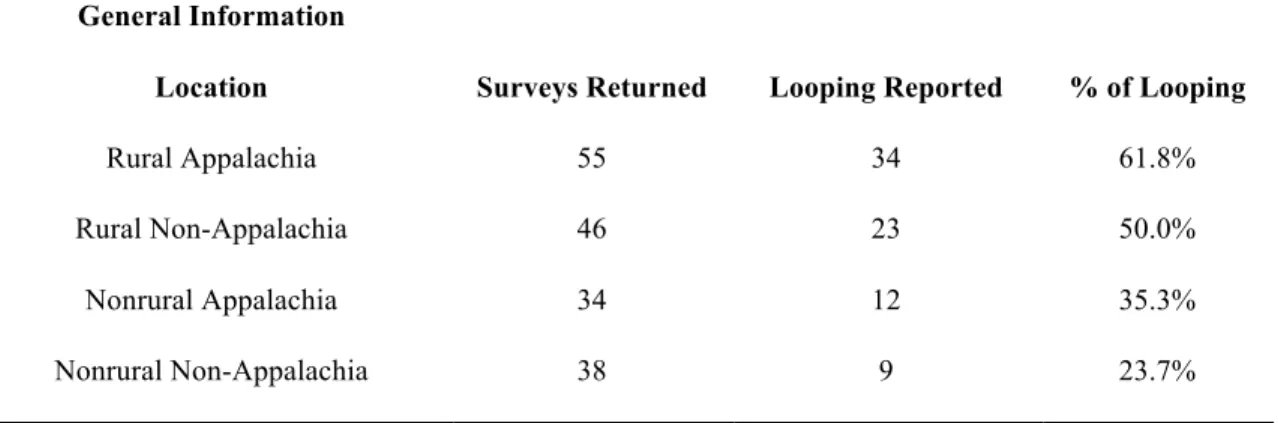
In order to determine the presence of natural looping in the state of Tennessee, a survey was sent to 293 public high schools to determine the amount of looping that occurred. Table 1.1 presents the data from the 173 surveys that were returned.
The returned surveys yielded the following data, which were found to be statistically significant based on a Two Proportions Test for Independent Samples:
1. The proportion of looping reported in rural schools was significantly higher than the proportion of looping reported in nonrural schools. (p < 0.001)
2. The proportion of looping reported in Appalachian counties was significantly higher than looping reported in non-Appalachian counties. (p = 0.034)
Spearman’s Rho Correlation Test found no significant correlation between looping status at a particular school and the school’s ACT Mathematics Test mean (rho = 0.138, p = 0.072).
Table 1.1 Looping in the State of Tennessee
General Information
Location Surveys Returned Looping Reported % of Looping
Rural Appalachia 55 34 61.8%
Rural Non-Appalachia 46 23 50.0%
Nonrural Appalachia 34 12 35.3%
Totals 173 78 45.1%
Number of Schools by Looping Percentage Reported
Location 100% Looped 50% or more
Rural Appalachia 4 16
Rural Non-Appalachia 5 13
Nonrural Appalachia 2 3
Nonrural Non-Appalachia 0 1
Totals 11 33
Type of Students Being Looped
Location All Types Honors Only Remedial Only
Rural Appalachia 22 11 1
Rural Non-Appalachia 14 7 2
Nonrural Appalachia 6 6 0
Nonrural Non-Appalachia 2 5 2
Totals 44 29 5
Amount of Looping in Schools with 1-2 Math Teachers
Location 1-2 Teacher w/ Loop 1-2 Teacher w/o Loop
Rural Appalachia 9 2
Rural Non-Appalachia 5 2
Nonrural Appalachia 1 0
Totals 16 4
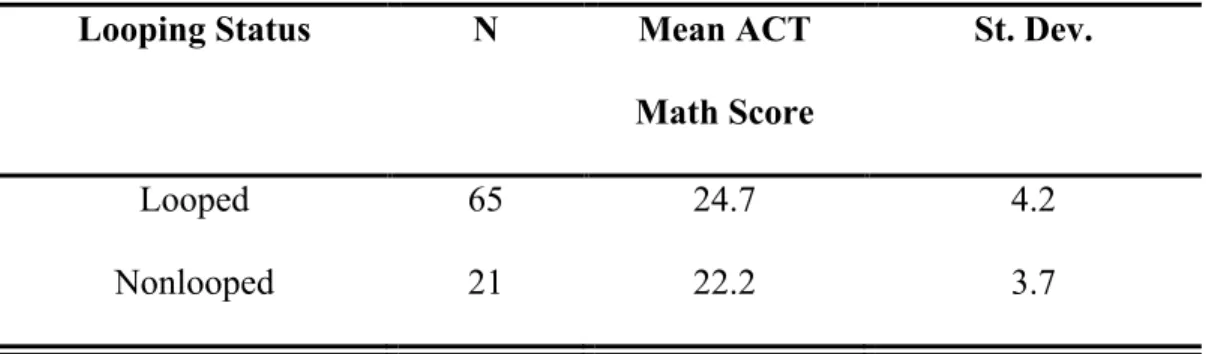
Table 1.2 Looping in Three Rural Counties
Looping Status N Mean ACT
Math Score
St. Dev.
Looped 65 24.7 4.2
Nonlooped 21 22.2 3.7
A Narrower Look
This part of the study looked at three rural Appalachian counties in Tennessee. A survey was given to all students in mathematics courses above Algebra 2 and Geometry for each school in these three counties, a total of five schools. These students were asked their ACT Mathematics Test Score and whether they had the same mathematics teacher in consecutive courses in their mathematics curricula progression. Table 1.2 indicates the responses from the survey.
size needed to be tripled. Thus, increasing the sample from three to nine rural counties (or five to 15 rural schools) might show a statistically significant difference between looped and nonlooped students’ ACT Mathematics Test Scores.
The Need for More Research
This initial examination prompted more questions that need to be researched. To begin, the occurrence of natural looping was found in Tennessee. Since purposeful looping is not practiced in Tennessee, several questions are raised:
1. Are the positives and negatives the same for natural looping and purposeful looping?
2. One reported benefit of looping is the development of relationships; the same benefit is also said to be inherent in small, rural schools. Is the benefit due to the relationships fostered by a sense of community, or due to looping?
3. Does increasing the sample size determine a significant difference between students who were naturally looped and those who were not looped? 4. Do similar findings exist in other Appalachian states and rural areas?
Further research into this area could help small schools with limited faculty in designing teacher rotations. Should they alternate courses as to not loop, or teach consecutive courses in order to loop? Does looping have any additional effect in a small community where relationships already exist? It is hoped that investigations into these areas will help shed light so that the mathematics achievement of rural students can be enhanced.
Burke, D.L. (1997). Looping: Adding time, strengthening relationships, ERIC Digests. (ERIC Document Reproduction Service No. ED414098).
http://www.ed.gov/databases/ERIC_Digests/ed414098.html
DeYoung, A. (2002). Dilemmas of rural life and livelihood: Academics and community. Appalachian Collaborative Center for Learning, Assessment, and Instruction in Mathematics, Working Papers obtained March 1, 2003 from
http://kant.citl.ohiou.edu/ACCLAIM/.
DeYoung, A. (1994). Researching rural american schools: Continuing cultural themes and cultural conflicts in the countryside. (ERIC Document Reproduction Service No. ED 366 475).
Forsten, C., Grant, J., Johnson, B., & Richardson, I. (1997). Looping Q & A: 72 practical answers to your most pressing questions. Crystal Springs Books, Peterborough, New Hampshire.
Howley, C. (1997). Studying the rural in education: Nation-building,
“globalization,” and school improvement. Education Policy Analysis Archives, 5(12), online journal available at http://epaa.asu.edu/epaa/v5n12.html.
Vander Ark, T. (2002). Personalization: Making every school a small school.
Zahorik, J., & Dichanz, H. (1994). Teaching for understanding in german schools. Educational Leadership, 51(5), 75-77.
FEATURE
An Interview with the Principal of a Rural Middle School
An interview with a rural principals perspective
Caroline Best, Associate Professor
Pellissippi State Tech Community College and ACCLAIM Doctoral student
Carpenters Middle School sits in a field surrounded by pastures with grazing cattle in Blount County, Tennessee. The school has three computer labs, a Smartboard, and Qwisdom technology. The principal, Rob Britt, a former high school choral director, has two masters’ degrees. The state of Tennessee classifies this school as rural, but the principal sees his school differently.
Caroline Best is a doctoral student in math education in the Appalachian Collaborative Center for Learning, Assessment and Instruction in Mathematics (ACCLAIM) program. She is an associate professor of mathematics and program coordinator of developmental mathematics at Pellissippi State Technical Community College, which serves Blount and Knox Counties in east Tennessee.
You are the principal of a rural middle school, grades six through eight. How is the
rural classification determined?
I think it is determined by the state. All you have to do is look around; you see cows on one side and a big field on the other. There is land that had been purchased by the school system to build a K – 5 school on one side and a 9 – 12 on the other. The way the county is growing in this direction, it will not be a rural school forever. It will be a suburban school very shortly.
Does population, income level, or number of students who receive free or reduced lunch
determine the rural classification?
How does this classification affect your students and/or teachers as it relates to funding,
professional development opportunities, instructional equipment, etc?
I wish it did. No, the classification is just in name only; it has little to no effect. We would have to have 45 – 50% free or reduced lunches to receive Title I funding. Lanier is a Title 1 school; they receive extra funding.
How do you see the rural classification played out in everyday activities at your school?
For the most part I do not think of my students as rural. Student behavior and conduct do impact us. For the most part we have students who come from traditional homes. Even single parents make an attempt to raise their children in such a way that they come to school with feeling of respect to authority. We don’t have any problems with violence; just typical middle school behavior played out on reality TV shows every afternoon and evening. The very same things that come into my office are the same things you see on TV or read about in the paper. For example, the other day, on the morning news, the father of one or our students here was picked up in Knox County for soliciting sex from a minor. Now we have to deal with that. That’s Jerry Springer right here. It’s a sad thing, but I think that’s how society has impacted us.
Were you given any guidance or training on how rural schools are different or operate?
environment. I came from William Blount High School so I pretty much knew the kids coming from Lanier and Fairview. I live in the Fairview Community so I knew those folks, the standard of living, and the norms that make up our community. We are very rapidly becoming a school that should be classified as suburban. I think that in another five to ten years we will be classified as suburban. I don’t see that a reclassification will matter.
What has been your connection with math teachers, in the past and/or in your present
school?
In my past experience I was in charge of curriculum and instruction. I worked a lot with math teachers, looking at curriculum and teaching strategies—seeing how we can do a better job. I helped facilitate a lot of discussion: how are we doing, can we be doing better, or looking at the data. Let’s do some training on how we can get from where we are to where we need to be. Sort of like what I do as the principal here. We have a curriculum chair who handles a lot of those responsibilities. We, the school, sent two teachers to the national NCTM conferences.
Where do you get the money to send teachers to these conferences?
schools; we have their machines in our schools and the schools get a portion of the proceeds.
We also sent teachers to the national middle school association conference in Atlanta, Georgia. We took math teachers with us there; they attended the math
workshops. We have teachers going to present at a conference in Athens, TN. We do a good job of keeping up with modern, contemporary learning. We are in a textbook quandary right now. When we came into this building, the textbook adoption had already gone through. One of our feeder schools already had Saxon math books. Another had Glencoe. We had no choice but to meld the two together in some form or fashion. And so we have a hodge-podge of what we are using. Now, we have directed our Saxon material to those students who are behind, the ones that have not been so successful because they need the constant repetition. The Glencoe math spends a little more time on higher-order thinking. We use it for medium to higher-level students. We are looking forward to our next adoption cycle so that we can get one series into the building. You know our math teachers teach a lot of computation and they do a lot on procedures.
Interesting. Is this because of the testing? What is the testing cycle at Carpenters
Middle?
score that will dictate what their gain is, they will get a cut-off score that says whether they are proficient at that grade level. And so we are looking at both those things now. That’s a whole other issue, but I think it does connect with what we are talking about because of instruction. How we roll out math; we do not do a very good job anywhere I think in terms of making connections to the real world.
Do you see your students making the connections between what they do in their rural
community and math? Are farm chores or other rural activities helping them connect
with math?
No. And I think if you ask our teachers, they would agree. They struggle to make those connections.
When your textbook committee meets to decide on the next textbook, will they be looking
for texts that have a more rural flavor?
No, they will look to see how well the textbook matches the Tennessee State standards. Everything is standards-based. The curriculum is pretty well laid out for us and driven by the test.
Is that a problem—driven by the test?
are some the highest in the east Tennessee region. We are proud of that. Because of the fact that we have to look at data and understand what it means, we have to look at what is essential. That’s what we need to focus on. Because we have to do that, we can take kids from where they are on the learning ladder and move them along to the best of their ability.
Can you describe how your math instructors are trying to make math relevant to the
student’s everyday life?
Some of our teachers really try to set up certain examples that relate to students. For instance, figuring the angles of a deck; the number of boards needed to build a certain size. They try to relate. We did at the high school. Because we had the tech-prep track and the technical math, it was easier to relate problems to automobiles or diesel engines; we were able to do that better there. At this level, we are just trying to meet the
standards.
Let’s talk about technology. What are you currently using?
We were very fortunate to move into a new building with technology. We have
three full computer labs with 24 -25 computers. A teacher can take their kids to the lab. The eighth grade math teacher can take her class and teach a lesson using the Internet or whatever is appropriate. We do not have a lot of math classes using the lab; it’s more the language arts, language, and social studies classes. We do have a new piece of
child in the class has a remote control. A problem is shown on the board; a higher- order- thinking type question. The child beams their answer to the board. Immediately a graph is displayed indicating how many students answered the problem correctly. It does two things—it gives the student immediate feedback, which is so important. Quite often a student is working a problem on a piece of paper, turning it in not knowing whether the problems were worked correctly until the next day. The students may practice the wrong procedure at home that night. I have a saying that practice does not make perfect, perfect practice makes perfect. Students have to learn the correct procedure. This technology is a great tool for our teachers. It gives the teacher immediate feedback. He or she knows what needs to be retaught immediately. It is in one classroom, and only used for math. We are piloting it this year and if it goes well and is useful, we’ll hope to use it in other classes. We saw it at the national middle school conference in action. The kids love it to; it has a game on it so if you answer a question correctly your racecar moves ahead.
Is this a NASCAR thing? And maybe NASCAR is a rural phenomena?
It’s definitely here. It would be a rural thing. We have kids that follow it religiously, along with their parents.
Do you use calculators to teach mathematics?
through a series of math problems. The software diagnoses the students’ entry level and then takes the student through the lesson at their own pace. We feel that this would be a great supplemental class in the lab, not to take away from a student’s regular class. We would use this with some kids, not all.
Are your kids so used to video games that the teacher has to find similar ways to engage
them in the classroom?
Yes, you can follow a group of kids that go from a traditional classroom into the computer lab. They are not doing so well (in the traditional class), yet take them over to a teacher working in the (computer) lab with a Smartboard and the kids are absolutely enthralled with it. It does not matter what they are working on, they will persist to the end because, I think, they are so engaged by this technology. This instructor is teaching computers in the lab; this is not a math teacher. The math teachers do not have
Smartboards. The fact is that you can take this same group of students from a class with very low engagement to one with high engagement; the only thing that I can point to is the technology use. It is fascinating. He, the computer lab teacher, doesn’t have any discipline problems.
Describe the financial support that is available for implementation of technology.
Fundraising; now that’s another topic. Are your parents involved, perhaps more so
because of your rural setting, in the parent-teacher organization?
We have a PTO. I would not consider them overly active. We had a really active one last year. It depends on the leadership, just like anything else. I feel like my role is to help them get them started, help set goals, set up meetings. It’s really up to them. I do attend the meetings. In terms of supporting our fundraising activities and our school, our parents do a super job. We raised $3,000 to $5,000 more than was expected for our fall fundraiser. Our related arts team did coupon books at the same time; our parents supported both.
I see great publicity in the local newspaper about your school and its principal. I think
that you are making a real effort to get the word out.
Thank you, Rob, for an hour of your time. I’ll let you get back to your job. I heard on the
intercom that tonight is the Valentine’s Dance for the students at Carpenters Middle
School. You’ll be here to chaperone. Just another day in the life of a middle school
principal.
FEATURE
MATH TALK-BACKS FROM RURAL WORLDS (Voices from the Field) This series is open to rural math teachers anywhere on the planet. If you teach math in a rural place, we’d like to hear from you. We’re looking for thoughtful manuscripts that engage the ideas that matter to the Center, but from a variety of perspectives and commitments.
From Strawberry Patch to ACCLAIM
A narrative by Brenda Lackey
Dad was the youngest in his family. None of his brothers or sisters went to high school. Mom was the oldest in her family. Neither her brother nor her sister went to high school. Both families were involved in farming for most of their lives. However, most of the second generation on both sides of the family tree finished high school. Many of the second generation did not choose farming as their life’s work. Several of the third generation have college degrees and a few even have advanced degrees.
I have many good memories of life on the farm. My brother and sister have told me that I only remember the good parts; they had to work harder than I did because they were older. By the time I got old enough to do the really hard work, Dad was no longer farming.
When I started to school that fall, I could already do some arithmetic and I could read simple books. I started wearing glasses after I started to school. There were not many children in my class that wore glasses, and I was teased about my glasses. I also have a lazy eye and was called names for that too. Another problem I had in first grade was that I was the only one in the class that was left-handed. The teacher did not want to make exception or provision for a left-handed child, so she forced me to use my right hand. She would hit my hand with a ruler any time I tired to use my left hand to write or color. First grade was not a good experience for me emotionally but I was thrilled to be learning to read and write and “do math.” Second and third grades were better. My teachers were more tolerant of my weak eyesight and I had mastered writing with my right hand. I overheard my fourth grade teacher make a comment to another teacher one day: “Too bad the little Moon girl is not like her brother and sister. She would be better off not to be so good in her school work. She will be very disappointed that she will not be able to go very far since she is the child of a dirt poor farmer.” I did not understand all of what she meant for several years. But thankfully, my seventh-grade teacher gave me a new vision.
material that we already knew. We took several tests in the first few days of class. When we could no longer answer many questions correctly, she told us that she knew where to start her teaching. There were six of us that she pulled aside to be her special helpers. We would serve as peer tutors and we would also be learning about a new subject called algebra. We had to do all the work that the regular students, did but we also studied with her in a small group. Mrs. T did not care what our family background was or how much money we had or didn’t have. She was only interested in our potential. She wanted to ignite our spark for learning. One day I told her that I thought I wanted to be a math teacher, but I had been told by other teachers that I would not be able to go to college because of my family situation. Mrs. T told me to let no one stand between me and my dream. She encouraged me to make the best grades that I could in all subjects and that there were scholarships available for excellent students, regardless of background. She encouraged me throughout the school year. She reminded me several times to keep my eyes on my goal and not to let anything stand in the way.
In my eighth grade year, our classes were held in the high school building. Again, I was fortunate to have a wonderful math teacher. She was a friend of Mrs. T, and Mrs. T had told her I wanted to be a teacher, especially a math teacher. I began to believe that I might actually be able to have my dream come true. Throughout high school, I had the encouragement of several special teachers. Upon graduation, I received a scholarship to attend University of Tennessee Martin (UT Martin). I was finally on the way to attaining my goal.
During my first quarter in college, I married my high school sweetheart. I
After completing his advanced training, he was transferred to Germany. The plan was for me to join him there. Unfortunately, I was not able to do that because of the escalation of the Viet Nam war. By the time I knew I was not going to Germany, it was too late to enroll in college that quarter. My plan was to re-enroll in the winter quarter, but my mother became ill and I had to take care of her. My husband was transferred to Washington State in the spring, and I went with him. The plan to return to school was always in the back on my mind; I just did not know when it would happen. When my husband was discharged from the army, we came back to our home town and began our family. I still had the dream but it did not seem possible to fulfill it while raising a family. When our youngest child started to school, we began saving for me to return to college. I re-enrolled in college the next year. By then we had a daughter in seventh grade, one son in third grade and the other son in first grade.
When I began making serious plans to re-enroll in college, I talked to an advisor in the department of education. He was not encouraging; he had no hope that I would be able to complete my degree in the amount of time I had designated. He even suggested that I needed to take remedial courses since I had been out of school so long. He thought that I should take an easier route than my goal of teaching high school math, and
advisor had planted. She repeated the words she had said to me years before: let no one stand in the way of your dream. She told me to turn the negative to positive, to work hard to attain my goal—and to prove the advisor was wrong. I left the store that day with her words echoing in my mind. I will never forget the day that I walked into that
advisor’s office with my grades from my first quarter as a non-traditional student: all A’s. With the encouragement of Mrs. T and the wonderful assistance of the faculty in the mathematics department, I was able to earn my bachelor’s degree in secondary mathematics education in 1986.
I taught four years at Fulton County High School in Fulton, Kentucky. I obtained my master’s degree in secondary mathematics education in 1988 while teaching full time at Fulton County. I had a different advisor this time; one who had no negative comments.
I probably would still be teaching high school if the enrollment had not declined dramatically at Fulton County. There were not enough students to justify employing two full-time math teachers. My position was rewritten as half-time math and half-time French. I did not qualify for the position since I could not teach French. The search began for a new position.
I met one of my former college math professors at the grocery store one
There have been several times that I thought I would be able to continue my studies to obtain a doctorate. In each case, the program either did not meet my needs or the requirements of the university, or I would have to give up my job to pursue the degree. I had almost given up when an email came to me in 2002. The email contained information about a new program called ACCLAIM. I sought the advice of several colleagues about entering the program. All encouraged me to apply. I even called Mrs. T to get her opinion. “Go for it!” were her words.
As the second year of the program draws to a close and the third summer of classes is just a few weeks away, I think back and wonder, what if—what if Mrs. T had not encouraged me the way she did, what if my parents had not supported my decision to go to college, what if my family had not been willing to make the sacrifice for me to return to college at 35, what if I had not obtained the position at UT Martin, what if I had let the negative comments sway me more than the positive ones, what if I had not gotten that ACCLAIM email, what if…
not be able to see me receive the doctorate. His death last summer was almost too overwhelming to allow me to continue. He was a strong supporter. His spirit keeps me strong and moving forward toward completion of the degree.
My reality is bigger and better than my dream was. I am able to do something I love to do. As I think of Mrs. T and some other very influential teachers, I hope that some day my students will remember me as a positive influence in their lives as they too pursue their dreams—whatever they might be. From strawberry patch to ACCLAIM doctoral program—quite a journey for a little farm girl.
FEATURE
Swapping Lenses & Places
Our work in the Center puts all of us on the edge of reaching new insights. Because we
are a multi-campus, virtual Center, some of our interaction takes place, and shows
surprising turns, online. Robert Mayes, West Virginia University, and Craig Howley,
Ohio University, share the following interchange with readers. It emerged as a tangent
to work they were doing related to Bob’s February 2004 Occasional Paper. The subject
they are debating is the complex relationship among context, content, method; or, put a
bit differently among place, mathematical knowledge, and educational purpose.
gender, ethnicity, or place—was to provide equity in understanding the subject of mathematics. The focus was the subject and understanding the concepts that make it tick. Math, I believed, was after all the most universal of subjects. I no longer hold to this view, after years of experience and studying cognition and affect in mathematics education. Striving to view the world through someone else's lenses is challenging; realizing we wear lenses is the first step in this strife.
Craig: Well said! Can we quote you on that in the next RME (I'm not kidding—it would be fun to get some conversation going around precisely this issue—your
experience has got to be common among the tribe of those of us devoted to mathematical
knowledge)! It's important for everyone to learn math—I believe that ardently; but the
pathways to appropriate knowledge seem a lot more varied than most people believe—
whatever their field. Thinking about the dilemmas of policy and of systems provides
footholds for climbing to a point where you can begin to see some of the related issues.
But, man, it's tough for anyone who loves a particular discipline. And math, like poetry,
philosophy, and music is lovely and compelling. So it's a mystery why so few people
perceive that (those) simple fact(s). Something has to be happening to turn these
potential pleasures into actual plagues.
I'm an economic determinist, with a footnote of free will at the individual level.
This means that I think that the same ways of doing business (and the same dominant
ideologies) shape rural and urban experiences alike, albeit it somewhat differently due to
the exigencies of place (rural) and space (urban spatial issues, as in physical segregation
place in the cosmopolitan conception of life, with world-class cities the idealized
urbanicity).
So, studying rural or urban by themselves decomposes the overarching issues.
But, were one smart enough, one could take what seems a key rural issue (e.g., school
consolidation) and do a comparative study of the issue in an urban setting, with the rural
literature and experience the lens for interpretation (rather than the urban experience).
One could relate both to such historical long-waves as colonization, imperialism, and
globalization. Which comes full circle to economic determinism.
Bob: Craig, I am of course open to conversing, so feel free to share my comments with anyone. From a teaching perspective I believe that many teachers are surviving the seven-period day with three to six different preparations. There are several stages teachers go through: First, on the novice level, they teach the skill without
understanding; sadly some teachers never leave this level. Second, on the mathematics appreciation level, they begin teaching for concept as well as skill. Third, on the
Craig: This gets better and better, Bob. Ya know, I taught math for about five semesters, to undergrads—many kids, many adults—basically disabled by previous
experiences, though few permanently.
Mightily enjoyed the experience—and I basically am confused by teaching
anything else... though an English major in college, a prodigious reader in education and
the borderland with sociology, philosophy, and history. I was at the point of
transitioning to level 3, but then I got a real (full time and even more engaging) job, and
that was the end of my brief career as a math instructor. This was the mid ’80s, and I
was doing group work, lots of student talk, and relevant computer applications (there
wasn't much that was real good or, to my mind, suitable—very different these days). And
this was some years before my engagement with rural ed research, though I had an
intense appreciation ofstudent idiosyncrasies and histories—and for the nutsiness of
formal learning programs generally. Pedagogically, I still believe that place more
affects the ‘how’ than the ‘what’--but my perspective on the 'what' concerns meaning,
understanding, and critique and by no means the fetishism of the correct answer, or even
the fetishism of 'scope and sequence.' So I see the ‘ what’ and the ‘how’ shaping each
other. One can't teach such insights, they have to be lived. That's not research, just
articulated experience.
Bob: I am in Kentucky for an ACCLAIM meeting on technology for the program. I am struck by your comments on ‘how’ and ‘what’ shaping each other in relation to our discussions about mathematics teaching via distance. The ‘how’ is
day and age from mathematics? How does that affect our choice of the appropriate technology to use?
Place influences student need, but need must also be viewed from a broader societal and economic perspective. I have been working with using mathematical modeling of real world data to motivate college algebra for incoming freshmen. Some buy it and some do not. Determining the place (this is tangential to our previous use of the word place) the student is coming from—what they see as pertinent—is mystifying at times. The longer I teach the more I realize how far I am from teaching what is the most important—desire and engagement in the subject of mathematics.
Craig: I remember the call on campuses from the ’60s kids: "relevance." I wasn't sure about that, then or now—and still prefer intrigue, puzzlement, curiosity.
Curiosity is wide, but fear really disables it once schooling starts. It seems like students
learn to trust the trustworthy teachers, but experience teaches them to be wary.
Mathematics is a particular challenge, as a traditional proving-ground for
academic aptitude. The educational point would be to develop aptitude, not to discover
and sort it—condemning about two thirds to fear and ignorance. By the time kids get to
college, they're in the grip! There's got to be an explanation for why so few of our kids
want to become math teachers and why so few want to pursue math majors.
It's not want of aptitude, surely.
The larger view could be the place—the role—of mathematics in our culture,
partly as marker of superiority, partly as marker of power. Western culture—from Plato
onward—has perhaps made knowledge of mathematics the province of various sorts of
not surprisingly. I think ordinary people, who certainly would be numbered among the
two-thirds condemned for want of aptitude, realize this, with varying degrees of
articulation, and resent it. This resentment constitutes a barrier to learning math, and
it's a resentment that can be propagated in a community via the usual means, leaving
school out of the picture almost completely. It would be interesting to understand that
phenomenon, that experience. It's a theory!
Bob: I see the relevance question as central to student affect towards
mathematics. Without relevance many students do see mathematics as an abstract game played by the mentally elite.
Unfortunately the current generation does not seem engaged by the beauty of mathematics and are certainly not motivated by authority telling them that mathematics is a necessary thing for them to master. Any subject that is being "forced" on a large
section of the student body needs to provide a case for relevance to the students—as citizens, in their major, for intelligent decision making, etc. I do not believe that most of the two thirds of students turned off to mathematics are incapable; they are not
engaged—they do not see the purpose. This is compounded by traditional pedagogy stressing skill development so that students can succeed in a next course that most of them will never take! We can motivate mathematics for those with a gift for it by exploring abstraction and pattern, crooning about the beauty of the subject. This works for about 10% of the student body.
Students experiencing cognitive overload will also develop a negative attitude towards mathematics.
Therein lies the difficulty with reform: it takes a subject that is already feared and potentially makes it less concrete, less black and white, less one correct answer, and also, on the positive side, less unrealistic.
Craig: Very interesting, and I think motive and relevance are deep and complex, because they both embody and express educational purpose. Relevance and motive
relate to affect, but the issue of purpose brings us to social differences over purpose—to
curriculum struggle (which is ongoing, and little acknowledged in its social and political
aspects—perhaps because considered too hot to handle or too little amenable to
prescription). We don't, for instance, trust students, families, or communities to have a
clue about educational purpose.
And this strikes me as increasingly odd the older I get. I know that the
'standards-based' mathematics (that phrase is too conveniently ambiguous) reform has a
large and liberal view of the subject, but it still cleaves to the idea of a correct
developmental sequence—with a basis in 'cognitive science' rather than 'behavioral
science.' The result for professionals (like us) is that we arrogate purpose to ourselves
along with our claim to expertise in educational process.
This expertise (I'm not talking about individuals, but about the collected
conventional wisdom of the various pedagogical fields) looks pretty much like illusion
(whether 'cognitive' or 'behavioral') from the point of view of the chaotic realities of
real-time learning among real-real-time humans. Most humans don't get definitive or authoritative
engaging experiences that they doggedly keep making sense of. It's a miracle, and one
we (still, 100 years beyond poor Dewey) still seem bent on not appreciating.
I think good teachers (I'm not one) acquire tricks, worry much about students and
providing the engaging fortuities, and we rightly honor them. Propagating more of them
is work no one seems to understand. Replicating their practices is plain idiocy. The
improvisation, the reinventing of the wheel each time is not only something not to be
avoided (I've said this a lot, unfortunately), but something to be embraced with
enthusiasm.
Bob: I appreciate the complexities of learning and teaching in the real world and concur that promoting one best way to teach is at best a flight of fancy. But relying totally on an apprenticeship model or worse an "innate ability to teach" fails to move the process forward.
We need to have an underlying theory in teaching, a building up of best practice, and I would like to see this based in research. There is a national movement to make mathematics teaching a profession that adheres to standards of practice—much as a doctor or lawyer—but there is a dreadful lack of consistent and meaningful research to base the practice on. I found some solace in the cognitive science approaches being applied to mathematics education, much of which has recognized the need for attention to both affective and cognitive factors (the second cognitive revolution). Perhaps the
I can't help but feel overwhelmed by thinking of going into my 150 student College Algebra class and determining what cognitive, affective, social and political approach is best for each individual student. That is of course carrying the argument to the extreme (since classes of 150 are lunacy). Teachers must have a deeper
understanding of mathematical content (mathematicians focus) and a deep understanding of learning and teaching (mathematics education focus), but the two often do not overlap. This is a major concern, much less the fact that social factors are mostly ignored.
Craig: In fact, C&I and best practice is where I began in this business (after approaching, if never actually entering, the academy), so I'm very sympathetic with the
anger and frustration one experiences when confronted with teaching that damages
students intellectually and emotionally—damage that accumulates over time. And it's
depressing to reflect on 100 years of "professionalizing" the profession of teaching. It
may be that medicine (the current model—again!—for education research and practice)
is the proper model for this work, and the reason the model hasn't worked in education is
simply the ineptitude of current research, dissemination, and implementation efforts.
Education is a political act and a social act because we learn from experience.
It's also, most essentially, a personal act. And the personal act is too often disparaged by
the profession; the chaos of the flow of personal experience from which all humans learn
doesn't fit with professional notions of an organized and rationalized curriculum. It's
funny, isn't it, that we insist that the proper way to learn a subject is through an
organized and rationalized curriculum (a matter of convention)? And yet, quite clearly
This might be a hopeful note so far as rural schools are concerned. Why? It would
mean, for instance, that "the latest thinking" is not the standard by which to judge what
rural schools offer. When rural schools—poorer, smaller, and situated in cultures quite
unlike the national average—are exhorted to live up to "the latest thinking," a lot of
damage is done in the process. In fact, while rural educators struggle to ape the latest
thinking—professional development arguably reaching them weakest and last—what's
"latest" has become passé. In other words, that game is one rural schools are bound to
lose. Not because dissemination and implementation are inadequate, but because the
rural-cosmopolitan script cannot be otherwise read—if it were, reality would be
unrecognizable.
This is not to deny the evident distinctions between good teaching and bad, and
between education and miseducation.
Bob: I certainly agree with your first comments about how little we have advanced the profession of teaching. The medical model is not reflective of the
Profession of Teaching in many ways (higher level of professional development, higher pay and prestige, better support for keeping current), but it does involve a community of best practice and constant revision based upon new findings—two things education could benefit from.
The chaos of the flow of personal experience is not often accounted for in
rural areas is not that they are spared the reform, but that the reform is refined and adjusted to local needs.
HERE’S WHAT’S HAPPENING IN OUR NECK OF THE WOODS
Capacity Building Update
The ACCLAIM Second Cohort
By Robert Mayes and Sandy James
The Appalachian Collaborative Center for Learning, Assessment, and Instruction in Mathematics (ACCLAIM) welcomes 18 new participants into the ACCLAIM doctoral program. ACCLAIM is a national Center for Learning and Teaching funded by the National Science Foundation. The ACCLAIM program is a collaborative effort among the University of Tennessee, the University of Kentucky, the University of Louisville, West Virginia University, Ohio University, Marshall University, and the Kentucky
Science and Technology Corporation. Participants will have an opportunity to work with mathematicians, mathematics teacher educators, and rural education experts on a
comprehensive and innovative Mathematics Education doctorate. The doctorate is offered via a combination of distance education and summer institutes, allowing placed bound professionals the opportunity to become future leaders in mathematics education.
the leadership capacity for the improvement of mathematics education in rural places is the mission of ACCLAIM. The second cohort comes from five states, including Kentucky, Missouri, North Carolina, Ohio, and West Virginia. Their vocations are varied, spanning high school math teachers, professors of mathematics or mathematics education, community college or college mathematics instructors, administrators, and a consultant. The ACCLAIM program has created a virtual university that draws on the resources and talent of five universities in the Appalachian region. They will have the choice of completing their research at and being conferred a degree by one of these institutions: the University of Tennessee, the University of Kentucky, the University of Louisville, West Virginia University, or Ohio University.
The second cohort begins with a summer session that runs from June 21 to July 30, 2004 at the Ohio University campus. During the intense 5 week summer session participants will take three graduate courses with professors from three different universities:
Course University Professor
Geometry University of Kentucky Carl Lee
Rural School and Community Ohio University Craig and Aimee Howley Learning and Assessment in
Mathematics West Virginia University Robert Mayes The program will also offer social activities highlighting the natural beauty and unique cultural events in the surrounding area. The second cohort participants and their states of residency are listed below. As they embark on this endeavor, we congratulate them and look forward to working with them as students and colleagues.
Missouri Jamie Fugitt
North Carolina Deborah G. Britt, Sharilyn O. Granade, Paula Schlesinger Ohio Courtenay G. Mayes, Nicolyn S. Smith, Ronald G. Smith West Virginia Barbara L. Gelpi, Sherry Jones, Jeremy Zelkolwski
RESEARCH UPDATE Craig Howley, Ohio University
Current collaborations, research and publications
In recent months the Research Initiative has approved support for several studies and is negotiating others. Two projects are up and running under recently established memoranda of understanding.
One is examining the views that rural community members (adults, seniors, and students) hold of mathematics and mathematics education. This study is unique because of the involvement of a class of (mostly rural) students as data-gatherers. The work is being supervised by Dr. David Lucas, of Ohio University, using a method known as "folknography." Lucas has conducted many similar studies of communities, including rural communities in Mexico and the Carribean. Check out his web page for details about the method and about his previous work with
students.http://www.southern.ohiou.edu/folknography/index.htm
Another new project is being led by Dr. William Larson, also of Ohio University. Larson will be assisted by ACCLAIM doctoral student Brian Boyd as a research
mathematics education reform, which Larson's contacts have identified as a major concern among rural principals. Boyd's participation is very appropriate because he is himself a rural principal.
Three other researchers are engaged in conversations with the RI staff about designing rural-appropriate mathematics education studies. We'll report the details as study agreements are established.
Ohio University, home of the Research Initiative, will be hosting the second ACCLAIM doctoral cohort this summer. Students will spend five weeks on the university’s main campus in Athens, furiously pursuing work in three courses--one in mathematics education, one in mathematics, and one in rural education. This is an exciting event for students, for faculty, and for ACCLAIM as a whole. The OU campus is really very pleasant, with brick buildings and walks and lots of trees.
In recent months a number of interesting and important publications have been added to the Research Clearinghouse. One recent working paper, by Jim Williams of George Washington University, for instance, does ground-breaking work with a
prominent European data set (which includes data for the United States and many other nations). Williams's study examines rural inequity in mathematics achievement. The most recent working paper, presented at the 2004 annual meeting of the American Educational Research Association, considers the literature that makes prescriptions for the pracdtice of rural mathematics education, co-authored by Donna Huber, Aimee Howely, and Craig Howley.
Canadian prairie in a recent Occasional Paper. Bonnie Beach’s occasional paper reflects on the themes raised at the 2003 NCTM research pre-session sponsored by ACCLAIM.
Occasional papers most recently added to our site are: • Mayes (Feb 2004)
http://acclaim.coe.ohiou.edu/rc/rc_sub/pub/4_occr/RM_OP6.pdf
• Eglash (April 2004)
http://acclaim.coe.ohiou.edu/rc/rc_sub/pub/4_occr/RE_OP7.pdf
• Schmidt (April 2004)
http://acclaim.coe.ohiou.edu/rc/rc_sub/pub/4_occr/MS_OP8.pdf
• Beach (May 2004)
http://acclaim.coe.ohiou.edu/rc/rc_sub/pub/4_occr/BB_OP9.pdf
The most recent working papers are: • Williams (March 2004)
http://acclaim.coe.ohiou.edu/rc/rc_sub/pub/3_wp/Williams21.pdf
• Huber, Howley, & Howley (June 2004)
http://acclaim.coe.ohiou.edu/rc/rc_sub/pub/3_wp/WP_22_Huber_Howley_Howle y.pdf
The RI staff—Schultz, Howley, and Waters—are collaborating directly on four new studies: (1) a study that identifies 10 critical issues in rural mathematics education; (2) a study of curriculum change and struggle in rural communities experiencing
suburban development; (3) a study of school size and rural mathematics achievement; and (4) a study of the mobility of rural versus other secondary mathematics teachers. One of these studies is near completion, one is in progress, and the other two are just getting started.
Association in San Diego in mid-April. The next week, Mike Waters and Jim Schultz gave sessions at the annual NCTM meeting in Philadelphia.
Finally, events are being planned for the Fall. These include the third annual ACCLAIM Research Symposium in early November (at the time of the Presidential election) and a research workshop designed for faculty at smaller Appalachian colleges and universities who want to participate in rural math education research.
Teacher Education & Professional Development Update By Karen Mitchell, Marshall University
The merger of the Teacher Education Initiative and the Professional Development Initiative into the Teacher Development Initiative has made finding ways for a diverse group of individuals to work together of fundamental importance. One of the ways that TDI brings all the individuals at all places of the continuum of mathematics teacher preparation together is through two conferences hosted annually. The Teacher
Development Initiative hosted the second annual Mathematics Teachers in Appalachia – Future and Present conference at the UT Conference Center in Knoxville, TN on
Because the majority, 108, of the participants for this conference were
intentionally pre-service students, the conference opened on Friday, February 27, with a dinner and a panel (Lyn Davies, Emily Gaude, Lee Hedrick, Leneda Laing, Dr. Bonnie L. Peterson, Frank VanZant) of talented middle school and high school teachers who
answered questions submitted by the students about mathematics teaching. The six concurrent sessions in the morning and afternoon of Saturday, February 28, addressed the conference theme of representation strategies. Amy Driesbach’s presentation on the uses of Algeblocks was well received. Each workshop participant was given a sample pack of Algeblocks donated by ETA. Bob Garvey sang his way through his TI-83 graphing calculator presentation. Participants in this workshop learned strategies for using graphing calculators as well as classroom management techniques. Judy Pomeroy pointed out the special features of the TI-73 graphing calculators that make them a valuable tool for middle school students engaged in investigations. The developer of The Geometer’s Sketchpad, Nicholas Jackiw, was generous enough with his much requested time to join us with his colleague, Nathalie Sinclair. Their presentation on ways that
Sketchpad can be used in a variety of mathematical contexts and with a range of ages of students was exhilarating. Students who attended the session on the uses of the
indicated that the conference was very successful, and that the conference sessions were appropriate to meet the professional development needs of all the groups that attended.
On September 17-18, 2004, faculty will be arriving at the Radisson Hotel in Huntington, WV, for the third annual conference, Mathematics Teacher Preparation in Appalachia. This conference is for faculty interested in mathematics teacher preparation at the middle school or high school level. This year the conference is organized around three of the NCTM process standards: communication, connection, and reasoning. Some very exciting presenters have already agreed to participate in the conference. Mary Lindquist will open the conference. Jerry Lipka’s presentation will help conference participants consider the role of place-based mathematics during their other sessions. Additionally, TDI is working collaboratively with RI to hold a research pre-session on Thursday, September 16, 2004. The pre-session will be attended by a small group of novice and experienced researchers interested in investigating questions relative to mathematics teacher education, specific TDI concerns, or questions that would contribute to the ACCLAIM research agenda.
RESOURCE REVIEW
Research Report: The impact of adult literacy and numeracy on small businesses in rural Lincolnshire and Rutland: A case study (Atkin, C., & Merchant, P.)
theoretical touchstone from the French sociologist and “critical theorist” Pierre Bourdieu. The study represents a perspective on rural mathematics education that seems fruitful to many of us working with ACCLAIM. For the full report go to
http://www.nrdc.org.uk/uploads/documents/doc_2844.pdf .
Suggested links (research agendas related to rural mathematics . . . one in rural education, one in ethnomathematics)
Guiding Rural Schools and Districts: A Research Agenda
Midcontent Research for Education and Learning has identified a research agenda that connects the challenges that schools face in implementing NCLB's provisions with the persistent issues that have plagued rural schools for decades. The agenda is focused around nine priority topic areas. To get a copy:
http://www.mcrel.org/PDF/RuralEducation/5041RR_RuralResearchAgenda.pdf
A Research Program in the History of Ideas and Cognition (Ubiratan d’Ambrosio) Ambrosio is one of the leading figures in ethnomathematics (see Bill Bush’s Working Paper). In this short article, Ambrosio sets out a research agenda. It usese the phrase
UPCOMING EVENTS National or Regional Events
June 24-26, 2004 Cleveland, Ohio
NCTM Academy for Professional Development
The National Council of Teachers of Mathematics offers professional development in a workshop format. Information is available at http://www.nctm.org/meetings/index.htm .
July 18-21, 2004 Dana Point, California
2004 Summer Institute for Rural and Suburban Superintendents
This year’s theme is Stand Up for Public Education: Taking the Next Steps. For information and online registration contact at www.aasa.org/conferences/summer_inst/ .
July 21-22,2004 Hayward, Wisconsin
Rural School and Community Trust
Assessing Place-Based Learning: An Introduction to the Place-Based Learning Portfolio
The event will be held in Hayward, Wisconsin 8:00 a.m.-3:30 p.m. each day. For more information www.ruraledu.org/workshops/
August 12-15, 2004 Sacramento, California
Rural Sociological Society Annual Meeting
The Rural Sociological Society will host its 67th annual meeting showcasing
Strengthening Partnerships: New Paths to Rural Prosperity and will focus Applications and Practices in Rural Contexts. For more information go to
ANNOUNCEMENTS
National Rural Education Association
The NREA presents three awards to recognize educators who consistently display outstanding leadership in rural education. Three categories for nomination can be made by July 1, 2004: NREA Annual Award for Outstanding Service by an Individual Member to rural education; NREA/Howard Dawson Memorial Award to a Regional Service Agency; and NREA award for Exemplary Practices and Programs. Make nominations prior to the deadline. Information is available at www.nrea.net .
Appalachian Studies Association
The Appalachian Studies Association is announcing the theme for the 2005 conference, Vital Words and Vital Actions: Partnerships to Build a Healthy Place. The conference theme strives to highlight connections, collaborations, and partnerships among local communities and the Appalachian Studies Associations constituents. The conference theme draws attention to vital words of storytellers, poets, writers, music makers, artisans and performers who give us inspiration, identity and hope. Vital actions of community-based organizations show that struggle is worthwhile and people can make a difference. Consult www.appalachianstudies.org for proposal instructions. The call for papers deadline is August 1, 2004.
Dr. Brenda Haas, a recent Ohio University graduate, received AERA’s second annual Rural Education Dissertation of the Year award at the group’s annual meeting in San Diego, in April. Dr. Haas’ study examined leadership in stable and unstable rural school districts. She is currently principal at rural Dawson-Bryant High School at Coal Grove in southeastern Ohio. Readers can contact Dr..Haas for further information at [email protected] .
Abstract
This qualitative case study addresses the question of stability in school leadership positions of two of the most poverty-stricken rural Appalachian school districts, located in distressed counties of southeastern Ohio. Case study methodology allows the necessary time interviewing, reviewing artifacts and observing the interactions and relationships of the school personnel, as well as investigating the surrounding rural community to identify common themes of the two rural school districts.
A major difference between the two school districts is the stability of the
superintendent and principal positions over the past ten years. One school district is very stable, with the same people occupying the positions for the 10 years or longer, while the other district has had multiple changes in each position during the same 10-year period. The Ohio Department of Education and the local community and state agencies data suggest that the two schools and their communities appear very similar in demographics.
communication (within and between the school and community). Changes in school leadership can cause disruption in the district communication, power relationships, and decision-making processes. Any change in administrator positions could be viewed positively or negatively depending on how the organization or the community reacts to the new leader.
Looking for a math teacher in Appalachia?
We were recently contacted by an individual who is trying to assist a student who will be completing coursework by June 15, 2004. The student’s major is mathematics with emphasis in elementary education and general education grades K-5. The individual is from Michigan and would “ideally, like to teach middle grades mathematics in the Appalachian Mountain region coming this fall.” If you know of any such positions or ideas that would help this individual search for locations, please e-mail
Publication Opportunities
Would we be interested in your work? The answer is yes if the words “rural” and “mathematics” appear often in your manuscript. We welcome distinctive and non-trendy scholarship. Empirical work (quantitative or qualitative) is a priority, but we will
What are your thoughts? We invite readers to respond to anything in this issue by sending an email to editor of the RME, Melissa Gholson, at [email protected]
WHAT TO LOOK FOR
In our next edition, we feature a book review ofDave Hutchisons, A Natural History of Place.
This material is based upon the work supported by the National Science Foundation Under Grant No.
0119670. Any opinions, findings, and conclusions or recommendations expressed in this material are those