PROJECT GROW:
A READING FLUENCY INTERVENTION FOR ELEMENTARY STUDENTS
ALISON VELCHIK
A dissertation submitted to the faculty at the University of North Carolina at Chapel Hill in partial fulfillment of the requirements for the degree of Ph.D in School Psychology in the School
of Education
Chapel Hill 2019
Approved by:
Rune J. Simeonsson
Sandra Evarrs
Steve Knotek
Patrick Akos
ABSTRACT
Alison Velchik: Project Grow: A Reading Fluency Intervention for Elementary Students (Under the direction of Dr. Rune J. Simeonsson)
Fluency, or the ability to read with speed, accuracy, and proper expression, has been
identified as a critical component of literacy attainment and has been consistently linked with
reading proficiency. Interventions to promote reading fluency have focused on oral reading by
elementary school students to teachers, parents, peers, and even therapy dogs. Although these
interventions provide an enriching and effective mechanism to promote literacy attainment, they
are inherently resource dependent requiring the presence of others. In order to provide effective
literacy intervention that bolsters a student’s autonomy and that is less dependent upon other
people as mediators, more research should be dedicated to understanding the child’s ability to
practice oral reading regularly and independently through other engaging and interactive means.
A six-week intervention to bolster reading fluency was designed in which third grade students
engaged in oral reading to succulent plants. Measures of reading fluency including prosody,
comprehension, and attitude towards reading were assessed to compare the intervention and
control group on specific performance outcome measures (fluency and comprehension). The
intervention group pre and post-test scores were associated with a significant increase in reading
fluency as measured by words per minute and reading comprehension. In comparison to the control
group of students who engaged in silent reading without a plant, the intervention group also
demonstrated a significant increase in reading comprehension. Overall, 88% of the students in the
is a limiting factor, the findings provide initial support for an innovative intervention to promote
reading fluency with elementary school students. Other methodological limitations, implications,
TABLE OF CONTENTS
CHAPTER ONE: INTRODCUTION ... 1
Literacy Attainment... 1
Consequences of Illiteracy ... 2
Roadmap ... 5
CHAPTER TWO: LITERATURE REVIEW ... 6
Literacy in Schools ... 6
Reading Fluency ... 6
Oral Reading ... 10
Interventions ... 10
School Based Interventions ... 12
Home-Based Interventions ... 17
Dog-Assisted reading interventions, non-human interaction ... 19
Interventions with Therapy Dogs ... 19
Plant-Based Interventions, non-human interactions... 22
Biophilia ... 22
Interventions with plants ... 23
Limitations ... 25
School-Based and Home-Based ... 25
Dog-Assisted Reading ... 26
Plant-Assisted Reading ... 28
Research Questions ... 30
Methods ... 33
Design ... 33
Participants and Setting ... 34
Ethical Considerations ... 35
Materials ... 36
Measures ... 37
Procedure ... 41
Feasibility and Acceptability ... 43
Implementation Considerations ... 44
Analytical Strategy ... 44
Quantitative ... 44
Qualitative ... 45
CHAPTER FOUR: RESULTS ... 47
Final Sample ... 47
Quantitative Results ... 48
Research Question One: ... 48
Research Question Two: ... 51
Research Question Three: ... 52
Research Question Four: ... 53
Research Question Five: ... 56
Post-Hoc Analyses ... 58
Fidelity Measures ... 59
Classroom Differences ... 64
Qualitative Results ... 65
General Overview ... 70
Quantitative ... 70
Reading Fluency ... 70
Prosody ... 72
Reading Comprehension... 73
Attitude Towards Reading ... 75
Post-Hoc Quantitative Analyses... 76
Effects of Fidelity ... 76
Classroom Differences ... 77
Qualitative ... 78
Thematic Analysis ... 79
Implications ... 84
Limitations ... 85
Future Studies ... 87
Conclusion ... 92
APPENDIX ... 94
APPENDIX A: FIDELITY LOG ... 95
APPENDIX B: INSTRUCTIONS FOR CARE ... 96
APPENDIX C: HOMEWORK INSTRUCTIONS ... 97
LIST OF TABLES
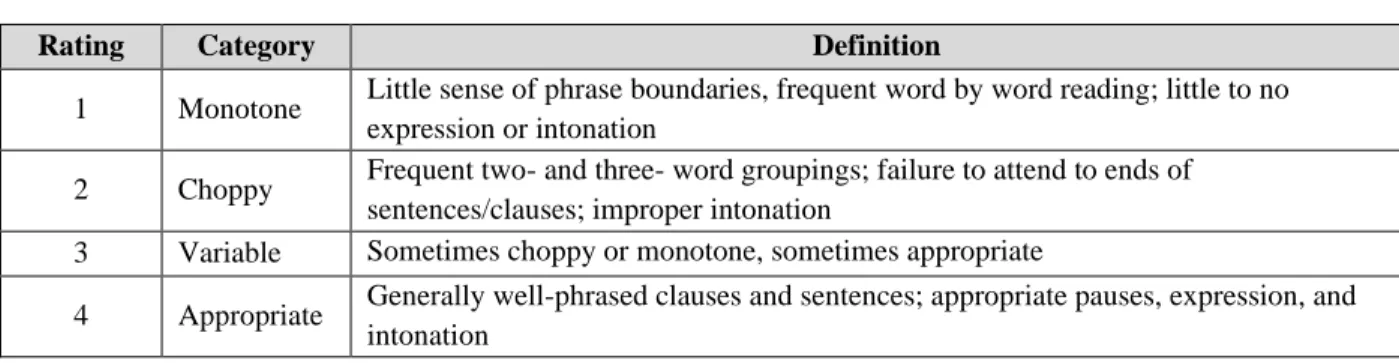
Table 1: Prosody Scale... 38
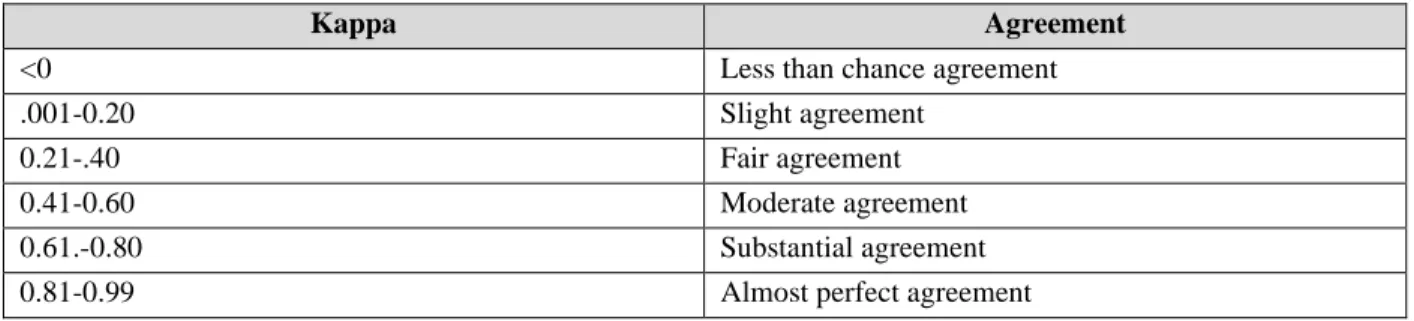
Table 2: Interpretation of Kappas ... 46
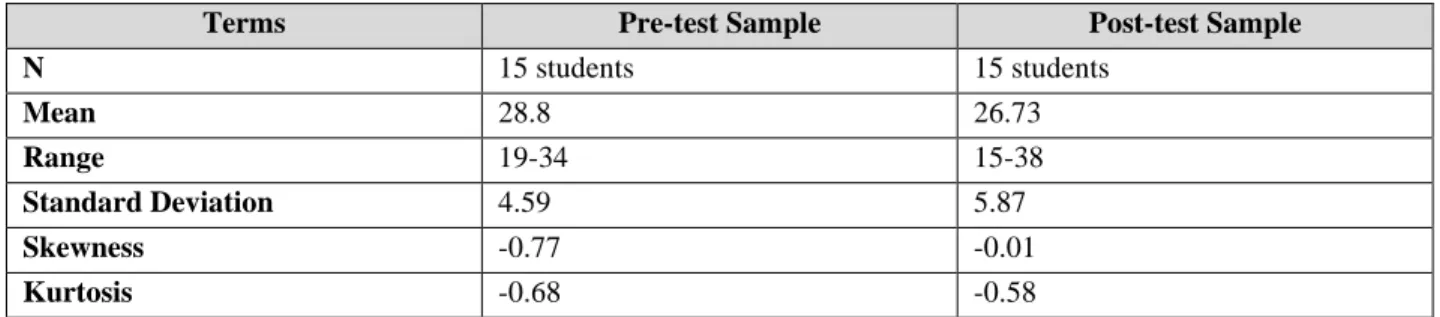
Table 3: Descriptive statistics on reading fluency data, words per minute ... 48
Table 4: Descriptive statistics on difference scores pre/posttest for fluency, words per minute .. 50
Table 5: Descriptive statistics on accuracy sample data ... 50
Table 6: Descriptive statistics on prosody sample data ... 51
Table 7: Descriptive statistics on reading comprehension data ... 52
Table 8: Descriptive statistics on Total Attitude Towards Reading sample data ... 54
Table 9: Descriptive statistics on Recreational Attitude Towards Reading sample data ... 54
Table 10: Descriptive statistics on Academic Attitude Towards Reading data ... 55
Table 11: Descriptive statistics on difference score for reading fluency words per minute for the intervention and control group ... 56
Table 12: Descriptive statistics on difference score for reading accuracy for the intervention and control group ... 57
Table 13: Descriptive statistics on the DAZE scores of the intervention and control ... 57
Table 14: Codebook ... 66
Table 15: Interpretation of Kappa Coefficient ... 68
Table 16: Kappa Summary for Inter-Rater Reliability Trial ... 69
Table 17: Number of Students and References by Code Category and Frequency ... 69
Table 18: Research Design ... 88
LIST OF FIGURES
Figure 1: Study Design ... 34
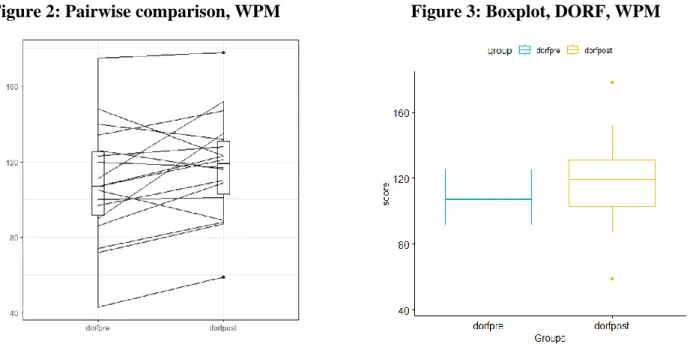
Figure 2: Pairwise WPM………..….……….49
Figure 3: Boxplot, DORF, WPM ... 49
Figure 4: Pairwise comparison of DAZE………..……….53
Figure 5: Boxplot comparison of DAZE ... 53
Figure 6: Pairwise comparison of recreational reading………...………..55
Figure 7: Boxplot of recreational reading……..………55
LIST OF ABBREVIATIONS
APA American Psychological Association
BOY Beginning of the Year
DIBELS Dynamic Indicators of Basic Early Literacy Skills
DORF DIBELS oral reading fluency
EOY End of the Year
ERAS Elementary Reading Attitude Scale
IRR Inter rater reliability
MOY Middle of the Year
NAEP National Assessment of Educational Progress
RAN Rapid automatic numbering
CHAPTER ONE: INTRODCUTION
Literacy is a necessary skill for success in society and has been emphasized in recent
decades as a priority among elementary students across the world. Fluency, which is defined by
the National Reading Panel (2000, p3-1) as reading with speed, accuracy, and proper expression,
especially has been realized as a critical component of early literacy attainment, as it is linked
with reading comprehension and basic reading proficiency.
Literacy Attainment
The ability to read and write is an integral part of academic development and is necessary
for individual success. Literacy attainment is also a mark of achievement and quality for
societies and countries. The ability to read serves as a strong predictor of success for children at a
young age, when the foundational skills are mastered. Reading scores in elementary school have
been reliably shown to be linked with future success academically and vocationally (Lloyd 1978;
Hernandez 2011.; Shutay, Plebanksi, & McCafferty, 2010; Evans, Kelley, Sikora, Treiman,
2010; Juel 1998; Payne, A., Whitehurst, G., & Angell, A., 1994). These studies researched the
association between early literacy attainment with other marks of success in life. In these studies,
lower reading scores in elementary school were strongly associated with high drop-out rates
during high school years, while high reading scores in elementary school were linked with higher
rates of high school graduation (Hernandez, 2011). Literacy attainment in these elementary years
is strongly associated with both the attainment of higher literacy skills and higher language
The skills mastered in the elementary years of reading set the foundation on which the
rest of the academic schooling is built, such as language acquisition. If success is not achieved in
these early years, then students will struggle throughout the rest of their education because
material is accessed mainly through reading each year, leading to the direct impact on high
school drop-out. Without completing high school, individuals are faced with several challenges
that will greatly affect their quality of life as many opportunities such as further education,
employment, and basic life skills will no longer be available.
Consequences of Illiteracy
Literacy attainment in the early years of elementary school have been studied in relation
to other forms of success in society. Research has uncovered that lower reading scores in
elementary school were associated with higher likelihood of incarceration in adulthood as well as
higher rates of claiming welfare status (Shutay, Plebanski, & McCafferty, 2010). This study
revealed that two-thirds of students scoring as ‘less than proficient’ in reading by the end of 4th
grade were either in jail or on welfare in adulthood (Shutay et al, 2010). Reading scores are a
clear indicator of future success or failure in a society, as the costs for providing for prison
systems and welfare are astronomically devastating for the economy. For example, one prisoner
in the United States costs the government over $30,000 a year, on average, with large variation
depending on the state, accumulating to a national cost of over 39 billion dollars per year to
taxpayers (Henrickson & Delaney, 2012). The National Institute for Literacy found that seven
out of every ten inmates incarcerated in the American prison systems were inadequately literate
(National Institute for Literacy, 1998).
Illiteracy is also highly associated with poor health outcomes compared to literate adults,
For example, a study examining managed care enrollees from Medicare found significant
associations between individuals who were illiterate and higher rates of admittance to
hospitalization, higher healthcare costs, and overall poorer health even when controlling for
socio-economic and demographic characteristics (Baker, Gazmararianm Williams, Scott, Parker,
Green, Ren, & Peel, 2002). The main author estimated the total cost of illiteracy in America to
be in the billions, as illiteracy affects the greater society through increased health care costs, low
productivity in the workplace, and significant strains on the welfare system (Baker, Parker,
Williams, Clark, & Nurss, 1997). The costs are high, and unfortunately, they typically follow a
continuous cyclical pattern across generations, as illiteracy is a notable intergenerational trend
(Costa, 1988).
Research has found astounding statistical data relating to future individual success and
early reading abilities. For example, one study found that one in every six children that cannot
meet reading proficiency standards in third grade does not graduate high school on time, a rate
that is four times greater than for children who do meet reading proficiency standards in third
grade (Hernandez, 2011). This same study found that about 23% of students with low, below
basic reading ability are the more likely to drop-out when compared to students with basic
reading skills, or proficient reading skills (Hernandez, 2011). The Bureau of Labor Statistics
reported the income and unemployment rate differences based upon education level and reported
that individuals who did not obtain a high school diploma were in the highest category for
unemployment, with a rate of 7.4% as of 2016, and similarly reported weekly income of $504
which was the lowest reported compared to the 5.2% unemployment rate and $692 weekly
earnings for a high school graduate (Bureau of Labor Statistics, 2016). The numbers show the
which this further validates the important role of academic achievement. Kirsch et al, 2001,
found that low proficiency readers were more frequently unemployed, typically worked fewer
weeks annually, and earned lower wages than individuals with higher literacy skills (Kirsch,
Jungeblut, Jenkins, & Kolstad, 2001). Quality of life and access to opportunities are greatly
decreased when individuals are not able to read proficiently.
With regard to a more national scale, there are many indexes which assess individual life
quality and overall wellbeing of citizens as a marker of a country’s success compared to other
countries across the globe. These calculated algorithms typically incorporate many aspects of
literacy attainment or related academic achievement. For example, the Human Development
Index (Human Development Report), the Physical Quality of Life Index (Morris, 1980), and the
Starting Well Index (Starting Well, 2017) rank countries on their development and well-being by
producing a score based upon calculations which include measures of academic success. Some
include measures such as percent of the population that is literate, years of education, or
availability of education. These globally recognized markers of well-being and country
development underscore the critical importance of academic success and literacy with regards to
quantifying the well-being and success of a country. This demonstrates the global perspective of
how literacy, and academic achievement, relate to markers of prosperity.
A foundational component of early literacy attainment is reading fluency, which is
defined by the National Reading Panel (2000, p3-1) as reading with speed, accuracy, and proper
expression. This skill is not only necessary for proficiency but is strongly linked with reading
comprehension. Further research is needed to understand the different whole-class and targeted
Roadmap
This study reviews the research on literacy and reading fluency in schools, and oral
reading interventions targeting reading fluency as the basis for the development of an innovative
reading intervention responsive to the current limitations in the research. Interventions for
reading fluency, although effective, are highly resource-intensive and require either a teacher,
intervention specialist, peer or parent to be present as the child practices oral reading to increase
reading fluency. Drawing on a novel form of intervention that utilizes trained therapy dogs,
alternative organisms will be examined in the literature to assess their potential to serve as a
component for an autonomous and purposeful third grade intervention. This intervention is
designed as a home-school partnership and is introduced to the students as a reading intervention
as part of their nightly homework. The procedures, materials, and methods of assessment in the
CHAPTER TWO: LITERATURE REVIEW
Literacy in Schools
The National Reading Panel was specifically appointed by Congress to review empirical
studies on literacy attainment among children and to report which methods were most effective
for learning to read. The National Reading Panel concluded that there were multiple main skills
that were imperative to eventual literacy attainment including: phonological awareness, fluency,
alphabetic principle, vocabulary, and comprehension (National Reading Panel, 2000). School
policy and curriculum focuses heavily on providing elementary students with instruction
surrounding these five areas with evidenced-based strategies of instruction provided by the
National Reading Panel, and with accountability measures to track progress of each individual
student. In continuing research and dedication to shaping policy by using evidenced-based
strategies, the National Early Literacy Panel also endeavored to examine strategies and crucial
variables for literacy success. It was determined that many variables accounted for future reading
proficiency such as alphabet knowledge, phonological awareness, rapid automatic naming,
writing in isolation, and phonological memory (National Early Literacy Panel, 2008).
Reading Fluency
Fluent readers are recognized by their ability to read with speed, accuracy, and proper
expression, a skill which has been identified as a critical prerequisite for reading comprehension
defined fluency as “the ability to read text quickly, accurately, and with proper expression”
(NICHD, 2000, pp 3-5).
Reading fluently is a critical component of basic reading skills and has been notably
linked with overall reading proficiency (Rasinski 2000). Multiple studies have consistently found
a significant link between reading fluency and reading comprehension (Klauda & Gunthrie,
2008; Cook, 2003; Roberts, Good, & Corcoran, 2005; Roehrig, Petscher, Nettles, Hudson, &
Torgesen, 2008; Kim, Petscher, Schatschneider, & Foorman, 2010; Alvarez-Canizo,
Suarez-Coalla, & Cuetos, 2015). Reading fluently impacts the reader’s ability to properly understand the
text, and to comprehend the significance and meaning not only within a sentence, but across
sentences and passages as a whole (Graesser, 2015). Reading comprehension has been identified
as a complex process that requires the use of prior general knowledge, ability to make inferences,
ability to integrate and synthesize meaning and information, and the ability to construct a mental
representation of the text, each of which first requires the reader to have early skills such as
decoding, vocabulary, working memory, and fluency (Kendeou, McMaster, & Christ, 2016).
Reading comprehension is crucial for later academic success as much of academic performance
relies upon students’ ability to read, cognitively digest, and analyze material presented in text
format. This relationship between fluency and comprehension is not unidirectional, it has been
described and conceptualized as a reciprocal relationship, with each building upon and
strengthening the other (Stecker, Roser, & Martinez, 1998).
Reading fluency, as defined and assessed, has evolved over the past decade to encompass
far more than an individual’s ability to read words accurately. Based on robust research findings
of strong connections between reading fluency and reading comprehension, there has been a
The definition of fluency has expanded to incorporate prosody, intonation, appropriate
influx, and purposeful pauses to interpret the text fully. These components greatly influence an
individual’s understanding of the text and their comprehension of the material. A recent study
examined the effects of early readers’ prosody with oral reading and found that in addition to
oral reading fluency predicting comprehension, there was notable additional variance accounted
for by prosody with regards to comprehension, even when decoding efficiency and language
comprehension were controlled (Veenendaal, Groen, & Verhoeven, 2015). This automaticity
between words and sentences, or verbal fluidity, has been found to be linked with greater literacy
as it demonstrates the reader’s deeper comprehension of early literacy skills such as phonetics
(Hawes, 2015). A reader who has the ability to manipulate the text orally achieves better in
comprehension measures.
Due to the robust research linking fluency and comprehension, assessments have evolved
to reflect this important link by attempting to document student reading fluency and perceived
automaticity. Historically, RAN (rapid automatic naming), or similar tests were administered in
which a list of words was presented to the child to read aloud in isolation. The number of words
read accurately within a certain time frame were tallied to produce a score that would correspond
to that child’s oral reading fluency. This form of assessment for oral reading fluency has been
adapted, and now there are multiple methods of assessing an individual’s score. It is stressed that
fluency should be assessed with particular attention given to accuracy, rate, quality, and the
newer addition of comprehension (Pikulski & Chard, 2005). Many fluency assessments rely
upon an entire passage being read while marking hesitation, transposition, substitution, or any
comprehension question section to fully assess the child’s ability to read fluently and absorb the
material in real time, as well as a prosody scale.
There has been a notable gap from theory to practice, as many literacy advocates claim
there is insufficient attention or instruction given to oral reading fluency. Research and theory
have found that there are multiple interventions with strong evidence to support them based upon
the National Reading Panels and the National Early Literacy Panel. Practiced reading is
consistently recognized in the literature as an important contributor to bolstering fluency
(Fountas & Pinnell, 2006). The National Reading Panel emphasized two main instructional
strategies that were evidenced-based, with the first being guided repeated oral reading in which
students read passages orally with systematic and explicit guidance and feedback from the
teacher and the other is independent reading. The National Early Literacy Panel found large
outcomes (ES=0.7) on oral language for shared-reading interventions, in which various forms of
interaction around material occurred, as well as home or parent interventions having a moderate
to large effect on oral language outcomes (National Early Literacy Panel, 2008). On average,
children who participated in a shared-reading intervention included in this meta-analysis scored
more than .7 of a standard deviation higher than children who did not participate in this
intervention (National Early Literacy Panel, 2008). The panel has described meta-analyses to
identify the most effective instructional and supplemental practices to bolster literacy in
elementary students. Their findings have been publicized nationally have been utilized to shape
policy and instructional efforts, yet there appears to be a failure to implement from research to
practice.
Despite the robust literature highlighting the importance of fluency, it is often neglected
profoundly negative effects on gaining proficiency (Rasinski, 2014). This affects a substantial
number of children, as only about 40% of the nation’s 4th graders could read fluently, a statistic
that has yet to change over the decade (National Center for Education Statistics, 2017; National
Assessment of Educational Progress, 2015; Abadiano & Turner, 2005; Daane, Campbell, Grigg,
Goodman, & Oranje, 2005). This failure to translate research to practice has been problematic
for gaining reading proficiency across the nation for elementary school students. The current
interventions being used must be examined to better understand the gaps in fluency performance
among students.
Oral Reading
Reading out-loud has been a well-supported concept providing that is evidence for an
increase reading fluency in students (Neumann, Copple, & Bredekamp, 2000; Fountas & Pinnell,
1996). Oral reading has also been shown to increase reading comprehension (Prior, Fenwick,
Saunders, Ouellette, O’Quinn, & Harvey, 2011) and oral reading has been linked with further
developed critical reading skills in general (Richards 2000; Martinez, Roser, & Strecker, 1999).
The intervention in this study, which prioritizes increased oral reading at a critical learning
period, addresses a national reading literacy standard (NCTE/IRA Standard No. 4) highlighting
the students’ ability to adjust their use of spoken, written, and visual language to communicate
effectively.
Interventions
The National Reading Panel asserted that fluency is best developed through practice
(NICHD, 2000, pp 3-1), and stressed that this can be accomplished specifically through oral
independent reading as much as possible (NICHD, 2000, pp 3-5). According to Fountas &
Pinnell, 2006, there are many types of evidenced based instructional strategies for bolstering
reading fluency. Fountas et al., describe three different levels for gaining early literacy skills
with fluency within the school setting. The first level is whole-group teaching which utilizes
common practices such as interactive read-aloud, shared reading, Readers’ Theater, storytelling,
poetry share, and interactive vocabulary lessons. The second level is small-group teaching which
utilizes guided reading, or literature study (typically in the form of a book club). Lastly, there is
an individual level of teaching which includes strategies such as independent reading, buddy
reading, and reading conference (Fountas & Pinnell, 2006, pp xxxv). Schools also typically
dedicate time for elementary students to read independently, however available data suggests
that this alone is not an effective practice and should never be used as the sole instruction for
developing fluency (Fountas & Pinnell, 2006).
Reading interventions target whole classrooms and at-risk students in elementary school
in order to provide the best possible instruction and increase literacy attainment in these early
years. Research indicates that interventions should follow certain guidelines to maximize
success. Gaining literacy is most effective through reading in an interactive process (Lonigan,
Shanahan, Cunningham, & The National Early Literacy Panel 2008; Wundenber, Wyse, &
Chaplain, 2013; Di Santo, Timmons, & Pelletier, 2016). An interactive process signifies
engaging interplay with the child which encourages active participation through vocal oral
reading. This can be achieved through multiple forums, such as child-teacher reading, peer
reading, child-parent reading, and even newer methods such as dog-assisted reading. Each of
these methods will be examined based upon the most recent literature while noting any
School Based Interventions
School-based fluency interventions have been slowly evolving over time to be more
complex and comprehensive than solely having a student practice reading silently. There are a
number of strategies that are on the forefront of development, and the research is currently
exploring the most effective strategies that are feasible within a classroom setting. Some of these
studies reaffirm what literacy panels and experts have suggested, while other studies have delved
into new possibilities that are on the cutting edge of developing technology.
Based upon the extant literature, there have been multiple meta-analyses focusing on
bolstering reading fluency for elementary aged students. The National Reading Panel, as
discussed earlier, reported an overall effect size of .41 for its meta-analysis of 77 studies for
repeated reading and guided reading, which has been repeated with similar evidence in the
literature (National Reading Panel, 2000). Burns & Wagner found in their meta-analysis that
performance feedback, ‘listening passage preview’, and ‘repeated readings’ were all statistically
significant in bolstering oral reading fluency (Burns & Wagner, 2008). Another meta-analysis of
30 studies involving 107 elementary students with or at risk of learning disabilities found that
goal setting plus feedback, or goal setting plus feedback and reinforcement, were most effective
with listening and repeated readings, keywords and previewing, and tutoring all producing
moderate effects (Morgan & Sideridis, 2006). Suggate (2016) published a meta-analysis which
found long-term effects for comprehension and phonemic awareness, though fluency did not
maintain its immediate effects long-term. This study did conclude, however, that interventions
were significantly more effective when administered in addition to typical instruction rather than
in place of instruction (Suggate, 2016). Another meta-analysis (Lee & Yoon Yoon, 2017)
effects of repeated reading on fluency gains, with the largest gains being with elementary
students, and with a larger effect being found for reading a passage at least four times.
Combining repeated reading and listening passage preview was also highly effective and was
noted to reduce student frustration. This meta-analysis, however, did not find support for
performance feedback or peer-mediation as a beneficial component (Lee & Yoon Yoon, 2017).
Ross & Begeny (2015) conducted an elementary reading fluency intervention with 2nd
grade students in order to compare the effectiveness of small group instruction vs one-on-one
instruction, as well as duration of intervention. The strategies utilized throughout the intervention
were evidenced-based including modeling, repeated reading, orally retelling the passage (retell),
and practicing new or incorrectly read words, known as read and phase-drill error correction
(Ross & Begeny, 2015). Although no significant differences were seen between the type of
instruction (small group vs one-to-one), there were significant differences for duration of the
intervention (14 minutes vs 7 minutes). Many of the strategies utilized in this study have been
validated as effective instructional strategies, but it is clear that research is still trying to finalize
exactly how long, and in what setting an intervention may be most effective.
Another study also found that multi-component interventions featuring repeated reading
and assisted reading with audiobooks contributed to gains in fluency and comprehension,
especially among learning disabled students, with repeated reading have the largest effect
(Stevens, Walker, & Vaughn, 2016).
Begeny & Silber (2006) examined group-based interventions that utilized a mix of
different evidenced-based strategies including repeated reading, listening passage preview, and
practicing difficult words in isolation. They reported that each intervention alone did contribute
combination of all of the strategies (Begeny & Silber, 2006). It appears that utilizing a
combination of evidenced-based strategies has the largest effect on elementary student outcomes
with reading fluency. Advances in research have led to new practices being implemented within
the school systems to increase reading fluency. Many of these advances have emphasized a
multi-component approach which utilizes more than one evidence-based practice or intervention.
Along with studies examining the effects of multiple strategies, there are new studies that aim to
better understand the ways in which technology can be better harnessed for fluency
interventions.
With technology constantly advancing, another intervention for class instruction to
improve literacy was recently studied by Redcay & Preston (2016), who found that 2nd grade
students’ reading fluency and reading comprehension both improved during a study that involved
teacher-guided iPad instruction sessions. The students receiving the iPad instruction
demonstrated significant growth in fluency and comprehension compared to the control group
(Redcay, & Preston, 2016). The use of technology, in this case, was met with astounding praise
of acceptance by the students and teachers and demonstrated significant gains in both fluency
and comprehension outcomes.
In the school systems, another strategy to increase the amount of time spent reading
out-loud includes peer buddy reading. This strategy has been utilized for decades and pairs two
children together as one reads a story and the other listens, and then the two children switch
being the ‘reader’ and the ‘listener’ in order to practice reading out-loud. These interventions
have robust literature supporting their effectiveness for increasing fluency (Topping & Bryce,
2004; Morrison, Everton, Rudduck, Cannie, Strommen, 2000; Fuchs, Fuchs, & Burnish, 2000;
Despite robust literature finding peer-reading alone to be a highly effective strategy for
bolstering oral fluency, there have been a number of adaptations to increase its effectiveness. For
example, Lee (2014) found that a peer reading intervention in which students were taught peer
assisted learning strategies contributed to gains in overall reading ability as well as student
attitude towards reading (Lee, 2014). The concept of peer reading has adapted from the peer
being a passive listener, to include efforts of examining the effects of having the peer become
actively involved and provide feedback or instruction during the peer reading time.
Research has recently begun to extend the effectiveness of peer-reading, with studies
attempting to incorporate peer tutoring strategies as well. Kourea, Cartledge, & Musti-Rao
(2007) conducted a small, study with a limited sample of six 2nd and 3rd grade students and
found increases in fluency and comprehension scores when peer-tutoring strategies were
involved with peer reading. These strategies included tutoring and practicing specific sight words
as well as encouraging and praising the reader (Kourea, Cartledge, & Musti-Rao, 2007). Similar
studies have found that the concept of peer tutoring and peer coaching have added gains to the
strategy of simply peer reading (Marr, Algozzine, Nicholoson, & Dugan, 2011). The research
from this study appears promising in the adaptation of peer reading to include teaching strategies
from peers to increase fluency among elementary school students, specifically for 2nd and 3rd
grade students from the studies mentioned above.
Another modern twist on the traditional peer reading, and even classroom peer tutoring
was trialed by Lin (2016) in an elementary school study between Taiwan and Australia in which
the students were involved with peer assisted reading via telecollaboration. This study aimed to
intervention showed significant improvements with fluency, specifically with significant gains in
reading accuracy, speed, and expression (Lin, 2016).
With regard to in school reading fluency interventions, the most effective strategies
produced in the literature are repeated reading (Begeny, Krouse, Ross, & Mitchell, 2009;
Swanson, Vaughn, Wanzek, Petscher, Heckert, Cavanaugh, Kraft, & Tackett, 2011; Therrien,
2004; Stevens, Walker, & Vaughn, 2016), guided reading (Blok, Oostdam, & Boendermaker,
2012; Oostdam, Blok, Boendermaker, 2015), peer-reading without instruction (Topping &
Bryce, 2004; Morrison, Everton, Rudduck, Cannie, Strommen, 2000; Fuchs, Fuchs, & Burnish,
2000; Koskinen & Blum, 1986) and peer-assisted reading with instructional and feedback
strategies incorporated (Lee, 2004; Kourea, Cartledge, & Musti-Rao, 2007; Marr, Algozzine,
Nicholoson, & Dugan, 2011; Lin 2016). It appears that multi-component interventions also prove
effective (Bengeny & Silber, 2006), and that there are many new advances in incorporating
technology into classroom intervention for increasing fluency (Redcay & Preston, 2016; Lin
2016).
Other literature has emerged emphasizing the need for increasing fluency beyond
repeated readings, and encouraging educators to increase the amount of reading students do with
new materials through interventions known as ‘wide reading’, not solely repeated materials
(Ardoin, Binder, Foster, & Zawoyski, 2016; Omer, 2015; Nathan & Stanovich, 1991; Stanovich
1986). Although the authors recognize and encourage the use of repeated readings when
necessary or to develop the fluency skills of struggling readers, these studies argue that readers
should be encouraged to explore new reading materials to bolster their proficiency when able, as
Home-Based Interventions
Historically, independent reading has been examined for its effectiveness on reading
development and reading achievement. The National Reading Panel 2000 acknowledges the
concept that increased independent reading results in increased reading achievement, as they
presented evidence of strong correlational data, though they found mixed results with
experimental studies studying relationships between independent reading and fluency.
A review of the literature finds that fluency has not always been incorporated as a
measurement for academic achievement, and typically previous studies surrounding independent
reading relied solely upon measures of vocabulary and comprehension for reading achievement
(Nagy, Herman & Anderson, 1985; Ozburn 1995; Manning & Manning, 1984; Langford &
Allen, 1983; Holt & O’Tuel, 1989; & Evans & Towner 1975). Many of these studies
traditionally had elementary students read an additional ten to twenty minutes per day (Nagy,
Herman & Anderson 1985; Ozburn 1995; Holt & O’Tuel, 1989), though the measures did not
incorporate examining fluency. This critique has been noted to be problematic in assessing the
true impact of independent reading on fluency and reading achievement (Williams, 2008).
Langford & Allen (1983), however, did find a link between increased independent reading and a
reported improvement in word reading, which would be considered a part of fluency. The
National Reading Panel 2000 suggested that there were mixed results on the effectiveness of
independent reading and therefore could not make conclusive statements on independent reading.
The previous gap in the knowledge with independent reading practices and its relation to
reading development has attempted be rectified with further dedicated research on the specific
outcomes associated with independent reading. Historically, the results were inconclusive with
examine the experimental effects of independent reading on increasing fluency. Research
conducted in more recent years, however, has examined the effects of print exposure,
independent reading, and joint-reading for elementary aged students with promising results
discussed in this section.
The literature has long-supported family efforts to become involved in a child’s literacy
attainment and development. Literacy specialists have proclaimed that parent-child reading is
considered to be a critical investment to their child’s language, literacy, life-long learning (Kalb,
& van Ours, 2014), and reading achievement (Saracho & Spodek, 2010). Parents reading
interactively to their child, co-reading with their child in which the child may read some words
or follow along with a finger to the words and turn pages, or having their child read with or to
them has been well-evidenced throughout the literature as a highly effective strategy to improve
fluency and overall reading skills for younger children (Wundenber, Wyse, & Chaplain, 2013;
Mol & Bus, 2011).
A recent meta-analysis of 99 studies (N=7,669) focusing on leisure time reading across
the lifespan of preschool to university students found that reading comprehension and technical
reading ability had moderate to strong correlations with the amount of print exposure. In primary
school, print exposure explained 13% of the variance in oral language skills. Moderate
associations of print exposure with academic achievement indicate frequent readers are more
successful students. Home reading experiences facilitated language, reading, and spelling
achievement throughout development, and low proficiency readers were noted to benefit
especially from independent leisure reading time (Mol & Bus, 2011). This study found that effect
sizes were .34 for oral language and .29 for overall reading skills utilizing studies from
1995) that found home print exposure had a similar effect size of .32 for oral language and .28
for overall reading skills when reviewing studies from 1951 to 1993.
Meta-analyses have examined the efficacious nature of reading fluency interventions
within the home and have found that increased exposure time to reading is highly effective and
connected to fluency and overall reading ability. This has been corroborated with studies finding
that the amount of exposure and time spent reading aloud is well-linked to reading performance
for elementary aged students (Zevin & Seidenber, 2004). Other recent studies have also
supported this claim, but have added that the use of traditional books, rather than the use of
electronic iPad books, were found to be significantly more effective especially in terms of
comprehension of material (Krcmar & Cingel, 2014). Overall, findings of the extant literature for
home-based reading interventions suggest that exposure to text and oral reading results in
significant gains in terms of language development and reading proficiency. As research
continues to develop, there has been a marked change in the field’s understanding of the
importance of increasing independent reading time, oral reading with others, and increased print
exposure to elementary school students, and how these activities influence the development of
reading fluency.
Dog-Assisted reading interventions, non-human interaction
Interventions with Therapy Dogs
With interaction as a crucial component of a successful reading intervention due to its
encouragement of active engagement of the child, increased participation has been noted as a
strengthening component. Research has begun to examine the fact that perhaps interaction may
shown numerous positive benefits associated with dog therapy in a variety of settings, as dogs
provide both positive interaction and foster engagement.
One approach to increasing active participation is through a supportive interaction as an
intervention with the use of animals, specifically therapy dogs. Therapy dogs have been
identified as animals that can produce both an emotionally secure atmospheres and interactive
environments. They have been used extensively to help calm and relax humans in hospitals and
retirement communities for decades (Nahm, Lubin, Lubin, Bankwitz, Blake, Castelaz,
McAllister, Chen, Shackson, Aggarwal, Manik, Totten, 2012., Vitztum, Kelly, Cheng, 2016.,
Naoko, Junkichi, 2011., Scheibeck, Pallauf, Stellwag, Seeberger, 2011). Specifically, therapy
dogs have been used to create emotionally secure, supportive, and interactive environments for
recovering youth in hospitals after surgeries (Vitztum, Kelly, Cheng, 2016). In these studies,
youth work extensively with a therapy dog as a component of their intervention and have shown
remarkable gains in their overall physical health through the emotional security and
connectedness that is formed solely through the presence of the animals.
The presence of dogs during therapy has been shown to have remarkable physiological
responses which result in measurable decreases in anxiety and stress (Freimann, Thomas, &
Eddy, 2000). This has led to the development and expansion of therapy dogs in a variety of other
settings, including college campuses, court-room proceedings, veteran support programs, and
more recently, dog-assisted reading programs in schools and libraries.
Specifically, research has linked the presence of therapy dogs with the reduction of
physical symptoms, such stress, anxiety, and loneliness (Odendaal, 2001; Jalongo, Astorino, &
Bomboy, 2004; Freidmann, Thomas, & Eddy, 2000). These studies have shown the presence of
heart-rate, while also decreasing feelings of stress and loneliness. Reading can be a taxing challenge
for students to learn, even without the presence of a learning disability, and many students
struggle during their elementary school years to practice their literacy skills regularly and with
enthusiasm. Dog-assisted reading programs for children have been gaining popularity in recent
years. Multiple studies have successfully implemented assisted-reading programs to help reduce
these symptoms in elementary students as they read aloud to practice their literacy skills with a
trained dog to produce an environment that is engaged, purposeful, and emotionally secure
(Jalongo, 2005; Kirnan, Siminerio, & Wong, 2016).
For assisted reading, therapy dogs have been shown to help children focus on the reading
material, increase their motivation and persistence for challenging reading material, and reported
enthusiasm to read while being assisted by therapy dogs (Granger, Kogan, Fitchett, & Helmer,
1998). Students reported feelings of increased enthusiasm for the program and would be highly
motivated to read with the assistance of therapy dogs. This increased engagement is a result of an
interactive environment in which children feel comfortable to explore the newly learned skills of
early literacy.
Therapy dogs may provide children with an engaging audience, in which the children are
prompted with the belief that reading to the dogs calms the animal, or that the animal enjoys the
stories. It allows for children to engage in active, out-loud reading while feeling purposeful in
their endeavor of reading. Children have reported feelings of more self-confidence with dog
assisted reading programs compared to reading with peers or adults (Jalongo 2005).
In library and school settings, children are positioned to be able to read out-loud,
speaking to the dog, and to be able to pet or stroke the animal during their reading time. The dog
chair (Nimer & Lundahl, 2007). These procedures ensure that the child is able to form a
connection with the animal by reading out-loud directly to the dog, and by the ability to interact
through touch in a manner to which the child believes the dog enjoys, or has pleasure, in
listening to the child. The child forms a sense of connection with the dogs, which may result in
more engaged participation as an outcome.
The use of therapy dogs in assisted-reading programs has demonstrated significant
outcomes such as higher reading rate and fluency, accuracy, and comprehension after the
intervention, even after controlling for maturity effects (Kirnan, Siminerio, Wong, 2016., Le
Roux, Swartz, Swart, 2014., Booten, 2011., Shannon, 2007). These studies also collected
qualitative data that reported positive feelings from the children towards the intervention
program and increased enthusiasm for reading (Kirnan et al, 2016; Le Roux et al 2014; Booten,
2011). This reported enthusiasm demonstrates that children feel connected to the intervention
and therefore are more engaged in reading. By creating an engaging interaction which involves
active participation, interventions with therapy dogs have consistently produced measurable
academic outcome results with regards to increasing reading fluency and reading comprehension
with elementary school students while simultaneously receiving consistently strong feedback
from participants.
Plant-Based Interventions, non-human interactions
Biophilia
To date, there have been no published literacy interventions involving children’s reading
to plants. Such an intervention would be novel in its design, however there is literature linking its
biophilia, popularized by socio-biologist and esteemed environmentalist professor at Duke
University, E.0. Wilson, proposes that humans have a genetic predisposition to instinctively bond
with the natural environment and life surrounding it (Colman 2015). This theory states that
humans have a natural affinity towards nature and animals, which has been utilized to possibly
explain the remarkable beneficial role of animals, including the dog-assisted reading programs
and other therapeutic animal interactions. As an extension of this logic, benefits should be
derived from any interaction with objects in nature, not just animals such as dogs. If this is the
case, then similar benefits could possibly be derived from other animals and perhaps other
naturalistic interventions that have the potential for more manageable interventions in the
classroom or home. As the children have been found to bond easily with therapy dogs, it would
be logical to assert that children may respond positively to other living organisms, as long as the
living thing provides a presence and the ability for the child to interact with it through reading.
Drawing on the theory of biophilia, it is proposed that other living organisms can provide
benefits for child interaction as non-animal alternatives and could be explained as easier and less
expensive natural objects to implement for a reading intervention with children.
Interventions with plants
A recent study found that plants had a significant positive therapeutic effect on recovery
of patients in hospitals which included better health outcomes as well as lower ratings of anxiety
and stress (Baldwin, 2012). A residential rehabilitation program introduced indoor plants as an
intervention and noted significant increases in reported well-being for patients (Raanaas, Patil, &
A large literature review conducted by Keniger, Gaston, Irvine, & Fuller (2013)
examined experimental and correlational studies to understand the effects and the benefits of
interacting with nature. The literature review examined benefits in areas of psychological,
physiological, emotional, cognitive, spiritual, and tangible outcomes. The review produced
significant evidence in support of interventions involving plants and nature. Specifically, the
literature review cited studies that found exercising in natural environments or with natural
landscape images significantly improved participant self-esteem and mood (Pretty, Peacock,
Hine, Sellens, South, & Griffin, 2007). Other studies of note included the finding that
psychological well-being was significantly promoted through intentional interactions with nature
including gardening (Catanzaro & Erkanem, 2004; Van den Berg, & Custers, 2011), and
watching wildlife (Curtin, 2009). Maller 2009 found that direct contact with nature through an
activity-based curriculum in an elementary school had a positive impact on self-esteem and
well-being for students. In terms of physical well-well-being, Ulrich (1984) found that post-operative
healing took less time for patients with a window view of nature compared to a brick wall.
Patients with a view of trees also required fewer painkillers, received fewer negative evaluative
comments from nurses, and had fewer post-operation complications (Ulrich, 1984). The
physiological, emotional, and psychological outcomes associated with plants has proved to be
worthwhile of further research, especially given their low-cost, low-care nature. Contact with
plants appears to increase overall psychological well-being and reduce physiological symptoms
of stress across different age ranges and settings. This robust scholarship merits continued
Limitations
School-Based and Home-Based
The outcomes measured by the school-based interventions have demonstrated significant
success in their goal to increase the reading fluency and comprehension of 2nd and 3rd grade
students. Extant meta-analytic literature surrounding the effects of reading fluency, however, has
been criticized for its limitation in its scope of investigation, commonly focusing on children
with learning disabilities in reading (Morgan & Sideridis, 2006), failing to understand
interventions usable for all students. This is evident in the literature reviewed in this paper,
however there is also useful information as to which interventions have been recognized as the
most effective, as well as the overall effect sizes of those interventions.
It is evident that many of these strategies have been implemented successfully, and with
strong results to support their existence. Despite the substantial gains these interventions offer,
they each have one core component in common which serves as a collective weakness: each of
these interventions is inherently resource-intensive. From teaching and monitoring peer-tutoring,
to small group instruction, to training and implementing technology in the classroom, each of
these interventions requires time and a teacher or instructor with specialized training to ensure
the intervention is implemented with fidelity and validity. This has been a well-noted concern
from teachers throughout the decades, as elementary teachers have been interviewed and
consistently report that they prefer interventions that are less time-intensive, and do not require
small-group instruction (Witt, Martens, & Elliot, 1984; Marcoe, 2001). Unfortunately, many
studies have highlighted the importance of parents reading with their children, but note that time
constraints have always been a limiting factor in this regard as well with many parents reporting
This study does not argue against the value and need for the interventions mentioned
above, however, it does recognize a need for a reading fluency intervention that can be
conducted in a more autonomous manner, without the constant instruction or monitoring of
teachers or other professionals.
Dog-Assisted Reading
While much of this research with therapy dogs focuses on the therapeutic benefits and
outcome of improved reading, it needs to be recognized that dog-assisted programs are not able
to be implemented as long-term interventions. The context of these dog-assisted programs has
been limited to libraries or short-term school programs, and therefore may not be transferrable to
grade-wide implementation during the course of the year, nor may they be manageable to
implement in the household. Therapy dogs are costly in resources and time, as each dog requires
a volunteer or paid handler to be present, and therefore must be recruited through an agency to be
provided.
Jalongo (2005) asserted that a number of steps that must be completed before therapy
dog programs can be used with children. His research highlights that first, an organization must
be sought out to provide the dogs and the handlers. This organization should be accredited to
provide these services to ensure the dogs are well-trained. Secondly, administrative support
should be gained in order to make the implementation more viable especially in the school
setting. Liability and safety concerns include allergies. The context of the environment should be
considered to ensure that the community would be willing to accept a program involving dogs.
Budget and sanitation concerns should also be considered. Lastly, permission and consent should
be obtained from the parents and children. These guidelines are necessary to fulfill if considering
dog-based interventions requires considerable time and resources to implement, which may make this
unavailable in many schools. This creates a barrier of a time-constraint and access, as many of
these programs do not extend past a few weeks. Along with these smaller barriers, these
programs do not possess the potential to transition or continue such a program, as teachers
cannot have a dog per classroom for reading, nor can families be expected to invest in having a
dog at home solely for the benefit of improving their child’s literacy rates. It is also not possible
to create a year-long, sustainable intervention program with therapy dogs, as it would not be
manageable after a few weeks.
Although highly effective, therapy dog assisted reading programs are nearly impossible
to transition into daily classroom schedules or to the homes for regular practice, which would be
a required component vital for success. Without the ability to procure a long-term program,
interventions involving therapy dogs may never be incorporated into the curriculum. These
programs involving dog-assisted reading are inherently short-term and therefore cannot be used
as a regular intervention in the classroom, nor as a manageable intervention to transfer to the
home. Other options should be explored that may provide similar benefits as dog-assisted
reading programs, but that do not require the same amount of resources yet can still easily
transfer into a year-long curriculum support or an intervention at home. The benefits of other
potential interactive and emotionally secure interventions should be explored by further research
in order to identify any manageable animals or natural life forms that may produce similar
benefits as the dog-assisted reading programs, yet not as intensive in the requirement of
resources. Interventions that may be long-term or transferrable to the home while maintaining the
ability for a child to form a sense of connection and emotional security may be highly beneficial
other forms of interactive interventions in which the child may still connect could produce
similar effects for reading fluency.
Plant-Assisted Reading
There are currently no published studies on the concept of students reading to plants or
any analysis of the effects. Based upon the literature, however, these is a clear support for the
benefits of human interaction with plants which may serve as a basis for this experimental study
With regard to increasing reading fluency through oral reading interventions in
elementary aged students, there appears to be a considerable gap in the research for whole-class
interventions that are not resource-intensive or dependent upon an adult. Many interventions
focus on a small population of children with a learning disability whereas all require an adult to
be fully present in the experience with the child aside from child independent reading habits.
Previous research has shown that significant gains can be made when supplemental independent
reading practice is added to pre-existing classroom instruction, however new avenues should be
explored to better examine the ways in which children can be scaffolded to read more
independently in an engaging manner. Recent studies have found elementary aged students to
appropriately be able to implement math fluency interventions with significant achievement
outcomes (Hulac, Dejong, & Benson, 2012), however there has been little research into children
reading autonomously, through a purposeful activity, despite studies that assert the importance of
exposure to print.
This study was designed to investigate the impact of implementing a reading activity into
a 3rd grade science curriculum to encourage children to read aloud. With education standards of
integrate this intervention with a pre-existing curriculum. This study examined the effects of
children reading aloud over a six-week period while simultaneously conducting a scientific
experiment to understand the effects of the human voice on the growth rate of plants. It was
integrated into the science curriculum by teaching children about the parts and function of plants
and what plants require to live, such as sunlight exposure and water.
The study investigated if children at this age were encouraged to read aloud in the home
would demonstrate increased fluency and comprehension as a result. To date, there have not
been any published literacy interventions involving children reading to plants, however there is
robust literature behind the concept of children reading independently and with therapy dogs.
Gaining literacy is most effective through reading in an interactive process (Lonigan, Shanahan,
Cunningham, & The National Early Literacy Panel 2008., Wundenber, Wyse, & Chaplain, 2013.,
Di Santo, Timmons, & Pelletier, 2016), however with independent silent reading being
non-interactive, and dogs being a resource-intensive and inherently short-term intervention, this study
examined the feasibility of an intervention that would encourage students to read aloud through a
purposeful and engaging interaction with plants. If effective, this intervention could easily
translate to a cost-efficient, resource-scare dependent home-based intervention to increase
reading fluency for elementary students.
Reading alone is one component of overall instruction for reading, this still encourages
increased exposure time to reading aloud with an autonomous and engaging intervention. This
intervention could be utilized for any students, not just struggling readers, as a home-based
intervention. Plants may be a viable alternative to an interactive reading intervention and could
be used in reading-assisted programs, as children would practice reading aloud. Plants are far
an outlet to practice reading aloud without the required presence of an adult or peer. The choice
of succulent plants, or other hardy plants that would persist in sub-ideal conditions, are ideal for
this intervention in order to avoid a plant from dying and therefore negatively affecting the child.
If effective, the accessibility and broader implementation of this intervention could be
tremendous, and therefore it is an important area to investigate to determine if it is beneficial for
literacy attainment for elementary students.
Research Questions
This study was designed to investigate the effects of a school partnered, home-based
plant assisted reading intervention with third grade students on reading fluency, prosody, reading
comprehension, and attitude towards reading. The study addresses five research questions:
Research Question One: Does a plant-assisted, home-based reading intervention/program
significantly increase student reading fluency as measured by quantitative pre-post classroom
assessment?
Research Question Two: Does a plant-assisted, home-based reading intervention/program
significantly increase student prosody as measured by a qualitative pre-post marker?
Research Question Three: Does a plant-assisted, home-based reading
intervention/program significantly increase student reading comprehension as measured by
quantitative pre-post classroom assessment?
Research Question Four: Does a plant-assisted, home-based reading
intervention/program significantly improve student attitude towards reading as measured by a
Research Question Five: Does a plant-assisted, home-based reading intervention/program
significantly increase reading fluency and comprehension as measured by pre-post classroom
CHAPTER THREE: RESEARCH DESIGN
Given the innovative nature of this intervention as developed in this study, it is important
to research the feasibility and acceptance of the intervention. The design of this research is based
on the science of intervention development and the literature of other effective reading fluency
interventions which also involve vocalized oral reading. The intervention requires participating
students to read out-loud for at least ten minutes (Krcmar & Cingel, 2014; Ross & Begeny, 2015;
Ardoin et al., 2016; Nagy, Herman & Anderson 1985; & Ozburn 1995), in keeping with the
requirements of the local school setting. Many schools require students to read each night,
therefore this intervention was integrated seamlessly into the pre-existing curriculum and
instructed students to read for twenty minutes per night, as the participating school dictates. The
students participating in the intervention were required to read out-loud rather than silently.
Although previous interventions often range from 4-8 weeks with some even lasting months, the
six week intervention time length in this study is consistent with the literature as being a
sufficient time frame to show effective results (Swanson, Vaughn, Wanzek, Petscher, Heckert,
Cavanaugh, Kraft, & Tackett, 2011; Begeny & Silber 2006; Begeny, Krouse, Ross, & Mitchell,
2009).
It is important to note that this study did not endeavor to replace any intervention or
instruction in fluency, rather it examined the effectiveness of an added intervention upon already
existing instruction. The limitations revealed in the literature review criticize the resource
and importance in the school setting. This intervention, if effective, could have greatest potential
as a supplemental intervention alongside current instruction and intervention in the schools.
Methods
Design
The study is a single group, mixed-methods, pre/posttest design with an intended sample
size of 40 third grade students at a single elementary school. The sample size was calculated on
the basis of a power analysis with a conventionally set power of .80, an effect size of .50
consistent with the literature of reading fluency interventions and a traditional significance level
of .05 (Morgan, Gliner, & Harmon, 2006, pp 150). This yields a required sample size of 33
students.
The study incorporated one additional classroom to serve as a control group. Data was
collected from the control classroom during pre-test and post-test data collection.
This is a quasi-experimental study due to the convenience sample of whole classrooms.
Classrooms are a product of the children living within a certain school district, therefore the
participants are not truly randomized as they will all be attending the same school. This threatens
the external validity to generalize to other populations and makes conclusions about cause
difficult due to its inherent non-randomized nature (Morgan, Gliner, & Harmon, 2006).
This is mixed methods research study designed to inform the development of this
intervention. The purpose of this research was to first determine if the intervention was effective
in bolstering reading fluency in third grade students, and then how to better capitalize on its
effectiveness by examining the perspective of participating third graders on their experience.
results gained from this study should be interpreted with caution and should only be utilized to
inform a more rigorous study to test the effectiveness of the intervention (Morgan, Gliner, &
Harmon, 2006, pp 82). The specific design of this study is a single-group pretest-posttest design
as displayed in Figure 1 with a comparison for performance measures against a control.
Figure 1: Study Design
E: 01 X 02
C: 01 02
This design will commence with a pretest (01), followed by the implementation of the
intervention (X), and lastly with a posttest (02). With the independent variable being recognized
as the implemented reading intervention, the dependent variables are (a) reading fluency, (b)
prosody, (c) reading comprehension, and (d) attitude towards reading. For feasibility purposes,
the DIBELS reading assessment measure will be utilized as the fluency and comprehension
measure, with an additional attitude towards reading scale administered at the pre-test and
post-test. In this study, a single group, pre/posttest design was utilized for measures of attitude
towards reading and prosody. An experimental design was utilized to compare the students
participating in the intervention against a control group for reading fluency (words per minute
and accuracy) and reading comprehension measures. A short essay was collected from the
students to examine the perceptions of the participating students.
Participants and Setting
The sample size was calculated through a power analysis and yields a required sample