A Musician’s Life: New Models for Success in the Music Industry in the 21st Century
Sumi Krishnan
A thesis submitted to the faculty of the University of North Carolina at Chapel Hill in partial fulfillment of the degree of Master of Arts in Journalism and Mass
Communication in the School of Journalism and Mass Communication.
Chapel Hill 2010
Approved by: Debashis Aikat
ABSTRACT
SUMI KRISHNAN: A Musician’s Life: New Models for Success in the Music Industry in the 21st Century
(Under the direction of Debashis Aikat)
This thesis explores how technology advancements have driven a power shift in the music industry, birthing new business models that musicians as well as the music industry at-large can adopt. It also provides a real-life story of one band’s struggles in the industry today.
ACKNOWLEDGEMENTS
I am grateful to my thesis chair, Deb Aikat, for his consistent encouragement and support throughout this project. I am grateful to have worked with someone who approaches life with a sense of humor and patience. I thank my committee member Donald Shaw for his humor, insight and unique methods which will always remain with me. I thank my committee member Andreas Preuss for his continued commitment to my success despite the miles of physical separation. I thank you all wholeheartedly.
None of my work would have been possible without the support of my wonderful colleagues – my peers in the graduating M.A. class of 2010 made this experience enjoyable, challenging and worthwhile.
Thank you to my sources and to the band Swaso for giving me access into even the most private aspects of life.
TABLE OF CONTENTS
Introduction ... 1
Research Questions and Method ... 3
So, You Want to be a Rock Star? ... 5
The Power Shift ... 14
New Business Models ... 17
The Prize at the End ... 32
Three Cities to a New Day ... 52
LIST OF TABLES
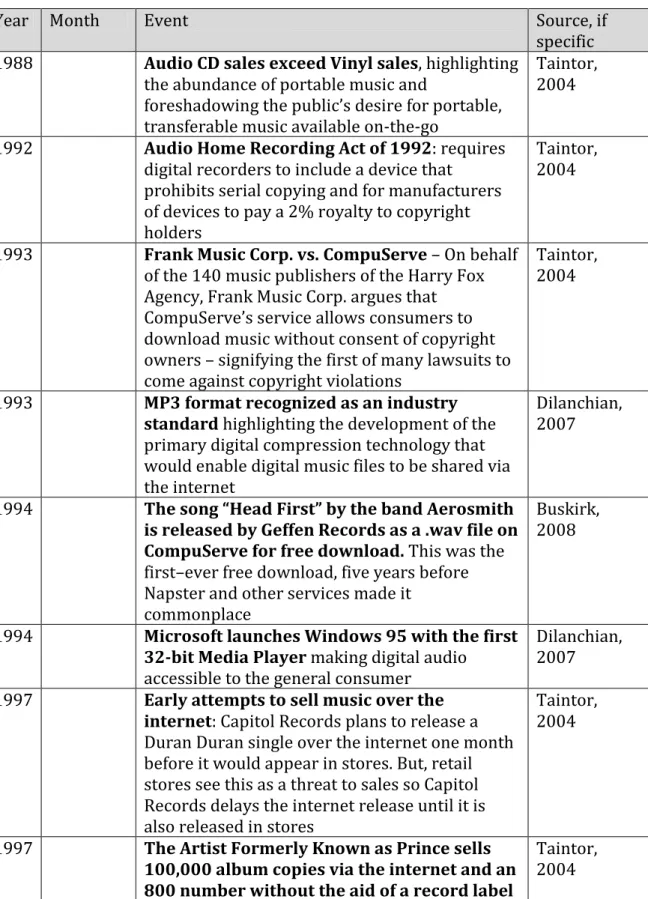
Table 1: Major Music Milestones ... 10
INTRODUCTION
“Music is the universal language of mankind,” said poet Henry Wadsworth Longfellow. Over time, this “universal language” created what became a billion-dollar industry controlled by only a couple of dozen key executives in a handful of companies (Kot, 2009). In fact, by the late-1990s, consolidation in the industry left five multinational conglomerates to run what was a $14.6 billion dollar record industry (Kot, 2009). Radio stations – the primary outlet by which the public found out about music – were owned by only a handful of corporations. By 2000, Clear Channel “owned more than 1,200 radio stations, covering 247 of the nation’s top 250 markets, and controlled the biggest concert venues nationwide” (Kot, 2009, p. 10). Power in this mammoth of an industry was centralized in a few, select hands -- fewer hands than it had ever been in before. But whether anyone knew it at the time, things were about to change in a major way.
The purpose of this is to explore how technology advancements have driven a power shift in the music industry, birthing new business models that musicians as well as the music industry at-large can adopt. Additionally, this thesis provides a real-life story of one band’s struggles in the industry today.
This thesis project consists of three articles. The first article, “So, You Want to Be a Rock Star? How Technology is Changing Business Models for the Music
learn from past mistakes. The final article, “Three Cities to a New Day: Chronicling a Social Media Experiment” picks up with SWASO a few months later and follows the band on a three-city tour where they implement, for the first time, new and
RESEARCH QUESTIONS & METHOD
This master’s thesis project addresses the following research questions: 1. What are new business models for the music industry in the 21st century?
• How has technology changed the industry? • Has there been a shift in power structures?
2. What are some of the struggles a local band that is trying to achieve national success may face?
3. What are some of the challenges a band may face when implementing social media strategies?
To answer the first question, I used a research approach. I examined a number of documents including blogs, Websites, books and conference
presentations. I studied real-life examples of musicians and businesses that have implemented new models with success. I also attended conferences and spoke to experts in the field. I drew from a few conceptual theories in order to understand the significance of new models.
To answer the third question, I changed my position from that of purely an observer to that of an active participant. I picked back up with SWASO in January 2010 -- one month after the first article ends. At that point, SWASO had decided to implement a detailed social media plan into their strategy – a plan that I helped them create. For this article, I accompanied the band to three shows – first Asheville, N.C.; then Atlanta, G.A.; and finally Birmingham, Ala. I take an active role in
SO, YOU WANT TO BE A ROCK STAR?
How Technology has Created New Business Models for the Music
Industry
In 1999, Shawn Fanning, a student at Northeastern University, tapped out the software code to a program he dubbed Napster – a digital file-sharing technology that enabled users on the Internet to share music with one another. Napster allowed people to download music in a digital, mp3 format, for free. Around the same time, the price of CDs had peaked at an average of $18.99 per CD (Kot, 2009). Not surprisingly, the public jumped on the opportunity to easily find and download music for free.
Now, more than ten years since the development of Napster and similar file-sharing programs like Kazaa and Grokster, the music industry is still grappling with how to succeed in an industry where free music is ubiquitous. The Recording Industry of America (RIAA) states, on its website, that the illegal downloading of music has caused 71,060 U.S. jobs lost and causes $12.5 billion of economic losses every year.
Why New Models?
The traditional music industry, which was comprised of a few powerful record labels controlling the hopes of artists who were trying to get noticed, and retail stores selling CDs to consumers – is no longer a viable model.
The “big four” – the four record labels that controlled more than 70% of the world’s music as of 2007 (Jobs, 2007) are tremendous financial losses. The big four labels are:
• Universal Music Group • Warner Music Group
• Sony BMG Music Entertainment • EMI Music
Atlantic Records, a subsidiary of Warner Music Group, is currently asking fans to help pay for one of its artist’s album. Atlantic teamed with the service Pledge Music in April 2010 to ask fans of the rapper Natty, to help fund his upcoming album (Houghton, 2010).
Warner Music Group has reported a net loss of $100 million in 2009, a net loss of $56 million in 2008 and a net loss of $21 million in 2007 (Warner Music Annual Report, 2009).
EMI Music reported an operating loss of $258 million in 2008 and $157 million in 2007 (EMI Annual Report, 2008).
total sales in the music industry have plummeted 45 percent since 1999, from $14.6 in 1999 to $6.3 billion in 2009 (Goodman, 2010).
In 2008, physical album sales in the United States fell for the seventh time in eight years (Goodman, 2010) and digital download sales also slowed. Neilson SoundScan reports that total album sales fell 14 percent in 2008 (Nielson SoundScan, 2008).
Tower Records, one of the largest music retail stores, went out of business in 2006 and the iconic Virgin Megastore in Times Square, N.Y. closed in 2009.
Clearly, record labels are facing difficult financial times. The Downfall of the Traditional Music Industry
Simply stated, the rise of peer-to-peer file sharing networks that enabled users to share music files for free disrupted and led to the downfall of the traditional music industry. Starting with Napster in 1999 and including a multitude of other file sharing services like Limewire, Kazaa, Grokster, Bittorent and general mp3 blogs, the sharing of music has revolutionized the way business must be done in the industry.
In December 1999, the Recording Industry Association of America (RIAA), filed suit against Napster. In May 2000, the band Metallica did the same. Over the next few years, a flurry of lawsuits was filed against other companies that, like Napster, allowed consumers to download music without paying for it. In 2003, the RIAA started filing lawsuits against individuals who were involved in file sharing.
and the Offspring publicly supported Napster. In 2000, Chuck D of the hip-hop band Public Enemy, said:
The people running the record labels are lawyers and accountants, and they could be selling Brillo pads for all they care. It’s not about the art at all. So when people download a song, if it’s a good song, people want the artist. People worship Eric Clapton or Ray Charles. What they do is bigger than any song. Downloading music gives people a chance to be exposed to an artist, not just a Brillo-pad manufacturer (Kot, 2009, p. 35).
Since then, music industry executives have been fighting to shut down the illegal file-sharing services and prosecute individuals who download files from these services. Now, more than 30,000 lawsuits have been filed by the RIAA against
individual pirates (Kravets, 2008). Despite this effort, as of January of 2009, the International Federation of the Phonographic Industry (IFPI) representing 1,400 companies in 72 companies, estimated that 95% of music downloaded was done so illegally (Masnick, 2009).
In 2007, Warner Music Group CEO Edgar Bronfman showed a dim sign of acceptance:
“We used to fool ourselves,” he said at the GSMA Mobile Asia Conference in November 2007.
We used to think our content was perfect just exactly as it was. We expected our business would remain blissfully unaffected even as the world of
a glacial pace, we inadvertently went to war with consumers by denying them what they wanted and could otherwise find. And as a result, of course, consumers won (Kot, 2009, p.56).
Unfortunately, most in the industry are still fighting the changes. At the 2010 ASCAP “I Create Music” conference, David Israelite, President & CEO of the National Music Publishers Association (NMPA) spoke about the organization’s success in negotiation large sums of money in lawsuits against copyright violators. He also spoke about efforts to control and restrict access to the Internet from users who participate in illegal file sharing.
But in the ten years since Napster and other file-sharing programs debuted, fighting the technology hasn’t proven to be a successful strategy. Record labels are facing record losses and technology advances have caused a shift in power from the hands of a few and powerful industry executives into the hands of consumers and creators, as will be discussed below.
Table 1: Major Music Milestones
Year Month Event Source, if
specific 1988 Audio CD sales exceed Vinyl sales, highlighting
the abundance of portable music and
foreshadowing the public’s desire for portable, transferable music available on-the-go
Taintor, 2004
1992 Audio Home Recording Act of 1992: requires
digital recorders to include a device that prohibits serial copying and for manufacturers of devices to pay a 2% royalty to copyright holders
Taintor, 2004
1993 Frank Music Corp. vs. CompuServe – On behalf
of the 140 music publishers of the Harry Fox Agency, Frank Music Corp. argues that CompuServe’s service allows consumers to download music without consent of copyright owners – signifying the first of many lawsuits to come against copyright violations
Taintor, 2004
1993 MP3 format recognized as an industry standard highlighting the development of the
primary digital compression technology that would enable digital music files to be shared via the internet
Dilanchian, 2007
1994 The song “Head First” by the band Aerosmith is released by Geffen Records as a .wav file on CompuServe for free download. This was the
first–ever free download, five years before Napster and other services made it
commonplace
Buskirk, 2008
1994 Microsoft launches Windows 95 with the first 32-bit Media Player making digital audio
accessible to the general consumer
Dilanchian, 2007 1997 Early attempts to sell music over the
internet: Capitol Records plans to release a
Duran Duran single over the internet one month before it would appear in stores. But, retail stores see this as a threat to sales so Capitol Records delays the internet release until it is also released in stores
Taintor, 2004
1997 The Artist Formerly Known as Prince sells 100,000 album copies via the internet and an 800 number without the aid of a record label
proving the early powers of the internet to facilitate distribution and connections with fans 1998 The Recording Industry Association of
America (RIAA) accuses three unnamed individuals of posting free downloadable audio
files from hundreds of artists. The individuals agree not to post again and the RIAA waives the fines of over $1million per violation. This marked the beginning of what would turn into more than 30,000 lawsuits against individuals participating in illegal file sharing
Taintor, 2004
1998 Diamond Multimedia Inc debuts the first handheld MP3 player in the U.S. market – the
Rio player – making music accessible to the consumer in digital formats on-the-go and driving the demand for digital mp3s
Dilanchian, 2007
1999 The peer-to-peer file-sharing program,
Napster, debuts. This marks the beginning of an
era served by the digital distribution and digital file sharing of music files which would
revolutionize the industry as a whole
1999 The price of the CD peaks at an all-time high of $18.99, providing another reason why
consumers would show high demand for the free, downloadable mp3 music files provided by file sharing programs
Kot, 2009
1999 December RIAA sues Napster for violating copyright, marking the start of a still on-going battle against programs that facilitate music file sharing and individuals that participate in file sharing
Taintor, 2004
2000 April The band Metallica and the rapper Dr. Dre sue Napster for violating copyright,
representing the fact that many musicians were on the side of RIAA and against free file sharing of music files
Taintor, 2004
Other artists and bands including Radiohead, Limp BizKit and Offspring publicly support Napster and the concept of free music
Kot, 2009
2001 July Napster shuts down. This does not, however,
prove to be the end to free music Taintor, 2004 2001 Other file-sharing programs spring up –
programs that don’t use a centralized server including Kazaa, Morpheus and Grokster providing a way for consumers to continue to
download free music files
2002 May Recording Industry takes Audiogalaxy.com to court for copyright infringement, signifying that
the lawsuits aren’t stopping anytime soon
RIAA, 2010
2003 March Satellite radio services SIRIUS and XM reach a music licensing agreement with the music
industry, providing additional outlets for streaming music, thereby disrupting a
traditional powerhouse in the traditional music industry – terrestrial radio.
RIAA, 2010
2003 August Social Networking Site MySpace launches,
allowing users to upload original music and allowing the public free access to streaming (not downloading) of music. MySpace would soon prove to be a portal enabling a direct artist-to-fan connection contributing to a power shift in the industry
2003 iTunes launches as an online music store
providing an easy way for consumers to get digital downloads of music, but legally
2003 Court rules that file-sharing networks like Grokster and Morpheus do not violate copyright law because they cannot be held
liable for the illegal activity of individual pirates. Overruled by the Supreme Court two years later, this decision proves the industry and the legal system was grappling with how to adapt to new technologies
Taintor, 2004
2003 RIAA begins a series of lawsuits against individual file-sharers in an effort to stop
copyright violation
Dilanchian, 2007 2004 Social networking site Facebook launches.
Facebook becomes the fastest-growing social network and like MySpace, serves as another portal to enable a direct artist-to-fan connection contributing to the power shift in the industry 2004 iTunes sales reaches about 70 million
downloads, proving a viable market for legal
online music downloads
Waters, 2004
2005 US Supreme Court rules against Grokster,
finding that “one who distributes a device with the object of promoting its use to infringe copyright…is liable for the resulting acts of infringement...”
Dilanchian, 2007
user-generated content and an opportunity for musicians to share videos with the public 2006 March Social networking site Twitter launches,
proving to grow slower than Facebook but serving as another direct way for artists to connect with a fan base on in a personal way 2006 The band OK Go’s “Here it Goes Again”
Grammy-award winning video earns its recognition through going viral on YouTube –
proving the power of YouTube to market an artist
2006 Google acquires YouTube for $1.65 billion
providing a monetary value for a new method to connect with people
2007 Apple surpasses one billion iTunes
downloads, proving legal digital downloads are
not disappearing
Silverstein, 2006 2007 RIAA launches new initiatives targeting
campus music theft RIAA, 2010
2008 March Despite the album’s appearance on illegal file sharing sites, Trent Reznor’s Ghosts I-IV
grosses $1.6 million in first week of sales by
utilizing an innovative multi-tiered product offering and pricing strategy
2008 April Facebook grows at an unprecedented rate,
reaching 115 Million visitors each month and Twitter reaches 1.6 million users foreshadowing the soon-to-be power of these networks for artists to connect directly with fans
Arrington, 2008; Vascellaro, 2010 2009 May Singer Amanda Palmer earns $11,000 in 10
hours by connecting with fans through
Twitter proving the power of Twitter to connect
with fans directly and earn money
Masnick, 2010
2010 April Twitter reaches approximately 100 million users and Facebook reaches 400 million
users proving these networks as a dominant force in the lives of people. Because of the sheer amount of users, these networks can be used as tools for artists to communicate and connect directly with fans
The Power Shift
As outlined in Table 1 above, social media networks like Facebook and Twitter have exploded in popularity – now in use by hundreds of millions of people. The power of these networks lies in the fact that they aggregate the power of the people -- enabling masses of people to communicate with each other instantaneously.
David Pakman, former eMusic CEO and Partner at the law firm Venrock Associates, says we are witnessing the “atomization of the music industry.” The atomization of the music industry refers to the decentralization of power from the hands of a few, powerful record company executives to the collective power of the many fans and consumers of music (Pakman, 2010). Pakman believes the new power in the industry will be with the people and companies who serve as
aggregators to pull together the collective wisdom of the people. “The future of the business is atomized and decentralized,” he says. “It is one where the collective power of the many fans actively engaged in discovery and sharing have more power than a few senior execs calling the shots about marketing budgets.”
Similar ideas have been echoed by industry innovators like Mike Masnick, CEO Floor64 and founder of the blog TechDirt; Ariel Hyatt, CEO, CyberPR; Ian Rogers, CEO, TopSpin and Terry McBride, CEO, Nettwerk.
almost 850,000 MySpace friends, more than 100,000 Twitter "followers" and 140,000 YouTube subscribers who watched about 20 million video streams”
(Bruno, 2008). Obama supporters did his work for him – reminding friends to vote or help raise funds. Musicians can do the same by reminding friends to buy tickets to a show or by encouraging others on their social media networks to buy the new box set offering from their favorite band, for example.
A way to connect and share directly with fans without the help of a record label has been created.
Participation in Social Networks
The American public is grouped as shown in Figure 1.
An artist or a music industry executive who is planning a social media strategy should keep in mind the above model because it predicts behaviors of fans. Artists could implement targeted initiatives depending on where on the ladder their fan base lies.
“Inactives” as fans would not even become a fan on Facebook or follower on Twitter. “Creators,” on the other hand would be integrally involved with helping the artist to create fan remixes of the newest single and probably share that single with all of their friends on their own social networks, for example, which is a strategy that will be discussed below. Perhaps “Spectators” and “Joiners” as fans would read updates on the band members’ personal lives monitor their tour dates and be interested in behind the scenes video footage – but wouldn’t add anything to the conversation. Meanwhile, the “Collectors” and “Conversationalists” would
participate in a Facebook picture tagging contest, would upload some their own pictures and would definitely comment on the band’s tweets. These social media strategies are discussed in more detail in the third article.
Recent statistics indicate that as of April 2010 there were 400 million users on Facebook and 100 million on Twitter (Moore, 2010) as indicated in Table 1. These statistics serve to highlight that an outreach plan created to communicate solely via these networks could be highly effective and that musicians have the power to reach hundreds of millions of people directly.
New Business Models
2007, more than double that – or 79,695 albums (including digital) were released (Nielsen SoundScan, 2008). A Harvard Business School report (Oberholzer-Gee, 2009) suggested copyright infringement has actually resulted in increased output. It also points to rising income for artists who participate in activities like book signings, speaking tours and merchandise sales -- which hints at a possible new business model for the industry.
These facts prove that there is hope that new business models exist, or can be created, that take advantage of the public’s desire to create and consume content.
The National Association of Recording Merchandisers (NARM) is a not-for-profit trade association whose mission includes “advancing the promotion, marketing, distribution and sale of music.” At the 2009 NARM conference, multiple speakers addressed the topic of how to save the faltering industry. Repeatedly, forward-thinking individuals warned that for the industry to survive it must embrace new business models, which include a heavy emphasis on new and social media. Ian Rogers, CEO of TopSpin, pointed to a “rising middle class” of artists emerging out of “do it yourself” promotional and marketing plans implemented through social media.
New Business Models in the music industry today do exist and include a place for both industry (businesses) and musicians.
New Business Models for Musicians
This section will outline three broad new models for musicians to embrace. The three models are:
2. Licensing Opportunities
3. Connect with Fans (CwF) + Reason to Buy (RtB) = The Business Model Each model will be described and examples of musicians who have implemented or are currently implementing the model successfully will be provided.
Model #1: Free Music
The cost of the Internet is very cheap. The cost of bandwidth, storage and processing continues to decrease and come close to almost zero (Anderson, 2008). Information that is transmitted across the medium of the Internet wants to be free. After years of deliberating, in 2007, The New York Times decided it would give users
access to its online content for free. In 2008, The Wall Street Journal decided to do
the same thing – and reserved fee-based access to “very special content” (Anderson, 2008).
The idea here is that an industry can make money by giving away products for free. How? By expanding the product line to include other products that are of value to the customer base. Anderson ventures to say that any industry, once it goes digital, will find itself moving toward adopting a model of free (Anderson, 2008).
Radiohead and Trent Reznor are the two primary examples of musicians who have implemented a model based on free music.
In 2007, the rock band Radiohead shocked the industry by releasing its album on the Internet with an innovative “pay what you like” distribution
good amount of free press, advertising, exposure and a decent amount of money from album downloads as well (Welsh, 2009).
Although the Radiohead example does involve free music, it doesn’t actually represent expanding a product line. Trent Reznor of Nine Inch Nails, however, gave away his music for free and expanded the product line -- and made a lot of money.
Reznor released all the tracks for his Ghosts I-IV album under a Creative
Commons license that allowed anyone to share them online for free. But then, he offered an innovative set of additional products giving fans an incentive to buy something other than music. First, Reznor encouraged his fans to post their videos and photos to his homepage even while Warner Music and other companies were taking videos off of YouTube due to copyrights. Reznor released a free iPhone application where fans could locate and communicate with each other. But most notably, he offered a tiered product offering enabling a consumer to spend $10 or $350 depending on their wants (Masnick, 2010). Masnick explains in detail:
It took just 30 hours for all 2,500 to sell out, bringing in $750,000 in just over a day. For music he was giving away for free.”
Despite the album’s appearance on illegal file-sharing sites, Trent Reznor’s
Ghosts I-IV grossed $1.6 million in the first week of sales by utilizing an innovative
multi-tiered product offering and pricing strategy.
Corey Smith is an example of a not-so-famous artist who performed an interesting experiment with free music. Smith was a high school teacher in the early years of the new millennium and pursued his music by attending open microphone (“open mic”) nights. But then, he started focusing on his music career, performing widely and promoting his shows through social media networks. He gave away all of his music for free on his website. He starting selling pre-sale tickets to his shows for very cheap – about five dollars – which served to increase his fan base by motivating people to come see him for the first time (Masnick, 2010).
Then, he decided to remove the free downloads from his Website, to see if his iTunes sales would go up. Ironically, once he removed the free downloads from his Website, his iTunes sales also went down! (Masnick, 2010). Free music was serving as a wonderful promotional tool for him. In 2008, Corey Smith was able to gross $4 million -- mostly from live show revenue (Masnick, 2010).
The examples above illustrate the power of the model of “Free” in the music industry.
Model #2: Licensing
In contrast to free music, licensing requires artists to focus on
programs and advertisements as new avenues for revenue as well as for exposure for their music.
The electronica artist, Moby, serves as the representative artist for this model. Moby’s album Play was the first album to ever have all of its tracks licensed
for movies, television shows or commercials. Moby’s album proved to be “a licensing venture so staggeringly lucrative that the album was a financial success months before it reached its multi-platinum sales total” (Smith, 2002).
In a 2008 article entitled “The new radio: music licensing as a response to industry woe,” Bethany Klein discusses music licensing. With radio being controlled by large conglomerates and with the record labels fronting large bills to
independent radio promoters to get their artists’ music on the radio, licensing is now “playing hero to the damsel-in-distress of the struggling artist” (Klein, 2008).
Klein offers licensing as an “antidote” to two things:
Model #3: Connect with Fans (CwF) + Reason to Buy (RtB) = The Business Model
This model was coined by Mike Masnick at the 2009 National Association of Recording Merchandisers (NARM) conference. The model is based on two simple principles that musicians can follow: Connect with Fans and then give them good Reasons to Buy. Connecting with Fans in this context means using social media to develop real connections with fans – make them feel like they are a part of
something. For example, giving fans insider access, letting them contribute musical content, and letting fans market songs themselves.
Fans doing Marketing – Corey Smith offered discounted $5 pre-sale tickets to
his shows – which encouraged fans to spread the word about the inexpensive performance to all of their own friends (Masnick, 2010). Social media now allow fans to collaborate with each other online, receive and comment on songs and strategies, share music, get together groups to post flyers to promote an artist’s show, rally a radio station to play an artist’s song and in general, use the power of their collective voice to market artists they love.
Insider Access - In his “In Harmony,” article, Adam Webb cites artists who are
using social media to connect with fans in innovative ways like offering “secret shows” to members of a fan club or giving out teasers of a single before it’s officially released (Webb, 2007).
Asking for Fan Content - Hip-Hop artists T-Pain and Nappy Boy created a
Giving fans good Reasons to Buy means thinking outside the box, expanding product lines and finding additional value to offer fan bases. There are plenty of examples of musicians who are giving good reasons to buy. Take the singer Amanda Palmer. She released a solo album on Roadrunner Records, a subsidiary of Warner Music. But, she found they were doing little to promote her and took things into her own hands. She developed a huge fan base on Twitter through touring and
connecting with fans. She has close to 300,000 followers on Twitter -- which has enabled her to run interesting promotions to make money. She often sets up impromptu “flash gigs” where she performs wherever her fans want her to. She designed a T-shirt one evening in collaboration with some of her Twitter followers, and grossed $11,000 from this one idea. She also decided to set up an impromptu auction of some of her personal items and grossed $6,000 because of the connection she has with her fans (Masnick, 2010). She has made the bulk of her money on products that are not music, but from consumers that buy other products from her
because they love her music.
Another artist, Josh Freese, matched the idea of RtB with his own, unique personality. He offered his fans the opportunity to buy a five minute phone call from him where they could ask him anything, a few items from his closet, a drum lesson, an opportunity to have lunch with him and an opportunity to spend a day in
Jonathan Coulton was a computer programmer in September of 2006 when he decided to offer his fans something truly unique – one new song every week (Masnick, 2010). He released all of his songs through a Creative Common license so they could be shared for free. But, he made his money from touring – he was able to accrue fans all over the globe and tap into services like Eventful to help him figure out if he had enough fans in a particular city to play a gig there. He would often “parachute” in and out of cities to play gigs for fans he had developed solely through his social media networks (Masnick, 2010).
The example of Jonathan Coulton is an important one because it underlines the significance of live shows. One thing that industry executives, new technology pioneers and musicians can all agree on is the continued significance of performing live shows - the “magic” of a live show cannot be simulated or taken away online. But now, musicians can tour in cities they haven’t even visited before because of the ability to connect with fans beforehand through social media. Money earned
through live shows will remain a sustainable and significant income source for musicians.
New Business Models for Businesses in the Music Industry
The RIAA has currently filed more than 30,000 lawsuits against violators of copyrights (Kravets, 2008) and is now working with Internet Service Providers (ISPs) like Comcast to restrict and control access to the Internet for users who participate in file sharing. But instead of fighting against technology and bringing lawsuits and fear, new models exist for record companies and others involved in the industry at-large to work with technology.
Three models will be discussed here: 1) Band as Brand
2) Enabling Direct-to-Fan Connection
3) Online Advertising Revenue & Subscriptions
Model #1: Band to Brand
The Band to Brand model suggests that record labels should build its model on revenue streams from an entire brand, not just on the band (or music) alone. This is being done already and is known as record companies signing “multiple rights” contracts or “360” deals. Traditionally, record labels would depend solely on one revenue stream – royalties from music sales to feed them. Given the changed industry, labels need to and can now rely on the entire brand to feed them by taking a percentage of other sources of income including the band’s creative merchandise income and tour receipts.
Madonna also signed a 360 deal --- with Live Nation. Her $120 million contract with Live Nation stipulates that Live Nation will receive a share of all future earnings
(Leeds, 2007).
These types of deals make sense in an industry where musicians are making money from products other than their music. However, some musicians and
industry personnel alike are skeptical and see these deals as ways for record labels to take advantage of their artists.
Model #2: Enabling a Direct-to-Fan Connection
Given the shift in power discussed above and the ability for artists to
communicate directly with their fan bases, it makes sense for industry to find a way to help. Not surprisingly, there are already a number of companies that are
facilitating the direct-to-fan connection. The following table briefly discusses a sampling of some of the major companies in this space and what they do.
Table 2: Enablers of a Direct-to-Fan Connection
Company Service Business Model
ReverbNation Web-based platform that helps artists manage relationships with fans through email management social media management. Additional features are added often.
Fee-based
TopSpin Extensive technology platform for an artist to create its own retail channel and manage relationship with fans.
Fee-based
Nimbit Web-based platform that helps musicians market to fans, sell directly to fans, manage social media networks and track consumer data among other functions.
All of the first four businesses listed above have survived the test of time proving that the fee-based model seems to be working. It is unclear how
Kickstarter’s business model works – further research should be done to clarify that. These companies are provided as examples of companies that are taking advantage of the power shift and finding ways to help artists manage the direct-to-fan connections. The opportunities are endless for additional businesses to tap into this very new market. Pandora and Spotify, the last two companies in the chart above, rely on Advertising Revenue as a business model. This leads to the third model outlined below.
Model #3: Online Advertising Revenue
Although services like Pandora and Spotify can be considered enablers of a direct-to-fan connection, they rely on online advertising revenue and/or subscriptions from users in order to survive. This model can be analyzed separately.
Tunecore Online service to help musicians get their music into digital stores like iTunes and Amazon.com.
Fee-based
Kickstarter A service allowing artists to tap into Kickstarter’s network of people to fund creative ideas.
Crowdsurfing/Fan-funded/Unclear Pandora Allows users to listen to free, streaming
music in the internet “cloud” and provides recommendations and other search and mobile capabilities.
Combined model – Subscription-based and Advertising Revenue Spotify Allows users to listen to free, streaming
music in the internet “cloud” with
robust capabilities like recommendations, the ability to share
playlists, and continuous mobile access.
Services that relied on advertising revenue to provide users free access to streaming music had a bumpy road before finding stability. The streaming service Imeem started in 2004 and as of 2009 it still wasn’t profitable when it was bought by MySpace (Woods, 2009). Pandora, sporting a combination of free (ad-supported) and subscription-based (monthly-fees supported) streaming was not on solid
ground until recently. In 2009 Pandora threatened a potential shutdown but by 2010 Pandora claims it is profitable because of its mobile feature (Houghton, 2010).
We7, another streaming service, currently claims its first month of profitability based fully on ad-supported revenue (Houghton, 2010).
Spotify, a service started in Sweden, is not yet available in the U.S. It is still negotiating licensing arrangements with labels and performing rights organizations to be able to play artists’ music online in the U.S. But industry leaders who are thinking in terms of enabling a direct-to-fan connection see Spotify as
representative of the future.
Terry McBride is CEO of the record label Nettwerk. Nettwerk is one of the only record labels thinking not in terms of controlling copyright but in terms of a new model. In November 2009, McBride spoke at a TAD conference about services like Spotify being the future of the personal music collection -- enabling users in the U.S. by 2011 to build playlists in the internet “cloud” and have instant, mobile access to millions of songs (McBride, 2010).
focus less on the ownership of music and more on the ability to access, instantaneously, music from the cloud (Hargrave, 2010).
Conclusion
The ideas outlined above demonstrate that there is a place for both
musicians and music industry executives to make money in the industry today. It is just a matter of changing processes and systems to embrace technology instead of fighting it. Free music is at the core of most of the models discussed above– because ultimately, in order to boast satisfied consumers one must give customers what they want. Customers have been telling the music industry for more than ten years now that free music is what they want.
New technologies will continue to revolutionize the music industry and it is important for musicians and the industry at-large to continually adapt. For example, a unique service released in April 2010 comes from a non-profit company called cashmusic.org. It involves two applications that manage the process of giving away free music through Twitter or Facebook – but manages the free music so that the user gets it if and only if he or she mentions the band in a particular way. Another example of a newly released service is headliner.fm, which works to connect one artist’s fan base with another. It manages posts, times, and trades services for “fake” dollars based on how many people exist in a network.
THE PRIZE AT THE END
One Band’s Struggle for Fame
It’s 4 a.m. and Manhattan is not asleep. Hugh, Jamie and Justin raise their glasses, laughing. They are huddled together. Jamie is standing under chandelier lights, leaning against the bar. “I’ve said it before - and I’ll say it again -- to the biggest band -- of two thousand ten!” Hugh says, laughing.
Oct. 29, 2009: Richmond, Va.
One for love, two for hate, three for pain, four for fear. Hugh Swaso, 27, paints four white circles under his left eye. He is leaning forward, across the dressing room’s vanity counter, pressing an eyeliner pencil into his mocha-colored skin.
Jamie McFarlane, 32, is standing in his white tank top behind Hugh, stretching his shirt out on an ironing board.
Justin Holder, 27, lounges on a couch in the adjacent room. “Come back, Come back, Come back to me love, why won’t you stay!” The band-mates hum through a new song they are getting ready to debut that night.
Across the hall, “Who’s Bad” members get into costume.
This article brings you up-close and personal to the personalities, conflicts and hopes of the members of SWASO in their quest to be the “biggest band of two thousand ten.” It takes you inside the head of Hugh, SWASO’s frontman and his struggles to be a “dirty rocker,” a touring professional musician, and a good Dad at the same time.
Original bands often struggle for years attempting to break through to achieve national success. For every band that breaks through, there are likely thousands if not hundreds of thousands of bands that don’t. A prestigious music venue in Atlanta, G.A. called “The Earl” claims on its website that there are more than 7,435,772 bands in the 404 area code itself. Most bands earn their money from the little they make at “gigs” – or live shows. But for the average local band that doesn’t have a fierce following, even booking a show can be a very difficult task. Most decent-sized venues expect that a band should bring at least 200 people to a show. But how does a band develop such a following without being able to perform in front of people in the first place?
Swaso’s opportunity to perform at a venue full of “Who’s Bad” fans is priceless. But whether or not the band members of Swaso can sort their personal problems out in a way that enables them to take advantage of this opportunity, is another question.
and to have an awesome show, and send us on our way so we can drink our asses off afterward!” Hugh says. Laughing, they take the stage.
Their sound immediately fills up the room. One middle-aged lady sitting in the balcony, there to hear Michael Jackson music, holds her ears shut. “I didn’t come here to lose my hearing!” Hugh lifts up his guitar and starts playing it with his teeth, “making love” to his guitar. The crowd goes wild.
After the show, a girl pushes her way up to Hugh and leans in close. “Let me take you home,” she whispers in his ear, pushing aside his long black dreads. Hugh has to talk himself down to come to his senses. Shake her hand, say goodnight and walk away, he tells himself. Groupies. A taste of what’s in store? He hopes so.
Next up – winning over Manhattan, he thinks.
The band-mates are stoked because after only seven months together, they have a gig opening at the B.B. King Blues Club and Grill in New York City. The gig is scheduled for Nov. 20, 2009. They have 21 days to get ready, and have a world of work to do to prepare.
They don’t have a logo or artwork or any CDs other than handmade, burned copies from home computers. They need to design and buy merchandise, create a Web site, record backing tracks to thicken out their sound on stage, finish writing and recording their new songs, finalize their image, register for song licenses, and put their music on services like iTunes and Amazon.com. But even more important – they still have to garner a fan base.
It was just nine months earlier, one afternoon in January 2009, when any of this started to come together. It was sunny outside, but the blinds were closed inside Hugh’s second-floor bedroom. He couldn’t afford rent. He could pass a whole day staying in bed. He had stopped making his own music after going through a humiliating on-stage break with his previous band, Barbarella. He was mostly ignoring his 5-year-old daughter. He had started a relationship with a much
younger woman. But it was actually something her mother said that started to echo
in his ears. “Hugh -- a nice guy -- but he seems like an underdeveloped 27-year-old.”
An underdeveloped 27-year-old?
He knew he couldn’t keep doing what he was doing. This was not who he wanted to be. Hugh had studied classical viola performance at Wake Forest University and had graduated from the North Carolina School of the Arts before committing to what he calls his “mistress,” his true love — the guitar. He had, years earlier, spent time “wandering through long black hallways” looking for people to jam with. But he knew he had real talent and potential — when he put his mind to something, he could do it.
He picked up the phone and called his long-time friend and mentor, Vamsi Tadepalli, Who’s Bad’s manager and founder.
Whispering into the phone, embarrassed, he asked Vamsi to help him get back to creating music, playing music: a productive life.
An underdeveloped 27-year-old Hugh did not want to be. He wanted a
“normal” life. He wanted a life with love, music, family and friends. So he started the journey.
Justin Holder was the first person Hugh called. He had heard Justin play and believed he was fantastic. Justin was in immediately — he had tremendous respect for Hugh’s talent and wanted to work with him.
Through Justin, Hugh found his bass player, Jamie McFarlane. Jamie and Justin were as close as brothers. They had been best friends ever since they were kids playing together in Alabama. They went to the same church groups, played in many of the same bands and even hit on some of the same girls.
In 2008, Jamie found out his wife was pregnant with their third child. Jamie told his wife he loved her.The very next day, Justin found out his girlfriend was pregnant. But Justin only managed to yell the following words into the phone -- “we don’t have any f***ing money!”
March 2009
So it was done. The “power trio” started practicing together. Hugh wanted the band name to remain Barbarella.
Hugh was writing, singing and playing lead guitar. He also served as the group’s manager. Vamsi’s booking agent, Zack, set Barbarella up with a test gig to see if the band was indeed good enough. Barbarella would open for a Tool tribute band at the Lincoln Theatre in Raleigh.
Check. Zack and Vamsi agreed they were ready for real lights.
So next came opening gigs for Who’s Bad at prestigious venues, including the House of Blues, in cities like Cleveland, Chicago and Asheville. One day, Jamie, a prolific songwriter in his own right, brought one of his tunes to Hugh. He hummed the guitar line through for Hugh to play. Hugh was hooked. Jamie started talking through the words for Hugh to sing. But Hugh looked at Jamie. He told Jamie it was a great song — and that Jamie should sing it. Jamie was silent. He didn’t know what to
say. In the other bands he’d been in, he’d almost always felt trapped. Other bands wouldn’t even consider performing his songs, much less look to him to sing them!
Walking around his hometown, Carrboro, N.C., in tight black jeans, a tight black t-shirt and a tight black leather jacket, Hugh tries to own his “rock-star” persona. “People should be blown away by us. They should be like, who the hell are these guys? How come I haven’t heard of these guys? They should be amazed by us,” Hugh says.
People in Carrboro have compared them to various bands – from the “rock gods” Muse -- to Hoobastank, Paramore and even Maroon 5. But the band-mates have yet to establish any sort of fan base of their own. Hugh’s goal? To be the “biggest band of 2010.” They want to be the breakout band of 2010 likening themselves to Kings of Leon 2009. Could it happen?
“Anything can happen. But it’s not likely to happen overnight,” Vamsi says. “They have a lot of work to do and need to stop thinking someone is going to just hear them at one of our shows, be blown away and sign them.”
Richmond, Va. to New York City
Thursday, Oct. 22. It’s seven days before the Richmond show, and 28 days before the Manhattan show. It’s also seven months after forming as a band, and the band-mates are brainstorming a new band name.
After a few late nights brainstorming with beer, they go with “Swaso,” Hugh’s last name. Now it’s time to focus on preparing for the Manhattan gig at B.B. King Blues Club.
“Some major industry players are going to be at that B.B. King’s show: producers, A&R reps,” Hugh mumbles as he starts to sets up the practice space with microphones, speakers, amps.
“I just looked up the venue. Our names are going to be on that huge sign in Times Square. We should ask our Moms to come see us,” Justin says in jest, while setting up his five-piece drum set.
The band is practicing in the very room that Ben Folds Five — a Carrboro band that achieved national fame — practiced in 15 years ago. There’s some “good mojo in that room,” says Chris Wimberley, the owner of the rehearsal space.
But logo, artwork, backing tracks, CDs, website, merchandise -- nothing is done. Hugh is in charge of completing – or delegating – it all. They’ve been touring with Who’s Bad for more than seven months, and they still don’t have any sort of a fan base to speak of. How much longer can they go on like this?
Barbarella— make that Swaso — isn’t bringing in any money. Hugh says they have to look at this like a start-up business. But who’s investing? No one. And where is the time going?
Justin is busy trying to support his 9-month-old daughter, Lillie, and her mom, on the income of a struggling musician, finding gigs and session work
a real estate agent helps to pay the bills, but it keeps him attached to his cell phone and not able to focus 100 percent on the band. Hugh works at The Music Loft, teaches guitar lessons, plays a church gig and takes up session work when it is available. He pays child support to the mother of his 5-year-old daughter. Ana was already two years old when he decided to “man up” and meet her. He is determined, now, to be a good father to her.
They all make ends meet, but money crises are continual — and have been followed by fears of having to move back to Alabama, or sporadic threats of taking off like a vagrant to New York City.
####
On Nov. 3, bad news comes their way. Their gig at B.B. King’s is dead. Hugh asks Zack what the hell happened. Apparently Zack hadn’t communicated with the venue clearly enough -- or early enough -- and since Who’s Bad was scheduled to take the stage at midnight, there was not enough time for an opening band. But Zack promised a conciliatory gig that same Friday night, in Long Island, N.Y., at a venue called Ollie’s Point. He also confirmed an opening gig the following night, Saturday, in Troy, N.Y.
They continue to perfect their set. Justin is excited because the New York weekend happens to fall on Justin’s birthday. They start looking forward to partying in the “big city.”
“Justin, we can even go to FAO Schwarz for your birthday!
“It’s going to be a glorious vacation,” Hugh says. “How often do we get to go to New York City? This is going to be great!”
Vacation?
A week and a half later, on Nov. 14, the guys receive more bad news. They find out that the gig at Ollie’s Point is now cancelled too. But the gig in Troy is still guaranteed, Zack promises. “Shit like that always happens,” they tell themselves.
Hugh decides the plan remains the same — they’ll still drive up Thursday morning and drive back Sunday. But instead of performing Friday night with Who’s Bad at B.B. King’s, or performing separately at Ollie’s Point that night, they’ll just party with Who’s Bad that night and enjoy the city. They’ll perform Saturday night in Troy.
Nov. 19, 2009: New York City
“In New York...concrete jungle where dreams are made of….there's nothing you
can’t do…..now you’re in New York…..these streets will make you feel brand
new…..these lights will inspire you…..let's hear it for New York, New York...” --Jay–Z
Hugh has a list of things he wants to do Friday in the city. He wants to at least meet one friend, a producer for an XM radio station and meet another friend who works for a record label. But the moment Hugh gets into the city, the city overwhelms him.
Riding up the subway escalator, New York’s horizon begins to come into Hugh’s view. There’s already a skip in his step. He’s already giddy because he knows he’s in the city. He can’t hear anything yet, he just knows — this way up. Finally he sees a crack of daylight. “There’s a great, immense gloriousness about daylight…it was like a sunrise…it kept getting bigger, bigger, and suddenly I started hearing the honks of cars and then seeing -- people rushing by. I was stopped in my tracks. You could smell it…you could feel it. The crispness in the air. Awesome. And then I saw the street sign — I was on Fashion Row! This is where it all happens. It’s like … you don’t watch it on television — you’re here!”
Hugh spends the day taking it all in. He is enamored at every turn — every structure, every building, every storefront. He’s unable to get anything done, unable to meet with anyone.
in Times Square together. Jamie and Justin go to FAO Schwarz and revel in the little things — playing tunes with their feet on the huge piano, like Tom Hanks in “Big.”
At night, while Who’s Bad is performing, the guys hang out backstage. They take pictures and help with whatever happens to come up. After the show, the whole group gets together in the dressing rooms. It’s Justin’s birthday — the
whiskey shots are flowing. A few girls have come backstage and are flirting with the guys. The guys teach them some dance moves, talk about music and laugh a lot. Meanwhile, members of the crew are clearing out the dressing rooms, and when everything’s out, the group moves to a nearby bar to continue the party after hours at O’Flannery’s. It’s 4 a.m.
“I’ve said it before - and I’ll say it again -- to the biggest band -- of two thousand ten!” It’s 4 a.m. and Manhattan is not asleep. Hugh, Jamie and Justin raise their glasses, laughing. They are huddled together. Hugh is standing under
chandelier lights, leaning against the bar.
By the time the guys find a cab to their friend’s apartment on the Lower East Side and get to sleep, it’s after 7 a.m. Justin, ending the night separated from Hugh and Jamie, ends up sleeping inside the 15-passenger van. As fate would have it, while Justin is asleep, the van receives a $200 parking ticket. This is on top of the two speeding ticket the guys received on the drive up from North Carolina. It’s noon before Justin wakes up. He is freezing and hung-over.
missing a turn and ending up in Brooklyn an hour earlier. It’s 2 p.m., and the guys are finally ready to leave for Troy.
Hugh receives a text message from Vamsi: “sound check – 6 p.m. downbeat – 8:30 p.m.”
The guys start panicking. They have to drive to Newark, N.J. first to pick up their instruments, which were left at Jamie’s aunt’s house, and then head to Troy from there. They have to go south before going north. And Troy was a three-hour drive from where they were now.
Hugh misses the turn for the Holland Tunnel — twice. “Lady Liberty,” Jamie
exclaims as they cross the bridge at top speed.
“We’ll be there right at 6:30,” Hugh tells Vamsi. “I know it’s half an hour late, but can we still get a sound check?” Yes, if they get there at 6:30 they can have a sound check. Jamie’s cell phone’s GPS map is providing the directions. They worry because it’s not always reliable.
No luck. It’s 6:39 p.m. The phone GPS gave them wrong directions and when the find the hall, it’s 7:15 p.m. Doors to the show have already opened.
“Swaso! Glad you decided to show up,” the Revolution Hall crew members mock the guys.
“It’s more important for us to run through the set in our heads before we go on, than for him to be able to walk around on stage,” Justin complains.
Jamie takes a shower in the dressing room. Hugh comes down to the dressing room and starts getting into costume. Crushed velvet jacket, grey frilled shirt, tight black pants, black boots.
They informally run through the set as Hugh puts on his make-up. One for love, two for hate, three for pain, four for fear – Hugh puts on his makeup.
When it’s time to go on stage, Justin doesn’t join the huddle for the prayer. He stands a few feet away.
Vamsi watches their performance. “Hugh has that talent and that star power — he’s got it. But it’s not here tonight. And it’s mostly because they got shit-faced last night. They look like three tired old guys playing on stage,” Vamsi says.
Hugh sat on the couch in the dressing room after the show, sweating even with his shirt off.
He felt small. He didn’t have the energy to get up and mingle with the crowd, or sell any CDs. “After a show, my ego is so high I can sell my own damn CDs to anyone,” Hugh has said. But that night, he sulked.
“The artistic types are like that — we get highs and lows really easily. So I completely understand how Hugh feels,” Jamie said, after unsuccessfully trying to encourage Hugh to get up, mingle and sell.
Things had gone wrong. Hugh’s guitar string had broken mid-song. The guys had to kill time by noodling through some cover tunes while Hugh fixed it. Since they hadn’t had a sound check, the feedback from the sound monitors was not giving them an accurate picture of what the crowd was hearing, so they were having
trouble knowing what to control. They didn’t feel the crowd engaging.
They showed up late and drank excessively the previous two nights. They knew it was unnecessary. And stupid. This trip was costing them hundreds of dollars — money they don’t have — and for what? They aren’t cultivating new fans here. They aren’t even cultivating good relationships with existing contacts.
Hugh shifts the van into park outside the hall. He tallies up the receipts, steps out of the van and walks into Who’s Bad’s bus, by himself, to find Vamsi and ask for money for their expenses – their payment for performing. Jamie and Justin smoke a cigarette outside the van, entertaining themselves in typical guy fashion — this time, by coming up with creative could-be porn movie titles.
After a long while, Hugh comes back to the van and the guys pile in. Everyone is quiet. Hugh is visibly agitated. He takes his cell phone out of his back pocket and throws it into the van’s cup holder, where it lands with a thud. He breathes loudly. He starts to say something, but ends up mumbling to himself. Grumbling under his breath. He puts the van into gear and begins to move out onto the road.
“What?” The guys are stunned. “What do you mean? What happened?” Justin asks.
“It’s not even about the money. It was just -- the whole thing. Vamsi, he looked me straight in my eye. And we’re friends, but it was all business.” Hugh trails off. He almost cries. “He was acting like -- acting like I was asking for a f***ing handout.”
But without Who’s Bad, what kind of venues would they play? What would be their strategy? Just yesterday, they were raising their glasses to being the “biggest band of 2010.” What happens now?
Justin moves to sitting on the van’s floor — between the driver’s seat and the first bench. He reaches forward, grabs the carton of dipping tobacco from the
console and a water bottle to spit in. “Ok…you can’t just make the decision to not work with them by yourself… we have to talk this over…” Justin’s voice is strained.
“Yes!” Hugh yells. “Yes! You don’t want to work with these guys! I don’t even want to tell you all the things he said!
“Justin, he basically came up to me and said ‘Hugh, I have total faith in you, you’re great, but Justin - he’s just not who I thought he would be. He doesn’t seem to find the groove and isn’t improving.’”
They stop for a snack. Hugh gets out of the car, goes to the bathroom and buys a bag of kettle chips and a soda.
Justin and Jamie wait in the car. “I just don’t like how he tries to make these decisions on his own without even acting like he’s talking it over with us. The band is not supposed to be just about him, it’s the band. And if it is, if it is just Swaso, then I’m out,” Justin says.
Jamie, knowing Justin well, calms him down.
Hugh climbs back into the driver’s seat and offers everyone kettle chips. They decline.
“Vamsi had to know. By treating us like this does he think we’re just going to keep on going on to the next shows? I mean it’s obvious to me he doesn’t want to be our manager. That he doesn’t care about managing an original band. That’s not what he wants. He doesn’t know even know how,” Jamie adds.
Touring with Who’s Bad had given them a golden ticket to play sold-out venues and hot spots like the House of Blues. Without the help of Who’s Bad’s promotions and fan-base, where would they be?
“I really don’t want to go back to playing 35 person venues again,” Justin says.
They throw around ideas of a new booking agent and new strategies.
No one comments on the fact that the same things had been said two months earlier.
Once they had run out of things to say, Hugh thumbs through the large stack of burned CDs sitting in the console. He searches for the Third Eye Blind “Blue” Album and plays it. Nobody speaks. Justin and Jamie stretch out on their respective benches — their heads embrace pillows and blankets warm their bodies. It is still early by Manhattan standards — it’s only 2 a.m. The white van heads back into the city.
It’s after 5 a.m. when the guys arrive at their friend’s apartment in the city. Sleepy-eyed and hungry, they awake at 11 a.m. and head outside to leave.
“It’s gone. It’s gone!” Justin shouts while running.
They frantically search the streets for their missing van.
They run to Ludlow Street, which they find is exactly one street behind where they are currently. There it is. And it is not even begrudging them a ticket.
Suddenly Hugh begins talking to himself. “Holy Crap! Ludlow’s! What the f***!” The guys wonder if Hugh is okay. Yes, he’s okay. He’s fantastic, in fact. There she was….he had thought about visiting her…but hadn’t made time. He had no clue she was waiting for him, just one street behind where they had stayed the previous night. Ludlow Guitars. His favorite guitar shop – he had thumbed through stacks of articles on this place in some of his favorite magazines, but had never been inside.
On the road back home, they get everything out in the open.
say. They talk about their personal lives and resolve to get to know each other better as people, not just as musicians. Hugh is very private about his life – and the guys feel they don’t know really know much about him.
Hugh is silent, but sees their point.
Nine hours later, Hugh sits in the empty parking lot of a Fresh Market grocery store. He is still in the 15-passenger van, but sits by himself now, staring through the windshield at the stars. He chuckles to himself. All this time he had been wondering what the f*** went wrong. Now he realizes, as he looks back, that he had been “sewing his own noose” this whole time.
“I just want to do things proper. I can be scatter-brained. I can put my foot in my mouth, a lot. I just want to do things right,” Hugh says. “I realize I had been so focused on the prize at the end -- that I ignored all the steps in between.”
This will be their first show without the automatic publicity that Who’s Bad brings to a venue.
####
Hugh doesn’t generally like the holidays. He usually spends them alone. But this year, he decides to take Jamie up on his offer to join Jamie’s family, along with Justin and his family, for Thanksgiving dinner.
He pulls into the driveway with his daughter Ana in tow – they are the first guests to arrive. A house that’s “always full of love,” Hugh is welcomed into Jamie’s home. The kids are running around — and Ana starts to play. Jamie’s wife, Andrea, seats Hugh at the head of the table, next to Justin.
This year, the McFarlane’s partook in a turkey cook-off contest. Jamie and his brother, Rob, each made their own turkey and stuffing. The formal dinner had plenty of judges — sisters, husbands, brothers, wives, parents, kids – everyone was together.
Hugh sips his wine and takes a bite of the asparagus Andrea had made. He looks around. He can’t remember the last time he felt surrounded by this much love.
Hugh looks at Ana and realizes it’s his turn now — his responsibility. He has to start taking responsibility for his life and making smart decisions for his
daughter. Ana looks up at her Dad and flashes him a big smile.
THREE CITIES TO A NEW DAY
Chronicling a Social Media Experiment
Hugh Swaso crinkles his dark brown closed eyes. Slowly becoming aware of his surroundings, he slides away from the curved silhouette of the woman sleeping next to him. He presses his nose against the glass screen of his old cell phone, wishing she had called. Stepping away from the bed, he pulls on his skinny black jeans, his tight black t-shirt and shuts the storm door behind him.
It’s January 2010. He walks down the colorful and quiet Main Street of
Asheville, N.C. and the morning mist makes his eyes water. 2009 had come and gone and he still had not proven it to himself. Was he any more than a self-proclaimed rock star in the small town of Carrboro, N.C.? Yes, he had years ago been dubbed the town’s “guitar hero” by the Daily Tar Heel, he thought. He had also won a local contest for “best guitar player”…
His thoughts turned to his childhood, as they often did. He thought of his overbearing mother who had disagreed with practically every choice he had ever made in his life. And his unassuming father who let his mother carry on with her antics.
Pausing on the street, he looks down at his phone again. Pulling up SWASO’s Twitter page, he types “hungry in Asheville.” The tweet goes out to his entire
Twitter following - of seven people.
Twitter, now a service used by roughly 100 million users (Moore, 2010), is an example of an innovation in technology that is changing the way people
People in the music industry are starting to use social networks to connect with fans and earn money in creative ways. Specific examples of this can be found in the first article. But many musicians haven’t tried to harness the power of social media to use it to their advantage.
This article details SWASO’s weekend trip to three cities - Asheville, N.C., Atlanta, G.A. and Birmingham, Ala. Swaso is opening for Who’s Bad in all three cities, and each show is immediately followed by the next -- Thursday, Friday and Saturday nights respectively. For the first time in its history as a band, SWASO tries to use innovative social media techniques to connect with fans and make a
difference in its music career.
The strategies seem to be working, but maybe not as fast as Swaso thinks. I met Hugh Swaso in September of 2009. His talent playing the guitar and his overall musical ability legitimately impressed me. I saw that he wanted to be, as he says, the next “rock ‘n roll messiah.” But living in Carrboro, N.C. for the past six years, he had jumped around from band to band and hadn’t been able to find stability or success. He had been a member of a number of bands from Jump Little Children, SONS, Who’s Bad and the Hugh Swaso Project. He started the three-piece rock trio Swaso last year – and all three members were considered almost too old to be aspiring stars. Though they were all talented and trained musicians they didn’t do much to promote themselves or to develop a fan base which could help earn them money.