Senior Project: ForumSphere.com
By Nick Gatehouse and Sam Rastovich
June 11, 2018
Abstract
We live in the Age of Information & Technology where social media has become an integral part of our society. Social media platforms such as Facebook help bring people and ideas together in one place. However, currently there is no centralized hub on the internet that is geared towards individual college campuses. Our goal is to create an environment that promotes structured and productive discussion between students, alumni, and staff. A platform like ours is needed to bring a campus closer if the community is willing and able to help one another.
There are other platforms that focus on social media as a place for communities to grow and help one another. Good examples include Reddit.com and Piazza.com. Reddit however has a much larger scope in terms of the audience that they reach and Piazza is solely focused on bringing a single classroom together for discussions and problem solving.
Contents
1 Background 1
1.1 Amazon Web Services . . . 1
1.2 Frameworks and Code . . . 1
2 Application 2 2.1 Overview . . . 2
2.2 Register / Login . . . 2
2.3 Communities . . . 3
2.3.1 Private Communities . . . 5
2.4 Questions . . . 6
2.5 Profiles . . . 9
2.6 Influence . . . 10
2.6.1 Influence points are earned by: . . . 10
2.6.2 Influence points are lost by: . . . 10
2.7 Tickets . . . 11
3 Design 12 3.1 Community based learning . . . 12
3.2 Productive and social user activity . . . 12
3.3 Scalability . . . 13
4 Implementation 13 4.1 Front End Breakdown . . . 14
4.2 Back End Breakdown . . . 14
4.3 Lambda Function Code Examples . . . 14
5 Analysis/Verification 16 5.1 User Tests - UI . . . 17
5.1.1 First Iteration: . . . 17
5.1.2 Solutions . . . 18
5.1.3 Second Iteration: . . . 19
6 Related Work 20 6.1 Intro . . . 20
6.2 Reddit . . . 20
6.3 Piazza . . . 21
7 Future Work 22
7.1 Notifications . . . 22
7.2 Profile Pictures, Contact Sharing . . . 22
7.3 Influence . . . 23
7.4 Student or Staff Verification . . . 23
7.5 Reporting System . . . 23
8 Conclusion 24 9 Appendix 24 9.1 Appendix A - User Testing Questions . . . 24
9.1.1 User Test . . . 25
9.1.2 Follow up . . . 26
9.2 Appendix B - API Documentation . . . 26
1
Background
We implemented this application using a serverless architecture - meaning we used Amazon Web Services to host a majority of our resources, and we integrated them into our web application without having to provision or use servers.
1.1
Amazon Web Services
The focus of our application was the mission and the algorithms that make it work. As such, we didn’t want to handle the backend maintenance with servers and APIs. We decided to let Amazon Web Services handle these parts, specifically the services geared towards web applications.
These services include:
• RDS: provisions and hosts a MySQL database so that we can easily set up and use it.
• Api Gateway: allows us to easily make an API and make custom func-tions on Lambda.
• Lambda: hosts functions on the cloud and allows them to be triggered by outside events.
• S3: a cloud file system for hosting files, videos, etc.
• Cognito: user authentication on the cloud that securely stores user passwords and data.
These services provide an easy way to maintain code and servers on the cloud. They don’t provide code, just the means to host applications on the cloud easily and that is how we utilize them.
1.2
Frameworks and Code
frontend. In the backend, we are coding in Python 3.6, which is integrated using API Gateway hosted by AWS.
2
Application
2.1
Overview
The purpose of the site is so users can ask questions and get answers to questions in an academic setting. The goal of the site is so users can be productive with their studying and not be distracted by the normal clutter of social media sites that are out there today. This section will demonstrate the user flow for the site.
2.2
Register / Login
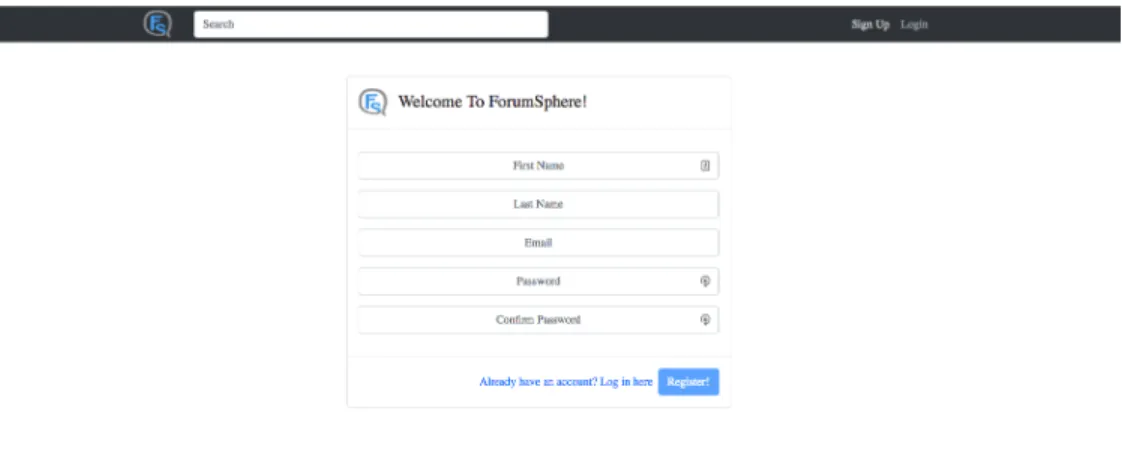
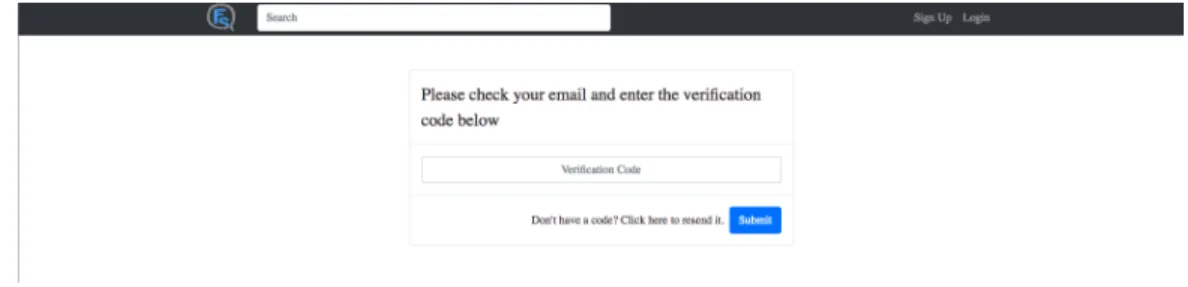
The first step to using this application is registering the user with the system and then logging in. The system needs to validate an email address for security reasons.
Figure 1: Register screen
Figure 2: Verification page
Once the user verifies, they will be taken to the login screen where they enter their email and password.
Figure 3: Login Screen
Now that the user has logged in, the site’s main functionality becomes avail-able for use. The main components of the site are:
• Communities
• Questions
• Profiles
• Influence
All of the site’s general functionality is available for use without logging in, except there are limitations. These will be covered in each of their respective sections.
2.3
Communities
answer. Each question asked must be tagged with at least one Community, but are not limited to the amount of Communities they can be tagged in.
Communities can be either public or private. However, 200 Influence is needed when creating a Community. Influence will be discussed in detail later.
Figure 4: The home page of ForumSphere.com
The home page of the site lists all available communities to the user. If a user is logged in, all the available private communities to them are also listed. Otherwise, only the public ones are listed. If a Community is clicked, the user is navigated to the Community home screen, which shows all questions tagged with that Community and all other relevant information.
Each Community page will show the users that follow that Community as well. Users have the option to follow Communities, allowing them to have easier access to the Community later. This feature is not available if the user is not logged in.
In order to create a Community, the user must be logged in. The user must click the plus sign in the upper right hand corner.
Figure 6: Demonstrating the create button
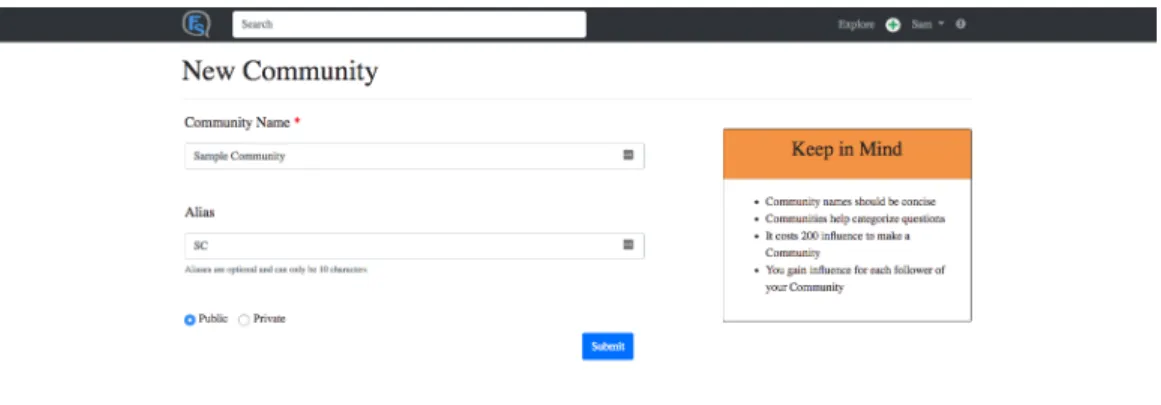
In order to create a Community a name is required, and the user must be logged in. There is an option for an alias, which can shorten the name when tagging it in a question. An example of a Community called “Sample Community” with the alias “SC” is shown below.
Figure 7: Public Community ‘Sample Community’ with alias ‘SC’
After hitting ‘Submit’, the Community will appear on the home screen and be available for use by all users.
2.3.1 Private Communities
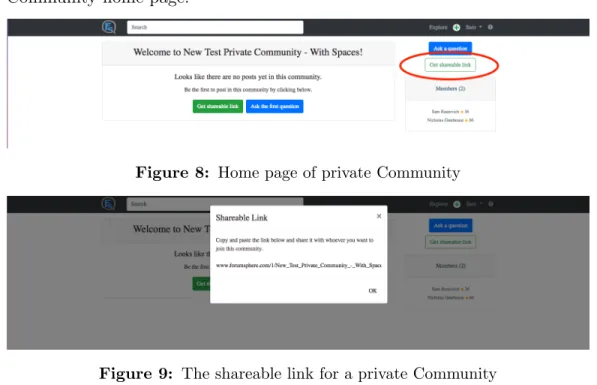
Community home page.
Figure 8: Home page of private Community
Figure 9: The shareable link for a private Community
The creator just has to copy and paste the shareable link for other users to join. When another user clicks on the link, they will be added to the Community and it will allow them to post questions in it. Questions inside private Communities are only visible to the users that are members of that Community.
2.4
Questions
Questions are the main purpose of ForumSphere.com. They provide a way for a user to ask a question, and get constructive answers and feedback on it. Questions must be tagged with at least 1 Community.
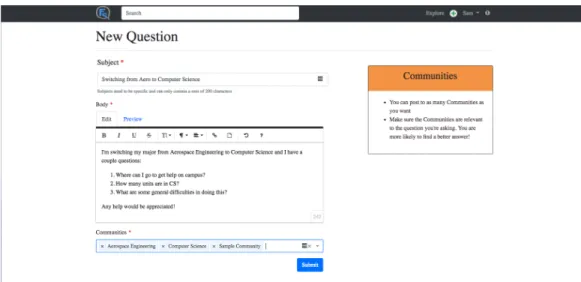
An example question from a student switching majors from Aerospace Engi-neering to Computer Science is shown below.
Figure 10: New question posting to Aerospace Engineering, Computer Science, and Sample Community
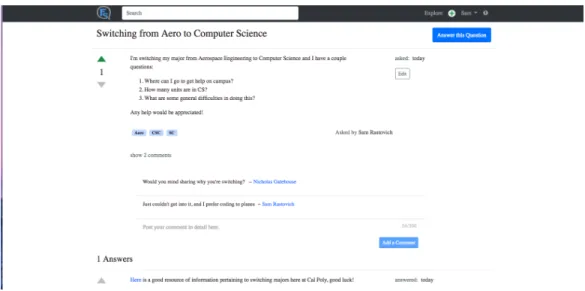
After asking the question, it becomes available for other users to interact with it. Other users can:
• Respond
• Ask clarifying questions
Figure 11: The question page: showing clarifying questions, and the body of the question visible to all users
The creator of the question can now see responses to the question, and mark one of them as the answer, which shows to all users that the creator marked it as answered. This is symbolized by a green check mark. An example of a response by another user to the question is shown below.
Figure 12: A response marked as the answer by the asker of the question.
2.5
Profiles
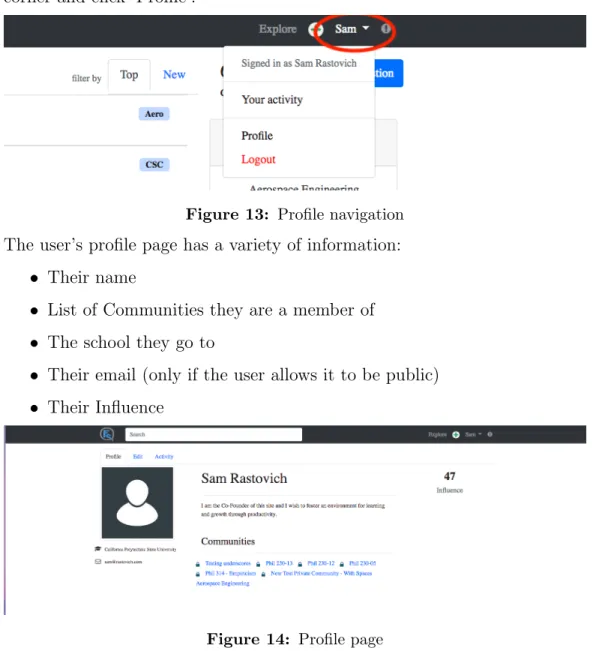
In order to get to the user’s profile, click on the name in the upper right hand corner and click ‘Profile’.
Figure 13: Profile navigation
The user’s profile page has a variety of information:
• Their name
• List of Communities they are a member of
• The school they go to
• Their email (only if the user allows it to be public)
• Their Influence
Figure 14: Profile page
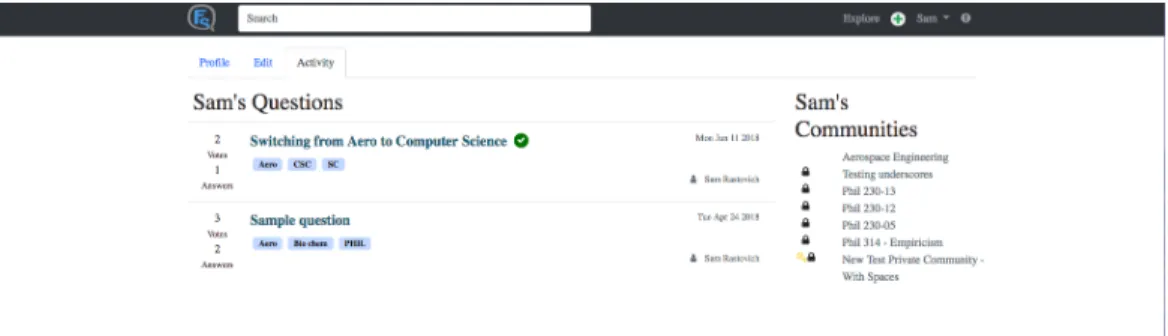
Figure 15: User activity page
The activity page shows the Communities and the questions associated with the user.
2.6
Influence
Every user on our application has an amount of Influence. These points determine how much weight they have on the communities and questions. This is implemented so that a productive environment is maintained on the site.
2.6.1 Influence points are earned by:
• Asking questions (+10)
• Receiving upvotes on a question or answer (+3)
• Answering questions (+5)
• Gaining followers on a community (+4)
2.6.2 Influence points are lost by:
• Receiving downvotes on a question or answer (-1)
• Receiving a flag on a question or answer (-10)
• Losing followers on a community (-4)
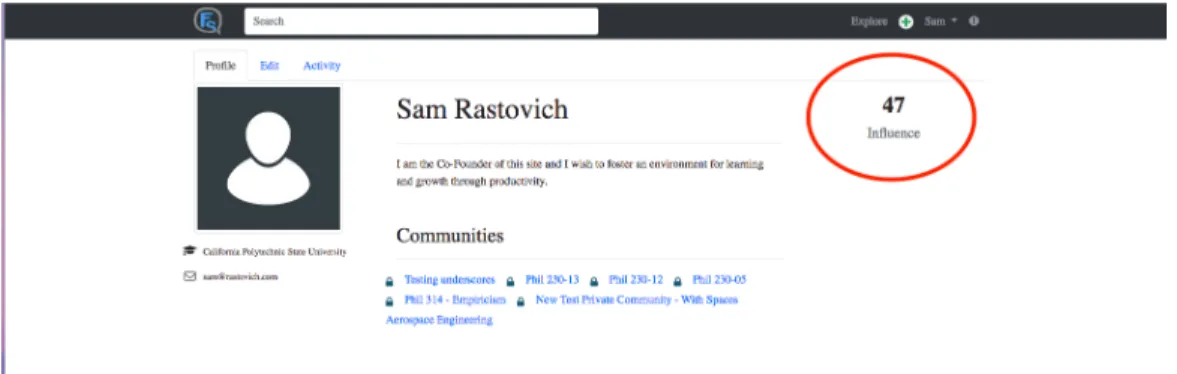
The amount of Influence a user has is their metric to how active and reli-able they are on the site. Other users can use this information to determine the validity of their answers, creating a more productive environment on-line. Every user starts with 201 Influence, and a user cannot drop below 1 Influence.
Figure 16: Highlighting the user’s Influence on the profile page
2.7
Tickets
ForumSphere.com has a ticketing system for user feedback. The user just has to click on the exclamation icon in the upper right hand corner and submit feedback. The user must be logged in to use this feature.
Figure 18: Ticket window
3
Design
We wanted to design this site so that it could accomplish 3 main things:
• Community based learning
• Productive and social user activity
• Scalability
3.1
Community based learning
Other forum-based sites focus most of their attention towards the posts that are made rather than the communities that organize them. When a user thinks about ForumSphere.com, we want them to think first about communi-ties and then questions; not vice versa. We achieved this by putting commu-nities at the front of the homepage, and by making navigation community-based. Our hope is that this will incite more inter-community interaction which in turn will bring the campus community closer together.
3.2
Productive and social user activity
of unnecessary information that floods users’ feeds. We decided to tackle this problem using a minimalist design — the questions can’t have very long threads, and the most relevant information is shown at the top of the page. This information is then sorted by our Influence metric which should indicate reliability of the information.
Our aim with Influence was to create an artificial metric in which users can tangibly see the reliability of a specific user. Much more forethought is needed into how to properly socially engineer such a metric to get the results that we are seeking. For now the arbitrary assignment of points shall suffice for our first iteration of this project.
3.3
Scalability
Finally, our site needs to be scalable. This is difficult to achieve when you don’t have much money or resources, which is why we decided to go with Amazon Web Services (AWS). They provide a year of free services that in-clude everything we needed for this project. AWS also provides the means of scaling upwards easily. AWS also provides a service for delivering and caching content globally, which is pivotal for a website that needs to gain traction like ours.
4
Implementation
4.1
Front End Breakdown
• Overview: The front end of our website is the User Interface which we went over extensively in the Application section. Refer to that section for a more in depth look.
• Framework: Angular 5
• Code: HTML 5 & Bootstrap 4
• Build: Webpack
4.2
Back End Breakdown
• Overview: The back end of our website is everything the user cannot see. This includes mostly data storage and manipulation. Below is a more in depth look at each of the pieces.
• Cognito: handles new user registration and current user authentica-tion. This way we don’t have direct access to user passwords as well as providing security via encryption
• AWS API Gateway: is used to activate the AWS Lambda Functions from the frontend via REST service requests.
• AWS Lambda Functions: are used to access, modify, and insert information into the database and S3 Buckets. This is where the ma-jority of the code was written. As an example, below are two of the lambda functions that we created.
• RDS: MySQL Relational Database is used to store information about the users and their content.
• AWS S3 Buckets: are used to store questions, answers, and com-ments. We did this because the body of text we used was in html (so users can format) and it was simpler to store it here than in a database.
4.3
Lambda Function Code Examples
• Functionality: This function simply queries the database for a userId and returns information associated with that ID
Figure 20: User/Get
2. API Call Post/Post
Figure 21: Post/Post
5
Analysis/Verification
5.1
User Tests - UI
We had 10 different students run through user tests of the site, keeping note of how much they struggled with finding specific pages and commenting on the overall usefulness of the site. We tested with 5 users with the first iteration of the site, and then we fixed the issues and re-tested with another 5 users. The rubric for the user testing can be found in Appendix A.
5.1.1 First Iteration:
After running through the tests with the first 5 users, we narrowed down the problems of the site into basic groups:
• Users had trouble navigating to their profile (average 30+ seconds)
• Users had trouble asking questions (average 45+ seconds)
• Users had trouble creating communities (average 45+ seconds)
• Users didn’t like the overall color-scheme
• Some basic functionalities broke (registering a new user, marking ques-tions as answered)
We noticed that during testing, a majority of the time, their mouse lived in the lower half of the screen, and we wanted them to mostly live at the top where the navigation bar is.
We also asked our users follow-up questions (Appendix A), and the general results are as follows:
• 100% of users said they would find this application useful and they would use it.
• The majority of students said they would use it for questions on exams mostly; they would use it for studying mostly.
• Users found that the navigation was frustrating, and they wouldn’t want to use it if it wasn’t more polished.
5.1.2 Solutions
We found that one of the biggest issues was the navigation bar at the top of the screen. Originally the color was a light grey, and it was almost never used by any of the users. A simple fix we applied to this was by darkening the navigation bar to black, making it stand out more for users. This helped improve navigation tremendously, and made it so users’ mouses lived at the top of the screen for a longer period of time.
We changed the overall color-scheme to be more dark. At first, the fonts were light, and the colors were minimally colored. We decided to make buttons darker and more colorful, the fonts changed from light blue to a dark black, and we added colors to names and other various details of the profile.
Figure 22: First iteration Community page.
5.1.3 Second Iteration:
After running through the tests with the second 5 users we found significant improvements. Overall, the user tests decreased in length by 5 minutes or more. Users found navigation a lot easier.
• Asking a user to ask a question no longer had any significant problems.
• Creating communities no longer had significant problems.
• Users liked the color-scheme, however, they still asked to see more colors.
• No functionalities broke or malfunctioned.
• Users still had trouble navigating to their profile, but the time decreased on average by about 10 seconds.
In terms of UI, the tests went really well, and there was significant improve-ment. However, we also wanted to test how users would interact with the site. A Philosophy professor at Cal Poly offered up 4 of their sections of classes to beta test our site. We decided to measure their activity using our Influence metric.
• Total users: 63
• Users who had Influence over 210: 17
• Users who had 230 or over: 3
With this metric, 27% of our test users were active (at least one question asked) and involved on the site. 5% of the users were highly active (2+ questions).
We determined that this was a successful beta test, seeing that there was only 63 students, and 27% of the users found it useful enough to use more than once. Comparatively if we applied this percentage to the amount of Cal Poly students attending in Fall 2016 which was 21,306, this would roughly be 5,800 active users.
the questions were productive and constructive, which we were happy with. We concluded that this was a successful test of our site.
6
Related Work
6.1
Intro
Creating an online community is no easy task but there are a few major websites that have tackled this problem with a great deal of success. The first that comes to mind is Reddit; a forum based website that is divided up into focused communities. The second is Piazza; a question and answer fueled forum that is moderated by a teacher. The third and final website we will discuss is Stack Overflow; a structured programming specific question and answer forum that implements a reward system.
6.2
Reddit is a website where users can anonymously create posts and interact with other users posts. The core functionality of Reddit consists of moderated communities, posts, comments, and a voting system that leads to gaining or losing Karma. Karma is used to measure the positive contribution users are making to Reddit as a whole whether it is by posting content people like or making comments people like.
Community based forums are the core of what our project is so this within itself makes Reddit largely similar to ForumSphere. Unlike Reddit there will be no moderators for the public communities and users cannot be anony-mous. These two design decisions together will hopefully promote people to moderate themselves since their real names are tied to what they say.
The last thing that sets us apart from Reddit is that there will be no direct messaging on our platform. We plan on replacing a direct messaging fea-ture with contact sharing. Instead of having a friends list, people will share contact information with the people they like which will purportedly lead to more personal connections outside of the online community.
6.3
Piazza
Piazza is a structured classroom oriented forum where students ask questions and their classmates collectively create an answer along with the teacher of the course. The environment Piazza creates for its users promotes collabo-ration between peers, decreases the workload teachers receive from repeated questions, and gives students a reliable source of help. Overall, it increases the accessibility to the teacher and other students specifically when a student needs help. As an additional feature Piazza allows companies to connect with students that use the website.
Since our aim is to help students collaborate and succeed academically we found Piazza’s forum structure as a great inspiration. We will be pulling a few things from their structure like providing feedback to students that a teacher thinks a question or answer is good. What makes us different is that communities will not be limited to QA style posts and we won’t have a moderator for a community unless it is private. Furthermore, all students answers will be individual without the option to be anonymous. We also will not be allowing companies to advertise and contact students about job opportunities.
6.4
StackOverflow
For now users obtain influence through using the site and receiving upvotes on the content they create. As for what they can do with their influence; our first thought is that it will cost influence in order to create new communities. Our hope is that this will prevent nonsensical communities from cropping up from users who aren’t that involved on the site in the first place. As of right now influence can be used to indicate how reliable someones answer may be or whether this person contributes often to the website.
7
Future Work
7.1
Notifications
We plan on continuing our work on this project because we believe it could become an invaluable tool for Cal Poly students and staff. In order for it to become usable and enjoyable there will be several new iterations. Our game plan for now is over the summer to implement Notifications so our users know when there has been activity that needs their attention. This is extremely important for users to be able to more easily interact with one another in a timely manner. Here is the lay out for how we see the Notifications feature working.
• Notify users when a question is posted in a community they follow.
• Notify users when someone answers a question they posted.
• Notify users when someone likes their question/answer.
• Notify users when someone comments on their question/answer.
• Notify users when their answer is selected as “the answer” by a question asker.
7.2
Profile Pictures, Contact Sharing
that will allow users (with click of a button) to share their contact informa-tion (either phone number or email) with another user. We hope this will encourage users to have more interactions outside of our application and in turn create a more cohesive and connected college community. This also makes up for the fact that we will not have direct messaging on our platform
7.3
Influence
Another huge change we would love to make is a well researched and complex influence point feedback system. Our hope is to socially engineer a system that encourages users to give honest and accurate answers to relevant ques-tions pertaining to the university and student life. We envision this to be a tier system with statistics provided as to why users are within that tier. This in turn will allow other users to see the reliability and activeness of the user they are getting an answer from.
7.4
Student or Staff Verification
One other feature we may want to add if the project gains traction would be to link up with the Campus ITS and setup a verification process in which users would use their Cal Poly login (or any other campus) to verify that they should be a part of this schools community. This will further the reli-ability of user answers and questions that we hope to resonate throughout the application.
7.5
Reporting System
We would like to put in a reporting system in which users can flag content that they deem to be inappropriate. This would help to follow the trend of the communities keeping themselves accountable for the content that they put onto the site. How we see this working technically would be as follows.
• Users who are reporting would be required to give a reason as to why they are reporting the content.
• After 3 reports (arbitrary) the content would be removed and a notifi-cation would be sent to that user as to why their content was removed along with a community behavior policy that we would draft.
8
Conclusion
This platform is a tool for the students at Cal Poly to use to their advantage. We hope that it will have a positive impact on their lives by creating a safe place online for them to get the relevant information they need pertaining to their school provided by their peers. If everything goes perfectly it will bring a sense of belonging to the students who otherwise haven’t found it yet. The only way for this website to work is if people see the value in the website that we do.
Overall we had a lot of fun working on this project, and we will continue to work on this by marketing it to new and existing students, administration, and faculty. Each of us put in a considerable amount of work to get this site to where it is today. We learned how to work as a team to turn a vision into a tangible product, and we were able to see the use of our product on a larger scale. It was very rewarding and we each grew tremendously as programmers and business professionals. We hope that by continuing to work on ForumSphere.com we will provide a platform for students to grow just like we did.
9
Appendix
9.1
Appendix A - User Testing Questions
Read out loud:
and video recording during the test? It is only for feedback and the results will only be used to help modify the site for better usability.
This test is an evaluation of the website. Please think out loud especially when voicing what you like, dislike, or if you become confused. Feel free to ask questions however we may not be able to answer some until the end of the test. Thank you!”
9.1.1 User Test
1. Go to www.dev.forumsphere.com
2. Create an account
3. Edit your Profile by adding a bio and a phone number
4. Ask a Question in at least 2 Communities (except the Math Commu-nity)
5. At this time one of us will respond to their question
6. Vote on the most recent Question in the Math Community
7. Respond to the most recent Question in the Aerospace Engineering Community
8. Sign up for the Private community with this hyperlink www.dev.forumsphere.com/1/BIO310/509f6930-b4ee-4526-9a0c-40e9e8a580dd
9. localhost:4200/1/BIO310/509f6930-b4ee-4526-9a0c-40e9e8a580dd
10. One person has asked a Question in this Community, Navigate to their profile.
11. Now edit the first Question you created at the start of this test.
12. Mark your Question as answered by one of the Responses.
13. Create your own community either private or public.
15. Find the page that shows the Communities you followed and the Ques-tions you’ve asked
16. Submit Feedback to the site.
17. Logout
9.1.2 Follow up
1. General thoughts on the layout of the site (colors, general feedback)
2. Is this a product you would find helpful?
3. If so, how would you use it?
4. Was there anything you found particularly frustrating? If so, what?
5. Are there any features that are not currently there that you would like to see?
9.2
Appendix B - API Documentation
<https://docs.google.com/document/d/1I_ABdS9L_IgKAS_ cogv3o99HDlq4BQIy0NghjMG20SM/edit?usp=sharing>
9.3
Appendix C - SQL Diagram and Schema
<https://docs.google.com/document/d/1RNQTy4_