Performance Evaluation Internet Protocol Television
(IPTV) by taking Various Modulation Schemes
Amita Dagar1, Sarika2,
M-Tech Student1, Assistant Professor2 & Department of CSE
Delhi Institute of Tech., Management & Research
Faridabad, Haryana, India
Abstract—
IEEE describes various modulation mechanisms for
WiMAX i.e. QPSK, BPSK, 16 QAM and 64 QAM. This paper measures the performance of Internet Protocol Television (IPTV) over Fixed WiMAX system taking various combinations of digital modulation. The performance is analyzed considering a number of main system parameters which involve the variation in the path-loss, video coding, scheduling service classes, various rated codes in FEC channel coding. The performance evaluation was carried out by utilizing OPNET simulator. The performance is measured with respect of packet jitter delay, packet lost, network throughput and end-to-end delay. Simulation results indicate that higher order modulation and coding techniques (namely, 16 QAM and 64 QAM) have better performance as compared to QPSK.Keywords: IPTV, QoS, modulation and coding, WiMAX,
OPNET, performance study.
I. INTRODUCTION
Internet Protocol Television (IPTV) offers digital television services over IP for residential and business users at a low cost. Moreover, IPTV is a system able of obtaining and showing a video stream utilizing Internet Protocol [5]. Users can obtain IPTV services anytime and anywhere to mobile devices. IPTV services can be categorized by their kind of services and content to [6]:
Video-on-Demand content: In this IPTV service a user is
permitted to surf an online movie book, to see trailers, and to choose a movie of interest
Live content: In this type of IPTV service a user is needed to access a specific channel for the content at a particular time, like to accessing a traditional TV channel.
Managed services: It enables video data to be provided by
the phone companies who operate the IPTV business or received from syndicated content suppliers, in which the data is generally well-maintained in terms of the playout and coding quality, as well as in the selection of video titles.
Unmanaged services: In this type of service the technique of
IPTV itself enables playout of any on-demand or live video content from any third party across the Internet.
This work is done towards analysing the performance study of IPTV (VoD) over Static WiMAX networks when
taking various coding and modulation techniques utilizing simulation software OPNET Simulator.
Figure: 1 IPTV Model II. LITERATURE REVIEW
Lately, there has been some research based on performance analysis of video streaming over WiMAX networks. Many research workers have worked on WiMAX in the context of stored video and real-time applications. For instance,
Pandey et al. [5] formulated a model to resize the network for IPTV service suppliers that provide VoD services to their users in heterogeneous surrounding. The suggested modeling and simulation mechanism permits us to find the optimal deployment conditions for a specified number of potential IPTV customers while fulfilling pre-specified QoE measures. Shehu et al. [10] talked about issues related challenges for providing IPTV over WiMAX. These issues involve the challenges of QoS needs.
Bhunia et al. [16] introduced an in-depth performance of mobile WiMAX is deployed by utilizing adaptive modulation and coding under the real-time simulation environment of OPNET. They have measured the performance metrics of mobile WiMAX with respect to various coding and modulation schemes.
III. SIMULATION MODEL
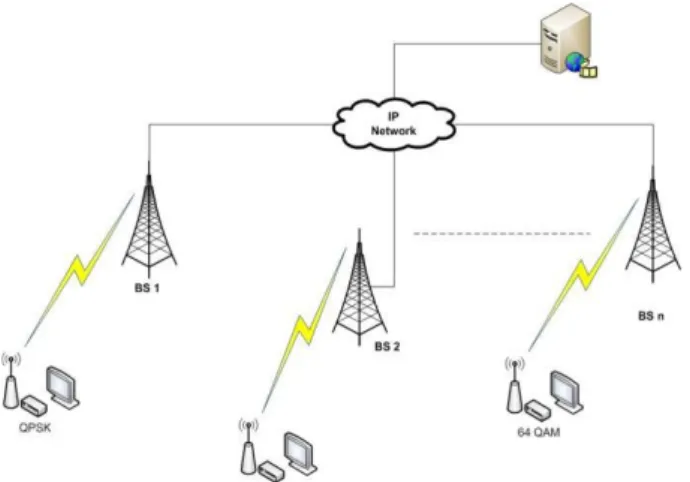
This section explains the simulation model employed for measuring the impact of Video on Demand (VoD) over the Fixed WiMAX Networks. The simulation was executed to measure the performance of VoD over the static WiMAX networks under various parameters: path-loss models, video codecs, and class’s services under static kinds of modulation and coding mechanisms in order to examine and measure the performance and behavior of these models. At first, topology described in Figure 2 was considered. This configuration has a server with a video encoder which is able of transmitting video to the subscriber station (SS). It is also considered that there are n WiMAX cells (BS) associated to the wired networks. An SS of every cell links to the server and request the video stream in real-time. It is considered that every SS at various distances from every BS so that every BS allocates various modulation and coding for SS. For instance: QPSK ½ allocate to SS in BS1, 16 QAM ¾ allocate to SS in BS 2, and 64 QAM 2/3 allocate to SS in BS n.
Figure 2: Topology of IPTV (VOD) over WiMAX
IV. Results and Discussion
Sixty six scenarios were modeled, and the results are gathered and summed in three scenarios based on various video codec of video application and varying path loss models, and for various kinds of service classes. For every scenario, the kinds of coding and modulation mechanisms are selecting one at a time to receive one set of simulation results for the various performance measures of packet delay, packet loss, traffic load throughput and packet jitter..
Scenario 1: Different video codec of video application
This subsection describes the simulation results of three scenarios under this category. Every scenario utilized various video codec under various coding and modulation scheme in every cell.
Figure 3 describes the mean variation of packet delay variation for audio/video IPTV over Fixed WiMAX networks. For various coding, video quality is best if the jitter is zero. As described in Figure mean audio/video jitter is nearly zero for higher modulation and coding scheme (MCS) (16 QAM, and 64 QAM) while QPSK has a bad mean variation of jitter for Movie coded through AVC codec. From the results in Figure 4(a), it is realized that WiMAX utilizing higher MCS (16 QAM, 64 QAM) as a modulation scheme indicates better jitter as compared to other MCS (QPSK). It is also realized that video coded through SVC, and MPEG-4 has a better mean jitter as compared to AVC codec. Thus, video codec by SVC is best choice for deploying IPTV.
Figure 3: Average packet delay variation
Figure:4 Average Packet End to End Delay
As depicted in Figure 5, the mean data loss is importantly higher when video codec through AVC codec. The impact of data drop naturally reduces the mean WiMAX throughput as
Figure 5: Average packet data dropped from SS node
Figure 6: Average WiMAX throughput for SS node Scenario 2: Mobile node with different path loss
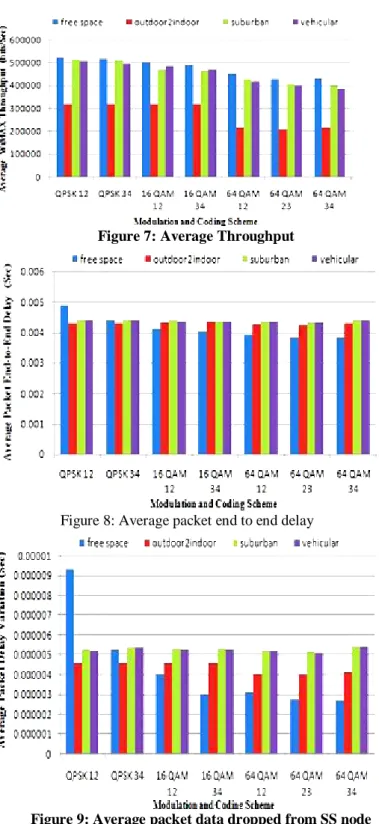
This subsection talks about the simulation results of twenty eight scenarios, performance parameters of every scenario realized for several modulation and coding schemes related to several path-loss models. It is assumed in this category holding the video codec with SVC codec and scheduling service classes as rtPS.
Figure 7: Average Throughput
Figure 8: Average packet end to end delay
Figure: 10 Average WiMAX throughput for SS node Scenario 3: Mobile node with different classes
This subsection contains the simulation results of 35 scenarios under this class where path loss and video codec kept constant.
Figure: 11 Average video jitter
Figure: 12 Average packet End-to-End delay
Figure: 13 Average packet data dropped from SS node
Figure: 14 Average WiMAX throughput for SS nosde CONCLUSION
In this work, study of IPTV performance over static WiMAX network taking various modulation and coding schemes have been introduced under various key system parameters involving path-loss models, video coding, and MAC service classes. The performance has been measured with respect to average packet jitter, average packet E2E delay, average throughput, and average data-dropped. OPNET simulation results describe that SVC has better performance as compared to other video codec strategies. Also results describe that the free space route loss is the excellent propagation model for distributing A/V video application over various static mobile node whereas vehicular model shows the worst performance providing the maximum packet drop rate. Furthermore, simulation results describe that rtPS scheduling service class is the most suitable scheduling service for A/V video application. The future scope will be to study the effect of mobility on video quality, and also the effect of utilizing multicast SVC multilayer adaptation strategy on improving the performance of video streaming over mobile WiMAX.
REFERENCES
[1] Ain K, Tarafder M, Khan SH, and Ali MD. Path Loss Compensation Technique for WiMAX Technology Based Communication System. International Journal of Engineering Science and Technology 2011.
[2] Uilecan I, Zhou C, and Atkin G. Framework for Delivering IPTV Services over WiMAX Wireless Networks. Proceedings of IEEE EIT 2007, Chicago, IL, May 2007, pp. 470–475.
[3] So-In Ch, Jain R, Tamimi A-K. Scheduling in IEEE 802.16e Mobile WiMAX Networks: Key Issues and a Survey. IEEE Journal on selected areas in Communications. 2009, 27(2): 165-171. [4] Islam Md, Mondal R, and Hasan Md. Performance Evaluation of WiMAX Physical Layer under Adaptive Modulation Techniques and Communication Channels. International Journal of Computer Science and Information Security 2009; 5(1): 111–114
[5] Pandey S, Won Y, Hong J, and Strassener J. Dimensioning internet protocol television video on demand services. International Journal of Network Management 2011; 21(6): 455–468
[6] She J, Hou F, Ho P-H, and Xie L-L. IPTV over WiMAX: Key Success Factors, Challenges, and Solutions. IEEE Communication Magazine 2007, 45(8): 87-93
[7] Tarhini Ch, and Chahed T. AMC-aware QoS Proposal for OFDMA-based IEEE802.16 WiMAX Systems. IEEE Global Telecommunications Conference. 2007: 4780-4784
[8] Hamodi J, Thool R. Investigate The Performance Evaluation of IPTV over Wimax Networks. International Journal of Computer Networks & Communications (IJCNC) 2013; 5(1): 81-95.
[9] Hamodi J, Thool R. Performance Evaluation of IPTV over WiMAX Networks Under Different Terrain Environments. International Journal of Engineering Inventions 2013; 2(2): 21-25. [10] Shehu A, Maraj A, and Mitrushi R,. Analysis of QoS Requirements for Delivering IPTV over WiMAX Technology. International Conference on Software, Telecommunications and Computer Networks (SoftCOM), 2010, pp. 380-385.
[11] Shehu A, Maraj A, and Mitrushi R. Studying of Different Parameters that Affect QoS in IPTV Systems. International Conference on Telecommunications and Information (WSEAS), 2010.
[12] Hrudey W and TrajkovicLj. Streaming Video Content over IEEE 802.16/WiMAX Broadband Access Networks. OPNETWORK 2008, Washington, DC, Aug. 2008.
[13] Hrudey W and TrajkovicLj. Mobile Wimax MAC and PHY Layer Optimization for IPTV. Journal of Mathematical and Computer Modeling, Elsevier, Mar. 2011, 53: 2119–2135.
[14] Gill R, Farah T, and TrajkovicLj. Comparison of WiMAX and ADSL Performance when Streaming Audio and Video Content. OPNETWORK 2011, Washington, DC, Aug. 2011.
[15] Telagarapu P, Naidu G, and Chiranjeevi K. Analysis of Coding Techniques in WiMAX. International Journal of Computer Applications 2011; 22(3): 19-26
[16] Bhunia S, Misra I, Sanyal S, and Kundu A. Performance Study of MobileWiMAX Network with Changing Scenarios under Different Modulation and Coding. International Journal of Communication Systems 2011, 24: 1087–1104
[17] Lloret J, Garcia M, Atenas M and Canovas A. A QoE Management System to Improve the IPTV Network. International Journal of Communication Systems 2011; 24: 118–138
[18] Mobile WiMAX. Mobile WiMAX—part I: A Technical Overview and Performance Evaluation. WiMAX Forum, August 2006.
[19] Niyato D, Hossain E, and Diamond J. IEEE802.16/ WiMAX-Based Broadband Wireless Access and its Application for Telemedicine / E-Health Services. IEEE Wireless Communications Magazine, Feb. 2007, 14(1), pp. 72–83.
[20] Doble, J. Introduction to Radio Propagation for Fixed and Mobile Communications. Artech House Inc, Norwood, USA, 1996. Extension. Available: http://trace.eas.asu.edu/h264/ index.html [ 10 March 2013]