Jurnal Pendidikan IPA Indonesia
http://journal.unnes.ac.id/index.php/jpiiSTUDENT MISCONCEPTION ON REDOX TITRATION
(A CHALLENGE ON THE COURSE IMPLEMENTATION
THROUGH COGNITIVE DISSONANCE BASED ON THE MULTIPLE
REPRESENTATIONS)
H. R. Widarti1, A. Permanasari2, S. Mulyani3 1Universitas Negeri Malang, Indonesia
2,3Universitas Pendidikan Indonesia, Bandung, Indonesia
DOI: 10.15294/jpii.v5i1.5790
Accepted: 23 January 2016. Approved: 28 March 2016. Published: April 2016
ABSTRACT
The misconception is one of the obstacles in the concept mastery that needed to be minimalized. This descriptive study was conducted to find the patterns of misconceptions which have occurred on college students who partici-pating in the redox titration course subject. Efforts to minimize misconceptions have been conducted through lec-tures using the multiple representations with the cognitive dissonance strategies on the 30 students who joined the Fundamentals of Analytical Chemistry course. The research instrument used in this study was 6 multiple-choice tests with reasons. In order to detect the misconception, Certainty of Response Index technique was performed. The preliminary study results showed that 34.30% of students experiencing the misconceptions on redox titra-tion. After treatments, the misconceptions reduced to 28.17%. A misconception that cannot be eliminated was related to the concepts involving in the microscopic and symbolic appearances.
© 2016 Science Education Study Program FMIPA UNNES Semarang
Keywords: e-learning, ICT literacy, Project based learning, Teaching and learning process INTRODUCTION
Redox Titration is one of the conventional methods of quantitative chemical analysis. The study material on redox titration is closely related to the concept of the redox titration that has been studied by students in high school level. In the high-er education level, the concept of redox and titra-tion are studied in the course of Basic Chemistry. The redox titration is deeply studied by students in the course of Fundamentals of Analytical Chemis-try. The study material on redox titration discusses about the concepts, types, and application of redox titration. Although the students have learned the concept of redox, there are many students who do not properly understand the study materials related to the redox titration. Some students are even expe-riencing the misconceptions.
Misconceptions that occur in students is one significant factor that plays a role in inhibi-ting the understanding of the concept. The mis-conception is the inconsistency of the understan-ding between the views of students and scientists (Louga et al., 2013). In line with Berg (1991), the misconceptions occur when students are not in accordance with the experts’ conception. Likewi-se that propoLikewi-sed by Driver et al. in Pinarbasi et al. (2009), it said that the misconception was an inconsistency or incompatibility of the students’ conceptions with the scientific conception. Most of the students have had its own ideas about che-mical concepts that have been acquired in high school before they enter higher education in col-lege. This circumstance sets the students opinion to often relate less precise relationship between their newly acquired knowledge with their prior knowledge. Therefore, it raises the new under-standing that is not in accordance with the expec-*Alamat korespondensi:
tations of experts. The students’ everyday experi-ence, their creativity, their perception, and some textbooks can lead to the misconceptions. Accor-ding to Louga et al. (2013) the students who have a good understanding of concepts could build a meaningful understanding in the colligative properties. Eymur et al. (2013) reported that the teacher-candidate students had the same miscon-ceptions with students. The misconmiscon-ceptions itself was difficult to be removed through learning. A teacher needs to implement appropriate learning strategies to identify and to reduce the miscon-ceptions. The misconceptions that allowed pas-sing through would be fatal and would be very harmful because it can affect learning outcomes.
Several researches on the chemistry mis-conceptions in chemistry have been identified by experts. Pinarbasi (2007) reported that students had a number of common misconceptions on the topic of acids and bases. Almost all the students managed to equalize the equation, but they could not draw the molecular diagrams to explain the equations in submicroscopic correctly. Moreover, the students’ experience in the previous study in-fluenced the material conception of the reaction equilibrium. Al-Balushi et al. (2012) reported that 12 grade students had difficulty in answering the questions related to visual representation. Redox material misconception had been experienced by students, for example: they had a difficulty on dis-tinguishing the definition of the oxygen and elec-trons transfer, they often experience an error in the determination of the oxidation number of the element or compound, they did not knowing the key concept of oxidation and its relation to the concept of charge; and also they had a difficulty on how to apply the equalization to equalize the redox reactions. Misconceptions are common-ly found in chemistry materials of study prior to inadequate teaching media. Misconceptions on redox titration will affect the students in the understanding and application of redox titration. Their misconceptions on redox titration may also disrupt the formation of a scientific conception of students in other study materials. Therefore, misconceptions on redox titration material in the
course of Fundamentals of Analytical Chemistry must be addressed immediately.
In order to identify the occurrence of mis-conceptions, a certainty of response index (CRI) scale technique was conducted, which has been modified from Hasan et al. (1999). CRI is a de-gree of certainty of the students to answer the questions. In this research, there were two instru-ments used, i.e. multipchoice test and the le-vel of confidence (CRI). The use CRI technique was able to distinguish the differences among a well-known concepts, unknown concepts and misconceptions. CRI scale used in the study was modified from Hasan et al. (1999). The four scale (1-4) with details 1 = guessing, 2 = less confident, 3 = confident, and 4 = very confident. Low CRI value (1-2) showed the lack of confidence of stu-dents to answer questions. High CRI value (3-4) showed high confidence of students to answer questions. Uncertainty of students to answer the questions was caused by the lack of confidence in students. Kurbanoglu & Akin (2010) stated that students who master the concept properly will have a high confidence. The students who answered the question with a lower CRI value (1-2) shows that these students do not understand the concept. High CRI value (3-4) showed that students have the confidence in answering ques-tions. It indicates that the student can master the concept of theory. Criteria for low and high CRI answers are shown in table 1.
There was a modification on CRI value criteria set by Hasan et al. (1999), since it could emerge the alternative answers by students; even it is only few answers. The reason is because of Indonesian students tends to be less confident in giving the reasons on the given answers. By this reason, a possible answer by those kinds of stu-dents is a correct answer with a correct reason but with a low level of confidence. It means that the students understood the concepts well, but lack of confidence (Hakim et al., 2012).
The preliminary study on the titration by 38 students who joined the Fundamentals of Analytical Chemistry course had found the dif-ficulty in understanding subject materials, especi-Table 1.Criteria of misconceptions identification based on the CRI results (Hasan, 1999)
Answers criteria Low CRI (1-2) High CRI (3-4)
Correct answer Correct answer with wrong reasons and low CRI is showing that they do not understand the concept (lucky guessing)
Correct answer with correct reasons and high CRI is showing a concept mastery
Wrong answer Wrong answer with wrong reasons and low CRI is showing the low under-standing on concept
Wrong answer with wrong reasons and high CRI is showing that there is a misconception.
ally on the quantitative analysis of the material. Generally, based on the research on the students’ answers, they were weak in mathematics literacy, and also weak in the ability to provide a relevant analysis of how to determine the choice of indi-cators in a titration (Widarti et al., 2014). It was highly associated with a lower ability of students in explaining the phenomenon through micros-copic and symbolic approaches. Therefore, the descriptive study was conducted to determine the student misconceptions in redox titration study materials.
METHOD
The method used in this study was a desc-riptive method with a form of case study research. Thirty subjects of Chemistry Education students in the third semester year 2014-2015 in State Uni-versity of Malang were studied. They joined the Fundamentals of Analytical Chemistry course subject. The research instrument employed was a multiple-choice test with open answers in the end of each question to measure their redox titration concepts mastery. Six problems were given in the test. The reason given by students was a reflection of their thinking ability and their understanding on the concepts learned.
RESULTS AND DISCUSSION
The results of preliminary study on the redox titration subject material found that there were 34.30% misconceptions. Some methods to overcome such misconceptions were to adjust the syllabus to the students thinking way, cogni-tive conflict, analogy, partner interaction, meta- cognition, and demonstrations. According to the Berg (1991) who stated that misconceptions could be addressed using an innovative model of lectures; for example, by using a variety of rep-resentations. Hand & Chio (2010) reported that multiple representations could give the positive impact on students’ ability to construct the ar-guments in lab classes. Similarly, McDermott & Hand (2013) stated that the use of multiple repre-sentations to support the task of writing-to-learn could act as a pedagogical tool in enhancing the chemistry learning in schools. Domin & Bod-ner (2012) also reported that the use of multip-le representations helped students in solving the problems in chemical concepts. Research on cog-nitive dissonance in chemistry through multiple representations have been made by Linenberger et al. (2012), who reported that the combination of representations to encourage students to try to
make the relationship between representation. In this study, the model of multiple representations associated with cognitive dissonance strategy has been implemented in the redox titration lecture materials. It was hoped that using this method, there was a change in the concept understanding.
Each student has a different understanding capacity and perception on the studied concept. These differences lead the students to have diffe-rent levels of ability and misconceptions about the concept. In order to determine the student misconceptions in the redox titration material of study, a multiple-choice test was conducted with open answers and CRI. The distribution of the problem on the redox titration are shown in Table 2.
The percentage of students answer questi-ons on redox titration of each item are shown in Table 3.
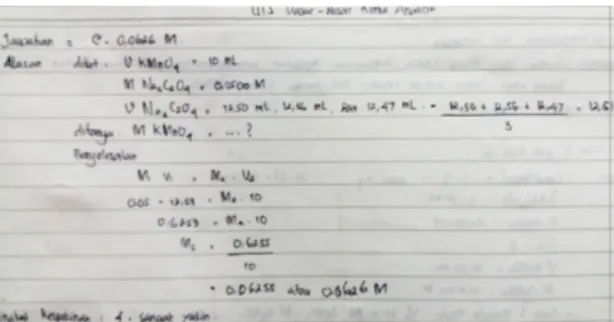
Problem number 1 was related to calculate the concentration of the redox titration which re-sulted in 66% of students had the misconceptions. Most of students used a dilution formula, which should not be needed in the titration. Besides, the students also did not write down the equation for the case, wrong in calculating the amount of the number of moles of KMnO4. This was possible to happen since the students were not familiar with the concept of redox reactions. Examples of student answer can be seen in Figure 1.
Figure 1.The example of student answer on problem no 1
Problem number 2, 3 and 4 were related to interpreting the species and calculating the potential value (E) on the redox titration. Some students still had the misconceptions as much as 23%, 20%, and 14%, respectively. In question number 2, students answered that at the point K (10 ml Ce4+), the dominant species were Fe2+
dan Ce4+ as Fe2+was previously appeared. The
students believed that there was no Fe3+formed
in the solution. This problem was happened also in the problem number 3 where the students ans-wered that at M point (addition of 80 ml Ce4+)
Table 2. The distribution of redox titration problems
No Problems
Calculating the Concentration on Redox Titration
1 Rina standardize the 10 mL KMnO4solution with the 0,0500 M Na2C2O4solution under acid-ic conditions in triplo. The volumes of Na2C2O4solution needed are 12,50 mL; 12,56 mL; and 12,47 mL. What is the concentration of standard solution KMnO4?
a. 0.3128 M c. 0.0626 M b. 0.1250 M d. 0.0250 M
Reason/Explanation: CRI: Interpreting the existing species and potential value (E) on the redox titration
Problems no 2-4
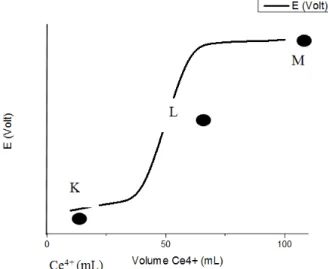
Redox titration graph 50 mL 0.100 M Fe2+ (Eo Fe3+/Fe2+ = 0.767 V)with a solution of 0.100 M
Ce4+ (Eo Ce4+/Ce3+ = 1.70 V) is as follows:
2 Based on the curve, what are the dominant species in the potential determination of solution in K point (10 mL addition of Ce4+) and how much is the E value?
a. Fe2+, Ce4+and E = 0.73 V
b. Fe2+, Fe3+ and E = 0.73 V
c. Fe3+, Ce3+and E = 0.78 V
d. Fe2+, Fe3+and E = 0.78 V
Reason/Explanation: CRI:
3 Based on the curve, what are the dominant species in the potential determination of solution in M point (80 mL addition of Ce4+), and how much is the E value?
a. Ce3+, Ce4+ and E = 1.67 V
b. Fe2+, Fe3+and E = 1.67 V
c. Ce3+, Ce4+and E = 1.69 V
d. Fe2+, Fe3+and E = 1.69 V
Reason/Explanation: CRI:
4 Based on the curve, what are the dominant species in the potential determination of solution in L point (50 mL addition of Ce4+) and how much is the E value?
a. Fe2+, Fe3+, Ce3+, Ce4+and E = 1.23 V
b. Fe2+, Fe3+, Ce3+and E = 1.23 V
c. Fe2+, Fe3+, Ce3+, Ce4+and E = 1.32 V
d. Fe2+, Fe3+, Ce3+and E = 1.32 V
Table 2. Continue
Identify the characteristics of the substances involved in redox titration
5 Which statement is true in a redox titration....
a. Titration of permanganomeri requires the addition of an indicator to determine the titration
end-point
b. Ce4+ions are directly undergo on hydrolysis in a low-pH solutions c. I
2is absorbed on the surface of α-amylose to produce blue color d. Iodide ion acts as a reductant in the iodometric titration
Reason/Explanation: CRI: Choosing the right type of redox titration to analyze samples
6 Given some reduction potentials as follows:
Ce4+ + e ⇆ Ce3+ Eo = 1.61 V MnO4- + 8H+ + 5e ⇆ Mn2+ + 4H 2O E o = 1.51 V Cr2O7 2- + 14H+ + 6e ⇆ 2Cr3+ + 7H 2O E o = 1.33 V Fe3+ + e ⇆ Fe2+ Eo = 0.771 V I2(aq) + 2e ⇆ 2I - Eo = 0.6197 V
What is the most suitable titration by using Fe?
a. Permanganometry and iodometry b. Cerimetry dan iodometry
c. Chromatometry dan permanganometry d. Permanganometry dan cerimetry
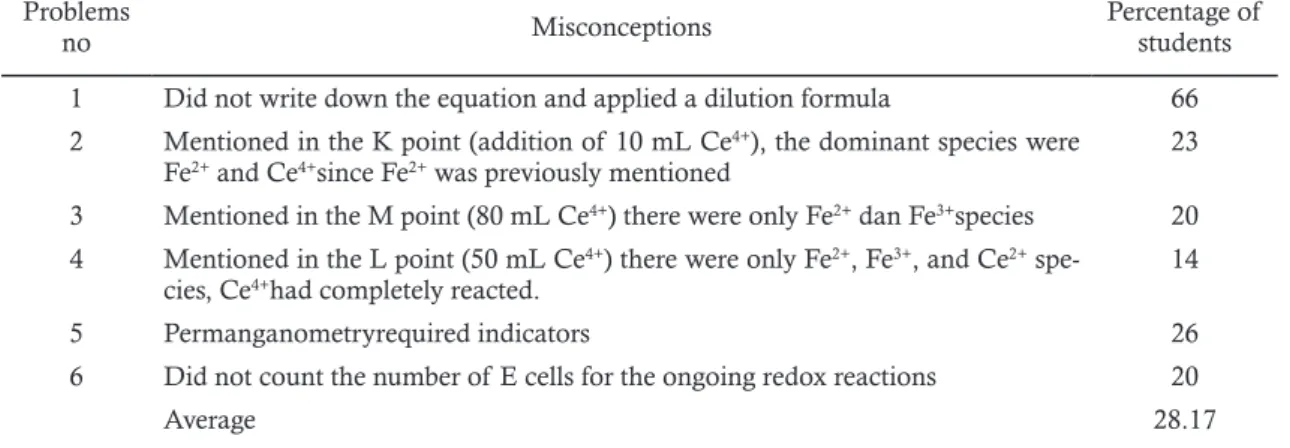
Reason/Explanation: CRI: Table 3. Distribution of student misconceptions on redox titration (n = 30)
Problems
no Misconceptions
Percentage of students 1 Did not write down the equation and applied a dilution formula 66 2 Mentioned in the K point (addition of 10 mL Ce4+), the dominant species were
Fe2+ and Ce4+since Fe2+ was previously mentioned
23 3 Mentioned in the M point (80 mL Ce4+) there were only Fe2+ dan Fe3+species 20
4 Mentioned in the L point (50 mL Ce4+) there were only Fe2+, Fe3+, and Ce2+
spe-cies, Ce4+had completely reacted.
14
5 Permanganometryrequired indicators 26
6 Did not count the number of E cells for the ongoing redox reactions 20
Average 28.17
Figure 2. The example of student answers on the problems no 2 (a), no 3 (b), and no 4 (c)
(a)
(b)
curve region over the equivalent point, the do-minant species that involved in determining the potential value were Ce2+ dan Ce4+. The similar
thing happened in the problem number 4 where students confidently answered that at the L point, (50 ml Ce4+) there were only Fe2+, Fe3+, and Ce2+,
and Ce4+had completely reacted. In fact, at the
equivalent point, the amount of Fe2+ was the
same with Ce4+. Both of them had the identical
potentioal; therefore, the dominant species in the solution were Fe2+, Fe3+, Ce2+ and Ce3+. All the
answers impacted on the calculation of the soluti-on, where students did not calculate the potential based on the reaction that occurs in solution but only suspect of the curve. Sample of answers are shown in Figure 2.
Problem number 5 was associated with the identifying characteristics of the substance involved in redox titration. There were 26% of students still had the misconceptions on this con-cept. There were some students who confidently answered that in the permanganometry, K2Cr2
O-7was required as an indicator. In fact, in
perman-ganometry, it is unnecessary to use an indicator since KMNO4 is already involved as an indicator (autoindicator).The example of student’ answer related to the characteristics in redox titration is shown in Figure 3.
Problem number 6 was related to choo-se the right type of redox titration to analyze a sample. There were 20% of the students still had misconceptions in this concept. There was stu-dent who confistu-dently answered without counting the E cell reaction that occurred. Students assu-med that the most redox titration were perman-ganometry and iodometric. In fact, in redox tit-ration, the occurrence of a reaction is conducted when the value of its cell potential is positive. The example of student’ answers on question no 6 is shown in Figure 4.
From the tables and figures above, it shows that although a treatment was conducted on lear-ning, it turned out that misconceptions could not diminished altogether. This phenomenon was in
line with the statement of the educational experts that misconception is very difficult to change through common learning. Based on the observa-tions, the concept of an abstract nature, which re-quires a clear picture to understand, was the most difficult concept which has a big chance of a mis-conception. The results showed that the biggest case of misconceptions was related to the micros-copic appearance of the ions in the process of titration, and also its symbolic equations during reactions. In the redox titration, the biggest mis-conception occurred in determining the concent-ration, and what are the dominant species that exist in the solution before the equivalent point, and also the characteristics of redox titration.
CONCLUSION
The research results showed that miscon-ceptions were still found on the particular redox titration lecture materials. The misconceptions were happened to concepts which involving cal-culations on concentration, equation, and species that exist in the solution in the titration process, and also the redox titration characteristics invol-ving potential calculation. The preliminary stu-dies showed 34.30% of students had the miscon-ceptions on redox titration. Treatments that had been made to minimize these misconceptions could suppress it to the level of 28.17%. In the redox titration, the misconceptions that could not be eliminated were related to the concepts invol-ving microscopic and symbolic appearances.
Based on the research findings, the deve-loped learning strategy was quite appropriate to reduce the misconceptions but was unable to make “a zero misconception”. This was under-standable because of misconceptions could re-tain longer in the students and it was difficult to change. The follow-up activities were needed to allow the logical thinking of students in order to change their misconceptions into the facts. One strategy to anticipate the more complicated mis-conceptions was the discussion with students on
Figure 3.Example of student’ answer on the problem number 5
the topic before starting the lectures to know what misconceptions brought by the students. Subse-quently, the remedial test and deep interview could be conducted to decrease the chance of complicated misconceptions.
REFERENCES
Al-Balushi, M., Ambusaidi, K.cA., and Al-Shuaili, H. A., Taylor, N. (2012). Omani twelfth grade students’ most common misconceptions in chemistry. Science Education International, 23(1), 221-240.
Berg, E. (1991). Miskonsepsi Fisika dan Remediasinya. Salatiga: Universitas Kristen Satya Wacana. Domin, D. & Bodner, G. (2012). Using students’
rep-resentationsconstructed during problem solv-ing to infer conceptual understandsolv-ing. Journal Chemical Education. 89(1), 837-843.
Eymur, G., Cetin, P. & Geban O. (2013).Analysis of the alternative conceptions of preservice teach-ers and high school students concerning atomic size.90(1), 976-980.
Hakim, A., Liliasari.,& Kadarohman, A. (2012). Stu-dent understanding of Natural Product Con-cept of Primary and Secondary Metabolites Using CRI Modified.International Online Jour-nal of EducatioJour-nal Sciences.4(3), 544-553
Hand, B. & Chio, A. (2010).Examining the impact of student use of multiple modal representations in constructing arguments in organic chemistry laboratory classes.Res Sci Educ. 40(29), 29-44. Hasan, S., Bagayoko, D., & Kelley, E. L. (1999).
Mis-conceptions and The Certanty of Response In-dex (CRI). Physics Education.34(5), 294-299.
Kurbanoglu, N. I., & Akin, A. (2010).The Relation-ships between University Students’ Chemistry Laboratory Anxiety, Attitudes and Self-Effien-cy Beliefs.Aistralian Journal of Teacher Educa-tion.35(18), 48-59.
Linenberger, J. K. and Bretz, L. S. (2012).Generat-ing cognitive dissonance in student interviews through multiple representations.Chemical Edu-cation Research & Pracice.13(1), 172-178. Luoga, N. E., Ndunguru, A. P., & Mkoma, L. S.
(2013).High school students’ misconceptions about colligative properties in chemistry. Tan-zania Journal of Natural & Applied Sciences.4(1), 575-581.
McDermott, A. M. & Hand, B. (2013).The impact of embedding multiple modes of representation-within writing tasks on high school students’ chemistry understanding.Instructional Sci-ence.41(1), 217-246.
Nakhleh, M.B. & Krajcik, J.S. (1994). Influence of levels of information as presented bydiffer-ent Technologies on studbydiffer-ents. understanding of acid, base, and pH concepts. Journal of Re-searchin Science Teaching.34(1), 1077–1096. Pinarbasi, T. (2007). Turkish undergraduate students
misconceptions on acids and bases. Journal of Baltic Science Education.16(1), 23-34.
Pinarbasi, T., Sozbilir, M., & Canpolat, N.(2009). Pro-spective chemistry teachers’ misconceptions about colligative properties: Boiling point ele-vationand freezing point depression. Chemistry Education Research and Practice.10(1), 273-280. Widarti, R.H., Permanasari, A., & Mulyani S. (2014).
Analisis Kesulitan Mahasiswa Pada Perkulia-han Dasar-Dasar Kimia Analitik di Universitas Negeri Malang. Malang: Seminar SNKP