An Approach for Hybrid-Memory Scaling Columnar
In-Memory Databases
Bernhard Höppner
SAP SE Potsdam, Germanybernhard.hoeppner@
sap.com
Ahmadshah Waizy
Fujitsu Technology SolutionsGmbH Paderborn, Germany
ahmadshah.waizy@
ts.fujitsu.com
Hannes Rauhe
SAP SE Potsdam, Germany[email protected]
ABSTRACT
In-memory DBMS enable high query performance by keep-ing data in main memory instead of only uskeep-ing it as a buffer. A crucial enabler for this approach has been the major drop of DRAM prices in the market. However, storing large data sets in main memory DBMS is much more expensive than in disk-based systems because of three reasons. First, the price for DRAM per gigabyte is higher than the price for disk. Second, DRAM is a major cause for high energy con-sumption. Third, the maximum amount of DRAM within one server is limited to a few terabytes, which makes it nec-essary to distribute larger databases over multiple server nodes. This so calledScale-Outapproach is a root cause for increasing total costs of ownership and introduces additional overhead to an in-memory database system landscape.
Recent developments in the area of hardware technol-ogy have brought up memory solutions, known as Storage Class Memory, that are capable of offering much higher data density and reduced energy consumption than traditional DRAM. Of course these advantages come at a price: higher read and write latencies than DRAM. Hence, such solutions might not replace DRAM but can be thought of as an ad-ditional memory-tier. As those solutions are not available on the market today, we investigate the usage of an avail-able bridge-technology combining high-end flash SSD and DRAM referred to ashybrid-memory.
In this paper we present an approach for columnar in-memory DBMS to leverage hybrid-in-memory by vertically par-titioning data depending on its access frequency. We out-line in what way our approach is suited to scale columnar in-memory DBMS to overcome existing drawbacks of Scale-Out solutions for certain workloads.
1. INTRODUCTION
In previous years computer architecture distinguished be-tween two types of data mediums, storage and memory. This
Permission to make digital or hard copies of all or part of this work for personal or classroom use is granted without fee provided that copies are not made or distributed for profit or commercial advantage and that copies bear this notice and the full citation on the first page. To copy otherwise, to republish, to post on servers or to redistribute to lists, requires prior specific permission and/or a fee. Articles from this volume were invited to present their results at ADMS’14, a workshop co-located with The 40th International Conference on Very Large Data Bases, September 1st - 5th 2014, Hangzhou, China.
Proceedings of the VLDB Endowment,Vol. 7, No. 14 Copyright 2014 VLDB Endowment 2150-8097/14/10.
separation likewise defined the design of Database Manage-ment Systems (DBMSs), making use of Dynamic Random Access Memory (DRAM) as a low latency and therefore fast but at the same time expensive as well as density-limited cache. Storage – mainly Hard-Disk-Drives (HDDs) – be-came the central store of the database [7].
Recent development in hardware has lead to rapidly drop-ping market prices of DRAM in the past years. This devel-opment made it economically feasible to use DRAM as the primary data store of DBMS which is the main character-istics of an in-memory DBMS [21]. In this paper we fo-cus onSAP HANA, a columnar in-memory DBMS released early in 2010 by SAP [26]. Further commercial systems are
VoltDB [28],IBM BLU [23],Microsoft Hekaton[17] as part
of SQLServer 2014 andOracle TimesTen[16]. Research sys-tems such asHyper[15] andHyrise[12] are also focusing on in-memory storage.
Major drawbacks of using DRAM as the main data medium are the physical limitations in terms of size as well as the cost gap between memory and storage. Not only is the price per gigabyte (GB) much higher for DRAM than for Solid-State-Drives (SSDs) and HDDs, it is also a major driver of energy consumption because of its frequent refresh cy-cles [32]. Also the amount of DRAM in a single server is limited by the maximum amount of Central Processing Units (CPUs) nodes in a machine, as in today’s systems memory controllers are directly attached to the CPU dies. Those architectural drawbacks of DRAM cannot be over-come, although the maximum amount of DRAM in a single server is increasing, for example because of an increasing number of available Dual Inline Memory Module (DIMM) slots per CPU or by introducing proprietary Non-Uniform Memory Access (NUMA) switches [25, 9]. SAP HANA can be distributed over multiple nodes using a shared nothing approach to manage the limited capacity of DRAM per server [18]. Today this so calledScale-Outis the only option available if it is necessary to store databases exceeding the memory limit of a single server. This leads to an overhead as the distribution of transactions between nodes needs to be handled and synchronized by the DBMS. Additionally, the Total Cost of Ownership (TCO) of the system landscape in-creases significantly due to higher efforts for administration and operation of the necessary hardware and the more com-plex infrastructure. Furthermore, many scenarios may not require additional computation power. In fact, the memory capacity of a single server is exceeded because data cannot be dropped, e.g., for legal reasons, from the database even
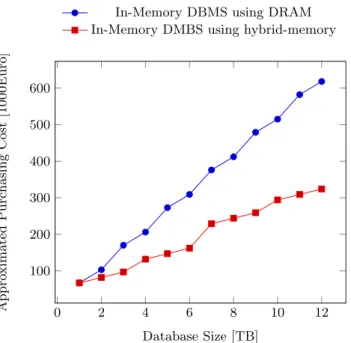
0 2 4 6 8 10 12 100 200 300 400 500 600 Database Size[TB] Ap pr oxima te d Pu rc ha sin g Co st [1 0 0 0 E u ro ]
In-Memory DBMS using DRAM In-Memory DMBS using hybrid-memory
Figure 1: Approximated purchasing cost of in-memory DBMS and in-in-memory DBMS using hybrid-memory. DRAM to hybrid-memory ratio not smaller than one to two.
though it is accessed rarely.
We believe that upcoming memory technologies are well suited to offer an additional approach for scaling columnar in-memory DBMS in a way which is capable of overcom-ing the mentioned issues usovercom-ing a simple method for verti-cal data partitioning. Storage Class Memory (SCM) is a term used to address such memory technologies, referring to high dense, low latency, and persistent memory which closes the gap between memory and storage. The terminology has first been used by IBM [8] and refers to a variety of dif-ferent hardware solutions such as Phase Change Memory, Spin Transfer Torque RAM, Magnetic RAM, and Memris-tors which are all sharing the characteristics mentioned to a certain degree [2]. These technologies are no commodity hardware today but will become reality in the near future. In the meantime the expected latencies can be emulated as proposed in [14] to gain first insights into the effects of using SCM. In this paper we used a bridge-technology designed by Fujitsu Technology Solutions GmbH combining high-end SSDs and DRAMs into hybrid-memory to be able to test some of the characteristics of future SCM and concentrate on the high memory density compared to DRAM.
The bridge-technology relies on latest SSDs technology as data medium which is buffered by traditional DRAM. The concept used is similar to the paging algorithms imple-mented in the Linux operating system [1]. Additionally, our solution offers several new features and configurations such as limiting the available DRAM buffer, introducing a prede-fined read-ahead functionality, as well as early page eviction. Especially the limitation of the buffer size makes it feasible to use hybrid-memory as an additional memory-tier next to DRAM. From a business perspective hybrid-memory is well suited to reduce the costs of scaling a database sys-tem as approximated in Figure 1 because of reducing the
number of servers and amount DRAM needed. Hence, it is also capable of reducing energy costs, downtime and mainte-nance expenses. Depending on data access patterns and the size of the hybrid-memory buffer a slowdown of data access can be assumed when introducing the technology into an in-memory DBMS. Therefore, the data needs to be partitioned depending on its access characteristics so that frequently ac-cessed data is kept in DRAM whereas seldom used data can be moved to hybrid-memory.
The focus of this paper is to:
• Extend a columnar in-memory DBMS by offering an additional data store which can be used for rarely ac-cessed columns generating no overhead for in-memory columns.
• Present an approach for vertically partitioning a colum-nar DBMS utilizing a slower but denser memory tech-nology.
• Evaluate the vertical data partitioning approach based on the trace of a productive DBMS and a commonly known benchmark.
2. VERTICAL PARTITIONING
In this paragraph we introduce our approach for columnar in-memory DBMS to leverage hybrid-memory as explained in Section 3. First we present our approach for vertically partitioning data for hybrid-memory. Afterwards, we an-alyze data access patterns in a productive Enterprise Re-source Planing (ERP) system to evaluate our idea.
2.1 Data Partitioning Approach
Our approach for using hybrid-memory is applicable to in-memory DBMS which store their data in a column ori-ented fashion. As a starting point we concentrate on the architecture of SAP HANA.
SAP HANA is offering two different states for data,hot
and cold. Hot data is referring to columns that are loaded into main memory and can be accessed by the DBMS with-out additional overhead of reading data from disk whereas cold data is not loaded into main memory but is stored in the disk-based persistence layer. Cold data is loaded into main memory on demand when accessed or can be loaded directly by the user or application using Structured Query Language (SQL). As described in [11] tables will be un-loaded from memory only when the system is running out of memory, or can by unloaded manually by using SQL. The potential transitions of loading and unloading data are shown in Figure 2. This figure also visualizes our extension which enables the use of hybrid-memory. In SAP HANA it is possible to set or alter an unload priority between zero and nine for a whole table using SQL. This way tables hav-ing a higher unload priority will be evicted from memory first.
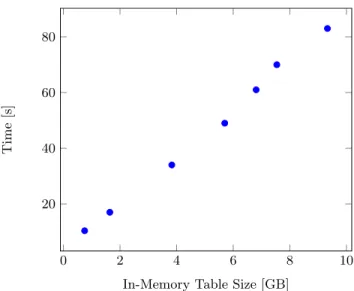
The idea of the load and unload approach is to make all frequently accessed columns available in memory ensuring low query response times and to store any unused tables or columns on the HDD-based persistence layer. For very large datasets this approach involves certain drawbacks. When-ever a cold column is requested and the system is running out of memory, SAP HANA unloads whole tables in order to free up as much memory as needed for columns requested. Afterwards the requested columns have to be fully loaded
into DRAM, generating an overhead. We have evaluated this behavior for various table sizes as shown in Figure 3. The analysis makes it obvious that query performance will be critically degraded in case a DRAM limit is reached.
To-dayScale-Outwould be the only option avoiding this effect.
Particularly for systems in which the database size ex-ceeds available DRAM it can be advantageous to offer a more fine grained load and unload mechanism of data in-stead, especially because many applications work on a mi-nor subset of the stored information, only. In these cases frequently loading and unloading full tables is no option to keep the system running when memory limits of the server are exceeded and Scale-Out remains the only option involv-ing the mentioned drawbacks. Usinvolv-ing hybrid-memory can be an alternative for scaling systems by offering an additional memory-tier to DRAM which could be used for data in a special state which is defined between hot and cold, and is referred to aswarm in the remainder of this paper.
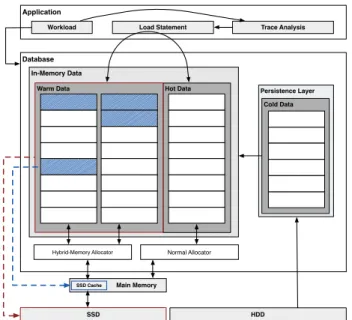
We introduce hybrid-memory as an additional store for columns as this seems well suited for a columnar DBMS, as well as for wide tables because it can be assumed that not all attributes are accessed in the same frequency. In our ap-proach we partition tables into hot, warm, and cold columns. A column is referred to aswarm when it is accessed infre-quently and therefore stored in a slower but larger mem-ory type such as hybrid-memmem-ory. Columns are hot when they are frequently accessed and should therefore remain in DRAM. The partitioning of data is implemented by us-ing a special allocator for warm columns while hot columns keep using the standard allocator for DRAM. Additionally, a horizontal partitioning of data for warm columns is im-plied by the architecture of hybrid-memory which is done
bypaging. Any data allocated on the hybrid-memory is
or-ganized in pages sized 4kB. These pages are read from SSD and evicted from main memory whenever space is needed. The resulting architecture is shown in Figure 4.
The architectural design of hybrid-memory influences the partitioning of data into hot and warm. As our approach for hybrid-memory relies on paging it is not well suited for sequential data access. As mentioned, columns allocated on hybrid-memory are loaded into and evicted from mem-ory using chunks of data sized 4kB. The size of the DRAM backed buffer is limited to a small fraction of the actual size of the warm data store to make the major amount of main
Unloaded Column Main Memory Loaded Column Hybrid-Memory Loaded Column SQL Load Statement OR Implicit r equest of column Database started
Column was notloaded befor e
Column was loaded befor
e
SQL Unload Statement OR
Exceeding available memory Load StatementSQL Hybrid-Memory SQL Hybrid-Memory Unload Statement
Functionality we added is visualized using dotted lines.
Figure 2: Process of implicitly and explicitly load-ing and unloadload-ing columns.
0 2 4 6 8 10
20 40 60 80
In-Memory Table Size[GB]
Time
[s]
Figure 3: Database initial request times for un-loaded tables related to their size in-memory. memory available for hot data. Therefore, fully scanning warm columns would lead to a sequential load of all related pages into the buffer which therefore could cause the evic-tion of a number of other pages whenever the data size of warm columns exceeds the buffer size. We propose to par-tition data related to our vertical parpar-titioning approach as outlined in Algorithm 1.
Algorithm 1Determination of warm data
1: functiondataWarm(columns,memoryLimit) 2: //columns ordered ascending by usage frequency
3: memory columns.sizeInMemory()
4: warm []
5: while memory > memoryLimitdo
6: column columns.next()
7: cond column.isCondition()
8: index column.isIndexed()
9: if (NOTcondORindex)then
10: memory-=column.size()
11: warm.append(column) 12: end if
13: end while 14: returnwarm
15: end function
In order to distinguish between hot and warm data, statis-tics of the access frequency of columns are needed. The access frequency describes how often a column is accessed compared with all queries within the time frame traced. Ad-ditional information defining if a column is used as a condi-tion within a Where statement and information if it is in-dexed is needed. If a column is used in a condition without an existing index, a sequential scan needs to be performed on the column data which would be an expensive operation using hybrid-memory. Also, we do not want to introduce ad-ditional indexes in order to bypass the problem as it would not follow the principles of a columnar in-memory DBMS. Hence, hybrid-memory is mainly suited for reading small datasets avoiding scans of whole columns.
Database Persistence Layer In-Memory Data Application Hot Data SSD Main Memory SSD Cache HDD Cold Data Warm Data Load Statement
Hybrid-Memory Allocator Normal Allocator
Workload Trace Analysis
Figure 4: Integration ofwarm data into the exist-ing states of hot and cold data.
Vertical data partitioning does not need to be re-run for existing and unchanged applications as the access patterns to data are defined by the application logic. Therefore an-alyzing a representative database trace of an existing ap-plication once would be sufficient to define columns to be loaded into hot and warm storage. An additional analysis is required only, whenever application access to data changes. We have not integrated data partitioning in the DBMS but implemented it in a separate preparation task instead. The result of the analysis is considered a fixed input of our sys-tem. By contrast, the main memory limitation can be ad-justed at any time, which determines the size of the warm and hot data partition. The partitioning of data into hot and warm as shown in Figure 2 and 4 can be achieved in our DBMS by using the following SQL statements.
/* Load table or single columns into DRAM or into hybrid - memory when WARM flag is set */
LOAD <table > { ALL | (< column >, ...)} [ WARM ] The SQL Data Manipulation Language (DML) has been extended adding the optional expression"WARM". When-ever the DML load statement is executed by the user or application using the identifier"WARM" data will be allo-cated using hybrid-memory. For any other case the load and unload command is kept unchanged. The definition of cold data remains unchanged and simply refers to data which is never used and therefore not loaded into memory at all.
2.2 Data Access Analysis
We analyzed our approach using a database trace of a pro-ductively used ERP system. The trace represents a number of samples taken from the DBMS during the system’s reg-ular operations and consists of 1,444,163 queries in total, 975,757 of which areSelect statements. We concentrate on vertical partitioning as no information about query results was available.
Figure 5: Projection and condition frequency for the columns of a single table.
Our investigation concentrates on the following questions:
• How are projections and conditions spread among columns of a table?
• Is there an access frequency skew between all tables?
• What does the total access frequency for all columns look like?
First we look into the usage frequency of the columns of one table separated into projections and conditions. Fig-ure 5 shows those results for a selected table. Looking at the projection frequency shows that almost 60% of all queries are accessing all columns. Hence, a high number ofSelect *
statements is performed on the table and only 40% of all queries work on a subset of all columns. Such a case is unsuitable for vertically partitioning data, as no clear dis-tinction regarding the access frequency for the columns of such a table is possible. However, the performance impact might not be that severe if the size of all accessed database tuples would not exceed the hybrid-memory buffer size and the same database tuples get accessed over and over again so that no cache misses occur. Continuing with the dis-cussion of column partitioning we have found that most of the columns accessed in theWherestatement have an index which means they are not scanned sequentially. Hence, they can be stored on hybrid-memory as well.
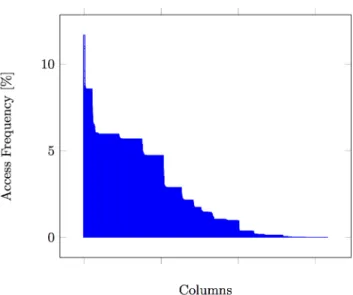
Another approach for partitioning might be derived from the general access skew of the tables in the DBMS. We have traced the access to all tables as shown in Figure 6 and all columns as shown in Figure 7. Out of 20 tables only 5 tables are accessed in more than 6% of all queries. By implementing a partitioning on table granularity we could save 65% of DRAM by moving tables which are accessed in less than 6% of the queries to hybrid-memory. Those tables are only used in 20% of all queries in total. Therefore, even in a worst-case scenario the performance of 80% of all queries would not be affected.
0 10 20 30 6% access frequency Tables Ac ce ss Fr eq ue nc y an d R el at iv e Si ze [%]
Access Frequency Table Size
Figure 6: Table access frequency and sizes. Finally, we combine both analysis by generating an access frequency chart for all columns taking the overall access fre-quency into account. Only about one-third of the columns are accessed in more than 5% of all queries. A potential vertical partitioning can leverage this information and use it to prioritize columns to be stored as warm data whenever the DBMS is running out of memory.
A full analysis of the available trace would have only been possible by taking a look into the actual rows returned by the DBMS. This would have allowed an analysis of the suitability of horizontal partitioning. Unfortunately, this was not possible. We are going to reiterate this approach in Section 4.1.2 when looking into the TPC-C workload.
3. HYBRID-MEMORY
This section provides an overview of hybrid-memory and how it is made available to the DBMS. Additionally, we will present a first evaluation of the technology using a mi-crobenchmark simulating DBMS data access behavior.
3.1 Integration
When looking at the latencies of the memory hierarchy shown in Table 1 the huge difference between persistent storage and memory becomes obvious. SCM’s latency and bandwidth are in the same order of magnitude of DRAM with a much higher capacity. However, as the capacity of SCM is limited by the number of available DIMM slots and it is still significantly slower than DRAM it might neither replace HDD nor DRAM. Hence, it is assumable that SCM will take its place as a third available storage technology within servers.
Besides emulating the technology a number of hardware vendors are working on bridge-technologies to overcome the time until SCM will be available. Those technologies as developed by Fujitsu Technology Solutions GmbH combine flash drives with a DRAM buffer. This technology is named hybrid-memory. It can be allocated like DRAM and is ac-cessed byte-wise. As soon as SCM becomes available the
Figure 7: Column access frequency.
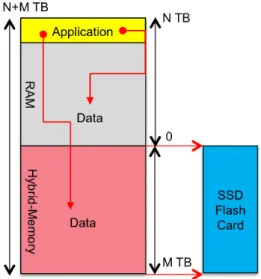
hybrid-memory libraries can be replaced transparently to use it instead. At the moment hybrid-memory works similar to the concept of paging as known from Linux. In case the amount of virtual memory used by the application exceeds the available physical memory size, the software based map-ping layer requires to reclaim pages from DRAM. This way selected pages are swapped to SSD and the required pages on SSD are re-transferred to the freed space in DRAM and thus become available in main memory again. This mechanism is extended by additionally offering the limitation of the avail-able DRAM buffer size, introducing a predefined read-ahead functionality, as well as early page eviction. Hence hybrid-memory extends the available amount of main hybrid-memory as shown in Figure 8.
L1 Cache ⇡4 cycles
L2 Cache ⇡10 cycles
L3 Cache ⇡40–75 cycles L3 Cache via QPI ⇡100–300 cycles
RAM ⇡60ns
RAM via QPI ⇡100ns
SCM ⇡80−10 000ns
SSD ⇡80 000ns
HDD ⇡5 000 000ns
Table 1: Latencies of the memory hierarchy. In contrast to the swapping algorithm of the Linux Op-erating System (OS), hybrid-memory can be accessed based on user needs. This way it becomes an additional memory-tier next to DRAM increasing the application’s influence on preserving memory performance. Hence, we have integrated hybrid-memory as a separate data store into the columnar in-memory DBMS, SAP HANA. We refer to this data store as warm data which can be used additionally to the DRAM based hot data store. This way the actual functionality of the columnar in-memory DBMS stays unchanged. Paging is offered as an additional concept extending the available
Figure 8: Hybrid-Memory integration into system. amount of memory in the DBMS with no need for scaling the database across several servers. HANA stores data in two different stores, main and delta. The delta store is op-timized for insert and update operations whereas the main store is read-optimized and read-only. Insert and update operations are performed on the delta store which is merged into the main store asynchronously. Additionally, all data is compressed using dictionary compression.
We integrated hybrid-memory into the main store only. Therefore mainly read operations are performed on hybrid-memory. All internal columns, indexes, and the delta store are always stored on DRAM. For the main store it can be chosen whether data is stored on hybrid-memory or DRAM.
3.2 Initial Benchmark
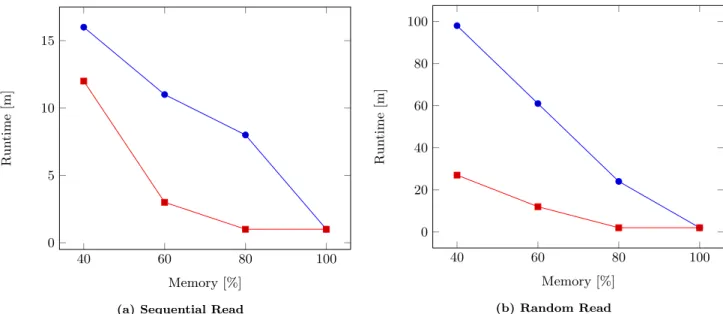
Hybrid-memory has been initially evaluated by using typ-ical data access patterns of a DBMS. We used a microbench-mark simulating sequential scans as well as random reads on a single column being represented by a vector. This vector has been filled using 64-bit random integer values and can by be partitioned using different memory allocators for each partition. Hence, partitions allocated on DRAM as well as on hybrid-memory can be created. We ran two different scenarios using the microbenchmark:
1. No data partitioning is used. The entire vector gets allocated using either DRAM or hybrid-memory. 2. Data is partitioned into 35% of hot data allocated on
DRAM and 65% of warm data allocated on hybrid-memory. Data access is skewed accessing hot data in 80% and warm data in 20% of all cases.
For each of those configuration we performed sequential scan and random read benchmarks. The vector size was set to 5 GB in all cases. The benchmark results show the effect of a limited physical memory in the system or offered to the hybrid-memory. Hence, paging is needed in order to make all data available. All configurations use a fast Peripheral Component Interconnect Express (PCIe) SSD as a backing store for DRAM. We used four measuring points limiting the memory between 100% and 40% of the total size of the vector.
In case data is not partioned performance results of the standard Linux paging algorithm and the implementation of the hybrid-memory are close to equal. Hybrid-memory shows a minor improvement in case of sequential data access. This does not apply for random access because prefetching can not be applied.
In case of data partitioning and skewed data access the ef-fect of using a slower storage medium is weakened as shown in Figure 9. Because only 20% of the access addresses hybrid-memory, the impact of higher latencies is reduced.
Concluding, the microbenchmark offers first insights into the effect of using a slower memory tier for sequential scan and random read operations. However it simplifies from running a real DBMS. We take a look onto the integration of our approach into a modified development version of SAP HANA in Section 4.
4. EVALUATION
We evaluate the approach of hybrid-memory for scaling columnar in-memory DBMS focusing on the impact of hybrid-memory towards database performance.
Our evaluation focuses on two major problems:
• Reducing the amount of main memory consumption of
the in-memory DBMS by vertical partitioning.
• Sizing the hybrid-memory buffer in order to minimize performance degradation of introducing data partition-ing.
We will answer those questions for the TPC-C benchmark. In the following we start by introducing TPC-C, giving a short introduction into its workload and how it can be ver-tically partitioned. Next we present our TPC-C based eval-uation results.
4.1 TPC-C Benchmark
The TPC-C benchmark is a commonly known OLTP DBMS benchmark approved by the Transaction Processing Perfor-mance Council (TPC) in 1992 [19]. Its standard specifica-tion can be obtained from [30]. Its workload describes the processes of a wholesale supplier having a number of sales districts and associated warehouses. Customers are plac-ing new orders or requestplac-ing status existplac-ing orders where information is received by the DBMS. In the following we describe the workload in more detail focusing on its appli-cability for our approach. Afterwards we introduce vertical partitioning in order to make TPC-C utilising the hot and warm data store.
4.1.1 Workload
The TPC-C workload focuses on a DBMS which is used by the employees of a wholesale supplier executing trans-actions from their terminals in order to enter and deliver orders, record payments, check the status of orders, and to monitor the current stock of the warehouses. It consists of five different transaction types, namely new order, payment, order status, delivery, and stock level. A minimum execu-tion frequency for each transacexecu-tion type is specified by the TPC-C standard besides from the new order transaction. The amount of new order transactions measured is defined as the main metric of TPC-C namedtpmC. It describes the number of new order transactions finished by the DBMS per
40 60 80 100 0 5 10 15 Memory[%] Ru nt im e [m]
Standard Allocator Hybrid-Memory Allocator
(a) Sequential Read
40 60 80 100 0 20 40 60 80 100 Memory[%] Ru nt im e [m] (b) Random Read
Figure 9: Comparison of allocator performances using a microbenchmark simulating sequential and random column access. Data is partitioned into one-third of hot and two-thirds of warm data. 80% of the operations are performed on hot data, 20% on warm data.
minute which reflects the business throughput of the whole-sale supplier. The dataset of the benchmark consists of nine tables having a total amount of 92 columns. It can be scaled defining the number of warehouses within the system. Ac-cordingly all column sizes will be adopted except for the
item table that reflects the products sold by the wholesale supplier.
Configuration Setting warehouses 50 virtual users 50 iterations 10000
Table 2: TPC-C configuration used for evaluation. Our implementation of TPC-C relies on the open source database load testing and benchmark toolHammerora[13]. Hammerora offers multiple parameters which can be changed by the user, e.g., the number ofwarehouses, virtual users,
andexecution iterations. The number ofwarehouses scales
the dataset of the benchmark. Virtual users is used to set the maximum number of emulated, simultaneously work-ing terminal operators executwork-ing transactions against the DBMS. Iterations defines the number of total transactions executed per user. Therefore it controls the runtime of the benchmark. Alternatively a timed run can be performed while iterations are executed until the defined time limit is reached. For the following evaluation these settings will be defined as stated in Table 2.
While using TPC-C we focus on the impact of introduc-ing hybrid-memory to the DBMS. As Hammerora does not implement a full specification of TPC-C’s metrics, we use transactions-per-minute (tpm) as the main metric compar-ing performance results of different DBMS configurations. As we are not focusing on actual DBMS throughput but
rather on potential performance degradation we will present our results as variations from an unchanged DBMS. The fol-lowing chapter concentrates on the vertical partitioning of TPC-C in order to make it applicable for our partitioning approach.
4.1.2 Dataset Partitioning
This paragraph concentrates on adopting TPC-C’s dataset in order to make it applicable for vertical partitioning based on its workload. We will analyze the dataset and workload to answer the following questions:
• Is the workload of TPC-C suited to outline effects of
introducing hybrid-memory?
• How can we partition TPC-C vertically to reduce the
latency overhead of hybrid-memory?
• Is TPC-C workload beneficial for paging introduced by hybrid-memory?
For the configuration given in Table 2 we have analyzed the resulting database sizes.
Initial Final
Main Delta Main Delta
Data 544 MB 2 MB 544 MB 330 MB
Dictionary 2571 MB 4 MB 2571 MB 1824 MB Indexes 279 MB 0 MB 279 MB 377 MB Sum 3394 MB 6 MB 3394 MB 2531 MB
Total 3400 MB 5925 MB
Table 3: Initial and final TPC-C data, dictionary and index sizes distributed on main and delta store of SAP HANA.
The aggregated table sizes shown in Table 3 describe the dataset distribution of the TPC-C dataset in the database before and after a complete run of the benchmark. Data has been merged into the main store before the start of the benchmark. After the execution the dataset has grown by a total amount of 74%. The delta merge is disable in the DBMS in order to preserve constant performance of the database. The high data growth is caused by a nearly equal number of Select and Insert / Update statements within TPC-C’s workload. Based on this we need to further ana-lyze if TPC-C is mainly working on newly inserted or up-dated tuples as hybrid-memory is introduced into the main data store only. Effects of hybrid-memory only become visi-ble whenever read operations access existing and unchanged data. Therefore we analyzed the number of Select state-ments accessing the main store and the delta store. The results listed in Table 4 show that most of TPC-C’s read transactions are performed on the main store. Therefore TPC-C is potentially suited to make the performance im-pact of introducing hybrid-memory visible as three-fourth of theSelect statements are accessing the main store.
Table Main Delta Customer 28% 5% District 0% 4% Item 19% 0% New Order 2% 0% Orders 2% 0% History 0% 0% Order Line 1% 19% Stock 15% 3% Warehouse 0% 2% Total 67% 33%
Table 4: Distribution of data access to main and delta store grouped by tables in relation to all Se-lect statements during a single TPC-C run.
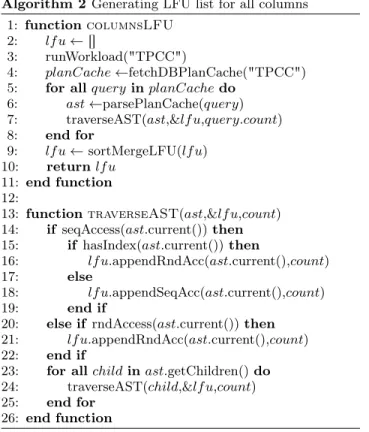
Next we analyze how TPC-C can be vertically partitioned while reducing the overhead of introducing hybrid-memory as good as possible. Our analysis focuses onSelect state-ments first as they are accessing the hybrid-memory. We run TPC-C in order to obtain its workload using theSQL
Plan Cache of the DBMS. Afterwards we parse the plan
cache using a simple SQL grammar building an abstract syntax tree. Finale we traverse the tree counting the usage of each column. We separate column usage into sequen-tial and random access. Sequensequen-tial access of columns refers to scan operations generated by theWhere statements of a query used to find corresponding rows. Columns used for projections rather generate a random access to memory as only subsets of the data are used during the materializa-tion of a result depending on the Where condition of the query. We found that for TPC-C between one and ten rows are materialized for eachSelect statement. This separation is necessary as hybrid-memory can cope with random ac-cess whereas sequential acac-cess of columns potentially causes significant overhead. Based on this knowledge we finally cre-ate a Least Frequently Used (LFU) ordering of all columns. Columns scanned sequentially are ranked highest priority to stay in main memory if they are not indexed. Columns accessed randomly are prioritized according to their usage
frequency. The process of analyzing the dataset is shown in Algorithm 2.
Algorithm 2Generating LFU list for all columns 1: functioncolumnsLFU
2: lf u []
3: runWorkload("TPCC")
4: planCache fetchDBPlanCache("TPCC")
5: for allquery inplanCachedo
6: ast parsePlanCache(query)
7: traverseAST(ast,&lf u,query.count)
8: end for
9: lf u sortMergeLFU(lf u) 10: returnlf u
11: end function 12:
13: functiontraverseAST(ast,&lf u,count)
14: if seqAccess(ast.current())then
15: if hasIndex(ast.current())then
16: lf u.appendRndAcc(ast.current(),count)
17: else
18: lf u.appendSeqAcc(ast.current(),count) 19: end if
20: else if rndAccess(ast.current())then
21: lf u.appendRndAcc(ast.current(),count)
22: end if
23: for allchildinast.getChildren()do
24: traverseAST(child,&lf u,count)
25: end for 26: end function
Based on the LFU the dataset can be vertically parti-tioned. We found that only 15 columns of TPC-C are ac-cessed in more than one-sixth of allSelectstatements. Over-all more than 30% of Over-all columns are projected in less than 4% of allSelectstatements whereas even 40% of all columns are not projected at all. The final share of data in the hot and warm store is set based on memory limitations of the server. Storing as much frequently used data as possible on DRAM using the LFU preserves the overall performance of the DBMS.
Finally hybrid-memory also implies a horizontal partition-ing based on its nature of pagpartition-ing chunks of data. Whenever rows are accessed which are already stored in the DRAM based cache of hybrid-memory no disk access is needed. If applications constantly access the same data the overhead of using hybrid-memory is reduced. We have analyzed TPC-C workload towards its capabilities to leverage paging. We instrumented the stored procedures of TPC-C storing the row identifiers of allSelect statements. Next, we simulated the access of TPC-C to the Customer table and assumed a limited amount of cache. As shown in Figure 10 hybrid-memory does not need to access the underlying SSD when the buffer size is not smaller than 60%. The number of page faults increases rapidly for lower buffer sizes.
Taking a look onto theUpdate statements of TPC-C we found that updates of the database are done identifying the corresponding rows using indexes. Therefore no fur-ther analysis needs to be done towards those statements, as indexes are not stored on hybrid-memory.
5 10 20 40 60 80 100 0 10 20 30 Hybrid-Memory Buffer Size[%] Pa ge Fa ul ts [%]
Figure 10: Approximated number of page faults for Customer table running TPC-C workload. Customer table is assumed to be fully stored on hybrid-memory only adjusting the buffer size.
4.1.3 Test System
For our evaluation we used a Fujitsu Primergy RX600 S6 equipped with four Intel Xeon CPU E7-4870, 512GB of DRAM, a 768GB Intel P3700 SSD used as hybrid-memory backing store and 512GB of HDD. The system was running Suse Enterprise Server 11 SP2.
4.2 Results
For the TPC-C benchmark we assumed a fixed vertical partitioning of data into hot and warm. In total about 20% of all columns were stored on DRAM which were the most frequently accessed columns. The remaining columns have been allocated using hybrid-memory. Hence, the amount of DRAM directly used by the attribute vectors could be reduced by 60%.
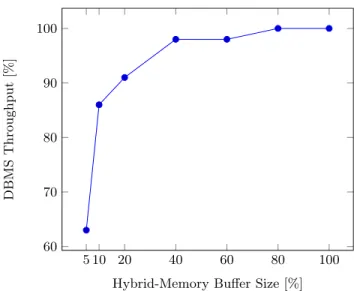
We adjusted the size of the DRAM based buffer of hybrid-memory analysing its impact on query throughput and op-timizing the amount of main memory saved. We found that the DBMS throughput is degraded less than 15% if the size of the hybrid-memory buffer is reduced by not more than 10% . Hence, the total amount of DRAM used by attribute vectors of the modified SAP HANA was reduced by 54%. This enables a potential scaling of the attribute vectors by more than 100% with no need for a Scale-Out accepting just a minor performance degradation.
In conclusion scaling SAP HANA based on hybrid-memory offers a good solution to reduce the amount of DRAM needed while still achieving high query throughput performance.
5. RELATED WORK
Novel storage technologies like SCM have been studied by various researchers in the past. Work concentrated on two different aspects of using SCM, scaling and data persistence. Ramos et al. [24] present an approach on scaling servers based on SCM using a hardware-driven page placement effi -ciently reducing the amount of DRAM in the system. Dhi-man et al. [5] present a hybrid hardware-software solution to manage the combination of SCM and DRAM. A software
100 80 60 40 20 10 5 60 70 80 90 100
Hybrid-Memory Buffer Size[%]
DBMS
Throughput
[%]
Figure 11: DBMS performance in percent of tpm compared to unchanged DBMS for different hybrid-memory buffer sizes and a constant share of hot and warm data of 20% by 80%.
based suggestion for integrating SCM is done by Qureshi et al. [22] reducing system power and cost. In contrast to our approach SCM is seen as a replacement for DRAM reducing the amount of it to a minimum. Contrary we propose SCM to become an additional memory layer.
Persistence characteristics of SCM, which we do not ad-dress in this paper, as they could for example be used for logging are proposed by Oukid et. al [20] for in-memory DBMS. The transition of data from disk to SCM in disk-based DBMS is presented by Tavares et al. [29] and Wang et al. [33]. Application independent usage of the persistence of SCM is shown by Condit et al. [3] and Venkataraman et al. [31].
There are a number of different papers that address the capacity limitation of in-memory DBMS. In H-Store an ap-proach calledAnti-Cachingis used to tackle the problem [4]. In contrast to the traditional approach of caching they do not try to keep active data in memory, but instead make sure that archived data is pushed to disk. A comparable tech-nique is used in Hekaton [6]. Here, cold data is also pushed to secondary storage, in this case flash memory. In their work the authors describe how the system can transpar-ently access a tuple without knowledge about its location. In Hyper a method calledCompacting is used [10]. Similar to our approach the data stored in a columnar layout is par-titioned horizontally and each partition is categorized by its access frequency. Data in the (rarely accessed)frozen cate-gory is still kept inRAM but compressed and stored in huge pages to save memory. Finally, an approach for identifying hot and cold data in an in-memory DBMS is presented by Levandoski et al. [27]. Contrary to our work data is either stored in memory or on disk. An additional store is not assumed.
6. CONCLUSION AND OUTLOOK
In this paper, we presented an approach for hybrid-memory scaling columnar in-memory databases. We investigated how to introduce hybrid-memory into a columnar in-memory
DBMS by vertically partitioning data into hot and warm columns. Additionally, we implemented our approach into a development version of SAP HANA in order to evaluate and optimize the reduction of DRAM consumption. We found that main memory used by the attribute vectors can be reduced by more than 50% while decreasing the DBMS performance less than 15%.
We believe that our approach can also be applied to SCM which would potentially further reduce the performance over-head. For further work, we plan to integrate hybrid-memory into additional parts of SAP HANA, supporting a parti-tioned data dictionary.
7. REFERENCES
[1] D. P. Bovet and M. Cesati.Understanding the Linux
kernel. O’Reilly, Sebastopol, CA, 2006.
[2] G. W. Burr, B. N. Kurdi, J. C. Scott, et al. Overview of candidate device technologies for storage-class memory.IBM, 52(4.5):449–464, July 2008.
[3] J. Condit, E. B. Nightingale, C. Frost, et al.Better
I/O Through Byte-Addressable, Persistent Memory.
2009.
[4] J. DeBrabant, A. Pavlo, S. Tu, M. Stonebraker, and S. Zdonik. Anti-caching: A new approach to database management system architecture.Proc. VLDB
Endow., 6(14):1942–1953, Sept. 2013.
[5] G. Dhiman, R. Ayoub, and T. Rosing. PDRAM: A hybrid PRAM and DRAM main memory system. In
Proceedings of the 46th DAC, DAC ’09, page 664–469,
New York, NY, USA, 2009. ACM.
[6] A. Eldawy, J. Levandoski, and P. Larson. Trekking through siberia: Managing cold data in a
memory-optimized database. InPVLDB Vol. 7, Issue.
11, June 2014. VLDB – Very Large Data Bases, Sept.
2014.
[7] R. Elmasri.Fundamentals of database systems. Addison-Wesley, Boston, 6th ed edition, 2011. [8] R. F. Freitas and W. W. Wilcke. Storage-class
memory: The next storage system technology.IBM
Journal of Research and Development,
52(4.5):439–447, July 2008.
[9] D. Fried, C. Skinner, and J. Loesche. HP and SAP advance SAP HANA through joint innovation, May 2013.
[10] F. Funke, A. Kemper, and T. Neumann. Compacting transactional data in hybrid OLTP OLAP databases.
CoRR, abs/1208.0224, 2012.
[11] F. Färber, N. May, W. Lehner, et al. The SAP HANA database – an architecture overview.IEEE Data Eng.
Bull., 35(1):28–33, 2012.
[12] M. Grund, J. Krüger, H. Plattner, et al. HYRISE: a main memory hybrid storage engine.Proceedings of
the VLDB Endowment, 4(2):105–116, Nov. 2010.
[13] HAMMERDB. HammerDB, 2014.
[14] B. Höppner, O. Lilienthal, H. Schmitz, et al. SAP HANA in a hybrid main memory environment. InHPI
Future SOC Lab: proceedings 2013. Universitätsverlag
Potsdam, Apr. 2013.
[15] A. Kemper and T. Neumann. HyPer: A hybrid OLTP OLAP main memory database system based on virtual memory snapshots. pages 195–206. IEEE, Apr. 2011.
[16] T. Lahiri, M.-A. Neimat, and S. Folkman. Oracle TimesTen: An in-memory database for enterprise applications.IEEE Data Eng. Bull., 36(2):6–13, 2013. [17] P.-a. Larson, M. Zwilling, and K. Farlee.The Hekaton
Memory-Optimized OLTP Engine.
[18] J. Lee, Y. S. Kwon, F. Farber, et al. SAP HANA distributed in-memory database system: Transaction, session, and metadata management.2013 IEEE 29th ICDE, 0:1165–1173, 2013.
[19] S. T. Leutenegger and D. Dias. A modeling study of the TPC-c benchmark.SIGMOD Rec., 22(2):22–31, June 1993.
[20] I. Oukid, D. Booss, W. Lehner, et al. SOFORT: A hybrid SCM-DRAM storage engine for fast data recovery. Snowbird, USA, June 2014.
[21] H. Plattner.In-memory data management: an
inflection point for enterpise applications. Springer,
Heidelberg, 2012.
[22] M. K. Qureshi, V. Srinivasan, and J. A. Rivers. Scalable high performance main memory system using phase-change memory technology. ISCA ’09, page 24–33, New York, NY, USA, 2009. ACM.
[23] V. Raman, G. Attaluri, R. Barber, et al. DB2 with BLU acceleration: So much more than just a column store.Proc. VLDB Endow., 6(11):1080–1091, Aug. 2013.
[24] L. E. Ramos, E. Gorbatov, and R. Bianchini. Page placement in hybrid memory systems. InProceedings
of the ICS, ICS ’11, page 85–95, New York, NY, USA,
2011. ACM.
[25] SGI. SGI to preview in-memory appliance at SAPPHIRER NOW, June 2014.
[26] V. Sikka, F. Färber, W. Lehner, et al. Efficient transaction processing in SAP HANA database: The end of a column store myth. SIGMOD ’12, page 731–742, New York, NY, USA, 2012. ACM. [27] R. Stoica, J. J. Levandoski, and P.-A. Larson.
Identifying hot and cold data in main-memory databases. ICDE ’13, page 26–37, Washington, DC, USA, 2013. IEEE Computer Society.
[28] M. Stonebraker, V. Inc, A. Weisberg, and V. Inc.The
VoltDB Main Memory DBMS.
[29] J. A. Tavares, J. d. A. M. Filho, A. Brayner, and E. Lustosa. SCM-BP: An intelligent buffer
management mechanism for database in storage class memory. JIDM, 4(3):374–389, 2013.
[30] Transaction Processing Performance Council (TPC). TPC BENCHMARK c standard specification revision 5.11, Feb. 2012.
[31] S. Venkataraman, N. Tolia, P. Ranganathan, and R. H. Campbell. Consistent and durable data structures for non-volatile byte-addressable memory.
InProceedings of the 9th USENIX, FAST’11, page
5–5, Berkeley, CA, USA, 2011. USENIX Association. [32] T. Vogelsang. Understanding the energy consumption
of dynamic random access memories. pages 363–374. IEEE, Dec. 2010.
[33] A.-i. A. Wang, P. Reiher, and G. J. Popek. Conquest: better performance through a disk/persistent-RAM hybrid file system. InIn Proceedings of the 2002