THE RELATIONSHIP BETWEEN INSTRUCTOR COURSE PARTICIPATION, STUDENT PARTICIPATION, AND STUDENT PERFORMANCE
IN ONLINE COURSES
By Erin Thornbury
Ted L. Miller Steven R. Banks
Professor Learning & Leadership Associate Professor Learning & Leadership
(Chair) (Methodologist)
Elizabeth K. Crawford David W. Rausch
Associate Professor Learning & Leadership Professor Learning & Leadership
THE RELATIONSHIP BETWEEN INSTRUCTOR COURSE PARTICIPATION, STUDENT PARTICIPATION, AND STUDENT PERFORMANCE
IN ONLINE COURSES
By Erin Thornbury
A Dissertation Submitted to the Faculty of the University of Tennessee at Chattanooga in Partial Fulfillment
of the Requirements of the Degree of Doctor of Education: Learning and Leadership
The University of Tennessee at Chattanooga Chattanooga, Tennessee
iii
Copyright © 2020 By Erin Elizabeth Thornbury
ABSTRACT
Online learning has become ubiquitous with higher education and has catalyzed many changes in teaching and learning, particularly in academic technology. However, foundational frameworks for supporting learning in a virtual environment argue that learners need very similar, if not more, instructional engagement and support as the traditional classroom. Moore’s (1989) three types of interaction and Garrison & Akyol’s (2013) community of inquiry
theoretical framework opine the importance of social engagement on the part of instructors and students in the online classroom, further asserting that learner-to-instructor interactions are essential to supporting student satisfaction and learning. Nevertheless, there are few studies, particularly quantitative studies, that examine the relationship between instructor participation in online courses and student participation and achievement. This study analyzed the relationship between select forms of instructor participation, including course announcements and discussion board posts, and student participation and achievement, represented by student course accesses, clicks within a course, time in a course, discussion board posts, and final course grade. The researcher utilized data available in the learning management system (LMS) log files from over 500 online master’s degree courses delivered at a private nonprofit university in the Northwest United States. The results of the multiple regression and multivariate analysis of variance (MANOVA) analyses on the data from the logs showed significant relationships between
instructor participation and student participation as well as student participation and achievement within an online course. No significant relationship was identified between instructor
participation and student achievement. Potential explanations for this discrepancy and opportunities for future research are also discussed.
DEDICATION
I dedicate the growth and struggles represented within these pages to Otto Henry
Thornbury. He was my motivation to power through as well as procrastinate endlessly. He is one of the reasons I finished, as well as the primary reason I considered walking away multiple times. He is my guiding light. While this work represents so much learned over the course of too many years, you, Otto, have taught me more in your time on this earth than all of my years. I am a better version of myself because of you, but I am here because of me.
Dr. Ted Miller is also a big part of my completing this final chapter of my doctoral journey. His unwavering belief in my intelligence and spirit, kept me believing that I could finish even when the finish line appeared to recede. Thank you for your kind and endless nagging, and for holding off your retirement until I finished.
ACKNOWLEDGEMENTS
I would like to recognize the guidance provided by my Dissertation Chair, Dr. Miller, who continuously helped keep this project focused and my writing as concise as possible. A great debt of gratitude is also owed to my Methodologist, Dr. Banks, for his support and expertise in analyzing the mounds of data collected. Finally, I would like to acknowledge the assistance, interest, and support of City University of Seattle Director of Information
Technology, Kevin Brown, in the identification and extraction of data use in this study. This research study would not have been possible without the contributions of these key individuals and many others who continuously offered encouragement.
TABLE OF CONTENTS ABSTRACT ... iv DEDICATION ... vi ACKNOWLEDGEMENTS ... vii LIST OF TABLES ...x LIST OF FIGURES ... xi
LIST OF ABBREVIATIONS ... xii
LIST OF SYMBOLS ... xiii
CHAPTER I. INTRODUCTION ...1
Definition of Terms...4
Statement of the Problem ...7
Purpose of the Study ...9
Research Questions ...10
Rationale for the Study ...11
Theoretical/Conceptual Framework ...13
Significance/Importance of the Study ...17
Methodological Assumptions ...19
Delimitations of the Study ...20
Limitations of the Study...21
II. LITERATURE REVIEW ...23
Teaching and Learning Online ...25
Three Types of Interaction ...27
Community of Inquiry ...30
Teaching Presence. ...32
Participation as Visible Evidence of Interaction, Teaching Presence, and Learning ...34
Conclusions and the Need for Future Research ...41
III.METHODOLOGY ...43
Population and Sample ...43
Variables Analysis ...44
Procedure ... 45
IRB Approval and Data Security ...45
Data Collection ...46
Research Design and Analysis ...48
Summary ...50
IV.RESULTS ...51
Research Questions One and Two ...52
Research Questions Three and Four ...56
Research Question Five ...57
Research Question Six ...58
Summary ...65
V. DISCUSSION ...67
Interpretation of Findings ...70
Instructor Participation and Student Achievement ...71
Grades and Grade Inflation ...74
Disciplinary Differences ...75
Leadership and Business Verses Education ...76
Soft, Applied, Life Disciplines ...77
Recommendations for Future Research ...78
Conclusion ...81
REFERENCES ...84
APPENDIX A. CITY UNIVERSITY OF SEATTLE IRB CERTIFICATE OF APPROVAL ...97
B. UNVERSITY OF TENNEESSEE AT CHATTANOOGA IRB LETTER OF DEFERRAL ...99
C. VARIABLES ANALYSIS ...101
D. SCHOOL OF MANAGEMENT QUALITY CONTROL RUBRIC ...103
LIST OF TABLES
4.1 Summary of Multiple Regression Analysis for Number of Student Course Accesses ...53
4.2 Summary of Multiple Regression Analysis for Number of Student Clicks within a Course ...54
4.3 Summary of Multiple Regression Analysis for Student Time within a Course ...55
4.4 Summary of Multiple Regression Analysis for Number of Student Discussion Board Posts in a Course ...56
4.5 Summary of Multiple Regression Analysis for Student Grade within a Course ...57
4.6 Summary of multiple Regression Analysis for Student Participation ...58
4.7 Univariate ANOVA results for Student School of Enrollment ...60
4.8 Game-Howell post hoc test for Student School of Enrollment ...61
4.9 Univariate ANOVA results for Course School ...63
LIST OF FIGURES
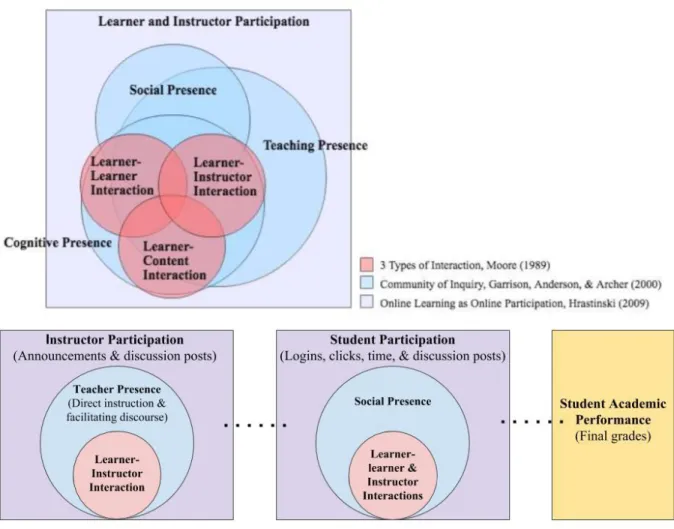
1 Relationship between the foundational theories of this study’s conceptual framework ...15 2 Conceptual framework representing the relationship between the community of inquiry
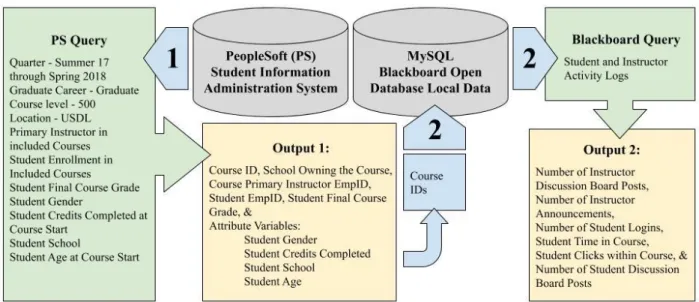
theoretical framework, Moore’s (1989) interaction framework, and Hrastinski (2009) theory of learning as online participation ...17 3 Data collection model shows query of PeopleSoft and Blackboard’s MySQL database and its
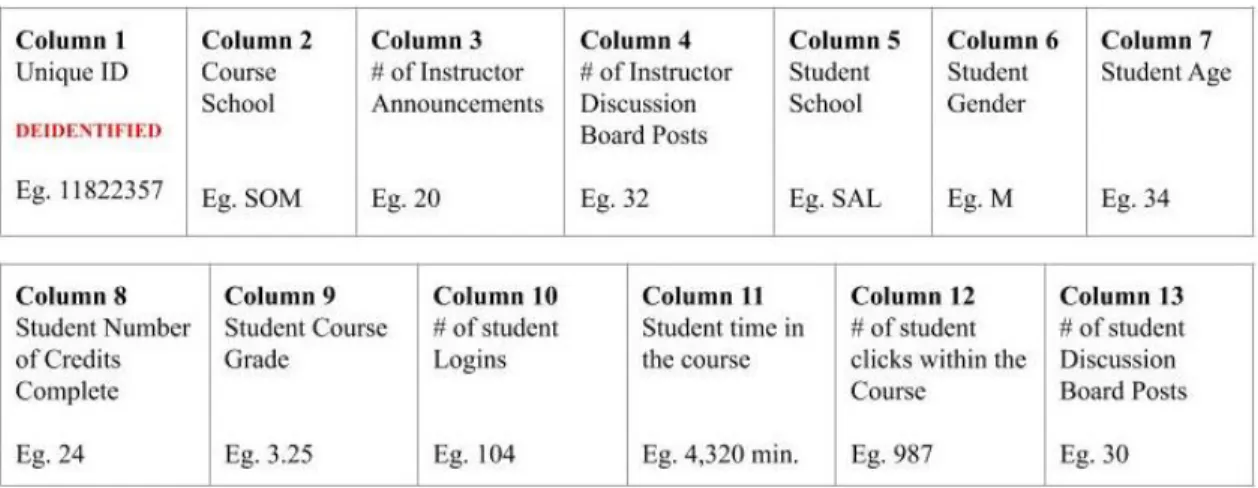
resulting outputs ...47 4 Example of resulting data report fields from the data pull described in Figure 3 ...48
LIST OF ABBREVIATIONS
EDM, Educational Data Mining ID, Identification
IPEDS, Integrated Postsecondary Education Data System IRB, Institutional Review Board
LMS, Learning Management System
MANOVA, Multivariate Analyses of Variance MOOC, Massive Open Online Course
NCES, National Center for Education Statistics PS, PeopleSoft
LIST OF SYMBOLS
b, The regression coefficient
, Standardized regression coefficient df, Degrees of freedom
F, F-ratio (test statistic used in ANOVA) n, Sample size
η2, Eta-squared
p, Probability (p-value or significance of a test) R, The multiple correlation coefficient
CHAPTER I INTRODUCTION
Learning online is no longer an innovative approach to post-secondary education (Allen & Seaman, 2016). To the contrary, online education has become a cornerstone of higher
education (Allen & Seaman, 2015). Integrated Postsecondary Education Data System (IPEDS) reported that over 70% of active degree granting institutions offered some form of distance learning in 2013 (Allen & Seaman, 2015). In 2016, over six million learners, just over 30% of all postsecondary enrollments, took at least one online course (Seaman, Allen, & Seaman, 2018). The number of students taking one or more online courses has steadily increased year after year, even when growth in overall enrollments in higher education is declining (Seaman et al., 2018).
Today’s well-established modes of online education provide the flexibility and
accessibility many adult learners need to pursue advanced education (Serhan, 2010). The Council of Regional Accrediting Commissions’ (2011) standards for distance education and the
competition inherent in this geographically borderless instructional modality have resulted in a plethora of best practices and guidelines for quality in online education. This literature on quality online instruction asserts that students have improved achievement of learning outcomes,
satisfaction, and retention in online courses when high levels of interaction and community are present (Cobb, 2009; Garrison & Akyol, 2013; Kim, Kwon, & Cho, 2011; Shea, 2006). In fact, many of the best practices for face-to-face undergraduate education, outlined by Chickering and Gamson (1999), are supported by online learning researchers (Calsolaro Smulsky, 2012; Tirrell
& Quick, 2012; Wang, Doll, Deng, Park, & Yang, 2013), who assert that the same interaction techniques that support effective traditional classroom learning are also effective online. Early myths portraying online students working in isolation (Li & Akins, 2005) are simply not true in courses adhering to what the field has defined as best practice. The research shows that practices that facilitate interaction with peers and the instructor support student satisfaction and learning outcomes (Garrison & Akyol, 2013; Moore, Dickson-Deane, & Galyen, 2011).
As early as the 1980s, Moore (1989) argued the importance of interaction between students and other students, content, and instructors in distance education. At the beginning of the current century Garrison, Anderson, and Archer (2000) elaborated on Moore’s constructs with the community of inquiry theoretical framework. The researchers argued that “a worthwhile educational experience is embedded within a community of inquiry that is composed of teachers and students – the key participants in the educational process” (Garrison et al., 2000, p. 88). In their model, the essential elements of a community of inquiry are social presence, cognitive presence, and teaching presence.
Of the three tenants of their framework, Anderson, Rourke, Garrison, and Archer (2001) asserted that teaching presence is the lynchpin for a successful community of inquiry. They argued that it is the instructor’s presence within a course that initiates and supports cognitive and social presence. In their model, teaching presence includes a category for elements of course design and organization, facilitation of discourse, and direct instruction (Anderson et al., 2001). These categories were later re-conceptualized by Heuer and King (2004) as an instructor’s role as planner, model, and coach, respectively.
The literature on teaching presence reflects the potential for a variety of impacts on the student experience. Shea (2006) found that the instructor’s facilitation of discourse and effective
instructional design, contributed to a student’s sense of connectedness and learning in an online course. Ma, Han, Yang, and Cheng (2015) indicated a positive relationship between instructional design and organization as well as direct instruction and students’ participation in an online course. However, few of these studies focused on the relationship between an instructor’s participation (facilitation of discourse and direct instruction components of teaching presence as defined by Anderson et al. (2001)) and the students’ reciprocal participation in an online course.
Hrastinski (2009) asserted that “participation [is] a condition for learning” (p. 78) and “learning occurs in interaction with others and… is an aspect of all human activity” (p. 79), a point supported by research on learning conducted by Bandura (1986), Jaldemark, Lindberg, and Olofsson (2005), and Vygotsky (1978). This may lead one to believe that participation online happens naturally. However, models such as the community of inquiry (Garrison & Akyol, 2013) indicate that student participation is cultivated by instructor efforts. In one study, if cultivated effectively, student participation was found to actually predict student success in online computer science courses (Romero, López, Luna, & Ventura, 2013).
Although traditional online courses are still focused on establishing community to foster student participation, continual advancements in technology, increased personal access to technology, and growth in a knowledge-based economy are pushing back on this traditional model (Johnson, Adams Becker, Estrada, & Freeman, 2015). New and emerging modes of online education, such as Massive Open Online Courses (MOOCs), competency-based education, and adaptive learning (Johnson et al., 2015) support elements of Moore’s (1989) framework for interaction and Garrison and Akyol’s (2013) community of inquiry theoretical framework, but in many instances instructor facilitated discourse and direct instruction are absent or modified (Paris, 2013; Tucker, Au, & Neely, 2015). Although existing models assert that interactivity as it
is perceived through social, cognitive, and teaching presence is essential to effective online learning (Garrison & Akyol, 2013; Garrison et al., 2000; Garrison, Anderson, & Archer, 2010; Moore et al., 2011; Moore, 1989), new models appear to contradict existing literature on online learning (Paris, 2013). MOOCs, adaptive learning, and competency-based models emphasize student-to-content interaction and modify or remove the traditional instructor role (Johnson & Samora, 2016; Johnson et al., 2015). These conflicting models represent an opportunity for researchers to help inform teaching practice through the analysis of traditional forms of teaching presence and their relation to student participation and academic achievement.
Definition of Terms
The terms included in this section are referenced throughout this study. The definitions provided are taken from the literature on online education in most cases and are intended to operationalize concepts with varying of definitions for consistency within this study.
• Adaptive learning: Bryant (2016) defines adaptive learning as “data-driven, and in some cases, nonlinear approach to instruction and remediation, adjusting to each learner’s
interactions and demonstrated performance level and subsequently anticipating what types of content and resources meet the learner’s needs at a specific point in time” (p. 3).
● Announcement: A course tool in the learning management system for communication from the instructor to students. The Blackboard announcement tool is used by instructors to post communications to students from within the course; these communications can also be emailed to course members (Blackboard Inc., 2016).
● Discussion board: WhatIs.com (May 2011) defines discussion board as a "general term for any online 'bulletin board' where you can leave and expect to see responses to messages you
have left" (para. 1). Messages left on a discussion board are referred to as posts. Discussion boards can also be read and do not require posting. In online courses discussion boards are used by instructors and students for asynchronous communication.
● Competency-based education: The Competency-based Education Network (2016) defines competency-based education as “an academic model in which the time it takes to
demonstrate competencies varies and the expectations about learning are held constant” (para. 1). In addition, “Learners earn credentials by demonstrating mastery through multiple forms of assessment, often at a personalized pace” (Competency-based Education Network, 2016, para. 1). The university participating in this study uses the term performance-based education when referring to its competency-based courses.
● Educational data mining (EDM): The International Educational Data Mining Society (n.d.) defines data mining as the “[development of] methods for exploring the unique types of data that come from the educational setting, and using those methods to better understand student, and the settings which they learn in” (para. 1).
● eLearning: Koohang (2012) defines eLearning as “the delivery of education (all activities relevant to instructing, teaching, and learning) through various electronic media” (p. 68). Also referred to as online learning or distance learning.
● Integrated Postsecondary Education Data System (IPEDS): National Center for Education Statistics define IPEDS as:
A system of interrelated surveys conducted annually by the U.S. Department of
Education’s National Center for Education Statistics (NCES) … [to] gather information from every college, university, and technical and vocational institution that participates in the federal student financial aid programs. (para. 1)
● Learning analytics: Agudo-Peregrina, Iglesias-Pradas, Conde-González, and Hernández-García (2014) define learning analytics as the interpretation of learning data for the improvement of learning.
● Learning management system (LMS): Psaromiligkos, Orfanidou, Kytagias, and Zafiri (2011) state that LMSs “constitute the basic software platform for supporting web-based learning in an easy-to-use, pedagogically flexible and cost efficient manner, providing a uniform
interface to [users], and promote portability of learning resources as well as interoperability between each other” (p. 188).
● Massive Open Online Course (MOOC): Allen and Seaman (2015) characterize a MOOC as a free, non-credit bearing, online course “designed for unlimited participation” (p. 8) made available to learners not registered with a particular institution.
● Microcredentials: Microcredentials Research Group (2016) define microcredentials as “a way of certifying that an individual has gained a specific skill or knowledge, or engaged in a particular experience … that extends to the social web in that the microcredential is
represented in a digital format” (para. 2) that often contains the credential’s criteria and evidence. Also referred to as digital or open badges, nanodegrees, or microdegrees. ● MySQL: The Oracle Corporation (2017) defines MySQL as an open source relational data
management system.
● Participation: Hrastinski (2008) defines “online learner participation is a process of learning by taking part and maintaining relations with others. It is a complex process comprising doing, communicating, thinking, feeling and belonging, which occurs both online and offline” (p. 1761). For the purpose of this study, participation is defined as contributions to
the course in the form of announcements or discussion board posts as well as course activity (clicks) and time in the course as recorded by the learning management system.
● Performance-based education: See Competency-based education.
● Self-efficacy: Shea and Bidjerano (2010) define self-efficacy “as a subjective judgment of one’s level of competence in executing certain behaviors or achieving certain outcomes in the future” (p. 1723).
● Social presence: Garrison and Akyol (2013) define social presence as “the ability of participants to identify with the group or course of study, communicate purposefully in a trusting environment, and develop personal and effective relationships progressively by way of projecting their individual personalities” (p. 107).
● Teaching presence: Anderson et al. (2001) define teaching presence as “the design,
facilitation, and direction of cognitive and social processes for the realization of personally meaningful and educationally worthwhile learning outcomes” (p. 5).
Statement of the Problem
Despite assumptions about online learning that presented an opportunity to maximize faculty time (Berg, 2002; Rumble, 2004), research shows that demands of instructor time are not reduced when the physical classroom is removed. Spector (2005) argued that online courses are more demanding of instructor time. The literature on best practice in online instruction presents extensive examples of lengthy development and preparation of the online course space
(Cavanaugh, 2005). When the course is finally ready for students, the instructor is expected to be an active participant in the resulting 24-hour learning environment (Jones & Johnson-Yale, 2005; Schulte, 2010).
More recent trends in online learning are changing the role of the instructor, often
pushing more responsibility onto the learner and the technologies used to deliver course material. MOOCs, which have lost some of their original promise and fanfare (Johnson et al., 2015), rely primary on a student’s intrinsic motivation and learner-learner and learner-content interactions within the course community (Hew & Cheung, 2014). Competency-based courses, which
continue to gain popularity in higher education, also depend on a learner’s self-motivation (Fain, 2015). Tucker et al. (2015) showed that in competency-based courses the role of instructor is often splintered into various roles, most commonly facilitator or mentor and grader or assessor.
MOOCs and competency-based courses have pushed the limits of existing instructional technology and catalyzed innovative technologies to meet the needs of new instructional modalities (Bryant, 2016; Harden, 2012; Johnson & Samora, 2016; Johnson et al., 2015; Kirp, 2013). Adaptive learning, which uses complex algorithms to track and place students on a learning path customized to their strengths and weaknesses, is a growing field (Johnson & Samora, 2016). Adaptive learning applications such as Flat World Inc. Boston, MA, Knewton Inc. NY, NY, and Pearson Inc. London, England, unbundle the faculty role and, in some cases, remove the traditional instructor role entirely from the course (Fain, 2014; Paris, 2013; Parry, Field, & Supiano, 2013). The technology of the adaptive learning environment assesses the learner’s knowledge and presents content and activities in a personalized learning path that address gaps in the learners knowledge or skills and scaffold the learning experience to facilitate successful achievement of learning outcomes (Bryant, 2016; Johnson et al., 2015).
As institutions of higher education seek to reduce costs, while also increasing enrollments and fulfilling the unique expectations of today’s learners, they push the boundaries of existing practice and explore new methodologies that may contrast with previous approaches. These new
approaches may change the traditional instructor role in the course space (Paris, 2013; Tucker et al., 2015); relying more heavily on learner-learner or learner-to-technology/content interactions to support student success (Hew & Cheung, 2014; Johnson & Samora, 2016). It is therefore important to examine more traditional learner-instructor interactions supported in the existing literature. If instructor participation has little impact on student participation, perhaps institutions need not be concerned about online class size and maintaining the traditional faculty role online; universities might feel freer to explore alternative or even innovative approaches to supporting, facilitating, and assessing learning. However, if teaching presence is as essential to learning outcomes and satisfaction, as much of the existing literature argues (Agudo-Peregrina et al., 2014; Anderson et al., 2001; Garrison et al., 2000; Ladyshewsky, 2013; Moore, 1989; Sheridan & Kelly, 2010), higher education may unknowingly be pursuing a stance that will reduce learning and ultimately impact other components of the student experience, such as student-to-student interactions, which Agudo-Peregrina et al. (2014) argued needed instructor prompting.
Purpose of the Study
The existing literature related to online instruction fails to document the relationship between learner-instructor interaction (Moore, 1989), or teaching presence (Garrison et al., 2000), and student participation and achievement in online courses. This study focused on the direct instruction and facilitation of discourse components of teaching presence, which represent observable learner-to-instructor interactions and are referred to within this study as instructor participation. This study was designed to examine the relationship between instructor
participation and student participation and achievement through the analysis of data related to the frequency of instructor announcements and discussion board participation, as well as student
logins, time in the course, clicks within the course, discussion posts, and final grades. Instructor announcements and discussion board frequency serve as observable artifacts of direct instruction and facilitation of discourse. Student participation is then operationalized as frequency of logins, time in the course, clicks within the course, and discussion board posts. Student academic achievement is based on final course grade.
Research Questions
This study was guided by five research questions and hypotheses, which were designed to examine the relationship between instructors’ course participation, measured by the posting of announcements and discussion board entries, and student’s participation, measured by logins, time in the course, discussion board posts, and course content clicks, and academic achievement (measured by final grades) in an online course.
RQ1: Is there a relationship between the frequency of instructors’ posting of
announcements and student participation in an online course? Does the relationship vary by student age, gender, or number of credits completed?
H01: There is no relationship between the frequency of instructors’ posting of announcements and student participation in an online course.
RQ2: Is there a relationship between the frequency of instructors’ discussion board posts and student participation in an online course? Does the relationship vary by student age, gender, or number of credits completed?
H02: There is no relationship between the frequency of instructors’ discussion board posts and student participation in an online course.
RQ3: Is there a relationship between the frequency of instructors’ posting of
announcements and student achievement in an online course? Does the relationship vary by student age, gender, or number of credits completed?
H03: There is no relationship between the frequency of instructors’ posting of announcements and student achievement in an online course.
RQ4: Is there a relationship between the frequency of instructors’ discussion board posts and student achievement in an online course? Does the relationship vary by student age, gender, or number of credits completed?
H04: There is no relationship between the frequency of instructors’ discussion board posts and student achievement in an online course.
RQ5: Is there a relationship between student participation and achievement in an online course? Does the relationship vary by student age, gender, or number of credits completed?
H05: There is no relationship between student participation and achievement in an online course.
RQ6: Is there a difference in student participation in an online course based on the student’s school affiliation or the course’s affiliation with a particular school?
H06: There is no difference in student participation in an online course based their school affiliation and that of the course?
Rationale for the Study
Teaching online is demanding, particularly for new instructors who are often unfamiliar with online pedagogy (Batts, Pagliari, Mallett, & McFadden, 2010; Wolf, 2006). While research regarding best practices in online instruction abound, there are few prescriptive guidelines for
instructors on how to successfully implement teacher presence in an online course (Mandernach, Gonzales, & Garrett, 2006).
The framework for a community of inquiry developed by Garrison et al. (2000) and the model of interaction outlined by Moore (1989), are widely accepted as frameworks for effective online instruction. Both models infer instructor participation in the course. Moore (1989)
described learner-instructor interaction as a dialog between student and the instructor where the instructor presents content to which the student responds, prompting the instructor to provide additional “counsel, support, and encouragement” (Moore, 1989, p. 3) to each student as needed. Garrison et al. (2000) included facilitating discourse and direct instruction in their definition of teaching presence, which is a key component in the community of inquiry framework. However, the research is less definitive on the components of these two models that have the largest impact on student satisfaction and achievement. Dennen, Aubteen Darabi, and Smith (2007) found that student-to-instructor interaction was associated with higher student satisfaction. However, Sheridan and Kelly (2010) found that teaching presence component, course design and organization, were more important than direct instruction or the facilitation of discourse to students in an online course.
Although Hrastinski (2008) asserted that student participation is essential to learning, participation is facilitated by social presence within the learning community, which Garrison and Akyol (2013) argued hinges on effective teaching presence. Teaching presence, as defined by Garrison and Akyol (2013), has three components – course design and organization, facilitation of discourse, and direct instruction. Here again the importance of instructor participation in online courses is inferred, but no relationship between instructor participation and increased student participation has been established in the literature.
Potentially related to deficiency in the literature is the relative infancy of learning analytics in empirical research (Agudo-Peregrina et al., 2014; Johnson et al., 2015). Previous studies on teacher presence have utilized surveys, case studies, or small samples of courses for the evaluation of student participation. Yet few studies have utilized learning management system (LMS) activity data to analyze student participation (Agudo-Peregrina et al., 2014; Joksimović, Gašević, Loughin, Kovanović, & Hatala, 2015; Mohamad & Tasir, 2013); even fewer studies have looked at instructor participation (Ma et al., 2015). Collecting and relating these data has the potential to increase the field’s understanding of the impact of instructor participation in online courses. Furthermore, the methods used to collect and analyze direct data on instructor and student participation in online courses will contribute to the development of actionable learning analytics to inform policy, practice, and innovation.
Theoretical/Conceptual Framework
The importance of social interaction to learning outcomes is evident in several
foundational learning theories. The constructivist learning theories proposed by Vygotsky (1978) emphasized the social nature of learning, arguing that learner interaction and verbalization solidify learning. Vygotsky (1978) asserted that all learning is social in the sense that it applies and/or is informed by the tools and ideas acquired through interactions. Vygotsky’s theory is supported by Bandura’s (1986) social cognitive learning theory, which emphasized that learning takes place through the observation of others. Bandura (1986) argued that observations can result in a kind of knowing through the mind’s eye that does not require demonstration. More recently Bandura (2006) contended that the growth and accessibility of digital media increases the role of observational learning or learning through the experience of others. Such early foundational
theories directly support instructional practices that facilitate peer-to-peer and peer-to-instructor interaction and collaboration.
Despite considerable difference in delivery from traditional instructional modalities, many researchers advocate for social interaction in online instruction (Chickering & Gamson, 1999; Garrison & Akyol, 2013; Moore, 1989). In 1989, Moore proposed a three-part interaction framework, which argued that effective online instruction incorporates many, if not all, of three interaction types: learner-content interaction, learner-instructor interaction, and learner-learner interaction. Moore’s (1989) framework, originally proposed as an editorial in The American Journal of Distance Education, became the basis for a wealth of future research on interaction in online courses. Research has supported, to varying degrees, the importance of the three types of interaction to the satisfaction and perceived learning of online students (Kuo, Walker, Schroder, & Belland, 2014; Swan, 2001).
Moore’s (1989) interaction framework fits neatly into the community of inquiry
theoretical framework developed by Garrison et al. (2000), which argued that “learning occurs within the community through the interaction of three core elements … cognitive presence, social presence, and teaching presence” (p. 88). These authors defined cognitive presence as the ability of learners to construct meaning from course communication. Cognitive presence aligns to all three of Moore’s interactions as learners construct meaning from content, peers, and their instructor. Learner-learner and learner-instructor interactions are informed by social presence, which is the capacity of participants to represent themselves in the digital environment, build relationships, identify with the community, and communicate effectively (Garrison & Akyol, 2013). Finally, teaching presence, defined as course design and organization, facilitation of discourse, and direct instruction, (Anderson et al., 2001) provides a framework for Moore’s
learner-instructor interaction, while also supporting learner-learner and learner-content
interaction. Figure 1 shows how the components of Moore’s (1989) interaction framework align with Garrison and Akyol’s (2013) community of inquiry theoretical framework and where the constructs overlap.
Figure 1 Relationship between the foundational theories of this study’s conceptual framework
Anderson et al. (2001) argued that teaching presence is the cornerstone of a successful community of inquiry. Without the effective development of teaching presence through thoughtful and supportive course design, continuous scaffolding of meaningful discourse, and relevant and necessary direct instruction, social and cognitive presence flounders. Cognitive presence, the basis of learning in Garrison and Akyol’s (2013) model, is supported by social presence, which facilitates exposure to new ideas, differing perspectives, and inaccurate assumptions. Teaching presence is responsible for providing the opportunity for cognitive and social presence.
Implied within the Moore (1989) and Garrison and Akyol’s (2013) models is the
importance of student participation in the learning process. Participation through contributions to communication in the course makes cognitive presence visible (Agudo-Peregrina et al., 2014). The instructor who creates opportunities for interaction through effective teaching presence is also creating opportunities for student participation in the learning process. Such practices are supported by social cognitive and constructivist learning theories. The theories assert that individuals learn by observing and modelling, through language and other shared cultural
objects, and by establishing connections to existing knowledge (Schunk, 2012; Vygotsky, 1986). Aligned with the argument by Vygotsky (1978) that individuals learn through social interactions, Hrastinski (2009) argued that online learner participation is synonymous with learning.
Hrastinski (2009) opined that to improve online learning, learner participation must be maximized.
Following this line of inquiry, this research study was designed to examine how the quantity of instructor participation, characterized by teaching presence, direct instruction, and the facilitation of discourse (Garrison & Akyol, 2013), relates to student participation within an online course. Furthermore, the study was designed to determine if higher student participation correlates to higher academic achievement, as suggested by Hrastinski (2009). Figure 2 shows how this study conceptualizes the relationship between the components of Garrison et al.’s (2000) community of inquiry and Moore’s (1989) types of interactions utilized in this study – including, participation of instructor and student, and student academic achievement.
Figure 2 Conceptual framework representing the relationship between the community of inquiry theoretical framework, Moore’s (1989) interaction framework, and Hrastinski (2009) theory of learning as online participation
Significance/Importance of the Study
The literature indicates that student participation is generally considered an essential component to learning outcomes and student satisfaction with online courses (Hrastinski, 2008, 2009). Research on online community and social presence suggests that teacher presence is the foundation of a successful learning community (Anderson et al., 2001). Moreover, studies have correlated teacher presence with student perceived learning and overall satisfaction with online courses (Moore, 1989; Sheridan & Kelly, 2010).
Facilitating an online course demands considerable instructor time when research supported presence and interaction strategies are utilized (Cavanaugh, 2005; Spector, 2005). Institutional efforts to increase online course size to improve financial returns will further strain demands on instructor time. Constraints on instructor time could be alleviated if alternative course facilitation strategies, less dependent on instructor participation, are employed.
Furthermore, if instructor participation has little impact on student participation and achievement in online courses, alternative facilitation strategies might be expanded. For example, future research might focus on methods that maintain student satisfaction and achievement through effective use of technology that supports learner-content and learner-learner interactions. However, should instructor participation correlate to increased student participation and
achievement, institutional policy and instructional practices that support high learner-instructor interaction and teaching presence should be supported (Anderson et al., 2001; Chickering & Gamson, 1999; Moore, 1989).
To date, much of the literature on teaching presence in online courses has utilized survey instruments for self-reports from students and faculty on their perceived participation and/or learning as well as their satisfaction with the experience. Self-reported data is susceptible to a variety of influences that affect the validity of findings (Gliner, Morgan, & Leech, 2009; Kahneman, 2011). To address these challenges this research study utilized objective data taken from the LMS database to directly represent student course participation as it relates to instructor participation in a course. Data from the LMS open database has rarely been used to analyze instructor activity (Ma et al., 2015). This study demonstrates just some of the research
opportunities represented un the vast LMS data, which could be harnessed to inform practice and policy.
Methodological Assumptions
Utilizing the Blackboard open database to ascertain user actions within online courses is a relatively new proposition for institutions of higher education (Ma et al., 2015). It was
necessary for the researcher to assume that the data within the LMS open database are an accurate and reliable representation of user participation. The participating institution in this study required the use of the Blackboard LMS in all online courses offered in the United States. The researcher assumed that all courses in the study used Blackboard as the institution required. For example, the researcher had to assume that instructors were not using synchronous tools, such as video conferencing, in place of the asynchronous discussion boards required by the institution. Furthermore, weekly instructor announcements and discussion board participation were required for online courses at the participating institution (City University of Seattle, 2013).
The community of inquiry has three main components. This study focused on just one component, teaching presence, and two of the three categories within teaching presence: direct instruction and the facilitation of discourse. The researcher included observable and LMS data logged interactions by the instructor within online courses and, therefore, assumed that the individual components of the community of inquiry theoretical framework (Garrison & Akyol, 2013), specifically teaching presence, could be analyzed in isolation from the model’s other components. This assumption was supported by the model’s authors who developed a tool that would assess teaching presence as a component of a community of inquiry (Anderson et al., 2001). Furthermore, Shea, Pickett, and Pelz (2003), Nagel and Kotzé (2010), and Ma et al. (2015) also looked expressly at teaching presence without full consideration of the community of inquiries’ other components of social presence and cognitive presence.
The researcher included qualifiable and LMS logged learner-learner and learner-content interactions in the analysis. Making the assumption is that these interactions were the result of instructor-to-learner interaction (Moore, 1989) The analyses compared overall instructor
participation online, with aggregates of student participation and achievement in online courses. In one of the few studies examining instructor participation directly, Beer, Clark, and Jones (2010) looked at student activity relative to instructor discussion board posts in online courses. The researchers concluded student activity increased when instructors were active participants in discussion boards.
Delimitations of the Study
This study utilized data from graduate level online courses from a small, not-for-profit university in Seattle, Washington. The study is limited to 10-week online courses at the master’s level that were taught within the United States in an asynchronous format. These course
parameters were chosen because these courses were designed and taught in a relatively
consistent format. The courses typically used announcements for general course communications to the class and discussions almost exclusively for weekly course interactions.
The data for this study were extracted from Blackboard’s open database for the four most recent terms at the institution (one calendar year), which included approximately 550 courses. Methodologies to identify and extract data described in this study may not be directly applicable to other LMSs as they may have differing data structures, instructional tools, and course designs. Furthermore, participation in this study is defined as a measure of user logins, time in the course, clicks within a course, and contributions via the discussion board or announcements. LMSs typically provide a variety of tools that support participation activities, such as blogs, wikis, and
virtual classrooms. These LMS tools were excluded from data mining queries because they were used so infrequently in courses at the participating institution. However, each LMS tool has the potential for future research, such as their implications for learner-instructor interactions, direct instruction, and student participation.
Limitations of the Study
Participation in this study was a measure of user logins, clicks with the course, time in the course, and contributions via the discussion board or announcements. The study was designed to help the researcher understand any relationships between instructor participation in online courses and student participation and academic performance represented by final course grades. While the use of final grades to represent learning is controversial (Allen, 2005; Berrett, 2012; Brookhart et al., 2016), many researchers continue to use final grades as a measure of academic performance similar to this study, as is evident in a recent literature review of educational data mining by Papamitsiou and Economides (2014). Furthermore, the study was not intended to evaluate the quality of instructor or student participation, merely the frequency. The study did not control for differentiation in student participation based on their interest or the importance of the class to their course of study. This may be a considerable limitation as Joksimović et al. (2015) found that student differences in participation correlated to whether a course was an elective or required. Future research might seek to establish parameters for the measurement of participation quality, such as length of post, citations, or the introduction of new ideas as well as student interest in course material.
The study does not account for activities occurring outside the LMS or with tools that are beyond the scope of the study’s data mining parameters. Student and instructor interaction via email, chat, phone, blogs, etc. are purposely not accounted for. However, the sample is
sufficiently large that anomalies of use, such as courses without discussion boards, were removed without great consequence. Future researchers might choose to incorporate more diverse types of interaction for a richer depiction of online participation.
Finally, study results do not verify that instructor participation has a direct cause and effect on student participation (Gliner et al., 2009). Results are not directly generalizable beyond the institution used in the study due to the research methodology and the population’s specific online course guidelines and facilitation requirements. Nonetheless, this researcher’s findings contribute to the literature on student participation, teaching presence, and LMS data analytics. Future researchers should consider an experimental approach with random sample that includes a greater diversity of higher education institutions to build on the results of the following research.
CHAPTER II LITERATURE REVIEW
Online learning developed and continues to grow in popularity out of a need to make learning more accessible to individuals in various phases of life and with varying personal situations, but with a desire to continue their professional and academic development (Fedynich, 2014). The National Center for Education Statistics reported that adult learners (ages 25+) made up over half the part-time undergraduate enrollments at 4-year institutions in 2016. The
traditional classroom is often unappealing or not an option for the adult learner population due to access limitations or obligations such as employment and family (Fedynich, 2014). The growth in the adult learner population has contributed to the ubiquity of online instruction at institutions of higher education (Allen & Seaman, 2016). Allen and Seaman (2015) reported that 70.7% of degree granting institutions offered online classes and that over six million students took at least one online course in 2016 (Seaman et al., 2018). Furthermore, online enrollments continued to grow in 2016 despite the overall decline in enrollment in higher education in the US (Seaman et al., 2018).
As the popularity and acceptance of online learning continues to grow, institutions of higher education are looking for ways to meet the changing needs and expectations of today’s learners (Johnson et al., 2015). Competition among colleges and universities for students, reduced state funding, and the need to do more with less are fueling additional changes and innovations in post-secondary institutions (Macfadyen & Dawson, 2010). New trends in higher
education, such as competency-based education, microcredentialing, and adaptive learning, are pushing the boundaries of established online learning methodologies and best practice (Bryant, 2016; Johnson et al., 2015). Where online learning introduced a new delivery methodology, these new trends focus more on the process of instruction and often decouple the instructor from the learning experience (Johnson & Samora, 2016; Tucker et al., 2015). This challenges over a quarter century of research on effective online instruction that emphasizes the importance of teaching presence and interaction, particularly interaction between the student and instructor, in the online classroom (Chickering & Gamson, 1999; Garrison & Akyol, 2013; Garrison & Cleveland-Innes, 2005; Ladyshewsky, 2013; Moore, 1989).
Learning analytics, particularly the data collected by learning management systems, extends opportunities to better understand the conditions and behaviors that support learning in the online environment (Baker & Siemans, 2014; Gašević, Dawson, Rogers, & Gasevic, 2016; Siemans & Gašević, 2012). LMS log files capture user activity and outcomes within the online learning environment, providing detailed quantitative accounts of individual learning experiences (Baker & Siemans, 2014; Siemans & Gašević, 2012). New research utilizing LMS and student information system (SIS) data, has already contributed new knowledge to the field, some of which draws into question established principles, such as the value of learner-learner interaction (Hernández-García, González-González, Jiménez-Zarco, & Chaparro-Peláez, 2015; Kim, Park, Yoon, & Jo, 2016). Just as the LMS captures data on student activity, it also records the actions of instructors in the course. Instructor activity data may provide additional insights into the relationship between instructor participation and student participation and achievement. For example, Beer et al. (2010) found that increased instructor participation in online discussion forums had a positive relationship to student activity within a course.
This chapter includes a review of two foundational frameworks for online learning; (1) three types of interaction developed by Moore (1989), and (2) the community of inquiry
theoretical framework established by Garrison and Akyol (2013). Greater attention will be given to the instructor-learner interaction and teaching presence components of these frameworks as they relate to instructor participation in the learning environment. The current literature on participation in the online classroom will also be reviewed. The chapter will close with an exploration of the current use of LMS data by researchers to answer questions related to the learning experience – more specifically the instructor’s impact on learning in the virtual environment.
Teaching and Learning Online
Online instruction developed out of the availability of new technologies that could support remote access and communication and the need to educate a new kind of workforce – a knowledge-based workforce (Bates, 2015). The format and methods of the early online
classroom would mimic those of the traditional face-to-face classroom; some even requiring synchronous meetings (Pittman, 2013). In starting the experimental high school, Benton Harbor, the University of Nebraska indicated that their goal was to work within their existing
instructional resources to provide training that met their standards of quality for graduation (Moore & Kearsley, 2011). Although the basic instructional premises are the same, the realities of the technology being used to deliver instruction at a distance necessitated new theories and frameworks for teaching and learning (Moore, 1989).
The foundational theories of learning have informed and revised online learning practices, just as they did in the traditional classroom. Social and constructivist instructional
methodologies that support active learning and student interactions with peers, instructors, content, and systems are recognized as essential to student satisfaction and learning online (Bell & Federman, 2013; Chickering & Gamson, 1999; Garrison & Akyol, 2013; Kuo et al., 2014; Ladyshewsky, 2013; Macfadyen & Dawson, 2010; Moore, 1989). In fact, the 2001 Council of Regional Accrediting Commission’s guidelines for online courses, asserted that online course work should be more interactive than traditional courses out of concerns related to academic integrity (Battalio, 2007). While the reasoning behind the guidelines is varied, this particular outcome supports Moore’s (1989) theory of transactional distance, which asserted the
importance of context and individual perspective to learning. Anderson et al. (2001) asserted a few years later that social interaction is essential to learning, stating that, “cognition cannot be separated from the social context” (p. 92).
Aligned with the research of Moore (1989) and Anderson et al. (2001), other research on best practice in online learning began to coalesce around the foundational research of Dewey (1959), which asserted that learning is fundamentally a social process that is supported by opportunities to interact and collaborate with a community of learners (Anderson et al., 2001; Battalio, 2007). Researchers stressed that a community of learners provides opportunities for students to confront new and conflicting ideas, which creates cognitive dissonance within the learner and the opportunity to resolve internal conflicts and establish new thought patterns (Anderson et al., 2001). These interactions support learner cognition, which facilitates learning (He, 2013; Picciano, 2002; Vygotsky, 1986). For these reasons foundational theories and models within online learning, including the three types of interaction framework developed by Moore (1989) and the community of inquiry theoretical framework by Garrison and Akyol (2013), are founded on social and constructivist learning methodologies. This study draws on the social
constructivist principles presented in these two frameworks and add to the literature on the instructor’s relationship to student participation and achievement in online courses.
Three Types of Interaction
As one of the first researchers to focus on interaction in courses taught at a distance, Moore developed the theory of transactional distance for distance education (Garrison & Cleveland-Innes, 2005; Moore, 1993). The term “transactional” stems from Dewey’s (1938) theory of knowledge as transaction, which asserted that knowledge is influenced by the environment as well as an individual’s perceptions of the experience (Giossos, Koutsouba, Lionarakis, & Skavantzos, 2009). Moore (1993) defined transactional distance as a “pedagogical concept” (p. 22) pertaining to the altered relationships between instructor and learner when separated by space and time in a distance learning setting. The original transactional distance education theory had three variables: dialog, structure, and learner autonomy (Moore, 1993). Moore suggests that the terms dialog and interaction are synonymous. Later he further delineated interaction into three types: learner-instructor, learner-content, and learner-learner (Garrison & Cleveland-Innes, 2005; Moore, 1989). Moore’s (1989) types of interaction spurred much research into interaction in distance education (Battalio, 2007; Garrison & Cleveland-Innes, 2005; Kuo, Walker, Belland, & Schroder, 2013; Macfadyen & Dawson, 2010).
Moore (1989) argued that instructors should design courses that provide multiple opportunities for each type of interaction in order to support learning and student satisfaction with the learning experience. Each interaction by the learner – with the instructor, other learners, or the content – is a transaction that either increases or reduces distance in the learning
designed with the learning outcomes and the diversity of the learners’ perspectives and needs in mind.
Researchers using LMS log files found differing relationships between the three types of interaction and student performance. Joksimović et al. (2015) and You (2016) found learner-content interaction to be the most significant predictor of student performance in online courses. Furthermore, Joksimović et al. (2015) found a negative relationship between learner-instructor interactions and achievement. The researcher suggested that these finding may reflect the
characteristics of the student that seeks or requires help from the instructor rather than the impact of instructor interactions with students (Joksimović et al., 2015). Such findings could also reflect differences in course design and organization, which are more difficult to account for (Gašević et al., 2016). Of the research identified, only Macfadyen and Dawson (2010) argued the importance of learner-learner interaction to students’ academic achievement. Their researched showed the number of discussion board posts made by students to be the most significant predictor of learner performance (Macfadyen & Dawson, 2010).
Similar findings were found by researchers exploring Moore’s types of interaction and student satisfaction. The findings of Kuo et al. (2013) supported the importance of all three interaction types. Kuo et al. (2013) found that all three of Moore’s interaction variables were correlated to and could predict student satisfaction. However, their findings indicated that learner-content and learner-instructor interactions had significantly greater influence on learner satisfaction than did learner-learner interaction. This effect was somewhat mediated by whether the student was enrolled in undergraduate or graduate coursework. Graduate students placed a greater emphasis on learner-learner interaction, but still less than the other two interaction types (Kuo et al., 2013). Battalio’s (2007) research also supported the importance of learner-instructor
interaction upon student satisfaction, but more recent research by Kuo et al. (2014) argued that instructor interaction has only a weak correlation to student satisfaction, and learner-learner interaction has no significant correlation. According to the research of Kuo et al. (2014), the only interaction type with a significant impact on learner satisfaction was learner-content.
As Moore (1989), Battalio (2007), and Bell and Federman (2013) asserted, the
interactions required of learners should match the course’s learning objectives as well as student needs. You (2016), for example, indicated that the courses included in his sample were designed for individual learning with very few opportunities or requirements for interaction. Conversely, Macfadyen and Dawson (2010) included courses with a discussion board requirement and went on to assert that regression models would need to align with the instructor’s intention and the design of the course. Finally, Joksimović et al. (2015) opined that the type of course, be it foundational, elective, or core, also impacted the amount of interaction observed. The authors hypothesized that the differences were related to the learner’s experience in online courses, importance of the course to program of study, and interest in the topic (Joksimović et al., 2015).
These findings highlight a need for more research into the impact of Moore’s (1989) three types of interaction and student achievement. In 1993, Moore asserted that learned-learner and learner-content interactions are facilitated by learner-instructor interaction. He stated that content interaction “is a form of learner-instructor dialogue because the learner has an internal or silent interaction with the person who... organized a set of ideas of information for transmission” (Moore, 1993, p. 25).
Moore (1989) argued that the lack of individualized interaction between student and instructor in courses designed for learner-content interaction requires the student to be internally motivated and monitor their own learning. Furthermore, generalized content built into a course is
often at odds with constructivist theories, which draw on the unique experience of the learner (Moore, 1989; Vygotsky, 1978). Moore (1989) asserted, “each student’s response to the presentation is different, and so the response to each student [by the instructor] is different” (p. 3). Many researchers have echoed Moore’s (1989) sentiment that learner-instructor interaction is essential to learning (Battalio, 2007; Dennen et al., 2007; Ma et al., 2015). The teaching presence construct, part of the community of inquiry theoretical framework developed by Garrison et al. (2000), for example, provides additional support for the importance of the instructor to
facilitating student participation and the overall effectiveness of online learning.
Community of Inquiry
Garrison et al. (2000) elaborated on Moore’s transactional distance theory to incorporate what they termed, educational presence. They argued that educational presence “is more than social community and more than the magnitude of interaction among participants” (Garrison & Cleveland-Innes, 2005, p. 134). Garrison et al. (2000) argued that an effective educational experience is “embedded in a community of inquiry” (p. 88) regardless of the mode of delivery, although it calls for special considerations in distance learning. The community of inquiry theoretical framework has three elements: cognitive presence, social presence, and teaching presence (Garrison & Akyol, 2013). These three elements are further delineated into categories for research purposes. Cognitive presence consists of triggering events, exploration, and
integration (Garrison & Akyol, 2013). Social presence includes emotional expression, open communication, and group cohesion (Garrison & Akyol, 2013). Lastly, examples of teaching presence are categorized as course design and organization, facilitation of discourse, or direct instruction (Anderson et al., 2001). The community of inquiry theoretical framework aligns with
collaborative constructivist approaches to learning by encouraging knowledge construction through communication and interaction with others in activities that define each category (Dewey, 1959; Garrison et al., 2000).
Researchers in online learning have studied the community of inquiry as a whole as well as focused on its individual elements, and have reported correlations to student satisfaction and perceived learning (Akyol & Garrison, 2008; Cobb, 2009; Enightoola, Fraser, & Brunton, 2014; Shea & Bidjerano, 2009; Sheridan & Kelly, 2010; Swan et al., 2008). Akyol and Garrison (2008) found a significant relationship between all three elements of the community of inquiry
theoretical framework and student satisfaction. Additionally, in their study researchers found a significant relationship between teaching presence, cognitive presence, and perceived learning. Studies by Cobb (2009) and Joo, Lim, and Kim (2011) used the Social Presence Scale and the Satisfaction Scale (Gunawardena & Zittle, 1997) to measure social presence. Both studies found significant positive correlations between social presence and student satisfaction. Beyond student satisfaction with the learning experience, Anderson et al. (2001) argued “high levels of social presence with accompanying high degrees of commitment and participation are necessary for the development of higher-order thinking skills and collaborative work” (p. 94).
Similar to the importance of learner-instructor interaction in Moore’s (1989) framework, Garrison et al. (2000) assert that teaching presence is the central pillar of a community of
inquiry. Teaching presence creates opportunities for the social and cognitive presence necessary for an effective community of inquiry and supports their continuous development throughout the course (Garrison et al., 2000). Consistent with learner-instructor interaction, teaching presence is how the instructor connects with and supports students through course content or direct
engagement (Anderson et al., 2001). The instructor’s presence and interactions with learners are essential to the community of inquiry theoretical framework.
Teaching Presence
Anderson et al. (2001) defined teaching presence as “the design, facilitation, and direction of cognitive and social processes for the purpose of realizing personally meaningful and educationally worthwhile outcomes” (p. 5). Specifically, teaching presence is the selection and organization of course content, presentation of course content, “intellectual and scholarly leadership” (Anderson et al., 2001, p. 8), subject matter expertise, directing knowledge, directing attention, confirming understanding, diagnosing misconceptions, and “encouraging active
discourse and knowledge construction” (Garrison et al., 2000, p. 93). Cognitive presence and the social presence that supports it, are dependent on teaching presence (Garrison & Akyol, 2013; Shea & Bidjerano, 2009).
Teaching presence and learner-instructor interaction, as defined by Garrison and Akyol (2013) and Moore (1989) respectively, require active participation by the instructor in a way that encourages student participation by modeling desired behavior, managing the group interactions, and supporting the unique and diverse needs of each student (Anderson et al., 2001; Sheridan & Kelly, 2010). Anderson et al. (2001) defined the three categories of teaching presence as course design and organization, direct instruction, and facilitation of discourse. The last two categories of teaching presence, direct instruction and facilitating discourse (Anderson et al., 2001), are central to this study as they align with Moore’s (1989) learner-instructor interaction construct and also represent observable examples of instructor participation in an online course
a relatively high degree of consistency in course design and organization due to institutional policy and requirements pertaining to course how courses are conducted.
Although Anderson et al. (2001) asserted that of the three tenets of the community of inquiry theoretical framework teaching presence is the component that instructors have the most control over, other researchers have argued that it is also the most expensive and least scalable component (Agudo-Peregrina et al., 2014; Joksimović et al., 2015). Unlike cognitive presence and social presence, which can be designed into a course content, tools, and expectations of learners; learner-instructor interactions, such as direct instruction and facilitation of discourse, require the instructor to provide for the unique needs of the class and individual students. Many of these activities still require human intervention, which is inherently limited and potentially costly. Nonetheless, various studies have supported the importance of teacher presence to student satisfaction and learning (Agudo-Peregrina et al., 2014; Ma et al., 2015; Sheridan & Kelly, 2010). Sheridan and Kelly (2010) for example, found that the most important aspects of teaching presence to students were those related to communicating course expectations as well as
instructor responsiveness to students. The authors asserted that their findings support greater emphasis on effective instructor communication (Sheridan & Kelly, 2010). However, Ma et al. (2015) found that instructor design and organization strategies had a greater impact on students’ activity than direct instruction. Notwithstanding, the researchers also argued that instructor feedback to students is also statistically correlated to student completion of learning tasks.
Research on the importance and impact of teaching presence is still divided. Campbell (2014) asserted that the findings of past research using survey instruments, which have reported correlations between teacher presence and student achievement, do not hold up under
correlation between teaching presence and student discussion board activity or achievement. However, it should be noted that Campbell’s (2014) independent variable was limited to personalized email from the instructor. It is possible that other types of instructor participation, such as discussion board participation and announcements, as is included in this study, may have different results. For example, Kim et al. (2016) and King and Tanner (2015) found that
discussion board activity and the quality of discussion board posts were increased when instructors were active participants in the discussions. Campbell’s (2014) opposing results support the need for more research on the effects of teaching presence on student participation and performance online.
Participation as Visible Evidence of Interaction, Teaching Presence, and Learning The concepts of participation, interaction, and engagement often overlap and are operationalized in a variety of ways in the literature (Beer et al., 2010; Henrie, Halverson, & Graham, 2015; Hrastinski, 2008, 2009; Morris, Finnegan, & Wu, 2005; Ravenna, Foster, & Bishop, 2012). Morris et al. (2005) defined participation as “student engagement in specific learning activities” (p. 224) including page views, discussion posts read, and original discussion postings. Henrie et al. (2015) operationalized engagement as frequency of logins, number of postings, responses and hits, frequency of posts or views, participation, and time spent online or a combination therein (p. 43), where participation is an observable indicator of engagement. Additionally, Wise, Speer, Marbouti, and Hsiao (2013) argued that online learner listening behaviors, such as reading the posts of others, are an important component of student
participation online. Distinct activities by the learner, which are recorded in LMS activity logs, have been used as proxy for participation by many researchers (Kim et al., 2016). Beer et al.
(2010), for example, asserted that clicks can be used as a proxy for participation in an attempt to capture the active types of participation described by Morris et al. (2005) and Henrie et al. (2015), as well as the more passive types of participation described by Wise et al. (2013).
These descriptions of engagement are supported by Hrastinski (2009), who proposed a theory of online learning as participation in online courses. Hrastinski (2008) argues that participation is a “complex process comprising doing, communicating, thinking, feeling, and belonging, which occurs both online and offline” (p. 1761). The researcher argued that the measurement of online participation should go beyond the frequency of student activity to include more internal impacts to a learner. However, much of the existing research looks at quantitative measures such as logins, clicks, and posts with fewer studies looking at the less quantifiable elements, such as thinking and feeling, included in Hrastinski’s (2008)
comprehensive definition of participation. This study uses the term participation to represent measurable student participation in an online course and the observable (by the student)
participation of the instructor; analyzing quantitative data related to participation by learners and instructors.