Adolescents' Well-Being as a Function of Perceived Interparental Consistency By: Anne C. Fletcher, Laurence Steinberg, and Elizabeth B. Sellers
Fletcher, A. C., Steinberg, L., & Sellers, E. B. (1999). Adolescents’ well-being as a function of perceived interparental-consistency. Journal of Marriage and the Family, 61(3), 599-610.
Made available courtesy of Wiley-Blackwell: The definitive version is available at http://www3.interscience.wiley.com
***Reprinted with permission. No further reproduction is authorized without written permission from Wiley-Blackwell. This version of the document is not the version of record. Figures and/or pictures may be missing from this format of the document.***
Abstract:
High school students reported separately on mothers and fathers' responsiveness and demandingness and their own academic achievement and engagement, involvement in problem behavior, psychosocial development, and internalized distress. Mothers and fathers were classified as authoritative, authoritarian, indulgent, or
indifferent, and adolescents from homes characterized by different types of interparental consistency were compared with those from homes where parents were not consistent. Adolescents with one authoritative parent exhibited greater academic competence than did peers with parents who were consistent but nonauthoritative. Adolescents with one authoritative and one nonauthoritative parent exhibited greater concurrent internalized distress than did youth from consistent homes, but these findings were not observed longitudinally.
Article:
Research on child socialization over the past several decades has consistently demonstrated that one of the most potent influences on the psychological and behavioral well-being of adolescents is the type of parenting they experience. Specifically, attention has focused on young people whose parents hold high standards for their offsprings' behavior, who maintain warm and supportive relationships with their children, and who encourage children to develop and express their own ideas and opinions. Such a style of parenting is termed authoritative. Children of all ages whose parents engage in authoritative parenting perform better in school, engage in less misconduct, and are better adjusted psychologically than their peers raised in nonauthoritative homes. (See Maccoby & Martin, 1983; Steinberg, 1990, for reviews.)
Authoritative parenting is generally contrasted with three other parenting styles (Maccoby & Martin, 1983). Authoritarian parents have rigid expectations about their children's behavior and are emotionally distant and unresponsive in the parenting role. Indulgent parents have warm and supportive relationships with their children but hold few expectations about mature and responsible behavior, Finally, indifferent parents are uninvolved in their children's lives, hold few expectations about mature and responsible behavior, and maintain cold and distant relationships with youth. Adolescents from these types of homes typically exhibit less optimal
psychological and behavioral adjustment than do their peers who are raised by authoritative parents (Lamborn, Mounts, Steinberg, & Dornbusch, 1991; Steinberg, Lamborn, Darling, Mounts, & Dornbusch, 1994), and such findings are robust with respect to ethnicity and social class (Steinberg, Mounts, Lamborn, & Dornbusch, 1991). Although the benefits of an authoritative parenting style are well documented, research on this topic has
typically ignored issues related to inter-parental consistency in parenting style. Research linking parenting styles to child and adolescent competence has traditionally examined the effects of mothers' parenting styles on child outcomes (e.g., Chao. 1994) or has considered parental authoritativeness by averaging scores across both parents or by asking children to report on their parents' attitudes and behaviors (e.g., Lamborn et al., 1991). In the first case, fathers' parenting styles are assumed to be either similar to those of mothers or irrelevant to child competence. In the second case, the assumption is that what matters is not the individual attitudes of each parent hut the central tendency in the household, Such an approach assumes there is little difference between being
parented by two authoritarian parents, for example, and being parented by one authoritative parent and one indifferent parent.
In defense of these strategies for assessing parenting style, previous research has revealed a high concordance in parenting style across parents. Baumrind (1991) found that in 76% of families parents exhibited the same
parenting style. This may be due to both selection effects (individuals with similar dispositions and values may be more likely to marry) and socialization effects (the tendency for marital partners to become more similar over time, Buss, 1984). In addition, parenting differences often occur with marital difficulties (Lamb, Hwang. & Broberg, 1989), and thus marriages characterized by differences in parenting style may be more likely to end in divorce, although not necessarily because of stylistic inconsistencies. Still, there has been little inquiry into the lives of the approximately 25% of families exhibiting interparental inconsistency in parenting styles.
Despite the lack of empirical research on the topic, modern American society strongly endorses the value of both inter- and intraparental consistency. Folk wisdom suggests that children of all ages benefit when they receive consistent messages from the adults around them. Virtually all parenting advice, past and present, urges parents to be consistent in their interactions with offspring (e.g., Steinberg & Levine, 1990; Wagonseller & McDowell, 1979). Clinicians are directed to recognize inconsistent discipline (both intra- and inter-parental inconsistency) as a potential focus of clinical attention (Chamberlain & Patterson, 1995).
The empirical basis for the claim* that inter-parental inconsistency is detrimental to adolescents is for weaker than might be assumed, Three characteristics of the literature on parental consistency prevent it from adequately addressing questions about the role of interparental consistency in relation to adolescent well-being. First, many studies linking parental consistency to child and adolescent well-being are actually studies of intraparental. not interparental. consistency. Such research has typically found that children benefit when individual parents are stable and predictable in their interactions with children (e.g.. Gardner. 1989). However, findings about intraparental consistency should not necessarily lead to assumptions that interparental consistency also will be linked to positive outcomes.
Second, studies that have explicitly focused on interparental consistency have almost exclusively considered its effect on younger children, usually preschoolers (Deal, Halverson, & Wampler, 1989; Lamb et al., 1989; Vaughn, Block. & Block, 1988). It is not clear that interparental inconsistency has the same meaning for adolescents that it has for younger children, however. The increased cognitive capabilities of adolescence bring about improvements in young people's abilities to understand that parents may have legitimate differences of opinion about childrearing. Inconsistency between parents may, therefore, not have as deleterious consequences for older children. Buchanan and her colleagues (Buchanan, Maccoby, & Dornbusch, 1996) found that
adolescents from divorced homes exposed to interparental inconsistency were more depressed and anxious and more likely to be involved in antisocial behavior than their counterparts with more consistent parents. In this sample, few associations existed between interparental inconsistency and school deviance, substance use, school performance, and school effort, Buchanan et al, also found that consistency across parents was not beneficial when the parenting was of poor quality. It remains unclear what the effects of such inconsistency on adolescents might be when experienced in the context of a two-parent family.
Finally, investigations that have explicitly set out to answer questions about the effects of inter-parental consistency on child well-being have almost exclusively examined inconsistencies in parental behaviors and have ignored the issue of parenting style entirely. The distinction between parenting styles and practices is significant (Darling & Steinberg, 1993). Stylistic components of parenting indicate general attitudes or
emotional climates set by parents. whereas parenting practices are specific behaviors exhibited by parents and intended to result, in a particular outcome. IL cannot be assumed" that the effects of consistent parenting styles on adolescents' development will be similar to the effects of consistent parenting practices, Johnson, Shulman, and Collins (1991) used cluster analyses to examine the well-being of adolescents from consistent and
consistency, yielding little usable information about the relative benefits of intoparental consistency versus authoritative parenting.
Our study addresses three questions about the tide of adolescents' perceptions of interparental consistency in relation to youth competence. First, do the benefits of authoritative parenting increase with the number of authoritative parents in the home, or is the presence of merely one authoritative parent enough to promote positive development in adolescents? Second. is it preferable for adolescents. to experience consistent,
nonauthoritative parenting. or do adolescents benefit more from the presence of just one authoritative parent in an inconsistent home? Finally, are certain types of parental inconsistency particularly harmful or beneficial to adolescent well-being'?
In light of work (Buchanan et al., 1996) indicating that the effects of interparental consistency may vary according to the outcome considered. we chose to examine each of the three questions by looking at a range of outcome measures grouped into four domains: academic competence, psychosocial development, problem behavior, and internalized distress. Such an approach helps to avoid erroneous general conclusions that adoles-cents' perceptions of interparental consistency arc associated with adolescent well-being when. in fact, such associations or lack thereof may he outcome dependent. We also address these questions froth a heretofore neglected perspective—we rely on adolescents, themselves, to report-their perceptions of their parents. Given that inconsistency is meaningful only to the extent that it is perceived by offspring, such an approach is more appropriate than an approach that relies on parents to describe their own behaviors or to identify
inconsistencies. METHOD
Design and Participants
Our sample was drawn from students at nine high schools in Wisconsin and northern California. These schools were highly diverse, ranging from a small. all-European American rural high school to a large. predominantly African American urban magnet school. The schools yielded a sample of students from different socioeconomic brackets, a variety of ethnic backgrounds. different family structures, and different types of communities. Data for present analyses were collected by means of self-report surveys filled out by the students.
Although over 11,000 adolescents participated in the survey, the number of participants used in the analyses presented here was reduced considerably by constraints imposed by the nature of the analyses. Only students who provided full answers to questions about parenting practices, outcomes, and demographics were retained. Because the focus of this study was on interparental consistency, we also restricted the sample to adolescents from traditional, two-parent homes, Finally, to ensure that our classifications of parenting styles were
meaningful, we only retained participants with two parents who were in either the top or bottom third of the distributions of both responsiveness and demandingness. This resulted in a sample or 1,117 students during Year I and a subset of 514 of these participants who also participated in the project during Year 2, Of the 1,117 students. 48% were male, and 52% were female. The sample was 23% seniors, 26% juniors, 27% sophomores, and 25% freshmen. Ethnic representation was 63% non-Hispanic White. 16% Asian American, 11% Hispanic American, 6% African American, 3% Pacific Islander, 2% Middle Easterner, and fewer than 1% Native American. Despite this ethnic diversity, the sample was predominantly middle class and professional (indexed by parental education). Only about 15% of respondents were from lower- or working-class Origins.
Measures
Demographics. During Year 1, students reported their sex, ethnicity, year in school, family structure, and the highest level of education completed by parents.
Parenting style. The Year 1 questionnaire contained separate items about mothers and fathers for several aspects of parenting. The Parental Involvement in Schooling Scale was derived by factor analyzing a set of questions about the extent to which parents were actively involved with and engaged in their children's educational experiences. The scale has been included in publications documenting the association between
authoritative parenting and academic competence (Steinberg, Lamborn, Dornbusch, & Darling, 1992). The Cornell Parenting Inventory (Rodgers, 1966) asked adolescents whether their fathers and mothers engaged in a variety of behaviors reflecting disciplinary style, expectations, and warmth, Items from these two scales that assessed parents' provision of structure or warmth were subjected to exploratory factor analyses using oblique rotations that forced two-factor solutions. Factor analyses were performed separately for fathers and mothers. The resulting factors were conceptually equivalent to the dimensions of responsiveness and demandingness used in previous studies of authoritative parenting and adolescent socialization (Baumrind, 1991; Schaefer, 1965; Steinberg, Ehnen, & Mounts, 19891.
The responsiveness scale (seven items) measured the extent to which adolescents perceived their parents to be responsive and involved. (Sample item: "I can count on him/her to help me out if I have some kind of problem;" α = .77 for fathers; α = .74 for mothers.) The second factor reflected demandingness and consisted of two items: "He/she lets me off 'easy when I do something he doesn't like" (reverse scored), and "he/she is very strict
toward me if I don't do what is expected of me.' For each item, adolescents indicated whether the description was usually true or usually false for their mothers and fathers. There were strong associations between mothers' and fathers' responsiveness. r( 1117) = .82, p < .01, and demandingness, r(1117) = .54, p < .0 I .
Frequency distributions were obtained for the two scales, separately for fathers and mothers, for all adolescents from traditional two-parent homes. Tertile splits then were performed, and in order to ensure that we compared adolescents whose parents genuinely represented qualitatively different styles of parenting, only adolescents whose mothers and fathers each scored in either the top or bottom third of both distributions were retained for further analyses. There were both methodological and substantive reasons for our decision to rely on tertile splits to identify these parenting groups. The scoring of the demandingness scale resulted in each parent being assigned a score of ,50. .75, or 1.00, A median-split strategy necessitated arbitrarily assigning parents who scored .75 to either the high or low demandingness group. rendering the distinction between the higher and lower groups considerably less powerful. Beyond that, we also were concerned that our sample was
disproportionately composed of relatively well-adjusted youth, Participating students had to have been enrolled in school and had to be present on the day of data collection, and they had to have completed the questionnaires accurately and completely. In such a sample, many presumably above-average parents would still score below sample medians for responsiveness and demandingness. In order to identify parents who were genuinely high or genuinely low in responsiveness or demandingness in this sample, we needed to employ a classification
procedure that eliminated parents whose status was unclear. A similar rationale has been used to justify the tertile-split approach toward classifying parenting styles in other well-respected publications linking
authoritative parenting and adolescent adjustment, including research papers generated from the same data set but using somewhat different .measures of demandingness and responsiveness (Lamborn et al.. 1991; Steinberg et al., 1994).
Each retained parent was classified as authoritative (high responsiveness, high demandingness; 262 mothers, 268 fathers), authoritarian (low responsiveness. high demandingness; 253 mothers, 317 fathers), indulgent (high responsiveness, low demandingness; 328 mothers, 287 fathers), or indifferent (low responsiveness, low
demandingness; 274 mothers. 245 fathers). Families were divided into 10 groups based on the consistency or inconsistency of the home. These groups were consistent authoritative n = 209), consistent authoritarian (n = 182), consistent indulgent (n = 247). consistent indifferent (n = 163), authoritative-authoritarian (n = 29), authoritative-indulgent (n = 70), authoritative-indifferent (n = 13), authoritarian-indulgent (n = 24), authoritarian-indifferent (n = 153), and indulgent-indifferent (n = 27). Seventy-two percent of families
exhibited interparental consistency in parenting styles, remarkably close to Baumrind's (1991) findings of 76% interparental consistency in her sample of families. The majority of families exhibiting interparental
inconsistency were in either the authoritarian-indifferent group or the authoritative-indulgent group, suggesting that divergence in demandingness is a more likely source of interparental inconsistency than divergence in responsiveness. Across all consistent homes, mean differences between mothers' and fathers' scores on the dimensions of responsiveness and demandingness were significantly smaller than differences in inconsistent homes (responsiveness: t(347.08) = 4.71, p < .01; demandingness: t(315.00) = -4.47, p < .01).
Due to concerns about the. use of a parenting classification system that eliminated one third of parents (those falling in the middle tertile of either responsiveness or demandingness). we repeated all analyses twice—once using the more methodologically appropriate tertile-split procedure and the second time using the somewhat imperfect median-split strategy,. Analyses using the median-split strategy yielded a pattern of findings similar to. the tertile-split approach but with fewer significant differences across groups, even with this larger sample. Such a pattern of results was likely due to the inappropriate classification of parents in the middle tertiles of the distribution of the parenting dimensions. Accordingly, we felt confident in our decision to pursue the strategy introduced by Steinberg and colleagues (Lamborn et al.. 1991; Steinberg et al., 1994) and use tertile splits to classify parenting styles.
Academic achievement. During Year 1 and Year 2, the questionnaire contained three measures of academic achievement. Students provided a self-report of their grade point average that was scored on a conventional 4-point scale. Previous work has indicated that self-reported grades and actual grades taken from official school records are highly correlated (r = .80; Donovan & Jessor, 1985: Dornbusch. Ritter. Leiderman, Roberts. & Fraleigh, 1987). Students also reported time spent on homework each week, averaged across their four major classes (mathematics, English. social studies, and science). Responses on a 6-point scale for each participant ranged from none (1) to about 4 hours or more (6). The School Orientation Scale was derived by factor analyzing a set of items that assesses the students' feelings of attachment to school (Wehlage, Rutter, Smith, Lesko, & Fernandez, 1989). Responses on a 4-point scale ranged from strongly agree (1) to strongly disagree (4). School orientation (six items, Year 1 α = .74; Year 2 α = .75) measures students' valuing of and com-mitment to school. A sample item is: "I feel satisfied with school because I'm learning a lot."
Behavior problems. Three measures were used to assess behavior problems in Year 1 and Year 2. First, respondents provided information about how frequently they used cigarettes, alcohol, marijuana, and other drugs since the beginning of each school year. This information was used to form an index of drug and alcohol use (Year 1 α = .86; Year 2 α = .85; Greenberger, Steinberg, & Vaux. 1981). Second, respondents reported how frequently they were involved in delinquent activities such as stealing, carrying a weapon, vandalizing, and using a phony ID since the beginning of each school year. This information was used to form an index of delinquent activity (Year 1 α = .84; Year 2 α = .84; Gold, 1970). Finally, we gathered information about
respondents' school misconduct since the beginning of each school year (cheating, copying homework; Year 1 α = .71: Year 2 α = .67; Ruggiero, 1984). All three of these measures incorporated items measured on a 4- point scale, ranging from never (l) to often (4).
Psychosocial competence. The three indexes of psychosocial competence available for Year I and Year 2 included a measure of global self-esteem (Rosenberg, 1965) and two subscales tram the Psychosocial Maturity Inventory, work orientation and self-reliance (Form D; Greenberger, Josselson, Knerr, & Knerr, 1974). The Self-Esteem Scale was a 10-item measure (Year 1 α = .90; Year 2 α = .90) of global self-worth adapted from Rosenberg. (Sample item: "On the whole, I am satisfied with myself.") Responses were scored on a 4-point scale ranging from strongly agree (1) to strongly disagree (4). The work orientation (Year 1 α = .76: Year 2 α = .77) and self-reliance (Year 1 α = .81: Year 2 α = .80) subscales each were corn-posed of 10 items. The work orientation subscale measured the adolescent's pride in the successful completion of tasks. (Sample item, reverse coded: "I find it hard to stick to anything that takes a long time.") The self-reliance subscale measured the adolescent's feelings of internal control and ability to make decisions without extreme reliance on others. (Sample item, reverse coded; "Luck decides most things that happen to me.") Responses were scored on a 4-point scale, ranging from strongly agree (1) to strongly disagree (4).
Internalized distress. Two indexes of internalized distress were adapted from the Center for Epidemiologic Studies Depression Scale (CES-D; Radloff, 1977) and were completed by participants during Year 1 and Year 2: psychological symptoms (i.e., anxiety, depression. tension, fatigue, insomnia; Year 1 α = .84; Year 2 α = .84) and somatic symptoms (i.e., headaches, stomachaches. colds; Year 1 α = .60; Year 2 α = .63). For each scale, participants were asked how often during the past month they had experienced the symptoms. They responded on a 4-point scale, ranging from never (1) to 3 times or more (4).
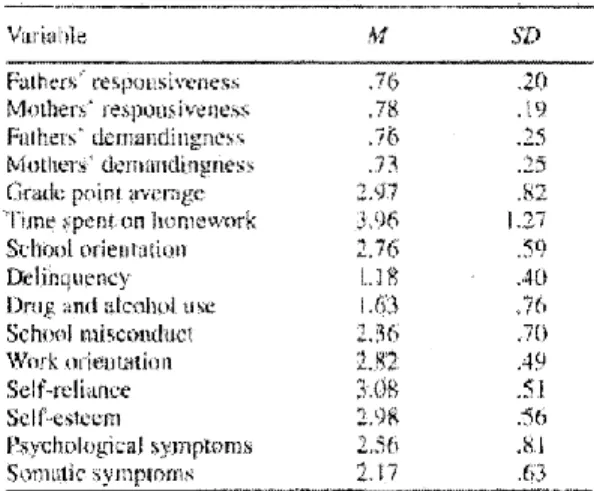
Means and standard deviations of all Year 1 variables are presented in Table 1. There were no significant differences in the variables for levels of adolescent adjustment for Year 1 or Year 2. Alphas for all outcome variable scales were similar in magnitude across all types of parental consistency.
RESULTS
Correlations Among Variables
Table 2 presents correlations between each outcome variable (Year 1 and Year 2) and both mothers' and fathers' responsiveness and demandingness. Patterns and magnitude of correlations indicate that mothers' and fathers' responsiveness and demandingness were similarly associated with outcomes during Year I and Year 2. Respon-siveness and demandingness were similarly associated with outcomes for mothers and fathers. High levels of responsiveness among mothers and fathers were associated with higher levels of academic competence and psychosocial development and lower levels of deviance and psychological (although not somatic) symptoms of distress. Demandingness was significantly associated with far fewer outcomes and was less consistent in terms of mothers' and fathers' associations and Year I and Year 2 associations. There was some suggestion that high levels of demandingness were associated with lower levels of substance use and school misconduct, higher academic grades and more time spent on homework. High levels of mothers' and fathers' demandingness were associated with lower self-reliance and self-esteem and more psychological symptoms of distress.
Effects of Authoritative Parents in the Home
To consider whether the presence of two authoritative parents benefited adolescents more than the presence of one authoritative parent. we conducted MANOVAs (used to control correlations among outcome variables in each domain) comparing mean levels of Year l adjustment variables for adolescents who had two authoritative parents (consistent authoritative) with those for adolescents who had one authoritative and one non-authoritative parent (authoritative-authoritarian. authoritative-indulgent, authoritative-indifferent). Given that mothers often
take greater responsibility for the day-to-day supervision of offspring (Lamb. 1987), we suspected that the meaning of parental inconsistency might vary, depending on whether the authoritative parent was a mother or a father. Therefore, in preliminary, MANOVAs, we compared adjustment levels for three groups of adolescents: those with two authoritative parents, those with an authoritative mother and a nonauthoritative father. and those with an authoritative father and a nonauthoritative mother, We detected no differences in the well-being of adolescents parented by an authoritative mother and adolescents parented by an authoritative father. Similar efforts aimed at understanding whether findings might differ according to the sex of the adolescent or the interaction of sex of adolescent and sex of parent indicated no meaningful differences. Accordingly, we collapsed across categories and in the analyses reported here compared levels of adjustment for adolescents parented by two authoritative parents with those parented by one authoritative and one nonauthoritative parent. Because only two groups were compared. this test was equivalent to a t test controlling for associations among variables.
Multivariate tests indicated no significant differences between adolescents from homes with two authoritative parents and adolescents with only one authoritative parent in terms of academic competence, involvement in deviant behavior, or psychosocial competence (Table 3), The multivariate test for the internalized distress domain indicated an overall effect of the presence of' one authoritative parent versus two authoritative parents. F(2.303) = 14.69, p < .01. Univariate tests indicated that adolescents from homes with two authoritative parents reported significantly fewer psychological symptoms of distress. F(2.304) = 29.19, p < .01, and somatic
symptoms of distress, F(2,304)=7.85, p<.01.
We then performed ANOVAs contrasting levels of psychological and somatic symptoms of distress during Year 2 for adolescents whose Year 1 parenting consisted of two authoritative parents and adolescents whose Year I parenting consisted of one authoritative and one nonauthoritative parent, controlling for Year I levels of psychological and somatic distress, respectively. Results indicated no significant longitudinal effects of having one authoritative parent or two authoritative parents.
Adolescent Competence in Consistent and Inconsistent Homes
We conducted a second set of MANOVAs (one for each domain of outcomes) comparing mean levels of adjustment variables for adolescents with consistent, nonauthoritative parenting (consistent authoritarian. consistent indulgent, consistent indifferent) and for adolescents whose parents were inconsistent in parenting style, but one parent exhibited authoritative parenting (authoritative-authoritarian, authoritative-indulgent, authoritative-indifferent). Once again, we looked separately at families in which the authoritative parent was a mother and families in which the authoritative parent was a father, For only one outcome (psychological
symptoms of distress) did we find group differences favoring the well-being of adolescents with an authoritative mother, rather than an authoritative father, Accordingly, we again combined participants to compare mean levels of outcome variables for two groups: teens with consistent, nonauthoritative parents and teens with one authoritative and one nonauthoritative parent. Differences emerged in two domains: academic competence and internalized distress (Table 4).
The multivariate test for academic competence was significant, F(3,498) = 3.50, p < .05, indicating an overall effect of parental consistency. Univariate tests indicated that adolescents who had one authoritative parent and one nonauthoritative parent scored significantly higher on all measures of academic competence than did their peers with consistent nonauthoritative parents. Youth with one authoritative parent received higher grades, F(1,500) = 7.24, p < .01, spent more time on homework, F(1.500) 5,65, p < .05, and were more oriented toward school, F(1,500) = 3.97, p < .05, than were their peers from consistent homes in which neither parent was authoritative.
The multivariate test for internalized distress was also significant, F(2,667) = 7.01, p < .01, Adolescents with one authoritative parent experienced more psychological .symptoms of distress than youth from consistently nonauthoritative homes, F(1,668) = 13.58, p < .01.
We followed these comparisons with ANOVAs comparing levels of Year 2 academic competence (academic grades, time spent on homework, and school orientation) and internalized distress (psychological and somatic symptoms) for adolescents whose Year 1 homes were characterized by consistent, nonauthoritative parenting and for adolescents whose Year 1 homes had one authoritative and one nonauthoritative parent. We controlled for Year 1 levels of the outcome variable for each ANOVA. Results indicated longitudinal effects for only one outcome, academic grades. In this case, adolescents who, during Year 1, experienced inconsistent parenting but had one authoritative parent received significantly higher grades, F(1,361) = 4.27, p < .05, one year later than did their peers with consistent, nonauthoritative parents.
Adolescent Competence in Different Types of Inconsistent Homes
To determine whether specific types of parental inconsistency were more strongly associated with the well-being of adolescents,, we performed MANOVAs and follow-up Tukey comparisons of mean scores on outcomes for the six types of inconsistent parenting (authoritative-authoritarian. authoritative-indulgent,
authoritative-rejecting, authoritarian-indulgent, authoritarian-rejecting, indulgent-indifferent). Multivariate tests were significant in the domains of academic competence, F(15.633) = 2.15, p < .01, and psychosocial de-velopment, F(15,630) = 2.80, p < .01. Univariate tests indicated differences across groups for grade
point average, F(5,211) = 4.06, p < .01, time spent on homework. F(5,2 II) = 2.27. p < .05, school orientation, F(5,211) = 3.40, p < .01. work orientation, F(5,210) = 2.29, p < .05, self-reliance. F(5,210) = 4.24, p < .01, and self-esteem. F(5,210) = 6.02, p < .01, Follow-up Tukey comparisons of means are presented in Table 5.
Tukey tests comparing the grade point averages of youth from the six types of inconsistent homes indicate that the highest grades are reported by adolescents from authoritative-indulgent homes. These grades are
significantly higher than grades reported by youth from authoritarian-indulgent and authoritarian-indifferent homes. In addition, adolescents from authoritative-authoritarian homes report higher grades than their counterparts from authoritarian-indifferent homes. Youth from authoritative-indulgent homes also spend the most time on homework. This difference is significantly greater than the amount of time spent by adolescents with authoritarian-indifferent parents. Similarly. youth from authoritative-indulgent homes are the most oriented toward school, and this level is significantly higher than the level observed among adolescents from
authoritarian-indifferent homes. The overall pattern for academic competence indicates that adolescents'
perceptions of parental inconsistency are most detrimental to adolescents when an authoritarian parent is paired with an indifferent parent and least detrimental when an authoritative parent is paired with an indulgent parent. Tukey comparisons were unable to detect differences in work-orientation means indicated by the multivariate test. Comparisons of self-reliance means indicate that youth from authoritative-indulgent families are
significantly more self-reliant than their counterparts from authoritative-authoritarian or authoritarian-indifferent homes, Youth from authoritative-authoritarian homes score the lowest on self-esteem, and this difference is significant when comparisons are made with self-esteem of adolescents from authoritative-indulgent, authoritative-indifferent, and indulgent-indifferent families. The least harmful type of inconsistency for adolescents to experience appears to be the combination of one authoritative and one indulgent parent.
We followed these analyses with longitudinal ANOVAs contrasting mean levels of Time 2 academic grades, time spent on homework, school orientation, self-reliance, and self-esteem for adolescents from different types of inconsistent homes, We controlled statistically for levels of adjustment variables during Year 1. Results indicated a significant effect of group. F(5.151) = 2.75, p < ,05, for the ANOVA examining, academic grades. Follow-up Tukey comparisons revealed that adolescents from authoritative-permissive homes received
significantly higher academic grades (M = 3,34) than did their counterparts from authoritarian-permissive (M = 2.50) or authoritarian-indifferent (M = 2.75) homes.
Discussion
The socialization literature strongly supports the proposition that authoritative parenting is beneficial to adolescents. However, research supporting this conclusion often assumes that mothers and fathers exhibit identical parenting styles. The information presented in this study indicates that a substantial minority of two-parent homes (on the order of 25%) consist of two two-parents who exhibit different two-parenting styles.
Our research indicates that there are few meaningful differences between the psychosocial adjustment of adolescents who report having one authoritative parent and the psychosocial adjustment of adolescents who report having two authoritative parents. Cross-sectionally, adolescents with one authoritative and one
nonauthoritative parent were observed to experience more psychological and somatic symptoms of distress than their counterparts from homes with two authoritative parents. However, this effect did not hold longitudinally once controls were added for Year I adjustment scores. Cross-sectionally, having one authoritative and one nonauthoritative parent, as opposed to two consistent but nonauthoritative parents. was associated with greater academic competence (higher grades, more time spent on homework, greater value placed on school) but more psychological symptoms of distress. Adding controls for Year I academic grades, the presence of one
authoritative parent was also longitudinally predictive of higher academic grades in Year 2. Finally, analyses revealed that not all types of parental inconsistency are equivalent in relation to adolescent well-being. Cross-sectional and longitudinal analyses indicated that in terms of several outcomes (particularly academic grades) the combination of an authoritative and an indulgent parent was most beneficial to adolescents.
A crucial question addressed in this research was whether adolescents benefited more from inconsistent parenting in which one parent was authoritative or from consistent parenting in which neither parent was authoritative. Interest in this question was driven by the tendency of parenting advice hooks (e.g.. Steinberg & Levine, 1990: Wagonseller & McDowell, 1979), developmental textbooks (e.g., Rice, 1996; Steinberg, 1999), and clinician references (Chamberlain & Patterson, 1995) to emphasize the importance of parents exhibiting both intraparental and interparental consistency with their children, In fact, the benefits of having one authoritative parent appear to exceed the potential risks of exposure to interparental inconsistency.
Adolescents who have just one authoritative parent receive higher grades, spend more time on homework, and are more strongly oriented toward school than are their peers who have consistent nonauthoritative parents. Longitudinal analyses indicate that not only is exposure to authoritative parenting associated with academic competence, it is actually predictive of higher academic grades. Using Cohen's d as a measure of effect size, the cross-sectional effect of interparental consistency versus consistent nonauthoritative parenting on academic grades is d = .42, a small to moderate effect (Rosenthal & Rosnow, 199 I ).
Perceiving parents as consistent appears to be less important for adolescents than exposure to at least one parent who is high in both demandingness and responsiveness. Such a parent, even acting alone, can effectively guide, monitor, and encourage youth and nurture both feelings of internal control and effectiveness and the ability to succeed academically. Past research (Steinberg, Elmen. & Mounts, 1989) has indicated that parental
responsiveness and demandingness make independent contributions to the academic wellbeing of adolescents. Only in authoritative parenting are high levels of both dimensions observed together. The strengths of having one authoritative parent appear to be so powerful that they cum pen- sate for the shortcomings of a
nonauthoritative partner.
Cross-sectional analyses suggested that parental inconsistency is associated with higher levels of internalized distress among adolescents. Two possible explanations might explain such associations. First, it may be that the beneficial effects of authoritativeness accumulate. Having two parents who exhibit the optimal combination of high levels of parental responsiveness and demandingness may buffer against adolescent depression and anxiety. Alternatively, adolescents may be adversely affected by exposure to conflict between parents who disagree about parenting issues (and may disagree about other issues also), or adolescents may feel pulled in opposite directions by parents who approach childrearing from different vantage points. Observed associations between interparental inconsistency and adolescent psychological distress are consistent with previous findings
(Buchanan et al.. 1996). However, longitudinal analyses indicated that although parental inconsistency is
associated with higher levels of internalized distress among adolescents, it is not predictive of such distress. The observed cross-sectional associations between parental inconsistency and internalized distress may he spurious. In general. perceiving parents as consistent does not appear to be particularly beneficial to adolescents. Indeed, inconsistent parenting can encourage academic competence in youth. as long as the inconsistency encompasses one authoritative parent. Similar findings emerge from our comparisons of the adjustment of adolescents from various types of inconsistent homes. The most positive outcomes are observed among youth from a subset of inconsistent homes in which one parent exhibits authoritative parenting.
In the domains of psychosocial development (cross-sectionally) and academic competence (cross-sectionally and longitudinally), the most well-adjusted adolescents from inconsistent homes have one authoritative parent and one indulgent parent. However, it is not merely the presence of one authoritative parent that is beneficial to adolescents. Were this the case, we would, expect to observe similarly positive outcomes for youth with one authoritative parent and one authoritarian parent. Instead, it appears that adolescents gain the most advantage by the presence of two parents who are both high in responsiveness. Such parents presumably foster feelings of competence and security in adolescents, and these youth report feeling better about themselves and are more confident about their abilities and decision-making skills. Not surprisingly, such attitudes translate into greater academic (and perhaps psycho-social) competence.
There are no significant differences across different pairings of types of parental inconsistency for either psychological or somatic symptoms of internalized distress. We already observed that, in general, perceptions of parental consistency are associated with, although not predictive of. a greater likelihood that youth will concurrently report feelings of anxiety or depression. It appears that such an association is not dependent on the particular type of parental inconsistency that is perceived. Nonsignificant findings in this area should be
interpreted with caution, however. Given the small size of several of the groups of inconsistent parents in this project. we doubtless lacked the statistical power to detect some potential hut smaller effects.
The findings reported here are not without their limitations. First, we obtained reports of parenting style and outcome variables from adolescents. themselves, This is a necessary consequence of our decision to obtain data from such a large and diverse group of adolescents. There is an extensive literature documenting that
adolescents can accurately and reliably report their parents' practices (see Golden, 1969; Moscowitz & Schwarz. 1982) and their own adjustment (e.g., Dornbusch et al„ 1987: Greenberger & Bond. 1976: McCord. 1990). Two additional observations add confidence to our belief that the findings are not due merely to common-source variance (i.e.. to the fact that adolescents reported on both parenting and adjustment). First, because longitudinal analyses control or Time I scores on the dependent variable of interest, in essence they control for any common-source variance that links adolescents' reports of outcome variables with adolescents' reports of parenting. Presumably. such common-source variance would be partialled out in the analyses. Second. it is difficult to account for the particular pattern of findings in this study on the basis of common-source variance alone. If well-adjusted adolescents were biased toward providing positive characterizations of their parents, adolescents who reported having two authoritative parents likely would have described themselves as better adjusted than adolescents who reported having just one authoritative parent, hut this was not the case. Similarly, it' better-adjusted adolescents simply were biased toward describing their parents as consistent, adolescents reporting consistent parenting would have described themselves us better adjusted than their peers. regardless of the type of consistency reported, and they did not. We do recognize. nevertheless, that future investigations of the effects of perceived inter-parental consistency on adolescent development would he strengthened by the use of data from multiple methods and sources.
We also recognize that our measure of parental demandingness was limited by its reliance on just two items. Although we would have preferred a demandingness scale with more items, the nature of this project forced us to rely on parenting questions that were answered separately for mothers and fathers. Few of these questions assessed parental structure and rule enforcement, Divergence in demandingness appears to be a more likely
source of interparental inconsistency than is divergence in responsiveness. This could he an artifact of a stable responsiveness scale or may reflect a reality of parenting—that it is easier to agree on how to support a child emotionally than on how to discipline a child. A substantial number of families in our sample did, in fact, include parents who diverged in demandingness, and we attempted to address issues concerning this diversity with analyses comparing different types of inconsistency.
Adolescents who perceive that their parents are stylistically inconsistent do not appear to experience impaired adjustment. We do not know if similar findings would be obtained with a younger sample. Adolescents may be less overwhelmed by perceptions of inconsistency because they possess the cognitive capabilities to understand that different people have different beliefs and that their parents will not always agree. Younger children may lack such understanding and thus may experience inure negative effects of interparental inconsistency in parenting styles.
Overall, the findings reported here buttress a large and growing literature indicating that authoritative parenting is the most beneficial way of parenting adolescents. The optimal home environment to facilitate the
development of adolescent competence consists of two authoritative parents who are active participants in their children's lives. However, in the minority of homes where interparental consistency is missing, adolescents benefit from the presence of even one parent who is high in both responsiveness and demandingness, Accordingly, it would be a mistake for developmental experts to advocate interparental consistency over inconsistent authoritative parenting without careful consideration of the specific types of benefits associated with each. Authoritative parents married to nonauthoritative spouses should he urged to consider the special advantages that their style of parenting confers on youth, rather than advised to change their own parenting styles for the sake of consistency.
REFERENCES
Baumrind, D, 11991), Parenting styles and adolescent development. .In J. Brooks-Gunn, R. Lerner. & A. C. Peterson (Eds.), encyclopedia of adolescence. New York: Garland.
Buchanan, C., Maccoby, E, & Dornbusch, S. (1996). Adolescents after divorce, Cambridge, MA: Harvard University Press.
Buss, D. M. ( 1984). Toward a psychology of person-environment (PE) correlation: The role of spouse se-lection. Journal of Personality and Social Psychology, 47, 361-377.
Chamberlain. P., & Patterson. G. R. (1995). Discipline and child compliance in parenting. In NI. H. Bornstein (Ed.), Handbook of parenting: Vol. 4, Applied and practical parenting, Mahwah, NJ: Erlbaum.
Chao, R. (1994). Beyond parental control and authoritarian parenting style: Understanding Chinese parenting through the cultural notion of training. Child Development. 65, 1111-1119.
Darling. N.. & Steinberg, L. (1993). Parenting style as context: An integrative model. Psychological Bulletin. 113, 487-496.
Deal. J. E., Halverson, C. F., & Wampler, K. S. (1989). Parental agreement on childrearing orientations: Rela-tions to parental. marital, family, and child characteristics. Child Development, 60, 1025-1034.
Donovan. J., & Jessor, R. (1985): Structure of problem behavior in adolescence and young adulthood. Journal of Consulting and Clinical Psychology, 53, 890-904.
Dornbusch, S., Ritter. P., Liederman, P., Roberts, D.. & Fraleigh, M. (1987). The relation of parenting style to adolescent school performance. Child Development, 58, 1244-1257.
Gardner, F. E. (1989). Inconsistent parenting: Is there evidence for a link with 'children's conduct problems? Journal of Abnormal Child Psychology, 17, 223-233.
Gold, M. (1970). Delinquent behavior in an American city. Belmont, CA: Brooks/Cole.
Golden, P. (1969), A review of children's reports of parental behaviors, Psychological Bulletin, 71, 222-235. Greenberger. E., & Bond, L. (1976). Technical manual fur the Psychosocial Maturity Inventory. Unpublished manuscript. University of California, Irvine, Program in Social Ecology.
Greenberger. E., Josselson, R., Knerr, C.. & Knerr, B. (1974), The measurement and structure of psycho-social maturity. Journal of Youth and Adolescence, 4, 127-143.
Greenberger, E., Steinberg, L., & Vaux,, A. (1981). Adolescents who work: Health and behavioral conse-quences of job stress. Developmental Psychology, 17, 691-703.
Johnson, B., Shulman, S., & Collins, W. (1991). Systemic patterns of parenting as reported by adolescents: Developmental differences and implications for psychosocial outcomes. Journal of Adolescent Research. 6, 235-252.
Lamb, M. E,. Hwang. C.-P., & Broberg, A, (1989). Associations between parental agreement regarding child-rearing and the characteristics of families and children in Sweden. International Journal of Behavioral Development, 12, 115-129.
Lamb, M. E. (1987). The father's role: Cross-cultural perspectives, Hillsdale. NJ: Erlbaum.
Lamborn, 5,. Mounts, N., Steinberg, L., & Dornbusch, S. (1991), Patterns of competence and adjustment among adolescents from authoritative, authoritarian, indulgent, and neglectful homes. Child Development, 62, 1049-1065.
Maccoby. E., & Martin. J. (1983). Socialization in the context of the family: Parent-child interaction. In E. M. Hetherington (Ed.), Handbook of child psychology; Vol. 4. Socialization, personality, and social development (pp. I -101). New York: Wiley.
McCord. J.1,1990). Problem behaviors. In S. Feldman & G. Elliott (Eds.), At the threshold: The developing adolescent (pp. 414-43(1), Cambridge, MA: Harvard University Press..
Moscowitz. D., & Schwarz, J. (1982). A validity comparison of behavior counts and ratings by knowledgeable informants, fount& of Personality and Social Psychology, 42,5 18-528.
Radial, L. (1977). The CES-D Scale: A self-report depression scale for research in the general population, Applied Psychological Measurement. 1, 365-401.
Rice, F. P. (1996). The adolescent: Development. relationships, and culture (8th ed.). Boston: Allyn & Bacon. Rodgers, R. R. (1966). Cornell parent behavior description: An interim report. Unpublished manuscript, Department of Human Development and Family Studies, Cornell University, Ithaca, NY.
Rosenberg, M. (1965). Society and the adolescent .self-image. Princeton, NJ: Princeton University Press. Rosenthal, R., & Rosnow, R. L. (199 I ). Essentials of behavioral research: Methods and data analysis. New York: McGraw-Hill.
Ruggiero, M. (1984). Work as on impetus to delinquency: An examination of theoretical and empirical connections. Unpublished doctoral dissertation. University of California, Irvine.
Schaefer, E. (1965). Children's reports of parental behavior: An inventory. Child Development, 36, 413-424. Steinberg, L. (1999). Adolescence. New York: McGraw-Hill.
Steinberg, L,. Elmen, 1., & Mounts, N. (1989). Authoritative parenting, psychosocial maturity, and academic success among adolescents. Child Development, 60. 1424-1436,
Steinberg, L„ Lamborn. S., Darling, N.. Mounts., N.. & Dornbusch, S. (1994). Over-time changes in adjustment and competence among adolescents from authoritative, authoritarian, indulgent, and neglectful families. Child Development., 65, 754-770.
Steinberg, L., Lamborn, S.. Dornbusch, S., & Darling, N. (1992). Impact of parenting practices on adolescent achievement: Authoritative parenting, school involvement, and encouragement to succeed. Child Development, 63, 1266- I 281.
Steinberg, L.. & Levine, A. (1990). You and your adolescent: A parent's guide for ages 10-20, New York: Harper.
Steinberg. L., Mounts, N,. Lamborn. S.. & Dornbusch. S. (1991). Authoritative parenting and adolescent adjust-ment across varied ecological niches. Journal Research on Adolescence. 1, 19-36.
Vaughn, B. E., Block. J. H., & B lock. J. (1988), Parental agreement on childrearing during early childhood and the psychological characteristics of adolescents. Child Development, 59, 1020-1033,
Wagonseller, B. R., & McDowell. R. L. (1979). You and your child: A common sense approach to successful parenting, Champaign, IL: Research Press,
Wehlage, G., Rutter. R., Smith. G.. Lesko, N., & Fernandez, R. (1989). Reducing the risk: Schools as communities of support. London: Palmer Press.