A JOINT ENDEAVOR OF RAND HEALTH AND THE RAND NATIONAL DEFENSE RESEARCH INSTITUTE
Center for Military Health Policy Research
For More Information
Visit RAND at www.rand.org
Explore the RAND Center for Military Health Policy Research View document details
Support RAND
Purchase this document Browse Reports & Bookstore Make a charitable contribution
Limited Electronic Distribution Rights
This document and trademark(s) contained herein are protected by law as indicated in a notice appearing later in this work. This electronic representation of RAND intellectual property is provided for non-commercial use only. Unauthorized posting of RAND electronic documents to a non-RAND website is prohibited. RAND electronic documents are protected under copyright law. Permission is required from RAND to reproduce, or reuse in another form, any of our research documents for commercial use. For
information on reprint and linking permissions, please see RAND Permissions.
Skip all front matter: Jump to Page 1
6
The RAND Corporation is a nonprofit institution that helps improve policy and decisionmaking through research and analysis.
This electronic document was made available from www.rand.org as a public service of the RAND Corporation.
CHILDREN AND FAMILIES EDUCATION AND THE ARTS ENERGY AND ENVIRONMENT
HEALTH AND HEALTH CARE INFRASTRUCTURE AND
TRANSPORTATION INTERNATIONAL AFFAIRS
LAW AND BUSINESS NATIONAL SECURITY POPULATION AND AGING PUBLIC SAFETY SCIENCE AND TECHNOLOGY TERRORISM AND HOMELAND SECURITY
This product is part of the RAND Corporation technical report series. Reports may include research findings on a specific topic that is limited in scope; present discussions of the methodology employed in research; provide literature reviews, survey instru-ments, modeling exercises, guidelines for practitioners and research professionals, and supporting documentation; or deliver preliminary findings. All RAND reports un-dergo rigorous peer review to ensure that they meet high standards for research quality and objectivity.
A JOINT ENDEAVOR OF RAND HEALTH AND THE RAND NATIONAL DEFENSE RESEARCH INSTITUTE
Center for Military Health Policy Research
Programs Addressing
Psychological Health and
Traumatic Brain Injury
Among U.S. Military
Servicemembers and
Their Families
Robin M. Weinick, Ellen Burke Beckjord,
Carrie M. Farmer, Laurie T. Martin, Emily M. Gillen, Joie D. Acosta, Michael P. Fisher, Jeffrey Garnett, Gabriella C. Gonzalez, Todd C. Helmus,
Lisa H. Jaycox, Kerry A. Reynolds, Nicholas Salcedo, Deborah M. Scharf
Prepared for the Office of the Secretary of Defense Approved for public release; distribution unlimited
The RAND Corporation is a nonprofit institution that helps improve policy and decisionmaking through research and analysis. RAND’s publications do not necessarily reflect the opinions of its research clients and sponsors.
R
®
is a registered trademark.© Copyright 2011 RAND Corporation
Permission is given to duplicate this document for personal use only, as long as it is unaltered and complete. Copies may not be duplicated for commercial purposes. Unauthorized posting of RAND documents to a non-RAND website is prohibited. RAND documents are protected under copyright law. For information on reprint and linking permissions, please visit the RAND permissions page (http://www.rand.org/publications/ permissions.html).
Published 2011 by the RAND Corporation
1776 Main Street, P.O. Box 2138, Santa Monica, CA 90407-2138 1200 South Hayes Street, Arlington, VA 22202-5050 4570 Fifth Avenue, Suite 600, Pittsburgh, PA 15213-2665
RAND URL: http://www.rand.org
To order RAND documents or to obtain additional information, contact Distribution Services: Telephone: (310) 451-7002;
Fax: (310) 451-6915; Email: [email protected]
Library of Congress Cataloging-in-Publication Data is available for this publication. ISBN: 978-0-8330-5236-0
The research described in this report was prepared for the Office of the Secretary of Defense (OSD). The research was conducted jointly by the Center for Military Health Policy Research, a RAND Health program, and the Forces and Resources Policy Center, a RAND National Defense Research Institute (NDRI) program. NDRI is a federally funded research and development center sponsored by OSD, the Joint Staff, the Unified Combatant Commands, the Navy, the Marine Corps, the defense agencies, and the defense Intelligence Community under Contract W74V8H-06-C-0002.
iii
Preface
Over the last decade, U.S. military forces have been engaged in extended conflicts that are characterized by increased operational tempo, most notably in Iraq and Afghanistan. While most military personnel cope well across the deployment cycle, many will experience difficul-ties handling stress at some point, will face psychological health challenges, or will be affected by a traumatic brain injury (TBI). Over the past several years, the Department of Defense (DoD) has implemented numerous programs to support servicemembers and their families in these areas. These programs address various components of biological, psychological, social, spiritual, and holistic influences on psychological health along the resilience, prevention, and treatment continuum and focus on a variety of clinical and nonclinical concerns. In response to this proliferation of programs, the Assistant Secretary of Defense for Health Affairs asked the RAND National Defense Research Institute to develop a comprehensive catalog of exist-ing programs currently sponsored or funded by DoD to address psychological health and TBI.
This report addresses this objective, providing a definition of what constitutes a program, an overview of these programs, and a description of how programs relate to other available resources and care settings. The contents of this report will be of particular interest to national policymakers within DoD and should also be helpful for health policy officials within the U.S. Department of Veterans Affairs (VA). The remaining activities will be documented in reports to be released at later dates.
This research was sponsored by the Assistant Secretary of Defense for Health Affairs and the Defense Centers of Excellence for Psychological Health and Traumatic Brain Injury (DCoE) and conducted jointly by RAND Health’s Center for Military Health Policy Research and the Forces and Resources Policy Center of the RAND National Defense Research Insti-tute (NDRI). The Center for Military Health Policy Research taps RAND expertise in both defense and health policy to conduct research for the Department of Defense, the Department of Veterans Affairs, and nonprofit organizations. NDRI is a federally funded research and development center sponsored by the Office of the Secretary of Defense, the Joint Staff, the Unified Combatant Commands, the Navy, the Marine Corps, the defense agencies, and the defense Intelligence Community.
For more information on the Center for Military Health Policy Research, see http://www. rand.org/multi/military.html or contact the co-directors (contact information is provided on the web page). For more information on the Forces and Resources Policy Center, see http:// www.rand.org/nsrd/ndri/centers/frp.html or contact the director (contact information is pro-vided on the web page).
v
Contents
Preface . . . . iii Figures . . . . ix Tables . . . . xi Summary . . . .xiii Acknowledgments . . . . xxv Abbreviations . . . .xxvii ChAPTer One Introduction . . . . 1Psychological Health in the Military . . . .1
The Recent Policy Context . . . .2
Department of Defense Task Force on Mental Health . . . .3
Department of Defense Independent Review Group . . . .3
The President’s Task Force on Returning Global War on Terror Heroes . . . .3
The President’s Commission on Care for America’s Returning Wounded Warriors . . . 4
Congress Passes the Wounded Warrior Act . . . 4
Mental Health Advisory Teams . . . .4
Department of Defense Task Force on the Prevention of Suicide by Members of the Armed Forces . . . .5
Department of Defense Response to Prior Recommendations . . . .6
Directors of Psychological Health . . . 6
Wounded Warrior Programs . . . .6
Wounded, Ill, and Injured Senior Oversight Committee . . . .6
Line of Action–2 . . . .7
Defense Centers of Excellence for Psychological Health and Traumatic Brain Injury . . . .7
Study Rationale and Objectives . . . .8
ChAPTer TwO Conceptualizing Psychological health and Traumatic Brain Injury . . . .11
Defining Readiness: The Historical Perspective . . . .11
Rethinking Readiness: Operational Stress and Resilience Continuums . . . .11
Navy and Marine Corps Combat and Operational Stress Continuum . . . .12
DCoE’s Resilience Continuum . . . .13
Total Force Fitness . . . .14
vi Programs Addressing Psychological Health and Traumatic Brain Injury Among U.S. Military Servicemembers
Model from the Department of Defense 2007 Mental Health Task Force Report . . . .15
Combat and Well-Being Model . . . .16
Conceptualizing Functioning and Reintegration . . . .16
International Classification of Functioning, Disability, and Health . . . .17
Summary . . . .17
ChAPTer Three what Is a Program? . . . .19
Conceptual Framework . . . .19
Inclusion and Exclusion Criteria . . . .21
Excluded Services and Activities . . . .21
Existing Clinical Delivery Systems . . . .21
Family and Community Services . . . 24
Resources . . . 26
ChAPTer FOur Methods . . . .29
Identifying Programs . . . .29
Web and Other Media Searching . . . 30
Scanning Conference Agendas and Program Materials . . . 30
Reviewing Public Domain Documents . . . 30
Consultation with Military Personnel . . . 30
Obtaining Department of Defense Lists of Programs . . . 30
Consultation with Staff at Nonprofit Organizations . . . .31
Consulting Topic-Area Experts Within RAND . . . .31
Snowball Sampling . . . .31
How We Counted Programs . . . .31
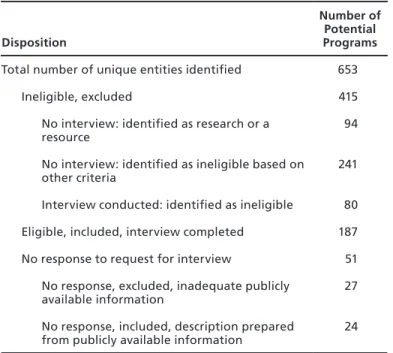
Data Collection. . . .31 Response Rate . . . .32 Program Interviews . . . .33 Analysis . . . .33 ChAPTer FIve results . . . .37 Identifying Programs . . . .37
A Typology of Program Activities . . . 38
Program Characteristics . . . 38
Branch of Service . . . 38
Targeted Participants . . . 44
Deployment Phase . . . 46
Program Development and Implementation . . . 48
Operational Stress Control and Readiness . . . .49
Fort Hood Resilience and Restoration Center’s Warrior Combat Stress Reset Program . . . .51
Traumatic Brain Injury: The Journey Home . . . .53
Families OverComing Under Stress . . . 54
Contents vii
Summary . . . .57
How Programs Address Recommendations from Earlier Reports . . . .58
Integrating Mental Health Care into Primary Care Settings . . . .58
Building the Capacity of Leadership to Address Psychological Health Issues . . . .59
Combat Stigma Associated with Mental Health Problems . . . .59
Increasing Access to Mental Health Care by Expanding Services . . . .59
Increasing the Use of Evidence-Based Practices . . . 60
Improving Support for Family Members . . . 60
Barriers to Maximizing the Effectiveness of Programs . . . 60
Information Is Highly Decentralized . . . 60
Programs Are Developed in Isolation from the Existing Care System . . . .61
Programs Face Common Barriers . . . .61
Evaluation Is a Challenge . . . .61
Limitations of Our Findings . . . .62
ChAPTer SIx recommendations and Conclusions . . . .63
Take Advantage of Programs’ Unique Capacity for Supporting Prevention, Resilience, Early Identification of Symptoms, and Help-Seeking to Meet the Psychological Health and TBI Needs of Servicemembers and Their Families . . . .63
Recommendation 1.1: Develop Programs’ Capacity for Early Identification, Promotion of Help-Seeking, and Referrals to Appropriate Resources for Members of the Military Community with Mental Health Concerns. . . .63
Recommendation 1.2: Programs Bring Particular Strength in Focusing on Prevention and Resilience; This Capacity Should Be Further Developed . . . 64
Recommendation 1.3: Programs Should Serve as Testbeds for Piloting New and Innovative Approaches to Psychological Health and TBI Care . . . 64
Establish Clear and Strategic Relationships Between Programs and Existing Mental Health and Traumatic Brain Injury Care Delivery Systems . . . .65
Recommendation 2.1: Programs Should Complement or Supplement Existing Services . . . 66
Recommendation 2.2: Ensure That Systems Exist to Support Appropriate Handoffs Between Programs and Other Settings and That Transitions in Care Are Appropriately Coordinated . . . 66
Recommendation 2.3: Track Referrals From Programs to Existing Clinical Care Systems on a Continual Basis, Including the Volume of Referrals and Rates of Follow-Up on Referrals Received . . . 66
Examine Existing Gaps in Routine Service Delivery That Could Be Filled by Programs . . . .67
Recommendation 3.1: Conduct a Comprehensive Needs Assessment Designed to Identify How Many Members of the Military Community Are in Need of Services, What Their Characteristics Are, What Types of Assistance They Need, and Where They Are Located . . . .67
Recommendation 3.2: Following the Needs Assessment, Conduct a Formal Gap Analysis to Identify How Well Programs Are Meeting the Identified Needs, Opportunities That Exist to Improve Current Programs, and Where Need Exists to Develop New Programs . . . .67
Recommendation 3.3: Adopt a Single, Integrated Conceptual Framework for Psychological Health Across DoD . . . 68
viii Programs Addressing Psychological Health and Traumatic Brain Injury Among U.S. Military Servicemembers
Reduce Barriers Faced by Programs . . . 68
Recommendation 4.1: Continue Widespread Efforts to Reduce Stigma and Institutional Barriers Associated with Seeking Treatment for Mental Health Problems and TBI . . . .69
Recommendation 4.2: Improve Continuity of Services over the Course of the Deployment Cycle and During Transitions Associated with Permanent Change of Station . . . .69
Recommendation 4.3: Improve the Sharing of Information Across Programs . . . .69
Evaluate and Track New and Existing Programs, and Use Evidence-Based Interventions to Support Program Efforts . . . .69
Recommendation 5.1: The Evidence Base Regarding Program Effectiveness Needs to Be Developed . . . .70
Recommendation 5.2: The Evidence Base Regarding Program Effectiveness Needs to Be Centralized and Made Accessible Across the Department of Defense . . . .70
Recommendation 5.3: Programs That Are Shown to Be Ineffective Should Be Discontinued and Should Not Be Replicated . . . .71
Recommendation 5.4: A Central Authority Should Set Overall Policies and Establish Guidelines Regarding Programs, Including Guidelines Governing the Proliferation of New Programs . . . .71
Recommendation 5.5. Both New and Existing Programs Should Be Tracked on an Ongoing Basis by a Single Entity, Preferably the Same Organization That Is Charged with Developing Guidance Regarding Program Proliferation . . . .72
Conclusions . . . .73
APPenDIxeS A. Index of Programs. . . .75
B. Program Descriptions . . . . 117
C. excluded entities . . . . 119
D. Mapping Programs to Our Typology of Program Activities . . . . 127
e. Terms and Definitions . . . . 139
ix
Figures
S.1. Ideal Characteristics of Services Provided by Programs and the Existing Delivery
System . . . .xix
2.1. Navy and Marine Corps Combat and Operational Stress Continuum . . . .12
2.2. DCoE Resilience Continuum . . . .13
2.3. Total Force Fitness . . . .14
2.4. Department of Defense Mental Health Task Force Model of Psychological Health . . . .15
2.5. Mental Health Advisory Team VI Combat and Well-Being Model . . . .16
2.6. Interactions Between Components of the ICF . . . .17
3.1. Conceptual Framework . . . 20
6.1. Ideal Characteristics of Services Provided by Programs and the Existing Delivery System . . . .65
xi
Tables
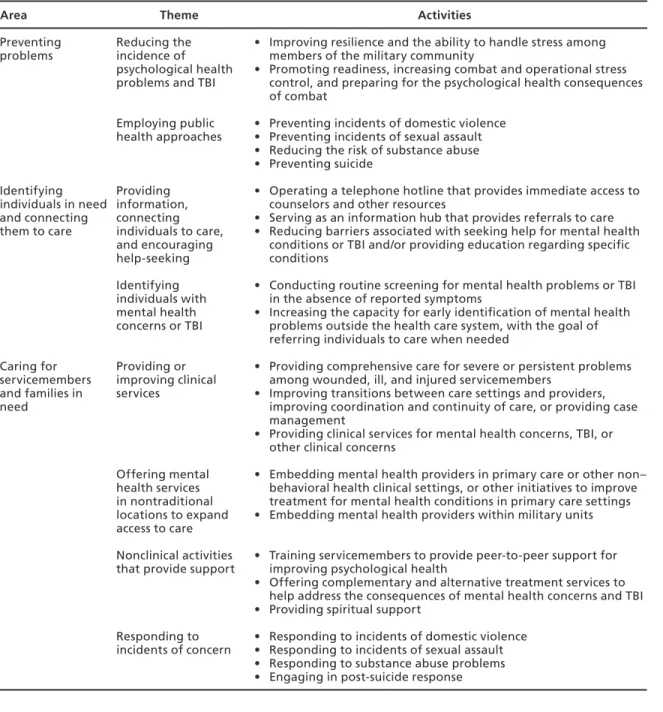
S.1. Typology of Program Activities: Prevention, Identification, and Care for
Psychological Health Problems and Traumatic Brain Injury . . . .xv
S.2. Typology of Program Activities: Specific Areas of Program Focus . . . .xvi
3.1. Inclusion and Exclusion Criteria . . . 22
4.1. Dispositions of Potential Programs Identified . . . .32
4.2. Questions Addressed in RAND Analysis Section of Program Descriptions . . . .35
5.1. Typology of Program Activities: Prevention, Identification, and Care for Psychological Health Problems and Traumatic Brain Injury . . . .39
5.2. Typology of Program Activities: Specific Areas of Program Focus . . . 40
5.3. Number of Programs by Targeted Participants, Deployment Phase, and Branch of Service . . . 40
5.4. Number of Programs by Domain, Approach, and Branch of Service . . . .41
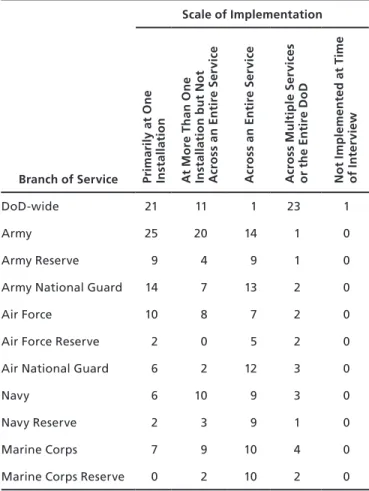
5.5. Number of Programs by Scale and Branch of Service . . . 42
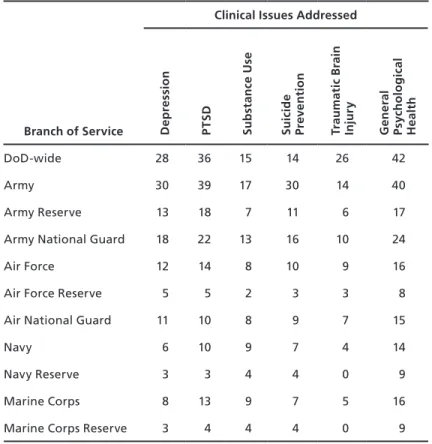
5.6. Number of Programs by Clinical Issues Addressed and Branch of Service . . . 43
5.7. Number of Programs by Nonclinical Issues Addressed and Branch of Service . . . 44
5.8. Number of Programs by Evidence Base, Evaluation, Data Collection, and Branch of Service . . . .45
5.9. Number of Programs by Domain, Approach, and Targeted Participants . . . .45
5.10. Number of Programs by Clinical Issues Addressed and Targeted Participants . . . 46
5.11. Number of Programs by Nonclinical Issues Addressed and Targeted Participants . . . 46
5.12. Number of Programs by Domain, Approach, and Deployment Phase . . . .47
5.13. Number of Programs by Clinical Issues Addressed and Deployment Phase . . . 48
5.14. Number of Programs by Nonclinical Issues Addressed and Deployment Phase . . . 48
5.15. Operational Stress Control and Readiness Program Characteristics . . . 50
5.16. Warrior Combat Stress Reset Program Characteristics . . . .52
5.17. Traumatic Brain Injury: The Journey Home Program Characteristics . . . 54
5.18. Families OverComing Under Stress Program Characteristics . . . .55
5.19. Real Warriors Campaign Program Characteristics . . . .57
A.1. Programs by Branch of Service . . . .76
A.2. Programs by Targeted Participants, Deployment Phase, Domain, and Approach . . . 86
A.3. Programs by Clinical and Nonclinical Issues Addressed . . . 98
xiii
Summary
Between 2001 and late 2010, over 2.2 million servicemembers were deployed in support of military operations in Iraq and Afghanistan. Despite the recent drawdown of troops in Iraq, the high operational tempo of the past decade, longer deployments, and frequent redeploy-ments have resulted in significant mental health problems among servicemembers. While most military personnel cope well under these difficult circumstances, many have experienced and will continue to experience difficulties related to post-traumatic stress disorder (PTSD, an anxiety disorder that can develop after direct or indirect exposure to an event or ordeal in which grave physical harm occurred or was threatened) or major depression. Others live with the short- and long-term psychological and cognitive consequences of TBI, an injury that has become increasingly common with the growing use of improvised explosive devices on the battlefield. These issues may also have consequences for military families, as struggles related to PTSD, depression, or TBI may affect marriage and intimate relationships, the well-being of spouses and partners, parenting practices, and children’s well-being.
A variety of factors—including increased news coverage regarding the psychological and cognitive consequences of deployment, recommendations resulting from the work of highly visible advisory committees, the expansion of numbers of mental health providers available in military clinical care settings, and the establishment of DCoE—have created significant moti-vation and momentum for developing programs to support servicemembers and their families. Despite the proliferation of programs and related efforts, an ongoing challenge for DoD is to identify and characterize the scope, nature, and effectiveness of these various and ever-evolving activities. Prior to this report, there has been no full accounting of what programs exist and how these programs complement “traditional” service provision and routine care.
Focus of This Study
The goal of this study is to provide a “snapshot” of all programs currently sponsored or funded by DoD that address psychological health and TBI. In this report, we characterize these pro-grams; identify barriers to implementing them fully and maximizing their effectiveness; and provide recommendations for clarifying the role of programs, examining gaps in routine ser-vice delivery that could be filled by programs, and reducing barriers that programs face.
We used a multifaceted approach to identify programs for inclusion in this study. Initially, we sought to identify as many potential programs as possible (e.g., through web and media searches; review of program materials and public domain documents; and consultations with military personnel, nonprofit organizations, and subject matter experts). Then we obtained
xiv Programs Addressing Psychological Health and Traumatic Brain Injury Among U.S. Military Servicemembers
information about the potential programs through interviews with program representatives or, when program representatives were not available, through publicly available documentation. We then applied a set of inclusion and exclusion criteria to determine which entities were pro-grams. Our efforts focus on programs that were active during our field period, which began in December 2009 and ended in August 2010. Programs identified after this report was writ-ten will be added to the Innovative Practices for Psychological Health and Traumatic Brain Injury online database on the RAND website, located at http://www.rand.org/multi/military/ innovative-practices.html, that houses information about each program.
What Is a Program?
In this study, the term program is used to describe entities that provide active services, inter-ventions, or other interactive efforts to support psychological health, as well as care for service-members (and their families) who are experiencing such problems as PTSD, anxiety, depres-sion, and TBI. Programs are distinct from clinical care services (e.g., mental health services, clinical services for physical health problems) and non–clinical care services (e.g., services pro-vided in chaplaincy or community and family support departments, including other services unrelated to psychological health and/or TBI). The programs that are discussed in this study may be provided within the same facility or organizational structure that provides these other types of services. Programs are also distinct from resources, a term that here refers to one-way, passive transmission of information (e.g., a directory that lists services available at an installation).1 Programs to address psychological health and TBI rely on a strong and growing research base to identify new treatments and best practices. While research projects are explic-itly beyond the scope of this study, some research projects include an intervention component that could be classified as a type of program.
In the study, we identified a total of 211 programs. Identifying these programs was a com-plex task, and one key finding from our work is that no single source within DoD or any of the branches of service maintains a complete listing of programs, tracks the development of new programs, or has appropriate resources in place to direct servicemembers and their families to the full array of programs that best meet their needs. Programs may be initiated in a number of different ways, including centrally by the Office of the Secretary of Defense (OSD), by a branch of service, or based on the interests of a small number of individuals at a single instal-lation, further complicating efforts to identify and track programs over time.
A Typology of Program Activities
To better understand the types of services provided by the programs, we grouped programs based on their mission, goals, and activities to develop a typology that can be used to describe
what programs do. As a result of these efforts, we identified three broad areas along the
preven-tion, identificapreven-tion, and treatment continuum (Table S.1), each of which is further categorized by two or more specific themes. Together, these encompass 23 key activities in which programs engage. In addition, we describe three more specific areas of focus (Table S.2) that are common 1 In some cases, it was difficult to identify whether an entity was best classified as a program or a resource.
Summary xv
to some of the programs included in this report, with eight common key activities.2 The cat-egories in this typology are not mutually exclusive, and many programs are described by more than one category.
2 Providing training, education, or support to servicemembers is not included here because it is the default activity for
nearly all programs in this report, except those offering similar services to care providers.
Table S.1
Typology of Program Activities: Prevention, Identification, and Care for Psychological Health Problems and Traumatic Brain Injury
Area Theme Activities
Preventing
problems Reducing the incidence of psychological health problems and TBI
• Improving resilience and the ability to handle stress among members of the military community
• Promoting readiness, increasing combat and operational stress control, and preparing for the psychological health consequences of combat
Employing public
health approaches • Preventing incidents of domestic violence• Preventing incidents of sexual assault • Reducing the risk of substance abuse • Preventing suicide Identifying individuals in need and connecting them to care Providing information, connecting individuals to care, and encouraging help-seeking
• Operating a telephone hotline that provides immediate access to counselors and other resources
• Serving as an information hub that provides referrals to care • Reducing barriers associated with seeking help for mental health
conditions or TBI and/or providing education regarding specific conditions
Identifying individuals with mental health concerns or TBI
• Conducting routine screening for mental health problems or TBI in the absence of reported symptoms
• Increasing the capacity for early identification of mental health problems outside the health care system, with the goal of referring individuals to care when needed
Caring for servicemembers and families in need Providing or improving clinical services
• Providing comprehensive care for severe or persistent problems among wounded, ill, and injured servicemembers
• Improving transitions between care settings and providers, improving coordination and continuity of care, or providing case management
• Providing clinical services for mental health concerns, TBI, or other clinical concerns Offering mental health services in nontraditional locations to expand access to care
• Embedding mental health providers in primary care or other non– behavioral health clinical settings or other initiatives to improve treatment for mental health conditions in primary care settings • Embedding mental health providers within military units
Nonclinical activities
that provide support • Training servicemembers to provide peer-to-peer support for improving psychological health • Offering complementary and alternative treatment services to help
address the consequences of mental health concerns and TBI • Providing spiritual support
Responding to
incidents of concern • Responding to incidents of domestic violence• Responding to incidents of sexual assault • Responding to substance abuse problems • Engaging in post-suicide response
xvi Programs Addressing Psychological Health and Traumatic Brain Injury Among U.S. Military Servicemembers
Program Characteristics
We also characterized the programs according to a variety of topics, including branch of ser-vice, targeted participants, approach, scale, and clinical and nonclinical issues addressed, among others.
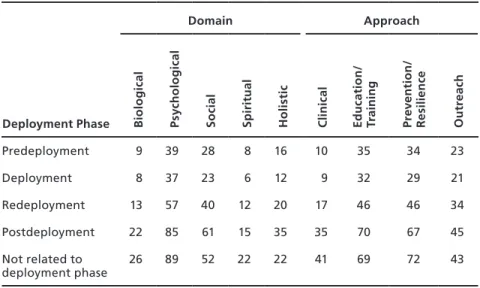
Branch of Service and Deployment Phase. Each branch of service has a unique set of needs for addressing psychological health services and TBI among its servicemembers. Varia-tion in need is related to the relative size of each service, its operaVaria-tional tempo, the types of activities in which its servicemembers engage, and other services that may be available to sup-port servicemembers and their families. Most programs, regardless of branch of service, focus their efforts on uniformed servicemembers, with some programs offering services to family members and civilian employees. Within each branch of service, more programs are typically offered for active-duty servicemembers than for those in the National Guard or Reserve com-ponents. Although some programs focus on a single deployment phase, the large majority of programs address multiple deployment phases or are not related to a deployment phase.
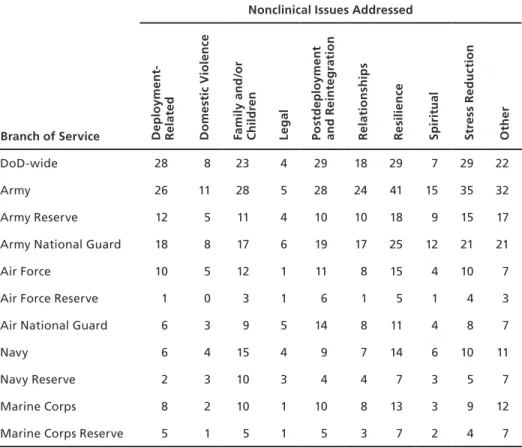
Clinical and Nonclinical Issues Addressed by the Programs. Because multiple mental health issues may occur simultaneously and because TBI is frequently associated with accom-panying mental health issues, programs typically address more than one clinical issue. In general, though, fewer programs focus on TBI than on issues associated with psychological health—including depression, PTSD, substance use, suicide prevention, and general psycho-logical health. In terms of nonclinical issues addressed, many programs focus on issues related to families and/or children, resilience, stress reduction, deployment, or postdeployment and reintegration.
Evidence Base. Based on the information reported to us during our interviews, DoD-wide and Army programs are more likely to report that their interventions are evidence based than programs serving the Air Force, Navy, and Marine Corps. We did not assess the strength of the evidence base employed, so it remains possible that these differences reflect varying per-ceptions of the individuals interviewed. It is also possible that there is differential availability of an adequate evidence base for the particular programs of interest to each of the services. Comparatively few programs—between one-tenth and one-third of programs targeting any branch of service—have had an outcome evaluation in the past 12 months. While more than
Table S.2
Typology of Program Activities: Specific Areas of Program Focus
Theme Activities
Providing training, education, or support for specific populations
• Providing training, education, or support for health care providers, chaplains, or educators
• Providing training, education, or support for military leaders, including officers and noncommissioned officers
• Providing training, education, or support for servicemembers’ families • Programs that promote psychological health for National Guard, Reserve, or
Coast Guard servicemembers Providing support during
times of military transition • Providing support for servicemembers and their families during transitions between deployment phases • Providing support for servicemembers as they transition to civilian life Internet-based interventions
and the use of new technologies
• Internet-based education or delivery of interventions • Application of new technologies
Summary xvii
three-quarters of all programs that we include in this report collect some process data (such as numbers of program participants or their satisfaction with the program), many fewer collect data on the outcomes of the services they provide.
Barriers to Maximizing the Effectiveness of Programs
Our analysis identified a number of potential barriers that must be addressed in order to maxi-mize program effectiveness.
Information Is Highly Decentralized
During our interviews, a number of program representatives noted that they did not know whether others in the DoD community had similar programs or materials they could borrow or learn from, what approaches other programs had used, and whether other programs had been successful in the past. In part as a result of this lack of sharing of knowledge, programs proliferate without utilizing a centralized evidence base or source for materials. This can lead to significant inefficiencies, such as multiple programs developing teaching points and training materials on the same topic.
Programs Are Developed in Isolation from the Existing Care System
Some programs are designed to encourage the early identification of mental health concerns and to provide appropriate referrals to clinical care where needed. However, relatively few pro-grams are established in partnership with or sustain formal relationships with existing clinical or supportive counseling services, except where such programs are embedded as an inherent part of the existing care system. This lack of linkage and partnership can leave programs with-out a consistent course of action when follow-up care is needed.
Programs Face Common Barriers
Programs also face many barriers in providing services. The most common barriers mentioned by our interviewees included inadequate funding, resources, or staff capacity; potential con-cerns about the stigma associated with receiving mental health services, including fear of career repercussions; and inability to have servicemembers spend adequate amounts of time with the program staff and/or materials because of other obligations on the part of participants or providers. Other barriers were mentioned less frequently, including program logistics (such as hours of operation, transportation, and administrative barriers to participation); a lack of awareness among potential participants about the program and/or its services; and the lack of full support from military leadership. Several programs also reported concerns regarding a lack of continuity of care when servicemembers are deployed or undergo a permanent change of station.
Evaluation Is a Challenge
Programs are evaluated infrequently—fewer than one-third of programs in any branch of service reported having had an outcome evaluation in the past 12 months. At the same time, for those programs conducting an evaluation, the rigor of the evaluation may vary in terms of whether it was conducted by an independent party or by program staff, whether it had a
con-xviii Programs Addressing Psychological Health and Traumatic Brain Injury Among U.S. Military Servicemembers
trol group, whether it examined both processes (implementation efforts) and outcomes, and the appropriateness of the metrics used.
Recommendations
Based on our interviews with program representatives and the process of identifying these pro-grams, we identified several high-level priorities for DoD:
• Take advantage of programs’ unique capacity for supporting prevention, resilience, early identification of symptoms, and help-seeking to meet the psychological health and TBI needs of servicemembers and their families.
• Establish clear and strategic relationships between programs and existing mental health and TBI care delivery systems.
• Examine existing gaps in routine service delivery that could be filled by programs. • Reduce barriers faced by programs.
• Evaluate and track new and existing programs, and use evidence-based interventions to support program efforts.
Take Advantage of Programs’ Unique Capacity for Supporting Prevention, Resilience, Early Identification of Symptoms, and Help-Seeking to Meet the Psychological Health and Traumatic Brain Injury Needs of Servicemembers and Their Families
Our work finds a lack of clarity regarding the role of programs and the unique contribu-tion that they can make to addressing psychological health and TBI among members of the military community. This section offers recommendations regarding how to capitalize on the strengths that programs often possess in order to address these issues.
Recommendation 1.1: Develop programs’ capacity for early identification, promotion of help-seeking, and referrals to appropriate resources for members of the military commu-nity with mental health concerns. Programs can potentially play a unique role in training and education to support early identification of concerns and symptoms, encouraging individuals to seek help, and identifying resources to provide such assistance.
Recommendation 1.2: Programs bring particular strength in focusing on prevention and resilience; this capacity should be further developed. Programs offer opportunities to build skills in these areas among servicemembers and their families. The growth of such pro-grams should emphasize the adoption of evidence-based approaches. At the same time, careful attention should be paid to the messages developed as part of these programs. Overemphasis on resilience may have the unintended consequence of increasing stigma, since individuals with symptoms of psychological health problems may feel that help-seeking is a sign that they are not resilient.
Recommendation 1.3: Programs should serve as testbeds for piloting new and inno-vative approaches to psychological health and TBI care. Figure S.1 presents an overview of the ideal characteristics of services provided by programs and by the existing delivery system, including clinical care and supportive counseling services. It illustrates where the existing delivery system and programs would each ideally place their primary emphasis. Under this framework, the majority of care provided in existing delivery systems should consist of treat-ment approaches that are supported by an empirical evidence base, although care in these
set-Summary xix
tings may also rely in part on treatment approaches that have mixed or less empirical support. Ideally, novel or unproven treatment approaches would be avoided in this setting, except when explicitly part of a clinical trial or other research project with appropriate protections in place for servicemembers and their families who receive such treatment. Programs off er opportuni-ties to test new and innovative approaches for addressing psychological health and TBI and can provide a mechanism for building the evidence base for both clinical care and for nonclinical approaches. With appropriate research and evaluation to demonstrate program eff ectiveness, a subset of programs may be scaled up for widespread implementation, or program approaches might become part of routine care, when appropriate.
Establish Clear and Strategic Relationships Between Programs and Existing Mental Health and Traumatic Brain Injury Care Delivery Systems
Reliable and accessible lines of communication and established referral processes between pro-grams and existing clinical care systems are essential to ensure that propro-grams can meet their potential to serve as a means of early identifi cation of clinical and subclinical symptoms, to function as testbeds for new and innovative approaches to care, and to address subclinical cases and enable the health care system to focus on those servicemembers with more-severe concerns. Recommendation 2.1: Programs should complement or supplement existing services. Programs may do so by focusing on subclinical psychological needs, which can divert some of the burden on the clinical care system and supportive counseling services; by focusing on prevention, resilience, and early identifi cation of problems; by embedding mental health pro-viders in nontraditional locations, such as within military units or in primary care settings; or by providing services in coordination with the clinical care system. While there are existing
Figure S.1
Ideal Characteristics of Services Provided by Programs and the Existing Delivery System
Level of empirical support
Nature of issues addressed
Novel
W
ell-supported
Clinical problems Prevention, resilience, and subclinical problems
RAND TR950-S.1
Programs Existing delivery systems
xx Programs Addressing Psychological Health and Traumatic Brain Injury Among U.S. Military Servicemembers
programs that address subclinical psychological needs and those that embed mental health providers in nontraditional settings, this recommendation is intended to suggest the need for increasing and/or expanding those types of programs.
Recommendation 2.2: Ensure that systems exist to support appropriate handoffs between programs and other settings and that transitions in care are appropriately coor-dinated. Ensuring appropriate referrals and transitions between providers and care settings is essential for ensuring that servicemembers’ and family members’ needs for care are met, that their care is continuous and coordinated, and that they transition safely between care provid-ers. This focus on continuity of care is particularly important for programs that are focused on early identification of problems and those that provide limited treatment.
Recommendation 2.3: Track referrals from programs to existing clinical care systems on a continual basis, including the volume of referrals and rates of follow-up on referrals received. Since many programs are designed to help servicemembers and their families iden-tify potential mental health problems in their early phases, it is important to ensure that appro-priate resources and follow-up services are available when needed and to understand the extent to which individuals follow through on referrals that are made. For individuals to successfully access follow-up care when referred from programs, there needs to be adequate capacity to pro-vide services in clinical and supportive counseling settings.
Examine Existing Gaps in Routine Service Delivery That Could Be Filled by Programs
Ideally, a report such as this would describe specific gaps in services provided by programs, highlighting content areas, specific populations, and geographic regions where new program development would offer significant benefit. In order to do so, however, we would need infor-mation that is not currently available, since few programs begin with a formal needs assessment or an estimation of the numbers of servicemembers and family members in need of assistance. Our recommendations therefore highlight the prerequisite for conducting such a gap analysis: a comprehensive needs assessment.
Recommendation 3.1: Conduct a comprehensive needs assessment designed to identify how many servicemembers and family members are in need of services, what their char-acteristics are, what types of assistance they need, and where they are located. A formal, comprehensive needs assessment conducted throughout DoD is a fundamental prerequisite for understanding what services are necessary for addressing psychological health and TBI. This needs assessment should establish the magnitude of demand for different types of services, the characteristics of individuals in need, and their geographic locations. This analysis should identify the full range of services needed, including need for clinical services, prevention and resilience training, and nonclinical support services, as well as the magnitude of the existing need. It should also describe the extent to which the routine care system—including clinical services and support services—currently meets those needs.
Recommendation 3.2: Conduct a formal gap analysis to identify how well programs are meeting the identified needs, opportunities that exist to improve current programs, and where need exists to develop new programs. A formal gap analysis would build on the infor-mation described in this report to provide an in-depth understanding of the extent to which existing programs meet the needs identified in the needs assessment and where gaps exist that warrant the development of new programs. When appropriate information is available and a gap analysis is feasible, it will be important to integrate the results of individual program evalu-ations to provide details on what types of programs and approaches work best and have the
Summary xxi
greatest likelihood of being expandable, replicable, or appropriately adapted for use in other settings.
Recommendation 3.3: Adopt a single, integrated conceptual framework for psycho-logical health across DoD. Adoption of a single departmentwide conceptual framework would provide significant benefits, reducing the current confusion and ambiguity when attempting to examine psychological health services and programs across the branches of service and allow-ing programs to be categorized and evaluated consistently.
Reduce Barriers Faced by Programs
We found that programs encountered a number of barriers in the course of their efforts and focused our recommendations on some particularly notable barriers.
Recommendation 4.1: Continue widespread efforts to reduce stigma and institutional barriers associated with seeking treatment for mental health problems and traumatic brain injury. Efforts to reduce the stigma associated with receiving such care among servicemem-bers must continue. To effectively do so, it may be helpful for training messages within DoD to focus on mental health problems as part of a range of reactions to combat and operational stress, to emphasize help-seeking as an appropriate response, and to avoid setting unrealisti-cally high expectations for resilience. To encourage servicemembers to seek care when needed, it must be evident to them that the career repercussions associated with seeking treatment are limited. There may also be opportunities to modify policy to reduce concerns in this area.
Recommendation 4.2: Improve continuity of services over the course of the deploy-ment cycle and during transitions associated with permanent change of station. For ser-vicemembers or family members participating in a program, continuity of care is important throughout the deployment cycle and across permanent change of station, and programs need a method to ensure such continuity. One model may be transitional coordination and coach-ing for servicemembers who are participatcoach-ing in programs or receivcoach-ing clinical or supportive counseling services.
Recommendation 4.3: Improve the sharing of information across programs. One common issue that was raised by program representatives was the lack of information they had about other programs that were attempting to accomplish goals similar to theirs. Recommen-dations 5.1, 5.2, 5.4, and 5.5 include methods that may help to alleviate this concern.
Evaluate and Track New and Existing Programs, and Use Evidence-Based Interventions to Support Program Efforts
The lack of a process to systematically develop, track, and evaluate programs is likely to result in the proliferation of untested programs that are developed without an evidence base, an inef-ficient use of resources, and added cost and administrative inefficiencies. Further, it raises the potential that some programs—despite the best intentions of their originators—may cause harm or delay entry into the system of care, and that such harm would not be identified in a systematic or timely fashion.
Recommendation 5.1: The evidence base regarding program effectiveness needs to be developed. Existing programs and those under consideration for future development should be required to embed an ongoing evaluation in their efforts that addresses at least four key ques-tions: (1) What works well? (2) What are the unanticipated consequences of the program? (3) What are the opportunities for improvement? (4) What lessons were learned during program implementation that can affect the successful transferability of the program to new
organiza-xxii Programs Addressing Psychological Health and Traumatic Brain Injury Among U.S. Military Servicemembers
tions or locations? Where possible and appropriate, evaluations that contribute to this evidence base should draw from a common set of measures to allow for comparability across programs.
Recommendation 5.2: The evidence base regarding program effectiveness needs to be centralized and made accessible across DoD. New programs should be built on the existing evidence base wherever possible and should focus on one of three approaches: (1) replicating programs that have been evaluated and shown to be effective while employing available evi-dence regarding lessons learned and transferability; (2) utilizing evievi-dence-based components of existing programs or other evidence-based approaches to care provision in order to develop new programs, with an evaluation designed as an inherent part of the program before it begins operation; or (3) using new treatments, techniques, or materials that are developed explicitly as pilot programs, incorporating a rigorous, detailed research study as an inherent part of the pro-gram before it begins operation, and not replicating or expanding the utilization of these new approaches until research and evaluation have shown them to be effective. The evidence base needs to be accessible across DoD to ensure that organizations that are considering the devel-opment of new programs or implementation of existing programs can utilize this information.
Recommendation 5.3: Programs that are shown to be ineffective should be discontin-ued and should not be replicated. If an evaluation is sufficiently rigorous and provides ade-quate evidence that a program is ineffective or is harmful, the program should be discontinued and should not be replicated elsewhere. Without such a policy and its uniform enforcement, DoD runs the continual risk of a poor investment of tax dollars in programs that have been demonstrated to be ineffective, are likely to have unintended consequences, and may harm servicemembers.
Recommendation 5.4: A central authority should set overall policies and establish guidelines regarding programs, including guidelines governing the proliferation of new programs. In order to avoid the proliferation of programs without adequate evidence and the duplication of effort across services to identify best practices, DoD should identify a central authority charged with the coordination of programs between branches of service and within OSD, centralization of the evidence base regarding program effectiveness (Recommendation 5.2), and ongoing tracking of programs (Recommendation 5.5).
Recommendation 5.5: Both new and existing programs should be tracked on an ongo-ing basis by a songo-ingle entity, preferably the same organization that is charged with develop-ing guidance regarddevelop-ing program proliferation. Over the long run, DoD needs to develop an infrastructure to build on this compendium and to ensure that its contents are kept current. One way to accomplish this is to require all ongoing and new programs to register with a cen-tralized database and to provide key pieces of program information for inclusion in the data-base, such as program name, target population, point of contact, and key activities. In order to ensure that the compendium is complete, DoD should adopt a single definition of what constitutes a program.
Conclusions
A variety of factors—including increased news coverage regarding the psychological and cog-nitive consequences of deployment, the recommendations resulting from the work of highly visible advisory committees, the expanded numbers of mental health providers available in
Summary xxiii
military clinical care settings, and the establishment of DCoE—have created significant moti-vation and momentum for developing programs to support servicemembers and their families. While this attention is both necessary and laudable, the proliferation of programs creates a high risk of a poor investment of DoD resources. Our report suggests that there is signifi-cant duplication of effort, both within and across branches of service. Without a centralized evidence base, we remain uncertain as a nation about which approaches work, which are inef-fective, and which are—despite the best intent of their originators—potentially harmful to servicemembers and their families. Given the financial investment that the nation is making in caring for servicemembers with mental health problems and TBI, servicemembers and their families deserve to know what these investments are buying. Strategic planning, centralized coordination, and the sharing of information across branches of service, combined with rig-orous evaluation, are imperative for ensuring that these investments will result in better out-comes and will reduce the burden that servicemembers and their families face.
xxv
Acknowledgments
We gratefully acknowledge the assistance of the many individuals who helped us identify psychological health and TBI programs and those who provided details about the programs included in this report. We benefited from the assistance and support of Emily Bever, Nicole Eberhart, Scot Hickey, Kristin Leuschner, Amy Maletic, Rajeev Ramchand, Shoshana Shel-ton, Elizabeth Steiner, and Terri Tanielian, all at RAND. We also thank our current and past project monitors at DCoE, Col Christopher Robinson and CAPT Edward Simmer, as well as Dr. Wendy Tenhula, for their support of our work.
The first five listed authors formed the core analysis and writing team; all remaining team members are listed alphabetically.
xxvii
Abbreviations
5FMQ Five Facets of Mindfulness Questionnaire A&FRC Airman and Family Readiness Center
AAR after action report
AAS American Association of Suicidology ABHC Automated Behavioral Health Clinic
ACE Ask, Care, Escort
ACEP Army Center for Enhanced Performance ACPE Association for Clinical Pastoral Education
ACS Army Community Service
ACSAP Army Center for Substance Abuse Programs ACS-LES Assessment for Signal Clients—Life Events Scale
ACT Acknowledge, Care, and Tell
ADAMS Alcohol and Drug Abuse Managers/Supervisors ADAPT Alcohol and Drug Abuse Prevention and Treatment ADHD attention deficit hyperactivity disorder
AFB Air Force Base
AFI Air Force Instruction
AFPD Air Force Policy Directive
AFSOC Air Force Special Operations Command AFSPP Air Force Suicide Prevention Program AFW2 Air Force Wounded Warrior program AHAW America’s Heroes at Work
xxviii Programs Addressing Psychological Health and Traumatic Brain Injury Among U.S. Military Servicemembers
AMC Army Medical Center
AMEDD Army Medical Department
AMSR Assessing and Managing Suicide Risk
ANAM Automated Neuropsychological Assessment Metrics
AR Army Regulation
ART Airman Resilience Training
ASAM American Society of Addiction Medicine
ASAP Army Substance Abuse Programs
ASIST Applied Suicide Intervention Skills Training ASSP Army Suicide Prevention Program
ATOM Automated Tools and Outcome Measures AUDIT Alcohol Use Disorders Identification Test
AW2 Army Wounded Warrior program
B-CBT brief cognitive behavioral therapy
BCT basic combat training
BHC behavioral health consultant
BHIN Behavioral Health Information Network BHIP Behavioral Health Integration Program BHOP Behavioral Health Optimization Program BMEDDAC Bavaria Medical Department Activity
BRAVE Building Resilience and Valuing Empowered BSAD Brief Screen for Adolescent Depression BUMED Navy Bureau of Medicine and Surgery
C5 Comprehensive Combat and Complex Casualty Care CAIB Community Action Information Board
CAM complementary and alternative medicine
CAMS Collaborative Assessment and Management of Suicidology CAPS Child Adjustment to Parental Supervision
CAPT Captain
Abbreviations xxix
CATEP Confidential Alcohol Treatment and Education Pilot CBCT Cognitive-Behavioral Couples Therapy
CBT cognitive behavioral therapy
CCH Chief of Chaplains
CCRP Care Coalition Recovery Program
CDMRP Congressionally Directed Medical Research Programs CDP Center for Deployment Psychology
CEMM Air Force Center of Excellence for Medical Multimedia CGFAP Coast Guard Family Advocacy Program
CISM Critical Incident Stress Management CNIC Commander Navy Installations Command
CONEX Container Express
COSC Combat and Operational Stress Control COSFA Combat and Operational Stress First Aid COSR Combat and Operational Stress Reaction
COSR/SR Combat and Operational Stress Reaction/ Staff Resiliency CPE Clinical Pastoral Education
CPSP Care Provider Support Program CPT Cognitive Processing Therapy CRI Community Resiliency Initiative
CSC Combat Stress Control
CSF Comprehensive Soldier Fitness CSL Center for Spiritual Leadership CSSP Citizen Soldier Support Program
D-RAT Down-Range Assessment Tool
DA Department of the Army
DAMIS Drug and Alcohol Management information System DAPA Drug and Alcohol Program Advisor
DCO Defense Connect Online
DCoE Defense Centers of Excellence for Psychological Health and Traumatic Brain Injury
xxx Programs Addressing Psychological Health and Traumatic Brain Injury Among U.S. Military Servicemembers
DDRP Drug Demand Reduction Program
DESTRESS-PC Delivery of Self Training and Education for Stressful Situations— Primary Care
DHCC Deployment Health Clinical Center
DoD Department of Defense
DoDEA Department of Defense Education Activity DoDI Department of Defense Instruction
DoL Department of Labor
DPH Directors of Psychological Health
DPMT Department of Pastoral Ministry Training DRRI Deployment Risk and Resilience Inventory
DSM Defense Stress Management
DTC Deployment Transition Center
DVBIC Defense and Veterans Brain Injury Center
EAP Employee Assistance Program
EFT emotional freedom technique
EMM Emergency Medical Ministry
FAMOPS Family Optimization Systems
FAP Family Advocacy Program
FIRP Federal Individual Recovery Plan
FLO Family Liaison Officer
FMWRC Family and Morale, Welfare and Recreation Command FOCUS Families OverComing Under Stress
FOCUS-C FOCUS for Couples
FRC Federal Recovery Coordinators
FRCP Federal Recovery Coordination Program
FRG Family Readiness Groups
FRO Family Readiness Officer
FY fiscal year
GAO Government Accountability Office
Abbreviations xxxi
HIV human immunodeficiency virus
HPO human health and performance optimization HQMC Headquarters Marine Corps
IAVA Iraq and Afghanistan Veterans of America
ICF International Classification of Functioning, Disability, and Health
IDS Integrated Delivery System
IED improvised explosive device
IG Inspectors General
iRest Integrative Restoration
ISRT Installation Suicide Response Team ITA Innovative Technology Applications
JAN Job Accommodations Network
JIF Joint Incentive Funds
JS2S Junior Student 2 Student L-LAAD leader-led after-action debrief
LINKS Lasting Intimacy, Nurturing, Knowledge, and Skills LINN Living in the New Normal
LOA line of action
LOA-2 Line of Action–2
MACE Martial Arts Center of Excellence
MAJCOM major command
MAMC Madigan Army Medical Center
MCA CoE Military Child and Adolescent Center of Excellence
MCCS Marine Corps Community Services
MCEC Military Child Education Coalition MCMAP Marine Corps Martial Arts Program MCTFS Marine Corps Total Force System
MCWIITS Marine Corps Wounded, Ill, and Injured Tracking System
MDNG Maryland National Guard
xxxii Programs Addressing Psychological Health and Traumatic Brain Injury Among U.S. Military Servicemembers
METC Medical Education and Training Campus MFLC Military and Family Life Consultants MFRI Military Family Research Institute MHAT Military Health Advisory Team
MINI Mini-International Neuropsychiatric Interview MMFT Mindfulness-Based Mind Fitness Training
MOA memorandum of agreement
MORE My Ongoing Recovery Experience
MOS Military OneSource
MOST Marine Operational Stress Training program
MOU memorandum of understanding
MPA14 Mayo-Portland Adaptability Inventory MRP2 Medical Retention Processing 2 MRT Master Resiliency Training
MSRP Medical Soldier Readiness Processing mTBI mild traumatic brain injury
MTF military treatment facility
MTU Mobile Telehealth Unit
MUPS Medically Unexplained Physical Symptoms MWR morale, welfare, and recreation
NADAP Navy Alcohol and Drug Abuse Prevention Program NASD National Alcohol Screening Day
NCCOSC Navy Center for Combat and Operational Stress Control NCIS Naval Criminal Investigative Service
NCO noncommissioned officer
NDSD National Depression Screening Day
NGB National Guard Bureau
NGPHP Air National Guard Psychological Health Program NICoE National Intrepid Center of Excellence
Abbreviations xxxiii
NOSC Navy Operational Support Center NSPS National Security Personnel System ODEP Office of Disability Employment Policy
OEF Operation Enduring Freedom
OIF Operation Iraqi Freedom
OMK Operation: Military Kids
OPNAVINST Office of the Chief of Naval Operations Instruction
OPORD Operations Orders
OPTEMPO operational tempo
OQ Outcome Questionnaire
OSC Operational Stress Control
OSCAR Operational Stress Control and Readiness OSD Office of the Secretary of Defense
PA physician assistant
PCCWW President’s Commission on Care for America’s Returning Wounded Warriors
PCL PTSD Check List
PCL-M PTSD Checklist–Military Version
PCL-R PTSD Checklist–Revised
PCM primary care manager
PDFRC Pre-Deployment Family Readiness Conference PDHA Post-Deployment Health Assessment
PDHAT Post-Deployment Health Assessment Tool PDHRA Post-Deployment Health ReAssessment
PHA Periodic Health Assessment
PHAP Psychological Health Advocacy Program PHP Psychological Health Program
PHQ Patient Health Questionnaire
PI primary investigator
PICK Premarital Interpersonal Skills, Choices, and Knowledge PME professional military education
xxxiv Programs Addressing Psychological Health and Traumatic Brain Injury Among U.S. Military Servicemembers
POM program objective memorandum
PPSCP Professional Postgraduate Short Course Programs PREP Prevention Relationship Enhancement Program PRMC Pacific Regional Medical Command
PROQOL Professional Quality of Life Scale PRP Penn Resiliency Project
PRRP Post-Traumatic Stress Residential Rehabilitation Program PSQI Pittsburgh Sleep Quality Index
PTO Prevention, Treatment and Outreach PTSD post-traumatic stress disorder
QUEST Question, Understand, Expedite, Stay, Take
RA research assistant
RC Reserve component
RCC Regional Care Coordination RCP Recovery Coordination Program RCT randomized controlled trial
RE-HIP Re-Engineering Healthcare Integration Programs REBT rational emotive behavior therapy
RESPECT-Mil Re-Engineering Systems of Primary Care Treatment in the Military ROTC Reserve Officer Training Corps
RSES Response to Stressful Experiences Scale
RTD Return to Duty
RWW Returning Warrior Workshops
S2S Student 2 Student
SAMHSA Substance Abuse and Mental Health Services Administration SAPR Sexual Assault Prevention and Response
SAPRO Sexual Assault Prevention and Response Office SARC sexual assault response coordinator
SARP Substance Abuse and Rehabilitation Program SAVE Suicide Awareness Voices of Education
Abbreviations xxxv
SAVI Sexual Assault Victim Intervention
SCP Specialized Care Program
SDQ Strengths and Difficulties Questionnaire
SDS Sheehan Disability Scale
SELF Soldier Evaluation for Life Fitness
SHARP Sexual Harassment/Assault Response and Prevention SMH Screening for Mental Health
SOC Senior Oversight Committee
SOF Special Operations Force
SOS Signs of Suicide
SPC suicide prevention coordinator
SPRINT Special Psychiatric Rapid Intervention Team SRP soldier readiness processing
STAI-T State-Trait Anxiety Inventory, Trait version STD sexually transmitted disease
STEPS UP Stepped Enhancement of PTSD Services Using Primary Care STRONG STAR South Texas Research Organizational Network Guiding Studies on
Trauma and Resilience
SWAPP Soldier Wellness Assessment Pilot Program T2 National Center for Telehealth and Technology T2WRL Telehealth and Technology Web Resource Locator TAA Transition Assistance Advisor
TAMC Tripler Army Medical Center
TAPS Tragedy Assistance Program for Survivors
TAU treatment as usual
TBI traumatic brain injury
Tele-TBI telehealth–traumatic brain injury
TFA Trauma First Aide
TLD Third Location Decompression
TRIAP TRICARE Assistance Program
xxxvi Programs Addressing Psychological Health and Traumatic Brain Injury Among U.S. Military Servicemembers
TTU transportable telehealth units
UMT Unit Ministry Team
UNH University of New Hampshire
USAISR U.S. Army Institute of Surgical Research USCENTCOM U.S. Central Command
USCG U.S. Coast Guard
USMC U.S. Marine Corps
USSOCOM U.S. Special Operations Command
USUHS Uniformed Services University of the Health Sciences VA U.S. Department of Veterans Affairs
VAS Visual Analog Scale
VBH Virtual Behavioral Health
VD Video Doctor
VR virtual reality
VR-GET Virtual Reality Graded Exposure Therapy vTBI Virtual Traumatic Brain Injury
VTC video teleconferencing
WAQ Warrior Adventure Quest
WAROPS Warrior Optimization Systems
WCSRP Warrior Combat Stress Reset Program
WMT Warrior Mind Training
WRAP Warrior Resilience Assessment—Post-Deployment WRMAC Walter Reed Army Medical Center
WRP Warrior Resiliency Program
WRT Warrior Resilience & Thriving
WSP Warrior Strengthening Program
WTU Warrior Transition Unit
WWA Wounded Warrior Act
1
CHAPTER ONE
Introduction
Between 2001 and late 2010, over 2.2 million servicemembers were deployed in support of military operations in Iraq and Afghanistan, including Operation Iraqi Freedom (OIF), Oper-ation Enduring Freedom (OEF), and the newest phase of operOper-ations in Iraq, OperOper-ation New Dawn (U.S. Department of Veterans Affairs Office of Public Health and Environmental Haz-ards, 2010). Despite the recent drawdown of troops in Iraq, members of the military commu-nity have been confronted by the high operational tempo of the past decade, longer deploy-ments, and frequent redeployments. While most military personnel cope well under these difficult circumstances, many have experienced and will continue to experience difficulties related to post-traumatic stress disorder (PTSD, an anxiety disorder that can develop after direct or indirect exposure to an event or ordeal in which grave physical harm occurred or was threatened) or major depression. Others live with the short- and long-term psychological and cognitive consequences of traumatic brain injury (TBI), an injury that has become increas-ingly common with the growing use of improvised explosive devices (IEDs) on the battlefield (Tanielian and Jaycox, 2008).
These issues have resulted in negative publicity in the lay press about the conditions under which servicemembers are treated and a multitude of high-level reports regarding care for our wounded warriors. In turn, this attention has prompted a proliferation of programs in recent years to support individuals dealing with mental health issues, including major depression, risk of suicide, and PTSD, as well as programs that address TBI (which also includes mild trau-matic brain injury [mTBI] or concussion). In fact, of the programs that will be described later in this report, 55 percent were initiated in 2007 or later in response to identified gaps or needs. This chapter provides a high-level summary of the recent policy context and of several reports that have served as the impetus or motivation for many of these programs. This descrip-tion is not intended to be comprehensive but rather is meant to highlight the depth and breadth of attention around these issues. This chapter also summarizes several key steps taken by the Department of Defense (DoD) to respond to these identified gaps. These steps have also paved the way for the creation of programs through increased leadership, funding, or infrastructure. Psychological Health in the Military
Estimates in 2004 suggested that over one-quarter of returning troops had mental health con-ditions (Hoge et al., 2004), while a later report found that among servicemembers who had been deployed for OEF/OIF as of October 2007, approximately one-fifth reported symptoms consistent with current PTSD and major depression, and about the same number reported