University of South Florida
Scholar Commons
Graduate Theses and Dissertations Graduate School
11-6-2015
A Comparative Study of Formal Verification
Techniques for Authentication Protocols
Hernan Miguel Palombo
University of South Florida, [email protected]
Follow this and additional works at:http://scholarcommons.usf.edu/etd Part of theComputer Sciences Commons
This Thesis is brought to you for free and open access by the Graduate School at Scholar Commons. It has been accepted for inclusion in Graduate Theses and Dissertations by an authorized administrator of Scholar Commons. For more information, please [email protected].
Scholar Commons Citation
Palombo, Hernan Miguel, "A Comparative Study of Formal Verification Techniques for Authentication Protocols" (2015).Graduate Theses and Dissertations.
A Comparative Study of Formal Verification Techniques for Authentication Protocols
by
Hernan Miguel Palombo
A thesis submitted in partial fulfillment of the requirements for the degree of Master of Science in Computer Science Department of Computer Science and Engineering
College of Engineering University of South Florida
Co-Major Professor: Hao Zheng, Ph.D. Co-Major Professor: Jay Ligatti, Ph.D.
Yao Liu, Ph.D.
Date of Approval: October 2, 2015
Keywords: Formal methods, security, secrecy Copyright c 2015, Hernan Miguel Palombo
DEDICATION
ACKNOWLEDGMENTS
I am grateful to Dr. Hao Zheng and Dr. Jay Ligatti for their precious and constant help on this project.
TABLE OF CONTENTS
LIST OF TABLES iii
LIST OF FIGURES iv
ABSTRACT vi
CHAPTER 1 INTRODUCTION 1
1.1 Background 2
1.1.1 Security Policies and Properties 2
1.1.2 Cryptographic Protocols 3
1.1.3 Authentication and Key-Establishment 5
1.2 Motivation 5
1.2.1 Protocol Design Issues 5
1.2.2 Protocol Verification 5 1.2.3 Verification Tools 7 1.2.4 Security Protocols 7 1.3 Related Work 8 1.4 Contributions 9 1.5 Outline 11
CHAPTER 2 BACKGROUND OF VERIFICATION TOOLS 12
2.1 Static Security Enforcement 12
2.2 Model Checking 13
2.3 Theorem Proving 15
2.4 Specialized Tools 16
CHAPTER 3 FORMALIZATION OF SECURITY PROTOCOLS 19
3.1 Informal Protocol Narrations 19
3.2 Formal Modeling Languages 21
3.3 A Generalized Modeling Approach 22
3.3.1 Communication on Shared Channels 24
3.4 Modeling in SPIN, Proverif, and Coq 25
3.4.1 Cryptographic Operations 26
3.4.2 Attacker Models 29
3.4.3 Property Specification 31
CHAPTER 4 CASE STUDIES 37
4.1 Needham-Schroeder Public-Key (NSPK) Protocol 37
4.2 Denning-Sacco (DS) Authentication 39
4.3 Tatebayashi-Matsuzaki-Newman (TMN) Protocol 39
4.4 Diffie-Hellman Key-Exchange (DH) 41
4.5 The Code for the NSPK Protocol 42
4.6 Experimental Results 44
4.6.1 SPIN 45
4.6.2 Proverif 46
4.6.3 Coq 49
CHAPTER 5 COMPARATIVE ANALYSIS 50
5.1 Modeling and Specification 50
5.1.1 Programming Style 51
5.1.2 Communication Model 53
5.1.3 Cryptographic Primitives 54
5.1.4 Attacker Modeling 55
5.1.5 Property Specification 56
5.2 Analysis of Verification Results 57
5.2.1 Number of Sessions 58
5.2.2 Attacker Model and Message Space 58
5.2.3 Correctness of Attacks 59 5.2.4 Automation 60 5.2.5 Termination 61 5.3 Chapter Summary 62 CHAPTER 6 CONCLUSION 63 6.1 Thesis Summary 63 6.2 Future Work 64 LIST OF REFERENCES 67
LIST OF TABLES
Table 1.1 History of protocol design and flaws found 6
Table 2.1 Case studies using model checkers to verify security protocols 15 Table 2.2 Case studies using theorem provers to verify security protocols 17 Table 4.1 Verification execution time in SPIN, Proverif and Coq 45 Table 4.2 Verification results of secrecy queries and injective properties in Proverif 48 Table 5.1 Comparison of language features in SPIN, Proverif, and Coq 51 Table 5.2 Comparison of verification results in SPIN, Proverif, and Coq 57
LIST OF FIGURES
Figure 3.1 Modeling cryptographic protocols for verification 23 Figure 3.2 Modeling communication for different attacker models 24
Figure 3.3 Definitions of cryptographic functions 26
Figure 3.4 Inductive types in Coq 27
Figure 3.5 Cryptographic functions in Coq 27
Figure 3.6 Cryptographic keys and functions in Proverif 28
Figure 3.7 Key constructors in SPIN 28
Figure 3.8 Decryption in SPIN 28
Figure 3.9 Diffie-Hellman exponentiation in SPIN 29
Figure 3.10 Diffie-Hellman exponentiation in Proverif 29
Figure 3.11 Generic attacker model in Coq 31
Figure 3.12 Generic attacker model in SPIN 32
Figure 3.13 Secrecy property 33
Figure 3.14 Authentication based on events correspondence 34
Figure 3.15 Authentication property 35
Figure 3.16 Protocol instantiations 36
Figure 4.1 The Needham-Schroeder public key exchange protocol (NSPK) 38
Figure 4.2 An attack on NSPK and a proposed solution 38
Figure 4.3 The Denning-Sacco key distribution protocol (DS) 39
Figure 4.4 An attack on DS and a proposed solution 40
Figure 4.5 The Tatebayashi-Matsuzaki-Newman protocol (TMN) 40
Figure 4.7 Promela code for the NSPK protocol 42
Figure 4.8 Proverif code for the NSPK protocol 43
Figure 4.9 Coq’s code for the NSPK protocol 44
Figure 4.10 NSPK’s authentication failure (man-in-the-middle attack) found by SPIN 46 Figure 4.11 NSPK secrecy and authentication failure output by Proverif 46 Figure 4.12 Proverif’s attack trace showing NSPK authentication failure 47
ABSTRACT
Protocol verification is an exciting area of network security that intersects engineering and formal methods. This thesis presents a comparison of formal verification tools for se-curity protocols for their respective strengths and weaknesses supported by the results from several case studies. The formal verification tools considered are based on explicit model checking (SPIN), symbolic analysis (Proverif) and theorem proving (Coq). We formalize and provide models of several well-known authentication and key-establishment protocols in each of the specification languages, and use the tools to find attacks that show protocols insecurity. We contrast the modelling process on each of the tools by comparing features of their modelling languages, verification efforts involved, and analysis results.
Our results show that authentication and key-establishment protocols can be specified in Coq’s modeling language with an unbounded number of sessions and message space. However, proofs in Coq require human guidance. SPIN runs automated verification with a restricted version of the Dolev-Yao attacker model. Proverif has several advantages over SPIN and Coq: a tailored specification language, and better performance on infinite state space analysis.
CHAPTER 1 INTRODUCTION
Network security is a prominent and challenging field of computer science that cross-cuts different areas of engineering, information theory, psychology, and economics. In order to help secure communications over insecure networks, systems use cryptographic protocols. The design of such protocols tends to be error-prone. Even though protocol design has been a subject of extensive study by the research community, attacks have been found on protocols that were thought to be correct for many years [1]. In this context, formal methods are useful because they can provide stronger assurances that protocol designs satisfy security properties.
There are two common static analysis approaches, model checking and theorem proving, to formally verify that protocol designs are correct. Model checking uses state transition systems to model the behaviour of a system and then uses state exploration to find if an undesired state is reachable (i.e. a counter-example). On the other hand, theorem proving involves defining logical inference rules that describe the semantics of a system, and then using mathematical tools (e.g. induction) to prove different security-related theorems.
In this thesis, we look at both methods from a practical perspective. We choose well-established general-purpose tools for each method, and evaluate each technique by verifying models of well-known security protocols. Furthermore, we experiment with a domain-specific tool based on resolution logic, and compare the overall verification process and results. While model-checking tools may be easier to use, theorem proving provides a language support for more expressive specifications and can be used to prove security by construction. On the
other hand, specialized tools have the benefit of convenient built-in features, with more structured specifications and attacker models.
1.1 Background
1.1.1 Security Policies and Properties
A security policy is a rule that defines specific behaviour of a system. In general, a system can be described as “secure” if it satisfies a set of security policies. Accordingly, a policy must remain true in all possible execution traces. A policy is usually composed of one or more properties, each characterizing about a set of traces. Additionally, non-property polices also exist, and are much harder to verify because they must consider the set of all possible traces [2].
Two main categories of properties exist, safety and liveness [3, 4]. Safety properties can be informally described as “nothing bad will happen”, while liveness properties could be explained as “something good will eventually happen”.
In general, if a system has flaws, safety properties are a lot easier to disprove because they only require to find one execution trace that leads to a property violation. On the other hand, proving/disproving liveness properties is usually harder because the proof must always exhaust all possible traces.
For our study, we are interested in two safety properties that the protocols must enforce, namely secrecy and authentication. Secrecy ensures that data can only be seen by authorized users. The goal of authentication is to assert that an agent is really who s/he claims to be. The process of authentication over a network is the result of a series of message exchanges, after which one party can assert that s/he has initiated communication with the other. A more formal specification of these properties and the cryptographic primitives required for enforcement will be given in Chapter 3.
Although other related properties exist, secrecy and authentication are two of the most important building blocks for security. For example, authorization, a property that regulates
what actions agents can perform on domains and objects, requires authentication of users to determine if s/he is allowed to access the resources, and secrecy to ensure that unauthorized users cannot access private data. In addition, privacy, a property that ensures that some action’s originator or agent’s presence cannot be traced, can also be stated in terms of secrecy of the actions or presence on the network.
An earlier classification of security properties was based on confidentiality, integrity, and availability [5, 6, 7]. Confidentiality is a property related to reading, which states that access to assets should be granted only to authorized users. Integrity is a property related to writing, which ensures that data has not been modified by unauthorized agents. Availability is usually stated as a liveness property, and refers to the ability of a system to service requests or remain operable. Clarkson presents more details of this taxonomy and related work in [8].
Another approach to specify security policies is to define policies for access control. This class of policies regulate actions on objects by specifying which subjects and domains can operate on those objects (e.g. file system permissions, or network access to some host). Some of the most popular models used to specify access control policies are access control lists (ACLs), role-based access control (RBAC) [9], and policy-based access control (PBAC). Access matrices, as introduced by Lampson [10], are a standard way of visualizing access control policies, in which permissions are mapped to domains and objects.
Model-checking has been successfully applied to formalize and verify different access control systems. Among recent interesting studies, there are those of [11, 12, 13].
1.1.2 Cryptographic Protocols
Cryptography is the science that studies techniques for secure communication in the presence of third parties [14]. A cryptographic protocol defines a set of rules for communi-cation between different entities, providing some security guarantees. These include initial, response, and termination requirements. Usually, the design of security protocols abstracts
the implementation of cryptographic operations and assumes perfect cryptography (e.g. en-crypted ciphers cannot be guessed).
There are two high-level mechanisms for encryption, namely symmetric and asymmetric cryptography. The idea of symmetric (secret-key) cryptography is simple, the key must remain secret and only the parties that hold the key can encrypt or decrypt messages. Assuming perfect cryptography, a more interesting problem is the initiation process, i.e. establishing a shared-key, which is usually achieved using asymmetric encryption (public-keys).
Public-key cryptography is based on the use of trapdoor functions, i.e. a one-way function with a secret inverse functionf−1 that allows the possessor of it to go back tof at any time [15]. Public-key cryptosystems usually consist of key generation, encryption, and decryption algorithms [16]. Compared to shared-key cryptography, using public-keys is more convenient for authentication services (authenticating many users using secret keys would require users to store a large number of keys that must remain secret). Notice, nonetheless, that using public keys requires some public key infrastructure for the exchange of public keys. Moreover, public-key cryptography can be used to generate digital signatures in order to maintain private communication. Nevertheless, public-key cryptography is rarely used to encrypt entire communications because it is significantly slower than secret-key cryptography. Therefore, one of the most common uses of public-key cryptography is to authenticate two parties and establish a shared secret key that can be used later to encrypt the rest of the communication.
RSA is a major cryptosystem implementation used to provide asymmetric cryptography. It relies on mathematical properties of numbers (specifically, the factoring problem) to allow an exchange between two parties who are able to use public and private keys to communicate securely over an insecure network. The security of this system is based on the assumption that computing the secret key is unfeasible, i.e. an NP-complete problem for the attacker.
1.1.3 Authentication and Key-Establishment
To preserve secrecy of data transmitted over an insecure network, either symmetric or asymmetric encryption may be used. In practice, though, asymmetric encryption is orders of magnitude slower and more expensive than its symmetric counterpart. Yet, establishing a shared secret key is an unavoidable problem. If a passive attacker can be assumed, ex-ponential key exchange (as described by Diffie-Hellman [16]) might be used. However, as this is not the general case, key-establishment usually requires the execution of a protocol that relies on asymmetric encryption and an infrastructure for managing public-keys (such as one that uses certificate authorities). The focus of this thesis is on verification of protocols that establish authentication and secret keys. Thus, the verification process must present evidence that authentication cannot be masqueraded, and that the secret keys cannot be seen or altered by an attacker.
1.2 Motivation
1.2.1 Protocol Design Issues
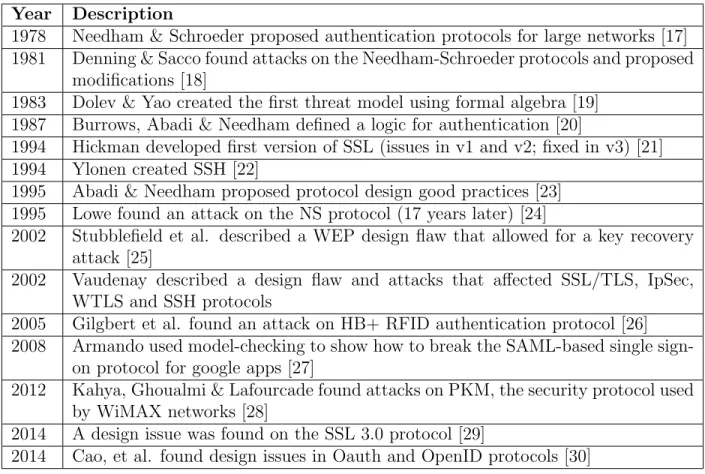
Designing secure protocols is an error-prone process. Protocol designs must be analyzed very carefully to avoid logical flaws. It is difficult to reason about protocols because one must consider concurrency, distributed systems, cryptography, sound mapping of designs to implementation, and an unknown attacker. History shows that attacks have been found even many years after the protocols were introduced and widely deployed [1]. Table 1.1 shows important examples that demonstrate this point.
1.2.2 Protocol Verification
Even though protocol verification began more than 30 years ago, it is still an active area of research. There are two main approaches, model checking and theorem proving, and a vast number of verification tools exist for each method. Therefore, it becomes difficult for
Table 1.1: History of protocol design and flaws found
Year Description
1978 Needham & Schroeder proposed authentication protocols for large networks [17] 1981 Denning & Sacco found attacks on the Needham-Schroeder protocols and proposed
modifications [18]
1983 Dolev & Yao created the first threat model using formal algebra [19] 1987 Burrows, Abadi & Needham defined a logic for authentication [20]
1994 Hickman developed first version of SSL (issues in v1 and v2; fixed in v3) [21] 1994 Ylonen created SSH [22]
1995 Abadi & Needham proposed protocol design good practices [23] 1995 Lowe found an attack on the NS protocol (17 years later) [24]
2002 Stubblefield et al. described a WEP design flaw that allowed for a key recovery attack [25]
2002 Vaudenay described a design flaw and attacks that affected SSL/TLS, IpSec, WTLS and SSH protocols
2005 Gilgbert et al. found an attack on HB+ RFID authentication protocol [26] 2008 Armando used model-checking to show how to break the SAML-based single
sign-on protocol for google apps [27]
2012 Kahya, Ghoualmi & Lafourcade found attacks on PKM, the security protocol used by WiMAX networks [28]
2014 A design issue was found on the SSL 3.0 protocol [29]
2014 Cao, et al. found design issues in Oauth and OpenID protocols [30]
protocol engineers to find the right tool to use. A primary goal of our study is to bring some light to this issue. We evaluate the different tools, and provide insights to help protocol engineers choose the right verification technique.
Moreover, the lack of case-studies has always been a weakness of formal methods which, in some way, has prevented its wider adoption by engineers without a strong formal mathe-matical background. This thesis intends to fill in this gap by providing a new set of protocol models in three different specification languages and the results of running each tool.
Additionally, researchers working on either model-checking or theorem-proving may benefit by learning how one approach compares to the other, applied to the specific domain of cryptographic protocol designs. Finally, we aim to use the results of our analysis to lay out future research opportunities by surveying some of the most relevant works in this area, which is abundant and challenging to mine.
1.2.3 Verification Tools
In order to evaluate the approaches of model-checking and theorem proving, we have chosen two of the most prominent existing tools, namely SPIN and Coq.
SPIN [31] is a mature model-checker (first released in the early 1980s by Holzmann), that has been adopted by industry, particularly in the hardware verification domain. It uses a finite state automata representation, which reflects the essence of the model-checking approach. SPIN has been used to verify security protocols [32, 33], although the number of available case-studies in this area is limited. In 2014, Ben Henda [34] presented an approach to encode generic attackers using the Dolev-Yao model [19]. This paper motivated our study; we wanted to find out if a generic approach could be extended to other tools, and how would these tools compare to each other.
On the other hand, Coq [35] is a well-established general purpose theorem prover. It has been used to verify security protocols [36, 37], but the number of published case-studies that use this tool for protocol verification is also rather small. This limitation was another motivation for us to choose this theorem-proving tool.
Another motivation is to compare and contrast general purpose tools against a domain-specific one. For this reason, we have chosen to use the symbolic model-checker Proverif [38]. One of Proverif’s interesting features is that it allows to verify protocol runs for an unbounded number of sessions. Its powerful modeling language, the applied pi-calculus, based on [39], is also an attractive feature. More on this topic will be covered in Chapter 3.
1.2.4 Security Protocols
For analysis, we have chosen a representative sample of authentication and key-distri-bution protocols. Particularly, we focus on protocols with authentication and secrecy goals. The protocols used in this study are those proposed by:
- Denning and Sacco (DS) [18],
- Tatebayashi, Matsuzaki and Newman (TMN) [40], - Diffie and Hellman (DH) [16].
The NSPK, one of the most analyzed protocols in the literature, has become a canonical example in protocol verification. In this thesis, we analyze both a simplified version and the full version. The DS protocol, also extensively studied, demonstrates the use of signatures with asymmetric encryption. The TMN protocol is one of the first authentication protocols designed for mobile networks. Apart from its historic connotation, it serves as an interesting example because of its use of Vernam encryption techniques, i.e. XOR functions, a technique commonly used in cryptography1. Finally, DH is one of the most significant protocols in the history of cryptography. Many protocol families have been derived from the idea of using exponentiation for an unauthenticated agreement of a shared key between two parties. Many widely-used protocols, such as SSL and TLS, rely on this technique for key-establishment.
1.3 Related Work
In 1996, Meadows [41] compared FDR [42] and NRL [43] model checkers by analyzing a model of the Needham-Schroeder public key protocol. FDR is a refinement checker that only works on finite-state systems. It was replaced by FDR2 in 1995, and more recently by FDR3. NRL is a logic-rewriting system that can verify infinite-state systems based on Prolog, which was later replaced by Maude-NPA. Our study is more comprehensive and current than Meadows’ work. This thesis analyzes more protocols with different cryptographic primitives, and includes theorem proving in the analysis.
Among the most recent studies, Patel et al. [44] compared FDR, AVISPA, HERMES, Interrogator, NRL, Brutus, Murphi, Proverif, Athena, and Scyther model-checkers. Their study only evaluated models in Scyther (the modeling process was not evaluated for the
1Vernam encryption is used in one-time-pads, which are implemented in RC4, a popular stream cipher that is widely used over the Internet [14].
other tools), and the metrics used for comparing the verification process were limited to the following yes/no questions: public availability of the tool, falsification, bounded/unbounded verification, and termination. This thesis provides models for all the tools compared and does a more extensive analysis.
In 2011, [45] compared CSP/FDR with other techniques for finding attacks on protocols, namely manual proofs using Strand spaces and BAN logic, and ALSP (Action Language for Security Protocols). Notwithstanding, this thesis is focused on existing tools that do not require manual construction of proofs.
In [46], Avalle surveyed formal analysis of security protocols, but focused on implemen-tations; more specifically it analyzed code generation and model extraction mechanisms and did not consider analysing models with the tools used in this thesis.
1.4 Contributions
The following is a list of the contributions of this thesis:
- It reviews the extensive related work of protocol verification with a focus on relevant case-studies. Despite the abundant literature, no previous surveys have approached the topic in this manner, from a practical and comparative perspective.
- It extends the number of case-studies of security protocols using some of the most prominent formal methods tools, and make the models publicly available2. We demon-strate with examples the benefits of applying formal methods to find protocol attacks, and provide source code of the models that can be used as a reference in the future by other engineers/researchers. We describe in detail how to encode protocol descrip-tions, attacker models, and security properties in a way that can be generalized for other protocols of the same class.
- It provides a comparison of the modeling and verification process using the two most common formal techniques, model checking and theorem proving. As a further matter, we generalize our encoding approach by showing how to formalize all the necessary cryptographic primitives for security protocol verification using any formal tool. - It analyzes pros and cons of using specialized versus general-purpose tools, and discuss
the modeling process and type of results that can be obtained with each.
Although others have attempted to compare different verification tools, we are not aware of other studies that have compared modeling and analysis of both model-checking and theorem-proving, general-purpose and tailored tools with the level of detail presented here. For all of the reasons mentioned above, our work provides a valuable and unique contribution.
In summary, three new findings are presented in the following chapters that form the core of this thesis:
1. We can generalize the process of modeling security protocols to build models for, at least, three different classes of verification tools.
2. The results of the experiments show that well-known attacks can be found using any of the three tools, but different attack models must be considered in some cases. 3. The three tools can be compared in terms of the suitability of their modeling languages
to encode cryptographic protocols, and the characteristics of the verification results. The modeling framework presented in this thesis is applied to several case studies and interesting conclusions are derived after comparing the results. The case studies considered in this thesis are a representative class of authentication and key establishment protocols. Our comparison does a thorough analysis of the results that can be obtained for different attacker and protocol models, and sets a road that may direct to future research.
1.5 Outline
Chapter 2 presents the reader with background on static analysis tools, and describes model-checking and theorem proving techniques. Chapter 3 explains how to model protocol specifications, from informal narrations to formal specification logics. It also shows how to encode cryptographic primitives, attacker models, authentication and secrecy properties. Chapter 4 describes the models of four protocols (NSPK, DS, TMN, and DH) using each of the three different tools, and shows the results of the verification process. Chapter 5 presents a comparison of the modeling and verification process for each of the tools. Finally, Chapter 6 discusses some of the issues with symbolic protocol models, explores opportunities in code generation and model extraction techniques, and concludes this thesis by setting the grounds for future work.
CHAPTER 2
BACKGROUND OF VERIFICATION TOOLS
2.1 Static Security Enforcement
There are two major approaches for security enforcement: static and dynamic analysis. Two common examples of dynamic mechanisms are runtime monitors and dynamic typing. Despite the benefits of real-time monitoring, the performance penalty introduced by these methods can be significant and, in many cases, static analysis is a better solution.
As Schneider explains in [2], runtime monitors cannot check for some non-property policies, such as one that states that information always flows from x to y, because this condition depends on all possible execution traces. On the other hand, a model checker can sometimes verify such information-flow policies by searching for a counter-example, i.e. a trace that leads to an invalid state in which information does not flow from x toy.
Static enforcement is a broad term that may refer to techniques that range from code analysis to type-checking, model-checking, and theorem proving. In this thesis, we limit our scope to model checking and theorem proving. Yet, type-checking is closely related to theorem-proving. For instance, the calculus of constructions (CoC), the underlying logics of Coq, is a theory of types that serves both as a typed programming language and a founda-tion for constructive proofs [47]. In standard programming languages, type-checking is fully automated, and achieves soundness by restricting allowable programs and sacrificing com-pleteness. On the other hand, human-guided proof construction using interactive theorem provers does not have this limitation.
2.2 Model Checking
More than three decades ago [48], model checking has emerged as an alternative tech-nique to manual proof construction for asserting properties about systems. Properties are specified in some form of propositional calculus, for example, linear temporal logic (LTL) [49, 50], or computational tree logic (CTL) [51]. Systems are modelled as transition graphs, where each node represents a possible state. For many practical systems, though, the state space may become extremely large, leading to the state-explosion problem, i.e. the number of states in a system grows exponentially as the number of variables increases.
Depending on the representation of the state space, model checking is either explicit or symbolic. Explicit model checking is based on enumerating all possible states of a program, resulting in a directed graph representing all reachable states and their transitions. Then, the decision procedure explores each path until, either a counter-example is found (property is unsatisfiable), or all the paths have been explored (property is satisfied). Until the 90s, explicit model checking was a popular technique in formal methods research. This method works well for checking LTL properties on small systems. However, when larger systems are considered, the memory requirements caused by the state explosion problem are so large that explicit model checking becomes impractical.
To cope with the state explosion problem, many optimization techniques were devel-oped and integrated into existing tools for asynchronous systems. Particularly, partial order reduction prunes the state space by eliminating non relevant states/transitions to properties under verification [52]. Bit-state hashing is another technique that focuses on state space coverage instead of completeness. It limits memory usage by indexing each state into a hash table of bits [53].
SPIN features these and other optimization techniques, which make it a prominent general-purpose model-checker that is still widely used today1. Another popular explicit
model-checker is Java Path-finder (JPF) [54], which started as a Java to Promela2 transla-tor, and then developed its own model-checking engine. While Promela is closer to the C language, JPF is naturally tied to verification of Java programs.
Symbolic representation is an alternative approach that can be applied to verify larger systems. Symbolic model-checkers encode transition systems as boolean formulas. Early tools were implemented using binary decision diagrams, while tools developed later use boolean satisfiability solvers. Some of the most popular symbolic model checkers are NuSMV, which was first published as SMV by McMillan in 1993 [55]. More recent symbolic model checkers are based on SMT solving [56] applied to system encodings with various theories on first order logic.
Despite the improvement over explicit representations, symbolic model checking can-not deal very well with recursion. Bounded model checking tries to solve this problem by imposing a fixed bound on recursion. This technique became popular in the early 2000s. Although it is generally incomplete because decision procedures may not terminate as the bound increases, in practice it is enough to disprove properties since counter-examples can often be detected with a small bound.
In general, model checkers’ modeling languages provide features to describe state-transition systems. For example, Promela’s labels andgotostatements allow users to specify state transitions, andif blocks can be used to capture non-deterministic selection behaviour. Even symbolic model-checkers use this representation. For instance, the symbolic model checker Uppaal has a graphical interface that allows users to draw networks of timed au-tomata. A different approach was taken by the bounded model checker Alloy [57], which has an input modeling language based on set relations.
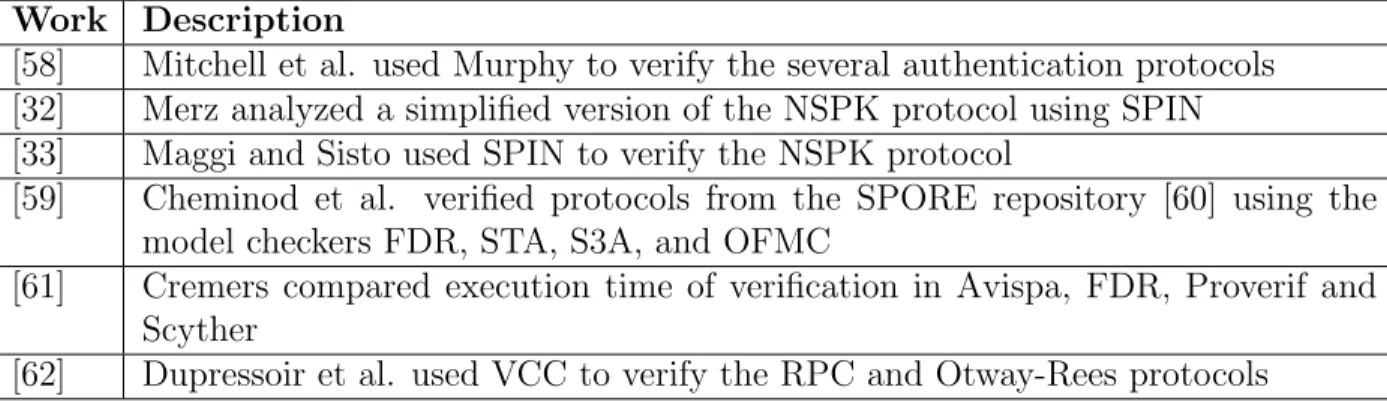
Table 2.1 shows related work in which security protocols were verified using model checking techniques. One of the early studies that used a model checker to verify security pro-tocols is described in [58], where the Needham-Schroeder, Tatebayashi-Matsuzaki-Newman,
Table 2.1: Case studies using model checkers to verify security protocols
Work Description
[58] Mitchell et al. used Murphy to verify the several authentication protocols [32] Merz analyzed a simplified version of the NSPK protocol using SPIN [33] Maggi and Sisto used SPIN to verify the NSPK protocol
[59] Cheminod et al. verified protocols from the SPORE repository [60] using the model checkers FDR, STA, S3A, and OFMC
[61] Cremers compared execution time of verification in Avispa, FDR, Proverif and Scyther
[62] Dupressoir et al. used VCC to verify the RPC and Otway-Rees protocols
and Kerberos protocols are analyzed using Murphy [63]. Several studies have modelled the Needham-Schroeder public key exchange protocol and verified it using SPIN [32, 33]. In [62] Dupressoir et al. used the general-purpose C model checker VCC [64] to prove secrecy and authentication on the RPC and Otway-Rees protocols.
Moreover, Cheminod et al. compared four model checkers (FDR, STA, S3A, and OFMC) to verify a number of protocols in [59, 60]. Their results only showed which tools can find known attacks, but the study did not analyze the modeling process for each of the tools. In [61] execution time was compared for several model checkers (the tools in Avispa, FDR, Proverif and Scyther) by verifying the NSPK, EKE, and TLS protocols to find known attacks. Proverif shows the best performance among the tools considered.
2.3 Theorem Proving
Proof construction has followed two major currents in computer science: automated provers, and proof assistants. Automated provers offer a “push-button” solution, i.e. they take a proposition and give a yes/no (or ran-out-of-time) answer [65]. On the other hand, interactive theorem provers3, also known as proof assistants, automate some basic aspects of building proofs while they still depend on human guidance for more challenging tasks.
3For simplicity, throughout the thesis we refer to interactive theorem provers using the general term theorem provers.
In this thesis, we focus on comparing a model-checker, a resolution verifier, and a theorem prover. Therefore, the rest of this section will have a focus on theorem proving.
Theorem provers can be used in two ways, either to prove a system’s security or to show its insecurity. Showing insecurity implies demonstrating that an attack is possible, i.e. prove that a conjecture can be derived given a logical deductive system. Proving security is a harder task, in which proofs must be completed by construction.
Proof development is a NP-complete problem, and human interaction is required. More-over, the learning curve is steep. In order to be able to construct proofs, engineers must have strong foundations in logic and mathematical tools such as induction.
Nevertheless, theorem provers facilitate the proof construction process by providing an environment with helpful resources and libraries. For example, Coq has a tactics library that consists of predefined –and extensible– functions to automate some steps in a proof. In addition, proofs are grouped in theories, and these are built in a modular way. Theories are organized in hierarchical structures that can be included when writing new proofs.
Theorem provers allow to verify infinite protocol runs and message spaces, as opposed to model-checking techniques, in which protocol sessions are always bounded or the algorithms may not terminate. While model-checkers verify models by searching for counter-examples, interactive theorem provers use type theory to derive facts about terms.
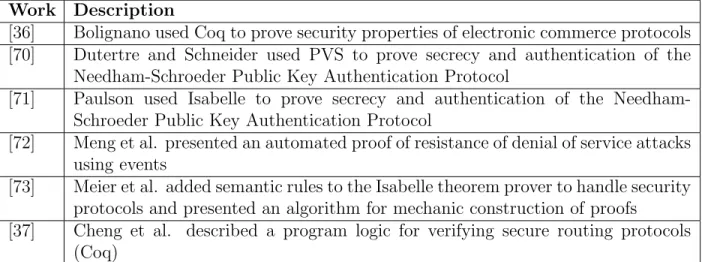
Some of the most popular proof assistants that have been used to prove security prop-erties of systems are Isabelle [66], Coq [35], LEGO [67], PVS [68] and ACL2 [69]. Table 2.2 summarizes relevant works in this area.
2.4 Specialized Tools
Several model checkers have been specially designed to verify security protocols. For example, SATMC is a bounded model checker that uses a SAT-solver to verify protocol specifications written in the ASLan language. Internally, SATMC uses NuSMV to gener-ate SAT encodings for the LTL formulae and MiniSAT to solve the SAT problems [74].
Table 2.2: Case studies using theorem provers to verify security protocols
Work Description
[36] Bolignano used Coq to prove security properties of electronic commerce protocols [70] Dutertre and Schneider used PVS to prove secrecy and authentication of the
Needham-Schroeder Public Key Authentication Protocol
[71] Paulson used Isabelle to prove secrecy and authentication of the Needham-Schroeder Public Key Authentication Protocol
[72] Meng et al. presented an automated proof of resistance of denial of service attacks using events
[73] Meier et al. added semantic rules to the Isabelle theorem prover to handle security protocols and presented an algorithm for mechanic construction of proofs
[37] Cheng et al. described a program logic for verifying secure routing protocols (Coq)
Furthermore, it has been integrated into several frameworks, such as the AVISPA project [75], which provides several back-end model-checkers for protocols specified in HLPSL, a high-level protocol specification language. Among those model-checkers, OFMC [76] is an on-the-fly model checker for infinite-state systems. It uses lazy and demand-driven search techniques for modeling a Dolev-Yao intruder. Another framework is the Casper/CSP/FDR approach, which combines the Casper specification language [77] to translate a protocol’s high-level description into a Communication Sequential Process (CSP) description; CSP is the input language to FDR3 [78], a refinements checker. All of the tools previously described can find attacks for a bounded number of sessions.
Protocol verification for an unbounded number of sessions has been shown to be an undecidable problem [79, 80]. There are two approaches to deal with this issue, either to abstract the models (e.g. Proverif), or to allow non-termination [81]. Proverif uses reso-lution techniques with over-approximations, which may report false attacks. On the other hand, Maude-NPA [81] is based on a term-rewriting algorithm with several heuristics to reduce the possibility of non-termination. Other specialized tools that have been developed for security protocols are HERMES [82], CL-Atse (Constraint-Logic-based Attack Searcher) [83], TA4SP (Tree-Automata-based Automatic Approximations for the Analysis of Secu-rity Protocols) [84], and Scyther [85]. Among more recent studies using specialized tools,
Kusters and Truderung [86] used ProVerif to analyze protocols with Diffie-Hellman exponen-tiation. Kahya et al. [28] presented a formal analysis of the PKM protocol using Scyther. Cheval and Blanchet [87] proved anonymity in the private authentication protocol [88] using ProVerif. Elbaz [89] analyzed and verified a key agreement protocol over cloud computing using Scyther.
Even though some studies have analyzed security protocols using different tools, none of those studies have examined a common modeling framework that can be applied to verify protocols using model-checking, theorem proving, and specialized tools. In order to fill this gap, in the following chapter we describe a generalized modeling framework.
CHAPTER 3
FORMALIZATION OF SECURITY PROTOCOLS
Security protocols can be specified at different levels of abstraction. Protocol narrations are a natural way of describing interactions between agents who participate in a protocol [90]. Nevertheless, narrations only describe expected message exchanges, and leave some agents’ actions unspecified. Therefore, more explicit formalisms are needed in order to verify correctness of such protocols.
In this chapter we describe some of the issues with informal protocol narrations. We then survey relevant formalisms for specification of security protocols. We present a gen-eralized modeling approach that we use for comparison of the different verification tools. Later, we explain how to model protocols and properties for each of the verification tools considered in this study. We conclude the chapter with a discussion of diverse approaches to protocol instantiation.
3.1 Informal Protocol Narrations
Traditionally, high-level specifications of security protocols have been written using protocol narrations [91], which describe a correct execution trace as a sequence of message exchanges between the parties involved in the protocol. For example,
1. A→B : {NA, B}P KB
2. B →A: {NA}P KA
means that A sends a message to B containing a fresh nonce NA generated by A and B’s
identity, encrypted with B’s public keyP KB. Then B replies to A by sending the received
nonce encrypted with the public key of A, (P KA). The numbers at the beginning of the
lines show the order in the exchange sequence and are incremented every time a message is sent/received. Messages can be extended by adding values separated by commas.
Most cryptographic operations can be represented in this format. Nonetheless, protocol narrations are sometimes ambiguous. In order to capture agents’ behavior precisely, we need to add important details that happen between transitions. For instance, B sends Message 2 in Protocol 3.1 only if the name identifier in Message 1 matches his own name. These constraints are important to reduce the message space and avoid incorrect results, e.g. false attacks.
Another source of ambiguity is the implicit initial knowledge. Apart from knowledge about its own identity, an agent may know some information about other agents at the start of the protocol. For example, in some cases, it is desirable to assume that a client’s registration phase has completed successfully before the protocol starts. Therefore, we assume that the server trusts its own copy of A’s public key. This assumption is part of an assumed trust base. The consequence of this assumption is that the server is able to detect a forged message that is supposed to come from A if it is encrypted with another key that is not P KA. This assumption can be modeled as an action through which the server checks if the
incoming message contains P KA before continuing with the protocol. Neither the honest
agent’s initial knowledge nor their intermediate actions are captured by protocol narrations. More ambiguities are due to an implicit attacker model, i.e. the attacker capabilities are not specified in protocol narrations.
Several authors have attempted to translate protocol narrations into process algebras for verification. Bodei et al. [92] describe how to translate protocol narrations into the Lysa-calculus, a formalism similar to the spi-calculus but without channels. Briais and Nestmann [93] have attempted to develop translators from protocol narrations into the pi-calculus.
In all cases, however, the translation requires human intervention to disambiguate implicit assumptions that the input notation does not capture, and the translation cannot be fully automated.
3.2 Formal Modeling Languages
There are different approaches to formalizing protocols for the purpose of verifying their security properties. Common formalisms used to model security protocols are BAN logic [20], CSP (Communicating Sequential Processes) [94], and Strand spaces [95]. A comparative case study of BAN-logic, CSP, and Strand spaces applied to the Needham-Schroeder protocol can be found in [96].
BAN logic is a formalism that describes protocols using a deductive system of beliefs, which gained some popularity in the early 90s. However, the protocol’s “idealization” [97] and facts that must be assumed may leave out important details, and make BAN proofs unsound [98]. BAN proofs can only show authentication properties, assuming confidentiality and integrity of the underlying cryptographic system. Most importantly, the logic does not have precise semantics for its operations [99].
CSP is a process algebra developed by Hoare [94] in the late 70s. CSP semantics are more general, i.e. it can be used to describe any communication process. Inspired by parallel hardware implementations, Hoare’s goal was to include parallelism and non-determinism as structural features of a language. A failures-divergence refinement checker (FDR) was later introduced by Roscoe in [100] as a model checker for CSP programs. Despite the benefits of the tool, modeling in CSP still remains a difficult task. Later, Lowe developed CASPER [101], a compiler to translate specifications in a high-level language into CSP.
Strand spaces, developed by Guttman et al. [95], represent sequences of events in secu-rity protocols. Strands may represent actions of both honest agents and attackers connected by causal events. Despite being useful to prove correctness of many protocols, the mechan-ics of proofs using strand spaces are very detailed and somewhat complicated [102]. This
modeling framework was implemented later in Athena [103], a specialized model-checker for security protocols.
The pi-calculus is a functional language similar to the lambda-caluclus designed to describe concurrent processes [104]. It provides channel primitives, which can be used to represent communications. Nevertheless, the pi-calculus does not have cryptographic primi-tives built in, and encryption must be encoded (this is achieved with some effort in [39, 105]). Based on this fact and the idea that scoping is the basis of security property enforcement, several variants of the pi-calculus have been proposed and used in the context of security [39] [106]. Proverif models can be written in the applied pi-calculus [107], an extension of the pi-calculus with function symbols that can represent data structures and cryptographic operations.
In explicit state model checkers, protocols are represented using automata. Their mod-eling languages reflect the underlying formalism. In SPIN’s modmod-eling language, Promela, a system is the composition of each agent’s automaton, which is described as a process and details the agent’s participation in the protocol. Send and receive actions are synchronized events on shared channels that are primitive language constructs. An attacker is usually represented by an independent automaton, and the state transition diagram of the entire system is generated by the interleaving of all possible transitions.
Theorem-provers use an inductive approach to specify protocols. For example, Coq’s modeling language is based on the theory of types, which has features such as inductive definitions and type inference. A protocol description has a set of rules that correspond to actions of agents and attackers. Security properties are stated as lemmas which are then proved inductively. The same approach is used in Isabelle and other theorem-provers.
3.3 A Generalized Modeling Approach
Despite differences in modeling frameworks, a general framework for modeling and verification of security protocols should support (a) formal protocol description, (b) attacker
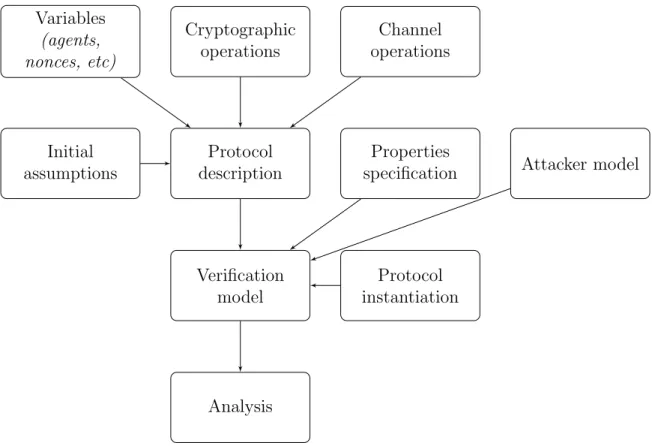
modeling, and (c) property specification. Moreover, depending on the verification technique, the framework must provide a way to instantiate the protocol in order to discover potential attacks. Figure 3.1 shows a high-level view of the modeling process.
Cryptographic operations Channel operations Protocol description Initial assumptions Verification model Analysis Properties
specification Attacker model
Protocol instantiation Variables
(agents, nonces, etc)
Figure 3.1: Modeling cryptographic protocols for verification
A formal protocol description is defined with a set of initial assumptions, and sequences of operations that represent interactions between agents. Moreover, it requires other prelim-inary definitions: a set of values that form messages (agents, nonces, etc), some communica-tion channels, a set of input/output funccommunica-tions (send, receive) that operate on those channels, and a set of cryptographic operations.
Some typical cryptographic operations are encryption, digital signatures, hashing, and Diffie-Hellman exponentiation. To represent cryptosystems, the framework should provide a way to generate keys, encrypt, and decrypt messages. Simmilarly, digital signature opera-tions require key generation, sign and signature verification funcopera-tions.
Initial assumptions are another important aspect of the modeling process. Unambiguous models must explicitly define the variables that each agent knows before the start of the protocol. In general, most models assume that every agent has access to all public keys and cryptographic functions. On the other hand, nonces and secret keys are kept private to their respective owners.
The attacker model refers to the attacker’s initial knowledge and all the attacker’s potential actions. For example, a Dolev-Yao (DY) attacker [19] may be able to spy, intercept, or inject messages at will. A more restrictive attacker can be specified, e.g. a passive eavesdropper, significantly reducing the message space.
A model must also include some security properties to be checked, sometimes called ver-ification goals. Proofs of (in)security will be bound to the properties specver-ification. Therefore, formulation of the properties is an important matter.
3.3.1 Communication on Shared Channels
In general, communications in authentication and key-establishment protocols occur on shared channels. Therefore, real source and destination of messages cannot be guaranteed. In order to capture the possibility that an attacker may intercept a message, we abstract away the identity of the addressee in all the send actions. Similarly, we abstract the sender’s identity from receive operations to consider attackers message injection capabilities.
1. A→X : {NA, X}P KX
10. Y →B : {NY, B}P KB
20. B →Y : {NA}P KA
2. X →A: {NA}P KA
(a) Interlocutors abstraction with strong restrictions
1. A→X : {NA, X0}P KX0 10. Y →B : {NY0, B}P KB 20. B →Y00 : {NY0}P K Y0 2. X00→A: {NA}P KA (b) Restrictions relaxation
The augmented message sequence for Protocol Narration 3.1 is shown in Figure 3.2a. Noteworthily, our abstraction maintains the relations between message elements. For exam-ple, the identity X in the body of message 10 must match the public key used to encrypt the message. Moreover, this formalization further restricts the message space by requiring that the addressee of message 1 by A matches the identity in the body of the message, and the public key used to encrypt the message. We call this restriction a strong one. A more relaxed version is shown in Figure 3.2b, in which addressor/addressee may not match the message elements (e.g. X andX0 in message 1), and there is no relation of identities between different messages in the sequence (e.g. X and X00 in messages 1 and 2 respectively). Ultimately, the decision to use strong or relaxed restrictions will depend on the assumptions about the protocol and the attacker model. For instance, to model a more powerful attacker, a relaxed protocol description should be used. In the case studies presented in Chapter 4, we try more restrictive attacker models first and, if no attacks are found, the message restrictions are relaxed to extend the message space. The remainder of this chapter explains how to model security protocols and their properties for each of the verification tools considered in this thesis.
3.4 Modeling in SPIN, Proverif, and Coq
In this section, we describe how to use the general modeling framework to develop protocol models and property specifications for SPIN, Coq, and Proverif. Our ideas are rooted in the works by [34, 108, 38]. Full syntax of specification languages for these tools can be found in [109, 110, 38]. As a general convention in all our models, we capitalize types, use all upper-case letters for constants, and lower-case for function names. Next, we discuss general aspects of models for each of these tools.
3.4.1 Cryptographic Operations
A main requirement for specifying security protocols is to encode cryptographic opera-tions. Our assumption of perfect cryptography allows us to abstract away the implementation details, and focus on the functional behavior of cryptographic constructs.
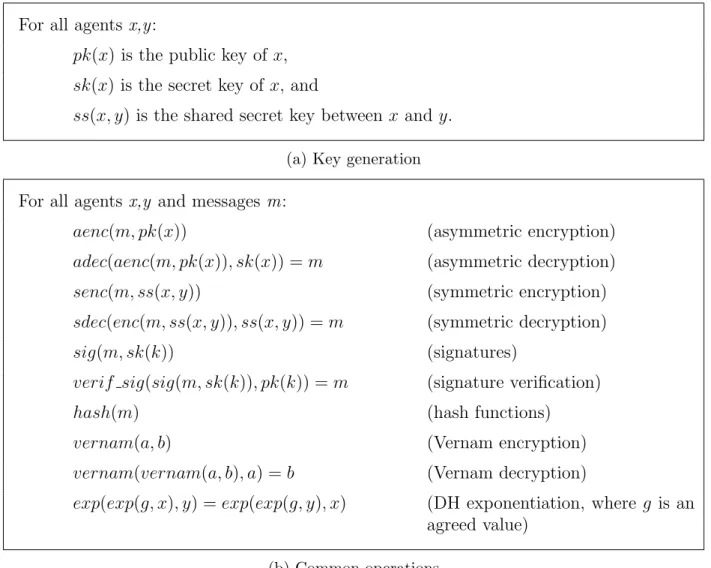
In Figure 3.3a we show how to represent asymmetric and symmetric key generation by defining functions that map agents to public, secret, and shared keys. Figure 3.3b shows common cryptographic operations used by authentication and key establishment protocols.
For all agents x,y:
pk(x) is the public key of x, sk(x) is the secret key of x, and
ss(x, y) is the shared secret key between x and y.
(a) Key generation
For all agents x,y and messagesm:
aenc(m, pk(x)) (asymmetric encryption)
adec(aenc(m, pk(x)), sk(x)) =m (asymmetric decryption)
senc(m, ss(x, y)) (symmetric encryption)
sdec(enc(m, ss(x, y)), ss(x, y)) =m (symmetric decryption)
sig(m, sk(k)) (signatures)
verif sig(sig(m, sk(k)), pk(k)) = m (signature verification)
hash(m) (hash functions)
vernam(a, b) (Vernam encryption)
vernam(vernam(a, b), a) =b (Vernam decryption)
exp(exp(g, x), y) = exp(exp(g, y), x) (DH exponentiation, where g is an agreed value)
(b) Common operations
At a high level, any language with functions will suffice for encoding cryptographic operations. However, there are some subtleties. For example, some operations, such as the Diffie-Hellman exponentiation, describe equivalence properties between functions. Moreover, encoding some operations using standard types requires careful thought.
From a computation perspective, we can think of cryptographic operations having one of two types, constructors or destructors [38]. Encryption, signature, and hashing functions are constructors, as they introduce new terms. On the other hand, destructors eliminate terms. Decryption and signature verification are two examples of destructor functions.
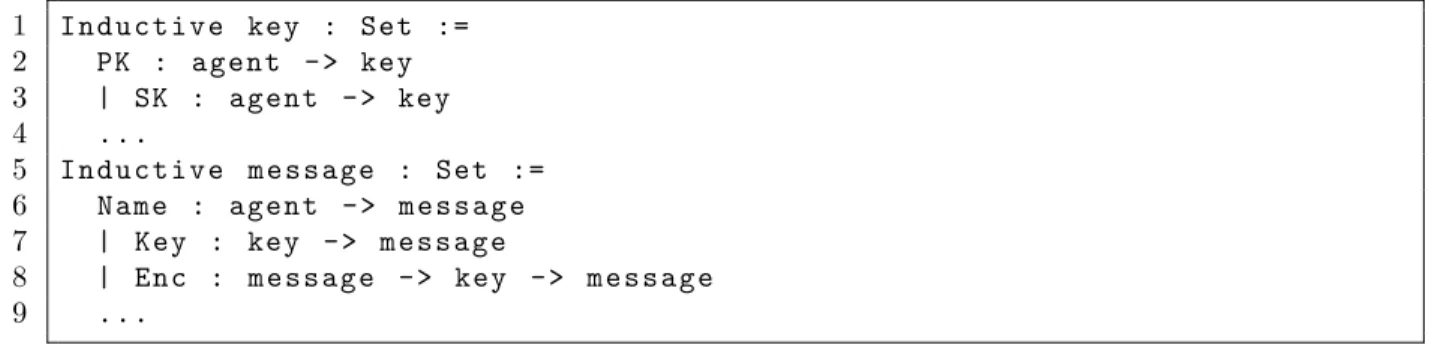
1 I n d u c t i v e key : Set := 2 PK : a g e n t - > key 3 | SK : a g e n t - > key 4 ... 5 I n d u c t i v e m e s s a g e : Set := 6 N a m e : a g e n t - > m e s s a g e 7 | Key : key - > m e s s a g e 8 | Enc : m e s s a g e - > key - > m e s s a g e 9 ...
Figure 3.4: Inductive types in Coq
We define one-way functions as having no body, so they cannot take an evaluation step. This representation of cryptographic operations is easy to implement in Coq and Proverif. In Coq, inductive types have constructors which can represent one-way functions that will be carried around as predicates. We specify constructors for keys and messages (Figure 3.4), and also for cryptographic functions (Figure 3.5).
1 k n o w n : m e s s a g e - > P r o p :=
2 | a e n c : f o r a l l m a , k n o w n m - > k n o w n ( Enc m ( PK ( a ) ) )
3 | a d e c : f o r a l l m a , k n o w n ( Enc m ( PK ( a ) ) ) - > k n o w n ( Key ( SK a ) ) - > k n o w n m
Figure 3.5: Cryptographic functions in Coq
Proverif allows the user to define constructor and destructor functions, so we use them for operations like encryption and decryption (Figure 3.6).
1 fun pk ( s k e y ) : p k e y .
2 fun a e n c ( b i t s t r i n g , p k e y ) : b i t s t r i n g .
3 r e d u c f o r a l l x : b i t s t r i n g , y : s k e y ; a d e c ( a e n c ( x , pk ( y ) ) , y ) = x .
Figure 3.6: Cryptographic keys and functions in Proverif
In SPIN, we must make careful decisions to minimize the state space, so in the models we use constants wherever possible. For example, agents, nonces, public and secret keys are labelled indices of a user-defined array. Then, to find if a value is an agent’s public or secret key, we define macros that just offset the function’s input value. An example can be seen on Figure 3.7.
1 # d e f i n e PK ( x ) x - j
2 # d e f i n e SK ( x ) x - ( j + 3)
3
4 m t y p e = { . . . A , B , I , . . . ( j o t h e r c o n s t a n t s ) ... , PKA , PKB , PKI , SKA , SKB , SKI . . . }
Figure 3.7: Key constructors in SPIN
A call to P K(x), where x is an agent A, B, or I, will return P KA, P KB, or P KI respectively. Moreover, decryption is achieved by evaluating the last field of an incoming message (Figure 3.8).
1 p r o c t y p e R e s p o n d e r ( m t y p e b ) {
2 ...
3 c o m m ? msg , e v a l ( PK ( b ) ) ;
4 ...
Figure 3.8: Decryption in SPIN
The receive operation (denoted by “?”) of message msgon channel commwill only step if the last field of the message matches the public key of b.
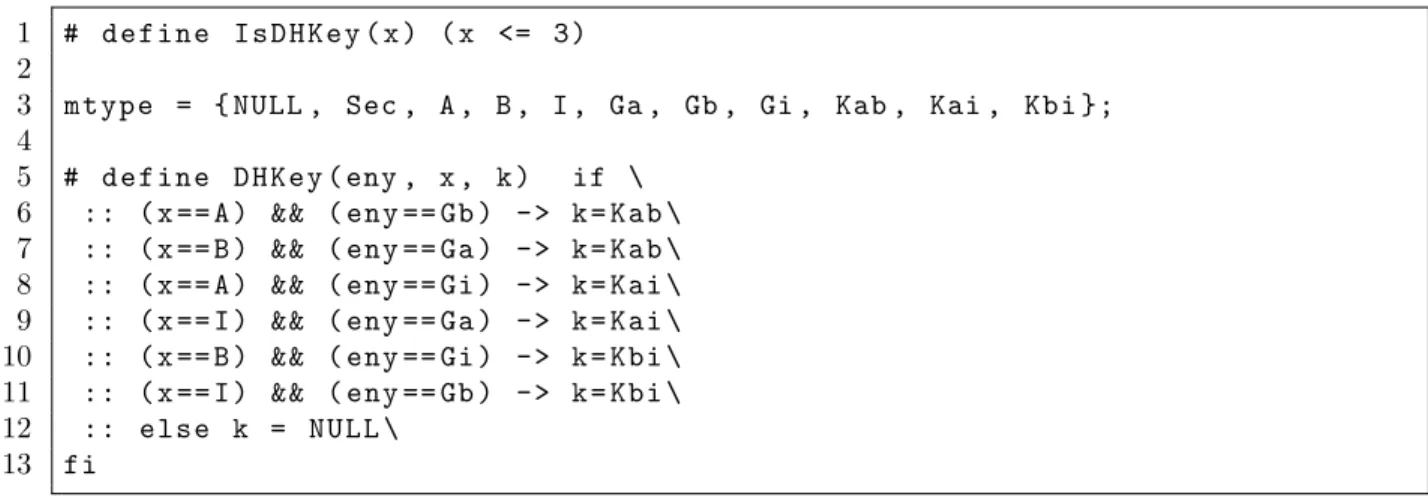
Furthermore, we use constants to abstract certain properties of operations that depend on equivalences. For instance, Figure 3.9 shows how Diffie-Hellman exponentiation can be
hard-coded using a macro definition. Thorough this representation, we are able to prove some attacks (e.g. a MITM) that work for –at least– a bounded number of sessions.
1 # d e f i n e I s D H K e y ( x ) ( x <= 3)
2
3 m t y p e = { NULL , Sec , A , B , I , Ga , Gb , Gi , Kab , Kai , Kbi };
4
5 # d e f i n e D H K e y ( eny , x , k ) if \
6 :: ( x == A ) && ( eny == Gb ) - > k = Kab \
7 :: ( x == B ) && ( eny == Ga ) - > k = Kab \
8 :: ( x == A ) && ( eny == Gi ) - > k = Kai \
9 :: ( x == I ) && ( eny == Ga ) - > k = Kai \
10 :: ( x == B ) && ( eny == Gi ) - > k = Kbi \
11 :: ( x == I ) && ( eny == Gb ) - > k = Kbi \
12 :: e l s e k = N U L L \
13 fi
Figure 3.9: Diffie-Hellman exponentiation in SPIN
In Proverif, we can define functions as equivalence relations. This is useful to represent properties like the Diffie-Hellman exponentiation (Figure 3.10).
1 c o n s t g : G .
2 fun exp ( G , e x p o n e n t ) : G .
3 e q u a t i o n f o r a l l x : e x p o n e n t , y : e x p o n e n t ;
4 exp ( exp ( g , x ) , y ) = exp ( exp ( g , y ) , x ) .
Figure 3.10: Diffie-Hellman exponentiation in Proverif
In Coq, we define constants to represent the calculated values in Diffie-Hellman ex-change (in the same manner as it was done in SPIN).
3.4.2 Attacker Models
The most commonly used attacker model is the one presented by Dolev-Yao (the DY model) [19], which assumes perfect cryptographic properties (cryptographic primitives treated as black-boxes), and a non-deterministic behavior of the intruder. Verification of models with DY attackers is done symbolically, as opposed to computational models that use probabilistic methods and take into consideration algorithmic complexity of cryptographic
operations. In the computational model, messages are bitstreams, cryptographic primitives are functions that operate on them, and the attacker is modeled as a any probabilistic polynomial-time Turing machine [111].
The assumption of perfect cryptography in the DY model implies that the attacker cannot guess secret keys. Typical attacker actions in this model are eavesdropping, injection, and interception of messages. The DY attacker model is simple and powerful; its behavior is non-deterministic, and the message space is infinite.
Ideally, verification with unbounded settings is desired. However, it is not always pos-sible on every tool. For example, it is not pospos-sible to model an attacker with unbounded storage space in SPIN. Therefore, the capabilities of each attacker model must be explicitly defined. In our modeling framework, a DY attacker with unlimited storage and message generation capability is denoted as class A1. Moreover, we define a restricted attacker class that can generate messages of a fixed length as A2. Finally, we refer to a class of attackers that can generate fixed-length messages and have bounded storage asA3.
Our modular approach to defining classes of attackers could be easily extended. For example, we could define an attacker class A4 for attackers that can only read but cannot inject or intercept messages (passive attackers). Verification of a protocol model using dif-ferent classes of attackers can lead to more fine-grained results. For example, we may be able to show that authentication holds when the attacker has limited storage capabilities even if the property fails in the case of an attacker with unbounded storage. On the other hand, a number of attacks may be found even in the presence of restricted attackers. The case studies in Chapter 4 demonstrate that attacks can be found for several protocols even when considering limited message generation and storage capabilities of the attacker.
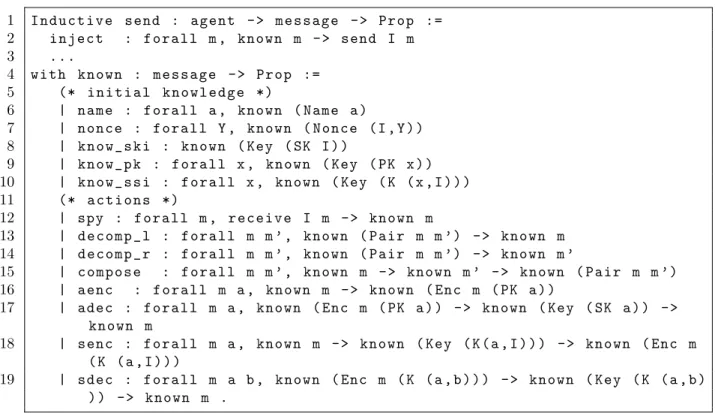
Another important decision when modeling an attacker is how to represent knowledge. It is not possible to allow the attacker to have infinite storage capabilities if model-checking is used. On the other hand, when using theorem proving, one can use induction to generalize proofs for an unbounded attacker’s knowledge vector.
1 I n d u c t i v e s e n d : a g e n t - > m e s s a g e - > P r o p := 2 i n j e c t : f o r a l l m , k n o w n m - > s e n d I m 3 ... 4 w i t h k n o w n : m e s s a g e - > P r o p := 5 (* i n i t i a l k n o w l e d g e *) 6 | n a m e : f o r a l l a , k n o w n ( N a m e a ) 7 | n o n c e : f o r a l l Y , k n o w n ( N o n c e ( I , Y ) ) 8 | k n o w _ s k i : k n o w n ( Key ( SK I ) ) 9 | k n o w _ p k : f o r a l l x , k n o w n ( Key ( PK x ) ) 10 | k n o w _ s s i : f o r a l l x , k n o w n ( Key ( K ( x , I ) ) ) 11 (* a c t i o n s *) 12 | spy : f o r a l l m , r e c e i v e I m - > k n o w n m 13 | d e c o m p _ l : f o r a l l m m ’ , k n o w n ( P a i r m m ’) - > k n o w n m 14 | d e c o m p _ r : f o r a l l m m ’ , k n o w n ( P a i r m m ’) - > k n o w n m ’ 15 | c o m p o s e : f o r a l l m m ’ , k n o w n m - > k n o w n m ’ - > k n o w n ( P a i r m m ’) 16 | a e n c : f o r a l l m a , k n o w n m - > k n o w n ( Enc m ( PK a ) ) 17 | a d e c : f o r a l l m a , k n o w n ( Enc m ( PK a ) ) - > k n o w n ( Key ( SK a ) ) - > k n o w n m 18 | s e n c : f o r a l l m a , k n o w n m - > k n o w n ( Key ( K ( a , I ) ) ) - > k n o w n ( Enc m ( K ( a , I ) ) ) 19 | s d e c : f o r a l l m a b , k n o w n ( Enc m ( K ( a , b ) ) ) - > k n o w n ( Key ( K ( a , b ) ) ) - > k n o w n m .
Figure 3.11: Generic attacker model in Coq
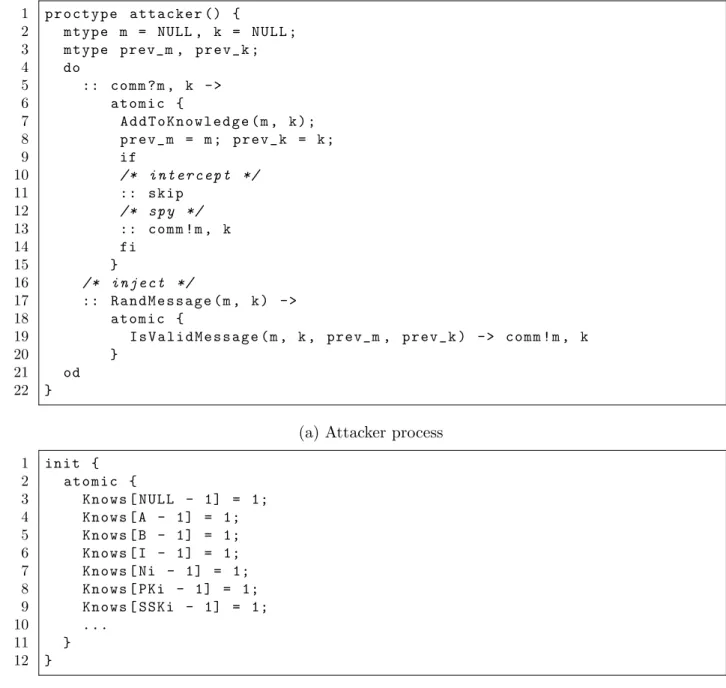
In Coq, we use an inductive typeknownto represent the attacker actions and knowledge vector (Figure 3.11). In Proverif, the attacker is implicit, so there is no need to model it. In SPIN, the attacker is specified as a separate process that can spy, intercept, or inject messages (Figure 3.12a). Furthermore, we initialize the knowledge vector to represent the facts that are initially assumed to be known by the attacker (Figure 3.12b).
3.4.3 Property Specification
Cryptographic protocols are designed to enforce specific security properties. In general, security goals, i.e. properties that need to be enforced, are usually stated in the protocol spec-ification. Property requirements are usually embedded in protocol specification documents, which are written in natural language and may include some informal protocol narrations and ad hoc annotations [91].
1 p r o c t y p e a t t a c k e r () { 2 m t y p e m = NULL , k = N U L L ; 3 m t y p e prev_m , p r e v _ k ; 4 do 5 :: c o m m ? m , k - > 6 a t o m i c { 7 A d d T o K n o w l e d g e ( m , k ) ; 8 p r e v _ m = m ; p r e v _ k = k ; 9 if 10 /* i n t e r c e p t */ 11 :: s k i p 12 /* spy */ 13 :: c o m m ! m , k 14 fi 15 } 16 /* i n j e c t */ 17 :: R a n d M e s s a g e ( m , k ) - > 18 a t o m i c { 19 I s V a l i d M e s s a g e ( m , k , prev_m , p r e v _ k ) - > c o m m ! m , k 20 } 21 od 22 }
(a) Attacker process 1 i n i t { 2 a t o m i c { 3 K n o w s [ N U L L - 1] = 1; 4 K n o w s [ A - 1] = 1; 5 K n o w s [ B - 1] = 1; 6 K n o w s [ I - 1] = 1; 7 K n o w s [ Ni - 1] = 1; 8 K n o w s [ PKi - 1] = 1; 9 K n o w s [ S S K i - 1] = 1; 10 ... 11 } 12 }
(b) Attacker’s initial knowledge
Figure 3.12: Generic attacker model in SPIN
The goals of authentication and key establishment protocols are mainly secrecy and authentication. Formalization of such properties has been thoroughly studied before [2, 112, 91]. According to Abadi [107], secrecy may be specified as a predicate on behaviours or as an equivalence relation on traces. When defined as an equivalence property, secrecy means that the attacker cannot distinguish between two traces with different secrets.
1 # d e f i n e S e c I n v ( ! K n o w s [ SEC - 1] ) 2 3 a c t i v e p r o c t y p e S e c M o n i t o r () { 4 a t o m i c { 5 do 6 :: ! S e c I n v - > a s s e r t ( S e c I n v ) 7 od 8 } 9 } (a) in SPIN 1 L e m m a s e c r e c y : k n o w n I ( S e c r e t ( SEC ) ) . (b) in Coq 1 f r e e SEC : b i t s t r i n g [ p r i v a t e ]. 2 q u e r y a t t a c k e r ( SEC ) . (c) in Proverif
Figure 3.13: Secrecy property
To check a security protocol for secrecy, we use an invariant condition specifying that the secret token is not known by the attacker. In SPIN, this invariant condition is checked by an active process monitor that must remain true in all states (Figure 3.13a). In Coq, we define it as a lemma which states that the constant SEC of type Secret cannot be known by the intruder I (Figure 3.13b). In Proverif we declare a private free variable of type
bitstring1, and then check if the fact attacker(SEC) is ever true (Figure 3.13c). Authentication is usually defined as a safety property [38] below.
“If B reaches the end of the protocol and he believes that he has shared the key k with A, thenA was indeed his interlocutor and she has shared k.”
This definition of authentication implies two things: (1) there is a correspondence between the event that B has finished the protocol with A sending k, and A has started the protocol with B receiving k, and (2) the relationship is injective (i.e. one-to-one). The
injective property implies that there is no man-in-the-middle. Figure 3.14 shows the events sequence. A B start(A,B) start(B,A) end(A,B) end(B,A)
Figure 3.14: Authentication based on events correspondence
From the message sequence, we can draw several conclusions: (1) end(B, A) should always happen afterstart(A, B), and (2)end(A, B) should always happen afterstart(B, A). Therefore, checking for authentication requires verifying that two events happen in chrono-logical order, i.e. the client requests authentication to the server (start(A, B)), and the server authenticates the client (end(B, A)). If only one of these conditions is met but not the other, or if they occur in incorrect order, the authentication process is compromised.
This is modelled by defining two global variables, one for the request and one for the response, defining the authentication invariant as described, and checking that this invariant is true on every reachable state. Figure 3.15 shows how this is done in each of the languages. In SPIN, the macro function Event can be specified just in terms of the event type, START
or END, and the participant agents, A and B, since the number of runs is fixed (Figure 3.15a). Conversely, the same property in Proverif must include the key being exchanged to identify the corresponding session (Figure 3.15c). In Coq, authentication failure is shown by proving lemma auth f ail (Figure 3.15b), which states that event end I B A is true. This
end function is analogous to the one shown in Figure 3.14, with an extra first argument to indicate the agent with whom A has initiated the protocol (in this case I).
1 bit S T A R T _ A B = 0; 2 bit E N D _ A B = 0; 3 bit S T A R T _ B A = 0; 4 bit E N D _ B A = 0; 5 # d e f i n e E v e n t ( e , x , y ) if \ 6 :: (( e == S T A R T _ A B ) && ( x == A ) && ( y == B ) ) - > S T A R T _ A B = 1 \ 7 :: (( e == S T A R T _ B A ) && ( x == A ) && ( y == B ) ) - > S T A R T _ B A = 1 \ 8 :: (( e == E N D _ A B ) && ( x == A ) && ( y == B ) ) - > E N D _ A B = 1 \ 9 :: (( e == E N D _ B A ) && ( x == A ) && ( y == B ) ) - > E N D _ B A = 1 \ 10 :: e l s e s k i p \ 11 fi 12 # d e f i n e A u t h I n v ( (! E N D _ A B || S T A R T _ B A ) && \ 13 (! E N D _ B A || S T A R T _ A B ) ) 14 15 a c t i v e p r o c t y p e A u t h M o n i t o r () 16 { 17 a t o m i c { 18 do 19 :: ! A u t h I n v - > a s s e r t ( A u t h I n v ) 20 od 21 } 22 } (a) in SPIN 1 L e m m a a u t h _ f a i l : end I B A . (b) in Coq 1 e v e n t s t a r t ( pkey , pkey , b i t s t r i n g ) .
2 e v e n t end ( pkey , pkey , b i t s t r i n g ) .
3
4 q u e r y x : pkey , y : pkey , z : b i t s t r i n g ; inj e v e n t ( end ( x , y , z ) ) == > inj -e v -e n t ( s t a r t ( x , y , z ) ) .
(c) in Proverif
Figure 3.15: Authentication property
3.5 Protocol Instantiations
To instantiate different runs of a protocol, we can think of each step in the protocol as a function application that takes an instance of a sender agent, a receiver agent, and a message, and outputs a message to be sent. The send and receive actions are modelled as separate functions. This approach is used when modeling protocols inductively. Moreover, in Coq, a
sequence of function applications represent traces. Consequently, a proof of insecurity uses inversion of function application to derive that an attack trace is possible.
On the other hand, agents can be modelled as independent processes, each defining a sequence of statements representing actions. In this case, send and receive operations are input/output events on one or more channels. This approach is common in model checking.
1 i n i t { 2 ... 3 run p r o c e s s A ( A ) ; 4 run p r o c e s s B ( B ) ; 5 run a t t a c k e r () ; 6 } (a) in SPIN 1 p r o c e s s 2 ... 3 ((! p r o c e s s A ( skA , pkB ) ) | (! p r o c e s s B ( skB , pkA ) ) ) (b) in Proverif
Figure 3.16: Protocol instantiations
In SPIN, protocols are instantiated by running the agents and attacker processes (Figure 3.16a). The state space is the parallel composition of automata representing agents and attacker actions, which are synchronized by channel events. The search algorithm traverses the state space looking for states that violate the security invariants, in which case, attack traces are reported. Figure 3.16b shows the parallel composition of unbounded instances of
A and B in Proverif. Internally, traces are represented symbolically. Processes defined in the applied pi-calculus are translated into Horn clauses, and then facts about property violations are checked using resolution techniques.
The next Chapter shows how to encode protocols and prove attacks using the general-ized framework just described.