BRAND LATITUDE
by
AARON B. CHARLTON
A DISSERTATION
Presented to the Department of Marketing and the Graduate School of the University of Oregon
in partial fulfillment of the requirements for the degree of
DISSERTATION APPROVAL PAGE Student: Aaron B. Charlton
Title: Brand Latitude
This dissertation has been accepted and approved in partial fulfillment of the
requirements for the Doctor of Philosophy degree in the Department of Marketing by: T. Bettina Cornwell Chairperson
Joshua Beck Core Member
Conor Henderson Core Member
Gerard Saucier Institutional Representative and
Janet Woodruff-Borden Vice Provost and Dean of the Graduate School
Original approval signatures are on file with the University of Oregon Graduate School. Degree awarded June 2019.
DISSERTATION ABSTRACT Aaron B. Charlton
Doctor of Philosophy Department of Marketing June 2019
Title: Brand Latitude
This dissertation addresses the topic of brand latitude, defined herein as a public entity’s capacity to deviate from category norms or to transcend the normal function of a brand without incurring adverse responses from the public. The study of brand latitude is important because modern managers use brands to achieve much more than greater market share relative to similar competitors. Established brands are often leveraged to facilitate entry into new product categories, gain attention for social causes, and attract talent, among other uses. While managers hope every branding effort to be successful, these non-standard uses of brands may be received positively, negatively, or indifferently. This dissertation explores both the brand attributes and styles of approach that can lead to increased brand latitude. The first essay integrates various streams of literature to develop the concept of brand latitude, including predicted antecedents and outcomes.
Additionally, potential moderators of these main effects are considered, including choice of narrative voice (first-person vs. third), a characteristic of the message. Essay 2 is an empirical investigation of both brand attributes (good character, innovativeness, altruism) and characteristics of the controversial message (use of first-person vs third-person narrative voice) as antecedents of brand latitude.
CURRICULUM VITAE NAME OF AUTHOR: Aaron B. Charlton
GRADUATE AND UNDERGRADUATE SCHOOLS ATTENDED: University of Oregon, Eugene
Arizona State University, Tempe, Arizona Brigham Young University, Provo, Utah DEGREES AWARDED:
Doctor of Philosophy, Marketing, 2019, University of Oregon Master of Business Administration, 2014, Arizona State University Bachelor of Arts, 2002, Brigham Young University
AREAS OF SPECIAL INTEREST: Consumer Behavior
Brand Strategy
PROFESSIONAL EXPERIENCE:
Research assistant, Department of Marketing, University of Oregon, Eugene, 2014-2019
Marketing consultant, Self-employed, Mesa, Arizona, 2007-2014 Army officer, U.S. Army, Fort Campbell, Kentucky, 2002-2006 GRANTS, AWARDS, AND HONORS:
Graduate Teaching Fellowship, Marketing, 2014 to present Robin and Roger Best Research Award, 2016, 2018, 2019 AMA Sheth Doctoral Fellow, 2018
ACKNOWLEDGMENTS
I thank my advisor, T. Bettina Cornwell, for providing her expertise, guidance, and motivation at every stage of the research process. I also thank my committee members, Professors Joshua Beck, Conor Henderson, and Gerard Saucier for their generous support in the development of this research program. I also wish to thank my supportive wife Mandy for all of her encouragement and support in helping me get through this process.
TABLE OF CONTENTS
Chapter Page
I. OVERVIEW OF ESSAYS ... 1
II. ESSAY 1: BRAND LATITUDE: A CONCEPTUAL MODEL ... 3
Introduction ... 4
Importance of Brand Latitude in Discussions of Brand Equity ... 8
Toward a Theory of Brand Latitude ... 15
Manifestations of Brand Latitude ... 20
Cultivating Brand Latitude ... 22
Outcomes of Brand Latitude ... 33
Discussion ... 35
Future Research ... 36
III. ESSAY 2: HOW BRAND ATTRIBUTES AND CHOICE OF VOICE (FIRST- PERSON VS. THIRD) AFFECT BRAND LATITUDE IN CONTEXTS OF CONTROVERSIAL ADVOCACY ... 38
Introduction ... 39
Theoretical Framework ... 42
Overview of Studies ... 50
Study 1: Brand Citizenship and Innovativeness Increase Latitude to Engage in Controversial Advocacy ... 51
Chapter Page Study 3: Latitude Partially Derived from Communication Style (Type of Self-
references) ... 61
Study 4: Type of Self-reference (First vs. Third-person) Affects Desire to Affiliate with Brand for Liberal Respondents ... 69
Study 5: Interaction Between Brand Citizenship and Voice (First vs. Third) ... 76
General Discussion ... 80
IV. OVERALL DISCUSSION AND SYNTHESIS OF ESSAYS ... 85
APPENDICES ... 87
A. Marketing Crisis Buffers ... 87
B. Measures ... 89
C. Study Stimuli ... 91
D. Keyword Pattern Selection ... 97
LIST OF FIGURES
Figure Page 1. Conceptual Model (Essay 1) ... 15 2. Study 1 Effect of Citizenship and Innovativeness (Essay 2) ... 54 3. Study 4 Effects of Public Advocacy on Recruiting (Essay 3) ... 74
LIST OF TABLES
Table Page 1. Table 1 Empirically-demonstrated Antecedents of Various Manifestations of Brand Latitude ... 24 2. Study 2 Results of Regression Analyses ... 60 3. Study 3: Effects of Brand Voice on Sharing of Politically Controversial Content ... 67 4. Study 4 Effects of Voice (First-person Vs. Third) ... 73
CHAPTER I
OVERVIEW OF ESSAYS
This dissertation is comprised of two essays that address the topic of brand latitude, defined herein as a public entity’s capacity to deviate from category norms or to transcend the normal function of a brand without incurring adverse responses from the public. The study of brand latitude is important because modern managers use brands to achieve much more than greater market share relative to similar competitors. Established brands are often leveraged to facilitate entry into new product categories, gain attention for social causes, and attract talent, among other uses. While managers hope every branding effort to be successful, these non-standard uses of brands may be received positively, negatively, or indifferently. The present investigation explores both the brand attributes and styles of approach that can lead to increased brand latitude.
The first essay is a conceptual paper that integrates various streams of literature to develop the concept of brand latitude. The essay first conceptualizes brand latitude. It next proposes brand-level antecedents and outcomes of brand latitude, which are based on a thorough review of multiple literature streams that discuss situations when brands are given more latitude to deviate or to transcend their traditional role as signals of functional brand attributes. Additionally, potential moderators of these main effects are considered, including choice of narrative voice (first-person vs. third), a characteristic of
The second essay is an empirical examination of the aforementioned framework in the context of controversial political advocacy by brands, an emergent and
understudied topic. Note that while Essay 1 is devoted to a discussion of how brand attributes relate to brand latitude, Essay 2 considers both brand attributes (good character, innovativeness, altruism) and characteristics of the controversial message (use of first-person vs third-first-person narrative voice) as antecedents of brand latitude. A consideration of message characteristics is useful in this context because individuals judge the
appropriateness of a brand’s engagement in controversial advocacy both by their prior knowledge of the brand’s attributes and by the nature of message delivered.
CHAPTER II ESSAY 1:
BRAND LATITUDE: A CONCEPTUAL MODEL
Contribution Statement
The present research seeks to (1) introduce brand latitude and define it, (2) highlight the importance of brand latitude in the study of brand strategy, (3) identify its various manifestations, and distinguish it from related constructs, (4) integrate parallel tracks of research related to brand latitude, and (5) outline an agenda for future research. To this end, the proposed research will carefully identify and synthesize relevant
literature following established, reproducible procedures. The final outcome of the research will be an integrative view of the current state of knowledge in this research area, including insights into research findings, gaps, and potential future research directions.
Introduction
Brands have long played a critical role in firms’ efforts to achieve marketplace success. Most notably, the signaling properties inherent in established brands have allowed many successful firms to charge price premiums and/or increase sales volume relative to less-well-branded competitors. The rise in prominence of user reviews, social media and other electronic forms of word-of-mouth have led to a dramatic shift in how information about brands is shared. Whereas information in pre-internet era marketplaces typically flowed in one direction—from firms to the public—information now flows freely among audiences for the company and brand, greatly increasing the complexity of the sphere of communications in which firms must operate.
Rather than being discouraged by this seeming loss in control stemming from the democratization of information, firms have been emboldened as they find ever more creative ways in which to leverage their brands. For example, established brands of today are often leveraged, supported by collateral communications, to ensure success when entering a new product category or making a political stand. While some such efforts are well-received, others fall flat. Ultimately, the success or failure of these various brand leveraging efforts depends on the public’s evaluation of both message and messenger. The present research (Essay 1) is a conceptual evaluation of how attributes of the brand (the messenger) may relate to increased leveragability.
While traditional concepts of brand health such as brand equity certainly play a role in the palatability of brand leveraging efforts, they fall short of explaining why the
public appears to allow some brands to be leveraged more freely in terms of what they can do and say. Consider, for example, two U.S. beer brands, Budweiser and Ninkasi. While the more prominent of the two, Budweiser, certainly enjoys many benefits
associated with having high brand equity, it is less clear that the brand has capacity to be leveraged beyond that afforded to another brand. Budweiser departed from standard ad fare with its 2015 Super Bowl ad associated craft beer with hipsters, a contemporary subculture in the U.S., whom the ad then proceeded to mercilessly mock. Not only were craft brewers unphased by this negative attention, but some gleefully played along with the criticism. What many would consider to be a low equity brand, Ninkasi, a craft beer based in Eugene, Oregon, released a video called “Brewed the Easy Way,” and
introduced a new beverage called “Easy Way IPA.” Both were plays on Budweiser’s “Brewed the Hard Way” campaign that derided local craft breweries and their customers. While it is difficult to ascertain all factors involved, it is clear that Budweiser has since lost its position as “the king of beers” (Snider 2018).
Defining Brand Latitude
Based on the logic that the properties of the messenger, or brand, can predict success in these situations, we introduce the concept of brand latitude. In defining brand latitude, we first examine definitions of its component words, “brand” and “latitude” independently. The American Marketing Association (AMA) defines a brand as “a name,
services of one seller or group of sellers and to differentiate them from those of
competitors.” This definition, though useful, does not fully express the meaning of the term as it is used in the literature. First, a brand is often manifest in other features besides those listed in the AMA definition (Wood 2000), such as musical tunes. Second, brands encompass much more than visual artifacts that are presented by the firm, and third, a brand can represent things other than goods and services. For example, a brand can represent a firm, a non-profit, a government agency, or a celebrity (Thomson 2006). In actual use, brands have come to represent “nothing more or less than the sum of all the mental connections people have around [the brand]” (Brown 1992; White 2000). Based on this conceptualization, we can simplify the definition of a brand to be a mental representation of a public entity or object. This concept of a brand is also sometimes referred to as brand image, defined by Keller (1993, p. 3) as “perceptions about a brand as reflected by the brand associations held in memory.” Note that this definition describes a brand from a purely public perception, and does not address an alternate use of the term, “brand,” in which it is used to describe elements of a corporate communications strategy.
Merriam-Webster dictionary defines latitude as “freedom of action or choice” (Merriam-Webster 2018). In their work examining advertising flexibility, Barone and Jewell (2013), discuss a scenario in which brands with certain characteristics have more “license or latitude to employ strategies that deviate from category norms without the penalty” relative to other brands. Rather than focusing solely on deviations within advertising contexts, we consider all brand deviations. We justify this broader
conceptualization by reasoning that attributes that lead to flexibility in one area of strategy should spill over into other areas of strategy. Nike, the sports apparel giant, for example, has been rewarded for deviations in various areas (e.g., social justice
campaigning (Abad-Santos 2018), banned Air Jordans (Gibbs 2018)) and forgiven for its transgressions (e.g., sweat-shop labor, sexual discrimination; Townsend 2018). Our observation is that Nike seems to have a general dose of brand latitude, rather than simple advertising flexibility. Our broad conceptualization helps explain cases such as Nike. We also take this a step further by saying that a brand with high latitude may not only deviate by behaving unexpectedly, but may also transcend the normal function of a brand. This is done, for example, when a consumer brand becomes a trusted platform for promoting political and social change. Thus, we define brand latitude as a public entity’s capacity to deviate from category norms or to transcend the normal function of a brand without incurring adverse responses from the public.
Need for a Conceptual Frame
Why are some brands able to do more while others are severely punished for any departure or misstep? The focus of the current research aims to help answer this question by developing a conceptual model of brand latitude, its outcomes (brand leveragability and brand resilience) and its potential antecedents. In our investigation of the potential antecedents of brand latitude, we shed light on how specific attributes and behaviors of a
This research begins with a conceptual examination of brand latitude that integrates various literature streams related to fallout from marketing crises and brand strategy flexibility that have previously been developed only in isolation. Prior research has examined concepts similar to our proposed brand latitude in leadership contexts (Abrams et al. 2018), advertising flexibility (Barone and Jewell 2013), and product-harm crises (see Cleeren et al. 2017 for a review). Yet, no unifying theory has been put forward to integrate the knowledge in this area into a single discussion, and no prior work has considered this capability as a characteristic of the brand to be cultivated.
Generally, the need for a unifying theory is apparent when one considers the likely occurrence of parallel tracks of research examining the same phenomena in
different contexts. Managerially, the importance of understanding brand latitude relates to proper valuation of brand assets, full understanding of a brand’s strategic capabilities, and a new perspective of the band as a social actor. As a byproduct of this research, we offer a fuller understanding of what a brand is and what brand equity is. It would be unwise, for example, to value two brands equally simply due to their ability to drive sales without any consideration of brand latitude, and therefore, the brand’s leveragability and
resilience.
Importance of Brand Latitude in Discussions of Brand Equity
Kotler and Keller (2012, p. 115) defined brand equity as the “added value
equity and brand value to be synonymous, though some scholars have argued
persuasively for their separate consideration (Aaker 2016; Raggio and Leone 2007). In 2018, Forbes.com estimated that the five most valuable U.S. brands each account for between 9.1% (Amazon) and 35.9% (Google) of the total market value of their respective firms (Forbes 2018a). These tremendous valuations help to demonstrate the importance of brands as critical firm assets.
Brand equity is generally measured directly based on the brand’s revenue
generating capabilities (sales-based brand equity), as is the case with Forbes (2018b), or indirectly based on consumer perceptions of the brand (consumer-based brand equity; Datta, Ailawadi, and van Heerde 2017; see Christodoulides and De Chernatony 2010 for a review). It is important to note that in either case, the goal of the instrument is to determine the brand’s ability to generate revenue beyond what could be generated by the same product marketed under an unfamiliar brand (e.g., Goldfarb, Lu & Moorthy 2009; Keller 1998).
While this past conceputalizations of brand eqity is useful for certain purposes, this limited view of brand equity is insufficient due to (1) its implication that firms derive no benefit from owned brands outside of increased sales price and volume, (2) its
inability to address the extent to which a brand may be leveraged outside of its current primary role (e.g., brand extensions, brand advocacy), (3) its failure to consider the resilience of said brand equity in the face of some crisis or shift in consumer preferences, and (4) its failure to address benefits derived from appealing to other stakeholders aside
Brand Benefits Other than Sales
First, in order for the revenue model of brand equity to hold up, we must assume that brands are only used to increase sales volume or price. Modern economic theory (Adam Smith 1887) is based on the premise that the purpose of a firm is to create profits. Milton Friedman and others of the Chicago School of Economics take it one step further and argue that working toward any goal other than profits is wasteful and potentially immoral. We argue that though the profit motive may be present, or even central for a given business, it does not preclude firms and their agents from having various other motives, including those that directly conflict with the profit motive. A wealthy founder, for example, having little need for further profits, may wish to focus the firm’s excess resources on promoting a cause that is close to the founder’s heart.
Rather than focusing on profit-maximization, many great firms have flourished by working to create really great products, delighting customers, or giving back to society as a primary motive. While cynics may see these activities as ultimately profit-motivated, and some may be, there is no reason why they must be. There is certainly no law of nature preventing a brand owner from acting altruistically, or feeling they have a higher calling than simply generating profits. If the agent directing the activities of a firm has motives other than profit seeking, it follows they would hope to leverage their brands to further these goals. Because it cannot be said that the sole, or even primary motive of every firm is to maximize profits, it also cannot be said that a brand’s value is solely
derived from its ability to generate sales. This would say nothing of the brand’s ability to meet other goals of the firm.
Moreover, by only considering incremental improvements in sales revenue effected by the brand, existing conceptualizations of brand equity imply that no brand equity is present in human brands, non-profit brands, government entities, or political brands. This omission was noted by Faircloth who introduced “nonprofit brand equity” (2005, p. 2) as an answer to this gap in understanding. It is difficult to accept, however, that these various types of brands are different enough to merit their own definition of what a brand is, or what brand equity is. Furthermore, in a dynamic, ever-changing marketplace, a broader conceptualization of brand equity that considers all types of brands is desirable.
Brand Leveragability
Second, we argue that two brands with equivalent revenue generating ability may perform very differently with regards to how freely they may behave in the marketplace. Such freedom is a desirable brand characteristic because it allows brand managers to successfully leverage the brand in unexpected or unique ways without fear of loss in brand equity. Additionally, such brands may be inoculated against future harm from marketing crises which so often beset modern firms. Logically, any discussion of a brand’s revenue-generating capabilities without consideration of how the brand could be
leveraged in new ways, is able to address new audiences, or is inoculated against future marketing crises portrays an incomplete picture of a brand’s true value.
Similarly, while thorough and appropriate for their time, past conceptualizations of consumer-based brand equity (Aaker 1996; Keller 1993) leave out any discussion of a brand departing from norms. Past conceptualizations of brand and brand equity focus largely on the firm’s communications with current and potential customers. This is evidenced even by naming the construct “consumer-focused brand equity” (Keller 1993). The frequency, extent and impact of commentary and action as played out in social media by individuals that may not be current or future consumers (e.g., social issue advocates) could not have been imagined a few decades ago. Because the current environment in which brands must operate is more dynamic due to the speed and democratization of information flows, brand latitude has become an important consideration.
Brand Resilience
Third, we argue that the true value of a brand is determined not only by its ability to increase sales, but also by its resilience. According to Dawar and Pillutla (2000, p. 215), “brand equity is a valuable yet fragile asset.” This conceptualization, dominant in the literature, implies that an asset’s value can be determined without any consideration of said asset’s durability. In contrast, typical valuations of other types of equity fully consider, and heavily weight the durability of the asset in question when determining the amount of equity present. For an example, from an applied perspective, Copulsky (2011)
argues that there are valuable brands and fragile brands. This shows that brand equity is best conceptualized with a stability dimension. Furthermore, we argue that brand latitude is what gives brands stability to weather shifting customer preferences, marketing crises and other problems faced by modern firms. Indeed, any discussion of brand equity is incomplete without an element of latitude.
Benefits Derived from Appealing to Other Stakeholders
Fourth, by conceptualizing brand equity solely based on a brand’s revenue generating capabilities, existing conceptualizations of brand equity fail to appropriately consider the benefits brands can derive from appealing to investors, potential employees, the public, or other groups. Some brands, for example, are valuable in large part simply because they attract the best employees. While the effect of the brand on recruitment is typically overlooked (with some exceptions, see Ambler and Barrow 1996), we contend that it does in fact increase the intangible value of the brand, and therefore must be considered when evaluating brand equity. Noting this omission, researchers have
proposed consideration of employees (Burmann, Jost-Benz and Riley 2008), volunteers, and donors (Faircloth 2005) as the objects of brand appeals. While these additions are helpful, a reconceptualization of brand equity to include all potential objects and
audiences of the brand’s appeal could be helpful. During the discussion that follows, we often refer to these various groups as “the public” or “members of the public” as
Brand Latitude Helps Provide a Complete Picture of Brand Equity
While brand equity proposes to assess the intangible value of a brand, existing conceptualizations of brand equity (Aaker 1996; Keller 1993) have neglected to include brand latitude or related constructs as part of the model. We argue that brand latitude is critically important to the intangible value of a brand, and therefore an important
component of brand equity for at least two reasons. First, brand latitude protects a brand from damage following a marketing crisis because high latitude brands are less likely to be punished for accidental deviations, creating an aspect of durability for the brand. Second, brand latitude enables the use of a brand in new and unexpected ways that allow the firm better meet its various goals. Given that firms often want to leverage existing brands in new ways, and must often deviate from the norm in order to stand out and be noticed, having the ability to deviate is a clear component of brand value. Thus, brand latitude is argued to be a critical component of brand equity that has been largely neglected.
Brand latitude is important to the study and practice of brand strategy because first, it integrates a set of brand topics that were previously considered separately as though they were disparate constructs, causing redundant studies. Integration is a necessary process to arrive at a more sensible view of how members of the public relate to brands. Second, brand latitude brings greater insight to the ways in which brand equity is determined. Beyond the ability to increase revenue through higher sales volume and
price premiums, brand latitude increases the value of a brand by allowing the brand to be leveraged in unexpected ways and to resist damage from negative information about the brand. Third, having the ability to identify brand latitude and knowing what brand attributes have been shown to lead to increased brand latitude enables researchers and practitioners to establish best practices to increase brand latitude in the future.
Toward a Theory of Brand Latitude
Brand latitude is observed when (a) a brand is given license by the public to deviate from expectations without punishment, or (b) a brand is allowed to transcend its normal expected role as a signal of quality, low price, or other product or firm attributes. In the conceptual development process that follows, we establish a theory base for brand latitude in social deviance theory and examine contexts in which brand latitude is
observable. Next, we propose a set of antecedents, including moderators of these relationships, and outcomes of brand latitude to develop a conceptual model (Fig. 1).
Brand Latitude Gives License to Deviate from Brand Social Norms
People imbue non-human objects, including consumer brands, with various human-like characteristics (Aggarwal and McGill 2011; Epley, Waytz, and Cacioppo 2007). This is evident when we consider that brands are associated with personality traits (Aaker 1997) and values systems (Torelli et al. 2012). Moreover, consumers form
relationships with brands that bear similarity to relationships between humans, including their use of social norms as a guide to evaluate the brand (Aggarwal 2004). Social norms are informal, often unspoken, rules that dictate what behavior is appropriate in a given
time and place. Norms are generally seen as useful because societies use them to regulate conduct in a way that promotes civility and cooperation (Gilovich et al. 2015).
Social norms can be categorized as either descriptive, meaning they reflect what individuals typically do, or injunctive, meaning they dictate what individuals must do (Cialdini 1991). While conformity to descriptive social norms is expected, it is not typically enforced, nor is nonconformity to descriptive norms generally seen to be
harmful. In contrast, conformity to injunctive norms is demanded, and their violation can cause harm. Violation of injunctive norms often results in punishment, such as ostracism by other group members.
The model in Fig. 1 shows how brand behavior relative to descriptive and injunctive norms influences the development and maintenance of brand latitude.
Violations of social norms can be punished (e.g., ostracism; Williams and Sommer 1997), permitted, or even rewarded in some cases, such as when the violation is deemed to be beneficial or superior to the expected behavior (Warren and Campbell 2014). In fact, societies often benefit from positive deviance and rely on it to bring needed change to social structures that have outlived their usefulness (Coser 1962). This positive deviance is exemplified by civil rights leaders, such as Rosa Parks in the U.S. and Mahatma
Gandhi in India. These are individuals who were reviled by many for their deviance at the time they took action, but later became known as crucial change agents. In 2006,
Rindova, Pollock and Hayward in their work on what makes “celebrity firms” (pg. 60) pointed out that “the processes that lead customers and other stakeholders to evaluate
years, there continues to be a lack of empirical investigation into what might make these brand deviations seem more acceptable.
According to expectancy violation theory, individuals take into account the characteristics of the messenger in addition to relational characteristics and situation context when evaluating whether a given communication is a violation of social norms (Burgoon and Jones 1976). Building on this theory, we suggest that members of the public create mental representations of a brand (the messenger) based on various data sources, including observable brand characteristics and past behavior by the brand. They are then able to use these mental representations of the brand together with information about their relationship with the brand and information regarding the situation context to evaluate the appropriateness of a brand’s subsequent behaviors.
Members of the public are then able to use prior information they have about a brand, for example, to resist challenges from counterattitudinal negative information (Pham and Muthukrishnan 2002). Given that consumers make use of prior information they have about a brand as part of their process to determine the appropriateness of a given brand behavior, it is logical to conclude that some brands may be able to get away with more deviations than other brands. When reasoning whether a deviation is
appropriate, the public may determine it to be acceptable because the brand is known for deviating, the brand has built up enough good behavior credit that it should be allowed some latitude, or for any other reason. The concept of brand latitude relies on the premise that some brands are allowed to deviate more than others, but it does not limit what the
set of possible reasons for granting this latitude though some effort is made to determine what these antecedents of brand latitude might be.
Unexpected deviations by brands may be either intentional or unintentional and can vary by degree, but it is necessary to distinguish the more severe transgressions— those that can lead to marketing crises—from the more innocuous brand strategy deviations that may—at worst—lead to a brand not being taken seriously (though they can also lead to a decrease in brand effectiveness over time). For example, Tesla, the U.S.-based automaker has consistently failed to meet delivery deadlines for new car orders, often making customers wait a year or more (Isidore 2017). More severe
transgressions include events in which the public is harmed or insulted in some way. For example, Pepsi appeared to imply in its 2017 ad featuring reality star, Kendall Jenner, that its sugary beverages are the solution to complex social issues involving protestors and police barricades. The timing of the ad was particularly misguided because it first aired when tensions were running high and semi-violent protests were occurring in response to what many saw as unfair targeting of the African American community by police, culminating in the “Black Lives Matter” movement. The ad appeared to be trivializing this movement, and everyone affected by it. A year after the advertisement aired and was pulled, the brand has not recovered sales amongst those segments most offended by the misguided advertisement (Marzilli 2018).
Not only might a brand deviate from expectations, but it may also transcend its role entirely. Since the traditional role of a brand is simply to signal product and firm characteristics such as quality, durability, or low price, anything that goes beyond
signaling expected features and benefits could be considered transcendence. Research on symbolic consumption has examined ways in which brands and products can be used to “fulfil internally generated needs for self-enhancement, role position, group membership, or ego identification” (Park 1986). Harley Davidson Motorcycles, for example, has become an important identity-signaling device for some -- used to increase social cohesion within the group and differentiation from those not of the group (Schouten and McAlexander 1995). A second example is the public acceptance of a brand as a voice for political and social change as has been the case with Patagonia, a U.S. apparel brand. Patagonia is widely known for its very public, forceful advocacy on behalf of various environmental causes. When a brand transcends its normal, expected role, it is easy to see how this makes the brand become iconic and likely increases the survival rate of the brand by ensuring that there is always a community of staunch supporters that are interested in more than just the features and benefits of the products sold under the brand’s name.
Manifestations of Brand Latitude
While a construct identified as “brand latitude” is not identified in the marketing mangagement literature, a discussion of the various manifestations of brand latitude
already identified in the literature is an essential component of developing an integrative model. By integrating the literature in these various areas, we are able to find similarities and patterns between manifestations, allowing us to make well-reasoned predictions regarding expected antecedents and outcomes that might apply to all manifestations of brand latitude.
Brand stretchability. Firms often extend well-established brand names to new products in order to capitalize on the brand recognition that they’ve already developed. While some brands are extended to products that are very similar to the original product carrying the brand name (in terms of category and attributes), other brand extensions are more distant (e.g., out of category) (Meyvis and Janiszewski 2004). Distant brand extensions are considered to be lower fitting extensions, with lower expectation of success (Loken and John 1999). For an example of a distant product extension, Tide, a laundry detergent brand, has been extended to a dry cleaning franchise, called Tide Dry Cleaners (Martin 2010). While there is congruity of meaning between laundry detergent and dry cleaning, the functional nature of Tide’s original detergent product would seem to make it difficult for this brand to extend to a different functional category (Park, Milberg, and Lawson 1991). A brand that is able to easily extend into distant product categories without damaging its brand image, and having the benefit of the brand recognition in the new space is said to have brand stretchability. Stretchable brands are given license by the public to deviate from their expectations. Thus, we consider brand stretchability to be a form of brand latitude.
Advertising flexibility. Due to the difficulty in gaining consumers’ attention in today’s world cluttered with marketing messages, it often behooves enterprising
marketers to deviate from established advertising practices of other brands in their same category. Unfortunately, such deviations are not always well-received, and can lead to embarrassment or loss in brand equity in severe cases. Brands that are able to
successfully deviate in this context have what has been termed “advertising flexibility” (Barone and Jewell 2013, 310).
License to engage in advocacy. The extent to which modern brands are engaged in politically controversial policy and social issues is a new, understudied issue. Given the enormous pressures placed on firms by their various stakeholders, it is likely that brands’ emphasis on social issues will continue for the foreseeable future. While we know of no examples in the literature where a brand’s attributes are considered in relation to its latitude in the realm of controversial advocacy, Essay 2 of this dissertation provides an initial study of this topic.
Cultivating Brand Latitude
When considering brand latitude, perhaps the most important question is “how can it be developed?” As a conceptual essay, the present research proposes some likely antecedents to brand latitude that can be tested with empirical data and methods. These propositions are based on an evaluation of extant empirical findings and conceptual research that appear to be relevant to brand latitude. Prior research has empirically
demonstrated a number brand attributes to be antecedent to concepts closely related to brand latitude in various contexts (see Table 1). Our approach to proposing antecedents of brand latitude generally starts by identifying the commonalities among the various antecedents in these diverse contexts.
The dynamic modern marketplace rewards firms that are able to make full use of their brands and this same marketplace punishes brands that are not aware of their
boundaries. Brands of today must do much more than fill their traditional role as symbols of quality, low price, or other firm or product attributes that can lead to increased sales volume or justify a higher price. Brands are relied upon for entry into new product categories (brand stretchability), engaging in unusual, attention-getting advertising
(advertising flexibility), and as a platform to engage with the public on important political and social issues. Research has shown that all brands are not equal in their usefulness in engaging in these activities. Research on brand extensions has shown that prestige
brands, due to their abstract nature, are more elastic than functional brands (Park, Milberg and Lawson 1991). Brands that are protypical of their category are likewise more
leverageable in distant product categories (Goedertier, et al. 2015). Research on
advertising flexibility has found that brands which are perceived to be more innovative are given more license to engage in advertising strategies that are atypical of their category (Barone and Jewell 2013; Barone and Jewell 2014). These research findings build a case for the idea that some brands, based on their perceived attributes, are better able than others to be leveraged in new and unusual ways.
Some prior research on brand stretchability has noted that prestige brands have a tendency to be more stretchable than functional brands due to the abstract nature of luxury relative to functional products which tend to be more closely tied to a functional category (Park, Milberg, and Lawson 1991). Additionally, brands that are considered to be prototypical within their category tend to also benefit from increased brand
stretchability (Goedertier, Dawar, Geuens and Wijters 2015). TABLE 1
EMPIRICALLY-DEMONSTRATED ANTECEDENTS OF VARIOUS MANIFESTATIONS OF BRAND LATITUDE
Antecedent
Manifestation of brand
latitude Definition Source
Prestige (vs. functional)
Brand stretchability
A brand's ability to extend into distant product
categories with new products
Park, Milberg and Lawson 1991
Protypicality Goedertier, Dawar,
Geuens and Wijters 2015
Innovativeness Advertising flexibility
Ability to effectively use advertising tactics under a broader range of
conditions (including those in which the tactic is perceived to be atypical)
Barone and Jewell 2013; Barone and Jewell 2014
Brand
citizenship License to engage in advocacy
A brand’s ability to engage in controversial social or political
discussion without public backlash
The empirically demonstrated antecedents identified thus far (prestigiousness, prototypicality, and innovativeness; Barone and Jewell 2013; Goedertier et al. 2015; Park, Milberg and Lawson 1991) all relate to the leadership of the brand, and are close enough to each other in form that we see some initial evidence of a spillover effect between types of leveragability. The similarity of these empirically-identified provides some justification for the conceptualization of brand latitude as a holistic variable that is not domain specific. In other words, a brand that has latitude in one domain likely has latitude in another domain. A second argument for the existence of a unifying construct is a consideration of the myriad ways in which a brand latitude may be manifest. There is no limit to the ways in which a firm may leverage its brand. It is not feasible, practical or desirable that every different type of deviation should have its own corresponding
concept of latitude.
Pattern of Conformity to Injunctive Norms
In an effort to explain why behavior that deviates from normative expectations can sometimes go unpunished by one’s social group, Hollander (1958; 2006) proposed the concept of idiosyncrasy credits. Idiosyncrasy credits are positive impressions of an individual that accrue over time as the individual exhibits a pattern of conformity to group expectations. We refer to these group expectations as injunctive social norms
injunctive social norms, and lost by disregarding injunctive social norms. Any deviation that follows such a demonstration of conformity to injunctive norms could be seen by one’s social group as anomalous and/or justifiable based on information not yet available to the group. Thus, a pattern of conformity to injunctive norms will act as a buffer against social penalties for future deviations, making it antecedent to brand latitude as shown in our model in Fig. 1. A similar mechanism is at work when brands, after developing an association with charitable giving and other altruistic activities, develop resistance to damage from subsequent failure to live up to the public’s expectations (Joireman et al. 2015; see Sen, Du, and Bhattacharya 2016 for a review). Such altruistic behavior is consistent with the social norm of helping others in need.
Having established that a demonstration of conformity to injunctive norms leads to increased latitude to deviate, we now turn our focus to the transcendent properties of brand latitude. Does this same pattern of conformity lead to increased ability to transcend the normal function of a brand? One injunctive norm relevant to brands is that the
products they produce should be high quality. Most consumers would consider a
defective product to be a serious breach of their expectations. Conforming to the quality norm allows brands to benefit from brand love, a relationship in which a brand is able to transcend its traditional role to become the target of consumer adoration, leading to resistance to negative information as an outcome (Batra, Ahuvia and Bagozzi 2012). Thus, we propose the following:
P1: Brands that establish a pattern of conformity (nonconformity) to injunctive norms will have higher (lower) brand latitude.
Brand Inauthenticity as a Negative Moderator. Running counter to the conformity to injunctive norms explanation of brand latitude is the idea that people can sometimes be more offended by brands that establish a stellar reputation then later violate it through bad or unexpected behavior. In this situation, members of the public may feel that they have been scammed and the most recent violation by the brand represents a sort of unmasking in which the brand’s true character has now become observable. What would lead to a pattern of good behavior being a bad thing? One likely possibility is the
perceived lack of authenticity of the brand’s original motives. Morhart et al. (2015) defines perceived brand authenticity “as the extent to which consumers perceive a brand to be faithful toward itself (continuity), true to its consumers (credibility), motivated by caring and responsibility (integrity), and able to support consumers in being true to themselves (symbolism).” As shown in Fig. 1, authenticity moderates the relationship between a pattern of conforming behavior and the development of brand authenticity. Brands behaving with continuity, credibility, integrity, and possibly even symbolic value to for consumers will be perceived as authentic but brands violating tenets of this
P2: Relative to high authenticity brands, low authenticity brands will be less likely to achieve brand latitude through a pattern of conformity to injunctive norms.
Similarity in Form or Category as a Negative Moderator. Another consideration is that people may become offended by the proximity of the category of the violation to the previously established pattern of good behavior. If the brand establishes itself as environmentally conscious, for example, any violation of public expectations related to environmentalism should be dealt with especially harshly by the public. Wagner, Lutz, and Weitz (2009) found that perceived corporate hypocrisy is one reason people react negatively to inconsistent information about a firm’s social responsibility. Many people are skeptical of coporate social responsibility efforts (Skarmeas and Leonidou 2013), and perceptions of information asymmetry between corporate brands and the public create the impression that earlier environmentalism was simply for show, and lurking underneath was a deep-seated hypocrisy. This concept was demonstrated in a study of automobile customer satisfaction in which higher levels of perceived product quality led to more negative responses to safety recalls (Liu and Shankar 2015). This brings us to our next proposition:
P3: Brands that demonstrate a pattern of conformity to injunctive norms will achieve brand latitude only when the deviation is in a distant category from the previously demonstrated pattern of conformity.
While conformity to injunctive norms is likely to contribute to brand latitude (P1), message characteristics that are incongruent with the goodwill nature of injunctive norms
conformity may have a dampening effect on subsequent brand latitude. The warmth inherent in positive attributes such as altruism, caring for employees, and other positive characteristics necessitates a warm approach to messaging. Stern (1991) argues that warmth can be conveyed through choice of narrative voice when the brand is referencing itself. In communications, the brand may self-reference either in the first-person voice (e.g. we, us, ours) or third-person (e.g. the brand name). Based on research of narrative voice in literary fiction, Stern (1991) argues that use of first-person voice signals warmth and compassion, which is consistent with properties displayed through brand citizenship. In contrast, she argues, third-person voice signals competence. While competence is not at odds with conformity to injunctive norms, it doesn’t closely mirror the construct as does warmth. Thus, a combination of conformity to injunctive norms, a brand attribute, and use of third-person voice should negatively influence subsequent brand latitude. Thus, the following proposition:
P4: Brands that demonstrate a pattern of conformity to injunctive norms will be less likely to achieve brand latitude when the brand communication uses third-person voice (vs. first).
Pattern of Nonconformity to Descriptive Norms
In answer to the question of which brands have latitude, it makes sense to consider whether a brand’s efforts to position itself as a deviating brand—one that is
explanation of brand latitude is that the public may become accustomed to their patterns of deviation and accept them as normal and expected, thereby granting latitude to the brand. For example, brands that are known for deviating by engaging in politics, use of irreverent advertising, risky product design, or other methods may develop brand latitude over time.
Research on perceptions of coolness has shown that deviation from social norms can actually be seen in a positive light, but only if the norms being violated are either descriptive in nature or deemed to be illegitimate (Warren and Campbell 2014). This idea is supported by a related stream of research in the management literature that puts
forward the idea that firms attain celebrity status, in part, through a pattern of very public, nonconforming actions (Rindova et al. 2006). For example, innovativeness, a brand attribute associated with nonconformity, but in a positive, non-offensive (descriptive norms) way, has been shown to increase a brand’s latitude to deviate in advertising contexts (Barone and Jewell 2013). Given that brands may obtain latitude to both to deviate (e.g. advertising flexibility) and to transcend their traditional role (e..g. celebrity status), we therefore argue that the demonstration of a pattern of nonconformity to descriptive norms will lead to increased brand latitude. The antecedent role of nonconformity to descriptive norms is depicted in Fig. 1. In summary, we offer the following proposition:
P5: A brand that has established a pattern of nonconformity (conformity) to descriptive social norms will have higher (lower) brand latitude.
If establishing a pattern of nonconformity to descriptive norms truly does lead to increased brand latitude, as depicted in Fig. 1, it follows that brand values that relate directly to conformity could be relevant as antecedents of brand latitude. Torelli et al. (2012) adapted the work of Schwartz (1992) on universal values to a brand context, and offered it as an alternative to existing conceptualizations of brand personality. One dimension that is very relevant to conformity is openness. The openness dimension encapsulates stimulation and self-direction values, and is in opposition to “conservation,” a value directly linked to conformity, which combines the values of security, conformity and tradition. Brands that are more open (e.g., innovative, liberal, creative, etc.) are less likely to conform to descriptive norms, and may be granted more brand latitude as a result. As stated earlier, innovativeness, a component of openness, increases brand latitude advertising contexts (Barone and Jewell 2013). Brands representative of the openness value are expected to take risks, and do things differently. They are brands that are not afraid to fail, and are known for diverging from the norm in positive ways. Thus, we offer the following proposition:
P6: Perceptions of brand openness (vs. conservation), a value trait, lead to higher (lower) brand latitude.
In Keller and Richey’s (2006) discussion of corporate brand personality, the “heart” of a brand is described as having passion and compassion. It is argued that a
communities in which it operates” (Keller and Richey 2006). Compassion may be expressed many ways both internally and externally. While internal compassion may result in positive rankings for the company in terms of a place where employees might like to work, it is the external communication of compassion that will influence perceptions of brand latitude and downstream consequences for the company and its brands.
One way in which compassion may be externally communicated is through taking a stance on important issues that express the brand’s ideological compass. Some political ideologies may be more congruent with brand latitude than others. Two criteria could be used to evaluate a political ideology for compatibility with brand latitude. First, if the ideology is commonly associated with conformity to injunctive norms, such as helping those who are unable to care for themselves, the ideology aligns well with the principle of adherence to injunctive norms and is consistent with brand latitude. Second, if the
political ideology is future-oriented and change oriented, it may transfer its reputation for deviating from descriptive social norms to the associated brand, again increasing brand latitude. In the U.S., brands typically only associate publicly with progressive causes. Given that progressive politics meets both criteria for brand latitude (compassion and future/change orientation) it makes sense to do so. Therefore, we propose the following:
P7: Brands that are more commonly associated (not associated) with
compassionate, change-oriented political ideologies will have higher (lower) brand latitude.
We argue that Proposition 6 is most consistent with a pattern of nonconformity to descriptive norms identified as an antecedent to brand latitude in Fig. 1. While the display of compassion component of such ideologies is clearly relevant to conformity to
injunctive norms, such as the norm of treating others well mentioned above, the
ideological disagreement about how to best show compassion, and under which situations it is warranted, make it so that association with change-oriented political ideology is a nonconforming attribute of a brand. This is particularly evident when one considers that the anticipated role of a firm is not to engage in politics at all, but to avoid them in favor of more conventional firm goals, such as maximizing profits (Hall and Hitch 1939).
Outcomes of Brand Latitude
Brand Resilience
A risk inherent to brands is that they can sustain large decreases in brand equity over time. Obviously, such decreases in brand equity are extremely disadvantageous because this means that the brand has less ability to effect important outcomes, such as driving revenue, acting as a magnet for the recruitment of talented employees, and
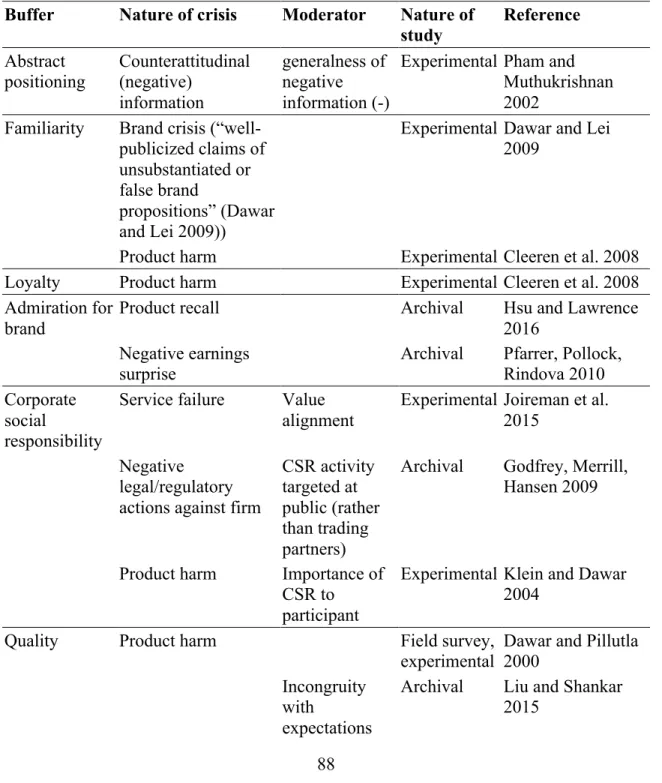
such as product-harm incidents, often cause rapid declines that are difficult to recover. Terry Clark (1988) tentatively defined a marketing crisis as “an event or issue which [has] the following characteristics: (i) Threatens marketing goals, (ii) reduces the marketer’s ability to control or direct the marketing environment, and (iii) decision or response time is short” (see Appendix A for an overview of marketing crisis literature). More subtle events such as changing consumer preferences simply chip away at brand effectiveness over time, leading to the same end result of lower brand equity. While brand equity is a well-studied concept, its resilience has often been overlooked, likely due the difficulty in predicting such future events and changing preferences.
Prior literature has shown that a brand can inoculate itself against marketing crises by achieving high quality standards (Dawar and Pillutla 2000; Liu and Shankar 2015; Pfarrer, Pollock, and Rindova 2010). Such standards are expected of nearly all brands, and therefore constitute an example of an injunctive norm. Even when someone buys an inexpensive product, there is an expectation that the product will perform its intended function. As we argued earlier, adherence to injunctive brand norms is antecedent to brand latitude. Brands that have high (low) brand latitude are thus, more readily able avoid, minimize, or overcome marketing crises, and other events that diminish brand equity. Thus, we make the following two propositions:
P8a: High (low) latitude brands will be more (less) likely to avoid a marketing crisis.
P8b: High (low) latitude brands will be more (less) likely to overcome a marketing crisis.
Brand Celebrity
Brands that are allowed to transcend the normal function of a brand can in some sense achieve celebrity status, characterized by a high level of public attention and positive sentiments about the brand (Rindova, Pollock, and Hayward 2006). Once
achieved, the level of brand attachment and commitment from customers is likely to help the brand avoid dangers such as shifting interest from customers. It also creates an ideal environment wherein loyal members of the public actively promote the brand free of charge. We argue that one outcome of a brand obtaining high brand latitude is that they ascend to a sort of celebrity status in which they are able to set the rules for their
category, they get free advertising from the press and loyal fans on social media, and they are able to weather or avoid various types of marketplace storms that other brands are affected by. Thus, we propose the following:
P9: High (low) latitude brands are more (less) likely to achieve brand celebrity status.
Discussion
Brands frequently deviate from category norms during the course of business. Often these deviations are simply minor departures from descriptive norms purposefully executed in order to draw increased attention to the brand. In other cases, these deviations are accidental or more egregious and can lead to marketing crises. While some brands are punished for the slightest of deviations, other brands seem to walk on water, and can get away with anything. Moreover, there are brands that actually transcend the normal function of a brand as a signal of expected characteristics of the products. Transcendent brands become trusted political voices and important identity signals for both groups and individuals. Normally, we would expect deviations from established norms, or the transcendence of a brand beyond its expected role to create a sense of dissonance within the observer due to the unexpectedness or even inappropriateness of the brand behavior that would lead to lower evaluations, but that is often not seen in these exceptional brands. Brand managers have a strong interest in figuring out ways to ensure that their deviations are not evaluated negatively.
The foregoing work provides a conceptual framework for a theory of brand latitude, including a testable set of propositions. We argue for its importance as an overlooked component of a brand’s true equity, explaining the portion of equity that is not encapsulated in a brand’s ability to increase revenue within its existing product category relative to a generically branded product. As part of this effort, we’ve drawn from multiple literature streams that examine brand deviations from a variety of lenses,
including product harm, advertising flexibility, and other types of strategy flexibility and marketing crises. Within our propositions we include various predictions that are relevant to managers regarding how to cultivate brand latitude, a highly desirable brand attribute, based on the foregoing literature review.
Future Research
First, the conceptual framework proposed herein and accompanying research propositions offer multiple opportunities for future brand latitude research. A variety of quantitative and qualitative investigative research programs would be appropriate for such an endeavor. Such programs of study could be used to further differentiate brand latitude from related concepts, explore its relationship to brand equity and brand value, and to understand the antecedents and outcomes of brand latitude, including any
moderators. Moreover, tests of mediation could assist in determining the process whereby various predictors of brand latitude lead to increased brand latitude. Potentially, brand transcendence and brand deviation can be studied as separate constructs to understand whether a brand must have both the capacity to transcend and to deviate simultaneously, or whether these are attributes that can be considered separately in brands that are high in one and low or average in the other.
Second, as discussed earlier, people are able to use both information about the brand (discussed in the preceding framework), and information about the message itself
into the properties of the message that might make it more or less palatable in various contexts relevant to brand latitude. One example that is discussed in Essay 2 is choice of narrative voice (first-person vs third) that is used when a brand references itself in messages that deviate from the norm in some respect (e.g., overt political messaging, edgy advertising messages, disclosure of breaches of trust).
CHAPTER III ESSAY 2:
HOW BRAND ATTRIBUTES AND CHOICE OF VOICE (FIRST-PERSON VS. THIRD) AFFECT BRAND LATITUDE IN CONTEXTS OF CONTROVERSIAL
ADVOCACY
Contribution Statement
This research aims to identify and explore the attributes of a brand that lead to higher or lower brand latitude in contexts of controversial public advocacy. Recall that brand latitude was defined as a public entity’s capacity to deviate from category norms or to transcend the normal function of a brand without incurring adverse responses from the public in Essay 1. Secondly, this research considers the brand’s approach to the style of the message itself—specifically the use of first person vs. third person voice. Managers increasingly desire to use their brand as a platform to engage in advocacy of a
controversial nature. A better understanding of which brands are able to credibly engage in such advocacy without fear of public backlash has thus become an important
marketing question. Moreover, the present research examines the process by latitude is granted to brands by consumers. If brand managers were to better understand their sources of brand latitude and how to develop it, they would be better able to leverage their latitude in communications.
Introduction
Brands and corporations have been increasingly pressured to take a stand on divisive social and political issues (Pinkham 2016). While many of these forays into controversy have ultimately been well-received, such as Nike’s 2018 partnership with Colin Kaepernick, a U.S. athlete and controversial activist, Pepsi’s 2017 partnership with reality star Kendall Jenner aimed at addressing the same topic proved to be catastrophic (Victor 2017). Prior research has challenged the wisdom of engaging in socially
responsible activities by providing evidence that it lacks economic benefits relative to other corporate efforts (Brown and Dacin 1997). This viewpoint, supportive of the neoclassical view of the firm, does not adequately consider the reality that firm decision-makers have motives besides profit-maximization (Monsen and Downs 1965). Given that firms are intent on engaging in controversy regardless of economic outcomes, it is
prudent to consider the circumstances under which such advocacy may be positively or negatively received by the public.
The aim of the present research is to evaluate potential antecedents of latitude to engage in advocacy at both the brand and message level. Latitude to engage in advocacy is characterized by a generally positive or neutral response to one’s efforts at engaging in the discussion around socially or politically divisive issues. A deeper understanding of the antecedents of brand latitude will help brand managers to evaluate whether they can successfully engage in controversial advocacy, and what they might do to improve their ability to do so more effectively in the future.
This research makes several contributions. First, building on social deviance theories, we offer an empirical examination of ways in which deviation from brand category norms may be positively received. As Rindova, Pollock and Hayward pointed out in 2016, “the processes that lead customers and other stakeholders to evaluate novel, nonconforming actions positively warrant closer attention” (p. 60). A lack of research in this area persists to this day.
Second, building on literature in adjacent fields of brand research that are latitude-relevant, we identify and test two brand attributes (citizenship and innovativeness) as potential antecedents of latitude to engage in controversial advocacy. Brand citizenship, a term we use to denote positive associations the public has with a brand due to a pattern of good behavior demonstrated by taking care of employees, charity involvement and other prosocial behaviors, positively predicts latitude to engage in advocacy. Innovativeness, already shown to be an antecedent to latitude to deviate in advertising contexts (Barone and Jewell 2013) is tested as a potential antecedent of latitude to engage in controversial advocacy.
Third, we address a gap in marketing communications literature regarding the effects of choice of narrative voice (first-person vs. third). While copywriters are forced to choose whether a given brand will address itself in the first or third-person, little is known about when a given narrative voice is preferred. The vast majority of research in marketing communications related to differences between use of first-person and third-person voice centers on the speaker, not the listener (Packard, Moor, and McFerran
consumers and other publics is an understudied topic in marketing literature. Because brand messages are more likely to be more critically evaluated when they relate to controversial advocacy, this study’s context provides an ideal environment to study choice of narrative voice in self-references.
In the studies that follow, both the properties of the brand (citizenship,
innovativess) and the properties of the message (narrative voice: first-person vs. third) are evaluated. Specifically, we hypothesize and provide experimental evidence that brand citizenship will lead to increased brand latitude (Studies 1 and 2). We also hypothesize and provide experimental evidence that brands that are perceived to be more innovative will have higher brand latitude to engage in controversial advocacy (Studies 1 and 2).
Next, using a large dataset of brand Twitter status updates, we shift our focus to evaluating the attributes of the message by testing and providing evidence for our hypothesis that—relative to noncontroversial brand messages—controversial advocacy messages will be more likely to be shared if they use first (vs. third) person voice to refer to themselves (Study 3). We then delve deeper into the discussion of narrative voice in message crafting by experimentally testing our hypothesis that third-person voice is more effective at driving types of engagement that require people to trust in the competence of the brand (Study 4). In experimentally testing H5, we explore the combined effects of brand citizenship, a brand attribute, and narrative voice, an attribute of the message. We provide initial evidence that the effectiveness of brand citizenship (H1) is attenuated by the use of third-person (first-person).
Theoretical Framework
Controversial Advocacy by Brands
We use the term controversial advocacy to describe engagement in a public debate that is currently divisive and morally-charged. Regardless of which side of the debate the brand enters into, it is likely to simultaneously please and offend large portions of the media and the general population. In recent years consumer brands have
increasingly engaged in the public debate over controversial issues. While some brands are pushed by external and internal stakeholders into taking a stand, other brands
voluntarily enter the fray with no apparent economic incentive for doing so. A prominent example of activism of a voluntary nature is U.S. apparel brand, Patagonia’s, staunch commitment to environmentalism, which has repeatedly pitted the brand against conservative policy and politicians (Bain 2017). According to Patagonia’s website, environmentalism, and by implication not profit, is the purpose of the business (Patagonia 2018). Other brands are likewise increasing their commitment and visibility with regard to various divisive issues that their founders or other stakeholders feel strongly about. According to Levi’s CEO, Chip Berg, taking a stand is a moral obligation that has the beneficial secondary effect of increasing employee loyalty (Schulman 2018). These brands are essentially leveraging their prominent place in society to promote their political or moral viewpoint.
Brands Subject to Social Norms
Societies have informal social norms to indicate what behavior is appropriate in a given time and place. Norms are generally seen as useful because they regulate conduct in a way that promotes order and civility (Gilovich et al. 2015). Given all of the literature showing that brands are often personified by consumers (e.g., Aggarwal and McGill 2011), it follows that brands too should follow an established set of social norms. Like humans, brands often deviate from established norms.
A brand’s deviation from norms may occur as part of an effort to stand out from the competition and be noticed, or it may simply be an accident. Following a deviation, consumers may choose to disregard the deviation, or evaluate it positively or negatively. In 2006, Rindova, Pollock and Hayward pointed out that “the processes that lead
customers and other stakeholders to evaluate novel, nonconforming actions positively warrant closer attention.” Yet, in subsequent years, there has been only a limited amount of investigation into what might make these deviations by brands seem more acceptable. We previously defined brand latitude as a public entity’s capacity to deviate from
category norms or to transcend the normal function of a brand without incurring adverse responses from the public (see Essay 1). Here we investigate how brands develop
latitude.