51935-88
Gel-filled pH Electrode
TABLE OF CONTENTS
SPECIFICATIONS... 5 SAFETY PRECAUTIONS ... 7SECTION 1 INTRODUCTION
... 9 1.1 Electrode Description ... 9 1.2 Electrolyte Description... 101.3 Conditioning the Electrode... 10
1.4 Measuring Hints ... 11
1.5 Checking the Slope... 12
1.6 General Applications... 12
SECTION 2 APPLICATIONS (sension2, 3, & 4 meters)
... 13pH, WATER AND WASTEWATER ... 15
SECTION 3 ELECTRODE MAINTENANCE
... 213.1 Storing the Electrode... 21
3.2 Cleaning the Electrode ... 21
SECTION 4 pH ELECTRODE CHARACTERISTICS
... 234.1 Theory of Operation ... 23
4.2 Sodium Error Interferences ... 24
SECTION 5 TROUBLESHOOTING
... 25ELECTRODE SERVICE REQUEST QUESTIONNAIRE ... 29
GLOSSARY
... 31GENERAL INFORMATION
... 35HOW TO ORDER... 37
REPAIR SERVICE... 38
SPECIFICATIONS
Specifications are subject to change without notice.
Electrode Type
pH combination with temperature probe
Range 0-14 pH units Isopotential Point 7.00 ±0.5 pH units (0 ±29 mV) Electrode Resistance 250 Mohms at 25 °C (new) Slope -58 ±3 mV at 25 °C Temperature Range Routine Use—0 to 45 °C (32 to 113 °F) Occasional Use—0 to 100 °C (32 to 212 °F) Storage -40 to 50 °C (-40 to 122 °F)
Reference Half Cell
Ag/AgCl
Dimensions
Tip Diameter—12 mm (0.472 inches) Total Length—152.4 mm (6 inches) Cable Length—0.91 m (36 inches)
Cable Connector
•
sension 5-pin Connector (Cat. No. 51935-00)•
Hach One® Meter Series BNC & 3.5 mm Phone Connector(Cat. No. 51935-11)
SECTION 1
INTRODUCTION
1.1
Electrode Description
The sens
ion
™ Gel-filled pH Electrode (Figure 1) is a reliable electrode designed for general purpose pH measurement.Figure 1 sens
ion
Gel-filled pH Electrode Gel-filled pH Electrode withtemperature probe, 5-pin connector for use with sens
ion™
pH meters (Cat. No. 51935-00)Gel-filled pH Electrode with temperature probe, BNC & 3.5 mm connector for use with Hach One® pH meters
(Cat. No. 51935-11)
Gel-filled pH Electrode with temperature probe, BNC & DIN connector for use with EC series pH meters
SECTION 1,
continued
The sens
ion
Gel-filled pH Electrode uses a silver/silver chloride reference element with a glass frit junction and a full-range pH glass that can be used in a wide variety of applications, especially at extreme levels of pH. If using the sension
System, the meter will automatically account for buffer temperatures during calibration and factor the information into the reported pH. The Auto Buffer Recognition/Auto Temperature Compensation calibration program built into sension
meters contains accurate pH profiles for buffers of pH 4.01, 6.86, 7.00, and 10.01 at temperatures from 0 to 60 °C.1.2
Electrolyte Description
The reference electrolyte in this non-refillable pH electrode is a low viscosity gel that slowly diffuses through the porous reference junctions (Figure 2). The gel is saturated with
potassium chloride (KCl) and silver chloride (AgCl2). Additional KCl crystals are added to the electrode during manufacture to offset losses through diffusion and maintain KCl saturation during the lifetime of the electrode.
Figure 2 Electrode End View
1.3
Conditioning the Electrode
When a pH bulb is immersed in an aqueous solution, a hydrated layer slowly forms at the glass/liquid interface. The formation characteristics of this layer depend upon the type of glass, the age of the glass, the previous usage history of the glass, the
temperature and ionic strength of the aqueous solution, etc. This hydrated layer affects the sensing properties of the bulb (charge transfer, and ion transport). A dry bulb will not function.
pH Bulb Temperature Sensor Reference Junction END VIEW
SECTION 1,
continued
To ensure the full development of the hydrated layer, electrodes should be conditioned for several minutes in a solution
comparable to the sample in terms of pH and ionic strength.
Normal Conditioning
(For routine measurements in samples of moderate to high conductivity, approximately 150 µS and greater):
Initial use: During shipping, the electrode is kept hydrated by a
cotton/wool ball saturated in a pH 4.00 buffer/KCl solution. The electrode and saturated ball are encased in a protective vinyl cap. Before using the electrode, remove the cap and soak the electrode tip in a pH 4.0 or pH 7.0 buffer. If the cotton ball is saturated, the electrode will be hydrated after several minutes in the NIST standard. If the cotton ball and electrode are dry, the bulb typically requires soaking in the standard for 30 minutes before becoming hydrated.
Between uses: Between sample measurements of medium to
high conductivity, store the electrode in Hach Electrode Storage Solution, a pH 6.35/1.7 M KCl buffer solution. The solution keeps the bulb hydrated and prevents the reference gel from solidifying in the reference junction. Hach electrode storage solution is available in powder pillow form for dilution with deionized water or as a prepared solution.
1.4
Measuring Hints
These suggestions will improve the accuracy of your calibration and sample measurement.
•
Allow the potential to stabilize completely(<1 mV/minute drift) before accepting a calibration point or sample reading. Meters set to higher resolutions will take longer to stabilize than meters set to lower resolutions.
•
Use calibration standards and samples that are at the same temperature to improve accuracy.•
Use fresh calibration standards to achieve greater accuracy.•
Thoroughly rinse and blot the electrode dry between sample measurements or rinse with small volumes of sample or deionized water.SECTION 1,
continued
•
Measure samples within a short period of time after collecting. Weakly buffered alkaline solutions can absorb carbon dioxide causing downward drift of pH readings. Cover samples if necessary.•
A multi-point calibration will ensure more accurate measurements than a single point calibration.1.5
Checking the Slope
After calibrating the electrode with fresh buffer, check the slope using the sens
ion
meter’s calibration review option. A slope of 58 ±3 mV indicates a properly functioning electrode.1.6
General Applications
SECTION 2 describes a general application for the Gel-filled
pH Electrode. Specific applications include:
•
Water and wastewater treatment to monitor influent and effluent quality.•
Agricultural applications including soil, fertilizer, food, and feed.•
Chemical and biological research.•
Industrial processes in the manufacture of foods, beverages, pharmaceuticals, dyes, photographic film, plating, and chemicals.•
Continuous sampling in aqueous samples up to 45 °C and intermittently in aqueous samples up to 100 °C.For information regarding applications not described in this manual, contact Hach Technical and Customer Service.
pH, WATER AND WASTEWATER
(above 150 µS/cm)1.
Connect the electrode to thesens
ion2
pH/ISE meter.Note: Ensure that the electrode has been conditioned according to instructions in Section 1.3 on page 10.
2.
Turn on the meter by pressing I/O. PresspH mV until the display shows pH.
3.
Press SETUP. Press the up arrow three times. Press ENTER to move to the desired number of decimal places, thenEXIT to leave setup.
4.
In two 50-mL beakers or cups, prepare buffers of 4.0 and 7.00 pH or 7.00 and 10.0 pH.Note: The sample pH should fall within the range of the calibration buffers. Note: pH 6.86 buffer may be used instead of pH 7.0. Autobuffer recognition for either pH 6.86 or 7.0 is user selectable in the sension meter setup function.
pH, WATER AND WASTEWATER,
continued
5.
Press CAL. The display will show:Standard 1?.
6.
Rinse electrode in deionized water and blot dry.7.
Place the electrode in pH 7.0 buffer. PressENTER. The display shows:
Stabilizing...
Note: Temperature variation causes changes in buffer pH. Hach sension meters correct for these changes during calibration when using buffers of pH 4,6.86, 7, and 10.
8.
When a stable pH is determined, the display will show Standard 2?. Remove the electrode from the cup. Rinse and blot dry.Note: The meter will select a stable reading using default meter parameters and the specified resolution. To override the default meter parameters, see the meter manual.
9.
Place the electrode in the 4.0 (or 10.0) pH buffer. Press ENTER.10.
After the last calibration point has stabilized and the display readsStandard 3?, press EXIT.
Note: For a three-point calibration, repeat steps 9-10 with an additional buffer.
11.
The display will show Store?. PressENTER to store the calibration or EXIT to leave the calibration mode without storing the values.
12.
Rinse the electrode with deionized water followed by a small amount of sample and blot dry.cal
0
READ
enter
READ
enter
READ enter ORpH, WATER AND WASTEWATER,
continued
Sampling and Storage
Collect samples in clean plastic or glass bottles. Fill completely and cap tightly. Cool to 4 °C and determine pH within six hours. If samples cannot be analyzed within six hours, report the actual holding time with the results.
Accuracy Check
Checking Electrode Response
An electrode is responding properly if its calibration slope is 58±3 mV per pH unit.
Checking Calibration Accuracy
Returning the electrode to a calibration buffer and determining the pH provides a good test of the system. Rinse and recondition the electrode before measuring subsequent samples.
Checking the Precision of the Sample Reading
When practical, measure the pH of the sample several times and report the average pH. sens
ion
2 meters will store and calculatethe average of up to 99 readings.
13.
Place the electrode in the sample.14.
Store or record the pH and temperature readings when they stabilize.pH, WATER AND WASTEWATER,
continued
Method Performance
Precision
In a single lab using an ASTM Substitute Wastewater Standard, specification number D5905-96, and two electrodes with a single
sension2, a single operator obtained a standard deviation of
0.005 pH. Each electrode was exposed to seven test solutions with no rinsing in between and with a default stability of 0.5 mV/min.
Interferences
Sodium error may occur in samples with pH 12 or higher. See
Section 4.2 on page 24.
Summary of Method
Water with relatively high conductivity typically has a fairly high buffer capacity. Slight pH changes due to absorption of carbon dioxide are usually not significant. If the sample conductivity is not known and high accuracy is desired, use the Platinum Series pH Electrode and follow either the Low Ionic Strength or high purity method.
The sens
ion
Gel-filled pH Electrode responds to the hydrogen ion concentration (activity) by developing an electrical potential. At a constant temperature, this potential varies linearly with the pH of the solution being measured.pH, WATER AND WASTEWATER,
continued
REQUIRED REAGENTS AND APPARATUS
Quantity Required
Description Per Test Unit Cat. No.
Gel-filled pH Electrode w/Temp., 5-pin...1 ...each ...51935-00 Gel-filled pH Electrode w/Temp., BNC & 3.5mm...1 ...each ...51935-11 Gel-filled pH Electrode w/Temp., BNC & DIN...1 ...each ...51935-22
sension2 Portable pH/ISE Meter/with electrode ...1 ...each ...51725-10
sension1 Portable pH/mV Meter/with electrode ...1 ...each ...51700-11
OPTIONAL REAGENTS
Buffer, Powder Pillow
pH 4.01, color-coded red... 15/pkg ...22269-95 pH 6.86... 15/pkg ...14098-95 pH 7.00, color-coded yellow ... 15/pkg ...22270-95 pH 10.00, color-coded blue... 15/pkg ...22271-95 Singlet pH Solution, pH 7 and 10 ...10 each/pkg ...27698-20 Singlet pH Solution, pH 4 and 7 ...10 each/pkg ...27699-20 Singlet pH Solution, pH 4 ... 20/pkg ...27700-20 Singlet pH Solution, pH 7 ... 20/pkg ...27701-20 Singlet pH Solution, pH 10 ... 20/pkg ...27702-20 Singlet pH Solution,Rinse Solution ... 20/pkg ...27703-20 Buffer Solution, pH 4 (red) ...500 mL ...22834-49 Buffer Solution, pH 7 (yellow)...500 mL ...22835-49 Buffer Solution, pH 10 (blue) ...500 mL ...22836-49 pH Storage Solution Powder Pillows ... 20/pkg ...26573-64 Water, deionized ...4 L ...272-56
OPTIONAL APPARATUS
Sample Bottles
General Purpose with Screw-cap, polypropylene, 500-mL ...each ...27581-10 Cleaned and Certified, HDPE, for EPA reporting, 500-mL...each ...27582-10
SECTION 3
ELECTRODE MAINTENANCE
The sens
ion
™ Gel-filled pH Electrode has been designed to give trouble-free use, but requires careful handling to extendlongevity. This section presents methods of storing and cleaning the electrode.
3.1
Storing the Electrode
Proper electrode storage requires different approaches based on how long the electrode will be stored, how quickly the electrode needs to be used, and the type of sample being measured. Storage affects the reference electrolyte gel, the Ag/AgCl reference element, and the pH sensing glass bulb.
Intermittent storage: Between uses, store the electrode in
solutions of similar ionic strength and pH to the samples of interest. Carefully rinse the electrode to prevent sample contamination.
Overnight storage: Store the electrode in Hach Electrode
Storage Solution to keep the electrode hydrated.
Shelf Storage: For very long-term storage, store the electrode
dry. For faster reconditioning in the future, wet the cotton/wool ball located in the vinyl storage cap with storage solution. Place the cap over the electrode. This will help keep the bulb hydrated.
3.2
Cleaning the Electrode
A contaminated glass bulb or fouled electrode may cause slow response times. Clean the electrode only after following the steps described in SECTION 5 TROUBLESHOOTING or when the electrode is known to be dirty. Do not clean the bulb more frequently than necessary, or bulb life may shorten. Clean the electrode according to the type of contaminant present:
General contamination—Immerse the electrode tip in 0.1 N
Hydrochloric Acid followed by immersion in 0.1 N Sodium Hydroxide and again in 0.1 N Hydrochloric Acid, each for a 2-minute period. Rinse with deionized water. Soak in deionized water for at least 15 minutes.
Oils and fats—Immerse the electrode tip in a detergent solution
such as Alconox™. Use a soft brush or ultrasonic bath if necessary. Avoid scratching the glass bulb.
SECTION 3,
continued
Organic films—Use an appropriate solvent, such as methanol or
acetone.
Note: Keep the cable and connector away from dirt, abrasives, and
harsh solvents.
If these steps fail to improve electrode response, complete the
ELECTRODE SERVICE REQUEST QUESTIONNAIRE on
SECTION 4
pH ELECTRODE CHARACTERISTICS
4.1
Theory of Operation
pH is a measure of the hydrogen ion activity in a solution and is defined as: -log10 aH+ where aH+ is the activity of the hydrogen ion. The 0-14 range of pH measurement is the measurement of a difference in hydrogen ion concentration of 100,000,000,000,000 (1 x 10¹⁴). This means that at pH 0, the hydrogen ion
concentration is 1 x 10¹⁴ times greater than at pH 14. This also
means that the hydroxyl ion concentration at pH 14 is 1 x 10¹⁴
times greater than at pH 0.
When the hydrogen and hydroxyl ions are present in equal numbers (the neutral point), the pH is 7. pH values from 0 to 7 are termed acidic and those from 7 to 14 are termed basic. It is important to note that a pH change of one unit (for instance from pH 6 to pH 7) is a factor-of-10 change in hydrogen ion
concentration.
The glass membrane of a pH electrode responds to the hydrogen ion activity by developing an electrical potential at the
glass/liquid interface. At a constant temperature, this potential varies linearly with the pH of the solution being measured. The change in potential per pH unit is termed the slope of the electrode. The slope of the electrode increases linearly with temperature.
The potential inside the pH glass bulb is fixed by the filling solution, and the reference electrode potential is constant. For these reasons, any change in the potential of the electrode system at a given temperature will be due to any change in the pH of the solution being measured.
Effects of temperature on pH measurements depend on the reference electrode used, pH of the solution within the pH electrode and pH of the test solution. At a certain pH, temperature will have no effect on the potential of the electrode system. This is known as the isopotential point. Also, at some pH level, the system will exhibit no potential. This is known as the zero potential point. Both the isopotential point and the zero potential point are features designed into electrodes. Hach electrodes are designed so the isopotential and zero potential points are at pH 7 to minimize temperature effects at this calibration point. At
SECTION 4,
continued
25 °C, an electrode performing at 100% efficiency will decrease by 59.2 mV for every unit increase in pH.
4.2
Sodium Error Interferences
Sodium error occurs at elevated pH values when sodium ions in the sample solution are incorrectly sensed as hydrogen ions by the glass pH bulb. Below pH 12, sodium error is negligible. The pH sensing bulbs can be optimized for different applications by altering glass composition. This electrode has been designed using a research-grade, full-range glass that is less susceptible to sodium ion error. Accurate pH values (less than 0.1 pH error) will be achieved at up to 100 mM Na+ concentrations in the range of
12 to 13 pH units, and up to 50 mM both at 25 °C in samples of pH 14.
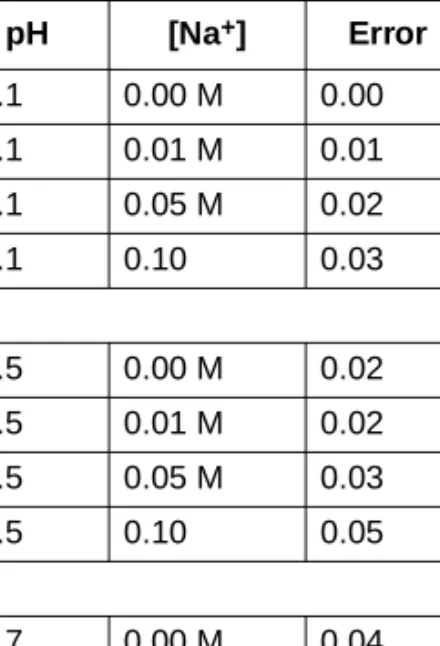
In a single lab, using a sample group of three pH sensing half-cells, in a controlled test versus a Standard Hydrogen Electrode, the following results were obtained:
Use the values presented in Table 1 to correct for sodium error in samples of similar composition. Add the error values listed below to the pH sensed by the electrode.
Table 1 Sodium Ion Error
pH [Na+] Error 12.1 0.00 M 0.00 12.1 0.01 M 0.01 12.1 0.05 M 0.02 12.1 0.10 0.03 12.5 0.00 M 0.02 12.5 0.01 M 0.02 12.5 0.05 M 0.03 12.5 0.10 0.05 13.7 0.00 M 0.04 13.7 0.01 M 0.06 13.7 0.05 M 0.07
SECTION 5
TROUBLESHOOTING
Symptom Cause Remedy
No response Electrode is improperly connected to meter.
Check connection. If a two-channel meter, is the
electrode connected to the displayed channel? (A shorting cap on a channel input will show
ZERO on the display.)
Reconnect the electrode to the desired channel or change the displayed channel on the meter.
Connector is dirty or wet. 1. Inspect both male and female connector.
2. Clean with mild solvents such as alcohol or acetone.
3. Clean and dry with a lint-free cloth or compressed air.
Reference junction is blocked. Immerse in hot water or an ultrasonic bath for several minutes.
pH sensing bulb and reference junction are not in contact with the sample.
Submerge the probe deeper into the sample.
Cable contains kinks, breaks, loose connectors, etc.
Replace or repair electrode. The meter is broken. 1. Try another electrode.
2. Try the other channel.
3. Check and replace batteries, if necessary.
4. Put shorting caps on and see if meter ‘zeros’.
The meter is not set up to read the appropriate connector.
Select the appropriate connector from the meter setup menu (5-pin on sens
ion
meters).Out-of-range response See “No response”, above. See “No response”, above. The bulb may be broken. Replace bulb.
SECTION 5,
continued
Erratic response Electrode is not plugged-in to selected meter channel.
Plug electrode into meter channel. Extreme external electrical fields
are present. (The pH cable, though shielded, can act as an antenna.)
Install a shorting cap on the unused meter terminal.
Do not use stirrers in low ionic strength solutions.
Avoid static electricity, nearby pumps, power supplies, etc.
pH sensing bulb and reference junction are not in contact with the sample.
Submerge the probe deeper into the sample.
The sample chemistry is changing.
None. The pH of a LIS solution is
changing due to CO2 uptake.
Use LIS Chamber Accessory. The bulb is cracked, discolored,
or contaminated.
If dirty, clean according to Section 3.2 on page 21.
If cracked, discard electrode. The sample container is
contaminated.
Use a clean sample container.
Low slope Bulb is old. Replace electrode.
Bulb is dirty. Clean according to Section 3.2 on page 21.
Standards are inaccurate. Make sure standards were entered into meter correctly.
Use only NIST traceable buffers. Use fresh buffers.
Change buffers frequently. History of harsh usage. Replace electrode.
Cracked bulb. Replace electrode.
High slope Buffers are incorrect. Use appropriate buffers. Incorrect measurement or
calibration technique.
Follow procedures described in SECTION 2 on page 13. Temperature variations in
standards.
Keep sample and standards at same temperature.
Standards contaminated. Prepare fresh standards.
SECTION 5,
continued
High offset Leakage pathway results in stray voltage via internal electrical short.
Return electrode under warranty.
Reference gel has become diluted or junction is plugged by a clogged frit.
Submerge in hot water or an ultrasonic bath to attempt to unclog the frit. Replace electrode if no improvement occurs.
Cracked bulb. Replace electrode.
Sluggish response Sample is cold and of low ionic strength.
Wait patiently.
Improper conditioning. Condition according to Section 1.3 on page 10.
Bulb, guard, and electrode stem are dirty.
Clean according to Section 3.2 on page 21.
ELECTRODE SERVICE REQUEST QUESTIONNAIRE
1. What model of meter is the electrode being used with? 2. What is the complete lot code of the electrode (located on theelectrode cable)?
3. What is the date the electrode was purchased? 4. How long has the electrode been in use? 5. What types of samples are being tested?
6. What is the temperature of the samples being tested? 7. How often is the electrode being used?
8. How is the electrode being stored between uses? 9. What is the electrode slope during a typical calibration? 10. If a new electrode, has it been conditioned according
to instructions?
11. If the electrode has been in use for awhile, what maintenance
has been performed?
12. Describe the suspected problem or failure of the electrode. 13. When calling for telephone support, have your meter,
electrode, buffers/standards, and this completed questionnaire near the phone before calling.
14. Did you use Ionic Strength Adjustor in samples or standards? 15. Did you use a low range method for Low Ionic Strength
and high purity water samples with conductivity below 150µ/cm?
GLOSSARY
Acid—a chemical compound that contributes hydrogen ions (H+)
to an aqueous solution or causes the pH to be less than 7.0.
Acidic—A solution or system with a pH less than 7.0.
Activity—The measure of work performed by an ion as it moves
through a system. The activity is dependent upon the
concentration of all ions in the system and the charge associated with the ion.
Alkali—A solution or system with a pH greater than 7.0. Alkalinity—Capacity of water to accept hydrogen ions (H+).
Indicates presence of carbonate (CO32-), bicarbonate (HCO 3),
and hydroxyl (OH-) ions.
Anion—A negatively charged ion (i.e., NO3-, Cl-).
Base—A chemical compound that contributes hydroxide ions
(OH-) to an aqueous solution or causes the pH to be greater
than 7.0.
Buffer—
a. A compound, mixture of compounds, or solution which,
when added to a system, changes pH to a specified, known value.
b. The ability a solution or system to resist change in pH if
either an acid or a base is added.
Buffering capacity—A measurement of the amount of acid or
base which can be added to a solution before the pH changes.
Cation—A positively charged ion (i.e., NH4+, Ca 2+).
Combination electrode—An electrode composed of a reference
half-cell and a sensing half-cell. The reference half-cell is the half of the electrode pair that maintains a constant potential regardless of solution composition. The sensing half-cell develops a
GLOSSARY,
continued
Conditioning—The process of preparing an electrode for use by
soaking the electrode in a solution with a pH and ionic strength similar to the sample. Conditioning allows the hydrated layer, necessary for accurate measurements, to form.
Decade—Any two standards with a concentration ratio of 10.
For example:
Dilution factor—A numerical value by which results must be
multiplied in order to obtain the actual value of the sample. For example, if 1 mL of sample is diluted to 10 mL, then the result obtained must be multiplied by 10 to obtain the value for the sample before dilution.
Electrolyte—A solution made of dissolved ions that is used to
facilitate electrical conductance and ionic transport. The
composition is usually potassium chloride (KCl), sodium chloride (NaCl), ammonium chloride (NH4Cl), or ammonium sulfate (NH4)2SO4).
Free-flowing reference junction—The point on the electrode
where reference gel is freely dispensed without obstruction by frits or other materials.
Hydrated layer—A layer that forms at the glass/liquid interface.
Chemically similar to the sample being measured (especially in samples of low ionic strength), the formation characteristics of this layer depend upon the type of glass, the age of the glass, the previous usage history of the glass, the temperature and ionic strength of the aqueous solution, etc.
Inert—Does not react with other substances.
Ion—An atom, group of atoms or molecule that is electrically
charged as the result of gaining or losing electrons. An ion resulting from the gain of electrons becomes negative (anion), while an ion resulting from the loss of electrons becomes positive (cation).
Ionic strength—A measure of the concentration of any ion in
solution, usually expressed in moles per liter.
Concentration of the higher Standard Concentration of the lower Standard
GLOSSARY,
continued
Occasional use—Infrequent use where the probe is subjected to
test conditions just long enough to obtain a proper reading.
pH—A relative numerical measurement of the acidic, neutral, or
alkali nature of a solution or system. Mathematically defined as the negative log of the hydrogen ion concentration.
Potential—The capacity of a system to perform work. When two
ions of opposite charge are separated by a distance, there is a potential developed from the tendency of the ions to come back together. Each ion exerts work to come back together. The amount of work needed by each ion to come back together is the potential.
Reference element—A silver wire coated with silver chloride,
this element develops a constant potential when immersed in an electrolyte such as potassium chloride.
Reference half-cell—Provides a constant voltage against which
the pH dependent voltage from the sensing half-cell is compared.
Reference junction—The point on the electrode where reference
gel is dispensed.
Routine use—Typical use following regular, frequent routines,
but not continuous as with an in-line monitoring process.
Salt—An ionic compound.
Sensing half-cell—Provides a voltage proportional to the
concentration of a specific ion in solution.
Siemen—The unit of conductivity equivalent to mho (ohm-1).
Conductivity is often expressed as microSiemens per centimeter (µS/cm) and milliSiemens per centimeter (mS/cm) and is a measure of how readily a sample conducts electricity. More concentrated solutions conduct more electricity and have higher conductivity.
Sodium error (alkaline error)—Occurs in strongly alkaline
solutions, generally greater than 12 pH, when concentrations of H+ are low, and small, positively charged ions such as Na+
generate potential differences across the pH glass membrane. These differences can result in measurement errors between -0.5 and -1.0 pH.
At Hach Company, customer service is an important part of every product we make.
With that in mind, we have compiled the following information for your convenience.
HOW TO ORDER
Information Required
Technical and Customer Service (U.S.A. only)
Hach Technical and Customer Service Department personnel are eager to answer questions about our products and their use. Specialists in analytical methods, they are happy to put their talents to work for you.
Call 1-800-227-4224 or E-mail [email protected].
International Customers
Hach maintains a worldwide network of dealers and distributors. To locate the representative nearest you, send E-mail to
intl@hach. com or contact:
In Canada, Latin America, Africa, Asia, Pacific Rim:
Telephone: (970) 669-3050; FAX: (970) 669-2932
In Europe, the Middle East, or Mediterranean Africa: HACH Company, c/o
Dr. Bruno Lange GmbH Willstätterstr. 11 D-40549 Düsseldorf Germany Telephone: +49/[0]211.52.88.0 Fax: +49/[0]211.52.88.231
By Telephone:
By Mail:
6:30 a.m. to 5:00 p.m. MST Monday through Friday (800) 227-HACH (800-227-4224) By FAX: (970) 669-2932 Hach Company P.O. Box 389 Loveland, CO 80539-0389 U.S.A.Ordering information by E-mail: [email protected]
•
Hach account number (if available)•
Billing address•
Your name and phone number•
Shipping address•
Purchase order number•
Catalog numberREPAIR SERVICE
Authorization must be obtained from Hach Company before sending any items for repair. Please contact the HACH Service Center serving your location.
In the United States:
Hach Company 100 Dayton Avenue Ames, Iowa 50010 (800) 227-4224 (U.S.A. only) Telephone: (515) 232-2533 FAX: (515) 232-1276 In Canada:
Hach Sales & Service Canada Ltd. 1313 Border Street, Unit 34 Winnipeg, Manitoba R3H 0X4 (800) 665-7635 (Canada only) Telephone: (204) 632-5598 FAX: (204) 694-5134 E-mail: [email protected]
In Latin America, the Caribbean, the Far East, the Indian Subcontinent, Africa, Europe, or the Middle East:
Hach Company World Headquarters P.O. Box 389 Loveland, Colorado, 80539-0389 U.S.A. Telephone: (970) 669-3050 FAX: (970) 669-2932 E-mail: [email protected]
WARRANTY
Hach warrants most products against defective materials or workmanship for at least one year from the date of shipment; longer warranties may apply to some items.
HACH WARRANTS TO THE ORIGINAL BUYER THAT HACH PRODUCTS WILL CONFORM TO ANY EXPRESS WRITTEN WARRANTY GIVEN BY HACH TO THE BUYER. EXCEPT AS EXPRESSLY SET FORTH IN THE PRECEDING SENTENCE, HACH MAKES NO WARRANTY OF ANY KIND WHATSOEVER WITH RESPECT TO ANY PRODUCTS. HACH EXPRESSLY DISCLAIMS ANY WARRANTIES IMPLIED BY LAW,
INCLUDING BUT NOT BINDING TO ANY WARRANTY OF MERCHANTABILITY OR FITNESS FOR A PARTICULAR PURPOSE.
LIMITATION OF REMEDIES: Hach shall, at its option, replace or repair nonconforming products or refund all amounts paid by the buyer. THIS IS THE EXCLUSIVE REMEDY FOR ANY BREACH OF WARRANTY.
LIMITATION OF DAMAGES: IN NO EVENT SHALL HACH BE LIABLE FOR ANY INCIDENTAL OR CONSEQUENTIAL DAMAGES OF ANY KIND FOR BREACH OF ANY WARRANTY, NEGLIGENCE, ON THE BASIS OF STRICT LIABILITY, OR OTHERWISE.
This warranty applies only to Hach products purchased and delivered in the United States.
Catalog descriptions, pictures and specification, although accurate to the best of our knowledge, are not a guarantee or warranty.
For a complete description of Hach Company’s warranty policy, request a copy of our Terms and Conditions of Sale for U.S. Sales from our Customer Service Department.