EXPLORING CLASSIFICATION ALGORITHMS AND DATA
FEATURE SELECTION FOR DOMAIN SPECIFIC
INDUSTRIAL TEXT DATA
Master Thesis IMSE
Student:Alejandro Gabriel Villanueva Zacarias Academic Supervisors:
Prof. Dr.-Ing. Habil. Bernhard Mitschang – University of Stuttgart Prof. Dr. Kostas Magoutis – University of Crete
Prof. Dr. Willem-Jan van den Heuvel– Tilburg University M.A. Laura Bernadette Kassner – University of Stuttgart
Abstract
Unstructured text data represents a valuable source of information that nonetheless remains sub utilised due to the lack of efficient methods to manipulate it and extract insights from it. One example of such deficiencies is the lack of suitable classification solutions that address the particular nature of domain-specific industrial text data. In this thesis we explore the factors that impact the performance of classification algorithms, as well as the properties of domain-specific industrial text data, to propose a framework that guides the design of text classification solutions that can achieve an optimal trade-off between accuracy and processing time. Our research model investigates the effect that the availability of data features has on the observed performance of a classification algorithm. To explain this relationship, we build a series of prototypical Naïve Bayes algorithm configurations out of existing components and test them on two role datasets from a quality process of an automotive company. A key finding is that properly designed feature selection techniques can play a major role in achieving optimal performance both in terms of accuracy and processing time by providing the right amount of meaningful features. We test our results for statistical significance, proceed to suggest an optimal solution for our application scenario and conclude by describing the nature of the variable relationships contained in our research model.
Abstract ... 2 1 INTRODUCTION ... 3 1.1 Research Motivation ... 3 1.2 Research Problem ... 5 1.3 Research Questions ... 7 1.4 Research Method ... 8 1.5 Thesis Structure ... 11 2 METHODOLOGY ... 12
2.1 Knowledge Base Creation ... 12
2.2 Conceptual Architecture for Text Document Classification ... 13
2.3 Data Exploration ... 13
2.4 Study Object Characterisation ... 13
2.5 Method to Select Optimal Classification Algorithm Configuration and Features13 2.6 Experiments ... 13
2.7 Evaluation ... 14
2.8 Limitations ... 14
3 THEORETICAL FRAMEWORK ... 15
3.1 Feature Extraction Mechanisms... 17
3.2 Feature Selection Strategies ... 20
3.3 Classification Algorithms ... 23
3.4 Related Technologies ... 26
4 FRAMEWORK TO OPTIMISE DATA FEATURES AND CLASSIFICATION ALGORITHMS ... 28
4.1 Conceptual Architecture for Text Classification ... 28
4.2 Data Exploration ... 30
4.3 Study Object Characterisation ... 56
4.4 Method to Select Optimal Classification Algorithm Configuration and Features59 5 EXPERIMENTS AND EVALUATION ... 63
5.1 Classification Algorithm Selection ... 63
5.2 Technical Setup ... 64
5.3 Extract All Data Features ... 66
5.4 Choose Document Representation and Weight Scheme ... 66
5.5 Data Exploration ... 66
5.6 Coverage ... 67
5.7 Naïve Bayes Algorithm Configurations ... 67
5.8 Algorithm Configuration Results... 68
5.9 Algorithm Configurations Evaluation ... 77
5.10 Artefacts Evaluation ... 84
6 CONCLUSIONS AND FUTURE RESEARCH ... 87
References ... 89
7 APPENDICES ... 92
7.1 Function Words Lists for English and German ... 92
TABLE OF FIGURES
FIGURE 1 SIMPLIFIED QUALITY INSPECTION PROCESS (ADAPTED FROM (KASSNER & MITSCHANG 2016)) 5 FIGURE 2 SEVEN GUIDELINES OF DESIGN SCIENCE RESEARCH (HEVNER ET AL. 2004). 9
FIGURE 3 DESIGN EVALUATION METHODS (HEVNER ET AL. 2004). 11
FIGURE 4 RESEARCH MODEL BASED ON THE CONCEPTS OF (COOPER & SCHINDLER 2011) 12 FIGURE 5 APPLAUDING CONCEPTUAL ARCHITECTURE (KASSNER ET AL. 2014) 15 FIGURE 6 COMPARISON BETWEEN THE ORIGINAL AND DETAILED CONCEPTUAL ARCHITECTURES. ADAPTED
FROM (KASSNER ET AL. 2014) 16
FIGURE 7 EXAMPLE OF SUPPORT VECTOR MACHINES CLASSIFICATION 25
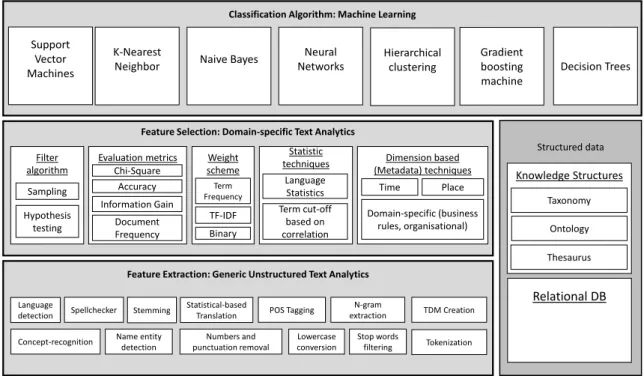
FIGURE 8 FULL DETAIL VIEW OF THE CONCEPTUAL ARCHITECTURE FOR TEXT-DOCUMENT CLASSIFICATION 29
FIGURE 9 RELEVANT STRUCTURED DATA FOR EVERY CAR PART 30
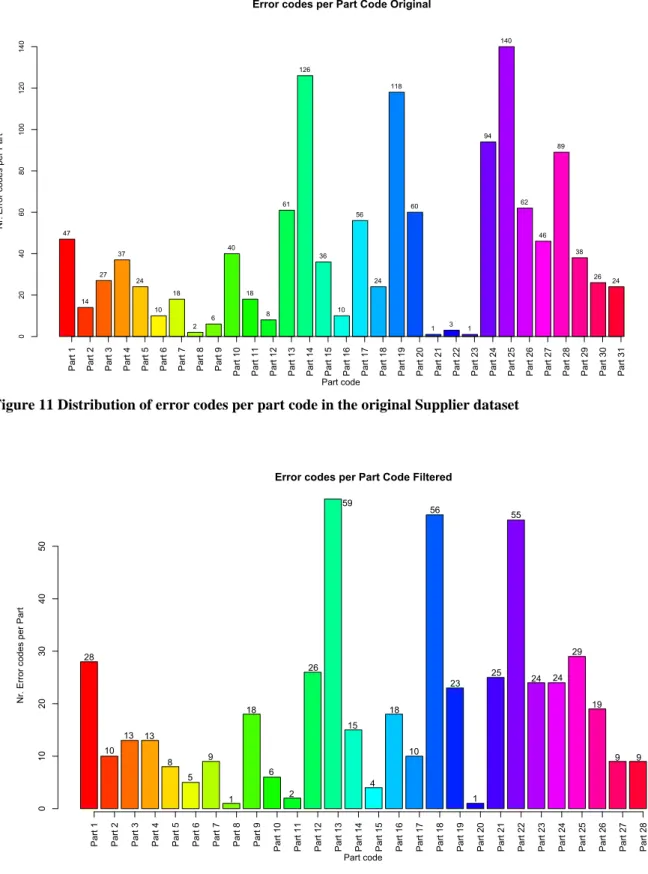
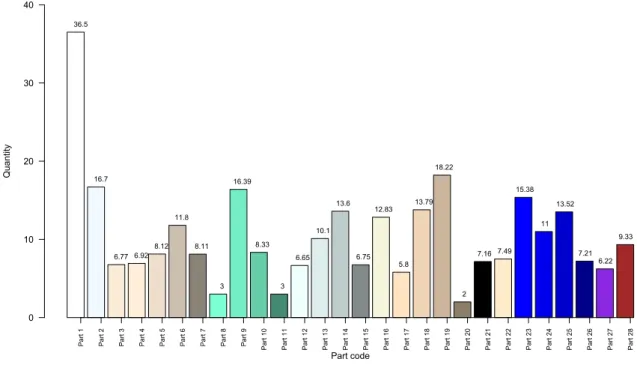
FIGURE 10 PLOT OF THE 150 MOST FREQUENT ERROR CODE FOR THE SUPPLIER ROLE (FILTERED DATASET) 32 FIGURE 11 DISTRIBUTION OF ERROR CODES PER PART CODE IN THE ORIGINAL SUPPLIER DATASET 33 FIGURE 12 DISTRIBUTION OF ERROR CODES PER PART CODE IN THE FILTERED SUPPLIER DATASET 33 FIGURE 13 OBSERVATIONS PER TYPE OF PART FOR THE FILTERED SUPPLIER DATASET 34 FIGURE 14 AVERAGE NUMBER OF OBSERVATIONS FOR EVERY ERROR CODE OF EACH PART TYPE FOR THE
FILTERED SUPPLIER DATASET 35
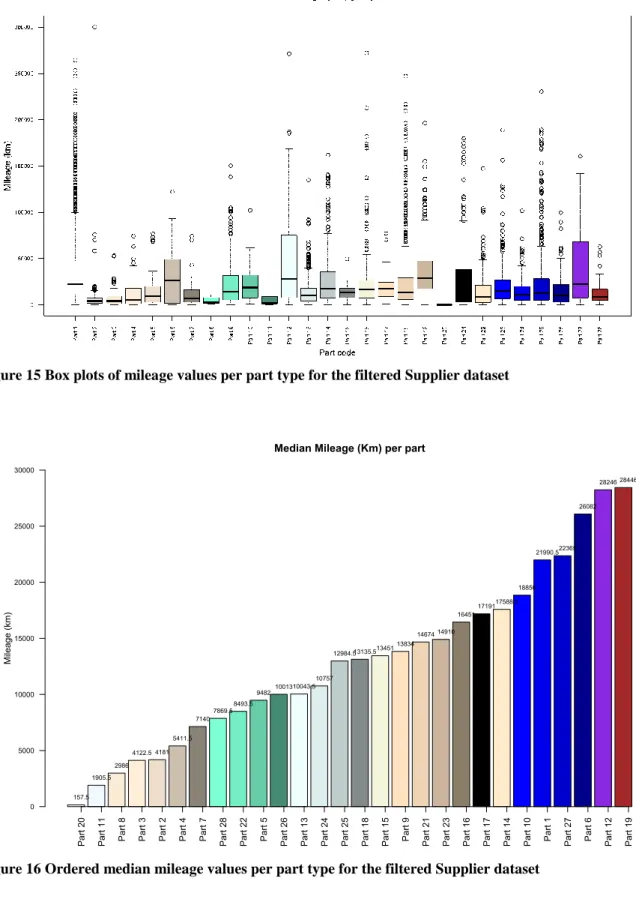
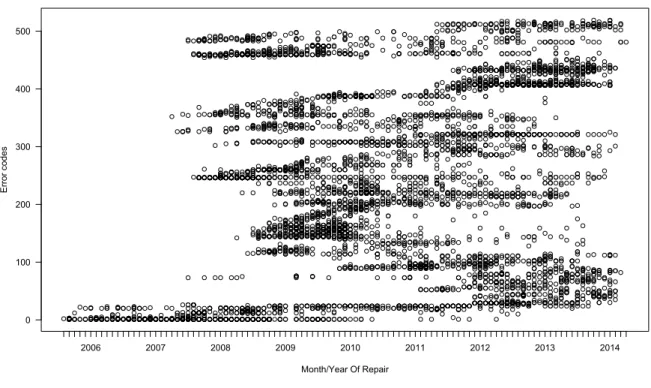
FIGURE 15 BOX PLOTS OF MILEAGE VALUES PER PART TYPE FOR THE FILTERED SUPPLIER DATASET 36 FIGURE 16 ORDERED MEDIAN MILEAGE VALUES PER PART TYPE FOR THE FILTERED SUPPLIER DATASET 36 FIGURE 17 ERROR CODES GROUPED BY THEIR MONTH OF REPAIR FOR THE FILTERED SUPPLIER DATASET 37 FIGURE 18 MONTHS OF THE REPAIR DATE GROUPED BY PART TYPE FOR THE FILTERED SUPPLIER DATASET 38 FIGURE 19 MONTHS OF THE ADMISSION-TO-DRIVE DATE GROUPED BY PART TYPE FOR THE FILTERED SUPPLIER
DATASET 38
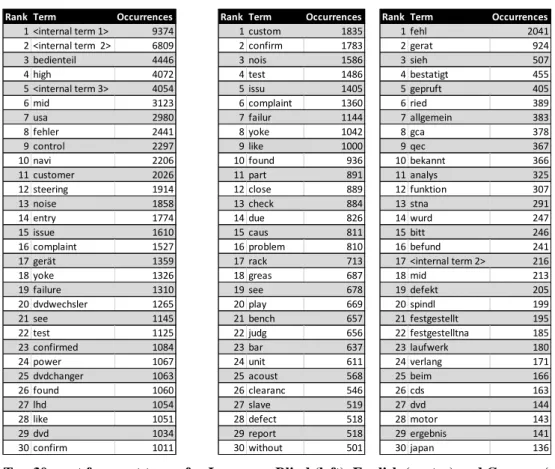
FIGURE 20 BOX PLOTS OF DRIVING TIMES PER PART TYPE FOR THE FILTERED SUPPLIER DATASET 39 FIGURE 21 TOP 30 MOST FREQUENT TERMS FOR LANGUAGE BLIND (LEFT), ENGLISH (CENTRE) AND GERMAN
(RIGHT) PRE-PROCESSING FOR THE SUPPLIER DATASET 41
FIGURE 22 CORRELATION RELATIONSHIPS AMONG THE 20 MOST FREQUENT TERMS (SUPPLIER DATASET,
LANGUAGE-BLIND PRE-PROCESSING) 41
FIGURE 23 CORRELATION RELATIONSHIPS AMONG THE 20 MOST FREQUENT TERMS (SUPPLIER DATASET,
ENGLISH PRE-PROCESSING) 42
FIGURE 24 CORRELATION RELATIONSHIPS AMONG THE 20 MOST FREQUENT TERMS (SUPPLIER DATASET,
GERMAN PRE-PROCESSING) 42
FIGURE 25 ZIPF PLOT FOR THE TERM FREQUENCY OF FEATURES IN THE SUPPLIER CORPUS (LANGUAGE BLIND) 43 FIGURE 26 ZIPF PLOT FOR THE TERM FREQUENCY OF FEATURES IN THE SUPPLIER CORPUS (ENGLISH) 44 FIGURE 27 ZIPF PLOT FOR THE TERM FREQUENCY OF FEATURES IN THE SUPPLIER CORPUS (GERMAN) 44 FIGURE 28 PLOT OF THE 150 MOST FREQUENT ERROR CODE FOR THE MECHANIC ROLE (FILTERED DATASET) 45 FIGURE 29 DISTRIBUTION OF ERROR CODES PER PART CODE IN THE ORIGINAL MECHANIC DATASET 45 FIGURE 30 DISTRIBUTION OF ERROR CODES PER PART CODE IN THE FILTERED MECHANIC DATASET 46 FIGURE 31 AVERAGE NUMBER OF OBSERVATIONS FOR EVERY ERROR CODE OF EACH PART TYPE FOR THE
FILTERED MECHANIC DATASET 46
FIGURE 32 ORDERED MEDIAN MILEAGE VALUES PER PART TYPE FOR THE FILTERED MECHANIC DATASET 47 FIGURE 33 MONTHS OF THE REPAIR DATE GROUPED BY PART TYPE FOR THE FILTERED MECHANIC DATASET 48 FIGURE 34 MONTHS OF THE ADMISSION-TO-DRIVE DATE GROUPED BY PART TYPE FOR THE FILTERED
MECHANIC DATASET 48
FIGURE 35 BOX PLOTS OF DRIVING TIMES PER PART TYPE FOR THE FILTERED MECHANIC DATASET 49 FIGURE 36 TOP 30 MOST FREQUENT TERMS FOR LANGUAGE BLIND (LEFT), ENGLISH (CENTRE) AND GERMAN
(RIGHT) PRE-PROCESSING FOR THE MECHANIC DATASET 50
FIGURE 37 CORRELATION RELATIONSHIPS AMONG THE 20 MOST FREQUENT TERMS (MECHANIC DATASET,
LANGUAGE BLIND PRE-PROCESSING) 51
FIGURE 38 CORRELATION RELATIONSHIPS AMONG THE 20 MOST FREQUENT TERMS (MECHANIC DATASET,
ENGLISH PRE-PROCESSING) 51
FIGURE 39 CORRELATION RELATIONSHIPS AMONG THE 20 MOST FREQUENT TERMS (MECHANIC DATASET,
GERMAN PRE-PROCESSING) 52
FIGURE 40 ZIPF PLOT FOR THE TERM FREQUENCY OF FEATURES IN THE MECHANIC CORPUS (LANGUAGE BLIND) 52
FIGURE 41 ZIPF PLOT FOR THE TERM FREQUENCY OF FEATURES IN THE MECHANIC CORPUS (ENGLISH) 53 FIGURE 42 ZIPF PLOT FOR THE TERM FREQUENCY OF FEATURES IN THE MECHANIC CORPUS (GERMAN) 53 FIGURE 43 MONTHS OF THE REPAIR DATE GROUPED BY PART TYPE FOR THE FILTERED OEM DATASET 54 FIGURE 44 COMPARISON OF THE SUPPLIER AND MECHANIC DOCUMENT COLLECTIONS (LANGUAGE-BLIND
PRE-PROCESSING) 55
FIGURE 45 COMPARISON OF LANGUAGE STATISTICS FOR EACH ROLE 55
FIGURE 46 METHOD TO SELECT THE BEST CLASSIFICATION ALGORITHM CONFIGURATION AND FEATURE SUBSET
GIVEN THE SELECTED CLASSIFICATION ALGORITHM 61
FIGURE 47 TECHNICAL SETUP FOR THE IMPLEMENTATION OF THE NAIVE BAYES CLASSIFIERS 65 FIGURE 48 COVERAGE OF OCCURRENCES IN DIFFERENT CONFIGURATION TYPES FOR DIFFERENT SUB SETTING
CRITERIA 67
FIGURE 49 RESULTS FOR THE ALGORITHM CONFIGURATIONS WITH SUPPLIER DATA 69 FIGURE 50 ACCURACY AND PROCESSING TIME PLOTS FOR THE SUPPLIER SET WITH TF WEIGHTS 70 FIGURE 51 ACCURACY AND PROCESSING TIME PLOTS FOR THE SUPPLIER SET WITH TF-IDF WEIGHTS 72 FIGURE 52 RESULTS FOR THE ALGORITHM CONFIGURATIONS WITH MECHANIC DATA 74 FIGURE 53 ACCURACY AND PROCESSING TIME PLOTS FOR THE MECHANIC SET WITH TF WEIGHTS 75 FIGURE 54 ACCURACY AND PROCESSING TIME PLOTS FOR THE MECHANIC SET WITH TF-IDF WEIGHTS 77 FIGURE 55 EFFECT ESTIMATES WITH SUPPLIER DATA FOR ACCURACY AT 1 79 FIGURE 56 EFFECT ESTIMATES WITH SUPPLIER DATA FOR ACCURACY AT 25 80 FIGURE 57 VARIATIONS IN ACCURACY LEVELS AT 1 BY FACTOR (SUPPLIER DATA) 81 FIGURE 58 VARIATIONS IN ACCURACY LEVELS AT 25 BY FACTOR (SUPPLIER DATA) 81 FIGURE 59 EFFECT ESTIMATES WITH MECHANIC DATA FOR ACCURACY AT 1 82 FIGURE 60 EFFECT ESTIMATES WITH MECHANIC DATA FOR ACCURACY AT 25 83 FIGURE 61 VARIATIONS IN ACCURACY LEVELS AT 1 BY FACTOR (MECHANIC DATA) 83 FIGURE 62 VARIATIONS IN ACCURACY LEVELS AT 25 BY FACTOR (MECHANIC DATA) 84 FIGURE 63 2K DESIGN MATRIX WITH SUPPLIER DATA FOR ACCURACY AT 1 99 FIGURE 64 2K DESIGN MATRIX WITH SUPPLIER DATA FOR ACCURACY AT 25 100 FIGURE 65 2K DESIGN MATRIX WITH MECHANIC DATA FOR ACCURACY AT 1 101 FIGURE 66 2K DESIGN MATRIX WITH MECHANIC DATA FOR ACCURACY AT 25 102
1 Introduction
As data grows, so does the need to design new ways to manage and process its ever increasing volume. For years public and private organizations have collected data in an electronic format concerning multiple issues, from technology-enabled processes to automated monitoring via sensors. In this context, unstructured data, in particular text data, represent a challenge not just to manage it in an efficient manner, but also to integrate it in an effective way. This means combining structured and unstructured data sources so the latter can provide depth and insight to queries for which the former only gives shallow (but wide) answers.
From a scientific standpoint, this challenge derives into an equally ambitious problem. Unstructured text data by nature requires new processing and analytic models which are not immediately compatible with the traditional structured ones. Moreover, these structured processing and analytic models are in comparison more efficient in terms of time and computational resources; something to consider given the current size and projected growth of unstructured data.
In this work we explore one possible solution to these organizational challenge and scientific problem in the context of automated text classification. We explore the various ways in which unstructured text data properties impact the performance of this kind of task. For this we focus on text classification algorithms and the selection of features used by them.
We start by defining the nature of the unstructured data we are concerned with. As a result of this we characterise the concept of “messy data” defined by (Kassner & Mitschang 2016) to adequately meet the context of a real business scenario in an automotive company from which this research topic originates (see (Kassner & Mitschang 2016)).
With this characterisation in mind we devise a method to select the appropriate text data features to test different classification algorithm configurations (variants in the inner workings of the same selected basic classification algorithm) and as a result, identify the one that yields the optimal performance in terms of accuracy and processing time. This method relies on a conceptual architecture developed to identify the elements from various disciplines that need to be taken into consideration when choosing a classification algorithm. In addition to this, we define a list of requirements that the ideal classification algorithm should have.
As a result of applying our method, we proceed to test the Naïve Bayes algorithm with different configurations and feature sets applied to the above mentioned business scenario/process from an automotive company. We benchmark their performance and discuss how these algorithm configurations perform compared to configurations from an adapted k Nearest Neighbours algorithm. This allows us not only to discuss the relevance of the solutions proposed regarding the defined problem, it also enables the definition of future research lines to generate a more optimal solution.
1.1 Research Motivation
The pervasive use of information technology in all aspects of society has led in the last decades to an ever-accelerating growth in the creation and manipulation of data. By 2012, (Turek 2012) estimated that from the beginning of recorded time until 2003, mankind had created 5 Exabytes of information, whereas in 2011 that same amount was created every two days (Turek 2012). Based on a study by (Turner et al. 2014) from IDC, in 2013 that same amount of data took a little less than 10 hours to be created or copied, and by 2020 it is predicted to take a little less than one. This data explosion is of particular importance for companies, since they already had liability or responsibility for 85% of the data in 2013 (Turner et al. 2014).
This phenomenon has become widely recognized since 2011 as Big Data (Gandomi & Haider 2014). Even though the concept has been open to discussion, there are certain characteristics that can define it in terms of data management challenges. In addition to the standard three V’s of Big Data (Volume, Variety and Velocity), (Gandomi & Haider 2014) also mention additional challenges such as Veracity, Variability, and Value.
In many cases, these challenges are derived from the fact that 95% of all data is unstructured and cannot be processed with traditional tools and techniques (i.e. relational databases) (Gandomi & Haider 2014). This has led to the creation of new technologies that can deal with vast amounts of data (Volume), coming from different sources (Variety) at different flow rates (Variability). Additionally they have to be prepared to process it at the required speed (Velocity), despite of the presence of unreliable sources (Veracity) and the low density of value relative to the volume (Gandomi & Haider 2014).
One area were the challenge is particularly significant for companies is data analytics. Although this area has been traditionally dominated by structured data techniques (Lang et al. 2009), the growth of unstructured data has brought the opportunity to enrich the structured analysis by providing insights hidden in it. This is relevant because organizations have been collecting both kinds of data (Gandomi & Haider 2014), but have struggled to properly integrate them.
There have been different approaches to address this integration problem. (Lang et al. 2009) consider the integration of unstructured text data into data warehouse applications via Unstructured Business Intelligence. This term comprises three steps that aim to enrich the existing ETL flow, warehouse schema, and BI infrastructure. (Gandomi & Haider 2014) points out a process by Labrindis and Jagadish with five stages organised in two main sub-processes: data management and analytics. “Data management involves processes and supporting technologies to acquire and store data and to prepare and retrieve it for analysis. Analytics, on the other hand, refers to techniques used to analyse and acquire intelligence (…)” (Gandomi & Haider 2014). Aside from specific examples, (Kassner & Mitschang 2016) mention that normally “approaches to automatically analyzing (sic) these unstructured data with traditional analytics for structured data are either very specific and case-based or too generic.”
As we see, there is a valid research interest in further exploring ways to do unstructured data analytics. In the particular context of this work, this interest can be described both from a scientific and an industry perspective.
1.1.1 Scientific Perspective
From a research standpoint, there are several challenges that structured analytics do not have to face. (Lang et al. 2009) mentions on one side the need to deal with misspellings, domain-specific, company-specific or even employee-company-specific acronyms and on the other side advanced data cleansing, to pre-process data beyond the capabilities of traditional cleansing. On top of that, text analysis technology typically requires an adaption to the domain where it is applied to work correctly (Lang et al. 2009), which makes this technology hard to apply and maintain in different scenarios. (Lang et al. 2009) also point out that unstructured text data involves term disambiguation based on the context, something that is rarely leveraged by traditional analytics.
In a similar way, (Gandomi & Haider 2014) highlight the problems that result from applying traditional statistical methods to big volumes of unstructured data.
There are two problems in particular that originate from the inherent properties of unstructured text data. Firstly, since this data can be obtained from multiple sources, it can actually represent different sub-populations instead of a single one. If this is not recognised, small sub-populations may be discarded under the assumption that they are outliers. Secondly, because of the sheer amount of data, independent random variables or features, may show false correlations.
In addition to this, some statistical methods may not be good enough in terms of computational efficiency to be feasible in the scale we are dealing with (Gandomi & Haider 2014).
1.1.2 Industry Perspective
For companies, achieving an effective integration of unstructured data means achieving time reductions to discover failures or complains, and as a result being able to react before it is too late. This is key in avoiding losing customers in favour of the competition and to maintain a good reputation with the existing and potential customers (Lang et al. 2009). Not only that, whenever failure or error happen, an effective use of unstructured data can also improve the quality of the detection by providing direct insight to the causes (Lang et al. 2009).
This is all the more important “in the face of ever larger amounts of data, faster innovation cycles and higher product customization (…)” (Kassner & Mitschang 2016).
1.2 Research Problem
This thesis is a continuation of the work of (Kassner & Mitschang 2016) in collaboration with a large automotive original equipment manufacturer (OEM). As such, the problem it addresses as well as the environment where it occurs are the same. In the following subsections there are reference descriptions of these two elements.
1.2.1 Process Description
The research problem occurs in a business environment, specifically in a quality inspection process in an automotive OEM. In this process, parts removed from cars already owned by customers are analysed to inspect the quality issues involved in their potential failure. This analysis involves three different roles, each one inspecting the part and writing a report until an error code is assigned. It is this error code the one that categorises each text report into 1 of 1271 possibilities (for the purposes of our scenario; total classification categories are actually more). The flow of data as the process progresses is shown in Figure 1.
Figure 1 Simplified quality inspection process (adapted from (Kassner & Mitschang 2016))
To assign the final error code, all reports written up to that moment (second participation of the OEM worker) are considered and a decision is made by a human quality expert at the OEM. In addition to the text reports being created, other structured data is also recorded for every car part that goes through this process.
To support the work of the quality expert in this classification task, a system should receive as input several texts in unstructured format related to each faulty or damaged car part along with their related structured data (see Figure 9), set that we will call a data bundle (Kassner & Mitschang 2016). Every
data bundle has then to be processed to suggest a list of possible error codes to the quality expert. From an academic perspective, this can be thought then as a text analytics task, in particular a specific application of automated text classification. As such, this task has to pick some features out of the unstructured dataset that allow executing a suitable classification algorithm. The “technical” process (the execution of the text classification task) begins with the reports to be classified located into a single source ready to be processed and finishes when the reports are given a list of error code classifications.
1.2.2 Problem Description
There are particular characteristics of the process and the dataset that give the research problem a different nature from purely academic ones.
Concerning the process, the fact that it is a quality management process and not a manufacturing one makes its behaviour less predictable. This because there is no a priori estimation that can be made about the process load or performance beyond the fact that the quality process is to some extent related to the manufacturing volume at a previous moment in time.
Regarding the dataset, there several characteristics that make it different from traditional approaches. First, the wide amount of categories to classify a text, exemplified by the existence of more than 1200 error codes in a dataset of 7500 instances; second, what (Kassner & Mitschang 2016) describe as messy data: “Text which consists of non-standard, domain-specific language, riddled with spelling errors,
Mechanic OEM Supplier
Mechanic
report OEM preliminaryreport (optional) Supplier report OEM final report
OEM Final error code Reference number
idiosyncratic and non-idiomatic expressions and OEM-internal abbreviations.”. On top of this already identified challenges, other important issues such as multilingualism, incompleteness of records, and a very big amount of possible classification categories (see section 4.3) complete a data profile that contradicts almost every good practice in traditional information systems. In addition to this, the fact that not every car part has the same amount of reports also adds to the dataset heterogeneity.
Previously, (Kassner & Mitschang 2016) have implemented several prototypical classifiers based on an adaptation of the k-Nearest-Neighbours (k-NN) algorithm (see sub section 3.3.6). In it, the result consists of a list of up to 25 suggested error codes instead of just one code assignation per data bundle. This enables the authors to evaluate the algorithm accuracy at different cut off levels (1, 5, 10, 15, 20 and 25 elements) and aligns with the goal of supporting the work of the human expert instead of replacing him.
They run this adapted k-NN algorithm in 12 different configurations (or variants) considering the following factors:
Data abstraction model: using all words in the text as classification features (bag of words) or the identified mentions of error and parts (bag of concepts).
Similarity measure: Used to delimit the scope of the majority vote to assign error codes. Either
Jacquard similarity coefficient (the absolute value of the intersection of feature sets A and B over the absolute value of the union of feature sets A and B) or Overlap similarity (the absolute value of the intersection of feature sets A and B over the absolute value of the smallest feature set, either A or B)
Roles: Using the reports of the Mechanic role only, using the reports of the Supplier role only, and using all data available to the human expert to assign the error code (mechanic report, optional initial report, supplier report, part description).
In all cases the pre-processing consists of tokenisation (based on punctuation and whitespaces) and language detection.
When analysing the accuracy results, they are compared (among others) to the accuracy of a so called code frequency baseline, which consists of retrieving all error codes available for the part type considered, ranking them by frequency and returning the desired cut off level. This baseline accuracy has values of (approximately) 35% at 1, 76% at 5, 88% at 10, 90% at 15, 94% at 20, and 100% at 25, which is assumed to be “an artifact (sic) of our randomly selected data set.” (Kassner & Mitschang 2016) In their results, all configurations tend to converge to a similar (high) value when the cut off is made at 25. This makes the lower cut off levels the ones of interest. The best configuration is the “bag of words with Jacquard similarity on all available text” with accuracies of 81% at 1 and 94% at 5, closely
followed by the configuration “bag of words with Jacquard similarity on the Supplier report only” with
accuracies of 78% at 1 and 93% at 5.
On the opposite side the worst configurations are those using only the Mechanic report, with accuracies of 16% to 29% at 1, below the code frequency baseline. This makes it clear that in terms of roles, text data coming from the Supplier can be assumed more useful than that of the Mechanic. This, the authors observe, can be attributed to the quality of each data source: “Mechanic reports tend to be poor in detail, focused on superficial problem description and often error-riddled, such that even human experts cannot draw conclusions about the detailed nature of the problem, whereas supplier reports tend to contain more detail and include descriptions of potential causes.” (Kassner & Mitschang 2016)
Also, when it comes to the data abstraction model, the bag of words configurations show most of the time better accuracy levels than those of the bag of concepts, especially in lower cut off levels. This however, comes with a price. Given the fact that every word is a feature in this approach, it is easy to encounter memory and processing time issues even at this reduced experimental level. In the bag of words approach classification takes about 11 minutes for ca. 1250 data bundles, resulting in approx. 0.5 seconds of processing time per data bundle. In contrast, the bag of concepts approach classifies the same amount of data bundles in three minutes, or 0.14 seconds per unit. This turns the bag of words approach inviable for a real implementation.
As we can see, there is a trade-off between accuracy and processing time. While it is clear that features and the way they are represented plays a significant role in the final outcome, there is no certainty on how all these variables interact, and whether this is the case with other classification algorithms. To investigate this matters, we can think of the bag of words and bag of concepts approaches as opposite ends in a continuous spectrum of features usage for text classification. On one side, the bag of words
approach proposes to use all words in a document collection as features for classification, ensuring in this way that even the least significant of the terms is taken into account, albeit at the expense of bigger training sets, and prolonged execution times. On the other side, the bag of concepts approach aims to use only a carefully selected set of words that represent relevant concepts in the domain at hand (parts, failures, errors, symptoms in our case), based on the premise that those are the truly meaningful words upon which the classification should be run. However, as (Kassner & Mitschang 2016) suggest, having a reduced knowledge coverage of the applicable concepts in our domain can translate into a less than optimal accuracy.
Framing the accuracy vs. processing time trade-off in this spectrum hints a possible way to discover the optimal middle point. In this thesis we direct the research efforts towards the bag of words approach by exploring the kind of relationship that features (and subsets thereof) have with the performance of classification algorithms both in terms of accuracy and execution time. By doing this, we can help understand how can someone identify a good subset of classification features as well as its optimal use with a suitable classification algorithm.
1.2.3 Goal Description
To understand the effects of text features on an algorithm`s accuracy regarding the classification of car part data bundles in one of several error code categories. This should be done via the implementation of a different classification algorithm, whose performance can then be compared to the performance of the (previously) adapted k-NN algorithm. As part of this goal, there has to be a selection of the most useful features to perform the classification.
Additionally, improvements in the processing time of the classification algorithm in comparison to the baseline performance achieved by the derived k-NN algorithm are also desirable.
1.2.4 Goal Metrics Definition
Derived from the description above, the following metrics were defined:
Accuracy: Number of instances (data bundles of text reports) assigned the correct error code over the total number of instances being classified. This assignation is measured at different positions in a list of error code suggestions (1, 5, 15 and 25).
Processing time: Total amount of time elapsed for the classification to complete. Time spent per instance (text report).
1.3 Research Questions
Throughout this thesis, the answers to the following questions are explored. They are meant to decompose the research problem and goal into more manageable tasks. Relevant sections that answer these questions are referred as well.
1. How to conceptualize the process of Automated Classification based on features of unstructured text data? (see Figure 8 in Chapter 3)
2. What are the best features to classify unstructured text data? (see section 5.9)
3. What characteristics make classification algorithms more suitable for this problem? (see section 5.1)
4. What factors and/or features affect the performance and accuracy of a classification task? (see section 5.9)
5. How do unstructured text data features relate to a classification algorithm’s performance? (see Figure 4 Research model and section 5.9)
1.4 Research Method
So far, the nature of the process and problem have made clear that this study is focused on what (Hevner et al. 2004) consider addressing a problem in an organizational context, so that “the analysis, design, implementation, management, and use of information systems can be effectively and efficiently accomplished”. This sets the direction of this thesis to that of Information Systems (IS) research. Moreover, the objective of prototyping a new technical solution to the defined problem in section 1.2 can be seen as designing and implementing “innovations that define the ideas, practices, technical capabilities, and products” to “extend the boundaries of human problem solving and organizational capabilities” (Hevner et al. 2004). Because of this, Design Science Research is a valid and meaningful methodological framework to design the research method of this work.
According to (Hevner et al. 2004), Design Science is a paradigm in IS research that is based in the pragmatic principle of utility, according to which research contributions “should be evaluated in light of its practical implications”.
When performing research based on this methodology, the authors suggest to avoid its direct application, advising instead to use “creative skills and judgment to determine when, where, and how to apply each of the guidelines in a specific research project.” (Hevner et al. 2004). Supported on this, we present in the remaining sections the concepts that are of particular importance for this work.
1.4.1 Design Science Process
As a research process, (Hevner et al. 2004) describe Design Science as an iterative set of activities concerned with the creation and application of an artefact. The iteration derives from the fact that the artefact is artificial in nature, an abstraction of reality. As such, there is a need to evaluate it against the problem it is intended to solve, both to improve the effectiveness of the artefact design and to gain understanding of the problem. As a result, there are two main activities to distinguish in this loop, namely: build and evaluate.
For a solution to be considered valid, it has to observe the means, ends and laws imposed by the environment. “Means are the set of actions and resources available to construct a solution. Ends represent goals and constraints on the solution. Laws are uncontrollable forces in the environment.” (Hevner et al. 2004). The set of solutions that meet these three conditions can be represented mathematically, even though that hardly occurs in IS research (Hevner et al. 2004).
Once a solution is found, it is more relevant to delimit the exact conditions and cases for which the solution works, instead of finding out why it works (Hevner et al. 2004). Additionally, to determine how good a solution is, it can be compared to a pre-defined optimal solution or against existing solutions.
1.4.2 Guidelines
While carrying out the process described in the previous subsection, (Hevner et al. 2004) describe some guidelines to assess the adherence to the Design Science paradigm. These are shown in Figure 2 Seven guidelines of Design Science ResearchFigure 2 along with a brief description.
Guideline Description
Guideline 1: Design as an Artifact
Design-science research must produce a viable artifact in the form of a construct, a model, a method, or an instantiation. Guideline 2: Problem
Relevance
The objective of design-science research is to develop technology-based solutions to important and relevant business problems.
Guideline 3: Design Evaluation
The utility, quality, and efficacy of a design artifact must be rigorously demonstrated via well-executed evaluation methods.
Guideline 4: Research Contributions
Effective design-science research must provide clear and verifiable contributions in the areas of the design artifact, design foundations, and/or design methodologies.
Guideline 5: Research Rigor
Design-science research relies upon the application of rigorous methods in both the construction and evaluation of the design artifact.
Guideline 6: Design as a Search Process
The search for an effective artifact requires utilizing available means to reach desired ends while satisfying laws in the problem environment.
Guideline 7: Communication of Research
Design-science research must be presented effectively both to technology-oriented as well as management-oriented audiences.
Figure 2 Seven guidelines of Design Science Research (Hevner et al. 2004).
Guidelines 1, 3 and 6 are covered in more detail in other points of this work and as a result, they are not commented here but instead discussed in subsections 1.4.3, 1.4.4 and 1.4.1 respectively.
In the context of guideline 2 and in general for this methodology, a problem is defined as a difference between the current and intended states of a system. The actions to go from the former to the latter are driven by goals given by the problem’s context, which is composed of the business needs. This may be expressed as profit maximization, cost reduction, resource consumption, performance optimizations, etc. Because IS target those same goals, the research problem is relevant as long as its solution contributes to their fulfilment by IS (Hevner et al. 2004). The details on how this work is relevant according to this guideline is presented in sections 1.1 to 1.3.
In guideline 4 (Hevner et al. 2004) distinguish among three main kinds of contribution: the design artefact, the foundation knowledge or the methodologies. The first is the most common since it is the product of the design science methodology (see subsection 1.4.3); the second refers to extensions or improvements of the knowledge base; the third focuses on evaluation methods and metrics being invented or creatively used. In all cases, the contribution is deemed valid or not in terms of what the authors call representational fidelity (to the business environment and technology environment) and
implementability (sic) (to actually solve the business need). The contributions of this thesis are detailed in chapters 4 and 5.
Concerning research rigor, guideline 5 advocates for the effective application of the knowledge base both in the creation and evaluation of artefacts. This ensures rigor in research, particularly during the artefact creation. However, rigor should also be balanced against relevance, because formalism may decrease the degree in which an artefact can be applied or generalized (Hevner et al. 2004). Taken into the evaluation part of the process, this means ensuring that subject groups used for evaluation should aim “to determine how well an artifact (sic) works, not to theorize about or prove anything about why the artifact (sic) works.” (Hevner et al. 2004)
Finally, guideline 7 advises to provide technology and management-oriented audiences with relevant information about the research based on their profiles. The first “need sufficient detail to enable the described artefact (sic) to be constructed (implemented) and used within an appropriate organizational context.” (Hevner et al. 2004), while the second need information “to determine if the organizational
resources should be committed to constructing (or purchasing) and using the artifact (sic) within their specific organizational context.” (Hevner et al. 2004)
1.4.3 Design Artefact
Considered the main result of design science research, “IT artifacts (sic) are broadly defined as constructs (vocabulary and symbols), models (abstractions and representations), methods (algorithms and practices), and instantiations (implemented and prototype systems).” (Hevner et al. 2004) In all four cases, the authors emphasize their definition of an IT artefact does not “include people or elements of organizations (…) nor (…) the process by which such artifacts (sic) evolve (…)” (Hevner et al. 2004). Constructs are the vocabulary to define problems and solutions. As a result, they enable the creation of models. Models then employ those constructs to represent a real world situation where the design problem, the solution space and the way these two connect can be identified. As such, models are useful to explore “the effects of design decisions and changes in the real world.” (Hevner et al. 2004).
Methods are guidelines for the solution of problems, in other words they advise on how to improve the construction process of a design artefact. Depending on the scenario (as defined by the model and constructs, and within them, the problem and environment) they can be “formal, mathematical algorithms that explicitly define the search process” or “informal, textual descriptions of ‘best practice’ approaches, or some combination.” (Hevner et al. 2004)
Artefacts of the type instantiation are the demonstration of a design and of the process that led to it. Thanks to this is that they are considered significant IS research. According to (Hevner et al. 2004), it is fundamental that this instantiation occurs after an initial assumption of uncertainty, in other words, that the artefacts proves possible something that has not been done before.
It is important to mention that instantiations can be thought as precursors of the other artefacts, since they are proof of feasibility for otherwise purely theoretical concepts. Therefore, once an instantiation is made, constructs and models can be elaborated to properly define the problem being solved and the possible solutions that can be further developed. This then triggers future research involving defining or using methods to explore the solution space.
Artefacts produced in this thesis are presented, even if they are covered elsewhere, in chapter 4.
1.4.4 Evaluation Methods
(Hevner et al. 2004) summarize the available evaluation methods as shown in Figure 3. They acknowledge that these methods are meant to be applied on the basis of suitability to the artefact. In other words, considering both the requirements of the problem the artefact is intended to solve and the knowledge base employed in the design of the artefact, one must select the most appropriate method.
Figure 3 Design Evaluation Methods (Hevner et al. 2004).
Taken this observation into consideration, the corresponding evaluation methods for the artefacts presented in this thesis depend on the knowledge base discussed on Chapter 3.
1.5 Thesis Structure
The rest of this thesis is organized in the following manner. Chapter 2 elaborates on the adaption of the Design Science methodology to the specific environment of this work, starting with the presentation of the research model to be explored. Chapter 3 describes the relevant concepts that conform the theoretical foundation that can serve as knowledge base for artefact creation and evaluation. These theoretical concepts set the context to define the contributions of this thesis in relationship with relevant previous efforts. Chapter 4 presents the resulting artefacts and contributions. Chapter 5 then proceeds to present the results of applying the designed artefacts into a real scenario as described in subsections 2.6 and 2.7. And chapter 6 finally discusses some directions to continue the research along with the final concluding thoughts.
Methodologies Methods
1. Observational Case Study: Study artifact in depth in business environment
Field Study: Monitor use of artifact in multiple projects
Static Analysis: Examine structure of artifact for static qualities (e.g., complexity)
Architecture Analysis: Study fit of artifact into technical IS architecture
Optimization: Demonstrate inherent optimal properties of artifact or provide optimality bounds on artifact behavior
Dynamic Analysis: Study artifact in use for dynamic qualities (e.g., performance)
Controlled Experiment: Study artifact in controlled environment for qualities (e.g., usability)
Simulation – Execute artifact with artificial data
Functional (Black Box) Testing: Execute artifact interfaces to discover failures and identify defects
Structural (White Box) Testing: Perform coverage testing of some metric (e.g., execution paths) in the artifact implementation Informed Argument: Use information from the knowledge base (e.g., relevant research) to build a convincing argument for the artifact’s utility
Scenarios: Construct detailed scenarios around the artifact to demonstrate its utility
2. Analytical
3. Experimental
4. Testing
2 Methodology
In this chapter we describe the stages considered to carry out the research for this topic. Each section briefly describes the main activities, focus and goals of the corresponding stage as well as the adaptation of the Design Science concepts presented in section 1.4 to the particular context of this work. Finally in section 2.8 we mention the limitations of this study as a way to delimit its scope.
Based on the problem environment described in the previous chapter and based on the concepts of (Cooper & Schindler 2011), we establish the research model in Figure 4 that serves as a starting point for the adaption of the Design science research methodology.
In this model we define Availability of Data Features as the presumed cause, operationalized by the variables Quantity of data features and Quality of data features.
As presumed effect we establish Classification Algorithm Performance as defined by Classification algorithm accuracy and Classification processing time. Both of these operational variables are defined in sub section 1.2.4.
As moderating variables (MV) in this model we identify the following constructs: first and foremost the
Classification Algorithm, along with Feature Selection Strategy and Feature Extraction Mechanism. As confounding variable we designate the Amount of categories, whereas the Availability of complementary structured data is considered a control variable.
With this model we aim to explore the effect that the presence (or absence) of relevant data features has on the performance of a classification algorithm as to determine a method to optimize the selection of the best algorithm configuration and features; but without focusing on the effects that the amount of categories or the availability of structured data may have.
Figure 4 Research model based on the concepts of (Cooper & Schindler 2011)
2.1 Knowledge Base Creation
The first step to build a series of artefacts that can provide information about the effect of interest in our research model is to build a knowledge base. Based on the previous work by (Kassner & Mitschang 2016) and the execution of a literature survey, we compile a collection of theoretical concepts coming from four main disciplines: Natural Language Processing (NLP), Text mining, Machine Learning, and Statistics. We also cover the working principles of the required technologies to implement a solution based on those concepts. The goal is to generate a solid theoretical foundation that can be referred to at different points later in this work.
Availability of Data Features
*Quality of data features: IV *Quantity of data features: IV
Classification Algorithm Performance *Classification algorithm accuracy: DV *Classification algorithm processing time: DV *Classification Algorithm: MV *Feature Selection Strategy: MV *Feature Extraction Mechanism: MV Amount of categories (classification space): CFV Availability of complementary (structured) data: CV
2.2 Conceptual Architecture for Text Document Classification
The focus on this step is to arrange the concepts gathered in the previous step in such a way that it allows us to distinguish the function and contribution of each element to the intended solution. As such, we aim to build a conceptual architecture that abstracts from the knowledge base the relevant concepts needed to address our problem. In doing so, we define the solution space with the intention to better understand both the problem and the potential solutions. Because of this, the resulting conceptual architecture is a model artefact (Hevner et al. 2004).
2.3 Data Exploration
At this stage of the work, the focus is to discover the properties, patterns, and assumptions that best describe domain-specific unstructured text data, particularly in the context of our application scenario (see section 4.3). To do so, different visual and statistical techniques are applied to a sample dataset of up to 7500 data points provided by an automotive company (OEM).
This dataset is analysed from the perspectives of the roles involved in the process that created it (Functional organization). They are the Supplier, Mechanic and the OEM itself. Inside of every role, we examine the data as a collection of data points and as a set of text documents.
The goal of this step is to delimit the characteristics that characterise our particular object of study. This would provide the necessary evidence to identify the specific problems to be considered in this work and constitutes the first step to define a list of “empirical” requirements (as opposed to the theoretical aspects covered by the conceptual architecture) to develop a solution.
2.4 Study Object Characterisation
Based on characteristics collected during the data exploration, this stage aims to characterise the study object within the context of our application scenario. Starting from the original definition of messy data by (Kassner & Mitschang 2016), this step focuses on bringing evidence for the characteristics present in the original definition as well as for the new ones introduce as part of the characterisation to justify their inclusion, identifying the underlying theoretical concepts that underpin the characteristics identified during the data exploration results, and framing this new definition within our research model.
2.5 Method to Select Optimal Classification Algorithm Configuration and
Features
In this step we design an appropriate method artefact that guides the creation of an instantiation artefact to search for an optimal solution. Such a method considers all possible factors that can affect accuracy and processing time according to our research model and conceptual architecture. The goal for this method is to obtain evidence on why is a configuration and feature set combination better than others. We focus on creating a list of requirements for the classification algorithm that could in theory best fulfil the goal and metrics described in sections 1.2.3 and 1.2.4. This is then used as reference to evaluate some candidate algorithms in order to select one to be tested with an instantiation artefact and a series of experiments.
2.6 Experiments
To evaluate the utility of the conceptual architecture and method to help design solutions to our research problem, in this step we build and instantiation artefact with the selected classification algorithm. We do so by applying our method artefact starting from the selection of the algorithm itself, and continuing with the design of the algorithm configurations, the execution of each configuration as an experiment, and conclude by presenting the results. We use our application scenario data to test its performance, in terms of accuracy and elapse time, so as to render it comparable to the previous k-NN implementation.
2.7 Evaluation
In the final step, we proceed to evaluate the results of running the experiments on our instantiation artefact as well as the other two artefacts. As a consequence, our evaluation comprises two levels. Firstly, we focus on the evaluation of the instantiation artefact in terms of the goals, questions and metrics proposed in sections 1.2 and 1.3. Secondly, we proceed to evaluate the other artefacts (conceptual architecture and optimal method) in the terms of the Design Science Evaluation Methods (see sub section 1.4.4).
2.8 Limitations
Along the process of developing this work, there are certain areas that are considered out of scope due to their distant relation to the research model or because of the magnitude of work they would entail. They are mentioned in this section as a way to delimit the scope.
The main interest in this thesis is to explore effects and relationships of certain variables on end results, not to implement software components meant for others do that explorations. As such, we aim to reuse existing (open source) tools and components whenever possible. This not only speeds up the prototyping process, it also makes the exploration rely on proven software.
Despite of this, it would be innocent to assume that existing software for text mining, natural language processing, machine learning or statistics is free of errors. Since the early stages, this was evident with language detection components. A sort of classification problem on its own, improving the performance of this kind of component is beyond the efforts of this work. Instead, we simply mention the cases when the performance of language detection affects the execution of our own analysis (e.g. by losing reports). A similar situation occurs with spelling mistakes. While it is clear that this represents a source of error in text classification, the implementation of a bilingual spell checker exceeds the reach of our goal. Regarding the business environment in which our research problem exists, there are a set of constraints derived from it that affect the reach of our efforts. Although they are transparent for the most part of this work, they may become notorious when analysing the dataset on which we work. Therefore it is important to point out that the nature of this dataset, the assumptions under which it was created, and the conditions for its use are all given characteristics that cannot be altered.
Finally, concerning the Conceptual Architecture for Text Classification introduced in section 4.1, it is important to emphasise that this architecture is supposed to work as definition of the solution space for this problem and exhausting the possibilities it offers to design alternative solutions, even in the best of scientific interests is beyond the scope of this work. Still, we do present an instantiation that makes use of representative components of each layer as a way to prove its adequacy.
3 Theoretical Framework
In order to give theoretical foundations to the solutions proposed in chapter 4, a literature survey was conducted. An academic enterprise on its own, the exploration of existing work is organised according to an extension of the preceding work of (Kassner et al. 2014) (from which this thesis derives) with the overview on text classification by (Khan et al. 2010). This allows to have a more detailed conceptual framework that enables better-focused research of related work.
By looking at the study object characterisation in section 4.3, it is clear that there is more than one way to address this text-document classification problem and as a matter of fact, each candidate solution may require different disciplines to come to fruition. (Kassner et al. 2014) already recognise this fact and in their conceptual architecture they propose a modularised separation of activities to analyse structured and unstructured data. Specifically, they propose in their middle layer Analyse a two-level structured composed of Core Analytics and Value-Added Analytics as shown in Figure 5.
Figure 5 ApPLaUDING Conceptual Architecture (Kassner et al. 2014)
The upper level is meant to generate complex value-adding analytic capabilities based on the results obtained from a composition of modular core analytics components. Meanwhile, the lower level is concerned with tools for both unstructured and structured data, respectively depicted on the left and right sides of the layer.
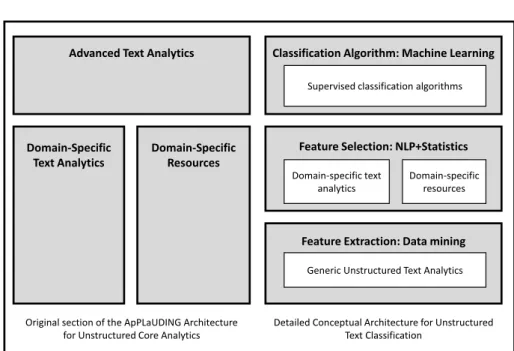
This thesis focuses on the components for unstructured data of the Analyse layer, namely Domain-specific text analytics, Domain-Specific Resources and Advanced Text Analytics.
The first two elements are considered part of the same analytics toolbox, which uses “domain-specific NLP resources such as taxonomies, wordlists / dictionaries and schemas (…)” and domain-specific text analytic tools for “the recognition of entities or expressions from a particular domain (…)” (Kassner et al. 2014). The third element and toolbox, Advanced Text Analytics, “contains advanced analytics
toolbox.” (Kassner et al. 2014). Examples for this are topic detection, and clustering and classification algorithms.
However as the enriched concept of messy data in section 4.3 highlights, there are equally important components involved in the generation of meaningful data and that are nonetheless not represented on the ApPLaUDING architecture. Prior to any analytics activity, there are certain pre-processing steps that are needed to handle unstructured data. Examples of these are: tokenisation, fundamental to transform unstructured text into a feature vector and language detection, to be able to apply other pre-processing steps like stop word removal or stemming correctly.
At the same time, (Khan et al. 2010) suggest that in every text document classification endeavour, three disciplines are required: Text Mining, Natural Language Processing, and Machine Learning. Even more, regardless of the technique employed, they tend follow a particular order.
Text mining begins with the application of two kinds of methods: Information Extraction and Information Retrieval. The first one is meant “(…) to extract specific information from text documents.” while the second employs statistical methods “for automatic processing of text data (…)” (Khan et al. 2010).
Natural Language Processing aims to analyse the data on a syntactical level so as to improve the classification process and to enable the usage of taxonomies or similar complementary resources, such as ontologies. Properly speaking, syntactical analysis aims to parse “sentences and paragraphs into key concepts, verbs and proper nouns.” (Khan et al. 2010).
Finally, Machine Learning involves all supervised approaches to document classification. This is particularly useful for our study subject since “supervised learning techniques are used for automatic text classification, where pre-defined category labels are assigned to documents based on the likelihood suggested by a training set of labelled documents.” (Khan et al. 2010)
If we then expand the original architecture by (Kassner et al. 2014) in order to distinguish the participation of the three above mentioned disciplines, we find a again a three-layered structured instead of the original pair of Core and Advanced Analytics. This is represented in Figure 6.
Figure 6 Comparison between the original and detailed conceptual architectures. Adapted from (Kassner et al. 2014)
This detailed conceptual architecture divides the classification of text documents into three layers. The first one consists of feature extraction techniques. This is therefore related to knowledge from Data
Feature Extraction: Data mining Feature Selection: NLP+Statistics Classification Algorithm: Machine Learning
Domain-specific text analytics
Generic Unstructured Text Analytics Supervised classification algorithms
Domain-specific resources
Domain-Specific Text Analytics
Advanced Text Analytics
Domain-Specific Resources
Original section of the ApPLaUDING Architecture for Unstructured Core Analytics
Detailed Conceptual Architecture for Unstructured Text Classification
Mining, in other words, the pre-processing techniques that can be applied to “make clear the border of each language structure and to eliminate as much as possible the language dependent factors, tokenization, stop words removal, and stemming.” (Khan et al. 2010).
Then, the feature selection layer is used “to select subset of features from the original documents (…) by keeping the words with highest score according to predetermined measure of the importance of the word.” (Khan et al. 2010). This is intended to make the existing set of available features manageable and scalable so that the selected classification algorithm can be applied on the dataset. To achieve this, it is composed of Natural Language Processing and Statistics components.
Finally, the classification algorithm layer contains Machine Learning algorithms which can be selected according to their performance when handling certain kinds of data.
The following sections in this chapter present the theoretical concepts behind the (potential) components in each of these three layers.
3.1 Feature Extraction Mechanisms
In this section we refer to the different steps that transform unstructured text data into more structured formats that can be later used by algorithms to analyse it. In this respect, we consider these steps as techniques from text mining. In this context we understand text mining from the perspectives of Data Mining and the Knowledge Discovery Process as described by (Hotho et al. 2005). As such, we see text mining simply as a process with sub components that perform certain pre-processing tasks to extract useful patterns for document analysis.
3.1.1 Term
Also known as feature, it represents the smallest meaningful unit of text with which a document can be represented. Depending on the approach taken, a term can refer to a word or a phrase (Sebastiani 2002). According to (Khan et al. 2010), other alternatives include N-Gram and RDR, this last one representing document as logical predicates (Khan et al. 2010). On the other hand, an N-Gram is “(…) a string-based representation with no linguistic processing" (Khan et al. 2010).
3.1.2 Feature Vector
This is the cornerstone of the Vector Space Model (VSM). It represents a text document as a vector composed of term weights, is a feature vector (Khan et al. 2010). When all distinct terms m from all documents to be analysed are merged into a single collection, this is called the dictionary of the document collection (Hotho et al. 2005). This dictionary represents the m-dimensional space in which feature vectors are expressed (Sebastiani 2002). Unfortunately, it is often the case that the amount of features considerably outnumber the number of documents available, something known as high-dimensionality (Khan et al. 2010).
This high dimensionality brings many challenges when it comes to text classification, such as prolonged execution times both in training and testing, the need for bigger samples to train the algorithm and difficulties in visualising the dataset (Rafeeque & Sendhilkumar 2011).
3.1.3 Bag of Words
A model to represent text documents for text classification in which every word is considered a term (Sebastiani 2002). Each position of a feature vector contains the occurrence of a word, with the total amount of words usually overcoming the total amount of training documents by more than an order of magnitude (Forman 2003). It does not preserve the semantic context (Rafeeque & Sendhilkumar 2011).
3.1.4 Bag of Concepts
A text document representation model based on the identification in text documents of mentions to domain-specific concepts (Kassner & Mitschang 2016). It requires the mapping of words in text to concepts stored in a semantic resource via named entity recognition (Kassner & Mitschang 2016). For
this to work, the semantic resource should be aware of synonymy relationships among its concepts (Kassner & Mitschang 2016).
3.1.5 Term-Weighting Techniques
They comprise the different ways to calculate the contribution of a term (or feature) to the semantics of a document, or to the semantics of the whole document collection (Sebastiani 2002), in other words, the representation of a term’s value (Forman 2003). In their most basic form, weights reflect the presence of a term within a document, but different approaches may use take into consideration other aspects, depending on the needs of a classification algorithm (Sebastiani 2002). According to (Forman 2003), this basic form is a binary representation, which should be enough for short texts since terms hardly repeat. It also enables the use of other feature selection metrics, such as Odds Ratio.
For the cases when weights are not binary, (Bank 2013) discusses three common components that can be used, namely the local, global and normalisation components. The first one refers to the importance of a term in the document where it is contained. The second is based on the importance of the document in the whole document collection. The third component is employed to negate the influence of very different document lengths in the weight of a term.
A technique with focus on the local component is term frequency, understood as the number of times N
a term i is mentioned in document j (Ruotsalo 2012), expressed in the formula: 𝑡𝑓𝑖,𝑗= 𝑁𝑖,𝑗
For the global component, inverse document frequency is a common way to calculate it. It is based on the number of documents n where term i appears in the document collection N (Ruotsalo 2012), expressed in the formula:
𝑖𝑑𝑓𝑖= log( 𝑁 𝑛𝑖+ 1
)
These two components combined derive in the creation of a major calculation method known as TF-IDF (Sebastiani 2002) with the formula:
𝑡𝑓𝑖𝑑𝑓𝑖,𝑗 = 𝑁𝑖,𝑗∙ log( 𝑁 𝑛𝑖+ 1
)
TF-IDF captures two notions. The first one is that the more often a term appears in a document, the more it represents the content of the document. The second one is that the more often a term is present across multiple documents, the less useful it is to discriminate among them (Sebastiani 2002). The TF-IDF approach then weights terms according to how unique they are among terms, documents and particular categories (Khan et al. 2010). It is important to note however, that his formula does not take into account the order in which terms may appear inside of documents (Sebastiani 2002).
A variant of the TF-IDF formula also considers the thirds normalisation component identified by (Bank 2013) in the form of a cosine normalisation, which is the square root of the sum of square TF-IDF weights for all terms i from 1 to m as shown in the formula:
√∑ (𝑡𝑓𝑖,𝑗∙ 𝑖𝑑𝑓𝑖)2 𝑚
𝑖=1 This then turns the TF-IDF formula into the expression
𝑡𝑓𝑖𝑑𝑓𝑖,𝑗=
𝑁𝑖,𝑗∙ log(𝑛 𝑁 𝑖+ 1) √∑𝑚𝑖=1(𝑡𝑓𝑖,𝑗∙ 𝑖𝑑𝑓𝑖)2
3.1.6 Document Term Matrix
A Document Terms Matrix (DTM) is the aggregation of all document vectors describing the term frequencies of all terms considered in the document collection, also known as the collection dictionary. It contains document IDs as rows and terms as columns, and every resulting intersection contains
weighted-term frequency of term i in document j. It is one of the most common ways to represents texts in text mining (Feinerer et al. 2008).
As (Damljanovic et al. 2012) mention, there are issues concerning the scalability of DTMs with large corpora. This is due to the fact that the matrix grows every time additional documents or terms are added.
3.1.7 Tokenization
The process of breaking a text document into a sequence of words or terms, each of them separated by nothing else than a whitespace (Hotho et al. 2005). It is fundamental preliminary step for text mining that renders the document in a compact format in order for subsequent tasks to be performed on it (Khan et al. 2010).
If certain components require it, this process can also partition documents into sentences instead of doing it by words (Khan et al. 2010). However, this document representation has not yielded significantly better performance (Sebastiani 2002).
3.1.8 Stop Word Filtering
A processing task to remove stop words, which are words with little significance for text classification, because they are both too frequent across documents and they have no discriminating effect across documents (Hotho et al. 2005). Examples of these stop words are articles, conjunctions and prepositions. The goal of doing this filtering is to reduce the size of the dictionary and as a result mitigate, albeit partly, the typical high dimensionality problem (see sub section 3.1.2).
Stop words can be both language-specific and domain-specific (Forman 2003).
3.1.9 Stemming
It refers to the process of reducing words to their morphological root (Sebastiani 2002). This root, also called stem, is the one that groups words with equal or very similar meaning (Hotho et al. 2005). Since all words from a group are now represented by their stem, the overall number of terms present in a document decreases, which in turn helps address the problem of high dimensionality (see sub section 3.1.2). As it can be inferred, this process requires knowledge of the language used in the document.
3.1.10 Part Of Speech Tagging
One type of linguistic pre-processing methods (Hotho et al. 2005) that tags every term in a document with the role they perform as part of the speech, the so called Part of Speech tag.
3.1.11 Named Entity Recognition (NER)
An information extraction task that deals with the identification of entities in natural language text and their classification according to their entity type (Freire et al. 2012). The identification of entities usually requires identifying one or two adjacent terms that textually refer to them (Schierle 2011). The possible categories typically considered are people, organizations, locations, expressions of time, quantities, etc. (Freire et al. 2012). This implies that the identification of domain-specific entities is normally outside of the scope of classical NER approaches and needs to be implemented on its own (Hänig 2012). This fact already hints that for a NER system to be successful, there is a strong need for manually created rules, manually created dictionaries or manually labelled training data, which makes the implementation in new domains or languages complicated (Schierle 2011). Current solutions already reach near human performance when applied to grammatically well-formed text (Freire et al. 2012).
3.1.12 Concept Recognition
Beyond the identification of entities in textual data, in domain-specific scenarios it is also necessary to identify the relevant concepts. This is due to the fact that concepts may be contained in more than nouns. Actions or properties can be expressed in adjectives, verbs and adverbs which are not identified by NER systems (Schierle 2011; Schierle & Trabold 2008).
Therefore concept recognition is a task focused on identifying concepts (entities, actions, properties or symptoms) in domain-specific textual data. This can involve the identification across different languages (despite of a potential lack of one to one term mappings), handling of synonyms and word sense disambiguation (Schierle & Trabold 2008).
Because of this transformation of the different terms referring to the same concept into a single identifier, Concept recognition can be seen as another kind of document representation that lies between phrase and single word representations.
3.1.13 Content and Function Words
Two major lexical classes to group words (Pulvermüller 1999). Content words (or open class words), which usually refer to more concrete meanings, include nouns, verbs and adjectives. Function words (or closed class words) can include articles, pronouns, auxiliary verbs, conjunctions and in general any word that contributes to the meaning of sentences by fulfilling a certain grammatical purpose, (Pulvermüller 1999).
3.2 Feature Selection Strategies
Defined by (Dasgupta et al. 2007) as the process of “selecting a subset of the features available for describing the data before applying a learning algorithm”, the main focus is to reduce the number of features extracted from a document collection to a number that can be managed by a classification algorithm. While traditionally there are two main types of feature selection methods, wrappers and filters, in this work we focus only in the latter. This is not only due to the fact that wrappers are in general not suitable for text classification (Khan et al. 2010), but also, as (Blum & Langley 1997) mention, because filters are independent of the algorithm that will use their output, which turns them into ideal methods for our proposed conceptual framework.
3.2.1 Dimensionality Reduction
A preliminary step before applying a classification algorithm, it reduces the amount of terms that comprise the feature space so that algorithms do not face high-dimensionality issues (see sub section 3.1.2). The new set of features is called a reduced term set (Sebastiani 2002).
Besides of enabling algorithms to handle bigger feature sets, performing dimensionality reduction also helps to avoid overfitting the classification model due to having a small amount of training data (Sebastiani 2002).
There are two main ways to perform dimensionality reduction: either by selecting a subset of the original term space (term selection) or transforming the original terms to obtain fewer (and new) ones (term extraction) (Sebastiani 2002). Within the term selection techniques we can find wrappers and filters, whereas in the term extraction approach Term Clustering and Latent Semantic Indexing are good exa