Application of SPACE Matrix
Case Study: Mahde Beton Concrete Construction Co Seyed mahmood ghochani1.Master of Business Adminstrative , Ershad
2. Faculty Member of Management Department, Allame Tabatabaie University, Tehran, Iran * E-mail of the corresponding author:[email protected]
Abstract
One of the most important questions for concrete construction firms managers is that what the current status of their concrete construction firm is. This paper presents the application of
matrix (Space Analysis) to find the answer of this question for a concrete construction the best degree of strategy managing to execute four strategies against the rivals, namely aggressive, conservative, defensive competitive strategies. Value of each factor mentioned in this matrix, were earned by preparing questionnaire surveys. These factors were listed in four groups (Financial Strength, Industry Attractiveness, Environmental Stability and Competitive Advantage) to identify which kind of strategy should be used by this firm.
Key words: Strategy ,Space Analysis, aggressive, conservative, defensive and competitive strategies
1. Introduction
Today, the most important concern of most of the organizations is for
guaranteed in complex environmental changes. Strategic planning provides some tools for the organizations to follow the formulation of the strategy in various aspects of the organization and manage their strategic performance [11]. Now, strategic management is widely applied in various levels of business.
Strategic management is considered as the set of decisions and operations that are applied by managers for all the organization levels. This is the set of decision
In other words, the general point of strategic management is that the managers need to know what factors are used to improve the organization condition for the success of the performance
2. The significance of the study
Strategy models provide a common focus point for discussion. The best strategies come of from the insight of applying the strategy tools and the discussions that happen within the management team and not
of using the planning model.Strategy models provide a common reference point. You can see a set of conditions or even a particular symptom and you can relate it back to the rest of the strategy model to understand more about what is happening at the moment, what is happening and perhaps what will happen
3. Research question
The most important thing in this article environment To find a rational strategy Evaluation Matrix In that way it is described
4. Theoretical base
4.1. SPACE Analysis – Strategic Position and Action Evaluation Matrix
The Strategic Position and Action Evaluati
evaluating the sense and wisdom in a particular strategic plan. It was developed by strategy academics Alan Rowe, Richard Mason, Karl Dickel, Richard Mann and Robert Mockler.The Strategic Position
Evaluation (SPACE) analysis framework is a very useful but not well known tool to develop and review a company’s strategy : [3]
It can be used at
• The beginning of the exercise to predict the overall key themes
• As a check at the end of the proce
• It can also be used to evaluate individual strategic options generated by using a tool like the Growth Matrix.
SPACE Analysis is a systematic appraisal of four key issues that balance the external and internal factors that should determine the general theme of the strategy:
External
• Industry Attractiveness
Application of SPACE Matrix
Case Study: Mahde Beton Concrete Construction CompanySeyed mahmood ghochani1* Fateme kazami1 Mohamadreza karimi alavije Master of Business Adminstrative , Ershad-Damavand Higher Education Institute, Tehran, Iran
Faculty Member of Management Department, Allame Tabatabaie University, Tehran, Iran ail of the corresponding author:[email protected]
One of the most important questions for concrete construction firms managers is that what the current status of their concrete construction firm is. This paper presents the application of strategic position and action evaluation matrix (Space Analysis) to find the answer of this question for a concrete construction the best degree of strategy managing to execute four strategies against the rivals, namely aggressive, conservative, defensive competitive strategies. Value of each factor mentioned in this matrix, were earned by preparing questionnaire surveys. These factors were listed in four groups (Financial Strength, Industry Attractiveness, Environmental
age) to identify which kind of strategy should be used by this firm. Strategy ,Space Analysis, aggressive, conservative, defensive and competitive strategies
Today, the most important concern of most of the organizations is formulating the strategies their success is guaranteed in complex environmental changes. Strategic planning provides some tools for the organizations to follow the formulation of the strategy in various aspects of the organization and manage their strategic
erformance [11]. Now, strategic management is widely applied in various levels of business.
Strategic management is considered as the set of decisions and operations that are applied by managers for all the organization levels. This is the set of decisions that can lead into long-term activities of the organization [12]. In other words, the general point of strategic management is that the managers need to know what factors are used to improve the organization condition for the success of the performance in the future [1].
Strategy models provide a common focus point for discussion. The best strategies come of from the insight of applying the strategy tools and the discussions that happen within the management team and not
of using the planning model.Strategy models provide a common reference point. You can see a set of conditions or even a particular symptom and you can relate it back to the rest of the strategy model to understand more about
pening at the moment, what is happening and perhaps what will happen[3].
this article tries to answer how we can determine their position in the
strategy based on. The method used in this article is Strategic Position and Action is described in detail.
Strategic Position and Action Evaluation Matrix
Strategic Position and Action Evaluation Matrix or SPACE analysis matrix is a super technique for evaluating the sense and wisdom in a particular strategic plan. It was developed by strategy academics Alan Rowe, Richard Mason, Karl Dickel, Richard Mann and Robert Mockler.The Strategic Position
Evaluation (SPACE) analysis framework is a very useful but not well known tool to develop and review a
The beginning of the exercise to predict the overall key themes As a check at the end of the process.
It can also be used to evaluate individual strategic options generated by using a tool like the tic appraisal of four key issues that balance the external and internal factors that should determine the general theme of the strategy:
Mohamadreza karimi alavije2 Damavand Higher Education Institute, Tehran, Iran Faculty Member of Management Department, Allame Tabatabaie University, Tehran, Iran
ail of the corresponding author:[email protected]
One of the most important questions for concrete construction firms managers is that what the current status of strategic position and action evaluation matrix (Space Analysis) to find the answer of this question for a concrete construction the best degree of strategy managing to execute four strategies against the rivals, namely aggressive, conservative, defensive and competitive strategies. Value of each factor mentioned in this matrix, were earned by preparing questionnaire surveys. These factors were listed in four groups (Financial Strength, Industry Attractiveness, Environmental
age) to identify which kind of strategy should be used by this firm. Strategy ,Space Analysis, aggressive, conservative, defensive and competitive strategies
mulating the strategies their success is guaranteed in complex environmental changes. Strategic planning provides some tools for the organizations to follow the formulation of the strategy in various aspects of the organization and manage their strategic
erformance [11]. Now, strategic management is widely applied in various levels of business.
Strategic management is considered as the set of decisions and operations that are applied by managers for all term activities of the organization [12]. In other words, the general point of strategic management is that the managers need to know what factors are
in the future [1].
Strategy models provide a common focus point for discussion. The best strategies come of from the insight of applying the strategy tools and the discussions that happen within the management team and not as a direct result of using the planning model.Strategy models provide a common reference point. You can see a set of conditions or even a particular symptom and you can relate it back to the rest of the strategy model to understand more about
their position in the competitive Strategic Position and Action
is a super technique for evaluating the sense and wisdom in a particular strategic plan. It was developed by strategy academics Alan Rowe, Richard Mason, Karl Dickel, Richard Mann and Robert Mockler.The Strategic Position and ACtion Evaluation (SPACE) analysis framework is a very useful but not well known tool to develop and review a
It can also be used to evaluate individual strategic options generated by using a tool like the Ansoff tic appraisal of four key issues that balance the external and internal factors that
• Environmental Stability Internal
• Competitive Advantage
• Financial Strength
By combining ratings on each dimension on one SPACE matrix diagram, the framework guides the strategic agenda.
The dimensions are combined in a way that seems strange at first but makes sense because two sets of factors are assessed as strengths (financial strength and industry strength) and rated positive while the other two (competitive advantage and environ
The logic is that financial strength is needed to compensate for environmental instability. The more difficult the future environment is thought to be, the more important it is to
Industry attractiveness and competitive advantage are seen as potentially alternative sources of superior profit. and indeed there are treated as such in my five pathways to profit in my
both favour the business, then results should be very good, if both are unfavourable, then the business is in trouble.
4.2. Assessing the SPACE Analysis Scores
Each factor in the Strategic Position and Action Evalu
exploring each in detail.There are a large number of factors that can be considered and each industry will have its own key features which should be included in the detailed SPACE evaluation. A
give you a flavour of what to include in your SPACE analysis are listed below. 4.3. SPACE Analysis Factors For Financial Strength
1. Return on Sales 2. Return on Assets 3. Cash Flow 4. Gearing
5. Working Capital Intensity
The factors for Financial Strength are marked from 1 to 6 and a high score is good, a low score indicates financial weakness.: [3]
• Return on investment (low to high)
• Leverage (debt to equity ratio) (inbalanced to balanced)
• Liquidity (access to quick money when needed) (
• Capital required versus capital available) (high to low)
• Cash flow (low to high)
• Ease of exit from market (difficult to easy)
• Risk involved in the business (much to little)
• Inventory turnover (slow to fast)
• Use of economies of scale and experience (low to high)
4.3.1. Interpreting Financial Strength In The SPACE Matrix To Your Situation
High profit margins and access to cash to invest when you want it are valuable in any business. Several of the financial measures are not black a
1. Leverage ranges from imbalanced (bad) to balanced (good) on the basis that equity finance is more expensive than moderate levels of debt so the business should aim for the lowest weighted average cost of capital
2. Liquidity also ranges from im
returns on investment while liquidity problems will mean the business struggles to pay creditors as they fall due and may mean the business is technically insolvent.
Businesses have different financial needs in terms of:
• asset intensity – some businesses need large investments in capital equipment
• working capital cycles – a supermarket will be paid in cash by customers well before it has to pay its suppliers while a distributor may
even pay for imported goods before they are despatched. [26]
4.3.2. The Impact On Strategic Direction For Different Levels Of Financial Strength
Financial strength is used to offset any environmental instability on the y
A strong score on financial strength backed up with reasonable environmental stability suggests that either an aggressive strategy or conservative strategy
and industry attractiveness.
By combining ratings on each dimension on one SPACE matrix diagram, the framework guides the strategic The dimensions are combined in a way that seems strange at first but makes sense because two sets of factors are assessed as strengths (financial strength and industry strength) and rated positive while the other two (competitive advantage and environmental stability) are assessed as potential weaknesses and rated negatively. The logic is that financial strength is needed to compensate for environmental instability. The more difficult the future environment is thought to be, the more important it is to have strong financials. [8]
Industry attractiveness and competitive advantage are seen as potentially alternative sources of superior profit. and indeed there are treated as such in my five pathways to profit in my Profit Tipping Point
both favour the business, then results should be very good, if both are unfavourable, then the business is in
Assessing the SPACE Analysis Scores
Each factor in the Strategic Position and Action Evaluation matrix can be quickly judged but there are benefits for exploring each in detail.There are a large number of factors that can be considered and each industry will have its own key features which should be included in the detailed SPACE evaluation. A few factors to be considered to give you a flavour of what to include in your SPACE analysis are listed below.
4.3. SPACE Analysis Factors For Financial Strength
Financial Strength are marked from 1 to 6 and a high score is good, a low score indicates Return on investment (low to high)
Leverage (debt to equity ratio) (inbalanced to balanced)
Liquidity (access to quick money when needed) (inbalanced to solid) Capital required versus capital available) (high to low)
Ease of exit from market (difficult to easy) Risk involved in the business (much to little) Inventory turnover (slow to fast)
ale and experience (low to high)
4.3.1. Interpreting Financial Strength In The SPACE Matrix To Your Situation
High profit margins and access to cash to invest when you want it are valuable in any business. Several of the financial measures are not black and white: [15]
Leverage ranges from imbalanced (bad) to balanced (good) on the basis that equity finance is more expensive than moderate levels of debt so the business should aim for the lowest weighted average cost of Liquidity also ranges from imbalanced (bad) to balanced (good) because high levels of cash will depress returns on investment while liquidity problems will mean the business struggles to pay creditors as they fall due and may mean the business is technically insolvent.
different financial needs in terms of:
some businesses need large investments in capital equipment
a supermarket will be paid in cash by customers well before it has to pay its suppliers while a distributor may have to hold high levels of stocks/inventories, finance trade debtors and even pay for imported goods before they are despatched. [26]
4.3.2. The Impact On Strategic Direction For Different Levels Of Financial Strength
any environmental instability on the y-axis of the SPACE matrix diagram. A strong score on financial strength backed up with reasonable environmental stability suggests that either an
conservative strategy is appropriate depending on the position for competitive advantage By combining ratings on each dimension on one SPACE matrix diagram, the framework guides the strategic The dimensions are combined in a way that seems strange at first but makes sense because two sets of factors are assessed as strengths (financial strength and industry strength) and rated positive while the other two mental stability) are assessed as potential weaknesses and rated negatively. The logic is that financial strength is needed to compensate for environmental instability. The more difficult the Industry attractiveness and competitive advantage are seen as potentially alternative sources of superior Profit Tipping Point report. If both favour the business, then results should be very good, if both are unfavourable, then the business is in
ation matrix can be quickly judged but there are benefits for exploring each in detail.There are a large number of factors that can be considered and each industry will have its few factors to be considered to
Financial Strength are marked from 1 to 6 and a high score is good, a low score indicates
High profit margins and access to cash to invest when you want it are valuable in any business.
Leverage ranges from imbalanced (bad) to balanced (good) on the basis that equity finance is more expensive than moderate levels of debt so the business should aim for the lowest weighted average cost of balanced (bad) to balanced (good) because high levels of cash will depress returns on investment while liquidity problems will mean the business struggles to pay creditors as they
a supermarket will be paid in cash by customers well before it has to pay its have to hold high levels of stocks/inventories, finance trade debtors and
axis of the SPACE matrix diagram. A strong score on financial strength backed up with reasonable environmental stability suggests that either an
A poor score without remarkable environmental stability indicates that either a strategy is required.
4.4. SPACE Analysis Factors For Competitive Advantage
1. Market Share 2. Quality
3. Customer Loyalty 4. Cost Levels 5. Product Range
Competitive advantage is scored -1 (m Advantage In The SPACE Matrix: [3]
• Market share (small to large)
• Product quality (inferior to superior)
• Product life cycle (late to early)
• Product replacement cycle (variable to fixed)
• Customer loyalty (low to high)
• Competition’s capacity utilisation (low to high)
• Technological know-how (low to high)
• Vertical integration (low to high)
• Speed of new product introductions (slow to fast)
4.4.1. Interpreting Competitive Advantage In The SPACE Matrix To Your Situation
This dimension more than any other in the SPACE matrix needs to be adapted to your business sector.The competitive advantage matrix shows that even market share isn’t necessarily a strong cause of advantage in some situations.
However to best assess competitive advantage to use in the SPACE matrix, I my customers and competitors to see who is providing the best
will help are Value chain analysis, Customer value attribute maps
4.4.2. The Impact On Strategic Direction For Different Levels Of Competitive Advantage
The competitive advantage rating will either reinforce or counteract the rating for are on the same axis in the SPACE matrix.
A strong rating on the Industry Attractiveness / Competitive Advantage axis points to an competitive strategy.A weak rating indicates that a
4.5.SPACE Analysis Factors For Industry Attractiveness 1. Growth Potential
2. Life Cycle Stage 3. Entry Barriers 4. Customer Power 5. Substitutes
Industry attractiveness is scored 6 great and 1 poor in the SPACE analysis matrix Attractiveness In The SPACE Matrix
• Growth potential (low to high)
• Profit potential (low to high)
• Financial stability (low to high)
• Technological know-how (simple to comple
• Resource utilisation (inefficient to efficient)
• Capital intensity (low to high)
• Ease of entry into the market (easy to difficult)
• Productivity; capacity utilisation (low to high)
• Manufacturer’s bargaining power (low to high)
4.5.1. Interpreting Industry Attractiveness In The SPACE Matrix To Your Situation
The Five Forces model created by Michael Porter
which need to be considered for your particular situation. we’d be looking to include some measure for competitive rivalry but we’ve seen good industries destroyed by kamikaze competition based
we’d also want to look at the ability of customers to exercise their bargaining power to squeeze the profits.
4.5.2.The Impact On Strategic Direction For Different Levels Industry Attractiveness
A strong rating on the Industry Attracti
competitive strategy. A weak rating indicates that a [9]
A poor score without remarkable environmental stability indicates that either a competitive strategy
SPACE Analysis Factors For Competitive Advantage
1 (minus 1) great to –6 (minus 6) poor – for more details see [3]
Market share (small to large) ior to superior) Product life cycle (late to early)
Product replacement cycle (variable to fixed) Customer loyalty (low to high)
Competition’s capacity utilisation (low to high) how (low to high) Vertical integration (low to high)
of new product introductions (slow to fast)
4.4.1. Interpreting Competitive Advantage In The SPACE Matrix To Your Situation
This dimension more than any other in the SPACE matrix needs to be adapted to your business sector.The shows that even market share isn’t necessarily a strong cause of advantage in some However to best assess competitive advantage to use in the SPACE matrix, I need to look in detail at my business, my customers and competitors to see who is providing the best customer value.The following
Customer value attribute maps and Key Success Factors
he Impact On Strategic Direction For Different Levels Of Competitive Advantage
The competitive advantage rating will either reinforce or counteract the rating for industry attractiveness are on the same axis in the SPACE matrix.
A strong rating on the Industry Attractiveness / Competitive Advantage axis points to an aggressive strategy .A weak rating indicates that a Conservative strategy or defensive strategy
Industry Attractiveness
Industry attractiveness is scored 6 great and 1 poor in the SPACE analysis matrix – for more details see Attractiveness In The SPACE Matrix: [3]
Growth potential (low to high) Profit potential (low to high) Financial stability (low to high)
how (simple to complex) Resource utilisation (inefficient to efficient) Capital intensity (low to high)
Ease of entry into the market (easy to difficult) Productivity; capacity utilisation (low to high) Manufacturer’s bargaining power (low to high)
Attractiveness In The SPACE Matrix To Your Situation
Michael Porter should be considered to see if there are additional attributes which need to be considered for your particular situation. we’d be looking to include some measure for competitive rivalry but we’ve seen good industries destroyed by kamikaze competition based
we’d also want to look at the ability of customers to exercise their bargaining power to squeeze the profits.
The Impact On Strategic Direction For Different Levels Industry Attractiveness
A strong rating on the Industry Attractiveness / Competitive Advantage axis points to an aggressive strategy . A weak rating indicates that a Conservative strategy or defensive strategy
competitive strategy or defensive
for more details see Competitive
4.4.1. Interpreting Competitive Advantage In The SPACE Matrix To Your Situation
This dimension more than any other in the SPACE matrix needs to be adapted to your business sector.The shows that even market share isn’t necessarily a strong cause of advantage in some need to look in detail at my business, .The following strategy techniques Key Success Factors.
he Impact On Strategic Direction For Different Levels Of Competitive Advantage
industry attractiveness as they aggressive strategy or a defensive strategy is appropriate.
for more details see Industry
Attractiveness In The SPACE Matrix To Your Situation
should be considered to see if there are additional attributes which need to be considered for your particular situation. we’d be looking to include some measure for competitive rivalry but we’ve seen good industries destroyed by kamikaze competition based on price wars. we’d also want to look at the ability of customers to exercise their bargaining power to squeeze the profits. [7]
The Impact On Strategic Direction For Different Levels Industry Attractiveness
aggressive strategy or a defensive strategy is appropriate.
4.6. SPACE Analysis Factors For Environmental Stability 1. Political Uncertainty 2. Interest Rates 3. Technology 4. Cyclical 5. Environmental Issues Environmental stability is scored –1 Stability In The SPACE Matrix: [3]
• Technological changes (High to Low)
• Rate of inflation(High to Low)
• Demand variability (much to little)
• Barriers to entry into market (much to little)
• Competitive pressure/rivalry
• Price range of competing products (narrow to wide)
4.6.1. Interpreting Industry Attractiveness In The SPACE Matrix To Your Situation
Environmental stability is offset by Financial Strength on the y
4.6.2. The Impact On Strategic Direction For Different Levels Industry Attractiveness
A strong score backed up with reasonable financial strength suggests that conservative strategy is appropriate.
competitive strategy or defensive strategy
4.7.Interpreting the SPACE Analysis Matrix Diagram
The Strategic Position and Action Evaluation Matrix which strategy is most appropriate in which situation.
The SPACE Matrix assesses the business across four dimensions
• Industry Attractiveness
• Environmental Stability
• Competitive Advantage
• Financial Strength
to come to a recommended strategic thrust which can be:
• Aggressive Strategy • CompetitiveStrategy • ConservativeStrategy • DefensiveStrategy 4.8. Aggressive Strategy
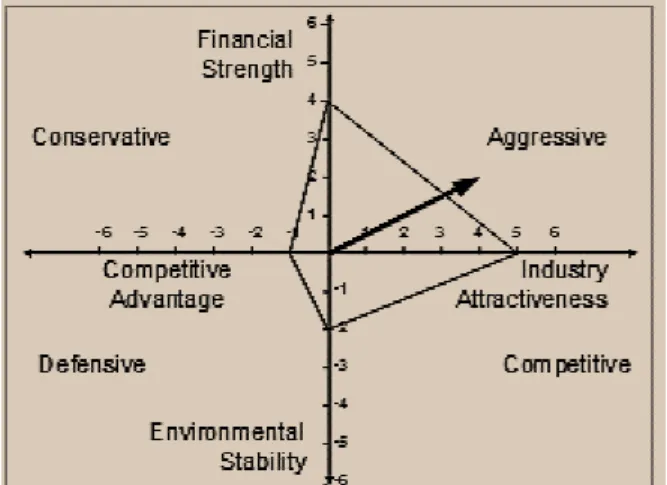
The Figure 1 favourable positions in all four dimensions and therefore the business can follow an aggressive strategy as it leverages its strengths into the opportunities available
SPACE Analysis recommends that businesses in such a strong position take the following actions:
• Continue to invest in innovation to sustain and build the competitive advantage which
• Cover any moves made by competitors to develop alternative competitive advantages. Close off the opportunities to build a differentiated value proposition that may prove attractive to segments of the market.
• Aggressively build market share by movi
• Raise the stakes for other competitors to play the game. This may be through rapid product innov marketing campaigns or reducing prices to levels that competitors find difficult to match.
• Grow within the market through acquisitions.
• Follow up on possible opportunities in the market including backward or forward vertical integration. [11]
• Move into related markets which complement the existing position.
This aggressive, offensive strategy will make it tough for competitors to trade and certainly difficult to build up the resources to challenge for market leadership unless they have very deep poc
The two big concerns in this very favourable position are:
1. Avoid complacency – business can seem also too easy but new threats may come from substitute markets or as technology makes different sectors converge.
2. Avoid running foul of
anti-attention of regulators and especially if it uses predatory pricing aimed at driving competitors out of business. [10]
SPACE Analysis Factors For Environmental Stability
1 (minus 1) great to –6 (minus 6) poor – for more details see [3]
(High to Low) (High to Low)
(much to little) into market (much to little) Competitive pressure/rivalry (much to little) Price range of competing products (narrow to wide)
Interpreting Industry Attractiveness In The SPACE Matrix To Your Situation
al stability is offset by Financial Strength on the y-axis of the traditional SPACE matrix. [7]
The Impact On Strategic Direction For Different Levels Industry Attractiveness
A strong score backed up with reasonable financial strength suggests that either an
is appropriate. A poor score without remarkable financial strength indicates that either a defensive strategy is required. [9]
Interpreting the SPACE Analysis Matrix Diagram
Strategic Position and Action Evaluation Matrix (SPACE Matrix) is a useful guide to help you to decide which strategy is most appropriate in which situation.
The SPACE Matrix assesses the business across four dimensions
mended strategic thrust which can be:
The Figure 1 favourable positions in all four dimensions and therefore the business can follow an aggressive trategy as it leverages its strengths into the opportunities available [3]
SPACE Analysis recommends that businesses in such a strong position take the following actions: Continue to invest in innovation to sustain and build the competitive advantage which
Cover any moves made by competitors to develop alternative competitive advantages. Close off the opportunities to build a differentiated value proposition that may prove attractive to segments of the Aggressively build market share by moving above the fair value line in the customer value map
Raise the stakes for other competitors to play the game. This may be through rapid product innov marketing campaigns or reducing prices to levels that competitors find difficult to match.
Grow within the market through acquisitions.
Follow up on possible opportunities in the market including backward or forward vertical integration. into related markets which complement the existing position.
This aggressive, offensive strategy will make it tough for competitors to trade and certainly difficult to build up the resources to challenge for market leadership unless they have very deep pockets.
The two big concerns in this very favourable position are:
business can seem also too easy but new threats may come from substitute markets kes different sectors converge.
-competition policies. Sometimes a business that is too strong can attract the attention of regulators and especially if it uses predatory pricing aimed at driving competitors out of for more details see Environmental
Interpreting Industry Attractiveness In The SPACE Matrix To Your Situation
axis of the traditional SPACE matrix. [7]
The Impact On Strategic Direction For Different Levels Industry Attractiveness
either an aggressive strategy or A poor score without remarkable financial strength indicates that either a
(SPACE Matrix) is a useful guide to help you to decide
The Figure 1 favourable positions in all four dimensions and therefore the business can follow an aggressive SPACE Analysis recommends that businesses in such a strong position take the following actions:
Continue to invest in innovation to sustain and build the competitive advantage which exists.
Cover any moves made by competitors to develop alternative competitive advantages. Close off the opportunities to build a differentiated value proposition that may prove attractive to segments of the
customer value map. [18] Raise the stakes for other competitors to play the game. This may be through rapid product innovations, marketing campaigns or reducing prices to levels that competitors find difficult to match.
Follow up on possible opportunities in the market including backward or forward vertical integration.
This aggressive, offensive strategy will make it tough for competitors to trade and certainly difficult to build up the
business can seem also too easy but new threats may come from substitute markets policies. Sometimes a business that is too strong can attract the attention of regulators and especially if it uses predatory pricing aimed at driving competitors out of
4.9. Competitive Strategy
The competitive strategy approach is recommen
Competitive Advantage (IA/CA)axis of the SPACE matrix but unfavourably on the Financial Strength / Environmental Stability (FS/ES) axis. The high IA/CA score can be when
• The industry is considered attractive and the company has competitive advantages over its rivals (a very strong position).
• The industry is considered attractive and the business is neutral on competitive advantage.
• The industry is reasonable but the business has a str The low FS/ES score can be when:
• The environment is unstable and the company is weak financially.
• The environment is considered to be unstable and the business has modest financial resources.
• The business is weak financially
The key strategic imperative is to acquire financial strength to compensate for the environmental instability so that the business can then follow an
strengthening the balance sheet and improving the underlying profitability of its sales.To strengthen the balance and to provide the funds for expansion, it can:
• Raise extra share capital or even long term loans. A private business can turn to private equity in terms of business angels or venture capital firms to provide cash although this will dilute the interest of the shareholders.
• Merge with a cash rich company who is lookin
• Form alliances to gain access to tangible and intangible assets without having to incur high investment costs.
• Improving profitability will also lead to strengthening th
withdrawn by the owners. This will take time to build up cash and equity.
To improve profitability of the business and take advantage of its strong combined position on the industry attractiveness / competitive advantage axis, the business should:
• Reduce its fixed and variable costs provided it doesn’t damage the competitive advantage. Innovate to improve productivity.
• Emphasise the differentiation competitive advantages, make sure they are communicated well to market and increase prices to improve margins. This action will depend on where the business is on the customer value map.
• Expand into new markets and p Ansoff Growth matrix. [15]
4.10. Conservative Strategy
The business is trapped into a weak position in an unexciting market
Matrix characterised by low market share and low (perhaps negative) market growth. The company has a choice [3]
1. To improve its current competitive position by dev more attractive niches of the overall market.
2. Looking outside the current market for profitable opportunities, either building on existing resources and capabilities or diversifying into a new area
Combined the individual assessments are negative but this may be:
• IA and CA are both weak
• IA is OK but CA is weak
• IA is weak but CA is OK
If the industry looks bad and the business has significant competitive advantages, then any remaining profitability is under major threat and the business can become a cash drain which will reduce financial strength to diversify elsewhere.
The business should look to trim costs and any loss making customers and products wherever it can to buy more time to find attractive diversification opportunities. It should also cut back on capacity so that it shrinks to fit the future market expectations.
Otherwise the business may be able to improve its position through a determined strategy to improve its competitive advantages. Businesses new to strategic management and
can make major gains through focused action and even find overlooked assets and
should be careful it doesn’t over-invest since upside is weak because the market isn’t considered to be attractive. The business may identify niches where it does have advantages or can quickly develop advantages that are not appreciated in the wider market.
The competitive strategy approach is recommended when the business scores well on the Industry Attractiveness / (IA/CA)axis of the SPACE matrix but unfavourably on the Financial Strength Environmental Stability (FS/ES) axis. The high IA/CA score can be when: [3]
is considered attractive and the company has competitive advantages over its rivals (a very The industry is considered attractive and the business is neutral on competitive advantage.
The industry is reasonable but the business has a strong competitive advantage. [17] The environment is unstable and the company is weak financially.
The environment is considered to be unstable and the business has modest financial resources. The business is weak financially but environmental stability is reasonable. [18]
acquire financial strength to compensate for the environmental instability so that the business can then follow an aggressive strategy. The business needs to split its attention between strengthening the balance sheet and improving the underlying profitability of its sales.To strengthen the balance
the funds for expansion, it can:
Raise extra share capital or even long term loans. A private business can turn to private equity in terms of business angels or venture capital firms to provide cash although this will dilute the interest of the Merge with a cash rich company who is looking for opportunities to expand.
Form alliances to gain access to tangible and intangible assets without having to incur high investment Improving profitability will also lead to strengthening the balance sheet provided the gains aren’t withdrawn by the owners. This will take time to build up cash and equity. [2]
To improve profitability of the business and take advantage of its strong combined position on the industry e advantage axis, the business should:
Reduce its fixed and variable costs provided it doesn’t damage the competitive advantage. Innovate to Emphasise the differentiation competitive advantages, make sure they are communicated well to market and increase prices to improve margins. This action will depend on where the business is on the Expand into new markets and products where the business is confident it will be profitable see the
[15]
into a weak position in an unexciting market – this is the dog position in the Growth Share Matrix characterised by low market share and low (perhaps negative) market growth. The company has a choice
To improve its current competitive position by developing competitive advantages or focusing on the more attractive niches of the overall market.
Looking outside the current market for profitable opportunities, either building on existing resources and capabilities or diversifying into a new area.
ed the individual assessments are negative but this may be:
If the industry looks bad and the business has significant competitive advantages, then any remaining profitability er major threat and the business can become a cash drain which will reduce financial strength to diversify The business should look to trim costs and any loss making customers and products wherever it can to buy rsification opportunities. It should also cut back on capacity so that it shrinks to Otherwise the business may be able to improve its position through a determined strategy to improve its
sses new to strategic management and customer value strategies
can make major gains through focused action and even find overlooked assets and opportunities. The business invest since upside is weak because the market isn’t considered to be attractive. The business may identify niches where it does have advantages or can quickly develop advantages that are not ded when the business scores well on the Industry Attractiveness / (IA/CA)axis of the SPACE matrix but unfavourably on the Financial Strength is considered attractive and the company has competitive advantages over its rivals (a very The industry is considered attractive and the business is neutral on competitive advantage.
ong competitive advantage. [17]
The environment is considered to be unstable and the business has modest financial resources.
acquire financial strength to compensate for the environmental instability so . The business needs to split its attention between strengthening the balance sheet and improving the underlying profitability of its sales.To strengthen the balance Raise extra share capital or even long term loans. A private business can turn to private equity in terms of business angels or venture capital firms to provide cash although this will dilute the interest of the current
Form alliances to gain access to tangible and intangible assets without having to incur high investment e balance sheet provided the gains aren’t To improve profitability of the business and take advantage of its strong combined position on the industry
Reduce its fixed and variable costs provided it doesn’t damage the competitive advantage. Innovate to Emphasise the differentiation competitive advantages, make sure they are communicated well to the market and increase prices to improve margins. This action will depend on where the business is on the
roducts where the business is confident it will be profitable see the
this is the dog position in the Growth Share Matrix characterised by low market share and low (perhaps negative) market growth. The company has a choice: eloping competitive advantages or focusing on the Looking outside the current market for profitable opportunities, either building on existing resources and
If the industry looks bad and the business has significant competitive advantages, then any remaining profitability er major threat and the business can become a cash drain which will reduce financial strength to diversify The business should look to trim costs and any loss making customers and products wherever it can to buy rsification opportunities. It should also cut back on capacity so that it shrinks to Otherwise the business may be able to improve its position through a determined strategy to improve its customer value strategies may find they opportunities. The business invest since upside is weak because the market isn’t considered to be attractive. The business may identify niches where it does have advantages or can quickly develop advantages that are not
The nice thing about the conservative strategy in the SPACE matrix is that the business is not under major threats from the environment and because of its financial strength, it has time to consider its options.
4.11. Defensive Strategy
A defensive strategy is recommended by SPACE analysis when: [3] 1. The Industry Attractiveness / Competitive A
2. The Financial Strength /Environmental Stability axis is also negative
A defensive strategy doesn’t have to come out of weakness but from strength. Sometimes maintaining the status quo suits a market leader or someone who is operating under a high price umbrella of a market leader because profits are high and life is easy. This can be dangerous since the indu
entrant to the market but sometimes “a bird in the hand is better than two in the bush.”Markets are very comfortable when competitors co-exist in their own little spaces and don’t threaten each other beyond loca skirmishes on the borders. I’ve known plenty of business owners who don’t want to grow their businesses significantly. they don’t have the desire to manage a big business. [9]
Different defensive strategy options apply in different parts of the busin
4.11.1. Defensive Marketing Strategy
First be clear on which product-markets you want to defend, which you want to grow and which you will allow to be taken from you without a serious fight.
The growth-share matrix from the Boston Consulting Group may and your market share to create four categories: [7]
• Stars – growing market, high share /
• Cash cows – stable or shrinking market, high share / profit and cash
• Question marks – growing market, low market share/ .
• Dogs – stable or shrinking market, low market share/ you manage for short term cash and profit.
5. Methodology
The current study is applied in terms of the type of goal and is descriptive and case study in terms of data collection and data processing. The most important source in this study is the existing documents in various sections of the organization as human resources, market research, financial, marketing, production and quality and in data collection, additional data are used in terms of the views of local and international managers and experts and research scientific centers.
In this paper, 34 the number of
and by Using Strategic Position and Action Evaluation Matrix use of average weights.
6. Analysis of the results
According to The tables obtained from the Concrete Construction Company centers According to what was said earlier
Mahde Concrete Concrete Construction Company
6.1. Offensive Strategy As A Frontal Attack
In a frontal attack you would target a competitor in the area of its streng same basic value proposition using either a lower price or a large
through brute force, not subtly. The competitor immediately knows that it is under attack and is likely to respond vigorously. This makes frontal attacks very risky and often expensive.
advantages of a low cost position and strong, committed relationships with customers. A frontal attack is only a viable offensive strategy if:
• The market is commoditised with few little differentiation and standard customer needs.
• The brand equity and customer loyalty for the targeted com
• The targeted competitor has few financial resources (or strong allies) relative to the financial strength of the attacker.
6.2. Offensive Strategy As A Flanking Attack
Instead of attacking a competitor where it is strong in a frontal attack competitors product range and attacks there instead.
The nice thing about the conservative strategy in the SPACE matrix is that the business is not under major threats from the environment and because of its financial strength, it has time to consider its options.
A defensive strategy is recommended by SPACE analysis when: [3]
The Industry Attractiveness / Competitive Advantage axis is negative; and The Financial Strength /Environmental Stability axis is also negative
to come out of weakness but from strength. Sometimes maintaining the status quo suits a market leader or someone who is operating under a high price umbrella of a market leader because profits are high and life is easy. This can be dangerous since the industry is inviting an aggressive move by a new entrant to the market but sometimes “a bird in the hand is better than two in the bush.”Markets are very
exist in their own little spaces and don’t threaten each other beyond loca skirmishes on the borders. I’ve known plenty of business owners who don’t want to grow their businesses significantly. they don’t have the desire to manage a big business. [9]
Different defensive strategy options apply in different parts of the business:
4.11.1. Defensive Marketing Strategy
markets you want to defend, which you want to grow and which you will allow to be taken from you without a serious fight.
share matrix from the Boston Consulting Group may help as it looks across the market growth rates and your market share to create four categories: [7]
growing market, high share / to grow aggressively
stable or shrinking market, high share / to defend strongly – these are your main s growing market, low market share/ live up to their names.
stable or shrinking market, low market share/ to harvest i.e. to let your market share drift away as you manage for short term cash and profit.
The current study is applied in terms of the type of goal and is descriptive and case study in terms of data collection and data processing. The most important source in this study is the existing documents in various ion as human resources, market research, financial, marketing, production and quality and in data collection, additional data are used in terms of the views of local and international managers and experts and research scientific centers.
of managers and professionals people have responded Strategic Position and Action Evaluation Matrix, we define company's position.
obtained from the Strategic Position and Action Evaluation Matrix, centers in the SPACE matrix is placed in the position of
about organizations that are in the position offers an aggressive Construction Company for research in the following.
Offensive Strategy As A Frontal Attack
In a frontal attack you would target a competitor in the area of its strengths. In the customer matrix same basic value proposition using either a lower price or a large-scale marketing campaign.
gh brute force, not subtly. The competitor immediately knows that it is under attack and is likely to respond vigorously. This makes frontal attacks very risky and often expensive. The targeted competitor may well have the
and strong, committed relationships with customers. A frontal attack is only a viable offensive strategy if:
The market is commoditised with few little differentiation and standard customer needs. The brand equity and customer loyalty for the targeted competitor is low.
The targeted competitor has few financial resources (or strong allies) relative to the financial strength of
Offensive Strategy As A Flanking Attack
Instead of attacking a competitor where it is strong in a frontal attack, a flanking attack looks for weaknesses in the competitors product range and attacks there instead.
The nice thing about the conservative strategy in the SPACE matrix is that the business is not under major threats from the environment and because of its financial strength, it has time to consider its options.
to come out of weakness but from strength. Sometimes maintaining the status quo suits a market leader or someone who is operating under a high price umbrella of a market leader because stry is inviting an aggressive move by a new entrant to the market but sometimes “a bird in the hand is better than two in the bush.”Markets are very exist in their own little spaces and don’t threaten each other beyond localised skirmishes on the borders. I’ve known plenty of business owners who don’t want to grow their businesses
markets you want to defend, which you want to grow and which you will allow to help as it looks across the market growth rates
these are your main source of
to harvest i.e. to let your market share drift away as
The current study is applied in terms of the type of goal and is descriptive and case study in terms of data collection and data processing. The most important source in this study is the existing documents in various ion as human resources, market research, financial, marketing, production and quality and in data collection, additional data are used in terms of the views of local and international managers and have responded to the questionnaire 's position. This study is the
Strategic Position and Action Evaluation Matrix, Mahde Beton position of offensive strategy and an aggressive strategy to
customer matrix you target the scale marketing campaign. If you win it’s gh brute force, not subtly. The competitor immediately knows that it is under attack and is likely to respond
The targeted competitor may well have the
The market is commoditised with few little differentiation and standard customer needs.
The targeted competitor has few financial resources (or strong allies) relative to the financial strength of
In the customer value map, the competitor may be attract
with the needs of the market segment. This makes it vulnerable to a flanking attack from a competitor who produces a differentiated product targeted at a specific niche. While the competitor will
competitive move, it may not be particularly concerned if little volume is looked threatened. It may decide that the size of the market is not worth the fight providing its core market position is not threatened.
6.3. Offensive Strategy As Encirclement
In the encirclement offensive strategy, the targeted competitor is attacked from two or more directions at once to confuse the response.
For example on the customer value map
1. At the same value point as the incumbent but without the aggression involved in 2. Below the value point to attract price switchers who
offers.
3. Above the value point to attract customer segments who feel under willing to pay a premium price.
The company that is attacked has to deal with three threats at onc
offering, it risks the price reduction spilling over into the other customer segments.
6.4. Offensive Strategy As A Bypass Attack
In this version of offensive strategy, the aggressive competitor does not g
competitor but instead targets areas where it isn’t. While this isn’t a direct attack, it can be thought of as a pre-emptive strike into new markets and new complementary products and is likely to be targeting the incumbent’s own offensive strategies. [3]
Another proposed strategy for the extension, upward and downward Vertical Horizontal variety, …….[4].
7. References
1.Stacy, Ralf. (2002). Strategic management and dynamics of the organization. Translated by Mohammad Reza Shojai, Tehran. Economical affairs school.
2.Aerabi, Seyed Mohamma. (2006). The strategic planning. Tehran. The office of c
3.H.Rows, R.Mason and K.DickelStrategic.(1982).Management and Business Policy: Methodological Approach, Reading Massachusetts:
Addison-4.Keller Janson, Louren & Luccke Richard.(2006).The Essentials of Strategy Boston, Massachusetts & Society For Human Resource Management Virjonia.
5. David, Fred. R. Translated by Parsian. Ali and Aerabi. Seyed Mohammad.(2008). Strategic management: Tehran. Cultural studies office.
6. Webster, L.j. , Reif, W.E. and Bracker, J.S., (1989). The Manger’s Guide to Strategic Planning Tool and Technique, Planning Review, November
7. Ansoff, H.I. , Declerck, R.P. , Hayes, R.L.(1967). From Strategic Planning to Strategic Management. Wiley New york, NY, PP 39-78.
8. Armstrong, J.S., 1982. The value of formal planning for strategic decisions. Strategic Management Journal 3, 197–211.
9. Backoff, R., Wechsler, B., Crew, R., 1993. The challenge of strategic management in local governments. Public Administration Quarterly 17 (2), 127
10. Kemp, R., 1991. Strategic planning for cities. The Futurist (July
11. Miller, C.C., Cardinal, L.B., 1994. Strategic planning and firm performance: a synthesis of more than two decades of research. Academy of Management Journal 37 (6), 1649
12. Mintzberg, H., 1991. Learning 1, planning: reply to Igor Ansoff. Strategic Management Journal 12, 463 13. Mintzberg, H., 1994. The Rise and Fall of Strategic Planning. Free Press, New York.
14. Pearce II, J.A., Freeman, E.B., Robinson Jr., R.B., 1987. The tenuous link between formal strategic planning and financial performance.Academy of Management Review 4, 658
15. Poister, T.H., Streib, G.S., 2005. Elements of strategic planning and man status after two decades.Public Administration Review 65 (11), 45
16. Poister, T.H., Streib, G.S., 2004. Municipal management tools from 1976 to 1993: an overview and update. Public Productivity and Management Review 18
17. Ramanujam, V.N., Venkatraman, V.N., Camillus, J.C., 1986. Multi strategic planning. Academy of Management Journal 29, 347
, the competitor may be attracting business it is the best option without being a close fit with the needs of the market segment. This makes it vulnerable to a flanking attack from a competitor who produces a differentiated product targeted at a specific niche. While the competitor will be aware of the aggressive competitive move, it may not be particularly concerned if little volume is looked threatened. It may decide that the size of the market is not worth the fight providing its core market position is not threatened.
Strategy As Encirclement
In the encirclement offensive strategy, the targeted competitor is attacked from two or more directions at once to customer value map, the aggressive competitor could launch three new products:
At the same value point as the incumbent but without the aggression involved in
Below the value point to attract price switchers who don’t appreciate everything that the incumbent Above the value point to attract customer segments who feel under-served by the incumbent and who are willing to pay a premium price.
The company that is attacked has to deal with three threats at once and if it cuts price to fight off the low priced offering, it risks the price reduction spilling over into the other customer segments.
Offensive Strategy As A Bypass Attack
In this version of offensive strategy, the aggressive competitor does not go head-to-head against the incumbent competitor but instead targets areas where it isn’t. While this isn’t a direct attack, it can be thought of as a emptive strike into new markets and new complementary products and is likely to be targeting the
bent’s own offensive strategies. [3]
for the company include: Penetrate in the market, Market downward Vertical integration, Homogeneous variety,
Non-Stacy, Ralf. (2002). Strategic management and dynamics of the organization. Translated by Mohammad Reza Shojai, Tehran. Economical affairs school.
Aerabi, Seyed Mohamma. (2006). The strategic planning. Tehran. The office of cultural research office. 3.H.Rows, R.Mason and K.DickelStrategic.(1982).Management and Business Policy: Methodological Approach,
-Wesley publishing co.
4.Keller Janson, Louren & Luccke Richard.(2006).The Essentials of Strategy, Harvard business School Press, Boston, Massachusetts & Society For Human Resource Management Virjonia.
5. David, Fred. R. Translated by Parsian. Ali and Aerabi. Seyed Mohammad.(2008). Strategic management: . , Reif, W.E. and Bracker, J.S., (1989). The Manger’s Guide to Strategic Planning Tool and Technique, Planning Review, November-December, pp.4-13.
7. Ansoff, H.I. , Declerck, R.P. , Hayes, R.L.(1967). From Strategic Planning to Strategic Management. Wiley 8. Armstrong, J.S., 1982. The value of formal planning for strategic decisions. Strategic Management Journal 3, 9. Backoff, R., Wechsler, B., Crew, R., 1993. The challenge of strategic management in local governments.
lic Administration Quarterly 17 (2), 127–144.
10. Kemp, R., 1991. Strategic planning for cities. The Futurist (July–August), 41–42.
11. Miller, C.C., Cardinal, L.B., 1994. Strategic planning and firm performance: a synthesis of more than two earch. Academy of Management Journal 37 (6), 1649–1665.
12. Mintzberg, H., 1991. Learning 1, planning: reply to Igor Ansoff. Strategic Management Journal 12, 463 13. Mintzberg, H., 1994. The Rise and Fall of Strategic Planning. Free Press, New York.
4. Pearce II, J.A., Freeman, E.B., Robinson Jr., R.B., 1987. The tenuous link between formal strategic planning performance.Academy of Management Review 4, 658–675.
15. Poister, T.H., Streib, G.S., 2005. Elements of strategic planning and management in municipal government: status after two decades.Public Administration Review 65 (11), 45–56.
16. Poister, T.H., Streib, G.S., 2004. Municipal management tools from 1976 to 1993: an overview and update. Public Productivity and Management Review 18 (2), 115–125.
17. Ramanujam, V.N., Venkatraman, V.N., Camillus, J.C., 1986. Multi-objective assessment of effectiveness of strategic planning. Academy of Management Journal 29, 347–372.
ing business it is the best option without being a close fit with the needs of the market segment. This makes it vulnerable to a flanking attack from a competitor who be aware of the aggressive competitive move, it may not be particularly concerned if little volume is looked threatened. It may decide that the size of the market is not worth the fight providing its core market position is not threatened.
In the encirclement offensive strategy, the targeted competitor is attacked from two or more directions at once to , the aggressive competitor could launch three new products:
the frontal attack. ing that the incumbent served by the incumbent and who are e and if it cuts price to fight off the low priced
head against the incumbent competitor but instead targets areas where it isn’t. While this isn’t a direct attack, it can be thought of as a emptive strike into new markets and new complementary products and is likely to be targeting the market, Market extension, Product -homogeneous variety,
Stacy, Ralf. (2002). Strategic management and dynamics of the organization. Translated by Mohammad Reza ultural research office. 3.H.Rows, R.Mason and K.DickelStrategic.(1982).Management and Business Policy: Methodological Approach,
, Harvard business School Press, 5. David, Fred. R. Translated by Parsian. Ali and Aerabi. Seyed Mohammad.(2008). Strategic management: . , Reif, W.E. and Bracker, J.S., (1989). The Manger’s Guide to Strategic Planning Tool and 7. Ansoff, H.I. , Declerck, R.P. , Hayes, R.L.(1967). From Strategic Planning to Strategic Management. Wiley, 8. Armstrong, J.S., 1982. The value of formal planning for strategic decisions. Strategic Management Journal 3, 9. Backoff, R., Wechsler, B., Crew, R., 1993. The challenge of strategic management in local governments.
11. Miller, C.C., Cardinal, L.B., 1994. Strategic planning and firm performance: a synthesis of more than two 12. Mintzberg, H., 1991. Learning 1, planning: reply to Igor Ansoff. Strategic Management Journal 12, 463–466. 4. Pearce II, J.A., Freeman, E.B., Robinson Jr., R.B., 1987. The tenuous link between formal strategic planning agement in municipal government: 16. Poister, T.H., Streib, G.S., 2004. Municipal management tools from 1976 to 1993: an overview and update. objective assessment of effectiveness of
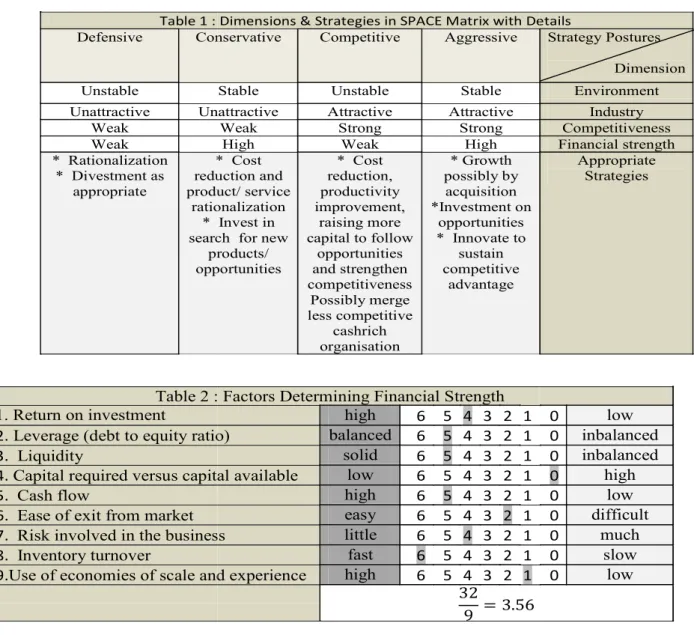
Table 1 : Dimensions & Strategies in SPACE Matrix with Details Conservative Defensive Unstable Unattractive Unattractive Weak Weak * reduction product/ rationalization * search products/ opportunities * Rationalization * Divestment as appropriate
18. Steiner, G.A., Miner, J.B., 1986. Management Policy and Strategy. York, NY, pp. 80–84.
19. Ugboro, I.O., 1985. Strategic planning systems: their effectiveness in strategy formulation in the electronic computing equipment industry, Unpublished, Dissertation, North Texas State University,
20 Abernathy, W. J., Clark, K., and Kantrow, A. (1981) ‘The new industrial competition’, HarvardBusiness Review, September–October, pp. 68
21. D’Aveni, R. J. (1994) Hypercompetition: Managing the Dynamics of Strategic Maneuvering. New York: Free Press.
22. David, F. R. (1989) ‘How companies define their mission’, Long Range Planning, 22: 90 23. Freeman, R. H. (1984) Strategic Management: a Stakeholder Approach. London: Pitman. 24. Galbraith, J. R., and Kazanjian, R. K. (1986) Strategy
25. Hambrick, D., and Fredrickson, J. W. (1996) ‘Are you sure you have a strategy?’ Academy of Management Executive, 15: 48–59.
26. Leavy, B. (1998) ‘Learning in the strategy field’, Management Learning, 29: 44 27. Mintzberg, H. (1973) The Nature of Managerial Work. New York: Harper & Row.
28. Porter, M. E. (1985) Competitive Advantage: Creating and Sustaining Superior Performance. New York: Free Press.
. Figure & Table
Table 2 : 1. Return on investment
2. Leverage (debt to equity ratio) 3. Liquidity
4. Capital required versus capital available 5. Cash flow
6. Ease of exit from market 7. Risk involved in the business 8. Inventory turnover
9.Use of economies of scale and experien
Table 1 : Dimensions & Strategies in SPACE Matrix with Details
Aggressive Competitive Conservative Stable Unstable Stable Attractive Attractive Unattractive Strong Strong Weak High Weak High * Growth possibly by acquisition *Investment on opportunities * Innovate to sustain competitive advantage * Cost reduction, productivity improvement, raising more capital to follow opportunities and strengthen competitiveness Possibly merge less competitive cashrich organisation * Cost reduction and product/ service rationalization * Invest in search for new
products/ opportunities
18. Steiner, G.A., Miner, J.B., 1986. Management Policy and Strategy. Macmillan Publishing Company, New 19. Ugboro, I.O., 1985. Strategic planning systems: their effectiveness in strategy formulation in the electronic
computing equipment industry, Unpublished, Dissertation, North Texas State University,
20 Abernathy, W. J., Clark, K., and Kantrow, A. (1981) ‘The new industrial competition’, HarvardBusiness October, pp. 68–81.
21. D’Aveni, R. J. (1994) Hypercompetition: Managing the Dynamics of Strategic Maneuvering. New 22. David, F. R. (1989) ‘How companies define their mission’, Long Range Planning, 22: 90
23. Freeman, R. H. (1984) Strategic Management: a Stakeholder Approach. London: Pitman.
24. Galbraith, J. R., and Kazanjian, R. K. (1986) Strategy Implementation. St Paul MN: West Publishing.
25. Hambrick, D., and Fredrickson, J. W. (1996) ‘Are you sure you have a strategy?’ Academy of Management 26. Leavy, B. (1998) ‘Learning in the strategy field’, Management Learning, 29: 447–66.
27. Mintzberg, H. (1973) The Nature of Managerial Work. New York: Harper & Row.
28. Porter, M. E. (1985) Competitive Advantage: Creating and Sustaining Superior Performance. New York:
Table 2 : Factors Determining Financial Strength 1 2 3 4 5 6 high 1 2 3 4 5 6 balanced
Leverage (debt to equity ratio)
1 2 3 4 5 6 solid 1 2 3 4 5 6 low Capital required versus capital available
1 2 3 4 5 6 high 1 2 3 4 5 6 easy 1 2 3 4 5 6 little Risk involved in the business
1 2 3 4 5 6 fast 1 2 3 4 5 6 high Use of economies of scale and experience
32
9 = 3.56
Table 1 : Dimensions & Strategies in SPACE Matrix with Details
Strategy Postures Dimension Environment Industry Competitiveness Financial strength Appropriate Strategies *Investment on
Macmillan Publishing Company, New 19. Ugboro, I.O., 1985. Strategic planning systems: their effectiveness in strategy formulation in the electronic
computing equipment industry, Unpublished, Dissertation, North Texas State University, Denton, Texas. 20 Abernathy, W. J., Clark, K., and Kantrow, A. (1981) ‘The new industrial competition’, HarvardBusiness 21. D’Aveni, R. J. (1994) Hypercompetition: Managing the Dynamics of Strategic Maneuvering. New
22. David, F. R. (1989) ‘How companies define their mission’, Long Range Planning, 22: 90–7. 23. Freeman, R. H. (1984) Strategic Management: a Stakeholder Approach. London: Pitman.
Implementation. St Paul MN: West Publishing. 25. Hambrick, D., and Fredrickson, J. W. (1996) ‘Are you sure you have a strategy?’ Academy of Management
28. Porter, M. E. (1985) Competitive Advantage: Creating and Sustaining Superior Performance. New York:
low 0 inbalanced 0 inbalanced 0 high 0 low 0 difficult 0 much 0 slow 0 low 0
Table 3: Factors Determining Competitive Advantage
1. Market share
2. Product quality
3.Product life cycle
4.Product replacement cycle
5.Customer loyalty
6.Competition’s capacity utilisation
7.Technological know-how
8.Vertical integration
9. Speed of new product introductions
Table 4: 1. Growth potential 2. Profit potential 3. Financial stability 4.Technological know-how 5.Resource utilisation 6.Capital intensity
7.Ease of entry into the market 8.Productivity; capacity utilisation 9. Manufacturer’s bargaining power
Average
Factors Determining Environmental Stability
1.Technological changes
2.Rate of inflation
3.Demand variability (much to little)
4.Barriers to entry into market
5.Competitive pressure/rivalry
6.Price range of competing products (
Average
Table
5 :
Factors Determining Competitive Advantage
1
2
3
4
5
6
large
1
2
3
4
5
6
superior
1
2
3
4
5
6
early
1
2
3
4
5
6
fixed
1
2
3
4
5
6
high
1
2
3
4
5
6
high
etition’s capacity utilisation
1
2
3
4
5
6
high
1
2
3
4
5
6
high
1
2
3
4
5
6
fast
uct introductions
32
9
= 3.56 = −2.44
Factors Determining Industry Attractiveness 1 2 3 4 5 6 high 1 2 3 4 5 6 high 1 2 3 4 5 6 high 1 2 3 4 5 6 complex 1 2 3 4 5 6 efficient 1 2 3 4 5 6 high 1 2 3 4 5 6 difficult Ease of entry into the market
1 2 3 4 5 6 high uctivity; capacity utilisation
1 2 3 4 5 6 high anufacturer’s bargaining power
36 9 = 4
Factors Determining Environmental Stability
3
4
5
6
Low
3
4
5
6
Low
3
4
5
6
Low
(much to little)
3
4
5
6
much
into market (to)
3
4
5
6
Low
Competitive pressure/rivalry (to)
3
4
5
6
narrow
Price range of competing products (to)
18
6
= 3 =
`small
0
1
inferior
0
1
late
0
1
variable
0
1
low
0
1
low
0
1
low
0
1
low
0
1
slow
0
1
44
low 0 1 low 0 1 low 0 1 simple 0 1 inefficient 0 1 low 0 1 easy 0 1 low 0 1 low 0 1High
0
1
2
High
0
1
2
High
0
1
2
little
0
1
2
High
0
1
2
wide
0
1
2
−3
Figure 1
:
Matrix SPACE
Figure 2 : Matrix SPACE for