Graphical diagnostics of endogeneity
∗
Xavier de Luna
aand Per Johansson
ba Department of Economics, Ume˚a University, S-90187 Ume˚a, Sweden.
E-mail: [email protected]
b IFAU - Office of Labour Market Policy Evaluation, S-75120 Uppsala, Sweden.
E-mail: [email protected]
Abstract
We show that in sorting cross-sectional data, the endogeneity of a variable may be successfully detected by graphically examining the cumulative sum of the recursive residuals. An interesting case arises with a continuous or ordered (e.g., years of schooling) endogenous vari-able. Then, a graphical test for misspecification due to endogeneity (e.g., self selection) can be obtained without instrumental variables. Moreover, the sign of the bias implied by this endogeneity becomes deducible through such graphs.
Keywords: CUSUM plot; Recursive residuals; Return to schooling; Self selection.
JEL: C32, C52.
∗Thefirst author would like to acknowledge the Wikstr¨om Foundation for itsfinancial
1
Introduction
In regression models for continuous responses, all sorts of model misspecifi -cations may be diagnosed by an analysis of ordinary residuals, i.e., from an ordinary least square (OLS) estimator. Endogeneity of variables is a notable exception, however; with linear models, this is due to the OLS estimated parameter being consistent for the reduced form parameter (other than the structural parameter).
The purpose of this paper is to show how recursive residuals associated with a specific ordering of the data can be successfully analyzed in order to diagnose the endogeneity of a variable. In particular, we show that a graphical display of the cumulative sum of the recursive residuals obtained by assuming exogeneity is helpful in diagnosing the presence of endogeneity. Moreover, the sign of the bias implied by this endogeneity (e.g., the direction of a self selection bias) is also deducible through such graphs. The use of recursive residuals was earlier advocated by Harvey and Collier (1977) to test for functional misspecification in regression analysis.1 In particular, they proposed a t-statistic to test that the residuals have expectation zero. This test is directly applicable to test against endogeneity when the data is sorted adequately. Instruments may be needed to obtain such a sorting.
However, an interesting case arises with a continuous or ordered (e.g., years of schooling) variable whose endogeneity is due to selectivity. Sorting the data with respect to this variable and looking at recursive residuals ob-tained with a model where exogeneity is assumed allow us to diagnose the misspecification. In this case, endogeneity can thus be diagnosed without specifying a model for the alternative, in contrast with the Hausman test (cf. Hausman, 1978) for which certain instruments are needed.
In Section 2, we start by presenting a framework allowing us to intro-duce special orderings of the data that are useful for diagnosing endogeneity. Section 3 presents the methodology based on the calculation of recursive residuals associated with a relevant ordering of the data. Graphical displays of these residuals as well as the Harvey-Collier test statistic are proposed to diagnose the endogeneity of a variable. Sections 4 to 6 present different areas of application. Thus, Section 4 looks at a text-book example of en-dogeneity due to simultaneity of two variables. Section 5 considers Garen’s
1Endogeneity of a variable is often equivalent to a functional misspecification. For
instance, if a random coefficient is associated to a continuous endogenous variable (e.g. Garen’s (1984) model), the outcome equation is implicitely non-linear in that variable.
(1984) model of selectivity based on a random coefficient. In particular, a real data set concerning returns to schooling is analyzed in detail. Finally, Section 6 discusses the case of endogenous treatment where the propensity score (Rosenbaum and Rubin, 1983) can be used to sort the data to identify self-selection. The paper is concluded with a discussion in Section 7.
2
Sorting scores for endogeneity
We consider an observational study where independent observations are avail-able for a response y, together with a set of exogenous variables x and a possibly endogenous variable z (denoted the treatment in the sequel). The following linear statistical model is considered
y =x0β+γz+ε,
where ε is a zero mean error term. The exogeneity of x implies that its marginal density, p(x;δ), δ ∈D ⊆Rd, can be ignored without loss of infor-mation about β andγ (see, e.g., Gouri´eroux and Monfort, 1995, Chap. 1.5). Similarly, if treatment z is exogenous, its effect can be studied by the sole specification of p(y|z,x;β,γ), that is, the density of the error term. How-ever, in a typical observational study,the exogeneity of treatmentz must be assessed.
We propose graphical diagnostics of endogeneity by sorting the data with respect to a sorting score. The sorted data should then not be distinguishable from any other random ordering, only under the exogeneity of the variable of interest.
In general, there is no unique sorting score for a given problem, but certain sorting scores will be more useful than others. In order to present results, we must give a minimal description of the alternative hypothesis of endogeneity. Hence, let us consider an unobserved variable u such that
E(ε|x, z, u) =u. (1) Let
m(x, z;θ) =x0β+γz,
whereθ = (β0,γ)0. UnderH0 : ”zis exogenous”, implying within this
and optimal (with minimum mean squared error of prediction) predictor of
y, given x and z.
Let us defineθc (possibly a function of c) as
θc= arg min
θ E[{y−m(x,z;θ)} 2
|z,x, s < c],
wheres is a random variable. We call this variable asorting score when it is such that θc =θ, a constant, only under H0. Such sorting scores will allow us to identify endogeneity by fitting m(x, z;θc) recursively to data sorted with respect to s and looking for evidence of a varying parameter θc. We now define a class of particularly useful sorting scores.
Definition 1 A monotone sorting score sforE(y|x, z)is such that ∀c∈Ωs,
m(x, z;θc)≶E(y|z,x) for all x, z such that s > c,
when H0 does not hold.
We start by a preliminary result.
Lemma 1 If u =λz, and hence sorting with respect to u or z is identical, then for s =u, ∀c∈Ωs, m(x, z;θc) =E(y|z,x) for all x, z.
Proof. We have that E(y|z,x) = x0β+ (γ+λ)z. Moreover, θ
c is solution of
E(y−m(x, z;θc)|z,x, s < c) = 0,
∀c ∈ Ωs. But here, E(y−m(x, z;θc)|z,x, s < c) = E(y−m(x, z;θc)|z,x) and θc= (β0,γ+λ)0. The lemma is then proved.
Thus, in the situation of the lemma,s=u is not monotone and will not help us identify endogeneity. In fact, λ and γ are not identifiable in such a situation. On the other hand, let u and z be not proportional but linearly dependent as
u=ξ1z+ξ2, (2)
where ξi, i = 1,2 are random variables with E(ξi|x, z) = αi, α1 6= 0, and V(ξi|x, z) ≥ 0, for any z. The latter inequality is assumed to be strict for at least one i, i = 1,2. Furthermore, when V(ξ1|x, z) > 0, z is assumed to be either always non-negative or always non-positive. Then, it can be shown that u is a monotone sorting score:
Proposition 1 Let u in (1) be such that under endogeneity of z, u and z
are linearly dependent as described by (2). Then, u is a monotone sorting score.
Proof.
We assume endogeneity ofz. We can write
E(y|x, z, u) =β0x+γz+u
and
E(y|x, z) =β0x+γz+E(u|x,z),
where E(u|x, z)6= 0. Furthermore, for a constant c∈ Ωu (the sample space of u),
E(y|x, z, u < c) =β0x+γz+E(u|x, z, u < c).
By the linearity assumption (2), we can write E(u|x, z, u < c) = αc
2 +αc1z,
where αc
i =E(ξi|x, z, u < c), i= 1,2, are constants although functions of c. Hence,
E(y|x, z, u < c) =β0x+γz+αc2+αc1z,
which is linear and equivalent to m(x, z;θc). Moreover, because αc i < αi when V(ξi|x, z) > 0 (this is true for at least one i), E(u|x, z, u < c) <
E(u|x, z) for any positivez andE(u|x, z, u < c)> E(u|x, z) for any negative
z. Thereby the monotonicity of uas sorting score is implied.
Even ifuis unobserved, this result is of practical use because the ordering of u can be retrieved by studying z and its relation to certain instruments, see the example sections below.
A most convenient case arises whenz is a monotone sorting score in itself, since no instrumental variables are then required. This situation can arise when E(u|z) is non-linear in z which is, for instance, the case with random coefficient models; see Section 5.
3
Graphical diagnostics
Graphical diagnostics are informal tools for analysis but,at the same time,
a very powerful medium for conveying information. A graph may tell more than the value of a test statistic, although both are obviously complementary. Since ordinary residuals are not really appropriate to identify the endogeneity misspecification,we base our analysis on recursive residuals.
3.1
Recursive residuals
Let a set of independent observations (yi,xi, zi), i = 1, . . . , n, be generated by a model with corresponding densityp(y|z,x;β).For eachk=q, . . . , n−1, a consistent estimate βbk of β, based on (yi,xi, zi), i = 1, . . . , k, is assumed to be available. Recursive residuals are then obtained by predicting yj with
E(yj|zj,xj;βbj−1), j = q+ 1, . . . n. This prediction is an estimate, based on
observations (yi,xi, zi), i= 1, . . . , j−1, of the optimal (mean squared error sense) predictorE(yj|zj,xj;β). The recursive residuals are then standardized prediction errors:
wj =
yj −E(yj|zj,xj;βbj−1) V ar(yj−E(yj|zj,xj;βbj−1)|zj,xj)
, j =q+ 1, . . . n.
Assuming that the involved moments exist and that the model is well spec-ified, these recursive residuals are, at least asymptotically, independent and identically distributed with mean zero and variance one. These properties hold exactly when β is known.
Example 1 The linear Gaussian model, yi =x0iβ+εi with εi independently
and normally distributed with mean zero and variance σ2, is an important
particular case for which recursive residuals were originally studied, e.g., by Brown et al. (1975). For this model, we have, for j =q+ 1, . . . n,
wj =
yj−x0jβbj−1
σ(1 +x0
j(X0j−1Xj−1)−1xj)1/2 ,
where Xj−1 = (x01, . . . ,x0j−1)0. Assuming that X0j−1Xj−1 are invertible, wj
are homoscedastic, independent, and with standard normal distribution (Brown et al., 1975). No asymptotic argument is needed here.
Kianifard and Swallow (1996) review the application of recursive residu-als, see also Dawid (1984) and de Luna and Johansson (2000).
3.2
Cumulative sum and the Harvey-Collier test
A graphical diagnostic tool is obtained by graphically displaying recursive residuals. Their cumulative sum (CUSUM) is most useful. Asymptotically,
the recursive residuals have mean zero for a well-specified model. When miss-specification arises, in our case when exogeneity of the treatment does not hold, the recursive residuals will typically have non-zero mean. If we then sort the data with respect to s, a monotone sorting score, the residuals will have positive (or negative) mean throughout the recursion.
The results of Section 2 can be used to obtain such sortings. In the time series context, the aim when inspecting cumulative sums is to detect a change of the parameter values, see e.g. Brown et al. (1975). Most often this is believed to be an abrupt structural change at a unknown point in time. The endogeneity misspecification is instead translated by small but systematic biases in predictions. Thus, a monotone sorting score should be used for these biases to accumulate instead of cancelling each other out, thereby guaranteeing the best visual effect when plotting the cumulative sum of the recursive residuals. Examples illustrate these issues in the next section. The constancy of the bias sign is also relevant for the test presented below to have power.
Harvey and Collier (1977) proposed a simple test based on the sum of the recursive residuals to identify functional misspecification in a regression model. In our context, write
w= 1 n−q n X i=q+1 wi
the average of the recursive residuals. Then, under H0, asymptotically (ex-actly under the normal model), w is normally distributed with mean zero and variance 1/(n−q), and constitutes a test statistic for H0. This test is a necessary complement to the CUSUM plot. Note that a simulation study conducted in de Luna and Johansson (2000) showed the good properties of the Harvey-Collier test in comparison with,for example, a classic Hausman test.
4
Application I: consumption and income
Consider the model for y and z:
where variable z is endogenous, such that
z=αx2+ν,
with εand ν correlated2. Denotex= (x1, x2). Assuming E(ε
|ν) to be linear in ν (e.g., bivariate normality), we have
E(y|x, z) =βx1+γz+λ(z−αx2), (3) where λ = 0 if and only if ε and ν are uncorrelated. Here, s= (z −αx2) is chosen as a sorting score. Note that λs(x2, z) plays the role of the omitted variable u in (1). The assumptions of Proposition 1 are met when, for in-stance,x2 andz are jointly normal3 (so thatE(x2
|z) is linear in z), in which case we can say that s is a monotone sorting score. It can be approximated by (z−bαx2),whereαbis a consistent estimate. Note thatx2 =x1 would lead to the non-identifiability of γ, and the non-applicability of Proposition 1.
Example 2 We use data on U.S. consumption expenditures (ct), disposable
income (yt) and government expenditure (gt), in billions of 1982 dollars, for
year t between 1975-1986.4 We assume:
ct =γ0 +γ1yt+εt,
where yt is endogenous such that
yt=α0+α1gt+νt. (4)
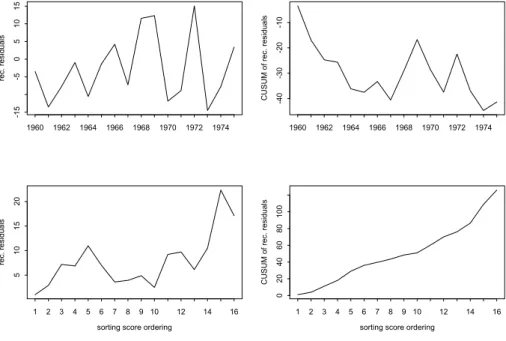
Figure 8 shows how the endogeneity of yt is revealed by using the residuals
from (4) as a sorting score.
2Classical examples include: i) y is a quantity of goods and z its price, ii) y is a
consumption measure and zdisposable income.
3This assumption might seem restrictive, but is only needed to ensure that Proposition
1 can be applied. It should be observed, however, that the linearity of E(s|z) is not a necessary condition for monotonicity.
4This data is described in Hill, Griffiths and Judge (1997) and obtained from
rec. residuals 1960 1962 1964 1966 1968 1970 1972 1974 -15 -5 0 5 10 15 CUS UM of rec. residuals 1960 1962 1964 1966 1968 1970 1972 1974 -40 -30 -20 -10
sorting score ordering
rec. residuals 1 2 3 4 5 6 7 8 9 10 12 14 16 51 0 15 20
sorting score ordering
CUS UM of rec. residuals 1 2 3 4 5 6 7 8 9 10 12 14 16 0 204 0 608 0 10 0
Figure 1: Recursive residuals and their cumulative sum when regressing the consumption expenditures on disposable income (yt), using time ordering (above panels)−HC=−1.09; and the ordering using the sorting score: resid-uals of regressing yt on the government expenditure variable (below panels)
5
Application II: return to schooling
5.1
The Garen model
We now consider the selectivity model proposed by Garen (1984, 1988)
y=x0β+zδ+zr+ε, (5)
z =f(x∗) +ν,
where E(ε|x∗, z, r) = 0 and x∗ contains all the variables in x and possibly
others.5 For this model,
E(y|x∗, z) =x0β+zδ+zE(r|ν). (6) AssumingE(r|ν) to be linear inν(e.g., bivariate normality), we haveE(r|ν) =
λ(z−f(x∗)). Exogeneity of z corresponds to λ= 0, i.e. uncorrelated r and
ν variables. Here, heteroscedasticity is present even if z is exogenous:
V(y|x∗, z) =z2V(r|ν) +σ2, (7) where σ2 is the variance of ε. In this case, neglecting the endogeneity of z
leads to a misspecification of the conditional expectation, by assuming it to be linear while zE(r|ν) is non-linear inx∗ and z.
In this example, not accounting for the endogeneity of z corresponds to omitting the variable6 z(z
− f(x∗)) in (6) which corresponds to u in (1).
The non-linearity of E(y|x, z) may often be hidden by the heteroscedastic noise when examining conventional residuals. On the other hand, recursive residuals can often identify the systematic bias in predictions obtained with the sorting score s = z(z −f(x∗))7 as illustrated in Example 3. Because f is unknown, an approximate sorting score must be used to estimate this function, yielding z(z −fb(x∗)). Notice that within this framework, it is
possible to proceed without specifying a parametric form for f but instead using a non-parametric estimate.
5Garen also considered a pure random effect, i.e. y = x0β+zδ+zr+η+ε, with
E(y|x∗, z) =x0β+zδ+zE(r|ν) +E(η|v) andE(η|v) =ρv. Here, we omitη for clarity.
6The omitted variable is a sorting score sinceλ= 0 under exogeneity. 7Note that Proposition 1 does not apply here sinceE(s
|z) is not linear inz. However,
E(s|z) is quadratic in z and therefore, fitting a linear model inz leads to a systematic under-prediction ofy and hence,sis a monotone sorting score.
Remark 1 An important property of the diagnostics (CUSUM plots and Harvey-Collier test) is that they have the correct size as soon as λ = 0, even if the random coefficient r exists. This is to be contrasted with a clas-sical Hausman type test (typically a conventional test on the residuals of the regression of z against instruments, when introduced in the outcome equa-tion) where the null hypothesis is r ≡ 0 and which therefore has power even against the mere existence of r.
Remark 2 The Garen model is an econometric translation of a theoretical proposition saying that individuals maximize their present value of future returns. Thus, stating further that individuals know their own coefficient r, we should observe a positive correlation between r and z (endogeneity). If not taken into account, this leads to an underprediction of individual returns to schooling for increasingz’s.8 In other words, the theory which has inspired
the Garen model also predicts that z is a monotone sorting score, leading to recursive residuals with a positive mean.
Example 3 The Garen model is considered, and we simulate 100 observa-tions with the following specifications: for i= 1, . . . ,100,
yi = 1 + 2x1i+γizi+εi,
γi = 1 +ri,
zi =x1i−x2i+νi,
with x1i ∼ U(0,1), x2i ∼ U(0,1),εi ∼ N(0,1) and ri and νi bivariate
nor-mal with expectations zero, variances 0.36 and1respectively, and correlation
−0.5. Assuming exogeneityE(yi|x1i, zi) =x1iβ+ziγ is estimated with OLS.
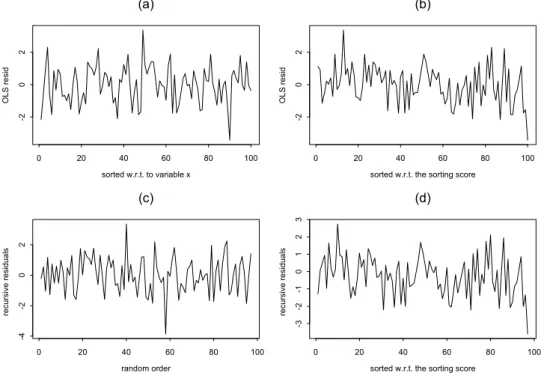
Several types of residual analyses are presented in Figures 2 and 3.
¿From the residuals plots of Figure 2, there seems to be no severe het-eroscedasticity. Identifying the misspecification of the conditional mean is not straightforward with these residual plots, although a trained eye may see some structure in the OLS residuals when sorted with respect to the omitted
8Using the full sample OLS estimator on (5) would, of course, lead to a positive biased
estimate of the mean return to schooling. Here,we rather discuss the individual’s return to schooling, when sorting with respect to schooling, recursively estimating the model with OLS, and thereafter performing out of sample predictions using this previous OLS estimate.
sorted w.r.t. to variable x OLS r e si d 0 20 40 60 80 100 -2 0 2 (a)
sorted w.r.t. the sorting score
OLS r e si d 0 20 40 60 80 100 -2 0 2 (b) random order re cu rs iv e r e si dual s 0 20 40 60 80 100 -4 -2 0 2 (c)
sorted w.r.t. the sorting score
re cu rs iv e r e si dual s 0 20 40 60 80 100 -3 -2 -1 0 1 2 3 (d)
Figure 2: Residuals from the Garen model of Example 7: (a) OLS residuals sorted w.r.t. the variable z; (b) OLS residuals obtained with the ordering of the omitted variable (optimal sorting score); (c) Recursive residuals obtained with a random ordering; (d) Recursive residuals obtained with the optimal sorting score.
sorted w.r.t. the sorting score CUS UM of OLS res id 0 20 40 60 80 100 0 5 10 15 (a) random order CUSUM of r ec ur siv e r es iduals 0 20 40 60 80 100 -2 24 68 (b)
sorted w.r.t. the sorting score
CUSUM of r ec ur siv e r es iduals 0 20 40 60 80 100 -2 5 -1 5 -5 5 (c)
sorted w.r.t. the estimated sorting score CUSUM of r ec ur siv e r es iduals 0 20 40 60 80 100 -2 5 -1 5 -5 (d) sorted w.r.t. to variable z CUSUM of r ec ur siv e r es iduals 0 20 40 60 80 100 -3 0 -1 0 (e)
sorted w.r.t. residuals from regress. of z against x CUSUM of r ec ur siv e r es iduals 0 20 40 60 80 100 -4 0 -2 0 0 (f)
Figure 3: CUSUM plots of various residuals from the Garen model of Ex-ample 2: (a) OLS residuals sorted w.r.t. the sorting score zi(zi −f(xi))
−HC(ri ≡0) = 0.00; (b) Recursive residuals obtained with a random order-ing −HC(ri ≡ 0) = 0.40; (c) Recursive residuals obtained with the sorting score zi(zi−f(xi)) −HC(ri ≡0) =−2.53; (d) ditto but with an estimate of the previous sorting score−HC(ri ≡0) =−2.83; (e) ditto but with the sort-ing scores(x, z) =z −HC(ri ≡0) =−3.75; (f) ditto but with the OLS resid-uals from the regression ofzionxi as the sorting score−HC(ri ≡0) =−4.74.
variable, graph (b), and in the recursive residuals obtained with this same sorting score, graph (d). The CUSUM plots in Figure 3 are more interest-ing. We note that the recursive residuals obtained with well chosen sorting scores all provide a clear sign of the misspecification of the conditional mean of the model (endogenous treatment) by displaying a systematic departure from zero for the CUSUM trajectory. This neat visual effect is due to the monotonicity property. Note that, as in Section 4, the residuals of the selec-tion equaselec-tion as well as the endogenous variable itself also seem to provide monotone sorting scores, see the bottom panel of Figure 3. The values of the HC test (for H0 :ri ≡0),given in the caption of the figure,confirm the visual impression.
5.2
U.S. data on return to schooling
The data set9 analyzed in this section was used by Angrist and Krueger (1991) to study the effects of compulsory school attendance, see also Angrist et al. (1999). It consists of a sample of 329 500 men born in 1930-39 from the 1980 US census. This data set will help us illustrate the kind of insights a graphical display of CUSUM recursive residuals can yield when investigating the exogeneity of a covariate.
The linear model of interest tries to explain the log weekly wage by the number of schooling years, while controlling for an age effect (assumed to be exogenous). Schooling systems differ between states, see Angrist and Krueger (1991, Appendix 2), and for that reason,we perform state-specific analyses. As argued in the previous section, the explanatory variable describing school attendance can be used as sorting score to check its endogeneity which is predicted by the theory. We discard individuals with zero to eleven years of education, in order to avoid effects due to compulsory schooling laws.10 In
particular, the compulsory schooling period should not suffer from a selection bias.
Recursive residuals are computed starting from 13 years of education, 1-12 years cases serving as starting values, together with one individual with 13 years to allow for estimability.11 In a sense, the question of interest is whether
9The data set is available at the following address: http://qed.econ.queensu.ca/jae/ 10Compulsory schooling laws may in some instances push students to complete a high
school degree, see Angrist and Krueger (1991, pp. 1004-1005).
11In this application, we have multiple observations for a given number of years of
the return to education remains constant after 12 years of education, which most often corresponds to the completion of a high school degree. Recursive residuals are not only useful for diagnosing whether years of schooling are endogenous (selection bias) but also indicate the sign of the selection bias when present, see Remark 2. This is illustrated by the comments below.
Figure 4 displays CUSUM plots of recursive residuals obtained for Cali-fornia, Kansas, New York and Louisiana. We use the Californian case for our main comments: The CUSUM plot indicates that there is actually no selec-tion bias up to year 15 of educaselec-tion (in agreement with Angrist and Krueger’s (1991) empirical findings, where they compared OLS and two-stage LS esti-mates). At year 16 (most often the completion of a University degree) there seems to be a positive selection bias, however. Indeed, although the HC value (1.02) is not significant at this stage, the clear upward trend observed for students with 16 years of education is convincing enough (such a trend is clear in 31 states out of 50; examples include Kansas and New York in Figure 4, while Louisiana is a counter-example). The non-significance of the test is most surely due to the fact that many of the recursive residuals are consistent with the zero mean hypothesis (those corresponding to 13 to 15 years of education). Finally, years 17 to 20 (most often postgraduate studies) do not seem to be rewarded at the same rate as previous years in terms of log wages since there is a strong negative selection bias (over predictions are observed); here, HC is significant (this downward pattern for postgraduate studies is observed in 39 states out of 50). The final HC value is seldom significant unless, as for California and New York, a large number of individ-uals is available. This is due to the use of a non-monotone sorting score:12
recursive residuals being not biased (up to year 15) -no selection bias-, then positively biased (year 16) -positive selection bias- and finally downwardly biased (years 17 to 20) -negative selection bias-.
FIGURE 4 CAN BE FOUND AT THE END OF THIS DOCUMENT
12Years of schooling, although not monotone, is an interesting sorting score. The
empiri-cal evidence against its monotonicity is actually interesting per se, because theory predicts monotonicity, more precisely positively biased recursive residuals.
Figure 4: Vertical bars indicate years of education; for instance, residuals before the first bar correspond to 13 years, residuals between the first and the second bar are for individuals with 14 years of education and so on, up to 20 years. HC values are: -2.13 for California, 0.73 for Kansas, -5.23 for New York and -1.34 for Louisiana.
6
Application III: self-selection into programs
The standard endogenous treatment model (cf. Heckman, 1978) is such that the choice is described by
z∗ =x∗0α+ε1
z =I(z∗ >0), (8) and the outcome equation is:
y=x0β+zδ+ε2. (9) wherez∗ is an unobserved latent variable and endogeneity implies thatε
1 and
ε2 are correlated. If ε1 and ε2 are bivariate normal and correlated, we have
that E(ε2|x∗, z) = ρσ−21(λz−eλ(1−z)), where λ = φ(x∗0α)/(1−Φ(x∗0α))
and eλ=φ(x∗0α)/Φ(x∗0α). We assume thatx∗ contains at least one variable
not included in x.
Assuming joint normality of ε1 and ε2, and denotingσ21 = 1,σ22, ρ, their
respective variances and correlation,
E(y|x∗, z) =x0β+ρσ2−1[λz−eλ(1−z)]. (10) The last term in this equation corresponds to the unobserved variableuin (1). In this case,the hypotheses of Proposition 1 are fulfilled13 and uis therefore
a monotone sorting score. Here,the missing variable is not observed but can be evaluated by using a consistent estimator αb of α.
Note that sorting with respect toλz−λe(1−z) is equivalent tofirst sorting the sub-sample for which z = 0 with respect toΦ(x∗0α)−1,or equivalently,
with respect to Pr(z = 1|x∗) = Φ(x∗0α), followed by the sub-sample with
z = 1, which is also sorted with respect to Φ(x∗0α). Pr(z = 1|x∗) is called
the propensity score.14 More generally, i.e. without the need to specify the relation between (8) and (9), the theory often predicts that the propensity score is a monotone sorting score (in that individuals maximize the expected return from the treatment, see e.g. Heckman and Robb 1986) allowing us to test this prediction.
When there are more than two possible exclusive treatments,m say, the outcome can be written as
y=x0β+ m
X
k=1
δkzk+ε,
where zki = 1 if individual i takes treatment k, k = 1, . . . , m, and zero otherwise. Then, s= m X k=1 zkPr(zk = 1|x∗)
is a sorting score under the stringent model assumptions of Lee (1983). More generally, treatments can be compared in pairs, e.g., against the non-treatment class, by using data concerning only two such non-treatments and then proceeding as in the above binary choice situation.
Finally, when there is a natural order and meaningful numbers can be assigned to treatments, then the situation is similar to a continuous treatment
z and, for instance, the Garen (1984) model may be used, as in the case study of Section 5.2. Other models are reviewed in Vella (1998), where a control function is always provided, often in the form of generalized residuals. This control function corresponds to the unobserved variable u and will often provide a useful sorting score.
7
Discussion
In this paper, a graphical analysis of the recursive residuals associated with a sorting of the data has been advocated as a tool for diagnosing endogeneity.
14Note that sorting the whole sample with respect to the propensity score does not yield
exactly the same sorting. In the latter case, the two sub-samples defined by z = 0 and 1 will generally not be fully separated by the sorting, since a non-treated individual may in fact have a similar, and indeed even higher, propensity to be treated than one who is actually treated.
We expect practitioners to find this type of analysis a useful complement to existing tests for exogeneity. A major application area arises when the endogenous variable is continuous or ordered. Indeed, it is then possible to test against endogeneity without instrumental variable, by sorting the data with respect to the endogenous variable and looking at the residuals obtained from recursively fitting the outcome equation through the sorted data set. An interesting by-product is that in case of endogeneity, the direction of the bias implied by the endogenous variable is directly available from the CUSUM plot of the recursive residuals,as illustrated with the U.S. data on returns to schooling.
When instruments are available,our approach is complementary to Haus-man-type tests by providing an appealing graphical diagnostic tool. The pro-posed Harvey-Collier test has, moreover, the advantage of having no power against the presence of a random coefficient in front of an exogenous variable, see Remark 1.
Monotone sorting scores have been emphasized because they ensure the best power when looking at CUSUM plots of recursive residuals. However, as soon as endogeneity implies non-linearity of the conditional expectation, e.g. random coefficient models or non-normality of the error term in the regres-sion equation for the endogenous variable, then any sorting, even a random sorting, may allow the analyst to diagnose endogeneity (by identifying the non-linearity). In this case, even ordinary least squares residualsmay be
suf-ficient. This is, however, far from certain because this non-linearity is often weak and the residuals heteroscedastic. In this article, we have shown how recursive residuals associated with a monotone sorting score may overcome this difficulty.
8
Reference
Angrist J.D. and Krueger A.B. (1991). ”Does Compulsory School At-tendance Affect Schooling and Earnings?,” Quarterly Journal of Eco-nomics, CVI, 979-1014.
Angrist J.D., Imbens G.W. and Krueger A.B. (1999). ”Jackknife Instru-mental Variables Estimation,” Journal of Applied Econometrics, 14, 57-67.
the Constancy of Regression Relationships over Time (with Discus-sion),” Journal of the Royal Statistical Society Series B, 37, 149-192. Dawid, A.P. (1984). ”Statistical Theory: The Prequential Approach,”
Jour-nal of the Royal Statistical Society Series A, 147, 278-292.
de Luna, X. and Johansson, P. (2000). ”Testing Exogeneity in Cross-section Regression by Sorting Data,”IFAU Working Paper 2000:2.
Garen, J. (1984). ”The returns to Schooling: A Selectivity Bias Approach with a Continuous Choice variable,” Econometrica,52, 1199-1218. Garen, J. (1988). ”Compensating Wage Differentials and Endogeneity of
Job Riskiness,”Review of Economics and Statistics, 70, 9-16.
Gouri´eroux, C. and Montfort, A. (1995). Statistics and Econometric Models, Cambridge University Press. Cambridge.
Harvey, A. and Collier G. (1977). ”Testing for Functional Misspecification in Regression Analysis,” Journal of Econometrics, 6, 103-119.
Hausman, J.A. (1978). ”Specification Test in Econometrics”Econometrica,
46, 1251-1271.
Heckman, J.J. (1978). ”Dummy Endogenous Variables in a Simultaneous Equation System,” Econometrica,46, 931-959.
Heckman J.J. and Robb R. (1986). ”Alternative Identifying Assumptions in Econometric Models of Selection Bias,” in: H. Wainer, ed.,Drawing infernce from Self selected samples. Springer-Verlag, Berlin, Germany,
63-107.
Hill, R.C., Griffiths, W.E. and G.G. Judge (1997). Undergraduate Econo-metrics, John Wiley & Sons, Inc. New York.
Kianifard, F. and Swallow W.H. (1996). ”A Review of the Development and Application of Recursive Residuals in Linear Models,” Journal of the American Statistical Association, 91, 391-400.
Lee, L.-F., (1983). ”Generalized Econometric Models with Selectivity,”
Rosenbaum, P.R. and Rubin, D.B. (1983). ”The Central Role of the Propen-sity Score in Observational Studies for Causal Effect,” Biometrika,70, 41-55.
Vella, F. (1998). ”Estimating Models with Sample Selection Bias: A Sur-vey,” Journal of Human Resources, 38, 127-169.
0 1000 2000 3000 4000 5000 6000 -100 -50 0 5 0