Title : Problems of English teaching in Sri Lanka: how they
affect teaching efficacy
Name :
Mahan Aloysius
This is a digitised version of a dissertation submitted to the University of
Bedfordshire.
It is available to view only.
This item is subject to copyright.
i
PROBLEMS OF ENGLISH TEACHING IN SRI LANKA: HOW THEY AFFECT TEACHING EFFICACY
Mahan Aloysius
A thesis submitted to the University of Bedfordshire in partial fulfilment of the requirements for the degree of Doctor of Philosophy
ii
ABSTRACT
Concerned to comprehend the teaching efficacy of English teachers in Jaffna, Sri Lanka, this thesis investigated contentions by principals, retired teachers and resource personnel that Sri Lankan teachers’ lack of teaching effectiveness (teaching behaviours that influence student learning) accounted for students’ low English attainment; and counter claims by English teachers that their teaching efficacy (beliefs in their abilities to affect student learning) was undermined by classroom and other-related problems.
This mixed-method research comprised two stages. In a preliminary study, 298 students and twenty-four teachers from twelve secondary schools participated in a survey designed to understand challenges encountered in the teaching and learning of English. With a similar purpose, thirty-four English lessons involving 320 students and ten teachers were observed. Interviews concerning the aspects underpinning effective English teaching were conducted with five principals, three English resource personnel and three retired teachers. In the main study, sixty-two teachers from thirty-five secondary schools were surveyed and twenty interviewed to identify factors which affected the teaching efficacy of English teachers. Participating schools were categorized vis-à-vis their students’ performance: low-performing and high-performing.
Findings support English teachers’ views concerning their teaching efficacy. Teacher perception revealed associations between the lack of teaching efficacy of English teachers in low and high-performing schools, and teacher
background/parental duties/self-development, classroom problems and
inadequate educational resources. No explicit evidence was found that students’ poor English attainment in low-performing schools was due to their teachers’ lack of teaching effectiveness. Observations showed that students were deprived of external resources which assisted students in high-performing schools to become proficient in English.
New insights about Jaffna teachers’ efficacy indicate the need for a more context-specific English language curriculum in Sri Lanka, informed by teachers’
knowledge of their students’ English learning needs at a local level if teaching efficacy and English attainment are to be enhanced.
iii
DECLARATION
I declare that this thesis is my own unaided work. It is being submitted for the degree of Doctor of Philosophy at the University of Bedfordshire.
It has not been submitted before for any degree or examination in any other University.
Name of Candidate: Mahan Aloysius Signature: Date: July 2015
iv
DEDICATION
This work is dedicated…
To my beloved mother who continues to love me from ABOVE,
To my loving aunts Anne and Rita who gave me their best till the end of their lives and
To my dearest cousin Jennet who completed her life journey as a very young and budding teacher of English.
v LIST OF CONTENTS Abstract ii Declaration iii Dedication iv List of Contents v References xv Appendices xv List of Tables xv
List of Diagrams xvi
List of Figures xvii
Acknowledgements xix
Abbreviations xx
Chapter 1: Background and Rationale of Study 1
Introduction 1
1.1. The background of the study 3
1.1.1.English language in Sri Lanka 3
1.1.1.1 Introduction and teaching of English language 3 1.1.1.2 Status of English in the state schools during
colonial time 4
1.1.1.3 Status of English after colonial time 5 1.1.1.4 English education in the contemporary Sri Lanka 6
1.2 The rationale of the study 7
1.2.1 The context 7
1.2.1.1 The failure of English language teaching (ELT) in Sri Lanka 7 1.2.1.2 Problems related to the failure of ELT in Sri Lanka 9 1.2.1.3 Criticism against teachers of English 11 1.3 Understanding the current study through attribution theory 12 1.3.1 Meaning of the term attribution 13
1.3.2 Attribution theory 13
vi
1.3.4 Weiner’s attribution model 18
1.4 Aim and focus of the study 21
1.5 Importance of the current study 22
1.6 Efficacy and Effectiveness 23
1.7 Research questions 26
1.8 Participants and research instruments 27
1.9 Organisation of thesis 27
Chapter 2: Education System and English Language Teaching
(ELT) in Sri Lanka 28
Introduction 28
2.1 General context of Sri Lanka 28
2.1.1 Geography of Sri Lanka 29
2.1.2 Ethnography of Sri Lanka 29
2.1.2.1 Major ethnic groups 29
2.1.2.2 Population 30
2.1.2.3 Language and religion 30
2.1.2.4 Location 31
2.1.3 Post-colonial and contemporary Sri Lanka 31
2.1.3.1 Post-colonial history 31
2.1.3.2 Post-conflict Sri Lanka (from 2009 to date) 33
2.2 General education in Sri Lanka 33
2.2.1 Characteristics of the education system 34 2.2.1.1 Unequal provision of education 34 2.2.1.2 Politicised nature of education 37 2.2.1.3 Impacts of above characteristics on the context
of the study 38
2.2.2 Education network (current education system) 38 2.2.2.1 School, student and teacher population in Sri Lanka 41 2.2.2.2 Curriculum and learning strategies at secondary
education level 41
2.2.2.3 Teaching strategies and regulations at
secondary school 42
2.3 English Language teaching (ELT) in Sri Lanka 44 2.3.1 ELT in the present education system of Sri Lanka 44 2.3.1.1 Structure and Content of the ELT curriculum 44 2.3.1.2 English learning strategies in secondary level 49 2.3.1.3 Problems faced by teachers in aforementioned
English teaching approaches 53
vii
2.3.1.5 English learning opportunities outside classrooms 56 2.3.1.6 English learning opportunities outside schools 56
2.3.2 Teacher Education 57
2.3.2.1 Recruitment and deployment of teachers 57
2.3.2.2 Education and development 58
2.3.2.3 Monitoring the impact of professional development
at school level 62
2.4 Chapter summary 62
Chapter 3: Background: Problems Associated to ELT
in Sri Lanka 64
Introduction 64
3.1 Issues related to students 64
3.1.1 Lack of motivation of students 64 3.1.2 Socio-economic status of parents 65 3.1.3 Parental lack of understanding about the importance
of English 67
3.1.4 Lack of English language exposure in social contexts 67 3.1.5 Lack of access to differentiated learning materials 68
3.1.6 Problems of teacher shortage 69
3.2 Issues related to teaching and learning situations
(classroom/school) 70
3.2.1 Limited facilities for teaching and learning 70
3.2.2 Overcrowded classrooms 71
3.2.3 Problem of heterogeneity in student population 72
3.3 Issues related to the curriculum 73
3.3.1 The textbook 73
3.3.1.1 Single textbook scheme 73
3.3.1.2 Content of the textbook 74
3.3.2 Language teaching approach 76
3.3.2.1 Communicative Language Teaching (CLT) 76
3.3.3 Challenges for CLT 77
3.3.3.1 Lack of teacher student interaction and relationship
with materials 77
3.3.3.2 Teacher-centred and exam-oriented curriculum 78 3.3.4 Problems related to the latest English teaching/learning
strategies 79
3.4 Issues related to teachers 80
3.4.1 Recruitment, education and deployment of teachers 80 3.4.1.1 Recruitment and deployment of teachers 81
viii
3.4.1.2 Education of teachers 82
3.4.2 Lack of motivation of teachers 85 3.4.3 Inefficiency of administration
(school and zonal Department of Education) 86 3.4.4 Low salary and lack of incentives 87
3.5 Chapter summary 87
Chapter 4: Literature Review on Effective Teaching of English
and Teacher Efficacy 89
Introduction 89
4.1 Effective Teaching of English 90
4.1.1 Defining effective teaching 90
4.1.1.1 Increasing students’ learning 90 4.1.1.2 Ability to instruct heterogeneous students 90 4.1.1.3 Planning and presenting the lesson 90 4.1.1.4 Exercising various classroom practices 90
4.1.1.5 ‘What’ and ‘How’ to teach 91
4.1.2.6 Ability to connect teachers, students and lesson 92 4.1.2 Distinctiveness of language teaching and teachers 93
4.1.2.1 Unique professional situation of second language
teaching 93
4.1.2.2 Distinctive characteristics of language teachers 96 4.1.2.3 Context specific language teaching 97 4.1.3 Characteristics of effective language teachers 98
4.1.3.1 Literature based on the personal and professional
insights of authors 98
4.1.3.2 Research literature on the characteristics of effective
language teachers 102
4.1.4 Sri Lanka based literature on effective teaching of English 116
4.1.4.1 Computer aided learning 116
4.1.4.2 Material adaptation 117
4.1.4.3 Encouraging students’ natural learning strategies 118
4.2 Teacher efficacy 119
4.2.1 Definitions of teacher efficacy 119
4.2.2 Theoretical Perspectives 120
4.2.2.1 The first conceptual strand 120
4.2.2.2 A second conceptual strand 122
4.2.2.3 Conceptual confusion of teacher efficacy 123 4.2.2.4 Two classes of expectations 123
ix
4.2.2.6 Implication of sources of efficacy in Jaffna context 127 4.2.2.7 Collective teacher efficacy 128 4.2.2.8 Collective efficacy as a property of schools 129 4.2.3 Teacher efficacy and positive teacher outcomes 130 4.2.3.1 Setting high expectations for students and themselves 131 4.2.3.2 Teacher behaviours fostering student learning 131 4.2.3.3 Teacher decisions in favour of student learning needs 132 4.2.3.4 Responding to innovation and change 132 4.2.4 Teacher efficacy and its relationship with student motivation
and achievement 133
4.2.4.1 Teacher self-efficacy and students’ motivation 134 4.2.4.2 Teacher self-efficacy and students’ achievement 135 4.2.5 Teacher efficacy and teacher effectiveness 137 4.2.5.1 Self-efficacy transfers skills to the classroom 137 4.2.5.2 Self-efficacy facilitates classroom management 137 4.2.5.3 Self-efficacy gives ability to respond in times of stress 138 4.2.5.4 High self-efficacy in certain subjects produces
high student achievements 138
4.2.5.5 Self-efficacy has implications for overall school
Effectiveness 139
4.2 Key aspects of literature for the current study 140
4.4 Chapter summary 143
Chapter 5: Methodology and Data Collection 144
Introduction 144
5.1 Research method 144
5.1.1 Mixed methods research 144
5.1.1.1 Understanding of mixed methods research 145 5.1.1.2 The reasons why mixed methods research
was employed 146
5.2 Research strategy 149
5.2.1 Research question 149
5.2.2 Purpose of a preliminary study 149
5.2.3 Purpose of the main study 150
5.2.4 Research goal and objectives 151
5.2.5 Research procedure 151
5.3 Overall processes of the current research 152 5.3.1 Rationale for the use of research tools 153
5.3.1.1 Questionnaires 153
x
5.3.1.3 Lessons observation 165
5.3.2 Participants and school classification 166
5.3.3.The preliminary study 167
5.3.3.1 Preliminary study research instruments 167
5.3.3.2 Preliminary study sample 176
5.3.3.3 Preliminary study data collection 182
5.3.4 The main study 185
5.3.4.1 Main study research instruments 185
5.3.4.2 Main study sample 189
5.3.4.3 Main study data collection 196
5.3.5 Ethical consideration 198
5.3.5.1Approval of the research ethics scrutiny panel 198 5.3.5.2Approval to access schools and teachers 198
5.2.5.3 Issues of consent 198
5.3.5.4 Issues of confidentiality and anonymity 200 5.3.6 Issues of reliability/validity/trustworthiness of data 200 5.3.6.1 Reliability in questionnaires 201 5.3.6.2 Reliability in lesson observations 202 5.3.6.3 Reliability in interviews 204
5.3.6.4 Insider researcher 205
5.3.6.5 Reflexivity 207
5.3.7 Data analysis and interpretation 209 5.3.7.1 Quantitative data analysis 209 5.3.7.2 Qualitative data analysis 210
5.4 Chapter summary 215
Chapter 6: Data Presentation and Analysis of Preliminary Study 216
Introduction 216
Part One 217
6.1 Students’ questionnaire 217
6.1.1 Various opportunities that facilitate students’ learning of
English 217
6.1.2 Students’ English learning experience in the classroom 223 6.1.3 Students’ expectations of their English teachers 226
6.2 Lesson observations 230
6.2.1 Physical and human settings 230
6.2.2 Interactional and programme setting 236
6.2.2.1 Teaching approach 236
Part Two 244
xi
6.3.1 Classroom problems 244
6.3.1.1 The problems selected by teachers 245 6.3.1.2 Problems mentioned by teachers but not included
in the list 245
6.3.2 Socio-economic problems 247
6.3.2.1 The problems selected by teachers 247 6.3.2.2 Problems mentioned by teachers but not included
in the list 248
6.3.3 Political problems 248
6.3.3.1 The problems selected by teachers 248 6.3.3.2 Problems mentioned by teachers but not included
in the list 249
6.3.4 Final list of problems 249
6.3.4.1Classroom problems 250
6.3.4.3 Socio-economic problems 250
6.3.4.3Political problems 250
6.4 Interviews with principals, resource personnel and
retired teachers 251
6.4.1 Aspects of English teaching efficacy 252 6.4.1.1 Daily preparation of lessons 253 6.4.1.2 Creative delivery of lessons 254 6.4.1.3 Developing the subject matter and the pedagogical
knowledge 254
6.4.1.4 Teaching what students actually need to learn 255 6.4.1.5 Fulfilling the English language teaching regulations
proposed by Department of Education 256 6.5 Discussion on the sub-research question 258
6.5.1 Factors assumed to be advantageous to students in
high-performing school 258 6.5.2 Students’ learning experience in the classroom 260 6.5.3 Concluding thoughts for the sub-research question of
the preliminary study 262
6.6 Discussion on operational criteria for main study 263 6.6.1 Various problems affecting the English teaching efficacy 264 6.6.2 Aspects of English teaching efficacy 264
Chapter 7: Main Study Data Analysis and Discussion 266
Introduction 266
xii
7.1 Problems with daily lesson preparation 268
7.1.1 Various family commitments 268
7.1.2 Teaching many classes in different grades 270 7.2 Problems in delivering creative lessons 272
7.2.1 Creative teaching 273
7.2.2 Lack of resources in the classroom 274 7.2.3 Noise of learning environment 276
7.2.4 Excessive number of students 278
7.2.4.1 Affecting the smooth running of the lesson 279 7.2.4.2 Affecting the distribution of learning aids 280 7.2.4.3 Affecting the effectiveness of group tasks 281
7.2.5 Problems related to textbook 281
7.3 Problems in fulfilling the learning needs of students 284 7.3.1 Fulfilling students’ needs and teaching curriculum 284
7.3.1.1 Following the textbook and preparing students
for exam 288
7.3.1.2 Students’ learning needs should have been addressed
in the primary school 292
7.4 Problem of teacher self-development 293 7.4.1 Self-development in English language 293 7.4.1.1 Lack of English language exposure in the classroom 295 7.4.1.2 Lack of English language exposure in the school
environment 296
7.4.1.3 Lack of English language exposure in the social
contexts 297
7.4.2 Lack of English language exposure due to existing
English language curriculum 298
7.4.3 Self-development in pedagogical knowledge of English 300 7.4.3.1 Professional qualification of the sample 301 7.4.3.2 Opportunities available for teacher self-development 301 7.4.3.3 Factors that hindered pedagogical development 302 7.5 Problems in co-operating with English language teaching (ELT)
regulations 306
7.5.1 Co-operation with ELT regulations 307 7.5.1.1 Irrelevant and impractical ELT regulations 309 7.5.1.2 Lack of intrinsic motivation of teachers 313 7.5.2 Attitude of teachers towards fulfilling the ELT regulations 315 7.6 Teachers’ views on their own English teaching efficacy 318
7.6.1 English teaching efficacy by teachers in low-performing
schools 318
xiii
7.6.1.2 Teaching only what students could understand
and grasp 320
7.6.1.3 Taking bold decisions for the sake of students 321 7.6.1.4 Co-operation of the educational authorities with
teachers to be effective in teaching 322 7.6.2 English teaching efficacy by teachers in high-performing
schools 323
7.6.2.1 Enhancing students’ communicative competence 324 7.6.2.2 Making students autonomous in learning 325
Part Two: sub-analysis 326
7.7. Gender 326
7.7.1 Daily lesson preparation and gender differences 327 7.7.2 Conducting creative lesson and gender differences 329 7.7.3 Fulfilling students’ learning needs and gender differences 331 7.7.4 Self-development of teachers and gender differences 332 7.7.5 English language teaching regulations and gender differences 334
7.8 Teacher qualifications 335
7.8.1 Daily lesson preparation and teacher qualification 336 7.8.2 Conducting creative lesson and teacher qualification 337 7.8.3 Fulfilling students’ learning needs and teacher qualification 339 7.8.4 Self-development of teachers and teacher qualification 341 7.8.5 English language teaching regulations and
teacher qualification 343
7.9 Length of time in profession and age group 344
7.9.1 Daily lesson preparation 345
7.9.2 Conducting creative lesson 346
7.9.3 Fulfilling students’ learning needs 348
7.9.4 Self-development of teachers 351
7.9.5 Fulfilling English language teaching regulations 354 7.10 Comparison of low and high-performing schools 355
7.10.1 Workload of teachers 357
7.10.2 Qualification of teachers 359
7.10.3 Opportunities for professional development 361 7.10.3.1 Opportunities for personal language development 361 7.10.3.2 Opportunities for professional development 362 7.10.4 Teaching and learning environment 363 7.10.5 Teaching and learning materials 364
7.10.6 Motivation for teachers 366
7.11 Interplay of existing problems on teaching efficacy 368 7.11.1 Interplay of problems in low and high-performing schools 370
xiv
7.11.2 Problems which made long standing impact on
teaching efficacy 373
7.12 Problems of English teaching efficacy according to Weiner’s model 375 7.12.1 Attributions made by teachers 375
7.12.1.1 Locus of control 376
7.12.1.2 Stability 376
7.12.1.3 Controllability 377
7.12.2 Emotional responses of teachers 377
7.12.2.1 Pride and self-esteem 377
7.12.2.2 Relaxation or surprise 378
7.12.2.3 Hopefulness and hopelessness 379
7.12.2.4 Frustration 379
7.12.2.5 Anger 380
7.12.3 Behavioural changes of teachers 380
7.13 Chapter summary 382
Chapter 8: Conclusion and Recommendations 390
Introduction 390
8.1 Conclusions of the study 390
8.1.1 Teacher related issues 390
8.1.2 Various classroom problems 392
8.1.3 Lack of opportunities for self-development of teachers 394
8.1.3.1 Teacher qualification 394
8.1.3.2 Length of time in profession and age group of teachers 395 8.1.4 Inefficiency of educational authorities at various levels 395 8.1.5 Teaching English effectively 396
8.2 Recommendations 398
8.2.1 Teacher education 398
8.2.1.1 Professional qualification for teachers 398 8.2.1.2 Continuous professional development (CPD) for
Teachers 399
8.2.1.3 School based teacher development (SBTD) 399 8.2.1.4 Quality service from in-service advisors (ISAs)
and other resource personnel 400
8.2.2. Autonomy in education 401
8.2.2.1 Learning materials for below average students 401 8.2.2.2 English language teaching (ELT) programme for
the primary and secondary students 402 8.2.2.3 Practicality and relevancy of English language teaching
xv
8.2.3 Efficiency and co-operation of school administration 404 8.2.3.1 Efficiency of school administration in matters
of teachers of English 404
8.2.3.2 Optimum use of available resources in schools 405 8.2.3.3 Fair teacher deployment and transfers 405
8.3 Contribution to knowledge 406
8.4 Evaluation of the study 413
8.5 Recommendations for future research 416
8.6 Conclusion 418
References 419
Appendices 455
Appendix-1 Information on schools and the research context 455 Appendix-2 Templates for data collection tools 465
Appendix-3 Approval for the research 496
Appendix-4 Main study questionnaire data 499
Appendix-5 Main study interview data 525
List of Tables
Table 1 Sri Lankan ethnic groups and religions 31
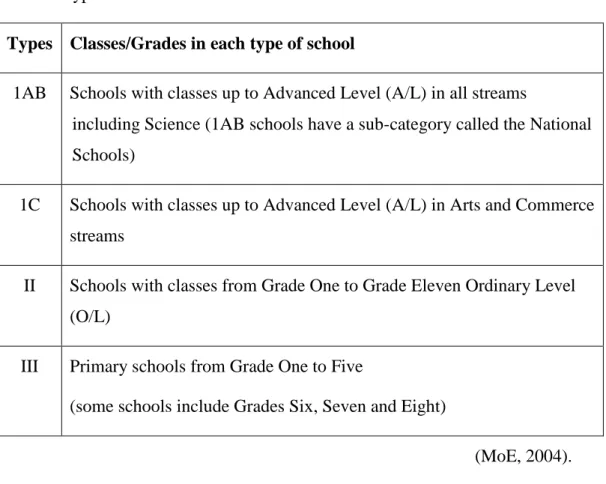
Table 2 Types of schools in Sri Lanka 36
Table 3 The research procedure 152
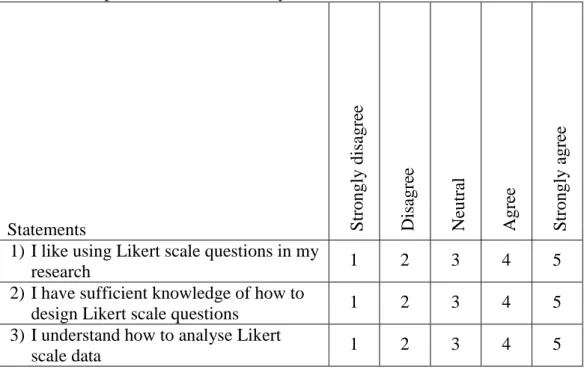
Table 3a Example of Likert scale survey 155
Table 4 Revised questions of student questionnaire 171 Table 5 Revised questions of teacher questionnaire 173 Table 6 Low-performing school student participants in questionnaire 178 Table 7 High-performing school student participants in questionnaire 179 Table 8 Low-performing school teacher participants in questionnaire 179 Table 9 High-performing school teacher participants in questionnaire 179 Table 10 Low-performing school classrooms for lesson observations 180 Table 11 High-performing school classrooms for lesson observations 180 Table 12 Low-performing school principals in interviews 181
xvi
Table 13 High-performing school principals in interviews 181 Table 14 Summary of the sample of the preliminary study 182 Table 15 Example for question in main study teacher questionnaire 186 Table 16 Revised questions of teacher questionnaire 188 Table 17 Sample of questionnaire participants according to zones 190 Table 18 Sample of interview participants according to zones 191
Table 19 Summary of main study participants 191
Table 20 Gender of the questionnaire and interview participants 192 Table 21 Teaching institutions and teaching qualifications of the
questionnaire and interview participants 193 Table 22 Length of time in the profession of the questionnaire and
interview participants (low-performing schools) 194 Table 23 Length of time in the profession of the questionnaire and
interview participants (high-performing schools) 194 Table 24 Age group of the questionnaire and interview participants
(low-performing schools) 195
Table 25 Age group of the questionnaire and interview participants
(high-performing schools) 195
Table 26 Primary education of students 217
Table 27 Socio-economic background of parents 218
Table 28 Educational background of parents 219
Table 29 Learning English through English-Day competitions 220 Table 30 The most used strategy in the English lesson 223 Table 31 Physical and human settings of observed classrooms in
low-performing schools 232
Table 32 Physical and human settings of observed classrooms in
high-performing schools 234
Table 33 Aspects of English teaching efficacy 252
Table 34 Comparison of low and high-performing schools 356-357
List of Diagrams
xvii
List of Figures
Figure 1Weiner’s original attribution model 20
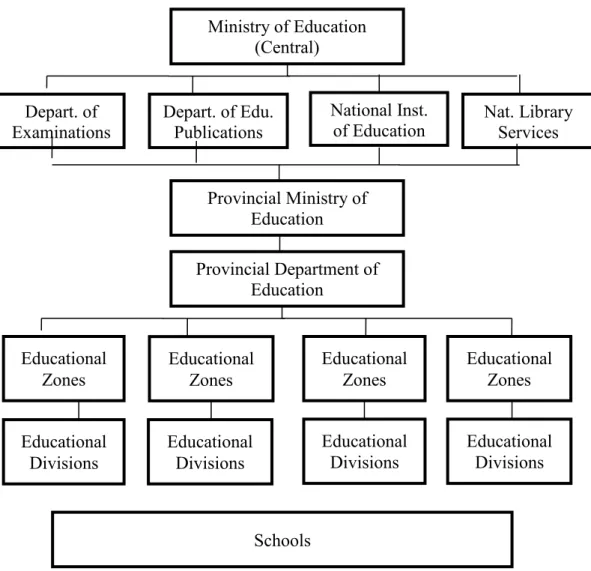
Figure 2 Education Network of Sri Lanka 40
Figure 3 Stages of qualitative analysis 211
Figure 4 Visual process of qualitative analysis 212 Figure 5 Overall process of the current research 214 Figure 6 A line chart to show the difference in the number of students
in low and high-performing schools who received various
opportunities for learning English 222
Figure 7 Students’ experience of learning English in classrooms 224
Figure 8 Different learning needs of students 227
Figure 9 Factors advantageous to students in high-performing schools 259 Figure 10 Teachers in low-performing schools on ‘Various Family
Commitments' 269
Figure11 Teachers in high-performing schools on 'Various Family
Commitments' 269
Figure 12 Teachers in low-performing schools on 'Teaching
Many Classes' 270
Figure 13 Teachers in high-performing schools on 'Teaching
Many Classes' 270
Figure 14 Teachers in low-performing schools on 'Lack of Resources’ 274 Figure 15 Teachers in low-performing schools on 'Noise from
Neighbouring Classrooms' 276
Figure 16 Reasons selected by teachers in low-performing schools as
problems in fulfilling students' learning needs 285 Figure 17 Reasons selected by teachers in low-performing schools to
teach the curriculum only 286
Figure 18 Reasons selected by teachers in high-performing
schools to teach more than what is in the curriculum 287 Figure 19 Reasons selected by teachers in low-performing schools as
xviii
Figure 20 Teachers in low-performing schools on 'Difficulty in getting
Reading Materials on Pedagogy’ 303
Figure 21 Teachers in high-performing schools on 'Working with
Experienced Teacher’ 304
Figure 22 Reasons selected by teachers in low-performing schools as difficulties in co-operating with ELT regulations 307
xix
ACKNOWLEDGEMENTS
This doctoral thesis would not have been possible without the immense support of my Director of Studies, Professor Uvanney Maylor. I am extremely thankful and indebted to her for sharing expertise, and the sincere and valuable guidance and encouragement extended to me.
A sincere gratitude and appreciation is to my Co-Supervisor, Professor Tony Green for his readiness and patience in helping me. Thanks to his insights which greatly assisted me in writing my thesis.
I also wish to thank Professor Trevor Corner who initially guided me with his valuable thoughts in this research study.
I would like to acknowledge the financial support provided by the University of Bedfordshire which was of great help in my study.
I want to express my sincere gratitude to all respondents in Sri Lanka. A special thank goes to my colleagues Rev. Frs. Charles Collins and Vimalasekaran (Vasanthan) who helped me a lot by distributing and collecting the teacher questionnaires in Sri Lanka. I am also grateful to Rev. Sr. Sheila Moloney who proofread my thesis and made it more presentable.
Finally, my deepest gratitude goes to my loving parents and siblings who encouraged and supported me both in my personal and academic life.
xx
ABBREVIATIONS
ABOE Activity Based Oral English
CLT Communicative Language Teaching CPD Continuous Professional Development DoE Department of Education
EL2 English as a Second Language ELSP English as a Life-Skill Programme ELT English Language Teaching
GCE (A/L) or A/L General Certificate of Education (Advanced Level) GCE (O/L) or O/L General Certificate of Education (Ordinary Level)
L2 Second Language
MoE Ministry of Education
NCOE National Colleges of Education NIE National Institute of Education SBA School Based Assessment TTC Teachers’ Training College
1
1.
Background and Rationale of Study
Introduction
The research problem investigated in this doctoral study was informed by the teaching experiences of the researcher in the context of Jaffna, one of the Northern districts of Sri Lanka. Whilst teaching English as a second language to students in a secondary school, he experienced various problems and challenges in the
teaching and student learning of English such as lack of English resources in the classroom, lack of motivation of students to learn English and lack of English language exposure for students to practice what they learn in the language lesson are a few examples to mention. These problems and challenges on the one hand, prevented teachers from working effectively in the classroom and on the other hand left more than half of the student populace without a pass in the Ordinary Level1(O/L or G.C.E. O/L) English examination. For example, the pass rate of students in the O/L English language in 2011 in one of the educational zones (see 2.2.2 for explanation on educational zone) in the district of Jaffna was forty-three per cent (Results Analysis – O/L, 2011). In addition, the researcher observed that students in the Advanced Level2 (A/L or G.C.E. A/L) classes did not generally _______________________
1. It is a General Certificate of Education (GCE) qualification in Sri Lanka, conducted by the Ministry of Education (MoE) for students at the end of Grade Eleven (age sixteen). It is based on the British Ordinary
Level qualification. Though a qualification in its own right, it is more often taken in prerequisite for the Advanced Level education.
2. It is a General Certificate of Education (GCE) qualification in Sri Lanka, conducted by the MoE for students at the end of Grade Thirteen (age nineteen). It is similar to the British Advanced Level. The qualification is also used as an entrance exam for Sri Lankan state universities.
2
consider the English subject important as it was not compulsory at A/L and consequently, the majority of the students left the school with a minimum level of English in spite of studying the language for more than ten years. The researcher also considered that the challenges related to English Language Teaching (ELT) were hard to overcome or became more acute as the educational context of Sri Lanka was hugely affected by the prolonged internal political turmoil of the country. (All of the above are discussed in greater detail below).
Furthermore, it was a recurring experience of the researcher that teachers of English frequently encountered criticisms from school principals, resource personnel of ELT and retired teachers of English that the teaching of English by the current teachers of English was not effective in order to improve students’ knowledge of English; by effectiveness in English teaching they meant the daily preparation of the lesson, delivering creative lessons to motivate students,
fulfilling various learning needs of the students, self-development of the teachers and fulfilling the ELT regulations laid by the educational authorities (see chapter six for more details). In many such situations teachers expressed frustration that their efforts to increase effectiveness in their teaching had been hindered and stifled by many classroom and other problems mentioned above.
It is against this background that this doctoral research investigated how
secondary school (Grades Six to Eleven) teachers of English who teach English as a second language in state schools in Jaffna, Sri Lanka considered their English teaching efficacy had been influenced or affected by the classroom problems and socio-economic and political challenges they encountered. The study sought to bring new insights to teaching efficacy within the context of ELT which is an under-researched area.
This opening chapter is divided into two parts. Part one presents the background of the study and part two explains the rationale of the study. Part two also introduces the research problem through attribution theory which attempts to understand the attributions the teachers make to their failure in effective teaching of English. The aim, focus and importance of the current study, the research
3
questions employed in this study and an overview of the chapters to follow are also presented in part two.
1.1
The background of the study
Since the current study is related to teaching and learning of the English language in Sri Lanka, the background of the study informs the reader with a general view of the introduction, development and the current state of the English language in Sri Lanka. This is essential for the reader to understand the rationale of the study which will be discussed in part two
.
1.1.1 English language in Sri Lanka
1.1.1.1 Introduction and teaching of English Language
Although Sinhala and Tamil are the two main languages in present-day Sri-Lanka, English has been in use since the1800s when Sri Lanka came under British
colonization, and until now the role of English in various spheres of Sri Lanka such as civil administration, education and industry has been very significant. When the British took charge of the island there were divisions in it such as low country Sinhalese3, Kandyan Sinhalese and Tamils areas. The British did not want to change this existing social order immediately but maintained a sharp distinction between the rulers and the ruled. In 1829 a Royal Commission called the
‘Colebrooke and Cameron Commission’ (CCC) assessed the administration of the Island. The commission believed that the administrative division encouraged social and cultural divisions and proposed that the country should be brought under one uniform administrative system. The commission also voted for a change in the membership of the administrative service so that local citizens would be included in the civil service. Hence a need of studying the English language arose for those engaged in the civil service (Saunders, 2007). ______________________
3. The Southern part of Sri Lanka is called low-country in contrast to its central part which comprises of many hill countries.
4
The opening of the Ceylon [British name for Sri Lanka] Civil Service to Sri Lankans required that a new emphasis be placed on English education. In time, the opening contributed to the creation of a Westernized elite, whose members would spearhead the drive for independence in the twentieth century. The [CCC] emphasized the standardization of the educational curriculum and advocated the substitution of English for local languages. Local English schools were established, and the missionary schools that had previously taught in the vernacular also adopted English (Ross and Savanda, 1988:18).
However, it was not the very first instance when the indigenous people had had the opportunity to learn English as Christian missionaries had established English language schools when Ceylon was declared a British Crown colony in 1802 and started introducing their learning and religion to the local people in English. But proposals of the Colebrooke and Cameron Commission (CCC) made English the official working language and consequently it was recommended that English be the primary medium of education in secondary schools and universities.
Opportunities of employment in the government sector were made available to Sri Lankans who had received education in the English medium and thereby
demonstrated fluency in English (Saunders, ibid.). All government schools which were using the local languages as the medium of instruction were brought under a newly formed School Commission controlled by the Anglican clergy who would enforce the recommendations of the CCC. Consequently, the national languages of Sinhala and Tamil were largely neglected in the school curriculum (Perera, 1969 in ibid.).
1.1.1.2 Status of English in the state schools during colonial time
Since the English schools were fee levying schools, the English education they provided was available only to an elite who were economically established and expected subsequently to become administrators in the government civil service under British supervision (UNESCO, 1993). The Anglo-vernacular schools were established for the children of the lower middle class Sinhalese and Tamil officials in the colonial administration and these schools were meant to make their children fit for lower rank posts in the government. Besides these privileged people from the upper and middle classes, the large number of Sinhala and Tamil people who could not afford to enter such schools got free education in their vernacular
5
language schools (also known as traditional schools) which continued to operate mainly in rural areas. This system led to English being considered as the language of upper class people and paved the way for social inequality. Job opportunities in the government sectors and numerous clerical posts in the colonial
administration were given only to the students educated in English medium schools. Hence a class distinction (underpinned by the English language) prevailed in the social life during the time of the British rule (Punchi, 2001). As the colonial government administration expanded and more jobs became
available, the only qualification for these jobs opportunities was the knowledge of English (Ruberu, 1969). As such, English education in the colonial period assured job opportunities and was considered to be of high social prestige and economic advantage. Thus two distinct traditions in education were identified in the colonial times of the British: one for the privileged few bestowing on them affluence and prestige and the other for the poor masses to reconcile them to their poverty (Perusinghe, 1969).
1.1.1.3 Status of English after colonial time
When Sri Lanka became independent in 1948, the English language gradually shifted from its status of being the medium of education to the status of a second language subject in the general curriculum. Consequently, the local languages, Sinhala and Tamil became the medium of instruction from primary to tertiary level education. However, the use and influence of English in the field of
education and the civil affairs of the country could not be easily avoided. Though the English language was seen as a source of social divisions during the colonial time, people realised its potential in their social life. Firstly, it functioned as a link language between different ethnic groups in Sri Lanka. Secondly, within and outside of Sri Lanka it was seen as a requirement for the development of both the people and the country (Kandiah, 2007). These two functions of the English language have played an important role in determining the educational and language policies in the independent Sri Lanka (Karunaratne, 2009).
6
1.1.1.4 English education in the contemporary Sri Lanka
The policy of teaching English as a second language to all people in Sri Lanka was taken into special consideration from the 1990s, first, to bring about national harmony among the different ethnic communities and second, to equip the younger generation, in view of developing the country, with English so that they could gain appropriate knowledge required for jobs in the modern market (De Mel, 2001 in Karunaratne, 2003). In 1991, the National Education Commission in view of formulating a national policy on education carried out a field study which identified the improvement of English language teaching (ELT) in schools as one of the priority areas. Hence the 1997 educational reforms proposed the following to be implemented to update the standard of ELT in Sri Lanka.
- Introduction of Activity Based Oral English (ABOE): It is a spoken English programme specifically designed for students in Grades One and Two to use simple English for communication. Children are taught oral English while they are engaged in guided plays and activities (see detailed description in section i. a) of 2.3.1.1)
- Training adequate numbers of teachers for English - Teaching of formal English from Grade Three
- Bilingual teaching for selected subjects from Grades Six to Nine: In order to provide an opportunity to all students to acquire proficiency of both first language (Sinhala or Tamil) and English, students are given options to follow certain subjects in English and the rest in their respective first languages (see detailed description in section i. of 2.3.1.2)
- Alternative English syllabuses at Grades Ten and Eleven
- General English for comprehension and communication at GCE (A/L) as an optional subject (General Education Reforms – Executive summary, 1997 in Perera, 2001).
Further educational reforms related to ELT were introduced in 2003 to extend the ABOE programme from Grades Three to Five and the bilingual programme to the senior secondary Grades from Ten to Thirteen (Little, 2007).
Though various educational reforms have sought to make English a means of communication among the different ethnic communities and to make its
instrumental advantages available to all Sri Lankans, the objectives were not fully achieved in relation to the whole student populace in the country. English still
7
remains a marker of the higher social classes rather than a language of everyone (Karunaratne, 2009).
1.2 The rationale of the study
1.2.1 The context
There is a general perception in the educational field of Sri Lanka that the lack of effectiveness in teaching the English language is one of the reasons for the failure or the underperformance of students in learning English (Wijesinghe, 2004; Sumanasekera, 2010; Wijesekera, 2012; Premalal, 2014). However, according to the former teaching experiences of the researcher and his colleagues, the
educational authorities such as school principals, resource personnel of English language teaching (ELT) and even retired teachers of English failed to understand this general perception in connection with various other problems which
contributed to the failure of ELT in Sri Lanka (see section 1.2.1.2). In other words, they failed to see how these problems prevented the teachers from delivering effective lessons to their students. This study, by contextualising the various problems and challenges in the teaching and learning of English and the experiences of teachers about their English teaching efficacy, emphasizes the need for understanding the relationship between these two realities.
The following sections explain the rationale of this study under three aspects: the failure of ELT in Sri Lanka, problems related to the failure of ELT and the criticism levelled against teachers of English.
1.2.1.1 The failure of ELT in Sri Lanka
Even though the students in Sri Lanka learn English as a second language for several years in the school i.e., from primary to Advanced Level, their proficiency in English remains very low and most of the students find it difficult to express themselves in simple and correct English (De Mel, 2007; Premalal, ibid.). This study which was conducted with teachers and students in Jaffna, seeks to understand why, especially when, the activity based oral English is introduced
8
nationally to students in Grades One and Two (age seven and eight), the formal instruction of the English language curriculum begins at Grade Three (age nine) and continues until students leave the school at the end of Grade Thirteen (age nineteen), and English as a second language is included as one of the main subjects in the daily timetable.
Two factors indicate the failure or the minimal success of the English language programme in Sri Lankan schools: one is that only a minority of the student population is able to achieve a desirable grade at the state examination. The Northern Education System Review (NESR) (2014) shows that only thirty-three per cent of students scored credit4 or a higher grade in the 2012 G.C.E. O/L English examination in the district of Jaffna. The percentage would be higher if students with ordinary pass are included. Another survey carried out by Student Sri Lanka Educational Network (2010) shows that only twenty-eight per cent of the whole student populace passed English language in the 2009 G.C.E. O/L. The NESR (ibid.) also says that according to the Ministry of Education, subject-wise, the highest number of fail grades among students in Sri Lanka was for English language in the 2013 G.C.E O/L. The report said that fifty-two per cent of students failed the English language examination. Hence student
underperformance in English education is a problem found not only in Jaffna but also throughout Sri Lanka.
The second factor is that the majority of Sri Lankan youth do not possess the required English proficiency to compete in the private sector oriented job market. The World Bank (2006: 57) reports, ‘Only 10 percent of children of the public system achieve a targeted level of mastery in English language
skills.’ Wijewardene et al. (2014) report that there have been recurring complaints from employers in Sri Lanka that business graduates lack proficiency in English; though they were ready for the work in respect of their subject
___________________
4. Sri Lankan O/L grading system has five grades: A = Distinction; B = Very Good Pass; C = Credit Pass; S = Ordinary Pass and W= Failure.
9
knowledge, they lack the proficiency of English language skills especially spoken skills. Herath and Ranasinghe (2011) investigated sixty-five private sector
business firms in Sri Lanka to know how these firms assessed English language proficiency of their graduate employees. They found that fifty-four per cent of the firms reported that the English proficiency of the business graduates was
unsatisfactory.
1.2.1.2 Problems related to the failure of English language teaching (ELT) in Sri Lanka
Many studies (Fernando and Mallawa, 2003; Hettiarachchi, 2010; Karunaratne, 2008; Perera, 2006; Perera et al., 2010; Perera, 2001; Wijesekera, 2012) have dealt with various problems and challenges related to the failure of ELT in Sri Lanka. However despite these studies, problems related to ELT remain. Section 1.5 explains why another study covering these issues is needed.
For this introductory purpose, this section outlines some of the problems related to ELT in general (see Chapter Three for more detail).
Most of the literature refer to several classroom issues that affect ELT in Sri Lanka. English is one of the main subjects in GCE (O/L), however, a pass in English is not considered compulsory to study GCE (A/L). English is taught as an additional subject in GCE (A/L) but, again a pass in A/L English is not necessary to enter university. As studying English at O/L or A/L is not considered a priority for students it is not unusual to find students in Sri Lanka who are not motivated to learn English as a subject on the national curriculum or teachers who are not motivated to teach English as a second language (Canagarajah, 1993; Perera, 2006; Karunaratne, 2009; Hettiarachchi, 2010; Perera et al, 2010).
The single textbook option is another main problem in ELT in Sri Lanka (Mosback, 1984, 1990; Wickrema and Colenso, 2003). The government of Sri Lanka issues free textbooks for every subject for all students throughout the country from Grade One to Eleven (up to O/L). Unfortunately the government maintains a single textbook scheme which provides only one specific textbook for each subject for the whole student populace and it is not differentiated by student ability. Therefore students with different academic abilities have to use the same
10
textbook and teachers struggle to handle students of varied levels of learning abilities with a single type of textbook (Perera et al., ibid.). The motivation of the teachers of English is greatly affected as they cannot find a textbook suitable to the varied proficiency levels of their students (Hettiarachchi, ibid.).
There is another problem which is a mismatch between the English teaching materials and the style of examinations (Perera, 2001; Karunatarne, 2008). With the introduction of Communicative Language Teaching (CLT)5 in the second language teaching in the 1980s, the English language teaching (ELT) enterprise around the world started using learning materials based on the CLT approach (see Richards and Rodgers, 2001). Though the government of Sri Lanka gradually adopted this teaching approach and published the necessary textbooks which are more communicative in nature, the English language exams conducted by the Sri Lankan Ministry of Education tests only the reading and writing skills of students, not their listening and speaking skills (Rathnasena et al, 2013). Thus teachers just prepare their students for the exam without making the maximum use of the textbook. Further, the teachers who come from social or academic backgrounds with less familiarity of the English language lack the English proficiency to conduct CLT and consequently they, along with their students, over depend on their mother tongue in the language classroom which impairs oral interaction in the target language necessary for its acquisition (Karunaratne, 2008).
Teachers also face problems such as overcrowded6 classrooms and a lack of ________________
5. CLT is meant to develop learners’ communicative competence in contrast to their grammatical competence of the language. The communicative competence includes the knowledge of what to say and how say it
according to the situations, the speakers and their roles and intentions (see detailed description in section ii. a) of 2.3.1.1).
6. Sri Lankan classrooms generally accommodate around thirty students. However certain 1AB or National Schools (see Table 2/Chapter Two – Types of Schools in Sri Lanka) have classrooms with forty or even more than forty students, and as such they are considered overcrowded.
11
resources and facilities in some schools (Hettiarachchi, ibid.). When there is an excess number of students in the classroom, teachers find it difficult to maintain order in the classroom and in addition the noise from overcrowded neighbouring classrooms greatly deprives students of a quiet learning environment.
Teachers find it difficult to deliver effective English lessons due to the lack of necessary English material resources in the classroom; the available materials become scarce when they are shared among large numbers of students in the classroom.
Besides the above mentioned classroom problems, there are also socio-economic and political problems which contribute to the failure of English language
teaching (ELT). According to Karunaratne (2009) students from rural areas because of the low income of their parents are deprived of additional opportunities such as private tuition to learn more English. The social status of students also influences their learning; Perera (2006) argues that poor social status and living conditions of students instil in them a motivational deficit in learning. This is because of the psychological impact made on them by their poverty. Perera contends that students from low income backgrounds develop an attitude that their low status in the society prevents them from moving upward in the social and educational ladder.
The political problems which greatly contribute to the ineffectiveness of ELT include the uneven distribution of resources (MoE, 2004) and qualifiedteachers (Liyanage, 2013) among schools, teacher transfers from rural to urban areas through political interference in placing teachers in particular schools and
corruptions in the education system (Research Report, 2009). Socio-economic and political problems are discussed in greater detail throughout the thesis.
1.2.1.3 Criticism against teachers of English
Though the aforementioned problems and challenges significantly contribute to the failure of ELT and poor student performance in English, it was the experience of the researcher and his colleagues (cf. 1.2.1) as teachers of English that they
12
were unduly blamed for the underperformance or the failure of students in English learning. School principals, resource personnel of English language teaching (ELT) and retired teachers of English have complained that teachers of English did not teach the English language effectively (Sumanasekera, ibid.; Prem al al, ibid.). The criticism against teachers sometimes accompanied comparison between the poor performance of their students, mostly in many low-performing schools, and the excellent performance of students from a few leading or high-performing schools. Thus they were indirectly accused of providing less effective teaching of English while the teachers of a few leading schools were commended for the success of their students in English learning. This generally happened when teachers attended seminars at the Department of Education after the O/L exam results were out. In such situations teachers became frustrated that the authorities failed to understand how various classroom and other problems related to ELT affected the effectiveness of the lessons they conducted. Hence, the current research seeks to understand how various problems related to ELT affected the teaching efficacy of the teachers of English.
1.3 Understanding the current study through attribution theory
The rationale outlined in the previous section shows that there are two main concerns informing the current study. One is the blame or criticism levelled at current teachers of English by principals, ELT resource personnel and retired teachers of English. These groups attributed the underperformance of students in learning English to a lack of effectiveness in English teaching. The other concern is the attribution of blame by current teachers of English in general in Jaffna as a response to the blame they received. As said in the introduction of this chapter the researcher during his English teaching experience in Jaffna found that the teachers of English in general became frustrated at the blame they experienced from others. Reacting to the blame directed at them, they in turn blamed various classroom problems that they claimed affected their teaching efficacy.A question naturally arising here is why it is that while others attributed blame for the failure of students in learning English to factors internal to teachers (teacher effectiveness), the teachers themselves blamed external factors (classroom
13
problems)? Another question also can be raised here particularly towards the principals and resource personnel of English: Why do principals and resource personnel blame the lack of effectiveness of the teachers in teaching English (which is external to them) instead of considering factors internal to them (which may also have contributed to students’ underperformance in learning English)? For example, a principal fails to provide necessary feedback (which is internal to him/her) to a teacher which is likely to result in poor teaching.
In the next section attribution theory is used to explore how people understand their own behaviours in relation to the outcome to their actions and also how people understand a person’s behaviours in relation to the outcome of that
person’s actions. Consequently this section explores why the current teachers of English blame causes external to them (rather than their teaching efficacy), and the principals, resource personnel and retired teachers of English blame the current teachers of English (rather than themselves) for the lack of English language proficiency amongst school students.
1.3.1 Meaning of the term attribution
Before understanding the basic tenets of attribution theory, it is useful to consider the meaning of the term attribution. ‘An attribution is a causal explanation for an event or behaviour’ (Harvey and Martinko, 2016: 147). For example if a nurse observes a colleague performing a procedure incorrectly on a patient, she is likely to make an attributional explanation for this behaviour. She might conclude that her colleague was poorly trained. Thus the nurse who is the observer attributes the behaviour of her colleague to having insufficient skills (ibid.). In the same
manner, people also form attributions for their own actions. For example, a student might attribute his or her success in an exam to his or her intelligence or hard work.
1.3.2 Attribution theory
Attribution theory was developed from the theories of social psychologists: Fritz Heider, Edward Jones, Keith Davis, and Harold Kelley. Heider first wrote about attribution theory in his book The Psychology of Interpersonal Relationships
14
(1958) and the others worked on the theory in the following decades (Harvey and Martinko, 2016).
Attribution theory is about ‘how people come to explain the causes of their
behaviour and those around them’ (Amaral, 2011: 1) or ‘how people perceive each other in interaction and especially how they make sense of each other’s behaviour’ (Malle, 2011: 73). According to Malle (ibid.), Heider found that perceiving persons in social interactions was more complex than perceiving inanimate objects, because of the manifold observational data available and the various causes (e.g. beliefs, desires, emotions, traits) to which these data can be attributed. He perceived persons as action centres and said that they can intentionally benefit or harm others and they have abilities, wishes and sentiments. Heider argued that with the help of others’ intentionality, the inference of wishes, sentiments and purposes perceivers find meaning to others’ behaviours (ibid.). ‘Attribution is, therefore, a judgment embedded in the point of view of the perceiver and subject to the epistemic state [the knowledge about others’ behaviour] of that perceiver’ (Tomai and Forbus, 2007: 1).
Social psychologists developed attribution theory as a means of dealing with questions which required social perception. Hence its purpose is to know how people make causal explanations or how they answer questions beginning with ‘why?’ Heider (1958) explained this situation by arguing that ‘all people are “naïve psychologists” who have an innate desire to understand the causes of behaviours and outcomes’ (Harvey and Martinko, 2016: 148). Harvey and Martinko (2016) contend that, as the examples above suggest, the attribution process is something automatic and very familiar to people in their daily lives though they do not notice it and/or cannot account for their actions.
‘We’re constantly told we shouldn’t judge others. Attribution theory says we can’t help it’ (Griffin, Ledbetter and Sparks, 2014:137).
Heider (1958) made his first argument in social psychology that people tend to place more weight on internal reasons for success but place more weight on external factors when they fail.
This theory states that when an individual has a negative experience, or make a mistake, they will attribute the cause to something external. Others,
15
however, will attribute the cause to something internal, something inherent in the individual’s internal locus of control (Amaral, 2011: 1).
Heider distinguished between internal and external attributions, arguing that both personal forces and environmental factors of people operate on them and the balance of these determines the attribution of responsibility (Lewis and Daltroy, 1990). For example, the principals, resource personnel of English language teaching (ELT) and retired teachers of English (who influenced my decision to undertake this doctoral study) attributed the causes of the underperformance of students in learning English to something internal to the teachers of English i.e., the teachers’ way of teaching the lesson was considered not effective.
However, as said above the researcher had a prior experience with the teachers of English in the educational contexts of Jaffna that they themselves attributed the causes for the underperformance of students to something external to them i.e., various classroom problems. Drawing on Heider it is possible to argue, that these teachers of English tended to place more weight on external factors (classroom problems) for their failure in teaching English to their students effectively. According to attribution theory many factors such as our view of the world, our prior experience with a particular person or situation, our knowledge of the behaviour and our own interpretation of events play an important role in how we assign attributes to behaviours (Heffner, 2014). For example, the principals, retired teachers of English and resource personnel of ELT referred to above, in order to make the correct attribution, needed to consider many factors related to the current teachers of English that may cause the low performance of their students’ learning of English. Harvey and Martinko (2016) state that ‘as with all perceptions, attributions are not always an accurate reflection of the reality!’ (p. 149 – emphasis in original). Heffner (2014) explains two kinds of errors or mistakes which people tend to make when assigning attributes to others and themselves: Fundamental Attribution Error (Heider, 1958) and Self-Serving Bias (Miller and Ross, 1975). These are discussed next.
16
1.3.3 Fundamental Attribution Error and Self-Serving Bias
Buahin (2012) says that fundamental attribution error occurs when individuals overestimate personal factors and underestimate external or situational factors to explain others’ behaviour. This is supported by Heffner who contends:
Fundamental Attribution Error refers to the tendency to overestimate the internal and underestimate the external factors when explaining the behaviours of others. This may be a result of our tendency to pay more attention to the situation rather than to the individual and is especially true when we know little about the other person (Heffner, 2014: 1).
In self-serving bias, the person tends to equate successes to internal factors such as his or her ability or efforts and attributes failures to external factors (Heffner, ibid.; Sanjuan and Magallares, 2014). Hence self-serving bias helps individuals to give themselves credit for the good outcomes that happen (Buahin, 2012). According to attribution theory, in situations where individuals are themselves involved, they tend not to blame themselves for their failures but, rather, blame external factors. For example, a head teacher may not blame his/her poor leadership of his/her school for children not gaining the required qualifications, but instead blame the lack of student achievement on a lack of parental interest in their children’s performance. However, where the situation relates to others (i.e. when the head teacher focuses on his/her teaching staff), there is an over-emphasis on blaming others’ attributes when things go wrong rather than seeing that external factors are also implicated. For example, the head teacher will be quick to blame the teachers and/or over emphasise the weaknesses he/she attributes to the teachers when children fail their exams or results are lower than the year before, instead of trying to understand the external factors which have contributed to the students’ lower performance or underachievement.
Heffner’s explanation can be used to shed light on the behaviour of the principals, resource personnel of English language teaching and retired teachers of English in blaming the Sri Lankan teachers of English for their lack of effectiveness in teaching English. The former were inclined to blame the attributes of their own teachers when students failed to learn English well, rather than also pinning the blame on the relevant external factors (e.g. classroom problems and other related
17
socio-economic and political problems) encountered by the latter. They tended to blame the teachers for children not learning English effectively instead of seeking to understand and blame the external factors which contributed to the difficulties encountered by the children in their acquisition of English.
Following Heider’s line of argument it could be argued that the educational authorities were predisposed to pay more attention to the situation of student performance rather than to the various classroom problems which the teachers faced as individuals. This is because schools locally and nationally are judged by student performance and student performance is used to compare schools and make judgements about the ability of teachers.
The current teachers of English attributed the failure of students in learning
English to some external factors, but did not acknowledge the contribution of their personal lack of effective teaching to the failure. This was a self-serving bias. However, what others especially the principals and resource personnel of English language teaching (ELT) attributed to themselves also reflected the self-serving bias. The principals and resource personnel of ELT have a part to play in the success of students in learning English as a second language. There are many factors which can contribute to the success of students such as proper teacher development, appropriate textbooks given to students, sufficient numbers of teachers being provided in schools through proper teacher deployment and so on. As long as these factors are managed by the principals, resource personnel of ELT and other authorities, they can be considered something internal to them.
According to self- serving bias of attribution theory, the principals and resource personnel of ELT attributed an external factor (lack of effectiveness in teaching English) to the failure of students instead of attributing any factors which were internal to them.
18
1.3.4 Weiner’s attribution model
Among the psychologists who developed Fritz Heider’s study of attribution, Bernard Weiner is significant as he developed it into a more comprehensive and extensive model of human attribution. His model is more used in research on student learning (Anderman and Anderman, 2009). Weiner explains how learners form causal beliefs in matters related to their learning (Weiner, 2005, 2012).
A basic assumption of Weiner’s model of attribution is that learners are affected by both environmental factors (e.g., characteristics of the
students’ home or school) and by personal factors (e.g., prior experiences and prior knowledge). These background variables affect the types of attributions that individuals are likely to make (Anderman & Anderman, 2009: 1).
Learners make an attributional search when there is an achievement-related event such as failing in an examination. They search for the cause of their failure. The perceived cause is very important to the learners as it will affect their future motivation when they engage with similar events. For example a student who attributes his/her exam failure to his/her own lack of ability will have a different level of motivation in future examinations than the one who attributes his/her failure to inexperienced teachers (ibid.).
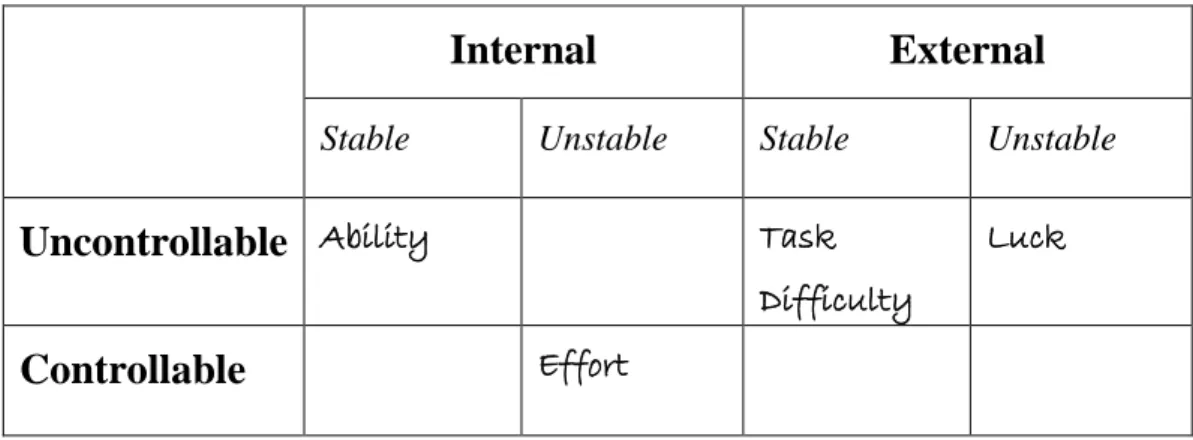
According to Weiner, four important factors such as ability, effort, task difficulty and luck determine the attributions we make (Weiner, 1986, 2012; Weiten, 2015). However, the characteristics (internal or external, stable or unstable etc.) of the attribution are more important than the mere attribution we make (effort, luck etc.). Weiner classified the characteristics of the attribution along three causal dimensions: locus of control, stability and controllability. These causal
dimensions are important as they affect learners’ subsequent motivation toward task or activity (Anderman and Anderman, 2009).
Locus of control (place of control) refers to one's belief that his or her behaviour is guided by external (such as luck, fate, etc.) or internal (such as ability and effort) factors (Fiske and Taylor, 1991). If a learner attributes his/her success in an exam to his/her ability or effort, then he/she chooses an internal cause because the ability or the effort is internal to a learner. However, if he/she believes that his/her failure is due to his/her teacher’s incompetence, then he/she attributes