Gene network inference by fusing data from
diverse distributions
Marinka
Zitnik
!
1and Blazˇ Zupan
1,2,*
1Faculty of Computer and Information Science, University of Ljubljana, Ljubljana, Slovenia and
2Department of
Molecular and Human Genetics, Baylor College of Medicine, Houston, TX, USA
*To whom correspondence should be addressed.
Abstract
Motivation:
Markov networks are undirected graphical models that are widely used to infer
rela-tions between genes from experimental data. Their state-of-the-art inference procedures assume
the data arise from a Gaussian distribution. High-throughput omics data, such as that from next
generation sequencing, often violates this assumption. Furthermore, when collected data arise
from multiple related but otherwise nonidentical distributions, their underlying networks are likely
to have common features. New principled statistical approaches are needed that can deal with
dif-ferent data distributions and jointly consider collections of datasets.
Results:
We present
FUSENET, a Markov network formulation that infers networks from a collection
of nonidentically distributed datasets. Our approach is computationally efficient and general: given
any number of distributions from an exponential family,
FUSENETrepresents model parameters
through shared latent factors that define neighborhoods of network nodes. In a simulation study,
we demonstrate good predictive performance of
FUSENETin comparison to several popular
graph-ical models. We show its effectiveness in an application to breast cancer RNA-sequencing and
somatic mutation data, a novel application of graphical models. Fusion of datasets offers
substan-tial gains relative to inference of separate networks for each dataset. Our results demonstrate that
network inference methods for non-Gaussian data can help in accurate modeling of the data
gener-ated by emergent high-throughput technologies.
Availability and implementation:
Source code is at https://github.com/marinkaz/fusenet.
Contact:
[email protected]
Supplementary information:
Supplementary information
is available at
Bioinformatics
online.
1 Introduction
Undirected graphical models or Markov networks are a popular class of statistical tools for probabilistic description of complex as-sociations in high-dimensional data (cf. Rue and Held, 2005). Biological processes in a cell involve complex interactions between genes and it is important to understand, which genes conditionally depend on each other. These dependencies can be inferred from the experimental data and represented in a gene network. As a popular approach to network modeling, Markov networks are particularly appealing because they focus on finding such conditional depend-ence relationships. Intuitively, the existdepend-ence of a link between genes A and B in a Markov network indicates that the behavior of gene A is still predictive of gene B given all available measurements about gene A and its immediate neighbors in a network. Hence, Markov networks can help us to find a rich set of direct dependencies be-tween genes that are stronger than gene correlations (Allen and Liu, 2013).
Markov networks have been well studied in bioinformatics and numerous applications are concerned with inferring the network structure primarily from microarray and next generation sequencing gene expression data (Koteraet al., 2012; Gallopin et al., 2013;
Segalet al., 2003). They are complementary but not superior to other gene network inference approaches (Marbachet al., 2012). However, the increasing variety of data generating technologies and heterogeneity of resulting data draw attention to two challenges in the context of Markov network inference: inference from non-Gaussian distributed data, and simultaneous inference from many datasets.
In bioinformatics, many datasets are high dimensional, contain a limited number of samples with a large number of zeros, and come from skewed distributions. Most existing methods assume that data follow a Gaussian distribution. While this assumption holds for typical log ratio expression values from microarray data, it is vio-lated for measurements obtained from sequencing technologies.
VCThe Author 2015. Published by Oxford University Press. i230
This is an Open Access article distributed under the terms of the Creative Commons Attribution Non-Commercial License (http://creativecommons.org/licenses/by-nc/4.0/), which permits non-commercial re-use, distribution, and reproduction in any medium, provided the original work is properly cited. For commercial re-use, please contact [email protected] doi: 10.1093/bioinformatics/btv258 ISMB/ECCB 2015 by guest on July 28, 2015 http://bioinformatics.oxfordjournals.org/ Downloaded from
For example, gene expression levels from RNA-sequencing count how many times a transcript maps to a specific genomic location (Wanget al., 2009) and as such these data are not Gaussian (Allen and Liu, 2013). The Gaussian assumption is also violated for cat-egorical datasets, such as data on mutation types and copy number variation data (Hudsonet al., 2010). While it would be possible to design a network inference for each specific data type, we could benefit from a procedure that can treat a wide class of distributions and can jointly consider all available data during network inference (Zitnik and Zupan, 2015! ).
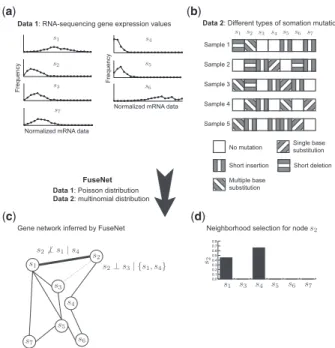
We have developed a novel approach, calledFUSENET, for
infer-ence of undirected networks from a number of high-dimensional datasets (Fig. 1). Our approach builds upon recent theoretical results about Markov networks (Yanget al., 2012,2013) and, unlike the previous works in Markov modeling, can be applied to settings where data arise from multiple related but otherwise nonidentical distributions. To achieve this level of modeling flexibility, we repre-sent model parameters with latent factors.FUSENETimplements data
fusion through sharing of latent factors that are common to all data-sets and distributions, and handles data diversity through inference of factors specific to a particular dataset.
In simulation studies,FUSENETrecovers the true networks
under-lying the observed data more accurately than several alternative approaches. The improved performance demonstrates thatFUSENET
can find conditional dependencies between genes that could not be reconstructed with Gaussian-based approaches. In a case study with
breast cancer RNA-sequencing expression values and somatic muta-tion data, we demonstrate the benefits of joint network inference from multiple related datasets. The networks inferred collectively from both types of data show greater functional enrichment than networks learned from any data type alone.
2 Related work
The most straightforward approach to network inference is a simi-larity-based approach, which assumes that functionally related genes are likely to share high similarity with respect to a given dataset. A well-known network obtained with this approach is theS. cerevisiae
genetic interaction network byCostanzoet al.(2010). Whenever the similarity value between two genes is above a threshold they are linked by an edge, which is referred to as a direct network inference approach (Koteraet al., 2012). In contrast to direct network infer-ence, model-based network inference via graphical models focuses on local dependencies between genes, where each gene is directly af-fected by a relatively small number of genes. Edges estimated by a graphical model can be related to causal inference (Pearl and Verma, 1991).
The problem of learning a network structure associated with an undirected graphical model has seen a wide range of applications ranging from social networks and image and speech processing (Metzler and Croft, 2005; Wang et al., 2013) to genomics. Applications in bioinformatics include estimation of molecular path-ways from protein interaction and gene expression data (Segalet al., 2003; Stingo and Vannucci, 2011), reconstruction of gene regula-tory networks from microarray data (Marbachet al., 2012), infer-ence of a cancer signaling network from proteomic data (Mukherjee and Speed, 2008) and reconstruction of genetic interaction networks from integrated experimental data (Isci et al., 2014). Methods applied to these problems and many other recent gene network in-ference algorithms (Anjum et al., 2009; Friedman et al., 2008;
Meinshausen and Bu¨hlmann, 2006;Ravikumaret al., 2010;Scha¨fer and Strimmer, 2005) estimate Gaussian or binary Markov networks, i.e. they assume that data follow an approximately Gaussian distribution.
Although non-Gaussian data are becoming increasingly common in biology, until now, very few network inference algorithms have been proposed for their treatment. When dealing with non-Gaussian data, some authors simply use methods that are based on a Gaussian assumption (Caiet al., 2012). We show in experiments that this de-cision may result in poor predictive performance. Recently, various extensions of Gaussian Markov networks have been proposed that first Gaussianize the data, using for example a copula transform (Liuet al., 2009,2012;Murrayet al., 2013) or a log transform, and then apply algorithms that rely on an assumption of normality. While these approaches perform better than naı¨ve application of Gaussian-based methods to untransformed data, they are ill-suited to data generated by next generation sequencing technologies (Allen and Liu, 2013). A handful of recent algorithms (Allen and Liu, 2013;Gallopinet al., 2013) have considered Markov networks for non-Gaussian data, using for example the Poisson distribution for RNA-sequencing read counts. In contrast to ourFUSENET, these meth-ods cannot integrate datasets across different data types, thereby limiting their ability to fuse information from many datasets.
Our work presented here is similar in spirit to our recently de-veloped methodology for data fusion via collective matrix factoriza-tion (Zitnik and Zupan, 2015! ). The methodology therein can jointly model any number of datasets that can be represented with matrices. Unlike existing data integration approaches, it does not require Single base
substitution Short insertion Short deletion Multiple base substitution Sample 1 Sample 2 Sample 3 Sample 4 Sample 5 Normalized mRNA data
Normalized mRNA data
0.0 0.1 0.2 0.3 0.4 0.5 0.6 0.7 0.8 (a) (b) (c) (d) No mutation
Data 1: RNA-sequencing gene expression values
Frequency
Frequency
Data 2: Different types of somation mutations
Gene network inferred by FuseNet Neighborhood selection for node
FuseNet Data 1: Poisson distribution
Data 2: multinomial distribution
Fig. 1.An overview ofFUSENET in a toy application to network inference. FUSENET’s input is a collection of datasets that can follow different exponential family distributions. The example from the figure uses two datasets: (a) gene expressions from next-generation sequencing follow the Poisson distribu-tion, and (b) somatic mutation data follow the multinomial distribution. (c) FUSENETinfers a network by collectively modeling dependencies between any two genes conditioned on the rest of the genes. The absence of an edge be-tweens2ands3(dotted line in grey) implies thats2acts independently ofs3 givens1ands4, the neighbors ofs2. The?symbol stands for conditional in-dependence. Geness1ands2are linked because data profiles ofs2in (a,b) are still predictive of the profile values ofs1givens4, the neighbor ofs2. (d) Shown are FUSENET-inferred coefficients that relates2 to all other genes. Nonzero values indicate gene dependency. In the resulting network, genes2 has two neighbors,s1ands4
by guest on July 28, 2015
http://bioinformatics.oxfordjournals.org/
transforming data into a common data space (e.g. a gene space). We applied this methodology to mining disease-disease associations (Zitnik! et al., 2013), predicting drug toxicity (Zitnik and Zupan,! 2014) and gene functions (Zitnik and Zupan, 2015! ) and observed substantial gains in predictive accuracy. While both our work here and inZitnik and Zupan (2015)! rely on latent factor models, they are substantially different from one another. First,FUSENETbuilds on
the Markov network theory, whereas previously we considered ma-trix decomposition. Second,FUSENETis a probabilistic model that
ex-plicitly considers various data distributions, and third,FUSENETis a
network inference approach, whereas our previous works focused on matrix completion.
3 Methods
FUSENETtakes as its input a collection of datasets where each dataset
consists of a set of gene profiles (Fig. 1). Gene profiles can be heterogeneous and belong to different data types, e.g. data can be continuous, discrete or categorical. For example, measurements from RNA-sequencing represent the numbers of fragments that were mapped to a specific genomic location (Wanget al., 2009). The RNA-sequencing expression values are then non-negative and integer valued and, hence, are not approximately Gaussian, but ra-ther follow the Poisson or negative binomial distribution. This is in contrast to copy number variation data and mutation data, i.e. single-base substitutions, short indels, or multiple base substitutions, that might be modeled better with multinomial or categorical distri-butions. On the other end of spectrum are microarray gene expres-sion data, which are approximately Gaussian distributed.
The crucial feature ofFUSENETis the representation of model
par-ameters via latent factors. This feature, together with the sharing of latent factors between datasets, allows us to infer a network by sim-ultaneously considering many datasets that each can arise from a different exponential family distribution (Section 3.7).
We exemplifyFUSENETby deriving Markov network models for
two distributions from an exponential family, the Poisson distribu-tion (Secdistribu-tion 3.3) and the multinomial distribudistribu-tion (Secdistribu-tion 3.5). Since the exponential family includes not only Gaussian but also bi-nomial, multibi-nomial, Poisson, gamma distributions and others,
FUSENETcan achieve great flexibility in estimating gene networks
from diverse data (Section 3.6) and also comes with an efficient al-gorithm for network structure estimation (Section 3.8).
Our work provides two novel contributions over current approaches to gene network inference discussed in Related work:
• FUSENETsimultaneously infers networks from datasets that may
be generated by nonidentical distributions, and
• FUSENETestimates large-scale genomic networks from increasingly
common non-Gaussian distributed data.
3.1 Preliminaries
3.1.1 Markov networks
A Markov network specifies conditional dependence relationships between genes. In particular, if there is no edge between genessand
tthen this implies that the behavior ofsis independent oftgiven the set of immediate neighbors ofs. From this local property (Murphy, 2012), one can easily see that two genes (nodes) are conditionally independent given the rest of the genes iff there is no direct edge between them. The conditional independence (Markov) properties permit a rich set of dependencies among the nodes and hence, the connectivity of a Markov network can reveal complex relationships between its nodes (Allen and Liu, 2013;Jalaliet al., 2011).
3.1.2 Exponential family
The probability distributions that we study in this article are specific examples of a broad class of distributions called the exponential family (Duda and Hart, 1973). Members of the exponential family
have many important properties in common. Given parametersh,
the exponential family of distributions overXis defined to be the set of distributions of the form:
PðXÞ ¼expðhBðXÞ þCðXÞ %DðhÞÞ; (1) whereB(X) are sufficient statistics,C(X) is a base measure andDðhÞ
is a log-normalization constant (Murphy, 2012). The exponential family includes many widely used distributions, such as Bernoulli, binomial, Poisson, gamma, multinomial and Gaussian distributions.
3.1.3 Parameterization of Markov networks
LetX¼ ðX1;X2;. . .;XpÞbe a random vector withXibeing a ran-dom variable. Suppose G¼ ðV;EÞ is an undirected graph with
pnodes representingpvariables inX,jVj¼p. Then the correspond-ing undirected graphical model is any distribution defined onXthat satisfies Markov independence assumptions with respect to graphG
(Murphy, 2012). By the Hammersley-Clifford theorem (Murphy, 2012), any such distribution ofXdecomposes according to graphG
in the following way. LetCbe a set of maximal cliques (fully con-nected subgraphs) in graph G and letf/cðXcÞ;c2 Cg be “clique potential” functions. By the Hammersley-Clifford theorem, any dis-tribution ofXwithin the graphical model family defined byGcan be represented as an exponential of a weighted sum of potential functions over the maximal cliquesC:
PðXÞ/exp X
c2C
hc/cð ÞXc
!
; (2)
wherefhc;c2 Cgare the weights of potential functions.
An important question is how one would select potential func-tionsf/c;c2 Cgto obtain various multivariate extensions of uni-variate distributions. Recently,Yanget al.(2012)showed that if a node-conditional univariate distribution, i.e. distribution of a ran-dom variable conditioned on all other variables, belongs to an expo-nential family,it necessarilyfollows that the joint distribution ofX
has the form:
PðXÞ/expðX s2V hsBðXsÞ þ X s2V X t2NðsÞ hstBðXsÞBðXtÞ þX s2V X t2;...;tk2NðsÞ hs;t2;...;tkBðXsÞ Yk j¼2 BðXtjÞ þ X s2V CðXsÞÞ; (3)
where the cliques are of size at mostk,Nð Þs are neighbors of node
s,Brepresent sufficient statistics andCis the base measure of the a given exponential family distribution (cf. Proposition 1 and Proposition 2 inYanget al.(2012)). These results tell us that the joint distribution specified inEq. (3) has the most general form under the assumption of exponential family node-conditional distri-butions. Hence, learning a graphical model from the data can be reduced to learning weightsfhsg [ fhstg [ . . .[ fhs;t2;...;tkgof
distri-bution-specific sufficient statistics.
3.2 Problem definition
Suppose we are given a collection D of n observations,
D¼fxð1Þ;xð2Þ;. . .;xðnÞg, wherexðiÞis ap-dimensional vector drawn
i.i.d. from a specific distribution of the form inEquation (3). This distribution has parameters fh&
c;c2 Cg and is associated with a
graph G¼ ðV;E&Þ on p nodes. Graph G encodes Markov
by guest on July 28, 2015
http://bioinformatics.oxfordjournals.org/
independence properties between the respective variables. The goal of learning the structure ofGis to infer an edge setE&that
corre-sponds to distribution, which generated observations inD. We can expressE&as a function of parametersfh&
c;c2 Cgand write it as:
E&¼fðs;tÞ2V'V:9cliquec2 C:fs;tg(c^h&
c6¼0g:
Hence, learning the network structure reduces to the problem of estimating weightsf^hc;c2 Cgthat should be as close as possible to the true but otherwise unknown parametersfh&
c;c2 Cg.
In this article, we focus largely on a special case of pairwise Markov networks, where the joint distribution has cliques of size at most two: Pð ÞX / expðX s2V h& sBðXsÞ |fflfflfflfflfflfflfflfflffl{zfflfflfflfflfflfflfflfflffl} set of nodes þ X ðs;tÞ2V'V h& stBðXsÞBðXtÞ |fflfflfflfflfflfflfflfflfflfflfflfflfflfflfflfflfflfflffl{zfflfflfflfflfflfflfflfflfflfflfflfflfflfflfflfflfflfflffl} set of edges þX s2V CðXsÞÞ (4) with entriesh&
st6¼0 ift2 NðsÞandh&st¼0 ift62 NðsÞ. Following the work ofRavikumaret al.(2010),Jalaliet al.(2011)andAllen and Liu (2013), we approach the problem of Markov network struc-ture learning via neighborhood estimation, where we obtain the global network estimateE^by stitching together the estimated neigh-borhoods of the nodes. The overall network structure is then:
^
E¼ [
s2V;t2N^ðsÞ
fðs;tÞg; (5)
where (s, t) denotes an edge between s and t and N^ðsÞ ¼
ft2Vnfsg: ^hst6¼0gis the estimated neighborhood of nodes. In the remainder of this section, we formulate two pairwise Markov networks, which assume either Poisson or multinomial data distribution. These two exponential family models are taken as an example through which we specify a general scheme for network inference from multiple potentially nonidentical data distributions.
3.3 Poisson model specification
Following the work ofYanget al.(2012)andAllen and Liu (2013), we define a Poisson Markov network model by specifying a distribution where all node-conditional distributions follow a univariate Poisson dis-tribution. Our Poisson Markov network model is then a series of locally defined models, one for every variable (node). A local model forsis given by a distribution ofXsconditioned on all other variables:
PðXsjXVnsÞ )Poissonðexpfusþ X t2Vnfsg uTsW T WutXtgÞ; (6)
whereXVns¼fXtjt2Vnfsggdenotes the rest of the variables, and
us2RrandW2Rr'rare model parameters. Anr-dimensional vec-torusis a latent factor for nodesthat consists ofrlatent compo-nents. For now, we assume that the number of latent componentsr
is given; we will later discuss how to automatically determine r. Notice that the latent factor of nodes,us, represents the strength of
membership of nodestorlatent components and Wmodels the
interactions between all combinations ofrlatent components. The formulation of the Poisson conditional distribution inEquation (6)
ensures that node pair-wise weights are symmetric, which is an appealing property when studying undirected graphical models. In particular, the contribution ofXttowardsPðXsjXVnsÞis the same as is the contribution ofXstowardsPðXtjXVntÞ.
We refer to our model as a model parameterized via latent facto-rization, since model parametersus;utandWform a factorization of the edge weighthst, which is specified by a Markov network
model inEquation (4). The importance of latent factor parameter-ization will be obvious later in Section 3.7 when we discuss collec-tive network inference from many datasets.
Recall the univariate Poisson distribution is given by the mass functionPðX¼xÞ ¼kxexp
ð%kÞ=x!, wherekis the shape parameter. Our model extends the univariate Poisson in a natural and strict sense to the multivariate graphical model setting. The latter can be obtained from the univariate Poisson by setting the shape parameter tok¼expðusþPt2VnsuTsW
T
WutXtÞ. We then write the expression inEquation (6)as: PðXsjXVnsÞ ¼expfusXs%logðXs!Þ þ X t2Vnfsg ðuT sWTWutXsXt %expðusþuTsW T WutXtÞÞg (7)
Intuitively, variable Xs in Equation (7) can be viewed as the response variable in a latent factor Poisson regression in which the other variablesXVns play the role of the predictors. Variables with strong relationships with geneswill have nonzero regression coeffi-cients, and these will be connected to nodesin the inferred graph.
3.4 Optimization of the Poisson model
The node-conditional distributions specified inEquation (7)define a global distribution that factors according to the cliques of the
underlying graph G that we would like to estimate. We obtain
edge set E^ by stitching node neighborhoods as prescribed by
Equation (5), where we define the neighborhood of node s as ^
NðsÞ ¼ft2Vnfsg:uT
sWTWut6¼0g. This means that edge (s,t) is included in the network if the estimated product of respective latent factors of variablesXsandXtis nonzero.
To estimate edge setE^, we have to determine the node neighbor-hoods of all nodes inV. To achieve this goal, we solve a sparsity constrained conditional maximum likelihood estimation problem:
min
U;W
X s2V
‘sðU;W;DÞ þaðRegðUÞ þRegðWÞÞ: (8) Here,Uis a matrix with node latent factors placed in the col-umns,U¼ ½u1;u2;. . .;un+.
Equation (8)consists of two parts, which we discuss next. Terms involving Reg represent the elastic net penalties (Zou and Hastie, 2005). The penalty is defined forUas RegðUÞ ¼ ð1%kÞ1
2jjUjj 2 2;1þ kjjUjj1;1, where k,0 is a regularization parameter controlling the
amount of sparsity in the node neighborhood. The definition of the penalty term forWis analogous. Notice that theL2;1norm is the
sum of 2-norms of the columns,jjUjj2;1¼
Pp
s¼1jjusjj22, and theL1;1
norm is the sum of 1-norms of the columns,jjUjj1;1¼
Pp
s¼1jjusjj1.
Since latent factors are affected by the strength of regularization, the choice of parameterkis important. Procedure for selection ofkis described inSupplementary Section 1.
The crucial part of Equation (8) is, however, the sum of the node-wise Poisson likelihood functions. Given nodesandn realiza-tions of the associated random variableXs, the Poisson likelihood function‘sfollows directly fromEquation (7)and can be written as:
‘sðU;W;DÞ ¼ % 1 nlog Yn i¼1 PðXs¼xðsiÞjXVns¼XðnisÞÞ ¼ %1nX n i¼1 ðxðiÞ s Xð iÞ nsU T nsW T Wus %expðXðnisÞUT nsWTWÞÞ; (9)
wherexðsiÞis thei-th realization ofXsin dataD;Xð iÞ
ns denotes thei-th realization of the rest of the variablesXVns, andUandWare matrix
by guest on July 28, 2015
http://bioinformatics.oxfordjournals.org/
unknowns. Notice that node-wise terms are ignored here for simplicity.
3.5 Multinomial model specification and optimization
We now develop a multinomial Markov network model that relies on latent factor parameterization of the model parameters and follows the same paradigm as our Poisson model described in the previous sec-tion. The multinomial model presented here is a natural extension of the multinomial graphical model described byJalaliet al.(2011).
We start with the neighborhood recovery of one fixed nodesand then combine the neighborhood sets across nodes to estimate the
network. The multinomial model assumes that each variable Xi
from a random vectorX follows a multinomial distribution with potentially different parameters. This means thatXican take any value from a small discrete set f1;2;. . .;mg of cardinality m. Probabilities of different values are not independent so that, given anym– 1 of the probabilities, the probability of the remaining value is fixed. It is convenient to express the distribution in terms of only
m– 1 values, thereby leavingm– 1 probability parameters that need to be estimated.
The distribution of Xs conditioned on other variables XVns¼ fXt:t2Vnfsggis given by: PðXs ¼jjXVnsÞ ¼ expðhsjþ X t2Vnfsg X k hst;jkIkðXtÞÞ 1þX l expðhsl þ X t2Vnfsg X k hst;lkIkðXtÞÞ (10)
for allj2 f1;2;. . .m%1g. Here, hsjrepresents a node-wise term that models the probability of variableXstaking valuej. The other model parameter ishst;jk, which models dependency between varia-bleXsand variableXtwhen they take valuesjandk, respectively. We can viewEquation (10)as a multiclass logistic (softmax) regres-sion, whereXsis the response variable and indicator functions asso-ciated with other variables:
fIkðXtÞ;t2Vnfsg;k2 f1;2;. . .;m%1gg; whereIkðXtÞ ¼1 ifXt¼kelse 0, are the predictors.
We now proceed by writing model parametershsjandhst;jkin the form of a product of latent factors. We gather node-wise termshsj into a matrix Q2Rp'ðm%1Þ. We factorize hst
;jk as hst;jk¼uTsQsj
WTWQtkut. Here,usandutarer-dimensional latent factors andW
2Rr'rencodes interactions between latent components in the same way as is described in Section 3.3.
To estimate the latent factors and node-wise terms from the data we solve the following convex optimization program:
min U;Q;W
X s2V
‘sðU;Q;W;DÞ þaðRegðUÞ þRegðQÞ þRegðWÞÞ; (11) where definitions ofU,Wand Reg are the same is in the previous section. Here, the node-wise multinomial likelihood function‘sfor nodesfollows fromEquation (10)and can be written as:
‘sðU;Q;W;DÞ ¼ % 1 nlog Yn i¼1 PðXs¼xðsiÞjXVns¼XðnisÞÞ ¼ %1 n Xn i¼1 ðQsxðiÞ s þ X t2Vnfsg X k uT sQsxðiÞ sW TWQ tkutIkðxðtiÞÞ% logð1 þ X l expðQsl þ X t2Vnfsg X k uT sQslWTWQtkutIkðxðtiÞÞÞÞÞ; (12) wherexðsiÞ2 f1;2;. . .;m%1gis thei-th realization ofXsin dataD;
XðnisÞdenotes thei-th realization of the rest of the variablesXVns, and
U,QandWare matrix unknowns. Given latent factor estimatesU
and W, and the estimate of node-wise terms Q, we determine
the neighborhood for node s as N^ðsÞ ¼ft2Vnfsg:
X j;k
uT
sQsjWTWQtkut6¼0g. This means that edge (s,t) is included in the network if productuT
sQsjWTWQtkut does not vanish over at least one choice of categoriesjandk.
3.6 Other exponential family distributions
So far, we described in Section 3.3–3.5, the Poisson model and the multinomial model that are suitable for separately inferring the edge set of a Poisson or a multinomial Markov network. In this section, we would like to allude to the fact that a procedure with derivations very similar to those in the above sections can be applied to any exponential family distribution.
FromEquation (1), we see that the unnormalized probability of an exponential family distribution can be expressed as an exponen-tial of a weighted linear combination of sufficient statistics. These sufficient statistics correspond to clique potential functions (see Sec. 3.1.3). Under the assumption of joint distribution having cliques of size at most two, node-conditional distributions take the form:
PðXsjXVnsÞ/expðhsBðXsÞ þ X t2NðsÞ
hstBðXsÞBðXtÞ þCðXsÞÞ
wherefhs;s2Vgandfhst;s;t2Vgare parameters that shall be esti-mated from the data.
FUSENETyields a general framework for including data from any
exponential family distribution, such as Gaussian, binomial, Poisson or multinomial distributions, in its predictive model by simply expressing weightsfhs;s2Vgandfhst;s;t2Vgof a given distribu-tion as products ofappropriatelyselected latent factors. Here, facto-rization of the weights isappropriateif it allows fusion of data from diverse distributions, such that factorization consists of both latent factors that are shared between different distributions and factors that are specific to a particular distribution (Zitnik and Zupan,! 2015), a property that we describe in the following section.
3.7 Collective inference of a gene network
We proceed by formulating a collective network inference model, wherein a network is jointly estimated from multiple nonidentical data distributions.
Let Dx¼fxð1Þ;xð2Þ;. . .;xðnxÞg be a set of nx observations of a random vector X, where each p-dimensional vector xðiÞ is
drawn from a distributionPxof the form ofEquation (4)and let Dy¼fyð1Þ;yð2Þ;. . .;yðnyÞg be a set ofny observations where each
p-dimensional vectoryðiÞis drawn from distributionPyof the form
ofEquation (4). Importantly, distributionsPxandPyare not necessarily identical in terms of their parameters or distribution type. For example,
Pxmight denote the Poisson distribution andPymight be the multino-mial distribution or they could both describe multinomultino-mial distributions that have different parameters. For simplicity of notation we provide here the formulation for the case with only two datasets,DxandDy, but notice that our analysis generalizes to any number of datasets.
In collective network inference, we solve for: min U;Qx;Qy; Wx;Wy X s2V ð‘s;PxðU;Qx;Wx;DxÞ þ‘s;PyðU;Qy;Wy;DyÞÞ þreg:param:; (13)
where regularization parameters depend on the form of data distri-butions. In a specific scenario in whichPxandPyare the Poisson and the multinomial distributions, respectively, we set Qx¼I.
by guest on July 28, 2015
http://bioinformatics.oxfordjournals.org/
We specify the regularization according to the Poisson model in
Equation (8)and the multinomial model inEquation (11)as:
kðRegðUÞ þRegðWxÞ þRegðQyÞ þRegðWyÞÞ;
where Reg is the elastic net penalty defined in Section 3.3. The esti-mated neighborhood of nodes, which corresponds to a random vari-ableXs2X, are then nodes whose behavior depends on behavior of
s according to any of considered data distributions,
^
N¼ft2Vnfsg: ^hst;Px6¼0
W^
hst;Py6¼0g. In our specific scenario,
parameters^hst;Px and ^hst;Py would be given by ^hst;Px ¼u
T
sWTWut
and^hst;Py¼
P
j;kuTsQsjWTWQtkut.
It is important to notice the coupling of the parameters in
FUSENETthrough which data fusion is achieved (Zitnik and Zupan,! 2015). As is evident fromEquation (13), the latent factor of nodes,
us, participates both in terms associated withPxand terms related to
Py. Hence, a good estimate ofus should simultaneously minimize both‘s;Pxand‘s;Py, but should do so in a way that statistics internal
to both data distributions are considered. To account for the fact that datasets may disagree and differ in how accurately they capture biological signals,FUSENEThas parameters that are specific to every
distribution. In particular, we allow that interactions between latent components inDx are different from those inDy and hence, the model has one latent matrixWfor each distribution. An additional parameterQcaptures the characteristics of a particular exponential family distribution,e.g., the bias associated withmcategories in the multinomial distribution.
3.8 Learning the models in practice
Now that we defined theFUSENETmodel, we explain how to solve
related optimization problems. Notice that the exact optimization problem one needs to solve depends on a particular data setting, i.e. a particular combination of considered exponential family distributions.
There has been a strong line of work on developing fast algo-rithms to solve sparse regression problems that are similar to
Equations (8)and(11)including the work byKrishnapuramet al. (2005),Meieret al.(2008), Jalaliet al.(2011) andAllen and Liu (2013). Existing algorithms for undirected graphical model selection assume that model parameters are independent of each other. This, however, is not true inFUSENETdue to reasons discussed in Section
3.7 that are important to achieve data fusion. Consequently, this also means that we cannot use off-the-shelf optimization solvers.
We propose to fit ourFUSENETby computing cyclical coordinate
descent along the path of regularization parameter k (see
Supplementary Section 1). Parameters of FUSENET inference
algo-rithm, i.e. regularization and latent dimensionality, are selected in data-dependent way via stability selection. Interested reader is referred toSupplementary Section 1.
4 Experimental setup
We compare the performance ofFUSENETto several state-of-the-art Markov network models in estimating the true underlying network structure.
4.1 Performance evaluation
The success of network recovery is evaluated by comparison to the gold standard networks, when they are available, and by functional enrichment of the inferred networks.
4.1.1 Assessing the accuracy of network recovery
Simulated data come with complete and unambiguous true underly-ing networks, hence we can assess the performance of the algorithms as follows. We report receiver operator curves (ROC) computed by varying the regularization parameterk, precision recall (PR) curves, and true and false positive rates for fixedkas estimated via stability selection. The true positive rate is estimated as proportion of the edges found by a network inference algorithm that are also in the true network. The false positive rate represents proportion of the edges in the inferred network that are not present in the true net-work. An algorithm with a perfect performance achieves an area under the ROC curve of 1, precision of 1 and recall of 1, a true posi-tive rate of 1 and a false posiposi-tive rate of 0.
4.1.2 Quantifying the functional content of inferred networks
We employ two approaches to evaluate the ‘functional correctness’ of the networks inferred from cancer data. First, we use SANTA (Cornish and Markowetz, 2014) to quantify the strength of associa-tion between sets of funcassocia-tionally related genes from the Gene Ontology (GO) (Ashburneret al., 2000) and the inferred network. Second, we overlay the inferred network with gene information from the GO and for every GO term assess how community-like a subnetwork of genes that belong to a particular GO term is. Communities are sets of genes with many connections between the members and few connections to the rest of the network. Four dif-ferent structural notions of network communities exist in networks and we report the values of their representative scoring functions (Yang and Leskovec, 2012). We refer the reader toSupplementary Section 4for mathematical details.
4.2 Considered gene network inference algorithms
In the experiments, we consider the PoissonFUSENET(Section 3.3),
the multinomialFUSENET(Section 3.5) and FUSENETwith fusion of Poisson and multinomial data distributions (Section 3.7). We com-pare our models to the Graphical Lasso (GLASSO) (Friedmanet al., 2007), which is a widely used Markov network model based on a Gaussian assumption. To see howFUSENETrelates to techniques that perform data preprocessing, we consider the GLASSO after applying a log transform to the data plus one (e.g. cf.Gallopinet al., 2013) and the GLASSO with the nonparanormal Gaussian copula
trans-formation (NPN-Copula) (Liu et al., 2009). We also compare
FUSENETwith two Markov network models that are designed for
non-Gaussian distributed data: the Local Poisson Graphical Model
(LPGM) (Allen and Liu, 2013), and the Multinomial Markov
Network Model (Mult-GM) (Jalaliet al., 2011). The crucial param-eter of these methods is degree of regularization, which controls sparsity of the networks. We select the value for regularization via stability selection (seeSupplementary Section 1).
5 Data
Network inference algorithms are evaluated based on simulated data and large-scale cancer genomic datasets.
5.1 Multivariate data simulation
Four network structures are simulated: (i) the Erdo†s Re´nyi random network, where an edge between each pair of nodes is set with equal probability and independently of other edges; (ii) a hub network, where each node is connected to one of three hub nodes; (iii) a scale-free network, in which node degree distribution follows a power-law; and (iv) a small-world network, in which most nodes are not
by guest on July 28, 2015
http://bioinformatics.oxfordjournals.org/
neighbors of each other but most nodes can be reached from every other by a small number of hops. We refer the reader to
Supplementary Section 2for detailed description of the procedures used for data simulation.
5.2 Cancer genomic data
We apply network inference algorithms to two examples of non-Gaussian high-throughput genomic data to learn (i) an mRNA expression network, (ii) a somatic mutation network and (iii) a col-lectively inferred gene network based on both data types.
We download breast cancer (BRCA-US) gene expression data measured by next generation sequencing and breast cancer (BRCA-US) simple somatic mutation data from the International Cancer Genome Consortium (ICGC) (Hudsonet al., 2010) portal (release 17). We follow the steps inAllen and Liu (2013)and process RNA-sequencing data to be approximately Poisson. Data preprocessing, whose detailed steps are described in Supplementary Section 3, results in a matrix with rows as the subjects (nexp¼1;012) and
col-umns as genes (pexp¼657). These genes form the nodes of our
Poisson breast cancer mRNA network.
Breast cancer simple somatic mutation data include single base substitutions, multiple base substitutions and short indels. Mutation data are converted into a matrix with rows as subjects (nmut¼954)
and columns as genes containing mutations or variations (500 genes). Each matrix entry is categorized into one of three groups based on the type of mutation: no mutation, single base substitution, insertion/deletion of<200 base pairs.
For the collectively inferred network, we consider both gene expression profiles and somatic mutation data provided by the ICGC assuming the Poisson model for the RNA-seq data and the multinomial model for the mutation data. We refer the reader to
Supplementary Section 3for more details.
6 Results and discussion
6.1 Network recovery with simulated data
In every simulation, we generated a dataset of observations based on a simulated network and then applied different network inference algorithms to determine whether the algorithms successfully recov-ered complex relationships between data variables.
We simulated four network types, which are known to resemble the structure of real biological networks (Allen and Liu, 2013;
Costanzoet al., 2010). We report receiver operator curves computed
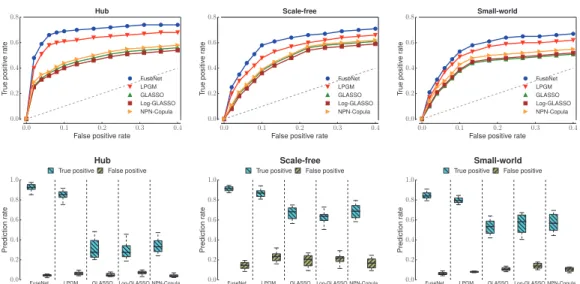
by varying the regularization parameter k in Figure 3 and
Supplementary Figure S4, boxplots of true and false positive rates for fixed k as determined by stability selection in Figure 3,
Supplementary Figures S2andS4. Further, we evaluated precision and recall of the networks estimated from different data distribu-tions inSupplementary Figures S2–S5.
Experimental evidence indicates that FUSENET outperforms
Gaussian-based competitors (GLASSO, Log-GLASSO and NPN-Copula) as well as existing methods that are designed specifically for the Poisson and the multinomial data (LPGM inFig. 2and Mult-GM inFig. 3). The overall good performance ofFUSENETis consistent across the four types of network structure and the two data distribu-tions that we considered in experiments.
The improved statistical power ofFUSENETand LPGM over
meth-ods that during network inference rely heavily on the assumption of normality is particularly impressive. Results inFigure 3suggest that in situations where this assumption is not satisfied, we can expect reduced prediction performance if we naively apply Gaussian-based
methods, (GLASSO) or if we perform insufficient data preprocessing (Log-GLASSO). However, we note that sophisticated techniques that replace Gaussian distributed data by the transformed data obtained, e.g. through a semiparametric Gaussian copula (NPN-Copula;Liu et al.(2009)), can give substantial gains in accuracy over the naive analysis. These observations are not surprising as dis-regarding information about data distribution can adversely affect performance of prediction models. Our results demonstrate that employing the ‘correct’ statistical model, in this case FUSENETor
LPGM, can lead to more accurate network inference.
Next, we try to understand which algorithmic component of
FUSENETcontributes most to its good performance relative to existing
algorithms for network structure learning. The primary difference betweenFUSENETand non-Gaussian-based methods considered here, LPGM and Mult-GM, is representation of model parameters with products of latent factors. In LPGM and similarly in Mult-GM, a prediction model is fitted locally by an algorithm, which performs a series of independent penalized regressions. This is in contrast with
FUSENET, where different model parameters are not entirely
independ-ent of each other but rather rely on borrowing strength from each other via factorization. Our results on simulated data suggest that representation of model parameters through the use of latent factors is beneficial. Furthermore, latent parameterization can improve per-formance of network recovery beyond what is possible with models that do not use latent factors. On the downside, we note that due to coupling of model parameters,FUSENETis not trivially parallelizable,
which is otherwise true for LPGM and Mult-GM.
Results shown inFigures 2and3are reported for datasets with a few hundred observations (n) and a few tens of variables (p; see fig-ure captions). We note that reported results are consistent with experiments done in various high-dimensional scenarios even when the number of variables is greater than the number of observations (p>n). Results therein reveal the same trend, namely, the overall strong performance of FUSENETin recovering true networks from
non-Gaussian data.
6.2 Functional content of genomic networks
An important challenge in cancer systems biology is to uncover com-plex dependencies between genes implicated in cancer. Since our knowledge about genome-scale gene networks is incomplete and only a few functional modules are known for higher organisms (Rollandet al., 2014), our aim is to quantify associations between
Fig. 2.Application of gene network inference algorithms to multinomial-distributed simulated data. Simulation studies on four network types were performed: random (seeSupplementary Fig. S2), hub, scale-free and small world. For each graph type, we generatedn¼300 observations at a high signal-to-noise ratio (SNR) withP¼50 variables (nodes) taking values from an alphabet of sizem¼3. Boxplots are shown for multinomialFUSENET (pro-posed here) and the multinomial graphical model (Mult-GM) (Jalaliet al., 2011)
by guest on July 28, 2015
http://bioinformatics.oxfordjournals.org/
the inferred gene networks and known cellular functions and pheno-types, and to assess the significance of these associations.
6.2.1 Comparison ofFUSENETvariants with existing methods
To characterize how functionally informative the inferred networks are, we employ four structural definitions of network communities (Fig. 4andSupplementary Figs S6andS7). These represent four pos-sible notions of association between a given GO term and the inferred network (Yang and Leskovec, 2012). The triangle participa-tion ratio quantifies how well genes that are members of a given GO
term are linked to each other in the inferred network. The cut ratio captures the abundance of external connectivity, i.e. edges between genes of a GO term and the rest of the network, whereas conduc-tance and flake-ODF consider both internal and external network connectivity. Through these four measures we are able to estimate the overall concordance of inferred gene networks and known func-tional annotation of genes. For these reasons, networks that score higher on many measures should be considered more informative across a wider spectrum of cellular functions.
Figure 4shows that gene network inferred byFUSENETthrough
fusion of breast cancer RNA-sequencing data and somatic mutation data is more concordant with functional annotation data in the GO than are networks inferred byFUSENETfrom either RNA-sequencing
or somatic mutation data alone. We note that we used Poisson
FUSENETto infer network from RNA-sequencing data, multinomial FUSENETto infer network from somatic mutation data and collective FUSENET for joint network inference from RNA-sequencing and
mutation data. These results demonstrate that combining data through the use of latent factors can perform better than independ-ent modeling of each dataset alone.
For each of the four community scoring measures inFigure 4, we compared score distributions of GO terms across three networks inferred byFUSENETusing Kolmogorov-Smirnov tests. We concluded
that the network inferred by FUSENET through fusion of
RNA-sequencing and mutation data associates with GO significantly more strongly than the other two networks (Pvalue<1'10%5on
all four measures fromFig. 4). This experiment shows how cancer genomic data provide different levels of information about cellular machinery, highlighting that it is possible to infer a network that better explains the mechanisms of cancer by combining multiple datasets in a principled statistical way.
We further compared FUSENET to existing network inference
methods on cancer data. The comparison was made only with LPGM, as this was the best performing method in our study on simulated data (Section 6.1) and in the cancer-data study ofAllen and Liu (2013).Supplementary Figure S6shows the functional con-tent of the networks inferred from RNA-sequencing data by either PoissonFUSENETor LPGM. On a related note,Supplementary Figure S7 Fig. 3.Application of gene network inference algorithms to Poisson-distributed simulated data. Simulation studies on four network types were performed: ran-dom (seeSupplementary Fig. S4), hub, scale-free and small world. These graph structures appear in many real biological networks. For each graph type, we gen-erated data withn¼200 observations withP¼100 variables (nodes) at a low (first row) and high (second row) signal-to-noise ratio (SNR). Receiver operating curves and boxplots are shown for PoissonFUSENET(proposed here), the Local Poisson Graphical Model (LPGM) (Allen and Liu, 2013), the Graphical Lasso (GLASSO) (Friedmanet al., 2007), the GLASSO on log-transformed data (Log-GLASSO) (e.g. cf.Gallopinet al., 2013) and the GLASSO on data transformed through nonparanormal Gaussian copula (NPN-Copula) (Liuet al., 2009)
Fig. 4. The strength of association between gene sets from the Gene Ontology (GO) and networks inferred withFUSENET. Inferred networks were overlaid with GO terms and subnetworks induced by each GO term were assessed for how well they corresponded to network communities. Four dif-ferent scoring functions were used to quantify the presence of difdif-ferent struc-tural notions of communities (Supplementary Section S4) that can appear in biological networks: flake-over-median-degree (flake-ODF), cut ratio, triangle participation ratio (TPR) and conductance. Considering breast cancer RNA-sequencing (RNA-seq) and somatic mutation data (Mut), these boxplots show the gains that fusion of data from different distributions (Mut & RNA-seq) can offer over network inference from any dataset alone, either RNA-seq or Mut. PoissonFUSENET was used with RNA-sequencing data, multinomialFUSENET with somatic mutation data and fully-specifiedFUSENETfor joint consideration of RNA-sequencing and mutation data
by guest on July 28, 2015
http://bioinformatics.oxfordjournals.org/
shows enrichment of the networks inferred from somatic mutation data by either multinomialFUSENETor Mult-GM. Notice that LPGM
and Mult-GM were designed for data that are approximately Poisson distributed, such as measurements from RNA-sequencing, and multinomially distributed, such as various types of gene varia-tions, respectively. These results demonstrate that networks inferred byFUSENETcan better capture known GO annotations than networks
obtained by methods such as LPGM and Mult-GM, whose predic-tion models do not have factorized representapredic-tion. These observa-tions are consistent across four complementary structural definiobserva-tions of GO terms, where every GO term is viewed as a network commun-ity defined by its member genes.
6.2.2 Networks via breast cancer data
We employ SANTA (Cornish and Markowetz, 2014) to quantify the functional content of gene networks. SANTA extends the concept of gene set enrichment analysis to networks. We observed that GO
terms indeed cluster more strongly on Poisson FUSENET’s
networks than on networks inferred by GLASSO and Log-GLASSO
(P value<1'10%6, RNA-seq network), NPN-Copula
(P value<1'10%5, RNA-seq network) and LPGM (P value<
1'10%4, RNA-seq network). These results suggest that network edges inferred byFUSENETmight represent more accurate indication
of shared cellular functions than edges inferred by other considered methods. This effect was independent of the GO term size and was strongest for specific cellular functions such as ‘centrosome cycle’ (Pvalue<1'10%9), ‘cellular response to DNA damage stimulus’
(P value<1'10%9), ‘apoptotic process’ (P value<1'10%9) and ‘regulation of cytokinesis’ (Pvalue<1'10%8). We observed similar
results when inferring networks from somatic mutation data. Gene network inferred by multinomial FUSENET was functionally richer
than network inferred by Mult-GM. Here, the functional content of a network was quantified with SANTA as proportion of evaluated GO terms whose association strength with the network had
Pvalue<1'10%5.
Interactions that are captured by fusing both cancer related data-sets recovered many gene–gene associations that have been previ-ously linked to increased breast cancer predisposition and metastasis. For example,FUSENETrevealed a hypothesized
transcrip-tional regulatoryGATA3module (Wanget al., 2014) consisting of
fully connectedGATA3,PTCH1,NFIBandPPARA.GATA3is an
important transcriptional regulator in breast cancer (Theodorou et al., 2013), and low expression levels ofGATA3are associated with a poor prognosis (Albergariaet al., 2009). It has been shown byWanget al.(2014)thatPTCH1,PPARAandNFIBexhibit epis-tatic interactions withGATA3, have negatively correlated expres-sion levels withGATA3and thatGATA3binds to gene regions near
NFIB,PTCH1andPPARAin breast epithelial tumor cell line. Other interactions identified in our network includeATMand
BRCA1, ATMandBRCA2, andCHEK2andBRCA2, which are
known gene-gene interactions whose mutations affect breast cancer susceptibility (Turnbullet al., 2012).
Another transcriptional module that was found byFUSENET
con-sists of FLI1, JAK2 and CCND2. This module has been only
recently associated with breast cancer patient outcome (Wanget al., 2014). Interestingly, FLI1 module has been captured by FUSENET
when fusing RNA-sequencing and mutation data but has been missed when usingFUSENETwith any of the two cancer datasets in isolation, as well as by any other inference algorithm considered in this study. One possible explanation for the latter result might be observations made byWanget al.(2014). Wanget al. examined
The Cancer Genome Atlas breast cancer patient survival data and found that low expressionormutation in one or more members of theFLI1module is associated with reduced overall survival time in all patients. The illustrative example ofFLI1module highlights an advantage ofFUSENETover methods considering a single dataset
dur-ing network inference.
7 Conclusion
FUSENETis an approach for automatic inference of gene networks
from data arising from potentially many nonidentical distributions. It is based on the theory of Markov networks, where the inferred network edges denote a type of direct dependence that is stronger than merely correlated measurements. An appealing property of
FUSENETis its ability to estimate network edges by fusing potentially many datasets. In the case studies,FUSENET’s models outperform
sev-eral state-of-the-art undirected graphical models. We show that
FUSENET’s high performance is attributed to the ability to model
non-Gaussian distributions and fusion of data through sharing of latent representations. Our work here has broadened the class of off-the-shelf network inference algorithms for simultaneously considering a wide range of parametric distributions and has combined Markov network inference with data fusion.
Funding
This work was supported by ARRS (P2-0209, J2-5480), EU FP7 (Health-F5-2010-242038) and NIH (P01-HD39691).
Conflict of Interest: none declared.
References
Albergaria,A.et al.(2009) Expression of FOXA1 and GATA3 in breast can-cer: the prognostic significance in hormone receptor-negative tumours.
Breast Cancer Res.,11, R40.
Allen,G.I. and Liu,Z. (2013) A local poisson graphical model for inferring net-works from sequencing data.IEEE Trans. NanoBiosci.,12, 189–198. Anjum,S.et al.(2009) A boosting approach to structure learning of graphs
with and without prior knowledge.Bioinformatics,25, 2929–2936. Ashburner,M.et al.(2000) Gene Ontology: tool for the unification of biology.
Nat. Genet.,25, 25–29.
Cai,Y.et al. (2012) Utilizing RNA-seq data for cancer network inference. In: Pal,R. and Ressom,H. (eds),IEEE GENSIPS. IEEE, Piscataway, NJ, USA,
pp. 46–49.
Cornish,A.J. and Markowetz,F. (2014) SANTA: quantifying the functional content of molecular networks.PLoS Comput. Biol.,10, e1003808. Costanzo,M.et al.(2010) The genetic landscape of a cell.Science,327, 425–
431.
Duda,R.O. and Hart,P.E. (1973)Pattern Classification and Scene Analysis.
Wiley, New Jersey, NJ, USA.
Friedman,J.et al. (2007) Sparse inverse covariance estimation with the lasso.
Biostatistics,9, 432–441.
Friedman,J.et al. (2008) Sparse inverse covariance estimation with the graph-ical lasso.Biostatistics,9, 432–441.
Gallopin,M.et al. (2013) A hierarchical Poisson log-normal model for net-work inference from RNA sequencing data.PLoS One,8, e77503. Hudson,T.J.et al.(2010) International network of cancer genome projects.
Nature,464, 993–998.
Isci,S.et al.(2014) Bayesian network prior: network analysis of biological data using external knowledge.Bioinformatics,30, 860–867.
Jalali,A.et al. (2011) On learning discrete graphical models using group-sparse regularization. In: Dudı´k,M. (ed.),AISTATS. MLR, Boston, MA, USA,pp. 378–387.
Kotera,M.et al. (2012) GENIES: gene network inference engine based on supervised analysis.Nucleic Acids Res.,40, W162–W167.
by guest on July 28, 2015
http://bioinformatics.oxfordjournals.org/
Krishnapuram,B.et al.(2005) Sparse multinomial logistic regression: fast al-gorithms and generalization bounds.IEEE TPAMI,27, 957–968. Liu,H.et al.(2012) High-dimensional semiparametric Gaussian copula
graph-ical models.Ann. Stat.,40, 2293–2326.
Liu,H.et al. (2009) The nonparanormal: Semiparametric estimation of high dimensional undirected graphs.JMLR,10, 2295–2328.
Marbach,D.et al.(2012) Wisdom of crowds for robust gene network infer-ence.Nat. Methods,9, 796–804.
Meier,L.et al. (2008) The group lasso for logistic regression.J. R. Stat. Soc.,
70, 53–71.
Meinshausen,N. and Bu¨hlmann,P. (2006) High-dimensional graphs and vari-able selection with the lasso.Ann. Stat.,34, 1436–1462.
Metzler,D. and Croft,W.B. (2005) A Markov random field model for term dependencies. In: Marchionini,G.et al. (eds),ACM SIGIR. ACM, New York, NY, USA,pp. 472–479.
Mukherjee,S. and Speed,T.P. (2008) Network inference using informative pri-ors.Proc. Natl. Acad. Sci. USA,105, 14313–14318.
Murphy,K.P. (2012) Machine Learning: a Probabilistic Perspective. MIT Press, Boston, MA, USA.
Murray,J.S.et al.(2013) Bayesian Gaussian copula factor models for mixed data.J. Am. Stat. Assoc.,108, 656–665.
Pearl,J. and Verma,T. (1991) A theory of inferred causation. In:Conference on the Principles of Knowledge Representation and Reasoning,pp. 441–452. Ravikumar,P.et al.(2010) High-dimensional ising model selection using‘1
-regularized logistic regression.Ann. Stat.,38, 1287–1319.
Rolland,T.et al.(2014) A proteome-scale map of the human interactome net-work.Cell,159, 1212–1226.
Rue,H. and Held,L. (2005)Gaussian Markov Random Fields: Theory and
Applications.CRC Press, Abingdon, UK.
Scha¨fer,J. and Strimmer,K. (2005) An empirical Bayes approach to inferring large-scale gene association networks.Bioinformatics,21, 754–764.
Segal,E.et al. (2003) Discovering molecular pathways from protein inter-action and gene expression data.Bioinformatics,19, i264–i272.
Stingo,F. C. and Vannucci,M. (2011) Variable selection for discriminant ana-lysis with Markov random field priors for the anaana-lysis of microarray data.
Bioinformatics,27, 495–501.
Theodorou,V.et al.(2013) GATA3 acts upstream of FOXA1 in mediating ESR1 binding by shaping enhancer accessibility.Genome Res.,23, 12–22. Turnbull,C.et al.(2012) Gene-gene interactions in breast cancer
susceptibil-ity.Hum. Mol. Genet.,21, 958–962. !
Zitnik,M.et al.(2013) Discovering disease-disease associations by fusing sys-tems-level molecular data.Sci. Rep.,3, e3202.
!
Zitnik,M. and Zupan,B. (2014) Matrix factorization-based data fusion for drug-induced liver injury prediction.Syst. Biomed.,2, e28527.
!
Zitnik,M. and Zupan,B. (2015) Data fusion by matrix factorization.IEEE
TPAMI,37, 41–53.
Wang,C.et al. (2013) Markov random field modeling, inference & learning in computer vision & image understanding: a survey.Comput. Vis. Image Underst.,117, 1610–1627.
Wang,X.et al. (2014) Widespread genetic epistasis among cancer genes.Nat.
Commun.,5, 4828.
Wang,Z.et al. (2009) RNA-Seq: a revolutionary tool for transcriptomics.Nat. Rev. Genet.,10, 57–63.
Yang,E.et al. (2012) Graphical models via generalized linear models. In:
NIPS,pp. 1358–1366.
Yang,E. et al. (2013) On Poisson graphical models. In: Welling,M. and Ghahramani,Z. (eds),NIPS,pp. 1718–1726.
Yang,J. and Leskovec,J. (2012) Defining and evaluating network communities based on ground-truth. In: Tang,J.et al. (eds),ACM MDS. ACM, New York, NY, USA.
Zou,H. and Hastie,T. (2005) Regularization and variable selection via the elastic net.J. R. Stat. Soc. B,67, 301–320.
by guest on July 28, 2015
http://bioinformatics.oxfordjournals.org/